CADMUS
The Journal of Australian Defence Force Dentistry
ISSN: 1834-0601
CONTENTS EDITOR’S MESSAGE
3
Training Update
41
The ADF Dental School
OFFICIAL ADDRESSES ADF Operations
5 12
Professional and Technical Items Restoration of an Endodontically Treated Molar
Pacific Partnership 2010 from a Navy Perspective
Severe Resorption of the 21 and the Treatment Options
The Life and Times of a Seagoing Dentist: Smiles All Around in Laos – November 2009
Single Tooth Placement – Functional or Aesthetic
Pacific Partnership 2010 from an Army Perspective: Contingent 1: 18 May 2010 – 03 July 2010
OBITUARIES
57
In Memoriam
Honours and Awards
24
Directorate of Defence Force Dentistry Annual Report
26
FEATURE ARTICLEs
29
The RAN Dental Branch – Action on the Waves
45
RAADC Corps and Historical
60
Update from the RAADC Association Incorporated
Unit News
63
Joint Units Royal Australian Navy Fleet News Royal Australian Navy Dental Branch
Exercise Long Look 2010
Royal Australian Army Dental Corps
Oral Surgery Rotation to Brisbane
Royal Australian Air Force Dental Branch
Professional Development of ADF Dental Officers: so much potential for clinicians and patients JEHDI – Electronic Health Package Coming to a Galaxy Near You!
ADF Health is published annually by Adbourne Publishing for the Australian Defence Force Health Services Division. For any correspondence regarding the content of this journal, please contact Lieutenant Colonel Genevieve Constantine, SO1 Dental Plans and Programs, Directorate of Defence Force Dentistry, CP2-7-061 Campbell Park Offices, Canberra ACT 2600 Australia. Email: genevieve.constantine@defence.gov.au The statements or opinions that are expressed in the Journal reflect the views of the authors and do not represent the official policy of the Defence Health Service unless this is so stated. Although all accepted advertising material is expected to conform to ethical and legal standards, such acceptance does not imply endorsement by the Journal or the Australian Defence Force Health Service. All literary matter in the Journal is covered by copyright, and must not be reproduced, stored in a retrieval system, or transmitted in any form by electronic or mechanical means, photocopying, or recording, without written permission. Published by: ADBOURNE PUBLISHING 18/69 Acacia Road, Ferntree Gully, Vic 3160 Phone: (03) 9758 1433 Fax: (03) 9758 1432 www.adbourne.com SOUTH AUSTRALIA Phone: 0488 390 039
CADMUS 2010
Adbourne Publishing and the Directorate of Defence Force Dentistry cannot ensure that advertisements appearing in this magazine comply with the Trades Practices Act and other consumer legislation. It is the responsibility of the supplier of advertising materials to ensure compliance with all legal requirements.
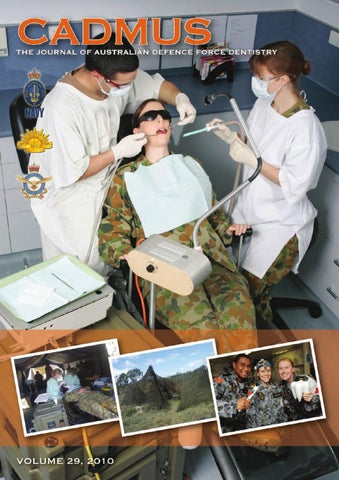
Front Cover: A RAAF Dental team providing dental treatment utilising field dental equipment set up in a surgery environment. Inset Left: An Army dental team providing dental treatment during Exercise CATA. Inset Centre: An Army Field Dental Section set up during Exercise CATA Inset Right: A RAN Dental Team during Exercise RIMPAC.
1
CADMUS
The Journal of Australian Defence Force Dentistry Volume 29, 2010
Editor’s Message 2010 marks the 29th issue of CADMUS and the focus of this year’s journal is the deployable role of the dental services. Exercise Pacific Partnership saw the involvement of Navy, Army and Air Force dental teams providing humanitarian assistance in austere environments and utilising their deployable skills, knowledge and ingenuity. Navy Dental personnel have participated in numerous deployments this year and have represented the RAN and the dental services extremely well. The Dental Team on Exercise RIMPAC were recognised with a Commanding Officer’s Commendation for their dedication and commitment to the provision of first class dental care. Congratulations to Lieutenant Cochrane, Able Seaman Woodleigh and Able Seaman Tevita Kama. A Navy Dental Officer also deployed on Op Smile to Laos, gaining invaluable experience in the construction of obturators for cleft palate patients. Exercise Saunders (AACAP) 2010 saw an Army dental team providing important dental care in Pukatja, just over the Northern Territory border into South Australia. The team worked tirelessly producing much needed full and partial dentures and providing essential oral hygiene education to the community. Each of these experiences provided unique and valuable opportunities for dental personnel to exercise their skills in a deployed environment. ADF ‘Dental’ is a small community and in many ways we are like a family. 2010 has seen the passing of some of our former dental colleagues, in particular, Brigadier Ewan Deane, OBE who served as Director of Dental Services - Army from 1970 to 1980 and Lieutenant Colonel Peter Naughton who served as the Staff Officer Grade One (Dental) Headquarters 3rd Military District from 1977 to 1979. Corporal Sonia Nicholls also sadly lost her husband Sean to Lymphoma early this year. Our thoughts and best wishes are with the families of our departed colleagues.
LTCOL Genevieve Constantine
The production of this journal is the result an enormous amount of work behind the scenes. I wish to thank the three single-Service sub-editors - Lieutenant Commander Kate Bailey, RAN, Captain George Lathouras, and Squadron Leader Alex Kwaan - for their outstanding efforts in requesting, receiving and collating articles over the past few months. I also pass on my thanks to all those who assisted with formatting and reviewing the content and distributing the journal. Most importantly, I thank the many authors who have contributed articles. Without your efforts, this journal could not have been such a success. I am also grateful for the continued support of this journal from the Director General Strategic Health Coordination, Brigadier Stephan Rudzki and Commander Joint Health, Major General Paul Alexander, at a time when the Directorate has been faced with under-manning, a myriad of conflicting priorities, and with the majority of its personnel working remotely around Australia. As always, the production of this magazine is made possible through the professionalism and expertise of the team at Adbourne Publishing, and those generous advertisers who support this publication. I thank the Managing Director Neil Muir and his Production Manager Claire Henry, who worked tirelessly to ensure such a successful edition.
LCDR Katherine Bailey, RAN CADMUS 2010
CAPT George Lathouras
SQNLDR Alex Kwaan
3
Joint Health Command
Message from Commander Joint Health, the Surgeon General Australian Defence Force Major General Paul Alexander, MBBS, MLM, FACLM, DTM&H, Dip Sports Med
It is great to see another edition of the CADMUS magazine showcasing the latest clinical and scientific achievements from each of the three Services. Stories such as the oral surgery rotation to Brisbane, Exercise Long Look and Exercise Validation are a terrific inclusion in this edition. I would like to take this opportunity to congratulate the Fleet Mobile Dental Team (FMDT) who deployed to Exercise RIMPAC 2010. During June and August 2010, this small team impressed those on HMAS KANIMBLA with their excellent dental skills and outstanding devotion to duty. Working long, and sometimes difficult hours, FMDT provided dental support to HMA Ships KANIMBLA, NEWCASTLE and WARRAMUNGA and responded to emergent dental issues, both at sea and in remote shore localities. A congratulations also goes to all involved in Pacific Partnership 2010. ADF Personnel visited Vietnam, Cambodia, Indonesia, and East Timor to conduct the US led humanitarian assistance mission providing medical, dental, engineering and community service assistance. ADF personnel joined a team of 1000 people from seven countries and hosted medical and dental clinics as part of the exercise. Aligning with the Defence Strategic Reform Program, 2010 has been a year of significant change for Joint Health Command. Particular focus has been given to improving health support for non-deployed personnel through Garrison Heath Services, developing strategic alliances with our industry partners and creating an eHealth recordkeeping system. With the finalisation of Australia’s Defence healthcare restructure in February 2010, new focus has been given to facilitating medical, dental and allied support health professionals, including members of the ADF Reserves, to support military operations. Opportunities have been created for these staff to also provide Garrison Health Services to ADF members while they are not on deployment. Currently we are managing 104 Garrison health facilities, including multiple delivery points on individual Defence facilities, and these are being closely examined with a view to rationalisation. The Garrison Health Model at the base level will be organised within a health precinct operating under a clear chain of command under a Regional Health Service (RHS). With this model, garrison health arrangements will be based on primary health consolidated and delivered within a multidisciplinary model in JHC facilities, including dental services and central dispensing points. Our Strategic Alliance arrangements will enhance the operational health capability of the ADF and improve the delivery of health care to members of the Australian Defence Force. The initial focus has been on South East Queensland with the Herston complex in particular intended to become a centre of excellence. Formal arrangements have been put in place with Queensland Health and the University of Queensland. Defence currently has two primary competing and discrete eHealth systems – HealthKEYS and MIMI – neither of which meets clinical user needs or Defence’s management requirements. The systems are not universally deployed, and from a clinician’s perspective, both are well below contemporary Australian practice.| To improve our healthcare and recordkeeping capability, Defence is undertaking the development of a comprehensive ADF eHealth system to be known as the Joint eHealth Data and Information (JeHDI) system. In conclusion, I would like to thank and congratulate you for your hard work and contributions over the last year. 2010 has proved to be a challenging year but your enthusiasm, hard work and commitment have not gone unnoticed. This is clearly evident throughout the features of this publication.
CADMUS 2010
5
Joint Health Command
Message from the Director, Defence Force Dentistry Captain Brendan Byrne, RAN, BDS, MMDS, MBA, Grad Dip MS, psc(j), AFACHSE
Welcome to the 2010 edition of CADMUS, the Journal of Australian Defence Force Dentistry. This volume focuses on the deployable role of the dental services. We have seen several deployments this year for Navy, Army, and Air Force Dental Officers (DO), in particular Exercise Pacific Partnership, Exercise RIMPAC 2010 and AACAP. These have proven to be exciting, challenging and memorable endeavours for our junior dental personnel. It has been particularly challenging to produce this year’s journal due to the diversity of the Directorate. Many personnel work part time and most work remotely from regions spread between Darwin and country Victoria. I am grateful to LTCOL Genni Constantine for the dedication and commitment that she has shown as editor, to ensure that this edition of CADMUS met its deadline. I also wish to acknowledge the sterling singleService editorial support provided by LCDR Kate Bailey, CAPT George Lathouras and SQNLDR Alex Kwaan. I am extremely grateful to all dental colleagues who have taken the time to contribute articles and showcase your work. And as always, I wish to acknowledge and thank the companies that support the journal though their advertising, and Neil Muir and the Adbourne Publishing team, without whose assistance this journal would not be possible. 2010 has been a year of turbulence and challenges, marked by a redistribution of Directorates within JHC, manning shortages, continued focus on the Strategic Reform Program (SRP) and geographic diversity of Directorate staff. With the rationalisation of Directorates, I have assumed responsibility for Health Research Coordination in addition to ADF Dentistry. This additional responsibility has halved the time that I can dedicate to dental issues. I wish to acknowledge the magnificent contributions made by my staff, LTCOL Genni Constantine, WGCDR Mark O’Sullivan, WO Shaye Metcalf and CPL Liza Wynen. Together they have ensured that the day-today requirements of the Directorate have been met and that advice and support to dental units has continued unabated.
CADMUS 2010
I would also like to take this opportunity to thank COL Janet Scott, GPCAPT Greg Mahoney, CMDR Peter Fatouris, LTCOL Scott Freeman and SQNLDR Janine Tillot for the ongoing provision of oral surgery and sedation services around Australia to ensure ADF personnel are ready for deployment. My thanks also go to GPCAPT Greg Mahoney who has contributed excellent support with epidemiological data and research, in particular in reviewing the financial and clinical benefit of predeployment examinations. His work will assist in developing future requirements in this area. I also wish to acknowledge the continued advice and policy support offered by COL Rick Olive, COL Stephen Curry, COL Geoff Stacey, COL Gerry Thurnwald, LTCOL Chris Daly and WGCDR Doug Stewart. Your assistance with reviewing many outdated dental polices has been invaluable. With the introduction of National Health Registration on the 1st of July this year, civilian dental practitioners are no longer able to refer to our Senior Dental Assistants – Preventive (SDA-P). This has caused some upheaval in regions where it has been necessary to relocate SDA-Ps to establishments with uniformed DOs. National Registration has also highlighted the requirements of mandatory Continuing Professional Development (CPD) for DOs and I urge all of you to familiarise yourselves with the new standards. The need for ADF strategic reform has seen a greater focus on the requirement for three uniformed dental services and how our deployable dental capabilities can be best provided into the future. There is no intention of reducing the level or standard of dental support to the ADF. Nonetheless, the Army Dental Corps has come under particularly close scrutiny as part of the Combat Health Support Restructure and Force Modernisation Review. There is still a significant amount of work to be conducted in this space; however the review of dental services aims to provide capabilities that will be deployable, affordable and sustainable. I hope that you enjoy this edition of CADMUS which showcases the outputs of your diligence and dedication. My thanks to one and all for your ongoing commitment to the provision of high quality dental care to our Servicemen and women and for continually representing your parent Services and the ADF with pride.
7
Royal Australian Navy Dental Branch Message from the Leadership, Navy Dental Branch Commander Mark Brazier, RAN, BDS Warrant Officer Penny Stone, OAM, BCom, Dip. Pract. Man.
The past twelve months has seen the beginnings of a number of major reforms that will continue to progress over the coming years within the Royal Australian Navy. The three pillar strategy involving changes in “Culture”, “Leadership and Ethics” and “Structure” are well underway towards the goal of delivering a New Generation Navy for the future. By now all members of the RAN Dental Branch should have completed the “Making the Change” workshops that are being held at establishments throughout the country. If you have not already done so, it is imperative that you do. These NGN strategies will lay the foundations for current and future challenges that will affect all members of the RAN. The Strategic Reform Programme is also well advanced with major structural changes already coming to fruition. Although our Branch is a very small part of the ADF it is important that all of us continue to look at improvements and new efficiencies in the way we deliver our services to Defence Force personnel while maintaining our traditionally high standards. On that note I can say with pride that the Dental Branch has continued to provide an excellent service to both our garrison and deployed personnel. The East and West Fleet teams have maintained a high operational tempo and are on track to complete six major deployments this year. Individual Readiness figures have been maintained at high levels throughout the country and the continued flexibility of our members has greatly contributed to the continuity of our services. In closing it gives me great pleasure to congratulate CPODEN Penny Stone on her promotion to Warrant Officer and Dental Branch Category Sponsor. WO Stone has a long and distinguished history of service within the RAN Dental Branch and her promotion is well deserved. I look forward to working closely with her on Branch matters in the near future and thank you all for your continued support.
It is with great pleasure I take over the position of Warrant Officer—RAN Dental Category Sponsor and write my first article in this CADMUS arena. I have big shoes to fill as WO Shaye Metcalf provided endless support to dental sailors and officers alike. She worked tirelessly on many projects to improve efficiencies, particularly in implementing and managing standards for infection control and statistics reporting. I see RAN Dental Sailors working in challenging times, with change and reform always constant reminders of our need to be efficient and productive. To assist us in preparing for the future, it is my intention to encourage strong communication, professionalism and leadership throughout the sailor ranks, and within the Branch. The Dental Action Team (DAT) has proven to be a successful platform for endorsing strong communication between Branch members and implementing standard best-practice initiatives throughout dental departments. I will certainly continue to encourage the DAT in the future and look forward to working on exciting projects. As CMDR Brazier discussed, NGN has been a positive influence in enabling us to reflect on our professionalism, performance and values. My intent is to continue to implement NGN strategies by researching and implementing standards of practice, governance strategies and identify where we can make efficiencies in our day-to-day operations. Furthermore, by focusing on strong leadership, I hope the Dental Branch Senior Sailors will unite and strengthen so that we may work together in providing high quality mentoring and support to our junior sailors. Finally, I look forward to working with CAPT Byrne, the Directorate team, and CMDR Brazier to provide you with a high level of support and guidance.
8
CADMUS 2010
Royal Australian Army Dental Corps Message from the Leadership, RAADC Lieutenant Colonel Genevieve Constantine, BDSc, Grad Cert Clin Dent, MPH, MHM, Head of Corps Warrant Officer Class One Kym Chiesa, CSM, Corps Regimental Sergeant Major
I was honoured to be appointed as the Head of Corps of the RAADC on 1 Apr 10. Firstly, I wish to acknowledge the hard work of all RAADC members in the provision of first class dental care and in ensuring that ADF personnel are ready to deploy despite short notice requirements, your efforts are acknowledged and commendable. I would like to pass on my thanks and that of the Corps to LTCOL Suzy Atkins for her hard work and commitment as the previous HOC. We wish you well for your future endeavours. I would also like to thank the Corps Committee for their ongoing support throughout the year. In particular, I commend the efforts of the RSM in providing counsel during an extremely challenging time. I would like to welcome and congratulate COL Stephen Curry on his appointment as COL COMDT of the RAADC. The Corps Committee looks forward to working with you. I sincerely thank COL Viv Bird, the outgoing COL COMDT, for his many years of service and support to the RAADC. Our Corps is facing significant challenges at present in relation to the Combat Health Support (CHS) Restructure as part of the Force Modernisation Review (FMR). The focus of the CHS FMR is to provide structures that are deployable, affordable and sustainable. Options will be presented to Chief of Army’s Senior Advisory Committee (CASAC) in September this year, but as yet nothing has been agreed to. Whatever the outcome endorsed by CASAC the intent is to centralise FORCOMD dental personnel to optimise operational support, foster mentoring, support and guidance, facilitate release to achieve competency level training and continuing professional development and create a more collegiate working environment. Army Dental Officers are currently a critical category and together with the Corps Committee and COL COMDT we are instituting action to address the recruitment issues; and in conjunction with the restructure, we hope to address many of the retention issues to provide sustainability into the future. We have had several personnel deploy on Exercises this year with RAADC personnel involved in Pacific Partnership, AACAP and Long Look. I personally thank all of those involved for their efforts and their excellent representation of the Corps. I also want to acknowledge all those that have received honours and awards this year. In particular, I wish to recognise CPL Sonia Nicholls for a Commander 17 CSS BDE Commendation, CPL Kerri-Ann Steindl who was awarded the 3rd Brigade Leadership Award and PTE Natasha Tippett who was selected to participate in the Anzac Exchange Programme from 13 Aug - 1 Nov 10. Congratulations to you all and well done on representing your Corps so well. The Strategic Reform Program has realised significant efficiencies in many areas across the ADF. I urge each and every one of you to continue to review your work practices and provide input to your chain of command and/or the Corps committee if you identify innovative ways to create efficiencies without diminishing the current quality or level of dental support. I am extremely proud of the continued professionalism, dedication and initiative demonstrated by all members of the RAADC. Keep up the great work and I wish you all the best for 2011.
CADMUS 2010
2010 has been an extremely challenging year marked by uncertainty. Our future Corps construct and numbers have been under very close scrutiny, however despite this uncertainty, each and every one of you have managed to maintain your outstanding level of commitment to the provision of high quality dental care. For this I am truly grateful and you make me proud to belong to the RAADC. I wish to welcome our new HOC LTCOL Genevieve Constantine and acknowledge her commitment in fighting to retain our small Corps. She has worked tirelessly to showcase your efforts and the value of the Corps. I look forward to the outcomes of CASAC and to a sustainable future for Army dental. I also wish to acknowledge the efforts of the Corps Committee over the past year and I urge Corps members to communicate your innovative ideas through your chain of command to the Corps Committee for consideration. I would also like to acknowledge the sterling efforts of the previous HOC LTCOL Suzy Atkins. I have not had as many opportunities to visit dental units this year; however those that I have visited have highlighted to me that you are all extremely busy providing essential dental support. It never ceases to amaze me that despite this high workload you, the members of the RAADC, maintain your sense of humour and continue to work hard to get the job done. As the RSM I am very proud when I speak to commanders and they outline the level of commitment demonstrated by dental personnel. RAADC members have represented themselves and the Corps extremely well over the last twelve months. In particular, I wish to acknowledge MAJ Thien Pham for his efforts on Exercise Pacific Partnership, CAPT Lines, SGT Allen, SGT McSorley, PTE Havali, CAPT Palfreyman and PTE McGrath for their efforts on Exercise Saunders and CAPT Anthony Craig for his excellent representation of the Corps to the British Army on Exercise Long Look. I also wish to acknowledge those that have received awards for efforts above and beyond what is expected. In addition to those members acknowledged by the HOC, I wish to draw your attention to the following achievements: PTE Claire Hebiton for receiving the Student of Merit award on the Dental Assistant Course and PTE Kristy McMillen for receiving the Student of Merit Award for the Senior Dental Assistant Course, these awards are a testament to your diligence and dedication. Well done. On 21 Oct 10 a commemorative plaque will be unveiled at the Australian War Memorial to honour all those dental personnel who have served on deployments. I would like to acknowledge the work of MAJ Debbie Olsson in arranging and coordinating all aspects to bring this plaque to fruition. The plaque will be an excellent reminder to all who visit the War Memorial of the dental support provided on numerous deployments. It has been another extremely busy year and as I reflect on all of your achievements for 2010 I realise that for such a small Corps we continue to punch above our weight. I wish you every success with your career aspirations in 2011 and as always, good soldiering.
9
Royal Australian Air Force Dental Branch Message from the Leadership, RAAF Dental Branch Wing Commander Christine Cordery, BDSc, Grad Dip Org Comm, Grad Dip Clin Dent Flight Sergeant Heather Fitzgibbon
As agreements regarding garrison and deployed health are being matured and SRP savings are a priority, there has been a lot of self-examination about the role of deployable dental teams. However, my response is that deployable dentistry within the Air Force is still relevant and necessary. The Air Force may have enjoyed a period of relatively low need to deploy dental teams but this is in no way guaranteed to continue. The “fluoride generation” is experiencing caries rates in healthy teeth at a rate equal to that of their parents and grandparents (AIHW, 2007). Plus, the environment is constantly changing - the nature of operations, recruiting demographics and resource allocations. The national shortage of dental staff will also continue to reduce the access to dental services, both in the private and public sectors. Over the year the RAAF dental teams applied themselves to remaining prepared with gusto. Combined with the arrival of the new field dental equipment under JP2060, this means that the professionalism and adaptability of our people will now be matched by our kit. HQHSW is currently looking at the collective training cycle and the validation of the new field equipment. Plans are to annually deploy a complete EHF2 on exercise (real time ops allowing), which will include dental. As always, Pacific Partnership was eagerly anticipated and in 2010 three RAAF Dental members were selected to participate. The reports back from this deployment are always highly positive, both in regards to the contributions of our people to the mission and the lessons learnt. We wish the team well and look forward to hearing about their experiences. I would like to congratulate Air Force dental sections who have worked tirelessly to ensure our people are ready. Your achievements in pre-deployment dental health levels, albeit bittersweet at times, are something to be applauded. Not only do you maintain the fighting force, but you reduce human suffering (even if they don’t necessarily thank you for it!). I would also like to offer a big welcome to FSGT Heather Fitzgibbon, as the T/Dental Trades Advisor, congratulate those of you selected for promotion in such a competitive environment and farewell those moving on. Soon I will move back to Australia to continue work at Amberley, after which I hope to meet with more of you in person. In the meantime, thank you all for your service and may you and yours have a great Christmas and New Year.
CADMUS 2010
It gives me great pleasure to be able to contribute to this edition of CADMUS as the Temporary Dental Trade Adviser in the absence of WOFF Brennan. I would first like to welcome our new Dental Assistants, ACW Bianca Goodhill (‘Student of Merit’ for 01/10), ACW Kymberley Monck, AC James Nichols, and AC Sergey Semenishchev. Congratulations to SGT Kathy-Anne Shaw on her promotion on posting to 1EHS Townsville. Changes within the mustering will see CPL Diane Beningfield and LACW Alana McKeon promoted in 2011 and posting to Darwin and Tindal, respectively. Well done to LACW Kate Priestley (‘Student of Merit’ for 01/10) and to LACW Crystal Lauw, LACW Amy Johnson, LACW Kellie Peters and LACW Teagan Walker on completing the Senior Dental Assistant Course. LACW Donna Hayes also completed her SDA-P Course, followed by her posting to 1EHS Townsville, congratulations - fantastic effort. Deployment opportunities are highly sought after and we again have RAAF dental personnel deploying on Pacific Partnership. Contingent Three to PNG, 25 Aug – 17 Sep 10 - FLTLT D. Ryan, CPL Margaret Galvin, LACW Terri-Anne Dehncke. Congratulations and have an enjoyable time. A reminder to all, you are all entitled to apply for ANYA positions, therefore remember to reply to DP-AF emails calling for nominations as soon as they are released. All of the Dental courses are currently under review by the ADFDS; with this in mind I encourage everyone to nominate for your respective dental promotion courses, noting that completion of the following courses are required for promotion – the SDA course is “compulsory” for promotion to CPL, the Dental Supervisors course for promotion SGT and the Dental Managers course for promotion to FSGT. As many of you are aware, the attrition rate for dental is very low at present; therefore I encourage each of you to take responsibility for your own future by: nominating for and completing mustering related courses; undertaking Air Force specific training and any other courses available to help you “stand out from the crowd”. I believe it is time to unite, open the lines of communication and forge ahead with determination to overcome difficult times and produce a dental mustering with a common goal. Finally, I wish you all a safe and joyful festive season and a prosperous 2011. As they say in the classics “Carpe Diem!”
11
Reports from Operations and Exercises
Pacific Partnership 2010 from a Navy Perspective LEUT Kiau Kiun (Tom) Yong BDSc, RAN – Fleet Dental Team 3
Exercise Pacific Partnership 2010 (PP10) is an annual humanitarian assistance mission sponsored by the United States Navy pacific fleet command. The event commenced after the 2004 Boxing Day Tsunami with the aims of strengthening alliances within the region, promoting multilateral security, peace and stability in the region as well as performing disaster relief. This year I was fortunate to be selected to participate with twenty other Australians in PP10 in USNS MERCY (MERCY). MERCY is a 70,000 tonne hospital ship and the third-largest ship in the United States Navy. MERCY was originally a 90,000 tonne bulk fuel carrier which was later converted into a 1000 bed hospital equipped with 12 operating theatres, a radiology department, blood bank, pharmacy, physiotherapy, optometry and a dental department. The dental department on board is equipped with six surgeries, four of which are used for general dentistry and dental hygiene and two are reserved for minor oral surgery (figure 1). The department also has a fully equipped dental laboratory capable of providing the full range of dental laboratory services. The department is equipped with a Cerec milling machine (figure 2) and digital radiography is via phosphor plates or portable hand held units and laptop – very sophisticated.
different members from the LCH crew came out to the site to help including the Commanding Officer, the Executive Officer and other members of ship’s company. When the LCH crew realised how hot it was at the mission site they graciously organised a swim exercise for us. Whilst on the LCH, the members of the dencap team were introduced to the famous Navy game of Uckers – an animated form of Ludo. It was so addictive that upon our return to MERCY, we made an Uckers board from cardboard (figure 6). I thought the RAN and RN were competitive but not nearly as fierce as the Yanks. Overall this experience has been extremely exciting and fulfilling and I would heartily recommend this opportunity to other RAN dental officers in the future.
The majority of the participating dentists on board were from the United States Navy, United States Public Health Service and from the Non-Government Organisation, University of California San Diego Pre-dental Society. In addition, dentists were also volunteered by partner nations; Canada, Cambodia, Indonesia and Australia. Whilst on PP10, I was able to participate in two dental civilian action programmes (dencap), one of them was at the Tobelo mission site at Halmera and the other was at the Ternate mission site in Sofifi. At Halmera, the site was at a school with an active volcano within a few kilometers (figure 3). We were taken to and from the site each day by MERCY’s Sea Hawk Helicopters. It was an incredible experience considering it was my first time in a helicopter (figure 4)! At Halmera, the dental work was mostly extractions of teeth with 41 patients seen in one day. More sophisticated procedures would have to be sent back to the ship however the distance from the ship was unfortunately prohibitive for this option. The dencap at Sofifi required an overnight stay at the mission site accommodated on board our landing craft heavy (LCH) HMAS LABUAN and HMAS TARAKAN in portable camping cots on the tank deck of the craft (figure 5). The Sofifi site was situated at the local clinic in the middle of the town. The dental team was extremely busy at this mission site; in one day we saw a total of 80 patients between two dentists and one hygienist. Every day
Figure 1: MERCY dental department (minor oral surgery room on the left)
Figure 2: Cerec Milling Machine
12
CADMUS 2010
Figure 3: Volcano at Halmera dencap site
Figure 5: Portable tent cots on the tank deck of HMAS LABUAN at the Sofifi Site
Figure 4: Personal Protective Gear requirement for the Helicopter embarkation at Halmera (modeled here by LEUT Yong)
Figure 6: Dental Uckers Board made from cardboard
Reports from Operations and Exercises
The Life and Times of a Seagoing Dentist: Smiles All Around in Laos – November 2009 LCDR Daniel Allan, RAN, BDSc, Fleet Dental Officer, HMAS SUCCESS
After all the good times I have had this year I really wanted to top off the year of travel and work with something I could be proud of so it was off to Laos with Operation Smile (OpSmile) to utilise my dental skills for those less fortunate than us. This was to be my first mission with OpSmile after my experience onboard the USNS MERCY in Papua New Guinea. I was a little nervous as I would be the only dentist in an international team of surgeons and nurses. I was extremely apprehensive as I was expected to construct obturators for the older cleft palate patients where surgery was not an option. My exposure to this type of treatment was virtually non-existent during university and I was relying heavily on my limited knowledge of constructing dentures and reading several textbooks on obturators before I left.
‘that’ smell. It is something you cannot even describe as you can only experience it – something to do with climate, smoke and probably a hint of open sewer. It is not exactly a bad smell but it definitely just, well, there. The odour is such that when you are on a ship coming in to port, you occasionally get a ‘whiff’ of it and you immediately realise exactly where you are. Pakse definitely had ‘that’ smell.
The six-hour bus ride from Ubon, Thailand was fairly quiet with most of the team sticking to themselves and catching up on some much needed sleep. Some of the American team members had flown over 30 hours to arrive in Bangkok the morning we flew out to Ubon. The only break on the bus trip was the bizarre border crossing from Thailand to Laos where they held on to our passports for an inordinate amount of time and then made us pay an extra fee because we were crossing outside of business hours. Interestingly this surcharge was not identified on the border crossing but I am sure that the extra $1US would help a family! On arrival at the hospital it was straight into screening and even though there were not as many patients as the team had anticipated it was still an extremely busy day. For those that have not heard of OpSmile, it is an aid organisation that aims to help those born with cranio-facial deformities where access to specialist care is limited. This mission in Laos was mainly a cleft lip and palate mission and my role was to check all the patients’ teeth prior to surgery, remove the teeth with a poor prognosis and construct obturators for those patients too old for surgical cleft correction.
The next morning we had our first view of Pakse, Laos and as we wandered towards the hospital for screening I realised that there are distinct similarities between most South East Asian towns. They all have similar architectural style (and vintage) and for those that have been anywhere in South East Asia there is always
14
CADMUS 2010
In Australia and other first world nations it is generally taken for granted that the suite of specialist services needed to repair cleft lips and palates is available and provided to an individual during early development – the ideal time to undergo corrective surgery. Such access is rarely available to third world children with most surviving to adulthood with no medical intervention. The stigma attached to such birth deformities can be socially debilitating in addition to the associated physical effects; a child may never attend school or interact with other people. The simple one-hour surgery for clefts can therefore be life-changing. Being part of a multi-disciplinary team was one of the greatest experiences I have ever had. The screening process involved plastic surgeons, nurses, paediatric specialists, speech pathologists, anaesthetists and obviously the dentist. The team came from all over the world and being able to work alongside plastic surgeons from Beverly Hills, anaesthetists from Italy and nurses from Cambodia was such an amazing experience.
During the screening process it is hard not to notice and admire the resilience and strength of the people attending the clinic. There were patients that seemed to have stepped out of the pages of my pathology textbooks and this was naturally very confronting. Very quickly, however, you become aware of the overwhelming happiness of the patients - made more remarkable in the face of their obvious adversity. Their gratitude at our simple services was humbling and we were particularly thrilled by their affection for some of the Aussie memorabilia that we had brought to share. I suspect the Americans were a little jealous that most of the kids were running around with an Australian flag, koala, kangaroo or sticker and there were only three Australians in the 40 man team! The screening process was one of the more emotional components of the clinical pathway. The stories told by some of the people with their children quite literally reduced even the toughest to tears. Some children had been hidden away from others for years and had never had the opportunity to attend school or go out with friends because of their cleft lip or palate. The nurses told of one father, so desperate not to lose his place in the
line for treatment for his child, who chose to wet himself rather than leave the line to go to the toilet. The second day was intended to be another full day of screening and setting up the operating theatres - but everyone chipped in and we had finished by mid morning. That left the rest of the day for some sight-seeing, so what better way to sight-see in Laos than hiring a scooter and exploring the countryside! It must have been quite the sight to see a large group of pasty-white men (and one woman!) on tiny scooters riding through the countryside. While all of us were clearly specialists in our fields it could not be said that any one of us was a specialist in Laos Scooter-Tourism! Nevertheless we only had one minor incident with one of the registrars coming off second best to the bike. A few grazes and some pride lost but no bones broken! was very impressive to watch the surgeons at work and we were extremely lucky to have Dr. Les Moehler with us. He has pioneered cleft lip surgery and even has a procedure named after him. He was very polite and very ‘old school’ not wearing any loupes and always doing things the same way (so you always knew what he wanted next).
Our first scooter-destination was Wat Phou, a Khmer temple built in the 7th century and whilst in some state of ruin was intended to rival Angkor Wat in terms of beauty in its day. What we did not realise was that we would have to cross the mighty Mekong River. We rode into a small town by the river and paid for the ferry across with our bikes. As we headed down to the jetty we all looked out for the ferry wondering what a ferry that costs $1US to use would be like. It was only as we parked our bikes on the jetty and started to float away that we realised that the jetty was actually boats tied up next to each other and that these were our ferries across!
The next day it was back to the work of giving people something to really smile about. We had four operating tables in two rooms and my job was to roam between the tables, extracting decayed teeth along the way and to help out where I could. Due to the fact that Courtney was the only trained scrub nurse on the mission I ended up spending a lot of time learning about cleft lip and palate instruments and passing lots of gauze and sutures to surgeons. It CADMUS 2010
It was amazing to think that some of these kids and even young adults would have never had the chance to go to school or get a job for something that took less than an hour to fix. The team gelled really quickly and it was not long before procedures became routine. Teams would work back to back in the operating theatre and assist each other. By the end of the first day of operating we had helped about 20 children. For the next four days it was all about the surgical teams doing their job. As for me I was busy running between the four tables with yet more extractions. It was an interesting experience performing extractions on patients under a general anaesthetic. Being accustomed to conscious patients and conversing with them during procedures the “silent” treatment was somewhat surreal. I think I still prefer working on conscious patients even if the only feedback is “ouch!” but in cases with multiple extractions on young patients the advantage of general anaesthetic is fairly undisputed. During the week of surgery I extracted about seventy teeth and constructed two obturators. The obturators were an interesting experience and really tested my lateral thinking. Trying to take an impression on a patient can often be challenging but taking an impression on someone who does not speak your language, has never been to a dentist and has a cleft palate really tests your resolve (and Charades skills). The only advice I can offer is to mix the alginate thick! Both patients were happy with their obturators and I would certainly feel more confident making more of these devices in the future.
17
In the four days of surgery we gave new smiles to 65 patients. The positive influence of the clinic’s services on the lives of these patients is something that will stay with me forever and I hope to have similar opportunities to make a difference in the future. There are no words to describe the experience of bringing a smile to a child’s face and I would heartily recommend that other dentists take similar opportunities when they present.
Reports from Operations and Exercises
Report of Activities in Vietnam and Cambodia
Pacific Partnership 2010 from an Army Perspective: Contingent 1: 18 May 2010 – 03 July 2010 Major Thien Pham, Senior Dental Officer Northern Territory/Kimberly Region, RAADC
Introduction Exercise Pacific Partnership is a joint exercise/deployment conducted by the United States military and involves support from a large number of partner nations and non-government organisations (NGOs). The mission involves the delivery of a number of community aid projects (CAPs) including surgical, medical, dental, optometry, veterinary and engineering to meet its aim of fostering better relations between nations in the region; and exchanging skills and information to better enhance the capabilities of the region to respond to future humanitarian crises.
2010 Mission The Australian contribution for contingent one consisted of 22 Army engineers, a medical officer, an ophthalmologist, four nursing officers, and of course, a dental officer. We boarded the USNS Mercy at Guam and set sail for Vietnam. Life on board the ship was a little surreal at first; but very comfortable once we settled into a general routine. The ship itself is rated as one of the five biggest hospitals in the world, and of course, it floats! The technology on board is quite simply amazing. There are 1000 beds, 12 operating theatres, a pathology lab, pharmacy, and the dental centre which has two surgical rooms and four operating chairs, digital OPG and x-rays and even a complete Cerec system! I was instantly welcomed aboard by all of our American friends who were interested to hear the ‘asian looking guy with the Aussie accent who wears the funny looking uniform’. I have to admit, on closer examination of our uniform, there were a large number of rabbit shapes which don’t compare to the ‘cool’ American digi-cams. The word that would best describe the mission in Vietnam is gruelling. Each day would involve waking up at 4am to get onboard a band-aid boat that would take us ashore. Once ashore, we travelled to our site by van which was in some cases over an hour away, and most of the time full of locals looking to receive treatment. The first day, we set up our equipment and got to work. Working in those conditions was tough. There was no power, no running water and it was hot and uncomfortable. We treated
patients in outdoor barbeque chairs and it was back-breaking work. Most of the time, we were on our knees, especially when it came to treating young children and the elderly. Having worked in some remote areas of Australia, I had a rough idea of what kind of dental issues to expect. The predominant treatment was extractions, or multiple extractions of periodontally involved teeth, or teeth with caries and symptoms of pulpitis. I have to admit that my additional training in oral surgery really paid off in this situation as I was often called upon to help remove broken roots or extract some of the more difficult teeth. Also being able to speak the language paid huge dividends, especially when it came to treating the children, who seemed to accept treatment willingly and were remarkably calm and resilient. When we had power, sterilising was done with a Statim. After each day’s work, we would break down our equipment, load the vehicles and make our way back to the ship, often not getting back until well after dark. We would then re-sterilise, re-supply and re-pack our instruments and consumables ready to go by 4am the next day. There were people rostered on overnight to complete this task and the pace of the work was constantly high. When I wasn’t rostered to go out on the MED/DENTCAP, I stayed onboard to treat patients that had been brought back to the ship. These patients predominantly needed restorative work that could not be provided ashore, or services such as oral surgery to remove impacted wisdom teeth. Working in the clinic there is like working in any other clinic, and it was a welcome relief from the early morning starts. After 10 gruelling days in Vietnam, we set sail for Cambodia. Cambodia was totally different in that we were granted permission by the government to remain ashore overnight. I was put in charge of a small group consisting of one other dentist from the US Public Health Service, a CPL dental assistant and a dental student from the University of San Diego Pre-Dental Society to go on the ten-day remain overnight mission. It was a great team. We boarded a C130 and flew to one of the most remote corners of Cambodia, Ratanakiri Province. When we arrived, there was a huge crowd of people waiting at the airport to see the plane land. We were told that they had not had any airplanes land at the airport for close to two years! The experience was very exciting
20
CADMUS 2010
and very surreal, especially getting into the vehicle convoy and driving down remote and dusty roads accompanied by flashing sirens and a police escort. Working in Cambodia was very much like working in Vietnam, except that I had to rely on translators to get the work done. Some translators are definitely better than others and it was sometimes frustrating for me (having not worked with translators before) to know whether what I was saying was being translated. We picked two of the best translators to stay with us the entire time so as to avoid re-training new people. Towards the end though, we had each picked up enough Cambodian to confirm that there was pain and tell the patient that the tooth/teeth needed to be extracted. On the first day of our mission in Cambodia, between the two dentists, we had seen 38 patients. We saw on average about 40 to 50 patients per day. On the second last day of the mission, the team decided that we would all put in a huge effort and do as much as we physically could before the mission was over. On that day, we powered through the heat, the cramped spaces, back pains, poor lighting and even lunch to work like we had never worked before. At the end of the day, we tallied our patients and found that we had seen 87. It was a fitting end to the mission and we returned to the Mercy feeling very satisfied with our achievements.
Discussion Deployable dentistry within the ADF and especially within the Army has diminished over the years as the opportunities to deploy have reduced and the number of experienced Dental Officers, SNCOs and Warrant Officers with deployment experience dwindle. As they leave, and without further opportunities to deploy either on field exercises or operations, the corporate knowledge and experience that they have acquired over the years goes with them.
was confusing to say the least. Drugs are called by their trade names and the generic name for drugs is also different in some cases. Luckily for me, in the field of dentistry, there were only a limited number of drug names and trade names to learn; however, every now and then I came across a stumbling block, for example, doxylamine succinate and paracetamol for treatment of acute TMJ pain. Otherwise my skills in field dentistry and oral surgery gained during exercises in Australia proved invaluable. Working with translators takes getting used to, as does working with children and the elderly. Prior to this experience, the last time I extracted a tooth in a child was at University, nearly seven years ago! Continuing professional development or opportunities for Dental Officers to gain experience in these population groups would be invaluable, as it would be likely that they would be required to treat these groups if deployed overseas.
Conclusion Overall the experience was unforgettable and I will have memories to cherish for a lifetime. The opportunity to represent the Australian Army in providing humanitarian assistance to the Vietnamese people, the country where I was born, was very rewarding, as were the experiences I gained in Cambodia. I made some great lifetime friends and learnt many things about dentistry in the US and other countries, and how they prepare, train and co-ordinate such large scale humanitarian operations. For correspondence: thien.pham@defence.gov.au
Today, an ADF Dental Officer deployed overseas would more than likely be working within a multi-national force to provide dentistry to coalition troops and local civilian populations as part of an overall health support plan. There were a number of differences between deployable dentistry in the US, Canada and Australia that I learnt whilst participating in this mission. The first is the problem of equipment failure, or damage to equipment whilst in transit. Whilst our Adec Porta-cart and suction units are of a sturdier build than the portable equipment of the Americans, there is always the problem that the equipment won’t work when it gets to the site. More training in troubleshooting the equipment would be invaluable to alleviate some of these problems of equipment malfunction; which can be crippling to the range of procedures that a deployed dental team can provide.
Treating children in a clinic in Vietnam, using the classroom desks as makeshift operating tables.
The Canadians I spoke with told me that they deploy with a dental van, similar to that used by some state governments in Australia for schools and to travel to remote communities, where everything is fixed to a container sized load on the back. This enables them a phenomenal degree of mobility and would be ideal in a Combat Service Support Team (CSST) setting where it may be required that the team moves at short notice. Portable digital x-ray equipment is such an advantage compared to our wet-film systems. Interoperability between Australia and the US was generally good; however the more difficult things to adjust to were the teeth nomenclature and drug names. Permanent teeth are numbered 1 to 32, 1 being our 18 and 32 being the 48, and primary teeth are given letters ‘a’ through to ‘t’. Notation used when treatment planning in orthodontics uses the FDI system, or so I am told. It CADMUS 2010
Myself and assistant Lina Alsad from University of San Diego Pre-Dental Society with a patient.
21
Pacific Partnership 2010 from an Army Perspective: Contingent 1: 18 May 2010 – 03 July 2010 (continued)
Group photo of our group during the mission to Cambodia.
A typical patient requiring multiple extractions of grossly carious teeth.
CADMUS
Honours and Awards
Recognition of Recipients of Honours and Awards Captain Brendan Byrne, RAN, BDS, MMDS, MBA, Grad Dip MS, psc(j), AFACHSE, Director of Defence Force Dentistry
It is important that we recognise the outstanding work of our personnel by nominating them for formal recognition of their performance over and above that expected in the performance of their duties. Congratulations to COL Stephen Curry on his appointment as COL COMDT of the RAADC. During August this year I had the honour of being appointed the Colonel Commandant, Royal Australian Army Dental Corps. I am humbled to have been considered let alone appointed and I look forward to assisting Head of Corps, LTCOL Constantine, in her duties and to serving the Corps. As my first duty, I wish to acknowledge the guidance provided by Colonel Viv Bird, the outgoing Corps Colonel Commandant. Colonel Bird has served as Colonel Commandant since his retirement in early 1998. As the last Director Dental Services - Army, Colonel Bird was well positioned to provide the experience and advice that was sought by successive Heads of Corps especially during times of profound downsizing and restructuring. His sage advice was always welcomed. Colonel Bird has always had a special relationship with Corps members as they knew that his thoughts and actions were always to fight for and improve the standing of the Corps; they also knew that he always had their welfare at heart. He has continually demonstrated an ability to cut through the mire and distil out the salient facts and present these very succinctly. Colonel Bird’s presence was missed by the Corps when he retired from the permanent force, he will again be missed as he retires from the appointment of COL COMDT. Viv, on behalf of the Corps I would like to thank you not just for your formal guidance but for the way you took such a personal interest in the Corps and it members. With such large shoes to fill I look forward to the challenge of serving the Head of Corps and this proud, close knit Royal Australian Army Dental Corps as Colonel Commandant.
DDFD Congratulates the Following: Honours
Colonel Commandant RAADC COL Stephen Curry
Awards Royal Australian Navy Recruit Instructor of the Year 2009 – LS Katrina Konacki Commander 17 CSS BDE Commendation – CPL Sonia Nicholls 3rd Brigade Junior Leadership Award – CPL Kerri-Ann Steindl HMAS KANIMBLA Commanding Officer’s Commendation – LEUT Sally Cochrane, Able Seaman David Kama, Able Seaman Christie Woodleigh
ADF Dental School Students of Merit 09/10 DDFD also wishes to congratulate the students of merit for ADF Dental School courses on exceptional achievement in their studies. Dental Assistant Course Sep-2009 to Nov-2009 Feb-2010 to Apr-2010
PTE Claire Hebiton ACW Bianca Goodhill
Senior Dental Assistant Course Oct-2009 to Nov-2009 AB Elisha Larkin Feb-2010 to Mar-2010 LACW Kate Priestley Jul-2010 to Aug-2010 PTE Kristy McMillen Senior Dental Assistant – Preventive Course Apr-2010 to Aug-2010 ABDEN Kortney Inmon
We also wish to publicly congratulate the following personnel for their recently received awards:
24
CADMUS 2010
ROYAL AUSTRALIAN NAVY RECRUIT INSTRUCTOR OF THE YEAR 2009 Leading Seaman Katrina Konacki (nee Lennon)
The Instructor of the Year award is presented annually to the most outstanding instructor who consistently demonstrates the highest order of professionalism in the pursuit of instructional excellence. Leading Seaman Katrina Jane Lennon is an outstanding instructor who provides exceptional service to Recruit School on all occasion. She has successfully passed on her experiences as an Instructor to her subordinates and fellow instructors. LSDEN Lennon’s personal drive and enthusiasm is infectious and consistently raises the bar of performance for other instructors.
COMMANDER 17th COMBAT SERVICE SUPPORT BRIGADE COMMENDATION Corporal Sonia Nicholls CPL Nicholls citation reads: Corporal (CPL) Nicholls was awarded a Commander 17th Combat Service Support Brigade commendation for her outstanding achievement in carrying out her duties as the Stores and Equipment Manager for the 2nd Health Support Battalion and the Gallipoli Barracks Dental Centre. Her performance as the Stores and Equipment Manager enhanced the deployable readiness of the 2nd Health Support Battalion dental capability, and the Garrison support function of the Gallipoli Barracks Dental Centre. Her initiative, commitment and dedication to her role in streamlining the equipment management processes within the Gallipoli Barracks Dental Centre and the 2nd Health Support Battalion is to be commended. Her work ethic exemplifies the characteristics of the Australian Army ethos, namely Courage, Initiative and Teamwork, and her contribution to the readiness posture of the unit has enabled a highly dependable and reliable dental capability. CPL Nicholls performed her duties well beyond the standard expected of her rank, bringing credit upon herself, the 2nd Health Support Battalion, the Royal Australian Army Dental Corps, and the 17th Combat Service Support Brigade.
and motivated Junior Non commission Officer who sets superior standards for subordinates and others to follow. During periods when the operational tempo has increased significantly, you have assessed the Brigade’s dental requirements, implemented an action plan and produced exceptional outcomes, often with limited manning. You have dramatically improved the processing of specialist treatment and have ensured the smooth coordination of post deployment group bookings. Of particular note is your proactive approach to service delivery and effective liaison with the recent return of members from the 2nd Battalion, Royal Australian Regiment to ensure that they are back to a high standard of dental readiness. Your clinical knowledge and experience far exceeds that expected of your rank. This has been clearly demonstrated through your acts fulfilling the Clinical Sergeant position. Your ability to highlight areas for close monitoring has enabled the Dental supervisor to accurately assess the Brigade dental fitness. You readily and patiently share your knowledge, experiences and expertise with others of the dental team and seek to maximise every available training opportunity. You continue to be quick to identify potential problems, make well reasoned, quick and accurate decisions and are open and adaptable to change. You are an excellent example and role model and consistently set the standard to which the junior members of the dental team aspire to. Your can-do attitude motivates others to perform to their full potential. Your outstanding performance and dedication to duty is of the highest order and in keeping with the finest traditions of the Australian Army and the Australian Defence Force.
HMAS KANIMBLA COMMANDING OFFICER’S COMMENDATION Lieutenant Sally Cochrane, RAN Able Seaman David Kama Able Seaman Kristie Woodleigh The Citation reads: The Fleet Mobile Dental Team (FMDT) were embarked in HMAS KANIMBLA for the period 07 Jun – 20 Aug 10 during which time the ship deployed to Samoa and Hawaii for Exercise RIMPAC 2010. Throughout the period of the deployment, the FMDT impressed all by their excellent dental skills and outstanding devotion to duty. They integrated well with the ships Medical Department and were also able to assist with medical duties as required. The small team consisting of Lieutenant Cochrane, Able Seaman Tama and Able Seaman Woodleigh were all prepared to work long and at times difficult hours, both at sea and alongside, to provide dental support to HMA Ships KANIMBLA, NEWCASTLE and WARRAMUNGA as well as MSA Samoa staff and embarked US Marine Corps personnel. Additionally they willingly undertook additional mentoring and training of a SMNGX sailor who expressed a strong desire to become a dental technician.
Corporal Steindl’s citation reads:
The ability to utilise the FMDT to improve ship Dental IR status as well as respond to emergent dental issues at sea and in remote localities can not be underestimated and yet again proved the worth of deploying the FMDT on high level exercises and operations where several ships are involved.
You have displayed a consistently outstanding level of dental support while working within Health Company at the Lavarack Barracks Dental Centre. Your positive attitude and technical abilities have demonstrated that you are an extremely capable
A well deserved KANIMBLA Commanding Officers Commendation was presented to the FMDT on their departure. I wish them all the best in their future endeavours and would be most willing to embark the team again for future exercises and operations.
COMMANDER 3rd BRIGADE LEADERSHIP AWARD Corporal Kerri-Ann Steindl
CADMUS 2010
25
State of the Union – ADF Dentistry
Directorate of Defence Force Dentistry
Focus for 2010-2011: Strategic Reform Program and Dental Initiatives Captain Brendan Byrne, RAN, BDS, MMDS, MBA, Grad Dip MS, psc(j), AFACHSE, Director of Defence Force Dentistry
The mission of the Directorate of Defence Force Dentistry (DDFD) is to exercise technical control of the provision of dental services to the ADF. This is achieved through policy development, clinical decisions and the provision of advice to Commander Joint Health on issues of a dental nature, including dental capability and resourcing, oral health standards for the ADF and dental workforce requirements.
Strategic Reform Program (SRP) SRP is a reform program designed to look at the way we conduct business across the ADF over the next decade. SRP provides an opportunity to review the way we deliver dental services and to change and improve that service through savings, without compromising the quality of care provided. Every individual needs to be committed to understanding that resources are scarce and that they need to be used wisely, and wherever possible we should simplify processes and eliminate duplication.
Future Dental Reform for Consideration Dental personnel are always busy with the constant requirement for the provision of Annual Dental Examinations (ADEs) and the associated dental treatment needed to ensure the ADF population is dentally fit to deploy. However, this treatment load has increased markedly with the requirement for just-in-time pre-deployment dental examinations. Many additional dental examinations are being conducted as a consequence of deployments but with minimal clinical or financial benefit. Recent audits suggest that pre-deployment dental examinations are revealing little if any new pathology but at considerable expense and drain on dental personnel. In a time when resources are scarce and duplication should be eliminated we need to question the financial and clinical value of multiple ADEs. Other foreign militaries have previously considered the benefit of standardised ADEs to meet an individual readiness level. Some have introduced a risk-based dental classification system which assesses each individual according to their specific risk factors. The Canadian Forces (CF) instituted a risk-based dental classification system in 19991. To be Class 1 or Optimal Oral Health - individuals must be dentally healthy and satisfied with their state of oral health. They are deployable and coded green. A recall period of 12, 18, or 24 months may be assigned to
Summary Points: SRP provides an opportunity to review the way we deliver dental services and to change and improve that service through savings, without compromising the quality of care provided. Recent audits suggest that pre-deployment dental examinations are revealing little if any new pathology but at considerable expense and drain on dental personnel. SDA-Ps offer extremely good value-for-money (VFM) to the ADF. They provide an appropriate level of care for the population they treat, at an excellent rate when compared with the alternative - civilian dental hygienists. The future dental capability needs to ensure best fit with the ADF’s concepts of operations. However there is no intent to diminish the level or standard of dental support to the ADF.
these patients. By instituting a risk-based classification system in the ADF, rather than providing an ADE and an additional pre-deployment check for every individual deploying, significant savings could be realised. In a risk-based dental classification system any member classified Dental Class 1 could have the interval between ADEs lengthened to as much as 24 months without significantly increasing their risk of becoming combat-non-effective due to a dental condition. For those classified Dental Class 2 a reasonable extension may be 15-18 months. Under a risk-based classification system each individual is assessed against a number of criteria and is assigned a classification according to their outcome. Those individuals that are at high risk may be required to be examined more regularly than annually. However, those that are at lower risk could be extended out to
26
CADMUS 2010
15 – 24 months and this group constitutes approximately 90% of the ADF. The savings realised with a dental risk-based classification system would be significant. However, with an increased level of risk on deployment, a dental team would be essential for deployments for either the entire deployment or at a minimum, as part of the Force Extraction Team. The cost of a deployed dental team compared to the cost of indiscriminate ADEs and pre-deployment dental examinations would be minimal and significant savings could be achieved.
Senior Dental Assistant – Preventive (SDA-P) With the introduction of National Health Registration on 1 Jul 10, Contract Health Practitioners are no longer able to refer to SDA-Ps as they are not registered health care providers. This does not, however, restrict our uniformed Dental Officers (DOs) from referring to SDA-Ps. SDA-Ps are currently trained at the ADF Dental School to a level required by the Services. This training does not include instruction on treating children or the elderly, therefore the training cannot meet civilian accreditation standards and SDA-Ps cannot be registered. However, the level of training that SDA-Ps undertake is appropriate for the ADF population that they treat. SDA-Ps offer extremely good value-for-money (VFM) to the ADF. They provide an appropriate level of care for the population they treat, at an excellent rate when compared with the alternative civilian dental hygienists. Due to the restriction of only uniformed DOs being able to refer to SDA-Ps, posting location options for SDA-Ps have recently been reduced. This does not change the fact that SDA-Ps continue to offer excellent VFM in the areas where they are able to provide services. Following the September Dental Training Advisory Group meeting, the single Services are reviewing the long-term future for SDA-Ps. However, their exceptional value-for-money makes them an attractive option to retain under SRP.
Joint Deployed Dental Capability The Dental Services have faced a particularly challenging time over the last 12 months due to the pressures of reducing uniformed manning and strategic reform. The issue of how a deployed dental capability will be provided into the future is now under consideration. Could a joint deployable dental capability be a consideration for the future? Is the care provided by each of the single Service dental
deployable elements sufficiently different to justify ‘triplication’. Any future dental capability needs to ensure best fit with the ADF’s concepts of operations but without diminishing the level or standard of dental support to the ADF. SRP encourages us to review our current practices and eliminate duplication. Perhaps this is one area where we should consider reform? These are the questions that need to be confronted in determining the way ahead for our future deployable dental capability.
Other Issues ARPANSA and Mercury Testing Defence, through its various regulatory bodies, has been reviewing standards and activities in certain areas. In particular, the Directorate of Radiation Safety and Assurance (DRSA) along with the Commonwealth body responsible for radiation safety (ARPANSA) has been conducting an increased schedule of Radiation safety audits throughout ADF Dental facilities. Feedback from these audits suggests that facilities are conducting business in this area very well. But as always, these areas need to be continually reviewed and improved to make our work environments safe for both staff and patients. Another area under review is that of mercury hygiene. The Defence Centre for Occupational Health (DCOH) has conducted several studies into this area over the past 12 months. As a result of these studies, it is expected that recommendations will be made to assist in minimising any associated hazards. My thanks to those that have participated in the studies as these results will assist in continuing to make dental facilities safe work places.
The Way Ahead Discussions will be held with the Senior Dental Personnel from each of the Services to consider the initiatives proposed in this report. I look forward to working with the Senior Dental Officers Advisory Group and the Reserve Dental Specialist Consultative Group to review and shape a sustainable future for our dental services. References 1. Groves R. R., Dental Fitness Classification in the Canadian Forces. Military Medicine. January 2008.
CADMUS
Royal Australian Navy Dental Branch
Feature Article
The RAN Dental Branch – Action on the Waves Petty Officer Scott Norbury, Senior Dental Assistant – Preventive, ADF Dental School, Cerberus
With this edition of CADMUS focusing on deployable dentistry it is appropriate to deliver a brief synopsis on the operational support provided by the RAN Dental Branch to the ADF through its deployable dental units. The Dental Branch has regularly provided deployed dental support in zones of conflict, as part of humanitarian assistance in war-torn or disaster-struck communities as well as taking part in routine exercises and non-operational deployments. The key operational involvements of the RAN Dental Branch over the last 20 years are outlined below.
Multinational Forces in Iraq-Kuwait (MNF (I-K)): HMAS SUCCESS 1990/1991 In 1990 Australian Forces were deployed to the first Gulf War, triggered by Iraq’s invasion of Kuwait, in which the United States of America responded with a lightening-paced attack on Iraqi forces. This operation was named OPERATION DESERT STORM and DESERT SHIELD. The RAN took part in the multi national maritime interception force in 1991 to impose United Nations (UN) sanctions against Iraq. This task group comprised of HMA Ships SUCCESS, WESTRALIA, SYDNEY (IV), ADELAIDE (II), BRISBANE (II) and DARWIN (on a rotational basis) in concert with allied vessels. This Task Group was designated 627.4 While the Gulf waters were liberally sown with mines no RAN vessel met with any harm. SUCCESS carried a dental team during this operation, consisting of LCDR T. Maddern and ABDEN M. Suckling, who provided dental support to the crews of SUCCESS and the other vessels of the Task Group enforcing UN sanctions.
Somalia OP SOLACE: HMAS TOBRUK 1993 In 1993 HMAS TOBRUK slipped the wharf at HMAS KUTTABUL to depart for Somalia as a part of the United Task Force (UNITAF), whose goal was to restore peace and order and halt the descent into anarchy that was gripping the country. In the two years preceding 1993 Somalia had experienced brutal civil and tribal war while the UN adopted a ‘non interventional’ stance. With mounting reports of atrocities and a growing dissatisfaction from the international community about maintaining a passive posture, a military task force was deployed to intervene. Australia was a part of UNITAF deploying 1RAR for duties in this role. TOBRUK, with LEUT Healy and ABDEN Krueger on board as dental support, played an important logistic role in transporting Armoured Personnel Carriers (APCs) and other materiel to Somalia. CADMUS 2010
Summary Points: The RAN Dental Branch has been actively involved in operational deployments, peace keeping missions and humanitarian aid missions for over 20 years Deployments for such missions utilising embarked dental teams include both Gulf Wars, Somalia, Rwanda, Bougainville, Solomon Islands, East Timor and Sumatra. The involvement of dental teams in these operations confirms the value and relevance of the RAN Dental Branch to the wider RAN community. Continued active involvement in such deployments is anticipated in the future.
Rwanda OP TAMAR: ARA 1994/1995 Following the horrific and systematic murder of 800, 000 Rwandans in one of the largest acts of genocide in recent times, pressure mounted on the UN to take action. The UN sent a force to provide medical assistance to the people of Rwanda. 300 personnel deployed under the auspice of the United Nations Assistance Mission for Rwanda (UNAMIR). As a part of this UNAMIR deployment, LEUT D. Roberts, PODENT W. Stone, LSDENH K. La Fontaine, and ABDEN N. Yates deployed with the Australian Army to take part in this peacekeeping mission. As part of establishing a high level medical facility in the region the dental team comprised of a Dental Officer, Dental Technician, Hygienist and Dental Assistants – a more comprehensive range of dental service providers than on routine deployments.
Bougainville OP BEL-LISI: HMAS SUCCESS 1997/1998 The Guerrilla leader Francis Ona led a rebellious uprising in the disputed territory of Bougainville in 1993. The war to secede from Papua New Guinea cost the lives of up to 20,000 people through conflict, starvation and disease. By 1997 the Bougainvilleans’ struggle for independence through war was running out of momentum and a succession of peace talks took place. Australia contributed to this peace process through
29
participation in a Peace Monitoring Group (PMG) whose role was to facilitate the talks and travel throughout the country. The PMG consisted of Military, Police and Civilian members. The RAN, in support of the peace accord provided several HMA Ships, including SUCCESS. The embarked dental team of LCDR M. Blenkin and LS R. Whitley provided much needed dental support to the PMG members.
Solomon Islands OP PLUMBOB, OP TREK: HMAS KANIMBLA 2000 / 2001 Australia committed a peace-monitoring group to the Solomon Islands in mid 2000. Due to ethnic tensions and internal factional struggles Australia evacuated its national citizens by sea in TOBRUK for repatriation to Cairns. Australia then provided RAN and ARA assets to monitor the peace established between the warring tribes. This support was followed by an Australian led International Police Monitoring Team (IPMT). Maintaining civil order on the Island community was extremely difficult. The Australian Government responded by supplementing the police force in situ with military personnel and assets to enhance the effectiveness of the peace effort. The RAN’s involvement in the joint efforts were OPERATIONs PLUMBOB and TREK. LEUT P. Caldwell and ABDEN S. Plank were the first RAN dental members to be involved in the Solomon Islands campaign in 2001. This team was deployed in the supply ship, HMAS KANIMBLA. Following this deployment LEUT P. Ma and ABDEN C. Fehrenbach arrived to provide further assistance onboard TOBRUK later that year.
East Timor OP WARDEN, OP STABILISE: HMAS SYDNEY 1999 / 2000 Australia’s largest commitment to peace keeping to date was to that of the International Force East Timor (INTERFET). This effort was to follow the international mission of Australian and Multinational forces into East Timor (UNAMET) in 1999. This was also the first time the UN had delegated Australia to lead such a mission – a decision based largely on the commitment Australia had made to play a key role in maintaining stability in this region of the globe (fondly referred to by the media as “our backyard”). The widely acclaimed success of INTERFET can be considered a testament to the professionalism of the ADF as an effective, coordinated body. LEUT P. Ma and ABDEN N. Hawley deployed with HMAS SYDNEY as a part of the INTERFET mission and provided much needed dental support to serving ADF members and the East Timorese. The extension of dental service provision to native populations during operations, while an uncommon role for RAN dental teams is universally considered a privilege and an honour by all members of the RAN Dental Branch.
Persian Gulf OP FALCONER, OP CATALYST, OP SLIPPER: HMAS KANIMBLA 2001 / 2002 / 2003 Between the first and second Gulf Wars Australia maintained a consistent Naval presence in the Arabian Gulf area. With the onset of the second conflict and the commitment of the Australian Government as a member of the coalition forces, this operational tempo understandably increased the profile of Australian Naval activity in the area.
Australian warships joined CTG 633.0 and of these ships KANIMBLA and HMAS MANOORA were rotated through the Area of Operations. This was done in concert with other Australian warships and ships from other Navies. The first dental team to take part in this mission was KANIMBLA with LEUT P. Ma and ABDEN Collins. AB Collins was then replaced by LSDENT P. Stone mid deployment. MANOORA relieved KANIMBLA in 2002 with a different embarked dental team; LEUT M. Letham and ABDEN S. Norbury. KANIMBLA subsequently returned to the same Area of Operations with veteran dental officer, LEUT P. Ma and ABDEN A. Munzer.
Persian Gulf (Kuwait) / Solomon Islands OP TREK: HMAS MANOORA 2003 On return from deployment to the Gulf on a mission to deliver equipment and materiel to Kuwait, TOBRUK was redeployed to the Solomon Islands to further assist in peace talks between warring tribal chiefs – something of a déjà vu evolution. Dental support throughout this deployment was provided by LEUT J. Moses and ABDEN G. Pashen.
Persian Gulf (Kuwait): HMAS TOBRUK 2005 TOBRUK, the linchpin of logistics support for the RAN and ARA for 3 decades, has been well utilised in her ability to provide roll on/roll off heavy lift capability, troop carrying and amphibious functions. The ship can carry up to 520 personnel as well as leopard tanks and APC’s. These functions were exploited in 2005 when she was used for transporting armoured vehicles to Kuwait. Again dental support for the ship’s crew and the Armoured Corps personnel was included in the services rendered by the ship; the dental team on this occasion comprised of LEUT E. Wilson and ABDEN S. Horgan.
Sumatra OP SUMATRA ASSIST: HMAS KANIMBLA 2005 Banda Aceh felt nature’s wrath in 2005 when a Tsunami devastated the western side of Sumatra. More than a quarter of a million people died and twice those numbers were left homeless and starving. Australia immediately pledged aid with Prime Minister John Howard granting the Indonesians one billion dollars to assist in the efforts to rebuild their shattered community. Part of the humanitarian assistance package that was pledged to Indonesia was assistance to rebuild their infrastructure and provide medical services to citizens of the affected areas. KANIMBLA was deployed as a part of this humanitarian assistance mission. LCDR D. Dugan and ABDEN E. Sills were on board to provide dental services to the crew and civilians. This synopsis demonstrates the continuous commitment the RAN Dental Branch has made to supporting ADF personnel in operational environments. A far cry from luxurious shore dental surgeries, the provision of dental services on floating (and moving) platforms amidst highly charged areas of operation is challenging. Deployed dental teams consistently acquit themselves well in the eyes of the wider RAN community. This stellar performance and active involvement in operations will continue well into the future. The RAN Dental Branch can be proud of its service and continuing relevance to the RAN of tomorrow.
30
CADMUS 2010
AASM ASM INTERFET AFGHAN IRAQ
7. 8. 9. 10.
HOSM RWANDA SOMALIA KUWAIT (1991)
References 1. http://www.peacekeepers.asn.au/missions/MNF.htm date accessed 04 Jul 10 2. http://www.peacekeepers.asn.au/missions/unitaf.htm date accessed 04 Jul 10 3. Author: Londey, Peter, Other people’s wars: a history of Australian peacekeeping, (2003) and http://www.awm.gov.au/units/ unit_20244.asp date accessed 12 Jul 10 4. Horner, David Murray, The Australian centenary history of Defence. Vol. 4, The making of the Australian Defence, (Melbourne: Oxford University Press, 2001) 5. http://www.peacekeepers.asn.au/missions/plumbob.htm date accessed 07 Jul 10 6. Author: Dr Bob Breen http://www.awm.gov.au/histories/ peacekeeping/volumes/four.asp date accessed 08 Jul 10
11. 12. 13. 14.
http://www.peacekeepers.asn.au/missions/pmg.htm date accessed 04 Jul 10 http://www.awm.gov.au/atwar/peacekeeping.asp date accessed 13 Jul 10 Author: Peter Londey http://www.peacekeepers.asn.au/missions/ interfet.htm date accessed 06 Jul10 Author: Peter Londey http://www.awm.gov.au/atwar/indonesia_ peacekeeping.asp date accessed 06 Jul 10 www.heritagemedals.com.au date accessed 09 Jul 10 http://www.militarymedals.com.au/ date accessed 09 Jul 10 www.itsanhonour.com.au date accessed 09 Jul 10, 12 Jul 10 www.defence.gov.au date accessed 13 Jul 10, 14 Jul 10.
Royal Australian Army Dental Corps
Feature Article
Exercise Long Look 2010 CAPT Tony Craig, 1 HSB
After posting to 1 HSB in January, I was then extremely fortunate in March to head across to Europe to participate in Exercise Long Look 2010. I was to spend the majority of the next four months based out of Javelin Barracks, Elmpt in the north-west of Germany. The base was home to 7 and 16 Signals Regiment and was situated on the Dutch border about 50km west of Dusseldorf. Up until 2001 the base had been home to four RAF Tornado squadrons. The place was every boy’s dream! There was a golf course, 10 miles of forest trails for running/mountain bike riding, a climbing wall, pool, tartan running track, bowling alley, cinema, clay pigeon range, gliding club and numerous football, rugby and hockey fields.
spent swimming at the beach, wakeboarding and sightseeing. I also went on a UN tour of the ‘Green Line’, an area in the capital Nikosia which separates the Greek side of Cyprus and the Turkish occupied area of Cyprus. This was an eye opener into the history and events surrounding the Turkish occupation in 1974 and we walked through an area which has been untouched for the last 36 years.
The Dental Centre was manned by three dentists, a hygienist, three dental nurses, a dental supervisor and a receptionist. They made me feel extremely welcome which made my transition much easier. There were a few issues with their new computerised record system which required a little TLC initially. Lab work was another drama with a 6-8 week turn around for crowns, if you were lucky. I’m now extremely grateful for the service we provide in the ADF. So did I get to spend four months in Europe travelling around and sightseeing? Unfortunately no! I spent the majority of my time in a surgery. Clinically this was very good experience as I worked with children for the first time in years, also treating dependents and UK public servants. It was a population that had considerably more medical issues and phobias than what we are used to back home. Patient management skills were essential. It wasn’t all dental work and even when it was, it was fun. It was nice not having to worry about any admin! I spent three weeks working at a base (Joint Headquarters, Rheindahlen) ten minutes down the road, as well as a week in the UK staying at the Army Medical Directorate, Sandhurst. I sat in on an information session, which went for two days, for prospective candidates for the equivalent of our undergraduate scheme. There were doctors, nurses, physios, dentists and pharmacists all attending to determine what a life in ‘green’ had to offer. The information sessions were extremely informative and blatantly honest in relation to what individuals could expect if they signed on the dotted line. The highlight of the trip (apart from two weeks leave travelling around with my girlfriend) was a move to Dhekalia Barracks, Cyprus for two weeks in July. A working day there goes from 0645h to 1330h, except Mondays which finish at 1630h. Afternoons were
Still smiling before the glider flight in Cyprus During my time in Germany I competed for 7 Sigs in athletics, cross country and a ten mile fun run they had on base. I also attended and presented at the Defence Dental Services (Germany) Clinical Conference. This conference covered clinical and military topics and I spoke about life in the RAADC and the Australian Army. Photos of our beaches and lifestyle left many wishing they were as lucky as we are. If you are offered the opportunity to participate in Long Look I say grab it with both hands. I had a fabulous time and it has provided me with memories and friendships to last a lifetime. There is no other dental job in the world that will afford you the same life experience and I will be forever grateful to 1 HSB and the RAADC for allowing me to go.
32
CADMUS 2010
Royal Australian Army Dental Corps
Feature Article
Oral Surgery Rotation to Brisbane COL Janet Scott
Introduction In 2008, I was appointed the Chairman of the Consultative Group in Dentistry. This is one of several groups of health professionals who report to the Surgeon General Health Reserves and Commander Joint Health Command. The groups are comprised mainly of Reservists who may be active or inactive. One of my first tasks was to contact the members and ascertain what their interests were in the ADF. The results were collated and presented to the Surgeon Generals and also the Director of Defence Force Dentistry. Most of the 100 or so respondents were still willing to ‘do their bit’ for the ADF, and in particular, many of the General Dental Practitioners (GDPs) and specialists expressed an interest in spending periods of time (mostly two weeks) providing services on military bases. From this grew an idea (and another Defence Paper!), to utilise the dental specialists within the Reserves to provide specialist services to remote areas. Darwin did not have resident specialists and demand outstripped supply often in Townsville. Oral surgical services were the most likely to be in demand, but the proposal was equally applicable to any other dental specialty and the GDPs. A business case was presented with the advantages and disadvantages of such a proposal, and the idea was accepted. The plan for oral surgery was for oral surgeons to perform selected surgical cases under intravenous sedation in ADF dental facilities, and where this was not possible, due perhaps to the difficulty of the case, the local hospital theatres could be used. The first and pilot rotation went to Brisbane late last year, and I was asked to travel to Brisbane in February to provide oral surgery for members about to deploy, either to the MEAO or Timor.
Gallipoli Barracks Dental Rotation, February 2010 As I was unavailable to attend the pilot scheme, I volunteered to go to Brisbane in February 2010. SQNLDR Janine Tillott (Senior Dental Officer, RAAF Edinburgh) volunteered to be the sedationist for me (no Reserve members were available for this service). The staff at Gallipoli Barracks Dental Centre (GBDC) did most of the pre-visit administration, including the ordering of consumables. A standard kit of instruments was agreed upon and any deficiencies in their kits were promptly amended. Local medics agreed to provide venepuncture services. Drugs as per SQNLDR Tillott’s requirements were ordered and her required equipment was made available and tested.
The week prior to my arrival, I was informed that I would be consulting with 30 members on the first day, to prepare them for surgery. All members required third molar removal (wisdom teeth extraction) and had been seen by a Dental Officer, and had had a ‘pre-consultation’ in most cases, in accordance with HD 404. 30 consults in one day is no mean feat, and I suggested that we could provide some generic information in group settings, and then see the members individually for their specific concerns, questions and consent. This was easier in principle than in practice, as most members were on exercise during the week prior, and could not be contacted! As it happens in most cases in the military, we managed. The generic consults were done in groups of four or five, and I gave each member a copy of the “Wisdom Tooth Information Sheet” which I give to my civilian patients and then I saw each member individually to explain his/her OPG and reasons for surgery. If I was happy that the procedure could be performed under intravenous sedation, the member then went to the next surgery to have a consultation with SQNLDR Tillott. Informed consent was thus obtained for the surgery and the anaesthetic. Although we had pre-agreed on the maximum weight of a patient for out patient sedation, no member exceeded this and no member was precluded on medical grounds from having sedation. There were several cases where I thought the surgery was too difficult to perform under sedation. Gallipoli Barracks Dental Centre (GBDC) staff (especially SGT Felaiffe and CPL Nicholls) were able to organise a list at 2HSB’s operating theatre, at short notice, using a civilian anaesthetist (who was not only a Navy Reservist, but I had worked with previously in East Timor). Surgery was scheduled from the Tuesday through to the Friday. Depending on the number and type of teeth to be removed, between 30 and 60 minutes were allowed for each procedure which included ‘turn around time’. Living in members were transferred to the ward for an overnight stay. Initially this caused a little confusion as in South Australia, sick leave for living in members is interpreted differently from Queensland and the ward staff were concerned that they could potentially have up to 30 fit young males on the ward. Common sense prevailed though and when difficulties arose, they were dealt with. CAPT Robinson was my main assistant and he soon learned to suture much quicker than he ever had after some cryptic comments from his mentor (me!). PTE Williams provided excellent dental assistant skills as she had had experience at her previous posting in Darwin.
34
CADMUS 2010
Over the four operating days, 23 members had surgery, five under general anaesthesia. When the item numbers for surgery were costed at Department of Veterans’ Affairs rates, the surgery alone would have cost approximately $22,000, excluding the sedation costs. My Reserve salary for the week – don’t ask, but it certainly wasn’t $22,000! A simple questionnaire was devised to give to the members at their check up appointments – not all were returned, but a sufficient number were returned to gain some valid results. All members seemed to prefer treatment ‘in house’ provided by members of the military. Very few had any memories of surgery if they had sedation and all were happy with the consultation process. There were no post operative complications. The week ended with a social meal at one of Brisbane’s restaurants. I couldn’t negotiate the Brisbane traffic, so arrived late, but none the less, it was a nice dinner and those who were present enjoyed a lovely evening. My thanks go to all the staff at GBDC and the medics who were involved, either directly or behind the scenes, in either organising the visit, ordering the consumables, processing instruments or just helping out when help was needed. I hope that the dentists gained some valuable experience – I know there were a couple of instances when an instant opinion and consultation was available – something that doesn’t happen every day.
Quo Vadis? There is no argument that this service is beneficial, from a customer service point of view but also the cost benefit. I think that the
arrangements should be formalised, with perhaps teaching aims set down for all the dental team, with the surgeons and sedationists involved agreeing on common teaching points. I should like to see the Defence Reserve Anaesthetists take part as well, especially if more surgery is performed under general anaesthesia. There has already been some interest in providing endodontists to Darwin and many general practitioners are willing to ‘backfill’ postings and billets if sufficient notice is given.
From the Sedationist SQNLDR Janine Tillott (SDENTO 4EHS) I would firstly like to thank all those involved at DDFD, GBDC, 2HSB and obviously COL Scott for making the week a very successful and positive experience. The 30 consultations definitely made me hoarse by the end of the day, but all flowed well. The 2HSB nurses and medics enabled a quick turn around by completing the pre-operative administration and patient observations as well as placing the cannula at times. This was great training for the medical personnel and they enjoyed the challenge. 2HSB staff also provided the post-op observation once I was happy that the patient was stable. Working closely with the medical staff was interesting and allowed us to effectively and efficiently utilise COL Scott’s skill set. The sedations were a little slow in the beginning, but once we understood each others methods, turn around time improved dramatically. By the end of the week we were like a well oiled machine! I am looking forward to assisting in another rotation hopefully in October!
Royal Australian Army Dental Corps
Feature Article
Professional Development of ADF Dental Officers: so much potential for clinicians and patients CAPT Amanda Leen
Professional development is not just attending a conference once a year; it is an essential ongoing professional responsibility to ensure patients are provided with the highest quality care. The newly created Australian Dental Board defines continuing professional development (CPD) as: “the means by which members of the profession maintain, improve and broaden their knowledge, expertise and competence, and develop the personal and professional qualities required throughout their professional life”. To retain Board registration dentists must complete at least sixty hours of CPD every three years. This applies to ADF dentists in a similar way to their civilian counterparts. The difference is that the professional skill set that needs to be developed by ADF dental officers (DOs) is much broader than that of civilian dentists. This skill set includes attributes like leadership, mentoring and being a dentist in the deployed environment. Whilst Board requirements could be satisfied by attending three single day didactic seminars yearly, this would be considered a minimum and aiming to achieve the minimum standard is a poor starting point. For ADF dentists there is significant scope for CPD above and beyond this minimum, in terms of time as well as content and format. It is anticipated that enhancement to current CPD arrangements in the ADF could have positive impacts for both patients and clinicians. Potential for professional development currently unrealised due to lack of formality For ADF dentists there is excellent potential for CPD activities. There is a large network of experienced dentists and specialists in uniform (full time and Reserve); we are often co-located with medical colleagues; we have easy access to medical facilities with operating theatres; there is field dental equipment at our disposal; and we may have access to professional development funding either individually or unit allocated. Unfortunately, these opportunities are passing many DOs by for a variety of reasons. Some of these reasons are beyond the control of DOs, however as a professional group within the ADF we could utilise our existing opportunities more effectively and spearhead change where we see potential for new activities. Being salaried should mean that our time is somewhat more flexible to allow for CPD. It is unfortunate then that excessive work pressures exist in some locations due to under-manning
and that the consequences of these pressures are dental teams not being requested to deploy on operations with the land-based force elements. However with Joint Health Command (JHC) assuming responsibility for garrison healthcare the ADF dental community has an opportunity to expand the time spent on CPD by uniformed DOs. Consideration should be given to formalising further CPD requirements at this unique juncture to ensure “other duties” do not erode time for CPD. The current DO Competency Level (CL) system is a useful tool that has huge potential to be updated and expanded. For example, the British Army has ongoing prescribed clinical mentoring for DOs, even for more senior clinicians. At regular intervals a more senior DO will spend time with a junior colleague going through patient files and discussing treatment planning. Aside from ensuring sound evidence based treatment planning skills develop, this also serves to ensure Defence dental policy is being correctly implemented. As part of this mentoring, DOs are also required to provide formal case presentation. Undoubtedly this would assist with courses of postgraduate study such as examination with the Royal Australasian College of Dental Surgeons. This official mentoring in the British Army is mandated and occurs regardless of whether the mentor is normally posted to the same location as the junior or not. Whilst this sort of close and continual mentoring may happen on an ad hoc basis in the ADF, there is no formal requirement and hence it is often neglected due to other pressures on time. Current DO CL requirements form the skeleton of professional development needs. However, there are several key areas that need to be augmented. CL requirements are in discrete packets and there is no ongoing requirement for mentoring. If CL2 requirements are satisfied in 18 – 24 months, there is only one further formal clinically related requirement until promotion to CL3, which may be up to four years later. These small packets of training as per the CL structure are inadequate to maintain, improve and broaden their knowledge, expertise and competence as required by the Board. Of course there is some element of responsibility that each DO must take for their own education, but CPD for DOs in the ADF could be further mandated to ensure that all have access and funding. The amount of clinical knowledge in the ADF dental community is outstanding, but there is no formal network for its dissemination. A useful way of monitoring, formulating and ultimately delivering CPD to ADF DOs may be to create a tri-Service CPD officer. This
36
CADMUS 2010
officer could take such an appointment in addition to clinical duties, provided they did not have any element of command. Alternatively, there could be a small committee with a representative from each service that performs a similar function. This single appointment or committee could devolve some responsibility for local organisation of CPD from individual element commanders. At this local level, an officer could be appointed to manage the central CPD directives and make them happen for the co-located dentists and auxiliaries. Individual commanders could then spend less time trying to re-invent the CPD wheel for their juniors and more time in the clinic with patients. Given that the CL system is tri-Service and that a Directorate of Defence Force Dentistry (DDFD) exists for overall technical control, the concept of centralising ongoing CPD monitoring, development and possibly delivery could mesh well with existing structures and policy. But you do your job every day- why do you need to do CPD? It is unfortunate that there is a perception in some parts of the ADF health sphere and the wider services that ADF DOs get to do their job every day and therefore CPD is a luxury. What many DOs do every day is see a narrow range of patients presenting for routine checks, preventive and restorative work. This applies equally to our supporting staff. In routine garrison practice, ADF DOs do not see children, there are rarely unwell patients and there is minimal exposure to any emergency dentistry that may well present in the deployed environment. To be deployed in isolation the clinical skills of a DO need to be as broad as possible. The Army Aboriginal Community Assistance Program (AACAP) is but one example where DOs are asked to see very sick patients and very young patients, despite the fact that it may have been many years since a child or someone with chronic heart failure and diabetes has presented to them in need of dental care. To mitigate the problems associated with ADF DOs not seeing a wide profile of patients in the ADF garrison environment, it is suggested that dental teams be placed in community clinics on a regular rotational basis. These clinics see a wide range of patients often with medical and dental conditions much more severe and advanced than those seen in the ADF. In relation to emergency dentistry, many tertiary hospitals have dentist on-call rosters that are associated with the oral and maxillofacial surgery (OMFS) units. Such rosters relieve OMFS registrars of purely dental workload and at the same time there is scope for quality one-on-one education with specialist colleagues when more complex cases present. With the garrison health care load being assumed by JHC, this sort of CPD activity would be at a minimal cost to Defence. Also, to loan DOs working pro bono for public institutions is a chance for considerable community goodwill and even a recruiting tool in the health arena. ADF DOs are required to have current and broad clinical skill sets The CPD needs of ADF DOs are different to their civilian colleagues. It is without doubt that attending basic scientific and clinical workshops are important for the clinical dentistry component of being a dentist, but the job of a DO has many facets other than the purely clinical. The first and foremost difference is that ADF DOs are expected to work in the deployed environment and provide the same standards of infection control as in garrison. Newer equipment certainly makes this task easier; however equipment is nothing without relevant and regular training. Setting up the field equipment, functioning and treating patients with this equipment for a variety of procedures is the only way to train the dental team to be effective and safe. It is simple to take a normal day in an appointment book and translate it across to the field equipment, with the only adjustment being to allow extra time for set-up and possibly an extra auxiliary. Aside from the training value, this
exercise is good advertising of the capability and readiness of the dental team to the commanding officer of the next battle group to deploy who could just be a patient on that day. ADF DOs need to learn and maintain skills not expected of civilian dentists In addition, as documented in HD 416 dental officers have a multitude of secondary roles that enhance the significant capability we offer as part of the wider health team. HD 416 states that DOs should be able to assist in a resuscitation team and also in triage. Whilst DOs do initial Advanced Trauma Life Support and triage training, formalised maintenance of these highly depletable skills is lacking. Army DOs are potentially in an advantageous position should the ongoing Force Modernisation Review place the majority of dental assets within a health unit structure. If a critical care nurse, emergency physician and anaesthetist are in the same unit structure as dental assets, the training opportunity is obvious. However this luxury may not apply equally to dentists in other services. Therefore, we cannot rely on opportunity training alone; a requirement must be prescribed for depletable secondary skills maintenance. Training and professional development of military and leadership skills of generalist officers is viewed as important across the services, particularly in Army, where the All Corps Officer Training Continuum is inescapably mandated. So why is it that ADF DOs are not specifically trained in one of our important functions, which is mentoring and development of junior dentists? Although it is a CL3 requirement to have workplace assessor competencies, this is a very general qualification that does not give any practical ideas of how a MAJ or equivalent DO should go about mentoring their junior colleagues. At the same time, prescriptive didactic training would not be useful to these potential mentors. However practical teaching opportunities are indeed a useful tool to develop mentoring skills. To mitigate this gap in training, DOs with a period of experience could be placed in dental schools to teach in the basic dental courses. Dental schools across Australia are often understaffed and any assistance is gladly accepted. The difficulty with ADF DOs is that posting locations may well not be near dental schools. However, the transient nature of the posting cycle should mean that DOs get the opportunity to be geographically co-located near a dental school at some point. To achieve the best outcomes for our patients, something needs to change At present there are numerous dedicated DOs conducting some excellent CPD activities for themselves and their colleagues. However, this piecemeal approach does not benefit all DOs and many miss out. Inequity in time for CPD, types of activities and funds allocated is a common complaint between DOs from different units. Disharmony such as this is counter-productive, especially in such a small and well-connected trade. A mandated, comprehensive CPD program covering all skill sets required of a DO could negate this inequity. Such a CPD package could also be a significant recruiting and retention tool. It is hoped that expanded formal CPD will continue to improve the quality of both clinical output and job satisfaction.
Captain Amanda Leen CL2 Dental Officer Currently on leave without pay and working at The Canberra Hospital as a dentist on call; The University of Sydney as a Bachelor of Dentistry year 3 mentor/clinical educator and part-time as a contractor placed at Russell Health Centre Dental Department. For correspondence: amanda.leen@defence.gov.au
Royal Australian Air Force Dental Branch
Feature Article
Exercise Validation 2010 FLTLT H Mohan, No. 3 Expeditionary Health Squadron, RAAF Base Richmond
During the period July 26-30, 3EHS Dental Flight Richmond, conducted our annual shakeout of the field deployable dental unit. The exercise provided a perfect opportunity for a number of our staff, especially those newly posted to a unit with a Dental Field Unit, to familiarise themselves with the deployable kit, its set up, function and maintenance, as well as the new Weatherhaven tent. Planned in coordination with 37 Squadron, the ‘deployed’ dental section was set up in a 4.8m x 4.8m Weatherhaven tent in the 37 SQN HQ compound to conduct annual dental exams and hygiene services for their personnel. Whilst the initial construction of the new Weatherhaven did result in some scratching of heads and animated ‘discussion’, once it was complete the structure provided ample space for clinical and clerical duties, as well as sound protection from the elements during a week of low temperatures and steady, solid downpour. The dental section was set up to provide examination, radiographic, hygiene and restorative services as well as manage
sterilisation and administrative tasks, and during the week we saw a steady flow of patients. Through Exercise Validation, 3EHS Dental Section was able to complete and verify a full stocktake of all deployable equipment and consumables, identify maintenance requirements and deficiencies in the deployable kit and modify our existing floor, electrical and lighting plans for the new tent. With the Digital Dental Imaging System (DDIS) and Deployable Dental Chair &Light (DDC&L) training course approaching in early August, I am keen to see how best we can integrate these new capabilities with our existing field kit. Finally, I would like to congratulate CPL Laura Kelly, LACW Crystal Lauw, LACW Sarah Bate and AC Sergey Semenischev for their diligent efforts in setup, clinical, maintenance and administrative duties. Also I would like to thank SQNLDR Alex Kwaan, FLTLT Khai Nguyen, SGT Rachel Dudgeon, 3EHS OPS, IHSB Dental (for the loan of their x-ray unit) and 37SQN administration for their part in organising the exercise.
CADMUS
Feature Article
JeHDI – Electronic Health Package Coming to a Galaxy Near You! Mr David Maybin, JeHDI Project, Joint Health Command
In an environment in which health-care costs are growing, Defence must continue to provide high-quality health care in a timely and affordable fashion that supports both operational capability requirements and efficient and effective garrison health support within Australia. To do this, the Australian Defence Force (ADF) is reforming health-care delivery options to better achieve greater efficiency and patient satisfaction. This will be complemented by the introduction of the Joint Electronic Health Data and Information (JeHDI) System, simplifying internal processes and consolidating work processes to reduce duplication and enabling accessibility to data to improve decision making and to deliver greater individual record portability. The JeHDI Project will deliver the implementation of an ADF electronic health information system linking health data from recruitment to discharge by December 2013, and ensure that from the time a person commences a military career through to moving back into the civilian arena, they will have a comprehensive and seamless management of their healthcare records. Joint Health Command (JHC) is playing a key role in making sure records management can finally align with the advances in practice, as the ADF takes a key national leadership role in the introduction of electronic health records throughout Australia. The JeHDI System will deliver a single Electronic Health System across the ADF. The JeHDI System will rationalise and consolidate information to enable better health provision and efficiency. To support the health service delivery model, every ADF member’s health information must be available in a timely and efficient manner, as well as providing a full set of primary care clinical and management information requirements. Add the fact that ADF healthcare is provided by a mixture of uniformed Defence personnel, contracted individuals and organisations, the complexities of the system makes a simple and straightforward eHealth system even more important. The primary capability of the JeHDI solution at the ‘point of care’ is to provide easy entry of individual clinical information to populate an Electronic Health Record (EHR) enabling immediate access of a member’s clinical information by diagnosis or ‘clinical encounter’. Provision of the JeHDI System will enable the elimination of a number of legacy ADF Health systems, improve efficiency of existing health services, reduce the manual intensive CADMUS 2010
tasks of managing paper based health records and reduce clinical time spent on administrative processes.
The road to JeHDI Defence’s existing eHealth systems are two primary discrete eHealth systems - HealthKEYS and MIMI. A review of the systems identified distinct capability gaps in these systems including an inability to universally meet Defence clinical user needs or management requirements; they are below clinical contemporary Australian practice; the systems are unable to provide aggregated governance data, such as the cost of fee for services delivery or after hours care; and they are unable to provide data aggregation to identify delivery efficiencies, or to identify early disease and injury trends. Not very 21st century… While the initial focus of JeHDI will be on clinical practice management usability, the intent is to progressively extend functionality to incorporate the clinical components required to raise an electronic health record, including primary dental care processes. By 2012, the ADF model will be fully operational to inform the national civilian model. The primary capability of JeHDI will be to provide easy entry of individual clinical information, enable immediate access to personal information and reduce clinical time spent on administrative processes of paper based records and will allow for: • • • • • •
greater individual record portability enhanced ADF Health readiness enhanced ADF population health improved clinical management productivity improved patient care productivity improved patient care quality
This will be in line with modern clinical and administrative needs as well as enabling improved readiness capabilities delivered to both individuals and force elements. Further details can be found under JeHDI http://intranet.defence.gov.au/vcdf/sites/JHCPMO
at:
39
Training Update
The Australian Defence Force Dental School LCDR Kim Leong CAPT Paul Jacobsen WO1 Wayne Butler CPO Robert Meldrum FSGT Carolyn Carruthers PO Scott Norbury SGT Sarah Brennan
OIC ADF Dental School 2IC ADF Dental School Dental Technician Course Manager Operations Manager Dental Assistant Course Manager Senior Dental Assistant Preventive Course Manager Senior Dental Assistant Course Manager
ADFDS 2011 Course Timetable Dental Assistant Course (103943) 31 Jan 2011 to 22 Apr 2011 Session 30 16 May 2011 to 05 Aug 2011 Session 31 05 Sep 2011 to 25 Nov 2011 Session 32 Senior Dental Assistant (200544) 21 Mar 2011 to 22 Apr 2011 Session 16 24 Oct 2011 to 24 Nov 2011 Session 17 Senior Dental Assistant Preventive (103940) 02 May 2011 to 23 Sep 2011 Session 15
Well another year has flashed by and the New Year has seen the Dental School return to a full compliment of staff with LCDR Kim Leong bringing new direction in the role of OIC. There has been a return to delivering the full suite of courses for 2010 with the Senior Dental Assistant – Preventive course being fully subscribed for 2010 after a twelve month ‘break’.
Course Curriculum Course curriculum has been a hot topic for the ADF Dental School in 2010 with our triennial Australian Quality Training Framework (AQTF) audit scheduled for July. This audit determines our status as a Registered Training Organisation (RTO), which in turn allows us to grant civilian qualifications for the courses we deliver. So the first half of 2010 has been spent reviewing our curriculum to ensure that we can demonstrate how our courses are delivered and how we assess the competencies mandated to issue the civilian qualification. After many hours working closely with the Education Officers to tweak our courses, the audit team were thoroughly impressed with our training packages. The next major curriculum task for the school will be to bring the Dental Supervisor and Dental Managers courses on the scope of our registration as a training organisation, so we can award civilian accredited qualifications throughout the ADF Dental training CADMUS 2010
Dental Officer Initial Course (113464) 22 Aug 2011 – 02 Sep 2011 Session 10
continuum (with the exception of the SDA-P course and DOIC). This task is well on track to have the Dental Supervisors course accredited in the near future.
Dental Assistant Course (103943) Since the last issue of CADMUS, the ADFDS has conducted three Dental Assistant courses, with the most recent graduating on the 6th August. With all Services currently being relatively flush for Dental Assistants, we have continued to see the Dental Assistants course somewhat undersubscribed as recruiting has tapered off. This has resulted in only 16 places being filled out of the possible 24 for the three courses. These numbers have been bolstered by Army allowing GAP personnel to attend. The last course of 2009 was an all Army affair with the Student of Merit being awarded to PTE Claire Hebiton. The first course of 2010 was fully subscribed consisting of four Army, three RAN and one RAAF student, with the Student of Merit being awarded to ACW Bianca Goodhill.
41
Senior Dental Assistant Course (200544)
Dental Officer Initial Course
The last 12 months have seen two SDA courses delivered and as anticipated both courses have been delivered to a full panel, seeing 20 students graduate as SDAs. The last session of 2009 saw an increased panel of 12 students to try to ease the backlog of personnel waiting to be panelled on the course. Student of Merit was awarded to AB Elisha Larkin. The first course of 2010 had eight students, with Student of Merit being awarded to LACW Kate Priestley.
The second half of 2009 saw a record Dental Officer Initial Course (DOIC) with 16 Dental Officers travelling down to experience the wonders of CERBERUS. The course delivers a diverse curriculum including Portable Dental Equipment, administration, denture repairs, simple procurement and a range of specialist topics, but just as importantly provides an excellent opportunity to establish networks across the three Services. This year the numbers will be reduced with a panel of five on course.
Senior Dental Assistant - Preventive Course
Some of the specialist topics include: Managing Maxillofacial Trauma by CAPT Barry Reed (OMF), Oral Medicine by LCDR O’Grady, Barodontalgia by LCDR O’Grady, Advanced Life Support by COL Harding & CAPT Systermans (Emergency Physicians), Endodontics by WGCDR O’Sullivan (Endodontist), RA Theory/ Practical by LCDR Page, Forensic Dentistry by LCDR Page and Implant by MAJ Chow.
As previously mentioned, 2010 saw the return of the SDA-P course, and the call for nominations was enthusiastically received by Senior Dental Assistants wanting to advance their clinical knowledge and skills. The 2010 course commenced in early April with representatives from each service to form one of the largest panels for some years with a total of six students. The course kicked off with the students in the classroom for several weeks completing the testing theory modules of the course. This phase of the course saw the students form a cohesive group and demonstrate their commitment to the course through their strong academic achievements. The course has now moved on to the clinical phase with all students relishing being in charge of their own clinical environment and treating patients. The excitement is building now as the end of the course is in sight and they anticipate returning home to provide hygiene services in their units.
Dental Technician course Greetings once again from the dental technician training wing of the ADFDS. The last twelve months has been another busy period in our efforts to transform selected dental assistants into highly skilled dental technicians. There are four students currently undergoing training at the Southbank Institute of Technology in sunny Brisbane. PTE’s Farley and Wilding commenced their course in Jul 09 and will graduate in Dec this year; both members are doing very well and are on track to be working in dental laboratories in Jan 11. PTE’s Keast and Zhang commenced course in Jan 10 and have a further twelve months before they graduate in Jul 11. So far, they too, under the watchful eye of WO1 Butler, are displaying the skills and attributes required to be successful in this arduous line of employment.
The Staff The second half of 2009 saw the staff numbers at the ADF Dental School reduce to five, with SGT Vivienne Harris departing for 1CSSB in Darwin just before the end of the year. However we managed to squeeze in an end of year function before she left, which included a bush walk down through Portsea and Point Nepean. CAPT Paul Jacobsen showed us the old building where he completed his dental technician training, before we retired for a relaxing lunch at a beachside restaurant in Portsea. The New Year saw a new OIC LCDR Kim Leong take over the helm from CAPT Paul Jacobsen (who was recognised by COMAUSFLT awarding the Australia Day Medallion for his efforts in his role as OIC and the progression of the curriculum in Dental Training in 2009). SGT Sarah Brennan was also welcomed to sunny Cerberus to take up the role of SDA Instructor. SGT Brennan announced her arrival to all by dominating the CERBERUS Athletics carnival, and being awarded the trophy for champion female athlete. She then followed this up taking out first place in the 5km female Cross Country Fun Run. PO Norbury was also keen for some of the limelight taking 3rd place in the 8km male Cross Country event. As the year races away from us and we begin to plan for 2011, we would like thank all the students and their supporting units, who have past through the ADFDS in the last 12 months.
The dental technician training has recently undergone a review by representatives of the various departments responsible for the training and delivery of the dental technician course. CMDR Van Geelan (DTA Log), LCDR Leong (OIC ADFDS) and CAPT Robinson (A/ECM Health Trades) all recently visited Gallipoli Bks Dental Centre (GBDC) to conduct the review. The main discussion points and recommendations have been submitted for further consideration. Having said that, the ADFDS will be conducting a Dental Technician Selection Board in Sep of this year and we are very pleased to have received five nominations.
Practice Manager and Supervisor Course (RAN & RAAF) This year has seen an increase of participants on both courses. The Supervisors course is now available to LS (E) as well as existing PO (E) ranks. This will endure as this course is a pre-requisite for promotion to Dental Supervisor. In some cases provisional promotion may be required where for Service reasons the training is unable to be completed prior to the promotion taking effect. In 2010, we saw our first graduates of the Supervisors course with Navy Graduates PO Scott Norbury, PO Tracey Morris & PO Rachel Edwards, and SGT Jason Randall from the RAAF.
PO Scott Norbury is presented with the 3rd place trophy for 2010 HMAS Cross country race
42
CADMUS 2010
SGT Brennan being presented with the female champion trophy trophy at the HMAS CERBERUS Athletics Carnival
CADMUS
Professional and Technical Items Dental Officer CL1 to CL2 Case Study
Restoration of an Endodontically Treated Molar Lieutenant Michelle N Morze, BDSc, RAN
OVERVIEW A 25 year old male presented to HMAS KUTTABUL dental department after being treated as a dental casualty in a civilian dental clinic. The dentist advised him that root canal therapy was required for the 46 tooth due to a carious pulp exposure. The patient had no significant medical history, was a non-smoker and had good oral hygiene. He was posted to a ship and was due to deploy for a significant period – therefore the critical treatment considerations were predictable, long term restoration and a limited time frame for treatment. On examination, the temporised 46 tooth was slightly tender to percussion and negative to CO2 testing. A periapical (PA) radiograph was taken and did not reveal any abnormalities. A diagnosis of symptomatic apical periodontitis was made. After discussions with the patient, root canal treatment (RCT), followed by restoration of the 46 with a full gold crown (FGC) was the preferred course of treatment.
Fig 1- 46 Working length PA radiograph
TREATMENT CONDUCTED The occlusion and periodontal status of the tooth was examined and determined to be sound. The temporary filling and residual decay were removed; the distal margin of the tooth was equigingival and the mesial half of the tooth was sound. No cracks or fracture lines were identified. The tooth was extirpated under rubber dam and three canals were identified (mesiobuccal, mesiolingual and distal). The canal orifices were located symmetrically within the pulp chamber. Direct line access was achieved through the use of Gates-Glidden burs and sodium hypochlorite was used as an irrigant. The tooth was temporised with Ledermix, Cavit and Fuji IX and an orthodontic band was cemented with Fuji Plus. Superfloss and interdental brushes were issued to help the patient maintain adequate oral hygiene around the orthodontic band.
Fig 2- 46 Prime point PA radiograph
At the second visit the working lengths were measured using an apex locator and confirmed with a PA radiograph (fig 1). The canals were then prepared with ProTaper rotary files under rubber dam. Sodium hypochlorite was used as the primary and final irrigant however a small quantity of EDTA solution was used on completion of biometric preparation. The tooth was again temporised with calcium hydroxide, Cavit and Fuji IX. At the final appointment a prime point radiograph (fig 2) was taken prior to obturation with ProTaper gutta percha (GP) using AH26 as the sealant. A cold lateral condensation technique was used
CADMUS 2010
Fig 3- Obturation PA radiograph
45
Fig 4- BW radiograph showing fitted 46 FGC
to place accessory GP points. A final PA radiograph was then taken (fig 3). At the following appointment approximately 3mm of GP was removed from the coronal portion of the root canals under rubber dam and amalgam was placed as the direct core material.
The 46 was later prepared for a FGC and impressions were taken with light and medium body polyvinyl-siloxane in a custom special tray. The tooth was temporised with a Luxatemp provisional crown cemented with Temp Bond. At the next appointment the cast FCG was cemented with Fuji Plus and a bitewing (BW) radiograph was taken (fig 4). The patient was satisfied with the outcome.
TREATMENT RATIONALE RCT with Rotary ProTaper Instrumentation The RCT in this case was performed using rotary ProTaper nickel-titanium (NiTi) instrumentation. NiTi alloys are stronger, tougher and more resilient than stainless steel (SS) whilst also demonstrating shape memory and superelasticity.1 ProTaper files in particular, have a variable taper which allows shaping of specific sections of the root canal with the one instrument.2 The tip of the files have a convex, triangular cross section which reduces the contact between the cutting blade of the instrument and the dentine, maintains an effective active cutting motion and reduces torsional strain.2 Research into NiTi instrumentation over the past decade has revealed numerous advantages. Various studies have discovered that teeth treated with NiTi instruments have a higher incidence of success3,4 and healing4,5 compared to those prepared with SS files. NiTi preparation techniques have also been found to have a lower incidence of procedural errors, such as the formation of ledges, apical zipping, canal transportation and perforations compared to SS files, even when used by undergraduate students.2-5 Additionally, Ni-Ti instruments can withstand a greater number of flexural cycles compared to SS files.5 NiTi preparation systems can therefore be considered as highly safe and efficient.2,5 Ferraz et al (2005) found that engine driven techniques demonstrated less apical extrusion of debris than manual instrumentation. This is a significant finding as material extruded from the apical foramen may contribute to post-instrumentation pain, a ‘flare up’ or failure.5,6 Other studies have verified these findings, concluding that techniques involving a linear filing motion such as step-back techniques created a greater mass of debris than those involving some sort of rotational action.6 It was suggested that rotation during instrumentation tended to pack the debris into the flutes of the files and direct it toward the apical orifice.6 NiTi instruments are also superior to SS files in terms of their shaping ability. Most NiTi instruments, when used according to current clinical guidelines, allow for a wider shaped preparation without major preparation errors and without excessively reducing radicular walls.5 Antibacterial efficacy from the preparation process is in turn positively affected as this depends, at least partly, on preparation width.5
Numerous studies have also identified that NiTi systems maintain the original canal curvature better than SS files.4,5,7 For most rotary NiTi systems, absolute canal transportation scores do not exceed 150Îźm.5 A study by Menezes et al (2009) showed that ProTaper instrumentation produced centred preparations in curved and thin canals with low proportions of apical deviation,8 although some advocate that the ProTaper system tends to transport the canals more than file systems incorporating a passive tip.2
Permanent Restorative Options The restoration of endodontically treated teeth is intended to protect the remaining tooth structure from fracture, prevent re-infection of the root canal system and replace the missing tooth structure.9 Numerous options are available for the restoration of such teeth including a conservative filling, a cusp coverage restoration or a complete coverage crown.10 A full coverage crown was used to restore the 46 for the reasons discussed below. Determining the need to crown It is widely held that root treated teeth are more prone to unfavourable fracture than untreated teeth due to the loss of structural tissue which would normally resist routine functional load.11,12 This is an important fact to consider when restoring posterior teeth which are exposed to constant wedging forces. Initial endodontic access may not cause critical damage, but when combined with tooth loss of one or both marginal ridges, as is common in many cases including the one discussed above, the tooth is left at serious risk of fracturing.12 Consequently, the placement of a cuspal coverage restoration is widely advocated in current literature for root treated posterior teeth that have lost one or both marginal ridges.9,11-15 Both laboratory and retrospective clinical studies have demonstrated that the essential element in the long term success of a posterior endodontically treated tooth is the placement of a cuspal coverage restoration.9,11,16,17 Aqilin and Caplan focused on the relationship between complete crown placement and the survival of endodontically treated teeth and concluded that teeth without complete crowns were lost at a rate six times greater than those with complete crowns.10,14 Sorensen and Martinoff also reported an extremely high failure rate for posterior pulpless teeth that lacked cusp coverage.14 The options for covering cusps following endodontic treatment are direct cusp-coverage restorations, indirect onlays or full coverage restorations such as full crowns. A full crown is distinguished from the former two options by the inclusion of all axial surfaces of the tooth in the preparation design.9,15 This forms the ferrule: a band that encircles the external dimensions of the residual tooth.9 The more tooth structure remaining, the greater the ferrule and consequently the greater the retention, resistance and fracture resistance of the tooth.9 Lack of a sufficient ferrule in the final restoration forces the core, the post and the root to accept high functional stresses which often results in fracture.9 The impact of ferrule on clinical outcome is supported by in vitro studies in which extracted teeth restored with a variety of posts and a composite core but no crown (no ferrule) consistently fractured at a lower force than crowned endodontically-treated teeth.9 Conservative Restoration When both the marginal ridges of posterior teeth are intact it is reasonable to consider the placement of a conservative permanent restoration of either amalgam or composite resin (CR). This premise is supported by laboratory data which demonstrates that a conservative endodontic access has minimal impact on the fracture resistance of posterior teeth.16 Other studies report high success rates for endodontically treated teeth restored with
46
CADMUS 2010
intracoronal, direct CR restorations as well as an increase in tooth strength as a result of the restoration.16 There remains however, some question regarding the true benefit of the latter of these findings as the CR-dentin bond, the critical component of the tooth-strengthening effect from the CR, degrades over time due to thermo-cycling and load fatigue.16 Additionally, the mechanical properties of amalgam and CR rely heavily on the integrity of the remaining tooth structure. Therefore, it is advocated that when the remaining tooth structure needs reinforcing, a cast restoration should be sought.15 Inlays Like intracoronal amalgam or CR fillings inlays rely on the strength of the remaining tooth structure for support and retention. It is for this reason that they are contraindicated in a weakened tooth.15 Inlays can also act as a wedge during cementation or function and therefore if the cusps of the tooth are weakened fracture will occur.15 While an onlay provides better cuspal protection they often lack retention.15 Full coverage restorations are thereby the preferred option for restoring endodontically treated teeth: providing the best retention and the best protection against fracture.15
The Requirement for a Post The next treatment variable to consider is whether to use a post to facilitate the retention of a core. A previous misconception has been that cementation of a metal post in a tooth provides reinforcement. In reality, the removal of dentine required to accommodate a post may weaken the tooth and predispose it to fracture or result in perforation of the root.12 A clinical evaluation of crowned teeth restored with posts reported a 10% failure rate due to fracture of the root.9,12 Another study found that preparation of a post space in the distal canal of mandibular molars with a size four Gates-Gliddens drill resulted in strip perforations of the furcal surface in 7.3% of teeth and less than 0.5mm of dentine thickness remaining in 40% of teeth.9 Consequently, posts should be avoided in multi-rooted teeth where possible. Posts are only required to provide retention for the core. Some advocate that posts should not be required where there is more than 50%9 or 4mm15 of coronal tooth structure with reasonable wall thickness remaining. Furthermore where adequate retention for the core may be derived from the use of natural undercuts in the pulp chamber and canal entrances a post should not be used.12,16,18 Nayyar and Walton described the ‘Amalcore’ ‘or Coronal-radicular’ restoration whereby amalgam is placed into the pulp chamber and 2mm into each canal space. This restoration has been successful both in laboratory and clinical studies.14-16 It was deemed in this case, that sufficient retention could be sought from the pulp chamber using this technique, thereby avoiding the use of a post.
Core Reconstruction Materials
operating field and has the ability to be condensed into retentive undercuts and root canals.9,11 Amalgam is the core reconstruction material of choice where strength is critical.14 It has a long history of success which has been confirmed in laboratory studies in both static and dynamic loading. Kovarik et al compared the fatigue of amalgam alloy, CR and GIC under chewing conditions in a laboratory study and concluded that amalgam showed a superior performance compared to other materials tested.11 Amalgam cores have also been found to be highly retentive – even more so than cast post and cores.9 Amalgam core reconstruction alone, without a post has been reported to be highly successful in teeth with a deep pulp chamber and sufficient residual coronal tooth structure.14 Where the residual tooth structure is judged incapable of supporting the core a prefabricated post can be used to augment the retention of the core.14,16 Composite Resin CR is a reasonable option for use as a core material due to its ease of manipulation and rapid set.9,16 A major advantage of CR is its ability to be bonded to tooth structure and then serve as a substrate to which a ceramic crown can be bonded.9,16 Conversely, CR is very moisture sensitive and is not dimensionally stable in a wet environment.11 Additionally, under a repeated load CR appears to undergo plastic deformation that may lead to core failure.16 Consequently, when there is minimal tooth structure remaining to help support the core and high strength is required, CR is not the material of choice.16 The micro-retention of CR to tooth structure has proven unreliable in the long term since there is a high level of dependency on the bond strength of the dentine bonding agent (DBA).9 Burrow et al (1996) showed that the bond strength of tested DBAs deteriorated significantly over the test period of three years and concluded that the capacity of resin adhesive systems to reduce microleakage is not reliable long term.11 Therefore, a CR core buildup must also rely on mechanical retention and the dentine-core interface must be protected sufficiently by fully covering it with a crown to prevent the invasion of oral fluids.11 Glass Ionomer Cement GIC has many advantages including fluoride release and ease of manipulation; however, these advantages are outweighed by the major disadvantage of low fracture toughness, which reflects the materials inability to resist crack propagation.9,14,16. Poor performance in load bearing cyclic failure testing suggests that GIC is generally contraindicated for large core build ups or where the core must resist functional forces.11,14 The use of GIC and resin modified GIC should therefore be limited to small and moderate sized core reconstructions respectively, where core strength is effectively a redundant concern.9 Cast Post and Cores
Amalgam
A custom cast post and core system may be considered for endodontically treated molar teeth however multi-rooted teeth can present challenges when nominating a path of insertion. This problem may be overcome using a split post system – a more complex pathway. Given the substantial loss of coronal tooth structure that is inevitable with preparations for cast post systems it is not recommended to utilise either a single or split cast post system. Prefabricated posts, with directly applied core restorations, are a cheaper, more practical and more conservative option to the indirect approach and have the added bonus of a lower clinical rate of root fracture.9,14
Amalgam has been used for many years as a reliable and durable core material. It was selected as the core material in this scenario as it has many advantages in terms of compressive strength, rigidity and wear resistance.9,11 It is also tolerant to moisture in the
The objective of a complete extracoronal restoration is to restore the patient’s dentition to good health with optimum function and
Many materials are available to consider for use in the core reconstruction of root treated teeth e.g. cast post and cores (indirect process) and direct options such as pre-fabricated post systems, amalgam, CR or glass ionomer cement (GIC). When there is substantial coronal dentine remaining the type of core material is relatively inconsequential.14 However, where the tooth structure is extensively reduced the properties of the core reconstruction material profoundly influence the long-term prognosis of the restored pulpless molar.14
CADMUS 2010
Full Coverage Crown Options
47
appearance. Crown types that may be considered for posterior teeth include full gold crowns (FGC), a metal-ceramic crown and an all-ceramic crown. Restorative materials have yet to perfectly simulate tooth structure; they all have limitations, which are important to consider when finalising a treatment plan. All Ceramic Crown While all ceramic crowns can be aesthetically pleasing, drawbacks include a comparative lack of strength due to a lack of reinforcing metal substructure and difficulties associated with achieving an acceptable marginal fit.15 Goodacre et al (2003) determined the incidence of fracture of all ceramic crowns for anterior, premolar and molar crowns to be 3%, 7%, and 21% respectively.15,19 Besides their significant reduction in strength, especially in posterior teeth, all ceramic crowns require a 90 degree heavy chamfer margin to ensure adequate material thickness.15 For these reasons they are rarely used on molar teeth due to the increased occlusal loads, reduced aesthetic demands and the option of placing a more conservative restoration.15
Address for Correspondence Lieutenant Michelle N Morze Dental Officer HMAS WATERHEN Dental Department Balls Head Road Waverton, NSW, 2060 Ph: (02) 9926 2756 Fax: (02) 9337 0286 michelle.morze@defence.gov.au
References 1.
Baumann M, Nickle-titanium: options and challenges. Dent Clin N Am. 2004;48:55-67.
2.
Clauder T, Baumann M. ProTaper NT system. Dent Clin N Am. 2004;48:87-111.
3.
Cheung G, Liu C. A retrospective study of endodontic treatment outcome between nickel titanium rotary and stainless steel hand filing techniques. J Endod. 2009;35(7):938-943.
4.
Pettiette M, Delano E, Trope M. Evaluation of success rate of endodontic treatment performed by students with stainless steel K files and nickel-titanium hand files. J Endod. 2001;27(2):124-127.
5.
Peters O. Current challenges and concepts in the preparation of root canal systems: a review. J Endod. 2004;30(8):559-567.
6.
Ferraz C, Gomes N, Gomes A, Zala A, Teixeira F, Souza-Filho F. Apical extrusion of debris and irrigants using hand and three engine driven instrumentation techniques. Int Endod J. 2001;34:354-358.
7.
Schafer E, Lohmann D. Efficiency of rotary nickel-titanium Flexmaster instruments compared with stainless steel hand K-Flexofile-part 2. Cleansing effectiveness and instrumentation results in severely curved root canals of extracted teeth. Int Endod J. 2002;35:514-521.
8.
Aguiar C, Mendes D, Camara A Figueireda J. Evaluation of the centering ability of the ProTaper Universal rotary system in curved roots in comparison to Nitiflex files. Aust Endod J. 2009;35:174-179.
9.
Cohen S, Hargreaves K, Keiser K, editors. Pathways of the pulp. 9th ed. St Louis: Mosby Elsevier Inc;2006.
Metal-Ceramic Crown Compared to all ceramic crowns, metal-ceramic crowns have poorer aesthetics but can be used in higher stress situations. However, due to the glass-like nature of the veneering material they, too, are subject to brittle fracture:15 Goodacre et al identified that the most common cause of single crown failure was porcelain fracture.19 Laboratory costs are also higher for metal-ceramic crowns due to the multistage construction process.15 Finally, additional tooth reduction is required to provide space for the bulk of the porcelain needed for a natural appearance as well as the metal under-layer making this a poorly conservative restorative option.15 Full Gold Crown A full gold crown on a posterior tooth has many advantages over the previous options. The strength of a full cast crown makes it highly recommended for endodontically treated teeth as it is capable of compensating for tooth structure loss.15 FGCs have a relatively low failure rate; 2.4% per annum compared to 5.2% per annum for metal-ceramic crowns.20 The final and most attractive advantage of FGC over other crown options is the requirement for the least amount of tooth reduction during preparation compared to metal-ceramic or all-ceramic crowns.21,22 This is an important consideration when preparing molar teeth for a crown as their naturally short and wide morphology compromises their retention and resistance form even before preparation begins.21
Conclusion In conclusion, the total time frame for the treatment was approximately 3 months. It was especially important to pursue definitive treatment options in the time available as the patient was deploying to an area of operation for a prolonged period. Rotary NiTi instrumentation was the preferred method of biometric preparation in this case due to its success rate, canal shaping ability, and efficiency compared to SS hand file systems.3-5 An amalgam core was used based on known strength, ability to engage natural undercuts in the canal system and its long history of success as a core material.11 It was determined that the pulp chamber would provide sufficient retention for the core and consequently there was no requirement for a post therefore no need to increase the risk of root perforation or tooth fracture.12 Finally, a FGC was placed again based on reported success rates and the ability to conserve tooth structure during preparation.20-22
Competing Interests None declared.
10. Backer H, Maele G, Decock V, Berghe L. Long-term survival of complete crowns, fixed partial prostheses, and cantilever fixed dental prostheses with posts and cores on root canal treated teeth. Int J Prosthodont. 2007;20(3):229-234. 11. Berekally T. Contemporary perspectives on post-core systems. Aust Endod J. 2003;29(3):120-127. 12. Whitworth J, Wassel R. Crowns and estracoronal restorations: endodontic considerations: the pulp, the root-treated tooth and the crown. Brit Dent J. 2002;192(6):315-327. 13. Stockton L. Factors affecting retention of post systems: a literature review. J Prosthet Dent. 1999;81:380-385. 14. Morgano S, Rodrigues A, Sabrosa C. Restoration of endodontically treated teeth. Dent Clin N Am. 2004;48:397-416. 15. Rosenstiel S, Land M, Fujimoto J. Contemporary fixed prosthodontics. 4th ed. St Louis: Mosby Elsevier Inc;2006. 16. Robbins J. Restoration of the endodontically treated tooth. Dent Clin N Am. 2002;46:367-384. 17. Ng Y, Mann V, Gulabivala K. Tooth survival following non-surgical root canal treatment: a systematic review of the literature. Int Endod J. 2010;43:171-189. 18. Ricketts D, Tait C, Higgins A. Post and core systems, refinements to tooth preparation and cementation. Brit Dent J. 2005;198(9):533541. 19. Goodacre C, Bernal G, Rungcharassaeng K, Kan J. Clinical complications in fixed prosthodontics. JProsthet Dent. 2003;90(1):3141. 20. Cheung G. A preliminary investigation into the longevity and causes of failure of single extracoronal restorations. J. Dent. 1991;19(3):160163. 21. Goodacre C. Designing tooth preparation for optimal success. Dent Clin N Am. 2004;48:359- 385. 22. Goodacre C, Campagni W, Aquilino S. Tooth preparations for complete crowns: an art form based on scientific principles. J Prosthet Dent. 2001;85:363-76.
48
CADMUS 2010
CADMUS
Professional and Technical Items
Severe Resorption of the 21 and the Treatment Options Captain Thomas van Heumen, BDSc
Introduction A 25 year old male patient expressed desire at his latest ADE to replace his single tooth acrylic denture with a fixed prosthesis option. A consult was arranged to assess his suitability for an implant. The member is currently applying for a Corp transfer with a high probability of approval and commencing his IET early 2011.
An orthodontic assessment was done in consultation with an orthodontist. The facial profile is retrognathic-convex with a recessive mandible, narrow maxilla and dolichofacial skeletal structure. Investigation of the lateral cephalogram revealed a long facial length, steep mandibular plane angle, narrow symphysis and poor upper lip support.
Medical and Dental History He is currently medically downgraded due to receiving rehabilitation post knee reconstruction but has no other medical history of note and is not taking any medication. He has a history of smoking but has managed to quit for the last 4 months. Before joining the ADF, the patient was a victim of assault and had consequently lost his 22 and required splinting and RCT of the 21 which had suffered extrusive luxation. The patients’ oral hygiene in the past has been average and requires some improvement.
Examination Extra-oral examination revealed a bilateral asymptomatic clicking on opening of the TMJ. Intra-oral examination revealed several concerns. His general oral hygiene and mucosal status were average considering his moderate crowding and mouth breathing. The upper partial denture was causing mild denture stomatitis, but was acceptable functionally and aesthetically. The 21 was previously root treated after an assault and is now eliciting a response to cold stimuli. A new PA revealed severe resorption to approximately 70% of the root. Review of radiographs from 2007 also illustrated evidence of initial resorption. Investigation of the PA with a dental radiologist did not provide a conclusion on whether the resorption was originally external or internal. The most probable diagnosis would be external resorption due to the history of trauma. The alveolar ridge from the 22 edentulous space has suffered significant resorption, causing a buccal defect and 4mm of recession on the distal aspect of the 21.
CADMUS 2010
The patient has Class II Div I malocclusion with a severe overjet of 8mm, 50% overbite and incompetent lips. There is moderate crowding of 7mm in the lower arch with a space from the previously extracted 36. There is no crowding to note in the upper arch. When questioned whether the position of his teeth ever concerned him, the patient expressed a high desire to correct his malocclusion in the future.
Radiographs
51
Diagnosis External resorption of the 21 with a poor and limited long term prognosis, 22 edentulous space, mild denture stomatitis and a severe Class II Div I malocclusion with associated orthodontic problems.
Treatment The initial consult included discussing the importance of improving oral hygiene, continued cessation of smoking, and denture hygiene and their relevance to his future treatment options within the ADF and civilian practices. Impressions were taken for study models and a new OPG and lateral cephalogram were requested. To ease the denture stomatitis the patient was prescribed Nystatin gel and given a chlorhexidine mouth rinse with instructions on cleaning the denture weekly with diluted sodium hypochlorite and advised to reduce the amount of time the denture is worn when possible.1,2 Cold testing was done on the upper anteriors and all responded with normal results excluding the 21 which elicited a response to cold despite being root treated. The patient did report that it was responsive to cold but not painful in any manner. An assumption could be made that the extent of resorption has lead to a response from within the replacement alveolar bone. The member was booked for another appointment in order to further investigate the available treatment options.
Treatment Planning Options The patient had several concerns and desires and during the planning of the treatment options these were all taken into account. The implications of being placed on a Dental Locality Restriction were explained to the member in detail. The significance of current decisions were also made clear in regards to future dental care and costs. Treatment options included no treatment; new RPD with addition; conventional fixed bridge; resin retained bridge; osseo-integrated implants; and surgically assisted orthodontics and osseo-integrated implants. No Treatment. This option of no invasive treatment only concerns the current situation and still requires active recalls. The patient would be required to return for reviews every six months to assess the 21 with a new PA and ‘vitality’ tests to investigate if there is a change in pathology such as an immune response to the GP point or rate of resorption. The fact that there is no response to the exposed GP currently would suggest that it will remain stable. The patient will remain Dental Class 2, but would not endure any negative administrative consequences and ultimately he consented to this option. New Removable Partial Denture with addition of 21. Prophylactic extraction of the 21 would negate the requirement for biannual reviews of potential developments in pathology. The old partial would serve as an immediate denture with the addition of 21 and after three months of stabilisation a new partial chrome cobalt or valplast denture would be fabricated.3 Conventional Fixed Bridge. A conventional four unit bridge after removal of the 21 was considered not to be a suitable option for this case; given that the adjacent teeth are unrestored and significant sound tooth structure would be removed for their use as abutments. Additionally a poor aesthetic end result is anticipated due to the resorption of buccal bone as is a high maintenance cost in the future.3,4 Resin Retained Bridge. A resin retained bridge using the 21 and 23 as abutments to replace the missing 22 would provide a fixed prosthodontic CADMUS 2010
solution albeit temporarily due to the eventual loss of the 21. This option is however not recommended to the patient because of the poor anticipated aesthetic result and unreliable response of the already severely compromised 21.3 Osseo-integrated Implants. While the loss of 22 was directly due to trauma and the inevitable loss of 21 will be indirectly due to trauma, the use of implants is neither the only suitable option nor the best option to restore the edentulous space and therefore would not likely be considered for approval by the recommending authorities. The requirement of bone grafting, orthodontic complexity and recent history of smoking all contradict the likelihood of approval.5 The dental downgrading would conflict with his IET training and therefore jeopardise his Corp transfer which is the patients’ priority.6 The placement of implants now would also significantly impair his wishes of getting future orthodontic treatment. This option was discussed but not considered suitable. Surgically Assisted Orthodontics and Osseo-integrated Implants. In order to manage and correct all of the patients’ concerns and achieve the ideal makeover a great amount of resources and risks are required. To correct the severe skeletal discrepancy he would require surgically assisted expansion of the maxilla in conjunction with the majority of fixed orthodontics. This would be followed by a surgical reduction of the maxilla, a mandibular advancement and additional final touches of fixed orthodontics in order to achieve Class I skeletal and occlusal relationship.7,8 The patient may require additional extractions of premolars prior to or during treatment. To ideally restore the edentulous space of 21 and 22 would require the placement of two osseo-integrated implants and will likely require bone grafting before placement.9 The estimated time of treatment is roughly four to five years and would require approval from a Command Level Dental Officer. With the considerable restrictions placed on his military service and implications on his Corp transfer, the member chose not to pursue this option at this point in time. The patient was made aware that this option has many types of risks and they are present throughout the several stages of treatment, but would likely deliver the optimal results.
Discussion The preference to opt for no treatment at this stage was the most sensible choice and in accordance with minimal intervention practice. The patient will remain Dental Class Two and once medically upgraded will once again be AIRN compliant as required by service needs and as desired by the patient. The resorption of the 21 is currently considered in the same manner as a retained deciduous tooth which is undergoing resorption. One cannot predict an accurate time that the patient will retain the 21 and given that the resorption of the tooth is replaced by bone, the longer the member has the tooth the more bone is preserved to restore with an implant in the future. The early extraction of the 21 could potentially produce a greater loss of bone. Inherent risks and difficulties associated with extracting a potentially fragile, ankylosed and root treated tooth could result in additional bone removal during surgery and through resorption thereafter. The early loss could potentially lead to a buccal defect similar to that of the 22 region, increasing the difficulty of future implant placement.10 If the tooth is extracted due to worsening of symptoms or lost naturally then a new partial denture can be fabricated to provide an aesthetically and functionally sound solution. The mouth-breathing and predisposition to further trauma of the exposed upper incisors can only be corrected by orthodontic and orthognathic means. While the short to medium term management of these problems can be achieved by reinforcing the importance of oral and denture hygiene to
53
prevent periodontal pathology associated with mouth breathing and educating the patient on wearing a mouthguard during any contact sport or activity.
References 1.
Webb BC, Thomas CJ, Willcox MDP, et al. Candida-associated denture stomatitis. Aetiology and management: A review Part 3. Treatment of oral candidosis. Australian Dental Journal 1998; 43 (4).
Conclusion
2.
Lal K, Santarpia RP, Pollock JJ, Renner RP. Assessment of antimicrobial treatment of denture stomatitis using an in vivo replica model system: Therapeutic efficacy of an oral rinse. The Journal of Prosthetic Dentistry 1992; 67 (1): 72-77.
3.
Carr AB. Removable Partial Prosthodontics. 11th edn. Missouri: Elsevier Mosby, 2005.
4.
Rosenstiel SF, Land MF, Fujimoto JF. Contemporary Fixed Prosthodontics. 4 edn. Missouri: Elsevier Mosby, 2006.
5.
Defence Health Directive 401, Dental Implantology in the ADF. November 24, 1999.
6.
Defence Health Directive 426, ADF Locality Restriction for Dental Treatment. August 14, 2000.
7.
Bishara SE. Textbook of Orthodontics. 1st edn. Philadelphia: W.B. Saunders Company, 2001.
8.
Proffit WR, Fields HW, Sarver DM. Contemporary Orthodontics. 4th edn. Missouri: Elsevier Mosby, 2007.
9.
Implant Restoration of External Resorption Teeth in the Esthetic Zone, Journal of Oral and Maxillofacial Surgery, Volume 63, Issue 11, Pages 1653-1661.
This case highlighted several important points which all dentists need to be mindful of when treatment planning for ADF members. This patient was originally referred for an implant consult to restore the 22. Once the consequences of implants were explained in regards to future orthodontic correction and service restrictions the member was no longer considering it an option. It is therefore important for dentists to make clear as early as possible the implications of dental locality restrictions during the discussion of treatment options to avoid unnecessary disappointment. Dentists must also be aware that treatment options not viable due to service restrictions may become an option if specific service circumstances change or the member separates from the ADF. Therefore the option elected should be the most suitable option currently in respect to service needs and policy whilst balancing the future cost and opportunity of further treatment.11 Correction of the malocclusion and restoration with implants may provide a significant increase in social and psychological well-being of the patient. It would also achieve the best combination of function, longevity and aesthetics and should therefore be considered a potential treatment option for approval in the future permitting service requirements and patient desires.12
10. Lindhe J. Clinical Periodontology and Implant Dentistry. 4th edn. Copenhagen: Blackwell Munksgard, 2003. 11. Defence Health Directive 424, Treatment Planning Guidelines for Restorative Dentistry in ADF Facilities. December 4, 1997. 12. Defence Health Directive 408, Orthodontic Treatment and Orthognathic Surgery in the ADF. July 19, 1994.
Dental Officer CL1 to CL2 Case Study
Single Tooth Placement – Functional or Aesthetic Flight Lieutenant Stephen D’Arcy, BDSc
Abstract: This case study examines the circumstances involved with replacing a member’s maxillary premolar in regards to Australian Defence Force (ADF) policies. Health Directives (HDs) have been drafted to guide the ADF practitioner towards obtaining a member’s dental fitness in the most efficient way. This case study aims to outline and discuss the thought processes involved with the different treatment options available. This member was originally examined in 2008 by another practitioner before consulting the author in 2009.
Case Report:
Figure 1. Bite wings dated 21 Feb 2008
The subject of this case report was a 27yo Caucasian female with no significant medical history. This member presented to the dental surgery for initial assessment in 2008, requesting the replacement of the left maxillary 2nd premolar. This tooth had been lost through caries in the previous 12 months and was of significant concern to the member. Along with other indicated dental treatment, a referral for a consultation with both an oral maxillofacial surgeon and a Prosthodontist was made to investigate placing an implant in the 25 region. The proposed implant site was assessed clinically suitable but the low sinus floor apparent on the orthopantomograph (OPG) (Figures 1 & 2) suggested that a short implant be used. Additionally, the crown would need to be out of function. All appropriate
Figure 2. OPG showing reduced space for implant due to low sinus floor in 25 region.
54
CADMUS 2010
information was then presented to the unit’s Senior Dental Officer (SDENTO) for treatment approval at commonwealth expense. This was declined on the basis that this particular treatment was not a functional requirement. However, the option to continue with the desired treatment through a private practitioner was explained to the member, along with the corresponding dental locality restriction (DENTLR) implications. No further pursuance was made by the member at that time. In 2009, during a periodic examination, the request for an implant was again made. The member expressed difficulty eating on the left hand side and having to favour the contra-lateral side when chewing. The missing tooth was also of aesthetic concern due to its visibility when smiling and attributed a degree of psychological impact to the member. A second consult was scheduled with the SDENTO given the new concerns. Again the option of an implant at commonwealth expense was declined due to treatment time projecting beyond the member’s continuing full time service (CFTS) contract and the relatively minor functional impairment. However, treatment options including partial cobalt chrome denture (PCC/-) or a Bridge were discussed as possible options although the suitability of a bridge was least preferred given its less conservative nature. The member chose to proceed with the PCC/-. A unilateral PCC/- was designed to minimize the extent of the denture and eliminate palatal coverage. Rest seats were utilized in adjacent teeth (Figures 3 & 4). On insertion, the member was not happy with clasp visibility and felt the cast frame was interfering
Figure 5. Fixed Partial Denture (FPD) replacing 25. with the occlusion. On review the following day, there was little improvement reported. A seven-week adjustment period was instigated whereby a bridge could be made if the member still insisted after this time. Although the member reported slight improvement to wearing the PCC/- after the seven-week period, it was still with minimal satisfaction. A Maryland bridge was then fabricated to minimize tooth removal to the adjacent teeth (Figure 5).
Discussion: Although dental treatment provided by the Australian Defence Force (ADF) is comprehensive, it does not necessarily cover all procedures. Accordingly, Health Directives (HDs) have been drafted to guide the practitioner towards obtaining a member’s dental fitness in the most efficient way. The aim of dental treatment in the ADF is to ensure combat preparedness so personnel are fit to deploy.1
Figure 3. Removable Partial Denture (RPD). Note rest on 27M removed after rest seat repaired.
ADF policy regarding restoration of edentulous spaces using implants is well documented and states that “implants should not be regarded as a routine treatment of choice for restoring edentulous areas for Service personnel”.2 Additionally, procedures solely concerned with enhancing aesthetics are also not supported by the ADF. “Replacement of teeth for aesthetic reasons is not generally supported unless such replacement is necessary to maintain the social or psychological well-being of the patient”.3 If replacing an edentulous area is deemed necessary, the goal is then to achieve the best combination of function, longevity, strength and aesthetics.3
Figure 4. Removable Partial Denture (RPD) side profile
When treatment planning this case, it was necessary to first consider if any treatment is required at all. Although the member was quite insistent that the tooth be replaced, it could be argued that there was minimal functional gain from replacement and that it would be for improved aesthetics predominantly. This was indeed the justification taken by the SDENTO for the decision to deny implant treatment at Commonwealth expense. Incidentally the World Health Organisation (WHO) regards 20 teeth to be the minimum for acceptable function and aesthetics.4 And with that determination in mind, perhaps all subsequent treatment options should have been abandoned at that point.
Option
Treatment
Advantage
Disadvantage
1
Implant
Conservative
Prolonged treatment time High initial expense
2
No Treatment
Conservative
Poor aesthetics Tilting, over-erupt of adjacent teeth
3
Removable Partial Denture (RPD)
Easy maintenance Minimal tooth prep
High compliance required Compromised aesthetics
4
Fixed Partial Denture (FPD)
No compliance issues Acceptable aesthetics
Least conservative On going maintenance
CADMUS 2010
Table 1. Treatment options for treating this case
55
However, treatment of this edentulous space may be justified as it is likely to prevent future functional problems.3 Drifting, tilting and rotation of adjacent teeth as well as super-eruption of opposing teeth are all possible sequelae when a tooth is lost from within the dental arch.3 The resulting dental complications along with any psychological concerns of the patient should therefore be assessed accordingly.3 This member reported to feel self-conscious when smiling as the missing tooth was clearly visible; however, a psychological assessment was not carried out. Nevertheless, the policy not to support procedures designed purely to enhance aesthetics also specifies “beyond normalcy”.3 This may suggest that restoring a member to a full compliment of 28 teeth may indeed constitute normalcy and therefore is justified. The decision to proceed with treatment was made based on these considerations. Another important consideration of providing treatment is the through life maintenance costs involved. The patient must be informed and willing to bear any long term replacement and maintenance costs associated with the treatment type. This patient was counselled about such matters and made aware about restoration longevity and maintenance requirements. The subsequent treatment was based on the principles of minimising invasive treatment and maximising long-term outcomes. The replacement of a single tooth with implants has been shown to be the most preferred modality of treatment given its high success rate and long term cost effectiveness.5-7 One study reported that implant reconstruction is recommended from an economical point of view especially in clinical situations with either non- or minimally restored adjacent teeth.6 However, Defence policy generally restricts this option unless used to replace congenital anodontia or tooth loss due to traumatic injury.2 In any case, implant approval is based on it being the only suitable treatment option or where it is demonstrably the best method of achieving optimal operational dental fitness.2 This is presumably due to the high initial costs and prolonged treatment time whereby the member will be on locality restriction and unable to deploy. Unfortunately, these factors still outweigh the more favourable cost/effectiveness ratio demonstrated by implants long term and consequently restrict their utilisation in the ADF. The increased cost of providing other treatment options are instead experienced later and usually borne by the member after separation from the service. A removable partial denture (RPD) is a conservative and reversible option that was initially considered to be treatment of choice for this member. This was due to the minimal tooth preparation required for occlusal rests, of which one surface was previously restored. A unilateral denture was designed to minimise tooth preparation further while being able to achieve the desired functional requirements. Being removable, this also allowed the denture to be thoroughly cleaned, however, patient motivation is a major factor in determining if the appliance is worn.8 RPDs can also be an aesthetic compromise as the metal clasps are often visible.8 An anterior clasp was omitted in this case to minimise visibility, however, complete invisibility of the posterior clasps was not possible. The member’s dissatisfaction with this appliance resulted from compromised aesthetics and occlusal interference from the retainer. This significantly increased the risk of noncompliance. Long term deleterious effects to the supporting abutment teeth and periodontium also remain a concern when treating with RPDs.9
to use a Maryland bridge design instead of full coverage crowns. The design utilised the large amalgam restoration on the 26 as well as extending the previous rest seats provided for the RPD. It also provided minimal reduction of tooth structure; minimised potential pulp trauma; and, maintained supra-gingival margins.9 The major disadvantage associated with this technique is the reliance on the cement and overall reduced restoration longevity when compared to conventional bridges.9 But, as previously discussed, the long term cost effectiveness of the bridge strategy is lower than the implant option.5
Conclusion: This case examined the treatment options available to Defence members when considering tooth replacement. Although implants have all but become the treatment of choice, assuming patient factors are suitable, they are not necessarily available to Defence members at Commonwealth expense. This is especially true when the need does not meet the required functional or psychological deficit. If an alternative treatment option is subsequently planned, it must be thoroughly discussed with the patient and the long term consequences understood and accepted.
Address for Correspondence Flight Lieutenant Stephen D’Arcy, RAAF Dental Section No. 4 Expeditionary Health Squadron Detachment Wagga RAAF Base Wagga Forest Hill NSW 2651
References: 1. 2. 3. 4. 5.
6. 7. 8. 9.
DI(AF) PERS 55-3. Dental Assessment and Treatment of Air Force Personnel on Periodic and Specific Occasions. 1997. Defence HPD No 401. Dental Implantology in the Australian Defence Force. 1999. Defence HPD No 424. Treatment Planning Guidelines for Restorative Dentistry in ADF Dental Facilities. 1997; Armellini D, von Fraunhofer JA. The shortened dental arch: a review of the literature. J Prosthet Dent 2004;92:531-535. Bouchard P, Renouard F, Bourgeois D, Fromentin O, Jeanneret MH, Beresniak A. Cost-effectiveness modeling of dental implant vs. bridge. Clin Oral Implants Res 2009;20:583-587. Bragger U, Krenander P, Lang NP. Economic aspects of single-tooth replacement. Clin Oral Implants Res 2005;16:335-341. Henry PJ. Tooth loss and implant replacement. Aust Dent J 2000;45:150-172. Chan RW, Tseng TN. Single tooth replacement - expanded treatment options. Aust Dent J 1994;39:137-149. Rosenstiel SF, Land MF, Fujimoto J. Contemporary fixed prosthodontics. 4th edn. St. Louis Mo.: Elsevier Mosby, 2006.
When choosing between a fixed and removable partial denture, a fixed prosthesis is generally preferred.9 When fabricated correctly, a fixed partial denture (FPD) provides better health and function than a RPD.9 This was the basis behind the relatively quick abandonment of the RPD. Additionally, given the relatively high proportion of virgin abutment teeth in this case, it was decided
56
CADMUS 2010
Obituaries
In Memoriam Brigadier Ewan Leonard DEANE, OBE Brigadier Ewan Leonard Deane, OBE passed away at the age of 85 in mid August, after a long illness. Brigadier Deane served as Director of Dental Services-Army from 1970 to 1980 and was the first and only Regular Army Brigadier in the RAADC. Born in Melbourne on 14 Mar 1925, Brigadier Deane graduated with a BDSc from the University of Melbourne in 1948 and gained the MDSc and FRACDS in 1968. He was also a member of the American College of Dentistry, the International College of Dentistry and the Pierre Fauchard Academy. He was a highly regarded member of the international dental profession, particularly in the field of military dentistry. Joining the Army on 12 Dec 51, Brigadier Deane first served as a Captain Dental Officer with 8 Dental Unit at Watsonia until he was posted on 22 Jun 53 to 102 Dental Section in Korea. He served as the Officer Commanding in Korea until 8 Apr 54. He was promoted to Major in this position on 3 Sep 53. From 9 Apr 54 to 15 Sep 54 Brigadier Deane served as Officer Commanding the British Commonwealth Dental Unit in Japan, before returning to 8 Dental Unit as the Officer Commanding. Brigadier Deane was promoted to substantive Major on 31 Oct 56 as Officer Commanding 8 Dental Unit and on 13 Nov 59 he was promoted to Lieutenant Colonel, and assumed the position of Deputy Assistant Director Dental Services Army Headquarters, a position he held until 1962. From 1962 to until 1970 he served as the Deputy Director Dental Services Army, being awarded the Order of the British Empire (OBE) in 1969 for his service to military dentistry. In 1970 he was promoted to Brigadier as Director Dental Services–Army in Army Headquarters, a position he held until his retirement.
CADMUS 2010
Brigadier Deane was appointed Honorary Dental Surgeon to Her Majesty the Queen from 1970 until he retired from the Regular Army on 8 Jan 80. Brigadier Deane held the role of Colonel Commandant, RAADC from 1980 to 1988. Brigadier Deane is survived by his wife Judy and two of his three daughters, his eldest daughter predeceasing him at the age of 59.
Lieutenant Colonel Peter John Naughton Peter John Naughton was born in Manly NSW on 7 August 1938. After considering a number of career choices, including journalism and education, Lieutenant Colonel Naughton entered the Royal Military College Duntroon in January 1957, aged 17. A conflict of interest between he and his superiors about the future direction of his military employment, led to him resign his commission in April 1958 and return to Sydney. Lieutenant Colonel Naughton commenced his study of dentistry in March 1959, graduating from Sydney University in 1963, after having been accepted into the Army as a Dental Undergraduate the previous year. After initially being posted to 7 Dental Unit at Victoria Barracks Sydney on 5 Apr 63, Lieutenant Colonel Naughton was posted to 33 Dental Unit Holsworthy on 12 Jul 63. He served with the 1st Australian Logistic Support Company in South Vietnam (SVN) from 5 May 65 until 6 Jul 1966, for which he was awarded the Army Combat Badge in 1977, the earliest service of an RAADC member to be granted that award. On his return from SVN, he was posted as OC 7 Dental Unit and in that position, was promoted to Temporary Major on 5 Apr 66. He was posted as OC 35 Dental Unit on 7 Dec 66 and promoted to Substantive Major on 5 Apr 67. The then Major Naughton served again with the 1st Battalion Royal Australian Regiment in Singapore and Malaysia in 1969/71 whilst Officer Commanding 32 Dental Unit. Service which saw him granted life membership of the 1 RAR Association. A posting back to 7 Dental Unit ensued in 1972, followed by study in 1973 to gain a Diploma of Public Health (Dentistry) from Sydney University. He was posted from 7 Dental Unit to Army Headquarters in Melbourne in 1973 within the Directorate of Dental Services-Army and was promoted to Lieutenant Colonel, Deputy Director Dental Services – Army in 1975 and on 14 Nov 77 to the position of Staff Officer Grade One (Dental) Headquarters 3rd Military District. Lieutenant Colonel Naughton retired from the Australian Regular Army on 2 Dec 79.
57
After retirement from the Army Peter Naughton turned his hand to a variety of jobs including working on mud brick houses, slate and brick paving, taxi driving and hotel management. He met his second wife Maura in 1978 and in 1981 they married. His caring nature and the esteem in which he was held are demonstrated by his tenure as President of the Melbourne Vietnam Veterans Association, demonstrating great flare and organisational skills. His health deteriorated in 1995 and he and Maura moved from Melbourne to Batehaven on the South Coast of NSW. Lieutenant Colonel Naughton passed away on 7 Aug 10 after a long illness and is survived by his wife Maura and five children from his previous marriage.
Sean Nicholls (Husband of CPL Sonia Nicholls, 2 HSB Dental) Sean passed away at the age of 36 after a battle with Lymphoma. Sean had previously served in the Army Reserve in 51 FNQR and had completed eight years as a radio operator and submariner in the RAN, before discharging in 2000. Sean is survived by his wife and best friend, Sonia and his daughter Molly. Below is a copy of the letter CPL Nicholls sent to Chief of Army following the sad loss of her husband on the 1st of August this year. The editor sought Sonia’s approval to publish her letter as it is an inspirational demonstration of courage and a heartfelt reminder of the importance of supporting one another. Your ADF dental family are thinking of you and pass on our sincerest condolences for your loss Sonia. Lieutenant General K.J. Gillespie, AO, DSC, CSM Chief of Army Army Headquarters Campbell Park ACT 2600 Dear Sir, Although this letter comes with much sadness and grief, I wish to draw your attention to one of your units that have provided an exuberant amount of support and compassion to my family and me. In order to fully appreciate my situation I must first provide some background information: I first enlisted into the ARA in May 1987 and served a total of 15 years before discharging. (I guess I am trying to highlight, that I joined in an era where if you were meant to have a family, you would have been issued with one!) I then re-enlisted in June 2008. During my first posting at Randwick (around October 2008) my husband, Sean, complained of stomach pain. Doctors could not obtain a diagnosis. At the end of 2008, we were posted to 1 CSSB Darwin. It was in Darwin that Sean collapsed in excruciating pain. Again, doctors were quite perplexed and ordered a CT scan. This scan was inconclusive when a chest x-ray was taken. It was this x-ray that revealed the life changing moment. My wonderful husband of ten years was diagnosed with Stage IV Diffuse Large B-Cell Lymphoma! This news arrived on 26 May 2009, the same day that Sean was meant to be enlisting into the ARA. It was the day before his 35th birthday! The doctors in Darwin advised us that we would need much family support and the treatment plan, as well as chemotherapy, would most definitely require radiation treatment, which wasn’t available in Darwin.
1 CSSB flew into action and with the assistance of the RSM (WO1 Peta Dawe), was able to secure a posting to 2 HSB Brisbane. Sean went from his hospital bed in the Royal Darwin Hospital, caught a plane on 20 June 2009, and had a bed waiting for him in the Haematology Ward at the Royal Brisbane & Womens Hospital of the same day. When he arrived in Brisbane, he was already suffering from pins and needles in his arm caused by the cancer lesion pressing on his heart! Our three-year-old daughter, Molly, and I arrived two weeks later. The next three months were agonising to watch. Sean got down to 46kg (from 79kg). The pain he was in was incomprehendable. Thankfully they operated on his stomach and found that his small intestines were looped! It took two operations to rectify this problem. At last Sean was on the road to recovery and commenced his chemotherapy cycles. Thirteen cycles later, including high dose chemo (on Christmas day!) and stem cell collection, Sean’s cancer relapsed in February 2010! Sean then underwent stem cell transplant using his own stem cells. Amazingly he handled this harsh treatment incredibly well. Then we commenced radiation treatment. Sean had attended 17 of the 20 prescribed radiation exposures when they performed a routine CT scan. It was this scan that revealed that all of the cancer lesions had reduced in size, however they detected some unusual spots on Sean’s liver. Sean underwent a liver biopsy of which we didn’t get the results until 16 July 2010. It was here that I witnessed my man loose hope! He just cried and cried, as did I. The doctors told us that Sean would be dead in 3 to 6 months time! The world stopped spinning! With this inevitable black cloud looming over him, Sean somehow mustered the courage to swing into action stations. (All of his submarine training must have rubbed off!). He prepared and sorted everything in days. He made me open bank accounts, he changed the power in my name, and he came with me to buy a new car so that Molly and I were safe. He did it all! What a guy! My hero. On Monday 19 July 2010 we advised the doctors that Sean has opted to not continue with treatment (which only had a 0.02% of success). Sean opted for the quality of life approach. Before we could sit down to work out what we wanted to do in our last months together, we attended the doctor for a follow up appointment. It was here we were given the ultimate crushing news! The pictures from the CT scan had come through. The cancer had grown from 1cm to 5cm in four weeks. The doctors told us that Seaney only had DAYS left! We both broke down… (I’m crying as I type!!!) I brought Sean home the next day. I was his carer to the very end. I was holding his hand at the time he expelled his final breath… My hero, my rock died on Sunday 01 August 2010. My boy was finally out of pain… I apologise for the length of this letter; however I wanted to provide you a detailed insight of what was happening in my world during this time. From the moment I arrived in 2 HSB the unit has provided anything and everything. They first asked me what my needs were. In the early days I just requested that I be given leave when Sean underwent his Chemotherapy Treatment.
58
CADMUS 2010
Not only did the unit grant this request, however they also took me out of the duty roster and all weekend and Tuesday evening activities.
The unit even assisted immensely for Sean’s wake. A truck arrived with tables and chairs, cold and hot urns and other such helpful items.
In January 2010 the unit requested an update of Sean’s situation. We provided Sean’s entire history as we had a new Commanding Officer march in, and we wanted to provide LTCOL Williams with the entire story.
Sean was an ex-submariner and one of Sean’s close Navy friends who attended the service from Perth, even said to me that the Army demonstrates an Espirit De Corps that no other service or organisation can compare to.
As soon as this information was received, the unit has been instrumental in its assistance to us.
Thanks to 2 HSB I now have the tools and knowledge to manage soldiers who are faced with similar devastating life changing events. This is the biggest gift they could ever give to me. If I can make a difference to someone’s life as 2 HSB has done for me, then Sean’s life will be honoured forever.
Some (but not all) of the help 2 HSB have provided me with include:
•
• • • • •
Variable working hours (i.e. start Mondays and Tuesdays at 1000 h, normal day Wednesday, and finish at 1400 h on Thursdays and Fridays). Time off for chemotherapy treatment I was given a case manager Excluded from duty roster and weekend trg Excluded from Ex Saunders, and Have closely been monitoring my work output to ensure I was attending to my family’s needs first.
When I advised my chain of command that Sean’s life had been slashed to 3 to 6 months, the unit were planning such things as taking Mondays and Fridays off; A trip to Victoria so that Sean could say goodbye to my family and other such thoughtful and caring suggestions. Sean’s service was conducted on Friday 06 Aug 10 and to see the military presence was just overwhelming. It was just so amazing. My and Sean’s family were absolutely speechless to see such a display of support.
In conclusion, I just cannot amplify my appreciation enough to 2 HSB. A special thanks must be extended to LTCOL Williams, MAJ Reidy, WO1 McKindley, MAJ Barnard, SGT Allen and CAPT Thomson. Each and every member that I have just mentioned, actually went out of their way to personally meet Sean. I believe the Brigade Commander, BRIG Creagh was even making weekly update telephone calls. What an honour it is to be part of such a supportive and loving family. I am truly blessed. Is the Army looking after its families? A big Yes, Yes, Yes! Yours sincerely, Sonia
Sonia Louise Nicholls Corporal Senior Dental Assistant – Preventative 2nd Health Support Battalion
RAADC Corps and Historical
Update from the RAADC Association Incorporated Mrs Dexter Purcell (WO1 Standby Reserve) President
RAADC Association Reunion 2010 The RAADC Association Reunion 2010 was held from 23 April to 25 April 2010 in Canberra. The three days commenced with the Reunion dinner and concluded with the ANZAC Day March. Reunion Dinner The Reunion dinner was held at the Crowne Plaza Hotel on the evening of 23 April which coincided with the Corps Birthday.
Our numbers represented past and present serving members and it was gratifying to see so many people attending the AWM on the day before ANZAC Day and particularly a large number of children and teenagers who listened intently to the words of the volunteer guides. After the tour, our members relaxed until the AGM at 1630. Some ventured out and saw the sights of Canberra and some caught up on some well earned rest.
There were 56 members and guests at the dinner and many travelled from interstate. There were current serving members as well as ex serving members in attendance. Dinner guests enjoyed pre dinner refreshments and posed for the reunion photo before the dinner in the Glebe Room. The dinner consisted of a 3 course meal served with a selection of Australian wines and Ron Brown was the MC for the evening. After grace and recitation of the ode, the Association president Dexter Purcell welcomed guests and before dessert, Sven Kuusk gave an insight into the publication he is compiling on the RAADC history. The dinner concluded at 2230.
Members attending Australian War Memorial on 24 April 2010 RAADC Association Annual General Meeting 2010 The AGM was attended by 24 members and commenced at 1630 in the Glebe Room, Crowne Plaza Hotel on 24 April 2010. The main items raised and discussed were the 2013 RAADC Association Reunion in Brisbane; the installation of RAADC plaques at the AWM; and extending membership to the next of kin of Association members. The following members were elected to the Executive and Management Committee for FY 2010/11: RAADC Association President, Dexter Purcell addressing the dinner Visit to the Australian War Memorial On Saturday 24 April, we visited the Australian War Memorial (AWM) and were given a personalised tour by Mike Sage who guided us through a history of dental and medical army wartime history. A bus collected 31 members from the Crown Plaza and delivered us to the AMW for the tour which commenced at 10am.
President: Vice President: Secretary: Treasurer: Social Member: Records Member: Property member: Serving member:
Mrs Dexter Purcell Mr Mal Slattery Ms Gayle Clare Mr Graham Sagar Mr Ian Macpherson Ms Dana Socal Mr Ron Brown Ms Haydee Stevens
60
CADMUS 2010
ANZAC Day March Canberra RAADC Association members attended the dawn service as well as the march on 25 April 2010. The contingent formed up just before 1000h and there were 48 in attendance.
Thanks to our ACT Rep, Peter Quintus-Bosz, we had a portrait of HRH Queen Elizabeth II, in situ for the Loyal toast. (And there’s a story…something about the COMDT’s office at RMC!)
CPL Alaina Rodway assisted in carrying the Association banner and the march commenced at 1030h. His Excellency Dr Ken Michael AC, the Administrator of the Government of the Commonwealth of Australia took the salute.
We had burnt orange candles and tablemats and everything to make it RAADC. Guests were provided with a gift bag containing an RAADC key ring and exquisite chocolates embossed with the Corps badge. Our thanks to the Treasurer, Graham Sagar, for this extra effort. Really made it special.
After the march, a post march function was held at the Crowne Plaza Hotel.
The ANZAC Day March was well attended but a few surprises were there. COL Ron Beynon (Ex Corps Director) and MAJ Kevin Konemann (Ex WO1 and SO2 Pers) attended at the FUP. Many of us were thrilled to see them both. It was a special privilege to have George Kingston attend the march. He is father of Donna, and father-in-law of Peter Quintus-Bosz, (both Ex-RAADC and resident in Canberra). George is a WW2 veteran of the Royal Australian Dental Corps. I’m told I set the pace at too fast a clip for him and Ron, for which I apologise, but even I don’t have eyes in the back of my head and was reliant on others to keep me centred in front of the Banner. At the AGM it was voted that we conduct our next Association Reunion in Brisbane in 2013, which will also commemorate the 70th Corps Anniversary. So mark your diaries, one and all. Hope to enjoy your company then.
Anzac Day March in Canberra From the left - Pat Jackman, Suzy Atkins, Rob Hazelwood, Jane Tait, Geoff Stacey and Mal Slattery
RAADC Association Update This year, the RAADC Association membership has 72 financial members and 4 life members. The Executive Committee is continually reviewing options to best serve the Association members as well as the members of the RAADC. We believe our support to the serving and past members of the RAADC is an integral part of the Association’s work. We are in contact with past serving members of the RAADC who have shared their experiences in the RAADC as well as donating to our organisation items of dental significance. Our link with the past will continue to inspire us. As the Australian Defence Force moves toward amalgamation and privatisation of health services, we understand that the membership base may not grow significantly in the coming years but we are continually seeking ways to support the RAADC.
“Keep the Dragon Flying” President’s Message Mrs Dexter Purcell, WO1 (Standby Reserve), President, RAADC Association Inc. My best wishes to all ADF Dental members. We are happy to report that the 2010 Dental Corps Reunion was a great success. Whilst attendances were down in number, we were supported by several of our regulars who can attest to the fun time had and significance of the event. We celebrated the 67th Corps Anniversary at a Dinner held at Crowne Plaza Hotel, Canberra. CADMUS 2010
61
Joint Units
Unit News Directorate of Defence Force Dentistry Campbell Park Offices, ACT
and understanding with having to wait three to four months for appointments while this task was completed.
LTCOL Genevieve Constantine
At the end of 2009 we sadly said farewell to CPL Ryan Cowgill who was posted on promotion to Townsville. His skills in reception were highly valued and appreciated. CPL Brett Lawler completed his technician course mid year and posted to 2 HSB for the remainder of 2009. He took up a position in Townsville in Jan 2010. CPL Natasha Senior posted into 2 HSB early this year, completed her Pay course and is now posted to 7 CSSB. Good luck Tash and thank you for your time and efforts in the RAADC.
This year has seen a reconfiguration of the Directorates within Joint Health Command (JHC) and the Director, CAPT Brendan Byrne, RAN now has the additional responsibility for health research and is known as the Director Defence Force Dentistry (DDFD)/Director of Health Research Coordination (DHRC). The Directorate is also operating with the majority of its staff remote from Canberra. SO1 DPP, LTCOL Genevieve Constantine works remotely from Darwin, is also working for FORCOMD during the Combat Health Restructure and has the additional appointment of Head of Corps, RAADC. SO1 CDS, WGCDR Mark O’Sullivan works part time, Tuesday to Thursday from Newcastle and WODEN Metcalf has maintained her two Reserve days per week from country Victoria. CPL Liza Wynen continued to provide invaluable administrative support to the Directorate on her one Reserve day per week. The Directorate congratulates WO Penny Stone on her promotion and welcomes her to the Directorate in October 2010. We farewelled LTCOL Kittie Lai as she moved to Brisbane and commenced study towards her MBA. We would like to congratulate Kittie and David on the arrival of their baby boy Zechariah in June this year. The Directorate continues to consult closely with representatives of all three Services, senior specialists and dental officers, and the ADF Dental School. We wish to thank COL Curry, COL Stacey, COL Scott, COL Olive, COL Thurnwald, GPCAPT Mahoney, CMDR Brazier, LTCOL Freeman, WGCDR Cordery, CAPT Jacobsen, WO1 Chiesa and FSGT Fitsgibbon for their excellent support and advice. We all wish you a safe and enjoyable Christmas and a happy and productive 2011.
Back in the Garrison, CAPT Mick Robinson (7 CSSB) took on the role as SDO. He has assumed this role with enthusiasm and carries the mantle handed on by MAJ Chow. SGT Tracey Feillafe adopted the position of Practice Manager at GBDC and is enjoying the challenge of implementing the GAT quality system for GBDC amongst her other new responsibilities. CPL Alexander Wilson, our CPL DA submitted his discharge recently and is making a move to Karratha to drive big trucks. We all wish you well Zac. CPL Haydee Stevens our resident hygienist is at the tail end of her Bachelor of Social Science in Counselling and she is looking forward to focusing on her career on completion. PTE Lisa Blencowe did the Enoggera shuffle from 2 HSB and has had her civilian technician course recognised. She is now putting her skills to good use in the Dental lab. PTE Larissa Kulk (Locke) came to us fresh from HMAS Cerberus in April and is adding an artistic flare to Dental. Welcome ‘Locke’ and Lisa! Finally, GBDC would not be able to function as well as it does, if it were not for our wonderful civilian and Reserve members. A big thank you to all who work with us each day, and to those who take time away from their private practices to assist when we need that extra hand. Thank you all for your dedication and hard work. It is appreciated. Wishing you all a safe, happy and healthy remainder of 2010.
JHC-SQ Gallipoli Barracks, Enoggera, QLD SGT Tracey Feillafe Hello again from Brisbane! Let us fill you in on the goings on here in the last twelve months. The later half of 2009 saw the JHC-SQ staff along with our mates from 7 CSSB and 2 HSB combine to tackle 7 Brigade Dental Readiness for deployment. Many long hours were spent coordinating and treating deploying personnel. To our Garrison dependency, if you read this, we thank you for your patience
CADMUS 2010
63
Royal Australian Navy Dental Branch
Fleet News Lieutenant Commander Peter Case, RAN, Fleet Dental Surgeon
Over the last twelve months the members of the Fleet Dental Team and their support staff have continued to prove their versatility and dedication to facilitating the dental readiness of members posted to RAN Ships. Our team has had to overcome a number of challenges this year including short notice deployments and a continually changing Fleet Activity Schedule. Fleet Dental continues to provide a high level of service to HMA Ships both alongside and most importantly, at sea. Over the last 12 months there have been extensive personnel movements within Fleet Dental. At the end of 2009, LEUT Oliver Pope accepted a position in the Endodontic Postgraduate Program at the University of Melbourne. Although he has transferred to the Naval Reserves he continues to maintain his ties with the dental department. Whilst we farewelled LEUT Pope, we eagerly welcomed LEUT Simon Flanagan to the team. LEUT Flanagan transferred into Fleet Mobile Dental Team One and was quick to make a good name for himself with his first deployment in HMAS MANOORA in early 2010. ABDEN Magdalena Cree posted out of the Fleet Dental Pool to HMAS ALBATROSS and we welcomed ABDEN Christie Woodleigh to the team. Last year drew to an end with LCDR Phil Ma handing the baton of Fleet Dental Surgeon to LCDR Peter Case and being promulgated on the 2009 promotion list to CMDR – congratulations! After an illustrious seagoing career (and a chest full of medals to prove it) LCDR Ma hung up his anti-flash pouch and took over as the Senior Dental Officer at the Fleet Air Arm in HMAS ALBATROSS. LCDR Peter Case took over the reigns as Fleet Dental Officer in January 2010. LCDR Case posted in from Brisbane where he completed his Doctorate of Clinical Dentistry (Endodontics) at the University of Queensland. In June we welcomed LEUT Sally Cochrane into Fleet Mobile Dental Team Two, just in time to embark HMAS KANIMBLA to sail for RIMPAC. In the later half of the year, ABDEN Rachelle Johnson handed over to ABDEN Lanie Boer just in time to embark HMAS TOBRUK for a three month deployment to South East Asia. LEUT Tom Yong, LS Amanda Cox and ABDEN Katie MacdonaldWalker continued to provide an outstanding service as the members of Fleet Dental posted to HMAS STIRLING. PODEN Alicia Hills continued to be the mainstay of the Fleet Dental Unit at Fleet Base East. With an ever increasing operational tempo, the demand for dental services at sea in 2010 has been high. 2010 has proven to be an exceptionally busy year for all the Fleet Mobile Dental Teams, with the deployment schedule seeing the teams embarking in all the
major warship platforms. This year saw dental teams embarked in HMA Ships ANZAC, WARRAMUNGA, ARUNTA, BALLARAT, STUART, MANOORA, KANIMBLA, SYDNEY and TOBRUK. Patients from HMA Ships NEWCASTLE and SIRIUS were also seen at sea by the dental team embarked in HMAS KANIMBLA. Whilst in between deployments, the dental teams at Fleet Base East ensured that HMAS Ships PARRAMATTA and MELBOURNE were 100 percent dentally ready when they deployed to the Arabian Gulf for Operation Slipper. This year also saw dental sailors being utilised by the MR2E with ABDEN Johnson deploying with the team as a CSD subject matter expert. This demonstrates the versatility of our sailors and the extent to which their skills can be utilised. As always, routine dental appointments were made for all ships berthed at Fleet Base East. Having passed a radiation inspection by DRSA, the Mobile Dental Unit continues to be a useful asset for the provision of dental care to all the HMA Ships berthed at Fleet Base East. So as we make course for another year, Fleet Dental continues to prove their worth by providing a dental capability in the sea going scenarios that we are all trained for.
FLEET DENTAL TEAM ONE Able Seaman Rachelle Johnson Guinness World Record for shortest deployment! In my short career to date, never have I met a man so passionate and eager to return to sea in the Fleet Dental Teams, following a three year holiday to study a Doctorate in Endodontics, than ‘old salt’, LCDR Peter Case. With his bags packed weeks in advance, who knew the original two week deployment in HMAS SYDNEY could turn out to be a record for the shortest deployment in the history of Fleet Mobile Dental Teams - 3 Days! Aft battle, the usual haunt of dental teams on FFG vessels, was ‘intimate’ to say the least and (as usual) as cold as Antarctica – such that we often wore a mask throughout the day just to keep our faces warm! In LCDR Case’s situation, often two masks! The stability of the platform was also a new challenge compared to the LPAs (aka “fat ships”) to which I was more accustomed. This being LCDR Case’s first deployment in a little while, it brought back many
64
CADMUS 2010
memories, as I listened to ‘waries’ of his previous deployments alongside the likes of PODEN Rachel Edwards, PODEN Scott Norbury and ABDEN Chris Fehrenbach. Specifics of these tales are probably best left to your imagination! In total, we were able to examine 101 patients, conducting ADE’s until November 2010. Unfortunately, LCDR Case was still five days off making it to tier two sea going allowance. . . maybe next time! On 8th February 2010, I returned for my second stint in HMAS MANOORA to participate in Aviation Reconstitution Week (ARW). Late 2009, MANOORA had the pleasure of being the first ship to embark the new MRH90 aircraft in First of Class Flight Trials off the Hobart coast. Unfortunately, Fleet Dental was obliged to decline the offer to embark, due to the nature of the exercise which involved the ship finding the roughest seas. Again I will leave it to your imagination what dentistry on high seas can be like… On conclusion of the trials the evolution was deemed a great success with many newly-qualified personnel and everyone eager for some crew rest! 15th February saw the Fleet Mobile Dental Team One (FMDT1) complete with LEUT Simon Flanagan embarking for a second bite at the deployment cherry. Unfortunately due to urgent defects we had to satisfy ourselves with remaining alongside in Sydney and retain our Hard Lying Allowances – a tough gig! Once underway to Northern Queensland following defect repairs, the dental team had ample opportunity to refresh their damage control knowledge, in between snappy dental appointments. This practice was essential in preparation for Exercise SEALION where very dangerous evolutions such as stern door marriages and aviation activities are frequent.
During the 7 week deployment we were able to dramatically increase dental IR. We treated one particular casualty during exercise SEALION, who had been hit in the face by a monkey’s fist, therefore, upholding our motto, “Fit To Bite, Fit To Fight” – although in this case not in that order! Particular thanks must go to Ship’s company Electronic Technicians for fixing our power and suction on numerous occasions and the medical team for use of their LISA steriliser when issues arose with ours.
FLEET DENTAL TEAM TWO Able Seaman Christie Woodleigh Every two years the Royal Australian Navy participates in what is arguably the largest multinational Defence exercise in the world; Exercise RIMPAC. Coordinated from Pearl Harbour, Hawaii (a military icon steeped in history and tradition), RIMPAC is a joint Naval exercise involving nations from many parts of the world. Most personnel in fleet rotations can only dream of participating in this massive evolution. Fleet Dental Team One, consisting of LEUT Sally Cochrane (Dentist), ABDEN David Kama and ABDEN Kristie Woodleigh, was given the opportunity to make this dream a reality in 2010. Our Mission; to maintain the dental fitness of the fleet. Fit to Bite, Fit to Fight!
LEUT Flanagan also celebrated his birthday onboard and was spoilt with a ship-wide power outage and a Sunday-Sea routine, after a sleepless night in sea state 5! Cairns was a highlight and an excellent opportunity to foster closer ties with HMAS CAIRNS dental staff. There was swimming in the lagoon, riding the Cairns Rainforest Sky-rail and walks along the picturesque beaches. A slight change of climate was called for next with a visit to Hobart with much time spent in the Salamanca Markets. It felt good to be amongst my fellow Taswegians again – not so many bad jokes about scars! To celebrate our arrival in Burnie, North-West Tasmania (the nominated home port of HMAS MANOORA), locals lined the main street as the Freedom of Entry March was undertaken and VIP ship tours conducted for relatives, friends and locals in the afternoon.
We joined the amphibious warship, HMAS KANIMBLA, from Fleet Base East on the 7th June 2010 and were immediately integrated into the ship’s medical team. The Ship’s Sickbay was to be our home and work station for the duration of the trip. Incidentally the Sickbay was also one of the few compartments on the ship with reliable air-conditioning, windows (scuttles) and our own TV… luxury! On the way to Hawaii the ship visited Apia, Somoa, for a public relations expedition. The Samoan Fire Department had previously lost several Fire Trucks to a tsunami, and so the Melbourne Fire Department donated two replacement trucks, transported care of HMAS KANIMBLA. While there we took the opportunity to care for Defence personnel and their families on overseas postings. Soon after leaving Apia came the word that a crossing-the-line ceremony was going to take place. ABDEN Kama immediately defected and betrayed the rest of uninitiated dental team to the “bears” in exchange for a place among them. As a “bear” (effectively a Marshall in the line ceremony), he took full advantage of his new
CADMUS 2010
65
MODU was put to immediate use down on the wharf by CMDR Blenkin and Senior Dental Assistant AB MacDonald-Walker. Over 150 patients were seen from HMA Ships WARRAMUNGA, TOOWOOMBA and CDT 4 in a two week period. AB MacDonaldWalker was kept busy taking all the required X-rays (making good use of her SDA skills) while AB Gamble and SMN Byzdra helped out with the sterilising and cleaning. Excellent teamwork can certainly be credited with the success of this evolution.
role as the rest of the team took a dip in the traditional rottenfood soup prepared especially for ceremony first-timers (known as “polywogs”). Apparently “SPARS will reflect”. After working hard to service the dental needs of three RAN vessels involved in the Exercise the Team made the most of what Hawaii had to offer – no need to go into details.
MODU was returned to the Dental Department for a week and unfortunately it couldn’t cope with all the intense work demands of CMDR Blenkin and AB MacDonald-Walker so it naturally went “on strike”. Unfortunately when it came time to conduct ADEs for HMAS ARUNTA the air lock brakes froze and there was not enough WD 40 in the world to free them up. MODU sat outside Navy Gym West until it could successfully be reversed back into its parking space outside dental. We suspect it really likes that parking space… The annual Fleet Base West Health Centre Bake-off was a success this year with LEUT Yong and LS Cox making a “MODU Cake” for the fleet contribution to the competition. In true MODU style the cake looked fantastic however no prize was won – umpire bias perhaps?
During the Exercise routine dental work continued – no mean feat given all the interruptions that are characteristic of participation in a major Exercise. The team even had a chance to turn green – with envy not motion sickness – with a tour of the very flash dental facilities in USS CLEVELAND: two permanent dental surgeries, two Dental Assistants for one Dentist and room to swing several cats! Overall the objectives of the team on Exercise RIMPAC were achieved: dental readiness was up and the whole team had an absolutely fantastic time. While only a very small part of the Exercise, the Dental Team demonstrated a very important point – the effectiveness and value of deployed fleet teams in keeping dental readiness high and therefore keeping people “Fit to Bite, Fit to Fight”!
FLEET DENTAL TEAM THREE Lieutenant Kiau (Tom) Yong, RAN and Leading Seaman Amanda Cox 2010 saw the start of another busy year for Fleet Dental Team Three (FMDT 3). Immediately after returning from Christmas Reduced Activity Period the FMDT 3 were busy packing in preparation for a short trip onboard HMAS ANZAC.
Currently LEUT Yong is embarked onboard USNS MERCY for a 2 month deployment undertaking humanitarian aid work on Exercise Pacific Partnership. At last contact LEUT Yong has been involved in a stint in Indonesia providing dental treatment and support to local residents. We are confident he will be kept very busy and will have many more tales of adventure to report for next year’s unit report!
Upon joining ANZAC at FBE after the completion of the Fleet Concentration Period, FMDT 3 was on their way to New Zealand for the Long Navigation Exercise in company with HMA Ships ARUNTA and SIRIUS. After a busy first week at sea, the team pulled into the Royal New Zealand Navy base in Auckland. The HMAS ANZAC and ARUNTA netball and rugby teams both played very well against the New Zealand side. Results unfortunately much like the Wallabies at the moment….. Other port visits included in the trip were Nelson, and spending Easter in Wellington before disembarking in Cairns. The Mobile Dental Unit (MODU) was successfully re-launched this year after FBW FSU invested many hours testing and repairing some mysterious electrical faults. It was then given the once over by some cleaning fairies and a rather large can of WD-40 which loosened up a few rusty joints.
66
CADMUS 2010
CADMUS
Royal Australian Navy Dental Branch
Unit News HMAS KUTTABUL Leading Seaman Emma R. Sills Like most dental departments, HMAS KUTTABUL has maintained a hurricane pace this year. In addition to the usual large patient load and provision of an extensive range of specialist dental services, the focus this year has been on training and implementing New Generation Navy initiatives. 2009 saw the formation of the Sydney Area Dental Infection Control Committee. This committee accommodates representatives from all the minor dental units and medical departments to forge a cohesive approach to tackling infection control issues in the area. The effectiveness of this joint approach to infection control has been enhanced by linking the committee findings and investigations with the widely popular, RAN Dental Action Team. This avenue of communication has been pivotal in streamlining practices throughout the RAN Dental Branch.
KUTTABUL staff have also been out and about at the minor dental units to provide manning relief while regular members have been on leave, course or proceeding on posting. There has been much celebration also, with many members getting engaged and married. Congratulations to LEUT’s Simon Flanagan and Michelle Inggs, PO Alicia Hills and civilian staff Ebony Makepeace and Kalee McGuiggan. KUTTABUL has welcomed back former CMDR Peter Fatouris as Dr. Fatouris, working with us as a part time civilian contractor. We are now busy planning the annual Dental Branch Meeting (DBM) and look forward to catching up with you all in Sydney in November. Farewell for now from the shores of Sydney Harbour where after many years of campaigning, we finally have computers located in all of our dental surgeries!
Internal audits across areas such as clinical practice, administration, equipment maintenance and repair and infection control have been conducted and have highlighted opportunities for improvement and training. As part of the education process, Dental Assistants have been able to demonstrate their understanding of the ADF Health Manual by giving presentations on a chapter of their choice at the fortnightly Dental Assistants meeting.
HMAS STIRLING
Monthly divisional meetings have also been invigorated and the focus of late has been on New Generation Navy (NGN). Junior sailors are embracing the opportunity to demonstrate their research skills and improve their public speaking by presenting on historical topics and events relating to the Royal Australian Navy at divisional meetings. So far, we have learned about the history of Jack Tar, Naval headwear, RAN involvement in the Korean War, RAN involvement in Gallipoli and Women in the RAN. It makes the meetings interesting and educational while building on NGN Signature Behaviours.
In July last year we said goodbye to our fearless leader, CMDR Dave Dugan, and his trusty sidekick, LCDR Maria Cicchini. CDMR Dugan has transferred to the Reserves to join his wife, LTCOL Kittie Dugan, in Brisbane. Heartfelt congratulations to you both on your nuptials and the birth of baby Zechariah John. LCDR Cicchini posted to HMAS COONAWARRA in July 09, but we couldn’t keep her away for long - she is due back in the west to resume her work in HMAS STIRLING in late July 10!
Four of our Able Seaman attended the Forensics for DA’s course in March at Westmead Hospital and presented a brief at our regular Tuesday staff meeting. The Women’s Development Program has also kicked into high gear with fortnightly meetings led by CPO Penny Stone. Focussing on getting to know ourselves and each other, it is fostering a greater bond in the “sisterhood” so that we may better achieve a harmonious workplace. ANZAC Day 2010 saw us once again marching with the Armed Forces Dental Association. With a platoon consisting of Tri Service personnel from current serving members to World War 2 veterans, a great day was had by all parading through the streets then on to the “after party” at the Freemasons Club.
Lieutenant Sarah Benton Whilst we may be on the other side of a continent (in a time zone far, far away), we are never really far from the action in HMAS STIRLING. The last twelve months has been a flurry of activity with staff movements, babies and adventure training to boot!
Of course when one ‘boss’ goes we need another to fill their place, and so it is with great pleasure I announce that CMDR Matt Blenkin joined FBW Dental in January this year. We have also said farewell to AB Karleigh Barbour as she pursues a career in nursing outside of Navy, and AB Kylie Skinner who is currently on her SDA course before posting ‘back east’ to HMAS WATSON. As some of our longer standing members left, we gained two new dental officers. LEUTs Sally Cochrane and Sarah Benton arrived fresh out of NEOC and ready to go in July. Unfortunately the department is having a little trouble telling the two apart - LEUT Benton soon learned that it was easier to just answer to ‘Sally’ than try to correct everyone. Both are also gradually coming to terms
68
CADMUS 2010
with the “different” shopping hours in WA. Soon after arriving the two headed back east to complete the Forensic Dentistry Course and Dental Officer Initial Course – and probably squeezed in a bit of late night shopping for a cheap thrill! LEUT Cochrane soon jumped ship again to join Fleet Mobile Dental Team One and is currently providing dental support to the crew of HMAS KANIMBLA on RIMPAC. We have also gladly welcomed the addition of Dr Neela Nath to our swag of dentists. There must be something in the water over here as FBW Dental would also like to congratulate AB Emma Burr and husband David on the birth of their son, Seth, AB Julie DeLange and her husband Anton on the birth of their daughter, Makayla, and Mrs Sue Davies on the birth of Toby. March 10 saw both medical and dental departments combine to participate in an adventure training exercise in Walpole, in southeast WA. The week-long exercise included kayaking, bushwalking and sampling the delicacies of the local area. Those of us brave (or maybe just stupid) enough also climbed the Diamond Tree - a 70m high tree used as a fire lookout by the early forestry’s department. I am sure that all involved would like to thank the adventure training staff and look forward to a similar event being held next year! That’s a wrap from STIRLING, hopefully the next 12 months will be as diverse and exciting as the last and we wish everyone a safe and happy 2010/2011.
AB Melissa Webb and AB Melissa Lavelle have completed their Senior Dental Assistants course, and are looking forward to their new postings at the end of the year. LS Heather Flannery, after her short stay, is now posted to Recruit School as a Recruit Instructor. “Senorita” PODEN Rachel Edwards and her family are moving to Europe at the end of the year as her lucky husband (LEUT Edwards) has been posted to Ferrol, on the north western coast of Spain to work on the development of the new AWD platforms. It is common to hear Spanish coming from her office now, although we aren’t exactly sure that it’s suitable to put the English translations into print! On a more domestic note, the civilian staff have been busy on the baby front, with Dr Spiro Kolivas and his wife Anne Marie having a little girl, Areti, dental assistants Ellen Neilson having a baby boy, Cliff, and Jen Smith having a baby girl, Sunny. In May, Dr Rachel Smith, Kath Williams and LS Heather Flannery went to the MCG for the Pink Lady game in support of Breast Cancer between Melbourne and Western Bulldogs. The ladies of the department also had a dinner and “Sex in the City 2” movie night and we have recently had the department’s “Christmas in July” function at God’s Kitchen in Mornington.
HMAS CERBERUS Leading Seaman Heather Flannery Hello to all from the hub of Naval training! The New Year has seen many staff depart and fresh new smiling faces join our team. Newly promoted CMDR Tanya Burton headed back to Sydney and we welcomed back LCDR Mark Page from Washington DC to take on the SDO role in March this year. AB Pippa Denholm did a swap posting to CAIRNS with LS Heather Flannery joining the CERBERUS Team. We welcomed Jane Winning to the front desk, Kelly Daniels from Darwin, and said good bye to Casey Hearn - who departed in May to pursue her career at another practice. We also welcomed two part-time hygienists to the department in April this year; Deb Kennison and Paulette Smith. Tragically, a valued member of our department, Sarah Parker, was injured in a car accident in early July and passed away several weeks later as a result of her injuries. She will be missed by all of us, and our thoughts continue to go out to her family and friends. CADMUS 2010
The military staff continue to excel in their contribution to ADF sport, except for LCDR Page, who insists that he does so, but on only one occasion each year (hopefully in under 13:00 minutes)! AB Melissa Lavelle and LS Heather Flannery went to Kapooka for the ADF Sports weekend in March, LEUT Shannon Godfrey and AB Melissa Lavelle recently participated in Inter-service Basketball. LEUT Godfrey has also recently returned from the Navy Ski week. In July, LS Flannery travelled to Darwin to promote the Navy (and AFL) to Aboriginal communities in the Tiwi Islands as part of the Navy Women’s AFL team. It has been a year of change for CERBERUS and we look forward to tackling the challenges ahead with our new crew in the year to come.
HMAS ALBATROSS Able Seaman Christopher Fehrenbach The last twelve months have seen many changes at HMAS ALBATROSS and the next twelve months will see quite a few more. The Dental Department at ALBATROSS supports the Ship’s Company, RAN’s three Helicopter Squadrons, HMAS CRESWELL, the Royal Australian Naval College, Beecroft Weapons Range,
69
Wollongong Hydrographic Office and the Army Parachute Training School. It has been a busy period for the ALBATROSS Dental department particularly in the lead up to the de-commissioning of 817 Squadron (the Sea King Squadron) and the commissioning of 808 Squadron (the new MRH-90 Squadron). ALBATROSS is also going through phase two of its redevelopment and modernisation program which involves much building construction around the base. CRESWELL has one surgery in the Medical Facility and is manned one day per week to provide treatment for NEOCs (New Entry Officer Course) following their initial dental exams at ALBATROSS. As well as the changes around ALBATROSS, there have been quite a few changes within the Dental Department. The previous SDO, LCDR Kim Leong, posted away at the end of 2009 to start her new job as the OIC of the Dental School at HMAS CERBERUS. One of our civilian contractors Dr Eugene Le Breton, LCDR Leong’s husband, also left to join her in Victoria. Another notable departure was LS Tanya Boge, one of our SDA-Ps. After a busy second half of 2009, including the completion of the Flight Deck Team Course and Advanced Combat Survivability Course, Tanya posted to HMAS SUCCESS. Our new SDO, LCDR Philip Ma arrived just in time for the New Entry Officer Course intake, so he was off to a busy start. I believe he will only be with us for 2010 as he will be promoted to the rank of Commander on 01 January 2011. We also welcomed two new dentists; Dr Haresh Kankotiya, who joined us from a State Government clinic in Wollongong, and LEUT John Webster, who joined the Permanent Navy from the Naval Reserves (incidentally also from another State Government clinic in Wollongong). LEUT Webster has had many weeks away from the Department at HMAS CRESWELL doing the Lateral Entry Program and the Junior Officers Leadership Course. On a personal note, when I posted to ALABATROSS I was warned about the magical reproductive powers of the water here. Our other SDA-P, LS Katrina Hetherington, commenced Maternity leave at the end of 2009 and early in the New Year gave birth to Clara Olive Hetherington, a little sister for Erin. AB Charni Groves has now commenced Maternity Leave and in mid May gave birth to a little boy, Noah Ryan Atkins. We hope to see Katrina return in 2011 and we wish Charni all the best with her posting to HMAS STIRLING on completion of her Maternity Leave. AB Magdalena Cree returned to ALBATROSS at the start of 2010 after postings to HMAS WATSON and Fleet Dental. AB Jessie Lantry completed her SDA course at the end of 2009 and is now on her SDA-P course. She is expected back at ALBATROSS in September.
We are about to lose another SDA, AB Lanie Boer, who, having completed her SDA Course in March, is going to help out at HMAS WATERHEN for a few months followed by a posting to Fleet Dental. ALBATROSS Dental Department is still very well supported by a number of civilian Dental Assistants without whom we would be lost. Mrs Jacquie McCarthy is still running the front desk, even after scaring us with talk of moving up to Sydney. At the end of 2009 Jacquie was even awarded the Ship Warrant Officer’s Quarterly Award for her outstanding contribution to ALBATROSS. Dr Lieve Stassen, our resident part-time contract dentist is still here after five years. Mrs Helen Purtscher is in her final year of her Bachelor of Nursing while still making the time to work her one day per week. Lastly, Mrs Belinda Hales, Janelle Ford and Sharyn Horgan make up the rest of the ALBATROSS team. At the end of 2009 the military members of ALBATROSS had a team building day which involved canoeing at Honeymoon Bay followed by a BBQ lunch. A fierce competition of canoe soccer saw a few minor injuries and most of the canoes being overturned. In May 2010 the Department had another team building day that involved breakfast at the Huskisson Bakery, riding mountain bikes from Huskisson to the gates of Jervis Bay National Park, with lunch at Hyams Beach and then a ride back to Husky. Dental fitness has taken on a new dimension this year with LCDR Ma leading all military members of our department in PT and team sport twice each week. Tuesday afternoon has seen us in organised PT classes involving various aerobic activities and Thursday afternoons playing team sports with another department. The players have been of a wide range in both age and sporting ability and yet it has been a positive team building exercise on an ongoing basis. The RAN Physical Fitness Test will not be a strain for us because of our ongoing preparation.
HMAS CAIRNS Able Seaman Elisha Larkin This year has seen the departure of PO Morris, who is taking time to discover Australia with her family, and LS Heather Flannery has flown down to “Sunny Cerberus” to take up a posting as a recruit school instructor. We started the year with a fresh set of dental sailors: AB P. Denholm and me – AB E. Larkin. Dr Shane Hearps is still “drilling and filling” and helping us keep Cairns’ members dentally fit. On posting into Cairns I was welcomed with extremely hot wet season; in my second week here I experienced my first of many cyclone warnings. This all seemed very exciting until I had my first 12 hour cyclone trick, I am sure many people were comforted knowing dental was on stand by to save the day! Cyclones aside, the Cairns community has been welcoming to both Pip and me; we have participated in the Townsville Melanoma Walk, Paws for Paws, Relay for Life, Legacy and you can always catch us most mornings down on the Esplanade for the local boot camp challenge. With all that fun we have still managed to implement new SOPs, review all of the MSDS, start a health centre infection control committee, implement radiation management system and pass our DRSA Audit - oh and of course keep our dental readiness above 92%! It’s been flat out: we have worked hard to cement our place in the Cairns family and really think we are living the dream up here!
CADMUS 2010
71
HMAS COONAWARRA
HMAS PENGUIN
Leading Seaman Gregory Pashen
Able Seaman Michael Hatzivalsamis
Well it has certainly been another very interesting year for the RAN Dental Team in beautiful Darwin.
HMAS PENGUIN – a minor dental unit situated in picturesque Balmoral. Recently refurbished and following a reasonable period of intermittent staffing the unit remains without a dedicated Dental Officer.
Our most dramatic news since the last edition of CADMUS is the merging of RAN and RAAF Dental units in Darwin. In May 2010 our dental officer, LCDR Maria Cicchini, returned to HMAS STIRLING in Perth so we wish her well with her future pursuits. Unfortunately a permanent replacement is not likely to be forthcoming until the New Year. Luckily LCDR Catherine Galloway graciously donated her services to act as our dental officer for a month. It should come as no surprise to anyone that it has been an absolute pleasure to have LCDR Galloway working at the unit. We are also glad that in her short stint with us she was able to sample and enjoy many of the wonderful things on offer in Darwin during the dry season. We will also be very lucky to have another two Dentists from HMAS STIRLING arrive to help us out for the remainder of the year until a more permanent posting for a dental officer is affected. The local merger of RAN and RAAF dental units in Darwin is the first of its kind in Australia and opens new doors for opportunities and discussion points for all three Services. As the merger is still not official, RAAF Darwin is likely to remain our home for a while to come. With the possibility of a more tri-Service approach to health (and dental) care in the ADF this will be an experiment worth watching.
Luckily with LEUT Elizabeth Close and her team at HMAS WATERHEN the dental needs of both bases have continued to be adequately met with commendably high dental readiness figures. This assistance from the WATERHEN dental team has been greatly appreciated. In 2010 LCDR Katherine Bailey was able to capitalise on the continued vacancy of the dental officer billet at PENGUIN by temporarily moving it to Canberra to allow her to reside with her spouse. The billet will revert back to Balmoral later this year when LCDR Bailey again relocates (to reside with her spouse) even further afield to London! HMAS PENGUIN provides support and a home for the following units: Navy Ward - St Vincent’s Hospital, RAN Diving School, RAN Hydrographic School, Medical Training School, Submarine and Underwater Medicine Unit, Recompression Chamber Facility, Army Dive Wing, and Army 1st Commando Company (1CDO COY). In addition the unit has a “tri-Service streak”, providing dental support to a large number of Army personnel posted to the Army Dive Wing and 1CDO COY here at PENGUIN. In the future it is hoped that the dental unit on site will be able to independently service the dental needs of personnel posted to this base.
HMAS WATERHEN Lieutenant Michelle Morze, RAN and Able Seaman Lanie Boer Moving to the relatively small dental unit in HMAS WATERHEN from the large dental clinic in HMAS KUTTABUL in late June 2010 has been quite the “sea change”. Located on the northern shores of Sydney Harbour in Waverton, HMAS WATERHEN is the RAN’s newest establishment and is the parent unit for Australia’s Mine Countermeasures Force, Clearance Diving Team One and a variety of support craft. In addition to seeing patients the dental team here have been busily revising countless policies relating to divers, Reservists and everything in between. The change to a smaller dental unit and RAN base has enabled the dental team to foster a close and interactive working relationship not only the medical department but also across the wider WATERHEN community. We have enjoyed being part of the numerous unit functions, including the Commanding Officer’s morning teas, a comedy trivia event and the medical department’s ‘Christmas in July’ function. WATERHEN dental unit has also played host to a few “drive through” postings in 2010. LS Nicole Walker filled in as the dental assistant for the first half of the year and then handed the responsibility over to AB Lanie Boer, (who will move on to a Fleet billet in mid August) only to be replaced by AB David Kama. WATERHEN dental still enjoys the help of a civilian dental assistant, Danni Delahunt, three days a week. Drs James and Amanda Sullivan have both done a great job in maintaining the dental health of personnel at WATERHEN since LEUT Close’s discharge at the end of 2010. While Dr James Sullivan has recently moved on to private practice, WATERHEN will continue to benefit from the help of Dr Amanda Sullivan one day a week. I have thoroughly enjoyed the first month of my posting at WATERHEN dental department and look forward to the remainder of my time here and whatever challenges and rewards lay in store.
HMAS WATSON Able Seaman Lisa Jansen HMAS WATSON has seen a few changes this year. As a very small health facility (in a truly ideal location) with only ten health staff a change of four of the five uniformed positions is naturally quite significant.
LEUT Bailey relocated to Canberra at the end of 2009 following a year of determined preparation towards accreditation (based on a ‘guestimate’ of what the Governance Accreditation Tool would require). The whole facility was desperately trying to work around minimal handover times to replacement staff in order to allow a fairly smooth transition. Thankfully with at least the Dental Assistant billet continuing with the same occupant, Dental was relatively unfazed! CMDR Brazier graciously spent a couple of months filling in on a part time basis until replacements could be found to carry the load in the clinic. The replacements came in the form of FLTLT Khai Nguyen filling in on Tuesdays and Dr Christine Williams taking on Thursdays. Dr John Ashton has been a truly precious constant presence - still working for WATSON dental on Mondays and Fridays. Coinciding with the major staff changes the dependency has also increased by 200 members making WATSON a very busy place indeed. Earlier this year we had a chance to ‘close shop’ for a day and participate in a Command Element Social Day. This consisted of a barbeque lunch followed by volleyball and bocce. MOST of us were not playing for sheep stations but just enjoyed a relaxing day ‘out of the office’. Despite the obvious increase in demand on the Health Centre with more patients, I still managed to fit in four weeks of work experience with the Naval Police Coxswains. Many thanks must go to Fleet Dental for staffing my absence with AB Christie Woodleigh and AB Rachelle Johnson. They did a great job and I returned with everything ship-shape. As a result of my time with the NPC’s, I have submitted my application and successfully made it through the selection process. Provided I pass the Basic Service Police course, I will begin the new branch in my career at the beginning of 2011. Thankyou to the Dental branch for the skills I have gained and the people I have met and worked with.
CADMUS
Royal Australian Army Dental Corps
Unit News Regular Army Units 1 CSSB Dental Platoon and AHS Robertson Barracks Robertson Barracks, Darwin, NT CPL Joan of Arc Parlour
It’s true what they say – no rest for the wicked! This year has yet again seen our staff hit the ground running. With many people deploying, I’m surprised that we manage to keep the ‘Troppo Season’ at bay! What did 2010 hold for the top enders? With it being such a busy year, MAJ Pham, CAPT Lathouras, SGT Locker, SGT Harris, PTE’s Kouflidis, Havili, Hosie, Thomas, Rowland and Capstaff all deployed out field to trial the new Controlled Environment Soft Shelters (CESS) in April, May and June. Not only trialling the new tents and testing our field equipment but also seeing to the dental requirements of patients out field on a Battalion Field Exercise. Let’s see, what’s new? PTE Kelli Huckin graced us with her presence in April straight from HMAS Cerberus. She was put to work in the surgery and was busy achieving her competencies. She is adapting well to the heat here in Darwin, but she is yet to experience the wet season. PTE Sarah Thomas arrived from 3 HSB having completed her SDA course earlier this year. PTE Thomas marched in with all guns blazing. She provides a much loved ‘lets go’ attitude, however she is in the process of Corps transferring to RAEME, she will be missed. PTE Elena Rowland Corps transferred from Medical (Environmental Health) to have a go at dental assisting. PTE Rowland has also been training to take over stores management. She is currently on her SDA course and will be sitting Dental Technician selection in September. PTE Karla Hosie joined us from 1 HSB and has also completed her SDA course. She is waiting in anticipation for her junior leadership course in the later part of the year. CPL Madeleine Gurkin posted from 1 CSSB to Robertson Barracks Medical Centre (big move) and is looking forward to her posting to 1 RTB Kapooka at the end of the year as a RI – an excellent achievement for someone who has been in less than four years. CPL Casey Dor’e posted in from 3 CSSB and completed her Sub 2 SGT course in July. She too is posting out (after just one year in Darwin) to 1 RTB Kapooka next year. SGT Vivienne Harris followed some of her freshly trained DAs from HMAS Cerberus to join the 1 CSSB Dental team. SGT Harris has since transferred to the Army Reserve to spend quality time with her family and to enjoy the fruits of being a full time mum.
CADMUS 2010
MAJ Pham decided that he liked Darwin so much he has offered to stay for another posting cycle. With all the deployment preparation, he is kept very busy with oral surgery. MAJ Pham also had the pleasure of deploying on Exercise Pacific Partnership with the US Navy from the 17 May to the 02 July 10. After two wonderful years with us CAPT Lathouras will be leaving at the end of the year and joining the team at Enoggera dental. CAPT Lathouras was very busy acting as SDO whenever MAJ Pham was absent. His ‘Richard Gere’ good looks will be missed. WO2 Tammy Smith, who has been working as the WOMED / WODEN this year, has been kept busy learning new skills. WO2 Smith will be moving to an Ops position at Canungra after making 1 CSSB dental her home for the last five years. After all his hard work in administration and finding time to work in the lab, as well as being out in the field SGT Kenny Locker got his wish; a posting to Sydney to be back with his children and his beach lifestyle where it all began. His life now revolves around spell check and a red pen. CPL David Clark has been ever so busy in the lab. With the completion of his prized hot rod, he starts on his next project; another one for his daughter, Tess. PTE Samuel Kouflidis still has tenure to serve here in Darwin; but he is said to be living the dream. PTE Sela Havili is still smiling her little heart out (God bless her cotton socks!). She is working well to keep up with the Dental Officers. PTE Miranda Capstaff has had a busy year, with completing her SDA and JLC. PTE Capstaff is training for the Technician’s course next year; hopefully her dreams of becoming a technician will come true. With her husband deploying again and Lillian keeping her busy, Miranda is a wonder mum. With all our Dental assistants new to Darwin, they will be here for the long haul, hard at work and if lucky – a bit of play too! As for myself, I’m enjoying being back from maternity leave. After completing Sub 2 SGT in June this year, and hoping to complete Sub 1 SGT later in the year; I will be heading to 1 RTB Kapooka as an RI at the end of the year also (Yes, that’s three of us from Darwin). Now to our fabulous civilian staff, who could ever forget them! To Dr’s Karat, Hosking and Rogers – thank you for your efforts and support. To our DA’s: Nikki Lewis and Maya McDuff, what else can we say but thank you for all your great work. Finally, Karen La Fontaine; your commitment to maintaining oral hygiene is awesome! Without the civilian staff where would we be?
75
3 CSSB Dental Platoon Lavarack Barracks, Townsville, QLD PTE Robert Maddock and PTE Danyelle Anderson Hello again from ever sunny Townsville. Another year has passed and what a year it’s been. We are busy as always here at 16FD but thanks to the introduction of HealthKEYS at Lavarack dental our efficiency has greatly improved. While not a perfect system HealthKEYS has allowed us to finally move beyond the paper age. In addition to the ever demanding garrison role, we have actively supported several exercises already this year including EX VAMPIRE in March, more recently EX BLAZING SUN in May and potentially towards the end of the year EX CATA in September and EX HAMEL in October. EX VAMPIRE was a HLTH COY shakeout and a highlight of the start of this year. LEUT Gregg, SGT Kaponay, CPL Steindl, CPL Cowgill, CPL Lawler, PTE Anderson, PTE Maddock, PTE Hebiton, and PTE Chugg were all part of the exercise. Whilst on EX VAMPIRE we were able to treat numerous patients for a range of different dental requirements. Members from No. 1 Expeditionary Health Squadron DET TVL aka RAAF Dental Townsville joined us for the day and observed how we operate in the field environment. We also learnt about our field equipment and setup. We were involved in a variety of first aid and medical scenarios. The biggest of which was a mass casualty where dental played a vital role in managing the triage element of the scenario. A scenario involving a patient suffering from anaphylaxis was also sprung on the dental team during routine treatment. This was handled exceptionally well by the dental team who remained calm and in control, allowing for a speedy recovery of the patient. All diggers were given the opportunity to take on additional responsibilities and gain more experience in leadership roles by taking control of delegated tasks. The exercise came to an end with a 4km stretcher carry to the nearby airfield where we were met by a Chinook. The Chinook transported us back to Lavarack Barracks whilst demonstrating tactical flying along the way.
able to exercise his Dental Technician skills whilst out field by constructing a denture for one of the soldiers. During one of the admin runs LEUT Gregg brought back a morale booster in the form of KFC buckets for the entire Composite Health Platoon. All in all the exercise was both productive and enjoyable for the CSST members. We have been short staffed for the first half of the year with PTE McMillen and PTE Tippett undertaking and successfully completing the JLC course, PTE Paul completing the SDA course and CPL Cowgill and CPL Steindl currently attending the SDA Preventative course at HMAS Cerberus. We have a new Acting SDO and Dental Manager this year with LEUT Kelly Gregg taking the reigns of the Dental team and SGT Tania Holland picking up where the newly promoted CAPT John Flemett left off. LEUT Gregg, being a Navy Dentist, has very capably assumed the role of SDO in an Army dental unit and has enjoyed her time out field so far. SGT Holland, despite being Medical Corps, has adapted to the role of Dental Practice Manager and is doing an excellent job of keeping the centre running smoothly. As for the rest of the team, SGT Kaponay is the new ‘Dental Rambo’. ‘Smashing’ out PT three times a day. He has also been putting in many extra hours after work to get the never-ending splints and crowns made. CPL Lawler joined us this year and is helping SGT Kaponay conquer the lab work as well as representing Dental as a member of the CSST along side LEUT Gregg and PTE Hebiton. PTE Gemma Hebiton, or ‘Claire’ as she likes to be called, joined us late last year along with PTE Anderson and both are enjoying their time both in garrison and out field. CAPT van Heumen recently completed a short visit to 1CSSB for some practical oral surgery training with MAJ Pham and will be taking over CSST duties from LEUT Gregg for the remainder of the year. PTE Mueller has taken over the role of stores manager and attended the SDA course in August at HMAS Cerberus along with PTE McMillen. Congratulations go to Renee, one of our civilian dental assistants, on the birth of her baby boy. PTE Paul is expecting her second child and PTE Maddock is soon to be a new Dad with his wife expecting in October. Our best wishes also go to PTE Chugg and PTE Hebiton who are both looking forward to their weddings at the end of this year and next year respectively. As always we need to thank our civilian staff here at Lavarack Dental. Without their hard work and support we would not be able to accomplish nearly as much as we do. Thanks go to; Dr Adrian Buell, Dr Allan Martin, Dr Helen Yie, Dr Sabrina Ali, Dr Vishali Patel, Dr Mary Love, Dr Kinga Marcelle, Kylie Greaves, Leanne Harlow, Bianca Wheldon, Sally Whittaker, Renee Judd, Sue Collins, Joanne Fox and Leslie Turner with special thanks to all of the specialist dentists for their vital support. With two major exercises coming up, the second half of 2010 is set to be busy and full of rewarding experiences. Good luck to all the staff for the rest of the year.
LEUT Gregg and PTE Anderson on EX VAMPIRE
EX BLAZING SUN, a CSST deployment, involving LEUT Gregg, CPL Lawler and PTE Hebiton was a well enjoyed bush trip for all involved. The team worked well together and thanks to their hard work throughout the exercise they managed to see over 60 patients making many of them AIRN compliant. CSST representatives of dental also helped out the resus team in many scenarios including a simulated casualty where a soldier had suffered a broken jaw and required wire splinting by LEUT Gregg. CPL Lawler was also
7 CSSB Dental Platoon Gallipoli Barracks, Enoggera, QLD CAPT Nicholas Palfreyman 7 CSSB Dental Platoon has been very busy in and out of the surgery. Our contribution to early and mid-year deployment force preparation has been immense. Involvement in Battalion activities
76
CADMUS 2010
has been embraced where possible though no Field Exercises are likely this year. The absence of the bulk of 7 CSSB with FSU-3 has left much to do locally for very few people. Support to GBDC has been the main focus for the Platoon, and has resulted in a very successful year so far. Last year saw the departure of WO2 Gorman and CPL Pyke. LCPL Theobald headed down to Adelaide to take up residence at 3 HSB. We have heard she is enjoying the cold down there. The start of 2010 brought five new faces to the Platoon. CAPT Nick Palfreyman migrated south from 1 CSSB and is settling in well to MAJ Chow’s old surgery. He is enjoying the opportunity to work with all of the great specialists in the building, and assisted 2 HSB on AACAP for a few weeks. CPL Kirstyn “Xena” Davies moved over from JHSA and has been playing Laboratory Supervisor in SGT Allen’s absence, along with being pregnant with her third child. Another “pink one” is due in August and we are all wishing her the very best. PTE Michelle Williams also came down from Darwin and is glad to be back with her parents and friends – though not enjoying the long drives from the Gold Coast! She had some time away from GBDC for part of the hygiene course and is now back in the routine. PTE Kirsty Schilling, a civilian qualified DA, came to us after a year at RAAF Amberley as an RACT Corps transfer. She will be sorely missed next year as she accompanies her husband on an overseas posting to NZ. PTE Nathan Pedemont took a rank reduction to join us from RAA, a former LBDR. His contribution to morale cannot be overlooked, and he is competing in the Army Snow sports Competition in Victoria later this year. There are a few old faces as well. CAPT Michael Robinson is posted to 7 CSSB, though predominantly acting in his SDO role for GBDC. Despite being constantly swamped with questions, he manages to maintain his sanity through his enjoyment of clinical work. PTE Dan Cameron has made his move to the stores room where he is learning the fundamentals of Army logistics and is presently undertaking the Senior Dental Assistant Course. He has recovered well from a fractured wrist and acute injury to his pride following a motorcycle accident and has made good use of his past soldiering experience working as an enemy for JLCs. PTE Antonella “Ellie” Pintus is enjoying her second year in the CSSB and has moved off base for some peace and quiet. She is currently tackling the JLC and hopes to compete with the Army Netball team in September.
Also posted in was SGT Lee Mathews RAAMC to replace the discharging SGT Kirron “KILLER” Kilpatrick. Killer did his Twenty years! We had a great send off for him and Sharlene. For those of you that know Killer and Sharlene, they have relocated to Hervey Bay, Queensland with the HUMMER! We also saw the discharge of Gap Year DA PTE Nicole Clarke and DA PTE Warren “DUNCS” Duncan, 3RAR. Nicole has gone to do a University course in Armidale and Duncs works with us as a civilian DA. An outstanding effort by DA PTE Lauren Morgan saw her attend, complete and pass both her JLC and her SDA course. Well done Lauren! DA-preventive CPL Maryann Broadway has had a difficult year and a very long convalescence. We wish her a speedy recovery. Dental Technician CPL Adam Collins’ is hoping he will be posted to greener pastures with his wife Lorry and daughter Chesapeek. We also welcomed the posting in to the unit and the Corps of DA PTE Natalie Harrison, her first posting and a warm welcome to Army life from all of us. The civilian team has been holding the fort, especially at times when there have been no military members present due to various courses, tasking and exchanges. Heading this up is Dr Neil Morris who is our SDO. The Dentists work very hard to keep Liverpool Military Area (LMA) and outlying units dentally fit. They include: Dr Annie Badve, Dr Mahis Wangasakir, Dr Judith Robinson, Dr Elisabeth Martin, Dr Louise Hogan, Dr Neil Stackpool, Dr Ross Adams(Orthodontist), Dr Russell Vickers (Oral Sargon) and Mark Lerche. I left Mark Lerche until last so I could mention him. He had surgery late in August and at this point he’s doing fine. He is convalescing at home and can’t wait to get back to work. He is also looking forward to driving his new VW Golf. Peter Watson Ex RADC has joined us this year as our civilian Hygienist. In the Lab there is Dental Technician Marc Morris who with CPL Collins meets the laboratory needs for LMA and RAAF Richmond. The civilian DAs also need to be mentioned. Sandra who is the SDA, Sue who is a DA and our stores people, Michelle, Eva, Twee, Mirabella and Deb. Brian Mitchell continues to work hard at the front desk with many hats to wear! Together the team has worked extremely hard this year and this is evident with MIMI stats being at an all time high of 94% dentally current and 89% IR ready. This is a credit to the efficiency, management and attitude of all the staff. To sum up, the unit has had its difficult times this year with illness, discharges, postings and people away from the unit. All that said the unit has continued to perform and perform to the highest standards! We carry on with a very long and proud history of serving the Dental requirements of the Liverpool Military Area and the ADF. We would like to wish the rest of the ADF Dental units the very best for the rest of the year and 2011 and if you are in the area don’t forget to drop in and say hi.
1 HSB Dental Platoon Holsworthy Barracks, Sydney, NSW Marc Morris Greetings, hello and welcome to Unit News for 2010. It has been an interesting and challenging time since our last update in the 2009 CADMUS. In late 2009 we saw the departure of our OIC, CAPT Amanda Leen to Canberra, while DAs PTE Karla Hosie and PTE Elena Rowland posted to Darwin. This left the unit thin on the ground. We held the fort until relief arrived in January with our new OIC, CAPT Tony Craig and DA PTE Nicole Morrissey. It was a short stay for both of them, as they departed on Exchange Programme Long Look 2010 in March. In their place from the RADC were CAPT Sebastian Burn and DA LCPL Amanda Walshaw. Both had a wonderful time and enjoyed the many sites of Australia. It was our pleasure to host them. CADMUS 2010
2 HSB Dental Platoon Gallipoli Barracks, Enoggera, QLD 2 HSB Dental Team 2009/2010 has seen the departure of MAJ Wayne Chow, our fearless leader, who handed over the SDO role to CAPT Robinson this year. He married his beautiful wife Nicky in December and is now on LTS for the next couple of years in Melbourne. SGT Karina Peacock and CPL Tammy Guganovic are now happy working in Civi Street. CPL Sonia Nicholls arrived from 1 CSSB mid 2009 and she has been working tirelessly on the equipment issues within GBDC and
77
has achieved results that are above and beyond the call of duty. She has been awarded the 17 Brigade Commanders’ Commendation for all the work that she has done this year in assisting the 7th Brigade Dental Asset. It is a credit to her professionalism and leadership in the unit. Well done Sonia. We welcomed PTE Morgaine Miscamble and PTE Brett McGrath from sunny HMAS Cerberus and they have been doing what they can in the surgery, eager to get their log books completed. CAPT Lines our fearless leader for 2010 has spent most of the year, in between courses, working at GBDC and deployed on AACAP. He’s been away so much he’s forgotten his address in Brisbane. SGT Mark Allen and SGT Lizzie McSorley share the role as Platoon Sergeant for 2 HSB, SGT Allen is the Lab Supervisor and I, SGT McSorley, am the Clinical Supervisor. We have been flat out this year, managing these roles and meeting our obligations to the unit.
SGT Mark Allen and Jaywyn making some dentures …
PTE Nancy Havili remains within 2 HSB and is preparing for JLC in October. She is filling the SDA role at GBDC and is doing a great job after returning from AACAP. PTE Tamara Axford was our Gap Year member, who at the end of 2009 was lucky enough to be offered a position, so she has signed the next couple of years of her life over to the Army as a FT member. The first half of the year was extremely busy as 7 Brigade deployed approx 1500 troops, this caused immense pressure, as it does, on garrison dental support, but finally thanks to the diligent team at GBDC, the waiting period has reduced from 50 days to 25 days for an ADE. This year we have been involved in numerous GRES training weekends, whether it’s for AIRN or for Weatherhaven training we have been there. We have also been lucky enough to be able to partake in AACAP, EX Saunders 2010. This year took us to a place called Pukatja, smack bang in the middle of Australia just over the NT border into SA. It has been very interesting and tiring but extremely enjoyable. The trip was originally only supposed to last 6 weeks, but when we arrived and discovered how much work needed to be done and found that our treatment decisions were being compromised by the impending deadline of our departure, we requested an extension until the end of the activity in late August.
SGT Lizzie McSorley just did some OHI with the local girls…
SGT Mark Allen has worked his way through 38 dentures so far and they are looking ‘schmick’. Mark has certainly had his work cut out for him, pulling a 24 hour shift just to process the dentures, great effort Mark. The community members weren’t quite sure what to expect in the beginning. We ventured out and walked the streets to win the hearts and minds of the locals and reeling in the patients for CAPT Mike Lines and PTE Nancy Havili. With the temptation of oral hygiene kits and OHI we were soon inundated. Not long after the first person was seen and the first set of F/F dentures were issued, the locals came flocking to our doors wanting dentures, along with a donkey or two. The donkeys took quite a liking to Mark and just wanted a set of dentures too, as they chased Mark around our work site. The first rotation, of 6 weeks, saw a positive outcome in the community, however the work that still had to be done saw us back for another rotation after our leave. This time CAPT Nick Palfreyman joined us from 7CSSB, as CAPT Lines headed off to course and PTE Brett McGrath replaced PTE Havili, as she needed to prepare for the JLC. The second rotation, of 6 weeks, saw many more dentures, with some of the community members supplying us with endless cake as a show of their appreciation.
Dora receiving her partial dentures. Dora remembers the British atomic bomb tests at Maralinga (not all that far away from Pukatja) in the 1950s.
78
CADMUS 2010
The field gear certainly needed to be ‘mobile’, we loaded all our gear into a refrigerator truck and would transport it into our ‘dental centre’ (old childcare centre) every day, then unpack ready for business and repack each night ready to be transported back to the FOB. SGT Lizzie McSorley got the opportunity to attend a school camp for a week. A different school would attend each night, as she engaged the children of all ages with the imaginary toothbrush in the air and lessons in oral hygiene. This was a real success and the children loved it. As part of the farewell to the community the school is having an OHI lesson in their assembly, so it should be a hit with the Dora and Diego toothbrushes and toothpaste for the children. On the weekends it was back at the FOB where we saw patients in the Brunswick shelter. We saw ADF, Tongan DF and PNG DF. We completed ADEs and treatment and Lizzie worked her way through the Hygiene appointments. Mark worked tirelessly to get the denture work done and even had the chance to do a couple of partials for the Tongan soldiers.
Gallipoli Barracks Dental Centre Gallipoli Barracks, Enoggera, QLD CAPT Mick Robinson, Senior Dental Officer Welcome to another year with GBDC. 2010 is moving along at a frantic pace as we sustain the tempo set by MAJ Chow in 2009 when 7 Bde went online. Force Preparedness is still our major focus with a number of short notice deployments and activities introducing additional challenges. GBDC is a bustling hive of activity this year as we undertake new initiatives to improve our effectiveness as a customer focussed organisation – including not just AIRN and healthcare, but the larger needs and priorities of our customers. The blend of ‘old’ experience and fresh perspectives of ‘new blood’ in the facility has sustained enthusiasm and been key to the insightfulness, creativity and originality of ideas and plans. My team this year consists of JHC personnel, deployable teams from 2 HSB and 7 CSSB, and the Technician training staff and trainees of the ADF Dental School.
We met some lovely people that we will remember for a lifetime, there is Gordon with the wooden leg who was speared in the 70’s who had a P/P inserted. He was a changed man! There are the lovely ladies from the Ernabella arts centre who would always welcome us and chat under the warm sun on a winters’ day. The word on the street is that the community will miss the presence of the Army in their town, the boys from 21 Construction Sqn and the training team and the health team doing PT, nutrition programs, environmental health and first aid programs. So after AACAP, we head back to 2 HSB where we are resupplying and preparing for EX Hamel which will take us through to November 2010. We hope to get the majority of our team out at high range, so you will just have to wait until next year’s CADMUS to hear all about it. Keep working hard and have a smile on your dial and remember we are all teeth in the same mouth! The large number of soldiers requiring examinations for deployment has resulted in extensive wait times for other garrison personnel and I wish to offer my thanks to them for their patience as we work to optimise access. 2 HSB has provided extensive and highly regarded support to Ex Saunders (Army Aboriginal Community Aid Program - AACAP) with participation by CAPT Lines, SGT McSorley, SGT Allen, PTE Havilli and PTE McGrath. CAPT Palfreyman from 7 CSSB also completed a short stint on AACAP to allow CAPT Lines to attend the Military Advance Resuscitation Course (MARC). Dental is an outstanding ambassador for Army in this exciting role. We work closely with the community to achieve sustainable Oral Health improvements through education, and personal health needs that impact on general health, daily well-being, and happiness.
That’ll do Donkey… That’ll do.
CADMUS
The coming months will see a continued increase in our workload as we move into the next rotation of deployments and welcome home the forces deployed last year. With the increased dental needs of ADF personnel returning from long deployments and limited timeframes in which to achieve AIRN compliance, the workload is unrelenting and demanding. It is a testament to the professionalism and dedication of the staff here that spirits are high and there are so many smiling faces. Whilst JHC and 7 CSSB staff sustain the Garrison, Ex Hamel will be an opportunity for 2 HSB Dental personnel to test new items for the Field Dental Suite and demonstrate our capabilities beyond the
80
CADMUS 2010
garrison environment. I wish them the very best in this endeavour and know that the troops in the field will appreciate having Dental support on-hand to meet their needs.
Hunter Valley Dental Services Lone Pine Barracks, Singleton, NSW Hello dear Dental comrades! We have big news and changes at Happy Valley in 2010. Our beloved Dental building from the ‘olden’ days is being retired! This is the end of an era and we feel a little sad. Many memories and lots of history will be closed with the closing its doors. The Pl found a photo album from back in the 70’s and the building hasn’t changed a bit! Thank goodness the dress codes have changed! Some very alarming hairdo’s, moustaches and shorts were noted! In September 2010 we move to our brand new facility working under the same roof as Medical services. We still have Dr Paul Morton and Dr Alan Hicks in surgery doing their bit to boost AIRN compliance. They share the week and between them we now have a dentist at Singleton five days per week. Liz Burke is our trusty DA/ receptionist three days per week. PTE Leesa Rowan is our only full time military member nowadays. The numbers have been reducing over the years here at Singleton. Tammy Guganovic joined us as a civilian DA for a few months and has now left. Karen Turner joins us as our new Civilian DA. “The furniture” aka SGT Heidi Mayall is our faithful Reservist who comes in two to three days a month to provide hygiene services! She got VERY excited when she got to meet Declan from neighbours in the Dental chair recently. So we have change happening here and we must admit we are sad and nervous about leaving our beloved Dental building to join our Medical colleagues. We look forward to updating you all again next year. Happy days to all, from your friends at Singleton Dental Services.
1 RTB Blamey Barracks, Kapooka, NSW
RAADC Reunion 2010 (CPL Gurkin, and Rodway) the long hours, constant yelling, fault correction, tears, and the odd streaker!, the pride and satisfaction of turning a bewildered, unsure person, some of whom resemble a rabbit caught in the headlights, into a confident well disciplined soldier marching onto the parade ground in front of their families is very rewarding. Then onto the bus they go on to their IET schools and then anything from ten days to three weeks later, another 50 odd unsettled individuals appear in our hallway and the process starts all over again. A posting to 1 RTB as a Recruit Instructor is most definitely a mentally and physically challenging one; however, for your personal development and the level of experience you will gain from it, it is a very worthwhile posting. Particularly if you are looking at proceeding down the Regimental path, as it will prepare you for later in your career. SGT Hall is currently a Pl SGT in E COY where she is kept very busy, especially when she had to step up into the CSM role for two months. If that wasn’t enough, she also had to go away for a month period to train ADFA Cadets. CPL Rodway and CPL Gurkin are being kept gainfully employed at Training Support Company, where CPL Gurkin is busy whipping recruits back into physical shape at Digger James Pl before they can return to training. CPL Rodway is busy fulfilling some recruit’s wishes to leave the Army at Weary Dunlop Pl. In keeping up with our busy lifestyles, CPL Gurkin and CPL Rodway managed to represent the Corp at the 2010 RAADC reunion in Canberra, where we were also given the honour of carrying the Corp Banner for the ANZAC Day march. Whilst the three of us have enjoyed our time here at the “Home of the Soldier” we are all wholeheartedly looking forward to returning to the Dental family and catching up on all the gossip from our time here at 1 RTB.
SGT Amy Hall – E COY CPL Alaina Rodway – TRG SPT COY CPL Danielle Gurkin – TRG SPT COY Hello to our fellow dental comrades, yes we are still alive! Our two year stint is nearly up here at the “Home of the Soldier”. The three of us are now waiting in suspense for our posting orders for 2011. It seems longer than two years since we last hit the surgery or the laboratory. However, CPL Rodway has been helping out at Kapooka Dental Section with a few days here and there of hygiene work to keep her skills up. Between the three of us and our fellow platoon staff in 2009 and 2010 we have marched out approximately 900 recruits. Despite CADMUS 2010
MDSK Irwin Barracks, Karrakatta, WA 2010 saw many changes to MDSK Dental, as we farewelled our previous OC, MAJ Ray Heffer, who has started his own private practice specialising in Endodontics. Sadly we also said goodbye to CPL Jane Roberts who has left the safety of Defence life to broaden her horizons as a civilian Dental Assistant. We wish them all the best as they adjust to their new lives on the outside.
81
MDSK was very fortunate to welcome CAPT Trent Kirk as OC HLTH. Even though he is required to spend the majority of his week down at Leeuwin Barracks Medical pushing pen to paper, he still finds enough time not only to visit us, but also to attend every single AFL game held in WA. We do feel sorry for him though, he believes that Fremantle are going to win the premiership in 2010. He can only hope…
SGT and is currently counting down the days until she goes on holidays with her family to Hawaii. Aloha!!!
We still employ the great services of Dr Jeff Ong, who is enduring the fight against impacted third molars. He is part time now as he is about to start post-graduate studies in Periodontics. Congratulations on this wonderful achievement. You will be greatly missed.
MDSK-Dental currently looks after 855 members, not including the CFTS, HRR and Reserve members that occupy WA. With the high tempo over at SASR, we usually find ourselves treating patients during lunch so that they can deploy the next day and we are usually required to complete bi-annual dental examinations to ensure our members are always dentally fit to deploy. There’s also the OSE and Post OSE for OP contingents.
Dr Neela Nath is also working part-time with us and has settled in nicely. Dr Nath also works at Stirling part-time, however, she tells us she has no favourites and enjoys working with both services; we know the truth though. LCPL Sarah Fisk has had a very busy year. At the start of the year LCPL Fisk completed the JLC and was only back at work a fortnight before she left us again to marry Campbell Irwin and have a well deserved honeymoon holiday. LCPL Fisk was promoted in June and is about to head off again on her annual pilgrimage to Mt Buller for the ADF Ski Championships. Not much gets past CPL Joanne Reed as she likes to organise and reorganise everything and anything. CPL Reed completed SUB2
We could never forget the wonderful work of Dr Greg Gee and his gorgeous assistant Lizzy who continue to make the most elaborate and amazing treatment plans known. LTCOL Darryl Andrews continues to provide us with an invaluable service via ARTDs.
Despite the heavy workload, our OC has been organising fantastic team building exercises, which are a combination of both the medical and dental staff. To our delight it has not been the mundane exercises of “bring a plate, celebrity heads or volleyball”. No, instead, we have been sailing the Swan River, horse riding along wilderness trails and a wonderful afternoon at an open archery range. No cowboys were harmed. As we write, we are waiting to see what wonderful posting delights are installed for us come August and also further down the track. Farewell from the West!
CADMUS 82
CADMUS 2010
Randwick Health Centre – Dental Randwick Barracks, Sydney, NSW CPL D. Kempster Randwick Health Centre-Dental (RHC-D) has long been described as the unit that sweats it out on the golden sands of Coogee Beach. Although this is a popular choice for unit PT, the centre is still running strong by providing dental support to ARA members in the Sydney Metropolitan area.
With an increasing percentage of both Reserve soldiers and officers serving in Afghanistan, Iraq, East Timor, and other areas around the world, our commitment to them hasn’t slowed down. Providing integral support to such forces in the Sydney Region has numerous challenges. Many Reserve members have fulltime employment outside the Army. Booking and conducting overseas exams is one thing, but completing their deployment or HRR administration is certainly another. Yet equipping these members with the necessary dental preparation prior to their deployment fulfills our Corps mission by maintaining soldiers’ health and wellbeing, and minimising the rate of operational casualties. We are reassured on a daily basis of the important role we play in a non-deployable unit. Recently, the manning for RHC-D has reduced. This time last year the unit boasted six uniform members. Currently, we are down to three. In the last 6 months we have seen the arrival of FOUR newborns, which is well above the national average!! The unit welcomed into the world a happy balance of two boys and two girls; Cameron Harrison, Amelia Kempster and Jovan and Sierra Lickorish. With past Generations such as the Baby Boomers, X gen, and Y gen, Dental gen could have grounds for a separate sub category. Sadly CPL Kelly Davies called it day and applied for discharge earlier this year. Kelly and her partner Brendan also fell pregnant in Sydney, and will be enjoying the rewarding change that family life brings in their new state of Western Australia. RHC-D has had a good solid year with plenty of work and many positive outcomes. We hope the centre can provide both clinical and administrative support to deploying and non deploying members for years to come.
CADMUS 2010
Army Reserve Units Health Services Reserve Agency – QLD Victoria Barracks, Brisbane, QLD Health Services Reserve Agency - QLD is an Army unit located at Victoria Barracks, Brisbane. It is staffed entirely by Reservists. Its role is to oversee the implementation of health policy and the manning of Reserve health assets in QLD. Colonel Rick Olive AM RFD is the director of RHSA – QLD and is the first RAADC officer to fill this position in QLD. He is an orthodontist in specialist practice in Brisbane. He has a panel of Consultant RAAMC officers to call on to assist in training and to provide advice to the ARA and Reserve Medical units in QLD. He is also the chairman of the Joint Health Command Regional Triumvirate. His brief is to oversee the activities of not only Army health assets but also Navy and Air Force in SEQLD. On his staff is MAJ David Hua RAADC currently filling the SO2 Med Admin position as the Director’s chief staff officer. The Triumvirate organises three clinical evenings and a conference each year.
Health Services Reserve Agency QLD Officers Front Row (Left to Right): LTCOL Chris Cuneen, RAAMC (Consultant Physician), COL Rick Olive AM RFD (Director), COL Gerald Thurnwald AM (Colonel Consultant Den).
Back Row (Left to Right): MAJ Chris Butson (SO2 Den), LTCOL Sven Bohnstedt (Consultant Periodontist), LTCOL Rob Hazlewood (Consultant Endodontist), LTCOL Paul Monsour (Consultant Oral and Maxillofacial Radiologist), MAJ David Hua (SO2 Med Admin).
The RAADC element is commanded by COL Gerald Thurnwald AM (Oral & Maxillofacial Surgeon). MAJ Chris Butson (QLD Health) is the SO2 Dental. Currently there are three consultants posted to the unit; LTCOL Paul Monsour (Oral & Maxillofacial Radiology), LTCOL Sven Bohnstedt (Periodontics) and LTCOL Rob Hazlewood (Endodontics). The consultants are kept busy providing specialist advice to the ADF, lecturing the ARA and ARES dental staff at Gallipoli Barracks and maintaining their individual readiness. A very successful TEWT was held in late June which provided an insight into the Military Appreciation Process and was facilitated by MAJ Butson. An invited participant in the exercise was our own Deputy Head of Corps LTCOL Nick Read who shares our office space at Victoria Barracks. Two Tri-Service dental training nights have been held already this year at Enoggera with a third to come in September. Topics covered this year include CAD CAM and Crown Fabrication, Adult Orthodontics, Perimplantitis and Haemostasis in Maxillofacial Trauma.
83
Royal Australian Army Dental Corps
13 CSSB Dental Platoon Irwin Barracks, Karrakatta, WA Greetings from the West! 13CSSB said farewell to SGT Kelly Miller in June of this year. She has been secretly studying a nursing degree for the last two and a half years! She underwent selection for, and was successful in being offered a position in the Under-Graduate Scheme. She will be transferring to the RAANC upon completion of her studies. Congratulations Kelly, we wish you all the best for your future career!
MAJ Ben Feng is still holding the fort here, although his skills as an Army linguist enable him to escape the dental clinic and help provide linguistic support to tasks that crop up from time to time. CAPT Victor Olsson-White pops his head in every now and then to parade, although more likely it is to take a break from his PostGraduate studies for Oral and Maxillofacial Surgery.
CADMUS
Royal Australian Air Force Dental Branch
Unit News No. 1 Expeditionary Health Squadron RAAF Base Amberley FLTLT Srishyam Sribalachandran Greetings from 1EHS Dental Amberley. The beginning of the new decade marked all things new at RAAF Amberley. It all started with the much anticipated arrival of the F/A18F Super Hornets. The initial wave blazed over our sky in March with more arriving later in the year, whilst 33 SQN is eagerly awaiting the arrival of KC30A providing air-air refueling capability. It has been an action packed year so far at 1 Expeditionary Health Squadron. 2010 began with Dental being placed on short notice to relocate, however due to unexpected delays, the relocation into the new dental building has been put on the back burner until September. The new building forms part of the existing medical centre and consists of ten dental surgeries with a CSSD for dental and medical instruments. Due to early relocation of a dental chair, we deployed into surgery 5. The FPDU was set up in the surgery and ADE, hygiene and restoration procedures were performed providing much needed hands-on experience for the young military team.
With the SDENTO position vacant, we saw the unique appointment of the Senior Environmental Health Officer, SQNLDR Clint Morton as OIC DENTAL for military guidance. FLTLT Srishyam Sribalachandran continues to progress towards completing CL2, dancing between clinical dentistry and administrative duties. He is expected to leave us at the end of year, hoping for a posting home to Victoria. FLTLT Amy Dempster gave birth to a gorgeous
CADMUS 2010
baby girl, Charlotte, early this year and spent much of 2010 away on MATL. We wish her and her family all the best. The Dental section also gained two newly graduated dental officers, FLTLT Tim Keys and FLTLT Troy McGowan. Both spent the majority of the year away from Amberley, completing the required courses for progression to CL2. FSGT Heather Fitzgibbon has had a hectic start to the year, donning multiple hats. She is diligently balancing her role as practice supervisor and senior Airwoman. Congratulations are also in order for her recent appointment as the Temporary Dental Trade Advisor. Meanwhile our practice manager, Mrs Leah Sheldrick, has provided much need support in running the section and more importantly, orchestrating the monthly themed lunch parties. CPL Jo Thorpe, our resident OH&S expert, was certainly busy dissecting MSDS audits and astrological books. Somehow she still found time to see hygiene patients, even though she was prematurely evicted from her surgery for the relocation. Our wonderful hygienist, Mrs Jany Skeates, is tirelessly working her way through the spiralling hygiene waiting list as she was the sole hygienist for the majority of the year. Our orderly room staff, Pamela Scamakas, CPL Melanine Kurr and Christine Hawes did an impressive job in 2010, ensuring that dentists and hygienists always had full books of patients. Certainly, our outstanding performance this year wouldn’t have been possible without the support from our fantastic team of civilian dental assistants; Catherine Van Western, Ally Grant, Jo Moses, Michelle Gibbon, Amanda Santhouse, Jenni Richards, and Edith Langton. A special mention must be made of our sterilising staff for their tireless efforts, enduring a love-hate relationship between LISA and PCD. Also, our military DA’s had an eventful year. LACW Alana Mckeon, who is soon to be promoted, leaves us at the end of year to return to Tindal, whilst LACW Amy Johnson continued her progress to SDA, attending the SDA course in July. We saw the arrival of two new Dental Assistants; AC James Nichols and ACW Bianca Goodhill, who was awarded the student of merit in her graduating class. Congratulations Bianca! CMDR David Dugan provided command level dental guidance and also weekly episodes of ‘Sea Patrol’ at Amberley. Dr David Rees, appointed as Senior Clinical Advisor, was busily occupied providing mentoring to the DENTOs. Dr Andrew Wong continues to climb the ladder of ADAQ and currently holds the position of Junior Vice-President. Dr Anoop Thakur managed to escape the volcanic smoke of Iceland, however not the childbirth classes. Anoop and Anudra are expecting their first child. We wish them both all the best. Also, a huge thank you to our visiting specialists; Dr David Keys (Periodontist), Dr Andrew Sainsbury (Endodontics) and Dr Ben Erzetic (Oral Maxillofacial Surgeon).
85
Hayes) grew exponentially with the arrival of SGT Kathy Shaw and FLTLT Eugeniya Kelloway. And from there on, it just did not stop! Some of the most exciting events that have happened include:
• • •
• • Even with numerous changes this year, one thing still remains the same and that is the mammoth effort put in by all staff, making it possible for us to deliver outstanding dental support for a rapidly expanding base.
Birth of Corbin - LACW Carly Caseur’s bubbly, smiling son who will be turning one in October 2010. Retirement of Mrs Shirley Beldan, after 13 years of civilian service in the RAAF. Shirl’s spot was filled by our brand new Dental Assistant – Ms Allanna Sturgiss. Arrival and departure of SGT Clare Danby – an Exercise Longlook exchange member from the UK. From March until July 2010. Clare energised our section with her incomparable sense of humour, efficiency and experience. We were all sad to see her go back to the UK! LACW Donna Hayes’ remuster to Senior Dental Assistant Preventative. Dr Ryan’s deployment to Exercise Pacific Partnership in September 2010.
Members of our section have also had the opportunity to undertake some interesting experiences including a Caribou ride (only days before the airframe’s decommission), Black Hawk rides, a field exercise with our colleagues from Lavarack Barracks and many others.
No. 1 Expeditionary Health Squadron Detachment Townsville RAAF Base Townsville FLTLT Genie Kelloway Well, it has been a busy, exciting and eventful year for everyone at RAAF Townsville Dental!
Our very sincere thanks go to LACW Sarah Bate who back-filled LACW Hayes’ spot for many weeks, to MAJ Kenneth Crasta who came to fill our gaping need for a Periodontist, to SGT Martin Blue – a “blast from the past” who also back-filled as a Dental Assistant for an entire five weeks, to SQNLDR Stanton who continues to take very good care of our orthodontics patients, and to Kinga Marcelle, Sabrina Ali and Lisa McLean who have all come to assist us during periods of Dr Ryan’s absence.
At the beginning of 2010, our skeleton crew of four (consisting of Dr Deidre Ryan, Mrs Shirl Beldan, Ms Kellie Pennell and LACW Donna
RAAF Townsville Dental will be looking forward to 2011!
86
CADMUS 2010
No. 2 Expeditionary Health Squadron RAAF Base Williamtown LACW Natalie Summersgill Greetings from RAAF Base Williamtown, France, Japan, Thailand, Bali, Tassie, London, New Zealand, Greece, Europe (Contiki Tour), a cruise ship….and the list goes on. Who says RAAF dental never goes overseas? It has been a fairly busy year so far. 2010 has seen SQNLDR Mark O’Sullivan become a Wing Commander and now performing a Canberra job remotely in Williamtown (well done, Sir). Dr Claire Novak is now the SDO with the CO of 2EHS taking the reigns at one stage. (Three SDOs in one year – we work them hard!). FLTLT Georgie Seto posted in and left almost immediately for OTS and Teagan Walker became an LACW. Teagan is currently on her SDA course with hopes to become an SDA-P. Even more time at sunny CERBERUS!
is the beauty school examiner (he is quite the hard taskmaster) and we are all looking forward to free manicures, pedicures, makeovers and massages. Jane Leach has been studying Japanese very hard and put her new found skills to good use when she visited Japan. Keryn Slade has returned part time after the birth of her delightful daughter, Kate. Amanda Ward seems to be spending more time helping out an understaffed medical centre than at dental, and Kylie Bradford brings a wonderful alternative, holistic approach to the section. Theron Saxon, our lab technician extraordinaire, keeps very quiet out the back in the lab and Ellie Welsh is offering her parents’ farm as a camping trip destination in November.
2010 has also been the year of self improvement for most here at Williamtown. There was the weight loss kick. The cabbage soup, no points soup, gluten free, dairy free, wheat free, body trim, only meat for two days, spinach shake diet(s). There was the daily gym, lunchtime walk/swim, bench push-ups and dips, squats and lunges in the surgery exercise regime. And then, there was improvement of the mind. LACW Joy Fletcher has been accepted into University in 2011 to begin her studies as a nurse (we are very proud of her). LACW Natalie Summersgill has begun distance education as a beauty therapist (she will be no beauty school dropout), Dr Jan Eveleens
FLTLT Kate Aitken is taking leave without pay in 2011 and will be jet setting off to England to be with her English gentleman. She
will be sorely missed but we are sure we will be in contact with her because no doubt, she will have left some important personal item in Australia. (Need we mention her leaving a suitcase behind when leaving for OTS last year?) It’s not everyday a patient growls at you and bites your leg. But this is exactly what happened to Dr Claire Novak (who has the scars to prove it) when the aptly named Military Working Dog, Kaos, came in for his consultation regarding some endodontic and crown treatment. It took two visits to the vet by WGCDR O’Sullivan, FLTLT Aitken, and LACW’s Fletcher, Summersgill and Walker to achieve a successful outcome. Kaos has some new bling in his mouth and is quite the hit with the lady dogs. CPL Galvin has been at Williamtown since the end of 2004 and will not be leaving until the end of 2011. Surely that is some sort of record which deserves a celebratory cake. FSGT McPherson is the ringmaster for this circus we call “Willytown dental” and does a marvellous job as the unit Warrant Officer.
has also completed the SDA course and was Student of Merit. Congratulations! This year our leader FLTLT Helena Horina has been on cloud nine since her Defacto “Chubbs” has been posted here to beautiful Tindal. As she is so happy in love she is now the unit matchmaker. I’m not so sure about how successful she has been. We are very proud of CPL Diane Beningfield SDA-P who soon will be SGT Beningfield DENTSPVR. Diane has been on a road trip to the Western Australian coast and enjoying Broome and Coral Bay before she posts outwards to RAAF Darwin. As Di has been in Tindal for a few years now, she is like a celebrity around base so we will miss her smiling face and great sense of humour.
If you are ever in the Williamtown area, pop into dental, as we usually have some sort of delicious treat we can share. Wishing you all the best!
LACW Terri-Anne Dehncke has been very busy this year. She is the Vice President of the Airman’s club. She has also been selected for Exercise Pacific Partnership again this year for the PNG leg. Fingers crossed that she gets to board the ship this year! Her hubby Noel is currently deployed, so she is busy making the Airmen’s Club Party central with the help of Shenelle and Kate who are also on the committee. Terri-Anne also had a big birthday bash for her 40th Birthday; a huge 1920’s party was held.
No. 2 Expeditionary Health Squadron Detachment Tindal RAAF Base Tindal
LACW Shenelle Douch is also a very busy lady. Our local Hip Hop Instructor was kept active teaching at the YMCA several nights a week. She is always busting a move in the surgery and it’s quite common the see both Helena and Shenelle doing some Flashdance moves. Shenelle is also posted to RAAF Darwin, we wish her all the very best for her next adventure as we will miss her laugh.
SGT Kerry Sears Greetings from Outback Australia! This year has been very interesting with a full house of staff and many laughs along the way. There is never a dull day here in Tindal and we are always busy. Our statistics are fantastic and we are always fully booked. But having the extra staff, we are called on all the time to drive the Ambulances or to do patient transfers to Katherine Hospital or to Darwin (a quick 660 kilometres return trip) or to drop off the path and blood samples. The girls sure do love driving around the base in the Ambulance! The girls are always up for a few laughs and a chance to get dressed up. This year we attended the Annual Fundraiser of the Tindal Preschool for Melbourne Cup Day. We also got together for a fun evening and jewellery party just for the Ladies.
It has been a pleasure to work with the lovely ladies of Dental Tindal yet again this year. I will miss the girls and I would like to thank them for there support over the years. I’m on the move to Amberley to be co-located with my husband. I will miss the Northern Territory and everything it has to offer. Overall, we have had a great year and a tonne of fun.
No. 3 Expeditionary Health Squadron RAAF Base Richmond LACW Sarah Bates At the end of last year we said a sad goodbye to FLTLT Amy Dempster who was posted to RAAF Amberley and soon after, welcomed her first child Charlotte into the world. We also said goodbye to GPCAPT David Wheatley and FLTLT Clarence De Silva as they left the Air Force to work in their private practices. We gained a youthful FLTLT Harry Mohan who posted in from RAAF Edinburgh and a motivated AC Sergey Semenishchev, fresh from the Dental Assistant course. We also welcomed back Mrs Kerrie English who returned to work this year from maternity leave. Our newest addition to the pool of contracted dental assistants is Miss Emma Byrnes. She started on the 3rd August and has been busy learning how the military packages instruments according to HEALTHMAN amongst other things.
Our little section has grown with our newest addition to the section LACW Kate Priestly from Edinburgh. We have found that Kate is into landscaping and creating water features. Kate
It’s been a busy year so far at Richmond, with LACW Crystal Lauw attending the SDA course earlier this year. LACW Bate undertook relief manning at 1EHS DET Townsville for almost three months and missed half of winter in Sydney which was a bonus. LACW Peters however, was not so lucky with winter, as she is down at HMAS Cerberus freezing, while completing her SDA course.
88
CADMUS 2010
We all had a great time at the ADEC convention in Sydney where we received lots of samples to try out. The dental team scored an impressive ride in a Blackhawk although out stomachs were not so impressed!
Our Hygienist, Miss Mandy Walker, along with Miss Rachelle Harris, and our Dental Supervisor, Mrs Lisa Merritt, make up our senior dental assistants. Their knowledge and sense of humour make our workplace an enjoyable place to be.
We also spent a week on the lawn of 37 SQN (instead of Tamworth) to shakeout our dental field kit and gain experience with the new Weatherhaven tents. Considering the inexperience of those involved, everything went smoothly, apart from getting the forklift bogged and having it towed out by some helpful 37SQN Loadies.
We gained some great members this year. LACW Charlene Duncan posted in this May from RAAF Base Wagga. Charlene has returned from nine months of maternity leave after having a baby boy, Hamish. Miss Skye Briske joined us late last year. Her bright smile and cheerful nature can be seen gracing our hallways and Miss Linda Kingsada joined us in recent weeks from the South Australian Dental Service and seems to be enjoying her new work environment.
Richmond still have the following members at 3EHS: Dr Harmata, SQNLDR Kwaan, FLTLT “talk to my guns” Nguyen, Dr Truong, SGT Dudgeon, Mrs Kim Fuller-Sale, CPL Kelly, LACW Peters, LACW Bate, LACW Lauw, Miss Reagan Smith, Miss Leela Ridout, Miss Tess Redington, Mrs Bethany English, Mrs Karen Conway and Mrs Pat Speirs and a great big thank you to all of you for your hard work! We would also like to thank our dedicated specialists: Periodontists - SQNLDR Matthew Hunter and SQNLDR Martin Cherry; Oral Surgeon - LCDR John McHugh, Prosthodontists - WGCDR John Churchin, and WGCDR Neil Peppitt for all their help throughout the year. Lastly, we will be farewelling CPL Laura Kelly and LACW Sarah Bate as they are posted at the end of the year. CPL Kelly is posted to RAAF Tindal and LACW Bate is going down south to RAAF Williams. They will both be sadly missed.
No. 4 Expeditionary Health Squadron RAAF Base Edinburgh LACW Charlene Duncan Greetings from the City of Churches! Our base has been a constant stream of flashing lights and construction workers as preparations are underway for the 1200 Army personnel from Darwin due to post in, in the new year. Our shiny new dental section is well under way and we hope to move in before the year is out. Our unit has lost of a few of its members this year. FLTLT Harry Mohan left us last year and headed off to RAAF Base Richmond. His playful nature has left a lasting impression on our unit. LACW, Kate Priestley, posted out to Tindal. We hope they are enjoying her company, as she is greatly missed by all of us. Some long time civilians have also left us. Dr Richard Goyne and two of our civilian DA’s, Miss Cecilia McCormack and Miss Karen Arnold have all left us for bigger and better things. We wish them well in their future endeavours. Our SDENTO, SQNLDR Janine Tillott remains with us this year. She enjoyed her trip away performing IV sedation at Gallipoli Barracks and giving lectures to the dental students at Adelaide Uni. Dr Colin O’Donnell will be retiring at the end of the year after providing us with 25 years of impeccable service. Colin will be setting off late next year to travel the US and UK. Husband and wife team, Dr Peter Wong and Dr Ella Chronowski have been working tirelessly in the constant battle to keep our members IR ready. Their outstanding work and commitment is to be applauded. We also gained a Periodontal Specialist, Dr Kaur who works with us once a fortnight.
Well it’s been a busy year, with next year set to be even busier. We look forward to serving our current dependency as well as our new Army additions in the upcoming year. We hope you all have a Merry Christmas and safe New Year!
No. 4 Expeditionary Health Squadron Detachment East Sale RAAF Base East Sale CPL Melissa Riseley Well it’s been another quick passing 12 months here at RAAF Base East Sale. The travelling in the section continues with FLTLT Robert Cox heading off at the end of last year on a three month trip of the UK and Europe, also managing to fit in a climb of Mt Kilimanjaro along the way. E-mails and post cards for our post card wall kept those left behind abreast of his adventures. Dr Clarke Barned stepped up into the SDO role over this period, keeping everything running smoothly with his sound knowledge of ADF policy and extensive clinical experience. Over the Christmas break our civilian Dental Assistant Kay HamblyClark left us to follow her husband to Melbourne. Taking over from Kay was our part-time Dental Assistant, Jo Rietschel. We also welcomed a new part-time civilian Dental Assistant Renae Hawkins to the clan. The rest of the section remains unchanged with SDO FLTLT Cox, Dental Supervisor CPL Melissa Riseley and our full time civilian dentist Dr Clarke Barned. The year has seen us continuing to work closely with OTS to coordinate dental induction days for officer’s undergoing their initial training here at East Sale. We saw FLTLT Cox take on the medical unit OIC role while our medical officer SQNLDR Newitt was deployed for 3 months. He took this role in is stride, drawing upon his skills and experience and that of those in the unit to assist in keeping medical and dental running smoothly through a challenging period. FLTLT Cox was also able to fit in two days a week working in private practice, to enable continued development of his clinical skills. CPL Riseley has also remained working parttime, allowing her to spend valuable time with her son. The Dental Section has been running efficiently over the last 12 months, thanks to the dedicated dental staff who take on the daily tasks of providing dental services, keeping the orderly room humming, and tackling the additional duties of safety, infection control, section operating procedures and other administrative tasks.
90
CADMUS 2010
(and we thought we could “drill and fill”!) There are four new accommodation buildings, which have recently been opened and the new mess is due to open shortly. Hopefully, by the time we return to work after Christmas leave, it will be finished!
No. 4 Expeditionary Health Squadron Detachment Wagga RAAF Base Wagga FLTLT Stephen D’Arcy and SGT Kylie Williams
We look forward to another year and the challenges ahead at East Sale.
No. 4 Expeditionary Health Squadron Detachment Pearce RAAF Base Pearce LACW Michelle Sheils and LACW Sacha Brown The beginning of 2010 saw the brief introduction of ACW Nicola Foot. Nicola posted to RAAF Pearce Dental from RAAF Amberley. It was only a short posting as she has since moved to HMAS Stirling so that she can be close to her family for the birth of her first child. We wish her all the best for this joyous occasion. Dr Tony Bartels is still with us and is enjoying the sights of WA with his regular trips to Margaret River, where we’re convinced he should buy his holiday house. We’d think it would benefit us as much as it would him! CPL Charmaine Gurney, our dental supervisor, has had the gruelling task of preparing our section for auditing (which is currently taking place and will continue for the ensuing months). She is currently on a well deserved long service leave break. LACWs Sacha Brown and Michelle Sheils were lucky to have received PAX flights on the Blackhawks when they visited in early 2010. We’d like to thank the pilots and crew of 1 AVN REGT for an awesome experience! LACW Brown has been helping out in the surgery with Dr Bartels. Sacha is enjoying (not!) house renovating with her partner Nick. Family life is also busy with her three year old. LACW Michelle Sheils has finally moved into her brand new house after months of building. Yay!!! Most of her weekends are now filled with DIY jobs and her favourite shop has changed from Myers to Bunnings! Michelle and Sacha have shared many conversations and swapped contacts during both the building and renovation processes. There are still major works continuing around the base, and it has been challenging trying to keep up with the road works
CADMUS 2010
Another year, another CADMUS submission and there is no need to tell you all how quickly the year is passing. This year, we have ramped up our clinical workload with an additional Dental Officer, thus enabling two surgeries to operate concurrently for the first time in over 12 months. The Dental Section at RAAF Wagga operates as a detachment to 4EHS (RAAF Edinburgh) and provides dental services to both staff and trainees, whilst providing initial examinations and limited treatment to the RAAF’s new recruits. Our unit is relatively small but comprises of a good team that work well together, enjoying a laugh or two along the way. And although the base is situated in anything but a thriving metropolis, our members all seem to remain in high spirits. FLTLT Stephen D’Arcy arrived in January from RAAF Williamtown. Having previously served in the Navy as a pilot, it was finally time to post him as far away from a coastline as possible therefore, Wagga was a forgone conclusion. Since arriving however, he has quickly discovered the attractions of the town and has indeed settled in well. SGT Kylie Williams is currently into her 4th year at RAAF Wagga and has been the backbone of the unit during her time here. Her administrative contribution is invaluable but just don’t mention Accreditation or APANSA and you’ll be fine. Kylie also doesn’t mind getting her hands dirty in the surgery occasionally, although when she does, it is often heard how “things certainly have changed since I did this full time”. LACW Kate Morris always has a story to tell at morning tea but must constantly be reminded that she is still classed as a spring chicken and should never start with “Back in my day”. Her obsessive compulsive cleaning keeps us all on our toes whilst her new radiation competency gained after six gruelling weeks at HMAS Cerberus is appreciated on 1RTU charting days. LACW Adriana Porcelli came to us straight from 1RTU. Yes that’s right; her removal consisted of her rolling her bags down the road. She has settled well into the unit and the local RSL have recruited her as their protégée and are funding a trip for her to Kokoda in September. Whilst we are all envious of such a great adventure we wish her every success and a safe return. Miss Kelly Boyce has turned into a fitness fanatic. We all have our suspicions that it is not just the equipment attracting Kelly to the gym, we could be wrong though. Kelly has become a serious bargain hunter when ordering our supplies, trying to stretch the unit budget to enable our young FLTLT his every desire. Dr’s Miles & Clive Connell along with Dr Sharma Nand visit our fine establishment throughout the week. Whilst they wage the
91
war against the onslaught of caries and the constant natter of a dominantly female unit, I am sure this leaves them requiring a well earned rest come the close of the week. Mrs Shona Graham makes the trip across town from Kapooka on Mondays to help us out. Shona has some great childhood stories to share and more often than not remembers to bring a packet of Tim Tams to go with the story. Well done Shona.
No. 4 Expeditionary Health Squadron Detachment Williams RAAF Base Williams CPL Corryn Johnston Well it’s that time of year to tell you all the gossip that has been happening here over the last 12 months. We have had a change over with staff. To start the trend off, we had Scott Jackman, our Lab Tech (of 10 years) leave us to concentrate on his private practice. Then Samantha Stuart, our Hygienist, left us for the country lifestyle of Bendigo. Sam bought a house there and after a while, the three hour commute via train each way took its toll (sometimes it would take three and a half hours depending on whether the Laverton station boom gates broke down). Sam is now working at Bendigo University, where she is teaching the Hygiene course. We also had CPL Leah Thomas discharge in Jan 2010, after seven years of service. Leah wanted a change and of course, missed being around her family. Leah has completed her beauty course and is looking for a place to set up shop in Newcastle. If you are looking for a makeup artist in Newcastle, Leah’s your girl! In the meantime Leah is currently working at BHP. She will be missed by Air Force Dental. We wish Scott, Sam & Leah all the very best with their new adventures. As we said our goodbyes we also welcomed three new staff members to the section. Paul Reed is our civilian dental technician who provides great service despite being a mad keen Collingwood supporter. Elizabeth Coyle is our Hygienist who works here two days a week. Elizabeth proudly participated in the “Great Shave for a Cure” earlier this year, and might I say, she looked fantastic! Malinda Knight our DA moved here this year from Wagga to the bright lights of the city. Mal used to work at Kapooka Dental. She is here one day a week and works the other four days with Dr Evens, our Endodontist.
After two beautiful years in Townsville accompanying her husband we welcome back DA, Jane Tapp. It’s great to have her back, it’s like she never left!! Jane is our pocket rocket who works here four days a week. Jane and her family have just bought a house in Point Cook. She is keen to move in, roll up her sleeves and give her new home some fresh paint and carpet. The rest of the dental team has remained constant with our leader, FLTLT Robyn Barrie, still here after 13 years in location (don’t tell anyone she has been here that long!) FLTLT Barrie is working on PTLWOP three days a week. She is the SDO here and WEF Feb 10 she is also the Acting OIC. FLTLT Barrie is busy with her secondary duties such as Unit Safety Adviser, Infection Control Officer, and Senior Advisor for Vic & RSO. With all of theses duties she still comes to work with a very warm smile every morning! GPCAPT Martin Tyas is here two days a week in between jet setting around the globe (the tea room notice board is full of postcards, it’s like we are there too, if only!) and lecturing at Melbourne University. GPCAPT Tyas is also a keen hockey player and plays once a week. Dr Graham Woolley our Prosthodontist, works here two days a week. Dr Woolley also works at HMAS Cerberus and Victoria Barracks once a month. On his other days, he is busy working at Melbourne University and his private practice. He has two young boys and loves doing projects with them. However we are not sure who enjoys them more! Dr Melinda Johansson another of our dentists works two days a week. When Dr Johansson isn’t working here, she is busy writing, or you can find her and her husband Adam cycling on the great bike ride. CPL Corryn Johnston is the SDA here. Corryn married Greg last October and will be proceeding on MATL on 30 July 10. Corryn is due in August and her son Joshua who is three is excited about the prospect of a baby sister. Corryn will return to work full time in Jan 11. Tania Henry one of our DAs also works four days a week. Over the last 12 months Tania has been busy designing her dream home with the building plans finally approved by council, the slab has finally gone down. Hopefully it’s all smooth sailing…. Sharon Smith another one of our DAs also works four days a week. Sharon is our master chef! You can smell the food at morning tea wafting down the hallway. If she’s not busy reading a recipe of some sort, you will find her cheering for her beloved Bulldogs!! We are a very small unit but extremely busy looking after all the members posted to RAAF Base Williams, SCMA in Geelong, 2CDO COY in Williamstown, 8/7RVR in Ballarat and the GAP Year students at Laverton. On behalf of all the dental staff here at RAAF Base Williams, we hope this finds all other dental units well!!!
CADMUS 92
CADMUS 2010