AUSTRALIAN DENTAL ASSOCIATION WA
EDITION 6 2026
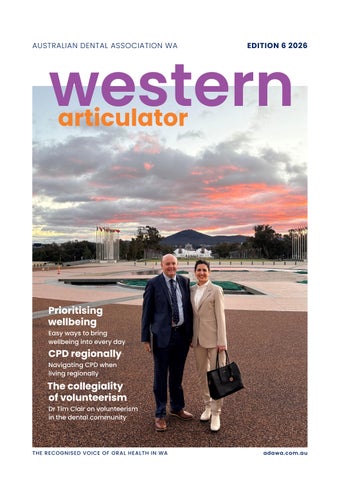
Prioritising wellbeing
Easy ways to bring wellbeing into every day
CPD regionally Navigating CPD when living regionally
The collegiality of volunteerism
Dr Tim Clair on volunteerism in the dental community
THE RECOGNISED VOICE OF ORAL HEALTH IN WA
adawa.com.au
ADAWA’s Peer Advisor Member Service
The ADAWA Peer Advisor Member Service is designed to support you through the complexities of dental practice. Your ADAWA Peer Advisor, Dr Tony Poli, is here to provide confidential, professional guidance to fellow dentists. How Dr Tony Poli Can Help You As your Peer Advisor, Dr Poli offers confidential, one-on-one support to ADAWA members navigating professional challenges, including: • Understanding AHPRA policies • Interpreting DBA regulations • Clarifying dental procedures • Navigating Professional Indemnity Insurance • Responding to Private Health Fund Audits • Managing patient complaints • and much more Whether you’re facing a difficult situation or simply need a second opinion, Dr Poli is here to help – dentist to dentist.
Contact tony.poli@adawa.com.au or phone 08 9211 5600
contents. report 4 President's Dr Tim Crofts comment 5 CEO Mr Trevor Lovelle wellbeing 6 Prioritising Easy ways for dentists
to bring wellbeing into every day.
collegiality of 12 The volunteerism
Dr Tim Clair on volunteerism in the dental communtity
15
Finding your optimum self Dr Parul Bhatia on focusing on wellbeing
north trip 18 President’s ADAWA President Dr Tim
Crofts' road trip up North
20 Farewell Dr Bill Brogan 23 CPD calendar
regionally 24 CPD Drs Haydn and Stephanie Taylor on navigating CPD when living regionally
a more 26 Creating inclusive community A free event for ADAWA members
arch we didn’t clear 28 The Centre for Prosthodontics protections claims 30 General Panetta McGrath Lawyers feature 33 DPL Leaving a practice part 1 – obligations to patients
36 Member news 41 Professional notices 42 Directory
adawa.com.au
The President's report Dr Tim Crofts, ADAWA President
a year behind schedule for release by the Federal Government. We have called on the Government to not only release but fund this plan.
Advocacy is a key priority for us at ADAWA. At a National level a coordinated effort is required. We had that in spades at the recent Dentist on the Hill event in Canberra.
It was a unified voice to our decision makers and by the end of the two days there was a great sense that the message was seen and heard. In fact, there were further requests
Joining me from WA was our Vice President Dr Janina Christoforou and Past President Dr Amit Gurbuxani. We met up with delegates from each branch around Australia to discuss with Federal politicians the issues facing our profession.
from Members of Parliament seeking meetings with us.
A key message was to stop separating oral health from general health. In our multiple meetings, with a variety of politicians, from every party we were able to advocate for issues such as improvements to the CDBS and DVA schedules, workforce planning to alleviate the maldistribution, GA access difficulties, improved oral health messaging, better funding for all things dental, to name just a few of the issues raised.
It was also a great opportunity to network well with other States and Territories and share ideas and experiences. This is something we have worked hard on over time. It is always inspiring and humbling to learn of the work of our people not only within WA but nationally. The dental community is full of passionate people, with a common desire to help their patients. We know the unmet need is great but with continual advocacy, we hope to improve the overall health of all Australians.
The overarching document to all of this is the National Oral Health Plan. This is
CEO Trevor Lovelle
President Dr Tim Crofts
Editorial Brooke Evans-Butler Designer Michelle Walker
Advertising Business Development Manager Shaden Kanaan
DISCLAIMER The views and opinions expressed in this publication and its attachments by advertisers and contributors are not necessarily endorsed by The Australian Dental Association (WA Branch) Inc. The Branch, its members, employees and agents do not assume any loss or damage which may result from any inaccuracy or omission in this publication, or from the use of the information contained, and make no warranties, express or implied, with respect to any of the material contained herein.
4
EDITION 6 ∙ 2026 western articulator
CEO comment Trevor Lovelle
Membership Matters One of the privileges of working for ADAWA is seeing firsthand the strength of the profession's commitment to its Association. Each year, the membership renewal cycle provides an important opportunity to reflect on the value of belonging to a professional body that exists solely to represent, support and advance the interests of dentists in Western Australia. I am pleased to report that the 2026/27 membership renewal cycle has delivered another strong result, with a renewal rate of nearly 95% and, importantly, strong member retention. These outcomes show the continued confidence members have in ADAWA and reinforce the value of belonging to a strong and connected professional association. Membership is about more than individual benefits – it is an investment in a profession that succeeds when its members are engaged and connected. The greater the level of member engagement and support, the stronger our ability to advocate on issues that matter to the profession, influence policy outcomes, deliver high-quality professional development, and provide practical advice and support to members.
Whether advocating to government, responding to regulatory change, supporting workforce initiatives, or delivering member services and CPD programs, ADAWA's success is made possible by the ongoing commitment and support of its members. A strong membership base enhances our credibility, strengthens our influence and ensures that the profession is represented by an organisation that understands the challenges and opportunities facing dentists in Western Australia. On behalf of Council and the ADAWA team, I would like to sincerely thank all members who have renewed their membership for the coming year. Your continued support enables ADAWA to invest in advocacy, professional development, member services and initiatives that benefit the profession. As an organisation governed by its members, ADAWA's strength has always been guided by those who are prepared to contribute their time, expertise and leadership. Together, we remain well placed to ensure that ADAWA continues to be a strong, relevant and respected voice for dentistry in both Western Australia and nationally.
adawa.com.au
Prioritising wellbeing
As a dentist you care for others, but it is also important to take care of yourself. We asked the experts for easy ways dentists can bring wellbeing into every day. YOGA THERAPY Tanaya Ti’en, Accredited Yoga Therapist from Mind Body Collective, mindbodycollective.com.au, says there are a few simple yoga therapy tips that dentists can do between patients: • Quick posture reset: stand up, reach arms to the sky on an inhale, exhale, and interlace your hands behind your back, gently lifting your chest. It helps undo all the hunching. • Neck release: slowly drop one ear to one shoulder, then switch sides. You can add a light hand for support, but keep it gentle.
• Wrist/forearm stretch: extend one arm, palm up, and lightly pull the fingers back, then switch palm down. Great for all the fine, repetitive work. • Seated twist: sitting in your chair, gently twist to one side using the opposite hand on your knee. Nice and easy way to reset the spine. • Uneven ratio breath: inhale 4, hold 2, exhale 6-8, hold 2. Even a minute of this can really calm things down between patients. The longer exhale activates the rest and digest response. • Just pause: feet flat on the ground, close the eyes, take 5 slow breaths. Simple but honestly so effective.
Tanaya Ti'en
6
EDITION 6 ∙ 2026 western articulator
Mind You Performance
STAY MOTIVATED WITH FITNESS Instead of hitting the gym alone, Shay Liggett, Director of Mind You Performance, mindyouperformance. com, says dentists understand better than most that details matter. “Expertise, precision and identifying what others can’t see are often what lead to the best long-term outcomes,” she says. “The same applies to training. Dentistry is physically and mentally demanding. It requires strength, mobility, endurance and the ability to maintain posture, concentration and precision for long periods of time. Your body isn’t just important to your health - it’s fundamental to your ability to perform at your best professionally. "Most people have blind spots. They naturally train the areas they enjoy or feel confident in, while overlooking the areas that need the most attention. Working with an experienced coach
provides an objective assessment, identifies those gaps and develops a personalised plan that builds a stronger, more resilient body around the demands of both your profession and your lifestyle.” Shay offers these three tips for busy professionals to stay motivated with fitness:
Prioritise quality over quantity You don’t need to train every day. Three well-designed, purposeful strength sessions each week are enough for most busy professionals to become significantly stronger, healthier and more capable. Focus on consistency and quality rather than simply doing more.
Train for performance, not just appearance The right training doesn’t just improve your body – it improves how you perform. Appropriate
adawa.com.au
strength training at the right intensity can improve energy, focus, mental clarity and composure under pressure, while increasing your capacity to manage the physical and mental demands of a highperformance career like dentistry.
Learn to Manage Your Unhelpful Thoughts
Speaker, author and Doctor of Psychology Dr Marny Lishman marnylishman.com.au, offers the following mental health tips:
The human mind produces thousands of thoughts every single day. Many of those thoughts are useful, they help us plan, problem-solve and navigate our lives. But many are not, and if left unchecked they can keep us stuck in cycles of worry, anxiety and rumination that serve no purpose other than to keep us distressed. Techniques like learning to observe your thoughts without being consumed by them, actively challenging thoughts that aren't grounded in evidence, or simply practicing letting them go, can make a significant difference to how you feel on a daily basis. Learning to manage your thinking is one of the most valuable skills you can develop for your mental health, and it's something mental health professionals can help with.
Move Your Body Every Single Day
Stay Connected to the People Around You
Remember what you’re really working for Many professionals dedicate years to building a successful career and a fulfilling life, while unintentionally neglecting the very body they’ll need to enjoy it. Fitness isn’t about spending more time in the gym. It’s about building the health, strength and energy to support the life you’re working so hard to create.
PRIORITISE MENTAL HEALTH
One of the most powerful things you can do for your mental health costs nothing and requires no prescription, it just requires you to move. Aim for at least 30 minutes of physical activity every day, and if a solid block of time isn't possible, break it up into smaller chunks throughout the day. Getting outside amplifies the benefit significantly, and if you can spend that time in blue or green spaces, near water, in parks, among trees, the research consistently shows even greater improvements in mood and stress levels. Exercise works on a biological level that we often underestimate: it triggers the release of endorphins, our body's natural
8
mood elevators, while simultaneously burning off stress-related chemicals like cortisol and adrenaline that build up when we're under pressure. You will feel so good!
EDITION 6 ∙ 2026 western articulator
Human beings are wired for connection, no matter how introverted you are, no matter how much you value your solitude, your mental health depends in part on feeling connected to other people. Having a sense of belonging, to a friendship group, a team, a workplace, a family, gives us something that nothing else can replicate. Other people listen to us, support us, challenge us and remind us that we are not alone in what we're going through. But beyond the practical support, connection gives us a sense of being part of something bigger than ourselves, which is one of the most fundamental human needs we have. So make the call, send the text, accept the invitation, show up for the people who matter to you. It makes such a difference to your mental health.
STRONG Pilates Highgate
TRY REFORMER PILATES For healthcare professionals such as dentists, Alicia Lind, Operations and Communications Manager, STRONG Pilates Highgate, strongpilates.com.au/location/ highgate/ gives three reasons to choose cardio-infused Reformer Pilates:
Full-body strength and endurance Professionals who spend extended periods working in fixed positions benefit from developing strength and muscular endurance and avoid long-term injury. Classes at Strong Pilates Highgate combine controlled, Pilates-inspired movements with resistance training to work the core, back, upper body and lower body. Each movement can be scaled to suit all fitness levels.
and full-body workout with minimal impact on the joints. This can be particularly appealing to healthcare professionals who want a challenging workout without additional high-impact loading.
Varied, purposeful movement Our 45-minute classes combine controlled movement, cardio and resistance, with programming that changes and progresses over time. Each day comes with a new workout providing valuable movement variety while supporting strength, mobility, cardiovascular fitness and overall wellbeing.
MINDSET AND NERVOUS SYSTEM WORK
High-intensity training with low impact
Why "Switch Off When You Get Home" Doesn't Work
The reformer beds at Strong Pilates Highgate are combined with rowing or cycling ergs, Rowformers and Bikeformers. Classes using the ergs combine resistance training with an efficient cardiovascular
“Dentists are trained to look beneath the surface, and the same applies to pressure,” says Brooke Sheridan, Licenced Clinical Hypnotherapist and multi-qualified therapist and counsellor brookesheridan.com. adawa.com.au
Brooke Sheridan
“What wears you down usually isn't the workload. It's the bracing before a difficult patient, the replay of a complaint at 2am, and arriving home already exhausted. Those patterns run well below the level where willpower reaches, which is why being told to leave it at the door so rarely works. You're not short on discipline. You're running a program you never consciously wrote, and that's exactly what hypnotherapy and nervous system work change. What I do doesn't add another task to your day. It updates the pattern underneath, so you get a longer fuse, a quieter mind at night, and capacity left over for the people at home.” She recommends three things you can use tomorrow: Prime the day before it primes you. Before you get out of the car, take thirty seconds to rehearse the day going well. Picture yourself steady
10
EDITION 6 ∙ 2026 western articulator
with the difficult patient, unhurried when you're running late, clearheaded at 4pm. The mind treats rehearsed experience much like lived experience, which is why athletes and surgeons do this before they perform. Breathe out longer than you breathe in. While you wash your hands between patients, breathe in for four counts and out for six. The exhale is where the vagus nerve engages and heart rate drops, so lengthening it is what shifts you out of stress response. Three rounds, thirty seconds. Close the day deliberately. Before you leave, write tomorrow's real loose ends on paper rather than carrying them home, name two things that went well, then tell yourself work is finished for now. The brain needs a signal that the shift has ended. Without one, it keeps the file open all evening.
Yoga therapy tips for dentists from Tanaya Ti'en, Mind Body Collective, Further details on page 6.
adawa.com.au
The collegiality of dental volunteerism
As well as his own volunteerism efforts, Dr Tim Clair is the ADAWA Volunteers Committee Chair, and the not-for-profit dental sector representative of State Oral Health Advisory Council. We spoke to him about volunteerism in the dental community.
As likely many other dentists in Perth, Dr Tim Clair was first inspired to contribute to dental volunteerism by Dr John Owen AM. “I had worked in medical research and public service roles prior to dentistry and through these experiences had been exposed to Indigenous health, and so the opportunity to contribute through the Kimberley Dental Team was of interest to me,” he recalls. “I also grew up in North Queensland, which fueled my interest in working in regional and remote locations of Northern Australia, so KDT offered this opportunity through volunteering where my family circumstances didn’t allow me to relocate for long-term employment.”
KDT Tim says meeting people in the Kimberley and seeing the vast, beautiful landscapes
12
EDITION 6 ∙ 2026 western articulator
of the region were huge highlights during KDT volunteerism trips. “Setting up mobile clinics in classrooms and outdoors on verandahs are also highlights, and something that KDT has honed to a fine art over the years,” he adds. “I have participated in 12 trips with KDT and, outside of the clinical achievements and pride taken from the treatment that can be provided in remote settings, a highlight of each week is the camaraderie experienced between the members of each team. It is great to be connected with people through having had shared experiences both in clinical situations that can often be out of your comfort zone and from chatting over the course of each week, particularly while on long drives across the Kimberley. Lifetime connections have been made.”
Rokeby Dental Tim is a dentist at Rokeby Dental, whose team host a regular Charity Day to give back to others. “Since long before my time at Rokeby Dental, the practice has taken a different approach to charity work by opening one Saturday per annum to donate the entire proceeds from treating our regular patients that day to a local charity,” Tim explains. “Practice staff donate their time for the event, and a team lunch follows the morning’s clinical work. “As with teams who have been on KDT trips, the Charity Day bonds the team through a shared experience to give to others. Patients are also happy to be involved through making appointments on the day or donating to the charity that the practice is supporting that year.”
ADAWA Council Tim joined as a member of council at ADAWA in 2019. “I was interested in being more connected as an ADA member and to learn more about the workings of the Association at the Branch and Federal levels from behind the scenes, and I thought I might have something to offer by getting involved,” he recalls.
“Chatting to numerous KDT volunteers over the years who had been on Council also contributed to my interest in getting involved. Additionally, volunteering with KDT also led to my interest in chairing the ADAWA Volunteers Committee when the vacancy arose during my time as a Councillor, and more recently to representing the not for profit/nonGovernment dental sector on the State Oral Health Advisory Council (SOHAC) when this opportunity came up.” He says the role as the ADAWA Volunteers Committee chair has been rewarding. “It is great to hear about the amazing work that each WA-based dental charity is providing, and the goals they have in the interest of helping more people in need,” he says. “To be able to play a role in information sharing between the charities themselves, and between the charities, the Branch and SOHAC more broadly, through the Committee is rewarding. “Being on both the ADAWA Volunteers Committee and the State Oral Health Advisory Council, has meant I have been able to help strengthen links between Western Australian dental charities and the State’s Office of the Chief Dental Officer,” he adds. “These links have recently increased
adawa.com.au
applications for ad hoc grants for dental care provided by volunteer organisations. This has been a great source of satisfaction and is something tangible that assists organisations provide valuable patient care.”
Encouraging others To other dentists thinking of being involved in volunteerism, Tim says: “It takes a lot of people to make dental volunteerism viable: founders and board members; dental practitioners, assistants, and students providing the dental care; and auxiliary volunteers, administrators, and funding bodies; and, not least the families of the volunteers who support them giving of their time. “Give volunteering a go and see if you enjoy it; you will likely find that it can put you out of your comfort zone while being rewarding, collegiate and fun all at once.”
14
EDITION 6 ∙ 2026 western articulator
Finding your optimal self
Dr Parul Bhatia is spreading the message to dentists to focus on their wellbeing. Dr Parul Bhatia’s professional journey has covered what many dentists may not in their entire careers. Over the past 11 years, she built a practice, Butler Dental, from the ground up – creating a safe, trauma-informed environment for vulnerable patients. She has mentored many young dentists in the process, and recently sold the practice. The wealth of experiences has shaped her perspective on leadership, burnout and wellbeing, as an inspiring example to others.
Beginnings Dentistry wasn’t something Parul thought she would pursue, but she fell in love with its mix of art, science and the opportunity to help others. “I was an artist by nature,” she recalls. “I loved painting and drawing, and my father said to me: ‘You have this beautiful art background, but you are also good at science – can you explore something that has both? Have a chat with your local dentist and see how it feels’.” Dental School in the UK was not without its challenges, but after failing her finals and undergoing some trauma, Parul was determined to make a difference – and after passing her finals, she went to work as a dentist in a prison, and in lowsocio-economic areas.
Becoming interested in sedation and dealing with anxious patients, she sat a diploma in conscious sedation but felt a pull towards specialising.
Practice ownership After Parul married her husband and they decided to move to Australia and start a family, Parul was accepted to study paediatric dentistry, but life took her another way. “I wasn’t an Australian citizen then and I had a young child, so in the end, we decided to open a practice instead,” Parul recalls. “I had this calling to create a safe space for anxious patients and wanted to offer transparent, ethical treatment for patients. “I had suffered trauma myself, so I knew what it was like to be embarrassed and judged and vulnerable – and that is how I built my practice Butler Dental.” Building a practice wasn’t easy due to debt involved and undergoing fertility treatment at the same time, but Parul says her husband (who is a full-time General Practitioner), was very supportive and held their young family so Parul could set up her dream practice.
adawa.com.au
“I did some business coaching on how to build a good team, retain a team, mentor new graduates, hone-in on my values and find people aligned with that,” she recalls. “It was a great journey, and I found some great new grads to work with me. “I had a passion to help new graduates because as a new grad myself I felt behind when I came out of university so wanted to be a good mentor.”
Another direction After 11 years as a practice owner, Parul decided to sell the practice last year. “Through practice ownership there was a period when I did burn out,” Parul explains. “I wanted more balance. I worked quite hard in my practice six days a week and I also had a position at the children’s hospital. I felt I was losing balance – there wasn’t time to do other things.” Since selling the practice, Parul has taken on the role as President of Women in Dentistry and, fueled by her growing interest in helping healthcare professionals navigate burnout, identity, wellbeing and personal growth, has started an online coaching business. “I’ve also recently joined Dr Fern White’s team as Head Coach,” she says. “I’ll be coaching and mentoring dentists through her Sell With Heart and Immersion programs, helping practice owners build sustainable, fulfilling careers while looking after themselves along the way.”
Work-life balance After burnout, Parul realised she had to focus more on her physical and mental wellbeing. “I started exercising religiously,” she says. “I get up at 4.30am to exercise because
16
EDITION 6 ∙ 2026 western articulator
having a young family, I wasn’t finding time for myself. I then treat myself by going to the beach and having a coffee.” Parul also found her artistic side again and is regularly painting. “I book my painting classes every fortnight and they are nonnegotiable, like a meeting,” she says. “I always say if you are starting to paint it is not about the end product – it is important to focus on the process. It is what brings you that joy – it is active meditation. “I know a lot of dentists are artistic so I feel like every dentist should be painting.”
Women in Dentistry Mentoring and supporting other dentists is something very important to Parul, and after being on the Women in Dentistry committee for two years, Parul hopes her term as Women in Dentistry President brings even more collaboration. “I am trying to do more events and build some more systems within the committee. I want to add to the good culture and goodwill that Janice and Gosia and Marilyn built. “Through Women in Dentistry, mentoring new graduates, coaching, and speaker, I have become increasingly passionate about helping healthcare professionals build sustainable careers without losing themselves in the process.”
Advice to other dentists Parul says that your health is the number one priority. “If you haven’t got your health, you don’t have anything,” she says. “Prioritising your health and your self-care is so important.
“It means different things for different people. It could mean a haircut every month, or a massage or booking a weekend away – anything that brings you joy. You can lose your identity in your profession, but it is important to remember you are a person outside of dentistry. “With all the influence on social media a lot of people talk about the wins, but it is a hard profession, and to be vulnerable about that is ok.” She adds that taking care of yourself also benefits your patients. “Patients deserve you as an optimal clinician,” she says. “If you are not at your optimum, if you are burnt out, exhausted and tired, you are not going to perform at your best and patients deserve your best. “The older I become, the more aware I am of it. The more I pour into myself, the less stressful the job becomes.
“If there was one message I would love readers to take away, it would be this: don’t lose yourself in dentistry. We are clinicians, but we are also people. The more we invest in our own wellbeing, creativity, relationships and health, the better we are able to care for our patients and the more fulfilled we become in our careers.”
adawa.com.au
President’s road trip
ADAWA President, Dr Tim Crofts, recently travelled up North, where he met with members and support staff in the dental community.
If you missed the updates about Tim’s roadtrip on our social media, we have summarised his experience below.
GERALDTON The first stop for Tim was Geraldton, where he met with Drs Steve Lawley, Kathryn Braysich, Ellen Rogers and Paul Milligan. "It was great to chat to some long term, dedicated, country practitioners and hear their views on a range of issues,” Tim says. “Geraldton is a great place to live and work. And there are jobs available right now too!”
CARNARVON In Carnarvon, Tim met DCA Samuel Christos, who has been looking after the locum dentists coming through Carnarvon Health Campus since 2021. “It’s not just about the dentists at ADAWA. Where would we be without our support staff?"
EXMOUTH "There are no dentists in Exmouth today," Tim said when he visited Exmouth. “One is on extended leave and the other practice runs mostly with locums and they would love a permanent dentist to come work with them, either here or in Geraldton.”
KARRATHA In Karratha, Tim met with Dr Pauline Wong from Karratha Dental Care. “Pauline is an inspiring young rural
18
EDITION 6 ∙ 2026 western articulator
practitioner who is thriving on the variety of work that only rural practice can bring,” Tim says. “She also enjoys mentoring the UWA students that visit the Pilbara every year. Well done, Pauline.”
PORT HEDLAND/SOUTH HEDLAND Tim spent time in Port Hedland/ South Hedland, where he met Dr Mark Smit and DCA Eden Martin.
BROOME “I met Dr Cletus Fimmel who is the hard-working DHS dentist in Broome. Again, we heard about the lack of staff in the Kimberley as in the Pilbara. These regions rely on the goodwill of some very dedicated Dental professionals. We need more people for DHS jobs around WA. Especially experienced staff that can mentor the new graduates. “I also bumped into John Owen and his sons at Matsos. ADAWA is so thankful for their long years of work in the Kimberley and to all the volunteers that went up there. We also had a sunset drinks on Cable Beach with the rest of the Kimberley DHS crew,” Tim says.
NEWMAN “Newman has been another northern town with a lack of dentists for many years now. It is good to hear there is a private dentist in town
again and RFDS visits the local Aboriginal Medical Service on a regular basis,” Tim says. “What blew me away though was the quality of the new DHS dental department in the new hospital. They are still looking for a permanent dentist if you are interested? It was lovely to meet DCA Daisy Hamylton and have a tour of the beautiful facility.”
What an incredible trip where Tim got to meet many amazing oral health professionals on his travels. Tim says everywhere he goes on his travels he finds lots of job opportunities open. Are you ready for a rural change?
adawa.com.au
Farewell Dr William Francis (Bill) Brogan 24 February 1931 – 2 June 2026 The dental profession in Western Australia has lost a significant figure with the passing of Dr Bill Brogan, whose vision and persistence transformed the care of children born with cleft lip and palate, and helped to build hospital-based dentistry at Princess Margaret Hospital (PMH/PCH) into the multidisciplinary service it is today. Bill trained as a dentist at the University of Liverpool before entering general practice in the early 1950s. A postgraduate qualification in orthodontics, undertaken in Glasgow, introduced him to pre-surgical orthopaedics (PSO) — the use of a customised intra-oral appliances combined with external strapping to reposition and reduce a cleft defect in preparation for surgical reconstruction. It was a technique that would come to define his career. Bill emigrated with his family to Australia in 1959, working first in Darwin before settling in Perth in 1962. He was approached by Harold McComb, PMH's chief cleft plastic surgeon, who had heard of his expertise in PSO and wanted this technique introduced to Western Australian cleft care. Appointed Honorary Consultant Orthodontist at PMH in 1966, Bill's PSO work with Dr McComb, markedly improved
20
EDITION 6 ∙ 2026 western articulator
the surgical and aesthetic outcomes for children with cleft lip and nasal deformity, and forged what became an enduring partnership between the Dental and Plastic Surgery departments. Bill was also instrumental in bringing secondary alveolar bone grafting to PMH. Following the 1981 World Cleft Congress in Acapulco, where a Norwegian team presented compelling results using orthodontic rather than prosthetic closure of alveolar cleft defects, Bill championed adoption of the Oslo Protocol, introducing it to PMH in 1983 within a strict interdisciplinary treatment framework. Recognising that good outcomes depended on genuine teamwork, Bill and Dr McComb established Australia's first multidisciplinary Cleft Unit, bringing together Dentistry, Plastic Surgery, Speech Therapy, ENT and Audiology. He built links to the WA Birth Defects Registry, established a Cleft Database and the role of Cleft Coordinator, and helped integrate Dental and Maxillofacial Surgery formally into PMH's Division of Surgery. Nationally, he and Dr McComb founded the Australasian Cleft Lip and Palate Association, organising its first conference in Perth in 1989, and later hosting the International Cleft Congress at Broadbeach, Queensland in 1993.
Bill also recognised that children referred to the Dental Clinic needed broader care than cleft treatment alone. He recruited sessional general dentists, prosthodontists, periodontists, oral surgeons and a second orthodontist to the unit, and championed the specialist training that led to the establishment of a specialist Paediatric Dentistry training program at PMH under the aegis of the University of Western Australia. Long after his retirement, Bill kept meeting regularly with departmental consultants at the Children's Hospital, staying connected to a service he had helped establish. Beyond dentistry, Bill was a passionate diver, underwater photographer and sailor, and was the driving force behind the development of Coral Bay on the Ningaloo coast, where he supported local marine research to protect the reef. Bill is survived by his wife Alison, one of his four children, by ten grandchildren and six greatgrandchildren. He will be remembered by colleagues as a tenacious, generous and formidable advocate for the children of Western Australia. Written by Drs John Winters and Steven Singer.
adawa.com.au
PATIENT-CENTRED CONTEMPORARY PERI-IMPLANTITIS TREATMENT 3 CPD WEDNESDAY 14 OCT
6.30pm - 9.30pm
COURSE OUTLINE Peri-implantitis occurs in around 1 in 5 patients restored with implant-supported prostheses. Periimplantitis is a plaque associated pathologic condition characterised by clinical inflammation of the peri-implant soft tissues (bleeding/suppuration) and progressive bone loss. Peri-implantitis may progress rapidly and is challenging to treat. Learning Objectives: • Understand the aetiology and diagnosis of peri-implant diseases • Understand when to choose which treatment approach
UNIVERSITY CLUB
ABOUT THE PRESENTERS
Professor Lisa Heitz-Mayfield received a Masters in Periodontology in 1996 and Odont Dr (PhD) in 1998 from Lund University, Sweden. From 1999 – 2003 she was the Head of the Oral Microbiology Research Laboratory at the Uni of Bernie, Switzerland. She was Chair of the International Team for Implantology (ITI) Research Committee, and member of the ITI Board of Directors from 2013 – 2021. In 2022 was awarded an Honorary ITI Fellowship. Current positions include Adjunct Professor at the International Research Collaborative, UWA, Professor at The University of Sydney, and Guest Professor at the University of Berne and the University of Shanghai. She is the Editor-in-Chief of Clinical Oral Implants Research. Lisa maintains a private practice limited to periodontology and implant surgery with an emphasis on regeneration, prevention and comprehensive treatment planning.
• Understand how best to prevent peri-implantitis and its recurrence • And more! SCAN QR TO BOOK
FOR MORE INFORMATION GO TO CPD.ADAWA.COM.AU
$403 members
CALENDAR 2026 September 8 TUES
9 WED
The Blueprint for a Thriving Start-Up (FREE EVENT) Sharon Lee ADA HOUSE New Practitioner Program Third Study Club September Dr Yasmina Andreani ADA HOUSE
october 6 TUES
14 WED
23 FRI
23 FRI
28 WED
29 THURS
31 SAT
31 SAT
LGBTIQA + 101: Creating a More Inclusive Community (FREE EVENT) WAAC ADA HOUSE Patient-centred Contemporary Peri-Implantitis Treatment Professor Lisa Heitz-Mayfield UNIVERSITY CLUB Restore My First Implant Drs Graham Carmichael and Glen Liddelow THE BRANEMARK CENTER Trauma Informed Care Workshop Dr Sharonne Zaks AM ADA HOUSE Endodontic Retreatment (FREE EVENT) Dr Gaurav Vasudeva ADA HOUSE Hands-on Clinical Photography Dr Graham Carmichael THE BRANEMARK CENTER Composite to Restore Shape and Form Drs Glen Liddelow, Joshua Graieg, Sally McMullen OHCWA Practical Oral Surgery Various CTEC
november 9 MON
11 WED
14 SAT
No Roots Left Behind: Hands-On Surgical Extraction Techniques Dr Frank Chang CTEC Destination Before Detail: Communication for Better Treatment (FREE event) Michelle Pritchard ADA HOUSE Conservative Ceramic Restorations, when to do what Drs Asheen Behari and Paul Gorgolis OHCWA
S C A N Q R TO B O O K
14 SAT
17 TUES
Practical Oral Surgery Various CTEC Drill, Fill, Bill, Chill - why is this old chestnut still applicable today? (FREE EVENT) Dr Hui Loh ADA HOUSE
Endodontics 27-28 Comprehensive Dr Gaurav Vasudeva
FRI-SAT
OHCWA
28
Young Dentists' Conference TBA ADA HOUSE
SAT
February 2027 18 THURS
24 WED
Controversies in Paediatric Dentistry? From Fluorides to Frenotomies Assoc Prof Jilen Patel UNIVERSITY CLUB Equine Endodontics: The Challenges of RCT in an Equine Tooth (FREE EVENT) Dr Kirsten Jackson ADA HOUSE
MARCH 2027 13-14 SAT-SUN
The Therapeutic Uses of Botulinum Toxin and Intraoral Dermal Fillers in General Dental Practice Drs Mahmoud Bakr and Mohammed Meer ADA HOUSE
APRIL 2027 10 SAT
The Limitless Dentist Workshop - Burnout to Breakthrough Dr Kaejenn Tchia ADA HOUSE
MAY 2027 Trauma Bunbury 5 Dental Prof Paul Abbott and Assoc Pro Jilen Patel WED
15 SAT
MANTRA BUNBURY LIGHTHOUSE
Management of Medical Emergencies in the Dental Practice Cynergex Group ADA HOUSE
PUBLIC HOLIDAYS 2026
PUBLIC SCHOOL HOLIDAYS 2026
28 Sept - King's Birthday
26 Sept – 11 Oct
25 Dec - Christmas Day 26 Dec - Boxing Day
18 Dec - 31 Jan
adawa.com.au
Regionally CPD
Is completing CPD a challenge for those who don’t live in the city? Drs Hadyn and Stephanie Taylor, who are based in the South West region, share how they navigate CPD when living regionally. How do you navigate completing CPD requirements when you live regionally?
As ADA members we receive regular updates regarding available courses. The best thing for us is that ADAWA organise most of the courses early, which allows us to plan and book our CPD at the start of the year. This is beneficial for us in knowing we will complete our 20 hours, allows us to plan our trips up to Perth well in advance and make necessary arrangements for our respective clinics while we’re out of town. The webinars are also very useful for us, and we especially like that they are often in a series format for different topics and specialties. This is particularly useful for Haydn who works across multiple country locations and mostly in paediatrics.
Do you prefer online or in-person courses? Why? We prefer the in-person courses as we enjoy catching up with colleagues, interacting with the presenters and the opportunity to speak
24
EDITION 6 ∙ 2026 western articulator
with the event sponsors such as Smith Coffey and BOQ Specialists. Also, in Haydn’s case, he enjoys winning the door prizes! We do also enjoy the webinars as they give us the opportunity to hear from interstate presenters.
Are there any courses/topics you look out for that you look out for to complete in person? If so, which topics do you look out for? Oral Surgery, Orthodontic and Prosthodontic practical courses are invaluable and we try to regularly attend those. We also look out for courses on new materials/equipment/ techniques to keep our skills current.
Does working at the Government Dental Clinic provide CPD entitlements for staff? One of the big benefits of working for the government is that we have a CPD allowance and CPD leave in our Industrial Award so we don’t only need to schedule when we are in town. This means we access the leave to get to courses and are never rushing to CPD.
What, if any, are the challenges of completing CPD when you live in a regional area? Access is of course our biggest issue. We really appreciate the courses that are held regionally, for example we have been attending the Albany course for a few years now. The webinars are a much-needed resource in ensuring we meet our annual hour requirements. The entitlements we receive as government employees do help a lot too.
Would you recommend WA Dental CPD courses? Why? Absolutely. They are always our first pick and first recommendation when deciding what courses to complete for the year. ADAWA offer a fantastic range of different types of courses such as practical, lecture style, and we especially enjoy the dinner courses at UWA Club. They also have access to great training facilities such as CTEC at OHCWA and provide access to resources after the courses, including contact with the presenters and presentation slides. Jenny (Ball) always runs a fabulous day and goes above and beyond to ensure we are all well fed (including allowing for Steph’s dietary requirements) and have a great day.
Is there any advice you would give to another dentist living regionally about navigating their CPD? Join the ADA. The CPD resources available to us as ADA members is worth the membership alone. And that is before you consider the other benefits to being a part of our professional association.
What, in your opinion, are the advantages of living in a regional area? There are many advantages to living in a regional area, personally and professionally. The dental community is even stronger where you get to know the specialists you are referring to and even though we work in the public service, we get to know the private dentists and support each other as professionals and in patient centred care. Patients are very appreciative for the care that we provide. As specialist services aren’t just down the road, we as clinicians are supported by the training we receive through our ADAWA CPD courses in managing each patient safely. We also now live in a place where we would regularly holiday, it doesn’t get much better than that!
adawa.com.au
Creating a more inclusive community
Shane Early
POPULATION HEALTH AND COMMUNITY DEVELOPMENT OFFICER
“LGBTIQA+” Lesbian, Gay, Bisexual, Transgender, Intersex, Queer, Asexual. It is not uncommon for members of the broader community to ask why having knowledge of this community is helpful. “The more knowledge our medical practitioners have on any minority community, not just the LGBTIQA+ community, can only help them grow their practices into safe and approachable services for all the members of the area they operate in,” says Shane Early, Population Health and Community Development Officer at WAAC, says. On October 6th, ADAWA and WAAC (formerly the Western Australia AIDS Council) will be teaming up to help answer this question. During our one-hour information session we will be talking about sexuality, gender identity, gender expression, and the
26
EDITION 6 ∙ 2026 western articulator
diversity of biological sex alongside common experience of queer populations to help you bring a wider lens of knowledge to your practise. With this knowledge you will find yourself better positioned to provide duty of care to patients who are members of the LGBTIQA+ community, will have knowledge of what dental care to provide and issues to look out for and how to provide unbiased care. What to expect in the session? An entry level conversation designed around peer reviewed information that is delivered by a trained and experienced population health and community development officer with lived experience. Allowing those who have always had questions they’ve wanted answered to chase their curiosity without the risk of asking the wrong question, and yes, we will cover how to ask questions in a professional setting as well. We look forward to seeing you there and please registered your interest at cpd.adawa.com.au *Note - this is a free event for ADAWA members only.
CONSERVATIVE CERAMIC RESTORATIONS - WHEN TO DO WHAT 6.5 CPD Saturday 14 NOV
9.00am - 5.00pm
COURSE OUTLINE This one-day hands-on course will address the following infamous dilemmas: Learning objectives • If you are already experienced in these restorations – this is a good “brush up” of your knowledge. • If you have little experience in this topic, this course will set you up for future success. • Be able to make informed choices for clinical cases • And more.
OHCWA
$1520 members
ABOUT THE PRESENTERS
Dr Asheen Behari is a general practitioner in private practice in Claremont, Perth. He graduated from the University of the Witwatersrand in 1993, subsequently completing a Post Graduate Diploma in Clinical Dentistry in Oral Implants at the University of Sydney. Dr Behari is a Clinical Associate lecturer in the Discipline of Oral Rehabilitation at the University of Sydney. Dr Paul Gorgolis is a general practitioner currently in private in Wembley Downs. He is a Fellow of the International Congress of Oral Implantologists. In London, he developed the UK’s first multi-disciplinary general and specialist practice where patients could be comprehensively managed and treated “under one roof”.
SCAN QR TO BOOK
FOR MORE INFORMATION GO TO CPD.ADAWA.COM.AU
The Arch We Didn’t Clear
By the team at Centre for Prosthodontics In dentistry, some treatment plans begin with what can be removed. Others begin with what can still be preserved. Every now and then, a patient arrives distressed, convinced the only path forward is to lose what remains — when the real question is whether that conclusion was ever the right place to start. This was one of those cases.
Case History She presented upset after being told she would need a full upper clearance and implant replacement treatment. At first glance, the situation certainly looked compromised: only a span of six upper front teeth remained, and one remaining premolar was fractured and only borderline restorable. But once the case was properly unpacked, the picture became more interesting. The remaining front teeth were slightly worn, yes, but periodontally stable and endodontically sound. And while we are not usually in the habit of making major decisions from an OPG alone, this was one of those rare occasions where it made one thing immediately clear: there was substantial bone deficiency. Conventional immediate implant placement after clearance would be biologically implausible, whether straight or angulated, unless one were prepared to venture into quad zygomatic implant territory. In other words, the proposed “replacement” plan was more ambitious than the anatomy would sensibly allow.
The Fork in the Road That is where the real prosthodontic question emerged. Should we remove teeth that are still saveable in order to pursue a prosthesis that may be highly complex, surgically demanding, and inherently compromised from the outset? Or should we recognise
28
EDITION 6 ∙ 2026 western articulator
that although natural teeth may be worn and imperfect, they are still teeth - and that even our best prostheses, however advanced the materials, design, and technology, can only ever take us so far? They do not quite look the same, feel the same, floss the same, or sound the same. And yes, some patients complain that the tapping does not sound the same either. Amusing perhaps, but it is an actual response from a patient.
Clinical Reflection Cases like this remind us that treatment planning is not simply about what is possible. It is about what is proportionate, and in the patient’s long-term interest. Not because implants are wrong, or because full-arch treatment does not have its place, but because removal is an irreversible act. Once teeth are gone, the biological, functional, and psychological consequences are not easily reversed, and we may not be offering a prosthetic solution that is genuinely superior to retaining them. Ethical dentistry is a matter of balance: the right diagnosis, the right treatment, at the right time. Finding that balance between over- and under-treatment can sometimes be the hardest step. Sometimes the most valuable treatment plan is not the one that replaces the most. It is the one that preserves what still deserves to stay. Because in some cases, the boldest thing a prosthodontist can do is not clear the arch.
WADA Golf News Joondalup Golf Club
The latest round of WADA Golf takes us to the always breathtaking Joondalup Golf Resort. Joondalup has some truly memorable holes on offer, with beautifully manicured fairways and bunkers and rolling hills. With rain threating all week we mostly avoided any bad weather, and it turned into a fantastic day. Thanks to our major sponsor for the day, Dentaurum Australia and Kevin Ferrari for hosting this event. Dentaurum is celebrating their 140th anniversary this year, and is a global leader in dental solutions and has been very generous in supporting WADA Golf. Today, we played Joondalup of the black tees, transforming the course with a lot of elevated tee boxes. Playing Stableford, competition was fierce with two players tied at the top on 35 points. Aron Lazaridis, new to WADA in 2026, managed to pip Micheal Yuan with a better back 9 holes to win his first competition.
Cec White points awarded 1st place – Aron Lazaridis 2nd place – Michael Yuan 3rd place – Brad Potter (Sponsor) 4th place – Paul Tan 5th place – Ian McCarrey
Nearest the pin 3rd hole
Richard Williams Health Practice Brokers
4th hole
Aron Lazaridis Health Linc
8th hole
Paul Tan Swan Valley Dental
9th hole
(Longest drive)
Paul Tan WADA
7th hole DUNE
Richard Williams WADA
9th Hole DUNE
Michael Welten Insight Dental Ceramics
NAGA
Hugh Gillespie
Congratulations to all the winners and looking forward to the next round of golf. Please direct all related enquiries to Paul Tan at dentistgolf@ gmail.com. For more information on the fixtures, please connect with us on Facebook at the WADA Golf page. Good golfing Paul Tan WADA Golf Captain dentistgolf@gmail.com
adawa.com.au
General Protections Claims: Why Every Dental Practice Needs a Defence Strategy By Enore Panetta and Sean Foy, Panetta McGrath Lawyers
A dental assistant takes stress leave during a business restructure and is retrenched a fortnight later. A hygienist requests flexible hours after parental leave and is asked to reduce her part-time hours. A practice manager raises a pay query and is placed on a performance improvement plan. The small business owner in each case does not recognise the warning signs but each is a classic fact pattern behind a general protections claim. Dental practices are particularly exposed. Teams are small, relationships are close, and staff move between casual, part-time and full-time work. Many associates are engaged as contractors rather than employees, which, contrary to common assumption, does not place them completely outside the general protections regime.
What makes these claims different The general protections in Part 3-1 of the Fair Work Act 2009 (Cth) prohibit “adverse action” taken for a prohibited reason. Adverse action is broadly defined. It includes dismissal, demotion, a cut in hours, refusing to engage a prospective employee, or otherwise injuring a person in their employment. In the case of contractors, altering the contractor’s position to their detriment and refusing to supply goods and services to the contractor are also included.
30
EDITION 6 ∙ 2026 western articulator
Additionally, threatening to take adverse action is also adverse action. The prohibited reasons include the exercise of a workplace right - taking leave, querying pay, or making a complaint or inquiry about employment - temporary absence due to illness or injury, and protected attributes including sex, age, disability, pregnancy, family or carer’s responsibilities, race, religion and - since December 2023 - being subjected to family and domestic violence. For contractors and employees, being entitled to the benefit of, or having a responsibility under a workplace law (like a workplace health and safety law) is also a workplace right. Importantly, not every adverse action is unlawful. It is unlawful only if taken for a prohibited reason. Genuine redundancy, declining to hire an applicant without a required qualification, and documented performance management are all defensible, provided the real reason has nothing to do with a protected right or attribute. However, the respondent employer (or contract principal) is presumed to have acted for a prohibited reason and must prove that they did not act for a prohibited reason: the so-called “reverse onus of proof”. Some features make a general protections claim easier to defend than an unfair dismissal. The grounds do not include broad unfairness grounds, so the scope of the defence can be narrower.
Conversely, the reverse onus of proof can make it more difficult to defend a general protections application. Especially if there a multiple persons and factors involved in a decision to do something that the applicants says is adverse action. In a redundancy situation, even for a small business the decision-making evidence may include the business owner, the practice manager or team leader and the business’s external accountant. Not leading the right evidence, or insufficient evidence can mean that the respondent has failed to prove that their management decision was defensible.
Putting your practice in the best position 1. Document decisions as they happen. Contemporaneous notes of performance conversations, complaints and the reasons for any change to a role are your strongest evidence. A file assembled after a claim is lodged looks reactive. 2. Know who your decision-maker is. Because the case turns on that person’s actual reasons, decisions should be made and recorded by one identifiable person who can explain them later. Where practical, whoever takes disciplinary action should not also handle a related grievance. If there are multiple decision makers, ensure that their reasons and contribution to the decision are clear and documented.
3. Pause after a complaint or leave request. The timing matters. If a dental nurse lodges a grievance and is dismissed a fortnight later, the proximity alone invites scrutiny, even where the reasons are unrelated. Take advice, determine whether a grievance is genuine, determine whether the workplace right is based on an actual legal right and in some cases build in a cooling-off period or a strategy to resolve grievances first. 4. Apply your policies consistently. Clear written policies applied the same way across the team make it far easier to show the action would have been taken for a genuine performance or conduct reason regardless of any protected right. 5. Train your practice managers and lead clinicians. Many claims begin with an offhand remark or a poorly handled conversation, long before anyone identifies a legal risk. Training for those with hiring, rostering or disciplinary authority is among the most cost-effective protections available. 6. Move quickly if a claim is served. A dismissed employee has 21 days to lodge (Form F8); the practice then has seven days to respond (Form F8A, or F8D where there is no dismissal). The Commission only conciliates - if the dispute does not resolve, a certificate issues and the worker has 14 days to go to court or, by consent, to have the Commission arbitrate. adawa.com.au
The financial reality Some claims resolve at conciliation for relatively modest sums. However, an increasing number of claims do not resolve at conciliation and move into the court system, where exposure and costs escalate quickly. Because the court matters are brought under the Fair Work jurisdiction, costs do not ordinarily follow the event and a practice that succeeds should expect to be out of pocket. For a dental practice, the real cost is rarely the settlement figure alone: it is the disruption to clinical scheduling, the strain on a small team, and the reputational risk in a tight professional community. The best defence begins long before any dispute, in the everyday habits of documenting fairly, acting consistently, and treating every complaint or leave request with the seriousness it deserves. The content of this article is intended to provide a general overview and guide to the subject matter. Specialist advice should be sought about your specific circumstances.
IN THEIR WORDS We were able to achieve an outcome that exceeded our expectations and Kang was there by our side through the entire process, ensuring we RECENTLY SOLD
were strongly represented every step of the way.
in dental practice sales settled across Western Australia.
Discreet representation, from first appraisal to final settlement. Kang Kim 0412 342 626 · kang.kim@hpbaus.com.au
His experience as both a clinician and a practice owner gave him a genuine understanding of the perspectives of both buyers and sellers, which proved invaluable throughout the negotiations.
Kang worked tirelessly to
Above all, I appreciated his
achieve the best possible
professionalism, integrity,
outcome while never making
and commitment to
me feel pressured to accept
achieving the right result
a deal that wasn't right.
without being focused on closing a deal at any cost.
Kang and the HPB team were incredibly
Kang was very
knowledgeable and assisted
knowledgeable and was able
me in every step of my first
to draw from his experience
practice purchase. He gave
as a past practice owner and
me confidence to navigate
current broker to ensure we
all the complexity and we
got the outcome that was
had a great outcome!
best for us
Leaving a practice Part 1: Obligations to patients
It is commonplace for practitioners to change practices through their career, but what are their obligations when doing so? This 3-part series by Dr Kiran Keshwara and Dr Simon Parsons, dentolegal consultants at Dental Protection, will explore the challenge of leaving a practice. Whether you have been offering extensive and complex treatment to your patients, or your appointment book has been largely recalls and simple restorative treatment, your departure from a practice can be a time of upheaval. The general principle for patients undergoing active treatment, irrespective of the reasons for leaving a practice, is to ensure they are informed of a clinician’s departure and have been appropriately referred or handed over to other clinicians for their ongoing care. There may be many reasons, both personal and professional, that can lead to a practitioner moving on. Most are planned, like a further study or retirement, others are unforeseen like illness. Naturally, it is impossible to predict the unforeseen. However, regardless of the reason for the departure, the old adage of keeping your house in order applies.
Do your current records and treatment plans outline the next steps for your patients? Can someone else pick up your patients’ treatment where you last left it? Incoherent and incomplete records frustrate the next treating clinician and leave one open to criticism, increasing the risk of a complaint. The last thing you want to have to deal with when moving into the next phase of your life is organising shambolic patient care or having to field complaints relating to your prior care of your patients. This is compounded if you have an unplanned absence due to ill health.
Transferring patient records If you are closing your practice, there needs to be an arrangement in place to enable patients to have their records transferred to a new clinician of their own choosing. If you are leaving a practice, it is helpful to discuss your plans for ongoing patients with the practice owner so
adawa.com.au
that they may be able to assist once you have left. Patients can be disconcerted by the appearance of a new clinician when they arrive for their next check-up or for ongoing treatment. It is sensible for the practitioner or practice staff to let the patient know that they will be leaving and that the next time they attend, another practitioner will be there to look after them. Naturally, this is only possible if you know you will not be there next time. Communicating the change helps avoid disappointment while providing patients with an opportunity to exercise some choice as to who their next clinician will be. Patients undergoing current treatment will need their records fully updated by the leaving practitioner so that any clinician taking over the treatment has ‘handover’ notes and is aware of what was planned. It is usually a good idea to inform the practice of your contact details so that a new colleague can talk to you if they have any questions.
Handing over complex treatments For patients undergoing complex treatment, the practitioner should refer the patient to the most appropriate clinician and could consider sending the patient a letter detailing the treatment that has been completed to date, and the treatment outstanding. It is also important to highlight to the patient the importance of ongoing upkeep and to warn of the risks of no further treatment, especially in complex care. These patients may not understand that they need to
34
EDITION 6 ∙ 2026 western articulator
have further treatment or ongoing care, and the risks of not wearing their retainers or having regular hygiene and maintenance appointments may not have been previously highlighted. Where specific warranty provisions may be in place, these should be clearly documented in the patient record so that there is less room for dispute later, should treatment fail. Some patients may have paid the full fee for their treatment in advance, and the fair apportionment of the payments received should be discussed with the practice owner. Similarly, where a patient has been extended credit, it is wise to discuss your share of these payments once they have been made. There will often be laboratory charges linked to work in progress and these payments require reconciliation. Third party payment schemes inplace may need attention too. Sometimes, the departure of a popular clinician proves to be a catalyst for patients to reconsider their treatment and move on to another practice. It may be necessary to offer such patients a partial refund where advance payment towards treatment has already been made. But what if a denture case is part-way through and a patient doesn’t want to continue with a new clinician? We recommend you exercise discretion in these cases as there may be occasions where continuity of care overrides all other issues. At Dental Protection we know of situations where practitioners have ‘left’ a practice but have agreed to complete a handful of patients’ treatment at the practice in the best interests of all parties. Whether such
an arrangement is workable in your own circumstances will be something for you to collectively decide.
calls, so that you don’t return to mayhem or a sea of disgruntled patients in pain.
It is also wise to plan for how the release of copies of patients’ records will be managed should patients move on, as this can be a timeconsuming administrative process. As always, written consent for record release should be obtained from each patient to ensure compliance with privacy principles, and the practice should not resist or refuse any reasonable request.
What if I’m unsure about my plans to return?
What about while I’m on holiday? If going on a few weeks’ leave but keeping your practice open with a locum, it is wise to inform your regular patients of this arrangement. Your locum needs to be able to decipher your treatment plans, and your patients may wish to delay complex treatment until your return. It can be helpful spending some time briefing locums on any problematic patients and your typical approach to managing reworks and emergency care. Locums can be reluctant to perform corrective treatment for gratis given it can affect their earnings, so some understanding of compensation for these events is prudent. If temporarily closing your practice instead, it is helpful that patients are abreast of emergency arrangements while you are away. Keeping patients informed about your return date is wise, as this can reduce the risk of patients seeking treatment elsewhere. Consider making arrangements for patients to book online or have a member of staff available to take
You may be unsure when you will return to work from a planned absence such as maternity leave. It is also commonplace to be unsure of what level of workload you may want to commit to, or what hours may fit with the competing demands on your time. Most patients will be understanding in these situations and will remain loyal to you and the practice. Patients will have advance warning of a clinician’s absence in these situations and have had ample opportunities to organise appropriate handover. However, the open-ended nature of a return to work can cause uncertainty about how many patients need to be managed and by whom. In fairness to all, it may be helpful to discuss a possible phased return to work with the practice owner. This can reduce the risk of being unable to meet expectations of billable hours at the practice and the risk of having to cancel patients at short notice. Remember, comments made before an event are an explanation, but those made afterwards are an excuse. Effective communication with patients is key to making a departure from a practice a smooth event, even when it is only temporary. Each scenario is different and so members are encouraged to contact Dental Protection to discuss their options and to get situation-specific advice.
adawa.com.au
member news Congratulations Dr Lisa Bowdin A huge congratulations to Dr Lisa Bowdin, who has commenced her term as the Federal President of the Australian and New Zealand Society of Paediatric Dentistry.
Renewed partnership with STS We are thrilled that STS have renewed their Premium Partnership with ADAWA. Hayley, Steve and the team at STS bring so much value and knowledge to our members with their expertise as an industry leader in infection control.
Donation thanks A huge thank you to the members who donated to the recent call-out by Perth Rotary and Lions Institute, for donations for Ukraine. As you can see, Dr Zara Torre and Andrea Paterson were appreciative of the generous donations. A special thank you to Dr Lida Sayadelmi, who delivered donations from OHCWA, and Dr Melanie Chen from CHAT, who dropped off a box of mixed donations.
36
EDITION 6 ∙ 2026 western articulator
Exciting announcement!
We have welcomed some new Lifestyle Partners on board – offering exclusive offers to ADAWA members STRONG Pilates Highgate
Try out STRONG Pilates Highgate before committing to a membership. Their Intro Offer, 5 Classes for $25 is available for 14 days from purchase. Also, exclusive VIP Membership, available for ADAWA members only. MYP Gym As an ADAWA member, you’ll receive exclusive access to the MYP 21-Day Experience. Designed specifically for busy professionals, business owners and leaders, this coaching experience provides personalised training, expert coaching and accountability to help you build sustainable habits, improve your health and fitness, and experience the MYP difference – without the pressure of a long-term commitment. Café Collective ADAWA members receive - 15% off storewide and online. Purchase over $2000 of WA art and receive free delivery and installation (delivery/ installation location to be no more than 20kms from a CCWA store). Customised gift hampers for Christmas, conferences, celebrations etc. Gurski As a special thank you to our local dental community, ADAWA members can enjoy 40% off the whole range of socks when shopping on our website. Simply use the code: "ADAWAMEMBER" at checkout to redeem the offer. Find out the details below; adawa.com.au/membership-and-benefits
adawa.com.au
member news Top tip from Sharon Lee, Resolve Dental Consultancy The relationship between a practice owner and their practice manager is the single greatest predictor of how well a dental practice runs. When it works, everything works. When it doesn't, nothing does no matter how good the systems are. If you'd like a structured framework to guide a conversation with your Practice Manager about what success in the role means to them, how they prefer to communicate and what could make your working relationship easier, the Owner-PM Relationship Framework is available to ADAWA members as a FREE gift, send an email to hello@resolvedentalconsultancy.com.au
Dental Health Week What better way to celebrate Dental Health Week than to educate the public about oral health? Our Oral Health Education Committee set up a dental stand in Forrest Chase during Dental Health Week to answer questions from members of the public all about keeping their smiles healthy. A huge thank you to the dentists for sharing their valuable knowledge! And thank you to Colgate-Palmolive for the donations!
38
EDITION 6 ∙ 2026 western articulator
Dentist on the Hill ADAWA President Dr Tim Crofts, Vice President, Dr Janina Christoforou and Past President Dr Amit Gurbuxani, recently advocated as part of the National delegation of ADA for ‘Dentist on the Hill’ in Canberra! This is advocacy in action! Read The President’s report by Dr Tim Crofts on page 4 for more about this important event.
Join us at the
Annual General Meeting Wednesday 21 October Join us at the Annual General Meeting with a lecture to follow.
ADA House
54-58 Havelock St West Perth
6.15pm
7.15pm
Eat and Meet
Meeting Followed by Lecture
RSVP to
adawa.com.au/adawa-general-meetings RSVPs must be received one week prior to the General Meetings for catering purposes Country members ONLY who would like to join via Zoom, please email: adawa@adawa.com.au
West Coast puts it all together West Coast Dental Depot has over twenty years experience supplying and installing dental equipment. We have the range, knowledge and experience to ensure you and your surroundings work in perfect harmony. From design through to completion, we will make your surgery transformation an easy and enjoyable experience – all within your budget. Talk to West Coast Dental Depot, we know how to put it all together.
Better equipment. Better support.
17A Wheeler Street, Belmont WA 6104 • Phone (08) 9479 3244 • Fax (08) 9479 3255 • Email greg@westcoastdental.com.au
Professional notices
Dr Renae Alford – new addition
We are pleased to welcome Dr Renae Alford to the Centre for Oral Medicine and Facial Pain. Renae completed her specialist training at the University of Western Australia, with expertise in orofacial pain, temporomandibular disorders, dental sleep medicine, and oral mucosal disease. She brings a compassionate, evidence-based approach to patient care and is dedicated to working closely with referring clinicians. Renae is now accepting new referrals. T (08) 6373 6731
Dr Lasanthini Weerakkody - new addition
Lasanthini manages a wide range of oral medicine conditions, including oral mucosal disease, orofacial pain, temporomandibular disorders, and dental sleep related concerns. Her approach combines evidence based care with comprehensive assessment and personalised treatment planning. Known for her collaborative style, Lasanthini works closely with patients and referring practitioners to achieve the best possible outcomes. Referrers can expect clear communication and timely correspondence throughout the patient journey. Lasanthini is consulting at our
E reception@omfp.com.au
Jandakot, West Leederville and Padbury locations, with
W oralmedfacialpain.com.au
T (08) 9376 6789
A Ground Floor, 1 Preston St, Como
appointments readily available. E admin@pomds.com.au
A West Leederville, Jandakot, Padbury W oralmedsleep.com.au
Directory Premium Partners Panetta McGrath Lawyers
Smith Coffey
We are excited to offer a member benefits program exclusive to ADAWA members. As a member of ADAWA, the member benefits program entitles you to an initial 30-minute consultation in person, by phone, or via video conference. ADAWA members are also eligible for a 15% discount on our standard hourly rates. ADAWA referral required. pmlawyers.com.au
For over 50 years, Smith Coffey has specialised in providing financial services for dentists. We offer expertise in taxation, superannuation, mortgages, and personal risk insurance. Trust us to help you achieve financial freedom while you focus on patient care. Contact us today! smithcoffey.com.au
Medifit
STS Group Australia
Medifit is an award-winning dental design and construction company, providing a comprehensive solution for dentists and dental specialists looking to build new premises or renovate their existing practices. Established in 2002, the company has designed and built hundreds of successful practices across Australia from their Head office in Perth. Contact Medifit and get the practice you deserve. medifit.com.au
STS Group Australia is a family owned, WA business and industry leader in infection control and we have been serving the WA dental community for over 30 years. You’ll know us as Mocom Australia, offering a range of infection control and reprocessing equipment in Australia and New Zealand, STS Health, providing service and education throughout WA and STS Professional, manufacturer of infection control testing devices and related consumables. sts-group.com.au
Member Benefits and Lifestyle Partners Make the most of your ADAWA membership with exclusive savings, offers and benefits from our valued partners, adawa.com.au/membership-and-benefits/
gurski designed in australia
gurski designed in australia
42
EDITION 6 ∙ 2026 western articulator
Plus Partners BOQ Specialist At BOQ Specialist, we understand that a highly personalised service is what dental professionals need. We offer a full range of finance products and services, tailored to your needs no matter where you are in your career. With over 30 years of experience in dental finance, our focus is on building long-term relationships with our clients so that you can make financial decisions that are right for you. boqspecialist.com.au
Commonwealth Bank At CommBank Health, we’re focused on delivering financial services for Dental Professionals at every stage of their careers. Services designed to increase productivity and enhance the patient experience. Tailored banking by experienced Health Bankers ensure your ambitions are fully supported. Flexible lending and insights enable business growth, Smarter payments can unlock efficiencies. commbank.com.au/healthcare
Primary Partner Dental Essentials
Covered Life
Dental Essentials, part of the Bruce Insurance Group, has delivered tailored insurance solutions exclusively to dental professionals for over 30 years. Because we understand your industry, we are able to provide risk management that is relevant, comprehensive, and responsive to the evolving needs of practitioners nationwide. bruce.com.au/insurance-types/ dental-insurance/
Covered Life is a Perth based specialist personal insurance practice, dedicated to protecting Western Australian dentists' income, career and family. As ADAWA's partner, we offer members free consultations, no obligation reviews and tailored Life, Total and Permanent Disability, Income Protection and Trauma insurance, with an exclusive 10% premium discount for members. coveredlife.com.au
adawa.com.au
SPECIALIST
Built to fit your your practice. No two dental practices are the same. Your patients, your goals, your way of working – it’s all unique. Your banking should reflect that. At BOQ Specialist, we don’t take a onesize-fits-all approach. We’ve spent over 30 years working with dentists across Australia, understanding how practices start, grow, and evolve. So whether you’re buying your
first practice, upgrading equipment, or planning your next move, we bring practical insight shaped by real experience. It’s not just about finance. It’s about partnering with someone who understands the decisions behind it.
Scan to learn how BOQ Specialist can support your practice.
BOQ Specialist - a division of Bank of Queensland Limited ABN 32 009 656 740 AFSL and Australian Credit Licence no. 244616. The issuer and credit provider of these products and services is BOQ Specialist. Terms and conditions, fees and charges and lending and eligibility criteria apply. Any information is of a general nature only. We have not considered your objectives, financial situation, or needs when preparing it. Before acting on this information you should consider if it is appropriate for your situation. BOQ Specialist is not offering financial, tax or legal advice. You should obtain independent financial, tax and legal advice as appropriate.