Wildlife Road Crossings (WRC’s) The importance of wildlife migration has gained widespread attention as rapid climate change forces entire natural communities to shift and adapt. Yet, a dense network of roads now
criss-crosses nearly every landscape, severing migration routes and cutting off many mammals and other species from the critical habitats they need to survive.
Well-funded studies have justified significant investments in migrational bridges to reduce the heavy toll of wildlife-vehicle collisions. While these efforts often focus on large mammals, it’s
essential to recognize that plant communities also migrate — and they rely on insect pollinators to move with them. To truly conserve biodiversity, we must consider the interconnected migration patterns of not just mammals, but also plants and insects. Wildlife migration bridges are critical for restoring connectivity across major roadways and the landscapes that they fragment. However, to maximize their effectiveness and cost-efficiency, they must be integrated into broader conservation networks that include numerous lower-cost
Wildlife Road Crossings (WRCs). WRC’s play an essential role in maintaining broader ecological connectivity and building long-term resilience of natural communities.
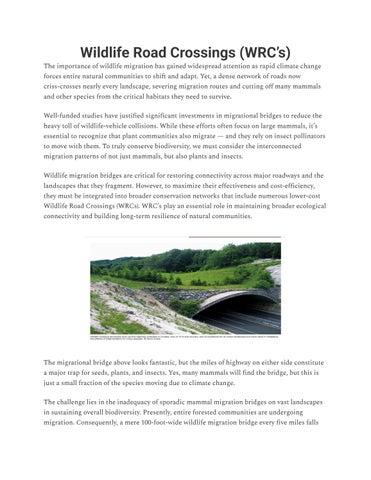
The migrational bridge above looks fantastic, but the miles of highway on either side constitute a major trap for seeds, plants, and insects. Yes, many mammals will find the bridge, but this is just a small fraction of the species moving due to climate change.
The challenge lies in the inadequacy of sporadic mammal migration bridges on vast landscapes in sustaining overall biodiversity. Presently, entire forested communities are undergoing
migration. Consequently, a mere 100-foot-wide wildlife migration bridge every five miles falls