
Activated, April 2026: The Kingdom of God

Page 1


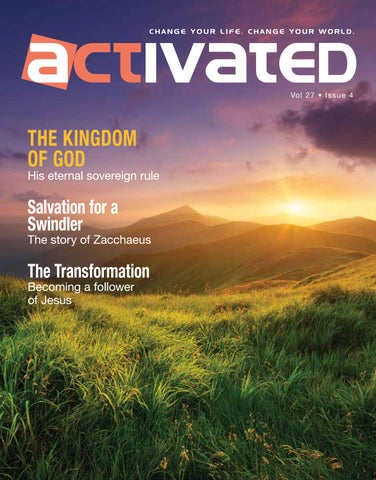
THE KINGDOM OF GOD

His eternal sovereign rule

Salvation for a Swindler

The story of Zacchaeus

The Transformation

Becoming a follower of Jesus
PERSONALLY SPEAKING

The need to “belong” seems to be an inherent desire in all of us. To fulfill this need for acceptance and belonging, think of how many young people seek to be part of an “urban tribe.” Have you ever noticed how many books, movies, and songs allude to coming home in one way or another? There is an undefinable longing; we’re searching, but for what?

Hebrews 11 gives us a bird’s-eye view into the lives of the patriarchs, those great men of faith. They all shared this same longing and declared that “they were strangers and pilgrims on the earth.” They were seeking a “homeland … a heavenly country,” and for this reason “God is not ashamed to be called their God, for He has prepared a city for them” (Hebrews 11:13–16 NKJV).

In his famous book, Mere Christianity, C. S. Lewis wrote, “If I find in myself a desire which no experience in this world can satisfy, the most probable explanation is that I was made for another world.” When Jesus came to earth, He proclaimed this “other world.” He called it the “kingdom of God.” That is the theme of this month’s Activated issue.

This month’s magazine also focuses on Easter, when Jesus rose from the tomb and conquered death forever. Jesus’ resurrection ushered in the kingdom of God and made it possible for all who believe and receive Him to live forever with Him in heaven.

So, happy homecoming! Welcome to God’s kingdom, where you can truly “belong” and find His peace and rest.

For more information on Activated , visit our website or write to us.

Website: activated.org

Email: activated@activated.org

Local contacts:

South Africa:

Email: activated@helpinghandsa.org

India:

Email: activatedindia@activated.org

Nigeria:

Cell: +234 (0) 7036963333

Email: activatednigeria@activated.org

Philippines:

Cell: (0922) 8191142

Email: activated.phils@gmail.com

© 2026 Activated. All Rights Reserved. Designed by Gentian Suçi.

All scripture quotations, unless otherwise indicated, are taken from the English Standard Version (ESV). Copyright © 2001 by Good News Publishers. Used by permission. Other Bible quotations are from the following sources: New King James Version® (NKJV). Copyright © 1982 by Thomas Nelson. Used by permission. New International Version (NIV). Copyright © 1978, 1984, 2011 by International Bible Society. Used by permission. New Living Translation (NLT). Copyright © 1978, 1996 by Tyndale House Publishers. Used by permission. Amplified Bible (AMP). Copyright © 1954, 1958, 1962, 1964, 1965, 1987 by The Lockman Foundation. Used by permission. The Holy Bible: International Standard Version®. Copyright © 1996-forever by The ISV Foundation. All rights reserved internationally. Used by permission. New Century Version (NCV). Copyright © 2005 by Thomas Nelson, Inc. Used by permission. All rights reserved.

WHAT MAKES THE “KINGDOM OF HEAVEN” HEAVENLY?

What would the perfect neighborhood or city look like? Perhaps it would have mansions lining the streets and parks on every corner. There would be no traffic jams, many beautiful restaurants, and an ideal climate. Everyone would have plenty of money. There would be unlimited health benefits, or better yet, no one would ever get sick.

Now imagine that perfect place with mean people living there. They lie, cheat, and steal. They get angry and are violent. They are always complaining. The perfect neighborhood and city are now far from perfect, not because something is missing in the way of material goods, but because the people living there ruin it.

The Pharisees were searching for their “ideal world.” They called it “God’s kingdom,” and to them, it meant the overthrow of the Roman Empire, Israel becoming a powerful nation, and an increase in their power and authority. When Jesus appeared on the scene, they asked Him when God’s kingdom would come, and Jesus told them, to their chagrin, that God’s kingdom wasn’t something they could see with their eyes or a place that could be identified by sight; rather, He said, “God’s kingdom is within you.” (See Luke 17:20–21.)

Jesus did not come to build a “better world.” Rather, He focused on making people better through spiritual

rebirth and transformation. He showed us how much God loves us. He taught us how to love God and others. He brought us into right relationship with God by paying the ultimate price for all the sins we’ve committed and will ever commit. When His disciples went out to further His kingdom, they took on the role of servants, just as Jesus had, and focused on people’s eternal souls, encouraging them, as Paul said, to “be reconciled to God” (2 Corinthians 5:20).

In the end, God’s kingdom rules where believers live in harmony with God and others. The kingdom’s inhabitants may live in nice houses or a local slum. They may be single or married, young or old, healthy or sick. Even so, they make up the kingdom, and God dwells with them, filling them with His presence. What’s more, His presence emanates from them into the world every time a member of His kingdom shares a smile or kind word, helps someone in need, and shares the truth of God’s Word and His love with others.

May we enjoy living in and expanding His kingdom every single day.

Lori Lynch is an educator who has taught children on three continents. She is also an author. She currently lives in the United States, where she homeschools her children. ■

THE KINGDOM OF GOD

The kingdom of God was a central theme of Jesus’ teachings throughout the Gospels, and is found in key passages, such as the Lord’s Prayer, the Last Supper, and in numerous parables. The Sermon on the Mount, one of the best known of Jesus’ teachings, talks about the reality of the kingdom of God and provides important principles on how to live as Christians within God’s kingdom.

So what is the kingdom of God? In general terms, the kingdom of God is referred to in the Bible as God’s eternal and sovereign rule over the entire universe. “The Lord has established his throne in heaven, and his kingdom rules over all” (Psalm 103:19). The Lord is the Sovereign of the universe, and the kingdom of God is His reign (1 Timothy 6:15–16).

While the phrase “kingdom of God” is not found in the Old Testament, the concept of God’s kingdom is present in many Old Testament verses, such as: “For the kingdom is the Lord’s, and He rules over the nations” (Psalm 22:28 NKJV). Scripture also foretold of the one to come who would establish the kingdom, understood to be the coming Messiah:

“For to us a child is born, to us a son is given; and the government shall be upon his shoulder, and his name shall be called Wonderful Counselor, Mighty God, Everlasting Father, Prince of Peace. Of the increase of his government and of peace there will be no end, on the throne of David and over his kingdom, to establish it and to uphold it with

justice and with righteousness from this time forth and forevermore” (Isaiah 9:6–7).

In Jesus’ day, the general understanding regarding this long-anticipated Messiah was connected to the hope of deliverance from the foreign occupation of the Jewish people. Thus, there was excitement when people heard of a man who was doing miracles and speaking of the kingdom of God. Perhaps the time had come for the deliverance of the nation of Israel and the setting up of the physical national kingdom they had been waiting for. However, Jesus’ teaching about the kingdom went beyond the expectation of a temporal political or geographical entity. Instead, He in essence redefined altogether the kingdom of God.

A present or future kingdom?

Throughout the Gospels, Jesus taught that the kingdom of God is both a present reality and a future one. On some occasions, He said that the kingdom had arrived (Mark 1:14–15), and at other times He spoke of it as yet to come in the future. Jesus’ miracles were signs that the kingdom of God had come and was present, at least in part, during His ministry (Luke 7:20–22).

For example, when Jesus was asked by the Pharisees when the kingdom of God would come, He proclaimed, “Behold, the kingdom of God is in the midst of you” (Luke 17:20–21). While this passage speaks of the kingdom being present, Jesus also spoke of it elsewhere as a future reality. “Then the King will say to those on his right, ‘Come, you who are blessed by my Father, inherit the kingdom prepared for you from the foundation of the world’” (Matthew 25:34).

So, is the kingdom of God something that was present in Jesus’ day (and continues to be present today), or is it a future kingdom which arrives after Jesus’ Second Coming?

When the kingdom is seen as the dynamic reign of God, it can be understood to be both a present reality initiated through the ministry of Jesus as well as a future one. The Bible teaches that the completion of the kingdom occurs when Jesus returns to set up His

kingdom on Earth. “The kingdom of the world has become the kingdom of our Lord and of his Christ, and he shall reign forever and ever” (Revelation 11:15).

Living in the kingdom

In the Gospel of John, we read that being born again is required for us to enter the kingdom of God ( John 3:3). It is through accepting Jesus as Lord and Savior, believing in His resurrection, and entering into relationship with God that one becomes a part of His kingdom. For those who put their trust in God and enter into a personal relationship with Him, made possible through Jesus’ death on the cross, the kingdom of God becomes a present reality.

Jesus demonstrated through His life, death, and resurrection that the kingdom of God wasn’t an ambiguous future hope; through His coming, it became imminent and demanded an immediate response. In the first chapter of the Gospel of Mark, we read that Jesus came “proclaiming the gospel of God, saying, ‘The time is fulfilled, and the kingdom of God is at hand; repent and believe in the gospel’” (Mark 1:14–15).

Jesus conveyed the meaning of the kingdom of God through His actions and revealed information about the kingdom through His teaching. His dining with the outcasts of the society of His day (the tax collectors and sinners), touching people deemed unclean, forgiving sins, and healing on the Sabbath gave a deeper understanding of the Father’s grace, love, care, and mercy, and the nature of His kingdom. Jesus teaching the disciples to pray “Our Father in heaven” brought them into a new relationship with God as their heavenly Father, making them part of His family (Matthew 6:9).

On top of that, Jesus made it clear that entrance into God’s kingdom wasn’t limited to Israel when He spoke to the Samaritan woman at the well, telling her that “the hour is coming, and is now here, when the true worshipers will worship the Father in spirit and truth” ( John 4:23). The invitation to enter into God’s kingdom is extended to all people, “from every nation, from all tribes and peoples and languages” (Revelation 7:9).

Entering the kingdom through belief in Jesus grants us eternal life, but eternal life isn’t something that only begins once we die. Eternal life, like the kingdom of God, is also a present reality and for us as believers has already begun. While our physical body will eventually die, our spirit will continue to live eternally with God. Our spirit—our essence, the person we are today—will simply exit the door of our present earthly life through death and step into the eternal continuation of our lives.

In the meantime, we are meant to be living within the kingdom of God in the present. When we are born again into God’s kingdom, the center of our lives completely shifts. Jesus calls us to “seek first the kingdom of God and His righteousness,” trusting that everything else will follow in accordance with God’s will (Matthew 6:33). When God reigns in our lives, we place our faith and trust in Him, and we seek to align our lives, our actions and decisions with His will (Matthew 6:10).

When we enter the reign of God, the call is for us to integrate our “kingdom”—what we have reign or control over in our own lives—with His kingdom. We are to seek to align our will with God’s and let His will, as expressed in the Bible, guide our lives. We are called to advance His kingdom by extending to others the invitation to enter His kingdom and to be a living example of His unconditional love for others.

Living within the kingdom in the present means that we allow God to rule and reign in our lives, acknowledging and honoring Him as the one who created us. It means striving to live in a way that honors and gives glory to Him. We model our lives after the example Jesus set of loving God and loving others (Matthew 22:37–39).

Living in God’s kingdom means living day by day as one who has a personal, interactive relationship with Him—a relationship that encompasses our earthly life and continues on throughout eternity.

Peter Amsterdam is a Christian author and Bible teacher, and retired co-director of TFI, a Christian online network. ■

THE TRANSFORMATION

Romans 12:2 says, “Do not conform to the pattern of this world, but be transformed by the renewing of your mind. Then you will be able to test and approve what God’s will is—his good, pleasing and perfect will” (NIV). We are either living the way the world lives, or we are being transformed into what God has designed for us. The point is that something is defining us. It starts with our thoughts, followed by our actions.

I recently saw a video of a woman rock climbing. She was easily scaling the indoor rock wall, breaking records, and I thought it was amazing. I would love to be able to do that, I thought.

If I wanted to become a rock climber, I would have to change things in my life. There’s a gym where you can train, so I’d have to get a membership. I would need the right shoes, too. Then I would have to actually go to the climbing gym, and I would probably totally embarrass myself on the most beginner wall there. My guess is that my first attempts would result in some bruises, humiliation, and sore muscles. I would focus my workouts on the muscles and skills needed for this new passion. All this would be at the sacrifice of other activities.

I would build community with other rock climbers. My enthusiasm for rock climbing would no doubt find its way into conversations, and I would probably convince a few of my friends to climb with me.

If I did all of this, within a year or so, from what was once a woman who could barely do a pull-up, there would emerge one who could probably scale the mid-range wall in the climbing gym. One day, my identity would be “rock climber,” even if I still worked at a desk job.

When I lay it out for myself this way, it’s easy to also see how much one would have to reorient their life if they really wanted to transform into a follower of Jesus. It’s not a passive thing; it’s not something that will just automatically happen to you.

I have been asking myself some questions that may be helpful for you, too. Questions such as: Does where I spend my time each day reflect my passion for following Jesus? And what is shaping me right now? Yes, they’re hard to answer, but worth the effort, if you really want the transformation.

Marie Alvero is a former missionary to Africa and Mexico. She currently lives a happy, busy life with her husband and children in Central Texas, USA. ■

APPLYING SCRIPTURE

The Bible is full of treasures, and scripture can be likened in a way to a jewel with many aspects. When viewing a jewel from different angles, with light shining from different directions, new beauty is seen and a new perspective gained. Likewise, Bible verses can take on greater clarity and we can gain a deeper understanding of their meaning as we apply them to our lives.

One thing that I have found to be very helpful when reading the Bible is to pray for guidance and clarity, as Psalm 119:18 says: “Open my eyes to see the wonderful truths in your instructions” (NLT). God’s Spirit will guide us as we read His Word, and help us to better absorb and grasp the truth ( John 16:13).

Another point that is helpful, either when claiming a scripture while praying or in my everyday understanding and application of it, is to read the surrounding verses. Doing this helps give the verse context and can help me apply it correctly. Paul instructed Timothy, “Study and do your best to present yourself to God approved, a workman who has no reason to be ashamed, accurately handling and

skillfully teaching the word of truth” (2 Timothy 2:15 AMP).

Here are two examples of well-known Bible verses that become clearer and more meaningful when reading the surrounding text.

Many people have heard the verse in Matthew that says: “Seek first the kingdom of God and his righteousness, and all these things will be added to you” (Matthew 6:33 NKJV). This is correctly seen as a promise of God’s supply. However, some people use this verse to promote the idea that if you follow God, or give your tithes and offerings, that God promises to make you rich or give you everything you want. But by reading the surrounding verses, the true meaning is clear.

“Can any of you add a single hour to the length of your life by worrying? And why do you worry about clothes? Consider the lilies in the field and how they grow. They don’t work or spin yarn, but I tell you that not even Solomon in all of his splendor was clothed like one of them.

“So don’t ever worry by saying, ‘What are we going to eat?’ or ‘What are we going to drink?’ or ‘What are we going to wear?’ because it is the unbelievers who are eager for all those things. Surely your heavenly Father knows that you need all of them! But first be concerned about God’s kingdom and his righteousness and all of these things will be provided for you as well” (Matthew 6:27–29,31–33 ISV).

We see that rather than promising riches or wealth, Jesus was telling His disciples not to worry and fret that they would lack their basic necessities, such as food and clothing, but rather to focus on obeying and serving God, trusting that He would provide these things as He knows best.

Another often-quoted verse is “I can do all things through Christ who strengthens me” (Philippians 4:13 NKJV). Sometimes we claim this when facing a difficult task, feeling overwhelmed, or when we are lacking physical health or strength, which is fine, but when we

read the surrounding verses, we see that Paul was actually talking about a very different topic.

He said: “I am not telling you this because I need anything. I have learned to be satisfied with the things I have and with everything that happens. I know how to live when I am poor, and I know how to live when I have plenty. I have learned the secret of being happy at any time in everything that happens, when I have enough to eat and when I go hungry, when I have more than I need and when I do not have enough. I can do all things through Christ, because he gives me strength” (Philippians 4:11–13 NCV).

So, the strength referred to here is being content or thankful in all situations, not allowing difficulty to make us doubt God’s love or question Him, but rather looking to God for strength to live with joy in whatever circumstances we find ourselves.

I have also found it helpful to read a Bible verse or passage in different versions or translations. This often gives me a well-rounded application, and sometimes the use of different words or phrases in the various versions helps me understand the meaning more deeply. (There are websites and apps that have a number of translations of the same verse for comparison.)

It is important to go into Bible reading and study time with an open mind and heart. For example, if I feel strongly about a certain situation or course of action, rather than going into my time of study hoping to find confirmation of my opinion or feelings, I need to be open to possibly having my opinions or feelings changed by God’s Word. Also, it’s important to realize that God’s Word, while interesting and informative, should also be transformative. In other words, I should desire that God changes and transforms me through His Word, so I become more like Jesus in my thoughts and actions.

Simon Bishop does full-time mission and humanitarian work in the Philippines. ■

WHERE’S THE TAXI?

The other day, my wife and I were on the last leg of our journey home. It was too late to take a bus, so we knew the only option was to get a taxi. But the area where we normally find a line of taxis was empty, and though traffic was still rolling by, no taxi was to be found. We tried another stretch of road around the corner, but the prospect there was just as bleak.

I was tired, and the medications that I had taken earlier after a dental procedure were starting to affect my mood and wear me down. Yes, I had to admit, I was somewhat sinking. It was late and I was feeling sad, and that realization edged me even lower. “Why am I discouraged,” I thought, “things can’t be that bad.” But it seemed that they were.

And then it struck me. I’m a child of God, a believer in Jesus, and He has my best interests at heart. Is this true? Or not? I know it is true, and so I prayed out loud saying, “In Jesus’ name, we ask for a taxi right now to take us home.”

You can probably finish the story for yourself. A taxi appeared right then and there and headed to our location on the roadside. As I stepped into the vehicle after my wife, I told her, “That was an answer to prayer!”

This is not a monumental testimony. I have experienced countless answers to prayer in my life. But what makes this story special is that it was not simply an

answer to our plea, “Please, Lord, send a taxi.” There was something more. There was a need for the taxi, but there was also a need for peace and encouragement. That wave of negativity disappeared when I remembered who God is and who I am in Him. He has our backs and simply asks us to commit all our cares to Him in prayer and to place our trust in Him.

Marcus Vernier lives in Taiwan. Apart from his missionary activities, he is pursuing an interest in watercolor painting and writing.  ■

The peace of God, which surpasses all understanding, will guard your hearts and your minds in Christ Jesus.—Philippians 4:7

Peace comes not from the absence of trouble, but from the presence of God.—Author unknown

Our daily lives can easily become filled with stress, pressure, and confusion. But we can stop at any moment and enter into God’s presence through prayer and find peace and be refreshed.—Maria Fontaine

GOD Communication with GOD

Can you imagine really caring about someone—your spouse, your child, your best friend—and never talking with him or her? Of course not. Love is built on communication and so are all the most important relationships we are blessed with.

So, if Jesus is both our Savior and Friend, as the Bible says, and if God is our heavenly Father, then isn’t it only logical that they would want to communicate with us? If Christianity were merely a philosophy or code of ethics or even just a religion, those might simply be clever analogies—savior, friend, father—to try to explain our relationship to God and Jesus in a philosophical sort of way. But true Christianity is far more than any of those! It’s more than rationale and rules, rhetoric and ritual, morals and ethics; it’s a living, loving, personal relationship—one that grows richer, deeper, and stronger through honest, open communication with our Creator. The means of communication that God has provided for us is prayer and His Word, which means not only talking to God, but also listening to His still, small voice speaking to our heart. He wants us to tell Him our needs and desires, our problems and fears, our innermost

thoughts, and our secret dreams. And it works both ways. He also wants to answer our questions, help solve our problems, encourage us when we feel down, and share in our victories and joys.

Most of all, He wants to help us understand and experience His love in a very real and personal way. “For God so [greatly] loved and dearly prized the world, that He [even] gave His [One and] only begotten Son, so that whoever believes and trusts in Him [as Savior] shall not perish, but have eternal life” ( John 3:16 AMP).

If you have not yet received Jesus as your Savior, you can do so by praying the following prayer:

Dear Jesus, I believe that You are the Son of God and that You died on the cross for me so that, through Your death and resurrection, I can live forever with You in heaven. I ask that You forgive my sins. I open the door of my heart to You. Please fill me with Your Holy Spirit and help me live in a way that glorifies You. Guide my life and help me to follow You. In Your name I pray. Amen.

Keith Phillips was Activated ’s editor-in-chief from 1999 to 2013. He and his wife Caryn now work with the homeless in the USA. ■

SALVATION FOR A SWINDLER

Zacchaeus, the main character in this story, was quite an infamous guy, especially when contrasted with the many religious figures who walked the streets of Jericho, which was considered “the city of priests.” We read about his encounter with Jesus in the Gospel of Luke.

Zacchaeus was not only a tax collector, but a chief tax collector and a very wealthy man (Luke 19:1–2).

Tax collectors were considered some of the worst sinners among the Jewish people, because they extorted excessive sums on behalf of the Roman occupying authority, and were considered robbers of the poor. Zacchaeus not only taxed the people, but anything he collected from them above the tribute required by Rome went straight into his own pocket.

One day something happened that completely changed Zacchaeus’ life and worldview. He had heard

about Jesus and the many miracles He had performed.— Not only that, but it was said that Jesus was a friend of tax collectors and sinners (Matthew 11:19)! In fact, one of His close followers, Matthew, had himself been a tax collector before becoming Jesus’ disciple (Matthew 9:9).

For some time, Zacchaeus had wanted to meet the “carpenter-turned-prophet.” Maybe he wondered, “Could a man supposedly so religious be a friend of someone like me, when the priests and many people of my city despise me? Would Jesus be my friend too?” He had no real friends and he had come to the realization that his wealth did not bring true satisfaction and peace.

Then one day Jesus passed through Jericho. When Zacchaeus heard that He was in town, he dropped everything and hurried off to see for himself who Jesus was. A large crowd with Jesus in their midst was moving slowly down the road, but Zacchaeus was so short that he couldn’t see Him.

Quickly he spotted a large sycamore tree ahead of the crowd. Perhaps from that tree he would be able to see Jesus as He passed by and hear Him speak! Oblivious to what people would think of him, Zacchaeus ran past the crowd and scurried up into the tree (Luke 19:3–4). When Jesus reached the tree where Zacchaeus was perched, He turned and looking straight up at him said, “Zacchaeus, hurry and come down. I must stay at your house today” (Luke 19:5).

Zacchaeus was shocked! As he slid down from the tree, it was hard for him to believe that there hadn’t been some sort of mistake. How could Jesus have known his name? He immediately came down and joyfully escorted Jesus to his home (Luke 19:6).

Upon witnessing this, the crowd that followed grumbled indignantly, saying, “How can this be? Jesus has gone to stay with a man who is a sinner and a tax collector!” (Luke 19:7). But Jesus knew exactly what He was doing. He had looked beyond Zacchaeus’ outward

appearance to see the desperate hunger for truth and salvation within his heart.

In that one encounter with Jesus, Zacchaeus discovered the way to enter God’s kingdom. He received Jesus into his heart and life and home and became a follower of Jesus’ example and teaching.

Excitedly, he said, “Jesus, right here and now I declare that I will give to the poor half of everything I own! And to make amends to those whom I have cheated, I promise to restore four times the amount I took from them” (Luke 19:8). What an astonishing and costly commitment made by a man who had just experienced a dramatic life change after talking with Jesus!

Then Jesus exclaimed, within earshot of the crowd outside, “Today salvation has come to this house. For truly the Son of Man came to seek and to save that which was lost” (Luke 19:9–10).

No matter how bad Zacchaeus had been before, the Lord’s love was great enough to forgive him. In fact, there is nothing recorded of Jesus making mention of Zacchaeus’ sins, as Zacchaeus showed the tangible fruit of repentance through his actions.

Because Zacchaeus “received the Lord joyfully” (Luke 19:6), his story has echoed down through the ages as an example of how God can change the life of any person—no matter what their past or what wrongs they have committed or the bad decisions they have made—when they surrender their lives to God. In the parable of the lost sheep, a story Jesus told in response to complaints that He welcomed tax collectors and sinners, He concluded by highlighting “the great joy in heaven over one lost sinner who repents and returns to God” (Luke 15:1–7).

May we always rejoice in the Lord’s great love for us and His desire to seek and save every person who is lost and in need of the Savior.

Adapted from an article in Treasures, published by the Family International. ■

EASTER RESURRECTION PLANTS

I get wowed almost every day by some amazing aspect of God’s creation! Today, it was the resurrection plant, so named because, though it appears to be dead, it is simply dormant until it finds water and blossoms to life again. These plants live in dry desertlike conditions and can survive years without water.

Resurrection plants can lose 95% of their cellular water and still survive. It might take years before they find any water, but when they do, the magic begins, and they open up and turn green in just a few hours.

Some Christian families pass down their resurrection plants from one generation to the next to remind them of Jesus’ resurrection. The beautiful plant is often displayed in a bowl of water at Christmas and Easter. It is a powerful reminder of the cycles of life and death, and the promise of new beginnings and renewal that come with faith in God.

The resurrection plant also illustrates that even when we are in dry times, there is hope of renewal. The spark of heavenly life remains within us despite outward appearances. We also need to adapt in hard times and be resilient. These plants also remind us that sometimes it takes time for us to find solutions to our problems—to draw from Jesus, the water of life, in a dry and dusty land. We may seem dormant during the quiet phases of our lives, but when the time is ripe, we have to let Jesus lead us to our desired haven where we can flourish and blossom.

I am reminded of what the Lord said to Jeremiah: “Blessed is the one who trusts in the Lord, whose

confidence is in him. They will be like a tree planted by the water that sends out its roots by the stream. It does not fear when heat comes; its leaves are always green. It has no worries in a year of drought and never fails to bear fruit” ( Jeremiah 17:7–8 NIV).

Easter is a time to meditate on this transformation from the death of the old to new life. It’s a time to celebrate the fact that Jesus laid down His life for us so that we, through His sacrifice, can have life eternal.

Curtis Peter van Gorder is a freelance writer and mime artist who spent 47 years doing missionary activities in 10 different countries. He and his wife Pauline currently live in Germany. ■

ULTIMATE SACRIFICE, ULTIMATE LOVE

When I think of God’s unspeakable love toward us, it’s absolutely mind-boggling!

Jesus left His heavenly home to come to earth to suffer and die for us. After His betrayal by one of His own followers, He was condemned to die a brutal death. He was scourged, beaten, mocked, spat upon, and crowned with thorns.

Then He was sent down the stony, narrow Via Dolorosa, often translated as the Way of Suffering. As He carried the cross, a large number of people followed Him. When they came to a place called Golgotha, they crucified Him there along with two criminals—one on His right, the other on His left. This is what happened next:

“One of the criminals who were hanged railed at him, saying, ‘Are you not the Christ? Save yourself and us!’ But the other criminal rebuked him saying, ‘Do you not fear God, since you are under the same sentence of condemnation? And we indeed justly, for we are receiving the due reward of our deeds; but this man has done nothing wrong.’ And he said, ‘Jesus, remember me when you come into your kingdom.’ And [Jesus] said to him, ‘Truly, I say to you, today you will be with me in paradise’” (Luke 23:39–43).

Even in death, Jesus acknowledged the repentant thief beside Him. Jesus spoke to him with love and compassion.

“When Jesus had received the sour wine, he said, ‘It is finished,’ and he bowed his head and gave up his spirit” ( John 19:30). When Jesus drew His last earthly breath,

His job on earth was finished. It was complete. However, for us it was not the end, but just the beginning, for He had opened the portals of heaven to all who believe.

“Surely he took up our pain and bore our suffering, yet we considered him punished by God, stricken by him and afflicted. But he was pierced for our transgressions; he was crushed for our iniquities; the punishment that brought us peace was upon him, and by his wounds we are healed” (Isaiah 53:4–5 NIV).

On the third day, Jesus rose triumphant, just as He had foretold. Through His death on the cross, Jesus purchased our salvation with His own blood.

Where would we be if Jesus had not made the ultimate sacrifice? Because of Adam’s sin, paradise was forever lost. However, in His infinite love for us, God sent His only begotten Son, who died for us so that we might be saved ( John 3:16).

Ruth Davidson (1939–2023) was a missionary in the Middle East, India, and South America for 25 years, and was an author and contributor to the website thebibleforyou.com ■

Eternal Dividends

When you invest in the kingdom of God, you are making an investment that will last for eternity. Everyone who invests their time, resources, and skills to further My kingdom will reap the rewards of the good and faithful servant and will enter into My joy (Matthew 25:23). Everyone who is faithful to commit whatever they have—no matter how seemingly small—to sharing My love and truth with others will receive a reward for their labor.

If you abide in Me and in My Word, your life will bear lasting fruit ( John 15:4–7,16). The paltry dividends of earthly investments will never last, and the temporal things of the world can provide no enduring security. So store your treasures in heaven where neither rust nor thief can destroy or steal (Matthew 6:19–20). Place your trust in Me and I will guide you to wisely invest your life in ways that will further My kingdom and reap eternal dividends.

Always keep the big picture of My eternal kingdom in sight, and don’t allow the cares of this world and its materialism to choke out your faithfulness to Me. For where your treasure is, there will your heart be also (Matthew 6:21). Invest in My kingdom by freely giving what you have received from Me to the people your life touches each day. Be faithful to share the good news of the gospel with others so that they too may enter into My kingdom.

Turn static files into dynamic content formats.

Create a flipbook
Activated, April 2026: The Kingdom of God by Activated - Issuu