Junior Kindergarten Language Arts Curriculum at a Glance Reading
Writing
Speaking & Listening
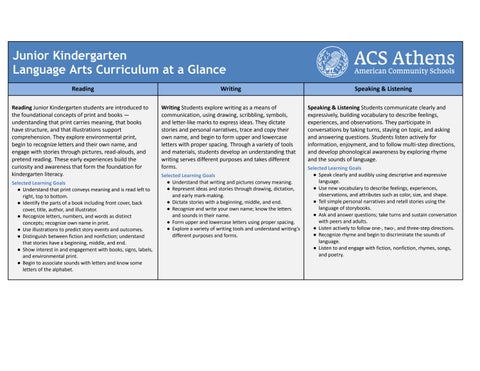
Reading Junior Kindergarten students are introduced to the foundational concepts of print and books — understanding that print carries meaning, that books have structure, and that illustrations support comprehension. They explore environmental print, begin to recognize letters and their own name, and engage with stories through pictures, read-alouds, and pretend reading. These early experiences build the curiosity and awareness that form the foundation for kindergarten literacy.
Writing Students explore writing as a means of communication, using drawing, scribbling, symbols, and letter-like marks to express ideas. They dictate stories and personal narratives, trace and copy their own name, and begin to form upper and lowercase letters with proper spacing. Through a variety of tools and materials, students develop an understanding that writing serves different purposes and takes different forms.
Speaking & Listening Students communicate clearly and expressively, building vocabulary to describe feelings, experiences, and observations. They participate in conversations by taking turns, staying on topic, and asking and answering questions. Students listen actively for information, enjoyment, and to follow multi-step directions, and develop phonological awareness by exploring rhyme and the sounds of language.
Selected Learning Goals ● Understand that print conveys meaning and is read left to right, top to bottom. ● Identify the parts of a book including front cover, back cover, title, author, and illustrator. ● Recognize letters, numbers, and words as distinct concepts; recognize own name in print. ● Use illustrations to predict story events and outcomes. ● Distinguish between fiction and nonfiction; understand that stories have a beginning, middle, and end. ● Show interest in and engagement with books, signs, labels, and environmental print. ● Begin to associate sounds with letters and know some letters of the alphabet.
Selected Learning Goals ● Understand that writing and pictures convey meaning. ● Represent ideas and stories through drawing, dictation, and early mark-making. ● Dictate stories with a beginning, middle, and end. ● Recognize and write your own name; know the letters and sounds in their name. ● Form upper and lowercase letters using proper spacing. ● Explore a variety of writing tools and understand writing’s different purposes and forms.
Selected Learning Goals ● Speak clearly and audibly using descriptive and expressive language. ● Use new vocabulary to describe feelings, experiences, observations, and attributes such as color, size, and shape. ● Tell simple personal narratives and retell stories using the language of storybooks. ● Ask and answer questions; take turns and sustain conversation with peers and adults. ● Listen actively to follow one-, two-, and three-step directions. ● Recognize rhyme and begin to discriminate the sounds of language. ● Listen to and engage with fiction, nonfiction, rhymes, songs, and poetry.