JK-5 Fine Arts and Motor Skill Development June 2026
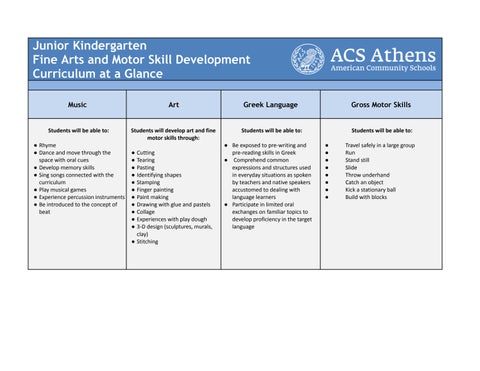
Junior Kindergarten Fine Arts and Motor Skill Development
Curriculum at a Glance
Students will be able to:
● Rhyme
● Dance and move through the space with oral cues
● Develop memory skills
● Sing songs connected with the curriculum
● Play musical games
● Experience percussion instruments
● Be introduced to the concept of beat
Students will develop art and fine motor skills through:
● Cutting
● Tearing
● Pasting
● Identifying shapes
● Stamping
● Finger painting
● Paint making
● Drawing with glue and pastels
● Collage
● Experiences with play dough
● 3-D design (sculptures, murals, clay)
● Stitching
Students will be able to:
● Be exposed to pre-writing and pre-reading skills in Greek
● Comprehend common expressions and structures used in everyday situations as spoken by teachers and native speakers accustomed to dealing with language learners
● Participate in limited oral exchanges on familiar topics to develop proficiency in the target language
Students will be able to:
● Travel safely in a large group
● Run
● Stand still
● Slide
● Throw underhand
● Catch an object
● Kick a stationary ball
● Build with blocks
Kindergarten Specialist Classes Curriculum at a Glance
Students in grades K-5 develop competencies in demonstrating knowledge and understanding of forms, styles, ideas, and functions of art and applying skills, techniques, media, and processes to create and present art They also use the language of art to critique, assess, analyze, and communicate and make connections between art and other disciplines, personal experience, world history, and cultures.
Students will be able to:
● Identify and explore the elements of art, including line, shape and form, color, value, and texture
● Understand that art can convey ideas and serve different functions
● Use art materials and tools in a safe and responsible manner
● Use different media, techniques, and processes to communicate ideas, experiences, and stories
● Use a variety of materials and media and demonstrate an understanding of how to produce various visual effects
● Use their senses to make observations about works of art. Describe what they see in a work of art
● Classify artworks into general categories, such as painting,
Students will be able to:
● Begin to identify low and high pitch, loud and soft dynamics, and fast and slow tempo
● Begin to develop the ability to follow/match tempo
● Sing from memory and variety of songs
● Begin to develop the ability to match dynamic levels
● Respond to cues from conductor,
● Maintain a steady tempo with the help of musical accompaniment
● Follow call and response
● Begin to control how sounds can be made louder, quieter, faster, and slower
● Identify different ways sounds can be made
● Begin to develop an understanding of timbre
● Recognize and use changes in timbre, tempo, and dynamics,
● Use untuned percussion instruments
● Begin to develop an understanding of rhythms
● Respond physically to music
● Use actions whilst singing
● Choose and order sounds to achieve an effect/image
● Compose and perform simple effects /rhythms
● Read graphic notation,
● Recognize rhythmic patterns
● Talk about music (dynamics, tempo,
Students will be able to:
● Perform loco--motor and non/loco--motor moves to verbal and non/verbal cues
● Move, stop and start on signal, change direction, level, speed and pathway
● Maintain balance in a variety of positions
● Skip
● Roll a ball underhand
● Throw a ball overhand and underhand
● Catch a bounced ball
● Kick a stationary bal
● Keep balloons in the air using different body parts
● Mirror movement of a leader or partner
● Move on, over, under and around equipment in a variety of ways
● Transfer weight by rocking and rolling on curved body surfaces
● Perform movements in flight: hop, jump and leap
● Jump over a self/ turned rope or a rope turned by others
● Move with self/ control, avoiding collisions.
● Identify body parts
● State rules for safe use of equipment
● Use correct terms to describe equipment
● Demonstrate knowledge of movement vocabulary (i.e. roll, dodge)
● Understand the meaning of the term “best effort”
At this level, students develop competencies in Mouse and Keyboard use, Graphics, Word processing, Content area reinforcement (reading and writing), and Simulations
Students will be able to:
● Use a mouse to click and double click
● Access programs
● Use directional prompts for beginner coding skills
● Use simple drawing tools
● Use simple text tools
● Use programs for reinforcement of subject area content in science, and reading
Students will be able to:
● Be exposed to pre--writing and pre--reading skills in Greek
● Comprehend common expressions and structures used in everyday situations as spoken by teachers and native speakers accustomed to dealing with language learners
● Participate in oral exchanges on familiar topics to develop proficiency in the target language
printmaking, collage, sculpture, pottery, textiles, architecture, photography and film
● Use basic art concepts and vocabulary when making observations about art
● Identify the elements of art in the work
● Describe similarities and differences in works
● Use basic art concepts and vocabulary when communicating ideas and feelings about work
• Present personal responses to subject matter, materials, techniques and use of design elements in artworks
● Using vocabulary learned in class, critique their own work
● Identify connections between the visual arts and other disciplines
● Recognize that all cultures produce art and can identify specific works of art as belonging to particular cultures, times, and places
● Use brainstormed criteria and appropriate terminology to evaluate the quality of a composition or performance
● Create art based on personal observation and experience rhythm, instrumentation, etc.) within an aural example and/or a class performance, using some music vocabulary
● Participate in a variety of loco--motor and non/loco--motor activities during recess
● Identify activities that are active and inactive
● Explore self and general space in a variety of ways
● Perform basic loco--motor skills without tiring quickly
● Participate in vigorous physical activity in physical education class
● Travel on, over, under apparatus with increasing control
● Work independently and safely in self and shared space
● Stop on the signal and keep equipment still
● Demonstrate cooperation with a partner
● Enjoy participating in physical activity
● Try new movement tasks (i.e., log roll)
● Continue to participate when not successful on the first try
● Identify physical activities that they consider to be fun
First Grade Specialist Classes Curriculum at a Glance
Students in grades K-5 develop competencies in demonstrating knowledge and understanding of forms, styles, ideas, and functions of art and applying skills, techniques, media, and processes to create and present art. They also use the language of art to critique, assess, analyze, and communicate and make connections between art and other disciplines, personal experience, world history, and cultures.
Students will be able to:
● Identify and explore the elements of art, including line, shape and form, color, value, and texture, Pattern, and Proportion
● Understand that art can convey ideas and serve different functions
● Use art materials and tools in a safe and responsible manner
● Use different media, techniques, and processes to communicate ideas, experiences, and stories
● Use a variety of materials and media and demonstrate an understanding of how to produce various visual effects
● Use their senses to make observations about works of art
● Describe what they see in a work of art
Students will be able to:
● Identify low and high pitch, loud and soft dynamics, and fast and slow tempo
● Follow/match tempo
● Sing from memory and variety of songs from different cultures
● Match dynamic levels
● Respond to cues from conductor
● Maintain a steady tempo with the help of musical accompaniment
● Follow call and response
● Begin to control how sounds can be made louder, quieter, faster, and slower
● Identify different ways sounds can be made and changed
● Begin to develop an understanding and recognition of timbre
● Recognize changes in timbre, tempo, pitch, and dynamics
● Use tuned and untuned percussion instruments
● Develop and understanding of rhythms
Students will be able to:
● Perform a movement pattern changing shape, level and/or pathway
● Move (stop, start, and change direction) to avoid others
● Explore controlling objects in a variety of ways in self and general space
● Throw overhand and underhand with force
● Catch a self--tossed object with hands or with an implement
● Strike a lightweight ball using different body parts
● Roll a ball to a target
● Run and kick a ball without hesitating or stopping prior to the kick
● Move in response to a variety of stimuli
● Use body actions as a means of communication/ expression
● Roll without stopping or hesitating
● Mount and dismount equipment safely
● Take off, maintain control in flight, and land safely
● Continuously jump a self--turned rope
● Demonstrate knowledge of movement concepts
● Use feedback to improve
At this level, students develop competencies in Mouse and Keyboard use, Graphics, Word processing, Content area reinforcement (reading and writing), and Simulations.
Students will be able to:
● Access learning programs
● Demonstrate continued awareness of mouse and keyboard use
● Apply drawing tools to create digital images
● Use problem solving skills for beginning coding
● Demonstrate beginning word processing skills to create stories, and other projects
Level I Students will be able to:
● Comprehend common expressions and structures used in everyday situations as spoken by teachers and native speakers accustomed to dealing with language learners
● Participate in oral exchanges on familiar topics to develop proficiency in the target language
● Identify essential information in short written texts to recognize written structures of the target
Level II Students will be able to:
● Use appropriate vocabulary, gestures, and oral expressions for greeting, introductions, leave taking, and other common or familiar interactions
● Use the target language to express needs, feelings, and ideas related to everyday situations
● Understand the basic ideas of oral messages and short conversations based on simple or familiar topics appropriate at this
● Classify artworks into general categories, such as painting, printmaking, collage, sculpture, pottery, textiles, architecture, photography and film
● Use basic art concepts and vocabulary when making observations about art
● Identify the elements of art in the work
● Describe similarities and differences in works
● Use basic art concepts and vocabulary when communicating ideas and feelings about work
● Present personal responses to subject matter, materials, techniques and use of design elements in artworks
● Using vocabulary learned in class, critique their own work
● Identify connections between the visual arts and other disciplines.
● Recognize that all cultures produce art and can identify specific works of art as belonging to particular cultures, times, and places
● Create art based on personal observation and experience.
● Recognize that different artists have different voices and styles
● Begin learning about art movements, recognize works of art by artists and styles
● Build stamina in working on projects for more class periods, and working for longer increments during class time
● Students will understand how to compose a complete piece of art, and build stamina in finishing a complete piece
● Perform music with control of pulse and awareness of what others are playing
● Respond physically to music
● Use actions whilst singing
● Show a sense of the shape of the melody
● Sing with use of dynamics
● Choose and order sounds to achieve an effect/image
● Compose and perform simple effects/melodies/rhythms
.
● Begin to perform/compose music applying some culture and style - - specific characteristics
● Recognize rhythmic patterns
● Begin to recognize pitch from traditional notation
● Talk about music (components of pitch, dynamics, tempo, rhythm, timbre, instrumentation, etc.) within an aural example and/or a class performance, using some music vocabulary
● Use brainstormed criteria and appropriate terminology to evaluate the quality of a composition or performance performance
● Recognize that skill development requires practice
● Repeat “cue words” for basic skills and explain their meaning
● State appropriate safety practices for moving in shared practice
● Participate in activities that require loco--motor and manipulative skills tried in physical education at other times
● Identify opportunities for active play outside of physical education class
● Participate in a variety of moderate--to-- vigorous unstructured play activities
● Recognize that participation in moderate--to--vigorous physical activity has temporary and lasting effects on the body
● Demonstrate sufficient muscle strength to momentarily support body weight
● Identify feelings and changes in the body that results from participation in vigorous physical activities (i.e. faster heart rate, perspiration)
● Sustain activities for longer periods of time without resting
● State reasons for safe and controlled movement
● Describe examples of cooperation and sharing in physical activity settings
● Remain on task until the stop signal is given
● Begin to work cooperatively with a partner and in a small group
● Try new activities
● Identify feelings that result from participation in physical activity
● Express pleasure resulting from
integrated into the subject area curricula
● Engage in online platform for science concepts language
● Write expressions and short sentences to convey personal ideas, concepts, and information
● Learn general facts concerning the geography of the country and cultural heritage and lifestyles of the people in order to develop a cultural awareness
● Use technology to present information about family, school events, and celebrations developmenta l level
● Understand oral and written descriptions of people and objects in the environment
● Learn poetry, songs, proverbs, short anecdotes or narratives
● Write in a variety of formats to describe and provide information about oneself, friends and family, school activities
● Use technology to research and present on a variety of information of designated special projects, school events, and celebrations
progress in learning a new skill
Second Grade Specialist Classes Curriculum at a Glance
Students in grades K-5 develop competencies in demonstrating knowledge and understanding of forms, styles, ideas, and functions of art and applying skills, techniques, media, and processes to create and present art. They also use the language of art to critique, assess, analyze, and communicate and make connections between art and other disciplines, personal experience, world history, and cultures.
Students will be able to:
● Identify and explore the elements of art, including line, shape and form, color, value, and texture, Balance, Pattern, Proportion
● Understand that art can convey ideas and serve different functions
● Use art materials and tools in a safe and responsible manner
● Use different media, techniques, and processes to communicate ideas, experiences, and stories
● Use a variety of materials and media and demonstrate an understanding of how to produce various visual effects
● Use their senses to make observations about works of art
● Describe what they see in a work of art
● Classify artworks into general
Students will be able to:
● Identify low and high pitch, loud and soft dynamics, fast and slow tempo
● Follow/m atch tempo
Sing from memory and variety of songs from different cultures
● Match dynamic levels
● Respond to cues from conductor
● Maintain a steady tempo
● Follow call and response
● Begin to control how sounds can be made louder, quieter, faster, and slower
● Identify different ways sounds can be made and changed
● Begin to develop an understanding and recognition of timbre
● Recognize and use changes in timbre, tempo, pitch, and dynamics
● Use tuned and un-tuned percussion instruments
● Develop and understanding of rhythms and poly-rhythms
● Perform music with control of
Students will be able to:
● Throw a ball hard overhand demonstrating a side orientation
● Catch a ball tossed to different levels (i.e., high, low)
● Strike a ball with your hand or implement using a side orientation.
● Kick a rolled ball
● Dribble with hands and feet
● Move body parts and contact objects with different amounts of force
● Reach a goal without being tagged
● Move effectively to chase and/or evade others
● Move in response to changes in accompaniment
● Demonstrate different degrees of muscular tension
● Transfer weight from one body part or parts to others with control
● Move on, over and around apparatus with purpose and control (i.e., balance beam)
● Jump a self--turned rope forward and backward without stopping or hesitating
● Demonstrate an understanding of giving a “best effort”
● Recognize similar movement concepts in a variety of skills
● Identify critical elements which lead
At this level, students develop competencies in Mouse and Keyboard use, Graphics, Word processing, Content area reinforcement (reading and writing), and Simulations.
Students will be able to:
• Demonstrate beginning keyboarding skills
• Use a variety of graphic tools to create simple digital imagery and animations
• Develop word processing skills
• Use problem solving skills for more complex beginning coding such as using “repeat command”
• Introduced to digital citizenship
Level I Students will be able to:
● Comprehend common expressions and structures used in everyday situations as spoken by teachers and native speakers accustomed to dealing with language learners
● Participate in oral exchanges on familiar topics to develop proficiency in the target language
● Identify essential information in short written texts to recognize written structures of
Level II Students will be able to:
● Use appropriate vocabulary, gestures, and oral expressions for greeting, introductions, leave taking, and other common or familiar interactions
● Use the target language to express needs, feelings, and ideas related to everyday situations
● Understand the basic ideas of oral messages and short conversations based on simple or familiar topics appropriate at this developmental
categories, such as painting, printmaking, collage, sculpture, pottery, textiles, architecture, photography and film
● Use basic art concepts and vocabulary when making observations about art
● Identify the design elements in the work
● Work for entire class pieces on one project, and work on one project for multiple class periods
● Recognize that different artists have different voices and styles
● Begin to recognize and develop their own artistic style
● Begin learning about art movements, recognize works of art by artists and styles
● Students will understand how to compose a complete piece of art, and build stamina in finishing a complete piece
● Describe similarities and differences in works
● Use basic art concepts and vocabulary when communicating ideas and feelings about work
● Present personal responses to subject matter, materials, techniques and use of design elements in artworks
● Using vocabulary learned in class, critique their own work
● Identify connections between the visual arts and other disciplines
● Recognize that all cultures produce art and can identify specific works of art as belonging to particular cultures, times, and places
● Create art based on personal observation and experience
pulse and awareness of what others are playing
● Respond physically to music
● Use actions whilst singing,
● Show a sense of the shape of the melody
● Sing and play with use of dynamics, musical phrasing and perform with intent
● Choose and order sounds to achieve an effect /image
● Recognize how musical elements can be used to compose descriptive music
● Compose and perform simple effects/melodies/rhythms.
● Perform/compose music applying some culture and style--specific characteristics
● Recognize rhythmic patterns
● Follow pitch direction from traditional notation
● Work on their own, in groups of different sizes, and as a class
● Talk about music (components of pitch, dynamics, tempo, rhythm, timbre, instrumentation, etc.) within an aural example and/or a class performance, using some music vocabulary
● Use brainstormed criteria and appropriate terminology to evaluate the quality of a composition or performance
● Perform music with awareness of the historical and cultural background of the piece/song under consideration
● Use culture specific language and attempt to reenact
to successful performance
● Explain that warm--up prepares the body for physical activity
● Participate in a variety of activities (outside physical education class) that require loco--motor, non--loco--motor and manipulative skills
● Participate in moderate--to--vigorous physical activities outside of physical education class
● Choose to participate in a variety of physical activities to improve health
● Describe ways that physical activity is good for personal well being
● Identify activities they enjoy that increase breathing and heart rate
● Support their own body weight in a variety of ways.
● Recognize that health--related fitness consists of several different components
● Follow directions and handle equipment safely
● Identify appropriate behaviors for participating with others in physical activity
● Play and cooperate with others regardless of personal differences
● Cooperate and interact positively with a partner by sharing observations about skill performance
● Develop an appreciation for physical activity in a variety of movement experiences
● Identify how cooperating and sharing contributes to completing a movement task
● Continue to participate when not initially successful
● Enjoy participation in physical activity alone and with others
/online etiquette
• Conduct beginning research skills for projects integrated into the subject area curricula the target language
● Write expressions and short sentences to convey personal ideas, concepts, and information
● Learn general facts concerning the geography of the country and cultural heritage and lifestyles of the people in order to develop a cultural awareness
● Use technology to present information about family, school events, and celebrations level
● Understand oral and written descriptions of people and objects in the environment
● Learn poetry, songs, proverbs, short anecdotes or narratives
● Write in a variety of formats to describe and provide information about oneself, friends and family, school activities
● Use technology to research and present on a variety of information of designated special projects, school events, and celebrations
performance settings appropriate to the piece(s)/song(s) under consideration
● Value the ability to be creative and to express feelings through movement
Third Grade Specialist Classes Curriculum at a Glance
Students in grades K-5 develop competencies in demonstrating knowledge and understanding of forms, styles, ideas, and functions of art and applying skills, techniques, media, and processes to create and present art They also use the language of art to critique, assess, analyze, and communicate and make connections between art and other disciplines, personal experience, world history, and cultures.
Students will be able to:
● Identify and explore different forms of art
● Understand that art can convey ideas and serve different functions
● Manipulate the elements of art and the principles of design including: line, shape and form, color, value, and texture, Balance, Contrast, Movement, Emphasis, Pattern, Proportion, and Unity
● Distinguish between different forms and styles of
Students will be able to:
● Use accurate pitch
● Remember longer phrases
● Begin to use some breathe control and posture
● Use correct articulation
● Demonstrate increasing aural memory
● Demonstrate increasing physical control and sound projection
● Begin to develop a clear understanding of low and high pitch in relation to instruments
● Use wind instruments as well as tuned and un--tuned percussion,
● Begin to develop some breathe control in relation to playing instruments
● Work on their own, in groups of different sizes, and as a class
● Develop a clear understanding of harmony (bass, chords, melody)
● Use musical emphases/accents and musical phrasing
● Sing or play with use of dynamics, musical phrasing appropriate to the composition’s musical ideas
● Perform with intent
Students will be able to:
● Throw with force and accuracy
● Catch a variety of objects coming from different directions and levels
● Strike an object using an overhand, underhand, and sidearm motion
● Kick toward a target
● Dribble an object with feet/hands changing directions, level, speed and pathway
● Demonstrate a ready position
● Fake, by changing level, direction, and speed or body position
● Position self to protect a goal
● Move to a musical beat and respond to changes in music
● Perform dance steps to traditional and contemporary accompaniment
● Transfer weight from hands to feet (i.e., cartwheel, round off)
● Mount and dismount apparatus assuming different body shapes
● Perform jump rope tricks forward and backward
At this level, students develop competencies in Mouse and Keyboard use, Graphics, Word processing, Content area reinforcement (reading and writing), Simulations, Multimedia presentations, Data handling, and Introduction to Programming.
Students will be able to:
● Demonstrate competency in touch typing
● Create and demonstrate simple animations, using dialogue and simple programming
● Use a variety of graphics tools
● Demonstrate competency in word processing tools
● Use problem
Level I Students will be able to:
● Comprehend common expressions and structures used in everyday situations as spoken by teachers and native speakers accustomed to dealing with language learners
● Participate in oral exchanges on familiar topics to develop proficiency in the target language
● Identify essential information in short written texts to recognize written structures of the target language
● Write expressions and short sentences to convey personal ideas, concepts,
Level II Students will be able to:
● Use appropriate vocabulary, gestures, and oral expressions for greeting, introductions, leave taking, and other common or familiar interactions
● Use the target language to express needs, feelings, and ideas related to everyday situations
● Understand the basic ideas of oral messages and short conversations based on simple or familiar topics appropriate at this developmental level
● Understand oral and written descriptions of
art and make informed decisions about the ideas or functions used in the creation of the art
● Demonstrate an understanding of how to use certain artistic forms or styles to convey specific ideas or functions
● Use the vocabulary of art to compare and contrast works of art
● Use art concepts and vocabulary to evaluate their own and others artwork
● Self-assess choices when planning and creating art
● Use artwork to communicate and enhance understanding of concepts in other subject areas
● Recognize that art objects, motifs, and styles define cultural identity; relate works of art to a particular time period
● Know and compare the characteristics of artworks in various eras and cultures and describe a variety of art objects in historical and cultural contexts
● Understand that culture and historical events influence art
● Brainstorm and generate many original ideas for a prompt
● Create planning sketches before starting a project
● Integrate elements of music with melodies, rhythms, and musical devices, to perform and/or compose music
● Integrate composed lyrics and melody with other fundamental elements of music, to compose their own songs
● Perform/compose music that is true to cultural and stylistic trends
● Read music from traditional notation,
● Read rests and note values
● Recognize time signatures
● Identify elements of music within the context of performance of an ensemble, using appropriate terminology
● Identify some musical periods and genres using their knowledge of period and genre specific elements
● Use provided criteria (i e technical accuracy, instrumentation, timbre, projection, diction, stage presence, musician communication and chemistry, precision, synchronization, appropriateness of venue, etc.) and appropriate terminology to evaluate the quality of a composition or performance
● Recognize distinguishing characteristics of a representative musical genre or style as they have been applied or appear in a musical selection, in relation to historical or cultural trends
● Recognize the presence or absence of critical elements of a performance
● Recognize similar movement concepts in a variety of skills
● Distinguish between offense and defense
● Explain key rules for a variety of physical activities
● Identify several moderate--to--vigorous physical activities that provide personal pleasure
● Recognize opportunities to participate in physical activities outside of the school day
● Describe benefits that result from regular participation in a variety of physical activities
● Identify exercises that can improve a specific fitness component
● Identify and regularly participate in aerobic activities that develop and improve fitness
● Identify the purpose of using equipment and space safely and properly
● Explore similarities and differences between physical activities of different cultures
● Treat others’ differences with respect.
● Verbally expresses feelings that result from participation in physical activity
● Explain reasons for selecting a particular activity as a favorite
● Choose an appropriate level of challenge in order to experience success and continue to participate
solving skills for beginning coding
● Use storytelling sites which include inserting images and formatting text
● Conduct research and present projects integrated into the subject area curricula
● Learn general facts concerning the geography of the country and cultural heritage and lifestyles of the people in order to develop a cultural awareness
● Use presentation software and beginning presentation skills and information
● Use technology to present information about family, school events, and celebrations people and objects in the environment
● Learn poetry, songs, proverbs, short anecdotes or narratives
● Write in a variety of formats to describe and provide information about oneself, friends and family, school activities
● Use technology to research and present on a variety of information of designated special projects, school events, and celebrations
Fourth Grade Specialist Classes Curriculum at a Glance
Students in grades K-5 develop competencies in demonstrating knowledge and understanding of forms, styles, ideas, and functions of art and applying skills, techniques, media, and processes to create and present art They also use the language of art to critique, assess, analyze, and communicate and make connections between art and other disciplines, personal experience, world history, and cultures.
Students will be able to:
● Identify and explore different forms of art
● Understand that art can convey ideas and serve different functions
● Manipulate the elements of art and the principles of design including: line, shape and form, color, value, and texture, Balance, Contrast, Movement, Emphasis, Pattern, Proportion, and Unity
Students will be able to:
● Use accurate pitch
● Remember longer phrases
● Begin to use some breathe control and posture
● Use correct articulation
● Demonstrate increasing aural memory
● Demonstrate increasing physical control and sound projection
● Develop a clear understanding of low and high pitch in relation to instruments
● Use wind instruments as well as tuned and un--tuned percussion,
● Begin to develop some breathe control in relation to playing instruments
● Work on their own, in groups of different sizes, and as a class
● Begin to play two part harmony
● Hold their part in a two part harmony
● Develop a clear understanding of harmony (bass, chords, melody)
● Perform music using gradual changes of tempo and dynamics
● Use musical emphases/accents and musical phrasing
Students will be able to:
● Send a ball to a moving target
● Catch an object sent with different amounts of force
● Move to strike an object with hand or implement alternating hits with partner
● Strike a ball demonstrating a bump, volley and serve
● Punt or dropkick a ball
● Maintain a dribble with hands and feet using the dominant or non--dominant hand
● Demonstrate a ready position and move quickly to move a ball
● Move to an open space to receive a pass
● Keep an object away from one or more opponents with one or more partners
● Move to fake or avoid an opponent.
● Position self to protect a space or goal
● Create and perform a dance and gymnastic sequence
● Mount and dismount a vault or apparatus
● Create a sequence of jump rope skills
● Understand and use movement concepts related to dance, gymnastics or sport
● Demonstrate basic game tactics in partner or small group activities
● Recognize that appropriate practice
At this level, students develop competencies in Mouse and Keyboard use, Graphics, Word processing, Content area reinforcement (reading and writing), Simulations, Multimedia presentations, Data handling, and Introduction to Programming.
Students will be able to:
● Demonstrate increased competency in touch typing
● Use word processing, graphics, research, and simulations tools to demonstrate understanding
Level I Students will be able to:
● Comprehend common expressions and structures used in everyday situations as spoken by teachers and native speakers accustomed to dealing with language learners
● Participate in oral exchanges on familiar topics to develop proficiency in the target language
● Identify essential information in short written texts to recognize written structures of the target language
Level II Students will be able to:
● Use appropriate vocabulary, gestures, and oral expressions for greeting, introductions, leave taking, and other common or familiar interactions
● Use the target language to express needs, feelings, and ideas related to everyday situations
● Understand the basic ideas of oral messages and short conversations based on simple or familiar topics appropriate at this developmental level
● Understand oral and written descriptions of
● Distinguish between different forms and styles of art and make informed decisions about the ideas or functions used in the creation of the art
● Demonstrate an understanding of how to use certain artistic forms or styles to convey specific ideas or functions
● Use the vocabulary of art to compare and contrast works of art
● Use art concepts and vocabulary to evaluate their own and others artwork
● Self-assess choices when planning and creating art
● Use artwork to communicate and enhance understanding of concepts in other subject areas
● Recognize that art objects, motifs, and styles define cultural identity; relate works of art to a particular time period
● Know and compare the characteristics of artworks in various eras and cultures and describe a variety of art objects in historical and cultural contexts
● Understand that culture and historical events influence art
● Brainstorm and generate
● Sing or play with use of dynamics, musical phrasing appropriate to the composition’s musical ideas
● Perform with intent
● Integrate elements of music with melodies, rhythms, and musical devices, to perform and/or compose music
● Integrate composed lyrics and melody with other fundamental elements of music, to compose their own songs
● Perform/compose music that is true to cultural ad stylistic trends
● Read music from traditional notation
● Read rests and note values
● Recognize the treble and bass clefs, bars, bar lines, time signatures, and music ties
● Identify elements of music within the context of performance of an ensemble, using appropriate terminology
● Use provided criteria (i.e. technical accuracy, instrumentation, timbre, projection, diction, stage presence, musician communication and chemistry, precision, synchronization, appropriateness of venue, etc.) and appropriate terminology to evaluate the quality of a composition or performance
● Recognize distinguishing characteristics of a representative musical genre or style as they have been applied or appear in a musical selection, in relation to
improves performance
● Understand the purpose of rules and apply that knowledge to a variety of physical activity settings
● Identify personal benefits of participation in physical activity outside of physical education
● Participate in moderate--to--vigorous activities outside of physical education class for longer periods of time
● Develop an awareness of participation in physical activities as a conscious personal decision, choosing activities for the purpose of improving skill and health
● Perform activities that enhance fitness components
● Maintain continuous aerobic activity for a specified time, and demonstrate an ability to pace performance relative to intensity and duration
● Relate personal fitness strengths and weaknesses to the ability to perform various tasks
● Work cooperatively and productively with a partner or small group to complete an assigned task
● Make judgments about safe use of equipment and space
● Demonstrate acceptance of skills and abilities of others through verbal and nonverbal behavior
● Identify the purpose of rules, procedures and safe practices, and apply them in physical activity settings
● Practice physically challenging activities in order to experience success and continue to play
● Enjoy participating in physical activities that are personally interesting.
● Celebrate personal success and
and depth of knowledge in subject area content, in the areas of social studies and science
● Use technology to handle and interpret data
● Work independently and collaboratively to create and present a variety of multimedia projects
● Use the online learning platform “Moodle”
● Use of email including: email etiquette, writing an email, salutations
● Use of Google Apps, including: Google Docs, Google Slides
● Write expressions and short sentences to convey personal ideas, concepts, and information
● Learn general facts concerning the geography of the country and cultural heritage and lifestyles of the people in order to develop a cultural awareness
● Learn poetry, songs, proverbs, short anecdotes or narratives
● Write in a variety of formats to describe and provide information about oneself, friends and family, school activities.
● Use technology to present information about family, school events, and celebrations people and objects in the environment
● Use technology to research and present on a variety of information of designated special projects, school events, and celebrations
many original ideas for a prompt
● Create planning sketches before starting a project historical or cultural trends achievement, and that of others due to effort and practice
● Accept the challenge of learning a new skill or activity and enjoy expanding their movement repertoire
Fifth Grade Specialist Classes Curriculum at a Glance
Students in grades K-5 develop competencies in demonstrating knowledge and understanding of forms, styles, ideas, and functions of art and applying skills, techniques, media, and processes to create and present art. They also use the language of art to critique, assess, analyze, and communicate and make connections between art and other disciplines, personal experience, world history, and cultures.
Students will be able to:
● Identify and explore different forms of art
● Understand that art can convey ideas and serve different functions
Students will be able to:
● Use accurate pitch
● Remember longer phrases
● Use some breathe control and posture
● Use correct articulation
● Demonstrate increasing aural memory
● Demonstrate increasing physical control and sound projection
● Develop a clear understanding of low and high pitch in relation to instruments
● Use wind instruments as well as tuned and un--tuned percussion,
● Begin to develop some breathe control in relation to playing instruments
● Work on their own, in groups of different sizes, and as a class
● Play two part harmony
● Hold their part in a two part harmony
● Develop a clear understanding of
Students will be able to:
● Throw a ball overhand with accuracy to a target using a mature form
● Catch an object demonstrating proper form
● Serve an object inbounds using an underhand and overhand serve
● Perform a volleyball bump and set demonstrating proper form
● Demonstrate an underhand, overhand and sidearm swing when hitting a ball or birdie
● Hit a pitched ball into fair territory
● Punt a ball demonstrating proper form
● Dribble a ball with feet, and kick to pass or score
● Hand and foot dribble while preventing an opponent from stealing the ball
● Dribble a basketball smoothly, changing from one hand to the other, while moving to different areas on the court
● Create space by moving to open areas to pass or receive a pass
● Position self to create or improve offensive opportunities
● Deny space by keeping between the opponent and intended goal
● Develop and refine a creative dance sequence showing smooth transitions
● Streamline and flutter kick in a prone position for 5 yards
● Swim front crawl for 10 yards
At this level, students develop competencies in Mouse and Keyboard use, Graphics, Word processing, Content area reinforcement (reading and writing), Simulations, Multimedia presentations, Data handling, and Introduction to Programming Students will be able to:
● Demonstrate increased competency in touch typing
● Demonstrate digital citizenship/onlin e etiquette
● Usage of email including: Email etiquette, composing an email and salutations
Level I Students will be able to:
● Comprehend common expressions and structures used in everyday situations as spoken by teachers and native speakers accustomed to dealing with language learners
● Participate in oral exchanges on familiar topics to develop proficiency in the target language
● Identify essential information in short written texts to recognize written structures of the target language.
● Write expressions and short sentences to convey personal ideas, concepts, and information
Level II Students will be able to:
● Use appropriate vocabulary, gestures, and oral expressions for greeting, introductions, leave taking, and other common or familiar interactions
● Use the target language to express needs, feelings, and ideas related to everyday situations
● Understand the basic ideas of oral messages and short conversations based on simple or familiar topics appropriate at this developmental level
● Understand oral and written descriptions of
● Manipulate the elements of art and the principles of design including: line, shape and form, color, value, and texture, Balance, Contrast, Movement, Emphasis, Pattern, Proportion, and Unity
● Distinguish between different forms and styles of art and make informed decisions about the ideas or functions used in the creation of the art
● Demonstrate an understanding on how to use certain artistic forms or styles to convey specific ideas or functions
● Use the vocabulary of art to compare and contrast works of art
● Use art concepts and vocabulary to evaluate their own and others artwork
● Self--assess choices when planning and creating art
● Use artwork to communicate and enhance understanding of
harmony (bass, chords, melody)
● Perform music using gradual changes of tempo and dynamics
● Use musical emphases/accents and musical phrasing
● Sing or play with use of dynamics, musical phrasing appropriate to the composition’s musical ideas
● Perform with intent
● Integrate elements of music with melodies, rhythms, and musical devices, to perform and/or compose music
● Integrate composed lyrics and melody with other fundamental elements of music, to compose their own songs
● Perform/compose music that is true to cultural ad stylistic trends
● Read music from traditional notation
● Read rests and note values
● Recognize the treble and bass clefs, bars, bar lines, time signatures, and music ties
● Identify elements of music within the context of performance of an ensemble, using appropriate terminology
● Identify some musical
● Kick on back for 10 yards while holding a kickboard
● Jump into deep water from the deck, surface, and swim to the side of the pool
● Demonstrate breath control and rhythmic breathing
● Demonstrate a variety of basic rope jumping skills
● Demonstrate a single bounce in a single rope
● Enter, exit and jump one or more long ropes turned by others
● Identify practice and conditioning principles that enhance performance
● Demonstrate warm up and cool down procedures and explain their purpose
● Understand safety concerns in and around the pool area, and follow the rules procedures
● Understand the concept of long, smooth strokes (stroke volume) when swimming a specific stroke
● Describe ways a person can save an active drowning victim without entering the water
● Use feedback from a variety of sources to make appropriate changes in performance
● Understand basic positions/roles in sport activities and game play
● Conduct self and peer assessments of a skill performance
● Understand resting heart rate and target heart rate
● Complete a fitness calendar/log showing that they have participated in physical activity in and out of school
● Participate in lunch recess or afterschool activity programs
● Identify at least three different opportunities in school and the community for regular participation in physical activity that one would personally enjoy
● Participate in moderate--to--vigorous physical activities on a daily basis
● Choose to exercise at home for personal enjoyment and health benefits
● Recognize healthy habits (proper diet, getting enough sleep, hygiene, saying no to drugs/smoking, being active, brushing teeth, dealing with stress) and express how these habits can improve the quality of life
● Meet the age/gender specific health-- related fitness
● Access homeroom assignments remotely using the online learning platform “Moodle”
● Use of Google Apps for collaborative writing and presenting, including: Google Docs, Google Slides
● Develop skills in Computer Assisted Design (CAD) and Coding
● Develop research skills by evaluating websites with criteria, including: bias, relevance, authorship, etc
●
● Learn general facts concerning the geography of the country and cultural heritage and lifestyles of the people in order to develop a cultural awareness.
● Use technology to present information about family, school events, and celebrations people and objects in the environment
● Learn poetry, songs, proverbs, short anecdotes or narratives
● Write in a variety of formats to describe and provide information about oneself, friends and family, school activities
● Use technology to research and present on a variety of information of designated special projects, school events, and celebrations
concepts in other subject areas
● Recognize that art objects, motifs, and styles define cultural identity; relate works of art to a particular time period
● Know and compare the characteristics of artworks in various eras and cultures and describe a variety of art objects in historical and cultural contexts
● Understand that culture and historical events influence art
● Brainstorm and generate many original ideas for a prompt
● Create planning sketches before starting a project periods and genres using their knowledge of period and genre specific elements
● Use provided criteria (i.e. technical accuracy, instrumentation, timbre, projection, diction, stage presence, musician communication and chemistry, precision, synchronization, appropriateness of venue, etc.) and appropriate terminology to evaluate the quality of a composition or performance
● Recognize distinguishing characteristics of a representative musical genre or style as they have been applied or appear in a musical selection, in relation to historical or cultural trends
standards defined by the fitness gram
● Describe ways that aerobic exercise strengthens and improves the efficiency of the heart and lungs
● Demonstrate the ability to perform an aerobic activity and maintain an appropriate pace
● Match different types of physical activity with each of the fitness components
● Identify and know how to use testing devices and technological tools to enhance fitness
● Participate with and show respect for persons of like and different skill levels
● Accept and respect the decisions made by game officials, whether they are fellow students or teachers
● Regularly encourage others to refrain from put--down statements or blaming others
● Make common sense choices when safety issues for self and others are a consideration during an activity
● Remain on task in a group activity without close teacher monitoring
● Cooperate and communicate with others to design or modify a game, rule, and/or procedure
● Identify strategies for including physically challenged individuals in a physical activity
● Follow activity--specific rules, procedures and etiquette, and utilize safety principles in activity situations
● Respect physical limitations of self and others
● Describe physical activities that provide personal enjoyment
● Enjoy learning new skills or improving attained skills through effort and practice
● Describe the role of participation in physical activities in getting to know oneself and others
● Communicate and cooperate with others to solve a problem or accomplish a task
● Appreciate the aesthetic and creative aspects of skilled performance of others
● Select and practice a skill that needs to be improved
● Recognize the role of games, sports and dance in getting to know and understand others of like and different cultures
● Interact with friends while participating in group