The Financial Services staff extends appreciation and thanks to the School Board, Principals, Executive Staff, Program Managers and Support Staff who contributed to the production of the Superintendent’s FY 2027 Budget Your hard work, cooperation and dedication allow us to prepare and present an effective, comprehensive budget. This process takes a tremendous amount of time, effort, coordination and teamwork
We are pleased to continue our efforts to streamline the budget book production process and provide the community with additional ways to view and understand the ACPS Budget This includes our new and improved Digital Budget Book option
FINANCIAL SERVICES DEPARTMENT
Dominic B. Turner, Chief Financial Officer
Robert Easley, Director, Budget and Financial Systems & Reporting
Henryetta Lang, Administrative Assistant II
Budget Office Staff
Lauren Walker, Assistant Director, Budget
Denise Moye, Budget Management Analyst
Shelly S. Tsuda, Budget Management Analyst
Jessica DeLeon, Budget Management Analyst
Financial Systems and Reporting Staff
Daniel Fugar, Business Systems Analyst
Hunter Kimble, Consultant
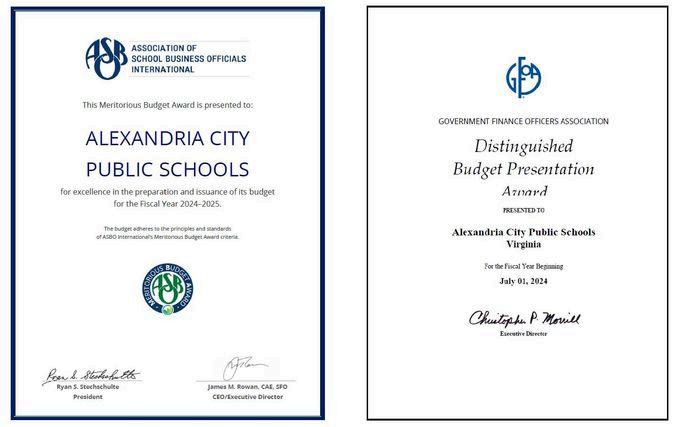
ACPS Budget Awards - GFOA and ASBO
Alexandria City Public Schools has been awarded The Government Finance Officers Association (GFOA) award for Distinguished Budget Presentation for the fiscal year ending June 30, 2024 The award encourages participants to prepare budget documents of the very highest quality that reflect both the guidelines established by the National Advisory Council on State and Local Budgeting and the GFOA's best practices on budgeting and then to recognize individual governments that succeed in achieving that goal
Alexandria City Public Schools has been awarded The Association of School Business Officials International Meritorious BudgetAward(MBA)for excellence in the preparation andissuance ofthe budget for the fiscalyear 2024-2025 ACPS has participated in the MBA program for 15 years. This award is a reflection of ACPS’s steadfast commitment to fiscal integrity
To Students, Staff, Families, Members of the School Board and the Alexandria Community:
As we begin the budget development process for the Fiscal Year 2027 (FY27) Combined Funds Budget, I am pleased to share an overview of our focus and priorities for the upcoming school year This year’s budget marks an important milestone for Alexandria City Public Schools (ACPS) as we enter the year of implementing our new 2030 Strategic Plan Nurture Educate Inspire
The FY27 budget is designed to translate this vision into action by investing in the people, programs and systems that support every student’s journey academically, socially and emotionally.
The Proposed FY27 Combined Funds Budget was presented at the January 22, 2026, Alexandria City School Board meeting and directly aligns with the budget priorities approved by the School Board on October 9, 2025 These priorities provided clear guidance as we developed a budget that balances student needs, staff support and fiscal responsibility
The Proposed FY27 Combined Funds Budget includes the Operating Budget, School Nutrition Funds, as well as the Grants and Special Projects Fund, totaling $406 5 million The ACPS Operating Budget of $374 5 million for the 2026–27 school year represents an increase of 3.7% from the FY26 Operating Budget.
Investing in Our Strategic Plan: Nurture. Educate. Inspire.
As we continue implementation of the 2030 Strategic Plan, this budget reflects our commitment to ensuring every student feels safe, supported and challenged while being prepared for life beyond high school
Through the Nurture bucket, we continue prioritizing student well-being, safe facilities and supportive learning environments
Through the Educate bucket, we invest in strong instruction, high-quality staff and tools that support academic growth
Through the Inspire bucket, we expand opportunities that spark curiosity, creativity and student engagement
Together, these three buckets guide how we allocate resources and ensure that our budget remains focused on the whole child
Supporting Our Workforce Through Collective Bargaining
The FY27 Proposed Budget reflects a historic moment for ACPS as we implement our first collectively bargained agreements with employee union groups These agreements represent a significant step forward in strengthening collaboration, transparency and shared decision-making across our school division
The proposed budget includes funding to support collectively bargained agreements, anticipated health benefit increases and recruitment and retention bonuses These investments are essential as we work to remain competitive with surrounding school divisions and retain the dedicated professionals who support our students every day.
In preparation for ongoing collective bargaining, the FY27 Proposed Combined Funds Budget also includes a labor relations position to further support our workforce and foster a strong culture of collaboration.
Strategic Budget Decisions and Operational Priorities
While prioritizing students and staff, the FY27 budget also reflects careful stewardship of resources To help balance investments, the proposed budget includes a 5% reduction to non-personnel accounts, reductions in vacant positions and strategic reclassifications to minimize the addition of new positions
The budget maintains school-based staffing to account for and accommodate redistricting, ensuring continuity and stability within our schools Additionally, funding is proposed to support:
Increased public carrier services to meet transportation needs
Continued repair and maintenance of ACPS facilities
Operations and safety enhancements
Technology integration and security reinforcements
These targeted investments allow ACPS to operate efficiently while maintaining safe, secure and effective learning environments.
Community Engagement and Budget Timeline
Community engagement remains a critical part of our budget process The School Board will hold its first work session on the Combined Funds Budget, along with a public hearing, on January 27, 2026 A second work session will take place on January 29, 2026
In partnership with the Alexandria Parent-Teacher Association Council (PTAC), ACPS will host a Budget Forum on February 3, 2026, providing families and community members an opportunity to learn more about the proposed budget and share feedback
The School Board is expected to approve its budget on February 19, 2026, with final adoption of the FY27 Combined Funds Budget scheduled for June 11, 2026
The full budget timeline and a summary of this year’s budget process can be found on the ACPS FY27 Budget Web Page
The January 22, 2026, School Board meeting, during which the Superintendent’s Proposed Budget was presented, is available for online viewing
Moving Forward Together
Budgets reflect choices and the FY27 Proposed Combined Funds Budget represents our continued commitment to putting students and staff at the center of every decision While financial realities require thoughtful planning and difficult
trade-offs, our focus remains clear: supporting student success while strengthening our workforce and sustaining excellence across our school division
We invite students, staff, families and community members to stay engaged in the budget process by offering questions, feedback and ideas Comments may be shared by emailing ask@acps k12 va us
Thank you for your continued partnership and support Together, we will continue building a school division where every student is nurtured, educated and inspired
The ACPS budget document is a source of useful information. It contains fund statements and supporting details that provide the reader with an understanding of the school division’s financial position and spending plan for the upcoming year The document is also filled with information regarding division-wide priorities, planning activities, educational programs, and initiatives The document provides a look at our recent history (where we have been), the present (what we are doing now), and the future (what we are planning and what the outlook is for several years down the road)
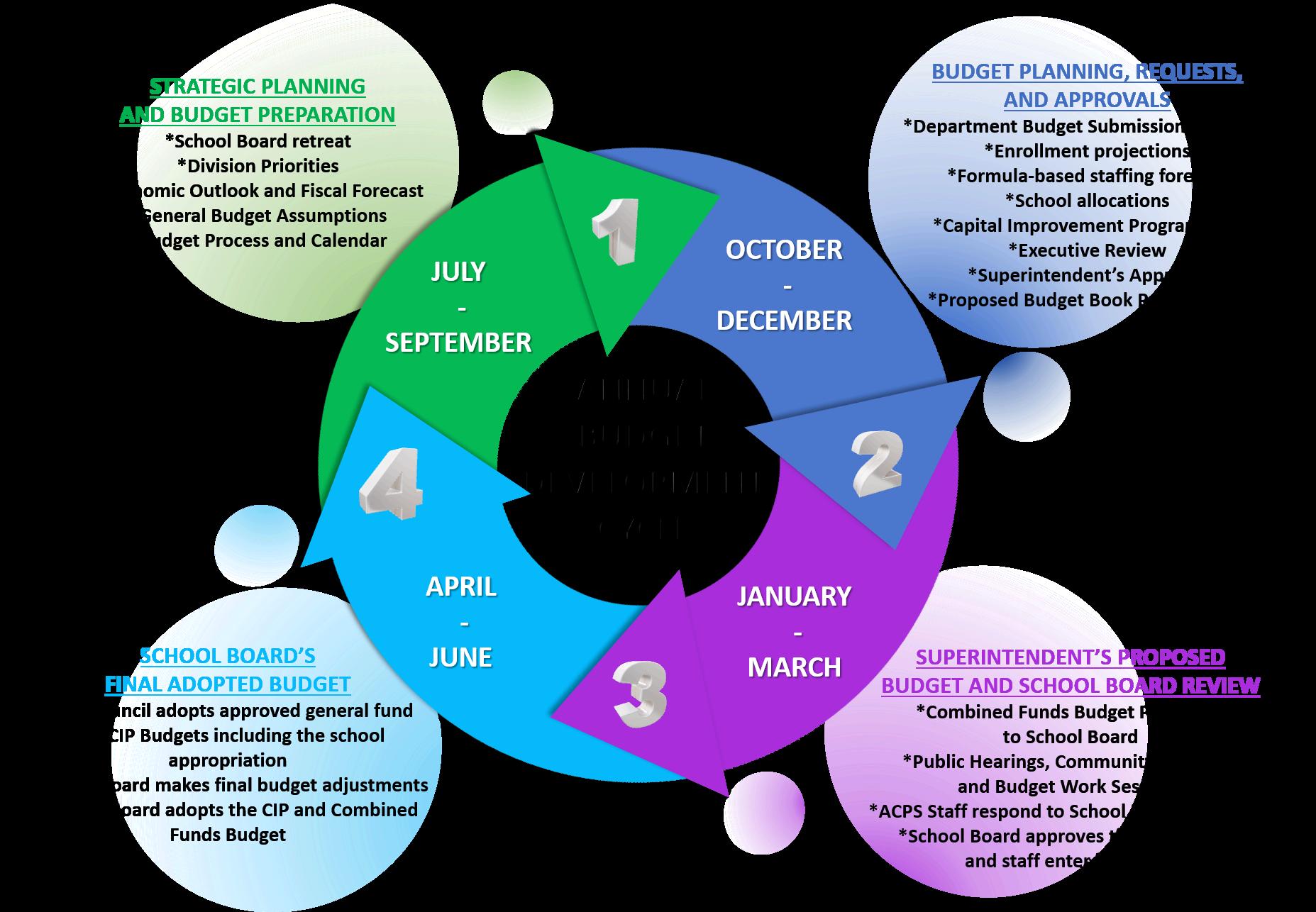
When reading the document, it is important to remember that the development of the budget is a year-long endeavor, with the final adopted budget evolving through a series of iterations Budget planning and development takes place from July through December The budget approval process begins in January and features three major milestones:
Proposed Budget
The Superintendent’s Proposed Budget is presented to the School Board and released to the public in January of each year This budget is the result of detailed work by the Superintendent and the ACPS leadership team, and it reflects what the Superintendent believes are the resources the division needs to meet the School Board’s budget priorities for the coming year The budget contains projections for enrollment, revenue and expenditures by fund, and highlights the major changes planned
Approved Budget
After receiving the proposed budget, the School Board reviews it, receives answers to any questions members may have, and holds a public hearing to provide community members with an opportunity to express their thoughts. The School Board may then suggest changes to the proposed budget The Superintendent takes those suggestions under advisement, creating a series of recommendations that are incorporated into a revised budget The School Board may make additional changes to the proposed budget, ultimately agreeing on the School Board Approved Budget, which reflects what they believe are the resources required by the division
Final Budget
In early May, when Alexandria City Council adopts its budget for the coming year, ACPS comes to a clear understanding of the total funding the City is planning to allocate to support the school division In a process similar to the development of the approved budget, the Superintendent presents recommendations for revising the budget to be consistent with the City’s budgeted funding support The School Board may again make changes to the budget, which, when passed, becomes the Final Budget
Budget Document
The budget document is organized into four major sections: Executive Summary, Organization, Financials, and Information The Information section has four subsections: division overview, schools, departments, and appendix, which includes the glossary. Each section is further described below:
ExecutiveSummary
The Executive Summary of the ACPS budget document is a comprehensive summary and presents a complete picture of the budget story. It includes major highlights from each of the other sections of the budget document and can be used as a stand-alone document
Organization
The Organization section includes information related to organizational structure, as well as long-term, division-wide, strategic goals that provide the context for decisions within the annual budget It also includes an overview of the budget process and calendar, as well as a summary of the division’s financial policies and practices
Financials
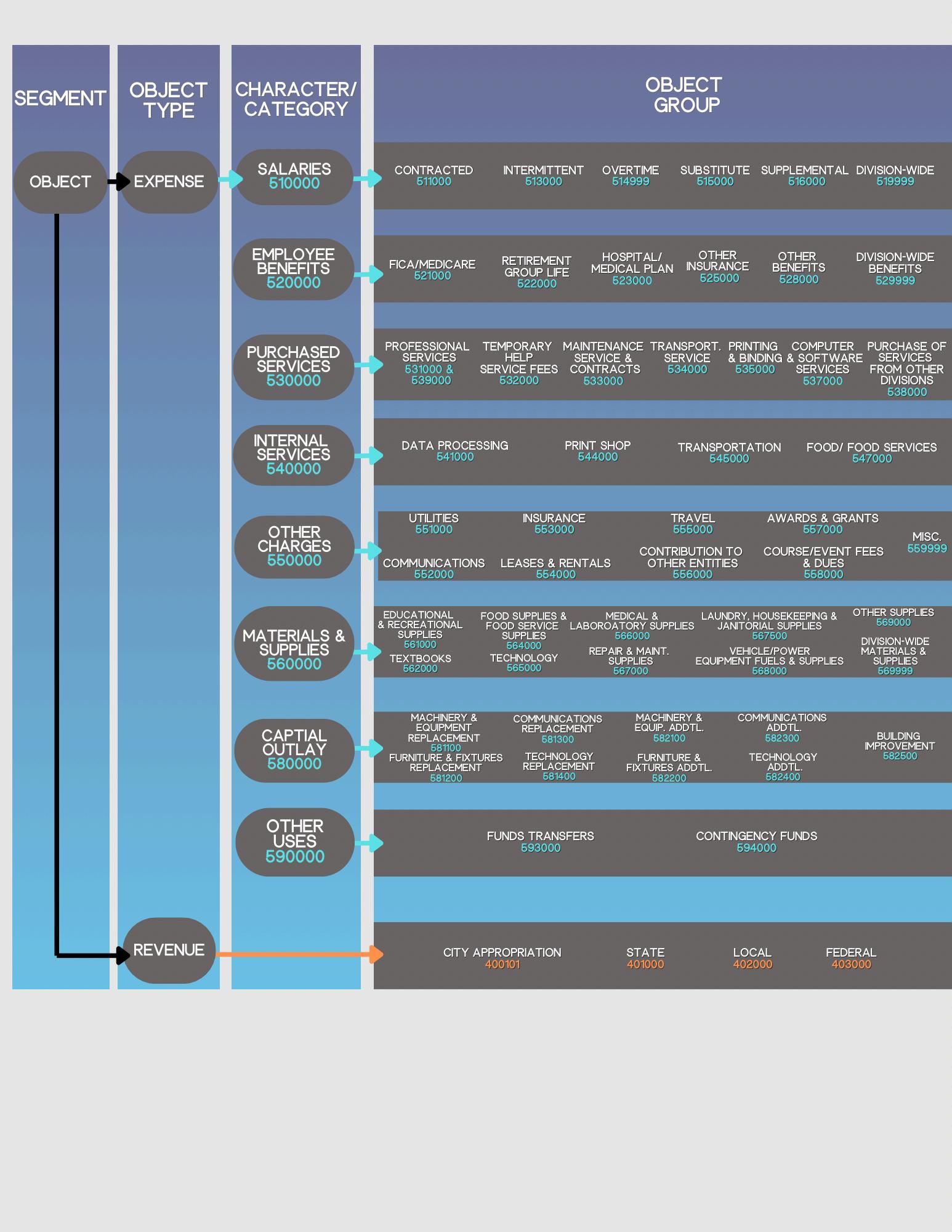
The Financials section includes summaries of all School Board funds, including the governmental, internal service, and fiduciary funds This section shows the detailed breakout of how all account codes and funds are organized in the ACPS financial system
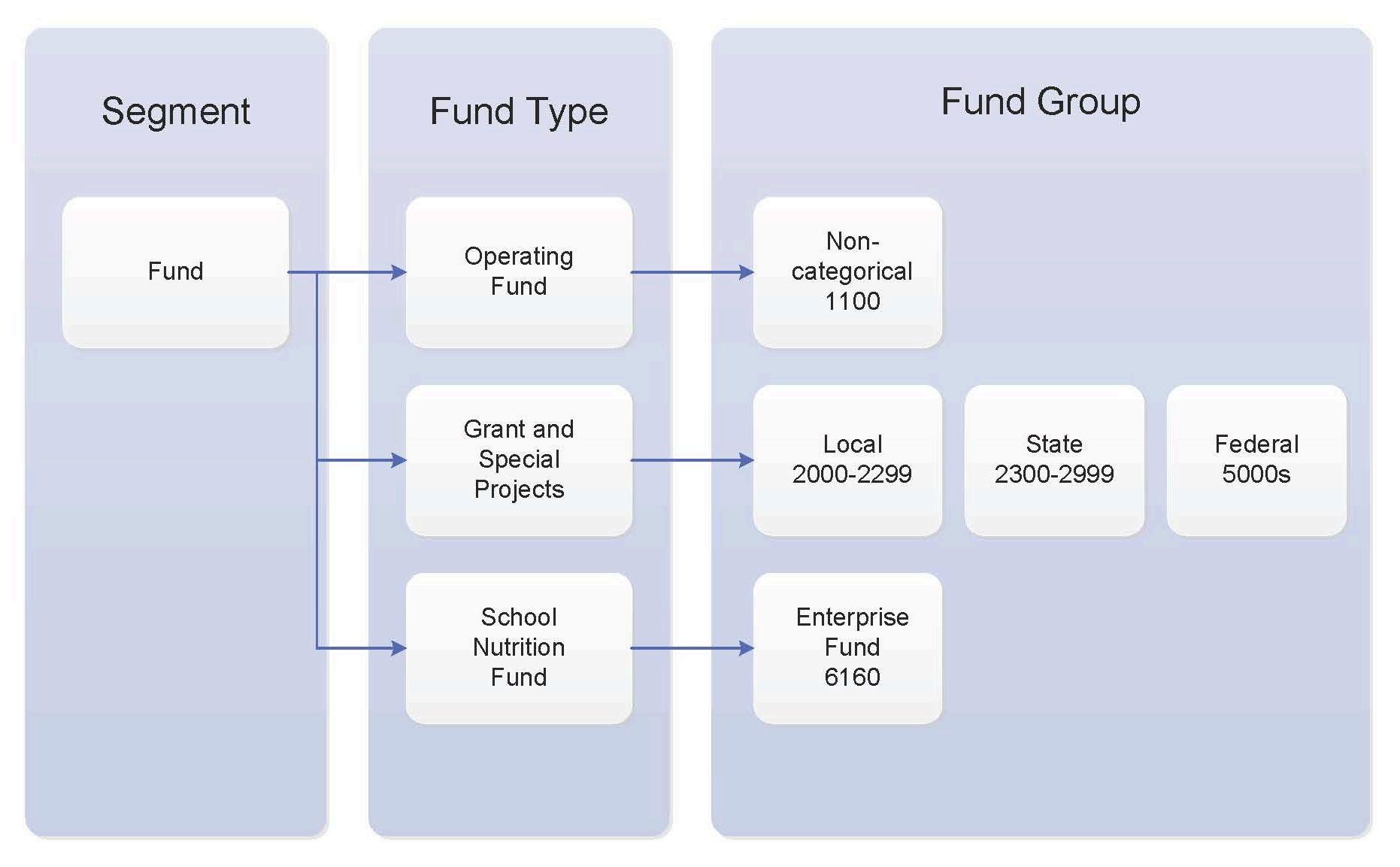
The highest level of the classification structure begins with the "Segment", which represents the Objector the type of Fund (Operating, Grants, School and Food Nutrition, Benefits, etc )
The next level consists of two "Object Types"; Expenseand Revenue Expenses are broken into high-level "Character/Categories";Salaries, EmployeeBenefits, PurchasedServices, InternalServices, OtherCharges, Materials& Supplies, CapitalOutlayandOtherUses.
Expenses are further refined to a third classification level called "Object Group" These classifications provide a finer level of detail Revenue is also categorized within four "Object Groups": CityAppropriation, StateRevenue, LocalRevenueor FederalRevenue
Information
The Information section of the document provides the details of ACPS’ enrollment, demographics, and staffing This section compares the unique make-up of our student population and also describes the various staffing formulae that are used to allocate staffing for elementary homeroom and encore, division-wide specialized instruction, English learners (EL), elementary advanced academic services (formerly known as talented and gifted), and assistant principal staffing In addition to these data, readers can find information regarding Alexandria community demographics, school allocations, and cost per pupil details The information section of the budget document is organized into three major sections: Schools, Departments, and Appendix
Schools
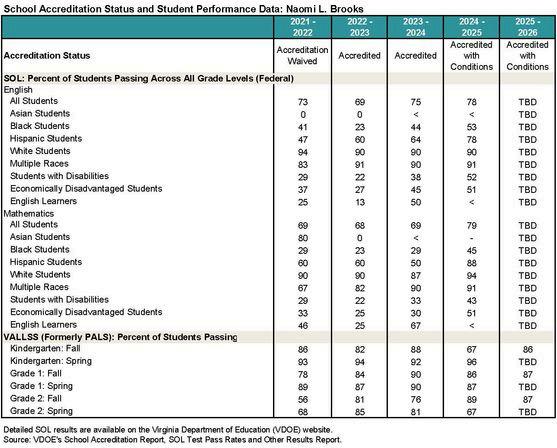
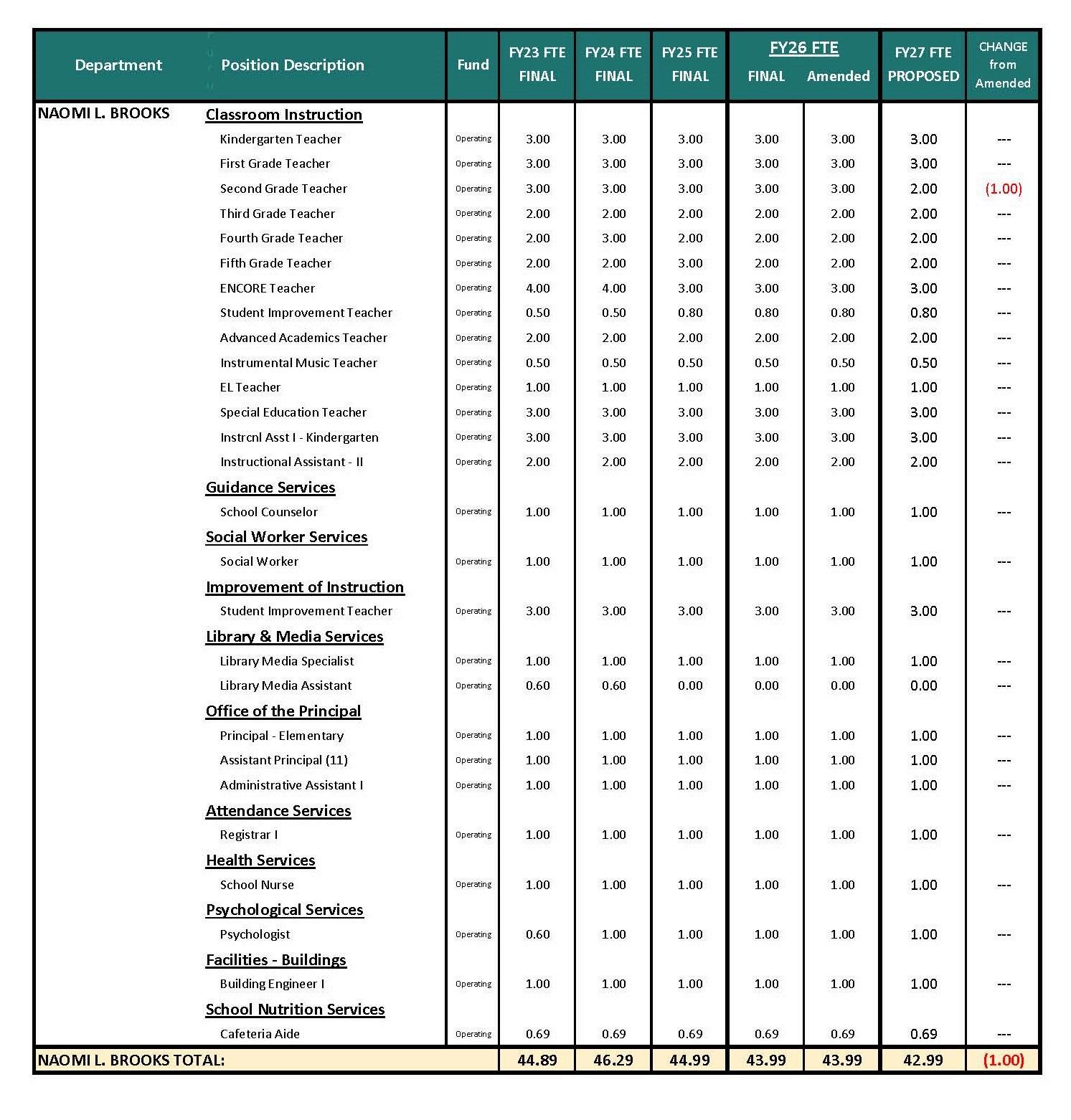
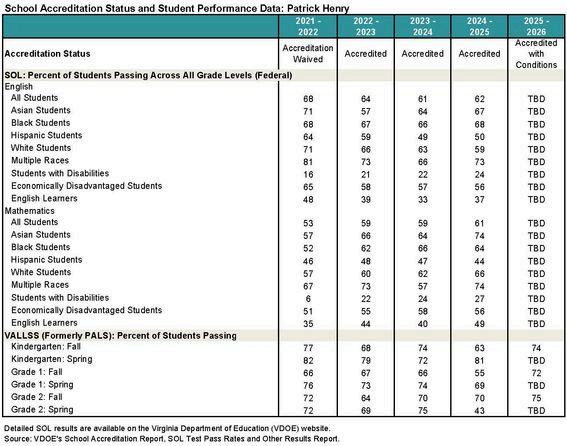
The Schools subsection contains summary-level information for all ACPS’ schools, Alternative Education Programs, and School-wide Resources Included are schools’ education plans, demographics, performance tables, staffing, and budget reports.
Departments
Similar to the Schools subsection described above, this subsection contains information for each department within ACPS These pages include the organizational structure, responsibilities, staffing, and budget reports.
Appendix
The Appendix includes a glossary of terms and positions used throughout the budget document and additional resources
What the Alexandria Community Should Know about the ACPS Budget
Citizens are encouraged to learn about the ACPS budget It is helpful to take a broad view first and understand concepts that are key factors in the development of the budget
ACPS is required by law to operate within a balanced budget Due to this requirement, the Operating Fund budget is purposefully conservative in its projections of revenues and expenditures, which, hopefully, helps the school division end the year with an available balance, typical of other school divisions as well as local and state governments Under current practice, ACPS retains this balance to pay for the carryover of encumbered obligations (orders of goods and services which have not been received as of the end of the fiscal year) and to support the following year’s budget (currently limited to no more than two percent of proposed operating expenditures) The remainder is held as a contingency against extraordinary circumstances that might cause significant, one-time increases in expenditures or decreases in revenue
The Final Budget is informed by the ACPS Strategic Plan The plan was developed with significant input from stakeholders, including students, parents, teachers and other staff, and members of the Alexandria community The plan approved by the School Board reflects the educational landscape, the specific needs of the school division, and the aspirations of the Alexandria community The ACPS Strategic Plan is the roadmap guiding the division’s decisionmaking for the next several years
The City of Alexandria is the primary source of the school division’s operating fund revenue The Commonwealth of Virginia views Alexandria as a wealthy community in comparison to other jurisdictions in the state When the State determines the amount of funding it will provide to ACPS, it takes into consideration this wealth factor (called the Local Composite Index (LCI)) and adjusts allocations, based on the calculation of financial resources determined to be available in the City. As a result, the State provides ACPS with less direct aid support on a per-pupil basis than many other Virginia school divisions
School operations are labor-intensive and due to this, salaries and benefits comprise the majority of the budgeted operating expenditures Most of these expenditures are for resources provided directly in the schools; for teachers
and instructional assistants; for counselors, nurses, and other licensed professionals; for principals and their administrative teams; and for support staff including custodians, security officers, and cafeteria aides
Major drivers of labor expenditures include enrollment changes, market competition, healthcare costs, and Federal, State and Local mandates (both funded and unfunded).
Changes in enrollment, in total and in subgroups of students with additional needs, drive the number of staff and the number of classrooms required Many school-based positions are driven by a formula prescribed by Standards of Quality (SOQs) established by the Virginia General Assembly
Competition for staff is concentrated in the Northern Virginia area, requiring the school division to offer competitive salary and benefit packages
Health care costs have risen dramatically over the last several years In response, changes to plan design were implemented in FY 2020 to minimize projected increases and those changes are maintained
Certain benefit expenditures are mandated by the Commonwealth of Virginia, notably retirement rates for licensed professionals and administrative staff in the Virginia Retirement System (VRS)
ACPS recognizes that revenue constraints require careful consideration of current expenditures to identify areas where costs may be reduced and operational efficiencies gained During the course of the annual budget process, all major programs are reviewed to assess what changes can be implemented to offset the expenditure increases noted above Budgets are often about making difficult choices, and sometimes an area which is no longer a strategic priority needs to be reduced or eliminated to make funds available for new priorities
Where to Get More Information
ACPS is committed to making the budget process as understandable and accessible as possible, and strives to improve the transparency of the process every year The key place to find more information is the ACPS website To access the latest information, visit:
https://www acps k12 va us/departments/financial-services/budget
The budget calendar, which details upcoming meetings and milestones leading to the approval of the annual budget
The final budget for the current year, and proposed budget for next year (when published), as well as an archive of historical budgets dating back to FY 2020
Questions about the budget, posed by the School Board, the City Council and community members, along with detailed answers from staff
A summary of revisions proposed by School Board members and the Superintendent’s recommended adjustments
How to Provide Feedback
Feedback from the community is an important part of the budget process and there are several ways to provide comments and voice concerns Specific opportunities include:
Send comments using the ACPS website: https://www acps k12 va us/departments/financial-services/budget or email the Budget Office at BUDGET@ACPS K12 VA US
Email us at ASK@ACPS K12 VA US
Contact your school’s PTA president and send your questions and comments through the Parent Teacher Advisory Council (PTAC)
Sign up to speak at one of the School Board’s public hearings on the budget
Join the School Board’s Budget Advisory Committee: https://www.acps.k12.va.us/school-board/school-boardcommittees/budget-advisory-committee-bac
Students and Schools
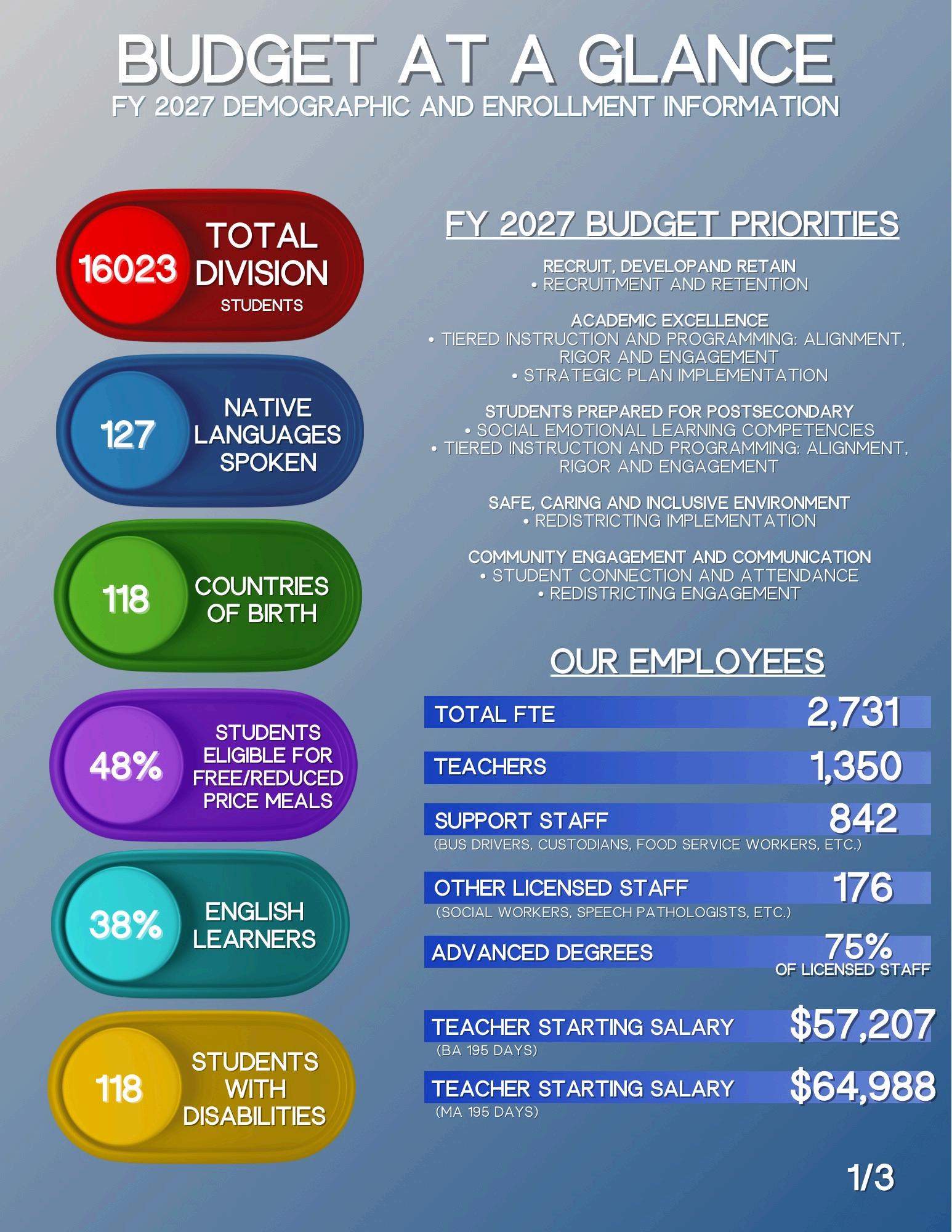
The City of Alexandria and Alexandria City Public Schools (ACPS) are dedicated to ensuring academic success for each and every student ACPS celebrates its diversity with students who come from approximately 120 different countries, speak 127 native languages and represent a multitude of ethnic, cultural, and economic groups The School Board’s Academic Excellence and Educational Equity Policy (Policy IGBJ) pledges to educate students in an atmosphere of excellence and educational equity that prepares them for citizenship and ensures they are challenged to stretch their talents and aspirations
In July 2020, the Identity Project was launched to work towards making Alexandria City Public Schools a more equitable future In FY 2022, Matthew Maury Elementary School and TC Williams High School were re-identified as Naomi L Brooks Elementary School and Alexandria City High School, respectively
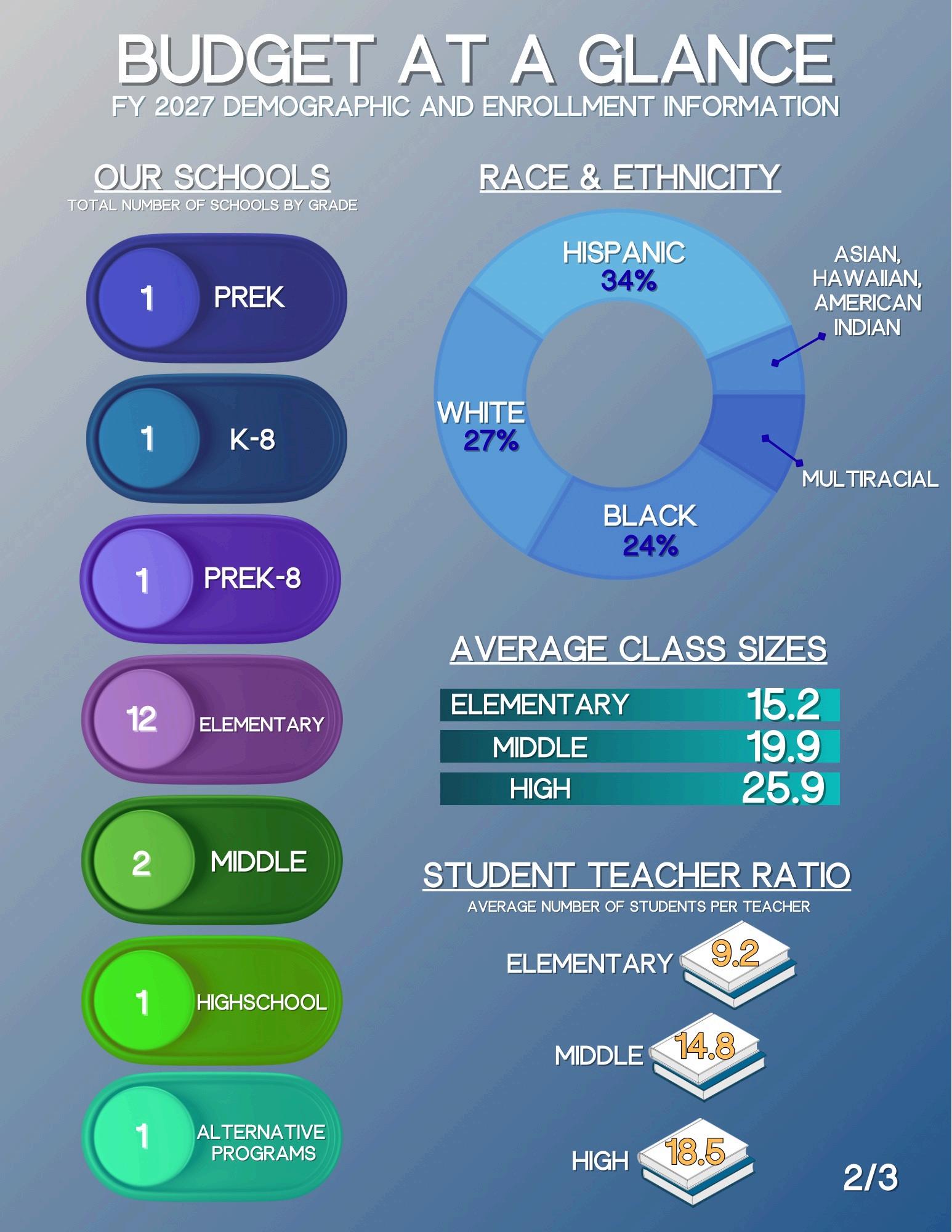
The school division is composed of one Early Childhood Center, 12 elementary schools, one Pre-K through eight school, one K through eight school, two middle schools (grades six through eight), and one high school Alexandria City High School consists of two campuses ACPS provides educational opportunities through a flexible online learning Satellite Program and the Chance for Change Academy (an interim education facility) ACPS also operates the Northern Virginia Juvenile Detention Center School and the Sheltercare facility.
ACPS will serve a projected 15,993 students in FY 2026 Based on VDOE’s fall 2020 membership data, ACPS ranked 16th of 132 school divisions in the Commonwealth of Virginia in terms of size. The three largest Virginia school divisions - Fairfax, Prince William, and Loudoun County Public Schools - are also located in Northern Virginia
Governance
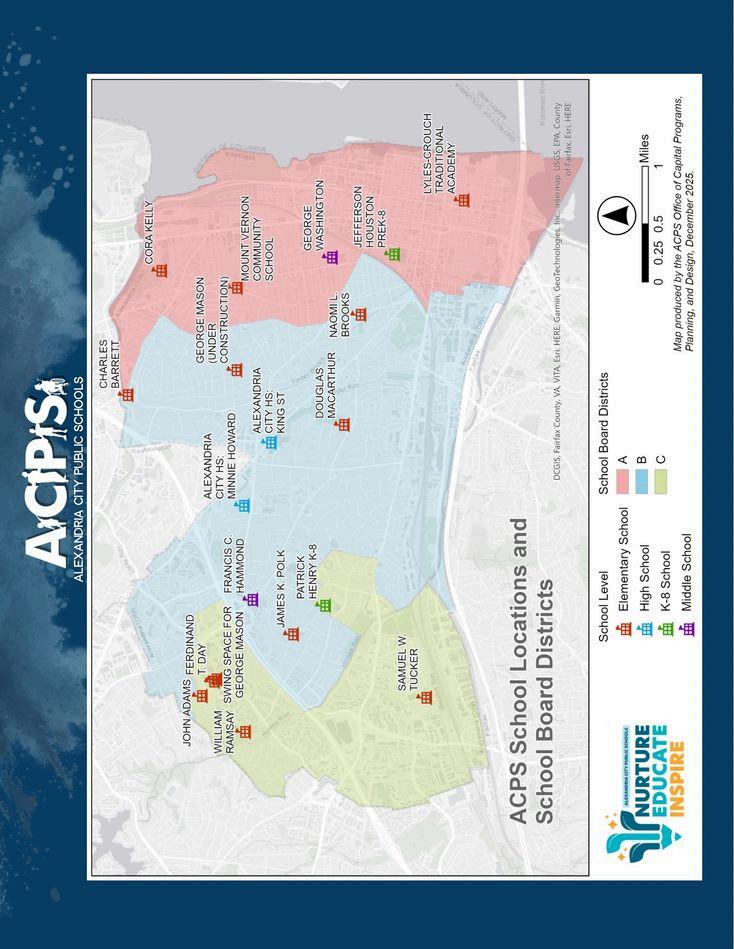
The Alexandria City School Board is a nine-member elected body whose primary responsibilities are to adjust and oversee capital and operating budgets annually, to formulate and adopt policy, to select a Superintendent to implement policy, and to evaluate the results (Policy BBA). The City of Alexandria is divided into three voting districts (districts A, B, and C) and three Board members are elected from each district Each member is elected concurrently for a three-year term of office The election took place in November 2024 and the newly elected Board took office in January 2025
School Board meetings are typically held twice a month, Thursday evenings, in the School Board Meeting Room located at 1340 Braddock Place Board meetings are televised live in Alexandria on Channel 71, streamed live and archived on the ACPS website Meeting agendas are maintained online at https://alexandriapublic ic-board com/ by the School Board Office For more information, please contact the Clerk of the Board at 703-619-8019
Any citizen may address the Board at any regular meeting during the designated period called “Communications and Addresses to the Board ” Persons wishing to appear before the School Board are asked to contact the Clerk of the Board or sign up online at www acps k12 va us/school-board for inclusion on the agenda A reasonable period of time, as determined by the School Board, will be allocated at each regular meeting for citizens to present matters of concern
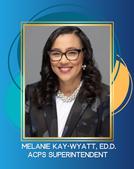
The Superintendent, Dr Melanie Kay-Wyatt, is the chief executive officer for the school division The Superintendent’s mission is to ensure that all activities within the school system support the five goals of the ACPS 2030 Strategic Plan: Nurture Educate Inspire:
Create safe, caring, inclusive environments where students feel supported and respected. Engage and challenge every student to achieve academic excellence
Recruit, develop, and retain a diverse and talented team of professionals
Cultivate trust through clear communication and community engagement
Prepare students for life after high school with the skills, guidance and opportunities for success
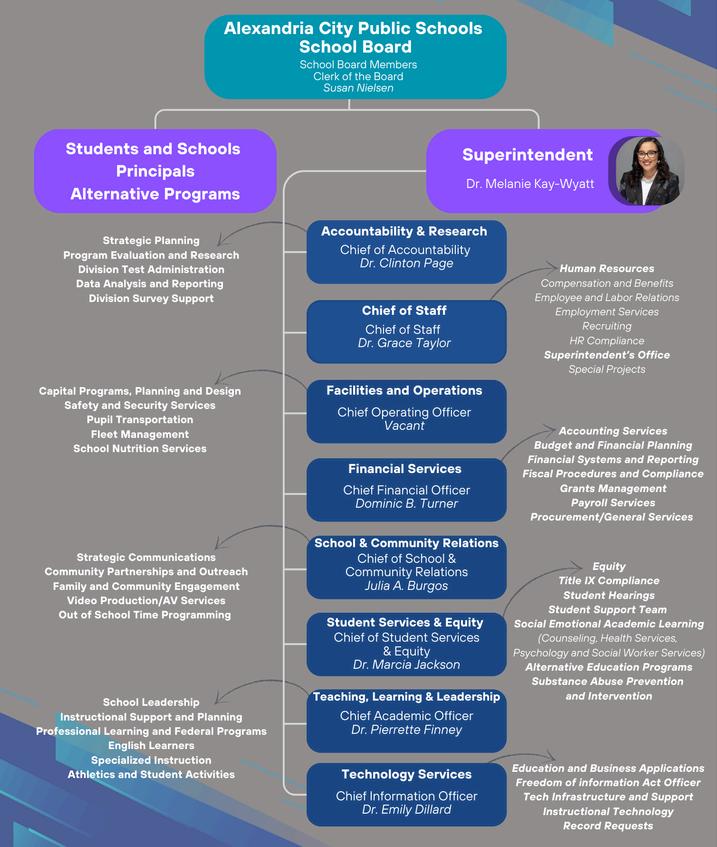
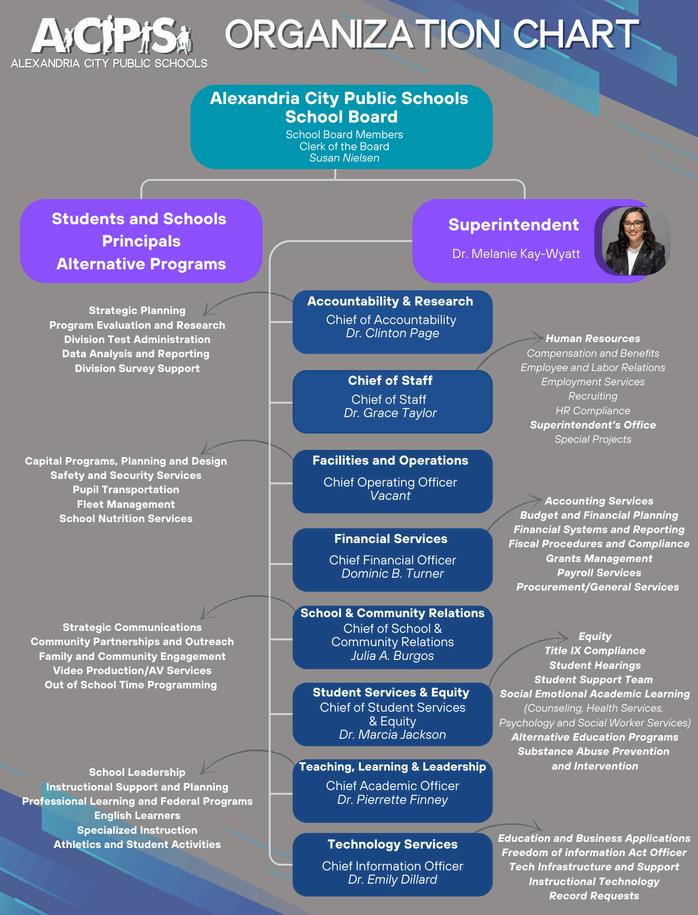
The Superintendent works closely with executive staff to manage all aspects of school division operations All chief officers report directly to the Superintendent
The work of central office concentrates on planning, continuous improvement, leadership development, and culture as shared responsibilities of all ACPS administrators The organizational structure is intended to ensure that the key focus remains on quality instruction, curriculum, and comprehensive student support Focus also remains on aging infrastructure and ensuring students and staff are housed in safe and secure buildings
ACPS, like many other school divisions, is retooling significant operations to ensure increased efficiency and effectiveness as budget discussions become increasingly difficult. Each year, all programs are evaluated to look for efficiencies and new programs are placed on hold or phased in over multiple budget years
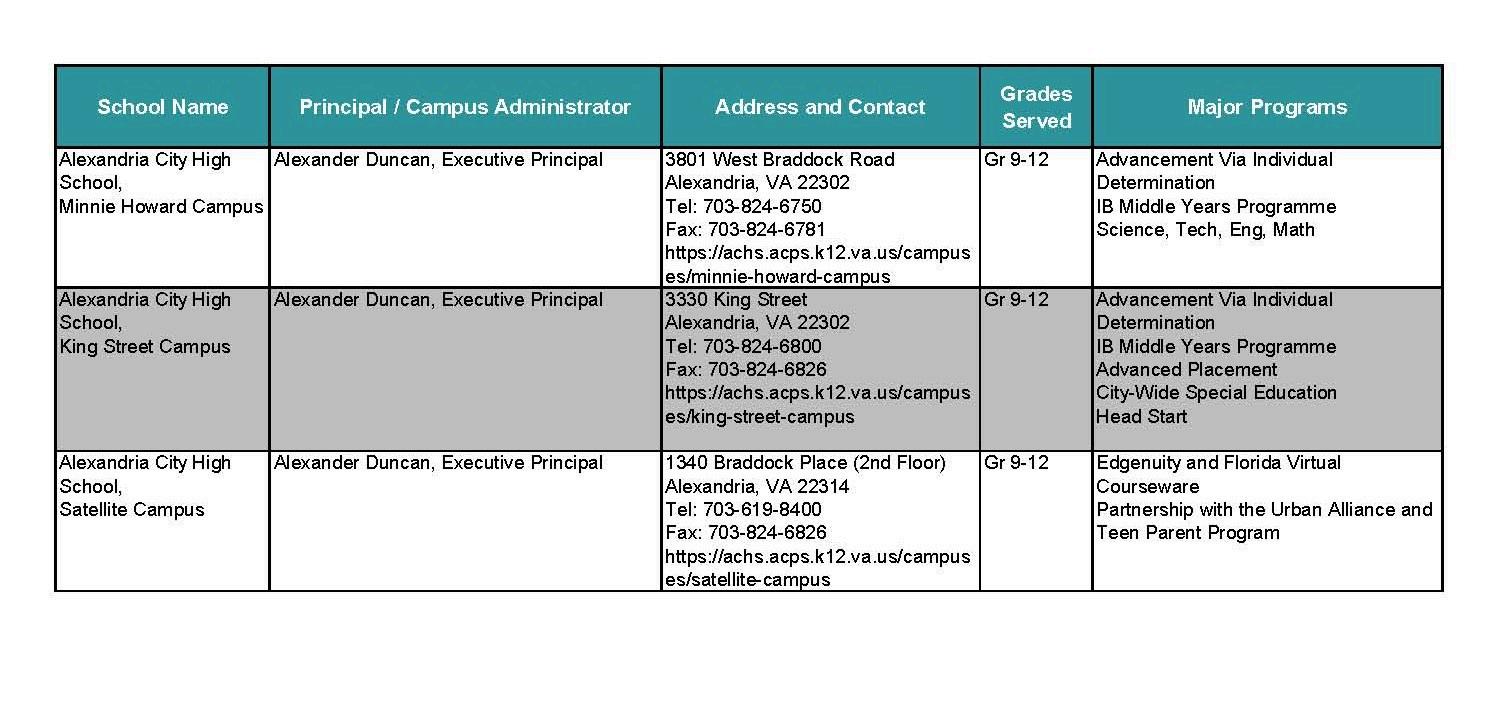
The following pages show division organizational structure and school leadership contacts.
ACPS Enrollment
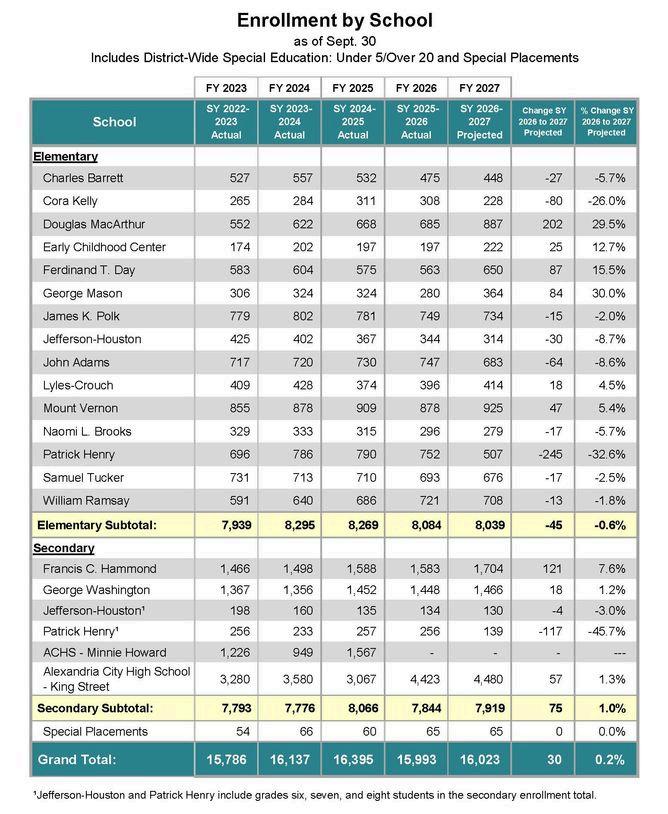
ACPS’ enrollment data series counts all students, including students under the age of 5 and over the age of 20, as well as all special placements The division incurs costs for all enrolled students even if they are not included in the state’s definition of average daily membership
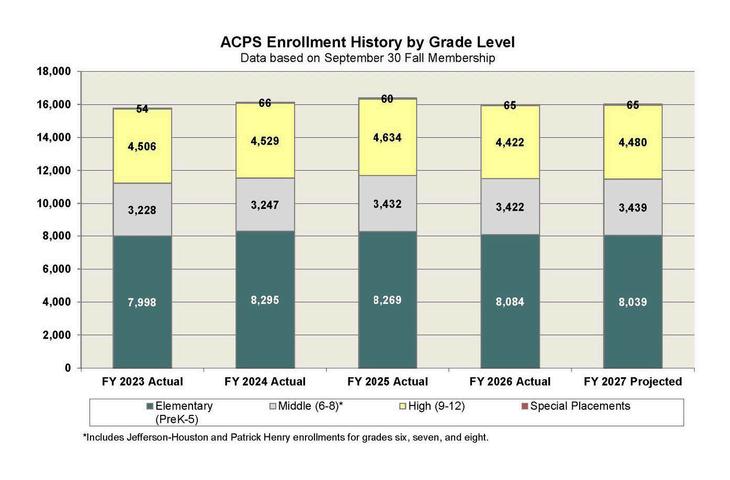
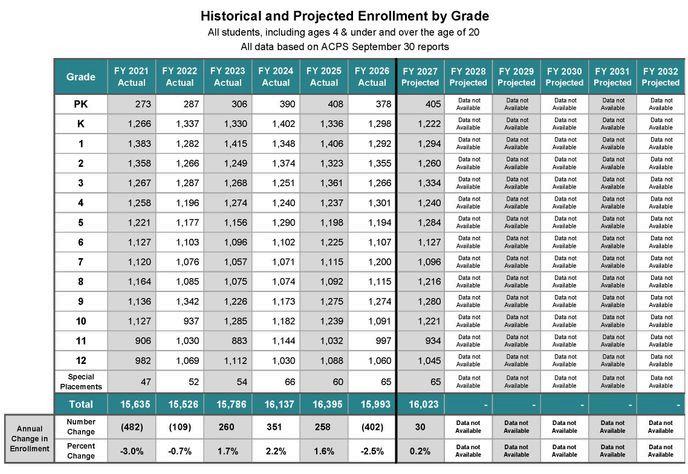
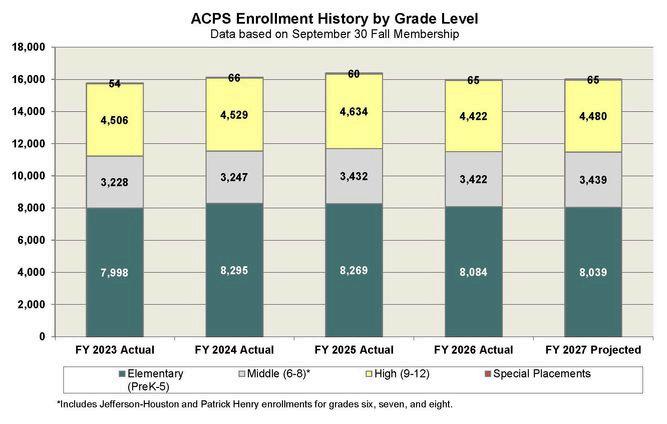
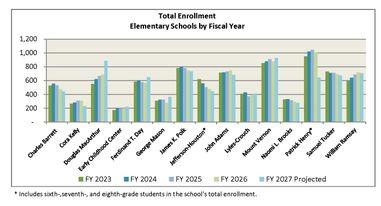
As shown in the chart below, from FY 2023 through FY 2026, the elementary school enrollment has increased from 7,998 to 8,084 students Middle school increased from 3,228 to 3,422 students and high school decreased from 4,506 to 4,422 students during this same period Over the same time period, the number of students attending special placement facilities has increased and is projected to be 65 in 2027
Enrollment projections are prepared annually as a collaborative effort by ACPS’ Operations Department and the City’s Planning and Zoning Department. In general, the enrollment projections are based on trends experienced throughout the school division by school and by grade An average “Cohort Survival Rate” from the previous 3 or 4 years at each school and grade is used to determine the numbers of students who would be retained and/or added to each school and at each grade level
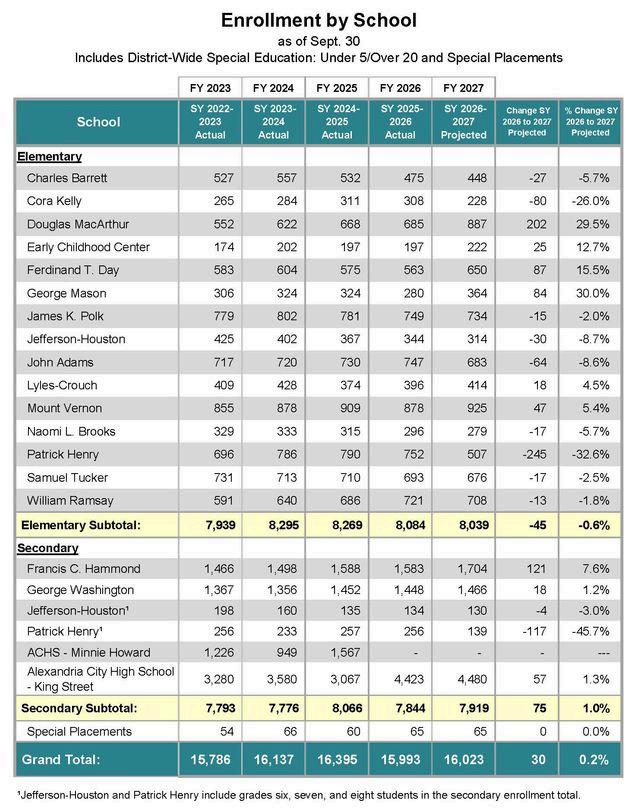
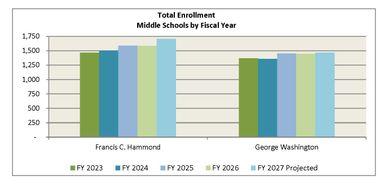
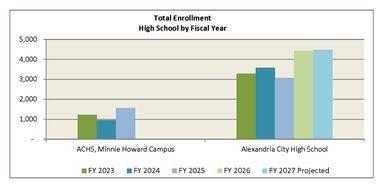
For FY 2027, elementary school enrollment is projected to be 8,039 with middle school at 3,439, which includes students in grades 6-8 at Jefferson-Houston and Patrick Henry High school is expected to increase by 58 students to 4,480
Enrollment in all schools is projected to increase for FY 2027 by 30 students, including students being served in special placement facilities
With the projected changes in enrollment for FY 2027, elementary school enrollment represents 52 0 percent with middle and high schools at 19 9 percent and 28 1 percent, respectively, of total enrollment, not including special placements
Budget Process
The budget is a resource allocation and policy document It incorporates the best estimate of the school division’s revenues and expenditures for the next fiscal year based on a snapshot of current fiscal year revenue and expenditures These estimates are revised to reflect changes in plans, priorities, and trends in enrollment as well as the economic environment
The Code of Virginia requires that each school Superintendent prepare a budget that estimates the expected funding necessary to support public schools during the upcoming year It is then the responsibility of the School Board to balance the needs of the school division with respect to the economic and political environment
The budget provides a framework for measuring and monitoring expenditures Throughout the year, actual spending is compared with the budget within each organizational and programmatic area. The comparison is used to provide a measure of effectiveness and also helps ensure that funds are being used for their intended purpose
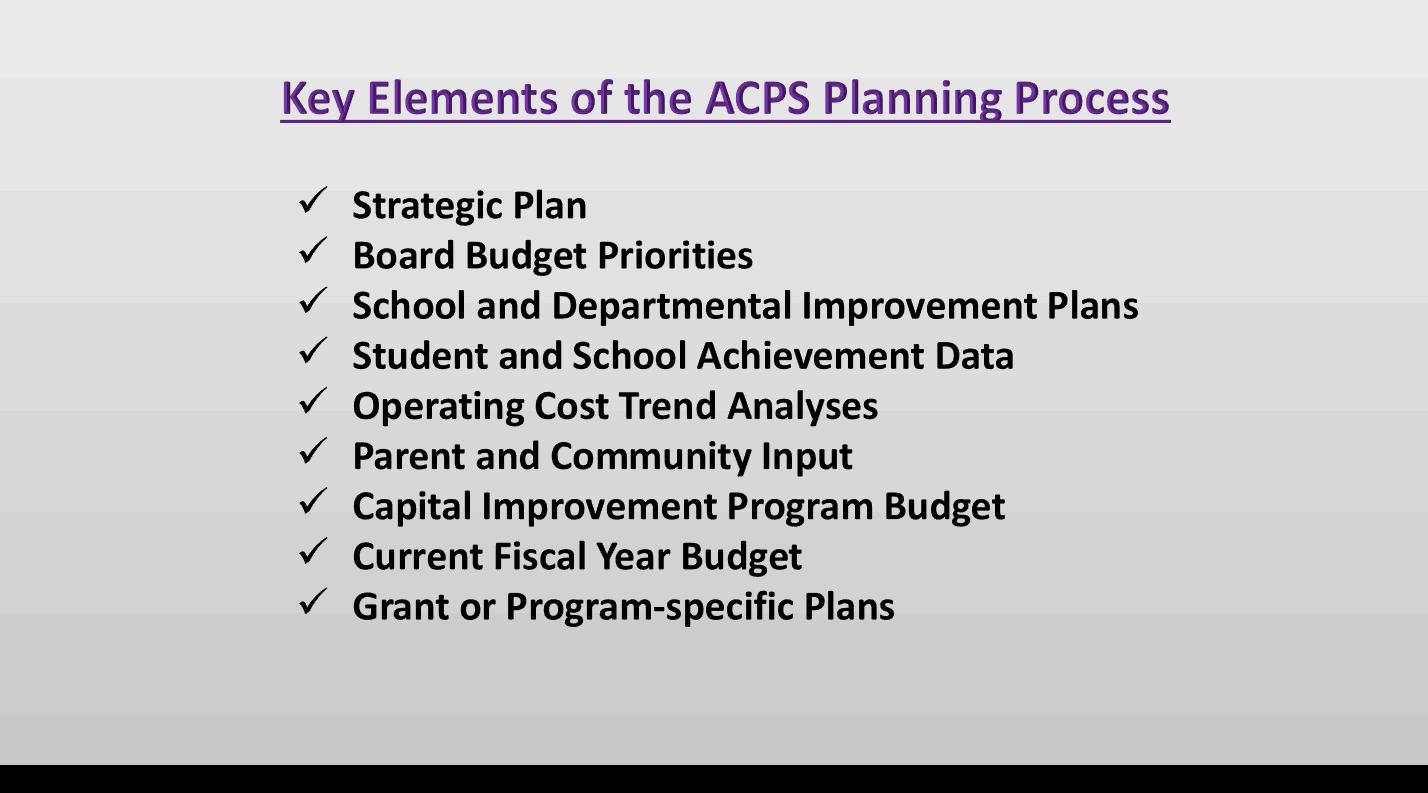
Key Elements of the ACPS Budget Planning Process
Strategic plan
Board budget priorities
School and departmental improvement plans
Student and school achievement data
Operating cost trend analyses
Parent and community input
Capital Improvement Program budget
Current fiscal year budget
Grant or program-specific plans
Budget Overview
The FY 2027 Combined Funds Budget represents an ongoing commitment to ACPS students as aligned with the Equity for All 2025 strategic plan A full review of programs and services was conducted to confirm the focus on student achievement and support of initiatives that have been implemented to decrease gaps in achievement across various economic, educational and racial groups
The FY 2027 operating expenditures budget totals $374 47 million, an increase of 0 037 percent compared to the FY 2026 Final Budget The appropriation to ACPS from the City of Alexandria totals $292 27 million, an increase of 035 percent compared to the FY 2026 Final Budget Total positions show a net decrease of 19 9 FTEs
For FY 2027, overall student enrollment is projected to decrease by 20 percent, or 30 students, for a total enrollment of 16,023 (including special placements)
Although exceptional progress can be seen through the division-wide transformation efforts over the past several years, the work is not complete The School Board, Superintendent, and staff continue long-term efforts that require strategic planning, investment in our staff, professional learning, accountability and community engagement
This budget aligns our resources effectively and efficiently in order to support student achievement, provide top-quality teachers, improve facilities, engage families and ensure the safety and security of students and staff
Budget Calendar
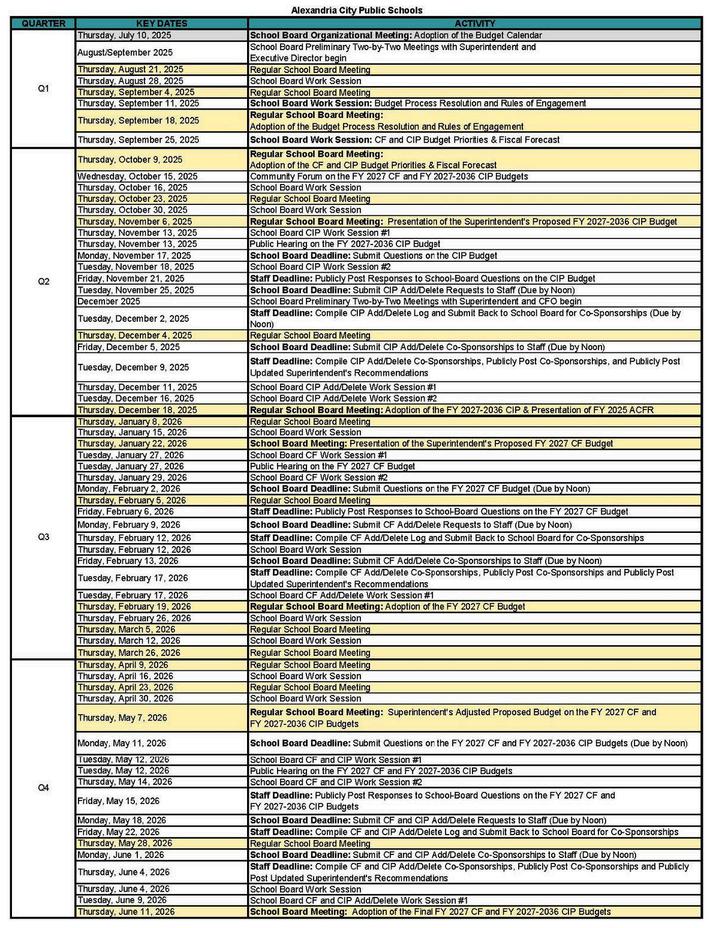
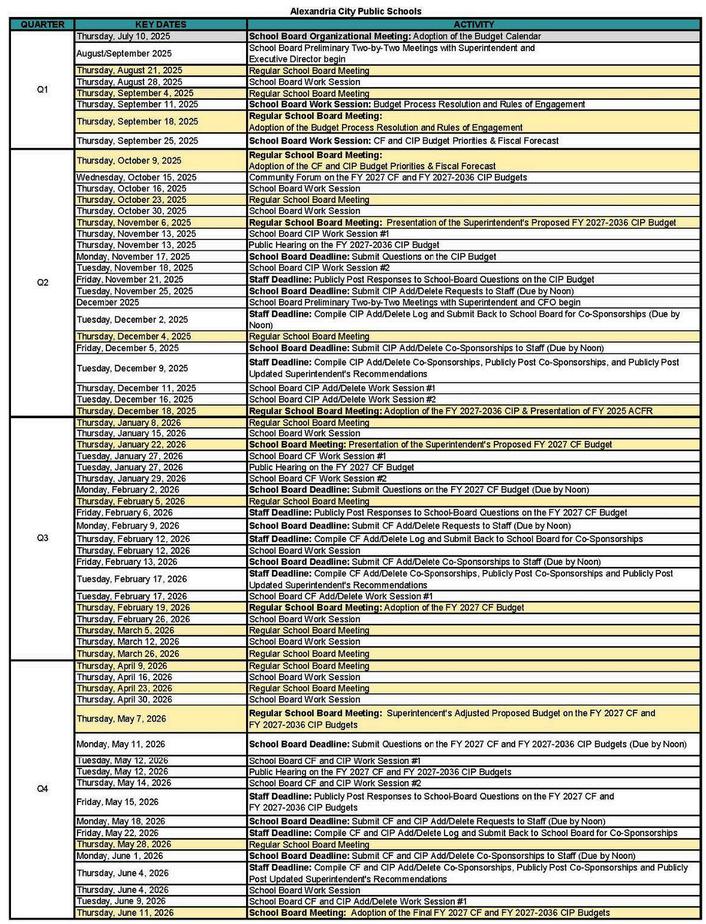
During the fall, the School Board and staff begin the budget development process for the next fiscal year The budget calendar is discussed by the School Board to define the time frame under which the Final Budget will be prepared, discussed, and approved The School Board approves the budget calendar as part of setting the work and meeting schedule for both the Combined Funds and CIP budgets
Shown below is the FY 2027 Budget Calendar table The School Board-approved FY 2027 Budget Calendar can also be found at https://www acps k12 va us/departments/financial-services/budget
ACPS Strategic Planning and Budgeting
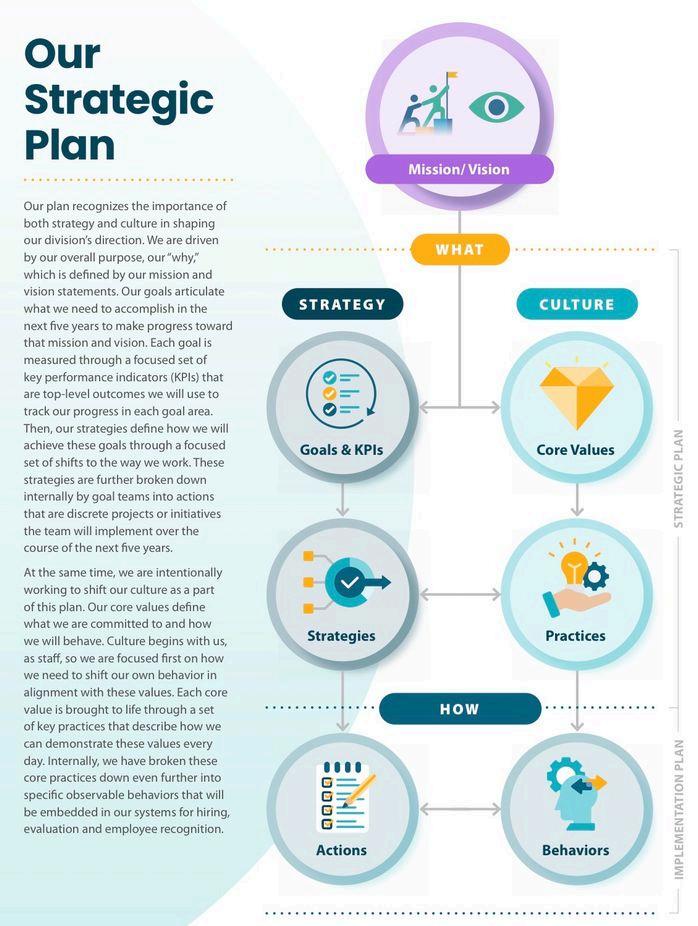
The Alexandria City School Board officially approved the 2025–30 Strategic Plan for Alexandria City Public Schools (ACPS), titled Nurture Educate Inspire , on May 8, 2025
This bold, student-centered roadmap reaffirms our commitment to providing every student regardless of background with access to a high-quality education The new five-year plan builds upon the work of the Equity for All 2025 Strategic Plan and reflects the voices and shared values of students, families, staff and community members
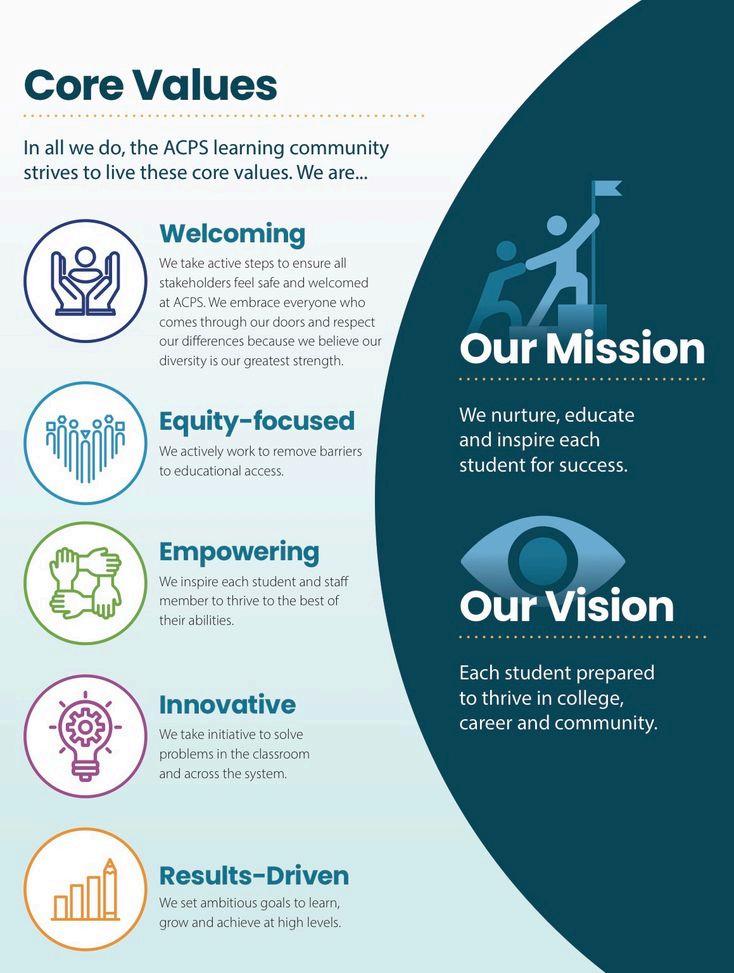
Mission, Vision and Core Values
Mission: Nurture, educate and inspire each student for success
Vision: Each student prepared to thrive in college, career and community
Core Values: Welcoming, Equity-Focused, Empowering, Innovative and Results-Driven
Strategic Plan Goals for 2025–30
Create safe, caring, inclusive environments where students feel supported and respected
Engage and challenge every student to achieve academic excellence
Recruit, develop, and retain a diverse and talented team of professionals
Cultivate trust through clear communication and community engagement
Prepare students for life after high school with the skills, guidance and opportunities for success
Budget planning requires the active involvement of school and department staff ACPS is committed to fostering inclusive budget discussions centered on student achievement For the first time in the history of ACPS, the strategic planning process was aligned with the planning process for multiple citywide departments and organizations with the goal of ensuring that City and school plans have shared goals and outcomes This Unified Planning Team included the Department of Community and Human Services’ Children and Youth Master Plan (CYMP), and the Alexandria Health Department and the Partnership for a Healthier Alexandria’s Community Health Improvement Plan (CHIP)
ACPS partnered with Deliver Ed, an external vendor specializing in strategic planning, to assist in the facilitation and management of creating an updated five-year strategic plan Engagement efforts continued throughout the 2025-26 school year Collaboration and engagement involving a Strategic Planning Committee consisting of ACPS staff from every school, students, parents and representation from key community groups across Alexandria
School Board Budget Goals
The ACPS School Board's goal was to determine top budget priorities for each goal area in the ACPS Strategic Plan This year, alongside staff, the district aimed to align with the already identified ACPS Priority Areas for SY 25-26 These priority areas have been identified by reviewing student data, program initiatives, and strategic plan goals
Each of the five goals for the strategic plan has a number of measures that help track and report progress in achieving the goal Key Performance Indicators (KPIs) define the key overall outcomes that an organization is trying to achieve They answer the question of what success looks like and how we will know if we are progressing toward the intended outcome
As an educational organization, within ACPS all KPIs are student outcomes
FY 2027 Approved budget priorities have guided the budget process.
Shown in this section is a summary of the ACPS Strategic Plan 2030: Nurture Educate Inspire For the full 2030 Strategic Plan, please visit:
https://www acps k12 va us/about-us/acps-2030-strategic-plan
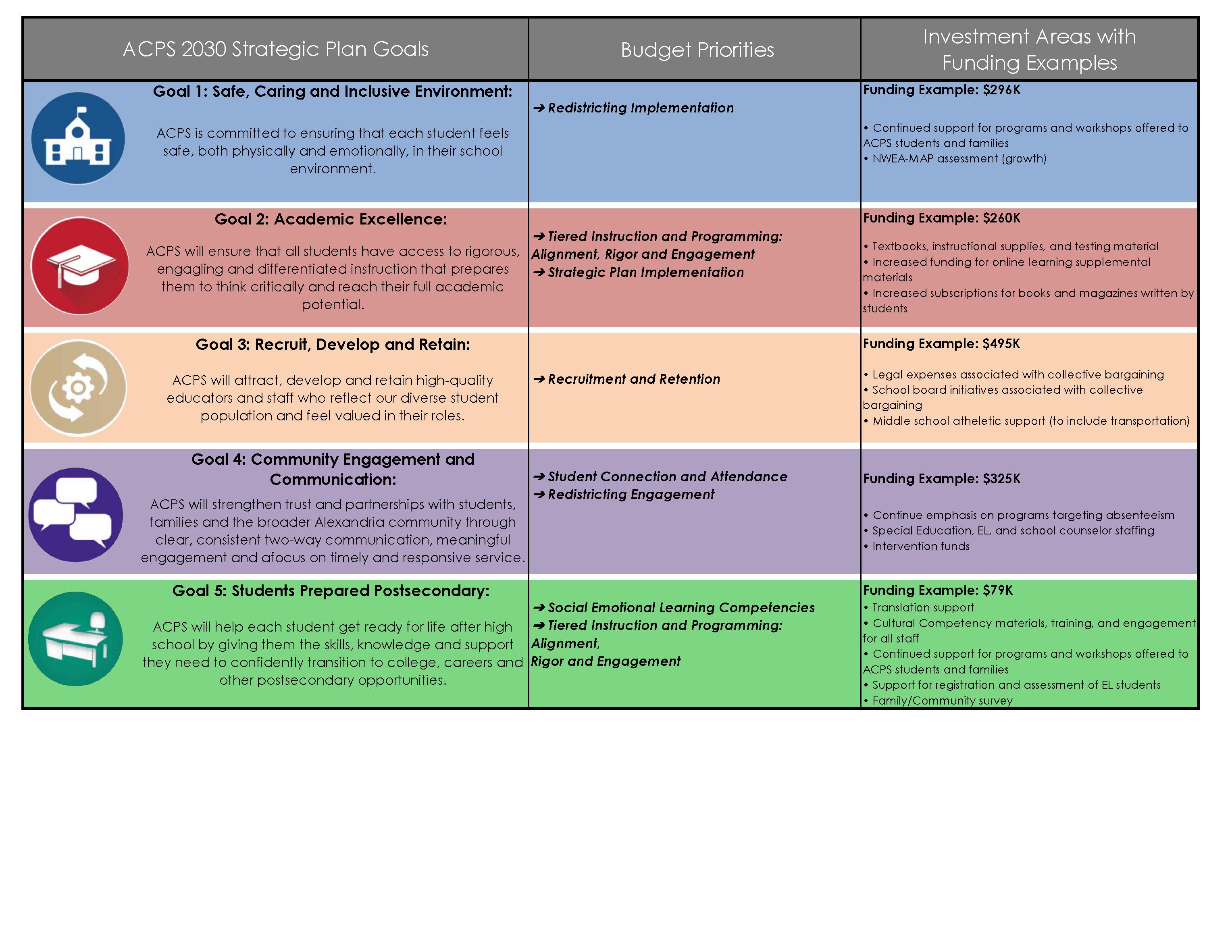
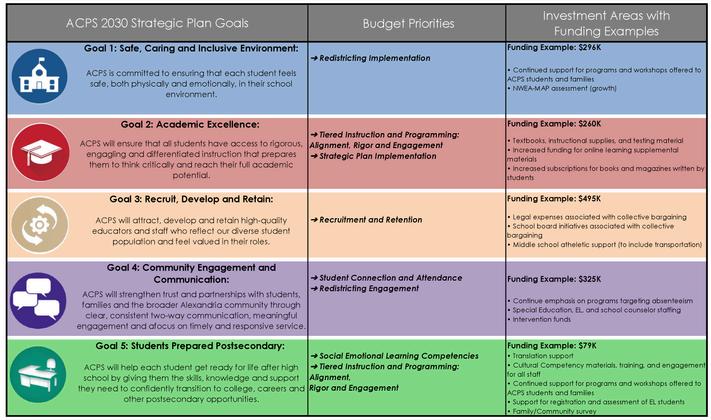
School Board Budget Priorities as they relate to ACPS Strategic Plan Goals
The budget priorities for FY 2027 align to the strategic plan goals and the strategic resource allocation goals They serve to ensure that differentiated resources and supports are provided for schools and departments and are used efficiently and effectively to focus on meeting students where they are to support equitable outcomes The chart below shows the Combined Funds Budget Priorities table aligned with the strategic plan goals
Budget Overview
The FY 2027 Combined Funds Budget represents an ongoing commitment to ACPS students as aligned with the Equity for All 2026 strategic plan A full review of programs and services was conducted to confirm the focus on student achievement and support of initiatives that have been implemented to decrease gaps in achievement across various economic, educational and racial groups
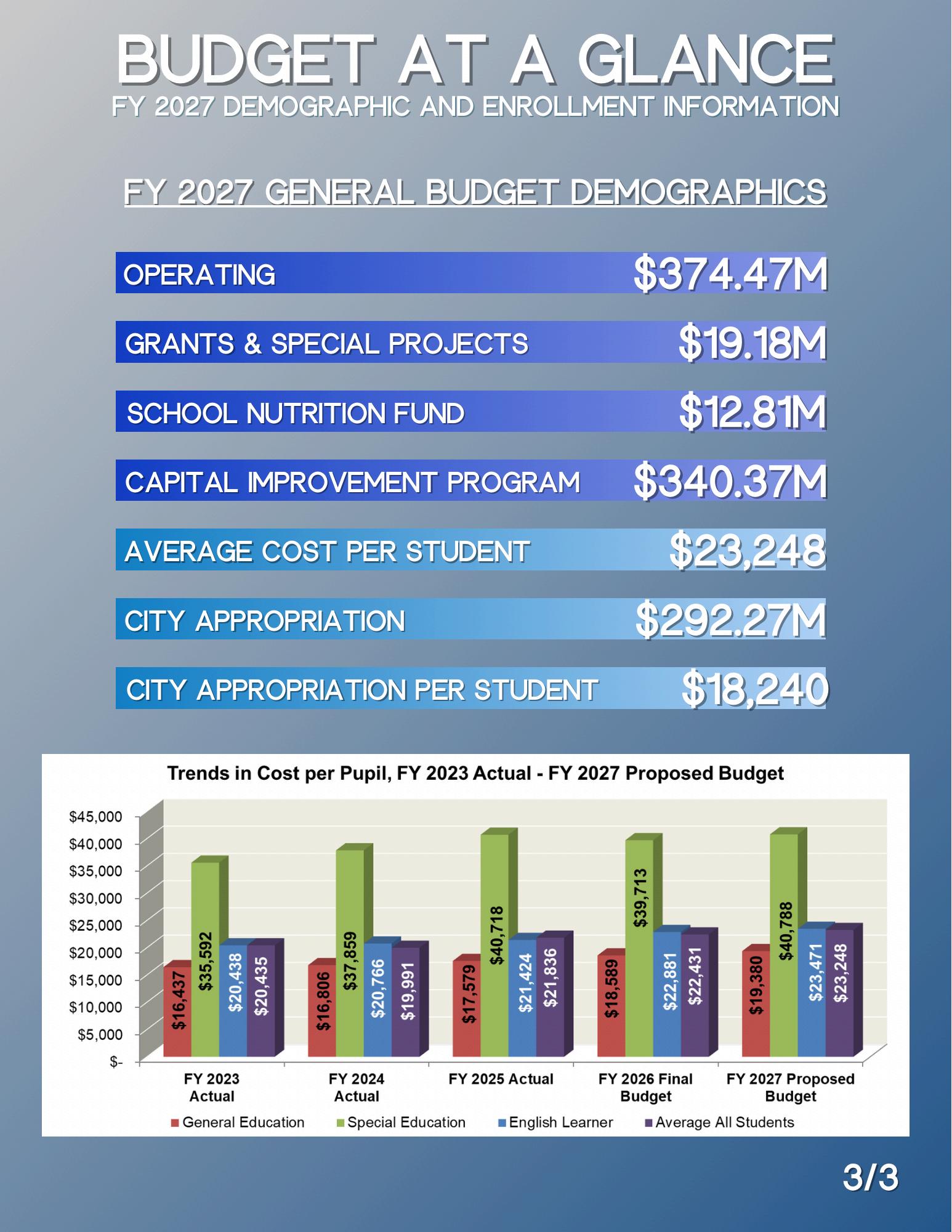
The FY 2027 operating expenditures budget totals $374.48 million, an increase of 3.7 percent compared to the prior fiscal year The appropriation to ACPS from the City of Alexandria totals $292 27 million, an increase of 3 5 percent compared to the FY 2026 Final Budget Total positions show a net decrease of 8 90 FTEs
For FY 2027, overall student enrollment is projected to increase by 0 2 percent, or 30 students, for a total enrollment of 16,023 (including special placements)
Although exceptional progress can be seen through the division-wide transformation efforts over the past several years, the work is not complete The School Board, Superintendent, and staff continue long-term efforts that require strategic planning, investment in our staff, professional learning, accountability and community engagement This budget aligns our resources effectively and efficiently in order to support student achievement, provide top-quality teachers, improve facilities, engage families and ensure the safety and security of students and staff
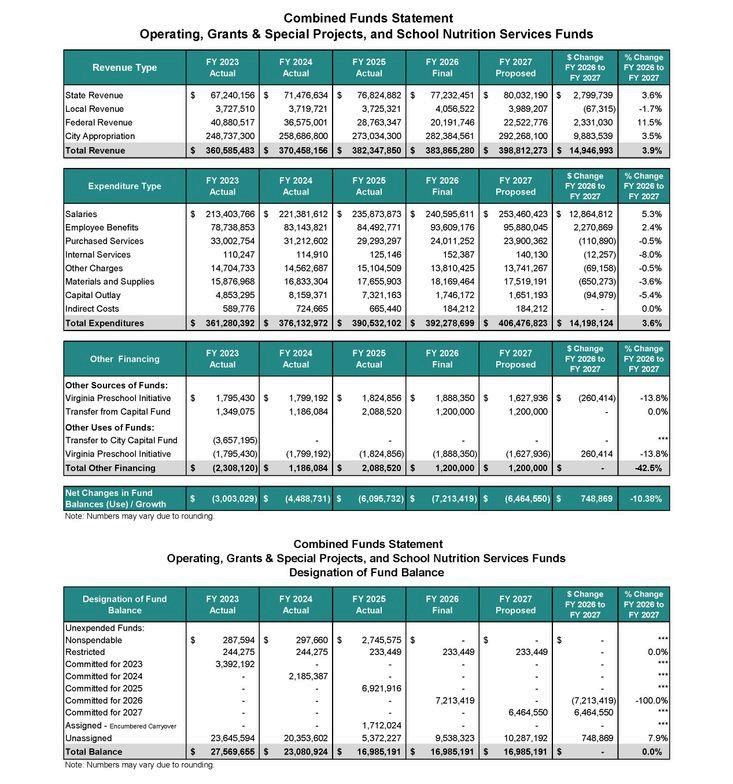
Combined Funds Statement
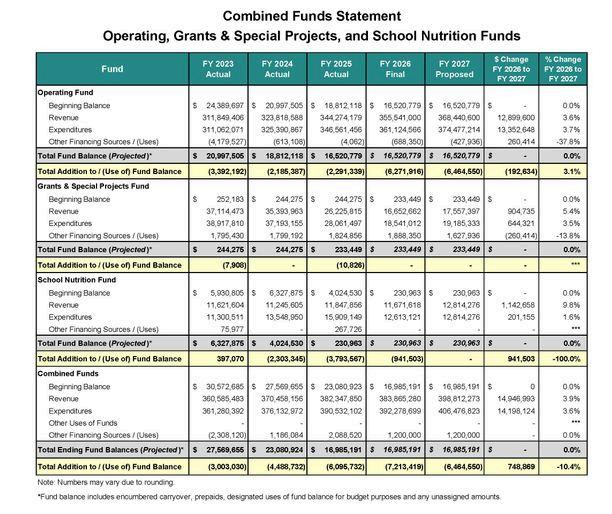
The table above shows the combined funds statement Actual figures are shown for FY 2023 through FY 2025, Final Budget figures are shown for FY 2026 The presentation of revenue and expenditures has been adjusted to show “Other Financing Sources and Uses” on a separate line This presentation more closely aligns with the statement of revenues, expenditures, and changes in fund balances as presented in the Audited Comprehensive Financial Report (FR)
The Combined Funds budget consists of three separate funds:
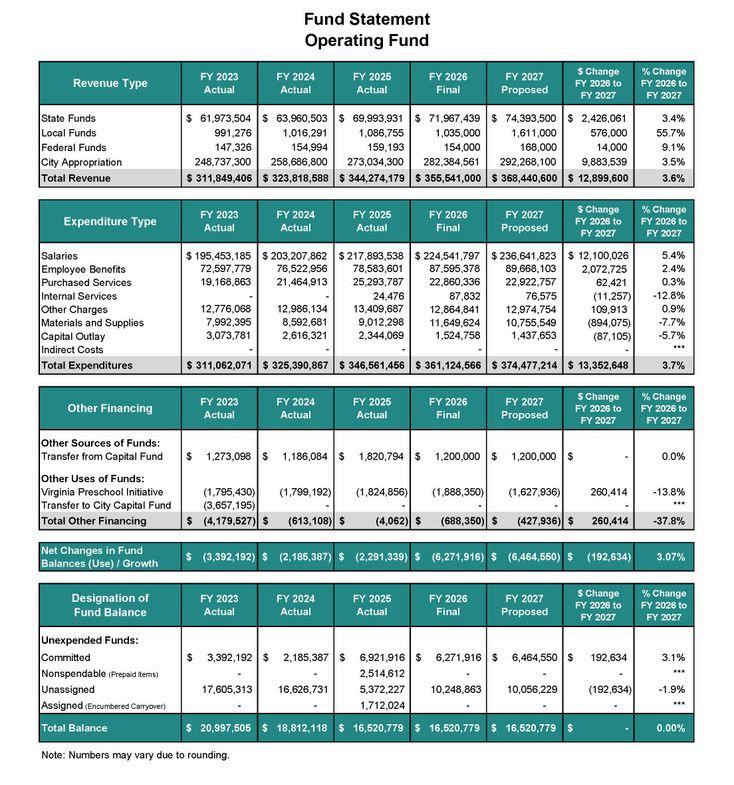
Operating Fund: This fund provides for the day-to-day operation of the school division and includes the division’s primary revenue sources from the Commonwealth of Virginia and the City of Alexandria Projected Operating Fund revenues are projected to increase by 3.7 percent in FY 2027, compared to the FY 2026 Final budget.
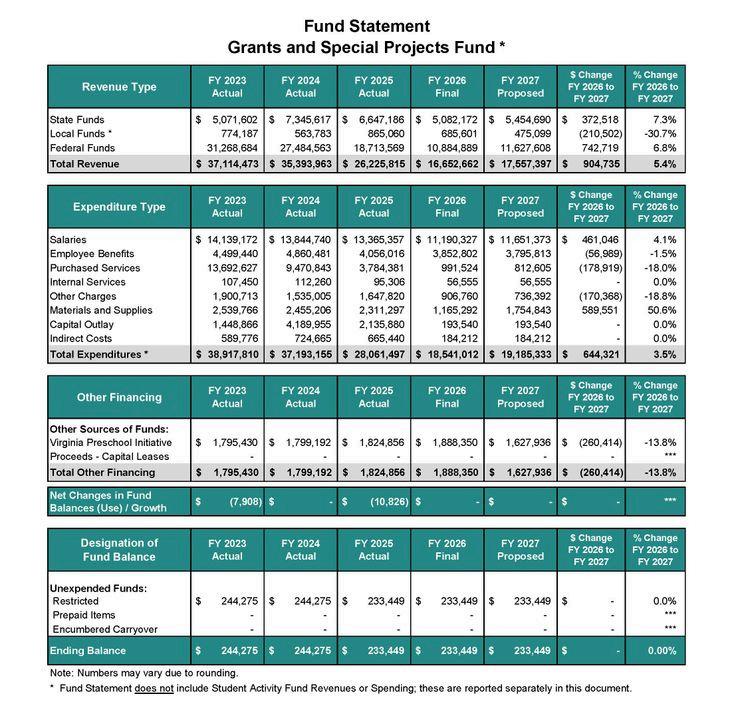
Grants and Special Projects Fund: This fund accounts for all federal, state, and local grants Federal and state grant funds are primarily entitlement funds allocated to the school division on a formula basis, but operate under grant rules as they relate to requirements, management, performance, and reporting Grants and special projects revenue projections are projected to increase by 5 4 percent compared to the FY 2026 Final budget
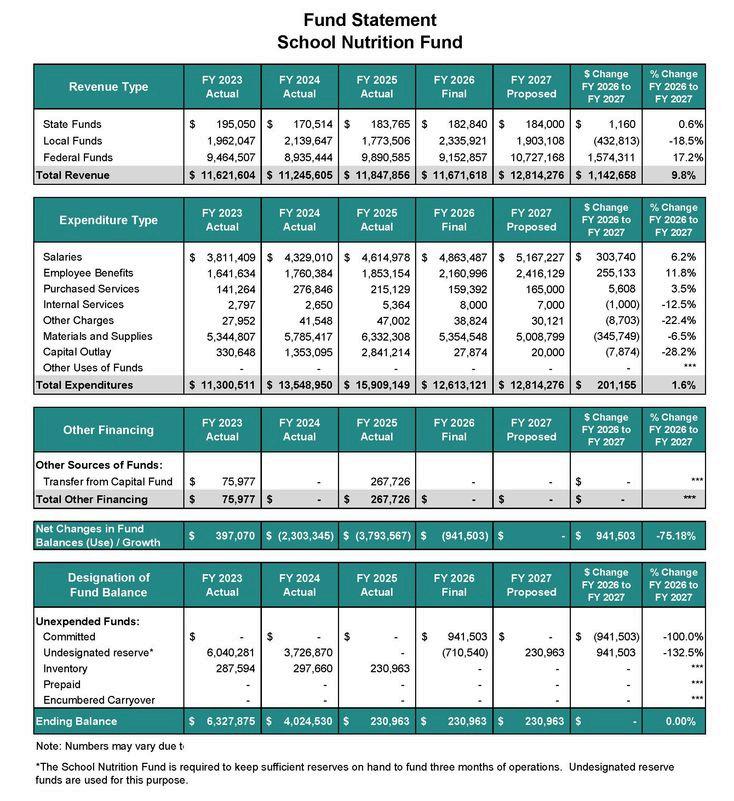
School Nutrition Fund: This enterprise fund covers all food service operations and administrative costs, primarily from food sales and federal revenue It does not include cafeteria aides who are budgeted from the Operating Fund School Nutrition Fund revenues are projected to increase by 9 8 percent from the FY 2026 Final budget
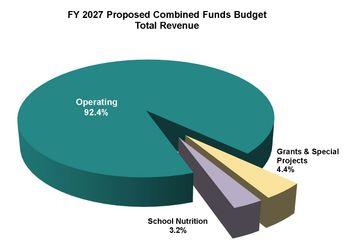
Combined Funds: As shown on the pie chart above, the Operating Fund revenue (excluding other financing) represents 92 4 percent of the combined funds budgeted revenue and totals $368 44 million Grants and Special Projects Fund revenue represents 4 4 percent and totals $1756 million School Nutrition Fund revenue represents 3 2 percent and totals $12.81 million of the combined funds budget revenue.
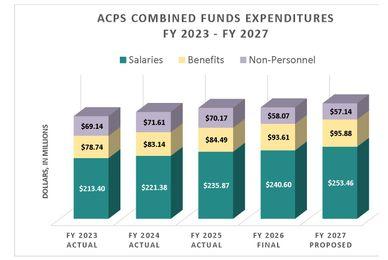
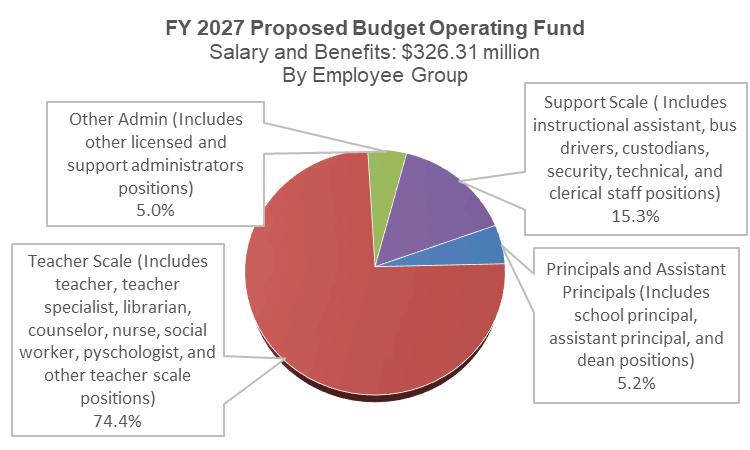
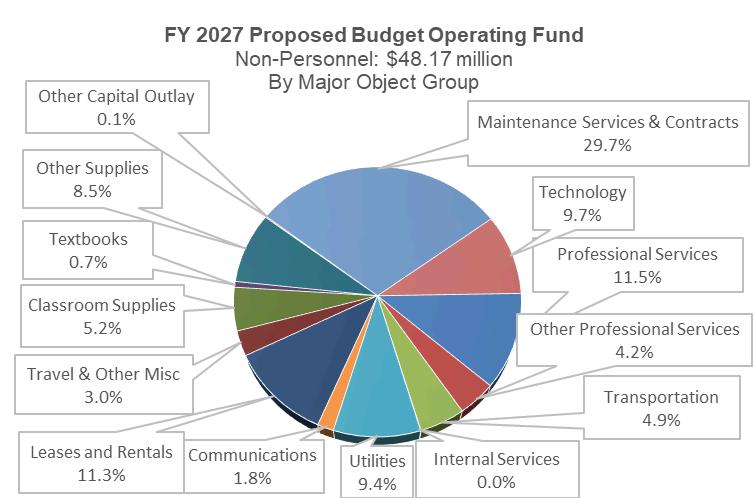
The chart below shows the distribution of salary, benefits, and non-personnel expenditures for all funds, combined Total salary and benefits expenditures comprise approximately 85.9 percent of the total combined funds budget in FY 2027, which is slightly more than the ratio in the FY 2026 budget
Salaries and benefits expenditures are projected to increase overall by 4 5 percent This increase is driven primarily by anticipated compensation improvements for current ACPS staff as well as increases in health insurance premiums
Sources of Revenue by Fund
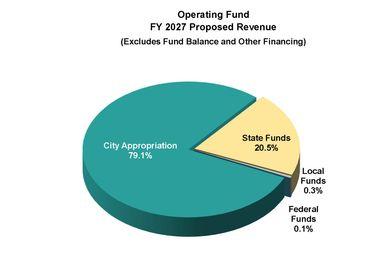
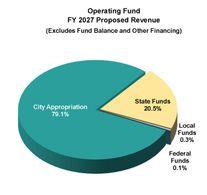
Operating Fund: The primary source of operating revenue for ACPS is the city appropriation, which comprises 79 1 percent of projected operating revenue and other financing State revenue is smaller at 20 5 percent, and local and federal revenues total approximately 0.4 percent. The school division is fiscally dependent on the City of Alexandria and is not permitted to incur long-term debt
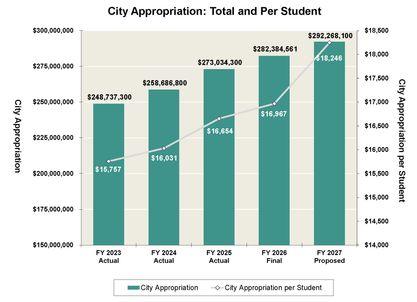
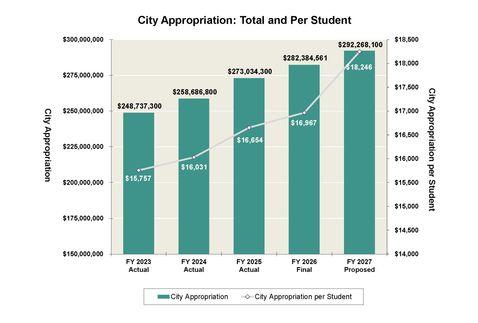
The City Appropriation of $292 27 million is an increase of $9 88 million, or 3 5 percent greater than the previous fiscal year The city appropriation per student is projected at $18,246, as shown in the chart below
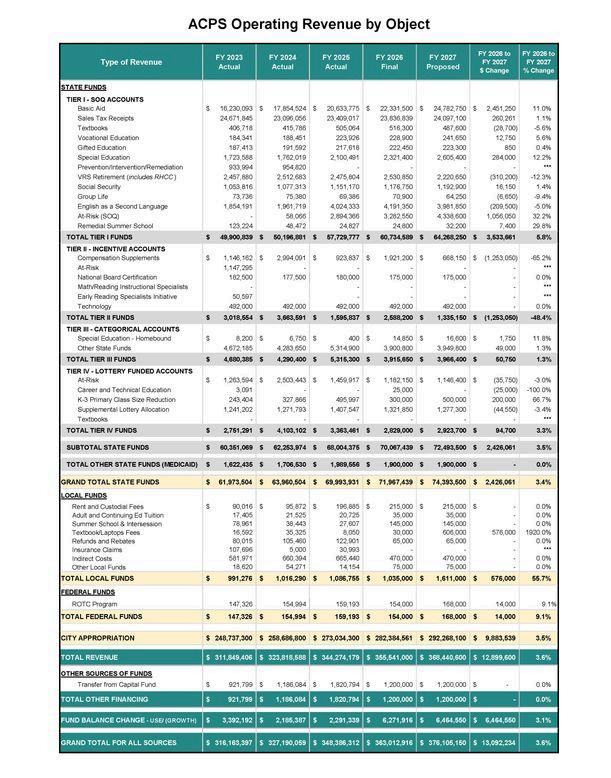
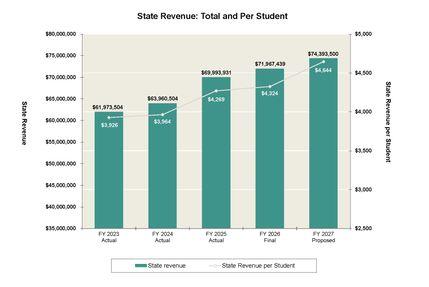
State revenues are projected to total $74 39 million, an increase of $2 43 million or 3 4 percent State revenues are projected to increase mainly in the area of Basic Aid, Salary Improvements, and At-Risk funding; overall, other funding categories are projected to remain at levels similar to those in FY 2026 Local revenue projections total $1 61 million in FY 2027, increasing by 55.7 percent from the amount budgeted for FY 2026 due to the implementation of a new Technology Use Fee
Federal funds total $0 17 million, an increase from the amount budgeted for FY 2026 These funds will support the ROTC program at Alexandria City High School Additional federal revenue received by ACPS includes entitlement grants which are budgeted within the Grants and Special Projects Fund
Other Financing includes other sources of funds from the Capital Improvement Project (CIP) fund Included in FY 2027 is other uses of funds for the Virginia Preschool Initiative (VPI) which is tracked in a separate grants and special projects fund
The FY 2027 Operating Fund support for the preschool program will be $1 63 million
The FY 2027 budget also includes the Use of Operating Fund Balance The total amount of $6 46 million budgeted for FY 2027 will support school operations and is approximately 1 75 percent of the total operating budget Throughout the year, the ACPS Fiscal Services Division closely monitors both the actual and projected year-end balances of all School Board funds to ensure both prudent fiscal management and ongoing compliance with School Board policies
Grants and Special Projects Fund: Total budgeted revenues in this fund are projected to increase by 5 4 percent to $1756 million Additional grant funding may be available during the upcoming fiscal year through the use of carryover from prior year grant funds or if new awards become available.
School Nutrition Fund: An increase in revenues of $1 14 million, or 9 8 percent, is driven by a projected decrease in federal revenue Additional information can be found in the Financial section of this document
Expenditure Overview by Fund Type
Operating Fund: The FY 2027 Operating Fund expenditure budget totals $374 48 million, an increase of $13 35 million or 3.7 percent when compared to the prior fiscal year’s budget. This does not include other financing such as transfers to support the preschool program and capital funds
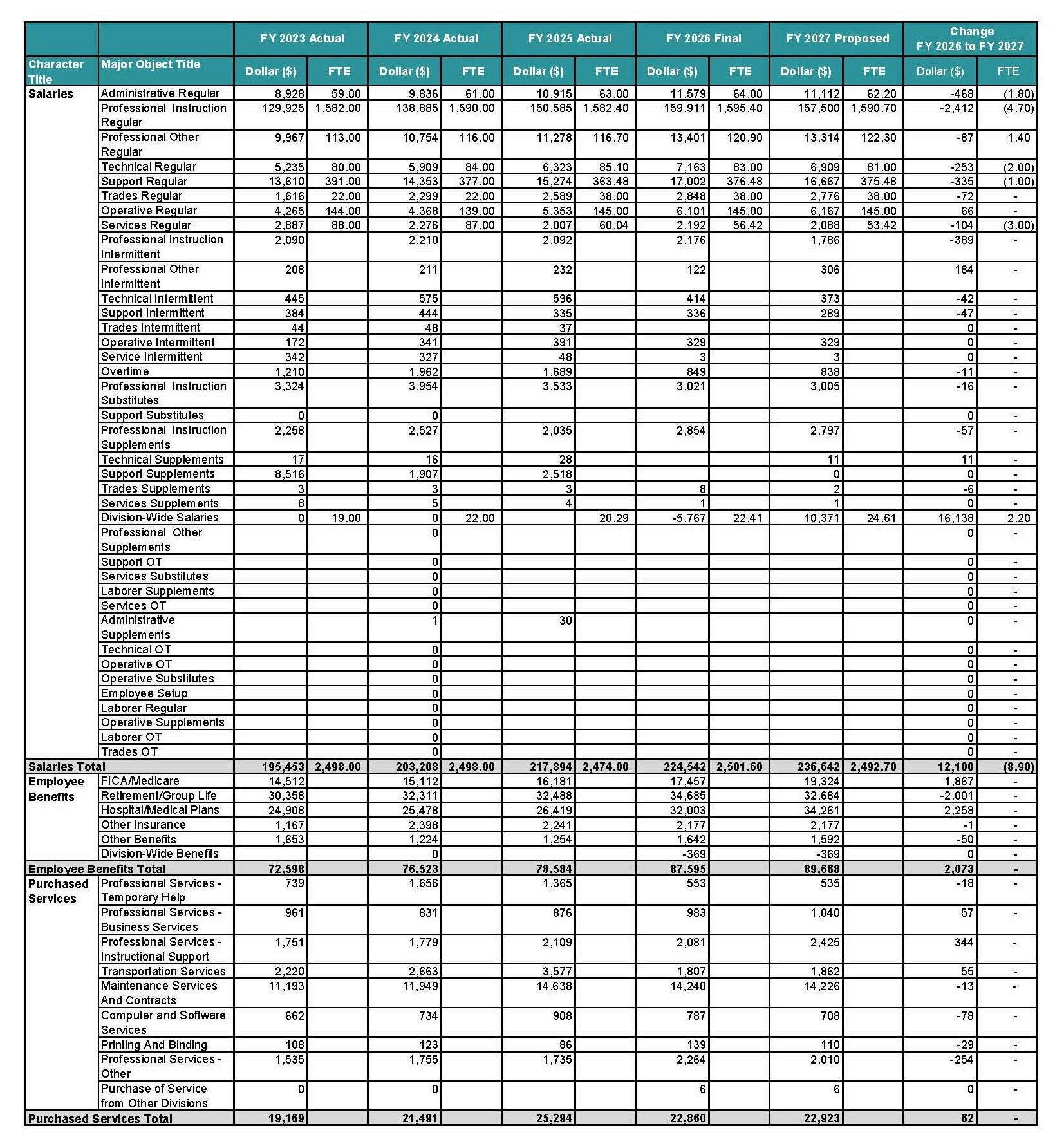
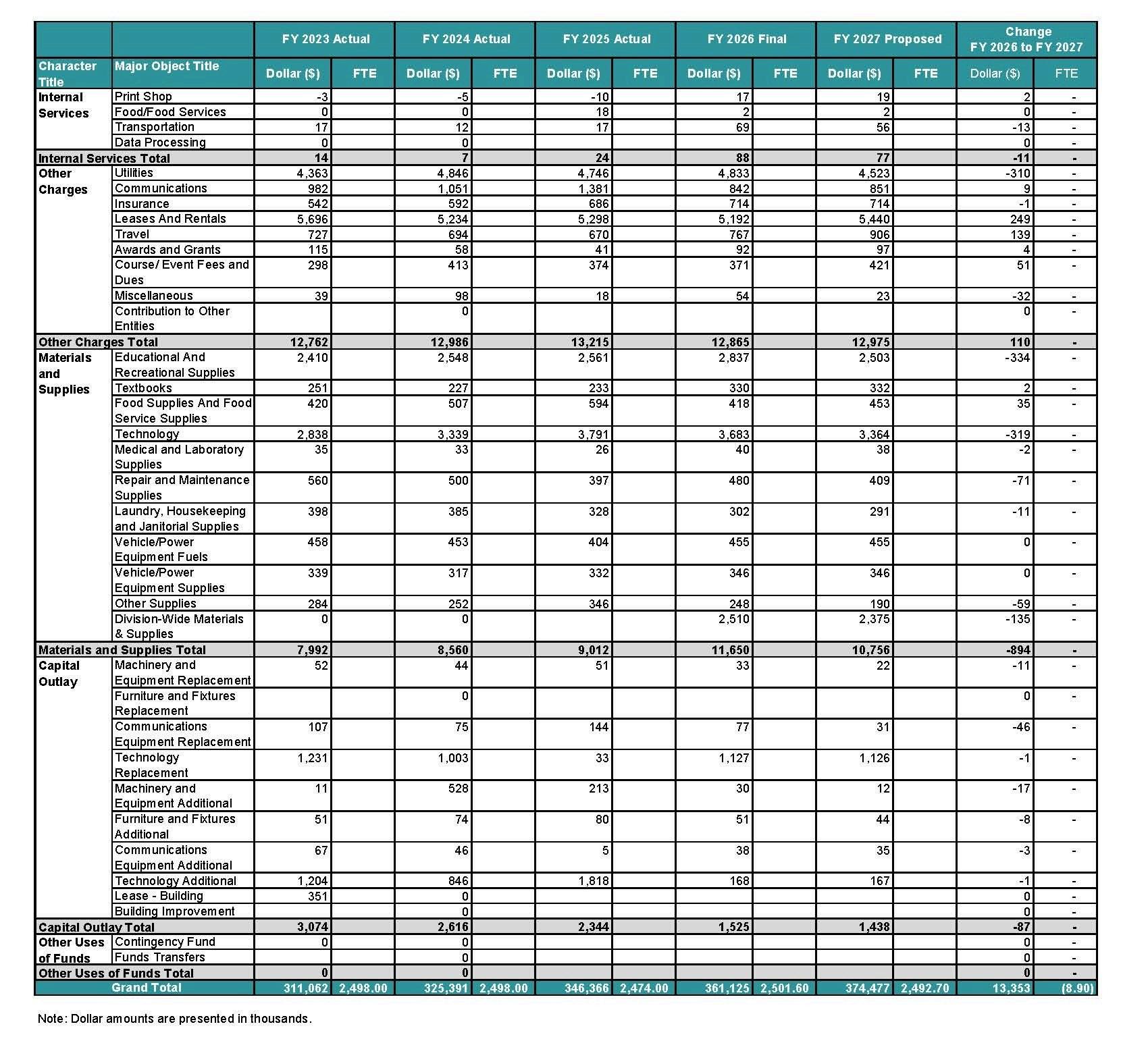
Salary accounts increased by $12 1 million or 5 4 percent compared to the prior fiscal year, primarily as a result of compensation enhancements The benefit expenditures increased by $2 07 million or 2 4 percent, primarily the result of VRS and Health rate adjustments Non-personnel accounts decreased by $0 82 million or 0 2 percent An explanation of character titles can be found in the Reading of the Financial Reports narrative in the Financial section
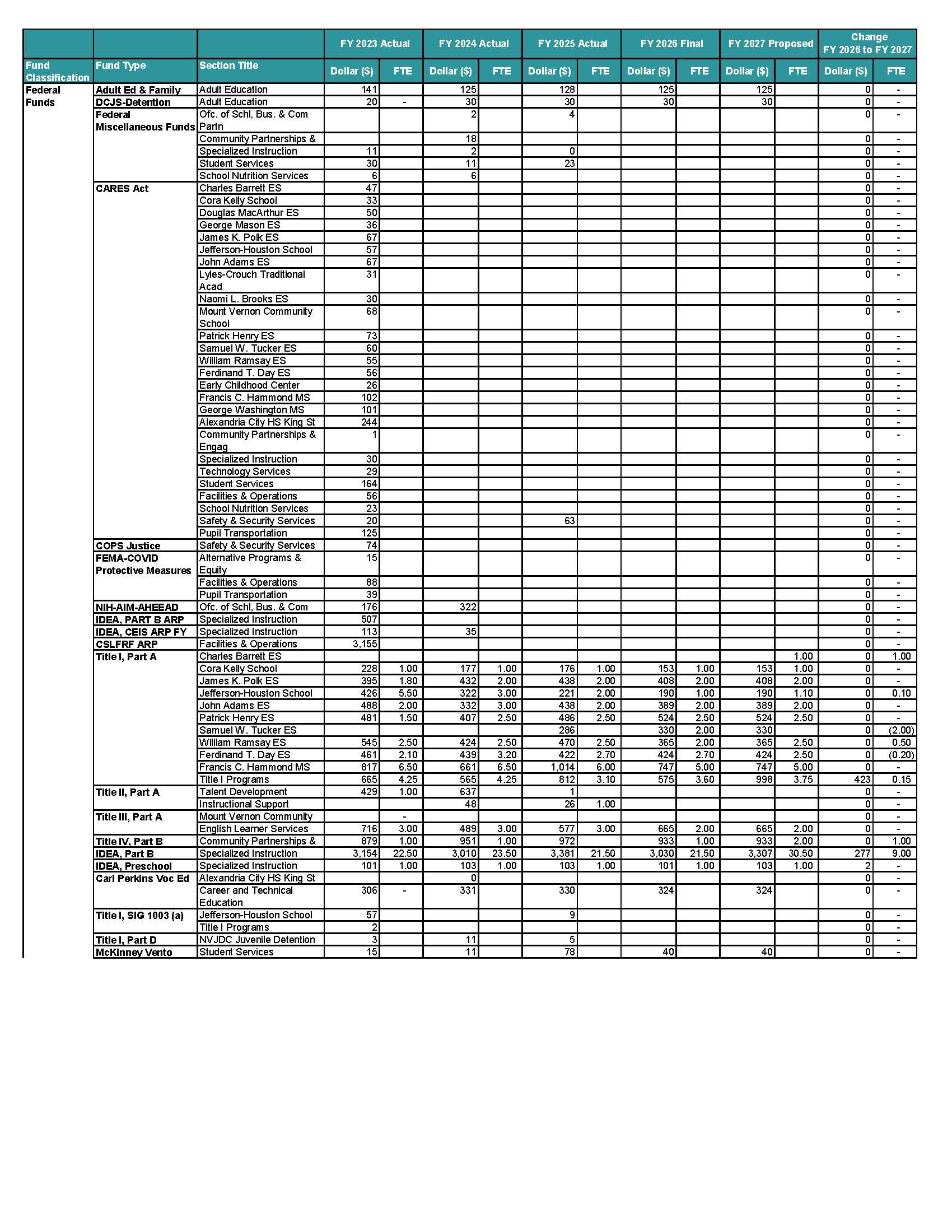
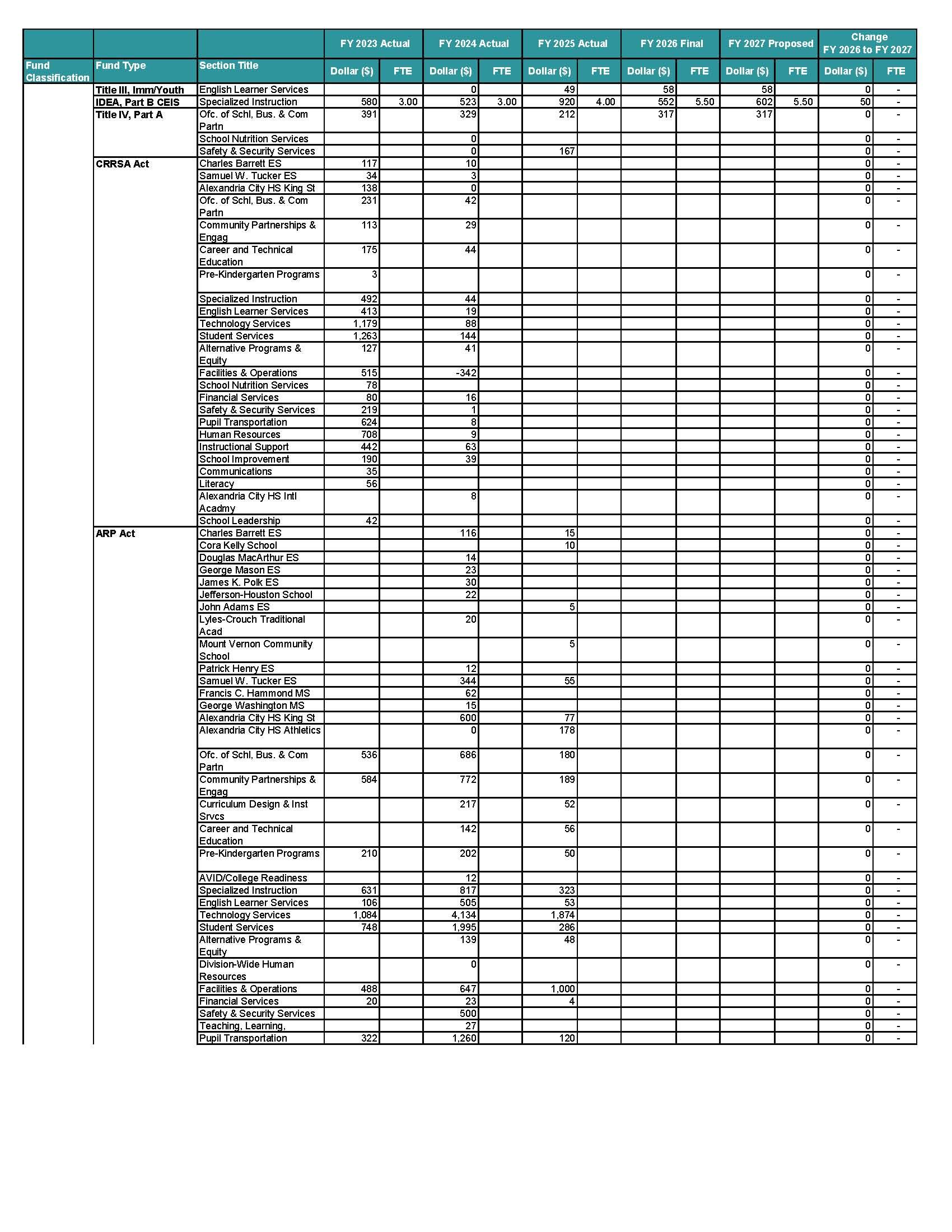
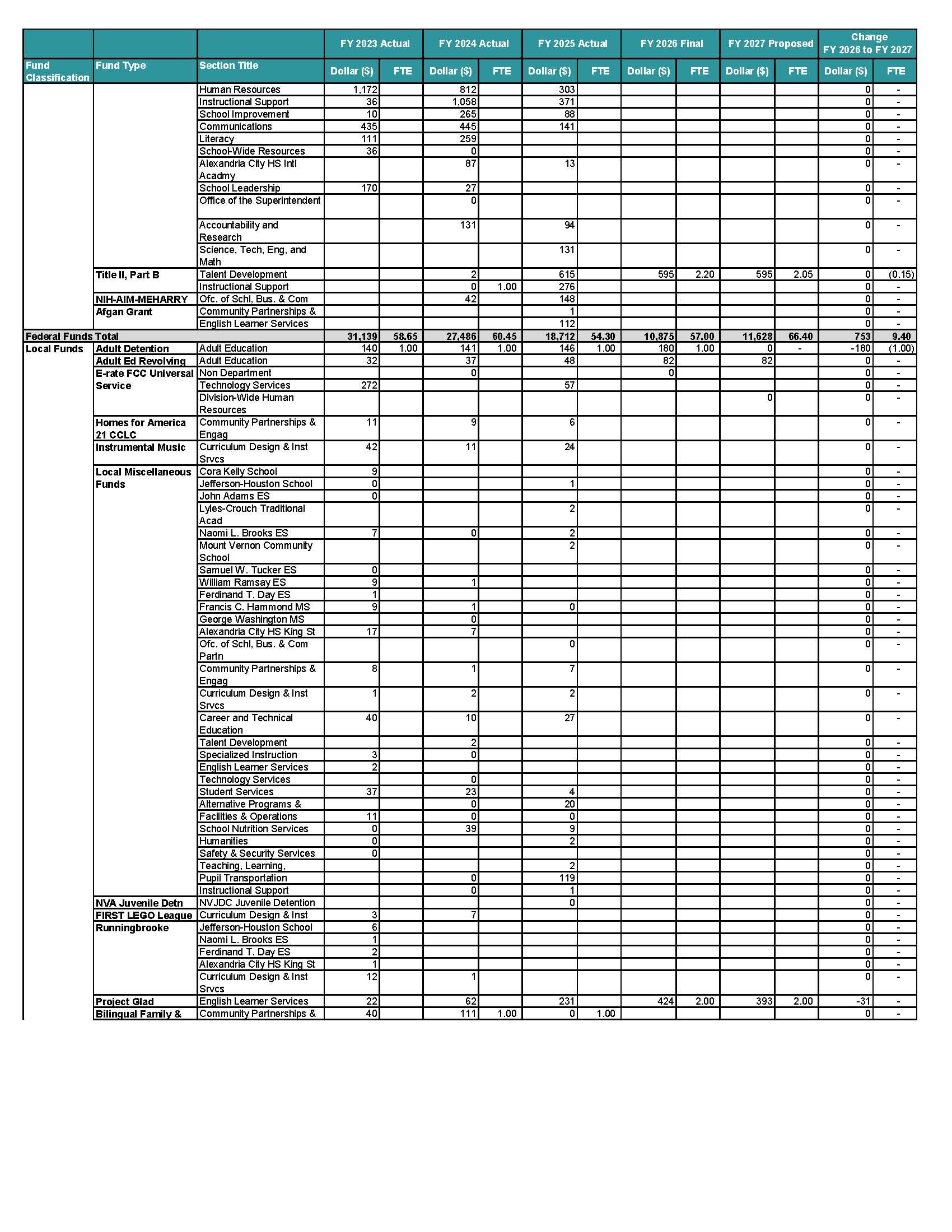
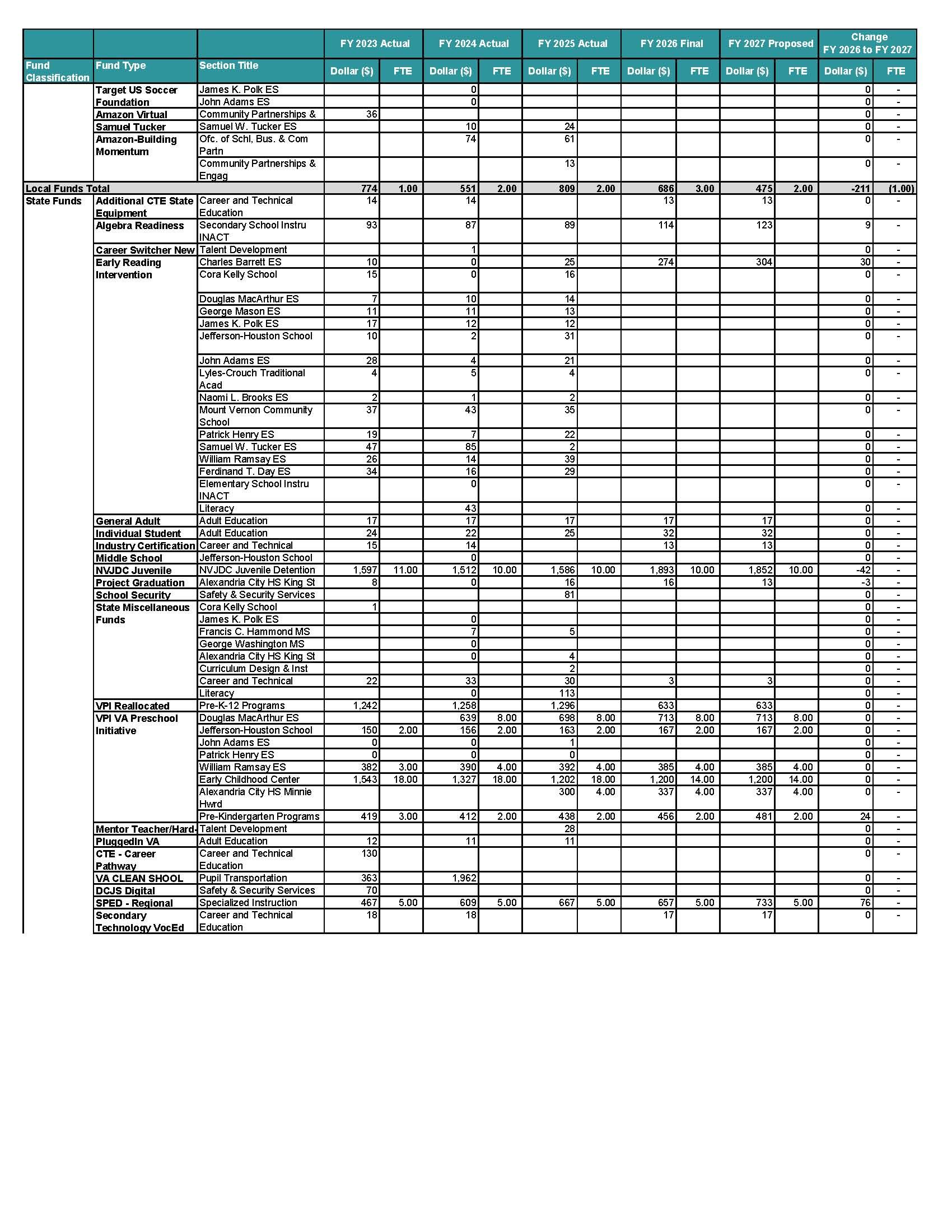
Grants and Special Projects Fund: The total budgeted expenditures for the Grants and Special Projects Fund in FY 2027 is $19 19 million, an increase of $0 64 million or 3 5 percent from the prior fiscal year Salaries and benefit expenditures total $15.45 million, or approximately 80.5 percent of the total grants and special projects budget. Non-personnel expenditures total $3 74 million and account for approximately 19 5 percent of the total grants and special projects budget These changes are seen in more detail in the Financials section of this document
The Grants and Special Projects Fund budget is a preliminary estimate based on current year awards, which will be adjusted later in the year as additional information is received Final grant award amounts are typically confirmed by the grantors in the fall In addition, carry-over funding will be determined based on the FY 2026 year-end audited actual expenditures
School Nutrition Fund: The Food and Nutrition Services Fund is a major special revenue fund used to account for revenues internally restricted to expenditures for certain purposes, specifically for the procurement, preparation and serving of student meals The FY 2027 budgeted expenditures total $12 81 million, an increase of $0 20 million compared to the prior fiscal year
Salaries will increase from $4 86 million to $5 17 million for FY 2027 Benefit expenditures will increase to $2 42 million due to health and VRS rate adjustments Non-personnel accounts total $5 23 million or 40 8 percent Details are shown in the fund statement tables in the Financials section of this document
Major Changes in Operating Expenditures
ACPS is committed to achieving the mission and vision articulated in the ACPS 2030 strategic plan and meeting the priorities that School Board established for the school year The FY 2027 Budget aims to bring these plans and priorities to fruition while at the same time ensuring we proactively mitigate adverse long-term impacts of the pandemic our students, our school system, and our community
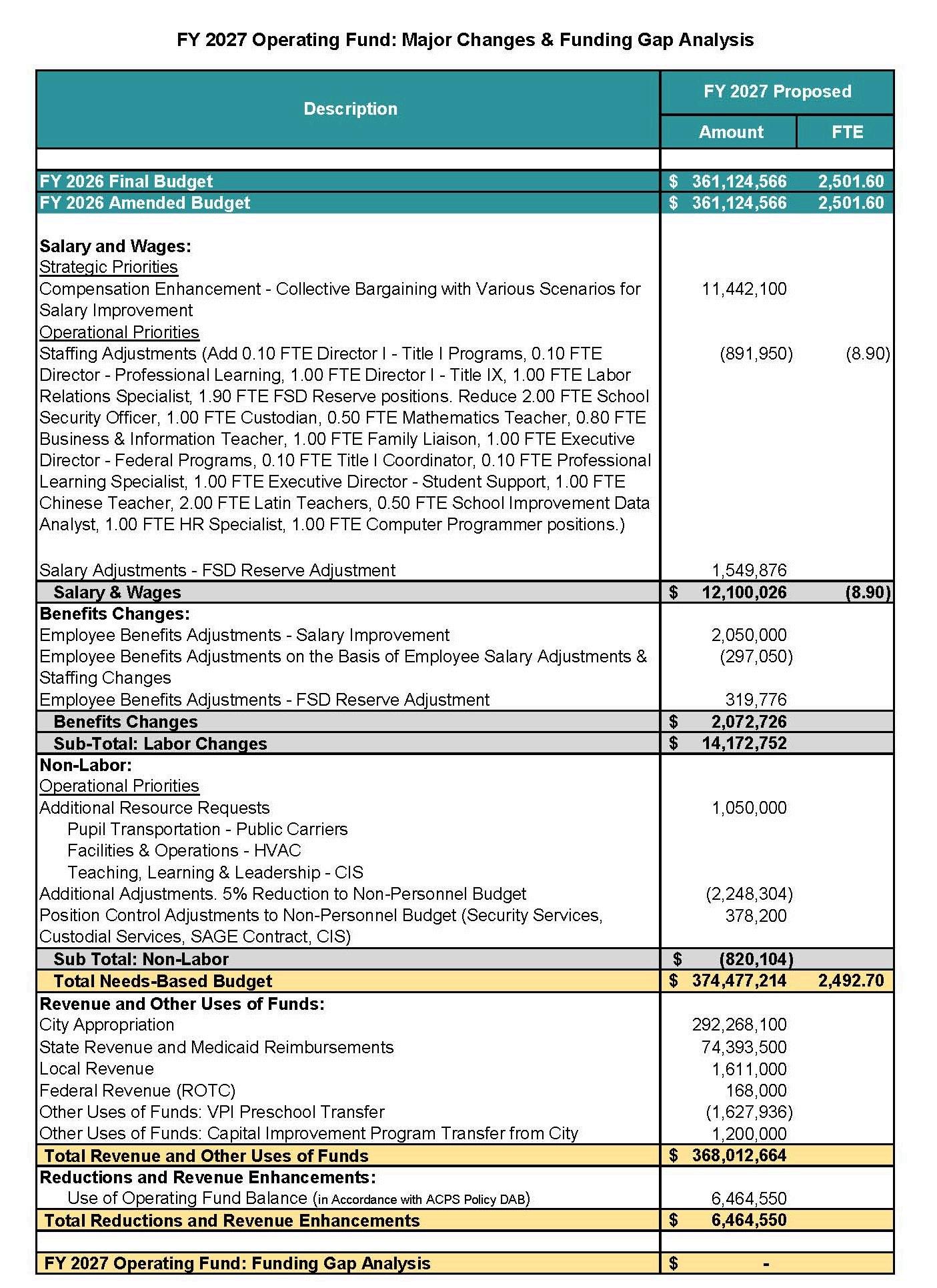
When compared to the prior fiscal year, the FY 2027 Operating Budget features a $13 35 million, or a 3 7 percent increase, with an decrease of 8 90 FTE positions The current enrollment trends, increased complexity of student needs, and staff compensation and benefits are the primary drivers in projected changes
Staffing changes are primarily the result of meeting shifting needs throughout the division Details of the enrollmentdriven staffing changes and other staffing changes can be found throughout this document
The table below highlights the above-mentioned changes As noted, the most significant cost driver is employee compensation Various expenditure adjustments, such as school-based and non-school based staffing enhancements as well as other expenditure adjustments were necessary additions to the budget. FY 2027 projected revenue and other uses of funds result in a funding gap The district intends to balance the budget with prior year fund balance resources The details of these changes can be found in the Financials section
Fiscal Forecast
FY 2026-2031 Fiscal Forecast
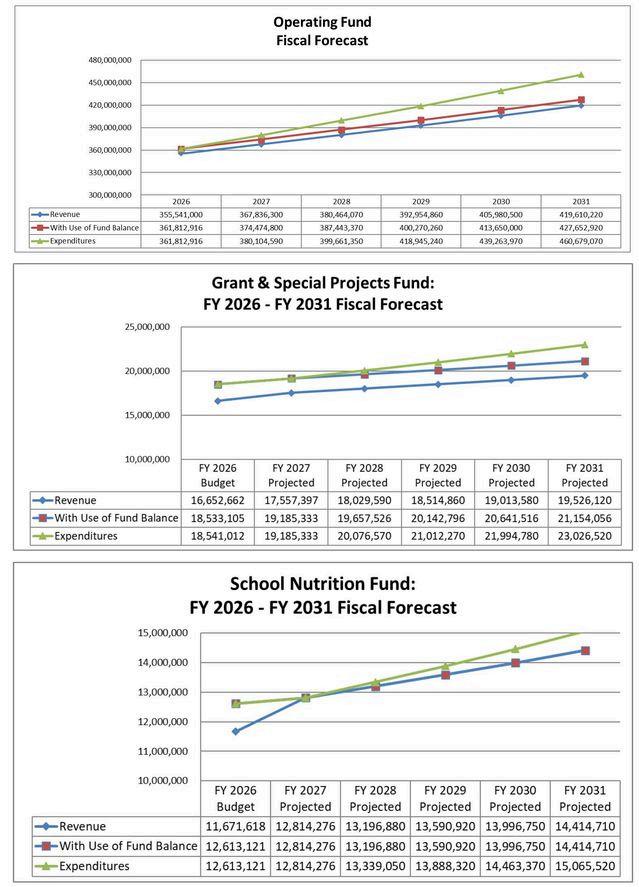
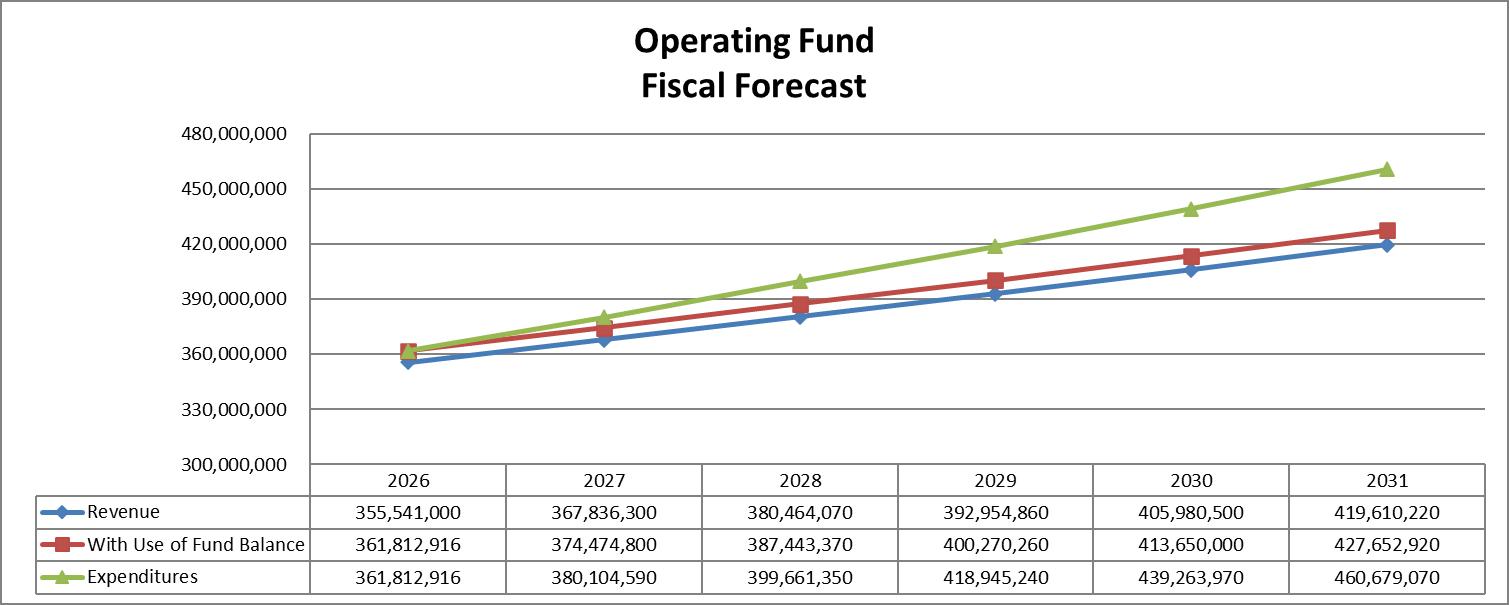
The FY 2026-2031 fiscal forecast incorporates the revenue and expenditures of the final FY 2026 budget and projects financial performance for the Operating Fund through FY 2031
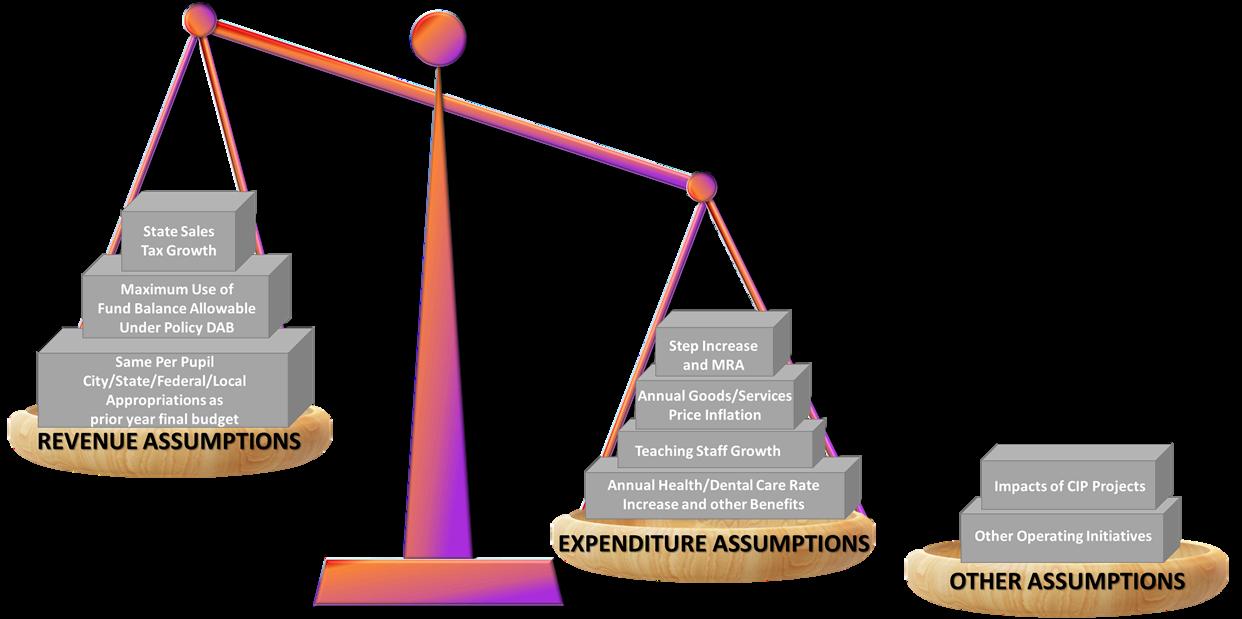
The forecast utilizes assumptions concerning enrollment and demographics, class size and staffing levels, as well as revenue and expenditure inflation trends, to provide a long-range picture of the financial challenges facing ACPS. The graphic below provides a summary of those assumptions The model underlying the forecast provides an analytical framework that allows the Alexandria City School Board and ACPS leadership to examine how changes in operating assumptions affect this financial picture, and will be used to determine how best to close the forecasted operating gap
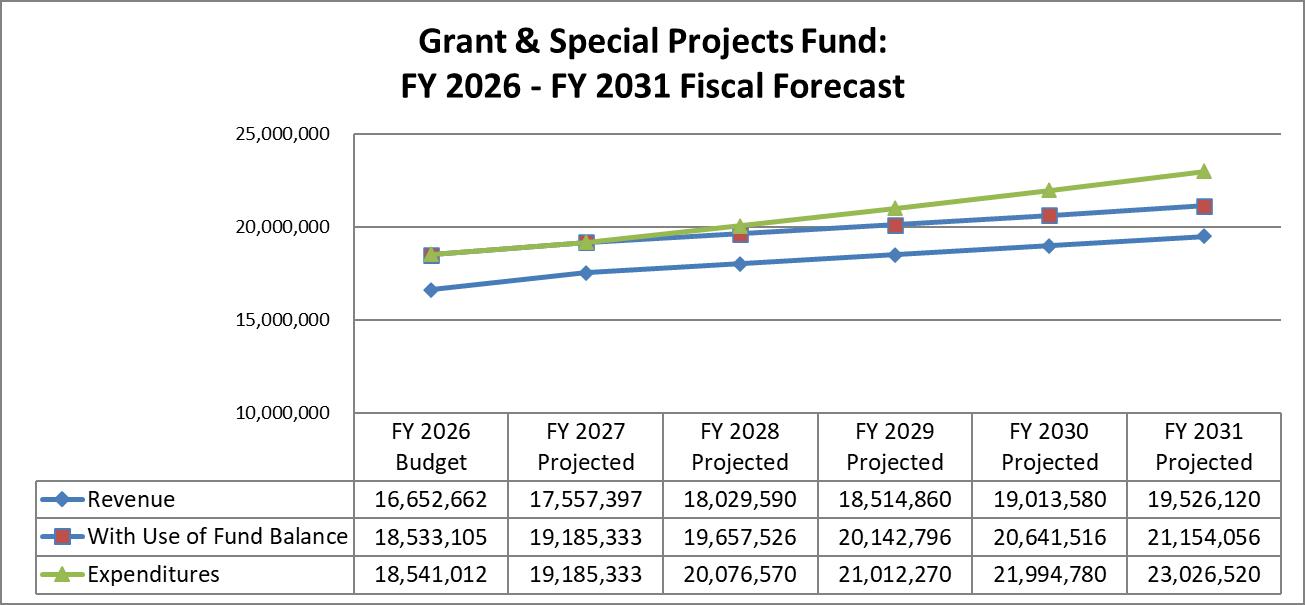
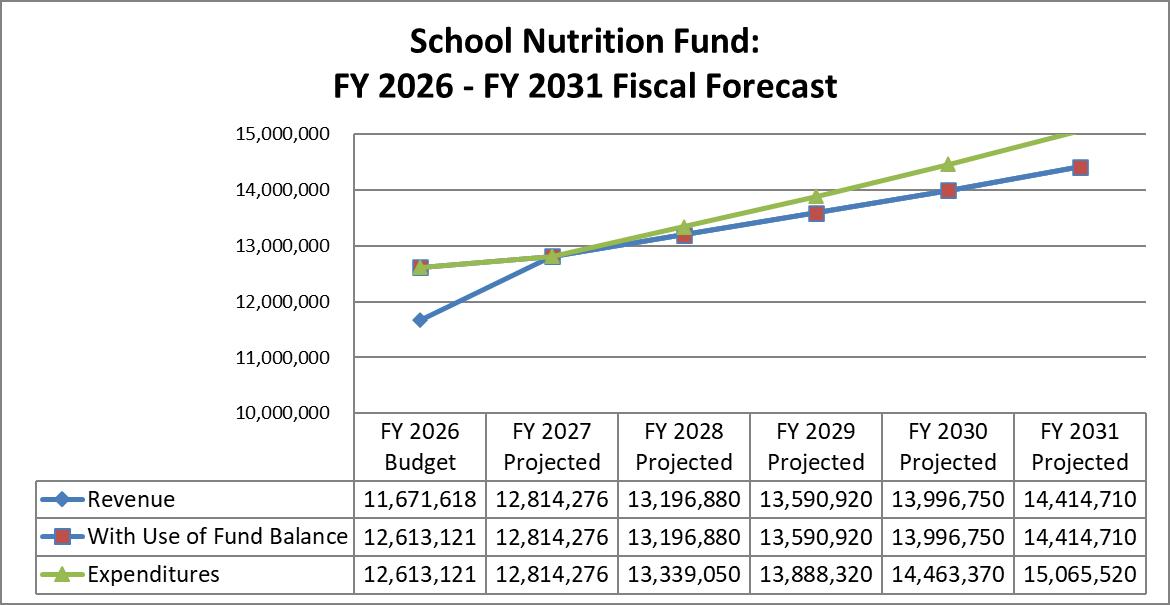
The fiscal forecast for the Grants & Special Project Fund reflects revenue assumptions for, primarily, Federal entitlement grants and are offset by the requisite expenditure modification Likewise, the School Nutrition Fund reflects similar expenditure assumptions; however, revenue projections offset the impact of the assumptions Thus, these two funds are presented separately from the Operating Fund forecast See the Financial Section for more details
Multi-year Revenue and Expenditure Projections
The chart displays revenue (inclusive of other financing sources and uses) and expenditures for FY 2026 Budget and FY 2027 Projected through FY 2031 Projected By FY 2031, Alexandria City Public School district is forecast to face an operating shortfall ACPS will continue to closely monitor revenue and expenditures and intends to mitigate potential unfunded needs through the following strategies:
1 Continue efforts to diversify and grow ACPS revenue sources by growing strategic partnerships;
2 Adopt fiscal austerity measures including de-prioritization of spending that could be deferred to future years; and,
3 Use fund balance, as deemed necessary by the Superintendent and approved by the School Board
Capital Improvement Program
Capital Improvement Program (CIP) Introduction
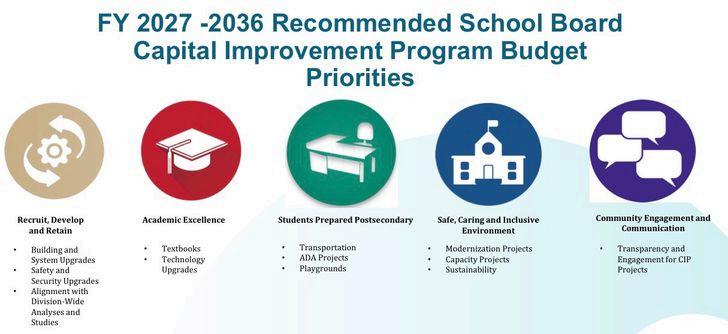
The Alexandria City Public Schools (ACPS) Superintendent’s Proposed FY 2027 - 2036 Capital Improvement Program (CIP) is framed with consideration for the School Board’s FY 2027 - 2036 Budget Priorities which are aligned with the ACPS 2030 Strategic Plan Goals of:
• Safe, Caring, and Inclusive Environments
Academic Excellence
Exceptional Talent
Trust and Engagement
• Life-Ready Students
ACPS incorporates current enrollment information, program requirements, city population data, and planning & zoning assessments, along with principal and department head needs In addition, staff uses operations and maintenance data, School Board strategic plans and facility needs assessments to determine capital needs The Capital Improvement Program adoption reflects the annual commitment to a series of projects with estimated costs based on current knowledge, market conditions and priorities
The City of Alexandria defines a capital project as one that acquires or improves a physical asset with a useful life of three or more years for greater than $10,000 not including day-today maintenance tasks Several capital projects have a direct impact on the operating budget and are typically related to capacity.
While the program serves as a long range plan, it is reviewed and revised annually based on current planning circumstances and the need to reprioritize
Strategic Planning Framework
The Alexandria City School Board officially approved the 2025–30 Strategic Plan for Alexandria City Public Schools (ACPS), titled Nurture. Educate. Inspire., on May 8, 2025. The following goals provide the structure for the framework:
Goal 1: Safe, Caring, and Inclusive Environments
CIP investments create modern, secure, and welcoming facilities that foster student well-being, accessibility, and inclusion that ensures every learner has a safe space to thrive
Goal 2: Academic Excellence
Facility improvements and technology upgrades create flexible, engaging learning environments that support highquality instruction and student success
Goal 3: Exceptional Talent
Upgraded professional and support spaces enhance collaboration, professional growth, and work environments that attract and retain outstanding educators and staff.
Goal 4: Trust and Engagement
Transparent capital planning and community-informed design strengthen partnerships and ensure schools serve as trusted, shared spaces for all Alexandria residents
Goal 5: Life-Ready Students
Investments in high school and career/technical spaces equip students with real-world skills and opportunities to succeed in college, career, and community life
Overview Of the CIP and Budget
The proposed FY 2027-2036 CIP reflects previous goals of a comprehensive planning approach and maintains the commitment to the recommended CIP schedule from the Ad-Hoc Joint City-Schools Facilities Investment Task Force (Task Force) from November 2017 Each major capacity project is intended to be comprehensive and the expected lifespan is 30-50 years However, this budget also acknowledges that our older facilities will need interim modernization projects to sustain a deferred replacement or major renovation to the school
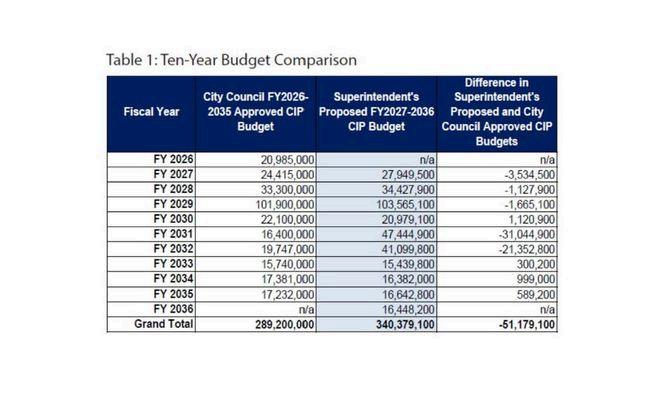
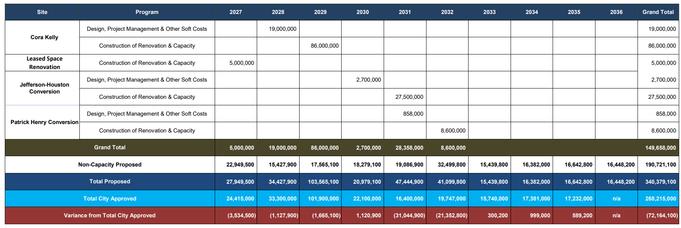
The total CIP budget is $340,379,100. This is $51M more than the total ten-year City Council approved FY 2026-2035 CIP. This budget reflects ACPS’s commitment to its partnership with the City in being fiscally responsible with taxpayers’ dollars However, middle school capacity continues to be a challenge for ACPS In accordance with the School Board decision to phase out the K-8 model, the ACPS adopted CIP includes funds for the conversion of Jefferson-Houston into an 850 student Middle School and the conversion of Patrick Henry into a K-5 school
The capacity portion of the proposed CIP program totals $149,658,000 over the 10-year period This includes funding for design, project management support for the renovation of existing buildings, and construction of additional capacity where necessary
The non-capacity portion of the CIP program totals $201,379,800 over the 10-year period This includes funding for major repairs and minor construction projects as well as funding for transportation services, technology modernization and textbooks
Enrollment projections indicate that secondary enrollment will exceed capacity in coming years ACPS has begun The High School Project to better serve the high school students academic experience while accommodating enrollment A dissection of more elements of the CIP budget is found in the Financial section of this document
Cost per Pupil
ACPS’s cost per pupil calculations determine the average cost per pupil for all students, then disaggregates the cost into three components:
All general education
Special education
English learner (EL) services
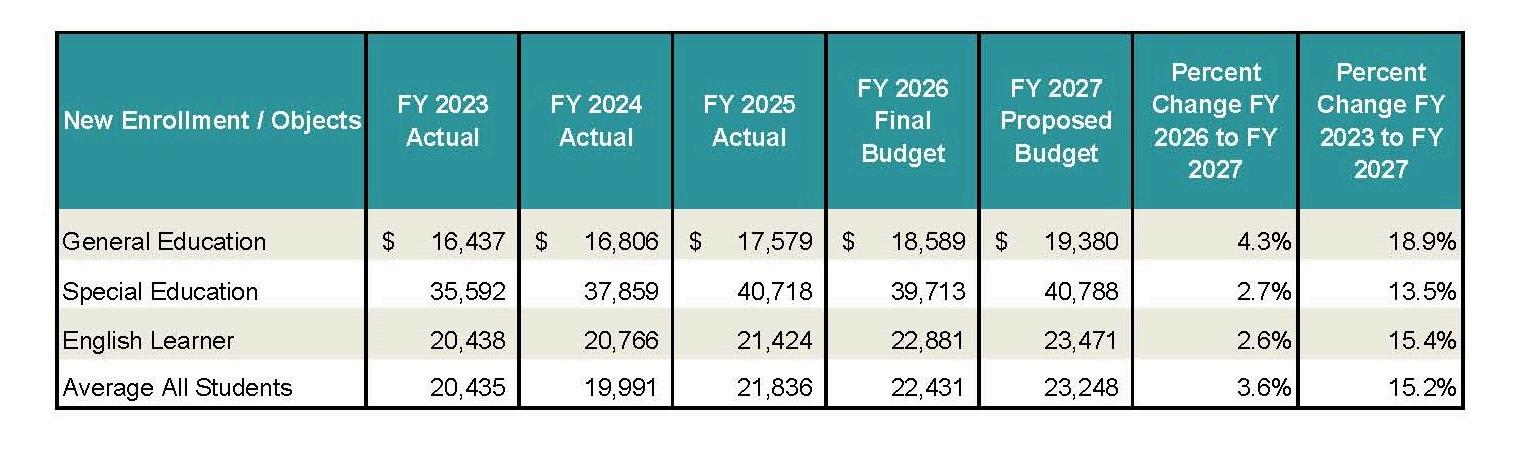
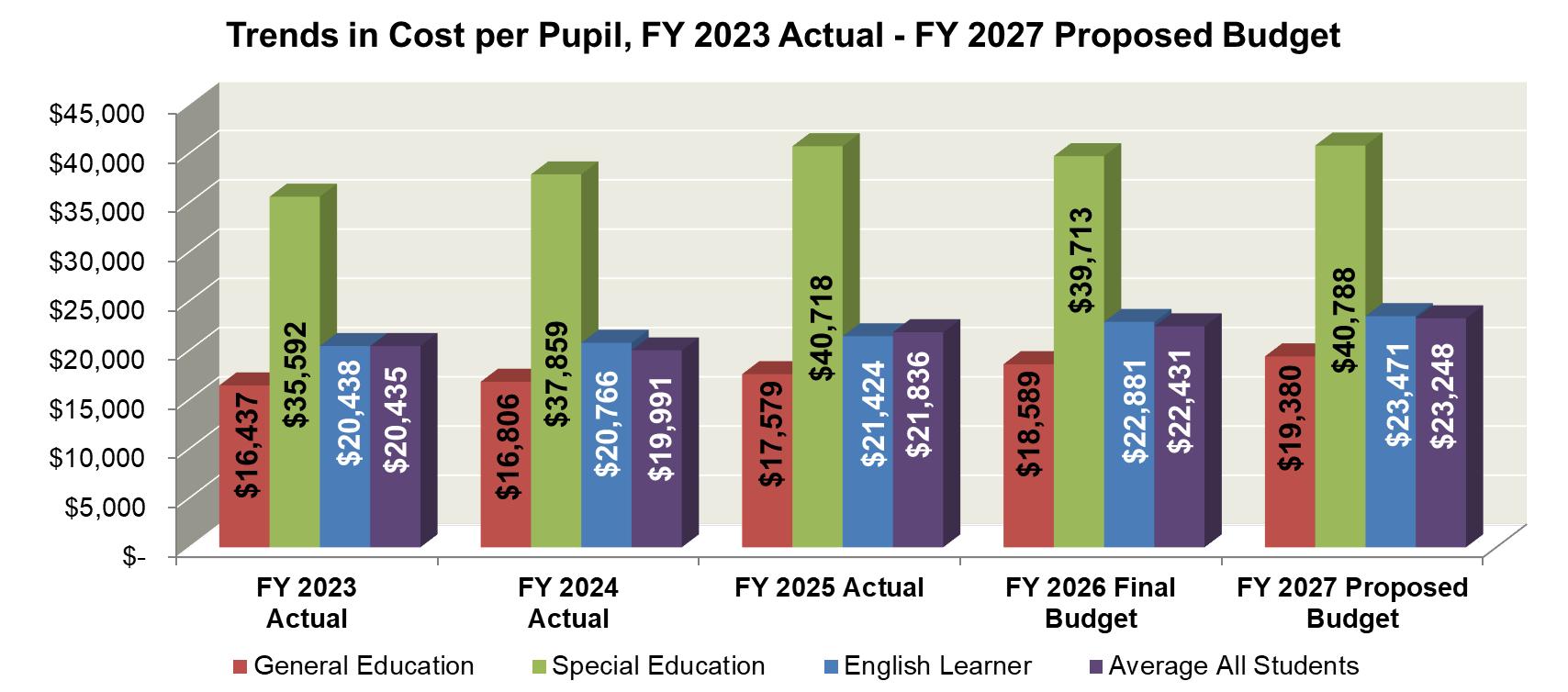
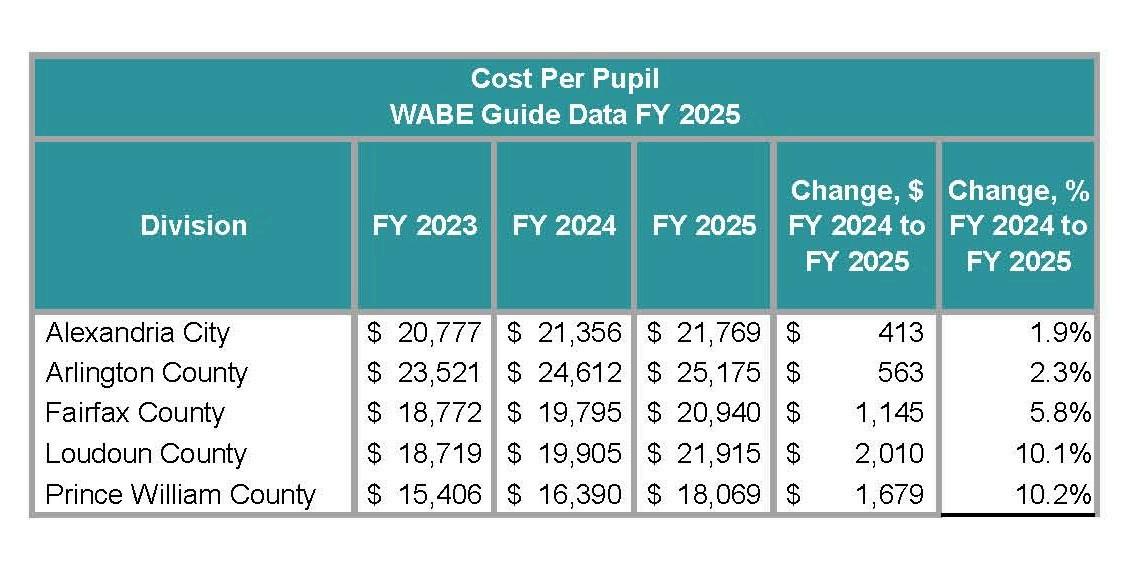
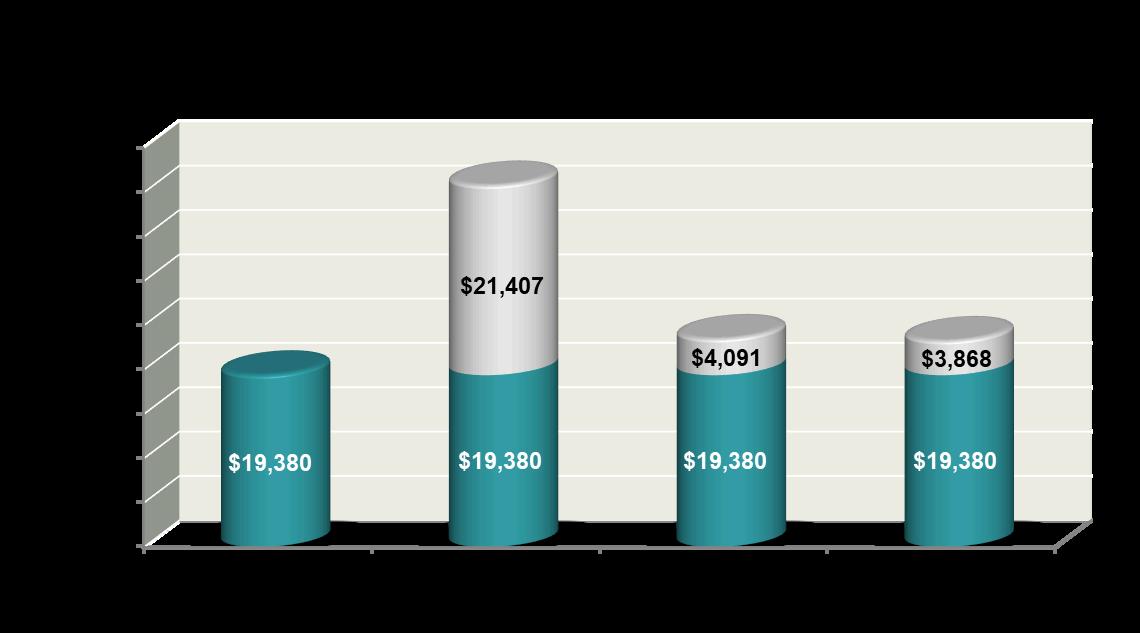
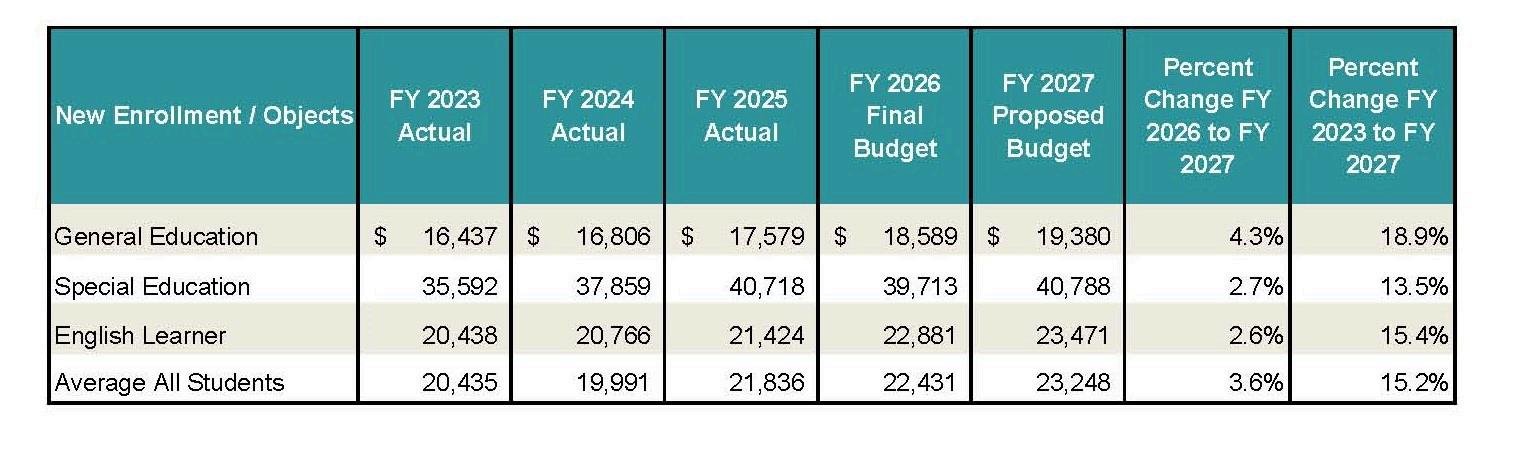
The table and chart below show the average per pupil cost projected to increase by 3 6 percent to $23,248 for FY 2027 compared to the prior fiscal year. The FY 2027 Budget for general education per pupil cost increases by 4.3 percent to $19,380, special education per pupil cost increase by 2 7 percent to $40,788, and EL cost per pupil increases by 2 6 percent to $23,471 compared to the prior fiscal year
The ACPS cost per pupil formula includes the Virginia Preschool Initiative (VPI) grant expenditures and updates the special education transportation cost factor, which apportions a share of the transportation cost to special education based on the ratio of special education buses to standard school buses
Alexandria City Real Estate Property Tax
Real estate property tax rates in the City of Alexandria are set by the Alexandria City Council
All real estate parcels in the City of Alexandria are annually assessed at 100 percent of the estimated fair market value as of Jan 1 Real estate assessed values are based on trends in the region and in the city, but primarily from large numbers of sales that are analyzed to determine values for groups of properties Real estate taxes are based on these assessed values and the real estate tax rate
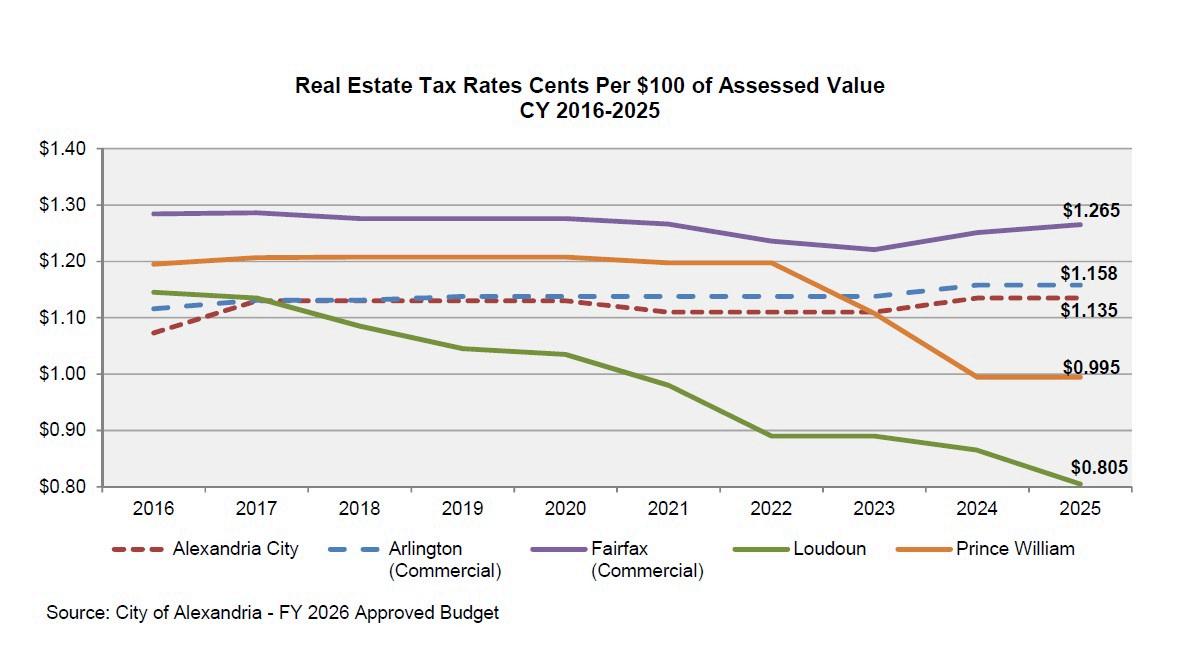
Alexandria has the third-lowest tax rate in Northern Virginia for CY 2025 (FY 2026), as shown in the real estate tax rate line graph The graph shows a comparison of tax rates between the City of Alexandria and neighboring jurisdictions, including Arlington County, Fairfax County, Loudoun County and Prince William County over the past ten calendar years Rates listed are per $100 of assessed value.
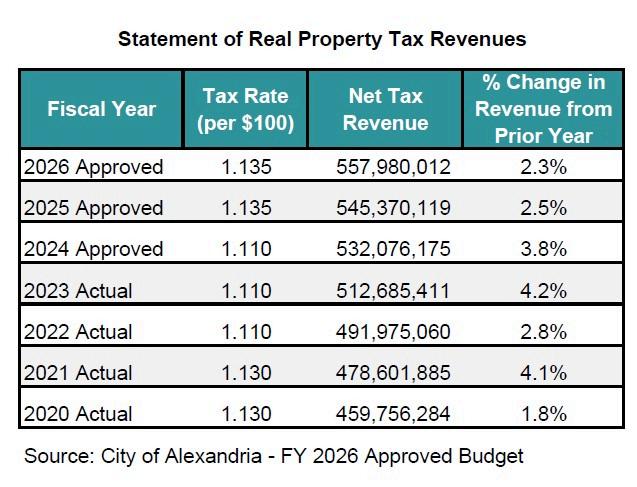
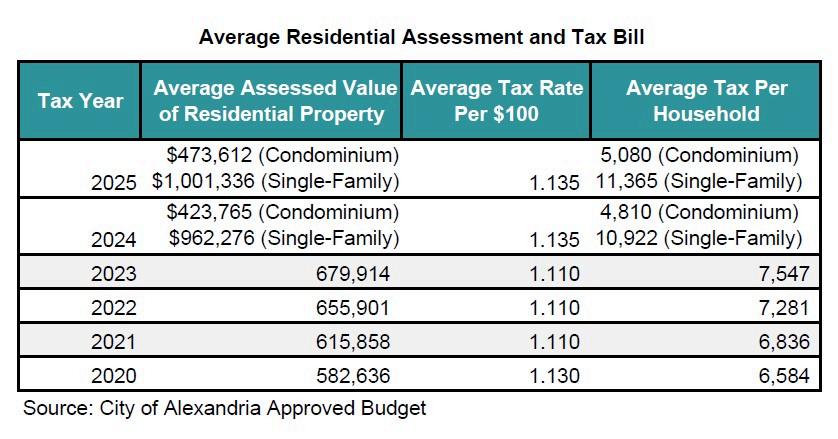
The FY 2026 budget reflects a real property tax rate of $1 135 per $100 of assessed value, unchanged compared to the prior year. Changes to the real estate tax rate can impact the budget through revenue collection and the average residential tax bill
Division Structure
Overview of Alexandria City Public Schools
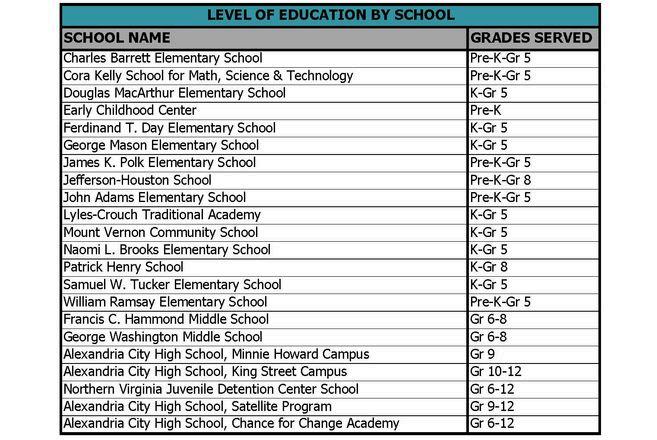
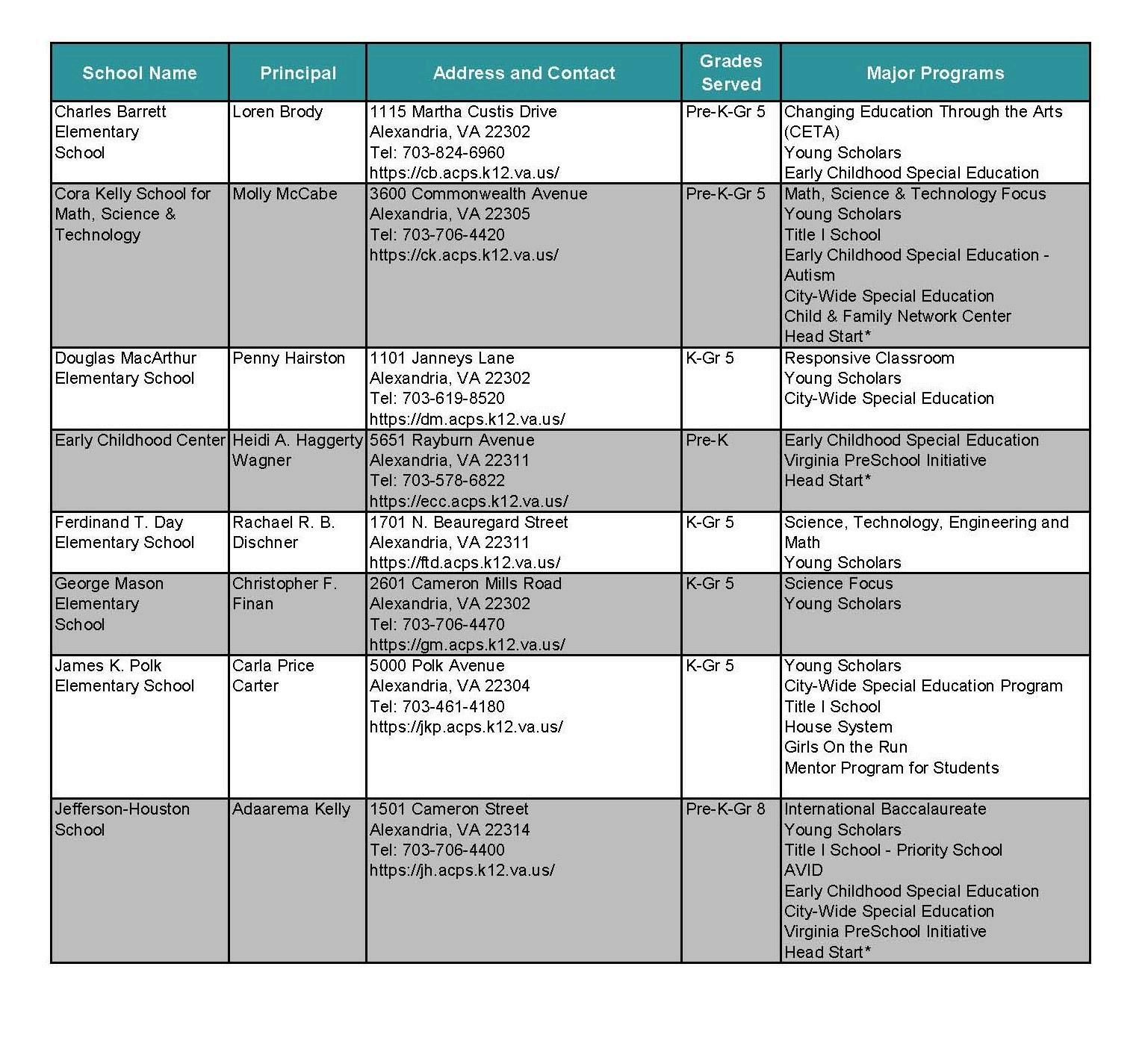
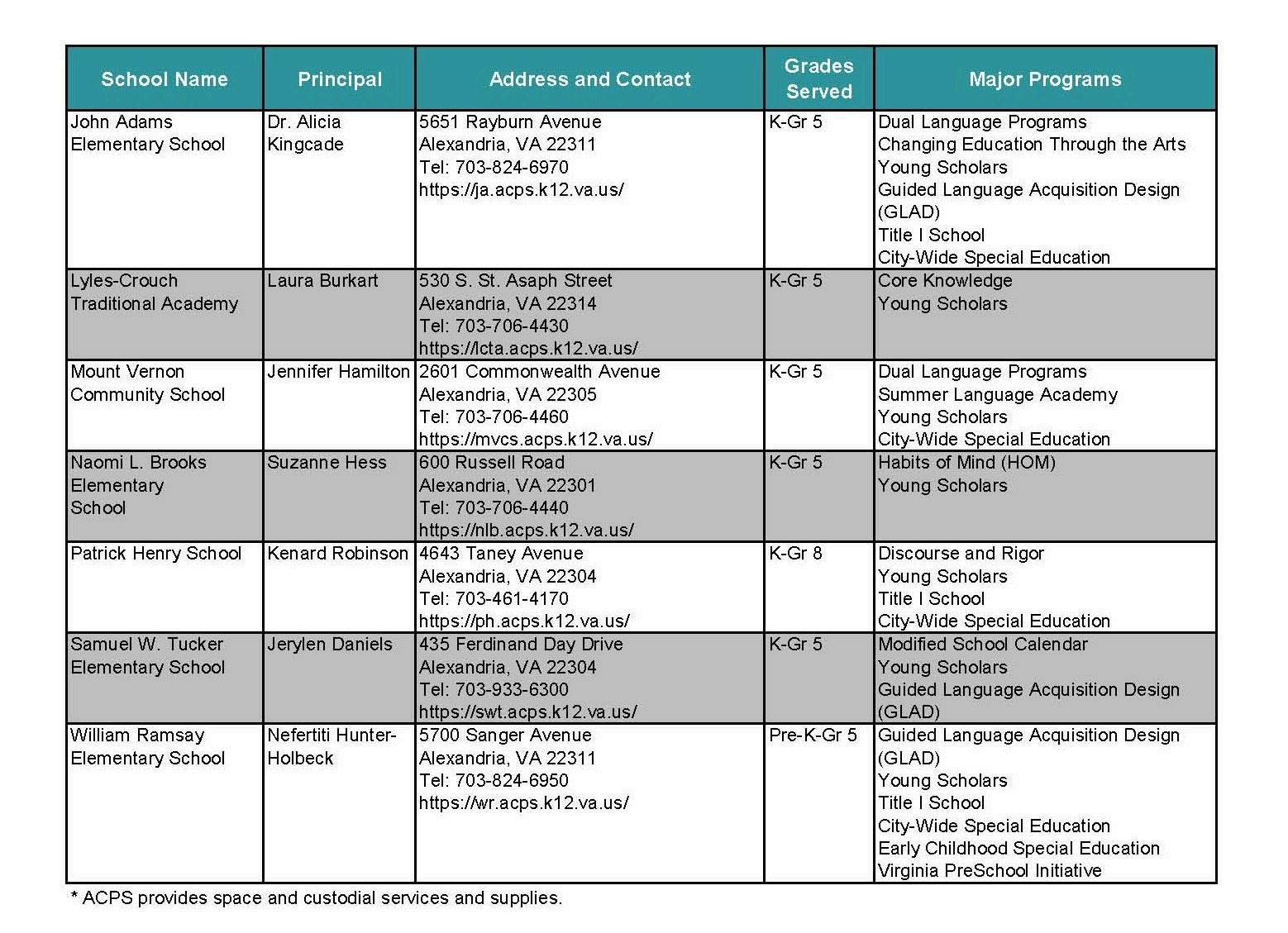
Alexandria City Public Schools (ACPS) serves the City of Alexandria, just outside Washington, D C in Northern Virginia For the school year 2025-2026, ACPS will serve a projected 15,993 (including special placements) students from preschool to grade 12 at one Early Childhood Center, 12 elementary schools, one Pre-K through eight school, one K through eight school, two middle schools, one high school (consisting of two campuses), a flexible online learning Satellite Program, and the Chance for Change Academy (an interim education facility) ACPS also operates a school at the Northern Virginia Juvenile Detention Center and the Sheltercare facility Below is a summary of the grades served at each school:
ACPS is considered a component unit of the City of Alexandria The City of Alexandria has a total area of 15 8 square miles and has an estimated population of 154,706 people, as of the 2021 Census Bureau Population Estimate The City funds 79 9 percent of the ACPS operating budget.
The ACPS School Board is a nine-member elected body whose primary responsibilities are to adjust and oversee capital and operating budgets annually, to formulate and adopt policy, to select a Superintendent to implement policy, and to evaluate the results (Policy BBA) The City of Alexandria is divided into three voting districts (districts A, B, and C) and three Board members are elected from each district Each member is elected concurrently for a three-year term of office The election took place in November 2024 and the newly elected Board took office in January 2025
The organizational structure of ACPS is designed to best meet the goals of the strategic plan and the needs of its diverse student population while effectively managing the various schools and programs within the division
The Superintendent, Dr Melanie Kay-Wyatt, is the chief executive officer for the school division Dr Kay-Wyatt works closely with executive staff in managing all aspects of school division operations All Chief Officers report directly to the Superintendent
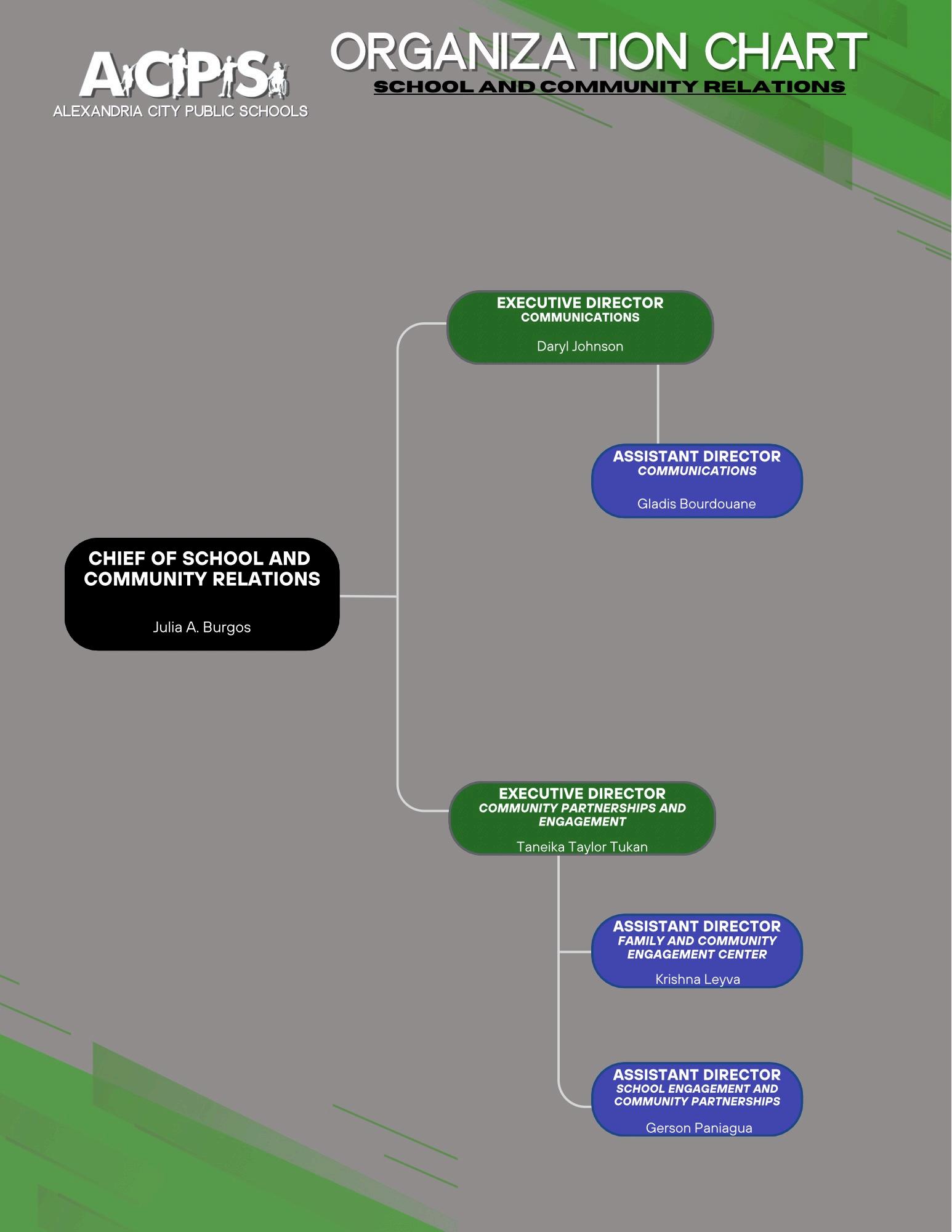
The Chief of School & Community Relations oversees the offices of communications and community partnerships & engagement The Executive Director of School, Business, and Community Partnerships serves as the initial point of contact and liaison between the City, the community and ACPS and coordinates major community-funded facilities projects and outreach efforts The office allows for consistent communication with interested partners and develops workflow processes associated with large, complex projects that involve multiple departments In addition, the office oversees the family and community engagement center and grants development The Executive Director of Communications oversees all division-level communications and public relations, multimedia services, audiovisual services, and school-level public relations liaisons The department is responsible for all emergency notifications, ACPS Express, ACPS Insider, school eNewsletters and the release of information from the school division to the media
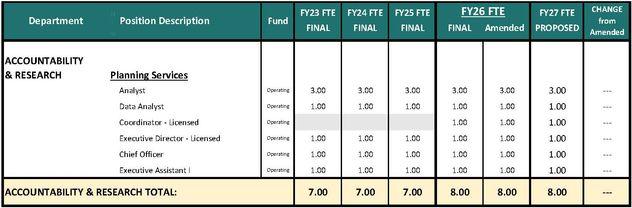
The Chief of Accountability & Research works closely with schools and central office staff to oversee instructional assessments, program evaluations and research, data analysis, reporting and school improvement The department provides decision-makers with valid, reliable, and timely data to enhance the quality of education offered to students.
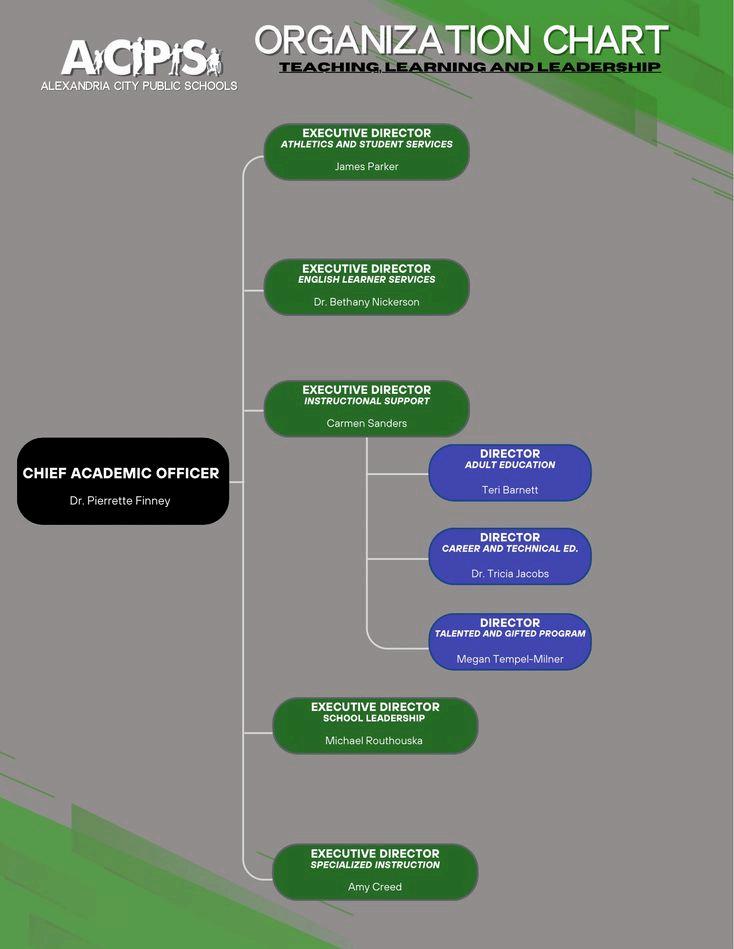
The Chief Academic Officer directly oversees all aspects of instructional programming, including curriculum and effective teaching, to ensure all ACPS students are prepared and equipped for success in college, work, and life in a global society. The offices/teams include Adult Education; AVID/College Readiness; Career and Technical Education; College and Career Readiness; Curriculum Design and Instructional Services; Early Childhood; English Learner Services; Humanities; Instructional Support; Library and Curricular Resources; Literacy; Specialized Instruction; STEM; School Leadership; Talent Development; Talented and Gifted Programs; and Title I Programs
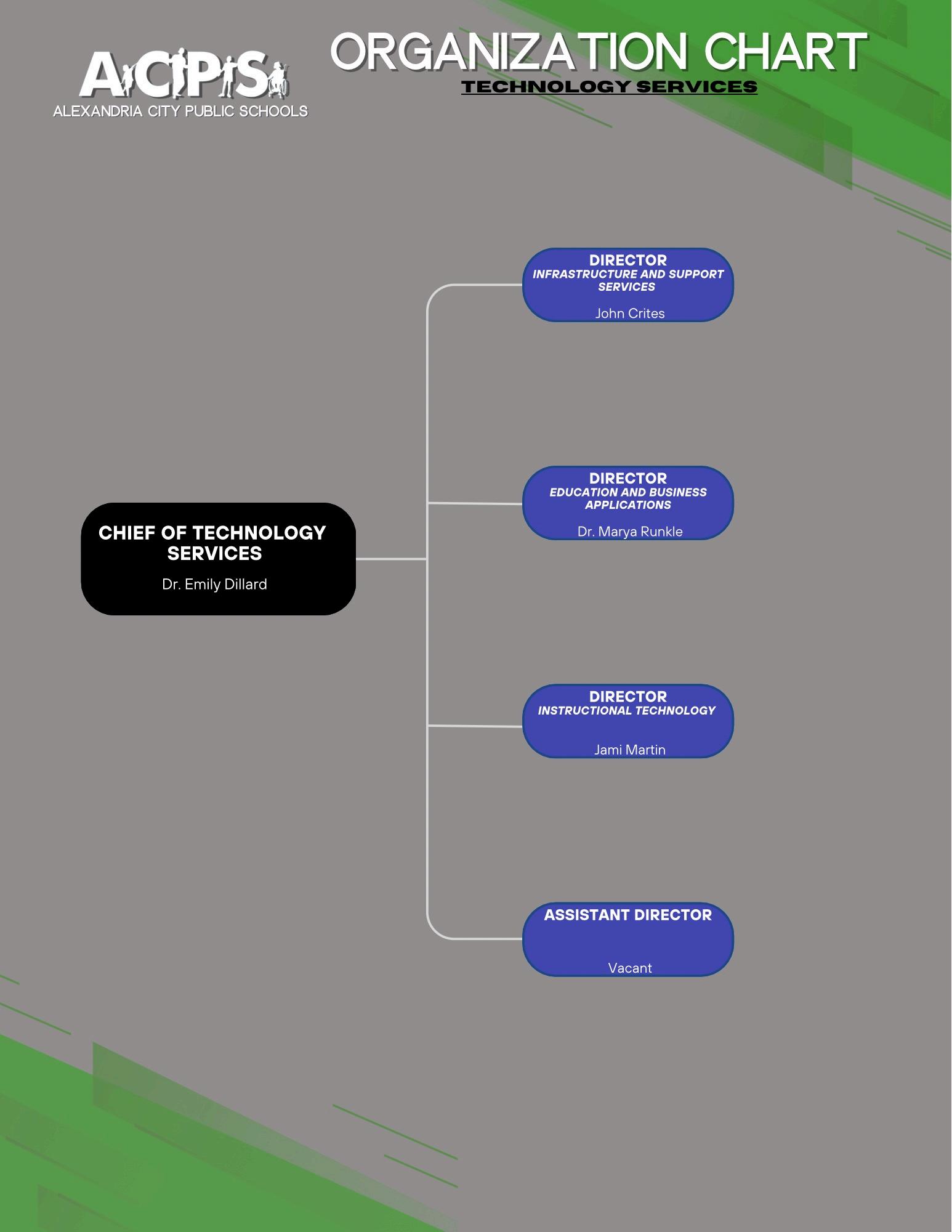
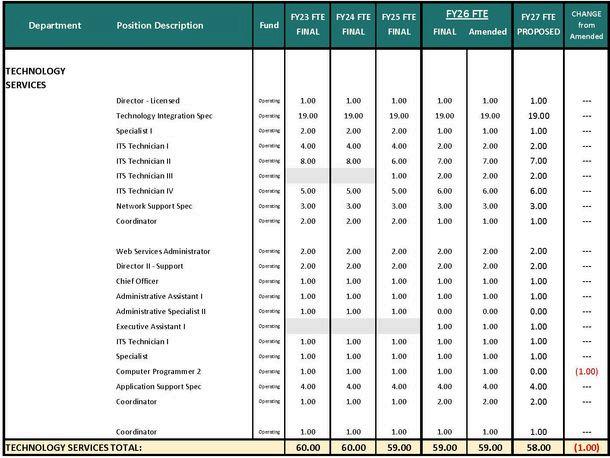
The Chief Information Officer oversees the division’s technology program, including education and business applications, instructional technology, infrastructure and support services, and online learning This position also coordinates the Freedom of Information Act (FOIA) requests
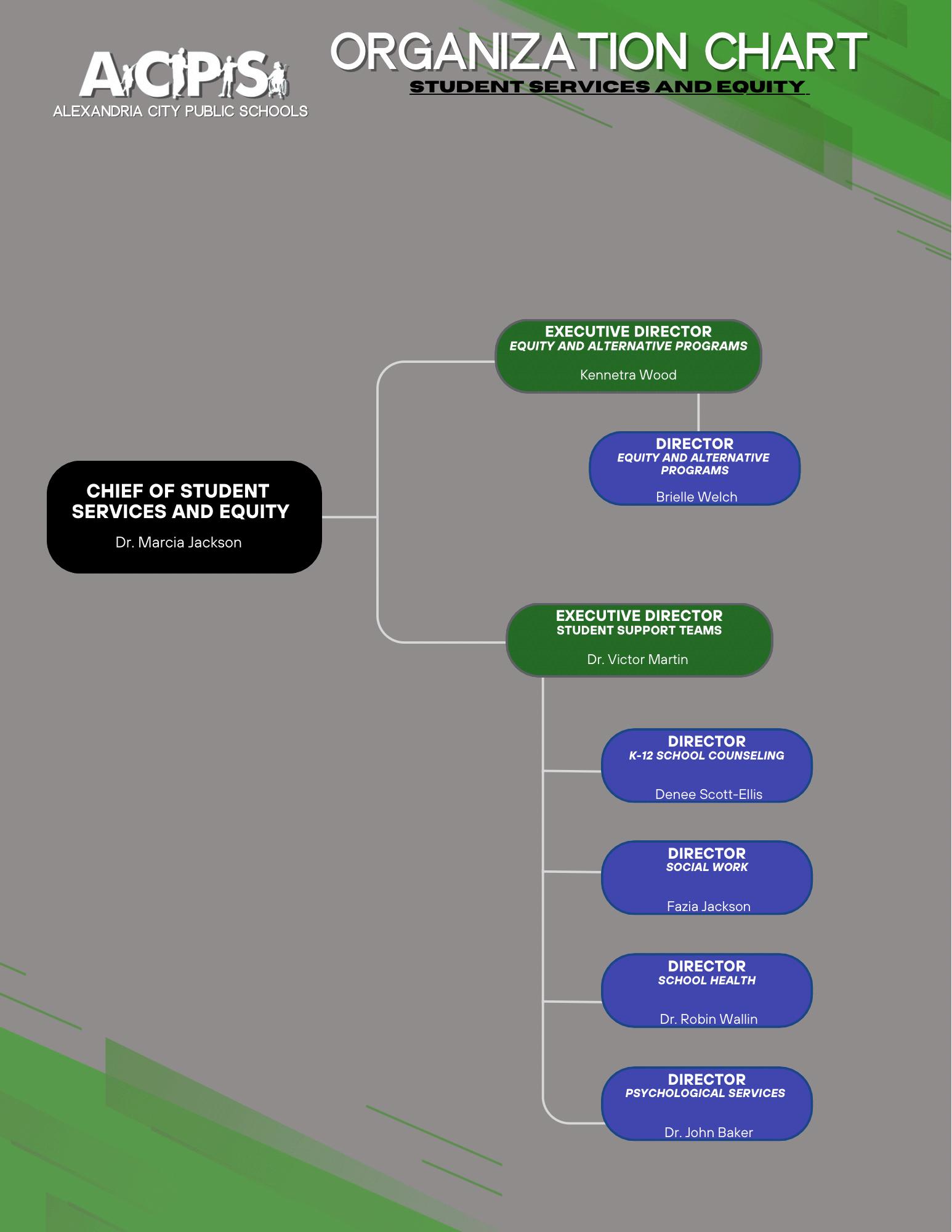
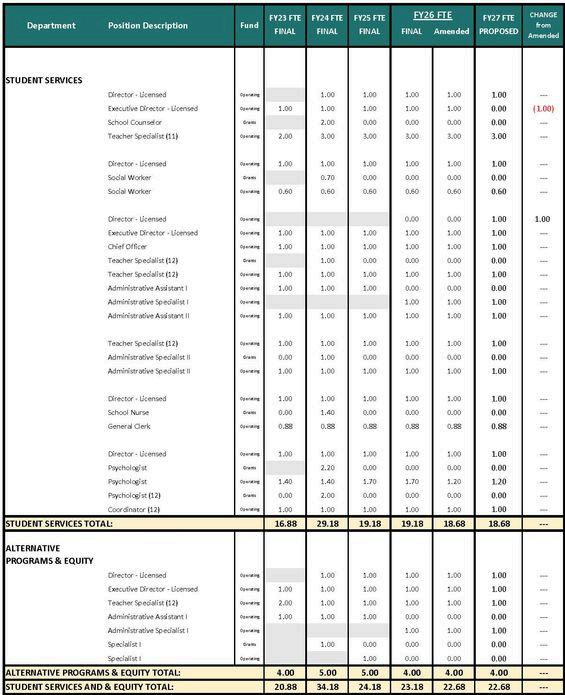
The Chief of Student Services and Equity oversees homeschooling, student hearings, cultural competence, school counseling services, school health services, school psychology services, school social work services, residency verification, truancy, and homelessness, as well as the alternative education programs, including the Northern Virginia Juvenile Detention Center School and Sheltercare. The department also provides counsel and support to the administration, school principals, and staff to help ensure that schools provide a safe and equitable learning environment for all students
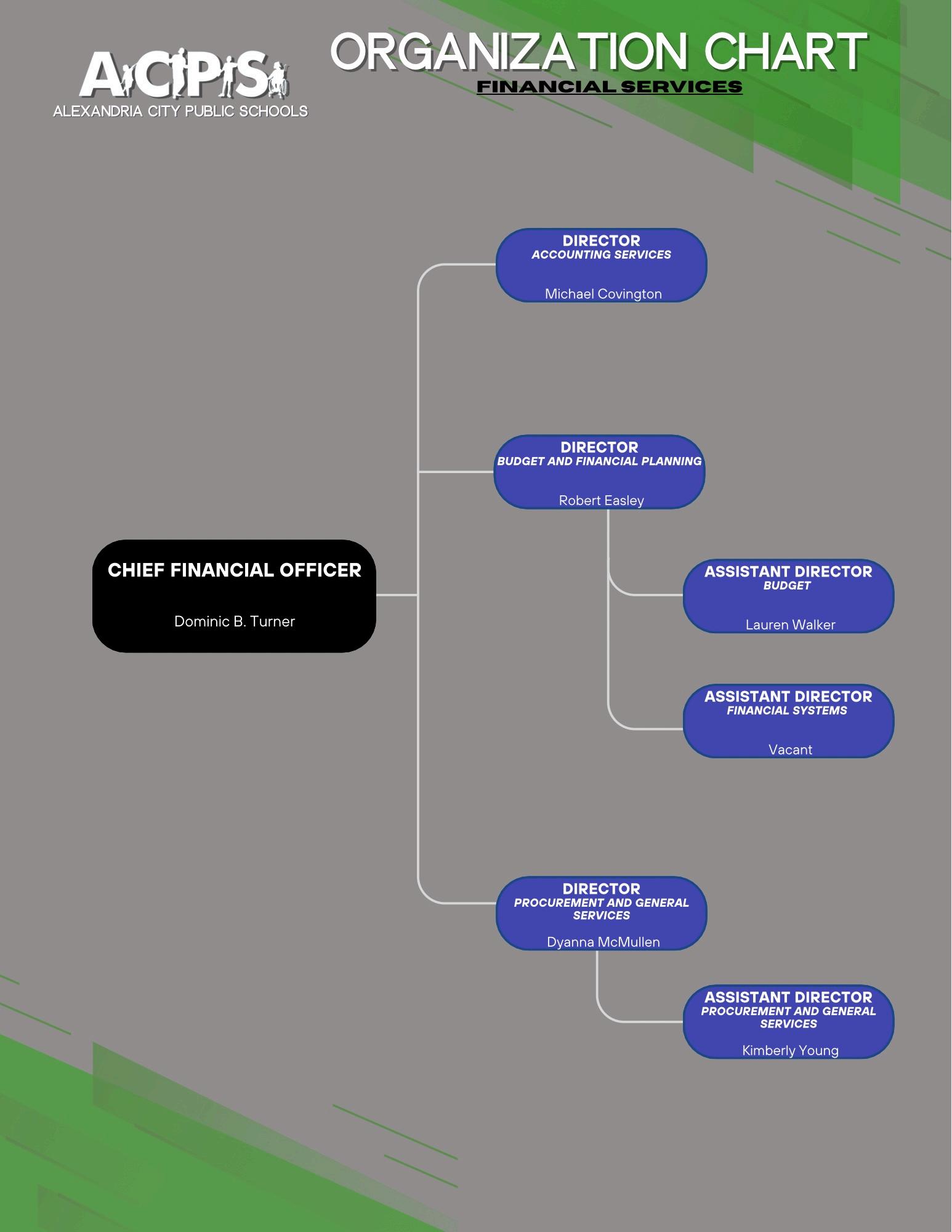
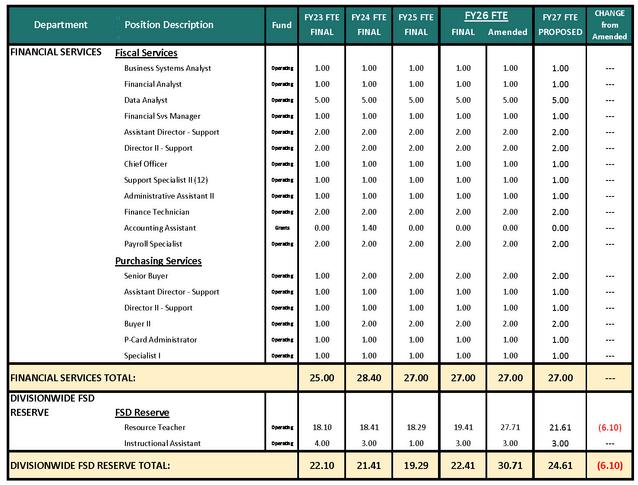
The Chief Financial Officer oversees accounting services, audit support, budget and financial planning, financial systems and reporting, fiscal procedures and compliance, grants management, payroll services, procurement, and general services
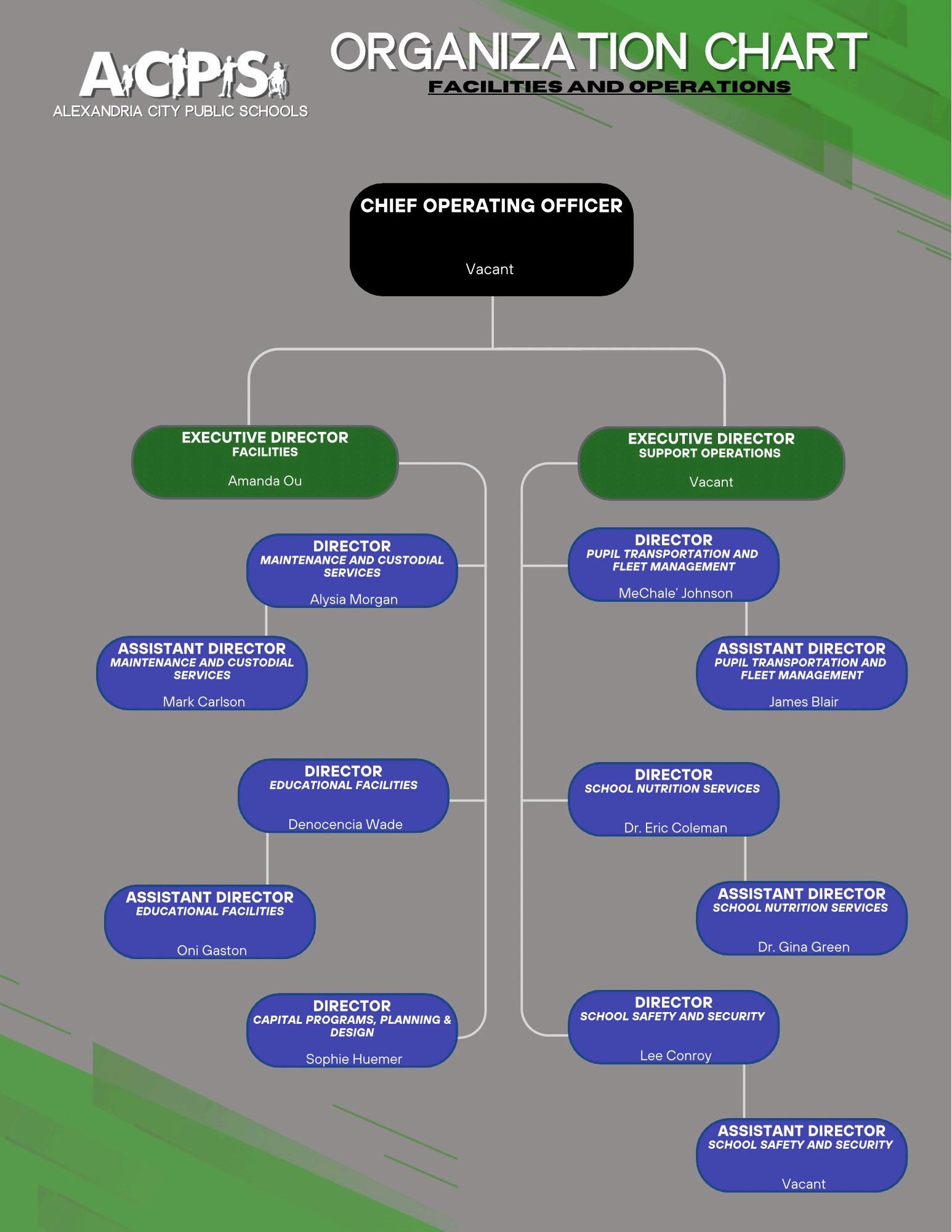
The schools are supported in non-instructional operations by the Chief Operating Officer, who oversees the support services provided by the Offices of Educational Facilities, Capital Programs, Planning & Design, Maintenance & Custodial Services, Pupil Transportation, Safety & Security Services, and School Nutrition Services
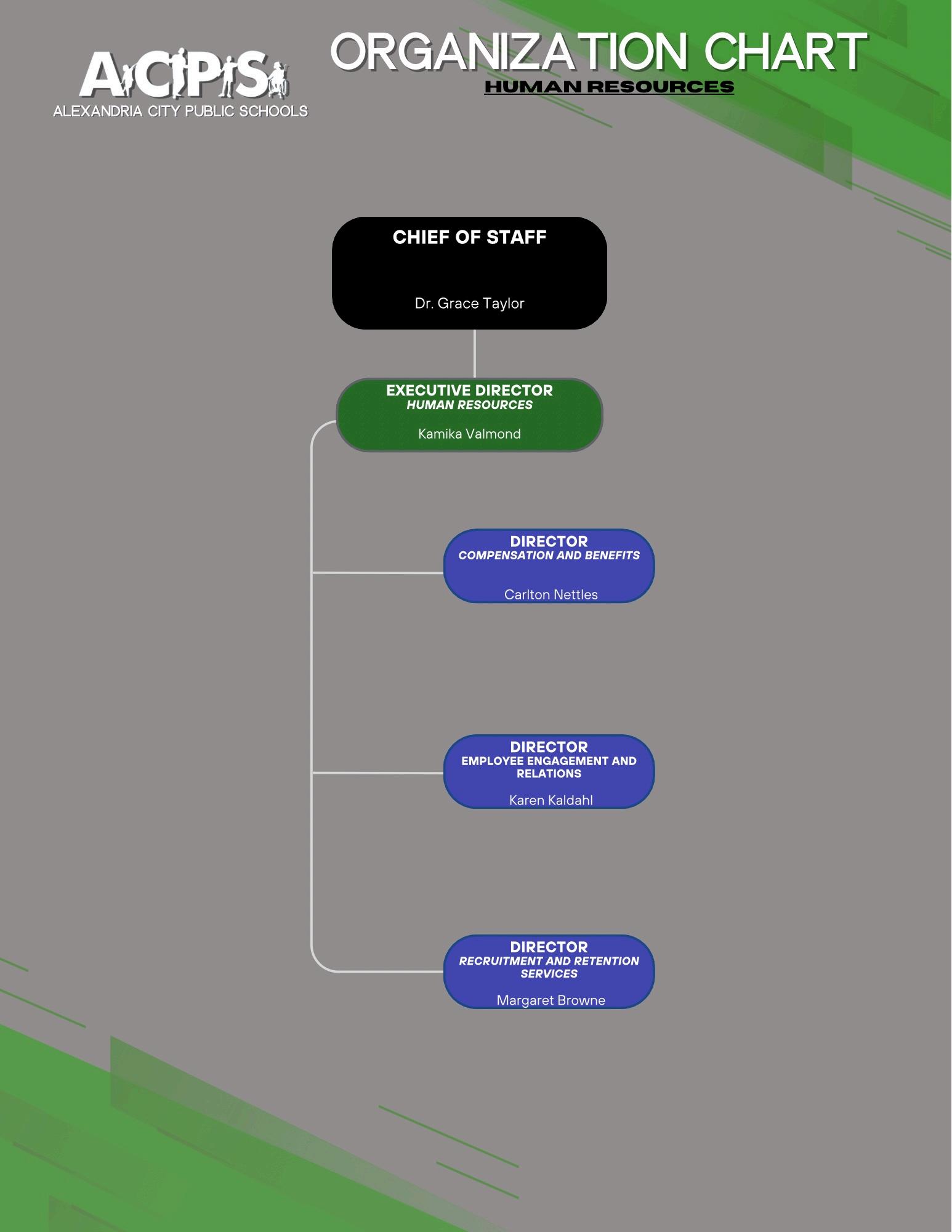
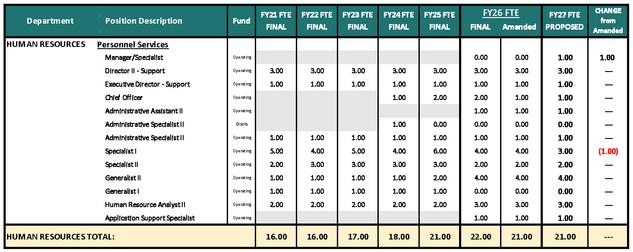
The Chief of Staff oversees compensation and benefits, employee relations, employment services, licensure and onboarding of new employees, succession planning, and continuous improvement
The organizational structure is intended to ensure the key focus remains on quality instruction, curriculum, and comprehensive student support, as outlined in the ACPS 2030 Strategic Plan: Nurture, Educate and Inspire Like many other school divisions, ACPS continues to monitor and evaluate its departmental operations to ensure increased efficiency and effectiveness as budget discussions become more difficult, understanding that additional capacity is needed for increased enrollment, and that focus on student achievement remains central.
The central office concentrates on planning, continuous improvement, leadership development, and a culture of shared responsibilities of all ACPS administrators
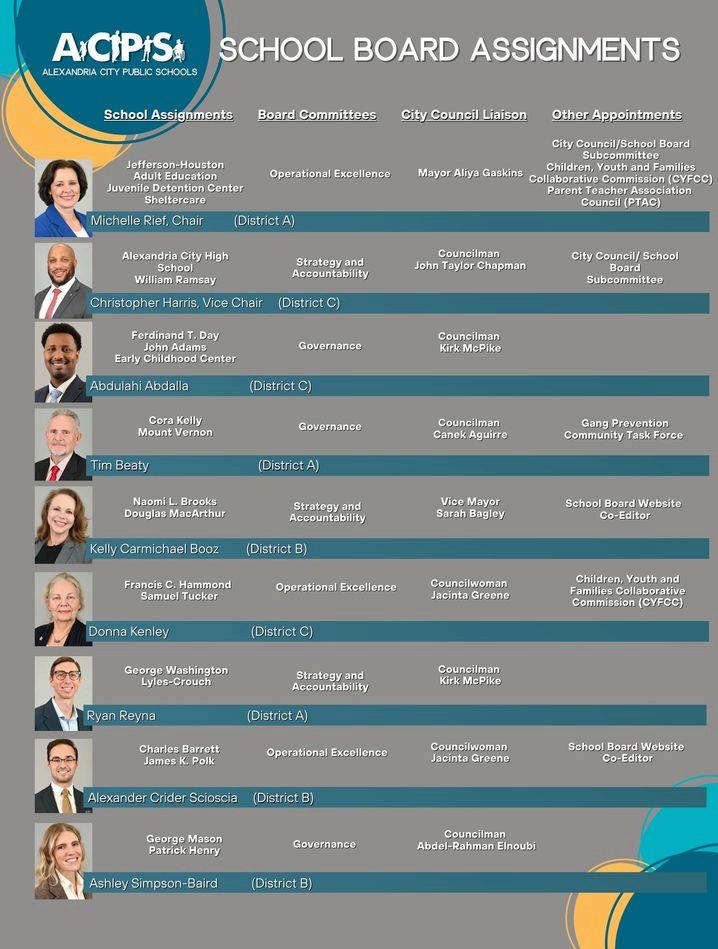
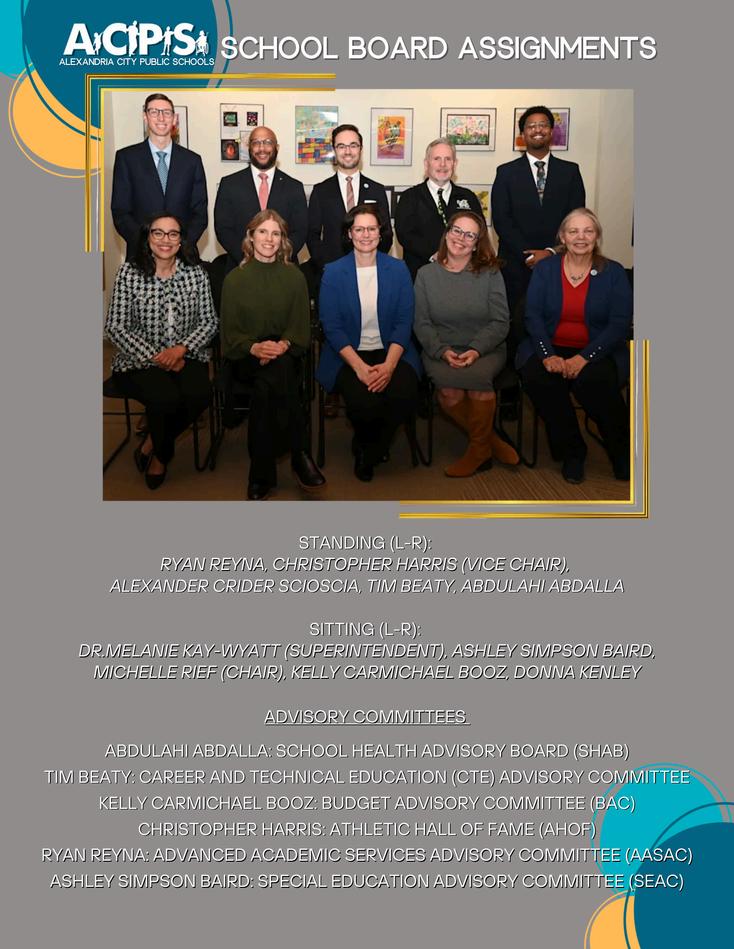
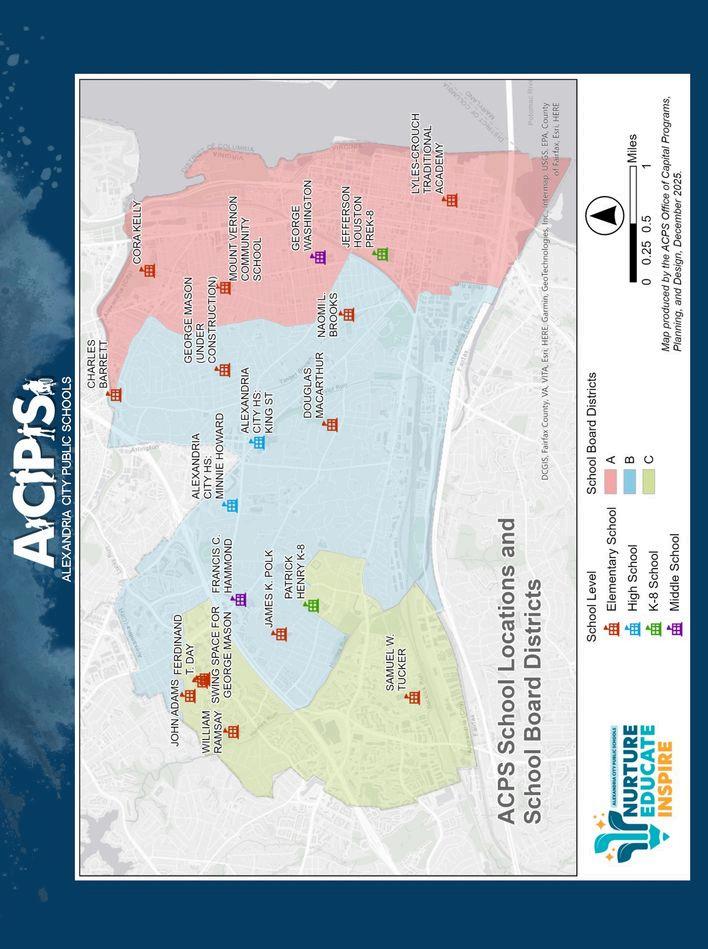
Shown below and on the following pages are the School Board member assignments, division map, organization chart for the division, and list of principals
ACPS Strategic Planning and Budgeting
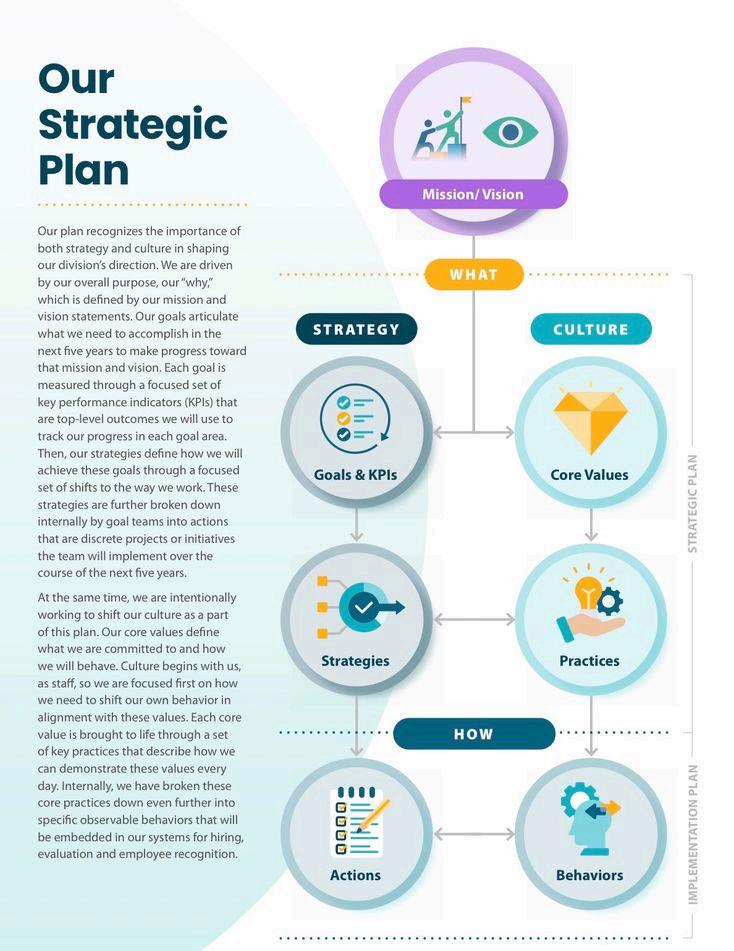
ACPS 2030 Strategic Plan
The Alexandria City School Board officially approved the 2025–30 Strategic Plan for Alexandria City Public Schools (ACPS), titled Nurture Educate Inspire , on May 8, 2025
This bold, student-centered roadmap reaffirms our commitment to providing every student regardless of background with access to a high-quality education The new five-year plan builds upon the work of the Equity for All 2025 Strategic Plan and reflects the voices and shared values of students, families, staff and community members.
Mission, Vision and Core Values
Mission: Nurture, educate and inspire each student for success
Vision: Each student prepared to thrive in college, career and community.
Core Values: Welcoming, Equity-Focused, Empowering, Innovative and Results-Driven
Strategic Plan Goals for 2025–30
Create safe, caring, inclusive environments where students feel supported and respected
Engage and challenge every student to achieve academic excellence.
Recruit, develop, and retain a diverse and talented team of professionals
Cultivate trust through clear communication and community engagement
Prepare students for life after high school with the skills, guidance and opportunities for success
School Board Budget Goals
The ACPS School Board's goal was to determine top budget priorities for each goal area in the ACPS Strategic Plan. This year, alongside staff, the district aimed to align with the already identified ACPS Priority Areas for SY 25-26 These priority areas have been identified by reviewing student data, program initiatives, and strategic plan goals
FY 2027 Approved budget priorities have guided the budget process
Shown in this section is a summary of the ACPS Strategic Plan 2030: Nurture Educate Inspire For the full 2030 Strategic Plan, please visit:
https://www acps k12 va us/about-us/acps-2030-strategic-plan
Budget and Financial Management
FY 2027 Budget Calendar
The ACPS fiscal year runs from July 1 through June 30, and corresponds to those of the City of Alexandria and the Commonwealth of Virginia. ACPS is a fiscally-dependent entity and, therefore, has a budget cycle that is driven by statutory deadlines from the city and state
July to Sept. 2025: ACPS financial staff close out FY 2025 and begin FY 2026 financial operations
Staff members analyze FY 2025 actual expenditures vs FY 2026 budget variances to prepare for FY 2027 budget development
Planning for the FY 2027-2036 Capital Improvement Program (CIP) begins.
Sept. to Nov. 2025: Department staff prepare FY 2027 budget submissions. Budget Office staff members compile and review FY 2027 budget requests and prepare compensation and benefit data for FY 2027 based on FY 2026 compensation as of September 30, 2025 Compensation estimates are not available until after the first payroll in mid-September due to the majority of ACPS teacher contracts beginning in September The most recent health insurance enrollment data and retiree health benefit data are also collected and analyzed
Enrollment projections are prepared based on the state September 30 Student Membership Report Formula-driven staffing calculations for elementary schools are prepared based on these enrollment projections
The FY 2027-2036 Proposed CIP Budget is prepared
Nov. to Dec. 2025: The Superintendent and Executive Leadership Team review all funding requests
Nov. 6, 2025: Presentation of the Proposed FY 2027-2036 CIP Budget
Dec. 2025: ACPS financial staff prepare the FY 2027 Combined Funds Budget by developing proposed budget numbers and generating reports The School Board considers the CIP Budget and discusses details during budget work sessions
Dec. 18, 2025: The School Board adopts the FY 2027-2036 Approved CIP Budget
Jan. 22, 2026: The Superintendent presents the FY 2027 Combined Funds Budget to the School Board Copies of the proposed budgets are distributed and are posted on the ACPS website
Jan. to Feb. 2026: School Board members, staff, and the community review and discuss the proposed budget Budget work sessions, public hearings, and add-delete work sessions are held throughout this period
Budget staff prepares and disseminates responses to budget questions from Board members and the community
Feb. 19, 2026: The School Board adopts the FY 2027 Approved Combined Funds Budget
Feb. 24, 2026: The City Manager presents the City of Alexandria’s FY 2027 Budget
Mar. to Apr. 2026: The City Council and community review and discuss the City Manager’s budget, including the city appropriation to schools and the ACPS Capital Improvement Program Budget City Council holds public hearings and work sessions and advertises the maximum tax rate for the new fiscal year In addition, City Council and the School Board hold a joint budget work session
May 2026: The City Council adopts the tax rate, FY 2027 General Fund, and FY 2027-2036 CIP Budgets, including the final appropriation to schools
June 11, 2026: The School Board adopts the FY 2027 Final Combined Funds Budget and the FY 2027-2036 Final CIP Budget
June to Sept. 2026: Financial staff prepares reports and budget documents and makes these available to principals and department heads
The School Board holds its first public hearing on the FY 2028 Proposed Combined Funds Budget and FY 2028-2037 CIP Budget
Staff closes FY 2026, which ends June 30, 2026, and prepares for the annual financial audit Staff analyzes FY 2026 grant balances, estimates carry-over for use in FY 2027, and loads data into the financial system/database
The budget calendar table can be found in the Executive Summary section
Budget Process
The budget is a resource-allocation and policy document It incorporates the best estimate of the school division’s revenues and expenditures for the next fiscal year based on a snapshot of current fiscal year revenues and expenditures These estimates are modified to reflect changes in plans, priorities, and trends in enrollment, as well as the economic environment
The Code of Virginia requires each school Superintendent to prepare a budget that estimates the amount of money needed during the coming year to support public schools It is then the responsibility of the School Board to balance the needs of the school division with the considerations of the economic and political environment
The budget provides a framework for measuring and monitoring expenditures Throughout the year, actual spending is compared with the budget in each organizational and programmatic area This comparison provides a measure of effectiveness and helps to ensure that funds are used for their intended purpose
Planning Activities in ACPS
The ACPS 2025: Equity for All Strategic Plan is the foundation document for all the actions of the school division It directs the actions the division takes in meeting the goals and aspirations of the Alexandria community and guides the activities of employees and leaders as well as the expenditure of all funds entrusted to the School Board. The Strategic Plan informs the development of the Board Budget Priorities, the School Improvement Plans and the Department’s Improvement Plans, all of which provide a framework for the school division’s operations The annual budget process quantifies the resources needed to carry out these plans
Major planning activities in ACPS
are as follows:
In June 2020, the School Board adopted ACPS 2025: Equity for All Strategic Plan, a comprehensive strategic plan for fiscal years 2021-2025 The full 2021-2025 strategic plan can be found earlier in this section
All school principals have prepared improvement plans congruent with the goals and objectives of the current strategic plan.
All department leaders have created department’s improvement plans congruent with the goals and objectives of the strategic plan
The School Board adopts a Combined Funds budget annually that reflects ongoing programs as well as initiatives for the following year
School professional learning community staff, in collaboration with central office staff from the Departments of Teaching, Learning and Leadership and Accountability, analyze student and school achievement data on a regular basis.
The standards of accreditation requirements and other student tests and achievement data provide the framework for the school planning process
Analysis of trends that affect ACPS costs and operations are conducted regularly in a variety of areas
School Board advisory committees work regularly with staff to provide input and feedback on ACPS operations and report annually to the School Board These committees include: the Athletic Hall of Fame Committee; the Budget Advisory Committee; the Career and Technical Education Advisory Committee; the School Health Advisory Board; the Special Education Advisory Committee; and, the Advanced Academics Advisory Committee, formerly Talented and Gifted Advisory Committee
The Superintendent receives planning input from a variety of advisory groups, such as the Education Association of Alexandria (EAA), the Superintendent’s Student Leadership Council, and the Teachers Advisory Council
The School Board adopts a Capital Improvement Program (CIP) budget annually, that provides a 10-year prioritized plan for major facility changes
In addition to division-wide plans such as the annual budget, there are many subsidiary areas that require detailed plans. The Commonwealth of Virginia requires plans for talented and gifted, career and technical, technology, and adult education programs Division plans, including special education, are impacted by the federal entitlement grant process, which requires comprehensive planning
Public hearings related to the Combined Funds and Capital Improvement Program Budgets are held every year and provide the opportunity for community input Additional information on public hearings can be found on the ACPS webpage
Financial Policies and Practices
Budget Structure
All budgets are developed using a variety of assumptions based on future expectations Funding decisions also reflect policies of the School Board
Public sector budgets are governed by accounting and reporting requirements established by the Governmental Accounting Standards Board (GASB) and by generally accepted accounting principles (GAAP) The ACPS budget structure is consistent with these requirements
The budget is divided into three major funds, each of which is grouped by related accounts used to maintain control over resources earmarked for specific activities or objectives The funds in the ACPS budget include:
Operating Fund: This fund is comprised of the school division’s primary revenue sources, including appropriations from the City of Alexandria, revenue from the Commonwealth of Virginia, selected federal sources and miscellaneous local fees, as well as the expenditures charged against these revenues. The Operating Fund accounts for 92.4 percent of ACPS revenue in the FY 2027 Budget
School Nutrition Fund: Local, state, and federal revenue as well as expenditures for the operation of all school food service activities are accounted for in this fund The School Nutrition Fund accounts for 3 2 percent of ACPS revenue in the FY 2027 Budget
Grants and Special Projects Fund: Entitlement and competitive grant monies are accounted for in this fund
Budgeted here are federal funds from the Individuals with Disabilities Education Act (IDEA), various entitlement programs of the Elementary and Secondary Education Act (ESEA), as well as other smaller entitlement monies and competitive grants. The Grants and Special Projects Fund accounts for 4.4 percent of ACPS revenue in the FY 2027 Budget
The School Board is responsible for establishing policy for the governance and operation of ACPS These policies and practices are aligned with the Code of Virginia and best practices as recommended by the Government Finance Officers Association (GFOA) and the Association of School Business Officials (ASBO) They provide a consistent framework for the budget process, long-term school division planning and decision-making regarding the use and allocation of resources
These policies and practices are developed by staff, presented to the School Board and reviewed each year during the budget process
The following pages summarize the major accounting, budget, and financial policies and practices used to develop longterm, multi-year financial plans and the annual budget These practices also guide the management of school division funds throughout the year
Financial Management
Financial Planning
The Superintendent or designee shall be responsible for administering the division budget in accordance with School Board policies and applicable state and federal laws and regulations; therefore, the Superintendent or designee will use appropriate fiscal planning and management methods, modeled after the best-accepted business practices and directed toward the educational goals of the division
The following addresses both the fundamental principle of a balanced budget and long-range financial planning.
Balanced Budget: Each fiscal year, the Superintendent, with input from staff and the community, shall prepare, with approval of the School Board and submit to the appropriating body, an estimate of the amount of funding needed during the next fiscal year for the support of the public schools of the division (policy DB) The School Board follows its adopted budget process to offer and review adjustments to the Superintendent’s proposed budget in order to arrive at the final, Board-approved budget
Under the Code of Virginia, School Boards are mandated to adopt a balanced budget, which means projected revenues plus beginning fund balance must fully cover total estimated expenditures A budgeted surplus at the fund level is also considered a balanced budget
Long-Range Financial Planning: Prior to approving the annual budget, the School Board reviews the five-year budget forecast and the long-term financial implications of current and proposed operating and capital budgets Each year, as a part of the budget process, ACPS staff develop and present a five-year fiscal forecast with varying revenue and expenditure assumptions to facilitate informed decision-making With approximately 80 percent of Operating Fund revenue derived from the City appropriation, assumptions regarding the City’s revenue growth and the resulting increase or decrease in the City appropriation drive forecast results Similarly, for expenditures, salaries and benefits comprise of approximately 87 percent of total Operating Fund expenditures and assumptions related to salary increases, as well as the growth of healthcare and retirement costs, also drive forecast results
Revenues
The majority of revenue received by ACPS derives from our city appropriations, with a small percentage collected from state, federal, and local revenues
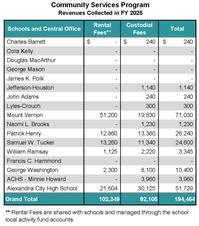
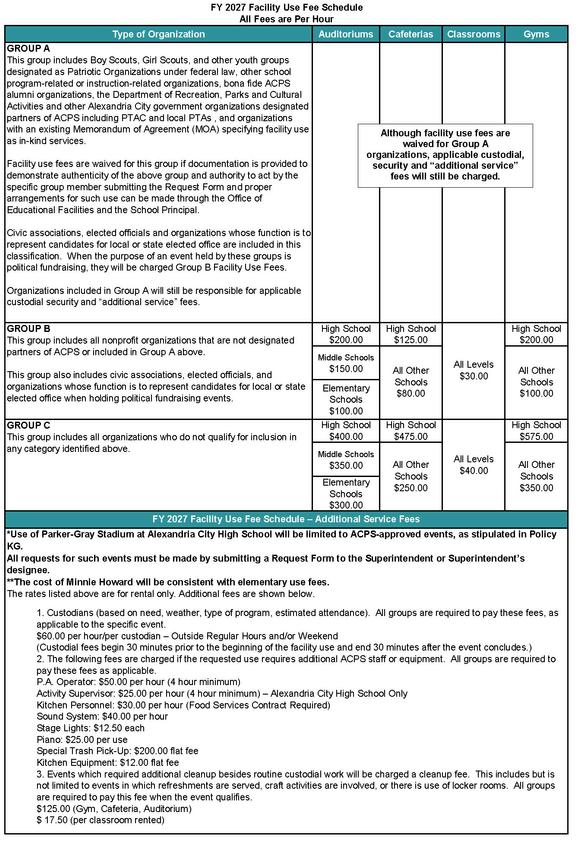
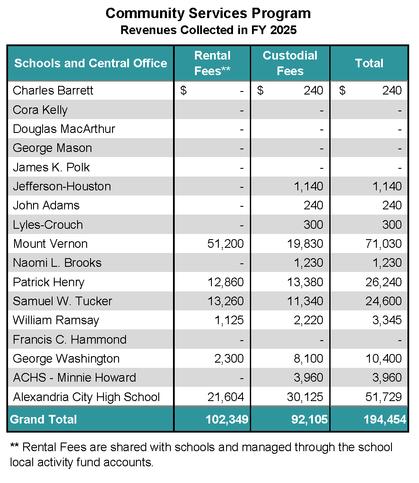
Local Revenue: Local revenue includes, but is not limited to, rental and custodial fees, summer school/intersession tuition, and indirect costs Additional information can be found in the Financials section Local funds total approximately $1 0 million of the operating fund and remain relatively flat compared to the prior fiscal years
To enhance revenue streams, promote fiscal stability, and ensure prudent financial planning, ACPS follows these guidelines:
Use of One-time Revenues: The use of one-time revenues for recurring expenditures is discouraged and is focused on onetime expenditures
Revenue Diversification: To improve the ability to handle fluctuations in revenue sources and still provide quality instructional programs, diversification of revenue sources through grant opportunities, fund-raising, public/private partnerships, and other sources is encouraged
Expenditures
ACPS strives to ensure prudent expenditure planning, fiscal accountability, and transparency
Debt Policy: The school division is fiscally dependent on the City of Alexandria and not permitted to incur long-term debt
Reserve Policy: The school division maintains three reserves to protect the division during times of revenue shortfalls and/or unpredictable, one-time expenditures:
The Staffing Reserve is allocated by the Superintendent to relieve critical staffing needs arising from unanticipated enrollment growth or other changes in the student population
The Enrollment Adjustment Reserve is used to adjust the base allocation for schools when the actual September enrollment significantly exceeds the projected enrollment in the final budget This reserve may be used to cover necessary, unforeseen expenditures
The Health Benefits Reserve is maintained to protect ACPS from unanticipated spikes in healthcare costs for medical and dental benefits, particularly the self-insured plan This reserve is funded by contributions from ACPS and its employees
The School Board establishes the size of all reserves as part of the budget process The reserves of the City of Alexandria are also available to the division
Salary Adjustments
All adjustments to ACPS salary scales are subject to School Board approval and are generally part of the normal budget development process for the subsequent fiscal year
ACPS has four salary scales:
The Support Scale is for instructional assistants, clerical, technical, bus driver, custodial, and financial support staff
The Licensed Administrative Scale is primarily for licensed administrators in schools and departments These include principals, assistant principals, and instructional department leadership positions
The Support Administrator scale is for leadership and specialized, technical positions in the support departments
The Professional Scale is for all teachers and other licensed staff, such as school counselors, library media specialists, nurses, social workers, and psychologists
Position Control
A position is defined as the authorization to hire an employee with full benefits No position should be filled until it has been properly authorized and approved Schools and departments are permitted to change budgeted positions, subject to Superintendent's approval, in accordance with the education plan and the changing needs of students All position changes are reported as part of the budget cycle, through the preparation or approval of the subsequent fiscal year’s budget
Requests for new positions that result in an increase in FTEs must be approved by the School Board. Grant-funded positions may be added during the year when additional grant monies are awarded outside of the budget cycle Changes in grant-funded position allocations are subject to the approval of the Superintendent, if not specifically directed by the grantor
Modified Zero-Based Budgeting
For FY 2027 all departments prepared their budgets using the modified zero-based budgeting (MZBB) methodology, which requires staff to scrutinize line items and certain items or activities that do not significantly change from period to period may be exempted from the zero-based evaluation This allows for a more streamlined budgeting process while still
ensuring critical expenses are justified MZBB is difficult to administer for schools because many of their resources are determined by formula (e g core teaching staff, funds for supplies and stipends) For this reason, the standard budgeting process for school principals focuses on activities linked to the strategic plan
Expenditure Controls
The official ACPS budget document is a means to formulate the planning and resource allocation for the school division It also serves as the primary vehicle to inform Alexandria residents and the community at-large about the mission, strategic plan, and priorities of the school division After the School Board adopts the final budget in June, it becomes the primary financial management tool for administering, controlling, and monitoring the expenditures.
The budget is controlled at both legal and administrative levels. The legal level is placed at the individual fund level, while administrative controls are placed at the office and school level within each fund
Certain portions of the budget are administered and controlled centrally. Budgeting and monitoring of all full-time salary accounts and employee benefits are handled through a collaboration of the Financial Services and Human Resources Departments Purchased services, internal services, other charges, materials and supplies, and capital outlay are managed at the local office and school level within guidelines developed in accordance with the Virginia Public Procurement Act (VPPA) and School Board policies
School principals, department heads, and program managers are responsible for monitoring the efficient and appropriate use of funds These leaders are authorized to approve the expenditure of funds within their respective school, office or program in accordance with ACPS procurement procedures and other legal requirements Most non-compensation expenditures are conducted via purchase order ACPS purchasing guidelines require that, prior to approval and processing, all purchase orders be verified for availability of funds and appropriate contracting authority.
The Procurement Office ensures all orders and purchases comply with legal purchasing regulations This is the only office authorized by the School Board to approve all bid awards and contracts. It is the responsibility of each school principal, department head, and program manager to regularly and carefully monitor and control expenditures, thus ensuring proper use of public funds and avoiding expenditures beyond the authorized budget
Unspent balances in the regular (contracted position) salary and benefit accounts are reviewed by the Financial Services Department’s Budget Office Any savings from these accounts accrue to the division as a whole and not to any specific department
Budget Amendment
The School Board reviews the budget each month and formally amends the budget once a year during the spring The Financial Services Department prepares the budget analysis, evaluates all revenue and expenditure accounts, and recommends amendments
Transfers Between Budget Accounts
Because needs and plans may change between approval of the final budget and the ending of the school year, principals, department heads, and program managers have the flexibility to request reallocation of budget funds Any transfer request exceeding $25,000 must be approved by the Superintendent System controls on the transfer of funds ensure expenditures do not exceed total available financial resources and that expenditure guidelines are enforced Any budget amendment that leads to an increase or decrease of the total Operating Fund requires School Board approval Additionally, staff must submit a monthly report to the Board detailing all budget transfers in the Operating, School Nutrition, and Grants and Special Projects Funds when such transfers are equal to or greater than $25,000 The capital program requires School Board approval for transfers greater than $50,000 that cross major project categories and/or sites/locations as defined in the adopted CIP Budget (policy DA)
Another important component of the ACPS financial control and reporting system is the use of encumbrance accounting All non-payroll expenditures – purchase orders, contracts, or other monetary commitments – must have funds set aside or encumbered to ensure funds will be available when payment is due The encumbrance accounting process is used as an extension of formal budgetary control It is an important financial planning tool and a control measure to prevent inadvertent over-expenditure of budget appropriations due to lack of information about future commitments.
Encumbrances outstanding at year-end in the Operating Fund are reported as assignments of fund balance and do not constitute expenditures or liabilities of the current year because the commitments will be honored during the subsequent year The year-end encumbrances represent the estimated amount of contractual obligations for goods or services in the current year that will be received and paid in the following year Funding for all encumbered appropriations is reappropriated at the beginning of the new fiscal year
Financial Information and Reporting
Financial reports are made available monthly to the School Board, schools, departments, and programs for monitoring purposes The School Board reviews and approves a monthly financial report for all funds, which includes the revenues and expenditures at the major object level The monthly financial report to the School Board also shows the changes in revenue and expenditure appropriations that have occurred since the budget was approved
Monthly detail and summary reports of all expenditures in miscellaneous salary accounts and all non-personnel accounts are reviewed by the Financial Services staff
Grant financial reports are prepared subject to the detailed grant management requirements from the granting agency
The Commonwealth of Virginia also has a number of reporting requirements, including the Annual School Financial Report for all division expenditures and program specific reports such as homebound teacher costs ACPS complies with all reporting requirements as mandated by the state, grantors, and other legal entities
Basis of Presentation – Fund Accounting
Governmental resources are allocated and accounted for in individual funds based on the purpose and the means by which spending activities are controlled ACPS uses funds to maintain its financial records during the fiscal year Fund accounting is designed to demonstrate legal compliance and to aid management by segregating transactions related to certain ACPS functions and activities. ACPS accounts are organized on the basis of funds, each of which is considered a separate accounting and budgetary entity The operations of each fund are accounted for in a separate set of selfbalancing accounts that constitute its assets, liabilities, fund equity, revenues and expenditures or expenses
Basis of Accounting
All governmental funds are reported using a flow of current financial resources measurement focus and the modified accrual basis of accounting ACPS’ primary sources of revenue are funds appropriated by other governmental units Accordingly, most revenues are considered to be available at the time they are appropriated For certain types of revenue, availability is determined to be 360 days from the end of the current fiscal year Governmental fund expenditures are recognized when the liability is incurred
All proprietary and trust funds follow the accrual basis of accounting These funds are accounted for on a flow of economic resources measurement focus With this measurement focus, all assets and all liabilities associated with the operation of these funds are included on the balance sheet Proprietary fund equity (i e , total net position) is segregated based upon the accessibility of the underlying resources; net investment in capital assets, restricted and unrestricted. Proprietary fundtype operating statements present increases (e g , revenue) and decreases (e g , expenses) in total net position
Basis
Annual budgets are adopted for all governmental funds except capital projects The Capital Improvement Program (CIP) is budgeted on a project-by-project basis that spans multiple fiscal years for a total of ten years All budgets are consistent with GASB and GAAP requirements
The budgetary basis is the same as the basis of accounting modified accrual for all governmental funds and accrual for proprietary and trust funds The budget period is the same as the accounting reporting period, July 1 to June 30 The budget document contains fund statements for all governmental and proprietary funds
Legal Authority
The ACPS School Board is charged by the Commonwealth of Virginia and the regulations of the Virginia Board of Education with providing and operating the public schools in the City of Alexandria It is the function of the School Board to set general school policy and, within the framework of Virginia Board of Education regulations, to establish guidelines and rules that will ensure the proper administration of the school program
The School Board does not have taxation authority. Most operating revenue is derived from local tax dollars appropriated by the city The remaining revenue is derived from federal, state, and local sources CIP funds are allocated by the city from a combination of general and bond funds
Other Budget Issues
Carryover from Prior Fiscal Years: Encumbered carryover is allowed If the carryover encumbrance exceeds the final payment, the balance of the carryover encumbrance funds are suspended and are not available to be re-allocated for spending in the current year
Centrally Budgeted and Managed Accounts: ACPS budgets and manages a variety of accounts centrally This is done to make budgeting and position management easier, to improve the efficiency of the purchasing process, or to generate cost savings from bulk purchases The accounts managed in this fashion include, but are not limited to:
Utilities for all buildings
Building/equipment repair and maintenance
Custodial and security contract services
Telephone services
Technology and facilities equipment
Leasing of network copier machines
Textbooks
Division-wide software and online products
Selected itinerant and part-time staff (particularly custodians, physical therapists, occupational therapists and speech language pathologists)
Tuition reimbursement
School-based temporary help services
Translation services
Substitute Teacher paid/unpaid leave
Inventories
Inventories consist of various consumable supplies and commodities maintained by the School Nutrition Services Department The School Nutrition Fund values and carries its inventory on a cost basis using the weighted-average method The purchase method of accounting is used in the governmental funds Reported inventories in the governmental funds are designated as non-spendable fund balance Food commodities received from the U S Department of Agriculture (USDA) are stated at fair market value and the amount consumed is recognized as revenue
The amount of unused food commodities is reported as inventory and deferred revenue ACPS participates in the single food inventory record-keeping system, which allows the combination of USDA commodity and commercial inventory records This program was approved jointly by the USDA and Commonwealth of Virginia Child Nutrition and Food Distribution Divisions.
Capital Assets
Capital outlays are recorded as expenditures in governmental funds and as assets in the government-wide financial statements to the extent that the ACPS capitalization threshold is met
Capital assets are defined by ACPS as assets with an initial, individual cost of more than $5,000. Major additions, including those that significantly prolong a capital asset’s economic life or expand its usefulness, are capitalized Normal repairs that merely maintain the asset in its present condition are recorded as expenses and are not capitalized Depreciation expense for capital assets is identified with a specific function and is included as a direct expense on the statement of activities
All capital assets are capitalized at historical cost (or estimated historical cost) and updated for additions and retirements during the year Donated fixed assets are recorded at an estimated value at the date of donation Upon sale or retirement of equipment, the cost and related accumulated depreciation, if applicable, are eliminated from their respective accounts and any resulting gain or loss is included in the results of operations
All reported capital assets other than land and land improvements are depreciated Building improvements are depreciated over the short of ten years or the remaining useful lives of the related capital assets Depreciation is computed using the straight-line method
Compensated Absences
ACPS staff accrue compensated absences All annual and sick leave benefits are accrued as a liability when earned by the employee and are reported in the government-wide financial statements The current portion of the accrued compensated absences liability includes: 1) an amount which pertains to those employees who retired or resigned by June 30 each fiscal year and who have not received payment for their accrued compensatory leave as of June 30; and, 2) an estimate of the amount of compensated leave that will be used by active employees during the subsequent fiscal year
Annual Leave: Eligible ACPS employees accrue annual leave throughout the contract year in amounts based on length of service Upon retirement, resignation, termination, or death, employees may be compensated for accrued leave at their current per diem rate of pay up to a maximum of 45 annual leave days as of June 30
Sick Leave: Sick leave eligibility and accumulation is specified in the employee handbook Upon retirement, resignation, or death, employees receive a lump-sum payment based on daily rates approved by the Board ACPS does not compensate terminating employees for unused sick leave unless they have completed three consecutive years of employment Sick leave is accrued for the amount earned and vested
For eligible licensed staff and administrators, a sick leave retirement incentive program is offered annually, subject to the approval of the School Board and/or Superintendent It provides an increased payout of unused accumulated sick leave at retirement if advanced notification is received by the stated deadline as indicated on the program’s application.
Personal Leave: Full-time employees are generally granted four personal leave days per year and certain employee groups may accumulate up to eight days. Unused personal leave may be carried forward at the end of the year as accumulated sick or annual leave, depending on the employee group Leave is credited to each employee at the beginning of each contract year and up to four days are payable to eligible licensed staff at retirement
Net position represents the difference between assets, liabilities and deferred inflows and outflows on the governmentwide statements In the government-wide financial fund statements, ACPS’ net position falls into three categories: 1) invested in capital assets, net of related debt; 2) restricted; and, 3) unrestricted The first category represents the portion of net position related to capital assets, net of accumulated depreciation, and the use of funds is restricted. The restricted category represents the portion of net position restricted for specific purposes At the end of FY 2019, these restrictions were related to our grants and special programs and to our health benefit fund The unrestricted category represents the remaining amount of net position that may be used to meet ACPS’ ongoing programs In the fiduciary fund financial statements, ACPS’ net position is categorized as held in trust for pension benefits, which represents the amount of assets accumulated for the payment of benefits to the beneficiaries of the ACPS Supplemental Retirement Plan When both restricted and unrestricted net positions are available for an expense, ACPS applies restricted resources first, unless there are legal documents or contracts that prohibit doing so (such as grant agreements)
Fund Balance
The Alexandria City School Board is responsible for ensuring the long-term fiscal health of ACPS Fund Balance, also referred to as Reserves, is an important measure of fiscal stability. It is essential that ACPS maintains adequate levels of unrestricted fund balance to mitigate financial risk that can occur from unforeseen revenue fluctuations, unanticipated expenditures, and other extraordinary circumstances
ACPS Policy DAB was adopted on May 19, 2016, and follows the definitions put forward in GASB No 54, Fund Balance Reporting and Governmental Fund Type Definitions:
Non-spendable: includes a fund balance that cannot be spent because it is either (a) not in spendable form or (b) legally or contractually required to be maintained intact (such as prepaid items)
Restricted: includes a fund balance that reflects constraints placed on the use of resources that are either (a) externally imposed by creditors, grantors, contributors, or laws or regulations of other government or (b) imposed by law through constitutional provisions or enabling legislation
Committed: includes fund balance amounts that can only be used for specific purposes pursuant to constraints imposed by formal actions of the highest level of decision-making authority, the School Board.
Assigned: includes spendable fund balance amounts that are intended to be used for specific purposes that are neither considered restricted or committed
Unassigned: includes residual fund balance within the Operating Fund that has not been assigned to other funds and/or the other above-mentioned categories
Policy DAB states that the School Board shall maintain a minimum unrestricted Operating Fund balance of 3 percent of the current fiscal year’s original Operating Fund expenditure budget, with a maximum of 5 percent, exclusive of the amount reserved for encumbrances The School Board may utilize the fund balance to support the Operating Budget each year; not to exceed 1 75 percent of the Operating Fund expenditure budget
The appropriation of Operating Fund Balance for the School Board is scheduled for City Council consideration each June
When expenditures are incurred for purposes in which both restricted and unrestricted funds are available, ACPS will use the restricted funds first, provided the expenditure meets the terms of the restriction; committed funds will be used first, followed by assigned funds, then unassigned funds.
Should the unrestricted fund balance of the Operating Fund exceed 5 percent, ACPS will consider the fund balance as excess and available to support one-time, school-related capital projects or major equipment/vehicle replacements. Funds may also be used to address any other urgent unforeseen matters at the discretion of the School Board
Use of Estimates
The preparation of the financial statements requires estimates and assumptions about various items included in the financial statements Actual results will differ from these estimates
Health Benefits Fund
Effective July 1, 2013, by School Board resolution, the Health Benefits Fund (an internal service, proprietary fund) was established to better manage health care expenses within ACPS ACPS offers several health insurance programs to employees (and their families) and retirees Medical insurance is offered through Kaiser Permanente and United Healthcare Dental and vision care are also offered to employees and retirees The primary sources of revenue for this fund are employer contributions paid by other funds and employee contributions deducted from employee pay on a semimonthly basis
To mitigate risks associated with offering medical benefits, ACPS has established a minimum level of reserve (where collections exceed expenses) in order to cover the following:
Claims incurred but not reported (IBNR);
Catastrophic losses;
Premium stabilization amounts to avoid harsh spikes in monthly premium amounts;
Unanticipated healthcare costs due to federal regulations in the Patient Protection and Affordable Healthcare Act; and,
OPEB funding requirements as necessary
Other Post-Employment Benefit Trust Fund (OPEB)
The School Board administers a single-employer defined benefits healthcare plan It provides medical insurance benefits to eligible retired school employees and beneficiaries A trust fund, used to account for assets held in a trustee capacity, was established in May 2009. The Other Post-Employment Benefit Trust Fund (OPEB) accounts for accumulating and investing for post-employment health benefit subsidies Contributions to the Trust are made annually based upon the actuarially-determined annual required contribution (ARC) in accordance with GASB Statement No 45
Risk Management
ACPS is exposed to various losses related to torts: theft of, damage to, and destruction of assets; errors and omissions; injuries to employees; and, natural disasters It is the policy of ACPS to retain risks of losses in those areas where the division deems it more economical to manage risks internally and account for any claims settlement in the operating fund
ACPS carries commercial insurance on all other risks of loss, including property, theft, auto, liability, physical damage, and general liability through the Virginia Municipal League
ACPS is self-insured for workers’ compensation Claims are processed by a third-party administrator under contract with ACPS per statutory requirements of the Virginia Workers’ Compensation Act The current portion is recorded as an accrued liability in the Operating Fund and the government-wide financial statements Liabilities are determined using actual claims experience and estimated recoveries An independent contractor processes claims and ACPS records a provision and liability in the government-wide statements and Operating Fund (current portion only) for estimated incurred but not reported claims
This section contains detailed information on ACPS revenues and expenditures in the FY 2027 Proposed Budget The first section provides an overview of the presentation of fund statements The second and third sections contain narratives and financial reports summarizing revenues and expenditures The last two sections present the most detailed financial and position reports on expenditures and full-time equivalent (FTE) positions Due to prolonged negotiations with ACPS' employee union groups, the FY 2027 Proposed Budget contains a placeholder funding estimate for collectively bargained compensation enhancements within the Division-Wide Human Resources Department. As negotiations with the collective bargaining units come to a resolution, the respective compensation enhancements will be appropriately distributed and associated to the respective school and department staff
School Board Funds
Public sector budgets are governed by accounting and reporting requirements established by the Governmental Accounting Standards Board (GASB) and generally accepted accounting principles (GAAP) The ACPS budget structure is consistent with these requirements
The budget is divided into funds Each fund is a self-balancing set of accounts reflecting the activities operated through that fund A diagram of the fund type structure can be found in the Appendix section of this document The funds in the ACPS budget are:
Operating Fund: This is the ACPS general fund which comprises the school division’s primary revenue sources from the Commonwealth of Virginia, the City of Alexandria, various federal sources, and miscellaneous local fees, as well as the expenditures charged against these revenues Operating Fund expenditures account for the majority of ACPS’ total combined funds budget
Grants and Special Projects Fund: This is a special revenue fund to account for entitlement and competitive grant monies, as well as special revenues from local activities Federal funds from the Individuals with Disability Education Act (IDEA), the Elementary and Secondary Education Act (ESEA)/Every Student Succeeds Act (ESSA), as well as other smaller entitlement monies and competitive grants are budgeted within this fund
School Nutrition Fund: This is a special revenue fund used to account for revenues internally restricted to expenditures for the procurement, preparation, and serving of student meals The School Nutrition Fund represents the smallest portion of ACPS’ combined funds budget
Health Benefits Fund: This internal service fund was established in FY 2014 to better manage the costs of health care programs provided to active ACPS employees, retirees, and families The primary sources of revenue for this fund are employer contributions paid by other funds and employee contributions deducted from their pay on a semi-monthly basis Fund expenses consist of costs incurred to provide the various types of indemnity health care coverage to employees and for the payment of claims and related expenses for the self-insured health care program
Fiduciary Funds: Fiduciary funds are used to account for resources held for the benefit of parties outside the governmental unit (school division) They are not reflected in the government-wide financial statements because the resources of those funds are not available to support the School Board’s programs. ACPS does not budget fiduciary funds at a detailed level beyond total revenue and expenditures
The following page presents a combined funds statement showing all revenues and expenditures for all funds combined. This consolidated statement is followed by individual fund statements for all funds described above, as well as the ACPS Supplemental Retirement Plan, Other Post-Employment Benefits (OPEB) Trust, Health Benefits, and the School Activity Funds (SAF)
Combined Funds
The FY 2027 Proposed Combined Funds Budget consists of three major funds: Operating, Grants and Special Projects, and School Nutrition Funds
Revenues: For FY 2027, revenue is anticipated to increase by 3 9% or $14 95 million compared to the prior fiscal year, and is driven by increases in both City Appropriation and State Revenue
Expenditures: The FY 2027 Final Combined Funds Budget totals $406 48 million, an increase of $14 20 million compared to the prior fiscal year
The FY 2027 Proposed Operating Fund Budget includes the majority of the division’s revenue and expenditures Compared to the FY 2026 Final Budget, revenues are projected to increase by 3 6 percent to $368 44 million, while expenditures are projected to increase by 3 7 percent to $374 48 million Approximately $1 63 million will be transferred out of operating funds to support the Virginia Preschool Initiative (VPI) program, in the Grants & Special Projects Fund In addition, ACPS will use approximately $6 46 million of the Operating Fund balance and $1 20 million from the Capital Fund to fully cover the budgeted expenditures.
Revenues: The primary source of revenue for ACPS is the appropriation from the City of Alexandria The appropriation will increase by 3 5 percent in FY 2027 to a total of $292 27 million
State revenue is budgeted to increase by 3.4 percent in FY 2027, to a total of $74.39 million. This change results from increases in Standards of Quality funding categories, such as Basic Aid that flows to ACPS through the state’s school allocation formula Increases in other state funding categories are estimated to increase slightly or remain flat for FY 2027 For FY 2027, ACPS' Local Composite Index (LCI) continues to reflect 0 8000, which highlights the locality's ability to pay its share of projected school division's expenditures
Local and federal revenues represent a modest portion of the operating fund budget For FY 2027, local revenue will increase by 55 7 percent, including a proposed Technology Use Fee, while budgeted federal revenue will increase by 9 1 percent
Expenditures: Compensation, which includes both salaries and benefits, represents 871 percent of the expenditures in the Operating Fund The remaining expenditures are for non-labor items, including purchased services, internal services, other charges, materials and supplies, capital outlay, and indirect costs
Salaries are projected to increase by an average of 5 4 percent in FY 2027, to a total of $236 64 million Because the collective bargaining process is still underway to determine FY 2027 salary improvements for the various union groups, the specific components of salary improvements (e.g. step increases, cost-of-living adjustments, bonuses, etc.) are not known at this time However, a total of $11 44 million has been placed in a division-wide salary reserve specifically for this purpose
Benefits are projected to increase by 2 4 percent, to a total of $89 67 million Changes in overall benefit expenditures are driven by salary improvements for current staff and changes in both retirement rates and health insurance premiums As with salary improvements, a total of $2 05 million has been placed in a division-wide benefit reserve that will be distributed among benefit accounts once actual salary improvements are known
Purchased services will increase by 0 3 percent to a total of $22 92 million This amount is primarily the result of changes in other professional services, equipment maintenance/repair services, and cleaning services, and reflects a change in nonpersonnel spending as part of an overall 5 0 percent reduction in these categories
The division-wide budget for internal services, a very minor percentage of the total operating expenses, shows a decrease compared to FY 2026 Internal services include internal food services, internal printing, and internal transportation, which are provided by the School Nutrition, Financial Services, and Transportation departments, respectively As in previous years, the Departments of Pupil Transportation and Financial Services have budgeted an expenditure credit to offset the school and department internal services budgets in FY 2027
Other charges are projected to increase slightly to a total of $12.97 million. This category includes the costs of building leases, electrical services, and telecommunications
Materials and supplies expenditures are projected to decrease by 77 percent, to a total of $10 76 million The change in this category is attributable to a directive to reduce all non-personnel spending by 5 0 percent overall
Other Funding Sources: The Operating Fund includes certain transfers to and from the Grants and Special Projects Fund and the Capital Improvement Projects (CIP) Fund
A total of $1 63 million will be transferred from the operating budget to the Preschool Fund to support the division-wide preschool program for children eligible to receive services under the Virginia Preschool Initiative (VPI)
Use of Fund Balance: In accordance with School Board Policy DAB, the budgeted use of fund balance should total no more than 1 75 percent of the FY 2027 budgeted operating expenditures This results in a budgeted use of fund balance totaling $6 46 million to support annual operations
Details on Operating Fund revenues and expenditures can be found in later sections of this budget book
Grants and Special Projects Fund
Valuable supplemental funding for ACPS’ instructional programs is provided by entitlement and competitive grant awards from various outside agencies and organizations, including state, local, and federal sources, as well as private organizations
As required by state and federal regulations and the Governmental Accounting Standards Board (GASB), this supplemental funding is organized, reported and tracked in a separate accounting and budget fund (Grants and Special
Projects Fund), with a separate set of self-balancing accounts comprised of assets, liabilities, fund balances, revenues, and expenditures In most cases, these funds must be used to supplement, not supplant, the Operating Fund budget
The grant information presented here represents an estimate of the grant funding anticipated for FY 2027 and has been developed based on information available as of December 2027 Until a grant application is officially awarded by the grantor, there is a level of uncertainty regarding the exact level of funding Final grant allocations for most entitlement awards are generally released in October after the start of each fiscal year.
Because ACPS is permitted to carry-forward certain unspent balances for use in subsequent years, the grants and special projects budget is adjusted later in the fiscal year after final, audited year-end figures are available to derive this confirmed carry-over funding
Grant and special project revenues and expenditures are dependent upon allocations from local (including private sector), state, and federal entities Expenditures in this fund are governed by the funding entity and must comply with specific requirements
For FY 2027, Grants and Special Projects Fund revenues are forecast to increase by $0 90 million, or 5 4 percent and expenditures are expected to increase by $0 64 million, or 3 5 percent, compared to the FY 2026 Final Budget figures
The table on the following page outlines key changes in grants awarded to ACPS as included in the FY 2027 Final Budget
Federal Grants
The federal funds portion of the Grants and Special Projects Fund is projected to increase by 6 8 percent for FY 2027 This is based on current award information from recent years and guidance received from the awarding agencies
Every Student Succeeds Act (ESSA)
The most recent reauthorization of the Elementary and Secondary Education Act (ESEA) is known as Every Student Succeeds Act (ESSA) ACPS’ Title I funding is designated for the division by this act
Title I, Part A of the Elementary and Secondary Education Act (ESEA), as amended, provides financial assistance to local educational agencies (LEAs) and schools with high numbers or high percentages of children from low-income families to help ensure that all children meet challenging state academic standards
Funding for Title I, Part A expenditures are projected to increase slightly to approximately $4 53 million For FY 2027, Charles Barrett, Cora Kelly, Ferdinand Day, James Polk, Jefferson-Houston, John Adams, Patrick Henry, William Ramsay and Francis C Hammond schools, as well as the Office of Title I Programs will receive Title I funding These funds will be used for personnel, staff development, translation services, technology equipment and software, instructional supplies, and parental involvement activities All items must supplement what is provided for all schools and offices in the operating budget
The purpose of Title II, Part A (Preparing, Training and Recruiting High Quality Teachers and Principals) is to increase academic achievement by improving teacher and principal quality This program is carried out by increasing the number of highly-qualified teachers in classrooms, increasing the number of highly-qualified principals and assistant principals in schools; and increasing the effectiveness of teachers and principals by holding local education agencies (LEAs) and schools accountable for improvements in student academic achievement
Funding for Title II, Part A is projected to remain flat at approximately $0 59 million These funds will be used for the salary and benefits of the Director of Talent Development, staff development services and other professional services for video editing and production, and travel Private schools within the City of Alexandria are eligible for staff development funding through Title II. Those funds pass through ACPS to private schools.
Title III, Part A (Language Instruction for Limited English Proficient and Immigrant Students) funds awarded under Title III support programs that improve the education of limited English proficient (LEP) children by helping them learn English and meet challenging state content and achievement standards Title III programs also provide enhanced instructional opportunities for immigrant children
The FY 2027 revenue projection for Title III, Part A totals approximately $0 72 million; no increase from the amount received by ACPS in FY 2026 is anticipated Grant monies will fund a parent resource coordinator, parent resource specialist, staff development activities, instructional materials, travel, and refreshments
Individuals with Disabilities Education Act (IDEA)
Federal funds under Part B, of the Individuals with Disabilities Education Act (IDEA) are available for preschool and schoolage special education programs The Individuals with Disabilities Education Act (IDEA) is a law ensuring services for children with disabilities throughout the nation The IDEA governs how states and public agencies provide early intervention, special education, and related services to children and youth with disabilities Projected funding for IDEA Part B totals $4 01 million The grant primarily supports specialist positions in the areas of behavior support, Autism, communications, compliance, as well as materials and supplies. Funds also cover a general special education teacher and a speech-language pathologist An early childhood special education teacher is funded through the preschool portion of the IDEA grant
State Grants
Juvenile Detention Center
ACPS receives funding from the Virginia Department of Education to hire and supervise instructional personnel who work in the education program of the Northern Virginia Juvenile Detention Center, a state-operated center The Department of Education has established a program of education in accordance with the rules and regulations of the Board of Education for all students, ages 2 to 21, receiving education services in the Northern Virginia Juvenile Detention Center
Funding for FY 2027 is expected to total $1 85 million ACPS also provides in-kind contributions such as technical, instructional, and financial management support based on the school’s needs
Preschool Fund
The Preschool Initiative fund, which includes revenues from the state’s Virginia Preschool Initiative (VPI) and the ACPS Operating Fund, was established in FY 2013 This fund includes all revenues, expenditures, and other sources and uses of funds related to the ACPS Pre-K Program except for the Pre-K Center and associated administrative positions
ACPS is Alexandria’s fiscal agent for VPI As such, a separate fund is established for VPI funds designated for private preschool providers in the City of Alexandria Revenues received from VPI are dependent on the number of children, age 4 and older, in the program. For FY 2027, the VPI program will provide $5,744 per student and a transfer from the operating fund completes the funding for these classrooms
For FY 2027,the VPI will provide approximately $3.28 million in state funds to ACPS and community-based organizations to provide quality preschool programs for at-risk four-year-olds who are not served by Head Start There will be a total of 16 VPI classrooms in ACPS for FY 2027, located at the Early Childhood Center, Douglas MacArthur, Jefferson-Houston, and William Ramsay, and the ACHS Minnie Howard Campus A portion of this total is distributed to partner preschool providers
Early Reading Intervention
The Early Reading Intervention (ERI) furnishes incentive funds for school divisions to provide identified students with additional reading instruction Each elementary school receives these funds based on the number of students who are identified through the Phonological Awareness Literacy Screening (PALS) in grades K-3 These funds are used for tutoring or intervention materials Funding for FY 2027 is projected to be $0 30 million
SOL Algebra Readiness Initiative
Since 2002, the SOL Algebra Readiness Initiative (ARI) has provided mathematics intervention resources and services to students in grades 6, 7, 8, and 9 who are at risk of failing the Algebra I end-of-course assessment, as demonstrated by their individual performance on diagnostic tests that have been developed or approved by the Department of Education For FY 2027, funding is projected to be approximately $0.12 million and will be used for software intervention programs and a summer Transition to Algebra program
Other Financing Sources
A total of $1 63 million will be transferred from the operating fund to the VPI Preschool Fund for FY 2027 This amount represents a decrease of 13 8% from FY 2026
School Nutrition Fund
Revenues: Compared to the FY 2026 Final Budget, overall School Nutrition Fund revenues are projected to increase by 9.8 percent to $12 81 million, with expenses projected to increase by 1 6%
Local revenues related to breakfast, à la carte sales, and services provided by the School Nutrition Department are projected to decrease by $0 43 million to a total of $1 90 million Federal funds, which come from the National School Lunch Program, are projected to increase by $1 57 million This is the result of changing methodologies to project revenue more accurately State revenues, which comprise a small portion of the budget, are projected to increase by 0 6 percent in FY 2027
Expenditures: Cost of labor, including salaries and benefits, is projected to increase by $0 56 million Because the collective bargaining process is still underway to determine FY 2027 salary improvements for the various union groups, the specific components of salary improvements (e g step increases, cost-of-living adjustments, bonuses, etc ) are not known at this time However, a total of $0 47 million has been placed in a salary reserve specifically for this purpose
The cost of the purchased services will increase in FY 2027, while the internal services category will decrease slightly from the FY 2026 level These expenses are associated with internal printing and equipment maintenance and repair services
Spending on materials and supplies comprised predominantly of food items is projected to decrease by $0 35 million or 6 5 percent
Capital Outlay expenditures are projected to decrease by 28 2 percent; however, funds have been included in the FY 2027 Capital Budget to continue renovation and rejuvenation efforts at school cafeterias
The ACPS Supplemental Retirement Plan is a single-employer defined benefit pension plan Both plan administration and management of plan assets have been delegated to a third-party administrator (TPA), Principal Financial Group The ACPS Supplemental Retirement Plan is fully funded by employee contributions at a rate of 1 5 percent that began in FY 2014; currently, the employer makes no contribution to this supplemental retirement program The plan exists for the single purpose of funding retirement benefit payments. Other sources of revenue are the earnings from investment of the plan assets
Beginning in FY 2009, ACPS began systematically shifting funds from fixed income assets into more diversified investments This diversification strategy has helped the ACPS Supplemental Retirement Plan increase investment earnings to a higher level than would have otherwise been experienced in the economic climate at that time, while maintaining an appropriate financial risk ACPS staff and independent advisors continue to evaluate asset allocations in light of economic changes and recommend changes accordingly
As of June 30, 2025, the ACPS Supplemental Retirement Plan’s estimated value is $172 13 million It is projected to total approximately $182 29 million in value as of June 30, 2026 The annual required contribution (ARC) projected to meet all future obligations is approximately $8 57 million, based on the most recent actuarial valuation for the plan year beginning September 1, 2025
Expenses include fees paid to the fund manager for administration of the retirement program and investment services, as well as direct payments to employees.
On December 19, 2013, the School Board adopted an Investment Policy Statement to outline the investment objectives of the plan’s portfolio as well as the responsibilities and decision-making authority for the fiscal administration of plan assets.
Other Post-Employment Benefits (OPEB)
In May 2009, in accordance with GASB 45, the School Board authorized the establishment of a trust for the purpose of accumulating and investing assets to fund other post-employment benefits in order to provide medical benefits to eligible retired school employees and beneficiaries
ACPS invests the OPEB Trust Fund’s assets with the Virginia Pooled OPEB Trust Fund (Pooled Trust) sponsored by the Virginia Association of Counties and the Virginia Municipal League (VACo/VML) The Pooled Trust is an investment pooling vehicle created to allow participating local governments, school divisions and authorities in the state to accumulate and invest assets to fund other post-employment benefits.
The annual required contribution (ARC) is actuarially determined based on projected pay-as-you-go financing requirements with additional amounts to pre-fund benefits
The pay-as-you-go amounts represent the School Board’s subsidy of $265 per month per retiree participant for healthcare benefits Amounts contributed to the Trust by the School Board are irrevocable and must be used solely to discharge the School Board’s obligations for other post-employment benefits and pay for reasonable expenses of the trust
Effective July 1, 2013 (FY 2014), the pay-as-you-go financing and any additional amounts to pre-fund benefits, as determined by the School Board, will be collected in the OPEB Trust Fund towards satisfaction of the ARC Based on the most recent audit evaluation, the contribution for the fiscal year ending June 30, 2025 was $1 79 million This compares to the prior year contribution at June 30, 2024, of $1 88 million Both reflect a long-term yield on plan assets and a discount rate of 6 0 percent per annum
For FY 2027, ACPS will fund its ARC by contributing current pay-as-you-go benefits plus an additional amount as necessary to fully fund the required ARC amount The most recent actuarial analysis as of January 2025 estimates that the ARC for FY 2027 is $1 85 million If the actuarial ARC exceeds estimates, adjustments will be made to ensure the ARC is fully
funded The total ARC will be reflected as an expenditure in the operating budget, offset by a transfer of funds from the Health Benefits Fund in FY 2027
Health Benefits Fund
In November 2013, the School Board authorized the establishment of a Health Benefits Fund to better manage the costs of health care programs provided to active ACPS employees and retirees and their families
ACPS offers indemnity-type health care insurance programs through Kaiser Permanente for medical coverage, CareFirst for dental coverage and EyeMed for vision coverage The employer and employee portions of the premiums charged by the insurance carriers are recorded in the fund as revenue during ACPS’ semi-monthly payroll process Payments to insurance carriers for monthly coverage are reflected as expenses in the fund
The Health Benefits Fund also reflects the activity associated with ACPS’ self-funded health insurance plan administered by United Healthcare (UHC) Under the UHC plan, which was adopted in FY 2009, ACPS pays all health insurance claims for employees and their eligible dependents as well as administrative fees
To mitigate risks associated with offering medical benefits, ACPS has established a minimum level of reserve (where collections exceed expenses) in order to cover the following:
Claims incurred but not reported (IBNR);
Catastrophic losses;
Premium stabilization amounts to avoid harsh spikes in monthly premium amounts; and, Unanticipated healthcare costs due to federal regulations in the Patient Protection and Affordable Healthcare Act; and,
For FY 2027 the premiums for United Healthcare, the self-insurance plan, and Kaiser Permanente are projected to increase by an average of 9 0 percent, as compared to FY 2026 premiums Effective July 1, 2019, at the recommendation of an ACPS Healthcare Benefits Committee, UHC introduced a new optional Qualified Health Plan with Health Savings Account (HSA) that will provide an additional option for eligible employees.
For projection purposes, claims expense for United Healthcare is projected using the estimated number of participants in FY 2025 plus the proportionate percentage of all new positions for FY 2027. All other premiums are set equal to payroll deductions and benefit contributions from regular employees and retirees
The detailed fund statement for Health Benefits is shown on the following page
School Activity Funds (SAF)
ACPS schools receive local revenue from facility rentals, donations, club dues, selected extracurricular sports activities and other miscellaneous fees These revenues are managed in local school activity fund accounts, as required by Virginia law The statement of annual activity for these accounts shows revenue for all schools combined; the disbursements are also combined across all schools
Local school activity fund accounts are operated at each school site under the direct supervision and responsibility of the school principal The ACPS Accounting Office provides financial support to school principals and treasurers and regularly reviews these accounts Each year, an independent accounting firm performs an annual financial audit of the school activity funds As in prior years, ACPS will retain a local CPA firm that specializes in SAF financial and process audits for K-12 public schools to conduct a thorough financial audit of all schools
Due to the recent pandemic, both school receipts and disbursements dropped significantly in Fiscal Years 2022 and 2023, but began to recover in FY 2024
Operating Fund Revenue Overview
The FY 2027 total Operating Fund revenue is anticipated to increase to $368.44 million, an increase of 3.6 percent or $12.90 million when compared with the FY 2026 Final Budget The primary source of operating revenue, the city appropriation, is projected to increase by 3 5 percent State funds represent 20 5 percent of the total FY 2027 revenue, and are projected to increase by 3 4 percent Together, these two funding sources comprise 99 6 percent of all revenue projected for the FY 2027 budget, as shown in the pie chart below
Additional funds that support the operating budget are noted under the category ‘Other Sources of Funds’; specifically, a $1 20 million transfer from the Capital Improvement Program (CIP) Fund The planned use of the unassigned fund balance is $6 46 million in FY 2027 compared to $6 27million in FY 2026
When compared with other school divisions in Virginia, a much larger portion of the ACPS budget is derived from local government funds than other revenue sources. ACPS will rely on the city appropriation for 79.1 percent of its FY 2027 Operating Fund budget
Additional sources of revenue for the ACPS Operating Fund include certain federal and local funds, generated primarily from fees, tuition, and indirect cost recovery
Types of Revenue
City Appropriation - $292.27 million
The largest portion of ACPS operating revenues comes from the city appropriation Real and personal property tax dollars are the primary revenue sources for the City of Alexandria. The City Council approves a transfer of city funds to ACPS to finance the Operating Fund on an annual basis
The chart above shows the city appropriation per student from the FY 2023 Actual through the FY 2027 Proposed Budget. The city appropriation per student will increase to $18,246 in FY 2027
State Funds - $74.39 million
State-funded accounts represent the second major funding source for ACPS. Additionally, state funding includes Medicaid revenue, which funds reimbursable healthcare-related expenses Medicaid revenue will remain flat at $1 90 million for FY 2027 based on actual claims reported and multi-year trend analysis
The chart on the following page shows state revenue trends compared to student enrollment State revenue per student will be $4,644 for FY 2027, an increase of $320 over the prior fiscal year
State funds are projected to increase by 3 4 percent, or $2 42 million Key changes in state funding for the FY 2027 budget compared with FY 2026 include: a $3 53 million increase in SOQ revenue categories (which includes Basic Aid), and a $1 25 million decrease in Incentive funding categories (which includes compensation supplements) State Sales Tax revenue is projected to increase by 1 1%, or $0 26 million, due to changes in the Commonwealth's policies on Sales Tax collection and distribution.
State funding is divided into four tiers:
Standards of Quality Incentive Categorical Lottery
The following is a summary of each tier:
Standards ofQuality(SOQ)Accounts
The Standards of Quality encompass the requirements that must be met by all Virginia public schools and divisions Standards for kindergarten through grade 12 are set by the State Board of Education, subject to revision only by the General Assembly, to provide school divisions with an incentive to offer specific programs, and for general and categorical support of other educational programs and needs
The General Assembly also apportions the cost of funding the SOQ between state and local governments Each locality’s index is adjusted to maintain an overall statewide local share of 45 percent and an overall state share of 55 percent, adjusted for each locality by an equalization formula The formula combines three separate measures of local fiscal capacity into a single index, which weighs a locality’s ability to pay relative to other localities in the state The state funding formula requires that each locality match state funds with local funds.
The Composite Index of Local Ability-To-Pay is calculated using three indicators: true value of real property (weighted at 50 percent); adjusted gross income (weighted at 40 percent); and, taxable retail sales (weighted at 10 percent). This composite value is then divided by average daily membership (ADM) and population Counties and cities with lower composite indices receive more state funding, while those with a higher index receive less
Alexandria’s current composite index of 0 80 is the highest possible under the formula, which indicates ACPS will receive less state aid per pupil than the average school division in Virginia
Basic Aid, the primary component of the SOQ, establishes standards for personnel, instructional materials, program and system-wide planning and management, as well as performance objectives for the Virginia Board of Education and local school divisions Based on projected FY 2027 average daily membership (ADM), total Basic Aid is estimated to be $24 78 million next year, an increase of 11 0 percent from FY 2026
Sales tax revenue is another key component of state funding and is projected to be $24 10 million in FY 2027 and represents an increase of 1 1 percent from FY 2026 Unlike other categories of state funding, sales tax is not subject to the Local Composite Index formula prior to being distributed among school divisions
The Commonwealth of Virginia distributes sales tax revenue to school divisions based on estimates of the school-age population as provided by the Weldon Cooper Center for Public Service at the University of Virginia
In addition, smaller amounts of SOQ funding are received for special education, vocational education, gifted education, remedial education, textbooks, state retirement, social security, group life insurance, English learners (EL), and remedial summer school Like basic aid, each SOQ account is funded by an individual per pupil rate and equalized by the local composite index (LCI) The total FY 2027 SOQ funding is estimated at $64 27 million, an increase of 5 8 percent over FY 2026
Incentive Accounts
Incentive-based payments from the state are not required by law but are intended to target resources for specific student or school needs statewide To receive funding from this category, each school division must certify to the state that it will meet the requirements unique to each category. For FY 2026, incentive categories include funding for Instructional Technology, stipends for Nationally Certified Board teachers, and Salary Improvements The total FY 2027 funding from incentive accounts is estimated to be $1 34 million, a decrease of $1 25 million compared to FY 2026
CategoricalAccounts
The various categorical programs focus on particular needs of special student populations to fulfill particular state obligations State or federal regulations typically require these programs Included in this group is funding for the homebound program The total FY 2027 funding from categorical accounts is estimated to be $3 97 million
Lottery FundedAccounts
The General Assembly established a tier of funds for lottery proceeds in its budget beginning in FY 2009 Lottery proceeds now serve as the funding source for programs previously funded through the state general fund, including at-risk (split funded with incentive accounts), career and technical education, K-3 primary class size reduction, and supplemental lottery per pupil allocation. Lottery funded allocations to ACPS in FY 2027 will total $2.92 million, an increase of 3.3 percent from FY 2026
Local Funds - $1.61 million
Included in this category is revenue received for adult and community education tuition, community use of school facilities, community partnerships/grants, summer learning tuition, tuition from students who reside outside the City of Alexandria, and other revenues such as fees from indirect cost recovery received from grant funding, lost textbook replacement fees, parking permits, and a newly-implemented fee for computer use
Local funds make up 0 3 percent of total Operating Fund revenue and are projected to increase by $0 58 for FY 2027
Federal Funds - $0.17 million
Federal funding is projected to total $0 17 million in FY 2027, an increase of 9 1 percent from the previous year Federal funds in the operating budget are provided for the ROTC program at Alexandria City High School Federal programs are budgeted by the federal government a year in advance of actual use by localities However, actual entitlements are not known until the beginning of the school year
Other Financing Sources - $1.20 million
A transfer into the operating budget from the CIP Fund will total $1 20 million next year to offset the expenses of current planning and construction efforts This category of funding will remain unchanged between FY 2026 and FY 2027
Operating Fund Balance - $6.46 million
Per School Board policy, ACPS may utilize fund balance to support the Operating Budget each year The amount used for this purpose should not exceed 1 75 percent of the Operating Fund expenditure budget This results in the planned use of $6 46 million of operating fund balance to support expenditures The ending Operating Fund balance as of June 30, 2025 was $16 52 million, a decrease of $2 29 million over the prior year
Community Use Program
Under School Board policy (policy KG), the Board may permit the use of school property by members of the community when such use will not impair the efficiency or educational mission of the school The Superintendent develops guidelines and applications for the use of school facilities Requests for the use of any school facilities are made to the Superintendent or the Superintendent’s designee
The Superintendent cooperates with the City in developing the City Facilities Use and Maintenance Agreement that establishes the guidelines for the mutual use and maintenance of schools and community facilities by and between the City and ACPS The Superintendent may collaborate with other organizations to develop other similar agreements for the use of school facilities.
As a result of this Board policy, the school system does incur some non-revenue generating expenses Many of the activities directly pertain to the use of schools by various community groups including civic associations, scout troops, colleges, and universities The City of Alexandria Department of Recreation, Parks and Cultural Activities, the Campagna Center, and the Electoral Board also use ACPS facilities No rental or event fees are charged to these organizations, which represent shared resources with the City of Alexandria
Many users of school facilities are not exempt from building use and custodial fees Groups using school facilities are categorized by three organizational types for the purpose of charging fees: Groups A, B and C These groups are defined in the fee schedule shown on the following page
Revenues collected from the use of school facilities are deposited in the general Operating Fund as shown on the above table The School Board initiated a revenue-sharing program during the 1998-1999 school year, enabling individual schools to share the rental fees collected from their building rentals Effective FY 2016, schools will receive 20 percent of revenues collected, compared to 50 percent in prior years
The Community Services Program revenue chart can be found in the Appendix, under Additional Resources
ACPS Fee Structure
Overview
This section shows the types and rates of fees ACPS may charge for various activities, materials, and services for the upcoming fiscal year Depending on current economic conditions as well as student/family demographics, the Superintendent may recommend reducing or waiving certain fees for a specific school/fiscal year
The following fees are deposited into the Operating Fund:
Regular Day School Tuition
Extended Learning/Summer Learning Tuition
ACHS Adult Education Tuition
Custodial and Facilities Building Use Fees
Facilities Rental Fees (80 percent)
Parking Permit Fees
Textbooks and Laptops Replacement Fees
Breakfast and lunch revenues are deposited into the School Nutrition Fund to support that program. The remaining fees are deposited with the schools and go directly to cover costs associated with the items or services for which they are charged
Operating Fund Expenditure Overview
Operating Fund expenditures for the FY 2027 Proposed Budget total $374.48 million, a $13.25 million increase from the prior fiscal year
ACPS expenditures are composed primarily of salary and employee benefit costs. These two characters total $326.31 million and constitute approximately 871 percent of the FY 2027 Operating Fund Budget Expenditures by character and positions for FY 2023 through FY 2027 are shown in the table below
Operating Fund: Salary and Employee Benefits
The pie chart to the right shows how both contract and non-contract compensation pay are allocated among the primary employee groups in ACPS Salary and wage payments for all teacher scale positions account for the largest portion of total personnel costs
Compensation, which includes salaries and benefits, has increased to $326 31 million This increase in salaries and benefits is driven primarily by compensation improvements for current ACPS staff, while we recognize adjustments in both retirement and health rates
Operating Fund: Non-Personnel Expenditures
The pie chart to the left shows the major sources of expenditures in the non-personnel category
FY 2027 non-personnel expenditures total $48 17 million and constitute 12 9 percent of the total Operating Fund budget The total nonpersonnel budget has decreased by $0 82 million compared to the prior fiscal year This is primarily due to a 5 0% reduction to the non-personnel budget
Within the total non-personnel budget, the largest categories are Maintenance Services and Contracts at 29 1%, Professional Services at 11 5%, and Leases and Rentals at 11.3%.
ACPS Debt Policy
The City Council (Council) annually approves the Board’s total annual General Fund budget appropriation, levies taxes, and issues debt for school projects The legal liability for the general obligation debt issued for school capital assets remains with the City Funds are also received from state and federal sources for general school aid and specific grant purposes, respectively
The Council is prohibited from exercising any control over specific appropriations within the operating budget of the Board ACPS is considered to be a discretely presented component unit of the City because ACPS is fiscally dependent on the City and its operations are funded primarily by payments from the City’s general fund The Board has the discretionary authority to expend the amount appropriated to it by the Council.
Budget Drivers and General Sources of Change
Many factors have a direct impact on the overall level of ACPS budgeted expenditures and may, therefore, change the budget from one year to the next
Enrollment is the largest driver of cost in any school division Enrollment projections are recalculated every year using the September 30th enrollment data as reported to the Virginia Department of Education (VDOE) for preliminary enrollment projections. Increased student enrollment requires additional teachers and other school-based staff , classroom materials, and textbooks Increases in these areas place constraints on school capacity and transportation The following descriptions outline major areas that are impacted by enrollment
Personnel and Allocation of Positions
Enrollment drives staffing for elementary homeroom, physical education, art, vocal music and library/media staffing, as well as division-wide English learner and specialized instruction staff
Middle and high school staffing is regularly reviewed, especially if there are significant changes in enrollment, course registrations, or if the addition of approved courses warrants a review
Each year specialized instruction positions are reallocated across schools to correspond to the projected enrollment of special education students and their specific instructional requirements as dictated by their Individualized Education Programs (IEP)
Similarly, English learner (EL) teacher positions are reallocated across schools each year to respond to projected enrollment and the proficiency level of students
More information on specialized instruction and EL staffing can be found in the Information section
Salaries
Increases in the salary accounts are the result of adjustments to staff positions and their salaries This increase is driven primarily by enrollment-driven staffing and compensation improvements for current ACPS staff
Savings are typically realized each year as the result of lapse or turnover savings Turnover savings result when the actual cost of a replacement hire is less than the budgeted cost based on the incumbent employee Savings that result from a position that remains unfilled for a certain period of time are referred to as vacancy savings and also are a component of the budgeted lapse figure
Benefits
Most ACPS benefit costs are driven by salaries, meaning they are calculated as a percentage of the salary paid to each individual Per Senate Bill 497, employees will continue to contribute 5 0 percent of eligible salary to the plan
The premium rates for the UHC Point of Service (POS) plan and the Kaiser plan are each expected to increase by 6 5 percent respectively Both the employer and employee contribute to these premiums
Non-Personnel
Formula-based allocations for schools, including base allocations, are determined based on the official enrollment reports as of September 30th as submitted to the VDOE Details on these school allocations are contained in the Information section of this document.
Changes in the cost of doing business, such as office supplies, paper, utilities, fuel, rent, and maintenance/repair costs also have been incorporated into the budget, based on specific analyzes for each area
For FY 2027, a 5.0 percent reduction was applied to the non-personnel budget.
Employee Benefits
Employee benefits include various non-cash compensation provided to employees in addition to their salaries or wages.
Employee benefits are ongoing expenses for which the school division contributes a portion or all of the cost for its employees Components of employee benefits include statutory, mandatory, and optional benefits
ACPSprovides the following employee benefits:
Statutory benefits:
Federal Insurance Contributions Act (FICA)/Social Security and Medicare
Unemployment Compensation
Workers’ Compensation
Mandatory benefits for which eligible employees are automatically enrolled include:
Virginia Retirement System (VRS)
VRS Retiree Health Insurance Credit (RHIC)
VRS Basic Group Life Insurance
ACPS Supplemental Retirement Plan
Disability Insurance Plan
Optional benefits for which eligible employees may choose to participate include:
Optional Group Life Insurance
Tax Sheltered Annuities 403(b) and 457(b) Plans
Health Insurance: Medical, Dental, and Vision Plans
Dependent Care, Health Care Flexible Spending, and Health Care Savings Accounts
Other benefits offered to employees include:
Leave Program (sick leave, personal leave, annual leave, family and medical leave)
Employee Assistance Program
Termination Benefits
Education/Tuition Assistance
National Board Certification
ACPS also offers health insurance to its eligible retirees for medical, dental, and vision. Information regarding ACPS employee benefits, including the school division’s costs for these benefits, is summarized in the following pages
Additional details can be found on the ACPS website at https://www acps k12 va us/Page/517
Federal Insurance Contributions Act (FICA)/Social Security and Medicare
Participation and rates are mandated by law FICA is a federal program that requires both employees and employers to fund Social Security benefits that include retirement, Old-Age, Survivors and Disability Insurance (OASDI) and Medicare, which provides hospital or medical insurance
In total, ACPS contributes 765 percent of employees’ salary For calendar year 2026 the employer tax rate for the Social Security portion of FICA is 6 2 percent of earnings up to $142,800 and the tax rate for the Medicare portion of FICA is 1 45 percent
Unemployment Compensation
Participation is mandatory and rates for unemployment compensation are determined by the state The school system is considered a Reimbursable Employer and makes quarterly payments to the Virginia Employment Commission
Workers’ Compensation
Workers’ compensation is a mandatory program In 1992, the school system instituted a self-insured program administered by a third-party administrator The budgeted amount is based on an estimate of the open claims ACPS pays each fiscal year
Employee Benefits Cost
Virginia Retirement System (VRS)
Participation and rates are governed by state regulations VRS rates have increased significantly over the past several years, as shown in the table on the following page The VRS Board has worked to comply with Governmental Accounting Standards Board (GASB) requirements to fully fund the long-term liability for retiree benefits
For FY 2027, the total VRS rate, relative to projected compensation, will be 18 37 percent for professional regular and 20 42 percent for professional hybrid groups, Non-professional groups will remain unchanged at 5 00 percent for regular and 6 85 percent for hybrid VRS Plan 1 and Plan 2 members continue to pay 5 00 percent of their salary towards the plan
The VRS Hybrid Retirement Plan will apply to most employees hired on or after January 01, 2014 The hybrid plan combines the features of a defined benefit plan and a defined contribution plan Upon retirement, the defined benefit plan pays a monthly retirement benefit based on age, total service credit and average final compensation, whereas a defined contribution plan provides a retirement benefit based on contributions to the plan and the investment performance of those contributions
VRS Hybrid Retirement Plan members automatically contribute 4 0 percent of their covered compensation to the defined benefit plan and 1.0 percent to the defined contribution plan. Hybrid plan members may voluntarily contribute up to an additional 4 0 percent to the defined contribution plan, for a total of 5 0 percent contributed to this plan ACPS matches this additional, voluntary contribution up to 3 5 percent Additional information on the VRS Hybrid plan can be found at wwwvaretirement org/hybrid
The VRS Retirement budget totals $28 52 million, which is based on the rate changes described in this narrative
VRS Retiree Health Insurance Credit (RHIC)
Participation in the VRS Retiree Health Insurance Credit program is mandatory for the professional employee group The RHIC program provides eligible retired teachers and other retired professional groups a monthly health insurance credit to be used towards the cost of their individual health insurance premiums if they retire with at least 15 years of VRS credited services The monthly health insurance credit amount is $4 per year of service, not to exceed the amount of the retiree’s health insurance premium for single coverage
The employer contribution rate for the RHIC is 6 9 percent of covered compensation for FY 2027
VRS Basic Group Life Insurance
Participation in VRS Basic Group Life Insurance is mandatory for all eligible employees For FY 2027, the Group Life Insurance Program rate is projected to be 1 31 percent of the annual covered payroll The employer portion will be 0 52 percent
ACPS Supplemental Retirement Plan
Participation is mandatory and eligible employees are automatically enrolled in the Supplemental Retirement Plan currently managed by Principal Financial Group As of January 01, 2013, the employee contribution is 1 5 percent and there is no ACPS contribution to the plan
Tax Sheltered Annuities 403(b) and 457 Plans
ACPS provides employees with optional retirement savings plans: 403(b) and/or 457(b) plans Both plans allow employees to set aside a portion of their salary on a pre-tax basis in accordance with Internal Revenue Service regulations Employees are entirely responsible for managing the investment of their 403(b) and/or 457(b) plans A third-party administrator, TSA Consulting Group, manages compliance with IRS regulations.
Health Insurance – Medical, Dental and Vision Plans
Participation in the ACPS health, dental or vision insurance program is optional Effective July 1, 2015, eligible employees are offered the choice of two medical plans: (1) a Health Maintenance Organization (HMO) plan with Kaiser Permanente and (2) a Point of Service (POS) plan with United Healthcare (UHC) Participants in the United Healthcare plan will automatically be enrolled in the prescription drug plan with CareFirst CVS/Caremark A third, high deductible plan is offered again in FY 2027
This fiscal year, premiums for both Kaiser and United Healthcare plans are projected to increase by 75 percent
ACPS contributes between 80 percent and 90 percent of the health insurance premiums for full-time employees, depending on the employee group Similarly, for part-time employees, ACPS contributes between 60 percent and 70 percent of the premiums, depending on the employee group In FY 2025, the employee cost share for full-time administrators increased by four percentage points from 16 percent to 20 percent, resulting in a 80/20 split This change creates greater equity among employee groups
CareFirst is the new dental insurance carrier, replacing MetLife, effective July 1, 2017 This change will provide members with access to a broad dental provider network, same dental coverages, and lower premiums
The vision plan offered by ACPS is through EyeMed and is paid solely by the employee Premiums for the vision plan remain the same for FY 2027
Dependent Care and Health Care Flexible Spending Accounts
Participation in the health care and dependent care flexible spending account is optional Flexible Spending Accounts allow employees to set aside money to be used for eligible out-of-pocket health care and dependent care expenses using pre-tax dollars The maximum election for the plan year has increased to $2,600 from $2,550 Participants in the healthcare FSA will be allowed to carry over to the next plan year a balance of up to $500 The dependent care flexible spending account will remain unchanged at $5,000
Disability Insurance
ACPS offers a short-term and long-term disability program to all eligible employees. The disability program is an ACPSpay-all plan, and eligible employees are automatically enrolled in the short-term and long-term disability plans The Hartford Life Insurance Company is the third-party administrator for the short-term disability plan and also the insurance carrier for the fully insured long-term disability plan The annual cost for the administrative fees of the short-term disability plan, including hybrid, is estimated to total $0 4 million
Long-Term Sick Leave
Eligible employees may take leave under the terms of the Family and Medical Leave Act (FMLA) Employees may use accumulated leave and/or donations of sick leave from other employees to continue to receive compensation payments
Employee Assistance Program
ACPS offers an employee assistance program which is embedded with the long-term disability program, and there is no additional cost to ACPS or its employees
Retiree Health Insurance Benefits
ACPS employees who retire while enrolled in an ACPS medical plan are eligible for an ACPS subsidy of up to $265 per month towards their retiree medical premiums Retirees whose medical insurance premiums are less than this subsidy amount receive the amount of their actual premiums
Medical plans available to eligible retirees include the same plans offered to active ACPS employees In addition, retirees and their dependents who are Medicare eligible may choose to participate in a Medicare Advantage Plan currently with United Healthcare or HMO Medicare Plus with Kaiser
Termination Benefits
ACPS’ leave program includes sick leave, personal leave and annual leave Rates of leave accrual vary based on employee groups for professional, support, and administrative staff Eligible employees are paid for unused annual and sick leave when they retire or leave their employment with ACPS A maximum of 45 days of annual leave may be paid out at termination. Upon termination of employment, employees may receive a lump-sum payment based on the rate approved by the Board
Education/Tuition Assistance
Courses eligible for tuition assistance for teachers and administrators will be classified according to the ACPS priority areas and may vary from year to year Details of education tuition assistance for licensed and support employees are available on the ACPS website at https://www acps k12 va us/Page/524
National Board Certification
National Board Certification is an optional program. The National Teacher Exam (NTE) is a standardized examination that provides objective measures of academic achievement for those completing teacher education programs ACPS pays the fees for selected new teachers In addition, a contract premium of $2,200 is awarded to these teachers annually
FY 2026-2031 Fiscal Forecast
Multi-year Revenue and Expenditure Projections
The line graphs below and on the following pages display the revenue (inclusive of other financing sources and uses) and expenditures for FY 2026 Final Budget and FY 2027 through FY 2031 Projected Budget.
Operating Fund
The FY 2026-2031 fiscal forecast incorporates the revenue and expenditures of the FY 2026 Budget and projects financial performance for the Operating Fund through FY 2031 The forecast utilizes assumptions concerning enrollment and demographics, class size and staffing levels, as well as revenue and expenditure inflation trends, to provide a long-range picture of the financial outlook and challenges facing ACPS. The model underlying the forecast provides an analytical framework that allows the Alexandria City School Board and ACPS leadership to examine how changes in operating assumptions affect this financial picture, and to determine how best to close the projected operating gap
Budget Imbalance Given Baseline Assumptions
The FY 2026 Operating Fund Final Budget serves as the baseline for the fiscal forecast All future years are informed by additional assumptions as summarized in the chart below and described in greater detail on subsequent pages of this section
Under the current assumptions, ACPS revenue and expenditures for FY 2026-FY 2031 are structurally imbalanced. The Operating Fund Revenue, principally the revenue from the City of Alexandria’s annual appropriation, is not anticipated to keep pace with the growth in Operating Fund expenditures The gap in revenue and expenditures is anticipated to grow from $12 27 million in FY 2027 to $41 07 million in FY 2031
Revenue Growth Assumptions
Student enrollment is anticipated to increase from a projected 15,958 students in FY 2027 This represents a 0 1 percent increase compared to the prior fiscal year The FY 2026 actual membership was presented by ACPS in November 2025
Same Per Pupil Appropriations: $12 90 million revenue growth in FY 2027 with City Appropriation totaling $292 27 million With FY 2027 projected enrollment of 16,018, the Per Pupil Appropriation equaled $18,246 per student. Using the same per-pupil allocation assumptions, if ACPS student enrollment is anticipated to increase, then this would translate to an increase of City of Alexandria Appropriation This same methodology is used to determine the revenue growth at the state, federal and local levels
The result of these revenue assumptions is an overall revenue of $368 44 million in FY 2027 and $419 61 million by FY 2031
The revenue assumption includes an increase in City Appropriation increase, State Appropriation, and combined federal and local appropriations ACPS recognizes that the amount of appropriation may be impacted by city and state strategies to balance their budgets
MaximumUseofFundBalance:Projected at $6 64 million in FY 2027
This projection also includes the maximum annual use of fund balance allowable under ACPS Policy DAB – Operating Fund Balance, jointly developed by the City of Alexandria and Alexandria City Public Schools There are several restrictions on the use of fund balance within this policy However, the one that is expected to prevail each year, as the most restrictive, limits annual use of fund balance Policy DAB anticipates that, each year, overall fund balance will be replenished by a total budget underspent
Expenditure Growth Assumptions
Expenditures are projected to grow at the following average annual rates across the projected period All numbers shown below are comparisons to the FY 2026 Final Budget unless otherwise noted
SalaryandBenefitChanges: A projected increase of $14 17 million in FY 2027, compared to the prior fiscal year, and a projected increase of $90 16 million in FY 2031, compared to FY 2026
The annual salary of each employee is expected to increase at an average of 2 8 percent each projected year and wages are anticipated to increase at an average of 1 0 percent ACPS recognizes that one of the key characteristics of a highperforming school division is recruiting and retaining exemplary staff The Division also understands that it exists in a very competitive labor market for teachers and other school employees in Northern Virginia As nearby jurisdictions continue to offer compensation enhancements, ACPS must do so as well
Employee benefit costs incurred by the School Division are anticipated to continue to increase in upcoming years Expenditures in the Health-Benefits fund have risen 32 6 percent between fund inception in FY 2018 and actual expenditures for FY 2023 Overall, ACPS projects a 5 0 percent annual health care cost increase and 1 00 percent Virginia Retirement System (VRS) rate decrease throughout the projection period
Non-PersonnelChanges:A projected decrease of $0 82 million in FY 2027, compared to the prior fiscal year, and a projected increase of $8 29 million in FY 2031, compared to FY 2026
Non-personnel costs are projected to increase by 1 0 to 3 0 percent each year along with general inflation This is in line with the escalator clauses in many ACPS multi-year goods and service contracts It is also aligned with the 5-Year Forward Inflation Expectation Rates published daily by the Federal Reserve Bank of St Louis (available online at https://fred stlouisfed org/series/T5YIFR)
Over the previous decade, ACPS enrollment has grown and is expected to slowly grow in future fiscal years In general, enrollment growth will require an increase in workforce to meet growing student needs
Future Considerations
As the gap between revenue and expenditures grows, all areas of the division must be examined for efficiencies to continue to provide the services needed by the students
Salaries and benefits comprise of 871 percent of the FY 2027 budget All staffing levels will be examined to determine if additional efficiencies can be realized Organizational changes and class size adjustments may need to be reviewed by the leadership team and School Board. In addition, outsourcing of certain functions or shared services with the City of Alexandria will be considered
All programs and services will be reviewed to determine if further efficiencies are possible Programs that are not meeting the benchmarks set may face reduction in funding or elimination
Finally, additional sources of revenue will need to be identified The division’s grant-writing capacity will need to be enhanced and other business development opportunities will need to be pursued
Grants and Special Projects Fund and School Nutrition Fund
Similar to the Operating Fund, the Grants and Special Projects Fund and School Nutrition Fund utilize assumptions to forecast revenue and expenditures for future fiscal years An annual rate of increase is applied to each revenue and expenditure category Unlike the Operating Fund, these funds do not carry a use of fund balance As shown in the line graphs below, the totals for Revenue and With Use of Fund Balance will be equal
ACPS employs a multi-segment account code structure that provides for valuable reporting capabilities The reports in this section are based on five components of the account code structure:
Fund Segment
This segment identifies the source of funds for the activity: the Operating Fund, School Nutrition Fund, or Grants and Special Projects Fund (the specific grant that funds the expenditure) Financial reports by source of funds are included in this section
Section (School/Department) Segment
Identifies the major and subsidiary organizational units in ACPS This includes individual schools, the School Board, the Office of the Superintendent, and the other organizational units within Central Office.
Object Segment
The object code is the most detailed level of the expenditure categories and identifies the actual expenditure, goods or service, purchased The major object is a grouping of object codes in accordance with their categories in the chart of accounts For example, supplemental teacher, supplemental librarian, and supplemental counselor have different object codes, but they all are grouped into a major object called ‘supplemental’ in the financial reports A description of major object groupings follows:
Personnel Accounts
Personnel Salaries: Major groupings within the compensation codes are:
Administrative: Salaries paid to regular, contracted administrators for full-time and part-time work Administrators include directors, supervisors, coordinators, and managers
Professional Instruction: Salaries and wages paid to principals, assistant principals, school counselors, library media specialists, instructional coaches, and classroom teachers for full-time and part-time work Classroom teachers include PreK-8, encore, core and elective at the secondary level, reading, special education, English learner (EL), dual language, talented and gifted (TAG), and alternative education teachers
Professional Other: Salaries and wages paid to support teachers and other teacher-scale positions for full-time and part-time work Support positions include social workers, nurses, psychologists, instructional coaches, program managers, and system analysts
Technical: Salaries and wages paid to technical analysts, computer and network support, security guards, and other specialized personnel
Support: Salaries and wages paid to paraprofessional and clerical personnel.
Trades: Salaries and wages paid to mechanics, maintenance supervisors, custodian supervisors, and general maintenance employees
Operative: Salaries and wages paid to bus monitors and drivers
Laborer and Services: Salaries and wages paid to laborers, food service workers, custodians, security, cafeteria aids, hall monitors, and building engineers For those who perform tasks requiring some manual skills or relates to both protective and nonprotective support services
Intermittent: Compensation for casual temporary employees paid on an hourly basis for hours worked
Overtime: Compensation for non-exempt employees for hours worked in excess of 40 hours per week
Substitute: Compensation for non-contract employees who perform the work of regular full-time or part-time employees who are absent Substitutes may also fill full-time positions on a long-term basis
Supplemental: Compensation for full-time and part-time regular employees for work performed outside of the scope of their full-time position It may include such pay as shift-premiums, incentives, and extra duty stipends, as well as additional pay for extended learning
Employee Benefits Accounts
Employee Benefits: Job-related benefits provided to employees as part of their total compensation Fringe benefits
include the employer’s portion of FICA, Medicare, retirement, insurance (life, health and dental, disability, etc ), and employee allowances
Non-Personnel Accounts
Purchased Services: Services acquired from outside sources such as private vendors, public authorities, or other governmental entities, including tuition payments to other school divisions for the education of students with disabilities Purchase of the service is on a fee basis or fixed-price contract basis Examples include HVAC maintenance, cleaning/janitorial work, legal, and other professional services
Internal Services: Charges from one department of ACPS to another for items such as field trips and printing.
Other Charges: Expenditures to support operations including utilities, travel, insurance, phone charges, postage, and leases/rentals
Materials and Supplies: Articles and commodities, including textbooks, that are consumed or materially altered when used and equipment that is not capitalized
Capital Outlay: Outlays that result in the acquisition of or additions to fixed assets Capital outlay includes the purchase of replacement or additional fixed assets
Other Uses of Funds: This series of codes is used to classify transactions that are not properly recorded as expenditures of the school division but require budgetary or accounting control These include fund transfers and budgetary contingency funds and are used solely by the Financial Services Department as well as expenditures for indirect costs which are applied to certain grant funds
Program Segment
The program code identifies one of nine major areas or one of its detailed sub-programs The major units are instructional support, regular, special, vocational, gifted and talented, other, summer, adult education, and non-local education agency (LEA) programs
Reports are organized by the major program level Similar to the major object, the major program is a grouping of similar programs to provide a more streamlined reporting view
Function Segment
The function code identifies what type of activity is supported by the transaction Pursuant to Section 22 1-115 of the Code of Virginia, the major classifications of expenditures are established as (i) instruction, (ii) administration, attendance and health, (iii) pupil transportation, (iv) operation and maintenance, (v) school nutrition services and other non-instructional operations, (vi) facilities, (vii) debt service and fund transfers, (viii) technology and (ix) contingency reserves These categories are further broken down into function areas, such as classroom instruction in category (i) and vehicle operation in category (iii) Function codes are used to complete the Annual School Report submitted to the Commonwealth of Virginia
The following financial reports provide five years of data: FY 2023, FY204, and FY 2025 actual expenditures and final positions (FTE), FY 2026 final expenditures and positions, and FY 2027 proposed expenditures and positions The change column is the difference between FY 2026 and FY 2027 budgets and FTEs
Dollar amounts in the following reports are expressed in thousands as noted
Budget and Positions by:
School/Department for the Combined Funds: This is a summary report that shows expenditures and positions at the school and department level for the planning year only
Major Object for the Operating Fund: This report shows expenditures and positions at the major object level
Major Program for the Operating Fund: This report shows the expenditures and positions at the major program level.
Department for the Operating Fund: This report shows the expenditures and positions at the school and department level
Function for the Operating Fund: This report shows the expenditures and positions at the function level
Major Object for the School Nutrition Fund: This report shows expenditures and positions at the major object group level
Major Program and Function for the School Nutrition Fund: These summary reports show expenditures and positions at the major program and major function group levels Fund for the Grants and Special Projects Fund: This report shows the grant and special projects funded expenditures and positions at the detail fund level Fund and School/Department for the Grants and Special Projects Fund: This report shows the grant and special projects funded expenditures and positions at the detail fund level and is further broken down by individual school and department detail School/Department for the Grants and Special Projects Fund: This report shows the expenditures and positions at the school and department level.
Major Program for the Grants and Special Projects Fund: This report shows the expenditures and positions at the major program level
Function for the Grants and Special Projects Fund: This report shows the expenditures and positions at the function level
Additional detailed reports on the operating fund by school and department can be found in the Information section of this document
School
School Nutrition Fund: Budget & Positions by Major Program
School Nutrition Fund: Budget & Positions by Function
Grants & Special Projects: Budget & Positions by Major Program
Grants
The FY 2027 Proposed personnel report is presented on the following pages Information includes Final FTEs for FY 2023, FY 2024, FY 2025, and FY 2026; Amended FTE for FY 2026; and Proposed FTE for FY 2027 budget years
Summary of Staffing Changes
Total division-wide staffing is projected to total 2,742 10 FTEs; Operating Fund to 2,492 70 FTEs, Grant and Special Projects Fund to 128 40 FTEs, and School Nutrition Fund to 121 00 FTEs This is a net decrease of 8 90 FTEs compared to the prior fiscal year
The school budget includes non-enrollment and enrollment-driven staffing adjustments Enrollment-driven staffing adjustments include elementary homeroom teachers and kindergarten instructional assistants, elementary encore (art, vocal music, and physical education), student improvement FTEs, assistant principals, English learner (EL) teachers, special education teachers and instructional assistants, and SOQ required positions Staffing at the schools and alternative education will decrease by 7.30 FTEs for FY 2027 compared to the prior fiscal year.
Major department staffing changes include the reduction of ESSER funded positions as the grant expired in FY 2025 and added reserve positions Staffing at the departments will decrease by 1 60 FTEs compared to the prior fiscal year
Capital Improvement Program
Capital Improvement Program (CIP)
The proposed FY 2027-2036 CIP reflects previous goals of a comprehensive planning approach and maintains the commitment to the recommended CIP schedule from the Ad-Hoc Joint City-Schools Facilities Investment Task Force (Task Force) from November 2017 Each major capacity project is intended to be comprehensive, and the expected lifespan is 30–50 years However, this budget also acknowledges that our older facilities will need interim modernization projects to sustain a deferred replacement or major renovation to the school
The total CIP budget is $340,379,100. This is $51M more than the total ten-year City Council approved FY 2026-2035 CIP
This budget reflects ACPS’s commitment to its partnership with the City in being fiscally responsible with taxpayers’ dollars However, middle school capacity continues to be a challenge for ACPS In accordance with the School Board decision to phase out the K-8 model, the ACPS adopted CIP includes funds for the conversion of Jefferson-Houston into an 850 student Middle School and the conversion of Patrick Henry into a K-5 school.
The capacity portion of the proposed CIP program totals $149,658,000 over the 10-year period This includes funding for design, project management support for the renovation of existing buildings, and construction of additional capacity where necessary
The non-capacity portion of the CIP program totals $201,379,800 over the 10-year period This includes funding for major repairs and minor construction projects as well as funding for transportation services, technology modernization and textbooks
The Alexandria City Public Schools (ACPS) Superintendent’s Proposed FY 2027–2036 Capital Improvement Program (CIP) is framed with consideration by the School Board’s FY 2027–2036 Budget Priorities, which are aligned with the ACPS 2030 Strategic Plan Goals of:
Safe, Caring, and Inclusive Environments
Academic Excellence
• Exceptional Talent
• Trust and Engagement
• Life-Ready Students
ACPS incorporates current enrollment information, program requirements, city population data, and planning & zoning assessments, along with principal and department head needs In addition, staff uses operations and maintenance data, School Board strategic plans and facility needs assessments to determine capital needs The Capital Improvement Program adoption reflects the annual commitment to a series of projects with estimated costs based on current knowledge, market conditions and priorities While the program serves as a long range plan, it is reviewed and revised annually based on current planning circumstances and the need to reprioritize
The City of Alexandria defines a capital project as one that acquires or improves a physical asset with a useful life of three or more years for greater than $10,000 not including day-today maintenance tasks Several capital projects have a direct impact on the operating budget and are typically related to capacity
Strategic Planning Framework
The Alexandria City School Board officially approved the 2030 Strategic Plan for Alexandria City Public Schools (ACPS), titled Nurture Educate Inspire , on May 8, 2025 The following goals provide the structure for the framework:
Goal 1: Safe, Caring, and Inclusive Environments
CIP investments create modern, secure, and welcoming facilities that foster student well-being, accessibility, and inclusion that ensures every learner has a safe space to thrive
Goal 2: Academic Excellence
Facility improvements and technology upgrades create flexible, engaging learning environments that support highquality instruction and student success
Goal 3: Exceptional Talent
Upgraded professional and support spaces enhance collaboration, professional growth, and work environments that attract and retain outstanding educators and staff
Goal 4: Trust and Engagement
Transparent capital planning and community-informed design strengthen partnerships and ensure schools serve as trusted, shared spaces for all Alexandria residents.
Goal 5: Life-Ready Students
Investments in high school and career/technical spaces equip students with real-world skills and opportunities to succeed in college, career, and community life
In 2019, ACPS conducted Targeted Facilities Conditions Assessments at six facilities expected to be in the worst condition: Cora Kelly, George Mason, Naomi L Brooks, Francis C Hammond, George Washington and the Transportation Facility The Targeted Facilities Assessment prioritized projects for these facilities in to 3 categories, Priority 1 being the most urgent Many Priority 1 projects have since been addressed by the Educational Facilities Team
In the summer of 2021 & 2025, ACPS conducted Facility Conditions Assessments of all of its facilities The FCAs do several things including:
Update Facility Conditions Indexes for each facility to determine which facilities will require replacement or a more robust modernization in the future
Provide projects to be used to inform capital planning for the next ten years based on life-cycle and current conditions; and break these projects down into three priorities:
Priority 1: Address in 1-2 years These projects have been incorporated in past CIP budgets and into the Superintendent’s Proposed FY 2027-2036 CIP if not addressed in previous budgets
Priority 2: Address in 3-5 years. These projects have been incorporated into the Superintendent’s Proposed FY 2027-2036 CIP in years 2028-2030
Priority 3: Address in 6-10 years These projects have been incorporated into the Superintendent’s Proposed FY 2027- 2036 CIP in years 2031-2036 except where a full modernization project may be required for schools other than those already on the ten-year plan
The FCAs will provide a baseline by which the Department of Facilities and Operations can continually update to inform future CIP information It is important to note that as projects are completed, the value of the buildings may change and the FCI will change This may mean that facilities which were thought to be in a condition that requires replacement in the ten-year CIP can either be deferred or will no longer require replacement with adequate investment in the short term
CAPACITY PROGRAM
The capacity portion of the proposed CIP program totals $149,658,000 over the 10-year period This includes funding for design, project management support for the renovation of existing buildings, and construction of additional capacity where necessary
MAJOR FACTORS
There are three major components of the capacity program
1 Adding Capacity
Based on enrollment projections completed in December 2024 that use September 30, 2024, membership data, system-wide enrollment is expected to continue to increase through about FY 2028 and then decrease slightly (see Table 3) There was a decrease in enrollment due to COVID-19 that has impacted this projection However, enrollment already exceeds capacity in many of ACPS’s facilities and growth may increase in the future close to pre-pandemic levels Enrollment will continue to be monitored to identify any long-term impacts
2 Renovating existing buildings because of their age and building condition
The second major component of the modernization program is to renovate the existing school facilities This year, five ACPS schools are older than 75 years (see Figure 2) Mount Vernon, Naomi L Brooks, George Mason, Charles Barrett and George Washington (our second-largest school) will all reach or exceed 75 years of age within the next five years Over the next 20 years, an additional six schools will reach 75- plus years Due to their age, the condition of these buildings is not all currently at a state where they can be properly maintained This causes significant reactionary and unpredictable maintenance and repairs. Part of the final CIP includes new buildings and modernizations to address building condition issues at select facilities
3 Leased Space Renovation
The leased space renovation will provide design and renovation funds for a new Chance for Change facility, to accommodate the growth of the program and an appropriate learning environment
NON-CAPACITY PROGRAM
The non-capacity portion of the CIP program totals $201,379,800 over the 10-year period This includes funding for major repairs and minor construction projects as well as funding for transportation services, technology modernization and textbooks
The 10-year funding totals $190,721,100 and includes:
$41,224,100 for elementary
$25,326,900 for secondary
$124,150,100 for system-wide projects including HVAC, emergency repairs, planning, the rowing facility, safety and security, curriculum materials, technology upgrades and transportation services
The Operations and Capital Improvement Program (CIP) budgets are separate yet connected Year over year, CIP projects impact the Operating Budget by approximately $10M The general increase over the next five years is predicted at the average inflation rate of 4%, which puts the fifth year closer to $11 0M of Operating Budget impact
Routine maintenance costs associated with custodial contracts (i e uniforms and apparel), routine preventative work (i e HVAC repairs, unanticipated maintenance work and parts of comprehensive CIP planning are all considered major parts of this cost
The chart below summarizes the dollar values of the FY 2027-2036 CIP budget For a more in-depth outline of specific budget details about CIP projects or for more detailed project status updates, please visit the following ACPS links:
https://www acps k12 va us/departments/financial-services/budget/capital-improvement-program-cip-budgets
https://www acps k12 va us/departments/facilities-operations/office-of-capital-programs-planning-design/capitalimprovement-program-budget
Overview
The City of Alexandria has a total area of 15 48 square miles and has a population of 159,102 people, as of the 2024 Census Bureau Population Estimate The 2024 dataset is a one-year estimate collected between April 01, 2023, and July 1, 2024 ACPS is considered a component unit of the City of Alexandria The city funds 79 3 percent of the FY 2027 operating budget The quality of ACPS is a major factor in making Alexandria City a desirable place to live and work
As shown in the chart to the side, the 2024 American Community Survey shows that 63 6 percent of Alexandria students attend kindergarten through grade twelve, 31 0 percent attend college or graduate school, and 5 4 percent attend nursery school and preschool
Alexandria compares favorably to the rest of the country when it comes to the economic characteristics of the community In wealth and diversity, Alexandria is comparable to its neighbors; however, it differs substantially in the percentage of its school-age population As shown in the chart below, only 12 4 percent of the total city population is of school age (between ages 5 and 19) and is enrolled in public school
The chart below shows the city’s income below poverty level at 5.9 percent in FY 2024, while over half of ACPS students were eligible for free and reduced-price meals (FARM) in the following year The FARM rate is the highest percentage of all Northern Virginia school divisions, and significantly different from the general Alexandria City population
City of Alexandria and Neighboring Jurisdictions
The tables below show the City of Alexandria’s diversity compared to neighboring jurisdictions on the basis of a language other than English spoken at home, school-aged population, and per capita income These factors are indicators of ACPS’ challenges and current status
Nearly 1/3 of residents over the age of five years speak a language other than English at home This is a decrease of 1 6 percentage points compared to the prior year
A total of 12 9 percent of Alexandria’s population are children of school age (between ages 5 and 19) who attend either public, private or are not in school 76 7 percent of the total school-age population in Alexandria attend public school These percentages are the smallest of the Northern Virginia jurisdictions, as shown in the chart below
As measured on a per capita income basis, Alexandria City is one of the wealthiest regions in Northern Virginia Per capita income was $83,398 in 2024 (see table below), second to Arlington County
ACPS and Other Northern Virginia School Divisions
The Washington Area Boards of Education (WABE) Guide is an annual publication that provides data collected from school divisions in a standardized format Data is collected through a survey form provided to school districts and reviewed by the WABE committee.
The ACPS school division will serve 16,018 students in grades Pre-kindergarten to 12 for FY 2027 According to the Virginia Department of Education, as of fall 2020, ACPS was the 16th largest school division of Virginia’s 132 divisions.
Class Size
Historically, ACPS has maintained smaller class sizes than neighboring school divisions
The data in the first chart on the left lists students per teacher scale position, including classroom and other teacher positions, such as library media specialists, coaches, music, art, English learner (EL), etc The second chart lists only classroom teachers, including EL and special education teachers
Alexandria City’s ratio is the second lowest in elementary for teacher scale positions and the lowest in elementary for students per classroom teacher These numbers are the result of the low class size caps that the School Board adopts annually In addition, the EL and special education programs are staffed above state ratios, decreasing the ratio of students per teacher
ACPS elementary schools are generally staffed at a ratio of 24 students per teacher with the addition of elective teachers Middle schools and Alexandria City High School are staffed in relation to program needs and tend to have smaller class sizes than neighboring school divisions.
The ethnic composition of the ACPS student population varies from that of the City of Alexandria The table below compares the population by ethnicity with the City of Alexandria and the United States The majority of the city’s population, per the U S Census Bureau, identifies as white (50 6 percent), followed by black (21 3 percent), Hispanic (18 6 percent) and other (28 0 percent) This is in contrast to the national population of white (59 8 percent), black (12 1 percent), Hispanic (20.0 percent) and other (28.1 percent).
Based on VDOE fall enrollment data, ACPS is one of the most ethnically diverse school divisions in Virginia The chart below shows ACPS ethnic enrollment compared to that of seven northern Virginia school divisions - Arlington, Fairfax, Loudoun and Prince William counties, as well as Falls Church City, Manassas City and Manassas Park City
Source: U S Census Bureau, 2024
Poverty
Source: Virginia Department of Education 2025-2026 Fall Membership
The economic status of the majority of families with children enrolled in ACPS is quite different from that of the average family in the City of Alexandria Although the City’s population has a high per capita income, with only 5 9 percent living under the poverty line in 2024, over half of ACPS students were eligible for free and reduced-price meals as shown in the table below This is the highest percentage of the surrounding Northern Virginia school divisions
Please note that some free and reduced meal rate information is not available from other school divisions because the reporting requirement related to this information was waived by the Virginia Department of Education for FY 21-23 This was done to help facilitate the provision of meals for children and to allow LEAs to reallocate resources to meal service and relevant COVID-19 response activities.
The federal government establishes income guidelines for free and reduced-price meals annually These income guidelines vary depending on the size of household. The chart below expresses the maximum values for the guidelines on a per capita basis (dividing the household income by the number of members in the household) The per capita income ranges from $19,564 for a family of two to a low of $12,522 for a family of eight
While the U S Census reports a per capita income of $83,398 for the City of Alexandria in 2024, FY 2025 data from the free and reduced-price meal program suggests that 52 3 percent of ACPS students are from households with significantly less per capita income
WABEGuidetotalswillberevisedandupdatedinthefinalBudgetbooktoincludeFY2026oncethenumbershavebeen released
Special Education
The FY 2025 WABE Guide reports that ACPS’s approved special education enrollment is --- percent of the total student population for FY 2025 The table on the right shows an average enrollment percentage for students who receive special education services compared with surrounding Northern Virginia school divisions
Alexandria City Schools has the highest percentage of students receiving EL services in the Northern Virginia school divisions at 39 1 percent, followed by Arlington County
Enrollment of EL students (receiving services at proficiency Levels 1 through 5) is shown in the table on the left
Many of the preceding characteristics--class size, poverty, special education, and EL enrollment--are associated with higher educational risk, needs, and costs Studies sponsored by the National Center for Education Statistics have found that the higher the enrollment of students with special needs, the higher the average per student educational cost
These factors, coupled with ACPS’ competitive teacher salaries, contribute to making the ACPS cost per student the second highest of the five Northern Virginia divisions, as shown in the table below These costs are calculated per the methodology of the WABE guide to allow for comparisons across jurisdictions
For the time period FY 2024 to FY 2025, the cost per pupil in ACPS has increased by 1 9 percent, while the cost per pupil in Prince William school division has increased by 10 2 percent, as shown in the table on the right
WABEGuidetotalswillberevisedandupdatedinthefinalBudgetbooktoincludeFY26oncethenumbershavebeen released
Drop Out Rate
For the time period FY 2024 to FY 2025, the drop out rate for ACPS has increased by 0 4 percent, while the drop out rate for Prince William County school division has stayed relatively the same as the previous year at 4 0 percent as shown in the table on the right
Alexandria City Real Estate Property Tax Information
Real estate property tax rates are set by the Alexandria City Council for all real estate located in the City of Alexandria Residential and commercial properties are assessed annually at 100 percent of the estimated fair market value as of Jan 1 Real estate assessed values are based on trends in the region and in the city, but primarily from large numbers of sales that are analyzed to determine values for groups of properties Real estate taxes are based on these assessed values and the real estate tax rate; approximately 58 percent of the city's annual revenue
Alexandria has the third-lowest tax rate in Northern Virginia for CY 2025 (FY 2026), as shown in the real estate tax rate line graph The graph shows a comparison of tax rates between the City of Alexandria and neighboring jurisdictions, including Arlington County, Fairfax County, Loudoun County, and Prince William County over the past ten calendar years Rates listed are per $100 of assessed value
The FY 2026 budget reflects a real property tax rate of $1 135 per $100 of assessed value, unchanged compared to the prior fiscal year rate Changes to the real estate tax rate can impact the budget through revenue collection and the average residential tax bill
The FY 2026 rate includes the following set-asides:
$0 022 reserved for transportation improvements
$0.010 for affordable housing
The statement of real property tax revenues table displays seven years of data; FY 2020-FY 2023 actual, and FY 20242026 approved Real property tax includes residential, commercial multi-family, office/retail and other commercial, and public service corporation The net tax revenue will increase to $55798 million, an increase of 2 3 percent or $12 61 million compared to the prior fiscal year
The table to the right shows the average residential tax bill and assessment since CY 2020 The average tax per household for the tax year 2025 is 5,080 for condominium and 11,365 for single-family
Alternative tax collected by the City includes sales, utility, business license, transient lodging, and restaurant meal taxes, as shown in the other major tax revenue table below
Sales: Collected by businesses and remitted to the State
Utility: Levied upon all residential and commercial users of water, natural gas, and electricity
Business License: Levied upon those doing business in the City of Alexandria
Transient Lodging: Levied on the City of Alexandria motel and hotel rooms
Restaurant Meal: Levied on all prepared food and beverages
Revenue collection for these taxes is shown in the Other Major Tax Revenue table For further details, please visit the City of Alexandria's website at https://www alexandriava gov/
Alexandria City Public Schools’ enrollment has fluctuated over the last four years, but now appears to be on a path of steady growth The projected growth for FY 2026 is 251 students, or 1 5 percent compared to the actual enrollment in FY 2026
This section details three data series: 1) total division enrollment by grade, school level, and school; 2) special education enrollment; and, 3) English Learner (EL) enrollment Staffing projections associated with each series, as well as explanations of the formulas used to calculate staffing are provided
Enrollment projections are prepared annually as a collaborative effort by ACPS’ Facilities and Maintenance Department and the City’s Planning and Zoning Department In general, the enrollment projections are based on trends experienced throughout the school division by school and by grade. ACPS and the City use an average “Cohort Survival Rate” from the previous 3 or 4 years at each school and grade to determine the numbers of students who would be retained at or added to each school and at each grade level
Grades 6 and 9 are considered “transition grades”, and the enrollment projection model uses the sum of the feeder schools for either the middle schools or Minnie Howard and applies the cohort survival rate to that entire sum Sixth graders projected to enter one of the K-8 schools are removed from the middle schools’ projections
Kindergarten is projected by applying a “K Capture Rate” or percentage of K enrollment compared to births to mothers who were Alexandria City residents from five years ago (applying the cutoff date of October 1st) Birth data are obtained from the Virginia Department of Health
All projections are adjusted to anticipate space challenges and budget constraints to optimize space and staffing throughout the division
Total ACPS Enrollment
ACPS’ enrollment data series counts all students, including students under the age of 5 and over the age of 20, as well as all special placements The division incurs costs for all enrolled students even if they are not included in the state’s definition of average daily membership As shown in the previous table, over the five-year period from FY 2020 to FY 2025, enrollment increased by 278 students With a projected increase in FY 2026 of another 251 students, ACPS will see a total rise in enrollment of 529 students over this six-year period, a cumulative growth of 3 3 percent
From FY 2022 through FY 2025, elementary school enrollment increased from 7,832 to 8,269 students; middle school increased from 3,264 to 3,432 students; and high school increased from 4,378 to 4,634 students
For FY 2026, elementary school enrollment is projected at 8,403 and secondary school at 8,183 Special placements are projected at 60 students. With the projected changes in enrollment for FY 2026, elementary school enrollment represents 50 6 percent of total enrollment, with middle and high schools at 20 9 percent and 28 5 percent, respectively
Enrollment data by school are provided on the following page. Actual enrollment data are shown for FY 2022 through FY 2025 and projected enrollments are shown for FY 2026
Historical enrollment for each ACPS school and demographic information on the ACPS student population is contained in the following pages
ACPS Student Demographics
Special education, English learner (EL), and free and reduced-price meal (FARM) eligible enrollment totals are shown above
For FY 2026, special education enrollment is projected to increase to 2,371 students This brings the percentage of special education students to 14 8 percent of total enrollment
The EL program enrollment is expected to increase for FY 2027, with a projected enrollment of 6,334 receiving services, or 39 5 percent of the total ACPS enrollment
The FARM program serves students whose family income meets federal eligibility requirements As of October 2025, 7,180 students were eligible for free or reduced-price meals Using a two-year trend analysis, ACPS projects FARM eligibility will decrease to 7,160 and represent 44 9 percent of total enrollment for FY 2027
Studies show that well-nourished students are better prepared to learn To this end, schools help maintain a healthy environment by providing nutritious meals, healthy snacks, and opportunities for physical and nutritional education Through school nutrition programs, 1 42 million lunches, 48 9 million breakfasts and 1 29 million after-school snacks are served on a typical day in Virginia public schools In FY 2025, ACPS served a total of approximately 1 72 million lunches, 800,500 breakfasts, 219,600 after-school snacks and 15,100 suppers
The FARM is part of the National School Lunch Program (NSLP), a federally-assisted meal program that operates in more than 100,000 public and non-profit private schools and residential child care institutions The NSLP provides nutritionallybalanced, low-cost or free meals to more than 31 8 million children each school day
Children from families with incomes at or below 130 percent of the federal poverty level are eligible for free meals Those with incomes between 130 and 185 percent of the poverty level are eligible for reduced-price meals, for which students can be charged no more than $0 40 per meal ACPS absorbs the entire meal cost for all eligible students For the period July 2025 through June 2026, the annual federal poverty level for a household of 4 is $32,150; 130 percent of that level is $41,800 and 185 percent of that level is $59,480
ACPS’s free and reduced-price meal program eligibility ranges from 25 9 percent of school membership at Lyles-Crouch Elementary to 58.2 percent of school membership at William Ramsay Elementary, shown above.
The chart below shows the division-wide average eligibility for free and reduced-price meals over the past 10 years Within the most recent five years, the percentage of qualifying students has fluctuated, ranging between 45.1 and 58.9 percent. The number of students served by this program has been dropping over the last four years, with 6,785 students currently eligible for free meals and 395 students eligible for reduced-price meals for FY 2026
Special Education Enrollment
Special education students are reported, per federal and state requirements, by primary disability category and level of service:
Disability category: The student’s disability category is determined during the special education eligibility process State regulations now mandate that all students receiving special education services are identified with a specific disability by age 7
Level of service: Student service levels have been modified to more appropriate tier service times and are categorized by the percent of instructional support:
Level I: 0-30%; 1.0 Points
Level II: 31-49%; 1 5 Points
Level III: 50-70%; 2 0 Points
Level III: 50% or more; 2 5 Points (Autism, Intellectual, Emotional and Multiple Disabilities)
Level IV: 71% or more; 2 5 Points
Students in special placements are included in the total special education enrollment figures, but do not receive services in ACPS facilities Special education enrollment will total 2,371 students in FY 2027 compared to 2,351 in FY 2026
Special Education Staffing
The allocation of special education staffing is determined by disability category and level of service
The provision of special education services, including special education staffing, is governed by state and federal regulations
Federal and state regulations also mandate the availability of a continuum of services from the least restrictive to the most restrictive environments At the least restrictive level, special education services are provided in the general education classroom At the most restrictive level, students are served in separate special placements for students with disabilities
The staffing ratios, which vary from the state requirements, are shown in the table below There are special ratios for specific city-wide classes requiring a more restrictive placement, including early childhood special education, autism, intellectual, emotional and multiple disabilities The instructional assistant staffing ratio in intellectual, emotional and multiple disability city-wide classes remains at 2 00 FTE per classroom to allow for more support in these classes
In an effort to further support inclusion and co-teaching across content areas, the formula was revised beginning in FY 2017 by adjusting the service intensity point values which determine staff ratios and further differentiating levels of service values This results in additional teachers and instructional assistants at both elementary and secondary schools All elementary schools continue to have a base staffing ratio of three teachers and two instructional assistants
The revised formula will continue for FY 2027 The projected number of special education teachers and instructional assistants will remain unchanged as shown in the table below
All instructional assistant II and certified nursing assistant positions are placed in a centralized pool, allowing more flexibility as students move from school to school
In the FY 2027 budget, there are 3 00 FTE special education reserve teachers and 3 00 FTE reserved instructional assistants budgeted
The program continues to improve instructional delivery to special education students and implement inclusionary models
English Learner Enrollment
ACPS is projected to experience a 344 student decrease in the enrollment of English Learner (EL) students for FY 2027 or 6.0 percent, as shown in the table below.
The table will also show proposed FY 2027 EL enrollment, with enrollment broken down into English Language Proficiency (ELP) levels. Monitored students are included for informational purposes; these students have exited the EL program and are not counted in ACPS staffing methodologies
EL students, excluding students in monitoring services, comprised 39 5 percent of total ACPS enrollment in FY 2027
The methodology of reporting on EL students may differ among various sources. The state reports on EL students (students at WIDA Access for ELLs English proficiency levels 1-5 and WIDA Alternate ACCESS for ELLs levels) Separately, the state also reports on former EL students who are in monitoring status As of FY 2017, the Every Student Succeeds Act (ESSA) requires monitoring students for two years (students in Monitoring Year 1 and Monitoring Year 2) and, for accountability purposes, permits EL students who have exited the EL program to be included in the EL subgroup for up to four years
ELP levels correspond to: 1) Entering; 2)Emerging; 3) Developing; 4) Expanding; and, 5) Bridging After reaching a composite overall proficiency level of 4 4 or higher on access for ELLS, students in Virginia are considered to have attained proficiency in English and are monitored for four years to ensure success in the general education classroom Additional information on ELP levels can be found at https://www.acps.k12.va.us/Page/387, and on the WIDA consortium website at https://wida wisc edu/
International Academy
The International Academy (IA) model of service is designed to meet the needs of recent immigrant students learning the English language while earning course credit toward the next grade level and on-time high school graduation with college/career preparation The IA model of service is currently offered at Francis C Hammond Middle School and Alexandria City High School, in addition to the traditional content-based English learner model of service
English Learner Staffing
Beginning in FY 2017, adjustments were made to the English learner staffing methodology The new methodology addressed staffing challenges at smaller elementary schools It incorporates a tiered allocation of teachers for schools with EL student populations of up to 119 students as follows:
1-30 students: 1 00 FTE
31-60 students: 2 00 FTE
61-119 students: 3 00 FTE
Elementary schools with 120 or more EL students are staffed using the service minutes formula, which applies service minutes to a student based on their grade and ELP level, and incorporates instructional hours per teacher with a caseload cap to allocate teacher FTEs
The FTEs for EL teachers will remain unchanged from the previous year in FY 2027 The EL teacher reserve will remain at 4 00 FTE in FY 2027 as shown in the table below
At the middle school level, Francis C Hammond has both a traditional model and an International Academy (IA) model of service Francis C Hammond Middle School is allocated a total of 13 00 FTE EL teachers There are 11 00 FTE core content teachers to support the traditional model of EL services and 2 00 FTE to support the IA model of EL services George Washington will receive an allocation of 11.00 FTE, and Jefferson-Houston and Patrick Henry will each receive 1.00 FTE to support the traditional model of EL services
At the high school level, staffing for the International Academy (IA) model of service at the Alexandria City High School campus provides each of seven student cohorts with core content teachers and EL support teachers In addition, both Alexandria City High School and Minnie Howard campuses are allocated EL support to provide services to EL students who receive traditional content-based EL services Staffing for Alexandria City High School campus includes 24 00 FTE EL teachers and the Minnie Howard campus includes 5 00 FTE EL support teachers
Elementary Homeroom Staffing
Elementary homeroom staffing is based on grade-bygrade enrollment projections and on the Capacity Reassignment (formerly referred to as Modified Open Enrollment) Ratios or class size caps shown to the right. All students are part of the homeroom staffing calculations, including students receiving specialized instruction and English learner (EL) services
ACPS uses a conservative approach to staffing, as enrollment projections for the next several years show continuing growth In an effort to manage increasing student enrollment within the constraints of the physical capacity of existing schools, ACPS implemented a capacity reassignment model in FY 2011.
Capacity reassignment places grade level caps on schools that are over capacity. As new families enroll at these full grade levels, they are offered the option to enroll in other ACPS schools ACPS staff helps families choose a different Alexandria school with space at their child’s grade level and provide transportation for the affected students This practice allows building administrators to utilize limited space more effectively and to staff appropriately, resulting in lower costs
Capacity reassignment does not affect students who are currently enrolled or their siblings; every effort is made to keep families together In addition, ACPS also makes a special effort to reach out to parents who may wait until the first day of school to register their children
Enrollment and staffing projections by grade level and school using capacity reassignment are shown in the table on the following page For FY 2027, homeroom staffing will decrease by 9 00 FTE positions compared to the prior fiscal year
Grades 1-2
Grades 3-5
Elementary Dual Language
Mount Vernon implemented a school-wide dual language model of instruction in FY 2017. All classrooms in grades K - 2 and math and science content areas in grades 3 -5 will continue to be dual language in FY 2027 For staffing allocations, class size caps are applied, assuming the same number of dual language classrooms for the rising classes The general classrooms are adjusted to accommodate any changes in projected enrollment This is done for the higher grades at Mount Vernon Community School and for all grades at John Adams
Elementary Encore Staffing
Elementary encore staffing includes art, vocal music, and physical education teachers Library media specialists are no longer included as encore Positions have been allocated according to standard instructional time periods for art, vocal music, and physical education for all elementary schools
In FY 2025, the staffing formula for art, vocal music, and physical education teachers was revised to better meet the needs of the school division Staffing for elementary encore teachers is formulated based on the number of K-5 classrooms, as shown in the table to the right
Formula (K-5 schools) x1 for Art and Vocal x2 for PE
The encore staffing formula continues to consider preschool classes, as these students also receive encore instruction It also allows for common planning time within the school
Instrumental music (band and orchestra) is available to students in grades four and five Since this is not a required class, staffing is provided based on course registration Details of school-based instrumental music teachers can be found in the staffing report in the Schools Information section.
The FY 2023 through FY 2027 allocations are shown in the table below
Each elementary school receives a base of 3 50 student improvement FTE (formerly referred to as FLEX) Those schools with a projected enrollment of greater than 700 students and free and reduced-price meal eligibility of greater than 60 percent will receive an additional student improvement FTE For FY 2027, student improvement FTE will remain unchanged at 52 00 FTEs These positions are assigned at the principals’ discretion based on individual school needs and are shown in the table below.
Student Improvement (FTE) FY 2027 Proposed Budget
Assistant Principal Staffing
ACPS provides assistant principal positions for elementary schools via formula Academic principal positions at JeffersonHouston and Patrick Henry are included in this number In FY 2016, the formula was expanded to add assistant principal positions at a rate of:
1 00 FTE for up to 600 students; 2.00 FTE for 601 to 900 students; and, 3 00 FTE for more than 900 students
For FY 2027, FTEs will remain unchanged at 24.00 FTEs, compared to the prior fiscal year.
Virginia Standards of Quality (SOQ)
The School Board is required to design and implement an instructional program that is aligned with the Standards of Learning set forth by the Virginia Board of Education These standards encompass the requirements that must be met by the school division. Additionally, the Virginia Board of Education has established maximum student-to-teacher ratios for the following areas:
English learners
Principals and Assistant Principals
Librarians
School Counselors
Art, music, and physical education (K-5)
Technology support
Instructional technology resource
ACPS routinely confirms that staffing across all schools meets or exceeds the ratios established by the Virginia Board of Education For FY 2025, ACPS emphasizes on areas of prevention, intervention, and remediation, elementary homeroom, special education, and English learners Although ACPS meets the minimum requirement in the areas of technology support and instructional technology resources, these are areas that will need to be monitored and assessed as enrollment continues to grow
Staffing for some of these SOQ areas are displayed on the following pages
Library Media Assistant
For FY 2027, the library media assistant FTE will be reduced by 1 00 FTE compared to the prior fiscal year Library media assistants allocations are shown in the table below
The Local Plan for Gifted Education was revised in 2023 and provides for additional services in order to reach a broader, more representative group of students in ACPS Once the plan was implemented, staffing availability needed to be thoroughly reviewed Historically, Advanced Academic Services (AAS) teachers were assigned one per building in each elementary school As a result, available staff was imbalanced, requiring a new allocation process for AAS teachers across schools.
A staffing formula to address enrollment and services for the Advanced Academic Services program was designed with the following factors taken into consideration:
Scheduling options for AAS services include Young Scholars, General Intellectual Ability (GIA) and Specific Academic Ability;
Class size and enrollment;
Teacher time requirements; and, Dual Language program at John Adams and Mount Vernon
AAS teachers are needed as teachers of record to provide advanced English/language arts and math instruction to two grade levels, as well as serve as either consultants or direct service providers to K-3 services and Young Scholars The need for staffing is primarily dependent on enrollment levels The net change for AAS is zero though code corrections occurred to reflect the shifts correctly
Standard School Allocations
The table on the following page shows FY 2027 non-personnel base allocations for each school Enrollment projections, on which these school base and stipend allocations are based, are typically calculated in November using projected PreK-12 enrollment data
The total school base allocation includes the costs of instructional materials, services, and capital outlay The per pupil rates are as follows:
Elementary: $ 95 00
Middle: $155 00
High: $195 00
Each elementary school continues to receive a base allocation. For FY 2025, the elementary school base allocation increased from $10,000 to $15,000 Additionally, Francis C Hammond, George Washington, and Alexandria City High School King Street each received a base allocation of $8,000 in FY 2025 The per pupil rate is multiplied by the projected enrollment base, then an additional base is added for the schools to determine the total school base allocations
For FY 2027, all non-personnel budgets will be reduced by 5 0 percent This includes school base and above school base allocations
Enrollment at each school is reviewed every fall after the school year has begun Schools where actual enrollment is significantly higher than projected receive an increase to their allocations through the enrollment adjustment reserve
School base allocation for Alexandria City HS Athletics, Alexandria City HS Financial Aid, Alexandria City HS International Academy, Alexandria City HS Satellite, and Alexandria City HS Chance for Change Academy is based on the prior fiscal year non-personnel budget which will carry into FY 2027 with a 5 0 percent reduction
In addition to the school base allocation, Alexandria City High School receives $0 34 million This includes additional resource requests for security and SAGE contracts, and realignment of funds for testing proctors and intramurals
Additional Standard Allocations
Elementary Exemplary Programs: Elementary schools will continue their exemplary programs in FY 2027 with funding based on specific program needs The schools have chosen the following exemplary programs:
Charles Barrett: Changing Education Through the Arts (CETA)
Cora Kelly: Science, Technology, and Math Focus
Douglas MacArthur: Responsive Classroom
Ferdinand T Day: Science, Technology, Engineering, and Math (STEM)
George Mason: Science Focus
James K Polk: Soaring with Pride
Jefferson-Houston: International Baccalaureate Primary and Middle Years Programmes
John Adams: Dual Language (Spanish) and Changing Education Through the Arts (CETA)
Lyles-Crouch: Core Knowledge
Naomi L. Brooks: Habits of Mind
Mount Vernon: Dual Language (Spanish)
Patrick Henry: Discourse and Rigor
William Ramsay: Guided Language Acquisition Design (GLAD)
Details on each school’s exemplary program can be found in the Schools section of the budget document
Other Supplemental Personnel
Standard School and Athletic Stipends: All schools, except for the Early Childhood Center, receive standard school stipends for the grade level/department chair and to conduct student activities and bus duty Early Childhood Center receives a
standard school stipend for grade level/department chair and bus duty only Details on the standard school, departmentfunded, and athletic stipends are provided later in the Stipends section of this chapter
Additional School Allocations
Additional school allocations, not defined on the standard school allocations page, are also provided to schools each year, including summer programs, field trips, and extended learning These allocations are explained below with detailed allocation information found on the following pages
In FY 2026, the school's summer program was realigned to be centrally budgeted to the department's accounts
Step Up to Kindergarten: All kindergarten elementary schools on a traditional calendar receive a summer allocation The Step Up to Kindergarten program is a one-day program offered in August to introduce rising kindergartners to their
respective schools and classrooms All students are introduced to beginning academic skills and are prepared for early success in school
Middle School Transition/Where Everyone Belongs (WEB): The Middle School Transition program is offered at JeffersonHouston and Patrick Henry and the Where Everyone Belongs (WEB) program is offered at Francis C Hammond and George Washington Middle Schools The programs provide all rising sixth graders with an opportunity to become acclimated to the middle school experience through information sessions with teachers, school counselors, school administrators, and various staff members These sessions may include the following topics: organizational and study skills, team-building opportunities with new classmates, tours, a scavenger hunt throughout the building, managing a multi-course load, and school policies
Summer Language Academy: Mount Vernon Community School was first allocated funding in FY 2015 for the Summer Language Academy as part of the transition from a modified to a traditional calendar The academy is offered to all rising first through fifth grade Mount Vernon Community School students and to John Adams Elementary School dual language students
Modified School Calendar: Starting with the 2004-2005 school year, Samuel W Tucker Elementary School converted from a traditional school calendar to a modified school calendar Samuel W Tucker students attend school the same number of days as included in the traditional calendar, but have the option of attending up to 20 additional days of school Samuel W Tucker students begin school in early August and have the summer break days redistributed throughout the year so that students attend school for approximately nine weeks and have a break before the next nine-week term begins During this break or extended learning session, the school hosts a two-week intersession where students can attend additional remediation or enrichment classes
Samuel W Tucker Elementary School is allocated additional funds for extended learning opportunities as part of the modified school calendar The FY 2027 budget includes the total funding necessary for four weeks of additional time; intersession revenue from fees collected will be credited to ACPS’s general operating fund
Division-Wide Summer Learning: In addition to the individual schools’ summer programs, three division-wide summer learning programs will be held: two at the elementary level and one at the middle school level Funding is located in the budget for the Office of Instructional Support These summer programs focus on Tier 2 and Tier 3 students
Alexandria City HS Summer Learning: Summer learning funds are allocated for the credit recovery summer learning program at Alexandria City High School Also included are additional summer work days for school counselors at Alexandria City HS to assist students with registration, applications, and course scheduling.
Extended School Year (ESY): Certain students with disabilities are served through the Extended School Year program during the summer months. The students must be identified for the program through their Individualized Education Plan (IEP) Funding is budgeted centrally at the Special Education Office
English Learner Summer: English learner (EL) students are served through the EL summer learning program Funding is centrally budgeted at the English Learner Services Office
Transportation: Transportation for all summer learning programs is provided and funded through a transportation allocation
Extended Learning Opportunities: Schools receive extended learning/tutoring funds to supplement classroom instruction Each principal has the ability to create a unique program to support students
Each elementary and middle school, except the Early Childhood Center, will receive a base allocation determined by student enrollment as well as a differentiated amount based on the enrollment and performance of special education, EL, and economically disadvantaged students, known as Gap Group 1
Field Trips: Each school, excluding the Early Childhood Center, is given an annual field trip allocation The Athletics Department receives a set allocation and the remaining funds are allocated to the schools based on each school’s percentage of total projected enrollment If the school or program anticipates additional needs, these may be funded through the school’s base allocation or its local school activity fund. Funding for school field trips is budgeted centrally by the Pupil Transportation Department FY 2027 Proposed Budget Field Trip Allocation
Stipends are provided for duties performed outside the scope of the regular work day and in addition to regular duties
The standard school stipends for grade level/department chair and student activity are shown in the tables below The expectation is that each school will award the same standard stipend for the additional duties performed
The following types of stipends have been budgeted for each school:
Grade level, department chair, or team leader stipends are awarded when a teacher coordinates instruction within the grade, department, or team level
Student activity stipends are provided to employees who supervise an after-school club or coordinate a student activity, such as the student newspaper or safety patrol
Bus Duty stipends compensate staff to monitor activity before and after school to increase safety and efficiency as children disembark and board school buses Each elementary school, except Early Childhood Center (ECC), receives a base of two bus duty stipends and one additional for every three additional buses Early Childhood Center receives a fixed allocation for the number of pre-school students attending programs at that location
Additional Stipends: Stipends are budgeted in departments for other activities at the school level which are undertaken outside of regular contract hours to support specific programs
At the elementary level, lead teacher stipends are awarded in the program areas of English learners (EL), special education, positive behavior interventions and supports (PBIS), and talented and gifted (TAG) For EL, special education, and PBIS stipends, the amount of the stipend is consistent across all eligible elementary schools For TAG, the stipend is formuladriven and based on the number of students referred for services Stipends are also offered for mentor teachers The amount of the stipend varies based on the experience of the mentee and the number of mentees mentors monitor Test coordinator stipends are funded through the Accountability Department and are given to the employees responsible for the administration of the standardized testing program Additionally, Charles Barrett funds a Changing Education Through the Arts (CETA) stipend, Douglas MacArthur funds a Responsive Classroom stipend, and Lyles-Crouch funds a Core Knowledge stipend through their respective exemplary program funds
At the middle and high school levels, stipends are provided for the special education lead teachers, mentoring, and test coordination Middle schools also receive stipends for PBIS lead teachers
Details of these stipends are below, totaling $318,850, excluding the exemplary program stipends funded at the school level
The Alexandria City HS Division-wide Athletics department also awards stipends for a variety of athletic duties for coaches, trainers, equipment managers, and the assistant athletic director
Details of athletic stipends are displayed below. For FY 2027, the High School athletics stipends will total $462,052 and Middle School athletics stipends will total $208,900; a total of $670,952
Cost per Pupil
Cost per pupil is a measure frequently used by school systems to put school budgets into perspective and relate total expenditures to the central purpose of schools the education of each student The per pupil amount also supports comparisons over time to easily identify overall cost trends
General Education, Special Education, and English Learner per Pupil Costs
This set of calculations compares the average cost for all ACPS students and then disaggregates that cost into three components:
the average cost for a special education student; the average cost for an EL student; and, the average cost for a student who receives neither of these services, termed “general education.”
There are 16,018 projected students for FY 2027 This total includes 2,371 special education and 6,334 EL students
General education includes many specialized services that are not shown separately For example, the general education category includes the costs of exemplary programs and advanced placement participation
It should be noted that these costs are averages and that actual costs for students in each of these subgroups may vary significantly.
The chart below shows the various components of the cost per pupil for each of these groups The first bar shows the cost for a general education student, with the caveats previously mentioned. The cost for general education students is $19,380, a 4 3 percent increase from the prior fiscal year and 18 9 percent increase from FY 2023 Actual cost per pupil, as shown in the table
The second bar shows the cost of educating a special education student The top half show the costs above the general education cost per pupil This is a composite of the cost of general education at $19,380 plus the additional cost for special education services at $21,407 The total cost to educate a special education student is $40,788, a 2 7 percent increase compared to the prior fiscal year and a 13 5 percent increase compared to FY 2023 Actual cost per pupil
The third bar in the chart shows the cost of educating an EL student The total cost of educating an EL student is $23,471, a 2 6 percent increase from the prior fiscal year and a 15 4 percent increase from FY 2023 Actual
The fourth bar shows the average cost for all ACPS students The average cost per student is expected to be $23,248 for FY 2027 This represents a 3 6 percent increase from the prior fiscal year and a 15 2 percent increase from the FY 2023 Actual cost per pupil
ACPS Methodology
The ACPS methodology considers general operating funds and federal entitlement grants that support students in grades pre-kindergarten (PreK)-12 in relation to PreK-12 enrollment Exclusions include the adult education and summer learning programs because these expenditures support programming for students not included in general K-12 enrollment, and the school nutrition program, which is a self-sufficient special revenue fund
In addition, ACPS disaggregates the educational delivery cost for EL students and students with disabilities to illustrate the additional support provided to these special student groups General education costs represent the services provided to all students, including classroom teachers, principals and other administrative personnel, and operational costs
The ACPS cost per pupil formula includes the Virginia Preschool Initiative (VPI) grant expenditures and updates the special education transportation cost factor, which apportions a share of the transportation cost to special education based on the ratio of special education buses to standard school buses
Please note that the methodology used by ACPS differs from the WABE methodology shown in the Information section
School Summary
School Overview:
ACPS has 12 elementary schools, one Pre-Kindergarten to grade 8 school, one Kindergarten to grade 8 school, one Early Childhood Center, two middle schools, and one high school. Additionally, ACPS provides flexible online learning through the Alexandria City Satellite Program and Chance for Change Program Enrollment is projected at 16,023, a decrease compared to the prior fiscal year For details on enrollment, please see the Information section of the Budget Book
The following pages include an elementary, middle, high, and alternative education summary, followed by the individual school or alternative education sections Each school or alternative education section consists of the contact information, overview, staffing table, budget table, and performance table, if applicable
Budget:
Salaries: The collective bargaining process is still underway to determine FY 2027 salary improvements for the various union groups, the specific components of salary improvements (e g step increases, cost-of-living adjustments, bonuses, etc ) are not known at this time However, a total of $11 44 million has been placed in a division-wide salary reserve specifically for this purpose
Benefits: Changes in overall benefit expenditures are driven by salary improvements for current staff and changes in both retirement rates and health insurance premiums As with salary improvements, a total of $2 05 million has been placed in a division-wide benefit reserve that will be distributed among benefit accounts once actual salary improvements are known.
Non-Personnel: A 5 0 percent reduction has been applied to school's non-personnel budget for FY 2027, this includes school base and above base allocations Details can be found in the Information Section of the budget book
Staffing Reports:
The staffing reports are shown by program, position title and funding source Reports include five fiscal years of data; FY 2023, FY 2024, and FY 2025 Final; FY 2026 Final; and FY 2026 Amended Budgets, with the variance from FY 2026 to FY 2027 displayed in the last column Major changes to staffing levels are described earlier in the section
These reports are found on the individual school pages in this section of the budget book
Budget Reports:
The tables on the individual school pages show the budget summary by program group, by character, or major expenditure category. The reports show the FY 2023, FY 2024, and FY 2025 Actual expenditures, FY 2026 Final, and FY 2027 Proposed Budgets with the variance from FY 2026 to FY 2027
The budget reports include six character categories as explained below
Salaries: All compensation for the direct labor of persons in the employment of the local government. This includes regular, intermittent, supplement and overtime pay
Benefits: Job-related benefits provided to employees as part of their total compensation, such as FICA, Medicare, VRS, and hospital/medical plans
Purchased Services: Payment for services acquired from outside sources such as staff development, other professional services, professional temporary employees, and other printing and binding
Internal Services: Charges from one department of ACPS to another for items such as field trips and printing
Other Charges: Payments for other services such as travel, lease and rental, and dues/association memberships
Materials and Supplies: Includes articles and commodities that are consumed or materially altered when used and minor equipment that is not capitalized, such as instructional, office and paper supplies, textbooks, software/online charges, and other technology equipment
The major changes in the school budgets include school allocation and staffing changes based on enrollment, other nonformula staffing changes and the reallocation of substitute funding
School Improvement Plans (SIPs):
School Improvement Plans (formerly School Education Plans) are required by ACPS to be submitted by each school For each school, there is a SMART (Specific, Measurable, Aggressive and Achievable, Results-Driven, Time-Bound) goal in the areas of math, reading, science, and the teaching, empowering, leading and learning (TELL) survey. Following the SMART goal are the school goal and strategy The final column is a reference to the ACPS 2025: Equity for All
The Department Improvement Plans and School Improvement Plans are currently being revised and updated according to the new ACPS Strategic Plan, ACPS 2025: Equity for All
School’s individual Student Improvement Plans can be found on the school webpages.
Charles Barrett: https://cb.acps.k12.va.us/about/school-improvement-plan
Cora Kelly: https://ck acps k12 va us/about/school-improvement-plan
Douglas MacArthur: https://dm acps k12 va us/about/school-improvement-plan
Early Childhood Center: https://ecc acps k12 va us/about-achs/school-improvement-plan
Ferdinand T Day: https://ftd acps k12 va us/about/school-improvement-plan
George Mason: https://gm acps k12 va us/about/school-improvement-plan
James K Polk: https://jkp acps k12 va us/about/school-improvement-plan
Jefferson-Houston: https://jh acps k12 va us/about/school-improvement-plan
John Adams: https://ja.acps.k12.va.us/about-achs/school-education-plan
Lyles-Crouch: https://lcta acps k12 va us/about-achs/school-improvement-plan
Mt Vernon: https://mvcs acps k12 va us/about/school-improvement-plan
Naomi L Brooks: https://nlb acps k12 va us/about/school-improvement-plan
Patrick Henry: https://ph acps k12 va us/about-achs/school-improvement-plan
Samuel W Tucker: https://swt acps k12 va us/about/school-improvement-plan
William Ramsay: https://wr acps k12 va us/about/school-improvement-plan
Francis C. Hammond: https://fchs.acps.k12.va.us/about-achs/school-improvement
George Washington: https://gw acps k12 va us/about-achs/school-improvement-plan
Alexandria City High School: https://achs acps k12 va us/about-achs/school-improvement-plan-sip
Performance Report:
The performance report shows the progress of schools in raising achievement and improving learning The US Department of Education established target school quality indicators for reducing proficiency gaps between lowperforming and high-performing schools In December 2015, the Elementary and Secondary Act of 1965 (ESEA) was reauthorized, replacing the No Child Left Behind Act of 2001 (NCLB) with the Every Student Succeeds Act (ESSA) The revised state requirements for schools to meet accreditation and for students to graduate took effect in FY 2019
The report includes the accreditation status, SOL pass percentages, and PALS pass percentages (for elementary schools) in reading and mathematics The division's performance table on SOL pass percentage is shown in the table below
Elementary Schools Summary
Elementary Schools Overview:
ACPS has 12 elementary schools, one Pre-Kindergarten to grade 8 school, one Kindergarten to grade 8 school, and one Early Childhood Center. Major programs can be seen in the table below.
Enrollment and Demographics:
Elementary School enrollment for Pre-Kindergarten through 5th grade was 8,084 as of September 30, 2025 and is projected to decrease to 8,039 next year Pre-Kindergarten through 8th grade enrollment, which includes students in grades 6-8 at Jefferson-Houston and Patrick Henry Elementary Schools, is projected to be 8,308 Elementary schools across the division have experienced varying levels of change in enrollment over the past few years, as displayed in the chart below
For reporting purposes, Jefferson-Houston and Patrick Henry enrollment, staffing, and budget reports presented in this section include grades 6 through 8
With increasing enrollment, the number of students with additional needs continues to grow as well
Significant numbers of English learner (EL) students attend ACPS schools, as displayed in the table below In total, the number of EL students at the elementary level is projected to increase by 6 9 percent to a total of 3,946 Additional information describing the EL program is located within the Information and Department sections of the budget book.
The trends of numbers of students requiring specialized instruction is shown by school in the table above
In total, the number of students receiving specialized instruction at the elementary level is projected to decrease by 0 5 percent, to a total of 1,209 For more information on Specialized Instruction, please refer to the Information and Department sections of the budget book
Many of the students in ACPS elementary schools come from families that are economically disadvantaged; this is reflected in the number of students qualifying for free and reduced-price meals, shown in the table below Assuming that the proportion of students qualifying for free and reduced-price meals stays constant, the FY 2027 projected number of students meeting these criteria will decrease to 3,825, which includes grades 6-8 at Jefferson-Houston and Patrick Henry
Staffing:
Elementary schools are staffed based on formulas for homeroom teachers, kindergarten instructional assistants (previously titled paraprofessionals), specialized instruction teachers and instructional assistants, English learner (EL) teachers, talented and gifted (TAG) education teachers, assistant principals, student improvement FTEs, and encore teachers such as art, vocal music, and physical education The Information section of the budget book contains details on the formulas for each of these areas
For FY 2027, staffing adjustments were based on enrollment discussions and formulas to reflect the needs of the schools Division-wide, operating funded staffing at elementary schools is projected to decrease by 1 00 FTEs
Homeroom: Total Operating Funded homeroom K-5 teacher and K instructional assistant I staffing is adjusted at the following schools:
Charles Barrett (-4 00 FTE)
Cora Kelly (-2.00 FTE)
Douglas MacArthur (+8 00 FTE)
Ferdinand T Day (+3 00 FTE)
George Mason (+3 00 FTE)
James K Polk (0 00 FTE)
Jefferson-Houston (-1 00 FTE)
John Adams (-2 00 FTE)
Lyles-Crouch (+1.00 FTE)
Naomi L Brooks (-1 00 FTE)
Mount Vernon (+1 00 FTE)
Patrick Henry (-6 00 FTE)
Samuel W Tucker (-2 00 FTE)
William Ramsay (-700 FTE)
Total Operating Funded homeroom and k instructional assistant I staffing will decrease by 9 00 FTE compared against the prior fiscal year
Encore: For FY 2027, the encore formula was adjusted based on the number of K-5 classrooms Encore positions will remain unchanged at 68 00 FTEs, which includes art, vocal music, and health and physical education
SpecializedInstruction: For FY 2027, staffing will increase to 209 00 FTE teacher, instructional assistant, and specialist positions at the elementary schools All elementary schools continue to have a base staffing ratio of three teachers and two instructional assistants For details, please refer to Specialized Instruction in the Information section
EnglishLearners:The EL methodology addresses staffing challenges at smaller elementary schools so it incorporates a tiered teacher allocation. In FY 2027 this will result in a total of 98.00 FTE EL positions at the elementary schools. For details, please refer to English Learners in the Information section
Total Grant and Special Projects Funded positions will total 42.60 FTEs.
Budget:
CompensationandBenefits: Operating funded salaries for elementary schools are projected to decrease to $94 89 million and benefits are projected to increase to $36 03 million As noted in the School Summary section of the budget book, the collective bargaining process is still underway to determine FY 2027 salary improvements for the various union groups, the
specific components of salary improvements (e g step increases, cost-of-living adjustments, bonuses, etc ) are not known at this time However, a total of $11 44 million has been placed in a division-wide salary reserve specifically for this purpose
Further information about division-wide cost of employee benefits can be found in the Salary and Employee Benefits pages of the Financials section
Non-Compensation: Operating funded non-compensation for elementary schools will decrease to $1 33 million for FY 2027
Grant Support of Elementary Schools:
Elementary schools also receive funding through grants that supplement the operating funds In addition to the grants listed below, schools may apply for competitive grants to support specific programs
TitleI: Title I, Part A of the Elementary and Secondary Education Act (ESEA), as amended, provides financial assistance to local educational agencies (LEAs) and schools with high numbers or high percentages of children from low-income families to help ensure that all children meet challenging state academic standards For FY 2026, Cora Kelly, Ferdinand T Day, James K Polk, Jefferson-Houston, John Adams, Patrick Henry, Samuel W Tucker, and William Ramsay will receive Title I funding. These funds will be used for school-based personnel and non-personnel such as instructional materials and professional development All items must supplement what is provided to all schools in the operating budget
EarlyInterventionReadingInitiative:The Early Intervention Reading Initiative (EIRI) furnishes incentive funds for school divisions to provide identified students with additional reading instruction Each elementary school receives these funds based on the number of students, grades K-3, who are identified through the Phonological Awareness Literacy Screening These funds are used for tutoring or intervention materials
VirginiaPreschoolInitiative:The Virginia Preschool Initiative (VPI) distributes state funds to schools and community-based organizations to provide quality preschool programs for at-risk four-year olds who are not served by Head Start There VPI classrooms are located at Early Childhood Center, Douglas MacAuther, Jefferson Houston, and William Ramsay The VPI program provides funding per student and a transfer from the operating fund completes the funding for these classrooms
MiddleSchoolTeachersCorps: Jefferson-Houston will continue to receive $5,000 in State Funds to support mathematics
Charles Barrett
Charles Barrett
Charles Barrett is an elementary school with a strong arts-integrated academic program, dedicated staff, a committed local community, and a diverse student body The staff of Charles Barrett provides a program of academic excellence, social-emotional learning, and equity Our dynamic, research-based instructional approach is a unique blend of artsintegrated learning and language acquisition strategies, which facilitate deep learning for all students We are dedicated to a learning partnership with our students and their families and support systems. The following beliefs define our vision as well as our daily practices
We believe in preparing each student to thrive in our diverse and ever-changing world.
We believe meaningful learning takes place in a positive, structured, nurturing, and child-centered environment
We believe our diversity enriches our learning environment, and we value the opportunities that it brings We believe collaboration among teachers, staff members, and caregivers is vital to achieving success in our school and community
Exemplary Program:
The Changing Education Through the Arts (CETA) partnership with the Kennedy Center provides arts integrated professional learning opportunities for teachers and staff at Barrett Students are taught to construct and demonstrate understanding through an art form Students engage in a creative process that connects an art form and another subject area to meet objectives in both Non-compensation and non-personnel support totals $22,126 for teacher substitute, professional development, travel mileage, course and event fees, refreshments, instructional supplies, and audiovisual supplies.
Charles Barrett
Performance Table
Charles Barrett
Staffing & Budget
Charles Barrett
Expenditure Summary
Historical Expenditures Across Section
Expenditures by Function
FY27 Expenditures by Function
8.5M
Expenditures by Function
Charles Barrett
Charles Barrett
Expenditures by Program Rollup
8.5M
Charles Barrett
Cora Kelly
Cora Kelly Elementary School is a diverse learning community dedicated to educating all students for success in the 21st century with a focus on math, science, and technology Its highly-qualified faculty and staff, in collaboration with parents and community partners, hold high expectations for every student in academic achievement and citizenship Cora Kelly students are encouraged to be effective problem solvers and critical thinkers to prepare them to become leaders in the global community
Exemplary Program:
The Science, Technology, and Math initiative prepares students for success in the 21st century and cultivates scientists, mathematicians, and engineers beginning at a young age by equipping them with strategies to think critically, solve problems, utilize higher-order thinking, and engage in cooperative learning and inquiry-based lessons This program is supported by a 1 00 FTE math teacher as well as an updated STEM Lab that includes an outdoor habitat area The STEM Lab has acquired an "Engineering is Elementary" kit which encourages project-based learning and exploration. Our goal at CK this year is to build our STEM program by integrating it into our math and science curriculum We updated our Digital Lab with a green screen as well as robotics equipment, coding activities, and a 3-D printer The Digital Lab is supported by a part-time Technology Integration Specialist Non-compensation support totals $28,300
AVID Elementary is a foundational component of the AVID College Readiness System and supports AVID’s mission and vision to provide a comprehensive model of success for all students, from elementary through higher education The AVID Elementary (AE) model supports students as they become independent learners and is designed to promote WICOR (writing, inquiry, collaboration, organization, and reading) throughout the academic day It also supports students as independent thinkers thinking about thinking and learning, and about their own learning Student success skills, organizational skills, and partnership development are all facets of the AVID School-wide model. Like AVID Secondary, AVID Elementary Essentials focuses on the four necessary areas that ensure all students are poised for academic success: Instruction, Culture, Leadership, and Systems Funding for this program is found in the AVID/ College Readiness budget for FY 2027
Cora Kelly
Cora Kelly
Performance Table
Cora Kelly
Staffing & Budget
Cora Kelly
Expenditure Summary
Historical Expenditures Across Section
Expenditures by Function
FY27 Expenditures by Function
6.77M
Expenditures by Function
Cora Kelly
Expenditures by Program Rollup
Expenditures by Program Rollup
6.77M
Cora Kelly
3001 - Partnerships, Family and Community Engagement
- Kindergarten and PreKindergarten
Cora Kelly
Douglas MacArthur
Douglas MacArthur Elementary School is a welcoming and inclusive community The school community fosters academic achievement, respect, responsibility, and citizenship Students are developing thinking and problem-solving skills that will lead to lifelong success As a Responsive Classroom school, each day begins with a morning meeting, designed to build a strong sense of community Douglas MacArthur celebrates its increasingly diverse school community and works to build strong partnerships with each family Our professional learning community includes highly trained staff that provides job-embedded learning through various coaching opportunities that supports student achievement and well-being. The school takes a multi-tiered approach to supporting students emotionally and academically with early interventions Support programs include early reading and math intervention programs, extended-day learning, and the use of technology to enhance the learning experience and provide access to targeted skill development and targeted literacy instruction Our mission is to eliminate race, class, gender, and ethnicity as predictors of success “MacArthur Stars Shine Brightly” has everything to do with the school and surrounding community’s commitment to work together to improve student academic achievement, self-efficacy, motivation and resilience
Exemplary Program:
Responsive Classroom (RC) is a research and evidence-based approach to education that leads to greater teacher effectiveness, higher student achievement, and improved school climate RC has been recognized by the Collaborative for Academic, Social, and Emotional Learning (CASEL) as one of the most well-designed, evidence-based social and emotional learning programs supporting academic growth for all students
Performance Table
Expenditure Summary
Historical Expenditures Across Section
Expenditures by Function
FY27 Expenditures by Function
10.3M
Expenditures by Function
Expenditures by Program Rollup
Expenditures by Program Rollup
10.3M
Early Childhood Center
At Early Childhood Center (ECC), our children are the center of our instruction, and we are committed to empowering children and inspiring them to be healthy, joyful learners who are compassionate citizens and stewards of the environment
Early Childhood Center’s core values are relationships, equity, teamwork, inclusion, and empowerment We love our children, welcome and affirm our families, and celebrate the rich diversity within our community We educate the whole child within the context of our community and the natural world We examine all practices to ensure equity and work to remove barriers to educational access We embrace change and commit to continuous professional growth We set ambitious goals and design instruction based on data, best practices, and research. We are all leaders in the work.
ECC houses 24 classrooms, including 9 ACPS Virginia Preschool Initiative (VPI) classes, 6 Early Childhood Special Education classes and 1 Preschool Autism program, as well as 8 Campagna Head Start and VPI classes This unique center brings together many Alexandria City early childhood stakeholders for collaboration and inclusive professional opportunities that foster student growth The Early Childhood Special Education (ECSE) and Preschool Autism programs serve students ages 2–5, while VPI serves students who will enter kindergarten the following year, and Head Start serves students ages 3–5
Family engagement is crucial to early childhood education, and we connect with our families through home visits, family nights, principal’s coffees, and volunteer opportunities
Staffing & Budget
Expenditure Summary
Historical Expenditures Across Section
$3,000K
$2,500K
$2,000K
$1,500K
Expenditures by Function
FY27 Expenditures by Function
2.67M
Expenditures by Function
Expenditures by Program Rollup
FY27 Expenditures by Program Rollup
Expenditures by Program Rollup
2.67M
Ferdinand T Day
Ferdinand T Day (FTD) is a neighborhood school that opened its doors for the first time in the 2018-2019 school year FTD is a Title 1 school that serves a diverse population on the west end of Alexandria City Most of our students speak a language other than English at home There are more than 30 languages spoken by our families To meet the needs of our diverse population, we incorporate Guided Language Acquisition Design (GLAD) strategies throughout all content areas. FTD embraces our greater community and helps students make meaningful connections between the diverse backgrounds, languages, cultures and experiences brought to our school Staff support this by including students and families in building upon culturally rich knowledge and work towards supporting students as lifelong learners through a collaborative process All families have the opportunity to engage in home visits with school staff Staff engages and supports the whole child with a focus on every student’s social, emotional, and academic needs Our students engage in daily morning meetings and cooperative learning structures within core instruction Our professional learning community includes highly trained staff that provides job-embedded learning through various coaching opportunities that supports student achievement and well-being.
Exemplary Program:
Ferdinand T Day Elementary School embraces pedagogy founded in STEM (Science, Technology, Engineering, and Mathematics) education. STEM education is a student-centered approach to teaching and learning that involves the intentional integration of rigorous content, processes, and skills such as critical thinking, creativity, collaboration, and innovation to solve relevant problems in both academic and real-world contexts Current educational research is clear that an integrated, problem-based, and real-world approach to learning maximizes student engagement, authenticity, and purpose Through performance tasks and culminating projects in a blended learning environment, students are engaged in regular hands-on scientific and mathematical investigations involving engineering-based scenarios and real-world problem-solving All FTD staff implement teaching the STEM framework with all students The school also seeks partnerships with local area cutting-edge businesses to mentor students and present career options in the STEM field
Operating funded non-compensation support totals $20,000 for STEM instructional supplies, plus an additional $20,000 funded through grant funding
Performance Table
Expenditure Summary
Historical Expenditures Across Section
Expenditures by Function
FY27 Expenditures by Function
7.98M
Expenditures by Function
Expenditures by Program Rollup
7.98M
George Mason
George Mason Elementary School is dedicated to developing students’ love of learning, academic excellence, with respect and appreciation for the community’s diversity To this end, it prepares learners to utilize knowledge and skills in a variety of contexts and for a variety of purposes It seeks academic excellence for all students through a best-practices approach to teaching and learning with a focus on equity The school provides experiences that foster academic, social, physical, and cognitive growth It prepares competent learners who are self-directed, self-evaluative risk takers George Mason provides a responsive, supportive, challenging, and nurturing environment, facilitating this growth in harmony with the home and greater community.
Exemplary Program:
With a science teacher funded through exemplary program funding, George Mason is able to provide students with a curriculum rich in hands-on science instruction and experimentation.
Performance Table
Staffing & Budget
Expenditure Summary
Historical Expenditures Across Section
Expenditures by Function
FY27 Expenditures by Function
6.96M
Expenditures by Function
Expenditures by Program Rollup
Expenditures by Program Rollup
James K. Polk
James K Polk (JKP) Elementary School serves nearly 800 students in grades K-5 and is proud of its widely-diverse student community Our student enrollment has increased annually, which has resulted in an increase in our English Language (EL) and special education populations The dedicated staff of JKP continues to embrace equity of all, researched-based instructional practices to support student achievement, a positive school climate, and the positive impact inclusive classrooms and co-teaching models have on our students We see this commitment to inclusion as we find creative ways to integrate students in our 3 citywide self-contained classes into the general education setting JKP also has 9 National Board-Certified teachers and has consistently had anywhere from 2 to 4 teachers pursue this certification annually We pride ourselves on building strong teacher leaders who support our climate of shared leadership and decision making.
James K. Polk is entering its seventh year of Title I status. With the added resources that come along with Title 1, it is our goal to strengthen and enrich the academic program by: extending the school day through increased after-school tutoring; embedding reading and/or mathematics curricula into other instructional areas; using technology to enhance the learning experience and provide access to targeted skill development; providing additional staff for reading remediation; and, increasing science and math investigations with both students and their families
Further, it is our goal to increase our student and family support services through Positive Behavioral Interventions and Supports (PBIS), an on-site full-time Parent Liaison, dental assistance through the Wellness on Wheels program (WOW Bus), and programs like EmpowHer and Space of Her Own (SOHO), all supporting students social and emotional development We were also able to have our two cafeteria hostesses and support specialist extend their hours as Community Outreach Specialists to increase parent engagement and ensure that necessary resources get to our families
JKP also prides itself on the strong sense of community that we have cultivated as our school staff and PTA consistently work together for the betterment of the students. Over the years, the PTA has sponsored a variety of activities that engage the entire school community and ultimately result in valuable programs and resources that have improved our school For a number of years, we have hosted phenomenal book fairs that have provided us with many resources such as much-needed Smart Boards and classroom libraries Our award-winning Safe Routes to School Program with monthly Fitness Fridays is another example of the collaboration of our PE department and our parent liaison who are committed to finding ways to keep kids healthy and active #PolkPride has everything to do with the school and surrounding community’s commitment to work together to improve student achievement
Exemplary Program:
In the fall of 2002, the staff at James K Polk adopted a house system inspired by the Ron Clark Academy to encourage collaboration among students James K Polk has started the house system to further the closeness of our small communities, as well as to add some fun to the academic atmosphere Our house system aims to help students find a sense of belonging. It allows our students to build a community where they have ownership and leadership. Our houses also address a mindset of growth and modeling good character, with an additional focus on culture and diversity
James K. Polk
Students are sorted into houses by spinning the “house wheel ” Each of the 8 houses represent important character traits we desire to instill in our students Throughout the year, students will have “house huddles” (meetings) and work together to gain Class Dojo points for their house Each house has a house leader and co-house leader who are also staff members at JKP. The house leader and co-house leader work with other staff members in their house to plan house huddles and support students within their house
Performance Table
Staffing & Budget
Expenditure Summary
Historical Expenditures Across Section
Expenditures
by
Function
FY27 Expenditures by Function
10.4M
Expenditures by Function
Expenditures by Program Rollup
by Program Rollup
Jefferson-Houston
Jefferson-Houston institutes a culture of high expectations and rigorous instruction It is the shared goal of administration and staff to encourage and support Jefferson-Houston students in seeking knowledge and becoming life-long learners
Exemplary Program:
The International Baccalaureate/Primary Years Programme (IB-PYP) is an internationally-recognized curriculum framework for children aged 3-12 years designed to promote the development of children socially, emotionally, and academically IB-PYP places major emphasis on inquiry-based teaching and learning, trandisciplinary lesson implementation, community service, real world applications, and character development
The International Baccalaureate/Middle Years Programme (IB-MYP) is a challenging framework that encourages students to make practical connections between their studies and the real world The MYP curriculum framework comprises eight subject groups, incorporates holistic approaches to teaching and learning, and focuses on authentic assessments through inquiry-based instruction
These programs are supported by a 1 00 FTE IB coordinator This coordinator supports both the Primary Years and Middle Years Programmes Non-compensation support totals $25,500 for the Primary Years Programme and $29,000 for the Middle Years Program for FY 2027
AVID Secondary School-wide model is a foundational component of the AVID College Readiness System and supports AVID’s mission and vision to provide a comprehensive model of success for all students, from elementary through higher education The AVID Secondary model, which spans grades 6–12, includes a two-prong approach that supports students through the promotion of WICOR (writing, inquiry, collaboration, organization, and reading) across the entire campus It also includes a selective elective course for students who have a desire to enroll in higher education This course supports students’ rigorous course schedules by providing a tutorial component, (supported by college-age tutors), college knowledge curriculum, and college visits The AVID Secondary model is a school-wide model that changes the trajectory of an entire school campus by focusing on the four areas necessary to ensure all students are poised for academic success: Instruction, Culture, Leadership, and Systems. Funding for this program is found in the AVID/ College Readiness budget.
Performance Table
Expenditure Summary
Historical Expenditures Across Section
Expenditures by Function
FY27 Expenditures by Function
Expenditures by Function
Expenditures by Program Rollup
John Adams
John Adams Elementary School is a Changing Education Through the Arts (CETA) school This partnership is in association with the John F Kennedy Center for the Performing Arts John Adams also offers a two-way immersion Dual Language Program
Exemplary Program:
The CETA program provides arts-integrated, professional learning opportunities to teachers and staff at John Adams so that they can teach students to construct and demonstrate understanding through an art form This site has focused on Tableau, Tableau II, and Reading Art Across the Curriculum in recent years Students engage in a creative process that connects an art form and another subject area, meeting evolving objectives in both This program is supported by a 0 50 FTE CETA coordinator Non-compensation and non-personnel support totals $38,000 for internal transportation, professional development, course and event fees and instructional supplies.
The John Adams Dual Language program provides an immersion program in English and Spanish The aim of this program is to promote “bilingualism, biliteracy and biculturalism” for all students. John Adams Elementary school offers the 70/30 model in Kindergarten and First grade and a 50/50 model in grades 2–5 In the 70/30 model, students receive most core subjects (Math, Science, Social Studies and Language Arts) in Spanish, while English Language Arts and Encore are taught in English In the 50/50 model, Science and Math are taught during the Spanish half day, while Social Studies, English Language Arts and Encore subjects are taught in English ACPS provides funds to support the program with 10 full-time elementary dual language teachers, 2 full-time paraprofessionals, and 1 full-time dual language instructional coach with non-compensation support for a total of $6,492
John Adams
John Adams
Performance Table
John Adams
John Adams
Expenditure Summary
Historical Expenditures Across Section
John Adams
Expenditures by Function
FY27 Expenditures by Function
11.2M
John Adams
John Adams
Expenditures by Program Rollup
John Adams
Lyles-Crouch
Lyles-Crouch Traditional Academy is a kindergarten through fifth grade public school located in Old Town, Alexandria Its diverse and dynamic student body consists of students from southwest Old Town as well as many other neighborhoods throughout Alexandria Lyles-Crouch Traditional Academy embraces the “whole child” approach to education, addressing each student’s social, emotional, physical, and academic requirements through the support of families, staff, and community resources The school believes the true measure of a student’s success transcends test scores True success is measured by the preparation necessary to meet the 21st century demands for career, college, and citizenship Partnering with parents and community resources can ensure this goal is achieved
Exemplary Program:
Through a rigorous vetting process, Lyles-Crouch Traditional has been recognized as a Core Knowledge School of Distinction with special recognition for content integration and teaching practices, one of only eight schools nationally to attain this designation. Core Knowledge (CK), the primary focus of instruction at Lyles-Crouch Traditional Academy, is based on the 4C’s: a content-rich curriculum that is coherent, cumulative, and context-specific Content is built into the program, featuring rich vocabulary, an emphasis on building background knowledge, and an enhanced focus on language development through read-alouds Coherence is incorporated as grade-level teams make decisions on the scope and sequence of content taught that best aligns with state standards The cumulative nature of learning is built into the CK sequence as content spirals through the grades The Core Knowledge allocation totals $39,292
Performance Table
Expenditure Summary
Historical Expenditures Across Section
Expenditures by Function
FY27 Expenditures by Function
6.42M
Expenditures by Function
Expenditures by Program Rollup
Expenditures by Program Rollup
- Summer and Extended Learning
Mount Vernon
Mount Vernon Community School (MVCS) offers a bilingual, bicultural learning environment in which dedicated staff, students, and families actively engage in and provide meaningful educational experiences that allow for language acquisition in English and Spanish Students in the dual language program will become bilingual, biliterate and socioculturally competent, while attaining high levels of academic achievement in both program languages A Summer Language Academy focused on biliteracy development (Spanish and English) has been offered since 2015 and will continue to be offered to all Mount Vernon Community School rising first through fifth grade students as well as rising first through fifth grade dual language students at John Adams Elementary School.
Exemplary Program:
The Mount Vernon Community School Dual Language program is a 70/30 immersion program in Spanish and English Students in the dual language program will become bilingual, biliterate and socio-culturally competent, while attaining high levels of academic achievement in both program languages Students in the MVCS dual language program receive bilingual instruction in all content areas This program will fund $10,000 for purchased services and is supported by 43 00
FTE dual language teachers and paraprofessionals
Performance Table
Expenditure Summary
Historical Expenditures Across Section
Mount Vernon
Expenditures by Function
FY27 Expenditures by Function
12.5M
Expenditures by Function
Expenditures by Program Rollup
3001 - Partnerships, Family and Community Engagement
Kindergarten
Total Expenditures
Naomi L. Brooks
Naomi L Brooks Elementary School is a kindergarten through fifth grade school in the Rosemont area of Alexandria The school’s mission is based on the knowledge and belief that all students can learn at high levels Naomi L Brooks is committed to a safe and orderly school environment, high expectations, and time-on-task for all students We are dedicated to fostering the love of learning by encouraging each child to think critically and creatively, work cooperatively and communicate effectively, thus promoting social, physical, and cognitive growth Our overarching school goal is closing the equity and achievement gap for our Students with Disabilities, Black, Economically Disadvantaged and EL students by increasing the number of students who attain proficiency within all content areas.
Exemplary Program:
The Habits of Mind are a repertoire of behaviors that help students and teachers successfully navigate the various challenges and problems they encounter in the classroom and in everyday life. The 16 habits were derived from studies of what successful, intelligent people do when they are confronted with problems to solve, decisions to make, creative ideas to generate, and ambiguities to clarify They promote strategic reasoning, insightfulness, perseverance, creativity, and craftsmanship and are relevant to support student mastery of unit and course/grade-level desired results Noncompensation support totals $5,000 for instructional supplies
Naomi L. Brooks
Naomi L. Brooks
Performance Table
Naomi L. Brooks
Staffing & Budget
Naomi L. Brooks
Expenditure Summary
Historical Expenditures Across Section
Naomi L. Brooks
Expenditures by Function
FY27 Expenditures by Function
Expenditures by Function
Naomi L. Brooks
Expenditures by Program Rollup
Expenditures by Program Rollup
L. Brooks
Naomi
Patrick Henry
Patrick Henry
Patrick Henry K-8 School is committed to advancing student growth by providing an environment that is conducive to high levels of academic achievement and that promotes academic rigor, and parental and community engagement
Exemplary Program:
The Discourse and Rigor program supports higher-order thinking, advanced academic opportunities, alternative assessments, hands-on learning experiences, and the shared inquiry literacy process This program will primarily support rigorous instructional opportunities for mathematics and literacy Total support is $16,000 for FY 2027
AVID Elementary and Secondary System is a foundational component of the AVID College Readiness System and supports AVID’s mission and vision to provide a comprehensive model of success for all students, from elementary through higher education The AVID System focuses on the four necessary areas that ensure all students are poised for academic success: Instruction, Culture, Leadership, and Systems This model supports students as they become independent learners and is designed to promote WICOR (writing, inquiry, collaboration, organization, and reading) throughout the academic day It also supports students as independent thinkers thinking and learning, and about their own learning. Student success skills, organizational skills, and partnership development are all facets of the AVID School-wide model Additionally, the AVID Elective component afforded in the middle grades targets students who have a determination to enroll in postsecondary education and the desire to learn about college access, financial aid, and post-secondary college options In addition, the AVID System encourages college campus visits, career learning and leadership opportunities for all students throughout the school setting Funding for this program is found in the AVID/ College Readiness budget for FY 2027
Patrick Henry
Performance Table
Patrick Henry
Staffing & Budget
Patrick Henry
Patrick Henry
Expenditure Summary
Historical Expenditures Across Section
Patrick Henry
Expenditures by Function
FY27 Expenditures by Function
11.7M
Patrick Henry
Expenditures by Program Rollup
Patrick Henry
Samuel W. Tucker
Samuel W Tucker Elementary School is committed to educating every student to his/her highest potential and maintaining its full accreditation status The community takes great pride in Tucker’s rich cultural diversity, unique calendar, and strong focus on academic achievement
Exemplary Programs:
Samuel W Tucker Elementary operates on a modified calendar with a shortened summer and the opportunity for students to participate in two optional intersessions providing remediation and enrichment courses that support the ACPS curriculum’s connection to the real world Total support is $0 36 million including participation fees contributed by families
Samuel W. Tucker
Performance Table
Staffing & Budget
Expenditure Summary
Historical Expenditures Across Section
Expenditures by Function
FY27 Expenditures by Function
10.9M
Expenditures by Function
Expenditures by Program Rollup
Samuel W. Tucker
Expenditures by Program Rollup
William Ramsay
The team at William Ramsay Elementary School is committed to increasing all students’ academic literacy and socialemotional awareness We ensure success by building strong relationships with students, families, and each other We have high expectations for students’ continuous academic growth, and students are required to think critically The school’s academic curriculum includes reading, writing, math, social studies, and science William Ramsay will continue to offer and seek to expand our talented and gifted programs to students at all grade levels William Ramsay also provides specialized instruction to eligible students and English learners.
Exemplary Programs:
The Project GLAD® (Guided Language Acquisition Design) is an instructional model dedicated to building academic language and literacy for all students, especially English Learner/emergent bilingual students. The model enhances teachers’ design and delivery of standards-based instruction through an integrated approach with the intent of building language proficiency, academic comprehension, and promotes an environment that respects and honors each child’s voice, personal life experience, beliefs and values their culture For FY 2027, the total support for this program is $28,500
William Ramsay
Performance Table
William Ramsay
Staffing & Budget
William Ramsay
Expenditure Summary
Historical Expenditures Across Section
Expenditures by Function
FY27 Expenditures by Function
10.8M
Expenditures by Function
William Ramsay
Expenditures by Program Rollup
10.8M
William Ramsay
Middle Schools Summary
Middle Schools Overview
ACPS has two middle schools (grades 6-8), Francis C Hammond and George Washington Jefferson-Houston houses grades PreK-8 and Patrick Henry houses K-8; however, the information for these locations is presented in the elementary school summary section Other major programs can be seen in the table below
Enrollment and Demographics:
The Middle School enrollment, for sixth through eighth grades, was 3,031 as of September 30, 2025 Enrollment is projected to increase by 4 6 percent to a total of 3,170 Both middle schools have experienced steady enrollment growth in recent years; however, enrollments are beginning to level off, as displayed in the chart below
For reporting purposes, both Jefferson-Houston and Patrick Henry student enrollments, staffing, and budget reports are presented in the Elementary School section
With the increasing enrollment, the number of students with additional needs continues to grow as well Significant numbers of English learner (EL) students attend ACPS schools, as displayed in the chart below.
In total, the number of EL students at the middle school level is projected to increase by 5 2 percent to a total of 979 students Additional information describing the EL program is located within the Information and Department sections of this budget book The trends of numbers of students requiring special education (SPED) services are shown by schools in the table above The number of students receiving special education services at the middle school level is projected to increase by 4.4 percent, to a total of 358. For more information on the special education program, please refer to the Information and Department sections of this budget book
Many of the students in ACPS middle schools come from families that are economically disadvantaged; this is reflected in the number of students qualifying for free and reduced-price meals, shown in the table below
Assuming that the proportion of students qualifying for free and reduced-price meals stays constant, the FY 2027 projected number of students meeting these criteria will increase to 1,464 students
Staffing:
Operating funded staffing at middle schools will be a total of 342 20 FTE in FY 2026 for Francis C Hammond and George Washington middle schools
Middle core and elective classes are staffed based on class enrollment There were no changes in secondary staffing in schools in FY 2026 It will remain the same as the previous year
Specialized Instruction: The allocation of special education staffing is determined by two factors: disability category and level of service Beginning in FY 2017, to further support inclusion and co-teaching across content areas, the staffing formula was revised by adjusting the service intensity point values which determine staff ratios For FY 2026, the formula will result in no change for special education positions at Francis C Hammond and George Washington
There are a total of 43 Special Education positions at Francis C Hammond and George Washington in FY 2026 Special education Instructional Support II and III positions are a central pool in the School-Wide resources section Speech language pathologist (SLP) positions are housed in a central pool in the Specialized Instruction Department. Positions will be allocated from these two pools based on individual student need
EnglishLearners:At the middle school level, Francis C Hammond has both a traditional model and an International Academy (IA) model of services Through the traditional model, Francis C Hammond receives 12 00 FTE positions Staffing for the IA model provides cohorts with 5 00 FTE core content teachers
The service minutes formula is applied at George Washington Middle School The school receives 11 00 FTE under the traditional model based on Service minutes
Budget:
CompensationandBenefits: Compensation for middle schools will increase by $0 38 million and benefits are projected to decrease by $0 18 million
NonCompensation: Non-compensation for middle schools is budgeted at $0 23 million for FY 2026 The budget will increase by $4,507 over the previous year
As noted in the Financials section of the budget book, the FY 2026 Final Budget includes a step increase for all eligible employees and a market rate adjustment
Further information about these changes can be found in the Salary and Employee Benefits pages of the Financials section
Grant Support for Middle Schools:
Secondary schools also receive funding through grants that supplement the operating funds In addition to the grant listed below, schools may apply for competitive grants to support specific programs
Title I, Part A of the Elementary and Secondary Education Act (ESEA), as amended, provides financial assistance to local educational agencies (LEAs) and schools with high numbers or high percentages of children from low-income families to help ensure that all children meet challenging state academic standards For FY 2026, Francis C Hammond will receive Title I funding These funds will be used for school-based personnel, staff development, translation, technology equipment and software, instructional supplies, and parental involvement activities. All items must supplement what is provided to all schools in the operating budget
Francis C. Hammond
Francis C Hammond Middle School faculty and staff are committed to creating a nurturing academic learning environment that allows students to master the knowledge and skills needed to prepare them for success in high school and a variety of post-secondary and career opportunities Francis C Hammond Middle School’s vision is to be a model instructional environment for diverse adolescent learners The mission of Francis C Hammond Middle School through a partnership of students, families, staff, and community, will ensure that every student has the skills to build a strong social and academic foundation in order to transition into a successful, responsible member of society Francis C Hammond’s mission and vision are grounded in the ACPS 2025 vision of “Empowering all students to thrive in a diverse and everchanging world ”
Exemplary Program:
AVID Secondary Schoolwide Model is a foundational component of the AVID College Readiness System and supports AVID’s mission and vision to provide a comprehensive model of success for all students, from elementary through higher education The AVID Secondary model, which spans grades 6–12, includes a two-prong approach that supports students through the promotion of WICOR (writing, inquiry, collaboration, organization, and reading) across the entire campus. It also includes a selective elective course for interested students who have a desire to enroll in higher education This course supports students’ rigorous course schedules by providing a tutorial component (supported by college-age tutors), college knowledge curriculum, and college visits AVID Secondary is a school-wide model that changes the trajectory of the entire school campus by focusing on the four areas necessary to ensure all students are poised for academic success: Instruction, Culture, Leadership, and Systems Funding for this program is found in the AVID/ College Readiness budget
Francis C Hammond Middle School was the first school in the state of Virginia to offer AVID Excel The goal of AVID Excel is to interrupt the path and change the trajectory of long-term English language learners by accelerating language acquisition, developing literacy, and placing AVID Excel Scholars on the path to high school AVID and college preparatory coursework. The mainstay of AVID Excel is the Elective class, which is designed to prepare middle school ELLs to enter AVID in the 9th grade The program is supported by a 1 00 FTE AVID teacher and provides funding for instructional supplies
Francis C. Hammond
Francis C. Hammond
Performance Table
Francis C. Hammond
Francis C. Hammond
Expenditure Summary
Historical Expenditures Across Section
Expenditures by Function
FY27 Expenditures by Function
22.9M
Expenditures by Function
Expenditures by Program Rollup
George Washington
George Washington is committed to providing a safe and nurturing environment where educating the whole child comes first. In partnership with parents and the community, George Washington will guide students to uphold the high standards of integrity, independence, and responsibility, while demonstrating civic virtues that enhance our shared community beliefs Each student is engaged so that he or she can develop and become a caring individual, a lifelong learner, a steward of the community in today’s multicultural and technological world
Exemplary Program:
Advancement Via Individual Determination (AVID) and AVID Excel is a system to prepare students in the academic middle years for rigorous classes in high school and four-year college eligibility Both AVID and AVID Excel share a proven track record of bringing out the best in students, while also closing access, opportunity, and achievement gaps among students The program is supported by a 2 00 FTE AVID teacher George Washington Middle School also offers a Dual Language Program, providing instruction in Social Studies and Spanish Language Arts
Performance Table
Expenditure Summary
Historical Expenditures Across Section
Expenditures by Function
FY27 Expenditures by Function
Expenditures by Function
Expenditures by Program Rollup
High School Summary
Secondary Schools Overview
Alexandria City High School is the only high school within the ACPS system, which comprises of three campuses: King Street campus, Minnie Howard campus, and the Satellite campus. The school also oversees the Chance for Change Program, the division-wide Athletics Program and the Financial Aid Program Other major programs can be seen in the table below
Enrollment and Demographics:
High School enrollment, for ninth through twelfth grades, was 4,423 as of September 30, 2025 Next year, enrollment is projected to increase by 1 3 percent to a total of 4,480 Alexandria City H S enrollment has fluctuated over the past few years, as displayed in the chart below
With the increasing enrollment, the number of students with additional needs continues to grow as well Significant numbers of English learner (EL) students attend ACPS schools, as displayed in the chart below In total, the number of EL students at the high school level is projected to increase by 3 1 percent, to a total of 1,409 students Additional information describing the EL program is located within the Information and Department sections of the budget book
The trends of numbers of students requiring special education (SPED) services are shown by campus in the table above
The number of students receiving special education services at the high school level is projected to increase by 1 2 percent, to a total of 493 For more information on specialized instruction, please refer to the Information and Department sections of the budget book
Many of the students at Alexandria City H S come from families that are economically disadvantaged; this is reflected in the number of students qualifying for free and reduced-price meals, shown in the table below Assuming that the proportion of students qualifying for free and reduced-price meals stays constant, the FY 2027 projected number of students meeting these criteria will increase to 1,871 students.
Staffing:
Secondary core and elective classes are staffed based on class enrollment As a result of staffing adjustments associated with the leadership reorganization, increased enrollment, and major changes in staff scheduling Total Operating Funded staffing at Alexandria City High School will decrease by 2 70 FTEs to 45790 FTEs
SpecializedInstruction:The allocation of special education staffing is determined by two factors: disability category and level of service Beginning in FY 2017, to further support inclusion and co-teaching across content areas, the staffing formula was revised by adjusting the service intensity point values which determine staff ratios For FY 2027, special education staffing, which includes teachers, instructional assistant II, and specialists, will remain unchanged at 62 00 FTEs Special education instructional support I and III positions are a central pool in the School wide resources section Speech language pathologist (SLP) positions are housed in a central pool in the Specialized Instruction Department Positions will be allocated from these two pools based on the needs of individual students
EnglishLearners: An International Academy (IA) was created in 2011 to support and empower English learners with content mastery and language proficiency through rigorous, experiential, and project based curricula for college and workforce readiness and to prepare them to become both contributing members of our community and conscientious global citizens of the future
Staffing for the IA at the King Street campus provides each of six cohorts with core content teachers and EL support teachers In addition, both campuses are allocated additional EL teacher FTE to provide services to students who do not participate in the International Academy For FY 2027, EL staffing levels, for EL teacher positions, will remain unchanged at 29.00 FTEs.
Total Grant and Special Projects Funded positions will remain unchanged at 4 00 FTEs compared to the prior fiscal year
Budget:
CompensationandBenefits:Operating funded salaries for the high school are projected to decrease to $44 46 million and benefits are projected to increase to $16 49 million As noted in the School Summary section of the budget book, the collective bargaining process is still underway to determine FY 2027 salary improvements for the various union groups, the specific components of salary improvements (e.g. step increases, cost-of-living adjustments, bonuses, etc.) are not known at this time However, a total of $11 44 million has been placed in a division-wide salary reserve specifically for this purpose
Further information about the division-wide cost of employee benefits can be found in the Salary and Employee Benefits pages of the Financials section
Non-Compensation:Non-compensation accounts are categorized into different character groups; purchased services, material and supplies, capital outlay, other charges, and internal services Non-compensation for the high school is budgeted at $1 87 million for FY 2027
The Alexandria City Chance for Change Campus is an alternative placement for students in grades 9-12 wishing to have a smaller learning environment, as well as an interim placement for students who have been suspended and the results of a hearing determined a change of placement in grades 6-12 The staffing and budget for the Alexandria City Chance for Change Campus can be found under the Alternative Program Section
The Alexandria City High School (ACHS) schools also receive grants funds that complement operating funds
Alexandria City High School
Alexandria City High School
Alexandria City High School is committed to the effective and efficient utilization of funding and resources to meet the goals and objectives of our school and the division Through the execution of our comprehensive school improvement plans, we prepare students with the requisite skills necessary to compete and succeed in the global marketplace by providing a rigorous and challenging academic curriculum; a diverse selection of extracurricular opportunities and experiences; access to the most current technologies; College and Career preparatory and transition programs; and a spectrum of services focusing on individualized care, goal setting, and planning Alexandria City High School is comprised of four school campuses: King Street, Minnie Howard, Chance for Change and Satellite, with a total of more than 4,500 students in grades 9-12 Alexandria City High School is committed to its overarching school improvement goal of increasing levels of student engagement that will result in gains in academics, attendance, conduct, and school involvement The commitment to student engagement, through project-based learning (PBL) and Kagan structures, is evident through staff professional learning and coaching models, which will then positively impact graduation and completion index rates. Alexandria City High School enjoys many partnerships that benefit our student population, including Communities in Schools, DASH Transit and local colleges and universities, such as Northern Virginia Community College, Virginia Tech and the George Washington University All students are able to choose from a number of extracurricular activities and athletics Our many sports teams, athletic clubs, and after-school clubs offer students many opportunities for participation
The Alexandria City King Street Campus is a fully comprehensive high school with thriving Career and Technical Education offerings, Advanced Placement (AP) and Dual Enrollment offerings, and a wide array of electives The student body is divided into academies, each including an administrator, school counselors, and social worker supports The King Street Campus is also home to the International Academy, which supports students who are new immigrants to the country The International Academy is fully supported by administrators, school counselors, and social workers. The International Academy partners with the Internationals Network of Public Schools, which provides staff with high levels of training for this population around language acquisition and social/emotional support Students at Alexandria City High School also have opportunities to take online course offerings under the guidance and support of an online learning mentor
The Alexandria City Minnie Howard Campus currently houses ninth grade students Students are divided into academies that have the necessary support from teachers, administrators, school counselors, and social workers Minnie Howard’s setting assists students in managing the crucial transition year from middle school to high school Ninth grade students are able to take AP courses and the beginning courses of the STEM Academy In addition, students at the Minnie Howard Campus have the flexibility to take electives or more advanced offerings at the King Street Campus and are transported by bus throughout the day. Students have the option to begin coursework in the GW Health Sciences field while at Minnie Howard
The Alexandria City Chance for Change Campus is an alternative placement for students wishing to have a smaller learning environment or who have been placed based on student need and behavior Students in grades 9–12 can apply to be transferred to this campus should they feel a traditional high school setting is too overwhelming The Chance for Change Campus is fully equipped with teaching staff and a School Support Team to support our students This campus also serves as an interim placement for students who have been suspended and the results of a hearing determined a change of placement in grades 6–12
The Alexandria City Satellite Campus is designed to offer a flexible schedule for students within a non-traditional school setting Students apply for admission to Satellite and may do so for a variety of reasons, such as having an aspiration to graduate early, a need to recover credit, a desire for a smaller setting, student health conditions that require flexible scheduling options, a competitive athletic schedule that also requires instructional flexibility, or a responsibility for helping to support their family that may conflict with traditional school schedules Many Satellite students are considered “hybrid”, and attend one to two classes at Alexandria City King Street Campus and Alexandria City Satellite Campus simultaneously Satellite provides every student with an academic adviser who monitors the student’s academic progress, supports their academic development, takes daily attendance, and engages their advisory caseload in a variety of team and relationship building activities that encourage student success Additionally, Satellite offers socio-emotional supports for students, and student groups, as well as opportunities for hands-on, experiential learning activities such as blended learning sessions, field trips to museums, colleges, universities, historical landmarks, and Alexandria sustainability facilities (these activities
are conducted virtually during Virtual Plus+ schedule), immersive science labs, a Satellite student government, and student-led extracurricular activities Courses are offered online and supplemented on site with face-to-face instruction This blend of online and face-to-face instruction is termed as “blended learning ” Current Alexandria City students in grades 9–12 may apply via their school counselors for admission to Satellite.
Exemplary Programs
Advancement Via Individual Determination (AVID) is a system to prepare students in the academic middle for four-year college eligibility It has a proven track record in bringing out the best in students and in closing the access, opportunity, and achievement gap with students. The program at Alexandria City King Street Campus is supported by 2.00 FTE AVID teachers The program at Alexandria City Minnie Howard Campus is supported by 1 00 FTE AVID teacher
The STEM Academy is a small learning community that was developed to reach students who have a deep interest in STEM topics The mission is to create a student-centered, inquiry-based environment that is both challenging and supportive so that students are excited to come to school and can become successful life-long learners The Alexandria City King Street and Minnie Howard Campuses support this program Non-compensation support totals $0 04 million for instructional supplies, public carriers, and course and event fees
The Governor’s Health Sciences Academy at Alexandria City High School is a school-within-a-school The academy has been designed through a collaborative effort between ACPS and The George Washington University Through this collaboration, students have the ability to receive up to 18 college credits from The GW School of Medicine and Health Sciences Students also have the opportunity to start a career pathway that leads to an associates and/or bachelor’s degree and career-related industry certifications Students who successfully complete an academy pathway are offered guaranteed admissions to the GW School of Medicine and Health Sciences
The Academy of Finance (AOF) is part of the Business & Information Technology program It prepares students for postsecondary education and careers through academic learning within a theme-based curriculum centered around the financial services industry AOF courses include AOF Introduction to Financial Services, AOF Economics and Personal Finance, and AOF Introduction to Business & International Finance (dual enrollment) On completion, students will receive a National Academy Foundation Certificate of Financial Studies Alexandria City is one of only two high schools in Virginia that offers this program
Performance Table
Staffing & Budget
Expenditure Summary
Historical Expenditures Across Section
Expenditures by Function
FY27 Expenditures by Function
Expenditures by Function
Expenditures by Program Rollup
62.7M
Alternative Programs Summary
Alternative Programs Overview:
ACPS has three alternative education programs consisting of the Northern Virginia Juvenile Detention Center School (NVJDCS), the Chance for Change (CFC) Academy, and Sheltercare Program
CFC reports to the Department of Student Services and Equity CFC is located at 216 Peyton Street The program receives student enrollments through the Department of Student Services, Alternative Programs, and Equity as well as through student, parent, and school counselor referrals
The NVJDCS and Sheltercare Programs are located on S Whiting St and receive placements through the Alexandria City court system In addition, ACPS provides funding for limited placement at the Fairfax County Bryant Center
Staffing:
Staffing for the Chance for Change Academy will be 16 00 FTEs in FY 2027 This will remain the same as the previous year
Specialized Instruction:
The allocation of special education staffing is determined by two factors: disability category and level of service Beginning in FY 2017, to further support inclusion and co-teaching across content areas, the staffing formula was revised by adjusting the service intensity point values which determine staff ratios
In FY 2027, Chance for Change Academy will continue to be supported by a 1 00 FTE special education teacher, which is unchanged from the previous year
English Learners:
A 1 00 FTE EL teacher will continue to be shared between the Alexandria City High School Satellite program and the Chance for Change Academy
Compensation and Benefits:
CompensationandBenefits: Compensation for the Chance for Change (CFC) Academy will decrease by $0 12 to $1 53 million and benefits are projected to decrease by $0 04 million to $0 57 million
As noted in the Financials section of this budget book, there is a collective bargaining process that is still underway to determine FY 2027 salary improvements for the various union groups, and because of this, the specific components of salary improvements (e g step increases, cost-of-living adjustments, bonuses, etc ) are not known at this time This information will be updated in the final FY 27 budget book
Further information about these changes can be found in the Salary and Employee Benefits pages of the Financials section
NonCompensation: Non compensation for the Chance for Change (CFC) Academy is budgeted at $0 03 million for FY 2027. The budget will remain the same as in the previous year.
Grant Support of Alternative Schools:
The NVJDCS will receive funding through the VDOE State Operating Programs to staff a total of 10 00 FTE This will remain the same as the previous year.
Northern Virginia Juvenile Detention Center
The Northern Virginia Juvenile Detention Center School (NVJDCS) is a regional, state-operated program whose local educational agency is ACPS NVJDCS provides full-day educational services for school-aged students who are residing at the detention center The school is a secure facility with a capacity for 70 students who are of pre- and post-judicial disposition NVJDCS’ students are enrolled for short periods of time, ranging from one day up to 180 days for students in the post-disposition program The school receives funding for school staff and instructional needs from the Virginia Department of Education State Operating Programs
The NVJDCS will receive funding through the VDOE State Operating Programs to staff a total of 10 00 FTE This will remain the same as the previous year The budget for NVJDC for FY 2027 is $1 85 million This is an increase of 0 05 million over last fiscal year
Expenditure Summary
Historical Expenditures Across Section Expenditures by Function
Expenditures by Function
Expenditures by Program Rollup
FY27
1.85M
Expenditures
Chance for Change
The Chance for Change (CFC) Academy serves as an alternative school program for students in grades 6-12 who have violated the student code of conduct, are transitioning from a disciplinary placement, or students have the opportunity to attend CFC through an application process This program is designed to equip students with tools to enhance their academic progress and address behavioral challenges which they are dealing with at school Each student who participates in this program is supported by a team of dedicated teachers and the student support team, in addition to having access to organizations that help in regard to mental health, wellness, and academics Parents or guardians will play a major role in their child’s success at Chance for Change Academy
Staffing:
Staffing for the Chance for Change Academy will be 16 00 FTEs in FY 2027 This will remain the same as the previous year
Specialized Instruction:
The allocation of special education staffing is determined by two factors: disability category and level of service Beginning in FY 2017, to further support inclusion and co-teaching across content areas, the staffing formula was revised by adjusting the service intensity point values which determine staff ratios
In FY 2027, Chance for Change Academy will continue to be supported by a 1 00 FTE special education teacher, which is unchanged from the previous year
English Learners:
A 1 00 FTE EL teacher will continue to be shared between the Alexandria City High School Satellite program and the Chance for Change Academy
Compensation and Benefits:
CompensationandBenefits: Compensation for the Chance for Change (CFC) Academy will decrease by $0 12 to $1 53 million and benefits are projected to decrease by $0 04 million to $0 57 million
As noted in the Financials section of this budget book, there is a collective bargaining process that is still underway to determine FY 2027 salary improvements for the various union groups, and because of this, the specific components of salary improvements (e g step increases, cost-of-living adjustments, bonuses, etc ) are not known at this time This information will be updated in the final FY 27 budget book
Further information about these changes can be found in the Salary and Employee Benefits pages of the Financials section
Chance for Change Academy
NonCompensation: Non compensation for the Chance for Change (CFC) Academy is budgeted at $0 03 million for FY 2027 The budget will remain the same as in the previous year
Expenditure Summary
Historical Expenditures Across Section Expenditures by Function
Chance for Change Academy
Expenditures by Function
Expenditures by Program Rollup
FY27
Expenditures by Program Rollup
2.08M
School-Wide
Responsibilities:
The School-Wide resources budget is composed entirely of contract salaries and benefits The positions in this section will remain in this budget but be deployed to schools as needed, e g special education Instructional Assistant I positions
The School-Wide Resources Office budget includes funding for 33 00 FTE Special Education positions, comprised of 21 00 FTE Instructional Assistant I positions, 5 00 FTE Instructional Assistant II, and 700 FTE Instructional Assistant IV positions Staffing these positions in this department allows flexibility for the Instructional Assistants to transfer with the student instead of being allocated to a specific school site
The budget totals $1 87 million, an increase of $0 11 million, and is comprised entirely of salary and benefits
Expenditure Summary
Historical Expenditures Across Section
Expenditures by Function
1.87M
Expenditures by Function
Expenditures by Program Rollup
Expenditures by Program Rollup
1.87M
Department Summary
Department: Overview
This section of the book provides detailed information about ACPS departments, including a list of responsibilities, budget summary narratives and detailed staffing and budget reports for each department or office.
Central Office departments prepare department goals and strategies in support of meeting division objectives. The Department’s individual Department Improvement Plans (DIP) can be found on the Accountability & Research web page: https://www acps k12 va us/departments/accountability-research
The budget for the Office of the Superintendent supports all the duties of the Superintendent as Chief Executive Officer of the school division with a continued focus on student, parent and community outreach
The Department of School and Community Relations, which includes the Office of Communications and the Office of Community Partnerships and Engagement, supports ACPS partners, Family and Community Engagement (FACE), Business Advisory Council (BAC), grants development, volunteer services and community-funded facilities projects
The Department of Accountability & Research (DAR) supports evaluation and research, technical support, data analysis and reporting and test administration
The Department of Teaching, Learning and Leadership (TLL) includes funding for Instructional Support, School Leadership, Specialized Instruction, English Learner services, professional development for staff, the Teacher Mentor Program, instructional supplies for students, and continued support of the Advancement Via Individual Determination (AVID) program
The Technology Services Department provides a reliable infrastructure, improves operational efficiency, and enhances the teaching and learning process by maintaining annual licenses for instructional and operational software and subscriptions due to the projected increase in enrollment and content agreements.
The Department of Student Services and Equity (DSSE) supports the Alternative Educational Programs, school counseling services, cultural competency, school health services, Family Education Rights and Privacy Act (FERPA), school psychologist services, homelessness, school social work services, homeschooling, student hearings, Title IX compliance and residency verification Funding will provide for two additional staff employees and staff development in cultural competency, an increase in intermittent pay for homebound instructional services, updated software and travel costs to attend the ASCA National Conference for staff
The Human Resources Department (HR) budget manages the daily operations of the department, while the DivisionWide Human Resources budget supports system-wide activities The budget for the Human Resources Department supports recruitment and retention of staff, new teacher and substitute orientation, compensation and benefits, employee relations, service awards, and retirement ceremonies
The Facilities and Operations Department (F&O) will continue to require increased financial support, largely precipitated by the increased square footage of the ACPS building portfolio, increased cost of pupil transportation services, provisioning of security services, rising costs of utilities, building leases, additional costs of sanitization/cleaning services; increasing insurance costs, HVAC service contracts as well as continuing efforts to improving ACPS service delivery and to address audit/study recommendations
The Financial Services Department (FSD) budget supports budget and financial planning, financial systems and reporting, procurement and general services, grants management, accounting services, payroll services, and fiscal procedures and compliance The FSD serves as a steward of public funds, safeguarding the assets of ACPS while supporting the division to meet annual and long-term performance goals
Salaries: The collective bargaining process is still underway to determine FY 2027 salary improvements for the various union groups, the specific components of salary improvements (e g step increases, cost-of-living adjustments, bonuses, etc ) are not known at this time However, a total of $11 44 million has been placed in a division-wide salary reserve specifically for this purpose
Benefits: Changes in overall benefit expenditures are driven by salary improvements for current staff and changes in both retirement rates and health insurance premiums As with salary improvements, a total of $2 05 million has been placed in a division-wide benefit reserve that will be distributed among benefit accounts once actual salary improvements are known
Non-Personnel: A 5 0 percent reduction has been applied to the departments' non-personnel budget for FY 2027
School Board
Responsibilities
The ACPS School Board directs and supports all aspects of the operational elements of the school system in accordance with the goals and objectives of the ACPS strategic plan The School Board’s budget reflects its role as the governing body of the school division
The School Board:
Ensures policies, regulations, recommendations, budgets and decisions consider that every student succeeds in ACPS
Ensures requisite consideration and incorporation of community views in the vision and mission statements of the school division
Provides opportunities for public access, review, comment, and input
Ensures application of accountability measures and provides a mechanism to receive performance reviews of the school division
Provides input, finalizes, and approves the budgets that are presented to the community and City Council. Advocates for all educational legislative issues at the local, state, and federal level that would directly affect the school division
Ensures public school operations are conducted in an efficient manner and in accordance with established law and Division policies
Creates, updates, and ensures the enforcement of school division policies, bylaws, and regulations, including those that pertain to Board governance, the management of official Division business, and the supervision of schools
Ensures proper care, management, operation, and control of all school division properties, including school facilities, Division headquarters, garages, and warehouses
Adjusts school boundaries and pupil assignment policies as required to ensure efficient and equitable operation of the school division
Provides input and approves the program of studies annually, consistent with state statutes and regulations
Approves the yearly school division calendar, including identifying the number of school days, holidays, etc , consistent with state statutes and regulations
Performs such other duties as prescribed by the Virginia Department of Education (VDOE) or imposed by law
Budget Summary
The School Board budget funds all the School Board’s efforts, with a focus on governance and community outreach and engagement. The School Board Services FY 2027 Proposed Budget totals $1.59 million. The slight decrease in budget reflects the reduction of non-personnel funding requested from each department during the budget development process Other non-labor expenditures such as materials and supplies and other charges reflect slight shifts in funding due to priority alignment and continued policy review and updates
Expenditure Summary
Historical Expenditures Across Section
Expenditures by Function
Expenditures by Function
1.6M
Expenditures by Program Rollup
Expenditures by Program Rollup
Office of the Superintendent
Responsibilities
The ACPS Office of the Superintendent represents the leadership role of the Superintendent All budget lines in this office are directly related to the role of the educational leader and chief executive officer for the school division
The Superintendent's duties are:
Serves as Chief Executive Officer of the School Board
Attends School Board meetings
Implements the policies of the School Board
Reports to the School Board about the status of programs, personnel, and operations of the schools Recommends actions to the School Board
Works collaboratively with the School Board to establish budget priorities and Areas of Focus
Communicates as liaison between the School Board and school personnel
Assists the Chair in developing and distributing notices and agendas of meetings of the School Board.
Act as the educational leader of the schools
Supervise the Chiefs
Oversee planning and evaluation of curriculum and instruction in collaboration with the Chief of Teaching, Learning and Leadership
Develops for approval by the School Board procedures for adopting textbooks and other instructional materials in collaboration with the Chief of Teaching, Learning and Leadership
Oversee the operations of all departments within ACPS in collaboration with the Senior Leadership team
Visit schools on a regular basis
Maintains current knowledge of developments in teaching, learning and leadership
Enforce school laws and regulations
Observe such directions and regulations as the Superintendent of Public Instruction or the Virginia Board of Education may prescribe
Makes reports to the Superintendent of Public Instruction whenever required
Distributes promptly all reports, forms, laws, and regulations which may be received from the Superintendent of Public Instruction
Enforces school laws, regulations, and decisions of the Superintendent of Public Instruction and of the Virginia Board of Education
Prepares and maintains administrative procedures, guidelines, and regulations to be used to implement School Board policy. If Board action is required by law or the Board has specifically asked that certain types of regulations be given prior to Board approval, these regulations and guidelines shall be placed in the School Board manual The administrative procedures, guidelines, and regulations shall be discussed with staff members and made available for their information
Oversees staff personnel management
Organizes recruitment of personnel through collaboration with the Chief of Staff
Conducts an annual review and evaluation of the staff organization of the school division Reassigns personnel to schools and offices
Reassigns personnel to schools and offices through collaboration with the Chief of Staff
Ensures administration of personnel policies and programs through collaboration with the Chief of Staff
Supervises evaluation of personnel in collaboration with the chiefs who report directly to the Superintendent
Provides guidance for the maintenance of up-to-date job descriptions for all personnel in collaboration with the Chief of Staff and Director of Recruitment and Retention
The authority of the School Board is transmitted through the Superintendent along specific channels as shown in the Senior Leadership Team organizational chart The Board approves the chart annually through the budget adoption process, and upon amendment by the Superintendent Although departmental organizational charts do not require Board approval, the Superintendent will share any organizational changes with the Board for informational purposes
Oversees facility management
Prepares long and short-range plans for facilities and sites in collaboration with the Chief Operating Officer
Ensures the maintenance of school property and safety of personnel and property in collaboration with the Chief Operating Officer
Inspects school property on a regular basis in collaboration with the Chief Operating Officer
Approves the utilization of school property
Monitors any construction, renovation, and demolition of school facilities in collaboration with the Chief Operating Officer.
Represents the school division before local or state agencies which control building requirements or provide financing for buildings
Closes school buildings which appear to her/him to be unfit for occupancy in collaboration with the Chief Operating Officer
Oversees financial management
Prepares budgets for School Board approval in collaboration with the Chief Financial Officer
Ensures that expenditures are within the limits approved by the School Board in collaboration with the Chief Financial Officer
Reports to the School Board on the financial condition of the school division
Establishes procedures for the procurement of equipment and supplies in collaboration with the Chief Financial Officer
Ensures that an accurate record of all receipts and disbursements of school funds is kept. Directs community relations activities
Articulates educational programs and needs to the community in collaboration with the Chief of School and Community Relations
Responds to concerns expressed in the community in collaboration with the Chief of School and Community Relations
Maintains contact with the news media in collaboration with the Chief of School and Community Relations
Participates in community affairs in collaboration with the Chief of School and Community Relations.
Involves the community in planning and problem-solving for the schools
Oversees student services.
Monitors student services in collaboration with the Chief of Student Services and Equity
Ensures that an accurate student record system is maintained in collaboration with the Chief of Student Services and Equity
Implements policies and programs relating to the behavior and discipline of students in collaboration with the Chief of Student Services and Equity
Maintains programs for the health and safety of students in collaboration with the Chief of Student Services and Equity
Communicates as the liaison between schools and community social services agencies in collaboration with the Chief of Student Services and Equity.
Budget Summary
The budget for the Office of the Superintendent supports all the duties of the Superintendent with a continued focus on student, parent and community outreach The FY 2027 Proposed Budget totals $0 58 million, a slight decrease from the prior fiscal year Positions remain unchanged from the FY 2026 Amended staffing at 3 00 FTEs The budget decrease is due primarily to employee benefits updates and the reduction of non-personnel funding requested from each department during the budget development process The Proposed compensation enhancements are budgeted in the Division-Wide Human Resources Department, pending CBA with ACPS' employee union groups
Expenditures by Expense Type
Historical Expenditures Across Section
Expenditures by Function
Expenditures by Function
Expenditures by Program Rollup
Expenditures by Program Rollup
582K
School and Community Relations
Responsibilities
The Department of School and Community Relations encompasses the Office of Communications and the Office of Community Partnerships and Engagement
Office of Community Partnerships and Engagement
Through building broad-based partnerships, the Office of Community Partnerships and Engagement supports the School and Community Relationship Department in the strengthening of education and equal opportunities for all students The Office of Community Partnerships and Engagement helps build the school division’s capacity to respond and coordinate partnerships, collaborate with families to provide meaningful opportunities, inspire civic engagement and encourage lifelong learners
The office supports the division in alignment with the ACPS 2030 Strategic Plan: Nurture Educate Inspire as referenced below:
Systematic Alignment
Creates a culture in which the specific office areas (Partnerships, Grants, Volunteers, Out of School Time, Family and Community Engagement and Community Outreach) can align work and collaborate with internal and external stakeholders collaboratively, including the engagement of families to support the education delivered to students
Instructional Excellence
Ensures that an aligned, viable curriculum is delivered to all students by providing resources, grant support, programming and partner program integration
Student Accessibility and Support
Engages students and families in identifying needed supports and services in schools while monitoring utilization of existing and new resources
Improves students’ and families’ experiences during key transitions in their educational journey
Expands families’ access and provides guidance for pre-K programs
Expands and enhances capacity to support the academic, social, physical, creative and emotional needs of students during out-of-school time hours
Coordinates effective outreach strategies designed to increase communication with our most difficult to reach families
School and Community Relations
Enhances digital/web presence to increase community access to important information and resources
Strategic Resource Allocation
Allocates resources and access to programs to the highest-need schools in a transparent way
Engages and expands the capacity of ACPS staff, schools and departments through in-kind partnership agreements, resources and donations from community members and partners
Builds and maintains positive relationships with stakeholders and partner organizations to foster a sense of community ownership in our schools
Works with city and nonprofit partners to address the health, social services and academic needs of students and their families
Investigates, develops and implements systems designed to increase external organizations’ support of ACPS
Family and Community Engagement
Engages families with a particular focus on immigrants and families of color to support children’s academic success and healthy social/emotional development
Connects ACPS families to tools, information and services that support educational achievement and overall quality of life
Helps eliminate barriers to family engagement for ACPS families who are low-income, limited English proficient and/or historically-marginalized families
Offers family and community activities/events within targeted high-need communities to enhance equity in the delivery of engagement opportunities
Connects ACPS families, community organizations and businesses with meaningful opportunities to volunteer within schools
Builds the capacity of ACPS schools to develop two-way trusted relationships with families
Implements effective and high-impact family engagement activities to improve student academic achievement
Provides opportunities for ACPS families and community members to provide feedback on issues of importance
Office of Communications
The Office of Communications seeks to inform all audiences and share stories about the good work being done within ACPS through targeted strategies to communicate and engage with internal and external stakeholders, including students, staff, families and the community
It provides a variety of services integral to the dissemination of information to ensure clear, timely and accurate delivery of communications to a wide range of audiences
The office supports the division in alignment with the ACPS 2030 Strategic Plan: Nurture Educate Inspire as referenced below:
Systemic Alignment
Provides counsel, training and support to administration and schools on best practices in communication and assists in their implementation
Responds to media inquiries related to schools and the school division from local and national newspapers, television and radio stations
Shares ACPS stories that demonstrate its mission and vision via a multitude of intuitive and user-friendly digital communication channels including email, weekly newsletters (ACPS Express, Insider), website, social media, webinars and professionally produced photos and videos
Instructional Excellence
Creates and develops effective communications plans and strategies to support student achievement and community and family engagement, in alignment with school board priorities and the ACPS 2025 Strategic Plan: Equity for All
Seeks, pitches and develops materials for interesting stories that highlight ACPS students, staff, families and community partners at work exemplifying ACPS core values of a welcoming, equity-focused and empowering school system
Student Accessibility and Support
Oversees that all content shared across social media platforms is presented in an appropriate, appealing and informative manner
Provides audio/visual support to schools, departments, School Board meetings and work sessions, as well as supports live-streaming functions
Strategic Resource Allocation
Trains staff on best practices for being spokespersons during interviews and live public events
Responds and manages the flow of information communicated on a daily basis and during crisis situations, in collaboration with departments and safety and security personnel when necessary
Facilitates and manages the implementation and logistics of various division-wide events, community meetings, VIP visits, and budget forums throughout the year
Family and Community Engagement
Builds upon existing communication channels with English and non-English-speaking families and community members to enhance engagement with ACPS and promote the growth of trusted relationships which instill confidence and credibility in the information shared
Seeks opportunities to continually improve communication strategies that will encourage interactive and engaging interactions with all members of the diverse ACPS community
Manages and ensures all major communications are available in multiple languages, reflective of the ACPS community demographics, for the division and individual school websites in compliance with Federal Accessibility Guidelines and in accordance with ACPS’ commitment to equity for all
Budget Summary
School and Community Relations
The 1 00 FTE Chief School and Community Relations Officer position and budget are included in the Office of Communications
Office of School, Business, and Community Partnerships
This office’s budget totals $0.44 million and funds 2.00 FTEs. The total non-compensation budget decreased slightly compared to the prior fiscal year
The Purchase Services category comprises the largest non-personnel budget for this office. This includes funding for other printing and binding and other professional services
Office of Community Partnerships and Engagement
The Community Partnerships and Engagement budget supports interactions among the families, community and ACPS, as well as the Family and Community Engagement (FACE) Center The FY 2027 Operating Funded Budget decreases slightly to $1 70 million
Support in the Materials and Supplies category will continue to fund instructional supplies, office supplies, paper supplies, refreshments, promotional items, software/online charges, and other operating supplies
The office will staff 10 50 FTEs in the Operating Funded and 2 00s FTE in the Grants & Special Projects Fund positions, totaling 12 50 FTEs
Communications
The budget for the Office of Communications supports all division-wide communication, focusing on the roll-out of the strategic plan by bringing the message to the community and telling the ACPS story The FY 2027 Operating Funded Budget is $2 14 million, a $0 07 million decrease compared to the prior fiscal year
Purchased services category will fund equipment maintenance, printing and binding, professional services, and clerical temp
The Office of Communications will staff a total of 11 50 FTE positions
Expenditure Summary
Historical Expenditures Across Section
Expenditures by Function
FY27 Expenditures by Function
Expenditures by Program Rollup
Accountability & Research
Responsibilities
The vision statement of Accountability and Research is: “Anyone can measure; Together we Illuminate, Innovate, and Improve ”
The mission of Accountability and Research in ACPS is to provide decision-makers with valid, reliable, and timely data to enhance the quality of education offered to students
The Department of Accountability and Research leads the division's strategic planning efforts, program evaluations and surveys, division standardized assessments administration, data analysis and reporting, organizational continuous improvement efforts, and external research review and approval processes
The Department of Accountability and Research leads the creation, implementation, monitoring, and refinement processes of the ACPS strategic plan This includes leading and facilitating groups of internal and external stakeholders across all phases of the division’s strategic plan, ensuring appropriate organizational alignment, prioritization, and monitoring The department works collaboratively with internal stakeholders to identify, collect, analyze, publicly report, and make necessary improvements from key data indicators throughout the implementation of the strategic plan
The department also manages all aspects of a wide-ranging assessment system The department implements the division’s standardized testing program and reports on students’ results for a variety of tests. The Virginia Department of Education requires some of the tests; others are required by ACPS; and others, such as the SAT or Advanced Placement (AP), are selected by students Typically, these tests are administered to all students at a specific grade level, through course enrollment, or to a certain subgroup (e g , EL)
Tests administered or overseen by the Department of Accountability include:
Virginia’s Standards of Learning (SOL) tests (six main administrations and six expedited administrations per year)
Virginia Growth Assessments (two times each year)
Virginia Alternate Assessment Program (VAAP)
The Phonological Awareness Literacy Screening (PALS) (two to three times each year)
Assessing Comprehension and Communication in English State to State (ACCESS) for EL
The Naglieri Nonverbal Ability Test (NNAT3)
The Cognitive Abilities Test (CogAT)
Virginia Kindergarten Readiness Program
The Department of Accountability and Research coordinates or produces a wide array of reports and presentations to provide decision-makers with valid, reliable, and timely data to enhance the quality of education offered to students The department provides these services to a wide array of stakeholders including the Superintendent, School Board, senior leadership, school administration, instructional staff, support staff, parents, students, and community members.
Along with analyzing and reporting test and survey data, the department evaluates the efficacy of various programs and services offered by the school division. The department engages in monitoring and evaluation activities to drive decisions that encourage the use of best practices Programs are evaluated at the request of the Superintendent, School Board and ACPS departments
The department works collaboratively with other Central Office departments on implementing continuous improvement structures, processes, and beliefs within the organization This includes the school and department improvement planning processes as well as individual improvement efforts identified throughout the division
Additionally, all external research requests and all survey requests that include ACPS schools, students, or staff, are reviewed by the department for practicality and methodology
Tertiary responsibilities include providing ACPS staff and departments with training and/or other educative utilities related to the department’s specialized expertise in assessment, research, statistics, and evaluation
Budget Summary
The Department of Accountability and Research budget supports the testing administration program, division-wide program evaluations, and data analysis and reporting. The FY 2027 Operating Funded Budget totals $2.08 million, a $0.43 million decrease compared to the prior fiscal year Staffing will remain unchanged at 8 00 FTEs
The materials and supplies category is budgeted at $ 01 million, a decrease of about $0 23 million compared to the prior fiscal year The reduction is due to departmental realignment to move the School Improvement office to the Teaching, Learning, and Leadership department
The purchased services category will be budgeted at $0 33 million, a decrease of $0 13 million compared to the previous fiscal year This category will continue to fund testing and evaluation, printing and binding services, professional temporary services, software maintenance, and other professional services
The other charges category is budgeted at $0 01 million, a decrease from the prior year of about $0 02 million, and will continue to fund dues/association memberships, travel costs associated with staff development, mileage reimbursements, and postal services
Expenditure Summary
Historical Expenditures Across Section
$3,000K
$2,500K
$2,000K
Expenditures by Function
2.08M Expenditures
Expenditures by Program Rollup
2.08M
Teaching, Learning & Leadership
Responsibilities
Department Overview
The Chief of Teaching, Learning, and Leadership (TLL) leads this department, which supports the implementation of highquality instructional programs These programs include student access to an engaging and rigorous curriculum, exemplary and effective teaching, highly effective instructional leaders, ongoing professional development, and academic enhancement and intervention programs Teaching, Learning, and Leadership provides leadership to the following offices: English Learner (EL) Services, Instructional Support, School Improvement, School Leadership, and Specialized Instruction
The organizational manner of the staff supports the division in achieving the ACPS 2025 Strategic Plan: Equity for All More specifically, the department commits to working collaboratively and providing services as well as support to ensure the empowerment of all students to thrive in a diverse and ever-changing world At the core of TLL’s work is a commitment to removing barriers that prevent all students from achieving their goals and aspirations. TLL’s collective commitment is to align programs, initiatives, strategies, systems, and resources, so that staff and students thrive and achieve at high levels
The priority work in TLL does not occur in a silo. TLL will continue to work with other departments within the school division to achieve the five ACPS 2025 Strategic Plan goals: 1) systemic alignment, 2) instructional excellence, 3) student accessibility and support, 4) strategic resource allocation, and 5) family and community engagement As the division builds a culture of continuous improvement and designs equitable systems for school and instructional improvement, TLL is integral to successfully implementing key measures, strategies, and actions associated with each strategic plan goal
In addition, TLL supports all aspects of teaching and learning in one early childhood center, 12 elementary schools, one K–8 school, one Pre-K–8 International Baccalaureate (IB) school, two middle schools, and one high school (located on multiple campuses) The department works collaboratively with principals, assistant principals, teachers, paraprofessionals, and others to create exemplary educational experiences for all ACPS students Ultimately, the department’s primary goal is to keep equity at the core of our work and ensure that all ACPS students are engaged in classroom instruction and have the educational resources and opportunities to graduate ready for college, careers, and life
Configuration of Offices Within the Department
The Office of English Learner (EL) Services provides a variety of services to students and families who have a primary language other than English This office is responsible for registering students in families who have a primary language other than English, assessing students for English language proficiency to determine eligibility for program services, and evaluating transcripts from countries outside the United States The Parent Coordinator in this office also provides orientation materials and connects families with community resources
Additionally, this office provides guidance and support to schools to promote language acquisition and academic achievement for ELs, ensures compliance with federal and state regulations for serving ELs, supports the Dual Language Education Programs, and coordinates translation and interpretation services to enhance communication with families who have a primary language other than English. This office also integrates best practices and resources into the ACPS curriculum to address ELs’ needs
The Office of Instructional Support focuses on ensuring a guaranteed and viable curriculum for all ACPS students, Pre-K–12 This office’s responsibilities include all core and encore subjects as well as career and college preparation programs and services It also includes a fully articulated set of career and college preparation programs and services for all ACPS learners, grades Pre-K–12 To ensure that ACPS students are prepared for as many opportunities as possible while in school and beyond their completion of high school, this team supports the continued expansion of dual enrollment, opportunities for industry certifications, and avenues for students to earn an associate’s degree while completing high school credits for an Advanced Studies Diploma Specific offices and teams within this office include:
The Office of Adult Education manages the federal Adult Education and Family Literacy Act (AEFLA) Grant as well as the following state grants: the Race to GED? Grant, the Adult General Education (AGE) Grant, and the Individual Student Alternative Education Program (ISAEP) General Educational Development (GED) Grant. These grants support basic programs and literacy education programs for adults who need a high school diploma or are not proficient in English This office also manages programs utilizing ACPS’s operating and grant funds that support the Adult High School Diploma Program, the GED Program, and English Language Learner (ELL) adult education and workforce development
The Advancement Via Individual Determination (AVID) school-wide system, which includes the AVID Elementary and AVID Secondary Model, is a college-readiness system designed to advance the trajectory and long-term outcomes for all students The AVID school-wide system at both the elementary and secondary levels focuses on targeting and expanding school-wide instruction and leadership capacity by creating a college-going culture that increases the number of students who enroll and succeed in courses of rigor and eventually, higher education, and who are workplace ready upon graduation. Additionally, the AVID Secondary Model supports approximately 600 students who enroll in the AVID elective over a series of years to take part in advanced courses and receive proper support for academic success Overall, AVID addresses college readiness through rigorous course preparation, opportunity knowledge, and student agency by advocating for students and breaking down barriers to higher education
The Office of Career and Technical Education (CTE) manages and oversees the Carl Perkins Grant This federal grant provides an increased focus on the academic achievement of CTE students, strengthens the connections between secondary and post-secondary education, and improves state and local accountability This office also manages state grants supporting workplace development, equipment purchases, and certification testing and oversees state and federal compliance of all Business, Marketing, Health and Medical Science, Junior Reserve Officers’ Training Camp (JROTC), Family and Consumer Sciences, Technology Education, and Trade and Industrial Education Programs, including the Governor’s Health Sciences Academy, the Academy of Finance, and the STEM Academy
The Office of Early Childhood Programs (Pre-Kindergarten) provides leadership and coordination of the division-wide implementation of early childhood education and collaborates with other City of Alexandria providers to ensure consistent delivery of services focused on kindergarten readiness Focus areas for this office include high-quality professional learning, equitable access to resources, curriculum development, and effective teacher-child interactions This office consistently monitors data to support informed decision-making, child development, and continuous program improvement This office also prioritizes family and community engagement to support social, emotional, academic, and developmental readiness for Alexandria’s youngest learners
The Humanities Team focuses on the improvement of student achievement in the areas of fine arts, health and physical education, social studies (including history, economics, political science, and service-learning), and world languages Team members include Instructional Specialists for fine arts, health and physical education, social studies, and world languages. Additionally, this team includes a dedicated specialist from the Offices of English Learner (EL) Services and Specialized Instruction This team collaborates to ensure appropriate content alignment within these disciplines; supports problem-
based/service-learning opportunities for students; engages teachers in implementing cross-content activities; and supports students’ social, emotional, and academic needs
The Library and Curricular Resources supports all offices across the TLL Department Moreover, ACPS school libraries serve all students, staff, and school communities, providing over 250,000 library books and rigorous, relevant instructional programming Our curricular resources are coordinated to quickly and efficiently serve the needs of TLL and all school staff in order to support guaranteed and viable curriculums for students. Our curricular adoption processes ensure that ACPS procures the optimal curriculum resources to increase student learning, is aligned with state standards, and maximizes return on curricular investments
The Literacy Team is a Pre-K–12 team committed to ACPS students’ achievement in reading, writing, speaking, listening, research, and media presentation skills This team includes elementary and secondary English Language Arts specialists and representatives from the Offices of Early Childhood Programs (Pre-Kindergarten), English Learner (EL) Services, Specialized Instruction, and Talented and Gifted (TAG) Programs This team strategically and deliberately focuses on ways to ensure that more students are reading at their grade level and have language skills that enable them to access the curriculum and other literacy-related resources effectively
The Science, Technology, Engineering, and Mathematics (STEM) Team focuses on the improvement of K–12 students’ achievement in the STEM areas of learning This team comprises elementary and secondary science instructional specialists as well as a representative from the Offices of English Learner (EL) Services, Specialized Instruction, and Talented and Gifted (TAG) Programs A major priority for this team is to provide direct services and support resources to schools in order to improve student achievement in the areas of science and mathematics Additionally, the team is responsible for helping schools implement an integrated and blended learning approach to engage students in mathematical problem-solving and scientific inquiry processes The STEM Team also helps educators to integrate STEM concepts and problem-solving into a more interdisciplinary and holistic approach to STEM education within the division
The Office of Talent Development supports all offices in providing professional development opportunities for teachers, administrators, and support staff This office ensures that procedures for providing professional learning align with the characteristics of high-performing school districts Additionally, this office works to ensure that professional development and growth opportunities carefully align with the ACPS 2025 Strategic Plan: Equity for ALL. This office also coordinates new teacher orientation, induction activities, and comprehensive professional learning opportunities for all staff
The Office of Talented and Gifted (TAG) Programs ensures effective identification and delivery of services for K–12 students who perform or show the potential to perform significantly above grade level These services and programs address the General Intellectual Aptitude (GIA), the Specific Academic Aptitude (SAA), and Young Scholars (YS) This office coordinates and conducts professional development for school-based personnel who coordinate the identification process and services to TAG students and families TAG teachers use supplemental curriculum materials and resources to enhance and extend differentiation There is a minimum of one TAG teacher on each elementary campus and one TAG resource teacher at each middle school program In addition, this office coordinates opportunities for gifted and highachieving students, such as the Governor’s School and Odyssey of the Mind competitions, and supports the Talented and Gifted Advisory Committee (TAGAC), which is a School Board Advisory Committee (SBAC)
The Office of School Leadership is a newly formed office within TLL. Currently, this office consists of the Executive Director with support from an Executive Assistant who also supports other offices The Executive Director is responsible for providing exemplary and innovative leadership as well as executive coaching for 18 school principals in developing the essential instructional leadership skills and practices to support teaching and learning within their schools The focus of this office is to specifically support and grow school leaders through coaching, professional learning, data analysis, and implementation of best educational practices through the lens of leadership
The Office of Title I Programs and School Improvement provides leadership in the coordination of division offices and programs to implement school support structures The purpose of the Title I grant is to ensure that all children are afforded the opportunity to receive a fair, equitable, and high-quality education as part of the division’s commitment to
closing educational equity and opportunity gaps This office ensures meaningful compliance and integration of state and federal expectations for academic achievement and school improvement under various federal and state programs, including federal school improvement programs
The Office of Specialized Instruction ensures that a continuum of Special Education (SPED) services are provided to students with disabilities (SWD), as required by the Individuals with Disabilities Education Act (IDEA) The staff supports schools by coaching and modeling effective instructional practices and behavioral interventions related SWD. In addition, this office provides support to families through outreach and technical support from the Anne R Lipnick Special Education Parent Resource Center These resources enable families to become engaged partners in their child’s educational success This office is responsible for providing resources within the ACPS curriculum to address the needs of students with Individualized Education Programs (IEPs)
Departmental Budget and Grant-Funded Services
The operating budget is the key funding source for the department However, several grants supplement the funding for specific purposes:
The Office of Early Childhood Programs (Pre-Kindergarten) manages the Virginia Preschool Initiative (VPI) Grant for ACPS and acts as the fiscal agent for private providers throughout the city Furthermore, this office coordinates the Unified Virginia Quality Birth to Five System (VQ B5) Grant for Alexandria City and serves as the liaison for Early Head Start and Head Start Programs
The Office of English Learner (EL) Services manages the federal Title III Grant, including subprograms The Title III Grant specifically targets the promotion of language instruction for ELs and immigrant youth
The Office of Specialized Instruction oversees the Title IV IDEA and IDEA Preschool Grants These grants provide funds for personnel and the materials directly supporting SWD
The Office of Talent Development manages the Title II, Part A Grant The purpose of the Title II, Part A Grant is to increase academic achievement by improving teacher and principal quality Title II funds focus on improving teacher and leader quality and increasing student success by providing evidence-based, sustainable, intensive, collaborative, job-embedded, data-driven, and classroom-focused professional development activities This office also oversees the state’s teachermentor grants while facilitating and coordinating the mentoring program for both new and novice teachers, managing the tuition reimbursement program, creating K–12 interactive professional learning videos focused on research-proven instructional practices and overseeing the professional learning management software system to support professional development across the division
Budget Summary
The Department of Teaching, Learning and Leadership’s FY 2027 Operating Funded Budget totals $28 44 million, a decrease of $1,869 over the prior fiscal year. There is an increase of 8.60 FTE across all Teaching, Learning, and Leadership offices for a total of 171 10 FTE positions
Office of Chief Teaching, Learning, & Leadership
The Office of Teaching, Learning, and Leadership’s budget provides funds to support all the offices in Teaching, Learning, and Leadership through leadership and professional development The FY 2027 budget totals $1 26 million, an increase of $0 10 million compared to the prior fiscal year This includes new funding for support for Communities-In-Schools, professional development for school leaders and teachers, and other professional services Staffing will remain the same at 5 00 FTEs for FY 2027
Instructional Support
The office oversees Curriculum Design and Instructional Services, Career and Technical Education, Humanities, Literacy, STEM, Talent Development, Early Childhood, Adult Education, Talented and Gifted, and AVID/College Readiness For FY 2027, the Operating Funded Budget totals $1.85 million, a decrease of $0.05 million compared to the prior fiscal year. This includes new funding to support and enhance online-learning software for virtual learners The office will staff 2 00 FTE positions, which includes a 1 00 FTE Grant Funded position
The purchase services category will continue to provide funds for other printing & binding, staff development, and to support the Concurrent Enrollment with NOVA/Early College Program
Adult Education
The Adult Education budget supports the day program and the midday ELL program offered at the central office and the night program offered at Alexandria City High School Courses include Adult Basic Education, ELL adult education, General Education Diploma (GED), high school diploma and Individual Student Alternative Education Plan (ISAEP)
The FY 2027 operating funded budget is $0 76 million, a slight decrease compared to the prior fiscal year The operating fund continues to fund 3 00 FTE positions
The intermittent salary accounts will decrease in FY 2027 to a total of $0 22 million This is a decrease of 0 02 million compared to the previous year Purchased services include funding for testing materials and other professional services Funding will increase slightly to $0 02 million
Advancement Via Individual Determination (AVID) / College Readiness
The AVID/College Readiness budget funds the AVID program and George Mason University Early Identification Program (GMU-EIP) Both support college readiness for select students and for all secondary and elementary sites that are part of the AVID System The FY 2027 budget totals $0 71 million, a slight $0 03 million decrease compared to the prior fiscal year Staffing remains at 1 00 FTE
In the purchased services category, funding provides for staff development, increased software purchases, and other printing and binding Funding for internal services continues to provide transportation for AVID students to participate in college visits and other events and GMU-EIP students to attend the Saturday Power Aid program
Career and Technical Education
The Career and Technical Education (CTE) budget supports the program in middle and high schools The office operating budget will decrease slightly to $0 52 million This is a $7,389 decrease over the prior fiscal year The operating budget will fund a total of 2 00 FTE positions
In the materials and supplies category, funding will be used to provide CTE textbooks to address replacement and growth in areas such as economics and personal finance
The CTE office will also receive $0 32 million funded by the Carl Perkins Vocational Education fund and $50,518 in funding from the Virginia Department of Education
Curriculum Design and Instructional Services
The Curriculum Design and Instructional Services budget supports curriculum areas with textbooks, curriculum writing, and instructional materials The FY 2027 budget remains at $2 74 million Positions total 15 00 FTEs and remains the same as the prior fiscal year.
The materials and supplies category, funded at $0 20 million, and will support the purchase of textbooks, library books & supplies, and software & online charges.
Early Childhood (Pre-Kindergarten Programs)
The main funding sources for the pre-kindergarten program are the Virginia Preschool Initiative (VPI) and the transfer from the operating fund The total grant VPI budget for FY 2027 is $3 91 million, including the funding designated for the private preschool providers in the City of Alexandria There are 34 00 FTEs funded through VPI; 16 00 FTE teachers and 16 00 FTE instructional assistants at Jefferson-Houston, Early Childhood Center, and William Ramsay; 3 00 FTE positions at the Pre-K program office
This office will also receive $0 39 million from the operating budget to assist with the implementation of the Early Care and Education System Building initiative
Humanities
The office supports programs such as foreign languages, music, physical education and health, drama, social studies, and world language The FY 2027 Operating Funded Budget totals $0 40 million for the office of humanities, a $0 03 million decrease compared to the prior fiscal year.
The materials and supplies category is the largest component of the Humanities' budget, which accounts for about $0 22 million for FY 2027. This category purchases athletic supplies, consumable texts, textbook replacements, instructional supplies, and software for its respective programs
Literacy
The office will have an operating funded budget of $0 35 million for FY 2027, to support English language arts The budget within the materials and supplies category will provide software and online charges, audiovisual supplies, instructional supplies, textbooks, and refreshments
Science, Technology, Engineering and Math (STEM)
The operating budget will total $0 57 million for FY 2027, a decrease of $0 03 million compared to the prior fiscal year This includes funding in the materials and supplies category for consumable texts, software and online charges, instructional supplies, and other operating supplies to support the STEM program
Talent Development
The Talent Development budget supports the division-wide professional development program, content academies and the teacher mentor program. Funding for the FY 2027 Operating Funded Budget is $0.81 million, a decrease of $0.28 million compared to the prior fiscal year Positions will decrease by 1 00 FTE, totaling to 2 15 FTE positions
The materials and supplies category will fund refreshments, office supplies, library books and supplies, instructional supplies, and more
The Talent Development Office is also funded through Title II The purpose of the program is to increase academic achievement by improving teacher and principal quality This program is carried out by increasing the number of highly qualified teachers in classrooms; increasing the number of highly qualified principals and assistant principals in schools; and increasing the effectiveness of teachers and principals by holding local education agencies (LEAs) and schools
accountable for improvements in student academic achievement While schools do not receive these funds directly, these funds support division-wide staff development, including the summer content academies
Talented and Gifted Programs
The Talented and Gifted (TAG) Programs budget supports both the TAG and Young Scholars programs The FY 2027 Operating Funded Budget totals $1 41 million, an increase compared to the prior fiscal year Staffing will increase to 760 FTEs, which includes 1.00 FTE director, 2.00 FTE instructional specialists, and 4.60 FTE advanced academic teacher positions
The purchased services category will continue to fund transportation through public carriers, testing and evaluation, staff development, instructional services, and other printing and binding
The materials and supplies category will continue to receive funds for refreshments, instructional supplies, other technology equipment, office supplies, paper supplies, and promotional items
English Learner (EL) Services
The EL budget supports all EL activities division-wide, dual language programs, and translation and interpretation services The operating funded budget is $4 34 million for FY 2027, an increase of $0 27 million There are 2700 FTE positions in this office; 2 00 FTEs funded through Title III grant, 2 00 FTEs funded through the GLAD program and 23 00 FTEs funded through the operating fund for FY 2027
Funding for intermittent and supplemental salaries decreased by $0 07 million The operating budget for FY 2027 will continue to support student registration and assessment The budget allocated for this in FY 2027 is $0 39 million
The purchased services category includes continued funding for ACCESS for ELLs testing material, management services, translation services, testing and evaluation, staff development, and other printing and binding The budget allocated for this in FY 2027 is $0 91 million
The EL Services Office also receives funds through Title III Federal funds awarded under Title III support programs to improve the education of limited English proficient (LEP) children and youths by helping them learn English and meet challenging state content and achievement standards Title III programs also provide enhanced instructional opportunities for immigrant children and youths Schools do not receive these funds directly, but are supported through staff development and instructional materials
Specialized Instruction
The Office of Specialized Instruction budget supports all special education services division-wide, including the Extended School Year (ESY) program and private placements
The FY 2027 operating funded budget is $9 60 million, an increase of $0 28 million over the previous year Additionally, the office will increase in staffing by 9 00 FTE positions to a total of 101 50 FTE positions The FY 2027 operating fund will support 59 50 FTEs and grants will fund 42 00 FTEs
The purchased services category will be budgeted at $0 09 million for FY 2027 This is an increase from the previous year's budget The budget for transportation of students with disabilities whose individualized education plan (IEP) requires this accommodation and is now reflected in the Transportation Department budget
The Office of Specialized Instruction receives funds through the Individuals with Disabilities Education Act (IDEA) The IDEA is a law ensuring services for children with disabilities throughout the nation IDEA governs how states and public agencies provide early intervention, special education and related services to children and youth with disabilities This grant funds an early childhood special education teacher, a special education teacher, a speech language pathologist, and several specialists and coordinators In addition, technology equipment and instructional supplies are funded through the IDEA grant
School Improvement
The Office of School Improvement and its budget has been moved from Accountability to the department of Teaching, Learning, and Leadership for FY 2027 The Operating Fund totals about $0 54 million The Office supports 1 00 FTE Analyst positions, a decrease of 0.50 FTE compared to FY 2026.
The purchased services category for FY 2027 totals about $0 11 million, which allocates services for multi-tiered support systems, student achievement, and subject matter consultants.
Title I Programs
The operating budget for Title I Programs funds a portion of the Title I Coordinator position's salary. It also funds association membership dues, travel and refreshments for parental engagement activities that are not covered by Title I
The FY 2027 operating funded budget totals $0 06 million, a decrease of $2,385 compared to the previous year's budget
The budget includes operating funded staffing of a 1.00 FTE Director I - Support, 1.00 FTE Title 1 Coordinator, 0.45 DirectorLicensed, 0 70 FTE Administrative Specialist, and 0 70 Financial Technician positions There are a total of 27 3 FTE positions funded by this program 23 4 FTE of those positions are funded through Title I grant and 3 85 FTE positions are funded through the Operating fund
The majority of the office budget is funded through Title I Title I, Part A of the Elementary and Secondary Education Act (ESEA), as amended, provides financial assistance to local educational agencies (LEAs) and schools with high numbers or high percentages of children from low-income families to help ensure that all children meet challenging state academic standards For FY 2027, Cora Kelly, Francis C Hammond, Jefferson-Houston, John Adams, Patrick Henry, Ferdinand T Day, Charles Barrett, James K Polk, and William Ramsay will receive Title I funding These funds will be used for school-based personnel, staff development, translation, technology equipment and software, instructional supplies, and parent and family engagement activities All items must supplement what is provided to all schools, by formula, in the operating budget
School Leadership
The Operating Fund supports 1 0 FTE for the Executive Director staff position The office will supervise all school principals For FY 2027, the Operating Fund Budget totals about $0 32 million
Expenditure Summary
Historical Expenditures Across Section
Expenditures by Function
FY27 Expenditures by Function
26.3M
Expenditures by Function
Expenditures by Program Rollup
Technology Services
Responsibilities
The Technology Services Department leads and manages the implementation of the ACPS Technology Plan The current 2023-2028 ACPS Technology Plan was approved by the School Board in June 2023 There are four major technology goal areas in this plan: Learning Environment; Infrastructure; Safety, Security and Privacy; and Professional Learning
LearningEnvironment- Provide accessible, engaging technology resources to create an environment for equitable and innovative teaching and learning
Students and staff will have equitable access to resources that support engaging and innovative learning Technology resources will be utilized to enhance the learning and instructional needs of students and staff Staff will purposefully balance the use of educational technology with face-to-face instruction to enhance and personalize teaching and learning
Instruction for students and staff will include a curriculum focused around the rights, roles, and responsibilities of digital citizenship
Families will have access to ACPS technology resources to support student learning
Infrastructure- Provide a reliable, scalable, transparent and resilient infrastructure that facilitates the operation of the school division and supports greater access and equity
Students and staff have equitable access to computing devices and other digital tools
Students and staff have access to technology and support that enables high quality and reliable access to the Internet and other networks used by students and staff
A reliable and resilient infrastructure is maintained
Safety, Security, andPrivacy- Minimize security risks through the use of systems, training, and policies
A secured network is maintained and managed for staff and students
Student and staff identities, data, and devices are protected ACPS network and assets are continuously improved to protect against cyberattacks.
ProfessionalDevelopment- Provide multiple models of professional learning that provide growth and development for all staff
Instructional staff have professional learning opportunities that create an environment for equitable and innovative teaching and learning
All staff have access to professional learning that directly supports the use of operational and business applications Staff are trained, aware, and utilize ethical techniques for the collection, use, storage, and destruction of data in current, emerging, and future technologies
In addition to implementing the Technology Plan, Technology Services is also responsible for complying with a variety of state mandates These are listed below
The Virginia Department of Education requires state-mandated assessments, including annual assessments and end-of-course (EOC) exams (some required for high school graduation) to be administered online on a computer unless a student has a documented need for a paper/pencil test Tests are administered during fall, spring, and summer
Virginia Code 22 1-253 13:2 SOQs: Virginia’s standards of quality (SOQ) require two full-time equivalent positions per 1,000 students in kindergarten through grade 12, one to provide technology support and one to serve as an instructional technology resource teacher (Technology Integration Specialist)
Virginia Code 22.1-253.13:6: A division must have a technology plan designed to integrate educational technology into the instructional programs of the school division, including the school division’s career and technical education programs, consistent with, or as a part of, the comprehensive technology plan for Virginia adopted by the Board of Education;
Virginia Code 22 1-70 2 Acceptable Use/Responsible Use Policy: Schools and divisions are required to establish guidelines for appropriate technology use These guidelines are generally called acceptable use policies (AUP) By definition, an AUP is a written agreement signed by students, their parents/caregivers, and their teachers It outlines the terms and conditions for using technology-based devices maintained by schools and personal technology-based devices used during school hours on school property. ACPS maintains a Responsible Use Policy (RUP). In June 2023, the RUP, and associated staff and student agreements were updated
Reports: As a result of local, state and federal requirements, (ESSA Every Student Succeeds, Title I, Family Educational Rights and Privacy Act, Individuals with Disabilities Education Improvement Act, student records collections, etc ) ACPS submits numerous reports throughout the calendar year These reports are all coordinated and collected through Technology Services
Filtering: Various laws mandate Internet filtering on school and library computers Legislation passed by the Virginia General Assembly required state schools to implement filtering in public schools by July 1, 2001. The Children’s Internet Protection Act (CIPA), passed by Congress in December 2000, applies to all schools and libraries that receive E-rate discounts for Internet access and internal connections On Apr 5, 2001, the Federal Communications Commission (FCC) issued regulations for schools and libraries receiving non-telecommunications E-Rate discounts
Budget Summary
The Technology Services funds services provided to ACPS in the areas of connectivity, business applications, educational applications, backup services, and security. The FY 2027 Operating Funded Budget is $13.08 million, a decrease of $0.59 compared to the prior fiscal year The Department will staff 58 00 FTE positions for FY 2027, a decrease of 1 00 FTE compared to FY 2026
The budget for the purchased services category is $1 0 million, a decrease of $0 08 million from the previous fiscal year This category funds professional services, maintenance services, other printing and binding, computer equipment repair, software maintenance, and computer network services
The materials and supplies category continues to provide support for the division through online subscriptions and software, such as Electronic School Board, Microsoft licensing fees, web development application, Kaltura, PowerSchool, Blackboard, Atomic Learning, BrainPop, VoiceThread, Discovery, Naviance, DimensionsU and Respondus The Operating budget for FY 2027 is $1 76 million within this category
The capital outlay category continues to fund additions and replacement of capital technology hardware for upgrades to the network and replacement of computers, laptops, and devices including hardware for data center and network storage The operating budget within this category for FY 2027 is $1.30 million.
Historical Expenditures Across Section Expenditures by Function
Expenditures by Program Rollup
Expenditures by Function 13.1M
Expenditures by Program Rollup
Student Services and Equity
Responsibilities
The Chief of Student Services and Equity leads the work of three offices within the Department of Student Services and Equity This work includes aligning the efforts of each office with the ACPS Equity for All strategic plan including development, implementation and monitoring of the department improvement plan for continuous improvement and innovation, review and updates policies that govern department work, serving on the executive cabinet, strategically executing the vision of the superintendent and School Board to support increased student achievement and remove barriers to student learning
The Executive Director of the Office of Equity and Alternative Programs provides direct oversight of division-level alternative programs, including the Northern Virginia Juvenile Detention Center School and the ShelterCare educational program The office also works to provide monthly division-wide professional learning focused on racial equity to all ACPS leaders to support equitable practices in every school and classroom Sustained professional learning on equity and cultural competency is offered for staff, students, and the community to assist schools in monitoring issues of disproportionality and diversity Instructional programs for students such as the Minority Student Achievement Network (MSAN) at Alexandria City High School and George Washington Middle School are coordinated through this office This office also supports school-wide implementation of the social emotional academic learning (SEAL). SEAL is implemented utilizing the multi-tiered system of support (MTSS) Tier 1 support for school-wide social emotional programs include Positive Behavioral Interventions and Supports (PBIS), restorative practices (RP) and the RULER curriculum are supported through this office
The Executive Director of the Office of Student Support Teams works in collaboration with Directors and the schoolbased Student Support Team (SST) which includes school counselors, school psychologists, school nurses and school social workers The office also serves as the division liaison to many community agencies that support student physical, emotional, mental health and wellness Staff work to ensure success for every child, every day Using a cross-disciplinary approach, these professionals are dedicated to executing the commitment to the academic, social, physical, and emotional well-being and development of ACPS students. The staff delivers essential services using the MTSS framework with expertise, compassion, and a commitment to positive results for every student The Executive Director also leads the work in consultation with school administrators and safety and security services to help ensure ACPS schools are safe and equitable learning environments for all students The office reviews, recommends and implements policies, regulations and procedures that address issues of disproportionality in disciplinary practices that result in over-representation of students of color in school and division outcome data
Budget Summary
The Student Services and Equity budget supports equity and student services The FY 2027 Operating Funded Budget totals $4.91 million, a decrease of $0.13 million compared to the prior fiscal year. Positions will decrease from 23.18 FTE to 22 68 FTE Operating Funded positions
Student Services
The Student Services budget supports school health, psychology, counseling and social work services, homebound instruction, Minority Student Achievement Network (MSAN), Positive Behavioral Interventions and Supports (PBIS), truancy and homelessness support The FY 2027 Operating Funded budget remains at $4 03 million Combined Funds staffing will total 18 68 FTEs for FY 2027
Funding in materials and supplies will continue to fund instructional materials, office and paper supplies, refreshments, software/online charges, and medical supplies
The Student Services grant budget, in the Grants & Special Projects Fund, will continue to receive funds from the McKinney Vento grant to support the homeless resource and social work programs This includes funding for salaries, benefits, materials and supplies, other charges, and purchased services
Equity (Alternative Programs and Equity)
The Equity budget supports the direct oversight of the alternative education programs and activities to ensure ACPS schools provide safe, equitable learning environments for all students and supports professional development of cultural competence The FY 2027 Operating Funded budget remains at $0 88 million Combined Funds staffing will total 4 00 FTEs for FY 2027
The purchased services category will continue to fund medical/legal services, instructional services, other professional services, staff development, other printing and binding, and tuition for services provided by other divisions
Expenditure Summary
Historical Expenditures Across Section
Expenditures by Function
FY27 Expenditures by Function
4.91M
Expenditures by Function
Expenditures by Program Rollup
Expenditures by Program Rollup
4.91M
Human Resources
Responsibilities
Office of the Chief of Staff/Executive Director, Human Resources
Aligns Human Resources programs, policies and procedures to support the Division Strategic Plan: Equity for All 2025
Ensures daily HR staff work supports the five core values and five strategic goals
Publish and update information on the ACPS Human Resource webpages
Conducts general office administration requirements
Promotes positive organizational relationships
Encourages professional behaviors, attitudes and feelings to foster a climate for team success.
Develop division organizational culture with an equity focus for high morale, optimum staff performance and employee satisfaction
Office
of Compensation and Benefits
Develops and sets compensation and salary that is market-competitive in the NOVA region
Publishes salary scales and adjusts annually per approved budget guidance
Uses the HR Information system (HRIS-MUNIS) for data management and continuous improvement
Office of Employee Engagement and Retention
Tracks annual performance evaluations and performance improvement plans.
Offers professional development for the non-instructional staff and/or common classes for all
Conducts annual new teacher/staff orientation and onboarding activities
Conducts workplace investigations to resolve complaints or grievances at the lowest level possible
Maintains personnel records (via electronic files and fewer paper files)
Office
of Recruitment and Retention
Recruits for diversity and equity to create a multicultural workforce that supports and reflects the residents of the Alexandria City community and vision
Protect student and staff safety with consistent due diligence and background checks
Use talent management techniques to maximize individual potential and organizational capacity
Support succession planning to prepare junior staff for future leadership roles
Sustain high-quality teachers-in-the-classroom by maintaining licenses and certifications for over 1,500 instructional staff members
Each HR office follows extensive legal requirements of employment law at the federal, state and local level which require detailed compliance and quality control Examples of these requirements include:
ACPS Board of Education Policies with focus on Section G: Personnel
Age Discrimination in Employment Act (ADEA)
ADA Amendments Act (ADAAA)
Civil Rights Act of 1964
Code of Virginia
Department of Homeland Security US Immigration Law
Equal Employment Opportunity Act (EEOA)
Family and Medical Leave Act (FMLA)
Fair Labor Standards Act (FLSA)
Health Insurance Portability and Accountability Act (HIPAA)
IRS section 125 (benefits cafeteria plans)
Occupational Health and Safety Act (OSHA)
Patient Protection and Affordable Care Act (PPACA)
Virginia Workers’ Compensation Act
Budget Summary
The Human Resources budget consists of two parts: the Human Resources Department and the Division-Wide Human Resources accounts. The Human Resources Department budget manages the daily operations of the department, while the Division-Wide Human Resources budget supports system-wide activities The FY 2027 Proposed Budget totals $275 million, an increase of a $13 6 million difference over the previous year The Division-Wide Human Resources accounts contain $13 5 milllion placeholder funding estimates to account for collectively bargained agreements amongst the ACPS' employee union groups for compensation enhancements The FY 2027 staffing plan remains the same as FY 2026 Amended Staffing
Human Resources
The budget for the Human Resources Department supports recruitment and retention of staff, new teacher and substitute orientation, compensation and benefits, employee relations, service awards, and retirement ceremonies The FY 2027 Proposed Budget is $3 87 million, a slight decrease of $0 01 million from the FY 2026 Final Budget In FY 2027, Human Resources will be negotiating new collective bargaining agreements (CBA) with the newly formed ACPS' employee unions
Division-Wide Human Resources
The Division-Wide Human Resources budget supports division-wide benefits, substitutes and staff tuition reimbursement, as well as a provision for MRA for Intermittent / Adult Education staff and a placeholder funding estimate for CBA agreements for compensation enhancements The FY 2027 Division-Wide Human Resources budget totals $23 59 million There are no FTEs budgeted under the Division-Wide Human Resources budget
Expenditures by Function
Expenditures by Function
Expenditures by Program Rollup
Expenditures by Program Rollup
27.5M
Facilities and Operations
Responsibilities
The Facilities and Operations Department is led by the Chief Operating Officer and supports the division in achieving goals in the ACPS strategic plan These goals are achieved through the collaborative efforts of the Offices of Educational Facilities, Capital Programs, Planning and Design, Maintenance and Custodial Services, Pupil Transportation and Fleet Management, Safety and Security Services, and School Nutrition Services with school leadership, parents and staff, and other ACPS stakeholders
The Chief Operating Officer oversees the operational efficiency and fiscal management of the Department, to include the Capital Improvement Program (CIP) budget Oversight of the CIP budget includes the planning for capacity modernization and construction of new schools, transportation and technology assets, real estate planning for the division, and developing schedules that integrate academic programs to meet the long-range portfolio development goals of the School Board and City Council The Chief also works with City of Alexandria peers and colleagues on crossorganizational efforts, including partnership with the Alexandria Police Department
The Executive Director of Facilities supports the Chief by directly managing the facilities-related offices to include Capital Programs, Planning and Design, Educational Facilities, and Maintenance and Custodial Services
The Office of Capital Programs, Planning and Design (CPPD) is responsible for capital and long-range planning, in collaboration with the Office of Educational Facilities and other departments, enrollment forecasts, GIS analysis and the planning, design and construction of capacity or new building projects in ACPS’s Capital Improvement Program (CIP) budget This office has significant interaction with City of Alexandria staff and the community in establishing plans and executing projects The team consists of planning, design and project management professionals
The Office of Educational Facilities (EF) administers the non-capacity Capital Improvement Program (CIP) budget and projects, which comprises planned minor and major projects for all ACPS-occupied schools and other facilities The office work program scope includes additions, renovations, abatement, system replacement projects and smaller-scale design and construction This effort is planned with facility and systems assessments, coordinated with Maintenance and Custodial Services, Capital Programs, Planning and Design and other offices and directed through the CIP and the City of Alexandria Educational Facilities consist of planning, engineering, environmental, energy and project management professionals and play a major role in coordinating with school campuses on environmental and sustainability programs In addition, this office manages the Community Use of School Facilities program permit process
The Office of Maintenance and Custodial Services (MCS) manages and cares for facilities and grounds owned and leased by ACPS The team is composed of both technical and labored staff to handle smaller-scale repairs and the cleaning of school buildings In collaboration with Capital Programs, Planning and Design and Educational Facilities, Maintenance and Custodial Services work to sustain the lifecycle of our facilities and grounds In addition, this office manages the
central warehouse operation and supports the Office of Educational Facilities with the Community Use of School Facilities program permit process
The Office of Pupil Transportation and Fleet Management (PTFM) maintains the school bus, van and vehicle fleet that provides transportation services for students to and from school (who live outside an established walking zone from each school) Transportation also supports specialized education students, after-school activity programs and interscholastic sports in safe, well-maintained vehicles. The office is also responsible for transporting students to and from summer learning programs, private placement facilities and on field trips The office maintains the Wellness on Wheels (WOW) bus, a mobile dental unit currently serving John Adams, Patrick Henry, Cora Kelly, William Ramsay Elementary school and Alexandria City High School students
The Office of Safety and Security Services (S&SS) oversees the division’s security and emergency management services programs, environmental safety requirements, and risk management areas in accordance with School Board policies and directives S&SS manages and monitors physical security, secure intervention, visitor compliance and visual surveillance of access control points at all schools S&SS manages training for compliance with state and local regulations, and manages the ACPS insurance portfolio The Office also serves as the liaison to city services and school leaders to design, evaluate, comply with and monitor safety and security policies, programs, and protocols.
The Office of School Nutrition Services (SNS) supports the educational mission and instructional programs of ACPS by providing nutritious meals to students and staff. School Nutrition Services provides a variety of choices for meals (breakfast, lunch, dinner, snacks, supper and summer feeding) that meet the Dietary Guidelines for Americans Meals are planned using the USDA mandated criteria for menu patterns as a guide that ensures a focus on whole grains, fruits and vegetables, lean proteins, and low-fat dairy
ACPS also strives to diversify its nutritional offerings to support the value of equity required by ACPS’ diverse and large international population of students and staff Nutritious meals give ACPS students the opportunity to make educated, healthy food choices that will have positive physical outcomes and contribute to high academic achievement
Budget Summary
Facilities and Operations Department
The FY 2027 Proposed Operating Fund Budget for the Facilities and Operations Department is $45 18 million, a decrease of $0 47 million from the prior year The FY 2027 School Nutrition Fund Budget increased by $0 20 million to $12 81 million
A total of 325 0 FTE positions is budgeted across all Facilities and Operations Offices for FY 2027 Of these total budgeted positions, the FY 2026 Proposed Operating Fund supports 204 0 FTE positions and the School Nutrition Fund supports 121 0 FTE positions
Executive Administration
The FY 2027 Proposed Operating Fund Budget for the Chief Operating Office totals $1 02 million and is staffed with 6 0 FTE positions
Capital Programs, Planning and Design
The FY 2027 Proposed Operating Fund Budget for Capital Programs, Planning and Design totals $1 34 million and 70 FTE positions. Of the 7.0 FTE positions, 6.0 FTE will be reimbursed through CIP Fund.
The Operations and Maintenance Program resources are designated for departmental oversight, management and operations of all schools and facilities, provision of maintenance & custodial services, and safety & security services
Educational Facilities
The FY 2027 Proposed Operating Fund Budget for Educational Facilities is $0 93 million and 6 0 FTE positions Of the 6 00 FTE positions, 5 00 FTE will be reimbursed through CIP Fund
Maintenance and Custodial Services
The FY 2027 Proposed Operating Fund Budget for Educational Facilities totals $23 27 million and includes 20 0 FTE positions
Safety & Security Services
The FY 2027 Proposed Operating Fund Budget for Safety and Security Services (S&SS) totals $3 94 million and includes 3 00 FTE positions
Pupil Transportation
The Pupil Transportation Program budget supports all pupil transportation systems, including after-school and summer learning programs, the Wellness on Wheels (WOW) bus and maintenance for all ACPS vehicles The FY 2027 Proposed Budget for Pupil Transportation totals $14 67 million, an increase of $0 34 million Staffing levels will remain at 161 00 FTEs
School Nutrition Services
The School Nutrition Services budget is a self-supporting enterprise fund and supports all meal and snack programs division-wide The FY 2027 Budget totals $12 81 million and the Office is staffed with 121 00 FTE positions
Expenditure Summary
Expenditures by Function
Expenditures by Function
Expenditures by Program Rollup
Expenditures by Program Rollup
45.2M
Financial Services
Responsibilities
The Financial Services Department (FSD) is led by the Chief Financial Officer and supports the division in achieving goal 4 of the ACPS strategic plan:
Goal 4: Strategic Resource Allocation: ACPS will strategically provide differentiated resources and support to schools and departments
This goal is achieved through the collaborative efforts of the Offices of Budget and Financial Planning, Financial Systems and Reporting, Procurement and General Services, Accounting Services, and Payroll Services
The Financial Services Department serves as a steward for public funds, safeguarding the assets of ACPS while supporting the division to meet annual and long-term performance goals
Primary responsibilities are to:
Support and assist schools and departments in budget preparation, financial management, procurement procedures, appropriation control, expenditure monitoring, position control, chart of accounts, and student activity funds;
Provide excellent customer service by enhancing the efficiency of financial operations throughout the division through continuous assessment of the department and implementation of technological and process improvements;
Lead, coordinate, and prepare the division-wide annual budget for all school funds This includes establishing budgets in compliance with grant awards and ACPS requirements;
Prepare and manage the allocation of all positions through the use of staffing formulas and class size analyses Monitor staffing assignments and compliance with total approved full-time equivalents (FTEs);
Prepare financial documents, including School Board materials, the Superintendent’s Final budget book, the School Board’s final budget book, internal management reporting, the Virginia Annual School Report (ASRFIN), and the Annual Comprehensive Financial Report (ACFR);
Maintain accounting and payroll records in compliance with state and federal regulations;
Ensure the timely and accurate processing of all financial transactions, including accounts receivable, accounts payable, payroll, Automated Clearing House (ACH) transactions, purchase orders, invoices, and credit or procurement cards;
Perform detailed financial analysis to ensure division-wide expenditures and positions are in compliance with approved and amended budgets, School Board policies and division regulations;
Manage the implementation of all new financial and payroll business systems and provide ongoing system administration and security support;
Increase savings through best business practices, procurement process standardization, and review of all ACPS contracts and partnership agreements with other organizations for greater business efficiency Train all staff for accurate decentralized procurement processes; and
Review and enhance internal controls to safeguard division assets and guarantee fiscal accountability Implement generally accepted accounting principles to ensure compliance and prevent theft and fraud.
Budget Summary
The Financial Services budget consists of two components: the Financial Services Department and the Division-Wide FSD Reserve. The Financial Services Department budget manages the daily operations of the department, while the DivisionWide FSD Reserve houses the funding for the staffing and enrollment adjustment reserves, lapse salary and benefits, as well as a contingency for emergencies and/or to cover any other unanticipated costs The FY 2027 Operating Fund Budget totals $710 million, an increase due to a reduced vacancy savings projection from prior year estimates Staffing is projected to decrease from the Amended staffing by 6 10 FTEs due to the staffing of FSD Reserve FTEs No funding is associated with FSD Reserve FTEs These positions allow for School Board authorized FTEs as contingencies and as funding is available
Financial Services Department
The Financial Services Department budget supports budget and financial planning, financial systems and reporting, procurement and general services, grants management, accounting services, payroll services, and fiscal procedures and compliance The FY 2027 budget will be $5 44 million with a total staffing of 2700 FTEs
Division-Wide FSD Reserve
The FY 2027 Division-Wide Reserve totals $1 63 million The reserve includes Teacher and Instructional Assistant reserve positions, as well as anticipated staffing vacancy lapse savings
The Teacher positions reserve account for 24 61 FTE Special Education Teacher, English Learners Teacher, General Education Teacher positions along with Instructional Assistant Kindergarten positions
Historical Expenditures Across Section Expenditures by Function
7.07M
Expenditures by Function
Expenditures by Program Rollup
Expenditures by Program Rollup
7.07M
Glossary
Accounts Payable:
The amounts owed to private persons or organizations for goods and services received by the school system
Accrual:
A charge for work that has been done but not yet invoiced, for which provision is made at the end of a financial period
ACPS School Board:
A nine-member elected body that adopts policy for the daily operation of Alexandria’s public schools and ensures school laws are properly explained, enforced, and observed
Administrative Compensation:
Salaries paid to administrators for full-time and part-time work Administrators include principals, assistant principals, directors, supervisors, coordinators, and managers
Adult Education:
Adult education and English literacy classes assist adults to become literate and obtain the knowledge and skills necessary for employment and self-sufficiency; assist adults who are parents to obtain the educational skills necessary to become full partners in the educational development of their children; and assist adults in the completion of secondary school education.
Advanced Placement (AP) Program:
An intensive program of college-level courses and examinations that provides high school students with an opportunity to earn advanced placement, college credit, or both, at participating universities and colleges across the country The AP program bridges the transition from secondary school to college by offering students an opportunity to develop their academic strengths through rigorous curricula, challenging national examinations, and by exposing them to academic experiences usually reserved for college students
Americans with Disabilities Act (ADA):
A federal law that prohibits discrimination against individuals with disabilities and requires employers to provide reasonable accommodations to help those with disabilities in performing their jobs The ADA defines an individual with a disability as a person with a serious physical or mental impairment that substantially limits a major life activity
Annual Measurable Objectives (AMO):
The AMOs represent the percentage of students within each subgroup that must pass Standards of Learning (SOL) tests in reading and mathematics in order to make acceptable progress over six years Although the AMOs represent yearly goals for low-performing schools, all schools must meet these objectives This measurement tool has been eliminated through the Every Student Succeeds Act (ESSA) and will not be reported in the future
Appropriation:
A legislative act authorizing a designated amount of public funds for a specific purpose The City of Alexandria appropriates funding to the school division to support operations
Asset:
The International Accounting Standards Board defines an asset as a “resource controlled by the enterprise as a result of past events and from which future economic benefits are expected to flow to the enterprise ”
At-Promise Student:
Any student who is not presently reaching his or her fullest potential, but has the ability to do so with additional resources, additional time, or different instructional strategies
Audit:
An official inspection of an individual’s or organization’s accounts, typically by an independent body
Average Daily Membership (ADM):
The sum of total daily student membership of the school system divided by the number of days school was actually in session ADM is a factor used in the state funding formulas
Balanced Budget:
A balanced budget is a situation in financial planning or the budgeting process where total expected revenues are equal to total planned spending.
Base Allocations:
The dollar amount for materials and supplies for schools, determined by adding per pupil allocations, recurring supplementals, and extended learning allocations, as applicable
Beginning Balance:
The dollar amount remaining in a fund at the start of a fiscal year
Benefits:
Job-related benefits are provided to employees as part of their total compensation Fringe benefits include the employer’s portion of FICA, retirement, insurance (life, health, disability income, etc ), and employee allowances
Budget:
The Association of School Business Officials (ASBO) defines a budget as “a plan of financial operation embodying an estimate of proposed expenditures for a given period or purpose and the proposed means of financing them ” It is a list of estimates of revenues and expenditures for the organization for a specified period of time Normally, a budget describes a period in the present or future, not the past
Capital Improvement Program (CIP):
The primary source of funding for school construction, renovation, and maintenance projects It provides a 10-year prioritized plan for major facility changes It is submitted in a separate document to the City Council and is entirely funded by the City of Alexandria
Capital Outlay:
It includes the purchase of replacement or additional fixed assets valued at more than $5,000 per unit that have a useful life of at least one year
Carryover:
The process at the end of one fiscal year by which certain funds for previously approved School Board commitments to pay for goods and services are reappropriated in the next fiscal year
Categorical Accounts:
State revenue funds for special student populations or for fulfilling particular state obligations
City Appropriation:
An expenditure level granted by the City Council to the School Board to make expenditures and to incur obligations for specific purposes Appropriation authorizations expire at the end of the fiscal year
Classroom Instruction Compensation:
Salaries and wages paid to classroom teachers for full-time and part-time work Classroom teachers include grades Pre-K to 5, core and elective, specialty, reading, special education, English Learners dual language, Talented and Gifted (TAG), and alternative education teachers
Combined Funds:
It includes the Operating Fund, Grants & Special Projects Fund, and the School Nutrition Fund These three primary funds include appropriated positions, including salaries and benefits for eligible full- and part-time employees, along with other revenues and expenditures, unlike the other funds.
Community Use Fees:
Funds collected from outside entities for the rental of ACPS facilities during non-school hours.
Component Unit:
Legally separate organizations for which the Division is financially accountable. In addition, a component unit may include organizations for which the nature and significance of its relationship with the Division is such that exclusion from reporting would be misleading
Cost Center Code:
Identifies the revenue or expenditure as an elementary, secondary, instructional support, operational support, or administrative activity
Deficit:
An excess of expenditure or liabilities over income or assets in a given period
Department Code:
Identifies the major and subsidiary organizational units in ACPS The Schools are included in the department code structure
Designated Funds:
Unencumbered, unexpended funds set aside by the School Board for subsequent use
Dual Language:
Program at elementary schools where Spanish-speaking and English-speaking students have the opportunity to learn Spanish and English literacy through content-based instruction in selected core subjects Science, mathematics, and Spanish literacy are taught in Spanish English language arts and social studies are taught in English Dual language students continue to develop language and literacy skills in their primary language while learning the same content in their second language
Employee Benefits:
Job-related benefits are provided to employees as part of their total compensation Employee benefits include the employer’s portion of FICA, pensions, insurance (life, health, disability income, etc ), and employee allowances
Encumbrance:
A commitment to use funds for a specific purpose
Encumbered Carryover:
Funds set aside at the end of a fiscal year to pay for items encumbered during that fiscal year to be received and paid for in the subsequent fiscal year
English Learners (EL):
The EL program helps limited-English-proficient students learn literacy and content concepts in order to function successfully in the general education program
Enrollment Adjustment Reserve:
An amount established in the budget and used to adjust material and supply allocations if an individual school’s September enrollment exceeds budgeted student projections
Every Student Succeeds Act (ESSA):
The most recent reauthorization of the Elementary and Secondary Education Act (ESEA) is known as the Every Student Succeeds Act (ESSA) ACPS’ Title I funding is designated for the division by this act
Exempt:
A categorization of employees who, because of their positional duties, responsibilities, and level of decision-making authority, are exempt from the overtime provisions of the Fair Labor Standards Act (FSLA).
Expenditures:
Total charges incurred, whether paid or unpaid, for current costs.
Extended Learning:
Extended learning is instruction provided outside the regular school day It includes summer learning programs, modified school calendar intersession periods, and after-school tutoring Funding is provided through the operating and grants budgets
Family Medical Leave Act:
FMLA is a U S federal law requiring covered employers to provide eligible employees job-protected and unpaid leave for qualified medical and family reasons Qualified medical and family reasons include: personal or family illness, family military leave, pregnancy, adoption, or the foster care placement of a child
Federal Funds:
Federal funds are provided through entitlement grants, including Title I, Title II, Title III and IDEA Funds from entitlement grants may be carried over into future fiscal years, but must be spent within 27 months from inception
Fiscal Year (FY):
The 12-month period is used for budgeting and measuring financial performance The ACPS fiscal year begins July 1st and ends June 30th and corresponds to the fiscal years of the City of Alexandria and the Commonwealth of Virginia.
Fixed Assets:
Long-lived, tangible assets obtained or controlled as a result of past transactions, events, or circumstances Fixed assets include buildings, equipment, improvements other than buildings, and land In the private sector, these assets are referred to most often as property, plant, and equipment
Free and Reduced-Price Meals (FARM):
A program that provides free or reduced-price meals to children whose families are determined to be eligible for the federally funded school lunch program established by the National School Lunch and Child Nutrition Acts
Freedom of Information Act (FOIA):
The Freedom of Information Act establishes the right of the public to obtain information maintained by the federal or state government and their agencies The FOIA creates a general mechanism designed to ensure that the process for getting that information will be simple, timely, and inexpensive
Full-Time Equivalent (FTE):
The ratio of the total number of paid hours during a period (part-time, full-time, contracted) by the number of working hours in that period, Mondays through Fridays. The ratio of units is FTE units or equivalent employees working full-time.
Function Code:
Defines what type of activity is occurring with the transaction, such as classroom instruction, social work services and building operations These codes are used to complete the Annual School Report that is submitted annually to the Commonwealth of Virginia
Fund:
A fund is a grouping of related accounts that are used to maintain financial control of resources segregated for specific activities or objectives
Fund Balance:
The Governmental Accounting Standards Board (GASB) defines fund balance as “the difference between assets and liabilities in a governmental fund.”
Fund Code:
Identifies the source (Operating, School Nutrition, Grants and Special Projects) of funds for an activity.
Fund Statements:
A financial summary indicating sources of funds and payments made during a given time period
FY 20XX Actual:
Terminology used to identify numbers that are actual, audited revenues and expenses for the fiscal year ended June 30, 20XX
FY 20XX Approved Budget:
Terminology used to identify numbers that are the planned revenues and expenditures for the fiscal year ending June 30, 20XX, as approved by the School Board and submitted to the City Council in early March
FY 20XX Final Budget:
Terminology used to identify numbers that are the planned revenues and expenditures for the fiscal year ending June 30, 20XX, as approved by the School Board in May
FY 20XX Proposed Budget:
Terminology used to identify numbers that are the planned revenue and expenditures for the fiscal year ending June 30, 20XX, as presented to the School Board by the Superintendent in January This budget serves as the tool for discussions leading to the 20XX Approved budget
Generally Accepted Accounting Principles (GAAP):
Uniform minimum standards and guidelines for financial accounting and reporting. They govern the form and content of the financial statements of an entity GAAP encompasses the conventions, rules, and procedures necessary to define accepted accounting practice at a particular time They include not only broad guidelines of general application, but also detailed practices and procedures GAAP provides a standard by which to measure financial presentations The primary authoritative body on the application of GAAP to state and local governments is the Governmental Accounting Standards Board (GASB)
General Education Program:
The major educational programs that serve students in the core instructional areas, namely elementary, middle, and high school instruction
General Ledger:
A record containing the accounts needed to reflect the financial position and the results of operations of a government
Government Finance Officers Association (GFOA):
The Government Finance Officers Association (GFOA), founded in 1906, represents public finance officials throughout the United States and Canada The purpose of the Government Finance Officers Association is to advance excellence in government finance
Governmental Accounting Standards Board (GASB):
GASB establishes the standards of state and local governmental accounting and financial reporting
Governmental Funds:
According to the GAAFR (the Blue Book), governmental funds are “used to account for activities primarily supported by taxes, grants, and similar revenue sources ” Within the category of Governmental Funds, there are five types: General Fund, special revenue funds, debt service funds, capital projects funds, and permanent funds.
Grants and Special Projects:
A fund grouping of entitlements and competitive grant monies, including federal funds from the Individuals with Disabilities Education Act (IDEA) and the Elementary and Secondary Education Act (ESEA), as well as state and local entitlement monies and competitive grants
Head Start:
A federal grant that provides a comprehensive child development program for children ages three to five years from income-eligible families The Head Start program in Alexandria is administered by the Campagna Center
Incentive Accounts:
Incentive-based payments from the state are not required by law but are intended to target resources for specific student or school needs statewide
Individualized Education Program (IEP):
A written statement indicating the primary special education placement and related services a student with disabilities will receive The IEP is developed mutually by the child’s parents and a team of ACPS specialists Instruction: The activities dealing directly with the teaching of students or improving the quality of teaching
Intermittent Pay:
Compensation for non-contract employees for hours worked or for contract employees for hours worked outside their contract period Hours worked are documented through timesheets or the time clock system
Internal Services:
Goods or services are provided from one ACPS office or school to another for items such as printing, internal transportation, food services, and planning activities
International Baccalaureate (IB):
An internationally recognized advanced academic program providing college-level course work in six academic areas and offering high school students an opportunity to earn advanced placement, college credit, or both, at participating universities and colleges
Lapse (Vacancy) Savings:
An estimate of savings that occurs when budgeted positions are filled for only a portion of the fiscal year or remain unfilled throughout the fiscal year
Liability:
The International Accounting Standards Board defines a liability as “a present obligation of the enterprise arising from past events, the settlement of which is expected to result in an outflow from the enterprise of resources embodying economic benefits ”
Local Composite Index (LCI):
The state’s measure of local ability to pay The higher the LCI, the greater the local school division’s ability to pay for educational services with local funds Alexandria holds the highest LCI available at 0 80
Local Funds:
Included in this category are revenues received for community use of school facilities, tuition from students who reside outside the City of Alexandria, revenue from summer learning programs and adult education students, and fees from
parking permits and lost textbooks Other types of revenue include refunds, rebates and insurance claims
Materials and Supplies:
Articles and commodities, including textbooks, that are consumed or materially altered when used and minor equipment that is not capitalized
Membership:
Another term for student enrollment
Modified Calendar Program:
Program held at Samuel W Tucker Elementary School The calendar consists of four nine-week sessions of instruction and two intersession periods.
Modified Accrual:
Modified accrual accounting is an alternative bookkeeping method that combines accrual basis accounting with cash basis accounting It recognizes revenues when they become available and measurable and, with a few exceptions, records expenditures when liabilities are incurred
Modified Zero-Based Budget:
A bottom-up review of all planned expenditures for the upcoming fiscal year – from justifying the need for every position to explaining the use of office supplies
Object Code:
Provides for a detailed classification of expenditures Codes are based on the Commonwealth of Virginia’s object code structure The object code is the level of the accounting code structure that defines what is purchased, e g , textbooks, electrical utilities, salaries, computers
Open Honors:
Enrollment program at the middle school level which encourages all students to participate in honors-level courses
Operating Fund:
This fund includes the division’s primary revenue sources from the Commonwealth of Virginia, the City of Alexandria, selected federal sources and miscellaneous local fees, and the expenditures charged against these revenues.
Other Charges:
Expenditures to support operations (e.g., utilities, travel, insurance, phone charges, postage, leases/rentals).
Other Financing:
Unexpended funds from the fiscal period two years prior that have been approved by the School Board for use in the specified budget year In previous budget documents, the beginning balance has been titled “Fund Balance ”
Other Post-Employment Benefits Trust Fund (OPEB):
This fund was established to implement the Governmental Accounting Standards Board (GASB) Statement No 45 This standard addresses how state and local governments should account for, and report costs related to post-employment health care and other non-pension benefits
Other Uses of Funds:
This series of codes is used to classify transactions that should not be recorded as expenditures of the school division but require budgetary or accounting control These include fund transfers and contingency funds Most federal grants and some state grants allow the school division to charge indirect costs for technical and overhead related to the programs
Overtime:
Compensation for non-exempt employees for hours worked in excess of 40 hours per week
Prepaid Items:
An accounting recognition of amounts paid in advance for future expenses An example is insurance where premiums are paid upfront to protect against future risk
Professional Support Compensation:
Salaries and wages paid to support teachers and other teacher-scale positions for full-time and part-time work Support positions include library media specialists, school counselors, social workers, instructional technology support teachers, instructional coaches, nurses, psychologists, and curriculum developers
Program Code:
It consists of 10 major areas as defined by the Code of Virginia and the subsidiary program areas
Purchased Services:
Services acquired from outside sources These include private vendors, public authorities or other governmental entities, including tuition payments to other school divisions for the education of students with disabilities) Purchase of the service is on a fee basis or fixed-time contract basis
Restorative Justice:
Restorative Justice is a theory of justice that emphasizes repairing the harm caused by negative behavior It is a cooperative process that can lead to transformation in people, relationships, and communities
Revenue:
The income of a government agency from taxation and other sources
Salaries:
All compensation for the direct labor of persons in the employment of the local government Salaries and wages paid to employees for full- and part-time work, including overtime, shift differential, and similar compensation Includes payments for time not worked, including sick leave, vacation, holidays, jury duty, military leave, and other paid absences that are earned during the reporting period
School Nutrition Fund:
A fund grouping of local, state, and federal revenue and related expenditures for the operation of all food service activities
Site Code:
Each site in ACPS has a unique code identifying the physical location of the activity
Specialized Instruction Programs:
Services are provided to eligible students in preschool through grade 12, division wide Specific programs include autism, hearing impairment, emotional disabilities, intellectual disabilities, learning disabilities, physical and occupational therapy, physical disabilities, speech and language, and visual impairment
Staffing Reserve:
An amount established in the budget to cover the cost of salaries and benefits for undesignated staff positions The reserve is managed centrally and used only in cases of unforeseen need
Standards of Learning (SOL):
The Commonwealth of Virginia’s expectations for student learning and achievement in grades K-12 Standards are established for English, mathematics, science, history and social science, technology, fine arts, world languages, health and physical education, and driver education
Standards of Quality (SOQ):
Board of Education Standards are prescribed for all public schools in the Commonwealth Established in the Code of
Virginia, these standards are the basis for the Commonwealth’s funding of local school divisions
State Category:
The broad expenditure categories for school divisions are determined by the State Board of Education Current state categories are: Instruction, Administration, Attendance and Health, Pupil Transportation, Operation and Maintenance, School Nutrition Services and Other Non-Instructional Operations, Facilities and Technology The State Category is also called “Function Code."
State Revenues:
State funding is divided into five tiers: Standards of Quality, School Facilities, Incentive, Categorical Accounts and Lottery Funded The General Assembly holds budget deliberations during the months of January and February each year and adjustments to state revenues are made as part of the final budget
Stipends:
Compensation for work that is in addition to regular duties and performed outside the scope of the regular work day
Substitute Pay:
Compensation for non-contract employees who perform the work of regular full- or part-time employees who are absent Substitutes may also fill full-time positions on a temporary basis
Superintendent of Schools:
Leader responsible for the day-to-day operations of the entire school division The Superintendent is hired by the School Board
Supplemental Compensation:
Compensation for full and part-time regular employees for work performed outside the scope of their positions It may include such pay as shift-premiums, incentives, and extra-duty stipends
Support Compensation:
Salaries and wages paid to clerical, technical, custodial, and maintenance staff members for full- and part-time work Support staff includes instructional assistants, administrative assistants, hall monitors, bus drivers and monitors, custodians, and building engineers
Title I (ESEA/ESSA):
Title I, Part A of the Elementary and Secondary Education Act (ESEA), as amended, provides financial assistance to local educational agencies (LEAs) and schools with high numbers or high percentages of children from low-income families to help ensure that all children meet challenging state academic standards
Title II, Part A (ESEA/ESSA):
Title II, Part A of the Elementary and Secondary Education Act/Every Student Succeeds Act aims to increase student achievement by elevating teacher and principal quality through recruitment, hiring, and retention strategies The program uses scientifically-based professional development interventions and holds districts and schools accountable for improvements in student academic performance.
Title III (ESEA/ESSA):
Title III of the Elementary and Secondary Education Act/Every Student Succeeds Act provides language instruction assistance for limited English proficient and immigrant students so they may meet the state Standards of Learning required of all students
Turnover Savings:
Savings from staff retiring or leaving and being replaced by employees coming in at lower steps on the salary scale
Unexpended Funds:
A positive difference between revenues and expenditures in a specific fiscal year Unexpended funds may be encumbered (tied to commitments to purchase already made) or unencumbered (available for other uses)
Utilities:
All expenditures for electrical, heating, water, and sewage services provided to school system-operated buildings and facilities.
Vacancy Savings:
Salaries and benefits not paid while positions are vacant. Refer to Lapse Savings for more information.
Washington Area Boards of Education (WABE) Guide:
A statistical report comparing area school districts’ data, such as salaries, budgets, costs per pupil, and class sizes
Additional Resources
The ACPS Website
Additional information on the ACPS budget is available on the ACPS website at the following link: https://www.acps.k12.va.us/departments/financial-services/budget
On this site you can view the FY 2027 Budget Calendar and send us your Budget Questions and Comments.
Budget information for the City of Alexandria can be found on the City’s website at: https://www alexandriava gov/Budget