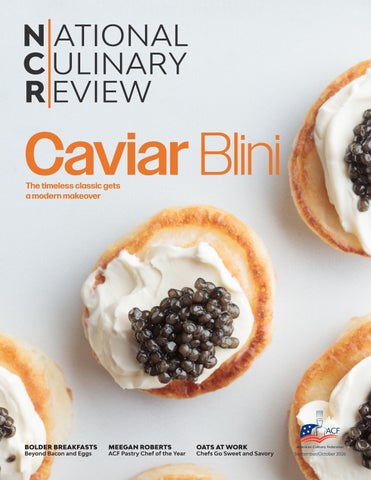
Caviar Blini The timeless classic gets a modern makeover
BOLDER BREAKFASTS
Beyond Bacon and Eggs
MEEGAN ROBERTS
ACF Pastry Chef of the Year
OATS AT WORK
Chefs Go Sweet and Savory
September/October 2026
Table of Contents 16 ACF Accreditation in Virginia MANAGEMENT
Connecting classrooms to culinary careers
20 Bolder Breakfasts MAIN COURSE
Taking morning menus beyond bacon and eggs
26 Snackable Seafood ON THE SIDE
From seacuterie boards and tinned fish to salmon skin chips
30 Caviar Blinis
CLASSICAL VS. MODERN The timeless classic gets a modern makeover
38 ACF Chef Ankish Shetty CHEF TO CHEF
From engineer in India to Executive Chef in New York City
40 The Art of Rebirth PASTRY
The story behind Pastry Chef of the Year Meegan Roberts’ winning dessert
HEALTH
44 Oats
Using the whole grain in both sweet and savory applications
SEGMENT SPOTLIGHT
48 Giving Back to the Community
ACF Chefs volunteer with kids and veterans in Grand Rapids
4 6 15
2
PRESIDENT’S MESSAGE NEWS BITES THE FOUNDATION’S MESSAGE
NCR | September/October 2026
24 52 58
ACF CHEF PROFILE CHAPTER CLOSE-UP THE QUIZ
IS HOW TO SATISFY YOUR
DAIRY-OSITY
SAPUTO’S PREMIUM DAIRY
s .
CONTACT YOUR SAPUTO REPRESENTATIVE OR VISIT US ONLINE AT SAPUTOUSAFOODSERVICE.COM TO LEARN MORE. © 2026
. os
President's Message
Editor-in-Chief Kerstin Kühn Director of Communications David Ristau Graphic Designer Santiago Cantillo Advertising and Event Sales Eric Gershowitz Contributors Pamela Brill, Jonathan Deutsch, Lyssa Goldberg, Lauren Kramer, Stephanie Lewis, Jody Shee, Jeffrey Spear Contributing Editors Kevin Blackston, Kivi Hermans
THE PRESIDENT’S MESSAGE Dear ACF Members,
American Culinary Federation, Inc. 6816 Southpoint Parkway • Ste 400 • Jacksonville, FL 32216 (800) 624-9458 • (904) 824-4468 • Fax: (904) 940-0741 ncr@acfchefs.org • ACFSales@mci-group.com • acfchefs.org
Board of Directors President René J. Marquis, CEC®, CCE®, CCA®, AAC® ACFEF Chairperson Barry R. Young, CEC, CCE, AAC National Secretary Bryan Frick, CEC, AAC National Treasurer Kyle Richardson, CEC, CCE, AAC American Academy of Chefs Chair Joe G. Aiello, CEC, AAC, HOF Vice President Central Region James F. Kokenyesdi, CEC, CCA, AAC Vice President Northeast Region Ray McCue, CEC, AAC Vice President Southeast Region Keith E. Gardiner, CEC, CCE, CCA, AAC Vice President Western Region Jay Marshall, CEC, AAC Executive Director JJ Vitale
The National Culinary Review® (ISSN 0747-7716), September/October 2026, Volume 50, Number 5, is owned by the American Culinary Federation, Inc. (ACF) and is produced six times per year by ACF, located at 6816 Southpoint Parkway, Ste 400, Jacksonville, FL 32216. A digital subscription to the National Culinary Review® is included with ACF membership dues; print subscriptions are available to ACF members for $25 per year, domestic; nonmember subscriptions are $40. Material from the National Culinary Review®, in whole or in part, may not be reproduced without written permission. All views and opinions expressed in the National Culinary Review® are those of the author and do not necessarily reflect the views and opinions of the officers or members of ACF. Changes of mailing address should be sent to ACF’s national office: 6816 Southpoint Parkway, Ste 400, Jacksonville, FL 32216; (800) 624-9458; Fax (904) 940-0741. The National Culinary Review® is mailed, and periodical postage is paid at Jacksonville, Fla., and additional post offices. POSTMASTER: Send address changes to the National Culinary Review®, 6816 Southpoint Parkway, Ste 400, Jacksonville, FL 32216.
4
NCR September/October 2026
Thank you once again for joining us in beautiful Grand Rapids, Michigan, for our National Convention. It was a tremendous success—made possible by you, our membership. Your open, receptive spirit, willingness to learn and eagerness to network created an energy that was truly special. Celebrating America’s 250th anniversary together added an extra layer of pride and purpose to the week. I left Grand Rapids grateful and inspired by the people who make this organization what it is. In this issue, you’ll find our Ingredient of the Month featuring oats and caviar. In the Health section, we explore how chefs are using oats to bring texture, fiber and flavor to both sweet and savory dishes. In the Classical vs. Modern column, we take a closer look at Caviar Blinis, honoring the classic while showing how today’s chefs are reinterpreting this elegant pairing. We also turn our attention to Operation Chefs: A Recipe for Change. Be sure to participate in our social responsibility initiative this October through the ACFEF Chef & Child Initiative. On October 16, we celebrate Child Nutrition Day. Take a moment to share healthy eating habits with children—or even start a garden with them. On October 20, we celebrate International Chefs Day by sharing our professional knowledge with the next generation of chefs. In this issue, we highlight two meaningful efforts from the convention: the Chef & Child event with Kids Food Basket in Grand Rapids and our veterans dinner held at Michigan Veteran Homes Grand Rapids, a veterans’ memory care facility. These initiatives remind us why community and service remain at the heart of our profession. Be sure to read the highlights of our national award winners, including ACF Chapter of the Year – Under 40 Members (Metro Mobile), Pastry Chef of the Year Chef Meegan Roberts, and Student Chef of the Year Jack Courtney. Their achievements reflect the excellence and promise that continue to strengthen our federation.
The main feature this month focuses on snackable seafood—from seacuterie towers to salmon skin chips. Chefs are finding creative ways to maximize utilization of the whole fish while often achieving stronger margins than traditional entrées. It’s a smart, practical and delicious approach worth exploring. In On the Side, we look at Bolder Breakfasts. Global flavors such as shakshuka, chorizo, chili crisp and adobo hollandaise are finding their way into familiar formats like bowls, Benedictsv and burritos—proving that breakfast can be both comforting and exciting. We’re also seeing encouraging growth in ACF certifications among students in Virginia schools. Be inspired and help your state achieve the same success. The year is moving quickly. In the midst of all we do for others, remember to take care of yourself first. Mental and physical health matter, and it is never too late to start prioritizing both. Chefs, I got your six!
#CIGY6 René J. Marquis, CEC, CCE, CCA, AAC MSG (R), US ARMY National President of the American Culinary Federation Chairman of the Board, ACF Tampa Bay Chapter Certification Chair, ACF Tampa Bay Chapter WORLDCHEFS Chairman - Military Committee WORLDCHEFS Culinary Competition Committee - Special Advisor Military Kitchens and Development
ACFCHEFS.ORG
5
News Bites
NEWSBITES
EVENTS
ACF CHEF’S TABLE WEBINAR SERIES: SEAFOOD’S BIG MOMENTSNACKABLE AND SUSTAINABLE October 14, 2026, at 2:00 PM ET Celebrate National Seafood Month with author and seafood expert ACF Chef Barton Seaver as he guides you through the art and science of serving raw fish. From pristine tuna to buttery salmon and delicate shrimp, Chef Barton will share how to source responsibly, handle with precision and present raw seafood safely and beautifully. You’ll gain insight into flavor pairing, texture and the cultural traditions that inspire these preparations. Whether for sushi, crudo, ceviche or tartare, this session will equip you with the confidence and creativity to elevate raw seafood on your menu. Register at acfchefs.org
SEPTEMBER DEADLINE FOR ACFEF HEALTHY EATING GRANTS The American Culinary Federation Education Foundation (ACFEF), through its Chef & Child initiative, is offering grants to help ACF chefs and chapters bring nutrition education into their communities. Active ACF members can apply for up to $300 per event, including cooking demonstrations and tastings, or up to $2,500 for programs such as after-school initiatives and cooking classes. Funding can be used for food, supplies and incentives, with the next application deadline September 30, 2026. Apply at acfchefs.org OCTOBER DEADLINE FOR ACFEF SCHOLARSHIPS The American Culinary Federation Education Foundation (ACFEF), with support from the American Academy of Chefs (AAC), offers scholarships to students pursuing culinary education. Awards of up to $1,500 are available for apprenticeship and certificate programs, while students enrolled in postsecondary degree programs can receive up to $2,500. The next general scholarship application deadline is October 31, 2026. ACFEF also offers professional development grants to working culinary professionals seeking continuing education opportunities. Apply at acfchefs.org
6
NCR | September/October 2026
ACFEF GRANTS AND RENEWS ACCREDITATION FOR 30 CULINARY SCHOOLS The American Culinary Federation Education Foundation (ACFEF) Accrediting Commission granted or renewed accreditation for 30 secondary and postsecondary schools following its biannual meeting, held July 16–19 in Jacksonville, Florida. The Commission reviewed team reports and institutional responses covering 48 Culinary Arts, Baking and Pastry and Food Management programs. Eight schools received initial three-year accreditation, while 22 earned renewed accreditation. Seven schools received seven-year exemplary accreditation: The Culinary Institute of Michigan at Baker College of Muskegon; Central New Mexico Community College; Schenectady County Community College; Houston County Career Academy; South Forsyth High School; Lambert High School Culinary Arts; and West Forsyth High School. ACF SEEKS CULINARY CANNABIS EXPERTS The American Culinary Federation is seeking chefs and subject matter experts with experience in culinary cannabis to help develop new educational content for the ACF Online Learning Center. Experts interested in contributing their knowledge to the course can contact KHermans@acfchefs.org for more information.
SALUT ACF CONSULTANTS DEVELOP MENU FOR PATHFINDER VILLAGE CAFÉ The ACF Culinary Consulting Cooperative recently supported menu development for Farmstead, a new café and farmers market at Pathfinder Village (Edmeston, NY), a community serving individuals with Down syndrome and other developmental disabilities. The project, which is scheduled to open in the fall, was led by ACF Chef Dan Follese of the ACF Tallahassee Area Chefs Association, with support from ACF Chef Gary Patterson, CEC. “We offered them support in developing a menu that they envisioned,” Chef Follese said. “They wanted to keep the menu simple but uniquely their own.” The cooperative created sandwiches, soups and salads designed for grab-and-go service, with recipes simple enough for staff to recreate with ease. Participants will work under a trained culinary manager, gaining hands-on experience while keeping the café stocked and running on schedule. Housed in a refurbished barn, Farmstead will double as a local farmers market, drawing on regional goods for its café menu, creating both a training ground for residents and a new destination for the community.
ACF CHEF COLIN ROCHE PUBLISHES NEW BOOK FOR CULINARY EDUCATORS ACF Chef Colin Roche, CEC, CCE, PhD, Academic Dean of the Biscayne College for the Liberal Arts & Social Sciences at St. Thomas University (Miami Gardens, FL), has published a new book, The Educator’s Journey: Brain-Based Teaching for Culinary and Hospitality Education, through Kendall Hunt. Designed for culinary and hospitality educators, the book explores how neuroscience can inform more effective teaching, offering practical strategies for course design, active learning, real-world instruction and student assessment. Chef Roche draws on his experience as a culinary educator to help instructors create engaging learning experiences that build both knowledge and professional skills. The book is available in print for $110 (ISBN 9798319730190) and as an eBook for $80 (ISBN 9798319730206). For more information, visit www.kendallhunt.com.
ACF CHEF TOMEKA DAY NAMED WILLIAMSON HIGH SCHOOL TEACHER OF THE YEAR ACF Chef Tomeka Day, CC®, Culinary Educator at Williamson High School (Mobile, AL), has been named the school’s Teacher of the Year. Chef Day, a member of the ACF Metro Mobile Chefs & Cooks Association, leads the school’s culinary program, where her students have earned recognition in a number of culinary competitions. Her work is part of the chapter’s broader efforts to connect secondary culinary students with mentorship, competition opportunities and professional pathways through ACF. ACF CHEFS RETIRE FROM LEBANON COUNTY CTC AFTER 30 YEARS After 30 years of teaching at Lebanon County Career and Technology Center (PA), ACF Chef Robert Corle Jr., CEC, CCE, and ACF Chef Brian D. Peffley, CEPC®, CCE, AAC, have retired, closing a significant chapter for the school’s culinary programs. During their tenure, Lebanon County CTC became home to the nation’s first ACFEF-accredited secondary Baking and Pastry Arts program, making the school the first secondary program in the country to hold ACFEF accreditation in both culinary arts and baking and pastry. Two former students are now stepping in to continue that legacy. ACF Chef Louie Manza, a 2012 graduate of the Lebanon CTC Culinary Arts program, and ACF Chef Katie Bomberger, a 2004 graduate of its Pastry Arts program, have returned to the school as instructors. The transition brings the program full circle, with two alumni taking the reins from the chefs who helped build its national reputation.
EDUCATION CERTIFICATION PRACTICAL EXAMS Practical exams, required for earning and maintaining ACF certifications, assess your skillset based on the certification level you are pursuing. Each level has specific requirements, including what dishes to prepare, the time frame for the exam, and other important details, all of which are outlined in the candidate handbook. Exams are conducted at various locations across the country throughout the year. Be sure to check the upcoming practical exam schedule to find and register for an exam! Visit acfchefs.org/certify for a list of upcoming practical exams. ACF ONLINE LEARNING CENTER The ACF Online Learning Center (OLC) offers a variety of courses, demonstrations, webinars, and NCR quizzes that can be used for certification requirements and Continuing Education Hours (CEH). Visit acfchefs.org/olc to explore all the courses, from garde manger to culinary nutrition, accounting, safety and sanitation, beverage management and more. SPECIALIZED CERTIFICATES ACF specialized certificates are available through the ACF Online Learning Center. In 2025, we introduced new and exciting specialized certificates while also revamping our current offerings, which include culinary essentials, baking/ pastry essentials, and personal chef certificates. Visit acfchefs.org/olc to learn more.
ACFCHEFS.ORG
7
News Bites
UPCOMING COMPETITIONS THE AMERICAN CULINARY CLASSIC RETURNS TO ACF NATIONAL CONVENTION The American Culinary Classic competition will return to the next ACF National Convention held in Orlando from July 1214, 2027. This historic competition will consist of a four-person team Grand Buffet, individual cold category competitions, and an individual live Centerpiece Showcase. Both local and international chefs will be eligible to compete. The following categories may be entered into by individual competitors; the Grand Buffet will be a W Category and will include all these categories: A; B1; B3; C1-2; D; E. Visit acfchefs.org/competitions to learn more.
September 12–13, 2026 - Cleary-Huffman St. Paul Farmer’s Market Competition 290 5th St E, Saint Paul, MN Show Chair: Logan Christensen, CEC Categories: D1-4; KG Lead Judge: Aidan P. Murphy, CMC®, AAC September 26, 2026 - St Louis Chefs de Cuisine Fall Competition 1964 Prairie Dell Rd, Union, MO Show Chair: Austin Hamblin, CEC Categories: KC1-11; KP1-2; SKC1-9,11; SP1-2; SKS1 Lead Judge: Kevin Storm, CEC, AAC October 14, 2026 - Raleigh-Durham Wake Tech Fall Culinary Salon 7821 Values Dr, Raleigh, NC 27616 Show Chairs: Caralyn House; Eric Stopka Categories: A1-6; B1-4; C1-5; D1-4; SA-D; SW Lead Judge: Raimund Hofmeister, CMC, AAC October 25–27, 2026 - Florida Restaurant Show Orange County Convention Center, Orlando Show Chairs: Lynda Alfano; Jason Fridrich, Ed. D, MBA, CEC, CCE, CE Categories: D-4; KC, KC-5, KC-11; SD Lead Judge: Reimund Pitz, CEC, CCE, AAC, HOF November 6–7, 2026 - John Joyce Competition Johnson County Community College, Shawnee Mission, KS
8
NCR | September/October 2026
Show Chairs: Edward Adel, CEC, AAC; Chrystal Tatum, CEC Lead Judge: Alan Susan Notter, CEPC, AAC November 6–7, 2026 - 8th Annual West Michigan Lakeshore Chapter Competition 336 W Clay Ave, Muskegon, MI Show Chairs: Christopher Sowa, CEC, AAC, and Amanda Miller, CEPC, CSC®, WCSC Categories: A1-4; B1-3; C2-5; D1-4; F1-5; FP1-2; FMH; KG2; KC-12; KG; KP1-2; KP1GF; KP2N; SA-D; SF; SG; SGP; SKC1-9,12-13; SP1-2, SP1GF; SP2N; SKP3; SKS1; SPS1; SKW Lead Judge: Michael Beriau, CEC, AAC November 13–14, 2026 - Midwest Culinary Institute Culinary Salon 3520 Central Pkwy, Cincinnati, OH Show Chairs: Betsy LaSorella, CEPC, and Greg Skibinski, CEC, AAC Categories: F4&5; KC-12; KG; KP1-2N; SA-D; SK1-9, 12&13; SP1-2N; SKP3; SKS1; SPS1; SKW Lead Judge: Michael Schmidt, CEC November 19, 2026 - Tri-Rivers Career Center Annual Competition 2222 Marion-Mt Gilead Road, Marion, OH Show Chairs: Lance Stalnaker, CEC, CCE Categories: KC; SKC-2; SP1-2; SKS; SPS Lead Judge: Matt Schellig, CEPC, CCE, CCA, AAC December 11–12, 2026 - Fox Valley Technical College Competition 1825 North Bluemound Drive, Appleton, WI Show Chairs: Gary Lyons, CEC, AAC, and Tim Steinhiser Categories: A1-4; B1-3; C1-5; D1-4; KC1-11; KP1-2; ST1; SKC1-9; SP1-2; SKS; SPS Lead Judge: Ryan C Shroeder, Jr, CEC, AAC
IN MEMORIAM We honor the memory of chefs who have passed, recognizing their invaluable contributions to the culinary profession and lasting influence they’ve had on the industry. Genevieve W. Thomas-Woodward, CEPC, CEC, CCE, AAC, a trailblazer in Oklahoma’s culinary community and longtime ACF member, died July 17, 2026, at age 93. Chef Thomas-Woodward made history as the first woman in Oklahoma to earn the Certified Executive Chef (CEC) credential through the ACF. She was inducted into the American Academy of Chefs (AAC) in 1993 and also earned credentials as a Certified Executive Pastry Chef (CEPC) and Certified Culinary Educator (CCE). She was named Chef of the Year by Culinary Arts of Oklahoma multiple times. Her career included positions at Integris Baptist and Mercy hospitals before she joined Casady School in Oklahoma City, where she spent more than 20 years as Executive Chef and Foodservice Director. A longtime member of the Oklahoma Chefs Association, Chef Thomas-Woodward served for many years as Apprenticeship and Certification Director, mentoring aspiring chefs and helping advance the profession in her state.
Ingredients of the Month
SEPTEMBER: OATS Oats, one of the world’s oldest cultivated cereal grains, are valued for their versatility, nutritional profile and adaptability across both sweet and savory applications. Available in forms ranging from steel-cut and rolled oats to oat flour and oat milk, their texture and cooking behavior vary depending on processing. Oats develop a mild, nutty flavor and creamy consistency when cooked, while also contributing structure and moisture retention in baked goods and savory dishes. In professional kitchens, oats extend well beyond breakfast, appearing in breads, desserts, coatings and plant-forward preparations where their functionality and subtle flavor make them a reliable staple ingredient.
OCTOBER: CAVIAR Caviar, traditionally referring to the salt-cured roe of sturgeon, has long been associated with luxury dining, though a wider range of roe varieties now appear across contemporary menus. Prized for its delicate texture and clean salinity, caviar offers subtle marine minerality and a distinctive burst on the palate that adds both flavor and contrast. Its quality depends on factors including species, maturity, salting techniques and careful handling, with temperature control essential to preserving freshness and texture. In professional kitchens, caviar is used sparingly but strategically, often paired with neutral or rich ingredients such as potato, egg, crème fraîche and seafood to highlight its complexity without overpowering it. Members can explore ACF Ingredients of the Month in depth through the ACF Online Learning Center presentation and National Culinary Review, earning continuing-education credit toward ACF Certification. Visit acfchefs.org/olc
Her commitment to service extended well beyond the kitchen. She volunteered with organizations including the Salvation Army and Red Andrews Christmas Dinner and prepared meals for search-and-rescue workers following the 1995 Oklahoma City bombing. Remembered as a mentor, educator and deeply committed member of her community, Chef Thomas-Woodward leaves a legacy built on the belief that food can educate, connect and strengthen communities.
ACFCHEFS.ORG
9
News Bites
Gold Medal WINNERS Elizabeth Osuna Yates
Spyridon Giannakoulopoulos, CEC, CCE
Bernard Urban Culinary Classic Category: SP
Chris J. Neary Competition Category: F4
Katie Velarde, CPC®
Alain V. De Coster, CEC, AAC
Bernard Urban Culinary Classic Category: SP
Chris J. Neary Competition Category: K
Laney Grace Hobbs, CPC
Gianna Colabella, CPC
Bernard Urban Culinary Classic Category: SP
Chris J. Neary Competition Category: P
Michael Green
Sisai G. Meza
Bernard Urban Culinary Classic Category: SK
Chefs de Cuisine STL Spring Category: SK
Samantha Fletcher
Rylee Anne Boyer
Bernard Urban Culinary Classic Category: SK
Chefs de Cuisine STL Spring Category: P
Joseph Fisher
Bradley Shannon
Bernard Urban Culinary Classic Category: SK
U Mass Amherst By Palm Beach County Category: W
Christian Culverhouse
Ryan D. Rodenhaus
Bernard Urban Culinary Classic Category: SK
U Mass Amherst By Palm Beach County Category: W
Lance Stalnaker, CEC, CCE
Christopher Caron
Monte Dolce Spring Classic Category: K
U Mass Amherst By Palm Beach County Category: W
Kaycee Robisch
Nicholas Simpson, CEC, CCA
Monte Dolce Spring Classic Category: SP
NACUFS Nationals 2026 Category: W
Cathleen A. Barron, CEPC
Maricus M Nolley
Monte Dolce Spring Classic Category: C
NACUFS Nationals 2026 Category: W
Oswald Willson, CC
Justin Lucas, CEC
Chris J. Neary Competition Category: SK
NACUFS Nationals 2026 Category: W
Zane Shiffer Chris J. Neary Competition Category: SP
10
NCR September/October 2026
News Bites
COMMUNITY FIRST: How Two ACF Chapters Grew Their Membership
When ACF launched its spring Membership Drive, chapters across the country set out to recruit new professional members and strengthen their local culinary communities. By the end of the three-month campaign, which ran from March through June, ACF chapters had welcomed a total of 624 new professional members.
Two chapters stood out. The ACF Caxambas Chapter of Southwest Florida recruited the highest number of new professional members with 41, while the ACF Cape Cod & The Islands Chefs Association achieved the highest percentage growth, increasing its professional membership by 59 percent. Although their approaches differed, both chapters shared a common philosophy: membership growth is the result of building an engaged, welcoming community rather than running a standalone recruitment campaign. For ACF Cape Cod & The Islands Chefs Association Chapter President ACF Chef John Norton, CEC, CCA, the chapter’s success began by expanding who helped tell the ACF story. Chef Norton recruited vendor sales managers to serve on the board of directors, recognizing that they interact with culinary professionals every day and could naturally introduce them to the organization. Those board members were equipped with information and invited prospective members to attend their first meeting free of charge. Rather than relying on special recruitment events, the chapter focused on consistently encouraging members to bring someone new to each meeting. Just as importantly, the chapter emphasized its impact beyond the kitchen. Proceeds from chapter activities support culinary students as well as local veterans and food insecurity organizations. That message has resonated strongly with prospective members. “Everyone wants to help a neighbor and the next generation,” says Chef Norton. “Once they’re engaged in the community, conversations about certification, education and competition happen naturally.”
meetings into events members genuinely look forward to attending. “Honestly, it comes down to dramatically elevating the quality and energy of our meetings,” says Chapter President ACF Chef Kristofer Jubinville, CEC, WCEC. “We transformed our meetings into true culinary spectacles.” Host chefs compete to create memorable experiences through creative themes, décor and exceptional food while still delivering meaningful education and networking opportunities. Vendor partners have enthusiastically supported the events, and the chapter has continued investing in student competitions, certification and professional development. Rather than assigning recruitment to a committee, membership growth became an organic effort across the chapter. As attendance increased, members naturally invited colleagues, culinary teams and even family members to participate. For many chefs relocating to rapidly growing Southwest Florida, the chapter has also become an important place to build professional relationships. “The biggest value proposition we offer is tight-knit community and connection,” says Chef Jubinville. “Joining our chapter gives new chefs an immediate home base to build real, lasting relationships.” The success of both chapters demonstrates that sustainable membership growth isn’t driven by recruitment campaigns alone. It comes from creating chapters where chefs find value, build friendships, support their communities and feel inspired to return month after month. When members are genuinely excited to participate, recruiting the next generation of ACF chefs becomes a natural extension of the chapter experience.
The chapter has also made meetings more inviting by replacing formal, traditional formats with experiences that appeal to today’s chefs. Bands, comedians, tattoo artists, family mini-golf tournaments, pig roasts and hospitality networking events have helped create an atmosphere that is both educational and enjoyable. Similarly, for the ACF Caxambas Chapter of Southwest Florida, the winning formula has been transforming chapter ACFCHEFS.ORG
11
Where chefs connect, exchange ideas, and elevate the craft, on air, online, and in print.
ACF CHEF’S TABLE is expanding across platforms to meet you wherever you are.
NEWSLETTER
Read the latest industry news and stay informed with the ACF Chef’s Table Smartbrief delivered daily to your inbox.
MEMBERS FORUM
WEBINARS
Join the upgraded ACF Chef’s Table Members Forum, now redesigned for a smoother, more engaging experience.
Log on to ACF Chef’s Table Webinars that dive into technique, trends, and culinary leadership.
And don’t miss our Chef-to-Chef interview series in the National Culinary Review, bringing chef stories from the kitchen to the page.
Chef’s Table is more than a forum; it’s your place at the table. Explore it all at CHEFS-TABLE.ACFCHEFS.ORG
12
NCR September/October 2026
TAKEAWAYS The ACF Chef’s Table Open Forum is where ACF members exchange ideas, share experiences and tackle industry challenges together. Here’s a round-up of recent conversations that got ACF chefs talking.
PACKAGING MATTERS IN HEALTHCARE FOODSERVICE
When ACF Chef Dan Follese, Managing Director of the ACF Culinary Consulting Cooperative, asked members whether individually portioned, pitted prunes in a cocktail-style sauce could work in healthcare operations, the conversation highlighted a broader consideration: making food packaging practical and accessible for patients. WHAT MEMBERS SAID ACF Chef Jennifer Bryant, Director of Food & Nutrition Services at Morrison Healthcare, noted that in her 24 years in healthcare foodservice, prune juice has been used more frequently than whole prunes. She also cautioned that portion-control cups can be difficult for patients with shaky hands or those eating in bed to open without spilling. ACF Chef Steven Walk, CEC, CCA, AAC, Executive Chef at Morrison/Compass Group, similarly said there is little demand for whole prunes in his operation, with prune juice generally preferred. The discussion also prompted chefs to share their experiences with difficult-to-open food packaging. ACF Chef Richard Farmer, CEC, Executive Chef, Culinary Innovation & Staff Development at St. Jude Children’s Research Hospital, noted that pocketknives aren’t permitted at his facility, so staff are issued safety box cutters instead. THE TAKEAWAY For healthcare foodservice operators, product innovation isn’t just about what’s inside the package. Ease of opening, patient dexterity, portion format and the realities of eating in a healthcare setting can be just as important as the food itself.
BUILDING THE NEXT GENERATION OF ACF EVALUATORS
When ACF Chef Tye Nielsen, CEC, CCA, Culinary Manager Catering at the University of California, Riverside, asked about evaluator training opportunities, he highlighted a challenge facing certification in Southern California: demand for practical exams can outpace the number of available certified evaluators. WHAT MEMBERS SAID ACF Chef Alexander Sapp, CEC, PCEC, CEPC, CCA, noted that evaluator trainers are particularly limited in some parts of the country. He cited approximately 430 registered evaluators
nationally, but only around 56 mentors and 30 trainers. ACF Chef Jay Marshall, CEC, AAC, ACF Western Region Vice President, acknowledged the shortage in the West and shared that ACF was working to expand the evaluator pool, including an evaluator training class in Los Angeles. ACF Chef Solon Pietila, CEC, CCA, suggested another opportunity: bringing back evaluators whose credentials lapsed during or after the pandemic. ACF National President Chef Rene Marquis, CEC, CCE, CCA, AAC, and ACF certification staff clarified that returning evaluators may not necessarily need to repeat the entire training process, depending on their circumstances. THE TAKEAWAY Expanding ACF certification depends not only on encouraging more chefs to become certified, but on building the evaluator, mentor and trainer network needed to support them. The discussion also highlighted an opportunity to bring experienced former evaluators back into the fold.
ACF CHEFS HELP SHAPE OHIO CULINARY EDUCATION STANDARDS When ACF Chef Jason Cobb asked fellow members to help review and update Ohio’s hospitality and tourism standards for public schools, chefs and educators from across the country stepped forward to participate.
WHAT MEMBERS SAID Members with experience spanning secondary and postsecondary culinary education, school nutrition, curriculum development and industry training volunteered for panels covering Culinary Skills & Operations, Food Safety, Food and Nutrition, Pastry Arts and Hotels & Lodging. Among them, ACF Chef Jon Woodgate, CC, Program Coordinator of Culinary Arts at Southwest Technical College, offered his experience teaching high school culinary arts, while ACF Chef Marc Hussey, AAC, who manages curriculum for the Connecticut Technical Education and Career System, expressed interest in bringing his own state-level curriculum experience to the process. Other members offered expertise in nutrition, food safety, pastry arts and workforce development. THE TAKEAWAY Industry input can play an important role in keeping culinary education aligned with the skills students need in today’s workplace. The discussion also showed how Chef’s Table can connect educators with expertise from well beyond their own state. Join the conversation. Visit Chef’s Table to share your perspective on these discussions and connect with fellow ACF chefs.
ACFCHEFS.ORG
13
The Foundation's Message
The American Culinary Federation Education Foundation As we reflect on the 2026 ACF National Convention in Grand Rapids, Michigan, we note several events in support of the American Culinary Federation Education Foundation, which, in turn, supports our overarching Federation. On behalf of the foundation and all its parts, I would like to express our sincere gratitude to the many sponsors, partners and volunteers who generously give their time, talent, and resources to support students of all ages in pursuing their careers. Some of the events included the Chef and Child event led by Chef Vanessa Marquis and her many volunteers, working with kids learning how to cook nutritious snacks and meals. Being part of these events over the years, I am not sure who gets more out of them, the chef volunteers or the kids. I have seen the most seasoned chefs with tears in their eyes.
Then we moved into the inaugural Chef Michael Ty Golf Outing, where we had a good number of golfers for a first year in an effort to raise money for the Foundation. Hopefully this will be the beginning of an annual event to continue to increase awareness of the Foundation and the work that is done on behalf of the students and chefs. Thank you to the many sponsors and volunteers who stepped up to make this event a success. Of course, we cannot forget the Education Summit, where educators came together to re-energize, support students of all levels, and network while learning about the latest industry trends. The American Academy of Chefs' annual Induction Dinner honors new Academy Fellows and award winners who give of their time to promote and elevate our industry. Congratulations to all the inductees to the AAC. We also recognize the leadership they provide regarding the many scholarships awarded each year, such as the NASA HUNCH Program. Also, remember the ACF Culinary Team USA as they prepare each month for the World Cup in Luxembourg in November. Check out the website under Partners, then Events, for their next training session. If you can come to support and encourage them on their journey, please do so! One of the initiatives we announced last year is finally going to be unveiled this coming Autumn, with the new school year. Students at ACFEF-accredited schools will receive free membership in the American Culinary Federation to create value and foster better engagement with students. Lastly, as the Foundation continues to develop and announce the new initiatives through fundraising, creating awareness, and telling our story, please tell us your story about how the Foundation may have touched you or someone you know, and bring any ideas you may have to the attention of the Board of Trustees. “ONE FOUNDATION. INFINITE FUTURES. TRANSFORMATION 2029 & BEYOND.” 501c3
Barry R. Young, MBA, CEC, CCE, AAC ACF Education Foundation – Chairperson Chapter OH021 - ACF Columbus Chapter
ACFCHEFS.ORG
15
Management
VIRGINIA STANDARD THE
The State is leading the way in connecting culinary education with industryrecognized credentials
Arlington Public Schools
16
NCR September/October 2026
By ACF Chef Jonathan Deutsch, Ph.D., CRC, CHE Chef Jie Na Funk, Service Director of Moon Rabbit (Washington, DC), is having a great year. The buzzy restaurant, which calls its cuisine “reimagined Vietnamese,” was already a James Beard semifinalist before adding a spot on the North America’s 50 Best Restaurants list and a James Beard win to its growing list of accolades in 2026. With a résumé like that, it’s easy to forget that Chef Funk didn’t start out as a polished hospitality professional. Like everyone in this industry, she started as a kid for whom the work was new, intimidating and overwhelming. She remembers being so nervous at a high school SkillsUSA competition that she pulled a pan of hot scones out of the oven with her bare hands, promptly dropping it and finishing the hours-long competition with painful burns. She didn’t just finish, though — she won. Chef Funk credits her Culinary 1 class at Wakefield High School (Arlington, VA), taught by ACF Chef Renee Randolph, CCE, with laying the foundation for her career. “Chef Randolph would always stay two hours late to let us practice for competitions,” she recalls. “It was optional, but whenever she offered it, I stayed. She taught me not only how to cook and work clean, but also ACF Chef Renee Randolph, CCE the importance of humility and a strong work ethic. I took every opportunity she gave me. Every time there was a competition, I signed up.” That dedication paid off: Chef Funk earned a full-tuition scholarship to the Culinary Institute of America’s AOS Baking and Pastry program, setting her on the path to the career she has today. Her strong high school foundation was no accident. Virginia is one of the country’s most committed advocates for aligning career and technical education (CTE) with rigorous, industryrecognized credentials such as ACF accreditation, through numerous House bills and the platform of Governor Glenn Youngkin, who has made the state’s industry competitiveness a priority. “If you look at culinary programs, they vary so much across different states or even within the same city,” says Dr. Jai Girard, Director of Education and Workforce Development with the Virginia Restaurant, Lodging and Travel Association. “Accreditation levels the playing field so students graduate with
Chef Virginia Mae Claffey, CFC, CFPC, at Arlington Career Center
industry-recognized credentials. It elevates the trainee and is a differentiator for the student, who knows which credentials can lead to better shifts, better hours and better pay.” As Dr. Girard puts it, “It’s not just about going to class for four years and graduating. It’s more about pathways and industry credentials.” At the district level, Dr. Enrique Wiggins oversees Family and Consumer Sciences (which includes Culinary Arts) for Chesapeake Public Schools. He’s candid about the difficulty of aligning high school culinary education with national standards: “It’s a heavy lift. On top of that, there’s a significant financial cost.” But he says the challenges are outweighed by the results. “This was a great opportunity to synchronize our seven high schools in the district and make sure we were all on the same page with industry standards. I like that it sets standards and expectations that ensure we are providing students with not just an elective, but a pathway to a career.” Like any new curriculum, the rollout came with growing pains. “The students initially didn’t know what to expect,” Dr. Wiggins says. Some teachers were resistant too, comfortable with their existing methods or unsure they had the professional chef training to meet ACF-level standards. But, he adds, “Some have really embraced it and have redefined their identity and purpose.”
ACFCHEFS.ORG
17
Management
Chef Jessica Steadman, Culinary Training Coordinator for Chesapeake Public Schools, is one of them. She runs the Peake Café, where students cook for and serve real customers, earning internship credit — and pay — for their work. “The biggest thing about going through the accreditation process is that you find the strengths and weaknesses Chef Jessica Steadman in your program,” Chef Steadman says. “ACF really pushes the teachers and students professionally. Those kids who want to go into the industry, it really pushes them and hones their skills. ACF site evaluators help connect them to the industry and give them opportunities.” Her advice to other instructors: “For teachers it can be very overwhelming, but if you can enlist the support of your administrators and start early, asking questions of the evaluators, it can be a very rewarding process. The key is to explain the process to students from day one and have them take ownership.” Chef Aaron Williams, knows that ownership firsthand. A recent graduate of Chesapeake Public Schools, he still works at the Peake Café mentoring rising seniors, ahead of starting hospitality management studies at Norfolk State University, where he’ll focus on food and beverage management. He also runs his own catering and personal chef business, Crock Spot Eats. “I thought it was going to be another class,” he says of starting at Peake Café, “but I liked that it’s work-based learning. It gave me the opportunity to experiment, not just follow the teacher’s assignment. I think ACF accreditation is great for
Students Preston Hall and Melvin Cooper at the Chesapeake Public Schools’ Peake Café
people coming out of high school and entering the industry.” Beyond culinary skills, Chef Williams credits the program with teaching him time management and organizational skills he uses far beyond the kitchen. Back in Chef Randolph’s classroom, Chef Funk’s relationship with her high school culinary education is far from over. “I am one of the judges for practical exams to evaluate the students and tell them where they can improve. I do that every six months or so, depending on their needs. When Chef Randolph needs me, I’m always there.” Chef Randolph sees that full-circle involvement as proof of the program’s value: “Competitions, as well as the CFC® and CFPC® test, give students instant buy-in and make it real for them. Accreditation can be time-consuming, expensive and finding industry professionals to come in can be a challenge. But you have to see the sense of pride these students have to understand it.”
“Accreditation levels the playing field so students graduate with industryrecognized credentials. It elevates the trainee and is a differentiator for the student, who knows which credentials can lead to better shifts, better hours and better pay.” Chesapeake Public Schools’ Peake Café
18
NCR | September/October 2026
Dr. Jai Girard
ACF Thanks Our Loyalty Partners
Main Course
BEYOND BACON and EGGS Global flavors, bold ingredients and fresh techniques are reshaping breakfast
20
NCR September/October 2026
By Lyssa Goldberg Breakfast may typically start with eggs, toast and coffee, but chefs are finding more ways to make the morning meal feel as expressive as lunch or dinner. By layering global flavors, heat, acidity, color and texture into familiar favorites, breakfast becomes a low-pressure place for discovery – a meal where diners can find comfort in the format and curiosity in the flavor. When Lazy Dog Restaurant set out to add a more globally inspired brunch item, ACF Chef Gabriel Caliendo started with the kitchen, not the trend. Brunch was already a highvolume service period, but the wok station had unused capacity. So, Chef Caliendo, Vice President of Research and Development for Lazy Dog, the California-based restaurant chain, asked what the team could execute consistently from that station while bringing something distinctive to the menu. The result was Lazy Dog’s Loco Moco fried rice, a Hawaiianinspired brunch dish served with a sunny-side-up egg, ground beef, ham, cabbage, carrots, soy sauce and garlic chili crisp. The dish not only introduced guests to a more adventurous breakfast bowl but also helped to redistribute production across the line. “Execution is probably the biggest consideration, next to what the guests would be looking for,” Chef Caliendo says. “If you can’t execute it, it doesn’t matter how well it reads on a menu.”
“Execution is probably the biggest consideration, next to what the guests would be looking for. If you can’t execute it, it doesn’t matter how well it reads on a menu.” ACF Chef Gabriel Caliendo
That balance between guest appeal and operational practicality is shaping how chefs approach bolder breakfast dishes. Rather than chasing novelty, they’re finding ways to introduce global flavors through familiar formats such as bowls, sandwiches, benedicts, burritos and egg dishes. The 2026 Tastewise Trend Forecast reports growing interest in bold umami flavors, aromatic herbs and globally inspired ingredients such as hot honey, za’atar, labneh and kimchi. Circana likewise reports consumers are seeking indulgent flavors, unique textures and premium ingredients at breakfast. As diners move beyond traditional sweet breakfast plates, chefs are responding with menus that feel both familiar and more adventurous.
ACF Chef Gabriel Caliendo
Lazy Dog brunch menu items with loco moco fried rice
ACFCHEFS.ORG
21
Main Course
ACF Chef Gerald Ford, CMC
Baked eggs with Middle Eastern vegetable stew by ACF Chef Gerald Ford, CMC
For chefs, however, “bold” doesn’t necessarily mean extreme. ACF Chef Gerald Ford, CMC, Founder of Legit Culinary Concepts, a coaching and consulting firm, believes the best breakfast innovations excite the palate without becoming gimmicks. “Bold is one of those words that’s difficult because it can be gimmicky,” he says. “I think bold comes from dishes that tend to excite the palate.” For Chef Ford, that means looking beyond the traditional American breakfast. Dishes such as shakshuka, ful medames or vegetable stews can provide flavorful foundations for eggs. To many American diners, these dishes feel bold not because they’re new globally, but because they’re new at breakfast. ACF Chef Eric Gillish, Corporate Chef for Millennium Restaurant Group in Michigan, sees a similar opportunity. Middle Eastern, African and Latin influences are helping operators bring more color, spice and variety to morning menus. “Breakfast doesn’t have to be just a bland egg, sausage, bacon and toast,” he says. “Chefs can have more fun with it.” That creativity works best when paired with familiarity. Chef Caliendo thinks about brunch guests in two broad groups: those looking for comfort and those looking for discovery. For the first group, Lazy Dog offers dishes like the Breakfast Club, a familiar egg sandwich elevated with a house-made biscuit and Lumberjack pancake tacos by Chef Gabriel Caliendo of Lazy Dog Restaurant
Eggs Benedict by ACF Chef Gerald Ford, CMC
spicy mayo. For more adventurous diners, there’s Loco Moco fried rice and Lumberjack Pancake Tacos, which reimagine a classic American breakfast in taco form. Chef Gillish sees similar opportunities in breakfast burritos, benedicts and handhelds. A classic benedict can be refreshed with adobo in the hollandaise or capicola in place of Canadian bacon, while burritos gain depth from chorizo, chipotle aioli or queso fresco. Chef Caliendo believes the shift is being driven by America’s increasingly diverse population, combined with the influence of social media. Chef Gillish agrees, noting that food television, magazines and online
22
NCR | September/October 2026
platforms often introduce guests to unfamiliar dishes before they ever see them on a menu. Presentation matters, too. Vibrant vegetables, colorful sauces and carefully layered bowls help dishes feel contemporary before the first bite. Chef Oscar Lastra, Owner of Facade Bakery in Miami, has noticed younger diners gravitating toward bold flavors and quality ingredients. One of the café’s most popular dishes is a Spicy Onion Toast with folded eggs, caramelized onion and chili crisp on housemade sourdough. While chili crisp may be trending, Chef Lastra says the flavor is personal. Raised in Queens in a Peruvian family, he grew up with chiles as an everyday ingredient and wanted those influences reflected in the menu. “It makes the dish sweet and savory,” he says. “When we put that on the menu, we asked ourselves, how can we make something that gives you the full umami flavor, knowing it would help people identify with Facade.”
Wet breakfast burrito by ACF Chef Eric Gillish
Behind the scenes, however, successful breakfast innovation still depends on disciplined execution. Chef Ford says dishes such as shakshuka are straightforward to produce when the vegetable base is prepared ahead of service. Likewise, upgraded sauces, spice blends or premium sausages can introduce bold flavor without slowing the line. Clear menu language also plays an important role. Rather than listing shakshuka by name alone, Chef Ford might describe it as baked eggs with Middle Eastern vegetable stew, giving guests a familiar point of entry. “You can implement a lot of international technique and flavor and spice without really impacting the service aspect,” he says. As for whether a bold breakfast item has staying power, chefs agree the answer lies in both sales data and guest feedback. “If it’s not selling well, then take a look at why,” Chef Caliendo says. “Is it price-driven? Is it maybe an ingredient or two that might be too far ‘out there’ for some guests? And then there’s seasonality. There are some dishes guests simply don’t want to be eating in the wrong season.”
600 Kitchen breakfast items by ACF Chef Eric Gillish
Ultimately, bold breakfast isn’t about reinventing the morning meal. It’s about expanding its vocabulary. Familiar formats still anchor the plate, while global flavors, thoughtful menu language and disciplined execution give chefs new ways to surprise guests without asking them to leave breakfast behind.
Southern breakfast bowl by ACF Chef Eric Gillish
ACFCHEFS.ORG
23
ACF Chef Profile
STUDENT CHEF OF THE YEAR
JACK COURTNEY
By Pamela Brill
As a kid, ACF Chef Jack Courtney did not dine on chicken tenders, but it’s not something he regrets. “I remember that my mom never let me order from the kids’ menu when we went out,” he says. “She told me, ‘I’m not getting you chicken tenders, you should pick something new.’ So eventually, all I wanted was to try new ingredients, from new places, in new ways.” Named the ACF’s 2026 Student Chef of the Year, he credits both his parents for cultivating that adventurous appetite. He often served as sous chef to his father, a former restaurant cook who let him help prep vegetables and stir pots “when I was probably too young to be cutting onions,” he recalls, adding that his dad taught him never to leave fond in the pan. His mom, meanwhile, “always made sure we had delicious, healthy ingredients in the home.” That upbringing eventually led him to the Country Club of St. Albans (MO), where he has learned the ins and outs of fine dining under Executive Chef ACF Chef Wade Bruhn, CEC, who also serves as Vice President of the Chefs de Cuisine Association of St. Louis. It was Chef Bruhn who coached Chef Courtney for the ACF Student Chef of the Year competition and widened his skill set. “Chef Wade could see all my habits, good and bad, and all my strengths and weaknesses,” he says. “He always keeps me working to improve.” That kitchen partnership prepared him well for the championship — an event he likens to a typical workday, albeit compressed into about 90 minutes of setup, prep, cleaning, plating, service, and cleanup. “By learning how to compete, you can take that into work and think, ‘What is the best way to do this? Why am I doing it like this? What needs to change?’” Chef Courtney says, adding that it works both ways. “As you work you can find yourself thinking, ‘Wow, this is great! Could this help with my competition?’”
24
NCR | September/October 2026
Chef Courtney’s drive for excellence was ultimately recognized by the ACF judges. His winning dishes included an amuse bouche of shrimp and grits canapé with a roasted red pepper relish, and an entrée in two parts. The first was a duck breast, modeled after the lavender duck at Eleven Madison Park in New York City: glazed, roasted on the bone, sliced, and topped with orange zest and a spice mix. “To complement that,
I made a gastrique with duck stock, spiced with ginger, rhubarb, and anise,” he explains. His second entrée, a nod to Chef Thomas Keller’s Roulade of Pekin Duck, put his own spin on the dish: tenderloin wrapped in a morel and cherry forcemeat, then in Swiss chard, alongside a summer succotash. “I also served it with a glazed carrot, crispy leek hay, and a cauliflower-potato purée,” he adds. While renowned chefs and restaurants inspired his entries, Chef Courtney also points to local mentors who have shaped his career, including Chef Bruhn, ACF Chefs Christopher Desens, CEC, CCA, AAC, Daniel Holtgrave, CEC, and Scott Scheible. “The chefs will sacrifice every bit of their time to make sure the people who want to learn will learn everything they have to teach,” he says. Among the wisdom he’s picked up along the way is the universal “hot food hot,” a reminder not to let a single mistake leave the kitchen. “While the food is in the kitchen, you control everything,” he says. “If something is wrong, you fix it – no questions asked. Your skill and reputation rely on the details: if the plates are wiped, if the salad greens are picked properly, if the sauce is split, if the hot food is hot.” Chef Courtney may have his ACF award in hand, but he’s not resting on his laurels. He aspires to join a Michelin restaurant team, with Mirazur on the French Riviera topping his wish list. “I’m just going to go where there’s good food and see what happens,” he says.
ACFCHEFS.ORG
25
On The Side
Snackable Seafood
26
NCR | September/October 2026
From seacuterie boards to salmon skin chips, chefs are rethinking seafood through shareables, bar bites and inventive uses for trim and byproducts By Jeffrey Spear When Chef Michael Nelson, Executive Chef at GW Fins (New Orleans, LA), decided to start purchasing whole, wildcaught fish, his goal was simple: to deliver ultimate quality. What followed was a complete overhaul of how his kitchen operated. “As chefs, we hated to throw stuff away,” he explains. “We had to rethink the way we butcher our fish, opening opportunities for new, creatively conceived dishes.”
Tempura fin wings with Korean glaze at GW Fins (New Orleans)
Fins’ Lobster Dumplings; tuna trim goes into Sicilian Tuna Meatballs; swordfish replaces pork in a Swordfish Bolognese. Underpinning all of it is a dry-aging program that Chef Nelson describes as transformative: “It’s a controlled process that preserves the fish, allows the meat to lose some of its moisture and creates rich natural umami flavors that develop slowly over time.”
Chef Michael Nelson
That approach, rooted in respect for the product, has improved both the restaurant’s bottom line and its environmental footprint. The results are some of the most inventive snackable seafood dishes found on menus today. When swordfish is butchered, the trim becomes swordella (swordfish mortadella), pepperoni, andouille and bacon. Yellowfin tuna bellies are cured into pastrami. The bloodline goes into blood sausage. Fish skins across species become cracklins’. White fish mousseline anchors GW
“Seafood, due to its versatility, allows us to showcase different flavors, textures and cooking techniques while enhancing menu diversity and overall guest satisfaction.” ACF Chef Ashutosh Kandpal
The GW Fins approach, whole fish in, nothing wasted, everything on the menu, may be one of the most visible examples of a broader shift happening in kitchens across the country. With restaurant snacking up nearly seven percent, according to Technomic, chefs are finding that bar bites, small plates and shareables aren’t just crowd-pleasers. Built around
ACFCHEFS.ORG
27
On The Side
Chef Grotha’s broader snackable seafood program centers on seacuterie: grazing tables or tableside towers featuring freshly shucked oysters and clams, lobster, crab claws and an array of in-house smoked seafoods, with tinned fish worked into the display for visual effect. “Our clientele are well informed and appreciate the healthful benefits of seafood,” he explains. “Served buffet style or as a tower or boat served tableside, we offer a little bit of everything.” He adds: “Our guests also appreciate tinned fish, so that’s always included. Recognizing that packaging for tinned fish is brightly colored and a touch whimsical, we like to integrate the boxes into the display whenever feasible.” The Muffaletta, made with swordfish, served with fish skin “cracklin’s” at GW Fins, New Orleans
trim, excess inventory and underutilized species, they can be among the most profitable items on the menu. For operators facing rising food costs, snackable seafood dishes offer an opportunity to maximize utilization while giving guests new ways to experience premium ingredients. ACF Chef Robert Grotha, CC, Executive Chef at Aberdeen Heights (Kirkwood, MO), takes a similarly resourceful approach. His salmon skin chips, seasoned with “everything” spice and offered free to guests at the bar, are a case study in utilization driving experience. “This is just one way in which we win over our clientele, serve a few more drinks and heighten the dining experience,” he says.
Packaging for tinned fish adds color and whimsy to seacuterie displays at Aberdeen Heights, Kirkwood, MO
28
NCR | September/October 2026
The seacuterie format, essentially charcuterie reimagined with seafood in place of pork, has gained significant traction as an accessible way to showcase premium product in a shareable, lower-commitment format than a full entrée. Fish spreads, salmon pastrami, caviar and smoked seafoods all translate well, and the format accommodates trim and by-catch species that might otherwise be difficult to move. The presentation also lends itself to customization, allowing chefs to highlight regional seafood, house-made specialties and products that may not fit naturally into traditional menu categories.
ACF Executive Chef Robert Grotha, CC
For Chef Kandpal, the appeal of seafood lies not only in its versatility but also in its ability to carry bold flavors and diverse culinary influences. Snackable formats allow guests to sample multiple dishes in a single meal while giving chefs greater flexibility in menu development and portioning. The range of formats available to chefs is broad: dumplings and bao, croquettes, fish jerky, crudo bites, skewers, dips and spreads, tacos and sliders, many of which are natural vehicles for trim and by-catch. Fish skin chips require almost no food cost. A seacuterie tower can be assembled from house-smoked product and pantry staples. A mousseline made from white fish trim becomes a premium dumpling filling. The operational case, as Chefs Nelson, Grotha and Kandpal each demonstrate in different ways, is straightforward: start with what you have, build dishes around it and put them in formats guests want to share. The result is better utilization, less waste and, often, stronger margins.
ACF Chef Ashutosh Kandpal
Beyond seacuterie, chefs are finding new uses for seafood trimmings and byproducts. While trim has long found its way into soups and stews, it is now also becoming the foundation for dishes such as rangoons, croquettes, fish sticks, dumplings and sliders. Some chefs are even dehydrating seafood trimmings and grating them into seasonings and garnishes that add depth of flavor while maximizing utilization. ACF Chef Ashutosh Kandpal, Executive Chef at Paheli Modern Indian Cuisine (Wayne, NJ), approaches snackable seafood through the lens of global flavor and kitchen efficiency. “Seafood, due to its versatility, allows us to showcase different flavors, textures and cooking techniques while enhancing menu diversity and overall guest satisfaction,” he says. His most popular small plates – shrimp pepper fry, calamari, lahsooni jhinga (garlic-marinated shrimp) and salmon tikka – are all configured for sharing, which he adds supports both guest satisfaction and cost control. “Trim and excess inventory are often incorporated into seafood kebabs, soups and fillings for small plates, allowing us to reduce waste while maintaining quality and flavor,” he says. “The greatest margins are typically realized through snackable seafood dishes and appetizers, where portion control is precise and ingredients can be utilized efficiently without compromising the guest experience.” Salmon Tikka at Paheli Modern Indian Cuisine (Wayne, NJ)
ACFCHEFS.ORG
29
Classical vs. Modern
CLASSICAL
VS MODERN
30
NCR September/October 2026
Caviar Blini
By ACF Chef Jonathan Deutsch, Ph.D., CRC, CHE Caviar is having a moment. Once reserved for traditional service, it is now turning up everywhere, from viral caviar bumps to sesame madeleines with ras el hanout butter, braised oxtail patties and chawanmushi. Whether served simply from the tin or woven into a composed dish, chefs are embracing caviar for its luxury appeal, savory depth, textural contrast and strong profit margins. Caviar is a food that is seemingly simple – just fish roe from a sturgeon or a member of the sturgeon family (Acipenseridae) and salt. The magic is in the eggs’ interaction with the salt cure, creating flavors that can be variously described as creamy, buttery, nutty and briny, along with the distinctive mouthfeel of a series of mini popping bubbles as you press the caviar against the roof of your mouth. It’s this stunning sensation, flavor and texture that have made caviar celebrated for hundreds of years, from a New York City bar snack in the Gilded Age, when the sturgeon in the Hudson River were said to be so plentiful you could walk across their backs to cross the river, to Czarist Russia, where the elites indulged in caviar and the meaty sturgeon fish as a workaround to the many Russian Orthodox fast days that prohibited meat. The popularity of caviar in the 19th and 20th centuries led to overfishing, scarcity and price inflation, securing its luxury status but presenting challenges for wild caviar that the industry is still grappling with. These days, the vast majority of commercially available caviar is farm-raised. Gary Shusman, Owner of Caviar XS, a Philadelphiabased caviar distributor, says that 99% of what’s on the market today is sustainably farmed for a number of reasons, predominantly poaching and overfishing. “The second reason is the quality and cleanliness of the caviar,” Shusman adds. “Wild is hit or miss. You won’t know the quality until you open the fish. If it’s farmed, they have scientific expertise, good nutrition and [reliable] quality.”
Shusman says that older fish yield better caviar. “All the premium caviar comes from fish at least 13 years old,” he says. Shusman advises chefs to work with caviar specialists to get the highest quality. “Don’t go for the cheapest. Build a relationship with a supplier that is always reliable, understands your kitchen, your vision and everything you look for. With chefs who cook at a high level, there is no room for error.” Shusman advises that chefs should look for uniformity in color, consistency and taste. He recommends a saltier caviar for classical service and a creamier caviar with less salinity for use as a delicate garnish. ACF Chef William Irvin, Owner of Snuff Mill Restaurant Butchery and Wine Bar (Wilmington, DE) along with ACF Chef Lee Wroten Jr., his Executive Chef, serve caviar throughout the menu. They incorporate it into innovative modern dishes such as their ponzu oyster, topped with chile garlic crunch, ponzu sauce and caviar, or their
ACFCHEFS.ORG
31
Classical vs. Modern
Gary Shusman | Photo Credit: DK Media
ACF Chef Lee Wroten Jr.
ACF Chef William Irvin
32
NCR | September/October 2026
Chef Jae Doan | Photo Credit: Louiie Victa
“surf and turf,” an oyster topped with beef tartare, seasoned with oyster juice, capers and onion, and garnished with caviar, which won Best Bite at the Nantucket Wine and Food Festival. Chefs Irvin and Wroten even incorporate caviar into their high-end mashed potatoes, topped with bacon, cheese and a full ounce of caviar. While caviar peppers the menu, Snuff Mill is also known for its classical caviar service: caviar served from the tin, sourced from Shusman or Marshallberg Farm in North Carolina and served with the traditional accompaniments of buckwheat blini (recipe follows), crème fraiche, chopped egg yolk, chopped egg white and chives. Chef Irvin menus caviar for around $130-$140 per ounce and says that his guests are enthusiastic even at that price point. “It has to be the best,” he insists. “If it’s not outrageous, you’ve lost them and they won’t be back. Some guests save up for a month, and it has to be worth it. It’s a splurge, but not a crazy splurge.” Chef Jae Doan, Executive Chef of Doanburi in Las Vegas, incorporates caviar in her signature Ama Ebi Scallop Caviar dish, sweet shrimp and scallop layered with truffle oil, Ossetra caviar and a quail egg, which is “very Vegas luxury bites,” she says. “The Ama Ebi Scallop Caviar is one of our most indulgent dishes, layering sweet shrimp, buttery scallop, truffle oil, Ossetra caviar and quail egg. It’s elegant, rich and
Chawanmushi by Chef Julian Silvera | Vicinity (Los Gatos, CA) Photo credit: Jesse Cudworth
designed to highlight premium ingredients at their absolute best.” This dish was initially improvised by Chef Doan at the Wynn when a guest asked her to “make me something special” with their favorite ingredients. “When I first made it, it was mixed together. Now it’s more elegant, mixed tableside, and has become our number one seller,” she adds. At $45, with a food cost that Doan estimates is in the single digits, the dish is also fundamental to the business success of this off-strip independent restaurant. Doan sources her caviar from Imperia Caviar, from a farm in Northern California. “I have tried many different caviars. The creaminess that I’m looking for, combined with value, is the top consideration for me,” she explains. Shusman says caviar can be a profitable addition to any menu, but it takes thoughtful collaboration with suppliers. “I ask them all these questions: what are you making, is it being paired with another food and so on, and I’ll make suggestions,” he explains. “Caviar is just another ingredient. If I understand what they’re going to make with it, it makes it easier for me to find them the perfect product.”
Sesame madeleines with caviar by Chef Evan Snyder Emmett (Philadelphia, PA) | Photo Credit: Gab Bonghi
ACFCHEFS.ORG
33
Classical vs. Modern
CLASSICAL Buckwheat Blinis with Caviar
By Chef Lee Wroten Jr., Snuff Mill Restaurant Butchery & Wine Bar Yeast Mixture: • 120 g all-purpose flour • 1 teaspoon sugar • 2¼ teaspoons (1 packet) active dry yeast • 120 ml lukewarm milk (105–110°F / 40–43°C)
Buckwheat Mixture: • 120 g buckwheat flour • 1 teaspoon kosher salt • 1 large egg yolk • 360 ml lukewarm milk
Finish: • 1 large egg white, beaten to soft peaks • 60 ml heavy cream, lightly whipped • 2–3 tablespoons melted butter, plus more as needed for cooking
To Serve: • Crème fraîche • Caviar • Chopped hard-boiled egg white • Chopped hard-boiled egg yolk • Chopped chives
34
NCR | September/October 2026
Method: 1. Sift the all-purpose flour and sugar into a small bowl. 2. Add the yeast and 120 ml lukewarm milk. Whisk until smooth. 3. In a separate bowl, whisk together the buckwheat flour and salt. 4. Add the egg yolk and remaining milk; whisk until smooth. 5. Cover both bowls and let rest at room temperature for 1–4 hours. 6. Whisk the yeast mixture into the buckwheat mixture until fully incorporated. 7. Gently fold in the whipped egg white and lightly whipped cream. 8. Cover and let rest at room temperature for 1 hour. 9. Heat a nonstick Swedish pancake pan (or small skillet) over medium-high heat. 10. Add a small amount of melted butter. 11. Spoon about ½ tablespoon batter into the pan. Spread gently into 2-inch rounds. 12. Cook until golden brown, about 30 seconds. Flip and cook the second side until golden. 13. Transfer to a paper-towel-lined plate. Repeat with the remaining batter. 14. Serve the warm blini with crème fraîche, caviar, chopped hard-boiled egg white, chopped hard-boiled egg yolk and chopped chives. 15. If desired, garnish with dill, lemon zest, finely chopped shallots or chive blossoms.
ACFCHEFS.ORG
35
36
NCR September/October 2026
MODERN
Classical vs. Modern
Scallop, Amaebi & Ossetra Caviar with White Truffle By Chef Jae Doan, Chef-owner, Doanburi, Las Vegas Yield: 1 serving Ingredients: • 38 g (1½ medium pieces) Hokkaido scallop • 18 g (1½ large pieces) amaebi (sweet shrimp) • 1 quail egg yolk • 3 g Ossetra caviar • 1 tsp white truffle oil • ½ tsp white truffle salt • Fresh wasabi (Shizuoka Prefecture), for finishing • Hanaho (shiso blossoms), for garnish • 24-karat edible gold leaf, for garnish
Method: 1. Dice the Hokkaido scallop and amaebi into ¼-inch cubes. 2. In a chilled bowl, gently toss the seafood with the white truffle oil and white truffle salt until evenly coated. 3. Place a ring mold in the center of a chilled serving plate. 4. Spoon the scallop mixture into the mold, gently pressing to create an even first layer. 5. Layer the amaebi mixture over the scallops, smoothing the surface with an offset spatula. 6. Carefully remove the ring mold. 7. Using an offset spatula or caviar spoon, delicately place the Ossetra caviar over the top, spreading it into an even layer. 8. Form a small indentation in the center of the caviar and carefully nestle the quail egg yolk into it. 9. Garnish with hanaho (shiso blossoms) and a few flakes of 24-karat edible gold leaf. 10. Finish with freshly grated Shizuoka wasabi. Serve immediately.
ACFCHEFS.ORG
37
Chef-to-Chef
From engineer in India to Corporate Executive Chef for Restaurant Associates at Bloomberg’s New York City headquarters, ACF Chef Ankish Shetty explains how systems thinking, accountability and standardized processes help deliver restaurant-quality food at scale
By Kerstin Kühn You began in computer science before moving to professional kitchens. What prompted that move, and how does engineering still shape how you lead? I trained in computer science engineering in India, but I knew long before graduating that it wasn’t where my passion lay. The turning point was ordinary – I came home exhausted one evening and cooked chicken ghee roast, a dish I love, and every bit of that tiredness vanished. I felt alive in a way I hadn’t in a long time. What I didn’t expect was that engineering would follow me into the kitchen and become the foundation of how I lead. I think in systems: throughput, failure points, redundancy and contingency. I don’t just see dishes, I see a process that has to produce the same result 800 times without variation. Engineering taught me to build systems so reliable that quality doesn’t depend on luck or on anyone’s mood that day. You trained in Michelin-starred kitchens in Switzerland. What lessons still shape your leadership? At Rasoi by Vineet in Geneva, I learned that “good enough” doesn’t exist at the highest level – every plate is measured against a standard that never moves. At the Grand Hotel de Bains Kempinski in St. Moritz, I learned the other half: composure under pressure. During the COVID-19 pandemic, most of our kitchen team tested positive, and a colleague and I were left to feed 400 hotel guests, working 16-hour days for nearly two weeks. That taught me more about leadership than anything before. You lead by staying calm when everything around you is falling apart, and you never let the team see your panic. Excellence isn’twhat you do when conditions are easy; it’s what you hold onto when they aren’t. Your operation serves a high volume daily. What are the biggest challenges to quality and consistency at that scale? Recipes don’t simply scale – what works for 30 covers behaves differently at 300. At that volume, you can’t rely on instinct alone because you have people across different stations and skill levels, yet every guest expects the 400th plate to taste like the first. I solve that by removing variance wherever judgment would introduce it. Spice blends are produced in controlled batches at the start of the week
38
NCR | September/October 2026
and treated as standardized ingredients no one adjusts ratios mid-service. The point where cream or butter goes in, the heat level and the cooking sequence are all specified, not left to feel. The craft is turning years of instinct into a system someone else can execute consistently. How do you build a culture of accountability and excellence across a large team? Accountability is the real skill of running food at scale; more than the cooking itself. Every station has an owner, and everyone knows they’re responsible for maintaining the standard. But accountability isn’t something you demand; it’s something you build. It comes from training people properly, giving them systems they can execute confidently and trusting them with ownership. If my expertise only lives in my head, I’m the single point of failure. I’ve done my job when the team holds the standard whether I’m standing next to them or not. What systems have had the greatest impact on efficiency and performance? Two stand out. First, standardized, pre-batched components – building every spice blend and base as a controlled ingredient so service becomes execution rather than improvisation. Second, written protocols for the things that usually live only in a chef’s head. For a large Diwali event, I created what I call “spice passports,” single-page cards showing what each blend should look and smell like, what it looks like when it’s gone too far and exactly when it enters the cooking sequence. A cook who had never worked with Indian spices could execute with confidence. If you can’t translate your expertise into something someone can follow under pressure, your team isn’t ready. What are the biggest misconceptions about corporate dining, and what are chefs overlooking? The biggest misconception is that corporate dining is a step down – less creative and less demanding. The reality is the opposite. In a restaurant, you can 86 a dish when you run out. In a corporate dining operation, that option doesn’t exist. You can’t simply pivot to something else. You deliver the standard every day, regardless of volume – a discipline many restaurant kitchens never experience. What chefs often overlook is the opportunity: leading large teams, cooking culturally ambitious food for thousands of guests, managing operations with real financial responsibility and building a stable career without sacrificing creativity. It’s one of the profession’s most underrated career paths. What advice would you give chefs considering an unconventional career path? Never say never. If something matters enough, you’ll find a way. When I left engineering, it was incomprehensible to the people around me. I had no culinary background, just conviction and the stubbornness to see it through. I think of myself as a horse with blinders: I knew where I was going and I didn’t look sideways. That focus comes with doubts and real challenges, but no one should have to look back wondering what might have happened if they’d tried. If you have the courage, back yourself.
ACFCHEFS.ORG
39
Pastry
ACF’s 2026 National Pastry Chef of the Year Meegan Roberts reflects on mentorship, motherhood and a competition dessert that turned out to be more autobiography than recipe
40
NCR | September/October 2026
Banksy’s Girl with Balloon by ACF Chef Meegan Roberts
By Kerstin Kühn
For ACF Chef Meegan Roberts, the path to becoming the American Culinary Federation’s 2026 National Pastry Chef of the Year began long before she stepped into the competition kitchen. It began with reinvention. The first time she competed for the title, in 2012, her life looked very different. “I needed everything to change,” she recalls. “Competing became a way for me to rebuild – not just as a chef, but as a person.” Fourteen years later, she returned to the same stage from a place she never expected. This time, she wasn’t searching for change at all. “I love where life has brought me,” she says. “I have an incredible family, an amazing husband, wonderful friends, mentors who have shaped me, and a career that allows me to create, teach and inspire every day.”
into photography, presentations, marketing, menu development and mentoring the next generation of chefs. It’s a role that draws on both sides of her background – before culinary school, she attended art school, and today she describes pastry as the place where all of those creative disciplines intersect. “It isn’t just cooking anymore,” she explains. “It’s art, sculpture, design, storytelling, engineering, science and hospitality all working together.” That philosophy was on full display in her competition dessert, Rebirth. Inspired by street artist Banksy’s Girl with Balloon, the plated dessert was designed to tell a story of resilience, healing and hope. Every component carried symbolic meaning: yogurt represented innocence; cherry blossom
Today, as Head of Culinary Innovations at Villa Dolce Gelato, an artisan gelato and sorbetto manufacturer in Glendale, AZ, her creativity stretches well beyond the plate,
ACF Chefs Anna Masini and Meegan Roberts
ACF Chef Meegan Roberts
ACFCHEFS.ORG
41
Pastry
pride in his eyes meant more to me than any medal ever could,” she says. “As a parent, those moments are priceless.” Taken together, those experiences reshaped what winning meant to her. “It recognizes perseverance, humility, mentorship, resilience and the understanding that our greatest accomplishments are never achieved alone.”
ACF Chef Meegan Roberts with the late ACF Chef Linda Boggioni, CWPC
reflected life’s fleeting moments; cherry symbolized healing and renewal; pistachio became growth and new beginnings; and almond formed the foundation that carries us through change. Alongside it sat a companion confection, Rocky Road, representing the difficult journey that precedes renewal. Together, the dessert and confection created a narrative that extended beyond flavor and technique – they reflected a personal journey. “Life isn’t linear,” Chef Roberts says. “There are unexpected turns, setbacks, heartbreak and triumphs that shape who we become.” The irony, she adds, is that she didn’t fully recognize it until after the competition. That realization crystallized around one relationship in particular: her assistant at Villa Dolce, ACF Chef Anna Masini. “When Anna first came to Villa Dolce, I thought my role was simply to mentor her,” Chef Roberts says. “Over the past two years, I realized something beautiful had happened. The relationship had become reciprocal.” The pair trained together, worked together and even ran a 5K together, where Chef Masini encouraged Chef Roberts to keep pushing when she wanted to slow down. “Growth doesn’t always happen because someone teaches us something,” Chef Roberts says. “Sometimes it happens because someone believes in us enough to help us see what we’re capable of.” Another lifelong influence is her late mentor, ACF Chef Linda Boggioni, CWPC, whom Chef Roberts credits with teaching her that competition was never about medals. It was about the person the process challenged her to become. On the night of the awards gala, she carried Chef Boggioni’s Presidential Medallion in her purse. “She has never left me,” she insists. “I still hear her voice reminding me why we do this and who we’re doing it for.” Family also played an important role in the experience. Her son, Robby, was waiting to give her the first hug. “Seeing the
That people-first philosophy carries directly into Chef Roberts’ work at Villa Dolce. As Head of Culinary Innovations, she sees her role not simply as developing products, but as helping chefs tell their own stories. “Innovation isn’t about making something different simply for the sake of being different,” she says. “Every chef has their own vision. Our role at Villa Dolce is to become part of that story.” It’s an ethos rooted in curiosity. Before a recipe ever takes shape, Chef Roberts starts with an idea, an emotion or a memory. Inspiration might come from music, travel, art or a conversation, but it always begins with the same question: ‘What’s the story?’ Only then does she begin to think about flavor, texture and technique. “I probably struggle more with flavor development than I do the visual side because I’m naturally a visual thinker,” she admits. “But I love that constant pursuit of perfection.” “Growth doesn’t always happen because someone teaches us something. Sometimes it happens because someone believes in us enough to help us see what we’re capable of.” ACF Chef Meegan Roberts
Indeed, her willingness to keep learning has defined her entire career – and her relationship with the ACF. The National Pastry Chef of the Year competition is judged on far more than the finished dessert – organization, sanitation, mise en place, time management, technique and composure under pressure all factor into the score. It’s a format built to test consistency and discipline from start to finish, not just a single moment of inspiration. Rebirth by ACF Chef Meegan Roberts
42
NCR | September/October 2026
A member of ACF since 2003, Chef Roberts credits the organization with opening doors to mentors, friendships and opportunities she never imagined. “I truly don’t believe I would have had these experiences if it weren’t for ACF,” she says. Winning National Pastry Chef of the Year is already leading to the next challenge. Shortly after the competition, ACF President Chef Rene Marquis, CEC, CCE, CCA, AAC, invited her to represent the Americas at the Worldchefs Global Chefs Challenge in Shanghai, China, next spring. For Chef Roberts, however, competitions are no longer simply about proving herself. “They’re opportunities to grow,” she says. “Every competition raises the standard. It reminds me that I can continue to learn, continue to improve and hopefully encourage others to believe they’re capable of more than they imagined.” It’s a perspective that brings her journey full circle. Years ago, competition became a way to rebuild her life. Today, it has become a platform to inspire others. As she puts it, echoing the same idea that has guided her from that first competition in 2012 to the stage this year: “My aspiration is to fulfill my curiosity in ways that can benefit others. Success isn’t measured by the medals you collect. It’s measured by the people who walk beside you when you earn them – and the people you help believe they can earn one someday.” Banksy’s Girl with Balloon by Chef Meegan Roberts
ACF Chefs Anna Masini and Meegan Roberts
ACFCHEFS.ORG
43
Health
44
NCR September/October 2026
Chefs use the whole grain to add texture, fiber and flavor to savory dishes, sweet snacks and fruitforward desserts By Jody Shee A creative chef sees oats as more than a pantry staple. This familiar ingredient adds body, texture and mild nuttiness while staying neutral enough to carry other flavors – making it a natural fit for nutrition-focused menu development, where the goal is not simply to make a dish more healthful, but to keep it satisfying and craveable. The whole grain’s key health quality is its beta-glucan, according to ACF Chef Deborah Kennedy, PhD, Author and Founder of the Food Coach Academy (Burlington, VT). “ Betaglucan is a special type of soluble fiber found in foods like oats and barley,” she says. “It can improve cholesterol, blood sugar, gut health and satiety.” Oats also contain insoluble fiber, which supports digestive health, says ACF Chef Amber Pankonin, CEC, Culinary Nutrition Instructor at Great Plains Culinary Institute (Lincoln, NE). “They are great for making us feel fuller longer and staying in the stomach longer, which prevents insulin spikes. They can certainly help with weight management,” she says.
ACF Chef Amber Pankonin, CEC
FROM FORM TO FLAVOR The more intact the oat, the longer it takes to digest. Of groats, steel-cut, rolled and quick oats, groats and steel-cut take longest to break down, which can slow blood-sugar response. Yet all four retain the bran, germ and endosperm and qualify as whole grains, says Chef Pankonin, who also operates Stirlist, a nutrition communications consulting business.
ACF Chef Deborah Kennedy, PhD
That said, Chef Kennedy cautions chefs against leading with health rather than flavor. “People choose foods because they taste good, look appealing and provide an enjoyable eating experience,” she insists. “The health benefits are often the bonus, not the primary driver of choice.” She suggests a mushroom and steel-cut oat risotto-style dish, where oats replace the rice in a creamy, savory preparation that delivers beta-glucan fiber alongside real depth of flavor.
ACFCHEFS.ORG
45
Chef Pankonin favors oat groats for their nutty flavor and chew, noting they can stand in for barley or farro. “Maybe it’s a savory oat and mushroom pilaf topped with caramelized onions,” she says. ACF Chef Mike Garahan, CEC, a personal chef based in Salt Lake City, often reaches for rolled oats and his food processor. For a recent cauliflower piccata, he ground rolled oats and red lentils separately – first in the processor, then in a coffee grinder for a finer texture – before combining the two into a gluten-free breading. “I used this breading for the cauliflower ‘steaks’ so the sauce would adhere to them,” he says. The oat and lentil flour combination, he adds, increases nutritional value without overpowering the dish. He also uses homemade oat flour as a thickener for his vegetarian French onion soup, made with roasted spaghetti squash stock and finished with oat croutons. SWEET ON OATS On the sweet side of the menu, oats extend well beyond cookies and muffins.
The Right Oat for the Right Job The more intact the oat, the more it contributes chew and grain identity. The more processed, the more it functions as a softener, binder, thickener or background ingredient. Oats Groats The most intact form. Firm chew, nutty flavor and a whole-grain bite. Use where the oat should function like a grain.
Steel-Cut Oats Cut from whole groats, they offer hearty texture with a creamy finish. Use when you want both body and bite.
Chef Pankonin sees potential in oat groat puddings and fruit compotes, formats she believes could rival chia and flaxseed preparations in both texture and appeal. She has also encountered steel-cut oat bread puddings with strong results. She also points to energy bites – a popular sports-nutrition snack that pairs oats with peanut butter, honey, chocolate chips and protein powder. Compact and nutrient-dense, they let oats contribute fiber alongside the protein, vitamins and minerals from the other ingredients. For a Southern-style dessert, Chef Garahan makes blackberry dumplings using oat flour. He begins with a blackberry sauce of frozen berries, lemon juice, salt and sugar, then combines oat flour, heavy cream, nutmeg and an egg yolk for the dumpling dough, shaping it into quenelle-like ovals and cooking them directly in the sauce. The oat flour adds structure and nutrition while the blackberry sauce keeps the dessert fruitforward and familiar. As Chef Kennedy puts it: “Oats become a vehicle for helping individuals experience how nourishing food can also be deeply satisfying, supporting sustainable dietary change through enjoyment, not restriction.”
46
NCR | September/October 2026
Rolled Oats Steamed and flattened, these are the most versatile form. Toast, grind, bake, bind or use to add structure and softness.
Quick Oats Cut smaller and processed for faster cooking, quick oats hydrate rapidly and blend easily into batters, fillings and thickeners.
Health
RECIPE:
ACF Chef Mike Garahan, CEC
Vegetarian French Onion Soup with Oat Croutons By ACF Chef Mike Garahan
This vegetarian French onion soup is built on a roasted spaghetti squash stock, thickened with oat flour and topped with crisp oat croutons. Yield: 3–4 servings
Soup Ingredients • 2 large Vidalia onions • 30 g butter • 2 shallots, sliced and roasted at 220°C for 20 minutes • 8 g oat flour • 700 ml Roasted Spaghetti Squash Stock (recipe follows), seasoned to taste with salt and pepper
Vegetable French Onion Soup with Oat Croutons by ACF Chef Mike Garahan, CEC
Roasted Spaghetti Squash Stock Yield: 700 ml
Ingredients
Method
• 2 shallots • 30 g butter or light olive oil • Stems from 1 bunch parsley, chopped • 5 g onion powder • 10 g Montreal chicken seasoning (contains no
Oat Croutons
• 2 pinches ground cloves • 5 g salt • 450 g roasted spaghetti squash, seeded and shredded • 950 ml water
Slice the onions with the grain. In a heavy saucepan, caramelize the onions in the butter. Add the roasted shallots and oat flour; cook for 5 minutes, stirring frequently. Add the stock and simmer for 30 minutes. Adjust seasoning with salt and pepper before serving.
Ingredients • 60 g oat flour (made by grinding old-fashioned oats
meat products)
into a fine powder)
• 30 g nutritional yeast • 10 ml olive oil • 20–30 ml water • Pinch of salt Method
Combine all ingredients until a dough forms. Place the dough between two sheets of baking paper and roll to 3 mm thick. Cut into 4–6 pieces and bake at 200°C/390°F for 9–13 minutes, or until crisp. Serve over the finished soup.
Method
Caramelize the shallots in the butter or olive oil in a medium saucepan for about 20 minutes. Add the parsley stems, onion powder, Montreal chicken seasoning, cloves and salt. Taste and adjust the seasoning. Add the roasted spaghetti squash and cook for about 5 minutes, stirring to combine. Add the water, bring to a boil, then reduce to a simmer and cook for 45 minutes, or until reduced to approximately 700 ml. Strain and adjust seasoning before using.
ACFCHEFS.ORG
47
Segment Spotlight
ACF MEMBERS
GIVE BACK IN GRAND RAPIDS
48
NCR September/October 2026
By Kerstin Kühn Community service took center stage during the 2026 American Culinary Federation National Convention as approximately 60 members volunteered with two Grand Rapids organizations, supporting local families through the Chef & Child initiative and serving veterans through Operation Chefs: A Recipe for Change. Organized by ACF Chef Vanessa Marquis, CEC, AAC, and ACF Chef Andrew Eggert, CEC, PCEC, CCE, AAC, of the Greater Grand Rapids Chapter, the day highlighted the chapter’s 24-year partnership with Kids’ Food Basket, one of West Michigan’s leading organizations addressing childhood food insecurity. The morning began at Kids’ Food Basket’s 10-acre chemicalfree farm, where members were welcomed by Bridget Clark Whitney, President and Founding CEO, before touring the property with Vice President of Philanthropy Tamara VanderArk-Potter and Senior Farm Manager Jason Lundberg. Founded in 2002, Kids’ Food Basket provides healthy meals to children experiencing food insecurity while teaching nutrition and agricultural education through classroom programs and hands-on farm experiences. Today, the organization serves approximately 11,500 healthy meals each weekday and reaches more than 7,000 children annually through its farm-based education programs.
“We know you do what you do because you care about feeding people good food. You care about nourishing people and getting good food into your communities – and so do we,” Whitney told the chefs. “Healthy food should never be a privilege; it is a right.” Whitney explained that while providing healthy meals remains central to the organization’s mission, education is equally important. Children learn where food comes from, harvest produce from the farm and prepare simple recipes, helping them develop healthy eating habits that last beyond the classroom. When local families arrived, ACF volunteers paired up with children and parents to explore the farm together, picking vegetables, fresh herbs and cherry tomatoes from the greenhouse. They then moved to the outdoor teaching kitchen, where they prepared zucchini pizzas – zucchini boats topped with marinara sauce and cheese – and fresh bruschetta using ingredients harvested just moments earlier. “That’s when they really eat it – because they were part of the process,” says Chef Marquis. “They touched it, harvested it and prepared it themselves. It becomes a sensory experience, and that’s what helps create lifelong healthy eating habits.” The Greater Grand Rapids Chapter has supported Kids’ Food Basket for more than two decades through volunteer service and its annual Feast for Kids fundraiser, helping the organization expand its reach to more schools throughout West Michigan.
ACFCHEFS.ORG
49
Segment Spotlight
Operation Chefs: A Recipe for Change Following the day’s activities, members continued their community service at the Michigan Veteran Homes at Grand Rapids as part of Operation Chefs: A Recipe for Change. Also spearheaded by Chef Marquis as well as ACF President Chef Rene Marquis, CEC, CCE, CCA, AAC, ACF members served a barbecue dinner to residents before spending time talking with veterans and sharing stories around the table. The meal was made possible through donations from Gordon Food Service, Hormel Foods, David’s Cookies, The Campbell’s Company and Land O’Lakes Foodservice, with Villa Dolce Gelato Italiano providing dessert. “None of this happens without the support of our local chapters,” says Chef Marquis. “My goal is always to make it as easy as possible for the host chapter by connecting them with manufacturers, sponsors and vendors who want to support these projects.” She credited the Greater Grand Rapids Chapter, including Chef Eggert and ACF Chef Kevin VanderMeer of KJ Catering, with helping organize the day’s events and bringing together local volunteers and industry partners.
50
NCR | September/October 2026
For many members, the opportunity to spend time with local families in the morning and veterans in the evening became one of the most meaningful experiences of the convention. “The look on the children’s faces as they picked fresh vegetables and herbs, then prepared and enjoyed what they had made, was priceless,” says ACF Chef Lisa O’Gorman, CEC, Chapter President of the Chefs Association of Westchester and Lower Connecticut. “Later, sitting down to share a meal and hear the veterans’ stories was just as meaningful. By the end of the day, it felt like we received so much more from the children and the veterans than we could ever have given.” This sentiment is echoed by Chef Marquis. “If I can inspire just one volunteer to return to their chapter and start something similar, then I feel we’ve done our job,” she says. “It’s not about us – it’s about inspiring someone else to get involved and support their local community.” While the National Convention is known for its competitions, education sessions and networking opportunities, the volunteer day served as a reminder that the culinary profession is equally rooted in service. Whether helping children discover fresh food growing in the soil or sharing a meal with those who served their country, ACF members demonstrated the power of food to nourish, connect and strengthen communities.
RETURNING TO THE
2027 ACF NATIONAL CONVENTION
Continuing a Proud Tradition of Skill, Creativity and Culinary Excellence. The American Culinary Classic will feature individual cold category competitions, a live Centerpiece Showcase and a four-person team Grand Buffet category. With both local and international competitors welcome, this competition is the perfect opportunity to put your skills to the test. Visit acfchefs.org/americanculinaryclassic to learn more about this returning competition and get involved in this year’s event!
ORLANDO 2027
Chapter Close-Up
MOBILE
ALABAMA Small Chapter of the Year
ACF Metro Mobile Chefs & Cooks Association
52
NCR | September/October 2026
E
A
By Lauren Kramer If there’s one ACF chapter that’s deeply focused on community health and wellness, it’s the ACF Metro Mobile Chefs & Cooks Association in Alabama. Named ACF’s 2026 Small Chapter of the Year, the 40-member chapter is preparing for its annual Health and Career Expo, where cooking demonstrations and tastings occur alongside blood pressure and weight checks conducted by health care providers. The free event attracts up to 400 attendees, and the chapter sponsors the food. “Last year we made a vegetarian jambalaya, a classic French Creole dish,” says ACF Chef Samuel Spencer, Food Service Director at Guided Discoveries, a nonprofit organization that operates outdoor education and summer camp programs, who has served as chapter president for the past eight years. “Our goal is to inspire attendees to shop for fresh ingredients and eat healthy dishes.” October brings Childhood Nutrition Day, when the chapter reaches approximately 700 students at a local elementary school. Partnering with high schools and local culinary colleges, the chapter provides nutritious food to students in kindergarten through fifth grade, teaching them about health, nutrition and a balanced diet. The chapter also raises funds for local nonprofits, including Big Brothers/Big Sisters, the Boys & Girls Club and the Child Advocacy Center.
ACFCHEFS.ORG
53
Chapter Close-Up
more knowledgeable professionals,” he recalls. “And they were so right. The chefs who helped me were board members and past presidents, so when I became involved as president, I was happy to accept the leadership torch.” He adds that his hope for the chapter is to continue to grow its membership base. “We also want to help students understand what a rewarding career this is, and how important it is to become an ACF member,” he adds. For me, and for many others, membership has been a career steppingstone in the hospitality and culinary industry.”
“As professional chefs, we want to give back to local schools and educate students and teachers about how you can have a balanced diet with fresh, quality ingredients,” Chef Spencer says. “We open the event up to parents and teachers, engage attendees with food trivia games and exercise courses, and emphasize healthy nutrition. It’s especially important in Mobile and the surrounding areas, where childhood obesity is a concern.” The chapter began in 1984 and, from the start, has maintained a close relationship with Bishop State Community College. The late ACF Chefs Levi Ezell, CEC, CCE, AAC, and Herman Packer, CEC, CCE, AAC, its founding members, were culinary arts instructors at the college, and to this day, the chapter maintains close ties with the college and Mobile County Public Schools. Two high school students and 16 college students count themselves as chapter members, while the remaining members are professional chefs. “We work hard to mentor incoming chefs entering the industry and assist them with job placement,” Chef Spencer says. “Any time we’re involved in a community event, we bring students to work alongside our professional chefs so they can be exposed to the work we do.” Chef Spencer himself joined the chapter in 2010, when he was a culinary student at Bishop State College. “I remember our chef instructor telling us that the American Culinary Federation would help us become better chefs, educators and
54
NCR | September/October 2026
ACF Chef David Bedwell, CC, is a chef at long-term care facility Little Sisters of the Poor, and a chapter board member who joined the chapter in 2012. He says the Mobile chapter has allowed him to promote culinary education and to continue growing professionally. “Being around chefs who are professionally stronger than me pushes me to be a better chef,” he says. “I love that our chapter is always out there doing important work in the school system and helping kids in the community. Attending the ACF National Convention each year is an incredible opportunity to grow and learn where I need to be professionally, whether that’s a week, a year or five years from now.” Chef Spencer is proud of the chapter’s legacy of community involvement and its commitment to feeding the hungry. In April 2026, members gathered for the annual Chef Challenge, a culinary cook-off at the local convention center. Their work helped raise funds for Feeding the Gulf Coast, an organization dedicated to ending hunger in local communities. “It’s very rewarding to see our members come together and volunteer for important causes like this,” he says. “I believe the three pillars to a successful career in culinary arts and hospitality are exposure, certification and community. This is how we grow our chapter, stay strong and build the future.” It’s this unwavering commitment to education, mentorship and serving the community that earned the Mobile chapter ACF’s 2026 Small Chapter of the Year award, a fitting recognition for a chapter that continues to make a lasting impact both inside and outside the kitchen.
“We work hard to mentor incoming chefs entering the industry and assist them with job placement.” ACF Chef Samuel Spencer
AUTHENTIC FLAVOR. MADE SIMPLE.
AUTHENTIC ITALIAN TOMATOES CIAOTOMATOES
ORLANDOFOODS.COM/CIAO
Sponsored Content
Common Blind Spots Eating Away at Your Uniform Budget Replacement costs, laundry, inventory management and brand presentation all contribute to the true cost of a uniform program Walk through most commercial kitchens, and you’ll find that uniform decisions come down to two things – price and appearance. It’s a practical approach, but it can leave a lot of money on the table. The true cost of providing uniforms extends well beyond the price of the garments. For executive chefs managing tight margins, those hidden costs can quietly add up. DURABILITY IS AN INVESTMENT, NOT A FEATURE Lower-cost garments can seem like a win at the point of purchase. Over time, however, fabrics that fade, stretch or lose their shape lead to more frequent replacements, higher total spend and a less polished look when garments become worn or inconsistent. Staff also feel the difference. Ill-fitting or poorly constructed garments reduce comfort and restrict movement during long, physical shifts. Garments designed to balance durability with comfort are better suited to withstand repeated washing and the demands of a commercial kitchen.1 DOING IT YOURSELF COSTS MORE THAN YOU THINK Whether uniforms are laundered in-house or sent home with staff, there are real operational costs attached. In-house laundry requires staff time, water, energy, cleaning products, equipment maintenance and space to support the operation. When staff launder their own uniforms, you also lose control over how garments are washed, which can create inconsistency in how your team presents to guests. Repairs are often the first thing to slip. Without someone responsible for catching issues early, they can linger until the garment is no longer usable. A managed laundry program removes that burden from your team entirely and extends the life of each garment. 1 WiseGuy Reports, “Chef Uniform Market,” 2025. https://www.wiseguyreports.com/reports/chefuniform-market
56
NCR | September/October 2026
INVENTORY GAPS CREATE REAL PROBLEMS Without a structured system, uniform inventory has a way of becoming chaotic. Garments go missing or are not returned when staff leave. Sizes pile up unevenly. New hires may even have to start their first shift without a properly fitted uniform. Behind all of this is time spent tracking issued items, ordering replacements and chasing down missing garments. It’s spending that’s easy to overlook because it doesn’t appear as a line item. UNIFORMS AS A BRAND TOUCHPOINT In open kitchen formats – and anywhere guests can see the team – uniforms are part of the dining experience. Worn, mismatched or inconsistent garments can weaken the overall impression of your operation. As more food service businesses treat uniforms as a core component of their brand identity, the standard for professional presentation has risen across the industry.2 Clean, consistent uniforms communicate professionalism and attention to detail. A SMARTER WAY TO LOOK AT THE NUMBERS Uniform programs that focus only on purchase price tend to accumulate costs under the radar – in replacement cycles, laundry overhead, inventory gaps and the slow erosion of brand standards. A more structured approach, one that accounts for durability, care and inventory from the start, makes the entire program more manageable and cost-effective over time. The real question isn’t what your uniforms cost. It’s what they’re costing you. 2 Data Insights Market, “Food Service Uniforms Navigating Dynamics Comprehensive Analysis and Forecasts 2026-2034” https://www.datainsightsmarket.com/reports/food-service-uniforms1352850?tab=summary
Make the Most of Meat’s Moment Consumers have had a growing interest in protein consumption over the last few years. In fact, 90% of Americans think getting enough protein is important to them. But they’re not just looking for plant-based protein options — 98% of American households purchase meat, and 81% of Americans consider themselves meat eaters.1 It’s evident that meat is having its moment, and foodservice can make the most of it by aligning with consumers’ values and giving them exactly what they’re craving.
Getting to the ‘Meat’ of the Data
Sponsored Content
Bowls With Big Flavor The fastest-growing flavor is al pastor, with a one-year growth rate of 66% and a four-year growth rate of 186%.2 While Mexican cuisine is trending, there’s plenty of opportunity to mix and match flavors and offer consumers the flexibility to meet their taste and flavor preferences. From Southern comfort bowls featuring pulled pork to Mediterranean bowls with lean pork tenderloin, there’s something to satisfy every craving. Try 30 Min Pork & Veggie Gochujang Stir-Fry, which highlights this growing trend and brings big flavors to the menu: 30 MIN PORK & VEGGIE GOCHUJANG STIR-FRY Ingredients
Between 2021 and 2024, meat eaters have grown by 12% — that’s the fastest-growing segment compared to other groups like flexitarians, vegetarians and vegans.2 We know consumers are eating more meat, but how are they integrating it into their daily lives? It’s time to think beyond the plate. Today’s consumers value taste, flavor, balanced nutrition and versatility. The ability to enjoy a meal that allows for customization, fits into a variety of diets and offers bold flavors plays a major role in food choices. Consumers are pushing their plates to the side and diving into the world of bowl cuisine, which currently have a 34% menu penetration with a 10-year growth projection of 22%.2 Individuals are hungry for meals that deliver both nutritious and diverse flavors, and bowls are one of the most popular ways to meet that growing demand.
What Pork Brings to the Bowl
• 1 lb pork tenderloin (thinly sliced)*
• 3 tbsp gochujang • 3 tbsp soy sauce • 1 tsp sesame oil • 1 tbsp honey • 2 cloves garlic (minced) • 2 tbsp vegetable oil • 1 medium yellow onion (sliced) • 1 head broccoli (cut into small florets)
• 1 red bell pepper (sliced) • 1 green onion stalk (thinly sliced) • 1 tbsp sesame seeds *For easy slicing, freeze the pork tenderloins for 15-20 minutes beforehand. Directions
1. In a medium bowl, mix the gochujang, soy sauce, sesame oil, honey and garlic. Divide and set aside half of the marinade.
2. In the bowl with half of the marinade, add sliced pork and coat well.
Pork has earned its place at the breakfast table with staples like ham, sausage and bacon, and it shines during holidays and special occasions — think Fourth of July ribs or classic Easter ham. But pork has even more to offer than those familiar favorites. It’s not just the main dish; it’s the key ingredient that brings high-quality protein and flavor to everyday meals. Pork contains over 20 grams of protein per 3-ounce serving and provides key nutrients like choline, zinc, and vitamins B6 and B12.2 Not only is it packed with protein, but it also offers over 110 unique flavor nuances, bringing bold tastes to the bowl. 3 1 The Food Industry Association & Foundation for Meat & Poultry Research & Education. (2025). The Power of Meat 2025: An in-depth look at meat through the eyes of the shopper. https://www.fmi.org/ docs/default-source/research/power_of_meat_2025_top_10_final.pdf?sfvrsn=9bff7e99_1. 2 NPB Checkoff-Funded Research, Datassential — America in Transition Reports 2021 & 2024. 3 Ankersen L. Comprehensive Sensory and Flavor Nuances of Pork Protein and Fat. National Pork Board. Access: https://www.porkcheckoff.org/research/comprehensive-sensory-and-flavor-nuances-of-porkprotein-and-fat/.
Let marinate for 10 minutes.
3. After 10 minutes, remove the pork and discard any used marinade. 4. In a large skillet, heat vegetable oil over medium-high heat. Add pork slices and cook while stirring until the pork is almost completely cooked, about 4 minutes.*
5. Add the vegetables and cook for another 4-5 minutes, stirring frequently until vegetables are tender-crisp.
6. Add the remaining (unused!) marinade to the pan, and turn to high heat. Stir constantly for 2 minutes to coat everything. Remove from heat.
7. Garnish with green onions and sesame seeds, then serve. *Whole muscle pork cuts are safe to eat when cooked to 145° F and allowed to rest for 3 minutes. For more recipe inspiration, visit tastewhatporkcando.com.
ACFCHEFS.ORG
57
Quiz
NCR Quiz Sept/Oct 2026 By Kerstin Kühn 1. According to Dr. Jai Girard, what is one benefit of students graduating from ACFaccredited culinary programs?
a. Guaranteed admission to culinary school b. Industry-recognized credentials c. Automatic management positions d. Exemption from certification exams
6. ACF Chef Robert Grotha seasons his salmon skin chips with which seasoning?
a. Old Bay b. Za’atar c. “Everything” spice d. Furikake
12. Beta-glucan, one of oats’ key nutritional components, is what type of fiber?
a. Insoluble fiber b. Soluble fiber c. Resistant starch d. Cellulose
7. Gary Shusman of Caviar XS, says approximately what percentage of commercially available caviar today is sustainably farmed?
13. Of groats, steel-cut, rolled and quick oats, which forms take the longest to break down during digestion?
a. Scholarship money only b. Competition points c. Internship credit and pay d. College tuition credits only
a. 50% b. 70% c. 85% d. 99%
a. Rolled and quick oats b. Groats and steel-cut oats c. Steel-cut and rolled oats d. Groats and quick oats
8. According to Shusman, premium caviar comes from fish that are at least how old?
3. What ingredient does Lazy Dog’s Loco Moco fried rice use to add heat and umami?
a. 5 years b. 8 years c. 13 years d. 20 years
14. Approximately how many healthy meals does Kids’ Food Basket provide each weekday?
2. At Chesapeake Public Schools’ Peake Café, students cook for and serve real customers while earning what?
a. Harissa b. Garlic chili crisp c. Gochujang d. Sambal
9. In ACF Chef Lee Wroten Jr.’s classical caviar service, which flour is used alongside all-purpose flour to make the blini?
4. According to ACF Chef Gerald Ford, CMC, which of the following can provide a flavorful foundation for eggs while introducing diners to a less traditional American breakfast?
a. Rye flour b. Buckwheat flour c. Rice flour d. Semolina flour
a. Shakshuka b. Ratatouille c. Cassoulet d. Panzanella
10. ACF Pastry Chef of the Year Meegan Roberts’ competition dessert, Rebirth, was inspired by which work of art?
5. At GW Fins, what does Chef Michael Nelson make from yellowfin tuna bellies?
a. The Starry Night b. Girl with Balloon c. The Persistence of Memory d. The Kiss
a. Bacon b. Pastrami c. Sausage d. Jerky
11. In Chef Roberts’ Rebirth dessert, which ingredient symbolized growth and new beginnings?
a. 2,500 b. 5,000 c. 8,500 d. 11,500 15. During the ACF National Convention volunteer day, what did children and families prepare using ingredients harvested from the Kids’ Food Basket farm?
a. Vegetable tacos and salsa b. Zucchini pizzas and fresh bruschetta c. Garden salads and flatbread d. Vegetable soup and sandwiches
a. Yogurt b. Cherry c. Pistachio d. Almond Chef & Child initiative in Grand Rapids, MI
Earn four CEHs toward your certification on ACF’s new Online Learning Center at acfchefs.org/olc.
58
NCR | September/October 2026
Do you have what it takes? The ACF can help you turn your passion into a profession. Certify your culinary skills today. Get started at acfchefs.org/certify.
SAVE THE DATE
ACF National Convention 2027
JULY 12 - JULY 14 ORLANDO WORLD CENTER MARRIOTT