The National Culinary Review® (ISSN 0747-7716), May/June 2026, Volume 50, Number 3, is owned by the American Culinary Federation, Inc. (ACF) and is produced six times per year by ACF, located at 6816 Southpoint Parkway, Ste 400, Jacksonville, FL 32216. A digital subscription to the National Culinary Review® is included with ACF membership dues; print subscriptions are available to ACF members for $25 per year, domestic; nonmember subscriptions are $40. Material from the National Culinary Review®, in whole or in part, may not be reproduced without written permission. All views and opinions expressed in the National Culinary Review® are those of the author and do not necessarily reflect the views and opinions of the officers or members of ACF. Changes of mailing address should be sent to ACF’s national office: 6816 Southpoint Parkway, Ste 400, Jacksonville, FL 32216; (800) 624-9458; Fax (904) 940-0741.
The National Culinary Review® is mailed, and periodical postage is paid at St. Augustine, Fla., and additional post offices.
POSTMASTER: Send address changes to the National Culinary Review®, 6816 Southpoint Parkway, Ste 400, Jacksonville, FL 32216.
The PRESIDENT’S MESSAGE
Dear ACF Members,
I am truly excited about the upcoming 2026 National Convention in Grand Rapids, Michigan, taking place June 28 to July 2. It’s not too late to register. We have put together an outstanding agenda filled with dynamic educational sessions and presentations from some of the most talented chefs in our profession.
We will kick off the week in meaningful service with the ACF Greater Grand Rapids Chapter and dedicated ACF volunteers participating in Operations Chefs: A Recipe for Change. On Saturday morning, we will support the Chef & Child Initiative at Kid’s Food Basket, followed by cooking and serving dinner for US veterans in Grand Rapids. There are still a few volunteer slots available for one or both events. If you would like to join us in giving back, please contact Chef Vanessa Marquis, CEC, AAC at vnmarquis@gmail.com.
This year’s convention will once again showcase the best of our craft with exciting live competitions, including the ACF National Championships, the Knowledge Bowl and the Educator of the Year competition. We are also proud to feature the Senior Living Chefs Competition, a World Food Championships qualifier and, how fitting, the Freedom Chef Challenge, where military branches of service will compete just days before Independence Day.
In this issue of NCR, you will find inspiring content to fuel your passion and creativity. Our Ingredients of the Month are kimchi and oolong tea. Our trend explorations dive into emerging and global flavors, along with the growing movement of teatime becoming the new happy hour, a fresh opportunity for pastry chefs. You will also enjoy a Classical vs. Modern look at the Mexican concha, a visit with the ACF's Chefs of Charlotte Chapter and interviews with our two newest Certified Master Chefs, along with their journey to attaining the coveted title.
Finally, be sure to read the article on Kitchen Culture in response to reporting on Chef René Redzepi’s leadership at Noma. It offers a thoughtful look at where our kitchens have been, where they are today and where they are headed.
I look forward to seeing you in Grand Rapids for what promises to be another outstanding National Convention and great food. It is always a highlight of the year, sharing stories, celebrating successes, networking and supporting one another as we move through another busy year in our profession.
Chefs, I Got Your Six. With appreciation and respect,
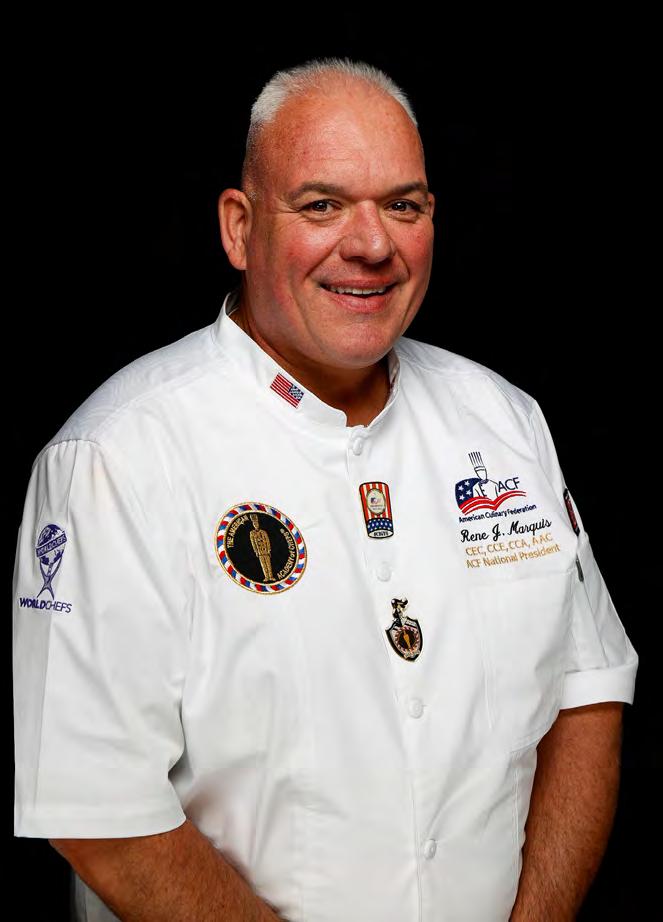
René J. Marquis, CEC, CCE, CCA, AAC MSG (R), US ARMY National President of the American Culinary Federation Chairman of the Board, ACF Tampa Bay Chapter Certification Chair, ACF Tampa Bay Chapter
WORLDCHEFS Chairman - Military Committee
WORLDCHEFS Culinary Competition Committee - Special Advisor Military Kitchens and Development
NEWS BITES
EVENTS
ACF CHEF’S TABLE WEBINAR SERIES: THE IMPORTANCE OF TEA FOR CHEFS
May 20, 2026, at 2:00 PM ET
Tea is the most consumed beverage in the world after water, yet many chefs do not fully understand its various types or the proper brewing methods each requires. Join ACF Chef Brian Hay, CEC, CCE, CSW, CSS, Sommelier, for an overview of tea and how chefs can thoughtfully incorporate it into their operations. Chef Hay will provide a concise crash course on this historic beverage and demonstrate how to assess quality when selecting teas for their establishments or personal enjoyment. Register at acfchefs.org
ACF CHEF’S
TABLE WEBINAR SERIES: KITCHEN HYDRATION AGAINST HEAT STRESS
May 27, 2026, at 3:00 PM ET
Every year, thousands of US workers get sick or injured from occupational heat exposure. Join Chef Mario Arena, Director of Culinary Innovation at Kent Worldwide, and Heat Science Specialist Bubba Wolford as they walk through the dangers of heat exposure in the kitchen and the preventative measures chefs can implement. While kitchens are some of the hottest, most hazardous work environments, you have the power to protect your team and your bottom line with the right hydration solutions. Register at acfchefs.org
ACF CHEF’S
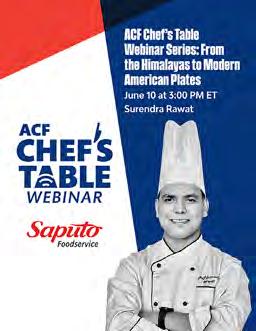
TABLE WEBINAR SERIES: FROM THE HIMALAYAS TO MODERN AMERICAN PLATES
June 10, 2026, at 3:00PM ET
Join ACF Chef Surendra Rawat as he explores the traditional cuisine of the Himalayan region of Uttarakhand in India, and its growing presence in U.S. kitchens as part of June’s featured trend, Emerging Flavors. Chef Rawat will present a black soybean dish rooted in simple mountain cooking, alongside traditional millets from the region. These everyday ingredients in Uttarakhand are natural, nutrient-dense and adaptable, now gaining attention for their health benefits, gluten-free appeal and versatility in modern kitchens. Register at acfchefs.org
SALUT
ACF CHEF STEPHEN GOTTHELF, CEC, TAKES TOP CULINARY ROLE AT MORRISON HEALTHCARE
ACF Chef Stephen Gotthelf, CEC, has been named Senior Director of Culinary Innovation at Morrison Healthcare, where he will oversee menu development, chef training and culinary strategy across the company’s national healthcare portfolio. Chef Gotthelf brings extensive experience within the organization, having previously served as System Culinary Director and Regional Executive Chef, where he played a key role in shaping culinary standards and supporting operations across multiple accounts. In his new role, Chef Gotthelf will focus on advancing research and development, strengthening culinary programs and elevating both patient and retail dining experiences, supporting Morrison’s continued emphasis on quality, consistency and innovation in healthcare foodservice.
ACF CHEF GABRIEL MALDONADO, CEC, CCA, JOINS WORLD MASTER CHEFS SOCIETY
ACF Chef Gabriel Maldonado, CEC, CCA , Executive Chef at Shady Oaks Country Club (Fort Worth, TX), has been inducted into the World Master Chefs Society, US Chapter, a distinguished honor recognizing excellence in the culinary profession. A proud member of the American Culinary Federation, Maldonado is known for his leadership, mentorship and commitment to advancing the craft. His induction reflects both his professional achievements and the respect he has earned among peers. Congratulations to Chef Maldonado on this well-deserved honor and his continued contributions to the culinary community.
EDUCATION CERTIFICATION PRACTICAL EXAMS
Practical exams, required for earning and maintaining ACF certifications, assess your skillset based on the certification level you are pursuing. Each level has specific requirements, including what dishes to prepare, the time frame for the exam, and other important details, all of which are outlined in the candidate handbook. Exams are conducted at various locations across the country throughout the year. Be sure to check the upcoming practical exam schedule to find and register for an exam.
Visit acfchefs.org/certify for a list of upcoming practical exams.
ACF ONLINE LEARNING CENTER
The ACF Online Learning Center (OLC) offers a variety of courses, demonstrations, webinars, and NCR quizzes that can be used for certification requirements and Continuing Education Hours (CEH).
Visit acfchefs.org/olc to explore all the courses, from garde manger to culinary nutrition, accounting, safety and sanitation, beverage management and more.
SPECIALIZED CERTIFICATES
ACF specialized certificates are available through the ACF Online Learning Center. In 2025, we introduced new and exciting specialized certificates while also revamping our current offerings, which include culinary essentials, baking/pastry essentials, culinary cannabis and personal chef certificates.
Visit acfchefs.org/olc to learn more.
Gold Medal WINNERS
Jonah Kanoho
aCF Cleveland Chapter, Inc Category: SK
Judith Zarate
aCF Cleveland Chapter, Inc
Category: Sa
Brittnee Rourke
aCF Cleveland Chapter, Inc
Category: K
Corey Brandon, CEC, CCA
Michigan Chefs de Cuisine MCC a Category: K
Oluwadamilola Oladipupo
Raleigh-Durham a rea Chefs a ssociation Category: SD
Zachery Cerqueda
a ppalachian aCF Chef's a ssociation Category: W
Rayna Hall, CC®
a ppalachian aCF Chef's a ssociation Category: W
Kianna Gray
Raleigh-Durham a rea Chefs a ssociation Category: SD
Austin Scoles, CEPC®
Raleigh-Durham a rea Chefs a ssociation Category: C Category: W
Fernando Mojica, Jr; CEC, CCA, AAC
aCF Cleveland Chapter, Inc Category: F4
Stephen Yu, CEC
Michigan Chefs de Cuisine MCC a Category: K
UPCOMING COMPETITIONS
May 2, 2026 - Chris J. Neary Competition - ACF Long Island Chapter
EJ. Milliken Technical Center, Holbrook, NY
Show Chair: Spyridon Giannakoulopoulos, CEC, CCE; Paul Jensen, Sr., CEC, AAC; George Wong
Lead Judge: Eric Pellizzari, CEC, CCE, AAC
May 2–3, 2026 - Chefs de Cuisine STL Spring East Central Community College, Union, MO
Show Chair: Austin Hamblin, CEC
Lead Judge: Andy Chlebana, CMPC®, CCA
June 11–12, 2026 - U Mass Amherst By Palm Beach County
CIA at Copia, Napa, CA
Show Chairs: John Noble Masi
Lead Judge: Michael Beriau, CEC, AAC
July 15, 2026 - Aramark - CIA Napa
CIA at Copia, Napa, CA
Show Chairs: Scott Zahren, CEC; Bill Allen, CEC
Lead Judge: Alan Neace, CEC, AAC
November 6–7, 2026 - John Joyce Competition
Johnson County Community College, Shawnee Mission, KS
Show Chairs: Edward Adel, CEC, AAC; Chrystal Tatum, CEC
Michael Deihl, CEC, AAC - COY Bronze - Regional Winner
Keunhae Do - COY Bronze
Marvin Herrera, CEC - COY Bronze
Ashville-Buncombe Technical Community College - STOY Silver- Regional Winner
Pellissippi State Community College - STOY Bronze
Ezrah Hanson - SCOY Gold - Regional Winner
MILITARY QUALIFIERS
Chef of the Year – SFC William Pelkey (Army-Ft. Hood)
Pastry Chef of the Year – MSgt Daniel Thompson (USAF)
Student Chef of the Year – CS3 Trenton Ortiz (USCG)
Student Pastry Chef of the Year – SPC Carolina Sanchez
Lozano (Army-Ft. Hood)
Student Team of the Year – Navy
Ingredients of the Month
MAY: OOLONG TEA
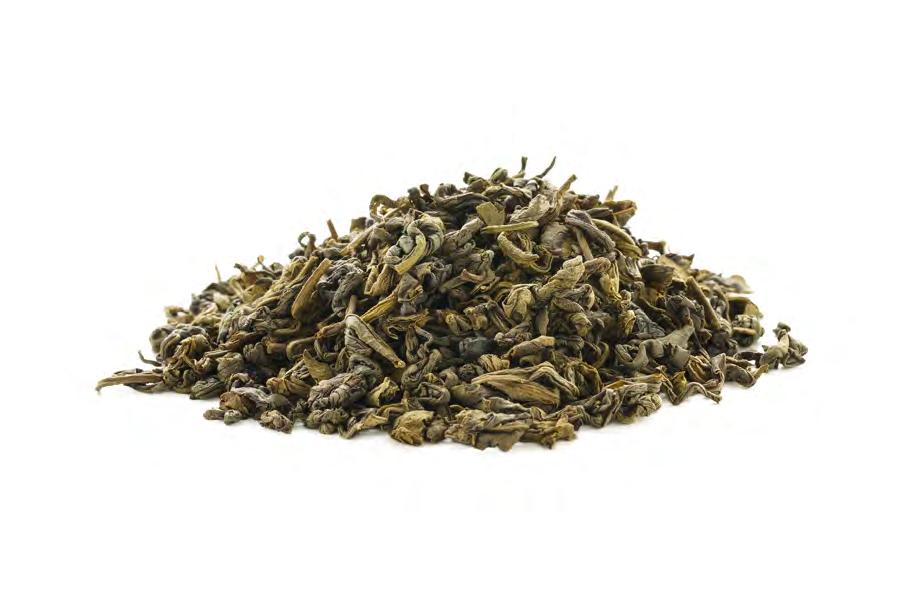
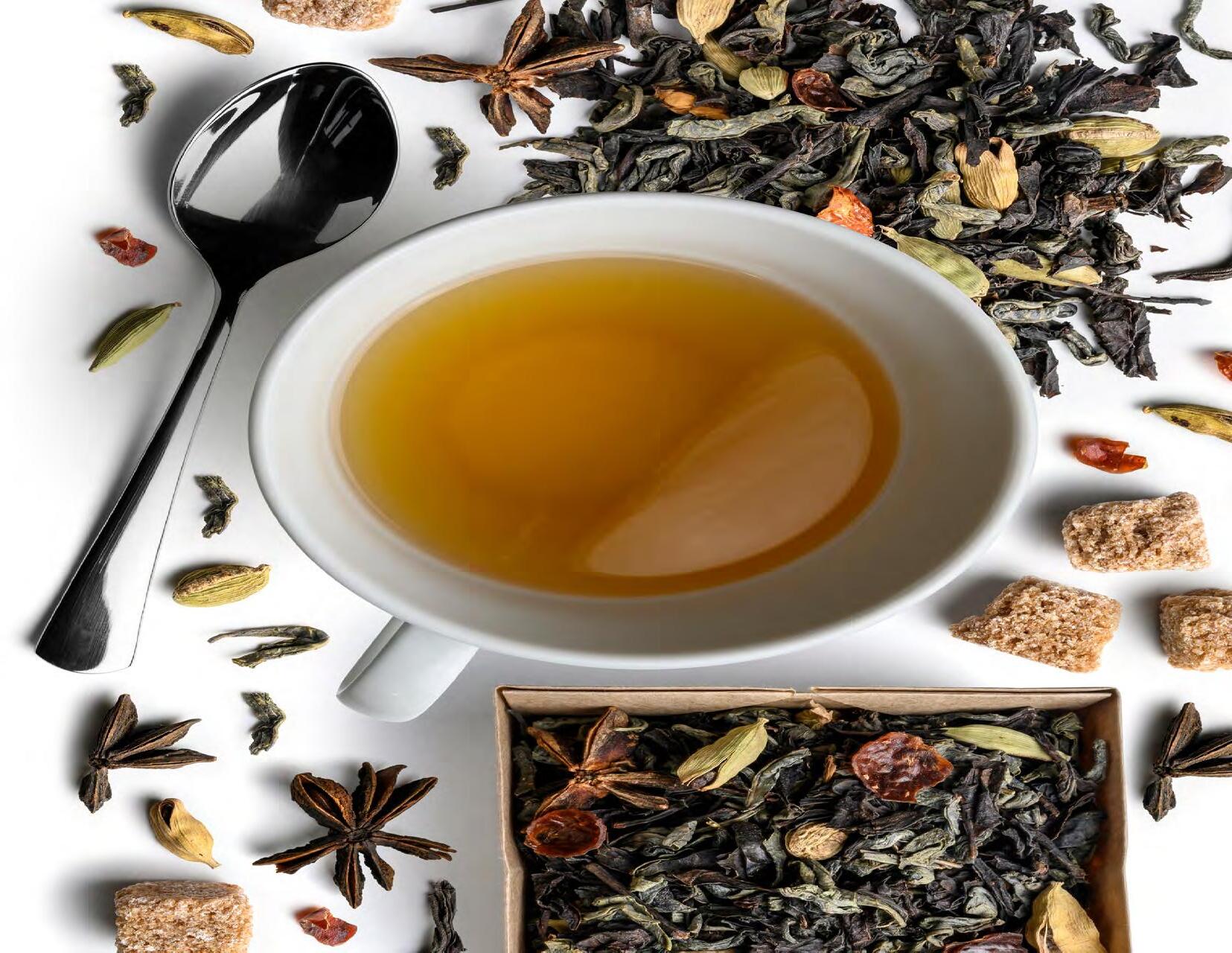
Oolong tea occupies a distinctive space between green and black teas, defined by its partial oxidation and wide spectrum of styles, from light and floral to dark and roasted. Produced primarily in regions of China and Taiwan, its character is shaped as much by terroir as by the skill of the tea maker, with processes that include withering, rolling and controlled oxidation. In the kitchen, oolong offers both aromatic complexity and gentle tannin, lending itself to infusions, smoking, poaching liquids and desserts. Whether used to perfume broths, cure proteins or steep creams, it brings a layered, evolving flavor that rewards precision and restraint.
JUNE:
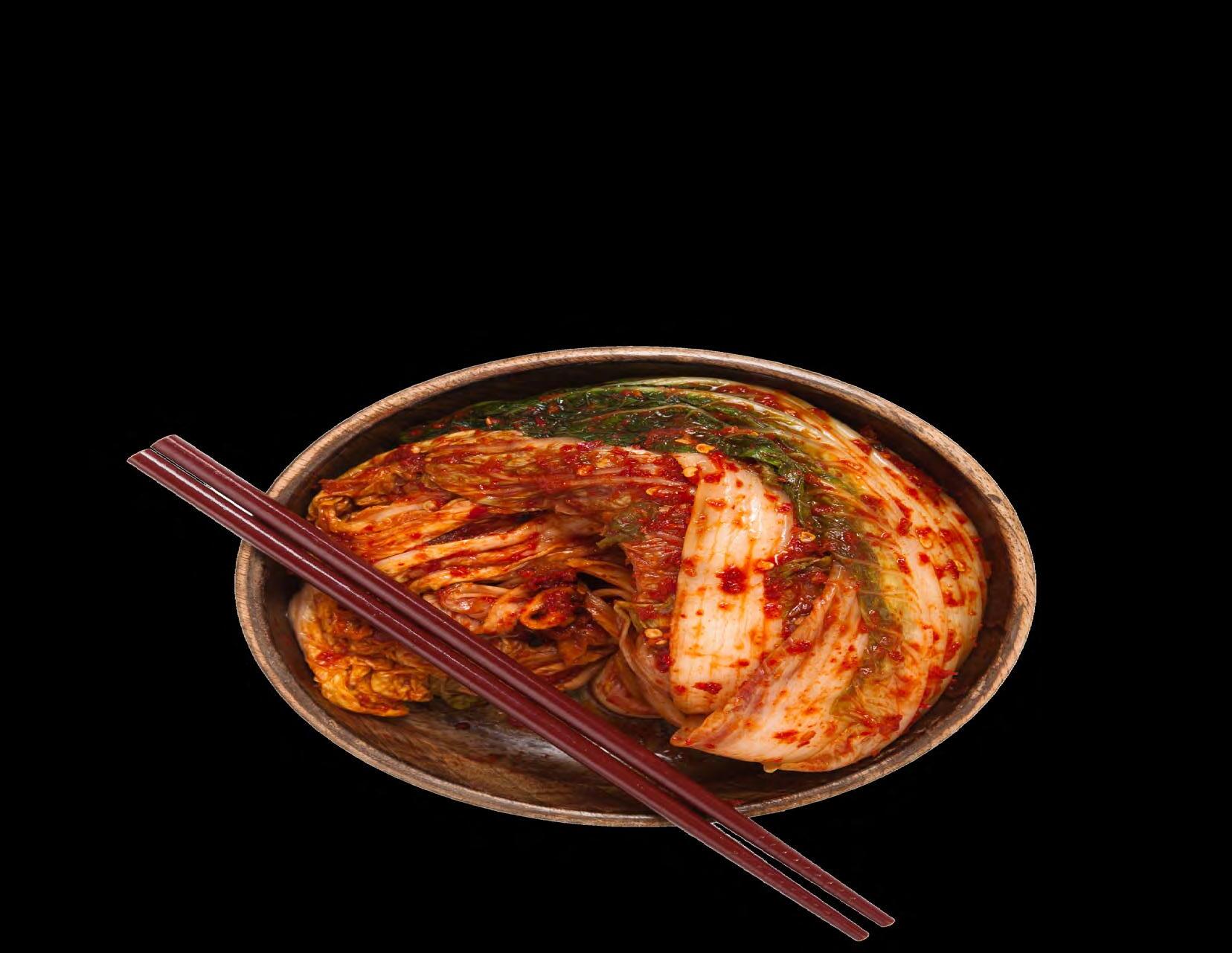
KIMCHI
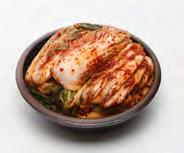
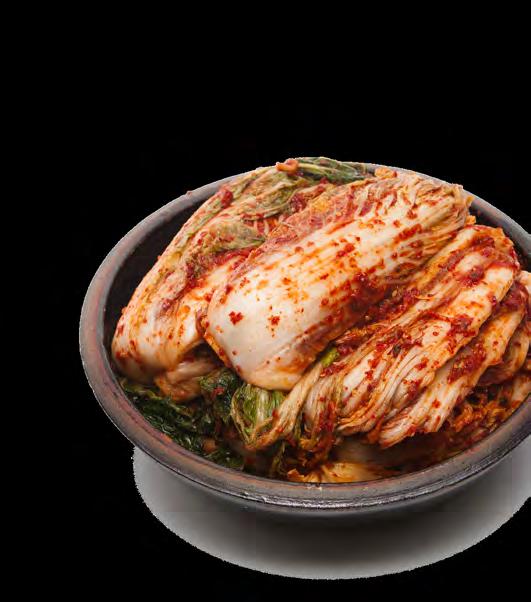
Kimchi, a cornerstone of Korean cuisine, is a fermented preparation most commonly made with napa cabbage, though countless regional and seasonal variations exist.
Built on a foundation of salting and seasoning, it relies on fermentation, traditionally ambient and now often temperature-controlled, to develop acidity, depth and complexity over time. The seasoning paste, often composed of gochugaru, garlic, ginger and other aromatics, creates a balanced interplay of heat, umami and brightness. In professional kitchens, kimchi functions as both ingredient and accent, adding contrast to rich dishes, energizing grains and broths and contributing a dynamic, living quality that evolves with age.
Members can explore ACF Ingredients of the Month in depth through the ACF Online Learning Center presentation and National Culinary Review, earning continuing-education credit toward ACF Certification. Visit acfchefs.org/olc
Register today and join us in Grand Rapids for five days of competitions, education, networking and culinary inspiration.
See YouThere!
JUNE 28-JULY 2, 2026
The American Culinary Federation Education Foundation
As the 2025–2026 school year comes to a close, we look ahead to summer, warmer weather, outdoor activities, family gatherings, vacations, seasonal fruits and vegetables, farmers’ markets and planting our gardens. We are also at the tail end of high school competitions such as SkillsUSA, ProStart and FCCLA, where we see what these young culinarians are creating for the next generation.
A key part of the Foundation’s mission is to invest in the future by educating and mentoring students, professionals, children and the public about the opportunities within our industry. This includes continuing education, competitions, grants and scholarships. It is never too early to start thinking about the next school year. The deadline for scholarships for 2026–2027 is October 31, 2026. For more information, please call (904) 484-0244 or e-mail scholarships@acfchefs.org.
To see the impact of these opportunities, Chef Carmine Catullo, CSC, shared this about receiving a scholarship: “The Ray & Gertrude Marshall Scholarship helped ease the financial challenges of pursuing my degree, allowing me to stay focused on my education. That support gave me the foundation to succeed as a student and grow into the leader I am today.”
The Foundation also supports a wide range of initiatives, including Chef & Child, ACF Culinary Team USA as they prepare to compete in the World Cup this November in Luxembourg, the American Academy of Chefs, accreditation and apprenticeship programs.
To kick off this year’s convention in Grand Rapids, Michigan, Chef Vanessa Marquis, CEC, AAC will host a Chef & Child event on Saturday, June 27, 2026. Around noon, we will also launch the inaugural Michael Ty Memorial Golf Tournament to benefit the Foundation’s work. To register or inquire about sponsorship opportunities, please email Greg Blose at gblose@acfchefs. org. Be sure to watch the website for updates, events and ways to get involved in supporting ACFEF.
We look forward to seeing many of you in Grand Rapids. “ONE FOUNDATION. INFINITE FUTURES. TRANSFORMATION 2029 & BEYOND.”
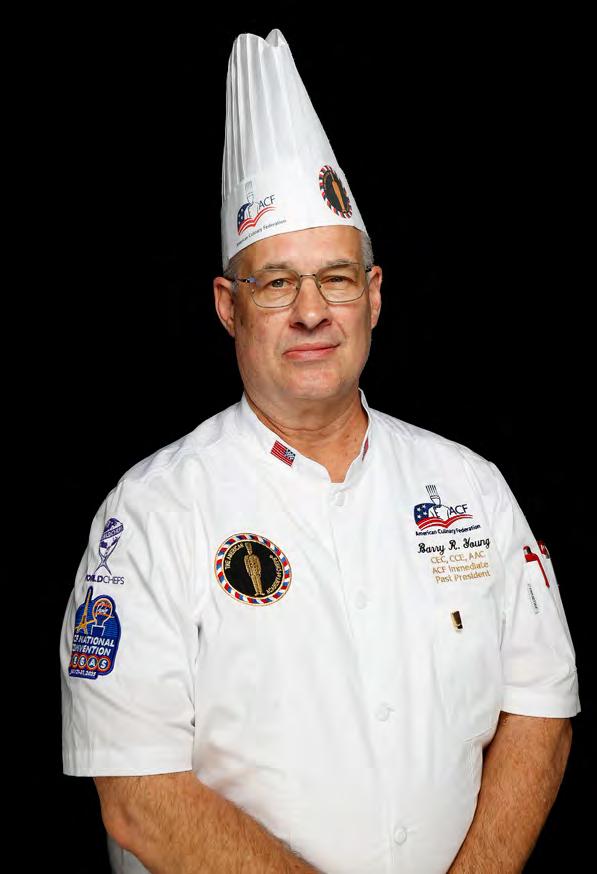
Barry R. Young, MBA, CEC, CCE, AAC ACF Education Foundation – Chairperson Chapter OH021 - ACF Columbus Chapter
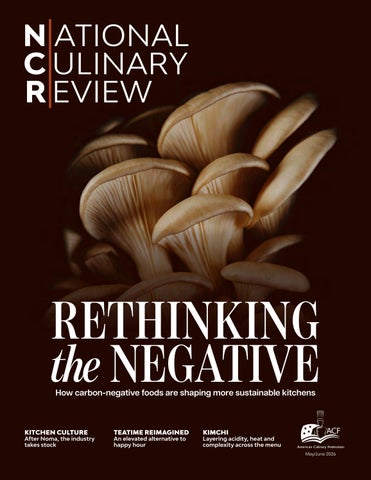
theRethinking Negative
From beans to oysters, carbon negative foods are reshaping how chefs think about sustainability
By ACF Chef Jonathan Deutsch, Ph.D., CRC, CHE
As chefs we often hear about the carbon footprint of our food supply. The food industry is the largest consumer of fossil fuels, clean water and land, and feeding the planet is one of our most resource-intensive activities. But what does carbon footprint actually mean?
A carbon footprint refers to the total amount of greenhouse gases, such as carbon dioxide and methane, generated by activities like growing, transporting, storing, cooking and disposing of food. It is measured in carbon dioxide equivalents and includes both direct emissions, like methane released from food waste in landfills, and indirect emissions, such as the energy used to power a walk-in cooler.
Some foods, including conventional beef, lamb, palm oil and farmed shrimp, are particularly carbon-intensive. This has led to a growing movement to reduce consumption or replace them with plant-based or more sustainably produced alternatives. At the same time, some foods can have the opposite effect and be considered carbon negative. These foods, including kelp and seaweed, tree nuts like chestnuts, cranberries, perennial grains like kernza, fungi such as mushrooms, legumes and bivalves like oysters, can remove more carbon from the atmosphere than they emit, depending on how they are produced and distributed. The more we support these systems, the greater the benefit to the planet.
ACF Chef Alyssa Termini, Philadelphia Program Director of the Culinary Careers Program (C-CAP) says she brings in guest chefs and speakers to introduce sustainable ingredients into their education and events. “In addition, we buy local wherever we can and include composting in our competition workshops to show students the amount of waste they produce,” she says.
Chefs are tastemakers, trendsetters, influencers and gatekeepers. By featuring carbon negative foods on our menus, we can feed well while doing good. Here are three dishes from chefs who are putting those principles into practice.
Beans
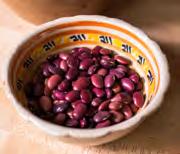
Beans are among the lowest-carbon sources of protein and can even be carbon negative when regeneratively farmed. They naturally fix nitrogen in the soil, reducing the need for synthetic fertilizers. Dried beans are also lightweight, requiring less energy to transport than canned products or meat.
Chef Cal Peternell, Chef-owner of FiNNBAR (Frenchtown, NJ), cooks lots of beans in various forms. “The ones I like the best are ayocote from Rancho Gordo. They cook up great: rich, plump and creamy,” he says. Chef Peternell uses beans across the menu, from a crunchy seasonal vegetable salad built on chickpea, white bean or red bean hummus, to a mushroom and chickpea falafel. With ayocote beans, he prepares a tagine with root vegetables, onions and North African spices, served with quinoa pilaf, harissa and chermoula. “One of the great things about cooking with dried beans is the liquid,” he adds. “It can take the place of where you might use chicken stock in a vegetable dish.”
Mushrooms
Mushrooms offer a meaty flavor and texture while remaining a very low-carbon ingredient. They are grown on upcycled agricultural waste such as straw, cocoa shells and sawdust, and can yield significant amounts of food per acre.
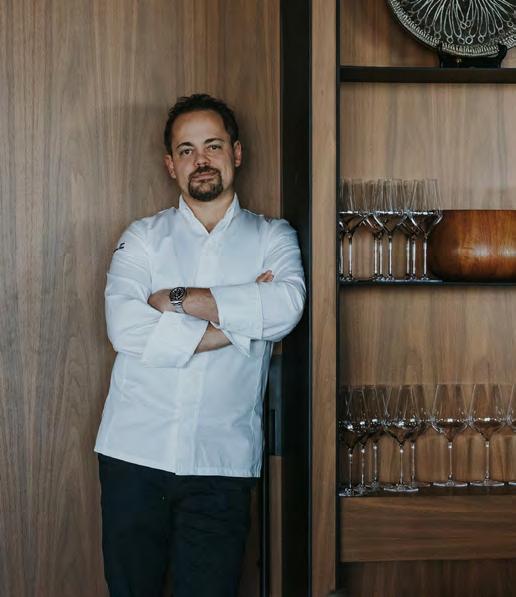
Chef David Skinner, Owner and Executive Chef of Eculent Restaurant and Liquid Lab (Kemah, TX), says mushrooms are his favorite ingredient and one of the few that truly embody balance. “They don’t demand anything. They transform nutrients into deliciousness with minimal water and land and give back more than they take,” he says.
His dish, Out of the Forest, features seven mushroom varieties, each prepared differently. Some are slow-roasted over live fire to deepen umami, others are fermented, smoked or freeze-dried for texture, while some are served raw with a mist of umami. The mushrooms are layered with butter-poached snails, soil made from beets, olives and vegetable scraps, and a cloche of smoke, inviting guests to forage through the dish. “We reveal sustainability through the dining experience,” Chef Skinner says. “We share where the mushrooms were grown or how they were foraged and highlight their role in regenerative systems.”
Chef Cal Peternell
Chef David Skinner
Oysters
Seafood sustainability can be complex, with concerns around overfishing and intensive aquaculture. However, oysters and other bivalves are widely considered carbon negative. Each oyster can filter up to 50 gallons of water per day, helping to clean ecosystems and protect shorelines.
Chef Melissa McGrath, Executive Chef and Partner at Sweet Amalia Market + Kitchen (Newfield, NJ) says: “Oysters are natural water filters that improve their ecosystem through carbon sequestration and habitat restoration. We share that with guests throughout service.”
At Sweet Amalia oysters are central to the menu. One standout is a fried oyster sandwich featuring oysters that have grown beyond the typical raw bar size. “They fry beautifully,” Chef McGrath says. “It’s a win-win. The larger oysters don’t go to waste and we create another product for the menu.” The sandwich is paired with seasonal accompaniments, such as celery root slaw in the fall or tomatoes and iceberg lettuce in the summer.
As these chefs demonstrate, cooking sustainably does not have to feel restrictive. It can be cost-effective, creative and deeply appealing to guests, while reinforcing the role chefs play in driving meaningful change through carbon negative foods.
Other Carbon Negative Ingredients to Know
Kelp and seaweed
Fast-growing, no need for freshwater or fertilizer, ideal for broths, salads and seasoning
Kernza (perennial grain)
Deep-rooted grain that improves soil health, works in breads, pilafs and porridges
Chestnuts
Tree crops that store carbon long-term, useful in purées, stuffings and desserts
Cranberries
Grown in wetland systems that can support carbon storage, great for sauces, ferments and pastry
Legumes (lentils, chickpeas)
nitrogen-fixing crops that reduce fertilizer needs, highly versatile across menus
Bivalves (mussels, clams)
Filter feeders that improve water quality, suited to a wide range of preparations
Chef Melissa McGrath
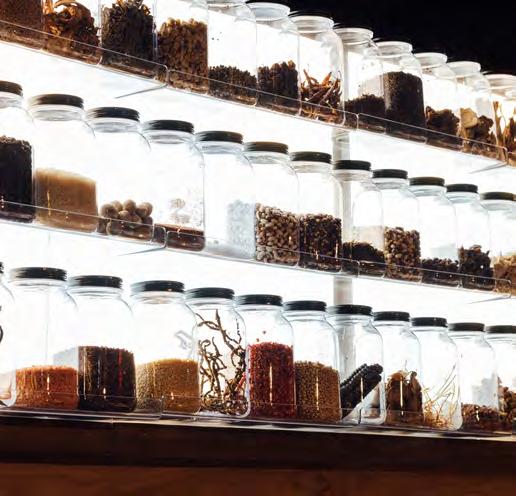
Ingredient Library at Ishtia | Photo credit: ISHTIA & JIA Media
A World of Flavor
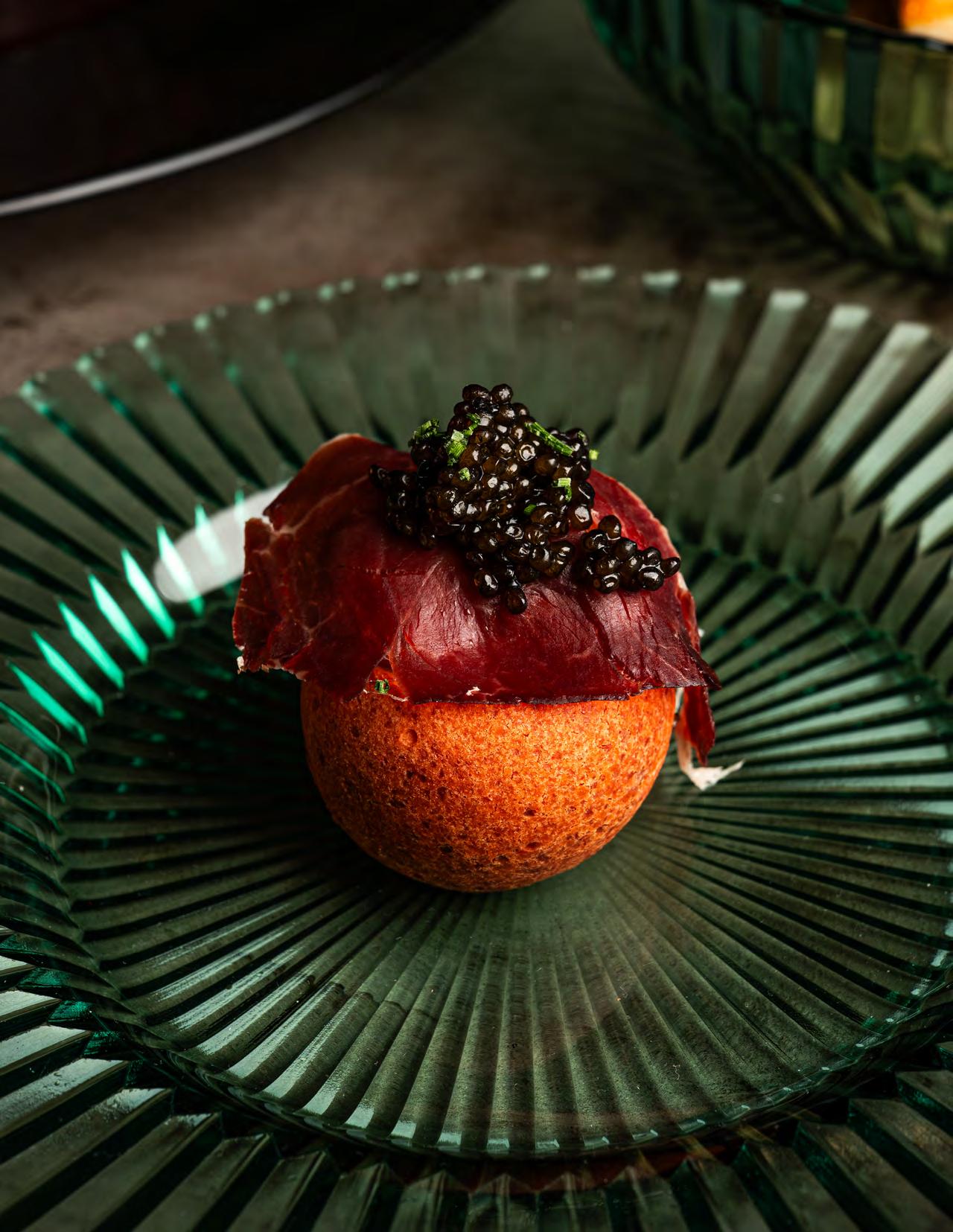
Buñelo: uni, jamón iberico, caviar - Belly of the Beast (Spring, TX)
Global flavors are moving from niche to mainstream as chefs build dishes that balance familiarity with discovery
By Jeffrey Spear
Chefs and restaurateurs are pushing beyond familiar flavor combinations, building dishes that lean into contrast, texture and surprise. That shift is coming from a broader global pantry, used not just for inspiration, but for ingredients that bring new aroma and depth to the plate.
Flavors and ingredients from Southeast Asian, Middle Eastern, Mediterranean and Latino cuisines are shaping how chefs are developing new dishes. Much of this movement is driven by contrast and play, combining textures, temperature and global influences in ways that feel both surprising and approachable.
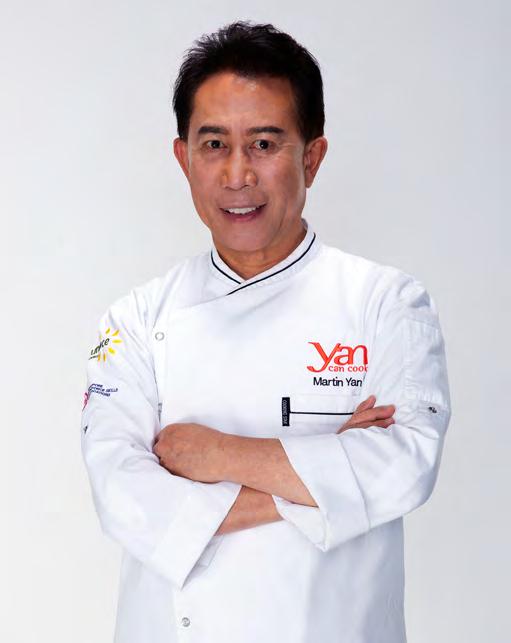
For ACF Chef Martin Yan, HAAC, HHOF, Host of Yan Can Cook, this shift is visible and accelerating across the industry. Drawing on decades of global travel, he points to the growing popularity of dishes that are bold, interactive and rooted in tradition. “People are enjoying food that is fun, communal and
full of flavor,” he says, noting the rapid rise of hot pot, dumplings and noodle-based broths across US markets.
Ingredients such as pandan, black sesame, berbere and black cocoa are also gaining traction, balancing familiarity with discovery across sweet and savory applications. At the same time, tropical fruits like mango, yuzu or guava; sour and fermented elements such as pomegranate molasses, calamansi and specialty vinegars; and floral infusions like orange blossom, hibiscus or elderflower are being used to layer flavor, texture and aroma, creating more dynamic, sensory-driven dishes.
Chef Yan has also seen a surge in foundational Asian ingredients becoming part of everyday cooking. “When I first came to the US, there was maybe one soy sauce on the shelf,” he says. “Now you see many varieties, along with chili sauces and chili crisp everywhere.” These pantry staples, along with ingredients like ginger, are no longer niche, but widely used across multiple cuisines.
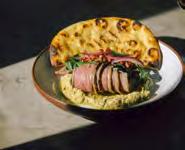
For many chefs, emerging flavors aren’t about novelty for its own sake, but about reworking familiar formats in ways that feel both new and accessible. ACF Chef Darrick Tucker, Chef-owner of the Southern Roots food truck (Merrillville, IN), sees that balance as key. “People are excited by things they recognize, but with a twist,” he says. Drawing on Italian, Mexican and Chinese influences, he creates dishes that stay grounded while introducing subtle shifts in flavor. One standout, smoked pork nachos topped with roasted poblano pepper salsa, exemplifies the approach: familiar at first glance, but layered with unexpected depth.
According to statistics published in Morgan Myers 2026 Flavor Trends, 85 percent of consumers are at least somewhat open to new flavors. From a generational perspective, Gen Z is eager for variety and trend-driven; Millennials and Gen X seek flavors that are both indulgent and offer functional health benefits; and Baby Boomers tend to favor familiar tastes.
Chef Tucker has found that willingness to try new flavors often comes down to trust. “Once people know you understand your flavors and you’ve done your homework, they’re much more inclined to try something new,” he explains.
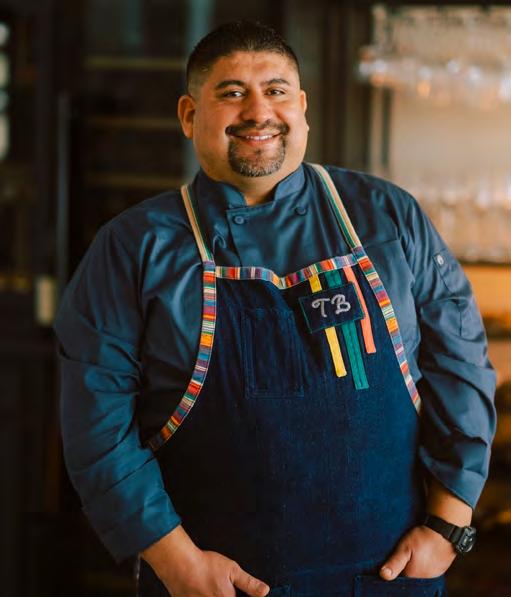
At Belly of the Beast (Spring, TX), Co-owner and Executive Chef Thomas Bille, the 2025 James Beard Best Chef Texas, is constantly refining his menu to reflect both his culinary perspective and the experience he aims to deliver. “My overriding philosophy is to work with seasonal ingredients. From there, I’ll find ways to use them in a manner that’s unexpected.” One example is his aguachile, where seasonal fruits such as mango, peach and strawberry are incorporated into the marinade, transforming a traditional dish into something new. He also keeps a variety of vinegars on hand, using them to shift the source of acidity across dishes.
When asked about the emergence of new global ingredients, Chef Bille notes that many of the most interesting and flavorful ingredients can be found in Asian markets, which he sees as foundational to some of his favorite foods. “If you want to understand global cuisines, eat other people’s food,” he adds. “Even if you don’t like them. Eat them and learn.”
Even when a restaurant’s culinary foundation is rooted in a specific tradition, such as the Baja Mexican cuisine at Valle, the only Michelin-starred restaurant in Oceanside (CA), Chefowner Roberto Alcocer continues to seek out new influences.
“The foods I prepare should deliver a concentration of flavor. They should sparkle in your mouth,” he says. To stay current, he travels extensively, noting that while ingredients once moved with trade routes, today ideas travel directly from chef to chef.
In more regional markets, chefs often act as cultural translators, introducing guests to flavors they may have heard of but not yet experienced. Based in the Midwest, Chef Tucker sees this firsthand. “In places like California or Texas, certain foods are already part of everyday culture,” he says. “Here, you
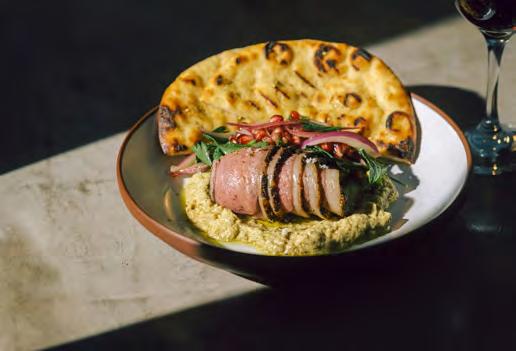
Roasted Lamb with baba ganoush, pita and pomegranate saladBelly of the Beast (Spring, TX)
have to introduce those ideas and make people love them.” Dishes like breakfast tacos, reimagined with smoked meats, help bridge the gap between familiarity and discovery.
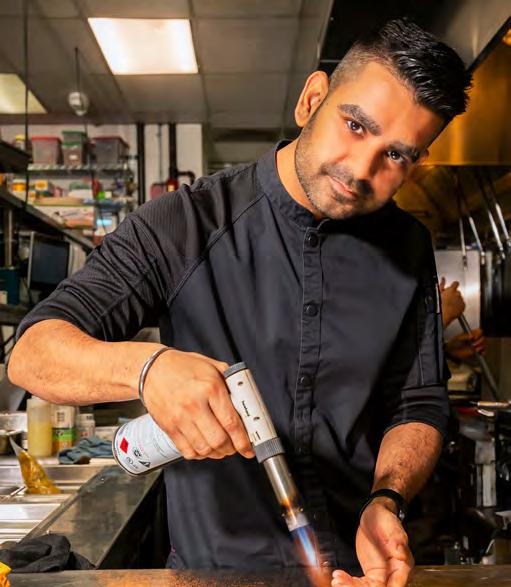
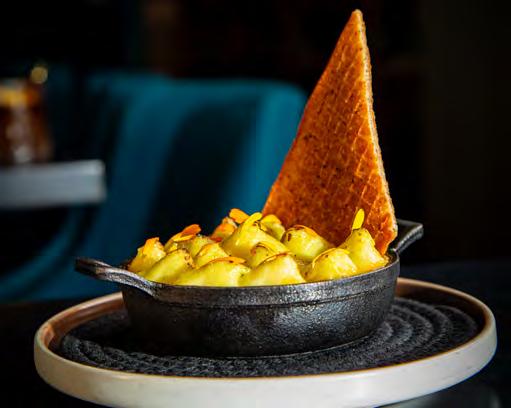
Known for its molecular take on classic Indian cuisine showcases dishes such as dal chawal arancini, Guntur chilli chicken bao and Peshawari paneer tikka lasagna, all of which draw from global influences. “While everything we make is elevated and visually striking, it is imperative that we maintain the cultural soul of our food,” explains Chef Gaurav Chawla, Brand Executive Chef. He adds that while sourcing locally is a priority, certain ingredients must be imported to preserve authenticity and consistency.
The demand for globally inspired flavor-forward experiences shows no signs of slowing. For chefs, the opportunity lies in using these ingredients to create dishes that feel both innovative and accessible. For diners, the reward is a more dynamic, engaging and memorable dining experience.
“My overriding philosophy is to work with seasonal ingredients. From there, I’ll find ways to use them in a manner that’s unexpected.”
Chef Thomas Bille
Ingredients Shaping the Global Flavor Landscape
Calamansi (Philippines)
Bright and aromatic, bringing both sweetness and sharp acidity to sauces, marinades and beverages.
Yuzu (Japan)
Fragrant and intensely tart, used to add refined citrus complexity across savory dishes and desserts.
Pomegranate Molasses (Middle East)
a concentrated sweet-tart ingredient that adds depth to dressings, glazes and finishing sauces.
Berbere (Ethiopia)
a bold spice blend that delivers layered heat, increasingly used beyond traditional applications.
Gochujang (Korea)
Fermented chili paste offering a balance of sweet, savory and heat, now widely used across menus.
Black Sesame (East Asia)
nutty and slightly bitter, with strong visual appeal, moving from traditional desserts into broader applications.
Pandan (Southeast Asia)
a romatic and vanilla-like, used to infuse both sweet and savory dishes with distinctive flavor.
Sumac (Middle East)
Bright and citrusy, used to add lift and balance to rich dishes.
Chef Gaurav Chawla, Farzi Café (Bellevue, WA)
Keema shepherd’s pie, Farzi Café (Bellevue, WA)
Becoming a Certified Master Chef
Two
chefs recently earned the Certified Master Chef credential, one of the culinary industry’s most prestigious distinctions. Our editor in chief, Kerstin Kühn, talks to them about what it takes to get there and what comes next
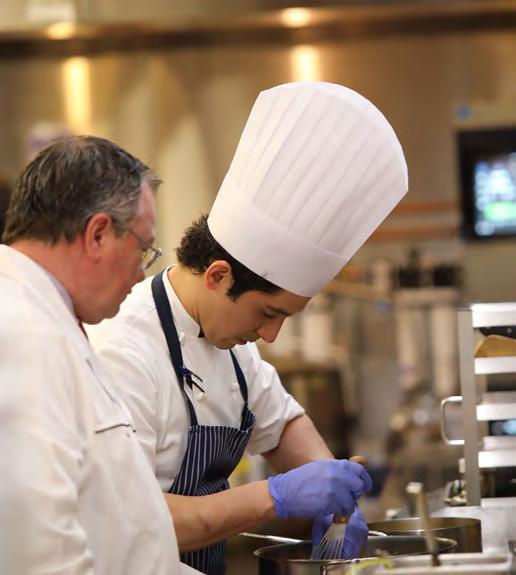
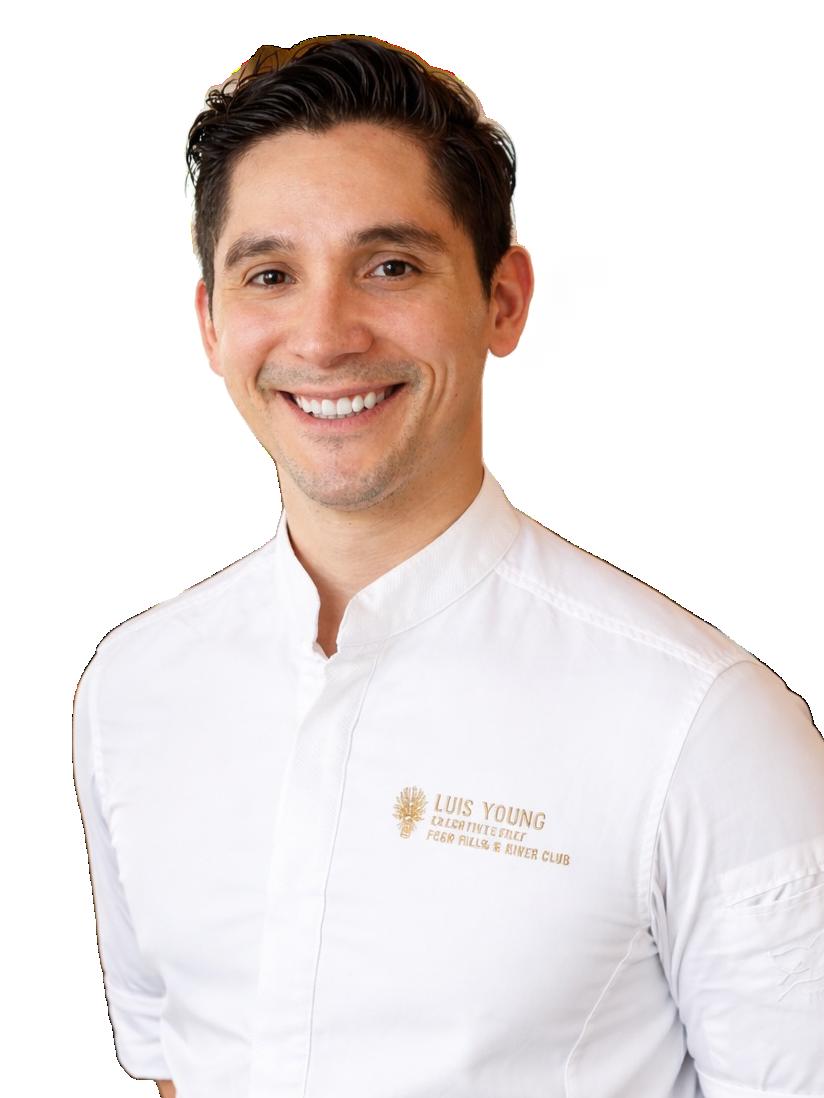
ACF CHEF LUIS YOUNG, CMC, CCA
For ACF Chef Luis Young, CMC, CCA the path to one of the industry’s most coveted certifications didn’t begin in a professional kitchen. It started much earlier, in his native Panama, where a childhood illness changed the way he experienced food. “I was diagnosed with kidney disease, so my diet was very controlled,” he recalls. Salt was limited; ingredients were few; and flavor, at least in its conventional form, often felt out of reach. “I loved food, but I couldn’t eat most of it,” he says. “So I started figuring out how to make things taste good anyway.” That instinct to adapt and refine would come to define his approach.
After moving to the US to attend Johnson & Wales University, Chef Young set his sights on gaining experience at the highest level. He worked in some of the world’s most renowned kitchens, including the three-Michelin-starred Alinea (Chicago, IL) and El Celler de Can Roca (Girona, Spain), building both technical skill and a broader perspective on cuisine.
Along the way, he also stepped outside the kitchen. A period studying wine in Germany reflected a desire to understand the full dining experience, not just what happens in the back of the house. “I wanted the whole picture,” he says. “Not just cooking, but service, wine, how everything comes together.”
His curiosity, coupled with a steady progression through high-performance kitchens, eventually led him to Chef Thomas Keller’s three-Michelin-starred French Laundry (Yountville,
CA), realizing a long-held goal. When the restaurant closed temporarily for renovation, another opportunity emerged, one that would shift his trajectory once again.
Chef Young returned to Panama City to help open a boutique hotel as part of a rapidly evolving hospitality scene. But it was a catering connection that brought him back to the US. and into the orbit of ACF Chef John Johnstone, CMC, who would become a defining influence. At The Broadmoor (Colorado Springs, CO), Chef Young spent five years working across multiple outlets, including Five Star and Five Diamond operations. It was here, he says, that the idea of pursuing the CMC designation took hold.
“There was something different about the way CMCs carried themselves,” he says. “It wasn’t just about cooking. It was leadership, discipline, a deeper level of commitment.” The decision to pursue the CMC was not immediate, nor was it straightforward. After COVID-19 reshaped the industry, Chef Young moved into private clubs, taking on executive chef roles while quietly beginning the long process of preparation. Over the next several years, the preparation became all-consuming. Days off were spent practicing. Techniques were broken down and rebuilt. “You can’t just replicate,” he says. “You have to understand what’s happening and why, so you can adapt under pressure.” Bread became a study in fermentation and timing. Pâte à choux became an exercise in precision. Every element was examined, tested and refined.
Equally important was the support around him. Mentors, colleagues and his team played a critical role in sustaining both the workload and the mental demands of preparation. “There’s no way to do this alone,” Chef Young insists. “You need people who support you, who help you stay focused, who step in when you need them.” And when he finally walked into the exam, the challenge was as much mental as it was technical. “At the end of the day, you know how to cook,” he says. “The real challenge is managing yourself. Staying calm, staying focused.”
Now, having earned the CMC, Chef Young sees the designation not as a finish line, but as a shift in responsibility. “There’s a perception that Master Chefs have all the answers,” he says. “For me, that means continuing to learn, continuing to grow, so I can give something meaningful back.” It’s a perspective rooted not in status, but in stewardship. “We’re guardians of the craft,” he says. “Everything we do has to be intentional.”
ACF CHEF GEO LANEZ, CMC
ACF Chef Geo Lanez, CMC, did not grow up in the kitchen. If anything, he was kept out of it as a child. “My mom and grandmother are incredible cooks, but they always kicked me out of the kitchen,” he says.
His future looked very different then. In high school, he was on track to study physical therapy, with a scholarship and a clear path his parents supported. But something didn’t sit right. It took a friend to point out what he hadn’t fully admitted to himself – he was constantly watching food shows, constantly talking about cooking. He took a leap and enrolled at Johnson & Wales University, having never picked up a knife.
But the real turning point came during his sophomore year, when he met ACF Chef Ray McCue, CEC, AAC. Instead of encouraging ambition alone, Chef McCue gave him a directive: find the people already doing what you want to do and learn from them.
Chef Lanez took that advice literally. With ACF Chef Michael Matarazzo, CEC, he attended the 2010 Chef of the Year competition, working behind the scenes. Watching CMCs and ACF Culinary Team USA members operating at that high level reset his expectations. “They were like superstars,” he says. “I remember thinking, I want that. I want all of it.”
From that point, everything became intentional. Chef Lanez aligned his decisions to long-term goals, placing
himself in environments that demanded precision, repetition and accountability. Under mentors like ACF Chef George O’Palenick, CEC, CCE, AAC, HOF, and ACF Chef Joseph M. Leonardi, CMC, AAC, that discipline sharpened into a deeper understanding of the craft. By 26, he was competing at the Culinary Olympics in Germany.
Progress, however, was not linear. And while he advanced through competitions consistently, often reaching finals, he didn’t always win. “It was humbling, but it pushed me to keep improving,” he says, adding that the cost was real. “I sacrificed a lot. I lost friendships, relationships and missed out on typical life experiences. People doubted me, including people close to me. But I stayed committed to the goal.”
This was true of his career outside competitions, too. At just 28, he stepped into the role of Executive Chef at The Patterson Club (Fairfield, CT), a position that would become both his platform and his proving ground. It was here, alongside a committed team of sous chefs, that his focus narrowed fully to the CMC exam. “We practiced every week, often 10–12 hours at a time, while also managing the daily operations of the club,” he says.
But his preparation extended far beyond cooking. He trained physically, incorporating hot yoga and strength work, and refining his diet with the help of a nutritionist. Mentally, the demands were just as intense. “You have to be able to handle pressure, criticism and self-doubt,” he explains.
During the CMC exam, the greatest challenge was not technical execution but endurance as Chef Lanez became physically ill, battling a fever and exhaustion. On day four, he missed passing by a single point. “I thought it was all over,” he says. Instead, it reset him: “I stopped thinking about the judges and just told myself to go cook.”
Earning the CMC marks a defining milestone, but for Chef Lanez it signals something larger than personal achievement: It reframes his role. Just as more experienced chefs once took a chance on him, he now carries that forward. “To be the first Filipino American chef to pass this exam means everything,” he says. “It’s for them, for my grandparents, for anyone who dreams of something bigger.”
He hopes his journey resonates with young chefs more broadly. “I want people to see that no matter where you come from or what people say about you, you can achieve what you set your mind to,” he says. “You just have to commit, work for it and put yourself in the right environments.”
Inside the CMC Exam
The Certified Master Chef (CMC) exam is widely regarded as one of the most demanding assessments in the culinary profession.
The current format spans five days, each focused on a different discipline:
Day 1:
Plant-Based Cuisine: Mystery basket, multi-course menu
Day 2:
Garde Manger: Pâtés, terrines and cold preparations
Day 3:
Global Cuisine: Assigned dishes across multiple regions
Day 4:
Classical Cuisine: Escoffier-based preparations
Day 5:
Final Mystery Basket: Five-course menu including artisan bread
Candidates receive feedback daily and must plan and requisition for the following day under tight time constraints.
Beyond technical skill, the exam evaluates organization, adaptability and the ability to perform under sustained pressure.
By Jody Shee
Kimchi is one of the most recognizable banchan, the small side dishes served with rice in a traditional Korean meal. Within Korean cuisine and beyond, it also speaks directly to several of today’s defining culinary drivers: global flavor, probiotic fermentation and the bright acidity that balances richness across the menu.
Traditionally, kimchi begins with salted napa cabbage coated in a seasoning paste and fermented under controlled conditions. Salt draws moisture from the cabbage, creating an environment where beneficial microbes can develop flavor. The paste, typically built around gochugaru, garlic, ginger and other aromatics, often includes fruit for sweetness, forming a complex, layered base.
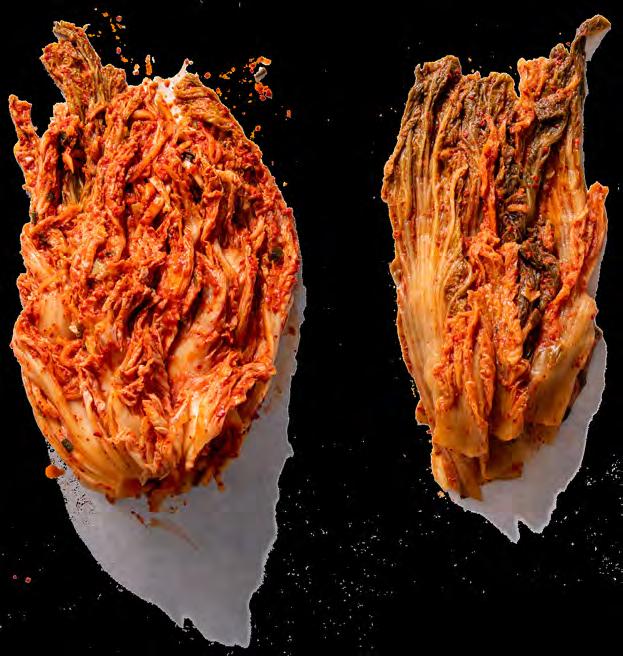
Kimchi is a living food, evolving in flavor throughout fermentation. That progression is what gives it such versatility. Fermentation begins to develop after about two weeks, says ACF Chef Anthony Jung, CEC, Executive Chef of retail dining, cafés and catering at the University of Massachusetts, Amherst
I2 months
(UMass). From two weeks to about six months, he notes, usage is largely interchangeable depending on the desired depth of flavor. In its earlier stages, kimchi is often used raw as a condiment, topping or filling.
On the UMass campus, kimchi appears across dayparts, from congee and breakfast burritos to scrambled eggs and omelets. “Its savory spice note is something more Americans are open to,” Jung says. And its applications continue to expand. In its milder state, kimchi works as a burger topping and in lettuce wraps, sushi and spring rolls. For cross-cultural interpretations, Jung points to Indian-inspired tacos using naan with chicken tikka and topped with kimchi.
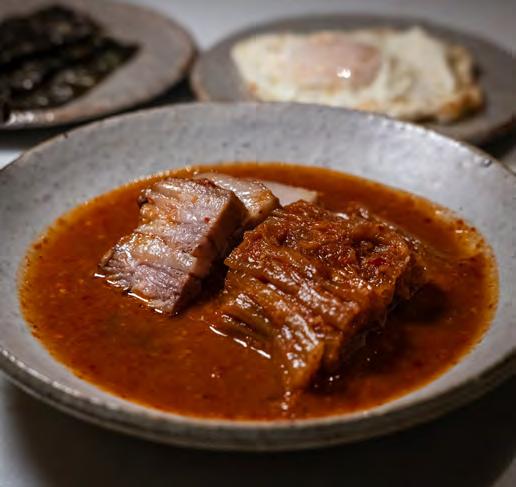
Peak flavor comes with extended fermentation, according to Chef Hooni Kim, Chef-owner of the Michelin-starred Danji (New York, NY) and the fermentation-driven tasting counter Meju (Queens, NY). He notes that the best kimchi makers in Korea age kimchi for up to 18 years. After about six months, he recommends cooking it to temper acidity. He uses 14-monthaged kimchi in traditional kimchi stew and braises it with fatty cuts such as pork belly to create balance.
At Meju, Chef Kim maintains a fermentation walk-in cooler at 29 to 31 degrees Fahrenheit. “Because of the salt content, it will not freeze, but the colder it is, the better,” he says. Ingredient quality also matters. “Probiotics do not respond well to man-made chemicals, so we use organic ingredients whenever possible.” He favors mountain salt (Andes or Himalayan) and organic garlic from California. 3 months
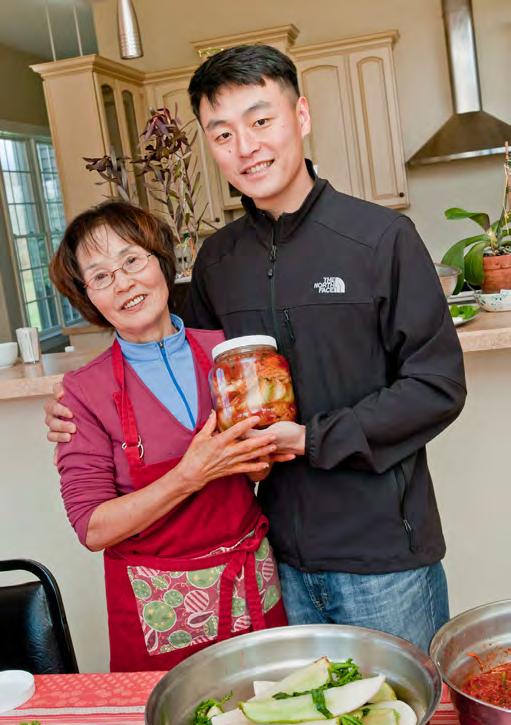
ACF Chef Anthony Young, CEC, with his mother Yeong, Ja Jung.
Chef Hooni Kim shows the difference between three- and 12-month fermented kimchi in My Korea: Traditional Flavors, Modern Recipes. Photo by Kristin Teig
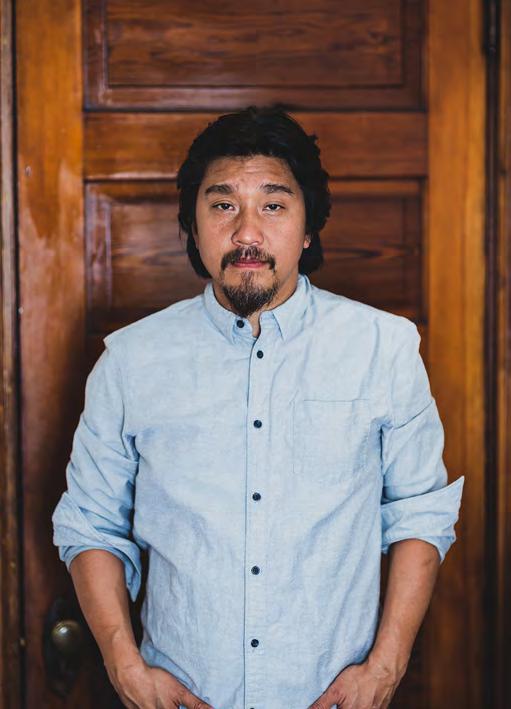
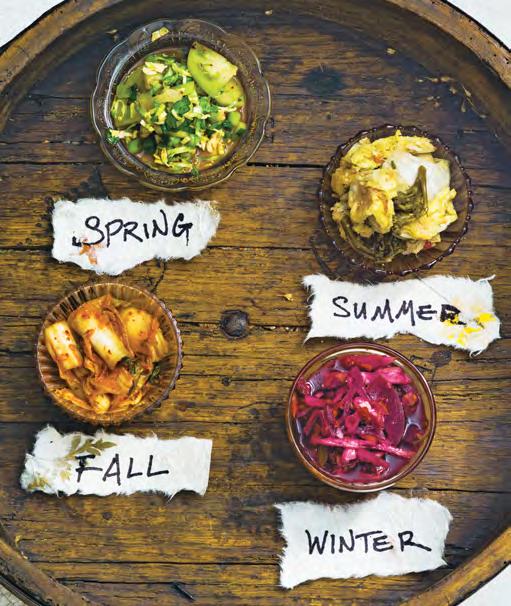
Once chefs understand the framework, kimchi becomes a technique as much as an ingredient. Chef Edward Lee, whose restaurants span Louisville (KY), Washington, D.C. and Seoul (South Korea), extends the concept beyond tradition, applying it to vegetables not typically associated with Korean cuisine, such as fennel or green tomatoes. He even refers to it as a verb, “kimching” everything from celery, beets and mushrooms to oysters and fruits like persimmon or melon.
Chef Lee notes that when finely chopped, “kimchi adds a wonderful spicy and sour flavor to anything from compound butters to risotto. There’s almost nothing it can’t be added to.” Indeed, he also folds it into comfort formats like mac and cheese, where its acidity cuts through richness and deepens savory flavor.
Whether used fresh, aged or applied in entirely unexpected ways, kimchi’s strength lies in in its adaptability. What begins as a traditional ferment becomes a living ingredient chefs can manage and deploy wherever a dish needs brightness, complexity or balance.
Chef Edward Lee
Photo by Grant Cornett
Braised kimchi and pork by Chef Hooni Kim
Photo by James Park
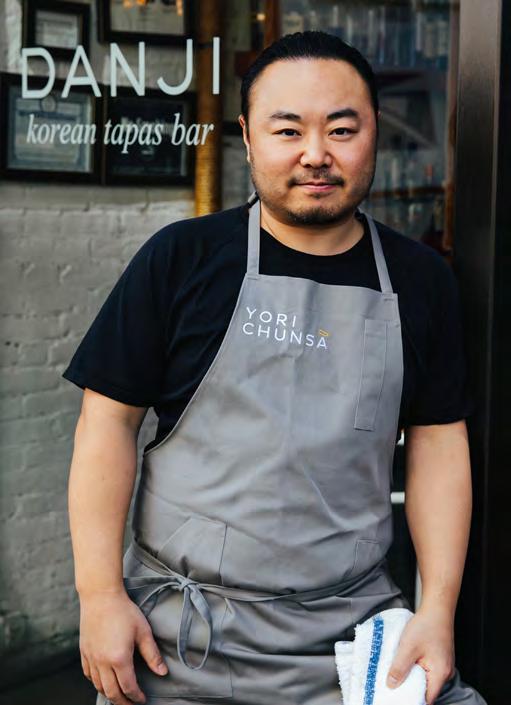
Chef Hooni Kim
Photo by Kristin Teig
RECIPE: Basic Kimchi
By ACF Chef Anthony Jung, CEC
Yield: 4 pounds
Ingredients:
• 2 Large napa cabbage, cut into quarters lengthwise
• 1 cup kosher salt
• 2 cups water
• 2 cups Korean red pepper flakes, course
• 3 tablespoons fish sauce
• ¼ cup sugar
• 6 scallions, cut into two-inch lengths
• 1 ounce ginger, minced
• 1 ounce garlic cloves, minced
• 4 ounce pears, grated
• 4 ounce apples, grated
• 4 ounce carrots, shredded
Method:
In large stainless steel bowl, season napa cabbage with kosher salt, being sure to massage the salt between each leaf. Let sit for 4 hours, turning over from time to time.
Squeeze cabbage to remove excessive moisture and rinse with cold water. Squeeze again to remove water.
In large container, add water, Korean red pepper flakes, fish sauce, sugar, green onions, ginger, garlic, pears, apples and carrots. Massage cabbage with chili paste mixture, being sure to season between each leaf.
Store in glass or plastic container in the refrigerator.
• 6 ounces daikon radish, grated (use a box grater)
• 2 garlic cloves, grated (use a Microplane)
• A 2-ounce piece ginger, grated (use a Microplane)
• 1 teaspoon Korean chili flakes
• ¼ cup fish sauce
• ¼ cup rice vinegar
• ½ cup chopped fresh cilantro
Method:
In large colander, toss Brussels sprouts and green tomato slices with salt. Let stand at room temperature 30 minutes. Drain, rinse and transfer to large bowl.
To make the paste: Combine water, rice flour and sugar in medium saucepan; bring to a simmer, stirring constantly until mixture thickens, 1 to 2 minutes. Allow to cool.
To make the guts: Combine daikon, garlic, ginger, chili flakes, fish sauce and vinegar in food processor; process to chunky puree.
Fold the guts into the cooled paste. Add chopped cilantro.
Wearing clean latex gloves, mix guts mixture thoroughly into Brussels sprouts mixture. Transfer to large glass jar or airtight plastic container with tight-fitting lid. Let stand at room temperature 24 hours, then refrigerate. The kimchi will be ready to eat in 4 or 5 days and will keep for another 2 weeks.
With notes ranging from floral to roasted, oolong tea gives chefs a flexible way to build flavor
By Kerstin Kühn
Oolong tea sits between green and black tea in how it’s processed, which gives it a wide range of flavors to work with. It can be light and floral or deeper and more roasted, depending on how it’s handled, making it a versatile tool in the kitchen for building flavor without adding heaviness.
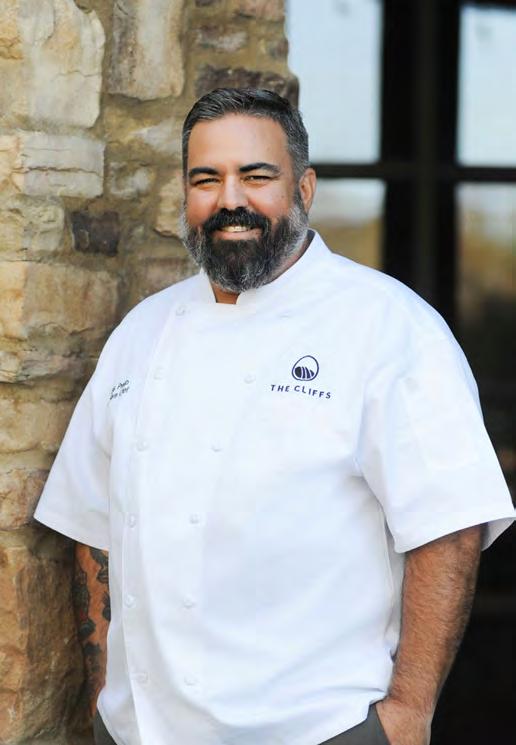
That range is what stands out to ACF Chef Tomas Prado, Executive Chef at The Cliffs at Glassy (SC). He describes oolong as spanning floral, nutty and even lightly smoky notes, a combination that “pairs especially well with delicate proteins like fish,” while still working alongside smoked or meat dishes.
In lighter styles, often produced at higher elevations, the tea leans toward lifted aromatics and a soft, almost creamy texture. These qualities translate well into applications where clarity matters, such as shellfish broths, lightly set custards or fruit-forward compositions. More developed oolongs, shaped by longer oxidation or roasting, bring deeper, warming notes that can anchor richer dishes, pairing naturally with caramelized elements, slow-cooked meats or aged dairy.
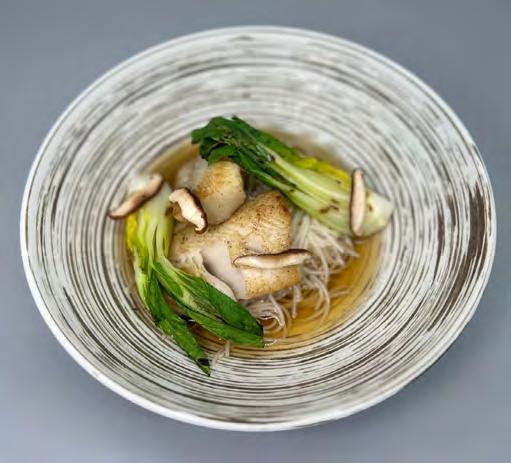
Chef Prado is already applying this versatility in his kitchen, using oolong in a broth for fish dishes, but sees far more potential. “It would be a great addition to a brine,” he notes, adding that it can extend easily into desserts. That adaptability, he believes, remains underexplored. “It is extremely versatile and underutilized,” he says.
Beyond flavor, oolong also contributes structure. Its tannins are present but restrained, offering grip and balance without the assertiveness of black tea. This makes it useful in brining or curing, where it can subtly firm proteins while layering in aroma. It also performs well in infusions, whether steeped into oils, syrups or dairy, allowing its character to integrate rather than dominate.
Working with tea, however, requires intention. Chef Prado notes that different varieties present distinct challenges. “Black tea can be very tannic, while green teas can be grassy and earthy,” he explains. Success comes from balancing those
qualities with the right ingredients and techniques. Small adjustments in steeping time or temperature can shift the profile significantly, from bright and floral to dry and bitter, requiring the same discipline applied to stock-making.
Oolong is equally effective as a smoking medium. When heated, dried leaves produce a gentle, aromatic smoke that is milder than hardwoods, making it well suited to fish, poultry or vegetables. Lighter oolongs yield a clean, floral smoke, while more roasted styles introduce warmer, toasted notes, offering another way to layer flavor.
While tea has begun to appear more frequently on menus, Chef Prado sees significant room for growth, particularly in pastry. The delicate, aromatic qualities of oolong lend themselves naturally to desserts, where its floral notes enhance rather than overwhelm. As chefs continue to explore tea as a marinade, smoking element or infusion base, oolong stands out as a tool for building nuance, connecting courses and bringing a more layered kind of complexity.
ACF
Chef Tomas Prado,
RECIPE: Pan-Roasted Black Cod with Oolong Broth, Grilled Baby Bok Choy, Pickled Shiitake Mushrooms
By ACF Chef Tomas Prado
Serves: 4
Ingredients:
Black Cod and Bok Choy:
• 4 Pacific black cod fillets, skin-on (200 g each)
• 4 baby bok choy, halved lengthwise
• 15 ml blended oil (80/20 neutral oil to olive oil)
• Kosher salt, to taste
• White pepper, to taste
Oolong Broth:
• 400 ml prepared oolong tea
• 30 ml soy sauce
• 30 ml mirin
• 5 ml sesame oil
• 5 ml kosher salt, or to taste
• 5 ml sugar, or as needed to balance
Pickled Shiitake Mushrooms:
• 450 g shiitake mushrooms, thinly sliced
• 480 ml rice wine vinegar
• 200 g sugar
• 240 ml water
• 60 ml pickling spice
Method:
Oolong Broth:
1. Steep 15 to 22 g loose-leaf oolong tea in 400 ml hot water (195°F) for 2 to 3 minutes. Strain and reserve.
2. In a saucepan, combine brewed tea, soy sauce, mirin, sesame oil, salt and sugar.
3. B ring to a gentle simmer over low heat. Do not boil.
4. C ool and reserve. Broth can be made up to 3 days in advance and refrigerated.
Pickled Shiitake Mushrooms:
1. Place sliced mushrooms in a heatproof container.
2. In a saucepan, combine vinegar, sugar, water and pickling spice. Bring to a boil, then remove from heat and strain.
3. Pour hot pickling liquid over mushrooms and allow to cool completely. Refrigerate until needed.
Black Cod and Bok Choy:
1. Preheat oven to 350°F.
2. S eason black cod with salt and white pepper.
3. Heat oil in a sauté pan over medium-high heat. Place fish skin-side down and reduce heat to medium. Cook until skin is crisp and fish is about halfway cooked.
4. Transfer pan to oven and cook until internal temperature reaches 145°F, about 6 to 8 minutes.
5. Lightly season bok choy and coat with oil. Grill until lightly charred. Transfer to oven and cook until tender, about 5 to 6 minutes.
Assembly
1. Warm oolong broth gently until just simmering.
2. Place black cod at the center of each plate. Arrange grilled bok choy alongside.
3. G arnish with pickled shiitake mushrooms.
4. S erve with warm oolong broth poured tableside.
CLASSICAL VS MODERN CONCHAS
By ACF Chef Jonathan Deutsch, Ph.D., CRC, CHE
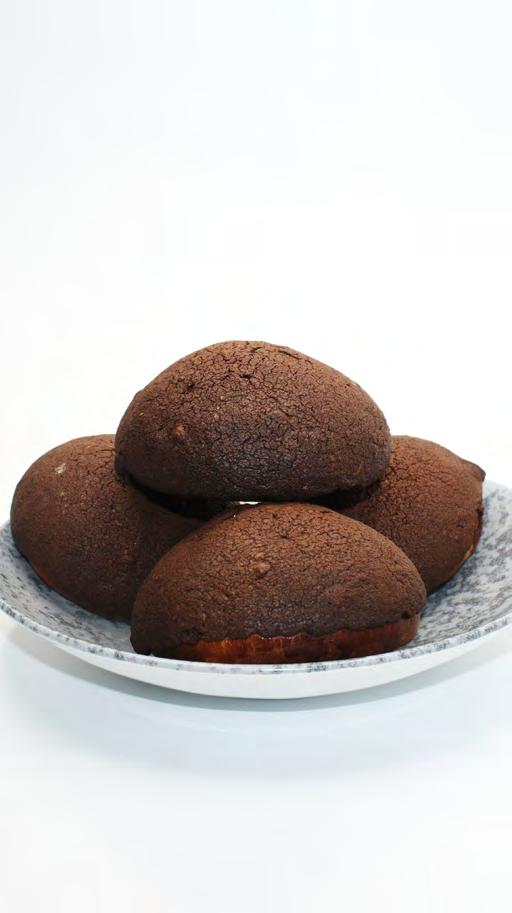
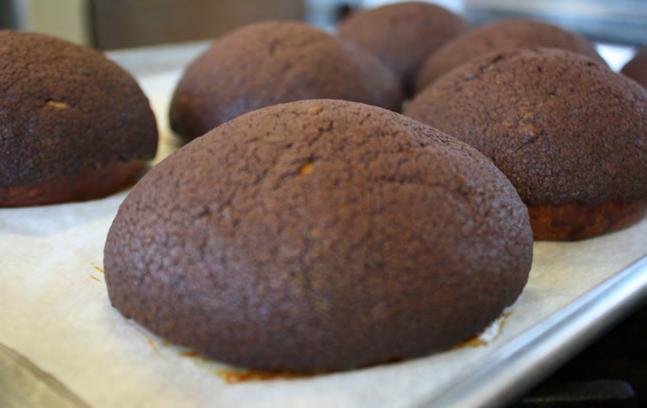
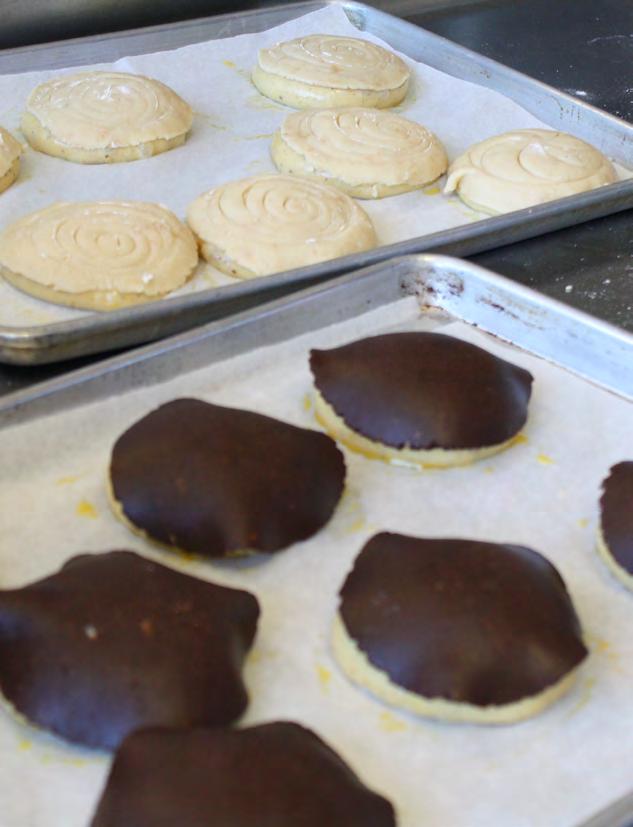
Conchas, the distinctive sugar-topped breakfast pastry, are a staple of Mexican bakeries and bodegas throughout the US. Literally meaning “shell,” the classic concha is an enriched yeast dough, similar to brioche, topped with a sugar coating and scored with a pattern resembling a seashell (hence the name). In Mexico, conchas are ubiquitous both in the morning and in the evening, usually accompanied by coffee, atole (a hot, sweet corn beverage), or hot chocolate.
Like much of Mexican cuisine, conchas are a multicultural creation, dating to the time when France occupied parts of Mexico from 1861 to 1867, introducing classical enriched doughs that combined with Spanish panadería traditions in the hands of local bakers, who substituted readily available ingredients such as lard and, later, shortening for butter.
Chef Naxielly Dominguez, Lecturer at Kingsborough Community College (NY), is passionate about conchas and other classic Mexican pastries. Classically trained in French pastry, she sees clear parallels in technique between the pastries and breads of her childhood and those she later learned in culinary school.
Chef Dominguez was born and raised in Oaxaca in southern Mexico. She always loved food and cooking but hadn’t seriously considered it as a career, choosing instead to pursue a college accounting degree. As a young woman, she met a vacationing New Yorker, Anthony Dominguez, exploring Oaxaca en route to Guatemala. They fell in love and Anthony, now her husband, canceled the rest of his Central American tour and stayed in Oaxaca for his entire vacation. After dating long distance for a year, they married and Chef Dominguez moved to Brooklyn in 1999.
While Anthony worked as a middle school teacher, Chef Dominguez found herself bored at home during the day. She saw a television ad for a local culinary school and enrolled, initially with the goal of leading culinary tours to Oaxaca. Upon graduation, she took a job as a foodservice coordinator at a local non-profit and never left the kitchen, later transitioning into education, teaching culinary and pastry arts at Kingsborough Community College in Brooklyn as well as Nassau Community College on Long Island (NY).
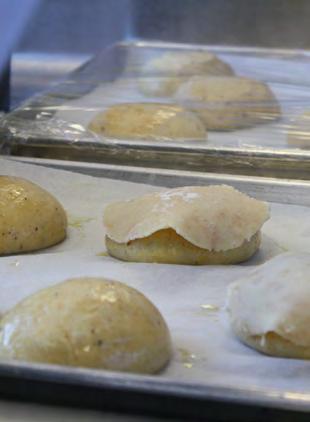
Chef Dominguez’s approach to the classic concha is traditional, with a few thoughtful refinements. She adds a proportion of bread flour to “provide a little more structure.” She also incorporates Mexican cinnamon into the dough,
noting that this is a traditional flavoring in Oaxaca but not throughout Mexico. She always splits the topping half-andhalf to offer both chocolate and vanilla conchas, both classic flavors. The neon pink version is less traditional. In addition to experimenting with bright colors, Dominguez notes that innovative panaderías in Mexico are offering unique flavors like hoja santa, pinole, calabaza and ube, as well as fillings such as Nutella and flavored pastry creams.
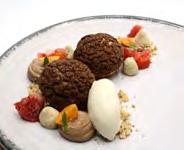
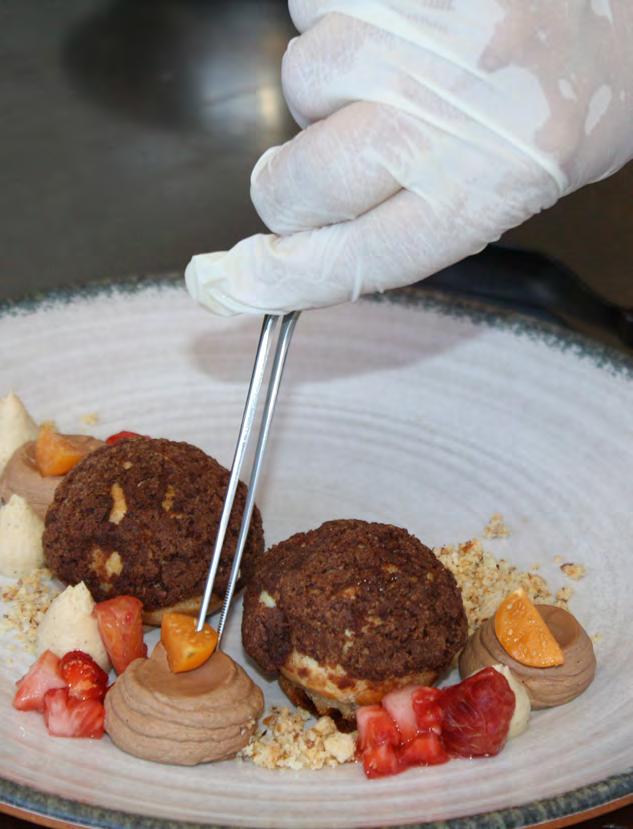
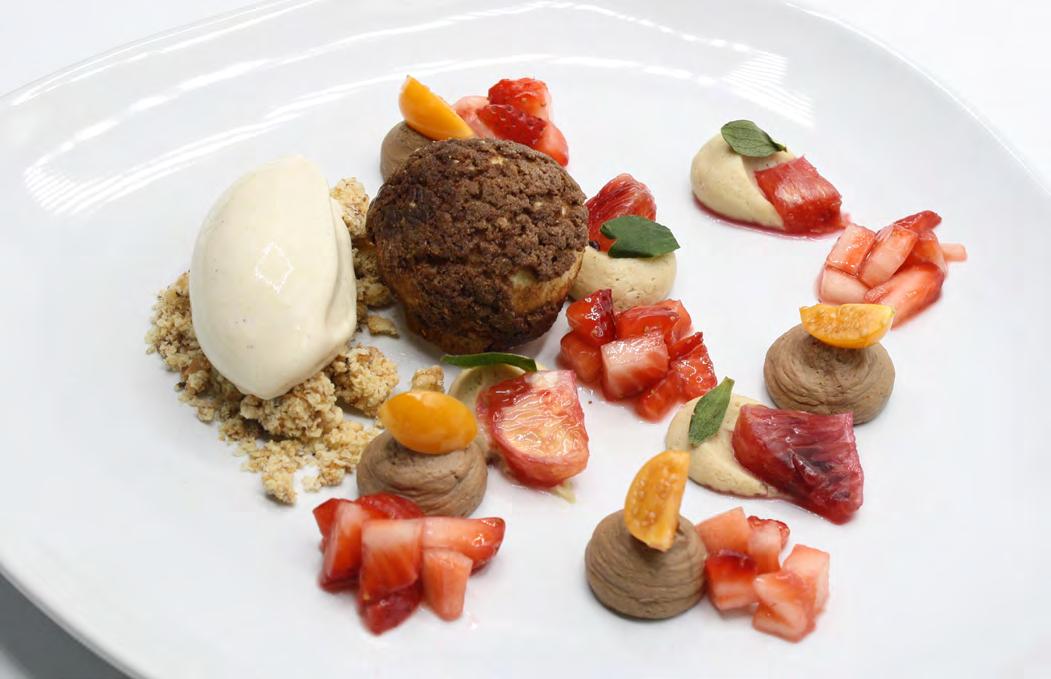
Chef Dominguez’s modern interpretation reimagines the concha and beverage experience as a plated dessert. “My idea is to take all the things that go into a concha with a beverage and present it on one plate,” she says.
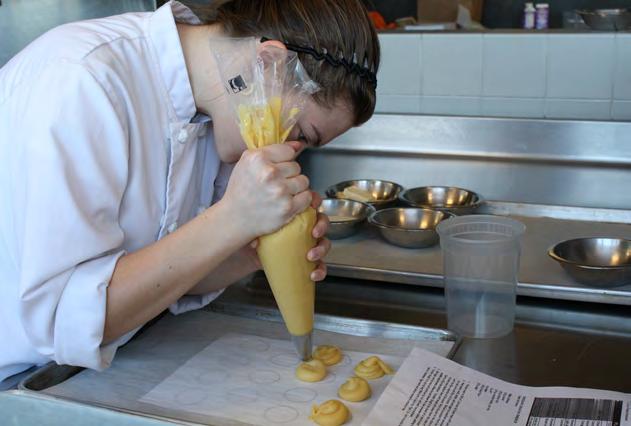
The main element of the dish is not a brioche-style dough but rather choux pastry. “When I teach pâte à choux, my Latin American students often comment that when I add the craquelin, they look like little conchas,” Chef Dominguez explains. “That’s what gave me the idea.”
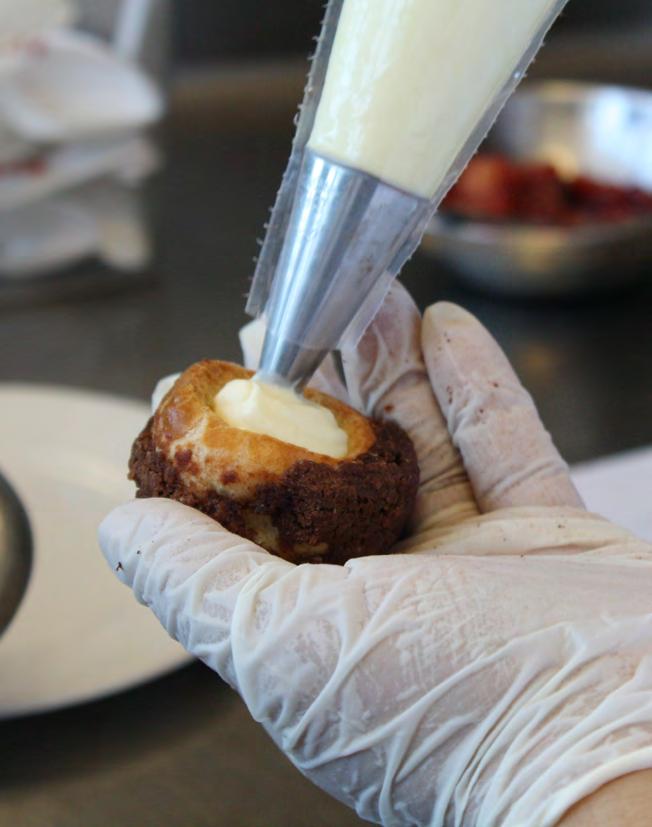
The choux pastry is stuffed with an orange crème diplomate. “Orange goes great with chocolate,” Chef Dominguez says. “I use Grand Marnier to highlight the orange flavor of the pastry cream, but it could be substituted with mezcal to keep it more traditional to Mexico.”
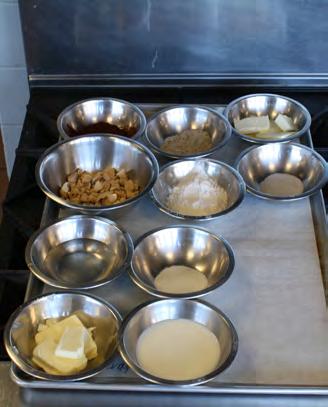
The remaining components completing the concha and beverage experience are a Mexican chocolate crémeux, café de olla whipped ganache, atole ice cream and a crumble made from traditional conchas.
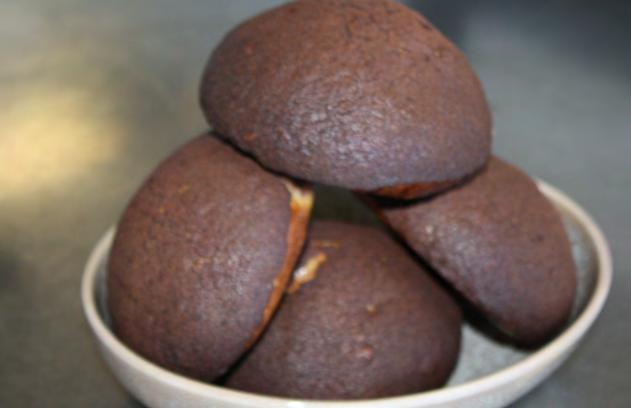
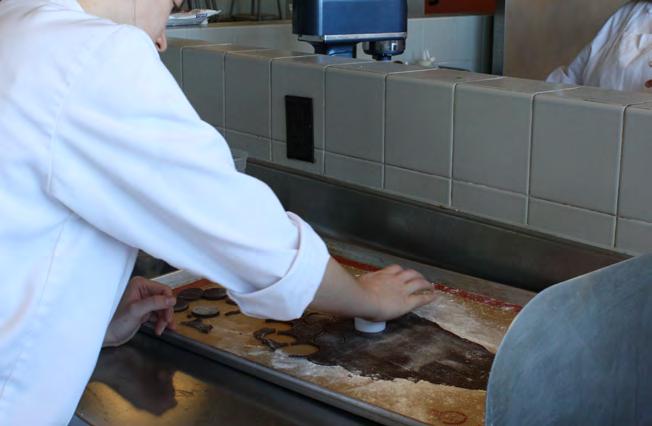
A consummate educator, Chef Dominguez worked with three Drexel University Culinary Arts and Science students to execute and photograph the classical and modern dishes.
Student Chef Jonathan Bush, a freshman from New Orleans who works at Ocho Supper Club in Philadelphia, says: “I was a fan of conchas, but most of the ones I have had were pretty dry. These are miles better.” Meanwhile Student Chef Angelina Nugent, a sophomore from Baltimore and a cook at Vernick Fish at the Four Seasons Hotel in Philadelphia, had never had conchas before, commenting on the modern version: “The plating is fun but is harder than it looks.” And Student Chef Kayla McCloud, a junior from New York City currently on co-op with Union Square Hospitality Group at the Marriott Marquis in Manhattan, enthuses that they are out of the park good. “If they were this good at the bodega, I would buy them all the time,” she says.
CLASSICAL
Classic Conchas
By Chef Naxielly Dominguez
Yield: 14 conchas
Dough:
• 2 30 g warm milk
11 g active dry yeast
• 1 00 g granulated sugar, divided
• 120 g eggs (2 large eggs plus 1 yolk)
• 1 0 g vanilla extract
• 4 00 g all-purpose flour
• 1 00 g bread flour
• 3 g ground cinnamon
• 8 g salt
• 1 00 g unsalted butter, room temperature Egg wash
Craquelin (Topping):
• 115 g all-purpose flour
• 115 g confectioners’ sugar
• 115 g unsalted butter, room temperature
1 0 g vanilla extract
• 15 g Dutch-processed cocoa powder
Method:
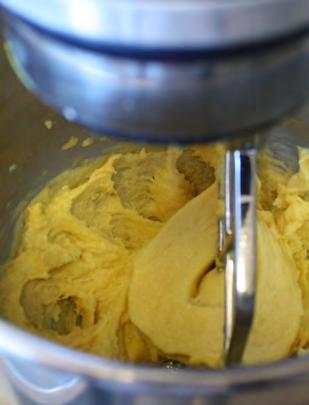
1. C ombine milk, yeast and 5 g of the sugar in a small bowl. Cover and let stand until foamy, about 5 minutes. Transfer the mixture to the bowl of a stand mixer fitted with a dough hook. Add remaining sugar, eggs and vanilla and mix to combine. Add flours, cinnamon and salt and mix on low speed for 5 minutes.
2. Add butter one piece at a time and increase speed to medium. Knead for about 10 minutes until the dough pulls away from the bowl and reaches windowpane stage.
3. Transfer dough to a lightly oiled bowl, cover with plastic wrap and proof at about 21°C/70°F until doubled in size, about 1 to 1.5 hours.
4. Line two large baking sheets with parchment paper.
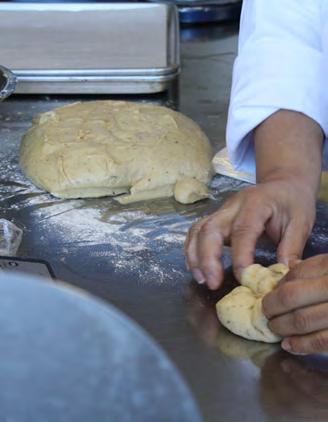
5. Divide dough into 76 g portions. Shape into smooth balls by cupping your hand over the dough and rolling against the work surface.
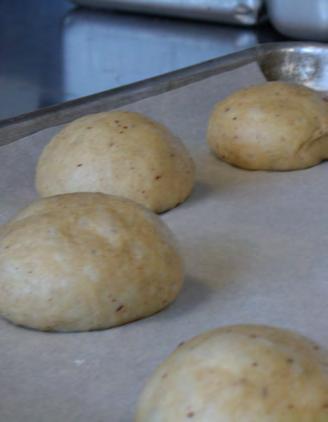
6. Place on prepared baking sheets (7 per tray), cover with plastic wrap and proof at room temperature until visibly puffy and slightly springy to the touch, with about a 75% increase in volume, 45 to 60 minutes depending on room temperature.
7. Meanwhile, prepare the craquelin: Combine flour, confectioners’ sugar, butter and vanilla in a bowl and mix until a dough forms. Divide in half (about 170 g). Mix cocoa powder into one portion until fully incorporated to create chocolate and vanilla toppings.
8. Preheat oven to 350°F.
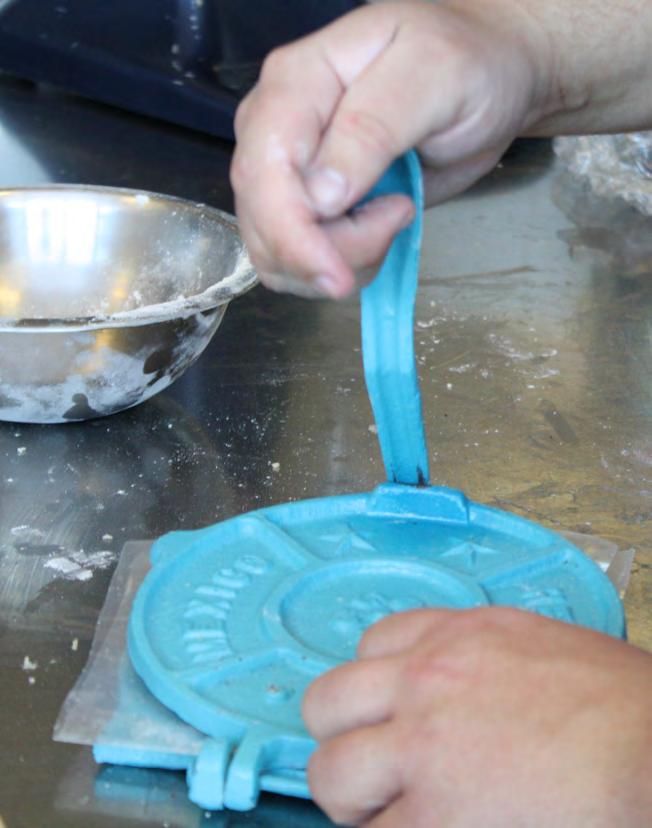
9. Portion 26 g craquelin per concha and flatten into thin disks to cover each piece. Remove plastic wrap, lightly egg wash the dough and place craquelin on top, pressing gently to adhere. Score with a concha stamp or the back of a paring knife to create a shell pattern.
10. Place a second empty baking sheet under each tray (double pan) and bake for 25 to 28 minutes until lightly browned. Cool on a rack before serving.
MODERN
Modern Concha-Inspired Plated Dessert
By Chef Naxielly Dominguez
Plated Dessert Components
Main Item:
• Chocolate choux au craquelin
• C oncha sponge
G rand Marnier syrup
• O range crème diplomat
Pastry note: Cut concha into ¼-inch slices. Cut a 1½-inch circle and soak with Grand Marnier syrup.
Sauce:
• Mexican chocolate cremeux
C afé de olla whipped ganache
Cake/Crumble/Crunchy Item:
• C oncha crumble
Fruit:
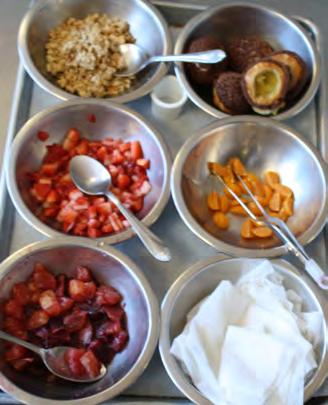
• 2 25 g strawberries, stems removed and small diced
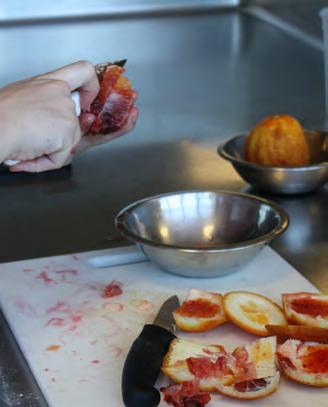
• 1 blood orange, cut into supremes and then into thirds
Ice Cream:
• Atole ice cream
Garnish:
• Strawberry stems, leaves separated
Chocolate Choux Au Craquelin
Yield: 40 choux
Pâte à choux:
• 120 g water
• 120 g whole milk
120 g unsalted butter
• 2 g salt
• 6 g sugar
• 160 g bread flour
• 2 50 g eggs
1. Preheat oven to 175°C / 350°F. Line two half-sheet trays with parchment.
2. B ring water, milk, butter, salt, and sugar to a boil. Add flour all at once and mix vigorously.
3. Return to heat and cook 1 to 2 minutes until dough pulls from sides and forms a film.
4. Transfer to a stand mixer and cool slightly. Add eggs one at a time until smooth.
5. Pipe 1½-inch mounds. Egg wash and top with craquelin.
6. B ake 30 to 35 minutes until golden. Cool completely.
Craquelin:
• 110 g unsalted butter, room temperature
• 125 g light brown sugar
9 0 g all-purpose flour
• 20 g hazelnut flour
• 15 g Dutch-processed cocoa powder
• 1 g salt
1. Cream butter and sugar until smooth.
2. Add remaining ingredients and mix to form a dough.
3. Roll to 3 mm (⅛-inch) thickness.
4. Cut 1½-inch circles and refrigerate until firm.
Orange Crème Diplomat:
• 500 ml whole milk
• 1 00 g sugar
• 3 6 g cornstarch
• 50 g egg
4 0 g egg yolks
• 20 g orange peel
• 1 0 ml Grand Marnier
• 1 gelatin sheet, bloomed
• 30 g unsalted butter
• 120 g heavy cream, whipped
1. W hisk milk, sugar, cornstarch, egg, yolks, and orange peel.
2. C ook over medium-high heat, whisking constantly, until boiling. Simmer 2 minutes.
3. Remove from heat and add Grand Marnier, gelatin, and butter. Remove orange peel.
4. Chill completely.
5. W hisk to loosen, then fold into whipped cream. Transfer to piping bag.
Mexican Chocolate Namelaka (Cremeux):
• 4 .5 g gelatin sheets
1 00 g milk
• 1 g Mexican cinnamon
• 1 g chili powder (chipotle or ancho)
• 1 0 g glucose
• 125 g dark chocolate (55–65%)
• 200 g heavy cream
1. B loom gelatin and squeeze dry.
2. Heat milk with spices and glucose. Pour over chocolate.
3. Add gelatin and rest 5 minutes. Emulsify.
4. Add cold cream and blend again.
5. Chill 6 hours or overnight. Pipe to serve.
Café de Olla Whipped Ganache:
• 3 g gelatin sheets
• 300 ml heavy cream
30 g piloncillo or panela, grated
• 3 g ground coffee
• 4 g Mexican cinnamon sticks
• 8 0 g white chocolate
1. B loom gelatin.
2. Heat cream with piloncillo, coffee, and cinnamon. Bring to a boil, remove from heat, cover, and infuse 5 minutes.
3. Strain over white chocolate. Add gelatin and rest 5 minutes. Emulsify.
4. Chill 6 hours or overnight.
5. W hip on low speed until smooth. Transfer to piping bag.
Atole Ice Cream:
• 6 0 g masa harina
• 360 g water
• 4 80 g whole milk
• 110 g piloncillo, grated
• 5 g cinnamon
• Pinch of salt
• 3 g vanilla paste
• 200 g heavy cream
1. W hisk masa harina with water until smooth.
2. Heat milk, piloncillo, cinnamon, and salt. Add masa mixture.
3. B ring to a boil, stirring constantly. Cook 1 minute until slightly thickened.
4. Add vanilla and cream. Chill over ice bath, then refrigerate overnight.
5. Churn per machine instructions.
Concha Crumble:
• 8 0 g vanilla concha
• 15 g almond flour
• 30 g white chocolate, melted
1. B ake concha pieces at 175°C / 350°F for 10 minutes until dry.
2. C ool and pulse into crumbs.
3. Mix with almond flour and melted white chocolate.
Grand Marnier Syrup:
• 200 g sugar
• 200 g water
• 1 0 g Grand Marnier
1. B ring sugar and water to a boil. Boil for 2 minutes.
2. Remove from heat, add Grand Marnier, and cool.
Assembly:
1. Cut bottoms from choux and fill with orange crème diplomat.
2. Insert soaked concha disk to seal.
3. Toss fruit lightly with syrup.
4. Plate components and finish with an atole ice cream quenelle or rocher.
A conversation with DARRYL BELL
By Stephanie Lewis
Chef Darryl Bell built his career at fine dining restaurants in Napa Valley, before returning to his Kansas City roots. At Stateline Road Smokehouse (Napa, CA) he blends precision and intention with a fresh perspective on barbecue.
After years of working in fine dining, why did you decide to switch over to casual dining and focus on Kansas City barbecue?
Shortly after the pandemic, I realized it would be beneficial to move into something more recession-proof and pandemicproof, like casual dining. But it wasn’t just a business decision. I’m from Kansas City, and when I moved to Napa, I didn’t really see the kind of barbecue I grew up with. For years, I stayed focused on fine dining, but around 2021 or 2022, it clicked that I could bring those two worlds together, the barbecue I knew from home and the technique I’d developed in Napa.
Before opening Stateline Road Smokehouse, you launched your own 816 BBQ Sauce. What sparked that?
When I first moved to California, I was making $8.25 an hour, but I was still giving to a foundation called Rafiki that supports orphans and widows in Africa. At some point, I couldn’t keep giving at the level I wanted to, so I started thinking about how I could create something that would allow me to keep contributing. That’s where the sauce came from. I took what I was learning in California and combined it with a Kansas City recipe I grew up with. The idea was simple, make something people would buy so I could donate the proceeds.
While switching to barbecue was a return to your roots, was there anything you took from your experience in Michelin-starred kitchens like Bouchon Bistro and PRESS and applied to Stateline Road Smokehouse?
The knowledge of food carries over completely. You’re still cooking proteins, just in a different way, smokers instead of sous vide or other techniques, but the attention to detail doesn’t change. Fine dining teaches you to question everything. A lot of barbecue traditions are passed down and repeated, and I respect that, but I also ask if it’s really the best way to get the most flavor. I’m not limited by what’s always been done. I think about what could be done.
Knowing you were bringing Kansas City–style barbecue to Napa Valley, did you adapt anything on the menu to reflect local tastes?
Nothing was changed to appeal to Napa, but I did adapt things so I could take advantage of the ingredients around me. We use beans from Rancho Gordo, which are local and high quality, and we source chicken from Petaluma in nearby Sonoma. Tomatoes, garlic, all of that comes from California. It’s not about changing the cuisine, it’s about elevating it with better ingredients. Even with the sauce, I’m using great local tomatoes and layering in flavors that reflect where I am now. Some of those elements wouldn’t typically show up in a traditional barbecue sauce.
What’s one memorable challenge you faced when opening Stateline Road Smokehouse and how were you able to overcome that obstacle?
The biggest challenge was learning to trust myself despite what others expected. A lot of people come in with a fixed idea of what barbecue should be. For example, we don’t serve baked beans or traditional cornbread, and our ribs aren’t cooked to fall off the bone. That’s not how I believe they should be done. You get some pushback at first, but you have to stick to your guns. Once people try the food, they usually get it, and they end up enjoying what we’re doing even more.
As live fire cooking continues to trend, what do you believe draws chefs to that style of cooking, and what advice would you give to those looking to master barbecue?
Ideally, it’s not about the trend. It should come from a real connection to the food and the process. If there’s no story behind it, people can feel that, and it won’t resonate in the same way. At the same time, it’s important to respect the process and the culture, but not feel limited by it. Learn the foundations, understand why things are done a certain way, then think for yourself. Focus on what should be done, not just what has always been done.
You introduced “Dine and Donate” events at Stateline Road Smokehouse as a way to give back to the community. Can you explain the concept and your inspiration behind the idea?
Stateline is meant to be a true community spot in Napa. The Dine and Donate events are a way to support local groups, whether that’s schools, sports teams or other organizations. We set a time window, and during that period, 10 percent of proceeds go back to that group. It’s a simple way to help support the community that supports us.
A New Take on Teatime
As demand for low- and no-alcohol options grows, pastry chefs are rethinking teatime as a modern, experience-led alternative to happy hour
By Pamela Brill
Mojitos
and wings may soon be taking a backseat to peppermint tea and savory scones.
As more consumers invest in healthier lifestyles, interest in low- and no-alcohol, wellness-focused beverages is creating a fresh opportunity in experiential dining: a revamped afternoon tea service. This shift in beverage consumption is largely driven by Gen Z and Millennials, many of whom are prioritizing their physical and mental well-being when socializing. “Instead of the traditional bar scene or coffee shop, teatime offers a great option to indulge with friends, gather socially and not be concerned about consuming alcohol,” says ACF Culinary Educator Brian Hay, CEC, CCE .
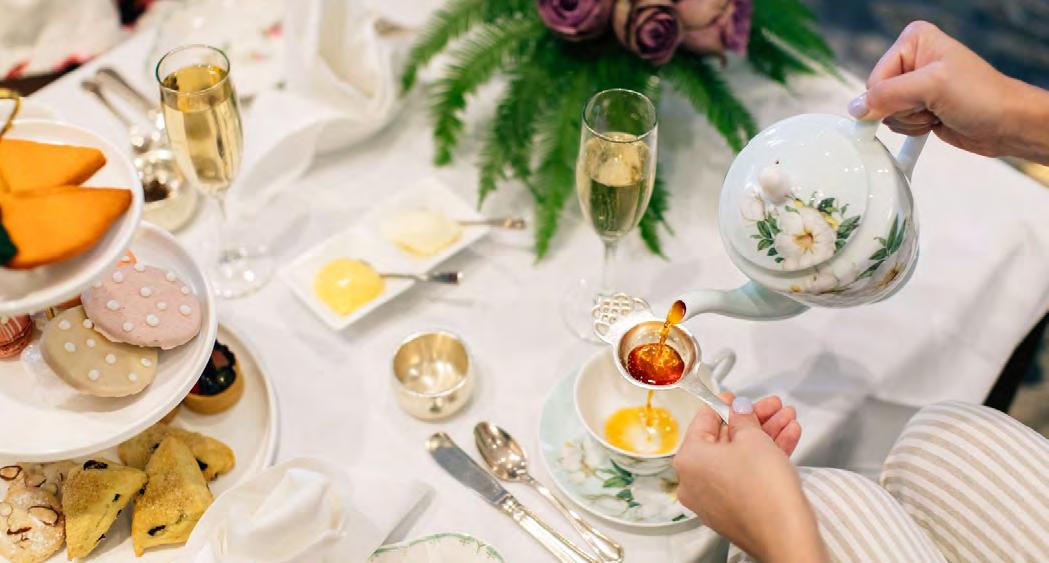
The American Culinary Federation’s 2026 Trends Report reveals a reimagined teatime as a departure from the classic happy hour. Characterized by an earlier start time (typically 2–4 pm), this off-peak service opens the door for experimentation beyond traditional scones, cookies and petit fours. Pastry chefs are catering to teetotalers with themed menus, complementary flavor pairings and presentations that elevate their tea-centric offerings.
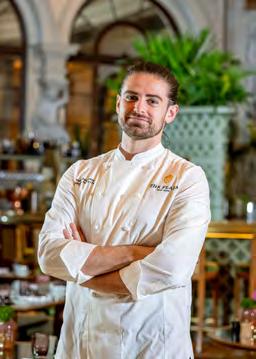
Specialty brews with global influences are driving inspiration in teatime menus. Chef Kevin Clemenceau, Chef at The Plaza Hotel in New York City (NY), where the children’s storybook character Eloise took tea in The Palm Court dining room, accentuates sophistication with his afternoon tea accompaniments. On the current menu is a Granny Smith pastry – crafted in the shape of a miniature apple – with a Japanese shiso leaf. “The crisp acidity of the apple, paired with the herbal brightness of shiso, offers a contemporary
twist that guests may not expect in traditional pastry,” Chef Clemenceau says.
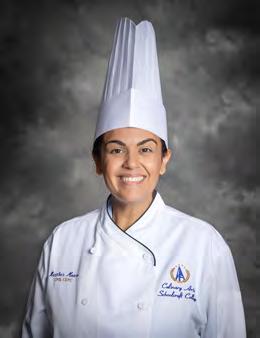
ACF Chef Heather Moore, CEPC, Instructor at Schoolcraft College (Livonia, MI), is noticing a shift away from classic vanilla, almond and strawberry teas in favor of a more diverse flavor palette, with notes like black sesame, cardamom, rose, orange blossom and lavender. “These ingredients add depth and make the experience feel more modern and globally inspired,” she says.
Traditional afternoon tea service has been upgraded with more seasonal pastries. Chef Jean-Francois Suteau, Chef at The Greenbrier (White Sulphur Springs, WV), helped reshape the resort’s longstanding amenity with an expanded menu, which debuted earlier this year. Cookie plates are now enhanced by miniature blackberry and blueberry tarts and bite-sized cupcake varieties that change with the seasons, including a raspberry Chantilly with fresh pecans.
Themed tea programs that highlight in-season ingredients also allow consumers to sample fresh flavors in modest portions. Chef Oksana Kravcenko, Executive Pastry Chef at The Ballantyne, a Luxury Collection Hotel (Charlotte, NC), offers a spring blossom tea, featuring cherry blossom scones, rosewater-honey cream puffs and lavender opera cake. “We focus on refined small plates that feel light, balanced and visually engaging,” she says. “The goal is to create something that feels celebratory, yet elegant and approachable.”
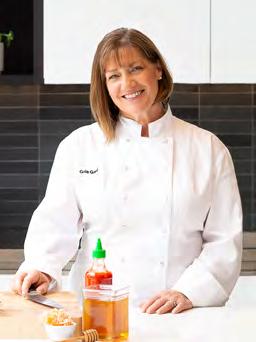
Playful pairings of tea and pastry highlight contemporary flavor mashups, while broadening the culinary range of teatime offerings. After a recent trip to Scotland’s tea rooms, Chef Gale Gand, HHOF, cookbook author and host of Food Network’s Sweet Dreams, was inspired to expand her teatime repertoire. “As an American, I feel we come from a core place of innovation and freedom, rather than being tied to tradition,” she says. Her sweet and savory scones feature different textures and tastes, such as smoked cheddar scones and candied kumquat scones served with herb-infused honey and flavored butters, paired with chai masala, green tea with ube or chocolate tea.
Chef Kevin Clemenceau
ACF Executive Pastry Chef Heather Moore, CEPC
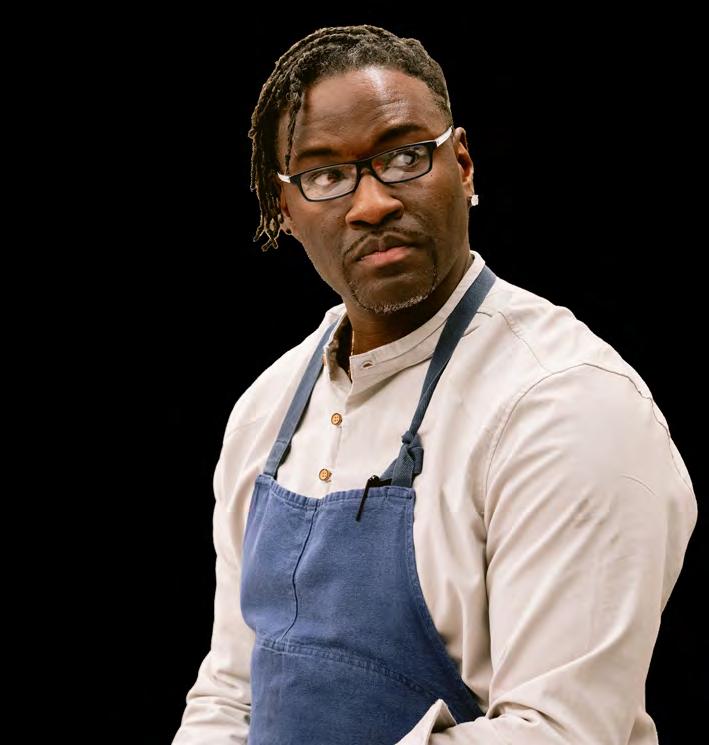
ACF Culinary Educator Brian Hay, CEC, CCE
Determining which tea varieties and pastry flavors work well together requires some taste-testing. Chef Hay recommends evaluating each tea not only for its flavor, but also for mouthfeel, tannin levels, aromas and acidity. Among his suggested pairings are a white Darjeeling served with a buttery Asian-spiced pound cake and Dragonwell tea served with chèvre cheese and lavash.
Chef Moore believes in finding a balance while utilizing contemporary flavors. For rich and buttery pastries, like a chocolate hazelnut croissant, she prefers a strong black English breakfast tea, while lighter, fruit-based pastries pair well with green or white teas. “They’re more delicate and won’t compete with those softer flavors,” she says.
Dietary restrictions can play a part in designing lighter approaches to teatime. Chef Gand balances her menu with tisanes in herbal, flower or spice infusions, as she sees caffeinefree options growing in popularity. Chef Angela Sweetser, CEPC, of the Tea Room at the Queen of Hearts Las Vegas
(NV) offers an inclusive menu of vegan-, gluten- and dairy-free pastries, including checkerboard shortbread and white rabbit cream puffs. “Converting traditional recipes elevates our offerings much more than truffle oil or lavender flavoring,” she says.
Adapting her menu to accommodate her customers does not affect cost, as all pastries are produced in-house. Instead, Chef Sweetser focuses her energies on quality control (menus incorporate only loose-leaf tea) and presentation (from dice-shaped sugar cubes to whimsical patterned dishes). “Incorporating fun details transforms familiar classics into something more theatrical,” she says.
With so many ways to reinterpret the format, teatime is evolving into a flexible platform for creativity. By leaning into wellness trends, global flavors and thoughtful pairings, pastry chefs are reshaping the experience into something lighter, more social and better aligned with how today’s guests want to gather.
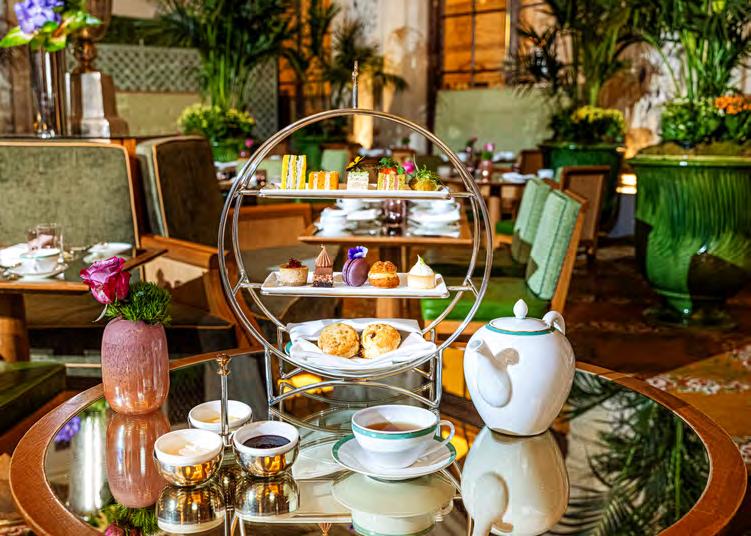
Tea at The Ballantyne (Charlotte, NC)
Pastry Chef Gale Gand
ACF Chef Angela Sweetser, CEPC
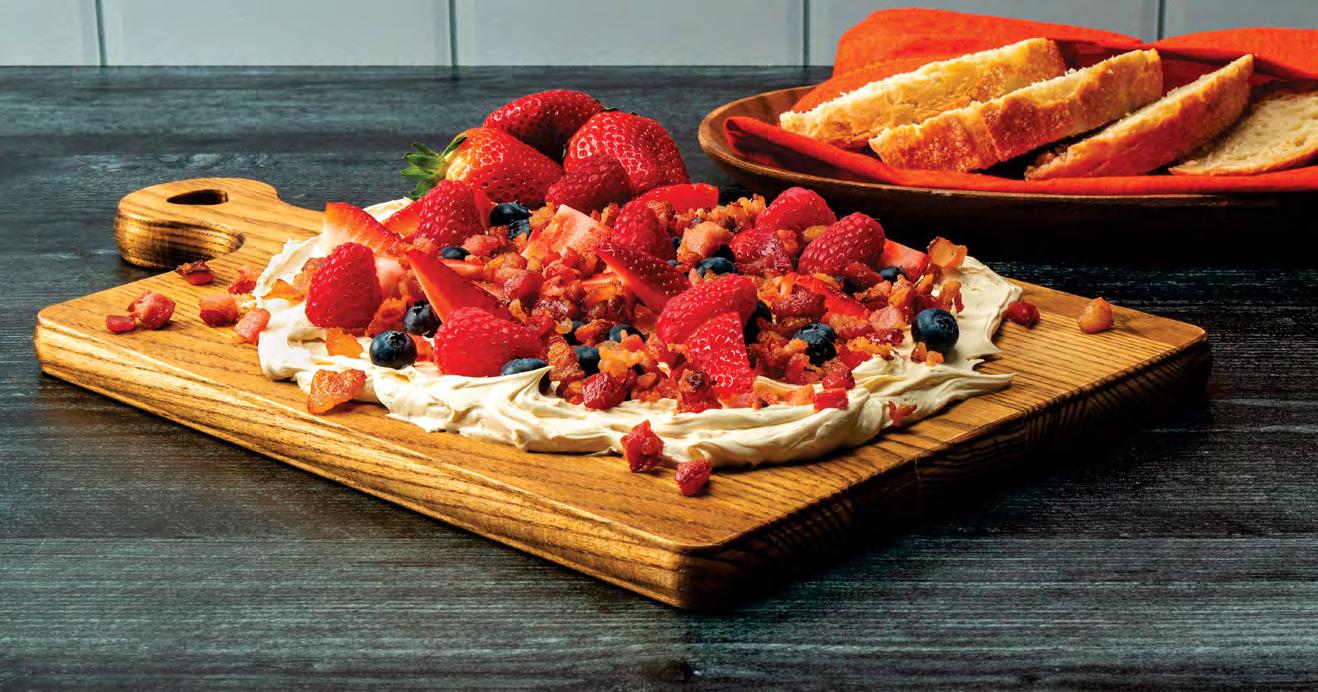
SUNRISE BUTTER BOARD
Unsalted whipped butter infused with maple syrup and cinnamon, slathered on a board, and topped with fresh berries. Finished with Jones Dairy Farm Diced Bacon and a hot honey drizzle.
RAW DICED BACON: NEW FROM JONES DAIRY FARM
For more than 137 years, Jones Dairy Farm has crafted distinctive pork products using simple ingredients, original recipes, and time-honored traditions.
JONES DAIRY FARM RAW DICED BACON is built for busy kitchens. Made from premium center cut pork bellies and naturally smoked over real hardwood chips for more than eight hours — never liquid smoke — it delivers rich, authentic flavor.
Individually quick frozen to reduce clumping and ready to cook, Jones Raw Diced Bacon allows operators to use exactly what they need while saving valuable prep time.
From appetizers and salads to breakfast builds, soups, and entrées, Jones Bacon delivers consistent performance across the menu.
Designing for Satisfaction
Health-forward cooking isn’t about restriction. Chefs are building dishes that deliver on flavor and experience
By Kerstin Kühn
Guests say they want healthier options. Then they order the short rib. It’s a familiar tension in professional kitchens, and one that has less to do with nutrition than it does with satisfaction: If a dish doesn’t feel complete, indulgent and craveable, it won’t move, no matter how balanced it is on paper.
“The challenge isn’t health, it’s satisfaction,” says ACF Chef Deborah Kennedy, PhD, Author and Founder of the Food Coach Academy. “Satiety is something chefs can design. It’s not just about calories or protein. It’s about how the dish is experienced.”
And that experience is built through structure. Texture, contrast, flavor layering, temperature and visual cues all play a role in whether a plate feels satisfying or falls flat. For chefs, the opportunity isn’t to reduce portions or remove indulgence, but to rethink how satisfaction is constructed.
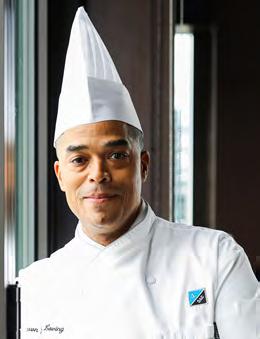
“Texture is key,” says Chef Shawn Loving, CMC, AAC, Executive Chef at the Detroit Athletic Club (MI). “I aim for at least three elements that contrast: something tender, something creamy and something crisp. Temperature also plays a role. Pairing hot and cool elements wakes up the palate, and flavor contrasts like bitter, spicy or acidic notes keep each bite engaging.”
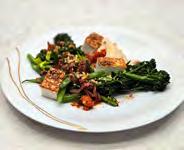
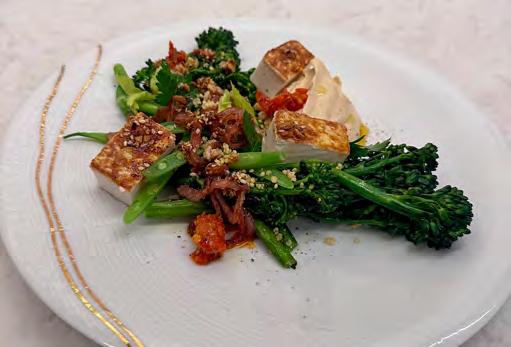
Chef Loving describes this approach as “flavor bouncing,” a way of building movement across the palate so no single element dominates. His dish Evolution of Vert dish puts this into practice through a composed, vegetableforward plate. Charred
broccolini brings bitterness and crisp edges, green beans add structure, yogurt provides creaminess, harissa delivers heat, sorghum contributes crunch and nuttiness, and pickled shallots introduce acidity. “What makes it work is how everything interacts,” he says. “The bitterness is softened, the heat energizes the palate, the crunch adds texture and the acidity lifts everything. It feels complete, even though it’s light.”
That idea of completeness without heaviness is central to how chefs are redefining indulgence. Chef Loving sees richness not as a function of density, but of structure and technique. “For me, richness isn’t about weight,” he says. “It’s about texture, structure and how an element carries flavor across the palate.”
Instead of relying on butter or cream, he often builds body through emulsification, using olive oil or avocado oil to create a similar mouthfeel. In some cases, that might mean whipping tofu with oil to create a smooth, creamy base that delivers the same satisfaction as a dairy purée, but with a lighter finish.
Chef Kennedy points to this kind of approach as a key shift. Dishes that feel indulgent through technique rather than excess are more likely to meet both guest expectations and operational goals. “Soft-on-soft plates plateau quickly,” she says. “You need variation in texture and structure to extend the eating experience and create a sense of fullness.”
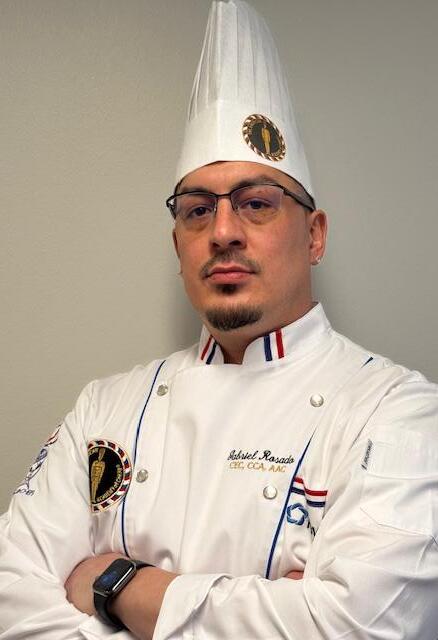
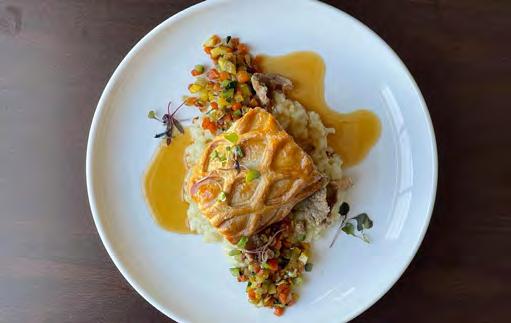
ACF Chef Gabriel Rosado, CEC, CCA, AAC, Executive Chef and Director of Hospitality & Nutrition Services at Powers (IN) and President of the ACF Chefs of Northwest Indiana Chapter, applies those same principles in a very
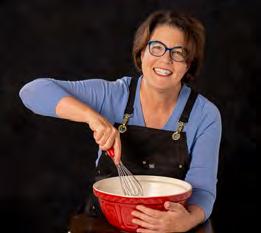
ACF Chef Deborah Kennedy, PhD
Evolution of Vert by ACF Chef Shawn Loving
ACF Chef Shawn Loving, CMC, AAC
Building Satiety into the Plate
Satisfaction comes from how a dish is constructed, not how large it is.
Contrast in texture, creamy, crisp and tender elements, keeps each bite engaging and extends the eating experience.
Depth is built through layered umami, using ingredients like mushrooms, fermented components or small amounts of aged cheese.
different setting, where food must balance nutrition, comfort and consistency across a wide range of diners.
“In a vegetable lasagna, I’ll add lentils for texture and heartiness,” Chef Rosado says. “With the right seasoning, fennel, herbs, even nutritional yeast, you create something that eats like a sausage dish. Guests don’t feel like they’re missing anything.”
Rather than relying on larger portions, both Chef Loving and Chef Rosado emphasize composition. Layering umami through mushrooms, fermented elements and herbs allows dishes to feel complete without signaling compromise.
Acidity plays a similarly important role. It sharpens perception, cuts richness and keeps dishes from feeling heavy. Chef Rosado recently applied this in a salmon Wellington developed for a health-focused menu. Instead of traditional puff pastry, he used a lighter crust and layered sautéed greens with mushroom duxelles. A restrained butter sauce finished with dill, capers and lemon zest brought balance. “It’s still indulgent, but controlled,” he says. “That brightness at the end pulls everything together.”
Designing for chew is another lever. Intact grains, legumes and fibrous vegetables extend eating time and enhance perceived fullness, allowing smaller portions to perform more effectively. Chef Kennedy reinforces this point. “The more time food spends in the mouth, the more satiating it is,” she says. “Chew time is one of the most underused tools chefs have.”
How a plate looks matters just as much as how it eats. Guests assess value quickly, and visual composition plays a critical role in that perception. “This is probably my favorite part of the conversation,” says Chef Loving. “Portioning and plate composition are critical. Even with lighter ingredients, the plate has to feel substantial and intentional.”
Acid provides balance, cutting richness and keeping flavors bright.
Chew increases satisfaction, with intact grains, legumes and fibrous vegetables helping smaller portions feel more substantial.
Presentation matters. A plate that looks intentional and well composed signals value before the first bite.
He balances a clean, modern aesthetic with elements of familiarity, ensuring dishes feel both elevated and approachable. “It has to look like it’s worth it before the guest even takes a bite,” he says.
That attention to composition is also shaping how guests respond. Chef Loving has seen a noticeable shift in how diners engage with these kinds of plates. “Guests are more aware now,” he says. “They’re paying attention to texture, to flavor balance. When you build a dish with contrast and layered flavor, they notice and they appreciate it.”
Chef Rosado sees a similar outcome, even in a healthcare environment. Meals are structured across courses with controlled portions, but the overall experience still feels complete. “Our proteins are typically four to six ounces, with smaller sides,” he says. “But when you build the meal properly, soup, salad, entrée, sides, dessert, it feels complete.”
Menu language and placement further shape perception. Chef Kennedy notes that guests don’t order nutrients, they order an experience. Dishes described through technique, texture and flavor consistently outperform those framed around health. “Diners aren’t rejecting indulgence,” she says. “They’re redefining it. They want food that feels energizing and responsible, but still deeply satisfying.”
For chefs, that shift presents both a challenge and an opportunity. Satisfaction can no longer rely on portion size alone. It must be designed through contrast, balance and intention. As Chef Rosado puts it: “It’s not about taking things away. It’s about building flavor, texture and balance so guests leave satisfied.”
Salmon Wellington by ACF Chef Gabriel Rosado
ACF Chef Gabriel Rosado, CEC, CCA, AAC
KITCHEN CULTURE AT A CROSSROADS
As scrutiny around kitchen culture returns
to the spotlight in the wake of revelations about Noma, chefs across the industry take stock of what has changed and what still needs to evolve
By Kerstin Kühn
Professional kitchens have always been demanding environments. The pace is relentless, the standards are high and the margin for error is small. For generations, that intensity has shaped not only how chefs cook, but also how they lead.
Recent reporting on workplace culture at world-renowned restaurant Noma, including allegations from former employees about Chef René Redzepi’s leadership, has brought these dynamics back into focus and sparked fresh conversation across the industry. For many chefs, the headlines feel familiar. The specifics may vary, but the underlying themes of pressure, hierarchy and intensity run deep. What’s changed isn’t their existence, it’s the willingness to question them.
For ACF Member Steve Weiss, Founder and CEO of Catalis Leadership (Seven Hills, OH), the story highlights a deeper issue. He describes the coverage as “painful to read, not just because of what was alleged, but because of what it revealed about how long a culture of fear and intimidation can be rationalized as rigor or excellence.” When kitchens at that level of prestige model those behaviors, the impact extends far beyond a single restaurant.
Across the industry, and within the American Culinary Federation, chefs and educators are reflecting on the kitchens they came up in, the ones they lead today and the environments they want to create moving forward.
For those who trained in earlier decades, the contrast is stark. ACF Chef Samuel Glass, CEC, CCE, AAC, Professor at Centennial College (Toronto, ON), recalls a very different era. “In the 1980s and 1990s, it was a culture of sex, drugs and rock and roll,” he says. “We worked hard and played hard. Cooks were abused, and in some cases, they were the abusers as well.”
At the time, much of that was accepted as part of the job. Long hours, low pay and constant pressure were expected. Calling in sick wasn’t an option and mental or physical wellbeing rarely entered the conversation. Today, the culture is shifting. “There’s a focus now on quality of life, living wages and mental and physical well-being,” Chef Glass says. “We’ve come a long way, and we still have a long way to go.”
That sense of progress, paired with unfinished work, comes up again and again. ACF Chef Susanne Ebacher-Grier, CEPC, Culinary Arts Educator at Center Grove High School (Greenwood, IN) and President of the Indiana Association of Career and Technical Educators, trained in kitchens where intensity and intimidation were simply part of the landscape. “Those experiences shaped us,” she says. “But they also forced many of us to think about what kind of kitchens we want to lead.”
For her, the shift is most visible in the classroom, where stories that once felt normal now land very differently. “When I share some of those experiences, students are often
shocked, especially when they hear what it was like navigating those environments as a woman,” she says. “What was once normalized would be unacceptable today.”
Indeed, the generational shift is clear: Young chefs are entering the profession with different expectations and are more willing to question the idea that excellence must come at the expense of dignity. Student Chef Kyla McCloud, a Culinary Arts and Science major at Drexel University, points to a critical distinction between challenge and harm. “The truth is that kitchens are hard and they should be,” she says. “But there’s a difference between a chef who holds you to a high standard and one who makes you feel small for not meeting it.”
“There’s a difference between a chef who holds you to a high standard and one who makes you feel small for not meeting it.”
Student
McCloud
At the heart of the conversation is a clear distinction: pressure that drives growth versus pressure that breaks people down. ACF Chef Jon Woodgate, Program Coordinator and Chef Instructor at Southwest Technical College (Cedar City, UT), sees this as a teaching responsibility. “We’re never going to remove the intensity of a kitchen,” he says. “But we can teach
ACF Chef Samuel Glass, CEC, CCE, AAC
ACF Chef Susanne Ebacher-Grier, CEPC
Chef Kyla
cooks how to handle that pressure in a more constructive way.” Planning, clarity and composure can turn the same highpressure environment into something far more productive and far less harmful.
That reframing is already happening in practice. Weiss points to his work at EDWINS Leadership & Restaurant Institute (Cleveland, OH), where leadership training is embedded into culinary education. In that environment, he says, kitchens operate with clear standards and accountability, without fear-based tactics. The result is not only a healthier culture, but stronger team performance.
Leadership remains at the center of the conversation. Kitchens still rely on discipline and high standards, but how those standards are communicated is evolving. Chef Weiss, like many in the broader hospitality space, points to leadership models championed by figures such as Will Guidara and Danny Meyer, where respect, empathy and empowerment are seen not as soft skills, but as drivers of consistency and performance. “That’s not soft leadership. That’s smart leadership,” he says.
Pressure will always be part of the job. The challenge isn’t removing it, it’s managing it in a way that builds stronger teams instead of breaking them down. That also means accountability. “We still have to hold standards and hold people accountable,” Chef Walk says. “But we have to do it in a way that treats people with dignity and respect.”
ACF Chef Michael Silver, CEC, CEPC, CCE , Culinary Instructor, Food Scientist and Executive Chef, emphasizes the importance of continuing that shift. “Working in a kitchen is hard enough without the additional stress of abusive relationships,” he says. “We need to promote a zero-tolerance approach and continue to change both the reality and the perception.”
Much of that change is happening at the education level. Many of the chefs leading this conversation are also teaching the next generation, shaping not only technical skills but expectations around leadership and culture. “We’re not just teaching technique,” Chef Grier says. “We’re shaping the culture of the next generation of kitchens.”
Professional kitchens will always be demanding, and the pursuit of excellence will always bring pressure. But there is growing agreement that neither requires humiliation, intimidation or fear. Many kitchens have already evolved into environments that are both high-performing and supportive. The challenge now is consistency.
At its core, this conversation is about leadership. Culture is shaped daily in how chefs respond to pressure, hold standards and treat the people around them. The expectation moving forward is clear: excellence and respect are not competing ideas. The strongest kitchens will be those that deliver both.
ACF Chef Jon Woodgate
ACF Chef Michael Silver, CEC, CEPC, CCE
To learn more about the chapter’s events, resources and membership, visit acfchefsofcharlotte.com.
“I’m proud that we’re a strong chapter, that our membership is growing and that we’re focused on nurturing the culinary leaders of tomorrow.”
That momentum is continuing into 2026. The next six months of programming include a wine tasting led by a local vintner, a session with a James Beard finalist focused on Cajun and New Orleans cuisine and volunteer opportunities with Feeding Charlotte to support the city’s homeless and underprivileged communities. “That diversification in our meetups is drawing people back,” Chef Aquilino says.
The chapter is also investing in the next generation. In April, members partnered with Lancaster Schools in South Carolina for an industry night designed to prepare aspiring chefs for future careers. A similar event last year with Butler High School brought together students, educators and industry professionals in a setting where students could showcase their skills and explore career pathways in culinary, hospitality and marketing.
“Fifteen FCCLA students worked collaboratively for weeks to plan and execute that event,” Chef Aquilino recalls. They served a full menu of cheeseburger sliders, chicken sliders, macaroni and cheese, and pumpkin and cheddar breads. More importantly, the event created space for meaningful dialogue. Students spoke candidly about what they need from the industry to succeed, while chefs offered mentorship, advice and potential opportunities.
“It’s events like these that help grow our culinary leaders of tomorrow, ensuring our chapter continues to evolve,” Chef Aquilino says.
Looking ahead, Chef Ziobrowski emphasizes the importance of collaboration beyond the local level. “We actively connect with other chapters to exchange ideas and develop new concepts for meetups,” he says, describing the approach as “chapters supporting chapters.”
The team also partners with a wide range of industry players, from glassware companies like Libbey to protein providers like Hormel, along with equipment manufacturers, hotels and restaurants. “It’s about showcasing what’s in your own community,” Chef Ziobrowski concludes. “Reach out and ask. Most people are excited to engage with ACF chefs and share what they do.”
NCR Quiz
May/June 2026
By Stephanie Lewis
1. T he total amount of greenhouse gases generated by activities like growing, transporting, storing, cooking and disposing of foods is referred to as what?
a. I ndirect emissions
b. D irect emissions
c. F ood waste
d. C arbon footprint
2. D epending on how they are produced and distributed, some foods such as seaweed and mushrooms can remove more carbon from the atmosphere than they submit.
a. Tr ue
b. Fa lse
3. W hich type of sea creatures are widely considered carbon negative?
a. C ephalopods
b. B ivalves
c. Cr ustaceans
d. Fi sh
4. According to statistics, what percentage of consumers are at least somewhat open to new flavors?
a. 6 5%
b. 75%
c. 8 5%
d. 9 5%
5. W hich of the following ingredients shaping the global flavor landscape is aromatic and vanilla-like, used to infuse both sweet and savory dishes with distinctive flavor?
a. C alamansi
b. Yu zu
c. P andan
d. Su mac
6. N ow having earned his CMC, ACF Chef Young views the designation as which of the following?
a. A b ragging right
b. A g oal for all chefs
c. A f inish line
d. A s hift in responsibility
7. W hich of the following is NOT one of the examples given on how ACF Chef Geo Lanez prepared himself for the CMC exam outside of cooking?
a. M editation
b. S trength work
c. H ot Yoga
d. R efining his diet
8. Traditionally, kimchi begins with sweetened napa cabbage coated in a seasoning paste and fermented under controlled conditions
a. Tr ue
b. Fa lse
9. According to Chef Hooni Kim, how long do the best kimchi makers in Korea age kimchi for?
a. 18 Days
b. 18 Weeks
c. 18 Months
d. 18 Years
10. M ore developed oolongs, shaped by longer oxidation or roasting, produce what results?
a. D eeper, warming notes
b. Li fted aromatics
c. S oft, almost creamy textures
d. L ighter flavors
11. W hen working with tea flavors, what challenge does Chef Prado note black teas present?
a. A v ery tannic flavor
b. A v ery earthy flavor
c. A v ery smoky flavor
d. A v ery grassy flavor
the rest of the questions, finish the quiz and earn four
12. W hich of the following items were conchas named after due to the resemblance in their scoring patterns?
a. F lowers
b. S hells
c. Ba sketballs
d. P ineapples
13. W hen Chef Dominguez is making classic conchas, one of her thoughtful recipe refinements is to add a proportion of bread flour to “provide a little more structure.”
a. Tr ue
b. Fa lse
14. I n Chef Dominguez’s modern interpretation of conchas, what type of dough does she use?
a. B rioche-style dough
b. P uff Pastry
c. S ablée Pastry
d. C houx Pastry
15. W hich of the following is NOT one of the ingredients Chef Daryll Bell listed as an example of ingredients he sources locally?
a. To matoes
b. C orn
c. G arlic
d. C hicken
Queen of Hearts tea
Reclaim Your Seat at Our Table.
For nearly a century, the American Culinary Federation has elevated the culinary profession through certification, education, mentorship and community. Rejoin today to reconnect with your peers, strengthen your credentials and take your career further with the organization that has always believed in the promise of our profession.
RETURN with PURPOSE
Connect Your Brand to the Culinary Community at the 2026 National Convention
Over 1,300 chefs, educators, food service leaders, and culinary competitors in one room for five days. The ACF National Convention is where products get discovered, relationships form and brands build trust.