Adverse Childhood Experiences (ACEs) in child refugee and asylum seeking populations ACEs in child refugee and asylum seeking populations
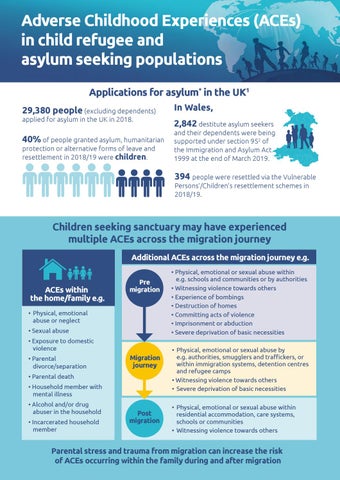
Applications for asylum* in the UK1 29,380 people (excluding dependents) applied for asylum in the UK in 2018.
40% of people granted asylum, humanitarian
protection or alternative forms of leave and resettlement in 2018/19 were children.
In Wales, 2,842 destitute asylum seekers
and their dependents were being supported under section 952 of the Immigration and Asylum Act 1999 at the end of March 2019.
394 people were resettled via the Vulnerable Persons’/Children’s resettlement schemes in 2018/19.
Children seeking sanctuary may have experienced multiple ACEs across the migration journey Additional ACEs across the migration journey e.g.
ACEs within the home/family e.g.
Pre migration
• Physical, emotional abuse or neglect • Sexual abuse • Exposure to domestic violence • Parental divorce/separation
Migration journey
• Parental death • Household member with mental illness • Alcohol and/or drug abuser in the household • Incarcerated household member
2
Post migration
• Physical, emotional or sexual abuse within e.g. schools and communities or by authorities • Witnessing violence towards others • Experience of bombings • Destruction of homes • Committing acts of violence • Imprisonment or abduction • Severe deprivation of basic necessities • Physical, emotional or sexual abuse by e.g. authorities, smugglers and traffickers, or within immigration systems, detention centres and refugee camps • Witnessing violence towards others • Severe deprivation of basic necessities • Physical, emotional or sexual abuse within residential accommodation, care systems, schools or communities • Witnessing violence towards others
Parental stress and trauma from migration can increase the risk of ACEs occurring within the family during and after migration
ACEs in child refugee and asylum seeking populations Experience of ACEs among refugee and asylum seeking children can increase the risk of:
Mental health problems such as PTSD, depression and anxiety
Physical health problems including injury and infection
Behavioural problems
And can affect settling in European countries academic achievement are thought to be affected by a
Up to a third of young refugees mental health disorder.
Certain factors increase the risk of experiencing harms from ACEs Experiencing multiple ACEs
Being unaccompanied
Pre-existing vulnerability
Poor parental mental health
Parental financial difficulties
Low host country language skills
Low levels of social support
Perceived discrimination
Longer asylum seeking duration
More relocations in the system
Other factors promote resilience (the ability to overcome challenges) Individual factors e.g. pro-social behaviours, belief that life has meaning, the ability to think positively
Family factors
Community factors
e.g. positive early attachment to caregivers, good family functioning, good parental mental health
e.g. peer friendships, school attendance, good community resources
There is much we can do in Wales to prevent ACEs and their negative impacts • Alongside on-going work on ACEs in general, develop understanding of ACEs among refugee and asylum seeking children living in Wales • Provide TrACE (trauma and ACE) informed services for children and families along the pathway of care • Target unaccompanied minors and those experiencing multiple ACEs for more comprehensive support • Understand and address the challenges of resettlement in Wales (social, economic, cultural) to help develop and maintain sources of resilience
In Wales, a number of organisations involved in the support and care of refugee and asylum seeking families and children have trained or are training staff in ACE awareness.
* See Box 1 in main report for definitions of an asylum seeker and a refugee 1. Home Office 2019. 2. Section 95 support is for asylum seekers that have on-going claims, who are destitute or almost destitute and their dependents 3. Kien et al, 2018 The information in this infographic is taken from the report: Adverse Childhood Experiences in child refugee and asylum seeking populations. Wood S, Ford K, Hardcastle K, Hopkins J, Hughes K. and Bellis M A (2020). Cardiff: Public Health Wales NHS Trust. PROFIADAU NIWEIDIOL MEWN PLENTYNDOD ADVERSE CHILDHOOD EXPERIENCES 3