
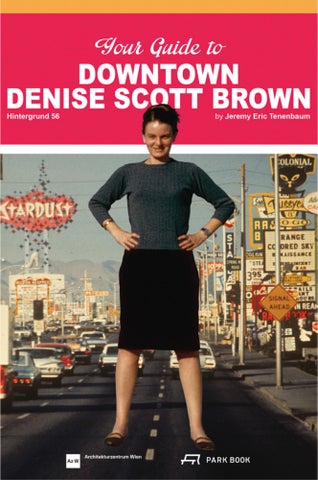
Your Guide to Downtown Denise Scott Brown_BLAD

Page 1


built environment on a daily basis. Waterproof clothing and welly boots are provided.

The exhibition Assemble. How we build at Architekturzentrum Wien will enable visitors to experience ten selected projects in a very direct way in large-scale installations. Videos, drawings, and other types of documentation will explain the collaborative processes involved in assembling their projects. Sample materials add a haptic level of experience. This publication in the Az W series Hintergrund provides an echo and gives those unable to attend the exhibition a first taste of the work of Assemble. The publication will also include material from a one-year visiting professorship of Assemble in Vienna. From the very first discussions in preparation for the exhibition, I considered it important not only to document their work, but also bring Assemble’s way of working to Vienna. This wish was fulfilled through co-operation with the Faculty of Architecture and Planning of the Vienna University of Technology. Together with students and David Calas as the local teacher, Assemble asked the question: “How does Vienna build?” An intense architectural investigation of the historical materiality of the city placed the focus on brick and its social, economic, and ecological contexts. In their second term, the students became a maker’s collective: how might Vienna build? In a collaborative design process they developed a pavilion for the courtyard of Architekturzentrum Wien. An experiment using bricks and clay, the structure is to be built by the students themselves. The pavilion with its integrated kiln will turn into a workshop in summer for new pro-

duction experiments and classes. When this publication appears, the construction of the pavilion will still be in progress. It was deliberately scheduled to last three weeks beyond the opening of the exhibition. The collective construction process thus becomes part of the exhibition. The pavilion is not only a public workshop but also an inviting, airy venue at the MQ during the summer, a site of collective reflection on what architecture can contribute to a good life.

Hence, the question “What can architecture do?” has also turned into “What can an architecture exhibition do?” My thanks go to all collaborators who were ready to engage in this adventure. I am particularly grateful to Assemble, especially Maria Lisogorskaya and Lewis Jones, for their intense and inspiring collaboration; thanks must also go to the Vienna University of Technology, particularly Dean Rudolf Scheuvens and the Dean of Studies Christian Kühn, as well as future.lab and the knowledge platform Öffentlicher Raum established in co-operation with the City of Vienna, the Institute of Arts and Design, David Calas and all the students. Thanks also go to Wienerberger Ziegelindustrie GmbH and especially Vanessa Rausch for their support as well as to CREAU, Lukas Böckle for the use of their workshops. I am greatly indebted to my co-curator Katharina Ritter, the authors of this publication, to Sonja Pisarik for the editing and the entire team of Architekturzentrum Wien, with whom co-production day-to-day is a genuine pleasure. Introduction │13

Angelika Fitz, Vienna, March 2017

built environment on a daily basis. Waterproof clothing and welly boots are provided.

The exhibition Assemble. How we build at Architekturzentrum Wien will enable visitors to experience ten selected projects in a very direct way in large-scale installations. Videos, drawings, and other types of documentation will explain the collaborative processes involved in assembling their projects. Sample materials add a haptic level of experience. This publication in the Az W series Hintergrund provides an echo and gives those unable to attend the exhibition a first taste of the work of Assemble. The publication will also include material from a one-year visiting professorship of Assemble in Vienna. From the very first discussions in preparation for the exhibition, I considered it important not only to document their work, but also bring Assemble’s way of working to Vienna. This wish was fulfilled through co-operation with the Faculty of Architecture and Planning of the Vienna University of Technology. Together with students and David Calas as the local teacher, Assemble asked the question: “How does Vienna build?” An intense architectural investigation of the historical materiality of the city placed the focus on brick and its social, economic, and ecological contexts. In their second term, the students became a maker’s collective: how might Vienna build? In a collaborative design process they developed a pavilion for the courtyard of Architekturzentrum Wien. An experiment using bricks and clay, the structure is to be built by the students themselves. The pavilion with its integrated kiln will turn into a workshop in summer for new pro-

Introduction │13

The Meet Point: Denise Scott Brown

“I use my life as a quarry. This is a trick I learned while teaching: students understand better and can take possession of knowledge and skills more easily if you share with them your experiences in acquiring them. So the accounts of my life are not autobiography but parable.”

Having Words

duction experiments and classes. When this publication appears, the construction of the pavilion will still be in progress. It was deliberately scheduled to last three weeks beyond the opening of the exhibition. The collective construction process thus becomes part of the exhibition. The pavilion is not only a public workshop but also an inviting, airy venue at the MQ during the summer, a site of collective reflection on what architecture can contribute to a good life.

Come on then, you and I. Let’s go meet Denise.

Hence, the question “What can architecture do?” has also turned into “What can an architecture exhibition do?” My thanks go to all collaborators who were ready to engage in this adventure. I am particularly grateful to Assemble, especially Maria Lisogorskaya and Lewis Jones, for their intense and inspiring collaboration; thanks must also go to the Vienna University of Technology, particularly Dean Rudolf Scheuvens and the Dean of Studies Christian Kühn, as well as future.lab and the knowledge platform Öffentlicher Raum established in co-operation with the City of Vienna, the Institute of Arts and Design, David Calas and all the students. Thanks also go to Wienerberger Ziegelindustrie GmbH and especially Vanessa Rausch for their support as well as to CREAU, Lukas Böckle for the use of their workshops. I am greatly indebted to my co-curator Katharina Ritter, the authors of this publication, to Sonja Pisarik for the editing and the entire team of Architekturzentrum Wien, with whom co-production day-to-day is a genuine pleasure.

At evening’s twilight, you and I cross the courtyard of the Architekturzentrum Wien. A sundown yellow glows across the windows. We wind through silhouetted trees and enter Downtown:

Golden lights winking above, a soft sound of water, the café hum. Ahead of us, high up on the far wall -- a woman’s face, grand but half-hidden. We turn to the murmuring fountain and there she is again, projected across the monument’s summit, smiling wryly down on us -- then flowing away in digital sparkle, transformed into her other faces scenes, old then young, leaves from her tree. Beneath, along its curving facade, the fountain declares: “I AM A MONUMENT.”

This woman is a famous architect and urbanist. She is a teacher and writer whose ideas have guided lifetimes. Together with her partner and husband, she redirected the course of 20th century design. Now some at last celebrate her and others discover her for the first time. Denise Scott Brown is a monument, famous if half-hidden, center of our story.

A Counterclockwise Life

Denise Scott Brown and Robert Venturi led a movement against rigid, doctrinaire late Modernism. Working at the crossroads of architecture and urbanism, Denise and Bob freed architects to embrace history, context, communication, social concern, symbolism, Pop Art, multicultural and pluralistic perspectives, and the “messy vitality” of the vernacular. “High art” and “low art” were brought eye-to-eye, and purity of expression was challenged by lively impurity: no wonder they became so controversial.

Angelika Fitz, Vienna, March 2017

built environment on a daily basis. Waterproof clothing and welly boots are provided.

The exhibition Assemble. How we build at Architekturzentrum Wien will enable visitors to experience ten selected projects in a very direct way in large-scale installations. Videos, drawings, and other types of documentation will explain the collaborative processes involved in assembling their projects. Sample materials add a haptic level of experience. This publication in the Az W series Hintergrund provides an echo and gives those unable to attend the exhibition a first taste of the work of Assemble. The publication will also include material from a one-year visiting professorship of Assemble in Vienna. From the very first discussions in preparation for the exhibition, I considered it important not only to document their work, but also bring Assemble’s way of working to Vienna. This wish was fulfilled through co-operation with the Faculty of Architecture and Planning of the Vienna University of Technology. Together with students and David Calas as the local teacher, Assemble asked the question: “How does Vienna build?” An intense architectural investigation of the historical materiality of the city placed the focus on brick and its social, economic, and ecological contexts. In their second term, the students became a maker’s collective: how might Vienna build? In a collaborative design process they developed a pavilion for the courtyard of Architekturzentrum Wien. An experiment using bricks and clay, the structure is to be built by the students themselves. The pavilion with its integrated kiln will turn into a workshop in summer for new pro-

Downtown Denise Scott Brown spans eightyseven years and three continents: from Africa to Europe to North America. Within the United States, our story leaps from East Coast to West Coast and back again.

Here’s a brief timeline of the projects, publications, battles, milestones, and adventures you’ll meet along the way.

duction experiments and classes. When this publication appears, the construction of the pavilion will still be in progress. It was deliberately scheduled to last three weeks beyond the opening of the exhibition. The collective construction process thus becomes part of the exhibition. The pavilion is not only a public workshop but also an inviting, airy venue at the MQ during the summer, a site of collective reflection on what architecture can contribute to a good life.

South Africa

October 3, 1931 Denise Lakofski is born in Nkana, a mining town in Rhodesia (now Zambia). She has two sisters, a brother, and a vibrant extended family.

1933 Contracts what may or may not be malaria. For her health, family moves to Johannesburg, South Africa.

1933 Denise: “I became a Modernist at two years old.” Her mother hires architects Hanson Tomkin & Finkelstein to design an International Style family house.

1935 Family briefly travels to London because Denise’s sister might have polio.

1936 - 1937 “I went to a Victorian Kindergarten run by Mrs. Fraser, American I think, who taught by the Froebel method that Frank Lloyd Wright’s mother used for him.”

Hence, the question “What can architecture do?” has also turned into “What can an architecture exhibition do?” My thanks go to all collaborators who were ready to engage in this adventure. I am particularly grateful to Assemble, especially Maria Lisogorskaya and Lewis Jones, for their intense and inspiring collaboration; thanks must also go to the Vienna University of Technology, particularly Dean Rudolf Scheuvens and the Dean of Studies Christian Kühn, as well as future.lab and the knowledge platform Öffentlicher Raum established in co-operation with the City of Vienna, the Institute of Arts and Design, David Calas and all the students. Thanks also go to Wienerberger Ziegelindustrie GmbH and especially Vanessa Rausch for their support as well as to CREAU, Lukas Böckle for the use of their workshops. I am greatly indebted to my co-curator Katharina Ritter, the authors of this publication, to Sonja Pisarik for the editing and the entire team of Architekturzentrum Wien, with whom co-production day-to-day is a genuine pleasure.

Angelika Fitz, Vienna, March 2017

built environment on a daily basis. Waterproof clothing and welly boots are provided.

The exhibition Assemble. How we build at Architekturzentrum Wien will enable visitors to experience ten selected projects in a very direct way in large-scale installations. Videos, drawings, and other types of documentation will explain the collaborative processes involved in assembling their projects. Sample materials add a haptic level of experience. This publication in the Az W series Hintergrund provides an echo and gives those unable to attend the exhibition a first taste of the work of Assemble. The publication will also include material from a one-year visiting professorship of Assemble in Vienna. From the very first discussions in preparation for the exhibition, I considered it important not only to document their work, but also bring Assemble’s way of working to Vienna. This wish was fulfilled through co-operation with the Faculty of Architecture and Planning of the Vienna University of Technology. Together with students and David Calas as the local teacher, Assemble asked the question: “How does Vienna build?” An intense architectural investigation of the historical materiality of the city placed the focus on brick and its social, economic, and ecological contexts. In their second term, the students became a maker’s collective: how might Vienna build? In a collaborative design process they developed a pavilion for the courtyard of Architekturzentrum Wien. An experiment using bricks and clay, the structure is to be built by the students themselves. The pavilion with its integrated kiln will turn into a workshop in summer for new pro-

Introduction │13

duction experiments and classes. When this publication appears, the construction of the pavilion will still be in progress. It was deliberately scheduled to last three weeks beyond the opening of the exhibition. The collective construction process thus becomes part of the exhibition. The pavilion is not only a public workshop but also an inviting, airy venue at the MQ during the summer, a site of collective reflection on what architecture can contribute to a good life.

Hence, the question “What can architecture do?” has also turned into “What can an architecture exhibition do?” My thanks go to all collaborators who were ready to engage in this adventure. I am particularly grateful to Assemble, especially Maria Lisogorskaya and Lewis Jones, for their intense and inspiring collaboration; thanks must also go to the Vienna University of Technology, particularly Dean Rudolf Scheuvens and the Dean of Studies Christian Kühn, as well as future.lab and the knowledge platform Öffentlicher Raum established in co-operation with the City of Vienna, the Institute of Arts and Design, David Calas and all the students. Thanks also go to Wienerberger Ziegelindustrie GmbH and especially Vanessa Rausch for their support as well as to CREAU, Lukas Böckle for the use of their workshops. I am greatly indebted to my co-curator Katharina Ritter, the authors of this publication, to Sonja Pisarik for the editing and the entire team of Architekturzentrum Wien, with whom co-production day-to-day is a genuine pleasure.

Angelika Fitz, Vienna, March 2017

1960 Meets Robert Venturi at a UPenn faculty meeting

1961 - 1964 Teaches as assistant professor and soon begins teaching collaborations with Bob

1961 Bob begins revising design for Vanna Venturi House in Chestnut Hill neighborhood of Philadelphia

built environment on a daily basis. Waterproof clothing and welly boots are provided.

1964 Venturi and Rauch, Architects and Planners is founded in Philadelphia

1965 Completes master’s degree in architecture at UPenn

USA: West Coast

1965 Leaves UPenn to teach at the University of California Berkeley as a visiting professor in the School of Environmental Design

1965 “The Meaningful City” published in the Journal of the American Institute of Architects

1965 Begins teaching as associate professor in the University of California Los Angeles’s School of Architecture and Urban Planning; named co-chair of urban design program

1965 - 1967 Travels and photographs throughout Southwest USA, including Las Vegas

November 1966 Invites Bob to visit Las Vegas with her

July 23, 1967 Marries Bob in Santa Monica, California

USA: East Coast Again

1967 Returns to Philadelphia to join Venturi and Rauch

1967 - 1971 Teaches as visiting professor in Urban Design at Yale University in New Haven, Connecticut

1968 Completes “Learning from Las Vegas” studio with Yale School of Architecture and Planning

The exhibition Assemble. How we build at Architekturzentrum Wien will enable visitors to experience ten selected projects in a very direct way in large-scale installations. Videos, drawings, and other types of documentation will explain the collaborative processes involved in assembling their projects. Sample materials add a haptic level of experience. This publication in the Az W series Hintergrund provides an echo and gives those unable to attend the exhibition a first taste of the work of Assemble. The publication will also include material from a one-year visiting professorship of Assemble in Vienna. From the very first discussions in preparation for the exhibition, I considered it important not only to document their work, but also bring Assemble’s way of working to Vienna. This wish was fulfilled through co-operation with the Faculty of Architecture and Planning of the Vienna University of Technology. Together with students and David Calas as the local teacher, Assemble asked the question: “How does Vienna build?” An intense architectural investigation of the historical materiality of the city placed the focus on brick and its social, economic, and ecological contexts. In their second term, the students became a maker’s collective: how might Vienna build? In a collaborative design process they developed a pavilion for the courtyard of Architekturzentrum Wien. An experiment using bricks and clay, the structure is to be built by the students themselves. The pavilion with its integrated kiln will turn into a workshop in summer for new pro-

1969 Becomes principal with Venturi and Rauch

duction experiments and classes. When this publication appears, the construction of the pavilion will still be in progress. It was deliberately scheduled to last three weeks beyond the opening of the exhibition. The collective construction process thus becomes part of the exhibition. The pavilion is not only a public workshop but also an inviting, airy venue at the MQ during the summer, a site of collective reflection on what architecture can contribute to a good life.

Hence, the question “What can architecture do?” has also turned into “What can an architecture exhibition do?” My thanks go to all collaborators who were ready to engage in this adventure. I am particularly grateful to Assemble, especially Maria Lisogorskaya and Lewis Jones, for their intense and inspiring collaboration; thanks must also go to the Vienna University of Technology, particularly Dean Rudolf Scheuvens and the Dean of Studies Christian Kühn, as well as future.lab and the knowledge platform Öffentlicher Raum established in co-operation with the City of Vienna, the Institute of Arts and Design, David Calas and all the students. Thanks also go to Wienerberger Ziegelindustrie GmbH and especially Vanessa Rausch for their support as well as to CREAU, Lukas Böckle for the use of their workshops. I am greatly indebted to my co-curator Katharina Ritter, the authors of this publication, to Sonja Pisarik for the editing and the entire team of Architekturzentrum Wien, with whom co-production day-to-day is a genuine pleasure.

Angelika Fitz, Vienna, March 2017

built environment on a daily basis. Waterproof clothing and welly boots are provided.

The exhibition Assemble. How we build at Architekturzentrum Wien will enable visitors to experience ten selected projects in a very direct way in large-scale installations. Videos, drawings, and other types of documentation will explain the collaborative processes involved in assembling their projects. Sample materials add a haptic level of experience. This publication in the Az W series Hintergrund provides an echo and gives those unable to attend the exhibition a first taste of the work of Assemble. The publication will also include material from a one-year visiting professorship of Assemble in Vienna. From the very first discussions in preparation for the exhibition, I considered it important not only to document their work, but also bring Assemble’s way of working to Vienna. This wish was fulfilled through co-operation with the Faculty of Architecture and Planning of the Vienna University of Technology. Together with students and David Calas as the local teacher, Assemble asked the question: “How does Vienna build?” An intense architectural investigation of the historical materiality of the city placed the focus on brick and its social, economic, and ecological contexts. In their second term, the students became a maker’s collective: how might Vienna build? In a collaborative design process they developed a pavilion for the courtyard of Architekturzentrum Wien. An experiment using bricks and clay, the structure is to be built by the students themselves. The pavilion with its integrated kiln will turn into a workshop in summer for new pro-

Introduction │13

duction experiments and classes. When this publication appears, the construction of the pavilion will still be in progress. It was deliberately scheduled to last three weeks beyond the opening of the exhibition. The collective construction process thus becomes part of the exhibition. The pavilion is not only a public workshop but also an inviting, airy venue at the MQ during the summer, a site of collective reflection on what architecture can contribute to a good life.

Hence, the question “What can architecture do?” has also turned into “What can an architecture exhibition do?” My thanks go to all collaborators who were ready to engage in this adventure. I am particularly grateful to Assemble, especially Maria Lisogorskaya and Lewis Jones, for their intense and inspiring collaboration; thanks must also go to the Vienna University of Technology, particularly Dean Rudolf Scheuvens and the Dean of Studies Christian Kühn, as well as future.lab and the knowledge platform Öffentlicher Raum established in co-operation with the City of Vienna, the Institute of Arts and Design, David Calas and all the students. Thanks also go to Wienerberger Ziegelindustrie GmbH and especially Vanessa Rausch for their support as well as to CREAU, Lukas Böckle for the use of their workshops. I am greatly indebted to my co-curator Katharina Ritter, the authors of this publication, to Sonja Pisarik for the editing and the entire team of Architekturzentrum Wien, with whom co-production day-to-day is a genuine pleasure.

Angelika Fitz, Vienna, March 2017

Up and Down Downtown

Toulouse Provincial Capitol

built environment on a daily basis. Waterproof clothing and welly boots are provided.

Up and Down Downtown

In Toulouse, we had this wonderful discovery: a road that we suggested across the cleared site had previously existed in the same location. We were merely reconnecting two things that had previously been connected for maybe 500 years -- reconnecting exactly where they should be! That’s what I call an encounter with the palimpsest: how you encounter the patterns underneath.

The exhibition Assemble. How we build at Architekturzentrum Wien will enable visitors to experience ten selected projects in a very direct way in large-scale installations. Videos, drawings, and other types of documentation will explain the collaborative processes involved in assembling their projects. Sample materials add a haptic level of experience. This publication in the Az W series Hintergrund provides an echo and gives those unable to attend the exhibition a first taste of the work of Assemble. The publication will also include material from a one-year visiting professorship of Assemble in Vienna. From the very first discussions in preparation for the exhibition, I considered it important not only to document their work, but also bring Assemble’s way of working to Vienna. This wish was fulfilled through co-operation with the Faculty of Architecture and Planning of the Vienna University of Technology. Together with students and David Calas as the local teacher, Assemble asked the question: “How does Vienna build?” An intense architectural investigation of the historical materiality of the city placed the focus on brick and its social, economic, and ecological contexts. In their second term, the students became a maker’s collective: how might Vienna build? In a collaborative design process they developed a pavilion for the courtyard of Architekturzentrum Wien. An experiment using bricks and clay, the structure is to be built by the students themselves. The pavilion with its integrated kiln will turn into a workshop in summer for new pro-

duction experiments and classes. When this publication appears, the construction of the pavilion will still be in progress. It was deliberately scheduled to last three weeks beyond the opening of the exhibition. The collective construction process thus becomes part of the exhibition. The pavilion is not only a public workshop but also an inviting, airy venue at the MQ during the summer, a site of collective reflection on what architecture can contribute to a good life.

Hence, the question “What can architecture do?” has also turned into “What can an architecture exhibition do?” My thanks go to all collaborators who were ready to engage in this adventure. I am particularly grateful to Assemble, especially Maria Lisogorskaya and Lewis Jones, for their intense and inspiring collaboration; thanks must also go to the Vienna University of Technology, particularly Dean Rudolf Scheuvens and the Dean of Studies Christian Kühn, as well as future.lab and the knowledge platform Öffentlicher Raum established in co-operation with the City of Vienna, the Institute of Arts and Design, David Calas and all the students. Thanks also go to Wienerberger Ziegelindustrie GmbH and especially Vanessa Rausch for their support as well as to CREAU, Lukas Böckle for the use of their workshops. I am greatly indebted to my co-curator Katharina Ritter, the authors of this publication, to Sonja Pisarik for the editing and the entire team of Architekturzentrum Wien, with whom co-production day-to-day is a genuine pleasure.

Angelika Fitz, Vienna, March 2017

built environment on a daily basis. Waterproof clothing and welly boots are provided.

The exhibition Assemble. How we build at Architekturzentrum Wien will enable visitors to experience ten selected projects in a very direct way in large-scale installations. Videos, drawings, and other types of documentation will explain the collaborative processes involved in assembling their projects. Sample materials add a haptic level of experience. This publication in the Az W series Hintergrund provides an echo and gives those unable to attend the exhibition a first taste of the work of Assemble. The publication will also include material from a one-year visiting professorship of Assemble in Vienna. From the very first discussions in preparation for the exhibition, I considered it important not only to document their work, but also bring Assemble’s way of working to Vienna. This wish was fulfilled through co-operation with the Faculty of Architecture and Planning of the Vienna University of Technology. Together with students and David Calas as the local teacher, Assemble asked the question: “How does Vienna build?” An intense architectural investigation of the historical materiality of the city placed the focus on brick and its social, economic, and ecological contexts. In their second term, the students became a maker’s collective: how might Vienna build? In a collaborative design process they developed a pavilion for the courtyard of Architekturzentrum Wien. An experiment using bricks and clay, the structure is to be built by the students themselves. The pavilion with its integrated kiln will turn into a workshop in summer for new pro-

Vanna Venturi House

duction experiments and classes. When this publication appears, the construction of the pavilion will still be in progress. It was deliberately scheduled to last three weeks beyond the opening of the exhibition. The collective construction process thus becomes part of the exhibition. The pavilion is not only a public workshop but also an inviting, airy venue at the MQ during the summer, a site of collective reflection on what architecture can contribute to a good life.

Hence, the question “What can architecture do?” has also turned into “What can an architecture exhibition do?” My thanks go to all collaborators who were ready to engage in this adventure. I am particularly grateful to Assemble, especially Maria Lisogorskaya and Lewis Jones, for their intense and inspiring collaboration; thanks must also go to the Vienna University of Technology, particularly Dean Rudolf Scheuvens and the Dean of Studies Christian Kühn, as well as future.lab and the knowledge platform Öffentlicher Raum established in co-operation with the City of Vienna, the Institute of Arts and Design, David Calas and all the students. Thanks also go to Wienerberger Ziegelindustrie GmbH and especially Vanessa Rausch for their support as well as to CREAU, Lukas Böckle for the use of their workshops. I am greatly indebted to my co-curator Katharina Ritter, the authors of this publication, to Sonja Pisarik for the editing and the entire team of Architekturzentrum Wien, with whom co-production day-to-day is a genuine pleasure.

With Bob’s house for his mother, it’s fascinating to trace the migration of ideas -diagonal zoots, the nowhere stair, the big chimney, the melding of Michelangelo and Levitt, consecration of stairways, the miniaturization and infantilization of suburbia, and the late arrival, after Bob and I began our work and life together, of the street through the building. I loved the contradictions, the broken rules, the strong juxtapositions that make it mannerist and recall historical Mannerism. But I criticized the decoration.

Angelika Fitz, Vienna, March 2017

Natural Structure

These are all human structures about natural form.I love to extend them.

built environment on a daily basis. Waterproof clothing and welly boots are provided.

Patterns: In the 1950s, a lot of people were talking about natural structure. My friend Wolfram [Schlote], who was Robert [Scott Brown]’s friend and then mine, photographed beautiful things you could find in natural structure: crystal structure, cliff structure, structure in fields. I loved that structure -- but then I found the geometric structure of fish set out on the sidewalk of High Street, London -- a beautiful structure. And so were the shoes and so were the glasses -- these are all human structures about natural form. I love to extend them.

The exhibition Assemble. How we build at Architekturzentrum Wien will enable visitors to experience ten selected projects in a very direct way in large-scale installations. Videos, drawings, and other types of documentation will explain the collaborative processes involved in assembling their projects. Sample materials add a haptic level of experience. This publication in the Az W series Hintergrund provides an echo and gives those unable to attend the exhibition a first taste of the work of Assemble. The publication will also include material from a one-year visiting professorship of Assemble in Vienna. From the very first discussions in preparation for the exhibition, I considered it important not only to document their work, but also bring Assemble’s way of working to Vienna. This wish was fulfilled through co-operation with the Faculty of Architecture and Planning of the Vienna University of Technology. Together with students and David Calas as the local teacher, Assemble asked the question: “How does Vienna build?” An intense architectural investigation of the historical materiality of the city placed the focus on brick and its social, economic, and ecological contexts. In their second term, the students became a maker’s collective: how might Vienna build? In a collaborative design process they developed a pavilion for the courtyard of Architekturzentrum Wien. An experiment using bricks and clay, the structure is to be built by the students themselves. The pavilion with its integrated kiln will turn into a workshop in summer for new pro-

Urban patterns form through the particular kind of system where the building block is a grid for good reasons and a marketplace is at the crossroads for good reasons, along with other important things like a cathedral and the ruler’s castle nearby.

You could take this system into a living room and ask what all these elements represent in a living room -- or you could take it into New York and ask what do they mean there. In New York you have to deal with where the highest density should be, what size sites people are looking for, what size sites are needed in the future, what growth should be permitted and which prevented. If you allow for a building on this site now and you don’t want it to invade everything around it, you allow channels for where it can grow and channels for where it can’t. So you are allowing for the uncertainty of growth but you’re channeling it. If you don’t want something very important -socially or historically precious -- to be swept away, you find ways to allow access where you want a lot of people to be and limit access by what you want to protect.

Introduction │13

duction experiments and classes. When this publication appears, the construction of the pavilion will still be in progress. It was deliberately scheduled to last three weeks beyond the opening of the exhibition. The collective construction process thus becomes part of the exhibition. The pavilion is not only a public workshop but also an inviting, airy venue at the MQ during the summer, a site of collective reflection on what architecture can contribute to a good life.

Hence, the question “What can architecture do?” has also turned into “What can an architecture exhibition do?” My thanks go to all collaborators who were ready to engage in this adventure. I am particularly grateful to Assemble, especially Maria Lisogorskaya and Lewis Jones, for their intense and inspiring collaboration; thanks must also go to the Vienna University of Technology, particularly Dean Rudolf Scheuvens and the Dean of Studies Christian Kühn, as well as future.lab and the knowledge platform Öffentlicher Raum established in co-operation with the City of Vienna, the Institute of Arts and Design, David Calas and all the students. Thanks also go to Wienerberger Ziegelindustrie GmbH and especially Vanessa Rausch for their support as well as to CREAU, Lukas Böckle for the use of their workshops. I am greatly indebted to my co-curator Katharina Ritter, the authors of this publication, to Sonja Pisarik for the editing and the entire team of Architekturzentrum Wien, with whom co-production day-to-day is a genuine pleasure.

Angelika Fitz, Vienna, March 2017

built environment on a daily basis. Waterproof clothing and welly boots are provided.

The exhibition Assemble. How we build at Architekturzentrum Wien will enable visitors to experience ten selected projects in a very direct way in large-scale installations. Videos, drawings, and other types of documentation will explain the collaborative processes involved in assembling their projects. Sample materials add a haptic level of experience. This publication in the Az W series Hintergrund provides an echo and gives those unable to attend the exhibition a first taste of the work of Assemble. The publication will also include material from a one-year visiting professorship of Assemble in Vienna. From the very first discussions in preparation for the exhibition, I considered it important not only to document their work, but also bring Assemble’s way of working to Vienna. This wish was fulfilled through co-operation with the Faculty of Architecture and Planning of the Vienna University of Technology. Together with students and David Calas as the local teacher, Assemble asked the question: “How does Vienna build?” An intense architectural investigation of the historical materiality of the city placed the focus on brick and its social, economic, and ecological contexts. In their second term, the students became a maker’s collective: how might Vienna build? In a collaborative design process they developed a pavilion for the courtyard of Architekturzentrum Wien. An experiment using bricks and clay, the structure is to be built by the students themselves. The pavilion with its integrated kiln will turn into a workshop in summer for new pro-

duction experiments and classes. When this publication appears, the construction of the pavilion will still be in progress. It was deliberately scheduled to last three weeks beyond the opening of the exhibition. The collective construction process thus becomes part of the exhibition. The pavilion is not only a public workshop but also an inviting, airy venue at the MQ during the summer, a site of collective reflection on what architecture can contribute to a good life.

Hence, the question “What can architecture do?” has also turned into “What can an architecture exhibition do?” My thanks go to all collaborators who were ready to engage in this adventure. I am particularly grateful to Assemble, especially Maria Lisogorskaya and Lewis Jones, for their intense and inspiring collaboration; thanks must also go to the Vienna University of Technology, particularly Dean Rudolf Scheuvens and the Dean of Studies Christian Kühn, as well as future.lab and the knowledge platform Öffentlicher Raum established in co-operation with the City of Vienna, the Institute of Arts and Design, David Calas and all the students. Thanks also go to Wienerberger Ziegelindustrie GmbH and especially Vanessa Rausch for their support as well as to CREAU, Lukas Böckle for the use of their workshops. I am greatly indebted to my co-curator Katharina Ritter, the authors of this publication, to Sonja Pisarik for the editing and the entire team of Architekturzentrum Wien, with whom co-production day-to-day is a genuine pleasure.

Angelika Fitz, Vienna, March 2017

In 1972 I went to Miami Beach with Bob and we discovered South Beach: all Art Deco Cubist, small hotels in pastel colors, shapes like portholes and boomerangs, sunbursts. We wrote to the head of the Miami American Institute of Architects to say how very unique it was, in America and the world. We heard nothing. Then I read in Preservation News about the Miami Design Preservation League and Barbara Capitman who formed it, and she and I became fast friends. Well, three years later we submitted a proposal to re-plan part of South Beach and we gave it a name, the Deco District, akin to the Vieux Carre in New Orleans. Bisecting it was Washington Avenue which was lined with discount outlets and convenience and cheap restaurants. Cuban supermarkets next to Kosher butchers, tawdry but vital. We recommended how to conserve the Deco but evolve, but critics called it the “Deco scam,” they thought it threatened their economy. Afterward I saw the Deco District on TV: Miami Vice. Barbara Capitman was their design advisor!

built environment on a daily basis. Waterproof clothing and welly boots are provided.

The exhibition Assemble. How we build at Architekturzentrum Wien will enable visitors to experience ten selected projects in a very direct way in large-scale installations. Videos, drawings, and other types of documentation will explain the collaborative processes involved in assembling their projects. Sample materials add a haptic level of experience. This publication in the Az W series Hintergrund provides an echo and gives those unable to attend the exhibition a first taste of the work of Assemble. The publication will also include material from a one-year visiting professorship of Assemble in Vienna. From the very first discussions in preparation for the exhibition, I considered it important not only to document their work, but also bring Assemble’s way of working to Vienna. This wish was fulfilled through co-operation with the Faculty of Architecture and Planning of the Vienna University of Technology. Together with students and David Calas as the local teacher, Assemble asked the question: “How does Vienna build?” An intense architectural investigation of the historical materiality of the city placed the focus on brick and its social, economic, and ecological contexts. In their second term, the students became a maker’s collective: how might Vienna build? In a collaborative design process they developed a pavilion for the courtyard of Architekturzentrum Wien. An experiment using bricks and clay, the structure is to be built by the students themselves. The pavilion with its integrated kiln will turn into a workshop in summer for new pro12│Angelika Fitz

Introduction │13

duction experiments and classes. When this publication appears, the construction of the pavilion will still be in progress. It was deliberately scheduled to last three weeks beyond the opening of the exhibition. The collective construction process thus becomes part of the exhibition. The pavilion is not only a public workshop but also an inviting, airy venue at the MQ during the summer, a site of collective reflection on what architecture can contribute to a good life.

Hence, the question “What can architecture do?” has also turned into “What can an architecture exhibition do?” My thanks go to all collaborators who were ready to engage in this adventure. I am particularly grateful to Assemble, especially Maria Lisogorskaya and Lewis Jones, for their intense and inspiring collaboration; thanks must also go to the Vienna University of Technology, particularly Dean Rudolf Scheuvens and the Dean of Studies Christian Kühn, as well as future.lab and the knowledge platform Öffentlicher Raum established in co-operation with the City of Vienna, the Institute of Arts and Design, David Calas and all the students. Thanks also go to Wienerberger Ziegelindustrie GmbH and especially Vanessa Rausch for their support as well as to CREAU, Lukas Böckle for the use of their workshops. I am greatly indebted to my co-curator Katharina Ritter, the authors of this publication, to Sonja Pisarik for the editing and the entire team of Architekturzentrum Wien, with whom co-production day-to-day is a genuine pleasure.

Angelika Fitz, Vienna, March 2017

duction experiments and classes. When this publication appears, the construction of the pavilion will still be in progress. It was deliberately scheduled to last three weeks beyond the opening of the exhibition. The collective construction process thus becomes part of the exhibition. The pavilion is not only a public workshop but also an inviting, airy venue at the MQ during the summer, a site of collective reflection on what architecture can contribute to a good life.

Hence, the question “What can architecture do?” has also turned into “What can an architecture exhibition do?” My thanks go to all collaborators who were ready to engage in this adventure. I am particularly grateful to Assemble, especially Maria Lisogorskaya and Lewis Jones, for their intense and inspiring collaboration; thanks must also go to the Vienna University of Technology, particularly Dean Rudolf Scheuvens and the Dean of Studies Christian Kühn, as well as future.lab and the knowledge platform Öffentlicher Raum established in co-operation with the City of Vienna, the Institute of Arts and Design, David Calas and all the students. Thanks also go to Wienerberger Ziegelindustrie GmbH and especially Vanessa Rausch for their support as well as to CREAU, Lukas Böckle for the use of their workshops. I am greatly indebted to my co-curator Katharina Ritter, the authors of this publication, to Sonja Pisarik for the editing and the entire team of Architekturzentrum Wien, with whom co-production day-to-day is a genuine pleasure.

Angelika Fitz, Vienna, March 2017

called something like Saunders even before that in the ‘40s.) Bob wouldn’t believe me; we had a huge argument. He said, “Of course America started it! And the artists were leading!” and I said, “It’s nice to see the artists in America catching up.” And finally the book on Paolozzi came out and he saw what I meant. It’s not as deep as the American Pop Art, but they stand on his shoulders, and it’s very vital interesting stuff. And Ian Hamilton doing the same thing; he’s married to Judith Henderson who’s a sociologist. So now a sociologist begins to introduce Peter Smithson to ideas like those of Herb Gans

Finally something happens with the Smithsons and they depart from Pop Art and they depart from sociology and they become Miesian and less interesting to us. In fact not interesting at all. In fact really hostile to us. Alison Smithson became extremely hostile to me and she had been a very good friend to my sister. Peter said, “The sociologists will have to extend their thought before I can work with them,” but I know what he meant; you try working with Herb Gans -- he’s churlish as all get-out!

So anyway, I knew all about that when I met Bob -- I’d been fighting with Paul Davidoff for two years by the time I’d met Bob and I continued to as he taught the theories course. Now it’s very interesting: there was a group of people meeting to discuss curriculum at Penn as I was a student and then when I joined the faculty. They were not architects, they were planners; it was in

the planning department. Bret Harris, for example, had long experience planning things to allow for creativity. And Dave Crane knew about such things. So I was listening to all this and also dealing with the Mannerist side of things when I met Bob over the use of this very Mannerist Building [the Fisher Fine Arts Library]. It breaks all the rules and I loved it. I was the only one. I said, “You mustn’t demolish it! Paint it white inside and use it.” And Bob came up afterward and said, “I agreed with everything you said (except the paint it white part). My name’s Robert Venturi.” And I said, “Why didn’t you say something?” We were friends from then. Then Bob, when he got back from Rome, started to work as an assistant to Lou [Kahn], and he started to share his ideas with Lou. Just two weeks before he left Rome -- not before then -- he decided Mannerism was for him.

built environment on a daily basis. Waterproof clothing and welly boots are provided.

The exhibition Assemble. How we build at Architekturzentrum Wien will enable visitors to experience ten selected projects in a very direct way in large-scale installations. Videos, drawings, and other types of documentation will explain the collaborative processes involved in assembling their projects. Sample materials add a haptic level of experience. This publication in the Az W series Hintergrund provides an echo and gives those unable to attend the exhibition a first taste of the work of Assemble. The publication will also include material from a one-year visiting professorship of Assemble in Vienna. From the very first discussions in preparation for the exhibition, I considered it important not only to document their work, but also bring Assemble’s way of working to Vienna. This wish was fulfilled through co-operation with the Faculty of Architecture and Planning of the Vienna University of Technology. Together with students and David Calas as the local teacher, Assemble asked the question: “How does Vienna build?” An intense architectural investigation of the historical materiality of the city placed the focus on brick and its social, economic, and ecological contexts. In their second term, the students became a maker’s collective: how might Vienna build? In a collaborative design process they developed a pavilion for the courtyard of Architekturzentrum Wien. An experiment using bricks and clay, the structure is to be built by the students themselves. The pavilion with its integrated kiln will turn into a workshop in summer for new pro-

In Europe, everyone was using the word “Mannerism”; in America, no one was using it. That word didn’t just come out of him. He’ll say it did.

Colin Rowe had been at the English Academy in Rome and lectured frequently. He said, “Denise, you must admit I was Mr. Mannerist of the 1950s.” They’d heard him lecture on Mannerism. I think someone heard a talk from Colin Rowe, and Colin had probably discovered Brasini’s buildings and said “Let’s go on an expedition.” So Bob went and saw the Brasini buildings and decided, “This is latter-day Mannerism.”

Here’s Downtown’s arthouse cinema,

Turn static files into dynamic content formats.
Create a flipbook