Laure Adler is a journalist, writer and historian, who specialises in women studies and feminism in the 19th and 20th centuries. She contributed to Dangerous Women: The Perils of Muses and Femmes Fatales (Flammarion, 2010) and has authored numerous essays and books, including Marguerite Duras: A Life (Phoenix, 2001), whose French edition was awarded the Prix Femina.
Clara Bouveresse is a photography historian, a member of the Institut Universitaire de France and a lecturer in English studies at the University of Évry Paris-Saclay. Her books include A History of the Magnum Agency (2017) and Photographs Straight Out of Bed (2020). She curated the exhibitions Unretouched Women: Eve Arnold, Abigail Heyman, Susan Meiselas (2019) and Erica Lennard: Women, Sisters (2025) at the Rencontres de la Photographie d’Arles, as well as cocurating An Imperfect World, with Isabella Seniuta and Guillaume Blanc in 2020–21 and exhibitions dedicated to Didier Lefèvre and to Stanley Greene’s work.
OPENING UP THE INFINITY OF THE WORLD
Laure Adler 7 WOMEN PHOTOGRAPHERS
Anna Atkins 24
Julia Margaret Cameron 26
Virginia de Castiglione 28
Christina Broom 30
Frances Benjamin Johnston 32
Alice Austen 34
Olive Edis 36
Laure Albin Guillot 38
Imogen Cunningham 40
Claude Cahun 42
Dorothea Lange 44
Tina Modotti 46
Berenice Abbott 48
Anita Conti 50
Lisette Model 52
Margaret Bourke-White 54
Grete Stern 56
Dora Maar 58
Julia Pirotte 60
Lee Miller 62
Edith Tudor-Hart 64
Gerda Taro 66
Eve Arnold 68
Helen Levitt 70
Janine Niépce 72
Diane Arbus 74
Lisetta Carmi 76
Vivian Maier 78
Agnès Varda 80
Claudia Andujar 82
Claude Batho 84
Letizia Battaglia 86
Marianne Wex 88
Martine Franck 90
Sarah Moon 92
Sandra Eleta 94
Abigail Heyman 96
Graciela Iturbide 98
Paz Errázuriz 100
Catherine Leroy 102
Christine Spengler 104
Paola Agosti 106
Ishiuchi Miyako 108
Susan Meiselas 110
Sophie Ristelhueber 112
Erica Lennard 114
Donna Gottschalk 116
Alix Cléo Roubaud 118
Sophie Calle 120
Nan Goldin 122
Anne Noble 124
Cindy Sherman 126
Pushpamala N. 128
Ouka Leele 130
Shirin Neshat 132
Francesca Woodman 134
Lorna Simpson 136
Angèle Etoundi Essamba 138
Désirée Dolron 140
Géraldine Lay 142
Zanele Muholi 144
Sara Bennett 146
Shadi Ghadirian 148
Tarrah Krajnak 150
Gohar Dashti 152
Laia Abril 154
Bieke Depoorter 156
Maya Inès Touam 158
AGNÈS VARDA
p. 6
CLAUDE CAHUN
‘Self-Portrait’, c. 1928, private collection
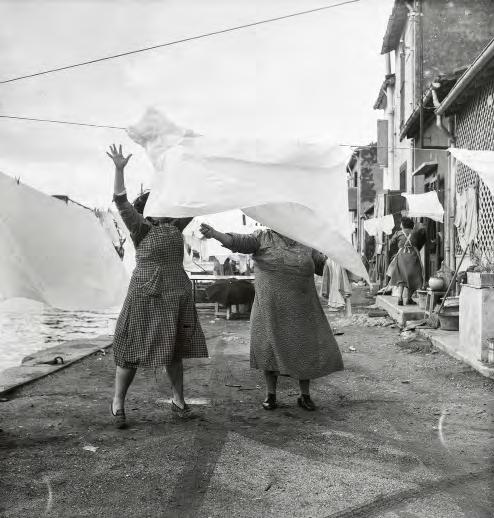
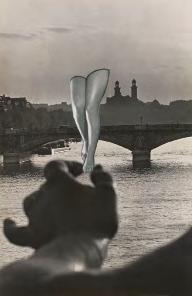
‘Washing on the Quai du Mistral’, from her film, La Pointe Courte, March 1954, Agnès Varda Estate – Agnès Varda Archive, held at the Institut pour la photographie
Move along, nothing to see here. Just some women in aprons in their husbands’ or brothers’ studios; ever compliant and obedient women doing the preparation for a work that will eventually be signed… by the man.
Multitasking women, minor-tasking women, women reduced to silence for decades, even those who were artists themselves; we are now very familiar with the implacable mechanism that renders women in the art world and the world in general invisible. Yet what is so distinctive about the major art of photography is that, from its very beginnings, it was regarded, not least by its inventor, as an activity so simple that it lay within the competence of women and children.
In 1838, Louis Daguerre announced his invention to the public by saying: ‘Even though the result is achieved by chemical means, this little task might well be found pleasing by ladies.’ The more photography was practised, the more accessible it became for persons of the feminine sex, who, as we all know, are not greatly endowed with technical or creative skills. Thus, the invention of the portable camera, the Kodak – a device so easy to use that its publicity made a point of saying that it was designed for women to play around with. Of course, it’s well-known that all women are ditzy. Likewise, the Leica made out-of-focus pictures a thing of the past. Likewise, the Polaroid: just press a button and it’s done. Click.
The problem is, to the chagrin of certain gentlemen who police the art world, women have never simply played around with photography. On the contrary, from the very beginning, they have taken it very seriously indeed and wielded it as a tool of emancipation, research, resistance, the documentation of real life, the exploration of self and other, and a way of finding beauty.
In many cases, they have appropriated the medium and turned it into an art, following its various technical developments, testing its boundaries and constantly redefining it. 1 For if you know how to see, you can capture reality, and this representation of the real that photography offers us is capable of changing our perception, our vision. This is probably what is so particular about the act of looking at photographs. Unlike paintings or drawings, they create an effect of truth (even if it is constructed) that goes straight to the heart and moves us immediately. We project ourselves. We are there. The art of photography opens up the infinity of the world, whether imaginary or real, introspective or
1. There are many books on the subject of photography. See Peter E. Palmquist, A Bibliography of Writings by and about Women in Photography, 1850–2000,
Arcata, published by the author, 1994; or Liz Heron and Val Williams, Illuminations: Women Writing on Photography 1850s to the Present, London, I. B. Tauris, 1996.
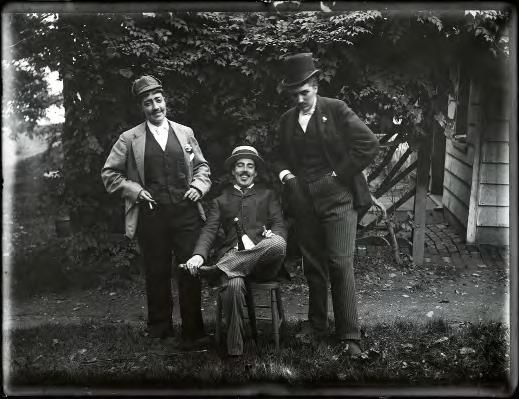
↑ ‘Julia Martin, Julia Bredt and Self Dressed Up, Sitting Down’, 15 October 1891, silver emulsion on glass plate, Staten Island, Alice Austen House Museum
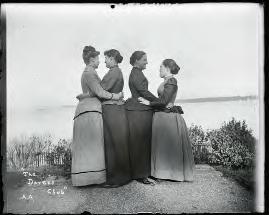
‘The Darned Club’, 1891, silver emulsion on glass plate, Staten Island, Alice Austen House Museum
ALICE AUSTEN
1866–1952, USA
Bicycling for Ladies , Violet Ward’s 1896 book defending women’s right to ride bicycles, was replete with illustrations showing how to negotiate bends or do repairs. The images were based on photos taken by Alice Austen, who had a personal interest, as she went about herself on two wheels, carting her heavy photographic equipment with her. Her boldness didn’t end there. A non-conformist, she lived more or less openly for nearly 56 years with her partner Gertrude Tate. Indeed, their house on Staten Island, New York, is today a museum dedicated to her work and her role in the history of homosexuality.
Alice Austen started taking photographs at the age of 10 and was entirely selftaught. She developed her own negatives, created albums and used the new invention of the flash to work indoors in poor light. She photographed people she knew as they played sport or went on excursions, recording the lifestyles of the better-off. In 1895, she began a series on the workers and shopkeepers on the streets of New York, from the ragpickers to the errand boys to the organ grinders. She also documented life in the quarantine station on Staten Island, where would-be immigrants were processed.
She lost her fortune in the crash of 1929 and had to leave her house in 1945.
Rediscovered in the 1950s, her work includes around 7,000 images. Many of them subverted the conventional ways of taking portraits then in vogue. Austen sometimes posed her female friends dressed as men, embracing or sharing a bed, providing a rare insight into relations between women at the turn of the 20th century.
CLAUDE CAHUN
1894, France–1954, Jersey
Born into a middle-class family in Nantes, Lucy Schwob studied philosophy and literature at the Sorbonne. They adopted the pseudonym Claude Cahun in 1917, while their partner Suzanne Malherbe, whom they first met at school, would take the pen name Marcel Moore. The couple lived in Paris between 1918 and 1937, frequented surrealist circles and worked in the theatre, creating costumes, scripts and illustrations, even acting on stage. In 1930, they published Aveux non avenus [Cancelled Confessions], which combined poems and photomontages in which Cahun took on a number of different personae. Dressed as either a man or a woman, androgynous, with long hair or a shaved head, they explored sexual ambiguity, codes of femininity and masculinity through dressing up, reflections and doublings (see p. 6).
‘Masculine? Feminine? Well, that depends on the situation. Neuter is the only gender that always fits,’ they wrote.
In 1934, Claude Cahun signed Les Paris sont ouverts [Place Your Bets], a
pamphlet against the cultural policy of the Communist Party, criticising the views of Louis Aragon. They participated in the foundation of the revolutionary group Contre-Attaque [Counterattack] with André Breton and Georges Bataille in 1935. In parallel, they created photographic images of objects as various as puppets, dolls, utensils, scraps of fabric, pens, playing cards, sticks, enhanced with gouache, notably their illustrations to Lise Deharme’s collection of poems Le Cœur de pic .
In 1938, the couple moved to a farm on Jersey, which they called the Farm with No Name. At the start of the Second World War, they joined the Resistance, printing and distributing pamphlets. They were arrested in July 1944 and sentenced to death but saved by the liberation of the island in May 1945. A large part of their work was destroyed at the time of their detention. Claude Cahun’s work was rediscovered in the early 1980s and was appreciated for its avant-garde subversion of gender norms.
‘Untitled’, c. 1936–39 gelatin silver print, Paris, Centre Pompidou
DORA MAAR
1907–1997, France
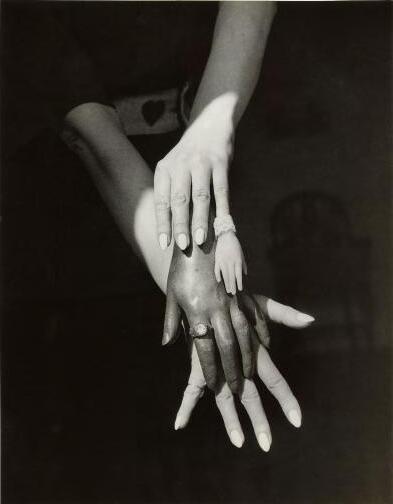
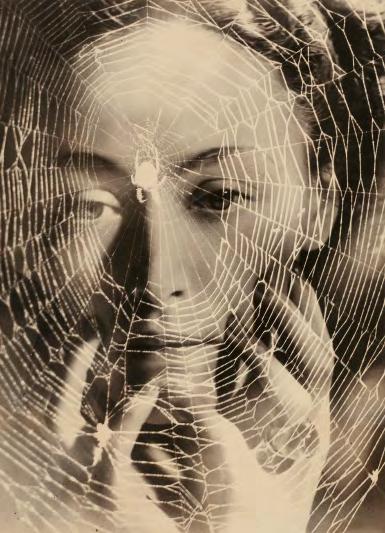
Born in Paris, Henriette Theodora Markovitch grew up between Argentina and France. She trained at the Ladies’ Committee of the Central Union of Decorative Arts, then at the Académie Jullian, in the studio of André Lhote and at the Technical College of Photography and Cinematography of the City of Paris. She adopted the pseudonym Dora Maar in the late 1920s and in 1931, along with the cinema designer Pierre Kéfer, established a studio in Neuilly specialising in portraits and fashion shots. She later opened her own studio and worked on commission for women’s magazines. She frequented avant-garde circles, exhibited with the surrealists in 1934 and 1937 and experimented artistically with film stills, double exposures, erotic nudes, photomontage, still life and street photography. Her hybrid creations displayed a surrealist fascination for the strange and dreams.
She was also interested in social issues, such as the poverty of the wastelands on the outskirts of Paris or life in deprived areas of London and Barcelona. Like Claude Cahun, she was one of the signatories of the manifesto of the revolutionary group Contre-Attaque [Counterattack].
In 1936, she became the lover and model of Pablo Picasso. She documented the successive stages in the realisation of the painting Guernica , which denounced the attack by Franco’s
bombers, produced film stills and took up painting again, inspired by cubism. When they split up for good in 1946, she fell into a depression and underwent psychoanalysis with Jacques Lacan. She moved to the Lubéron and made ink drawings of Provence landscapes before returning briefly to photography in an abstract vein in the 1980s. Her original work, sometimes overshadowed by her relationship with Picasso, shows that active women running thriving studios could succeed commercially and is testament to their contribution to the artistic adventure of the interwar period.
← ‘Les années vous guettent’ [The Years Are Catching Up with You], 1936, gelatin silver print, private collection
↑ ‘Untitled’, 1935, gelatin silver print, Paris, Centre Pompidou
LISETTA CARMI
1924–2022, Italy
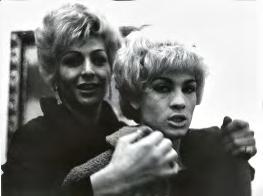
Lisetta Carmi took up photography in the early 1960s, abandoning her career as a pianist after a trip to Apulia with the ethnomusicologist Leo Levi. She committed herself to political social documentary, exploring the world of work or the lives of children being cared for in Gaslini hospital in Genoa. In the port of Genoa, she witnessed the harsh working conditions of the dockers. With the support of the Italian Federation of Port Workers, her exhibition toured the country and travelled as far as the Soviet Union. In 1966, she published a collection of photos of the monumental cemetery of Staglieno and a book of images of people on the streets of Paris, accompanied by words by Alain Robbe-Grillet. Her 1966 portrait of the poet Ezra Pound at home won the Niépce prize for Italy.
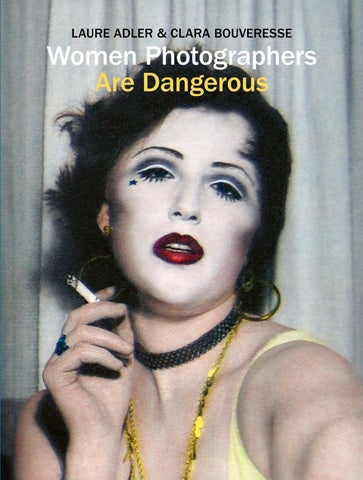
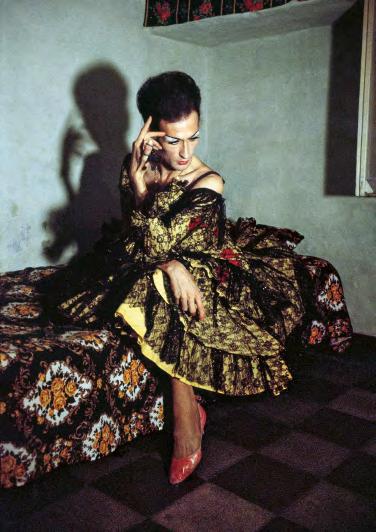
Between 1965 and 1971, she gained the confidence and friendship of transvestite prostitutes living in a house in Genoa’s former Jewish ghetto. In 1972, Sergio Donnabella founded the publishing house Essedi with the aim of publishing a book based on her photos, which hadn’t found a publisher up until then. But it proved too incendiary for the bookshops, who refused to sell it, and only a few hundred copies of the 3,000 printed escaped being pulped. Over time, she gave up photography to devote herself to her spiritual quest and opened an ashram in Apulia.
The rediscovery of her work on transvestites led to the publication in 2022 of an expanded edition, including colour images. Lisetta Carmi denounced the stigmatisation of transvestites by a society that ‘uses them, pays them, judges them’. Her portraits gave visibility and dignity to ostracised people whose very existence threatens the fundamentals of the social order: ‘I believe that the judgement that we make on others is almost always a judgement that we make on ourselves. What we are afraid of in others is also inside us. And we always defend ourselves by attacking that part of us that we reject.’ 1
1. Back cover blurb of I travestiti, Rome, Essedi, 1972.
↑ ‘I travestiti, Novia e la bella Elena’ [The Cross-dressers, Novia and the Lovely Elena], 1965–67
Genoa, Galleria Martini e Ronchetti
→ ‘I travesti, Lola Montez’ [The Crossdressers, Lola Montez], 1965–70, Genoa, Galleria Martini e Ronchetti
GRACIELA ITURBIDE
1942, Mexico
Graciela Iturbide began studying cinema at the age of 27, when she already had three children and was in the throes of a divorce, thus breaking with her conservative upbringing. She turned to photography when she met Manuel Álvarez Bravo, who encouraged her on this path. She became his assistant and travelled all over the country with him. Deeply affected by the loss of her daughter, who died at the age of six in 1970, she documented child funerals in the cemeteries of Mexico, where the graves were decorated with paper cutouts and flowers, and photographed the Day of the Dead ritual.
In 1978, she received a commission from the National Ethnographic Archive to document indigenous groups, such as the nomadic Seri in the Sonora desert in the north-west of Mexico. The following year, she began a decade-
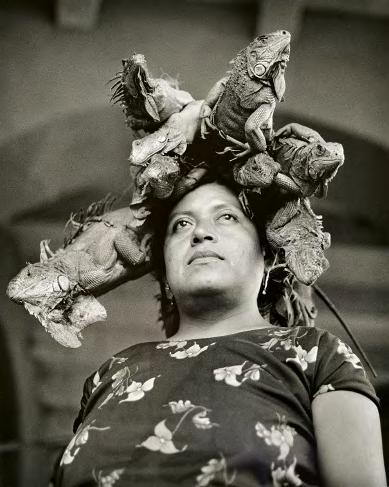
long study of the Juchitán people in the south of the country. Embedded in their community, she tried to avoid the pitfalls of exoticism as peddled in touristic clichés. She published Juchitán de las mujeres [Juchitán of the Women] in 1989, highlighting the central political role played by women in this community. Her high-contrast black-and-white photographs showed the intermingling of traditional rituals and modernity, illustrating the salience of pre-Hispanic cultural ideas. Her portrait of a woman with her head crowned by reptiles, captured one market day, shows the irruption of strangeness and magic into everyday life. Avoiding downbeat condescension, she defended indigenous and popular cultures by unveiling their mystery and poetry.
Various commissions took her to Cuba, Germany, India, Madagascar, Hungary, France and the USA. In 2019, she published a book containing her photographs of birds, a recurring motif in her work. From poultry in shops to skies filled with enigmatic clouds, these sometimes lyrical sometimes prosaic photographs interrogated our relationship with the living world.
‘Nuestra Señora de las Iguanas, Juchitán, Oaxaca’ [Our Lady of the Iguanas, Juchitán, Oaxaca], 1979, gelatin silver print, Santa Monica, ROSEGALLERY
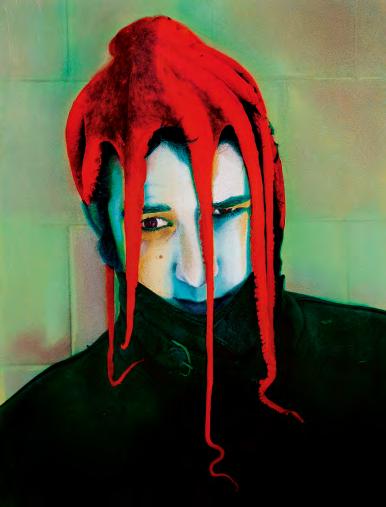
An octopus, a bird, a miniature plane, a ventilator, lemons, knives, shoes or tortoises disguised as hats: the portraits in the Peluquería series of 1979 make up an unusual and extravagant gallery. Photographed in black and white, her pictures were then hand-painted, mostly in watercolour. The garish, saturated, kitsch colours accentuate the acidic artifice of her drole and incongruous juxtapositions. These surrealist provocations demonstrate the subversive spirit of Movida, which was shaking off the shackles of the Franco era. In the democratic opening-up of the late 1970s, Ouka Leele was a leading figure in this movement of cultural liberation embodied in the cinema of Pedro Almodóvar, whom she was close to, and who showcased many of her works in his films.
OUKA LEELE
1957–2022, Spain
After studying painting, drawing and sculpture, she trained at the Madrid Photocentro in 1976. Born Barbara Allende Gil de Biedma, she adopted the pseudonym Ouka Leele in the late 1970s, her ‘war name, artist’s name’. Moving between the fantastical, the absurd and burlesque, she tried her hand at nudes, still lives and portraits, but also video and poetry. A number of her compositions ironically combined female figures with household devices, subverting the conventions of advertising posters in an eccentric sublimation of the ‘domestic goddess’. Ouka Leele reclaimed the blurring of genres and nonconformity: ‘I am a photographer, but, as in Magritte’s painting, this is not a photograph!’ 1
1. Interview with Élise Padovani and Annie Gava, 14 November 2013, published in Zibeline magazine on the occasion of the 12th edition of the Festival of Spanish Cinema in Marseille.
‘Invraisemblances, Pulpo Rojo’ [Unlikelihoods, Red Pulp], Peluquería [At the Hairdresser’s] series, 1979
MAYA IN È S TOUAM
1988, France
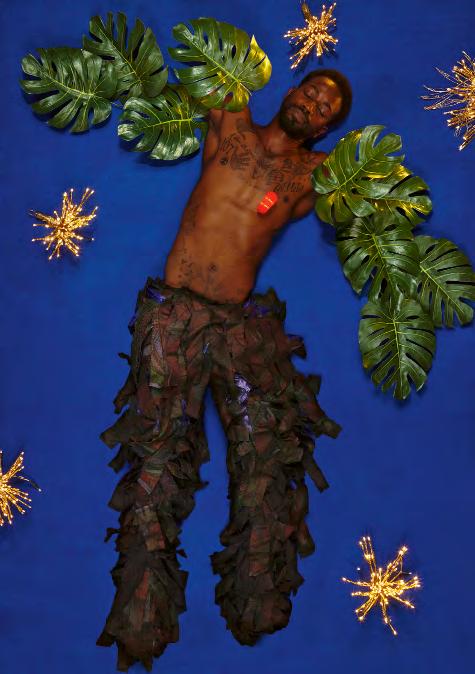
The granddaughter of Algerian immigrants, Naya Inès Touam interrogates her cultural heritage between France and the Maghreb. Drawing her references from the history of art, she presents a daring creolisation of artistic traditions. Icare, le revenant [Icarus the Ghost], for example, cites a celebrated gouache découpage by Henri Matisse representing the fallen Greek hero, punished for flying too close to the sun. The Black man with the leafy wings, open against a blue background, relates to current political events, evoking exile and the crushed hopes of the migrants who drowned in the Mediterranean.
She describes the dazzling deep colours that characterise her work as a form of ‘photographic fauvism’. This is particularly evident in her still lives in the series Ready-Made , an assembly of Moroccan objects revealing contemporary vanities, or the project Sanctuarium , in which she collects religious objects from various regions of the African continent such as statuettes, rugs or candlesticks, whether from monotheist religions or nomadic rituals. The prints are inserted as panels in altarpieces that open like windows on a heteroclite spirituality.
Maya Inès Touam is also interested in Arabic femininities, with her portraits of Algerian women displaying a diversity of cultural practices, and the different ways in which they wear or don’t wear the veil; these portraits are accompanied by testimonies. Her work is not confined to photography exclusively. Her sculpture Burqafacette represents the silhouette of a woman covered in a mosaic of mirrors, twirling like a glittering disco ball. In La France est tissu de migrations [France Is Woven by Migrations], she constructs a map of France made of sewn-together fabrics from the former colonies. The work of Maya Inès Touam employs the canons of western art to open up a rich hybrid visual space illustrating contemporary cultural fusions.
‘Icare, le revenant’ [Icarus the Ghost], 2020, pigment print, Paris, Galerie Les Filles du Calvaire