Laure Adler is a journalist, writer and historian, who specialises in women studies and feminism in the 19th and 20th centuries. She contributed to Dangerous Women: The Perils of Muses and Femmes Fatales (Flammarion, 2010) and has authored numerous essays and books, including Marguerite Duras: A Life (Phoenix, 2001), whose French edition was awarded the Prix Femina.
Clara Bouveresse is a photography historian, a member of the Institut Universitaire de France and a lecturer in English studies at the University of Évry Paris-Saclay. Her books include A History of the Magnum Agency (2017) and Photographs Straight Out of Bed (2020). She curated the exhibitions Unretouched Women: Eve Arnold, Abigail Heyman, Susan Meiselas (2019) and Erica Lennard: Women, Sisters (2025) at the Rencontres de la Photographie d’Arles, as well as cocurating An Imperfect World, with Isabella Seniuta and Guillaume Blanc in 2020–21 and exhibitions dedicated to Didier Lefèvre and to Stanley Greene’s work.
OPENING UP THE INFINITY OF THE WORLD
Laure Adler 7 WOMEN PHOTOGRAPHERS
Anna Atkins 24
Julia Margaret Cameron 26
Virginia de Castiglione 28
Christina Broom 30
Frances Benjamin Johnston 32
Alice Austen 34
Olive Edis 36
Laure Albin Guillot 38
Imogen Cunningham 40
Claude Cahun 42
Dorothea Lange 44
Tina Modotti 46
Berenice Abbott 48
Anita Conti 50
Lisette Model 52
Margaret Bourke-White 54
Grete Stern 56
Dora Maar 58
Julia Pirotte 60
Lee Miller 62
Edith Tudor-Hart 64
Gerda Taro 66
Eve Arnold 68
Helen Levitt 70
Janine Niépce 72
Diane Arbus 74
Lisetta Carmi 76
Vivian Maier 78
Agnès Varda 80
Claudia Andujar 82
Claude Batho 84
Letizia Battaglia 86
Marianne Wex 88
Martine Franck 90
Sarah Moon 92
Sandra Eleta 94
Abigail Heyman 96
Graciela Iturbide 98
Paz Errázuriz 100
Catherine Leroy 102
Christine Spengler 104
Paola Agosti 106
Ishiuchi Miyako 108
Susan Meiselas 110
Sophie Ristelhueber 112
Erica Lennard 114
Donna Gottschalk 116
Alix Cléo Roubaud 118
Sophie Calle 120
Nan Goldin 122
Anne Noble 124
Cindy Sherman 126
Pushpamala N. 128
Ouka Leele 130
Shirin Neshat 132
Francesca Woodman 134
Lorna Simpson 136
Angèle Etoundi Essamba 138
Désirée Dolron 140
Géraldine Lay 142
Zanele Muholi 144
Sara Bennett 146
Shadi Ghadirian 148
Tarrah Krajnak 150
Gohar Dashti 152
Laia Abril 154
Bieke Depoorter 156
Maya Inès Touam 158
ANNA ATKINS
1799–1891, UK
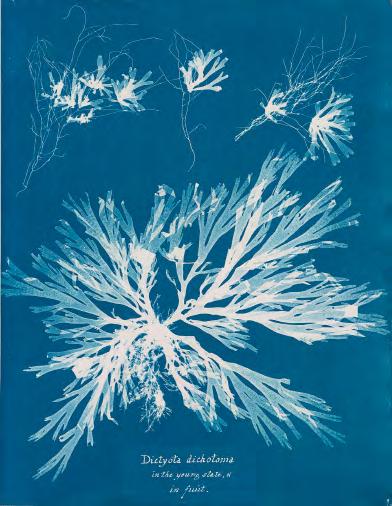
The daughter of naturalist John George Children, in 1823 Anna Atkins provided the illustrations for his translation of Jean-Baptise Lamarck’s book on molluscs. A watercolourist and lithographer who had an interest in the natural sciences, in 1838 she became a member of the London Botanical Society, one of the very few scientific institutions that accepted women. She transformed scientific publishing and illustration through her use of a new photographic technique, namely the cyanotype method, developed by the astronomer John Herschel. This involved making an image through contact, without the use of a camera, by exposing an object on a surface coated in iron salts that reacted to sunlight. The contours of the plants were picked out in white in extraordinary detail when the print was developed, contrasting with the paper, which was tinted Prussian blue.
Between 1843 and 1853, she used this method to illustrate William Henry Harvey’s work on algae. The silhouette of each specimen, accompanied by its Latin name, seemed to unfurl in a translucid liquid. She later published a book of 160 plates of plants and ferns dedicated to her friend Anne Dixon, who helped her produce her collections and prints. On the opening page, the plants formed an elegant crown around the title, illustrating the combination of erudition and formal harmony that she brought to each fascicle.
These books were reference works for the scientific community and established the new medium of photography as a tool of scientific discovery, exploration and record, prized for its rigour and precision. Their pared-down aesthetic, bringing to mind stencils and herbariums, also attracted art collectors. Anna Atkins invented the genre of the photographic book in all its diverse forms, opening the way to its use in education and science, but also art.
‘Dictyota dichotoma’, 1849–50, cyanotype on paper, New York, The New York Public Library
CHRISTINA BROOM
1862–1939, UK
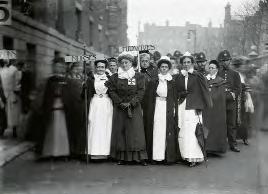
Christina Broom is the creator of magnificent photos of Suffragette marches demanding votes for women prior to the First World War. Her images are a record of the ferment and diverse forms of activism, the banners with elaborate coats of arms carried by the regional and professional delegations, and the posters used for fundraising. She got up close with the militants with her cumbersome equipment and her tripod and took full-length photos of the leaders of the marches, giving a human face to the growing feminist movement. Boldly she went out her studio to capture the political action on the streets and she exploited her photos commercially by producing much sought-after postcards, which gave the movement a great deal of publicity.
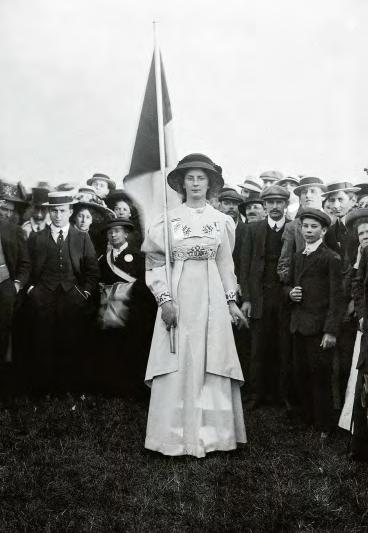
Self-taught, Christina took up photography in 1903 in order to provide for her family. She documented university boat races and public appearances by the royal family. Her daughter acted as her assistant, working in the darkroom to produce the postcards that made money for the family business. As the official photographer of the royal guard, she managed to go behind the parades and the pomp to capture moments of rest and camaraderie. Taken on the occasion of the rally on 23 July 1910, one of her best-known images features Charlotte Marsh, standing out in white against a largely male crowd dressed in black. Charlotte had been incarcerated the previous year and had been force-fed during her hunger strike in prison. She proudly carries the flag of the Women’s Social and Political Union, whose upright pole gives her an authority that seems to part the crowd, emphasising her stature and her direct gaze.
‘Nurses and Midwives
← ‘Suffragette Charlotte (Charlie) Marsh at Hyde Park Rally’, 1908, silver emulsion on cellulose acetate
Marching to the Albert Hall’, 27 April 1909, silver emulsion on glass plate
DORA MAAR
1907–1997, France
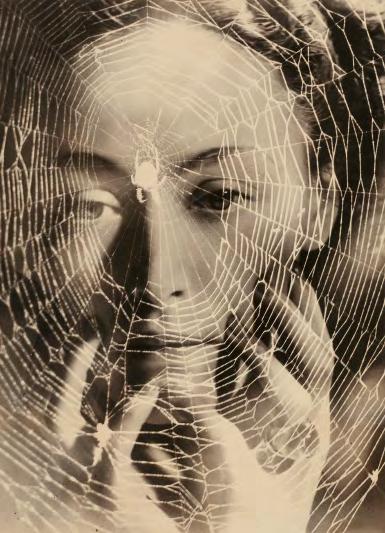
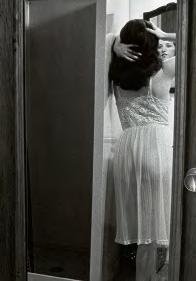
Born in Paris, Henriette Theodora Markovitch grew up between Argentina and France. She trained at the Ladies’ Committee of the Central Union of Decorative Arts, then at the Académie Jullian, in the studio of André Lhote and at the Technical College of Photography and Cinematography of the City of Paris. She adopted the pseudonym Dora Maar in the late 1920s and in 1931, along with the cinema designer Pierre Kéfer, established a studio in Neuilly specialising in portraits and fashion shots. She later opened her own studio and worked on commission for women’s magazines. She frequented avant-garde circles, exhibited with the surrealists in 1934 and 1937 and experimented artistically with film stills, double exposures, erotic nudes, photomontage, still life and street photography. Her hybrid creations displayed a surrealist fascination for the strange and dreams.
She was also interested in social issues, such as the poverty of the wastelands on the outskirts of Paris or life in deprived areas of London and Barcelona. Like Claude Cahun, she was one of the signatories of the manifesto of the revolutionary group Contre-Attaque [Counterattack].
In 1936, she became the lover and model of Pablo Picasso. She documented the successive stages in the realisation of the painting Guernica , which denounced the attack by Franco’s
bombers, produced film stills and took up painting again, inspired by cubism. When they split up for good in 1946, she fell into a depression and underwent psychoanalysis with Jacques Lacan. She moved to the Lubéron and made ink drawings of Provence landscapes before returning briefly to photography in an abstract vein in the 1980s. Her original work, sometimes overshadowed by her relationship with Picasso, shows that active women running thriving studios could succeed commercially and is testament to their contribution to the artistic adventure of the interwar period.
← ‘Les années vous guettent’ [The Years Are Catching Up with You], 1936, gelatin silver print, private collection
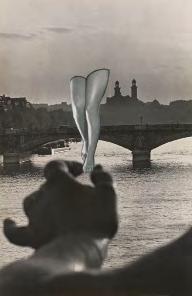
↑ ‘Untitled’, 1935, gelatin silver print, Paris, Centre Pompidou
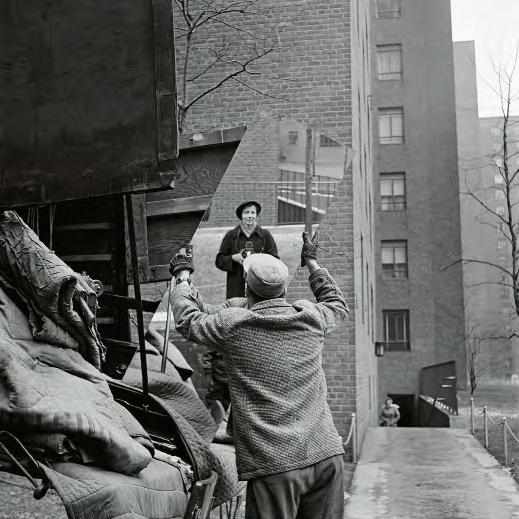
↑ ‘Self-Portrait’, 1955, New York, Howard Greenberg Gallery
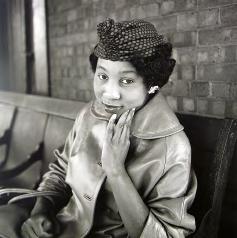
→ ‘Chicago’, 16 May 1957, New York, Howard Greenberg Gallery
VIVIAN MAIER
1926–2009, USA
The ‘nanny photographer’ Vivian Maier has excited much interest since the end of the 2000s with the discovery of her work, which was never shown in her lifetime. It came about when the collector John Maloof acquired her vast photographic archive, when the storage facility in which it was kept was obliged to sell it in 2007 because of a default on payment of rent. This discovery marked the beginning of the process of reconstructing her mysterious life story. Vivian Maier had made thousands of prints of striking modernity, echoing the works of some of the great figures of street photography. Who was this prolific and enigmatic woman who had ended up alone and penniless having processed nearly 100,000 negatives in the utmost secrecy? In 2013, Maloof produced the film Finding Vivian Maier , cleverly feeding the mythology and the speculation around her work, from which he was profiting handsomely.
Vivian Maier grew up between France and the USA. She worked as a nurse in New York and Chicago, while practising photography with the aid of a cheap camera, a Box Brownie, then after 1952 a Rolleiflex. She developed and printed her own snaps, playing with geometry, shadows and reflections of urban scenes. She also used colour and travelled abroad. Did she see herself as an artist and did she want her images to be seen? In a biography published in 2017, Pamela Bannos dismissed the legend of the ‘Mary Poppins of photography’, dreamed up by certain men for their own profit, and defended the coherence of her technical and formal work. Her posthumous celebrity remains ambiguous, however, especially as she appears in a large number of self-portraits, at the edge of a mirror or a shadow, a fleeting, elusive presence.
GRACIELA ITURBIDE
1942, Mexico
Graciela Iturbide began studying cinema at the age of 27, when she already had three children and was in the throes of a divorce, thus breaking with her conservative upbringing. She turned to photography when she met Manuel Álvarez Bravo, who encouraged her on this path. She became his assistant and travelled all over the country with him. Deeply affected by the loss of her daughter, who died at the age of six in 1970, she documented child funerals in the cemeteries of Mexico, where the graves were decorated with paper cutouts and flowers, and photographed the Day of the Dead ritual.
In 1978, she received a commission from the National Ethnographic Archive to document indigenous groups, such as the nomadic Seri in the Sonora desert in the north-west of Mexico. The following year, she began a decade-
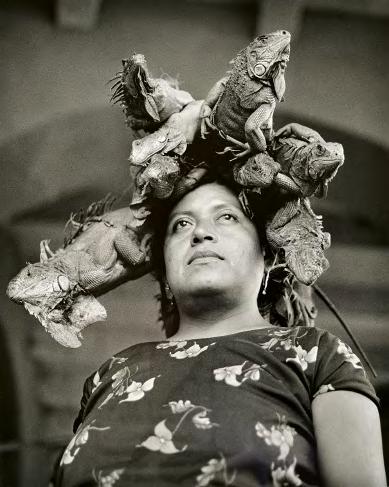
long study of the Juchitán people in the south of the country. Embedded in their community, she tried to avoid the pitfalls of exoticism as peddled in touristic clichés. She published Juchitán de las mujeres [Juchitán of the Women] in 1989, highlighting the central political role played by women in this community. Her high-contrast black-and-white photographs showed the intermingling of traditional rituals and modernity, illustrating the salience of pre-Hispanic cultural ideas. Her portrait of a woman with her head crowned by reptiles, captured one market day, shows the irruption of strangeness and magic into everyday life. Avoiding downbeat condescension, she defended indigenous and popular cultures by unveiling their mystery and poetry.
Various commissions took her to Cuba, Germany, India, Madagascar, Hungary, France and the USA. In 2019, she published a book containing her photographs of birds, a recurring motif in her work. From poultry in shops to skies filled with enigmatic clouds, these sometimes lyrical sometimes prosaic photographs interrogated our relationship with the living world.
‘Nuestra Señora de las Iguanas, Juchitán, Oaxaca’ [Our Lady of the Iguanas, Juchitán, Oaxaca], 1979, gelatin silver print, Santa Monica, ROSEGALLERY
NAN GOLDIN
1953, USA
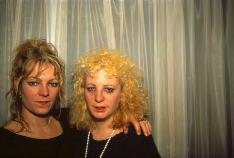
In the early 1980s, Nan Goldin exhibited in a bar on Times Square in New York, where she worked as a waitress, a series of photographs of her friends in the LGBTQIA+ community. Her images with their acidic colours, lit by a blinding flash, were shown as a slideshow of more than 700 slides accompanied by songs. Breaking with the convention of glossy prints on museum picture rails, The Ballad of Sexual Dependency caused a sensation at the Whitney Museum of American Art in 1985 and at the Rencontres de la photographie d’Arles in 1987 and inspired whole new generations of photographers.
This intimate journal combining sound and images contained a recessed memory of her sister, whose suicide had blighted her adolescence. This prolific documentation of the links connecting her circle of friends transformed photography into a tool of resistance against loss and forgetting. Nan Goldin dealt uncompromisingly with themes such as love, sexuality, cross-dressing, drugs and the AIDS epidemic. In 1987, she published a book drawn from this series. The cover shows her lover Brian sitting on the edge of a bed, smoking, with his back turned, while she lies still recumbent in the bed straight after making love. Later, a self-portrait details with forensic precision her bruised and swollen face after being beaten by Brian, whom she subsequently left.
In 2004, Nan Goldin paid homage to her sister in her installation Sister, Saints, & Sybils , which documented her confinement in psychiatric facilities as well as Nan’s own experience of such institutions receiving treatment for addiction and depression. She later campaigned against the Sackler family. Respected patrons of major museums, the Sacklers were the owners of the pharmaceutical firm that sold a highly addictive opioid that was implicated in the deaths of hundreds of thousands of Americans. This struggle and her life are the subject of a 2023 documentary by Laura Poitras, All the Beauty and the Bloodshed .
↑ ‘Cookie with Me After I Was Punched, Baltimore, Maryland’, 1986, colour print, artist’s collection
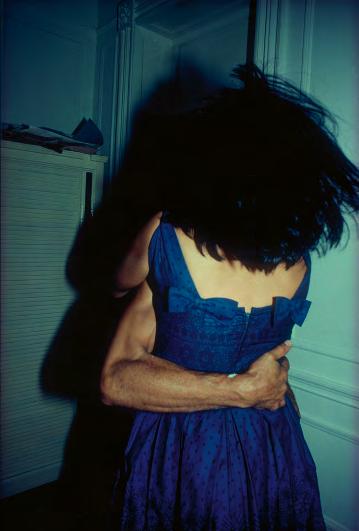
→ ‘The Hug, New York City’, 1980, colour print, artist’s collection
CINDY SHERMAN
1954, USA
A sense of déjà-vu: Cindy Sherman’s photographs seem to be taken from black-and-white Hollywood films, replete with glamorous actresses and dramatic situations. They are, however, all staged. Her Untitled Film Stills , 1977–80, in fact do not come from actual films. In each case, the beautiful young woman is none other than the photographer herself, decked out in wigs to embody Hollywood stereotypes. These images reveal the hegemony on the screen of what Laura Mulvey in 1975 called the ‘male gaze’. Women are seen as passive objects, offered for consumption, created by and for the pleasure of men.
These photos created from scratch and yet so familiar show how much we are saturated by visual mass culture. Cindy Sherman continued her exploration using advertising and media images, drawing on the worlds of pornography, fashion, fairy tales, monsters, dolls, masks and the history of art. Her transformations were achieved by use of extravagant toupees, prosthetics and make-up; they hover between the grotesque and the scary. The abused body becomes a support
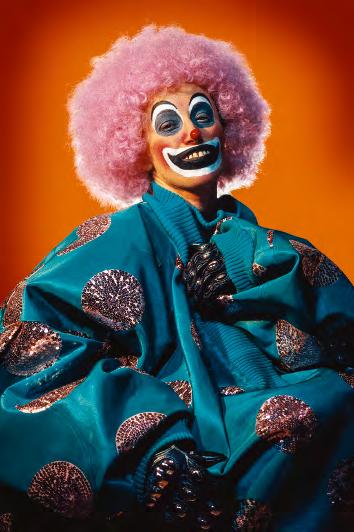
for fictional identities, exposing our obsession with ageing, our narcissism and our compulsive consumerism. She also incarnated archetypes from the middle classes or high society, reappropriating the expensive symbols of their power, and in 2017 subverted the tools used on Instagram for correcting and improving selfies. Her Clowns series (2002–03) crystallised the latent anxiety that haunts her work, as the deformed features scrawled on her face seem to obliterate any human expression, sad greasepaint disguising a collapse of entertainment.
↑ ‘Untitled Film Still #81’, 1980, gelatin silver print, artist’s collection
Zanele Muholi grew up in a Durban township and is an activist against the violence inflicted on lesbians and transgender people in Black South African communities, focusing on the punitive rapes that happen despite the fact that there has been a judicial framework in place since the 1990s banning discrimination on the basis of sexual orientation. As a non-binary person, Zanele Muholi wishes to be designated by the neutral pronoun they/them and describes themself as a ‘visual activist’.
They co-founded the Forum for the Empowerment of Women in 2002 and then, in 2006, created Inkanyiso, the Zulu word for light, an online space for queer visual expression. They devote their photography to their activism and make portraits of LGBTQIA+ Black people. Working in cooperation with their models, they give a visibility and dignity to these people who are so often unseen and stigmatised, paying homage to their courage. Sometimes photographed over many years, the models participate in the progressive construction of their identity. In headand-shoulder pose, looking straight at the camera, they assert their existence and their singularity. This collection of nearly 300 portraits constitutes a collective archive attesting to the diversity and solidarity of this community.
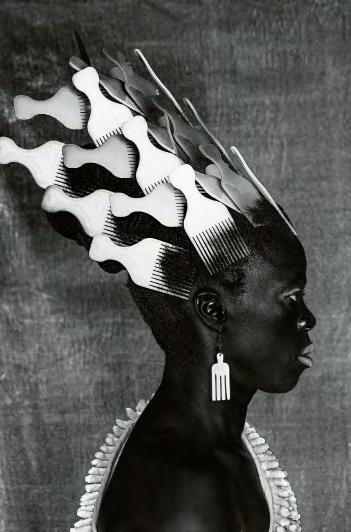
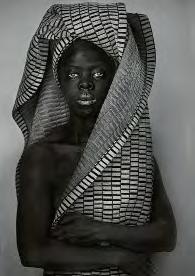
In 2012, Zanele Muholi began their series Somnyama Ngonyama , which in Zulu means ‘Hail, black lioness’. They shot 365 self-portraits featuring monumental hairstyles including, for example, combs, clothes pins, sunglasses and string, playing with the prejudices underlying representations of racialised women. Subverting dress codes, they also used fabrics contrasting with the deliberately accentuated darkness of their skin to interrogate and reclaim their identity.
← ‘Qiniso, The Sails, Durban’, Somnyama Ngonyama series, 2019, gelatin silver print, New York, Yancey Richardson Gallery
↑ ‘Lena, London’, Somnyama Ngonyama series, 2018, gelatin silver print, New York, Yancey Richardson Gallery