
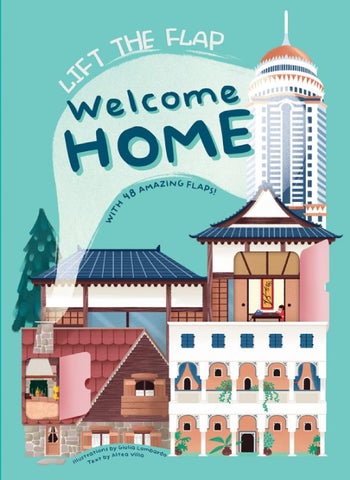
Welcome Home With 48 Amazing Flaps

Page 1


HELLO! Our names are Ulysses and Blue. We’ve discovered something very interesting, and we can’t wait to share it with you.

DID

YOU KNOW THAT THERE ARE MANY DIFFERENT TYPES OF HOUSES IN THE WORLD?

You might think that you know them all already; in a city, for example, there are apartments, houses, taller buildings, and shorter buildings, some built right next to each other.

These are buildings that can be found in every country, but we have found some others that are really unique!

They have been designed to allow their inhabitants to live in the icy regions of the Arctic, or at the top of huge trees. Some of these homes can even be dismantled and carried away!

IT’S TIME TO KNOCK ON THE DOOR AND ENTER THESE INCREDIBLE HOUSES!

LIVING SCRAPING THE SKY...

HOW DO YOU CLEAN THE WINDOWS IN SUCH TALL BUILDINGS?

These buildings are very tall and incredibly strong at the same time, thanks to an internal structure made of steel. First used in the United States, this technique is used to build taller and taller buildings! Record-breaking!

LATIN AMERICA

In this vast region, many diverse people and cultures have cohabited. This diversity is reflected in the buildings, too. Let’s visit two of them and admire their interesting details!

THE MEXICAN HOUSE

At first glance, we immediately notice the bright colors of the facade, including green, blue, orange, yellow, red, and hot pink.

ESTANCIA

In the heart of the South American grassland called the pampa are big estates where farmers live with their families.

NEXT TO THE MAIN BUILDING ARE THE STABLES WHERE, ALONG WITH COWS, ANOTHER VERY USEFUL ANIMAL LIVES. DO YOU KNOW WHICH ONE?

THE ARGENTINIAN COWBOYS ARE CALLED...

EUROPE

Next to modern skyscrapers, ancient palaces, villas, and apartment buildings, there are some traditional buildings with different characteristics, depending on the climate of the area where they are located.

THE HOUSES IN SANTORINI

The Greek island of Santorini features small houses made of stone, grouped together in front of the sea.

DO YOU KNOW WHY THESE HOUSES WERE BUILT SO CLOSE TO ONE ANOTHER?

WHY ARE THEY PAINTED WHITE AND BLUE?

THE CHALET

WHATISALODGE?

The name of this building, typical of the alpine areas, comes from a SwissFrench word that means “shepherd’s hut.” It is quite common to have the stable, where cows and sheep live, next to the main house.

THE COTTAGE

The characteristic building of the English countryside is normally quite small and all on one level.

Usuallybuiltof wood,thechalet canhaveabasemade ofstone.

WHERE DOES THE WORD “COTTAGE” COME FROM?

WHAT’S THE PURPOSE OF THIS BUILDING?

AFRICA

Busy cities, hot deserts, and villages in the middle of green forests—Africa boasts a lot of different landscapes and features many diverse and interesting traditional houses!

RIAD

In Moroccan cities, the traditional houses are built using bricks coated in white, red, or ocre lime.

The front of a riad is bare, with just a simple door that...

TUKUL

It’s a dwelling with a round base, built using pressed earth and stone, that the Halaba people usually embellish inside and outside with beautifully colorful decorations.

ENKANG MAASAI

These low buildings are made using dried mud and dung. This way they are easy to... destroy! Do you know why the Maasai people do this?

ASIA

Houses made of super-light wood or suspended above water...on a continent as vast as Asia, people live in so many different homes! Some of these types of houses, which haven’t changed in centuries, are definitely original.

THE JAPANESE MINKA

The frame of this house in made entirely of wood, whereas the doors are made of a special material...find out what it is by opening them. But be careful: They are very delicate, and they slide open without making any noise.

THE DOORS...

In order to keep it dry, the base of this house is built on long, thick wooden stilts. The wood is light and strong, like bamboo, and no metal nails are used!

THE STILT HOUSE

The wooden frame is covered with sheepskin or felt, forming a tent with a large circular space inside. There are beds for the adults and for the children, a table, and a fire. A hole in the roof allows the smoke to exit. THE STEEP ROOF...

THE YURT

DO YOU KNOW WHAT THE GREATEST CONVENIENCE OF THIS HOUSE IS?

WHEN YOU EXIT ON THE GANGWAY…

OCEANIA

Australia, New Zealand, and most of the islands in the Pacific Ocean make up a region where modern and ancient customs live hand in hand!

IN MICRONESIA

The traditional dwelling on the islands of Yap is a tall building in the shape of the letter A, built using wood and long rope from coconut fibers. The roof is made of dried palm leaves.

IN PAPUA NEW GUINEA

The houses of the indigenous Kombai people are built high up in the trees!

HOW HIGH ARE THESE HOUSES FROM THE GROUND?

WHAT’S THE PURPOSE OF THESE DISKS WITH HOLES?

THE AUSTRALIAN FARM

A farm in Australia is often a large building in the middle of an immense stretch of land; when you live on an Australian farm, your neighbors may live many miles away from you!

TALL WINDMILLS ARE USED

TO...

HOW IS WATER STORED?

ECOLOGICAL HOUSES...

During our journey we have been invited inside many different traditional homes, all varying in shape, colors, and atmosphere, as developed through the centuries...

...but what type of house can we imagine for the future?

... AND HOUSES ON THE MOVE!

How about a house on four wheels or a big house that can be moved if you choose?

OUR CAMPER VAN

From the front it looks like a small truck, but the inside is unique; it contains seats, beds, a kitchen, and even a small toilet!

You can put your clothes in small closets and food inside cupboards or in the mini-fridge. You can also have a small library or a TV!

Let’s continue our journey like this!

Turn static files into dynamic content formats.
Create a flipbook