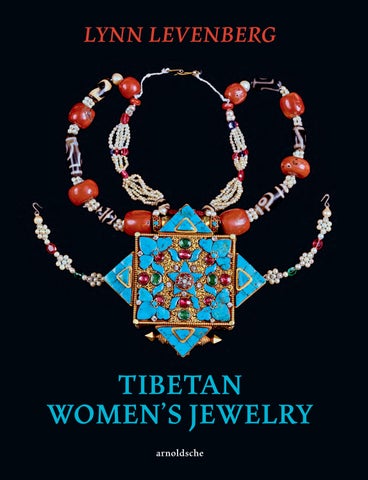
Tibetan Womens Jewelry

Page 1


LYNN LEVENBERG

WOMEN’S JEWELRY

Chapter

Dalai Lama: Thupten Gyatso (1876–1933; r. 1879–1933)

Chapter 7The Tsarong Family ...........................................................................................................

Chapter 8The 14th Dalai Lama: Tenzin Gyatso (b. 1935; r. 1940–1959)

Chapter 9 Gau DESIGN #6 – The “Peach Design Box” (Kambu Soh

Chapter 10Pre-Peysar (“New Style”) Tsarong

Chapter 16 Diamond “Gaus” and Other Non-

DESIGN #1, STYLE 1.

Kalsang Metok Gau

Auspicious Flower Box

C. 1800. 3" W.

96 plump turquoises

Small size box

Straight-sided box

4 scalloped appendages

Open filigree

Dorje across bo om

DESIGN #4, STYLE 1.

Dogden Soh Gau

Apron Corner Box

C. 1910s. 3 ½" W.

52 fla er turquoises

Straight-sided box

Pointier appendages

Round corner petals

First faceted glass

Rounded stones

Filigree & repoussé

Dorje across bo om

DESIGN #4, STYLE 4.

Dogden Soh Gau

Apron Corner Box

C. 1930s. 4 ¼" W.

56 turquoises

Pointier turquoise corners

4 bezeled corner gems

Slightly curved box

All-repoussé

Dorje at bo om

DESIGN #7.

Maltese Cross Gau

1946–1950. 5 ¼" W.

24 turquoises

8 arms

16 jeweled points

Pearl outlining All-repoussé Dorje at bo om

DESIGN #2.

Ta So Gau

Horse Tooth Box

C. 1850. 3 ¾" Sq.

294 plump turquoises

Small size box

Straight-sided box

4 scalloped appendages

Open filigree

Dorje across bo om

DESIGN #3, STYLE 2. Do Chama Gau

Stone Paved Box

C. 1920s. 4" W.

1 row of 58 turquoises

Larger size in 1920s

Straight-sided box

Pointed appendages

Faceted glass gems

Rounded stones

All-repoussé ground

Dorje across bo om

DESIGN #5.

Bardun Gau

Transitional Box

C. 1930s. 4 ¼" W.

50 turquoises

Three-petal flowers

Pointed turquoise corners

First pearl outlining

Slightly curved box

All-repoussé

Dorje at bo om

DESIGN #8.

Star-Cross Gau

1946–1950. 4 ½" W.

20 turquoises

8 arms

8 jeweled points

Pearl outlining All-repoussé

No Dorje at bo om

Fig. 5. Chronology and Styles of Ten Lhasa and

Central Tibetan Women’s Gau (“Box”) Designs.

DESIGN #3, STYLE 1.

Do Chama Gau

Stone Paved Box

C. 1860. 3 ¾" W.

184 plump turquoises

Small size box

4 scalloped appendages

Open filigree ground Dorje across bo om

DESIGN #4, STYLE 2.

Dogden Soh Gau

Apron Corner Box

1920s. 4 ¾" W.

52 turquoises

Larger size in 1920s

Straight-sided box

Round corner petals

Faceted glass gems

All-repoussé Dorje across bo om

DESIGN #6, STYLE 1.

Kambu Soh Gau

Peach Design Box

C. early 1940s. 5 ¼" W.

32 turquoises

Three-petal flowers

Pointed turquoise corners

Pearl outlining

Four corner gems

More curved box

All-repoussé

Dorje at bo om

DESIGN #9.

Radiating Star Gau

C. 1946. 4 ⅜" W.

20 turquoises

8 arms

16 points

Pearl outlining All-repoussé

No Dorje or Box

DESIGN #1, STYLE 2.

Kalsang Metok Gau

Auspicious Flower Box

C. 1880s. 3 ¾" W.

115 plump turquoises

Small size box

4 scalloped appendages

Open filigree ground

Dorje across bo om

DESIGN #4, STYLE 3.

Dogden Soh Gau

Apron Corner Box

1920s. 5" W.

49 turquoises

Larger size in 1920s

Straight-sided box

Rounded corner flowers

First jeweled tube

All-repoussé background

Dorje across bo om

DESIGN #6, STYLE 2

Kambu Soh Gau

Peach Design Box

C. late 1940s. 5 ½" W.

36 turquoises

Three-petal flowers

Pointed turquoise corners

Pearl outlining Four corner gems

Swooping box

All-repoussé

Dorje at bo om

DESIGN #10.

Rounded Star Gau

C. 1946–1959. 5" W.

12 turquoises

8 arms

16 points

Pearl outlining All-repoussé Dorje at bo om

Fig. 27. Woman’s silver, DESIGN #1, STYLE 3, “Auspicious Flower” (Kalsang Metok) Gau with 87 good quality turquoises and a gold backplate that can be seen through open gold pearled Newar filigree foliage. Four corner flowers, each with five turquoise petals and a faceted red glass center embezzled in gold, alternates with four smaller flowers, each with four turquoise petals and a faceted glass “diamond” center. In the middle of the relic box is a turquoise “Treasure Vase” (Bumpa) with four teardrop-shaped corner turquoises on either side of it. The four turquoise appendages are very sharply pointed now in STYLE 3 and are a ractively trimmed with small silver granules. At the top of the relic box is a sturdy looking silver necklace tube with cable wire edging. This is balanced at the bo om by a silver wire-wrapped Dorje with pointed terminals. On the outer sides are pearled gold wire horn motifs. The back cover is plain silver.

Lhasa, U Province, Central Tibet.

4 ¾" (12 cm.) wide × 1 ⅛" (2.7 cm.) deep × 4 ¾" (12 cm.) high.

Reign of 13th Dalai Lama (r. 1879–1933) – Circa early 1920s.

Private Tibetan collection #23.

Fig. 230. Noblewoman’s gold, Maltese Cross-shaped Gau Peysar (“New Style Container”) with twenty-four pieces of flat, carved turquoise, pearls, foil-backed, colored glass “gems”, glass “diamonds” and sixteen jeweled points within gold flower bezels. The glass stones on relic boxes of this sort were very desirable to Tibetans, because of their intense colors and the fact that they were imported novelties. There was still a horizontal gold Dorje behind the bo om center arm on this design, which disappeared somewhat later.This sixteen point (Tib: Zur) shape and the similar Gau Zurgyad (“Eight-Armed”) Gau, which both represent four crossed Dorjes (“Sacred Thunderbolts”), started to be made in the mid-1940s. They were based on the Victoria Cross, Britain’s highest medal for bravery and valor, and the Commander of the British Empire (C.B.E.) military medals. Removable silver back. This was fabricated by a Newar master goldsmith. Lhasa, U Province, Central Tibet.

Gau box: 5 ¼" (13.34 cm.) wide × 1 ¼" (3.18 cm.) deep × 4 ¾" (12.07 cm.) high.

Reign of 14th Dalai Lama (b. 1935; r. 1940–1959) – Circa late 1940s.

This piece appears in Vanishing Beauty: Asian Jewelry and Ritual Objects from the Barbara and David Kipper Collection, M. Ghose, ed., The Art Institute of Chicago, Distributed by Yale University Press, New Haven and London, 2016, p. 60, item 47. Photograph: © 2014, Camerarts, Inc. Courtesy of Lynn Levenberg.

Figs. 231 and 232. View of Maltese Cross Gau (top)with horn motif filigree wirework, which can also be seen as mountains, behind the horizontal gold Dorje (“Diamond Scepter”) and back view (bo om) of Maltese Cross Gau. There is a small gold loop above the jewel-trimmed necklace lug on the top back and two larger gold loops for side a achment chains. A loop for a second necklace on a Central Tibetan woman’s relic box, which started to be seen in the late 1920s, generally disappeared by the early 1940s. This loop was probably not for a second necklace, but for a hook and string that pinned the relic box to a woman’s robe. The removable back is plain silver, something usually only seen on a noblewoman’s Gau, as it was more expensive than copper or brass. This must have belonged to a very wealthy noblewoman, because it has jewels on the back rims of the necklace lug where they were o en omi ed as they too were never seen.

Barbara and David Kipper Collection. Photograph: © 2014, Camerarts, Inc. Courtesy of Lynn Levenberg.

Fig. 640. Pair of gold and turquoise, noblewoman’s, DESIGN #6, lotus-shaped, Agor (“Round Ear Temple Pendants”). The gold coil surrounds encircling the center turquoises on the second sections started to appear in DESIGN #5 and continued in DESIGNS #6 and #7. They have the added embellishment of terminating in small granulated tips under the bo om upturned lotus cross sections. Gold backs. The date on this pair is derived from the fact that although the turquoises are rounded, they are over 4¾" (12.07 cm.) long. Agors can be found as offerings embedded on the Potala Palace tombs of the 11th Dalai Lama (1838–1856), the 12th Dalai Lama (1856–1875) and the 13th Dalai Lama (1876–1933).

Lhasa, U Province, Central Tibet.

1 ¾" (4.45 cm.) wide × 1 ¼" (3.18 cm.) deep × 5 ½" (14 cm.) high. Taller than picture size. Reign of 14th Dalai Lama (r. 1940–1959) – Circa 1940s.

These ear pendants appear in Gold Jewelry from Tibet and Nepal, Jane Casey Singer, Thames & Hudson, London, 1996, p. 126, plate #50. They have been exhibited at: the Brunei Gallery, University of London (SOAS) from December 1996 to March 1997; the Palais de Beaulieu, Lausanne, Switzerland in November 1997; the Tropen Museum, Amsterdam from March 1998 to June 1998 and the Asian Civilizations Museum, Singapore from July to October 1999. Articles about the Singapore exhibition entitled “Jewel Power” appeared in the Asian Art newspaper by Ola Lenzi in October 1999, p. 16 and in Arts of Asia magazine by Sian E. Jay in the November–December 1999 issue, pp. 145–147.

They are also in Vanishing Beauty: Asian Jewelry and Ritual Objects from the Barbara and David Kipper Collection, M. Ghose, ed., Art Institute of Chicago, Yale University Press, New Haven and London, 2016, p. 106 right, where they are vaguely dated as “first half of 20th century” and mis-labeled as being from U-Tsang Province instead of Lhasa.

Photograph: © 2014, Camerarts, Inc. Courtesy of Lynn Levenberg.

Fig. 693. Noblewoman’s le shoulder, DESIGN #3, Yarthen chatelaine with twenty strands of seed pearls (Tib: Kapchas) and faceted colored glass gems. In the center is a large circular gold plaque (Mo Go) inset with rounded turquoises and more glass stones. The outside of this medallion is rimmed with small, truncated, bicone-shaped red glass beads. Near the top and bo om are horizontal gold Drelkag (“Line Connector”) bars, which hold the multiple strands of pearls in place. At the apex is a hook that was a ached to the wearer’s robe that is decorated with three turquoises that form a Triratna (“Triple Gem”). On the bo om are two rows of small, drum-shaped, dark red corals and two rows of small blue glass beads, which terminate with an agate bead. This decoration was suspended from a woman’s le shoulder and hung down to her waist. Yarthen means “pulled up” (yar – “up”; then – “pulled”), because it pulled up a long Kyetreng necklace of jade and coral beads. The pearl strands on a Yarthen were purposely le somewhat loose so strings with hooks on the ends could be tied onto them to hold the long ornament in place. The small sizes of the pearls, two bars and round medallion as well as the presence of glass “gems” instead of real ones all indicate that this was made before the 1930s when Tibetans started traveling to India and acquiring real jewels and larger pearls. To balance the larger pearls at that time, the gold bars also grew in size. The gold repoussé background work on the medallion came into vogue circa the 1920s. This was made by a Newar jeweler. Lhasa, U Province, Central Tibet. 15" (38.1 cm.) long with 2" (5.08 cm.) diameter medallion. Reign of 13th Dalai Lama (r. 1879–1933) – Circa mid-1920s.

This chatelaine also appears in Vanishing Beauty: Asian Jewelry and Ritual Objects from the Barbara and David Kipper Collection, M. Ghose, ed., The Art Institute of Chicago, distributed by Yale University Press, New Haven and London, 2016, p. 109, item 126.

Photograph: © 2014, Camerarts, Inc. Courtesy of Lynn Levenberg.

DESIGN #3 Yarthen s (c. 1920s–c. 1945) grew even larger a er women started traveling to India and returning to Tibet with bigger pearls. The bars and medallions were then approximately 2–3" (5.08–7.62 cm.) wide and the bars were now covered with colored real or glass jewels (Figs. 693–694 and 696 ) 1202 The pearl strands on le shoulder Yarthen chatelaines like these three were purposely le somewhat loose at the bo om underneath the center medallion so strings with li le hooks on the ends could be tied onto them to hold the chatelaine in place on a wearer’s robe.1203 Many DESIGN #3 medallions had repoussé backgrounds (Figs. 693 and 696). *See a complete, but upside-down, circa 1920s DESIGN #3 Yarthen with a Navaratna (“Nine Gems”) medallion a ached to a white jade and coral Kyetreng (“Necklace”) that is connected to a bu erfat jade Gyabzar (“Jade Back Ornament”) and a pair of triangular-headed, woven mesh, fringed Thyen-Tha (“String Puller”) side dangles in Precious Deposits, Vol. 5, Morning Glory Publishers, Beijing, 2000, p. 178. *A DESIGN #3 Yarthen with a white jade and coral necklace from the 1930s can be seen in A Well-Selected Collection of Tibetan Cultural Relics, Forbidden City Publishing House of the Palace Museum, Beijing, 1992, p. 159, plate 138. There is another DESIGN #3, circa 1930s pearl Yarthen (Fig. 697) with twenty pearl strands and a round gold repoussé medallion that also has a center Navratna in the Cultural Palace of Nationalities in Beijing. This was given to Mao Tse Tung by the 14 th Dalai Lama in 1954 at the National People’s Congress in Beijing.

A le shoulder Yarthen chatelaine pulled up a long Kyetreng (“Necklace”) that was a ached to it at the bo om. (See Figs. 660–662, 665, 668 and 669 in DESIGN #1; 670–678, 683, 684, 686–692 in DESIGN #2; 693, 696–709, 711 and 712 in DESIGN #3; and 713, 717–723, 725 right and 726–728 in DESIGN #4.) A Kyetreng had a small jade, coral and gold Gyabzar (“Back Hanging”) pendant with short dangling strands of pearls and colored precious or glass stones on it that sat on the back of the neck when worn (Fig. 719 in DESIGN #4).1204 A triangular version was called a Zul Gyableh (“Jade Back Triangle”). Zul means “jade” and Gyab, Kab or Kep mean “back”. They look as if they were a ached to the rear of a headdress, but they were not.1205

Fig. 827. Married noblewoman’s, DESIGN #3, cruciform-shaped, Dikra Longtreng (“scorpion-shaped stomach necklace”) half-belt of silver, gold, turquoise and rubies. The square center medallion here is still covered with small Kuree (“Pebble”) turquoises and decorated with two crossed double Dorjes that have a small round ruby in the middle. Two pairs of small, flat, gold discs that appear on the third inner le and right borders opposite the medallion’s round red ruby indicate Lhasa fabrication. Only the le discs are visible. The finial on top, however, is now a triangular Norbu (“Jewel”) with two rows of turquoises encircling a larger oval ruby. Both rubies are surrounded by Newar-fabricated, gold pearled wire surrounds while the rows of turquoises have borders of tiny gold Newar granules. On either end of the horizontal top sections are a achment hooks shaped like the curving tails of scorpions (Dikras or Digras) that kept a woman’s apron from twisting. The three straps contain gold and turquoise plaques embellished with open wire filigree decoration. A closeup of the vertical center strap shows tiny, silver-headed pins on the sides that held its many rows together. This strap dangled down the front links of a robe, was fastened with a silver Dharma ring at the bo om and then a ached to a silver chain with 108 links of Chinese Shou (“Long Life”) symbols and pinned to the le shoulder with a decorative trinket. It is rare to see a complete Dikra with its entire chain and dangling charm. Lhasa, U Province, Center Tibet. 68" (172.7 cm.) long.

Reign of 12th Dalai Lama (r. 1860–1875) – Circa 1860s.

Metropolitan Museum of Art, John Stewart Kennedy Fund, 1915, Inv. No. 15.95.166 (Art Resource, NY).

Another photo of this Dikra taken by the Met appeared upside-down in “Arts from the Roo op of Asia: Tibet, Nepal, Kashmir”, a pamphlet by Wen C. Fong (1930–2018), first Chairman of Asian Art at the Metropolitan Museum (1971 to 2000), 1971, item 68. He was a great scholar of Chinese art, but was not at all knowledgeable about Tibetan or Nepalese jewelry. The Met continued to mismark this Tibetan frontal half-belt as having been made in Nepal in the above picture taken for this book in 2024, when, in fact, it was fabricated by a Newar master goldsmith in Lhasa.

It would be best if museum curators refrained from repeating decades old mistakes or guessing at their descriptions, especially the Metropolitan Museum of Art in New York, which, along with the British Museum in London and the Hermitage in St. Petersburg, contains one of the three greatest collections of Asian art in the world. Every word from the Met is taken as the Gospel. Once read in one of their books or on their website, it is impossible to correct it.

Fig. 900. Tibetan aristocrats laden with jewelry were visions of beauty from both the front and the back, which was a way of pleasing the gods. This very rare example of a gold, DESIGN #2, Trakey Norbu Gakyil (“Circle of Joyous Stones”) contains seed pearls, turquoises, faceted colored gemstones, diamonds and six round tomato red corals. It held the two braids from a noblewoman’s Lentse wigs in place on the sides of her hips just below the back of her waist. In the center of the oval, turquoise inlaid Cintamani (“Flaming Jewel”) is a ruby over a turquoise Nima Dawa (“Sun and Crescent Moon”) symbol above a pearl. The flames represent the burning away of spiritual ignorance. The chains of seed pearls on this ornament are similar to those found on a Yarthen (“Pulled Up”) chatelaine, which li ed a long Kyetreng (“Necklace”). The Yarthen, however, hung vertically from the front le shoulder down to the waist. Both had narrow, gold, jeweled Drelkag (“Line Stopper”) bars through which multiple strands of pearls were threaded to hold them in place. This was worn only on very formal occasions like Losar (New Year’s), Monlam (“Great Prayer Ceremony”) or a woman’s own wedding. When Agor Drum-Zar (“Tiered Dangling Ear Pendants”) were worn on the head and a Gau Sum-Drum (“Three Relic Box”) necklace decorated the chest, a Trakey Norbu Gakyil was tied or hooked onto the rear waist. A Dikra Longtreng (“Scorpion Stomach Necklace”) half-belt was worn in front.

Lhasa, U Province, Central Tibet.

Turquoise double ornament: 2½" (6.5 cm.) wide × 5 ¾" (14.5 cm.) high.

Largest coral: ½" (1.4 cm.) diameter.

Smallest coral: ⅜" (1.2 cm.) diameter.

Bars on sides: 3¾" (9.5 cm.) wide × ⅝" (1 cm.) high.

Pearls from bar to side of pendant: shortest part – 4¾" (12 cm.) wide; longest part – 8⅝" (22 cm.) wide.

Weight: 384.91 grams (13.57 oz.)

Reign of 14th Dalai Lama (r. 1940–1959) – Circa 1940s.

Provenance: Ex-collection of Ragashar family in Gangtok, Sikkim. Purchased circa 1996–2001.

Private Tibetan collection #45.

Fig. 901. Back view of a DESIGN #2, Trakey Norbu Gakyil ornament, which shows how the multiple strands of pearls were strung through two single horizontal gold Drelkag (“Line Stopper”) bars at the top as well as through a teardrop-shaped Cintamini (“Flaming Jewel”) that also functioned as a “line stopper”. At the top is a simple Trakey (“String”) with four corals, which changed from dark red to tomato red in the 1940s because the Italian coral beds had been overfished and become polluted. Although this Trakey Norbu Gakyil looks like the one Princess Kuku-la loaned to Sonam Lhamo Sadutshang (Fig. 892) and the one worn by Sonam’s mother-in-law, Yangchen Dolkar Samdup Phodrang (Fig. 899 right), it has twenty-three, not twenty-six strands of pearls and a different connector between its simple waist Trakey and its teardrop-shaped Cintamini ornament. The tops of the two very similar decorations are pointed and have double loops of pearls joining the two parts while Fig. 900 has a straight, vertical strap.

Fig. 967. Anna Louise Strong (1885–1970) (le ), an American Marxist journalist, greeting Tseten DolkarYuthok Ngapö (1915–2012) at her house in the Lhasa suburbs. In the right center is Tsering Wangmo Langdun (1912–c. 1963), whose husband, Kunga Wangchuk Langdun Yabshi (1906–c. 1963), was the 13th Dalai Lama’s nephew and the Prime Minister of Tibet from 1926 to 1939. The woman on the right was the wife of Sonam Wangdi Tsoko (c. 1889–?), who was sent by the Lhasa Government to capture the 9th Panchen Lama (1883–1937) in 1923, but allowed him to escape to China. He later became a General (Depön) in the Tibetan Army.

Mrs. Ngapö wears an older DESIGN #2, Apron with narrow, unevenly spaced stripes, which she has shortened to a DESIGN #4 length.

Mrs. Langdun and Mrs. Tsoko display DESIGN #4, Aprons with wider stripes, which are now a racy length just below the knees. All three aprons have triangular brocade Dogdens on the top sides. Lhasa, August 1959.

When Serfs Stood Up in Tibet, Anna Louise Strong, New World Press, Peking, 1960, reprinted edition of 1965, opposite p. 93.

Fig. 968. Model of a Lhasa Noblewoman wearing a DESIGN #4, Apron with purposefully mismatched stripes and a pair of large, triangular brocade corners (Dogdens) at the top sides. Aprons at this time were a sassy length just below a woman’s knees.

Tibet Museum, Lhasa, circa 1955–1959.

Tibet: Treasures from the Roof of the World, the Bowers Museum of Cultural Art, Santa Ana, California, 2003, p. 218.

Fig. 969. Model of a Lhasa noble bride wearing a Chirkyang-Yukyang Patruk (“Only Coral and turquoise Headdress”) and a DESIGN #4, knee-length Pangden (“Apron”) with mis-matched stripes. Trésors du Tibet, Muséum National d’Histoire Naturelle, Editions du Muséum, 1987, plate #109. From the Collection of the Administration of Patrimony of the Tibetan Autonomous Region.

Fig. 970. Noblewoman’s DESIGN #4, just below knee-length, Apron (Tib: Pangden) made of three widths of unevenly striped woven woolen fabric with large triangular brocade corners (Dogdens) and a brocade waistband. 21¼" (54 cm.) wide × 30½" (77.5 cm.) long. Circa 1959.

(“Waist Wraps”), which were also called Kapteys, made of striped apron fabric were worn. One was knee-length and wrapped around the body. The shorter second one, also of striped apron fabric, was a square folded into a triangle worn on top of the first one and tied in front. The point of the triangle that hung down in back was called a Jepga (“Bird’s Beak”). These two aprons were held together by an engraved silver or brass Kaydhig (“Waist Scorpion Buckle”) that had clawed hooks on either end.1351 Two more apron variations worn by women in Kyirong, Western Tibet were a striped ankle-length one in front and a square,

knee-length striped wool blanket apron folded and wrapped around the body. The top fold of the blanket apron extended over the sash on the first apron. The wrapped apron was called a Shama and had edges trimmed in blue co on and square blue, green and red co on patches with embroidered flowers in the bo om center of the wrap and on op of the fold. A narrow silver or brass Gyaltsen (“Banner”) clasp with a narrow plate hanging from it was a ached to the front of the waist. 1352 These were similar to the clawed Kaydig (“Waist Scorpion”) buckles worn elsewhere in Western Tibet.

Tibet Museum, Compiled by the Tibet Museum, Encyclopedia of China Publishing House, 2001, p. 133, pic. 2.

Turn static files into dynamic content formats.

Create a flipbook
Issuu converts static files into: digital portfolios, online yearbooks, online catalogs, digital photo albums and more. Sign up and create your flipbook.