palma vecchio portait of a young woman known as ‘la bella’
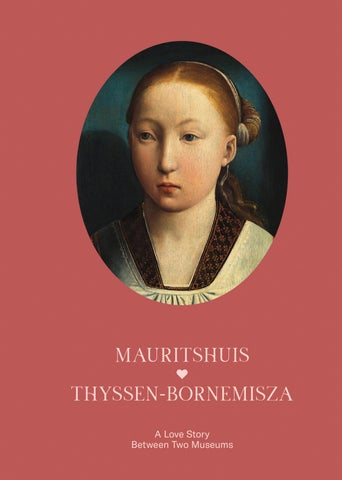
thyssen-bornemisza & mauritshuis
chrissy hanna bervoets
Brown hair that shone gold in the sun. Big eyes, a creamy-white neck, a look somewhere between suspicious and playful: I found the photo on Tinder. Yes, dear Romy, I confess. I stole the photo and used it when I made a new profile on Bumble. ‘Christina’ is what I called my avatar, and I made her thirty-one (because she looks a bit old-fashioned, doesn’t she, with those ringlets?). The pictures of her body came from other websites. No one will believe this, I thought. From her portrait, you can clearly see that Christina – ‘Chrissy’, as you’d soon be calling her – has breasts, so why would she suddenly need a push-up bra for her underwear shots? Anyone who fell for it wasn’t paying attention and didn’t really care about the girl they were chatting to. That’s how I’d justify my deed in the following weeks. I wrote that Christina loved hiking and long-distance travel. That she cared about the climate and was a cat person. You, Romy, were her first match, and she quickly took you into her confidence. For example, she wrote to you that she’d just broken up with someone. For five years, she’d been with a slightly older girlfriend who’d asked her every day where she’d been when she came back from the supermarket. That woman didn’t believe her when she said she didn’t like the girl she’d been smoking with on the balcony at that party. Christina ‘liked’ her, of course, but not in that way. Not that saying so would have helped: her lover would have flown off the handle regardless, screaming that she didn’t love her any more – and at the end of their relationship, that was actually true. How dreadful for you! you replied, after every new detail Christina shared with you. And that you understood, of course, that she wanted to take things slow for now. So the first time Christina failed to show up, you reacted with understanding. She panicked before she even left the lobby of her flat, later writing to you: What if the two of you had bumped into her ex in the cafe where you were meeting? She was suddenly sure that her ex would be sitting at a table there. It was Saturday night, and how many lesbian bars are there anyways? You, Romy, sweetheart that you were, assured her that it was okay. You still had a fun evening. The barmaid had been great company. Hopefully not too great? Christina had asked (with a winking emoji, of course).
24
25
short stories
thyssen-bornemisza & mauritshuis
everything else aside. Everyone who wants to touch it, stroke it, hold it: you want to wipe them all out with a bazooka. Even when you no longer recognise yourself, even then it’s yes, the answer is yes. Will you love it when it walks into school for the first time on stiff little legs, its small face pale, holding someone else’s hand? Will you love it when you’re at work and not thinking about it? Will you love it when it’s bullied, when you know who the culprits are and you want to strangle them but that’s not allowed because it’s against the law and because your child says: Never mind, please don’t, don’t get involved. Will you love it when it’s given your bike away, hit someone, stolen your money, when it says no and no and no, when it enters the room looking pale and doesn’t want to talk about it, when it avoids you? When it wants to cling to you forever because you’re the dearest, when it creeps into your bed, when it bakes you surprise pancakes? It starts to smell different, it starts to sound different, it brings others back home, others who are someone else’s dearest possession, at least you’d hope so. There’s unfamiliar packaging round the house, a lighter falls out of a pocket, there are strange bottles around and you see the head under the lamp and you think: I know you but I don’t know the new you yet. Will you love it when it makes choices that aren’t yours, when you have to pick it up from hospital, from the police station, from a party, waiting with others by the exit to a nightclub in the sticks, when your heart skips a beat, when you bite your tongue? Yes is the answer, yes. Will you love it when you drive out of the street where it’s gone to live, do you really have to leave it in this dump of a place? You loaded the car together, why this and not that, and finally you set off. You carry the boxes inside and count the cockroaches and bugs in the sink, you put up the shelves and avoid the view and paint the walls and clean the drain of unfamiliar hair and you say, ok I’m off, you can always call me, any time. You split in two again, and you tear. You’re waved off from the doorway. You wait for the first message with a hole punched inside you the size of the Lourdes grotto, and in that vacuum, there of all places, yes is the answer, yes. Will you love it when it’s always so busy, so far away, when you only see it every few months, sometimes a message, sometimes nothing? When the radio silence lasts too long, when you think you’re forgotten but you mustn’t think like that, it’s not your life. As the years go by, and lovers come and go, and work comes and goes, and there’s an ocean between you, when you sympathise with everything, when you can’t keep your opinion to yourself, when you get to sit in the front row and are given flowers or when
34
35
thyssen-bornemisza & mauritshuis
short stories
warehouses – peace, treaties, routes, goods. They talk a lot about Spain at home without ever really talking about Spain. They talk about wool, salt, wine, the oil that arrives with the patience of ships; they talk about silver that comes from overseas and about how it flows through Europe like slow-moving blood, poor circulation; there is talk of the northern ports and Cadiz – by people who have never seen it; of Seville, as if it were an ancient word. They speak of war as a bad habit of which sensible men have at last been cured. And yet, when your country is mentioned, they lower their voices slightly, as if the war had left a wound in their ears. In The Hague, everything is negotiated, even silence: the diplomats who look like elegant ravens, the merchants who count with their fingers hidden in their sleeves, the painters who seek an everyday gesture to turn it into eternity – they all want a good deal. Austere façades, clean windows, floors that creak discreetly. Inside, the warmth of home is nothing like the warmth of passion: it is fuelled by carefully tended embers, tapestries that retain the heat, soup in the kitchen and rules at the table. I write within that order like someone opening up a crack. From the room where I picture you, where I study music and where my mother inspects the sewing, I can hear the whole house: my father coughing at the end of the corridor, my brothers laughing when they think no one’s listening, the rustle of my sisters-in-law’s dresses. My eldest sister, now married, sometimes comes back with her husband and brings me news of the world as if she were giving me new ribbons. One of my sisters-in-law is always talking about the price of amber and lace, goods her family deals in; another is always complaining about the cold and the price of coal. No one speaks of desire, because desire has no place in an inventory. I hide it in the ink. So, who are you? Allow me to give you whatever name suits me. I call you Diego when the afternoon turns the colour of copper. I call you Gabriel when it rains and everything is a haze through the windows. I simply call you ‘you’. In my mind, you’re a young merchant, perhaps not very important yet, sent by an uncle or a boss, someone who believes the world can be folded up like a map and tucked away in a pocket. You come from far away: that is enough. Sometimes, I tell myself you could be a secretary to some ambassador. The Hague is full of those men who write quickly and rarely smile. My life can be broken down into days that are all similar, with the same schedules, the same light on the wall. Here, real love would come in the form of a supervised visit, an arranged marriage, children and duties. An imagined love, in contrast, can travel. And that is what you and I do: we travel on paper. I’ve taken you with me to Scheveningen, even though I’ve never been
54
55
michael sweerts boy in a turban holding a nosegay
thyssen-bornemisza & mauritshuis
a first love lieke knijnenburg
A thread that runs from your navel to your throat. A tension that builds as you inhale, that tightens in your stomach as you exhale. Pleasantly exciting but also a little nauseating. Like a sneeze that doesn’t come. Do I see desire welling up here? Such exuberant colours, and yet, my attention is drawn to that curious gaze and then to the dark shadow under the nostrils. The mouth that seems to betray a twist of disgust. As though it had tasted something intoxicating. The face is tilted, but the nose points straight at me. It gives the portrait a sense of movement, as in the haze from one wine too many. It makes me feel dizzy, as desire can. How disorientating is a first love? Suddenly, the things you appreciated grow dull, you drop everything, and routines are abandoned. You can’t touch a morsel, you can’t keep focused on your studies or keep your shoulders straight. But you’re also struck by all kinds of details you never noticed before. That black is not just black, but that it can shine brown, purple and red. And music speaks louder to you because it now seems made specially for you. Love is a source of renewal, whereby you lose your view of the world and your place within it. A new love shakes up the idea you had of yourself. It rearranges what is considered valuable and rebels against plans and orders. A disorientation that’s also reflected in the words we use: ‘I’m not myself any more’, ‘you’re driving me crazy’, ‘without you, I’m nothing’. Love is bittersweet. There is an agonising pleasure in desiring something that eludes our grasp. The poet Anne Carson describes how the fantasy of sweet fulfilment comes with an awareness of painful longing. Eros is the reaching-out from longing to fulfilment: a reach that never ends and that we never want to end because possession would sate desire. The erotic is not getting what you want, but teary eyes gazing at something beyond the frame. It is the anticipation you set in motion that makes you feel alive. But how long can we bear to inhabit that uncertain point between hope and fear, the point that makes us feel dizzy? It is in desire that you discover that you are not complete. You long for something that you feel you lost, something that could make you whole again because it in fact already belonged to you. Who would you be with the loved one at your side?
58
59
sebastiano del piombo portrait of ferry carondelet with his secretaries
thyssen-bornemisza & mauritshuis
heavenly humming bert natter
Until recently, everything was going perfectly for me here, but now I want to get home as soon as possible. After I became the secretary’s assistant, we had to sort through the incoming correspondence: important people received immediate replies, others had to wait, or their petitions and pleas were tossed in the wastebasket. It wasn’t much work, but we behaved as though we were virtually collapsing under the strain. A few months ago, the secretary wondered whether it might be a good idea for the master to have his portrait painted. I followed the conversation from our small office, which is separated from our master’s study by a curtain. In hindsight, the plan would turn out disastrously for me, but at the time, it seemed an excellent idea. Wouldn’t it be nice, fawned the secretary, if the guests who were waiting in the reception room could already form an image of the important figure they were about to meet, thanks to a ceremonious and magnificent portrait painted by one of the greatest artists of our time? There was a moment’s silence. I stood up to peek past the heavy curtain into the study. I saw my master’s back and the secretary sitting opposite him at the table. He shook his head slightly. I quickly withdrew and rustled the papers on my table. My master wanted to know how much it would cost. He flaunted his wealth, but throwing money around wasn’t his style. The secretary was ordered to draw up an inventory of artists who could fulfil the brief of immortalising the master, a small task that was subsequently delegated to me. In my most elegant hand, I wrote down what I knew and what I had heard. That was mostly rumours. One afternoon, the secretary was summoned and read out my findings in order of the expected fee, from princely to gigantic. He mentioned Michelangelo, who had just completed the ceiling of the Sistine Chapel. All sorts of things were whispered about him that the secretary preferred not to repeat. He also suggested Raphael, a man who had worked in the Apostolic Palace. Apparently, he turned down clients whom he deemed beneath him. There was also a haughty young man who had recently visited the city, a certain Titian, now as famous for his portraits as he was for his impudence. I heard the master sigh. Although these figures were evidently protegees of the pope, their conduct was anything but irreproachable. He did not intend to have his likeness made by a sodomite.
80
81
thyssen-bornemisza & mauritshuis
short stories
Based on Greek philosophy and Christianity, the British author C.S. Lewis popularised the idea of four kinds of love: storge (a bond of empathy); philia (a bond of friendship); eros (romantic love) and agape (unconditional, selfless love for God).Instead, I propose a notion of love based on three different forms: parental and partner love, the love of friends, and the public’s love. To start with, there is the love that you receive from your parents, love that is necessary for your very survival. The love that you may be most likely to demand because you suppose that it’s unconditional. That, too, is an assumption, notwithstanding that there are mothers who regret having a child. I am reminded of an intrusive but sincere report in the Belgian magazine Humo, in which a mother says: ‘For the first five years I typed into Google every morning: I don’t want to be a mother, help me.’ Later in life, we look for a partner (or multiple partners) who can gradually assume that role and then fulfil that first category of love – a love that is the most intimate, disarming and vulnerable. And, after parental love, the most unconditional – although that is also an assumption that proves to be false, given that one in three marriages end in divorce, and two in five Dutch people live alone. The government statistics agency even predicts that by 2047, a quarter of Dutch adults will live alone. The second form of love comes from friends or other relatives. I am blessed with a rich group of friends, several of whom I can call in the middle of the night if I need to, but with whom I can just as easily go to the pub or cinema – the kind of friends for whom it doesn’t matter where you go on holiday, so long as you are together. The love of friends can certainly come close to the first form of love, but it can never replace it in its entirety. Firstly because you notice – certainly as a single gay man, which is what I am at the time of writing – how prevalent the nuclear family is and the knock-on effect that building up that nuclear family can have on a person’s life. To give a specific example: two years ago, a female friend and peer, whom I saw daily during my time at university and with whom I would stay several times a week, moved to The Hague with her boyfriend to live in the first house they’d bought together. They both work five days a week, and our contact is now reduced to seeing each other a few times a year and sending lengthy voice notes. And that nuclear family? The house has a room that’s used as a study for now, but the potential for expansion is there. Secondly, I am blessed with the family of my best friend, whose parents feel like surrogate parents to me. I even went abroad to stay with them once, without her. But in that family, too, it is frequently made clear to me, through small symbols and habits, that I am not the same as their two children. And that is how it should be: that is the order of things, and if it were different,
86
87
mauritshuis 26
pieter van anraadt still life with earthenware jug and clay pipes 1658 Oil on canvas 67 × 58.8 cm Mauritshuis
On a table partly covered with a green cloth, next to some tobacco, Gouda-clay pipes and a coal pan, stands a German earthenware pitcher known as a Westerwald jug. A glass of beer has just been poured from it. This is the only known still life by Utrecht painter Pieter van Anraadt (before 1634–1678), who was mainly celebrated as a portrait painter. The painting’s strength lies in its apparent simplicity, both in its composition and in the use of colour. Although the limited palette draws on the monochrome still lifes of the 1640s, Van Anraadt’s understanding of the play of light and shadow allows him to create a rich range of nuances. The bright white pipes, the butter-coloured jug and the off-white paper each reflect the light in their own way, resulting in a convincing representation of the different materials. The seemingly random arrangement of the Gouda pipes hints at the smoker’s recent presence, while simultaneously helping to create depth and space. In the seventeenth century, just as today, people took a dim view of drinking and smoking. The surgeon Dr Nicolaes Tulp, known from Rembrandt’s Anatomy Lesson in the Mauritshuis collection, had already warned of the dangers. When tobacco imports from the English colony of Virginia rose, it was mainly sailors and soldiers who smoked. From the 1630s, its use spread across all the social classes, and societal acceptance grew. JH
178
179
mauritshuis 32
jan both italian landscape c. 1645 Oil on canvas 108.2 × 125.8 cm Mauritshuis
The low sun in this hilly landscape gives the scene its romantic character and causes the horizon to gradually fade away. Bathed in golden-yellow light, the large rock formations assume an impressive grandeur. A small company of travellers, halted by the banal necessity of a toilet break, emphasises the contrast between humanity and the magnificence of nature. Jan Both (circa 1618–1652) has created a remarkable sense of depth in this painting. The shaded foreground is painted with subtle, opaque brushstrokes and extensive detail, while the wooded hills in the background gradually merge into the atmospheric light. Jan Both was one of the ‘Italianates’: Dutch artists who dared to make the arduous journey across the Alps to the Mediterranean, an expedition that was not without risk. Leaving from the flat Netherlands, the journey through the mountains must have made a deep impression on Both. He settled in Rome around 1638, returning to the Netherlands via Venice around 1642. His introduction to the Italian countryside and the warm southern light remained an important source of inspiration throughout his life. The meandering landscapes in Both’s paintings, in which nature appears to do as it pleases, form a stark contrast to the tightly organised Dutch polder-plains in the paintings of contemporaries such as Jan van Goyen. JH
190
191
thyssen-bornemisza Thyssen–Bornemisza&Mauritshuis mauritshuis
thyssen-bornemisza & mauritshuis
226
227
thyssen-bornemisza Thyssen–Bornemisza&Mauritshuis mauritshuis
thyssen-bornemisza & mauritshuis
226
227
This catalogue was published to accompany the exhibitions Mauritshuis ♥ Thyssen-Bornemisza. Masterpieces from The Hague 9 October 2026 – 10 January 2027, Madrid Thyssen-Bornemisza ♥ Mauritshuis. Masterpieces from Madrid 15 October 2026 – 17 January 2027, The Hague
Short stories Karin Amatmoekrim Hanna Bervoets Gershwin Bonevacia Sacha Bronwasser Rob van Essen Radna Fabias Laura Ferrero Espido Freire Lieke Knijnenburg Tobi Lakmaker Sara Mesa Lara Moreno Antonio Muñoz Molina Bert Natter Tahrim Ramdjan Marta Sanz Juan Tallón Jesús Terrés David Uclés Gabriela Wiener Catalogue Mar Borobia (Museo Nacional Thyssen-Bornemisza) Quentin Buvelot (Mauritshuis) Dolores Delgado (Museo Nacional Thyssen-Bornemisza) Julie Hartkamp (Mauritshuis) With forwords by Rianne Letschert (Minister of Education and Culture, the Netherlands) Ernest Urtasun Domènech (Minister of Culture, Spain) Martine Gosselink (Mauritshuis) Guillermo Solana (Museo Nacional Thyssen-Bornemisza)
Edited by Julie Hartkamp Publication Department of Museo Nacional Thyssen-Bornemisza Translations from Dutch Vivien Collingwood Translations from Spanish Jenny Dodman Text editing Mark Soo/linguistic.services Image editorial Julie Hartkamp Esther Navarro
All rights reserved. No part of this publication may be reproduced, stored in a retrieval system or transmitted in any form or by any means, electronic, mechanical, photocopying, recording, or otherwise, without prior written permission of the publisher. The publisher has made every effort to secure permission for the illustrations in accordance with legal requirements. Those who nonetheless believe they have claims to certain rights are invited to contact the publisher. ISBN 9789462627284 NUR 644
Project coordination Ana Cela (Museo Nacional Thyssen-Bornemisza) Catali Garrigues (Museo Nacional Thyssen-Bornemisza) Julie Hartkamp (Mauritshuis) Lydia Randt (Mauritshuis) Ángela Villaverde (Museo Nacional Thyssen-Bornemisza)
This publication is published in Dutch and Spanish editions.
Book design Petra Warrink
© 2026 Waanders Uitgevers b.v., Zwolle | Royal Picture Gallery Mauritshuis Foundation, The Hague | Museo Nacional Thyssen-Bornemisza, Madrid | The authors
Production Stichting Koninklijk Kabinet van Schilderijen Mauritshuis, The Hague Museo Nacional Thyssen-Bornemisza, Madrid
ISBN NL 9789462627277 ISBN ES 9789462627406 www.waanders.nl www.mauritshuis.nl www.museothyssen.org
Printed in the Netherlands The exhibition is sponsored by
Lithography Benno Slijkhuis, Wilco Art Books Printing Wilco Art Books, Amersfoort Publisher Waanders Publishers, Zwolle
Exhibition partners Friends of the Mauritshuis Foundation, Johan Maurits Compagnie Foundation, Turing Foundation and Blockbuster Fund This catalogue has been made possible in part by the Mercura Fund Photography Mauritshuis, Den Haag Museo Nacional Thyssen-Bornemisza, Madrid
Toppartners