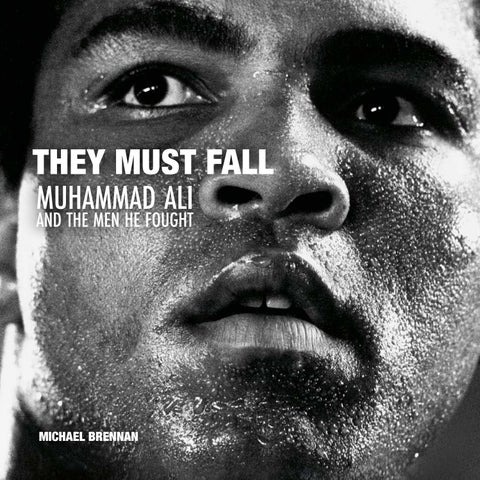
THEY MUST FALL MUHAMMAD ALI
AND THE MEN HE FOUGHT
MICHAEL BRENNAN
Some heroes we forget. By Simon Van Booy
As Muhammad Ali once said when discussing the term, killer instinct, “My intention was to win, but never to kill—even when I knocked a man out—I was happy to see him come back to it.”
6
Boxing is as much a sport, then, as it is a metaphor that embodies a paradox of human nature: the impulse to fight coupled with the equally fierce desire for companionship and comfort. The photographs in this book tell the whole story, for Michael Brennan’s pictures are more than a just dazzling record of hooks and jabs—rather, they explore the personal narratives of 25 vastly different men, who all rose to challenge one of the most successful and popular fighters of all time. Brennan not only pulls viewers into the ring— freezing pivotal moments in boxing history with mesmerizing beauty—but leads them beyond the ropes and across time, into the private lives of men who played vital roles in the history of our ancient sport. Without these individuals, the life of our protagonist, Muhammad Ali, would have been entirely different. In boxing, glamour and success are often braided with catastrophic failure, casting the men in this book (immortalized forever by Brennan) as the unsung heroes of a champion sportsman: fighters whose defeats enabled, or at least played their part in Ali’s greatness.
For anyone who has spent time in a gym or been laced into a pair gloves, it’s obvious that there is more to boxing than just aggression. In fact, that’s only a small part of it. The physical training is intense, perhaps more so than any other sport in the world. It demands a superhuman level of fitness that—in the ring, under the lights—may still not be enough.
about providing safe opportunites for men and women to face an injustice of the past, some unresolved conflict, a relationship left hanging, the torment of abandonment. These are the demons that spectators never see, though rest assured, they are ever-present in every boxing ring throughout the world, from Lagos to Las Vegas.
Those who excel as pugilists also possess rare artistry. They move about the ring with the grace and precision of a dancer. There is a seamlessness to their actions, a visual harmony made of up of speed, vision, breath, flawless technique, and above all— control. While hobbyists might use boxing as way to release anger, in the professional ring it’s discipline that wins bouts. What makes so many of the greatest fighters exciting to watch is that moment they explode, like the uncoiling of a spring. But it’s the poise that’s thrilling and often so devastating to the opponent.
What makes boxing safe is also what imbues it with honor. Strict rules govern engagement. Anger is channeled into aggression, which is then converted into self-discipline, and respect for oneself, one’s opponent, the referee, and even for the chattering, jeering crowd, gathered to witness ‘a fight’ safe in the knowledge that boxing is, at its core, the celebration of life—the chance for victory over one’s private gallery of torments.
For the fighters themselves, the journey into the ring is intensively psychological. Visit any boxing gym and you will find that every single person engaged in the sport has a story worthy of a Hollywood blockbuster. For boxing is not only about nurturing the biological instinct that helped ensure the longevity of our ancestors through epochs of bloodshed but also
Photography captures something in boxing that would otherwise be lost forever—actions that occur too quickly to be perceived with any detail by the human brain. For instance, the arc of a fighter’s arm a millisecond before the glove makes contact with an unsuspecting opponent’s chin. In pictures such as these, we can study a fighter’s footwork in relation to a devastating combination of punches. But it’s not just the technical aspects of boxing to which Brennan’s lens is so attuned—it is also the emotions of the fighters and, of course,
the stories of what happened to them in the years after the biggest night of their lives. Spend some time in these pages and you will soon realize that each photograph is not just a visual landscape to be inhabited momentarily but part of a story we can all relate to—regardless of whether we can throw a punch. For everyone knows that so much of life involves the reconciliation of triumph and defeat. 7
Simon Van Booy is an award-winning and best-selling author of fourteen books, including The Secret Lives of People in Love (short-listed for the Vilcek Prize), Love Begins in Winter (awarded the Frank O’Connor International Short Story Award) and The Illusion of Separateness. He enjoys hitting the bags at Overthrow Boxing Club in Brooklyn and has trained with Lenny DeJesus at UFC Gym, and with martial artist, David Kaplan.
Some heroes we forget. By Simon Van Booy
As Muhammad Ali once said when discussing the term, killer instinct, “My intention was to win, but never to kill—even when I knocked a man out—I was happy to see him come back to it.”
6
Boxing is as much a sport, then, as it is a metaphor that embodies a paradox of human nature: the impulse to fight coupled with the equally fierce desire for companionship and comfort. The photographs in this book tell the whole story, for Michael Brennan’s pictures are more than a just dazzling record of hooks and jabs—rather, they explore the personal narratives of 25 vastly different men, who all rose to challenge one of the most successful and popular fighters of all time. Brennan not only pulls viewers into the ring— freezing pivotal moments in boxing history with mesmerizing beauty—but leads them beyond the ropes and across time, into the private lives of men who played vital roles in the history of our ancient sport. Without these individuals, the life of our protagonist, Muhammad Ali, would have been entirely different. In boxing, glamour and success are often braided with catastrophic failure, casting the men in this book (immortalized forever by Brennan) as the unsung heroes of a champion sportsman: fighters whose defeats enabled, or at least played their part in Ali’s greatness.
For anyone who has spent time in a gym or been laced into a pair gloves, it’s obvious that there is more to boxing than just aggression. In fact, that’s only a small part of it. The physical training is intense, perhaps more so than any other sport in the world. It demands a superhuman level of fitness that—in the ring, under the lights—may still not be enough.
about providing safe opportunites for men and women to face an injustice of the past, some unresolved conflict, a relationship left hanging, the torment of abandonment. These are the demons that spectators never see, though rest assured, they are ever-present in every boxing ring throughout the world, from Lagos to Las Vegas.
Those who excel as pugilists also possess rare artistry. They move about the ring with the grace and precision of a dancer. There is a seamlessness to their actions, a visual harmony made of up of speed, vision, breath, flawless technique, and above all— control. While hobbyists might use boxing as way to release anger, in the professional ring it’s discipline that wins bouts. What makes so many of the greatest fighters exciting to watch is that moment they explode, like the uncoiling of a spring. But it’s the poise that’s thrilling and often so devastating to the opponent.
What makes boxing safe is also what imbues it with honor. Strict rules govern engagement. Anger is channeled into aggression, which is then converted into self-discipline, and respect for oneself, one’s opponent, the referee, and even for the chattering, jeering crowd, gathered to witness ‘a fight’ safe in the knowledge that boxing is, at its core, the celebration of life—the chance for victory over one’s private gallery of torments.
For the fighters themselves, the journey into the ring is intensively psychological. Visit any boxing gym and you will find that every single person engaged in the sport has a story worthy of a Hollywood blockbuster. For boxing is not only about nurturing the biological instinct that helped ensure the longevity of our ancestors through epochs of bloodshed but also
Photography captures something in boxing that would otherwise be lost forever—actions that occur too quickly to be perceived with any detail by the human brain. For instance, the arc of a fighter’s arm a millisecond before the glove makes contact with an unsuspecting opponent’s chin. In pictures such as these, we can study a fighter’s footwork in relation to a devastating combination of punches. But it’s not just the technical aspects of boxing to which Brennan’s lens is so attuned—it is also the emotions of the fighters and, of course,
the stories of what happened to them in the years after the biggest night of their lives. Spend some time in these pages and you will soon realize that each photograph is not just a visual landscape to be inhabited momentarily but part of a story we can all relate to—regardless of whether we can throw a punch. For everyone knows that so much of life involves the reconciliation of triumph and defeat. 7
Simon Van Booy is an award-winning and best-selling author of fourteen books, including The Secret Lives of People in Love (short-listed for the Vilcek Prize), Love Begins in Winter (awarded the Frank O’Connor International Short Story Award) and The Illusion of Separateness. He enjoys hitting the bags at Overthrow Boxing Club in Brooklyn and has trained with Lenny DeJesus at UFC Gym, and with martial artist, David Kaplan.
Introduction to Jimmy Breslin. By Michael Brennan
The noisy and brilliant Jimmy Breslin holds forth about the idiot politicians plus the need to scream about the poor and abused before heading out to confront both. Meanwhile, bartender Fred Percudani couldn’t care less since he is more interested in the fifth race at Belmont and whether Breslin will pay his bar tab!
10
Pulitzer Prize winner Jimmy Breslin was a patron of Costello’s Bar & Grill on Manhattan’s East 44th Street because of its close proximity to the New York Daily News building where he wrote a daily column. Perhaps its greatest attraction was owner Tim Costello’s very liberal attitude to the cashing of personal checks nearly all of which ‘bounced’ on a regular basis.
For a near thirty years, I resided two blocks further uptown on East 46th and also had use of the check cashing facilities, with the same rubberized consequences. Costello’s went out of business in 1996. I knew Jimmy had written extensively about the then Cassius Clay and his involvement with Malcolm X. After many beers one evening he eventually snapped and said, “Okay Mickey, why don’t I write a piece for whatever goddam money-making scheme you are up to.” Two years later he delivered this magnificent memory of ‘The Greatest.’
Any morning 1986. Around 11.45am, Costello’s Bar and Grill, 225 East 44th Street, New York City
11
Introduction to Jimmy Breslin. By Michael Brennan
The noisy and brilliant Jimmy Breslin holds forth about the idiot politicians plus the need to scream about the poor and abused before heading out to confront both. Meanwhile, bartender Fred Percudani couldn’t care less since he is more interested in the fifth race at Belmont and whether Breslin will pay his bar tab!
10
Pulitzer Prize winner Jimmy Breslin was a patron of Costello’s Bar & Grill on Manhattan’s East 44th Street because of its close proximity to the New York Daily News building where he wrote a daily column. Perhaps its greatest attraction was owner Tim Costello’s very liberal attitude to the cashing of personal checks nearly all of which ‘bounced’ on a regular basis.
For a near thirty years, I resided two blocks further uptown on East 46th and also had use of the check cashing facilities, with the same rubberized consequences. Costello’s went out of business in 1996. I knew Jimmy had written extensively about the then Cassius Clay and his involvement with Malcolm X. After many beers one evening he eventually snapped and said, “Okay Mickey, why don’t I write a piece for whatever goddam money-making scheme you are up to.” Two years later he delivered this magnificent memory of ‘The Greatest.’
Any morning 1986. Around 11.45am, Costello’s Bar and Grill, 225 East 44th Street, New York City
11
125th Street and Seventh Avenue, 1960. By Jimmy Breslin, 2006
That night, Officer Johnny McGuire was the first one with a badge to attend Eddie Davis’ sermon on the corner of 125th and Seventh Avenue in the heart of Harlem. Davis, bald and bulky, put up his stepladder, with the American flag tied to it, thus making his ladder legal, tucked a Bible under his arm and went up the ladder. He immediately brayed into the Harlem night that whites were robbing the blacks blind.
12
“Roll on, Brother, Roll On,” Johnny McGuire and all the others in the crowed chanted. That was Davis’ name on the street corner, Roll On Davis The second one present with a badge was Cassius Clay, age 18, who had just won the Olympic heavyweight title and had the big gold medallion hanging from a chain around his neck. He was tall and with a young handsome face that upon each glimpse in the mirror caused him to cry, “I’m beautiful!” He was from Louisville, where white businessmen treated him so well because he was champion and a deferential one at that. But now Cassius Clay was shocked to see a crowd of blacks clap and shout when Roll On Davis said: “The white man is a rapist!”
Clay was in disbelief. A black man was saying this about whites and there were no police with clubs storming into them. The person who had brought Clay to Harlem was Dick Schaap, a sports writer who told Clay, “Of course you can say this. You’re in America.” On this night, the “Yassuh” fell out of Cassius Clay and the bright mind of a black came out.
getting a major beating. He went back to his corner and quit. The new champion went to a motel where Malcolm X of New York announced that Clay was becoming a Muslim and his new name was Muhammad Ali. Eddie (Roll On) Davis had started it on a street corner and now Muhammad Ali made it international.
the batteries from the wheelchair. Robert Goulet, who had been tremendous fun with us all week, forgot the words to the ‘Star Spangled Banner.’ He was right and the song was wrong. Moments before the first round, Ali stood in his corner and gave the hand motions of his new faith and from the stands came a wail: “Muuuuhammaddd!”
And here in Miami Beach on February 25, 1964, was the last of Cassius Clay taking these long swift steps around the ring while Liston, the heavyweight champion, his face without expression, trailed him. Liston’s feet made a thump. That was the sound of his life. He trained with a beaverboard that made great sound when Sonny jump-roped to ‘Night Train.’ And now, feet pounding, he came after this fresh young Clay. This time, Sonny’s head snapped back as Clay’s jab, a big strong left arm that whipped so fast it could hardly be seen. Liston loaded up with a right hand. Clay packed it off and jabbed. Once, twice. Then his legs moved him away. He had trouble in the fourth and fifth round when an ointment from somewhere, his corner, Liston’s, got in his eyes and had him shrieking. But that jab whisked out and he hooked off it so quickly Liston didn’t know what it was all about. He was tiring. He could figure one thing: he was on the verge of
As Ali, he went to Houston and was drafted for the service but did not take a step forward and never went in. Anybody else would have been arrested. Ali was too much to handle. The rematch was in Lewiston, Maine. The training was at Poland Springs where, on a morning, Ali came to a press conference. He came in military style. The black draft resister marched and then went, “Right flank!” and his body wheeled, then marched over the grass to “Column Left!” and the body swung. He infuriated the fat patriots here to see a fight or made everybody laugh. The fight was on May 25th of 1965. My friend Jack O’Neill from New York came with a group of thieves and took over my room for a card game with local car dealers. One of them, in an electric wheelchair, tried dealing seconds. This was taken for as a green light by the thieves with O’Neill. They took all but
He caught Liston with a short right hand in the second round, so short most people never saw it. Liston went on his back. Ali stood over him and screamed for him to get up, Liston wasn’t rising. Ali screamed that he was the greatest, that he was beautiful. He said that the punch was one he had learned from watching Jack Johnson in fight films. It didn’t matter where it was from he took that punch and a name that showed utter contempt for white rulers and the chanted, “I am the Greatest!” and “I’m Beautiful!” and the world loved it and made Muhammad Ali the one everybody in the world knew and loved. There was nobody else. He was alone.
13
125th Street and Seventh Avenue, 1960. By Jimmy Breslin, 2006
That night, Officer Johnny McGuire was the first one with a badge to attend Eddie Davis’ sermon on the corner of 125th and Seventh Avenue in the heart of Harlem. Davis, bald and bulky, put up his stepladder, with the American flag tied to it, thus making his ladder legal, tucked a Bible under his arm and went up the ladder. He immediately brayed into the Harlem night that whites were robbing the blacks blind.
12
“Roll on, Brother, Roll On,” Johnny McGuire and all the others in the crowed chanted. That was Davis’ name on the street corner, Roll On Davis The second one present with a badge was Cassius Clay, age 18, who had just won the Olympic heavyweight title and had the big gold medallion hanging from a chain around his neck. He was tall and with a young handsome face that upon each glimpse in the mirror caused him to cry, “I’m beautiful!” He was from Louisville, where white businessmen treated him so well because he was champion and a deferential one at that. But now Cassius Clay was shocked to see a crowd of blacks clap and shout when Roll On Davis said: “The white man is a rapist!”
Clay was in disbelief. A black man was saying this about whites and there were no police with clubs storming into them. The person who had brought Clay to Harlem was Dick Schaap, a sports writer who told Clay, “Of course you can say this. You’re in America.” On this night, the “Yassuh” fell out of Cassius Clay and the bright mind of a black came out.
getting a major beating. He went back to his corner and quit. The new champion went to a motel where Malcolm X of New York announced that Clay was becoming a Muslim and his new name was Muhammad Ali. Eddie (Roll On) Davis had started it on a street corner and now Muhammad Ali made it international.
the batteries from the wheelchair. Robert Goulet, who had been tremendous fun with us all week, forgot the words to the ‘Star Spangled Banner.’ He was right and the song was wrong. Moments before the first round, Ali stood in his corner and gave the hand motions of his new faith and from the stands came a wail: “Muuuuhammaddd!”
And here in Miami Beach on February 25, 1964, was the last of Cassius Clay taking these long swift steps around the ring while Liston, the heavyweight champion, his face without expression, trailed him. Liston’s feet made a thump. That was the sound of his life. He trained with a beaverboard that made great sound when Sonny jump-roped to ‘Night Train.’ And now, feet pounding, he came after this fresh young Clay. This time, Sonny’s head snapped back as Clay’s jab, a big strong left arm that whipped so fast it could hardly be seen. Liston loaded up with a right hand. Clay packed it off and jabbed. Once, twice. Then his legs moved him away. He had trouble in the fourth and fifth round when an ointment from somewhere, his corner, Liston’s, got in his eyes and had him shrieking. But that jab whisked out and he hooked off it so quickly Liston didn’t know what it was all about. He was tiring. He could figure one thing: he was on the verge of
As Ali, he went to Houston and was drafted for the service but did not take a step forward and never went in. Anybody else would have been arrested. Ali was too much to handle. The rematch was in Lewiston, Maine. The training was at Poland Springs where, on a morning, Ali came to a press conference. He came in military style. The black draft resister marched and then went, “Right flank!” and his body wheeled, then marched over the grass to “Column Left!” and the body swung. He infuriated the fat patriots here to see a fight or made everybody laugh. The fight was on May 25th of 1965. My friend Jack O’Neill from New York came with a group of thieves and took over my room for a card game with local car dealers. One of them, in an electric wheelchair, tried dealing seconds. This was taken for as a green light by the thieves with O’Neill. They took all but
He caught Liston with a short right hand in the second round, so short most people never saw it. Liston went on his back. Ali stood over him and screamed for him to get up, Liston wasn’t rising. Ali screamed that he was the greatest, that he was beautiful. He said that the punch was one he had learned from watching Jack Johnson in fight films. It didn’t matter where it was from he took that punch and a name that showed utter contempt for white rulers and the chanted, “I am the Greatest!” and “I’m Beautiful!” and the world loved it and made Muhammad Ali the one everybody in the world knew and loved. There was nobody else. He was alone.
13
ALI
ALI
16
Muhammad Ali v Joe Frazier 2 Final press conference Wig & Pen restaurant, New York City Thursday January 17, 1974 Muhammad Ali; a promoter’s dream. My first experience of Ali’s promotional skills: Tucking into a free steak dinner, Ali suddenly jumps up and says to Joe Frazier, “Okay sucker, let’s get it on now”... end of the much-anticipated freebie.
16
Muhammad Ali v Joe Frazier 2 Final press conference Wig & Pen restaurant, New York City Thursday January 17, 1974 Muhammad Ali; a promoter’s dream. My first experience of Ali’s promotional skills: Tucking into a free steak dinner, Ali suddenly jumps up and says to Joe Frazier, “Okay sucker, let’s get it on now”... end of the much-anticipated freebie.
Buster Mathis Fought Ali on 17 November 1971 in Houston Lost over 12 rounds, knocked down four times “I thought he was a terrific person, the biggest b.s. artist in the whole world. He kept saying, ‘I’m gonna do to Buster what the Indians did to Custer.’ That was O.K., he was just drumming up publicity and boosting the ticket sales. He kept telling me how he was going to beat me. He kept chastising me, it does play on your mind. 206
“I fought the hell out of him. He had me down in the 11th and 12th rounds. He hit me with some good shots, but he’s not a great puncher; he didn’t hurt me. Joe Frazier was the hardest puncher I ever met. Joe could hit you on your big toe and knock you out. After the fight, Ali told me not to quit because I was a good fighter, the fastest he ever fought. “But now I try to stay away from boxing because it bothers me. I ‘almost’ went to the Olympics but I was injured… I was ‘almost’ World Heavyweight Champion… Those things still haunt me. I guess it’s all water under the bridge. I have come a long way from where I started from. I was from a poor family. I was marked for prison. I’m pretty proud of myself. “Ali, he wakes up every morning with his money. Me, at 4am I’m loading trucks just to get by.” Buster Mathis died of a heart attack in 1995.
Truck loader, Grand Rapids, Michigan, July 7, 1979
Buster Mathis Fought Ali on 17 November 1971 in Houston Lost over 12 rounds, knocked down four times “I thought he was a terrific person, the biggest b.s. artist in the whole world. He kept saying, ‘I’m gonna do to Buster what the Indians did to Custer.’ That was O.K., he was just drumming up publicity and boosting the ticket sales. He kept telling me how he was going to beat me. He kept chastising me, it does play on your mind. 206
“I fought the hell out of him. He had me down in the 11th and 12th rounds. He hit me with some good shots, but he’s not a great puncher; he didn’t hurt me. Joe Frazier was the hardest puncher I ever met. Joe could hit you on your big toe and knock you out. After the fight, Ali told me not to quit because I was a good fighter, the fastest he ever fought. “But now I try to stay away from boxing because it bothers me. I ‘almost’ went to the Olympics but I was injured… I was ‘almost’ World Heavyweight Champion… Those things still haunt me. I guess it’s all water under the bridge. I have come a long way from where I started from. I was from a poor family. I was marked for prison. I’m pretty proud of myself. “Ali, he wakes up every morning with his money. Me, at 4am I’m loading trucks just to get by.” Buster Mathis died of a heart attack in 1995.
Truck loader, Grand Rapids, Michigan, July 7, 1979
“Sweet Jimmy” Robinson Fought Cassius Clay on February 7, 1961 Lost by a KO in the first round
210
“There’s only been one sighting since then. In 1979, a photographer shooting pictures for Sports Illustrated went to find Ali’s earliest opponent. Michael Brennan located Jim Robinson, who people down in Miami called ‘Sweet Jimmy.’ Most of what’s known about his life comes from a brief blurb that ran with the photos. He lived off veteran’s benefits. He claimed he was born around 1925. He claimed he was wrongfully convicted of armed robbery. Most days, he just hung out in the seedy Overtown neighborhood, at the pool hall owned by Miami concert promoter Clyde Killens. “The photos show a haunted man. His jaw juts out, like he’s lost teeth. His eyebrows are bushy; once, they probably seemed delicate. A visor throws a shadow across his eyes. A deep scar runs along his left cheekbone. In one, he leans up against the wall of a Winn-Dixie. In another, he walks down railroad tracks, the skyline of Miami rising behind him. He never smiles. “Brennan shot the photos on a Friday night and Saturday morning. Sweet Jimmy smelled of booze and Camel cigarettes. Brennan remembers the last time he saw him. It was in the morning, on the railroad tracks, and he slipped the old fighter 20 bucks. Sweet Jimmy turned and walked off, negotiating the crossties. He never looked back. ‘Tell Clay I ain’t doing too good,’ he said.” Wright Thompson, ESPN magazine
Welfare recipient living in cheap hotels, Overtown, Miami, Florida, November 9, 1979
“Sweet Jimmy” Robinson Fought Cassius Clay on February 7, 1961 Lost by a KO in the first round
210
“There’s only been one sighting since then. In 1979, a photographer shooting pictures for Sports Illustrated went to find Ali’s earliest opponent. Michael Brennan located Jim Robinson, who people down in Miami called ‘Sweet Jimmy.’ Most of what’s known about his life comes from a brief blurb that ran with the photos. He lived off veteran’s benefits. He claimed he was born around 1925. He claimed he was wrongfully convicted of armed robbery. Most days, he just hung out in the seedy Overtown neighborhood, at the pool hall owned by Miami concert promoter Clyde Killens. “The photos show a haunted man. His jaw juts out, like he’s lost teeth. His eyebrows are bushy; once, they probably seemed delicate. A visor throws a shadow across his eyes. A deep scar runs along his left cheekbone. In one, he leans up against the wall of a Winn-Dixie. In another, he walks down railroad tracks, the skyline of Miami rising behind him. He never smiles. “Brennan shot the photos on a Friday night and Saturday morning. Sweet Jimmy smelled of booze and Camel cigarettes. Brennan remembers the last time he saw him. It was in the morning, on the railroad tracks, and he slipped the old fighter 20 bucks. Sweet Jimmy turned and walked off, negotiating the crossties. He never looked back. ‘Tell Clay I ain’t doing too good,’ he said.” Wright Thompson, ESPN magazine
Welfare recipient living in cheap hotels, Overtown, Miami, Florida, November 9, 1979