
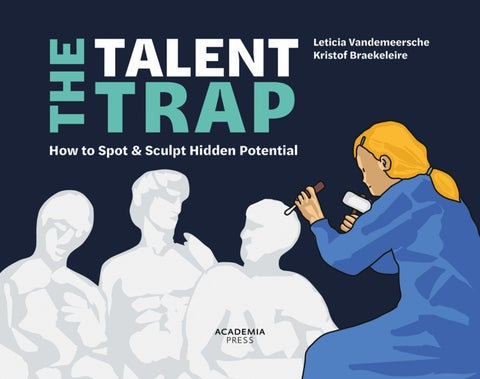
The Talent Trap

Page 1


Academia Press Coupure Rechts 88

9000 Ghent

België

www.academiapress.be

Academia Press is a subsidiary of Lannoo Publishers.

isbn 978 90 209 9950 1 d/2025/45/469 nur 807

Leticia Vandemeersche & Kristof Braekeleire

The Talent Trap – How to Spot & Sculpt Hidden Potential Ghent, Academia Press, 2025, 296 p.

Cover: Thomas Vanryckeghem

Cover image: Kristof Braekeleire

Layout: Crius

© Leticia Vandemeersche & Kristof Braekeleire

© Lannoo Publishers

No part of this publication may be reproduced in print, by photocopy, microfilm or any other means, without the prior written permission of the publisher.

INTRODUCTION

HOW TO SPOT AND SCULPT HIDDEN POTENTIAL

You’re the one holding the door open for top talent to leave 11

Why do we overlook so much potential? 12

Why is it so important to discover more talent? 14

Understanding the talent spectrum 15

How do you discover and retain more talent in your team? 16

What to expect? 17

Why read this book? 18

PART I

HOW TO SPOT HIDDEN POTENTIAL

From the classic to the future high potential

What is the talent trap? 30

What hidden potential are you missing? 38

Countless colourful combinations 76

The next generations 80

PART II

HOW TO SCULPT HIDDEN POTENTIAL

P.A.C.E. your high potentials

P for Person 94

A for Autonomy 144

C for Challenge 164

E for Environment 204

S for Sustain 238

PART III

THE TALENT TRAP IN REALITY

Shape your own role – Imane 254

Get what you want by simply asking – Liam 258

The consequences of not acting – Nadia 262

Do not lose yourself in the process – Jessy 266

You better prepare your exit – James 270

Live the company culture – Tom & Sarah 274

Step into the arena – R.K. 278

Build a common compass – Steve Skills 282

In conclusion 289

Acknowledgements 290

About the authors 291 References and bibliography 292

INTRODUCTION

How to spot and sculpt hidden potential

YOU’RE

THE ONE

HOLDING THE DOOR OPEN FOR TOP TALENT TO LEAVE

The morning air hums with the energy of a new workday. You stand in the entrance hall, observing the morning ritual. Colleagues exchange pleasantries over coffee. Some dive into lively discussions. Others head straight to the lift, focused and ready for the day’s challenges.

There are Ian, Helen, and Sahid. You know them well. You’ve seen them grow in the last few years, their potential literally unfolding right before your eyes. They’re the top performers, high potentials who stood out. Their future in the firm is secure.

But did you spot the twelve others? They just walked past you. Quietly, unnoticed. Not because they don’t matter, but because no one is really looking. Their talents remain hidden, their potential untapped. Now that you’ve seen them, you sense the inevitable: they’re on the verge of walking out. To find a place where they can flourish, where they will finally be recognised, where their abilities won’t be overlooked. And in that moment, it hits you: you’re the one holding the door open for them to leave.

Well, what if today you decided to close that door? Not to stop them from leaving, but to give you a final chance. A chance to truly see them by recognising their potential and helping them realise what they’re capable of. Maybe then they will decide to stay?

You look around. Who else in your company have you missed?

WHY DO WE OVERLOOK SO MUCH POTENTIAL?

The issue isn’t that there’s a lack of high-potential individuals. High potentials are not scarce. They’re all around us. The real problem is that we don’t always recognise them. We tend to focus on those who match the familiar mould: the “classic” high potentials. People like Ian, Helen, or Sahid. They follow the expected path, check the right boxes, and present themselves in a way that fits our standard image of success. Most learning & development programmes, recruitment processes, and leadership tracks are designed with them in mind. But this creates a narrow definition of what potential looks like. And that narrow view leaves a lot of talent unseen.

The kind of high potential we’re talking about has three defining traits: they’re intelligent, they engage critically and creatively with the information they have, and they have a level of drive and intrinsic motivation that’s hard to ignore.

But how they show these traits to the outside world varies greatly. Some – the “classic high potentials” –

do so in ways that align with what organisations traditionally expect: structured, linear, visible. But many others don’t. They may express their potential in unconventional, non-linear, or quieter ways. Their journey looks different but their talent and ambition are just as strong.

Unfortunately, many organisations have institutionalised learning, development, and recruitment in a way that rewards conformity. They use a checklist approach: the more boxes you tick, the higher your chances. But talent doesn’t live on a checklist. Even before we wrote this book, it was clear: success comes in many forms.

Only about 20% of high potentials follow a conventional path. The other 80% shape their own, often messy, personal, and deeply original. And yet, research on gifted adults remains limited (Silverman, 1993; Kieboom, 2015). Models like Betts & Neihart’s (2010), originally developed for gifted children, still offer valuable insights into how diverse and complex

these paths can be, even in adulthood. Unfortunately, these models have never really found their way into the field of talent management.

If we only look for potential where we expect it to appear – on the main road, in familiar packaging –

INTRODUCTION

we miss out on a wealth of hidden talent. Those who don’t match the norm fall under the radar. And without recognition or support, they risk stagnating, circling back, or quietly disappearing altogether.

WHY IS IT SO IMPORTANT TO DISCOVER MORE TALENT?

We live in a world shaped by climate change, wars, geopolitical tensions, artificial intelligence, and cutting-edge technology, a world where everything around us is evolving faster than ever. To address these different challenges and the speed at which they are developing, companies need to be more strategic than ever when it comes to talent.

Success no longer relies solely on experts. We’d argue it never truly did. It also depends on individuals who excel at collaboration, are forward-thinking, and have the ability to pivot quickly in a disruptive environment. It’s not enough to simply assign someone a role and hope for the best. Talent development demands a deliberate, thoughtful approach. Here, leadership and the surrounding environment play a critical role in making that happen. Moreover, a new generation of high potentials is entering the workforce: Generation Z. These young people, born around the turn of the century, are differently educated. They are accustomed to guidance, coaching, and mentoring, and bring a fresh perspec-

tive on work, autonomy, and growth(1). They are selective about where and how they work. Alongside them are millennials who are changing careers for a variety of reasons, not least personal ones.

And let’s not forget the increasing impact of economic and political migration, where many newcomers with significant potential for our labour market encounter new barriers, such as language challenges, cultural differences, and variations in entrepreneurial mindset. That gives us two compelling reasons to take a fresh look: the current approach doesn’t always deliver the desired outcomes, and a changing workforce calls for a renewed perspective. That’s exactly where this book comes in.

It offers a broader, more inclusive view of high potential: one that recognises the classic profiles, but also makes room for the many other ways talent can show up. Because organisations that succeed in recognising, developing, and retaining this wider range of high potentials will be better positioned for the future.

UNDERSTANDING THE TALENT SPECTRUM

Throughout this book, we refer to a range of terms that describe different expressions of talent and potential. While these terms are sometimes used interchangeably in everyday language, words like high potential, giftedness, or even geniuses are inflated in modern day language. In this book we focus on hidden potential.

Hidden potential

People whose capacity for growth or performance is not (yet) visible or fully activated often due to lack of opportunity, confidence, or systemic barriers. The skills or capacities of this group is underused or unrecognised.

Rather than boxing people into categories, we want to broaden the conversation. Talent is not linear, and potential does not always show up in predictable ways. Some people are recognised early and rise fast. Others stay under the radar for years, only to shine under the right conditions. This book is about creating the conditions to see, grow, and leverage the full range of human potential, whether visible or hidden.

HOW DO YOU DISCOVER AND RETAIN HIDDEN TALENT IN YOUR TEAM?

Spotting and keeping the high potentials we miss takes more than the traditional playbook. It requires a broader perspective and a structured approach. We suggest to:

• Move beyond the traditional profile – The ‘idealised’ high potential is just one of many, not the only one.

• Learn to spot the variations – Talent comes in many forms, each with its own strengths and pitfalls.

• Work with four essential pillars – Person, Autonomy, Challenge & Environment (P.A.C.E.).

The P.A.C.E. method we offer in this book offers a solid framework for retaining the full 100% of talent within your organisation. It is based on more than 20 years of working closely with high potentials and their managers.

The four P.A.C.E. pillars invite you to explore the answers to four crucial questions:

• Person – Who is the person behind the potential?

• Autonomy – How much freedom does someone need to perform at their best?

• Challenge – What keeps the work stimulating and meaningful?

• Environment – How supportive is the ecosystem around them?

Through practical insights and the P.A.C.E. method – Person, Autonomy, Challenge, and Environment –you’ll learn how to spot, sculpt, and activate hidden potential to benefit both individuals and your organisation. With real-world examples and actionable strategies, this book will show you how to create the conditions for diverse talent to thrive and will lead to lasting success.

This method is designed for use in a business context, whether you’re a manager, a leader, or even a colleague. For high potentials, it provides the space to reflect, sparking self-discovery, growth, and autonomy. Done well, this method creates lasting impact, not just for the high potential, but also for the entire organisation.

WHAT TO EXPECT?

In the first part of this book, we expand the traditional high-potential profile. There are far more high potentials out there than we are currently able to identify. You’ll be introduced to four new types, each with their own strengths, pitfalls, and development needs. Through stories, practical tips, and directly applicable techniques, you’ll learn how to spot these talents and offer them the essential early support they need.

In the second part, we guide you step by step through the P.A.C.E. method. This offers you a clear framework to identify more talent and provide more targeted support. The result? Greater impact, exactly what high potentials strive for. Once they feel they’re truly making a difference, they tend to stay.

Finally, we explore how organisations can apply the P.A.C.E. method at a broader level to retain their strongest profiles in the long term. We’ll give you real-life examples that illustrate how even small shifts in P.A.C.E. can unlock extraordinary capabilities and truly make a difference.

This book is grounded in true stories from people we’ve met and worked with across a wide range of organisations. All individuals featured in this book are real. Some share their insights anonymously, others proudly under their own names.

WHY READ THIS BOOK?

Talent isn’t always easy to spot. While some stand out immediately, others with immense potential remain hidden, overlooked, misjudged, or misunderstood. The Talent Trap reveals how to break free from the outdated idea of the classic profile of the – often ‘idealised’ – high potential and spot the diverse talents that are often flying under the radar.

We’d like to take you back to a moment where the ‘why’ behind this book first took shape. It began with an experience of one of us – Leticia – which laid the foundation for what would become a collaborative exploration.

Back when Leticia was still teaching, there was Bart, a student in her class. He frequently clashed with his teachers, often ending up in conflict. One day, things escalated: a classmate provoked him, and he exploded – shouting, lashing out, on the verge of physical violence. After the classroom was cleared, Leticia stayed behind. She looked him in the eyes and said, ‘Shall we sit down, Bart?’

In that quiet moment, tears in his eyes, Bart spoke: ‘I understand everything. I just want to do things my own way sometimes.’ That sentence changed everything. He wasn’t a ‘problem student’, but a different kind of high potential, one who didn’t fit the traditional mould. It made her wonder: how many other students remain unseen, simply because no one is really looking?

That moment marked the start of a deeper inquiry. Leticia began reading about different gifted profiles and adjusted her teaching accordingly. She created space for variation, challenge, and new ways of thinking and working. Gradually, hidden strengths began to emerge – talents that had been buried under conventional systems and standardised tools. Including Bart. As the environment changed, more and more students began to show their true potential.

She kept observing them closely – how they grew, what they responded to, and where she, as a teacher, could continue to evolve. This experience reinforced

a powerful insight: potential doesn’t always look the way we expect. There isn’t one kind of giftedness. There are many.

Around that same time, Leticia began a conversation with Kristof. With years of experience in the corporate world, including mentoring hidden potential, he immediately recognised much of what she described. In their discussions, he shared his observation that brilliant minds often go unnoticed in the workplace. People with exceptional abilities who don’t fit the standard mould – and therefore don’t get the space they need to thrive. What at first seemed like a personal story turned out to be a widespread issue.

That realisation brought them together. From two different domains, but with a shared motivation: to challenge the system and to learn to see the strength in those who are not yet recognised. That’s how the idea for this book was born – as an invitation to look differently, with more nuance and openness to the unexpected.

That’s why we wrote this book. Just like Bart – although still a teenager – many adults today are asking themselves the very same questions: What

do I have to offer? Where do I thrive? The increasing demand for career coaching, assessments, and development tools signals that more and more people are looking to reconnect with their strengths and unlock their potential – sometimes for the first time in years.

This book is for managers and leaders who want to help various generations of high potentials uncover and develop hidden talent. You’ll learn how to guide, support, and challenge your people in ways that elevate both individual growth and organisational impact.

It’s also for professionals who design learning programmes and want to make them more inclusive, tailored, and effective – grounded in a broader understanding of what high potential really looks like.

And if you’re a high potential yourself, you’ll find tools to better understand your own strengths, work more effectively with your manager, and create new opportunities for growth.

Let’s stop looking for talent in all the wrong places. The talent you need is already there – waiting to be discovered, supported, and activated.

PART I

HOW TO SPOT HIDDEN POTENTIAL

From the classic to the future high potential

Turn static files into dynamic content formats.
Create a flipbook
The Talent Trap by ACC Art Books - Issuu