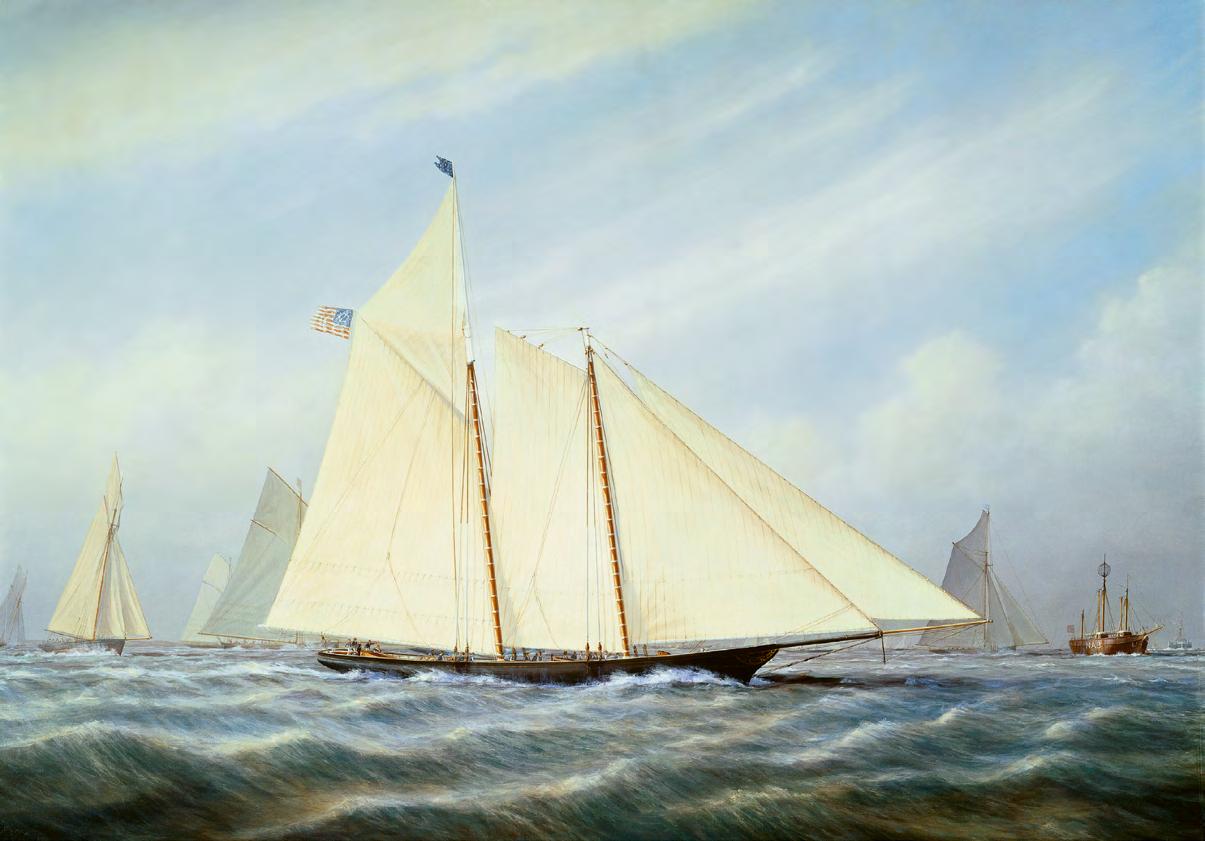
1870 MAGIC DEFEATS CAMBRIA
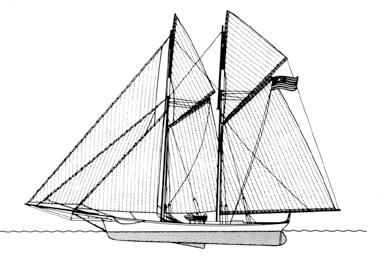
Magic ‖ New York Yacht Club
LOA: 84ft
LWL: 79ft
beam: 20ft 9in
draft: 6ft 3in
draft with board: 17ft
understood that the Cup is to be the property of the Club, and not of the members thereof, or owners of the vessels winning it in a match; and that the condition of keeping it open to be sailed for by yacht clubs of all foreign countries, upon the terms above laid down, shall forever attach to it, thus making it perpetually a Challenge Cup for friendly competition between foreign countries.’
But, as it happened, the Yankees were given twelve more years to crow about their victory and when battle recommenced there was nothing friendly about it at all.
when the Cambria subsequently defeated the American schooner Dauntless on their passage to New York, it became clear why no decision had been reached. The New York Yacht Club had no intention of handing over the Cup on a plate, and when they argued that the terms should be similar to those of the first match, Ashbury realised that the New York Yacht Club were intending to knock him out with all the guns that they could bring to bear.
displacement: 112.2 tons sail area: 1680sq ft (lowers only)
owner: Franklin Osgood
designer: R. F. Loper
builder: T. Bylerly & Son
skipper: Andrew Comstock
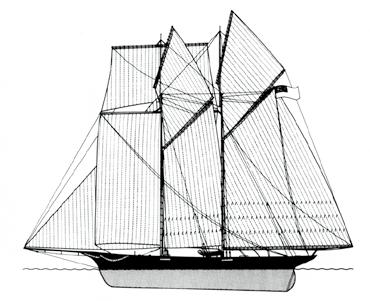
LOA: 108ft
LWL: 98ft
beam: 21ft
draft: 12ft
displacement: 228 tons
Aftersail area: 8602sq ft
owner: James Ashbury
designer: Michael Ratsey
builder: Michael Ratsey
skipper: J. Tannock
the America’s heroic win in 1851, her syndicate sold her in England to Lord de Blaquiere, but they continued showing off the Cup in their respective homes until in 1857 George Schuyler had the bright idea of saving on the silver polish by presenting it to the New York Yacht Club as an international yachting trophy. In a letter sent to the Club, later known as the first Deed of Gift, the syndicate made certain stipulations, concluding: ‘It is to be distinctly
British yachtsmen had misguidedly been in no hurry to take up the challenge, for in America there had been a rapid decline in yachting due to the Civil War. During this period several boats, following the America’s example, sailed in English waters, including Fleetwing, Henrietta and Vesta, which raced across the Atlantic for the first time in history. The race, won by Henrietta in just under fourteen days, was unfortunately marred by tragedy when six men were swept off Fleetwing by a giant wave, and generally the expedition was to have little success. More significant, however, was the arrival in 1868 of the large American schooner Sappho, sent across by her owners to be sold. Although she had acquitted herself well in the United States, they gave strict instructions that she was not to be tested but, as had happened in 1851, her skipper could not resist the temptation, and in a race held once again around the Isle of Wight she was soundly beaten by four British yachts including Mr James Ashbury’s Cambria, which won.
It was this that no doubt encouraged Ashbury, a man who had made a fortune on the railways, to write to the New York Yacht Club during 1869 initiating the first challenge for the America’s Cup.
The tedious correspondence which followed became almost acrimonious at times, and the details were debated to such lengths that no match could be arranged until the following season. Among his many requirements Ashbury insisted that, as per the rules of the Royal Yacht Squadron, centreboarders should not be eligible to compete, but the New York Yacht Club, turning a deaf ear, countered that his own challenge was unacceptable as it had not come through a recognised yacht club, and Ashbury was thus forced to challenge instead through the Royal Thames. Another of Ashbury’s proposals had been that he should race against their boat across the Atlantic and then around Long Island, but although the committee agreed to the first part, the second idea was never settled, and
That the Cambria should now be asked to take on the Club’s entire fleet seemed not a little unsporting, and to many it was a gross misinterpretation of the Deed of Gift. It was one thing for a yacht like the America to join in and win a friendly club race, but quite another for a yacht to be taken on by a well-prepared and hostile armada, intent only on preventing the Cup leaving the country. The Deed definitely talked about a match, not a war, and although it could have been said that America had been jostled by a number of British competitors in 1851, nothing quite compared with the treatment planned for the gallant Cambria in 1870!
The New York Yacht Club had invited Ashbury to sail a single race over a course starting off Staten Island and thence through the narrows and round the Sandy Hook lightship, a distance of about 36 nautical miles. The morning of 8 August, the day set for the race, broke with leaden skies, and when Cambria and her eighteen opponents took up their stations the challenger was generously given the weather end of the line. According to the custom of the day the start was from anchor, all the yachts being drawn up with their chains short and their sails down, and as the signal was given there was feverish activity as the crews sweated at the windlasses and struggled with the halyards to hoist the sails.
The best position was, as it happened, of no benefit to Cambria, for as the sun broke through the wind shifted from the south-west to the south-east, making her the most leewardly boat of the fleet. Among the large number of spectator craft gathered to witness the inaugural defence of the America’s Cup stood out a tug bedecked with British colours, and as Cambria got under way the tug’s brass band blared out ‘Rule Britannia’, but all to no avail. She had a poor start and was immediately besieged by most of the boats around her.
The little centreboard schooner Magic was the first away, and with the advantage of her shallower draft she was able to stand over towards the shore and establish a convincing lead, but
by the Spit Buoy the old America, which had been hastily fitted out by the Navy Department to defend her title, had almost caught her up. It was soon after this that Cambria, who was already nineteen minutes behind, was struck by another boat, losing a port shroud and her fore topmast-backstay, the Spirit of the Times subsequently reporting, ‘she suffered a little delay by being fouled by Tarolinta, which, being on the starboard tack should have kept away’. Magic went on to win, but Cambria, probably as a result of this collision, lost her fore topmast as she gybed for the run home, and could not manage better than tenth place, finishing some fourteen minutes behind America. Thus the first attempt to lift the Cup had failed but, undaunted, Ashbury continued racing for a time in America. Finally, at last confident that the New York Yacht Club would ease the rules, he took his boat home and sold her as a trading vessel, Cambria later making money for her owners on the west coast of Africa in the humbler occupation to which fate had condemned her.
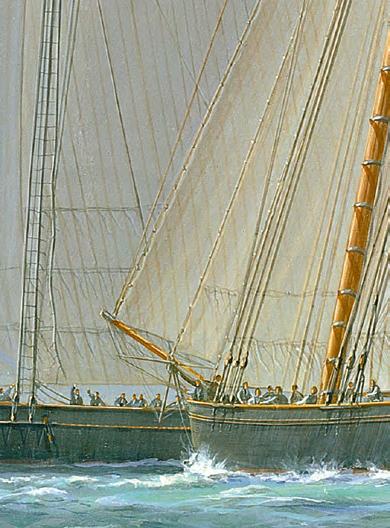
As Magic, pursued by the America, makes for the Sandy Hook lightship, Cambria is fouled by the Tarolinta, which carries away part of her rigging while going about.
broken shroud
Cambria ‖ Royal Thames
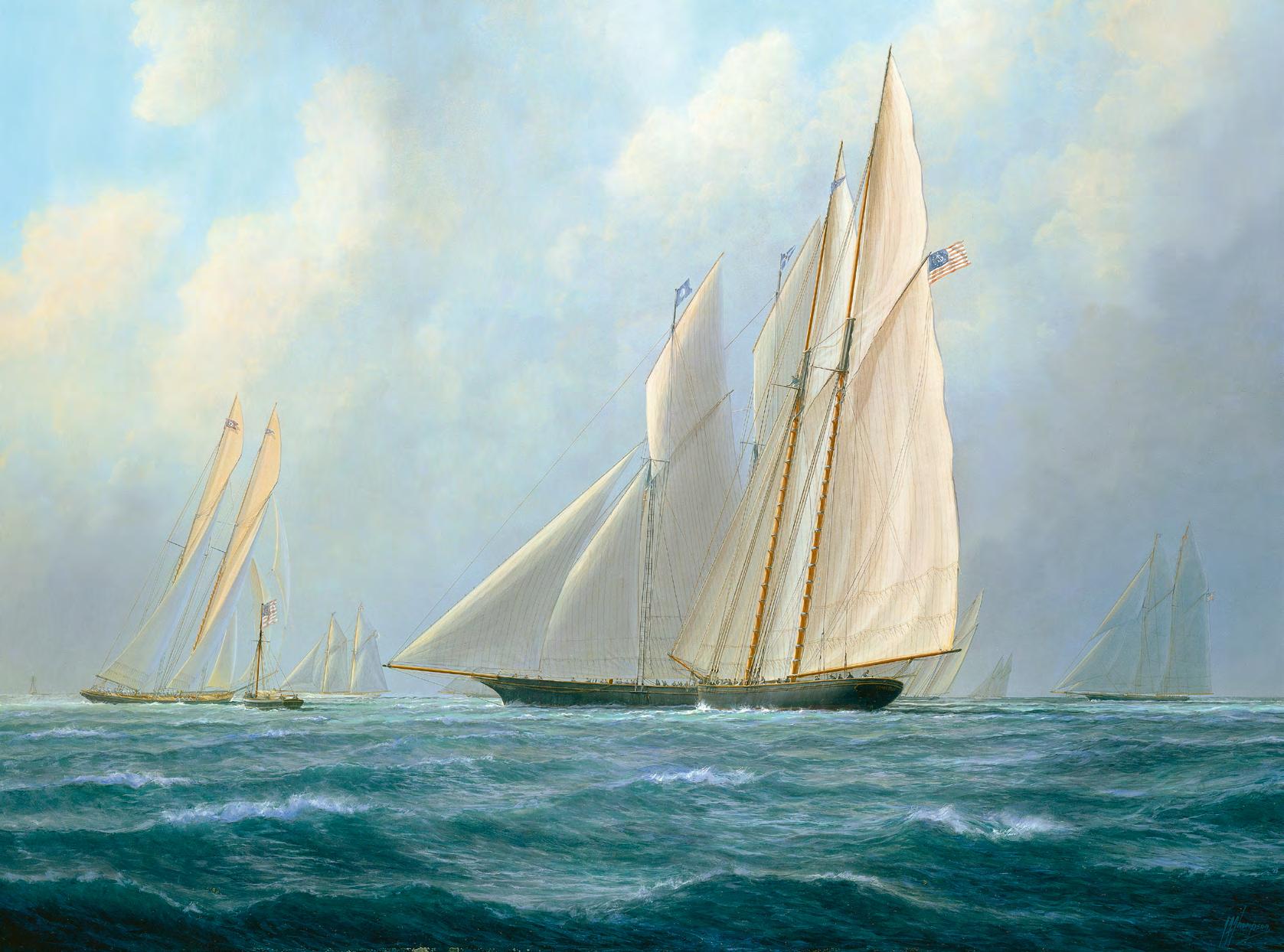
Sandy Hook lightship Fleetwing marker flag Magic America (half hidden) Cambria Tarolinta Dauntless Idler Phantom
1887 VOLUNTEER DEFEATS THISTLE
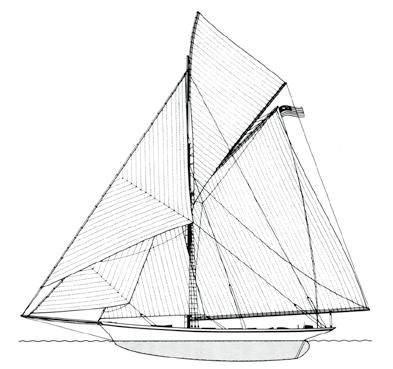
Volunteer ‖ New York Yacht Club
LOA: 106ft 3in
LWL: 85ft 10in
beam: 23ft 2in
draft: 10ft
draft with board: 21ft
displacement: 130 tons
sail area: 9271sq ft
owner:
General Charles J. Paine
designer: Edward Burgess
builder: Pusey and Jones
skipper: Henry C. Haff
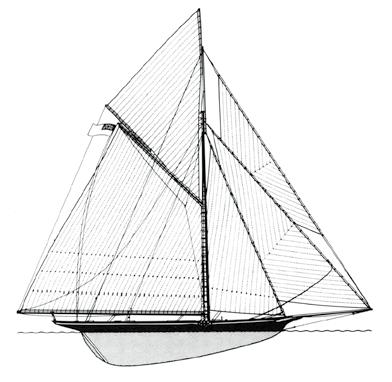
LOA: 108ft 6in
LWL: 86ft 5in
beam: 20ft 3in
draft: 18ft 10in
displacement: 138 tons
sail area: 8968sq ft
Vice-Commodore James Bell of the Royal Clyde Yacht Club was the next to lay his head on the chopping block. But when the Club’s Secretary wrote to New York late in 1886 proposing a challenge with a boat ‘about the size of Mayflower’, the Cup committee simply sent back a curt reply, enclosing a copy of the Deed of Gift and stating that the challenge would only be considered when it was received in ‘proper form’.
Although Bell and his syndicate were surprised by this rebuff, they decided that if the New York Yacht Club wanted to play it their way, then they would do likewise and continue with their plans regardless. As no British competitor had been built for the Cup for sixteen years, they had already sent the eminent Scottish designer, G. L. Watson, over to America to study all the latest tricks of the trade, and they now gave him carte blanche to go ahead and build the fastest yacht possible. Watson, who later designed the famous Britannia, was probably one of the most successful marine architects that Great Britain had ever produced, and because the Yacht Racing Association had in 1886 decided to change the old method of measurement for the ‘length and sail area’ rule, he was able to design a very different craft indeed. More beamy than her forebears, Thistle had a clipper bow, and was cut away at the forefoot to give a minimum of wetted surface when sailing in a light breeze. Built in utmost secrecy, she remained cloaked in tarpaulins until she hit the water, and Bell took particular pleasure in waiting until March to send in his formal challenge, giving the New York Yacht Club the minimum required information and little time to build a defender.
Undeterred, General Charles Paine again quickly picked up the gauntlet and, on account of his two previous successes, the defence was left entirely to him. He at once went to Edward Burgess and placed an order for a new sloop of approximately 85ft (26m). Constructed of steel, Volunteer, as she was named, was designed to carry more sail than any previous defender, and she was completed in the remarkably short time of sixty-six days.
hired a diver to go down one dark night and explore the mysteries of her bottom. The result of his endeavours was a report of a keel so unlike that of any yacht afloat that Bell exclaimed, ‘Did they really get a diver or was it a duck?’
On 2 September both boats were towed to the Erie Basin for official measuring, and when it was discovered that Thistle was nearly l½ft (45cm) over her declared length, all hell was let loose. Bell should have been seriously embarrassed, for the waterline length of a yacht governs her maximum speed. But saying that her designer had been unable to give him more accurate information at the time of the challenge, he shrugged off the vociferous New York critics, asking what all the fuss was about as Thistle would be penalised on handicap. Eventually, George Schuyler, the last of the Cup’s donors, had to step in and agree to let Thistle race, for many thought that she should have been disqualified.
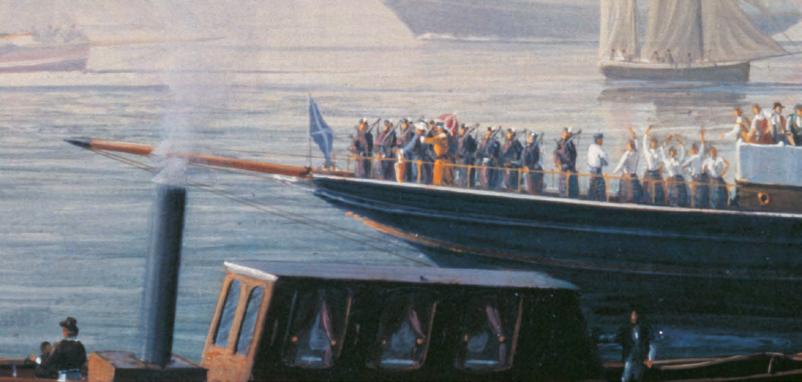
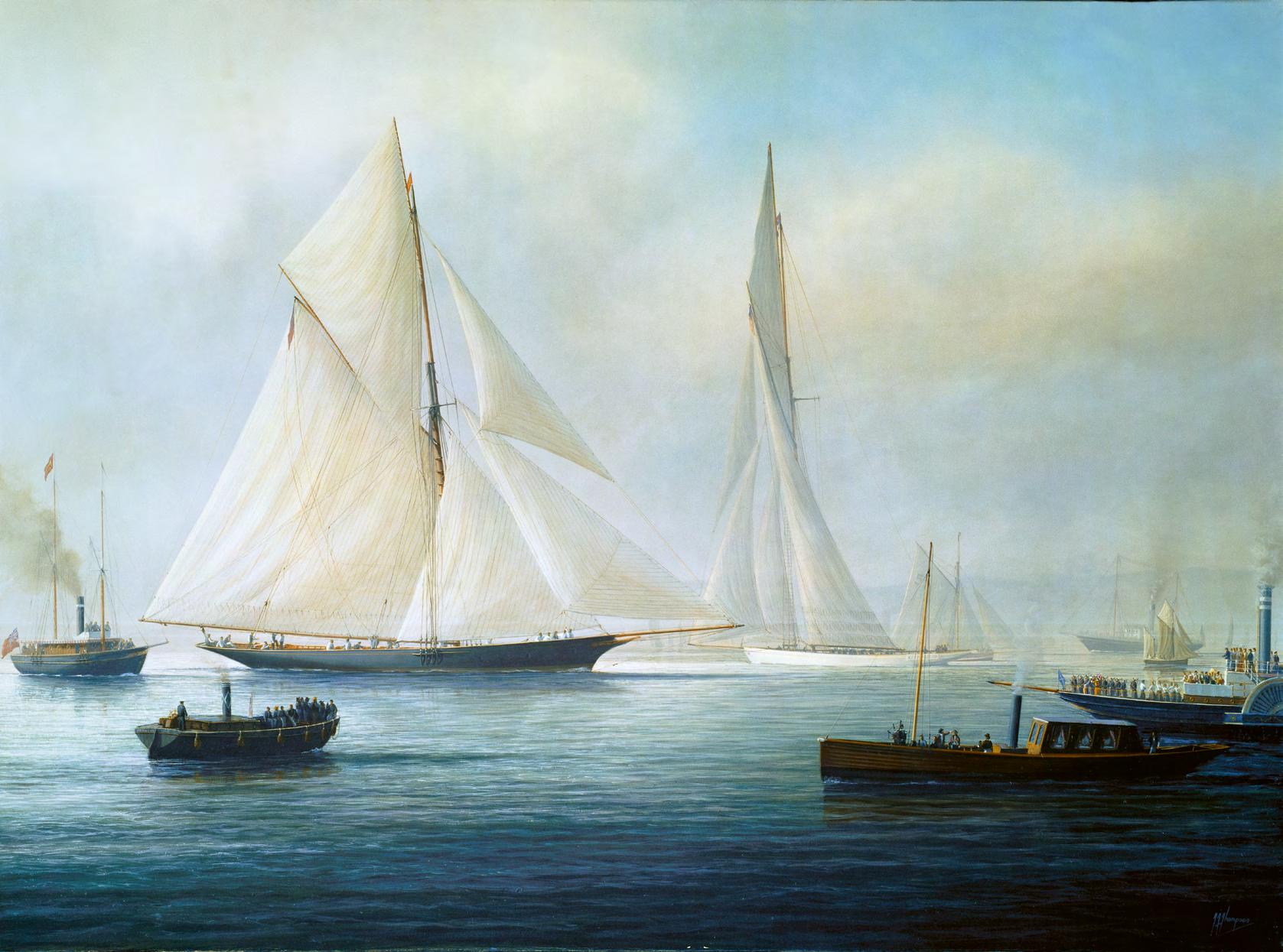
Excitement was intense for the first of the two duels, but as the morning fog lingered over the course and obscured the heights of Staten Island, the start had to be postponed. It was the last time, as it happened, that the race was to be held on the Club’s inside course, and down in the narrows an immense fleet had gathered to send the two boats on their way. Thistle made the most of the delay, and her skipper, Captain Barr, threading his way through the spectators, caused gasps of dismay as he dodged amongst their clumsy craft, seeming to find a breeze as if by magic. The stock of the Volunteer and General Paine, sitting quietly in her stern wearing his old straw hat, went down even lower when from the Mohican, whose deck was crowded
with fair dames glorying in the colours of the Thistle, there came the skirl of the bagpipes and the pungent aroma of a haggis which her cooks were preparing in the galley.
Such was the scene off Owl’s Head as the starting cannon boomed, and Thistle, first over the line, basked in a few moments of glory before being determinedly and decisively overhauled by her opponent.
The second race was sailed in a stiffer breeze, but both results were so devastating that one American correspondent put it nicely as follows: The canny crew of Scotchmen told us to wait for rougher weather, and so we waited. Now they have had their fill, the sooner they get back to their spindles, their fraoches and their meres and leave yachting to those who understand it, the healthier it will be for their wallets and for the honor of Bonnie Scotland. For ignorance and deceit the owners and designers of the Thistle take the cake—we take the Cup.
It was not a pleasant ending to what was then a purely sporting occasion, and some supporters, bewildered by Thistle’s sudden lack of form, accused her skipper, who stayed on in America, of accepting bribes from the opposition. But others were full of sympathy, and before Bell’s departure for Scotland he and Watson were both invited to a reception given in their honour by the New York Yacht Club.
Waiting for the fog to lift, Thistle shows off her paces while Volunteer, displaying a banner asking spectators to keep clear, nudges towards the starting line with the only true wind coming from the pipers!
owner: James Bell and syndicate
designer:
George L. Watson
builder: D. & W. Henderson
skipper: John Barr
Captain John Barr was put in charge of Thistle. Having won eleven of her fifteen trial races, easily outpacing Genesta, she left Gourock for New York on 25 July, accompanied for the first 40 miles by the steam yacht Mohican, which was later to take over many of her supporters.
The Yankees had been baffled by all the secrecy surrounding Thistle, and when she docked after twenty-two days at sea, the New York World
Thistle ‖ Royal Clyde
Thistle Volunteer Mohican
1934 RAINBOW DEFEATS ENDEAVOUR
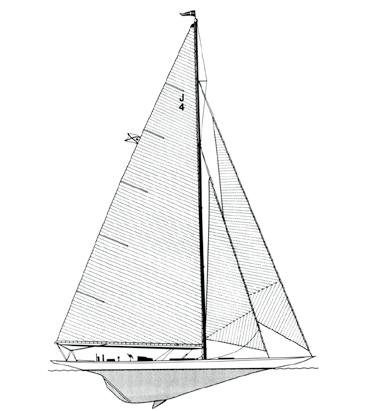
Rainbow ‖ New York Yacht Club
LOA: 126ft 7in
LWL: 82ft 4in
beam: 21ft
draft: 14ft 6in
displacement: 141 tons
sail area: 7535sq ft
owner: Harold Vanderbilt and syndicate
designer:
W. Starling Burgess
builder: Herreshoff Mfg Co
skipper: Harold Vanderbilt
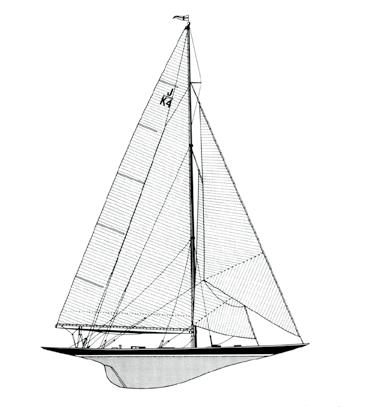
Endeavour ‖ Royal Yacht Squadron
LOA: 129ft 8in
LWL: 83ft 3in
beam: 22ft
draft: 14ft 11in
displacement: 143 tons
sail area: 7561sq ft
TheDepression of the 1930s was to hit the yachting industry hard. But somehow the great boats survived, as they usually do, and by 1933 the order books were beginning to fill once more. The magnificent J-Class now ruled the waves, and they had been joined by Shamrock V, bought after the death of Sir Thomas Lipton by the distinguished aircraft manufacturer T. O. M. Sopwith. Sopwith, who was already one of the best amateur helmsmen in England, decided at the end of the season to build a new boat and challenge for the America’s Cup.
The New York Yacht Club accepted, but they also announced changes to the rules. Yachts in future would be expected to have crew’s quarters, thus eliminating the below-decks mechanisation of Enterprise, the 1930 defender, and both competitors were to have identical J-Class ratings. Sopwith approached the task more professionally than Lipton. The experienced Charles Nicholson was chosen to design the new yacht, and Frank Murdoch, an aeronautical engineer working with Sopwith, was asked to help with the rigging and other advanced features. Endeavour, launched in April 1934, was acknowledged to be the most beautiful ‘J’ yet built. She was also such a superb racing machine that she was to come within an ace of winning the America’s Cup for Great Britain.
The defender, Rainbow, was commissioned by ‘Mike’ Vanderbilt, who had defended the cup successfully with Enterprise in 1930, and headed a syndicate of seventeen patriotic millionaires. Rainbow was lucky to be chosen, for in trials she was almost defeated by Yankee, who was to make her name the following year racing in England. Sopwith was meanwhile trying out a radical double-clewed, or quadrilateral, jib in the Solent. Later, he was to regret that he had not tested it further away from prying eyes, for within a few days the Americans were flying their own ‘Greta Garbo’ as they called it. Endeavour was towed to Newport, Rhode Island, by Sopwith’s motor yacht Vita. But, before she left England, she suffered a disaster which almost certainly cost her the Cup. Her professional crew had gone on strike for more pay, and as a result Sopwith, in cavalier mood, had misguidedly replaced many of his men with amateurs.
achieved more than any challenger—now all she needed was one more victory. The British were ecstatic.
The third race was again Endeavour’s, right until the final beat. Vanderbilt, believing the Cup had gone, went below and handed over the helm to Sherman Hoyt, a much respected and crafty sailor, who knew from past experience that Sopwith liked to cover his rival at all times. He luffed up into the light breeze, causing Sopwith to cover him by tacking twice. Endeavour lost momentum and the race. Sopwith and his crew were devastated, but they had a further chance.
In the fourth race the two boats nearly collided at the start. Both skippers thought the other was at fault, but neither flew a protest flag. Rainbow had a twenty-second lead crossing the starting line, but by the first mark Endeavour had already overtaken her. Then the inexperience of Sopwith’s crew once again began to tell.
Sopwith had as his navigator a merchant navy officer called Paul who, although efficient at plotting a course across the Atlantic, had little knowledge of racing. Paul was now to direct Sopwith too far downwind, and by the time Sopwith realised the mistake, Rainbow was forging past. Sopwith quickly threw over the helm with the intention of forcing Vanderbilt to luff into wind and give way, as was allowed by the racing rules, in a desperate attempt to stop him passing.
Sherman Hoyt, who had been sitting on Rainbow’s spinnaker boom, reckoning that the two yachts were about to collide, shouted: ‘Luff!
Luff, Mike, for God’s sake luff!’ But Vanderbilt carried straight on.
Vanderbilt had risked everything. If the two boats had struck each other it would have been a disaster; but if Sopwith, now compelled to bear away, protested, and proved successfully that he would have hit Rainbow forward of the shrouds, Vanderbilt would lose the Cup.
As he approached the committee boat at the finish, over a minute behind Rainbow, Sopwith hoisted the red protest flag, according to British rules. But the race committee declined to consider the protest, saying that in America the flag had to be flown at the time of the foul. Later, the committee defended their decision by saying that Endeavour had already fouled Rainbow before the start, and if they were now forced to eliminate her, she would then be unable to disqualify her opponent.
Vanderbilt, hotly denying that he had been within thirty metres of Endeavour, went on to win the next two races and the America’s Cup. But the incident caused a major controversy that has never been settled.
owner: T. O. M. Sopwith
designer: Charles Nicholson
builder: Camper & Nicholson
skipper: T. O. M. Sopwith
The first two races were sailed in strong winds and rough seas, and Endeavour won both impressively. In the second race Sopwith, the first British owner to sail an America’s Cup boat himself, beat the course record. Endeavour, accepted as being the faster boat, had already
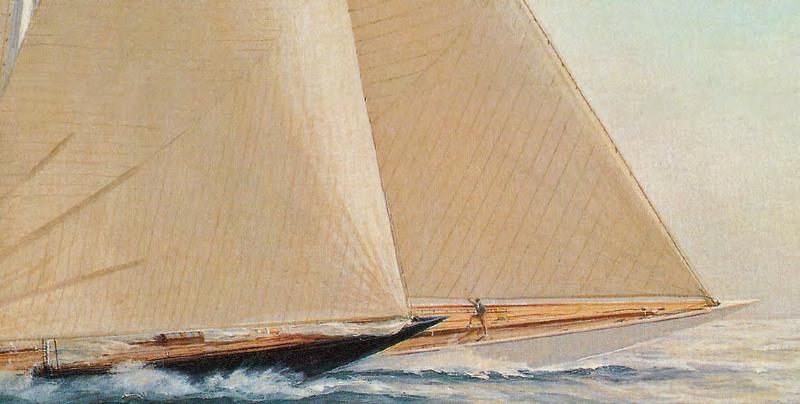
Sherman Hoyt, wearing his famous red pants, shouts at Vanderbilt to give way. (This incident has been painted from photographs taken by a spectator through a telescope. These images are shown earlier in the book.)
Sherman Hoyt
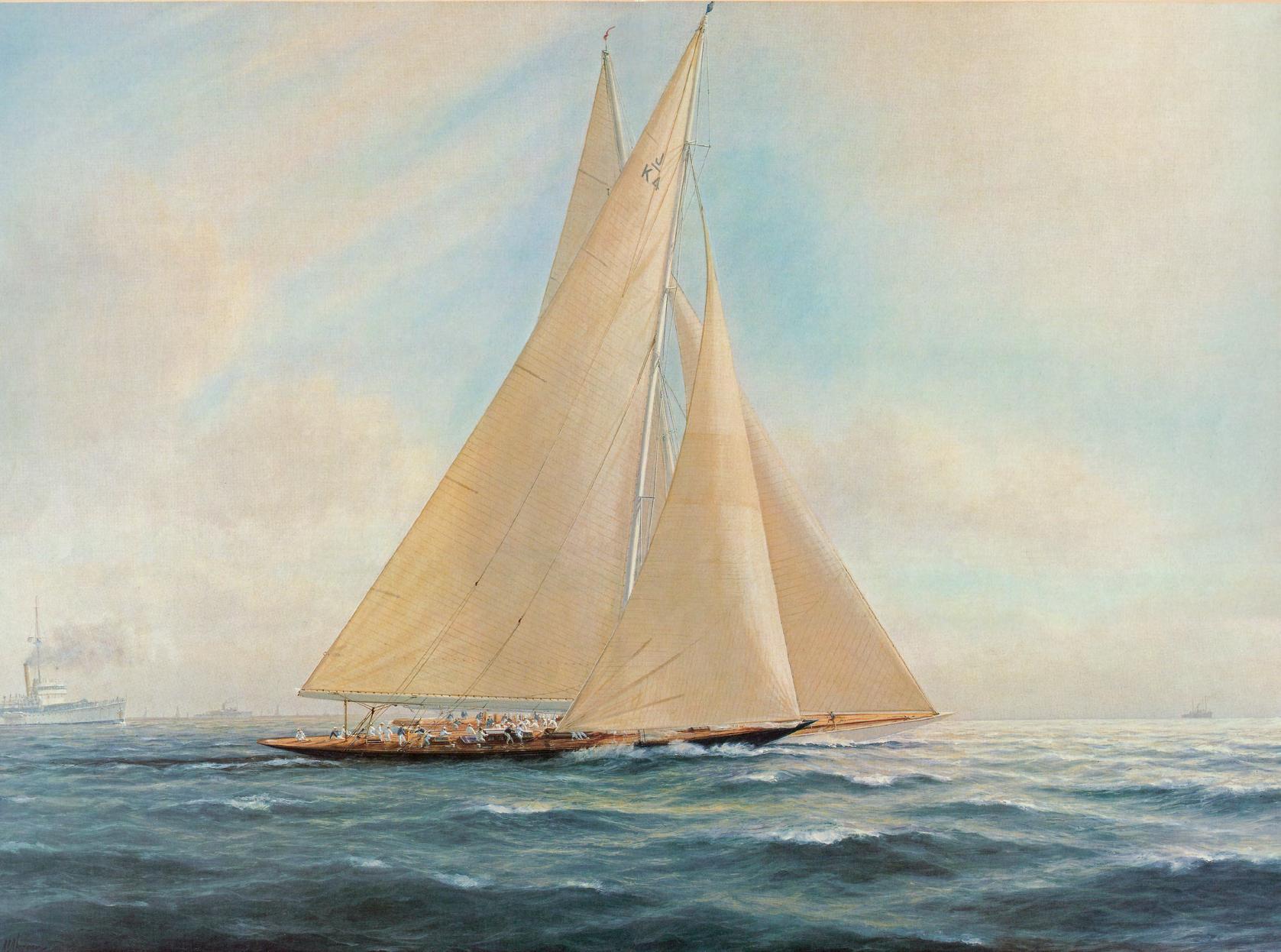
T.O.M. Sopwith Endeavour Rainbow
1962 WEATHERLY DEFEATS GRETEL
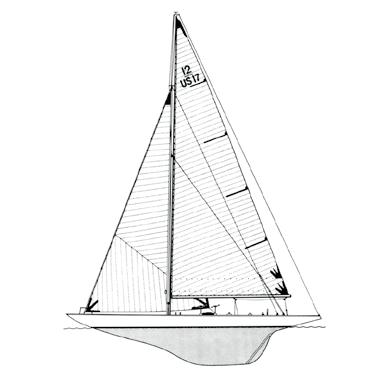
Weatherly ‖ New York Yacht Club
LOA: 66ft 10in
LWL: 46ft
beam: 11ft 10in
draft: 8ft 11in
displacement: 59,000lbs
(29.5 tons)
sail area: 1850sq ft
owner: Henry Mercer, Arnold Frese and Cornelius Walsh
designer: Philip Rhodes
builder: Luders skipper: Bus Mosbacher
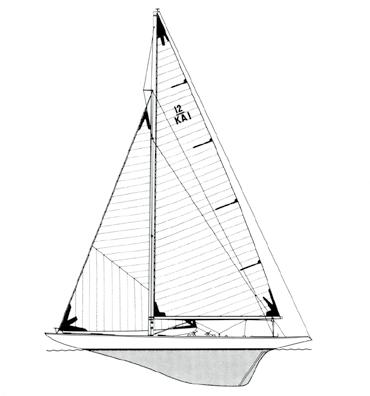
Sceptre’s defeat in 1958 had left a nasty taste in the mouth, and so, determined to put matters right, two syndicates were formed in England with the intention of building better boats for 1962. But the next challenge was, as it happened, to come from an entirely different direction, and there were howls of protest when it was discovered that the New York Yacht Club had already agreed to defend the Cup against a surprise entry from the Southern Ocean. All the Royal Thames Yacht Club could do, after the Duke of Edinburgh had tried to help by suggesting a joint Commonwealth effort, was to book their ticket for another day.
In Australia, which at that time had no crews experienced in sailing international racing yachts greater than 8 Metres, there had been a boom in sailing, and several big spenders had been toying with the idea of building a contender for the Cup. Of these Sir Frank Packer, who had made a fortune from publishing, was the first afloat with Gretel, drawn by Alan Payne, then Australia’s only full-time naval architect, with the aid of Vim, Vanderbilt’s former 12 Metre, which he had chartered. It was a shrewd move, for not only did the Australians have the second fastest Twelve in America to tune up with, but as a result Payne was able to test scale models based on her lines at the Stevens Institute of Technology in America. Although the New York Yacht Club had just stated categorically that the 1962 challenger must be designed and built in Australia, Payne had already bent the rules, and even Gretel’s sails, numbering over eighty, were cut from American Dacron. Indeed, Payne went one step further by linking two American ‘coffee grinders’, as the jib-sheet winches were now called, through a single clutch mechanism, so that four men, instead of the usual two, could apply their muscle-power, thus giving the yacht a significant advantage.
It was possible that the New York Yacht Club,
by allowing the challenger such leeway, were trying to avoid a repeat performance of 1958, but when they heard reports of Gretel’s excellent showing in Australia, they agreed that such generosity had to come to an end. Three older boats were already available to them, Columbia, Easterner and Weatherly, but because of general complacency, only one new Twelve, Nefertiti, commissioned by a Boston syndicate, had been considered necessary. It was almost a decision they lived to regret.
There followed some of the most exacting trials Americans had ever seen. Although Easterner, sailed more for fun as a family venture, was soon discarded, there was little to choose between the remaining yachts, and it was only because of Emil S. Mosbacher’s determination at the helm of Weatherly that she was finally chosen to defend. ‘Bus’, as he was affectionately called, knew what was required of a skipper by the New York Yacht Club selection committee, and it was not just a pretty face!
Jock Sturrock, who had prepared Gretel almost as well, was unfortunately not chosen to be her helmsman until the day before the race, and Packer, who liked to be in charge, made other last minute changes that did not help. ‘His bluster and brass,’ wrote an observer, ‘was a stalking horse for a mind as devious and sly as a barrel of snakes.’
The Cup races began on 15 September, watched by a large crowd including President Kennedy, also from a destroyer. Gretel’s inexperienced navigator, appointed by Packer that morning, soon made an error that cost Gretel two minutes on the wrong tack, and when a broken backstay lost her further valuable seconds, she was unable to make up the deficit and finished nearly four minutes adrift. It seemed to prove very little, but the canny Mosbacher already knew that the Aussies had built the faster boat.
The second race, held three days later over the triangular course in a 20-knot wind, turned
swiftly into a tacking duel. Mosbacher, slightly ahead at the start, desperately tried to cover Sturrock, who was gaining with Gretel’s superior winches on every turn, but as the spray flew and the two boats were slammed from tack to tack, he wisely disengaged before it was too late. Leading after the first leg by a slender twelve seconds, he gained two more seconds on the next 8-mile reach, but on gybing Weatherly round the final mark he had a problem with his spinnaker, and before it had filled Gretel was on them with a war cry which could be heard for miles.
Lifted by a rogue wave, perhaps caused by some wandering Atlantic swell, Gretel nosed over the crest and plunged forward like a surfer at Bondi, with a crewman standing at her mast hollering his lungs out. She surged on and on, with her wake smoking in the sunlight, and taking Weatherly’s wind as she careered past, she won by nearly half a minute, beating the course record.
Australia went mad, and so large was the crowd of reporters in Newport when she was berthed, that they almost capsized the pontoon, ‘gretel the great’ were the headlines, ‘One all, and everything to play for.’ It was a fine win, but sadly it could not quite be repeated. Although the third race was an anticlimax, the fourth was again a crowd stopper. Tricked by Mosbacher close to the finish, much as Sherman Hoyt had robbed Sopwith of certain victory in 1934, Sturrock failed to press home his attack, and lost by the narrowest margin in the Cup’s history.
The fifth race, won narrowly again by Mosbacher, finally dashed Australian hopes. But the series had shown just how surely a resolute country, with no previous experience of 12 Metres, could claim and one day would claim the America’s Cup.
In a welter of white water, Gretel surfs past Weatherly in a matter of seconds, riding high on a surging Atlantic roller.
LOA: 69ft 5in
LWL: 45ft
beam: 11ft 10in
draft: 9ft
displacement: 60,480lbs
(30.25 tons) sail area: 1900sq ft
owner: Sir Frank Packer and syndicate
designer: Alan Payne
builder: Lars Halvorsen skipper: Jock Sturrock
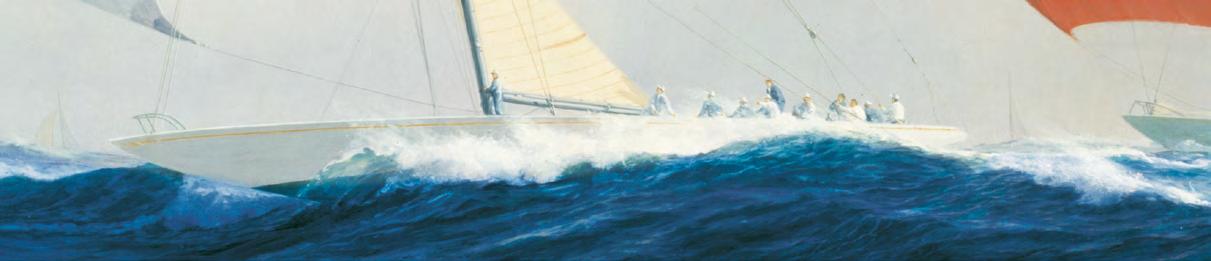
Gretel surfing
Gretel ‖ Royal Sydney Yacht Squadron
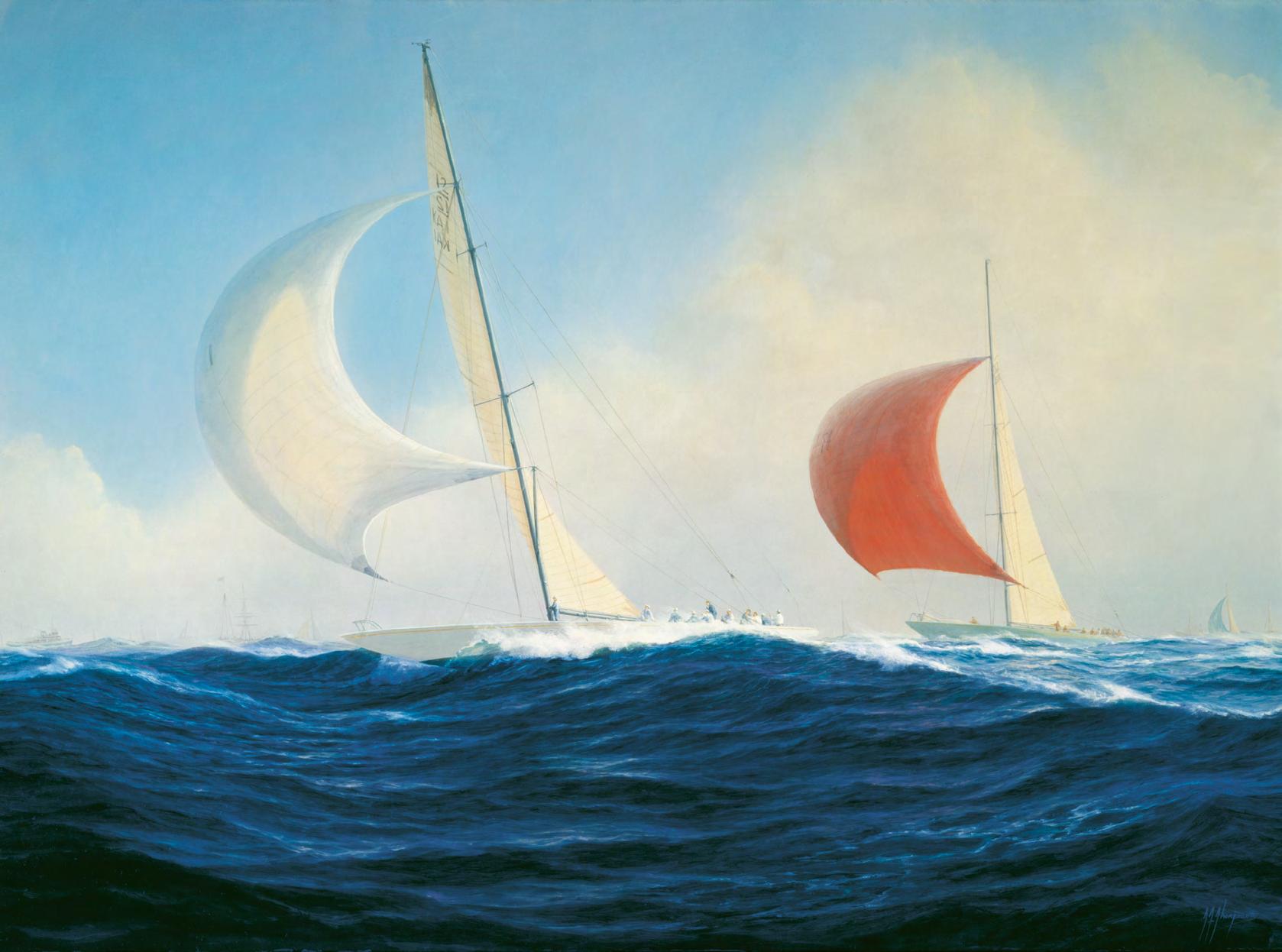
Gretel Weatherly
1974 COURAGEOUS DEFEATS SOUTHERN CROSS
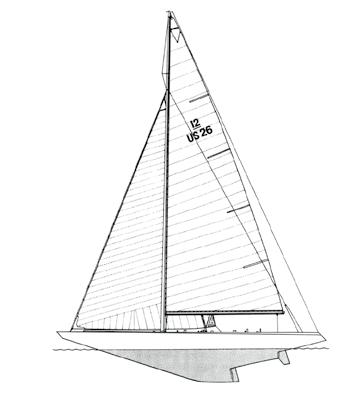
Courageous ‖ New York Yacht Club
LOA: 66ft
LWL: 45ft
beam: 12ft
draft: 8ft 10in
displacement: 58,000lbs (29 tons)
sail area: 1770sq ft owner:
Courageous syndicate designer: Sparkman & Stephens
builder: Minneford
skipper: Robert Bavier
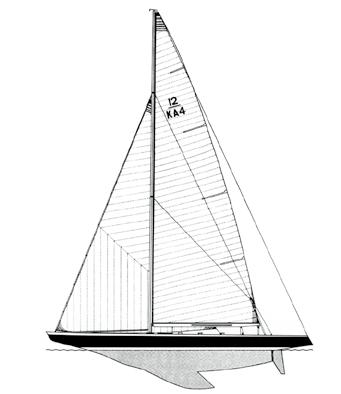
Southern Cross ‖ Royal Perth
LOA: 67ft 3in
LWL: 46ft 8in
beam: 12ft 4in
draft: 9ft 6in
displacement: 62,000lbs (31 tons)
sail area: 1811sq ft
owner: Alan Bond
designer: Bob Miller
builder: Halvorsen, Morson & Gowland
skipper: John Cuneo
Thetwenty-second challenge for the America’s Cup, which should have taken place in 1973, is remembered not so much for its somewhat predictable conclusion but more for its unusual start. The defenders may well have looked down a gun barrel before, but this time it was from the wrong end!
In 1970 the New York Yacht Club had extended the period for submitting challenges from thirty to ninety days, and during this period eight aspiring clubs from Great Britain, Australia, Canada, France and Italy had sent in their applications. But although this was a pointer for the future, only the French, headed by the now legendary Baron Bich, and the Australians, with a new man Alan Bond in the hot seat, ultimately got their campaigns off the ground.
Bond, who, since leaving London at the age of thirteen, had amassed a fortune from real estate in Western Australia, was not slow to declare war; and making no pretence of his distaste for the methods of the New York Yacht Club race committee, he warned them that he would be taking his lawyer to Newport along with a videotape camera crew instructed to get everything on record. It was to be the start of the most pugnacious and protracted onslaught on the Cup in its entire history.
The Baron, however, was in trouble right from the outset. Although by now the French had learned a great deal about the game and were certainly a force to be reckoned with, Bich overstepped the mark by employing a Dane to coordinate his latest offensive. Paul Elvstrom was one of the most distinguished helmsmen in the world, and had won four Olympic gold medals for sailing, but that meant very little to the Baron’s compatriots who, suspicious that Elvstrom was about to employ a Scandinavian crew, or even build his own boat, were looking for every excuse to have him ousted. They were not to be frustrated for very long. The ‘Great Dane’, as he was soon named, made his first mistake when France sank in a gale while being towed back from the Baltic, and he then compounded his problems by being beaten by Frenchmen in the 1972 Olympics and the 1973 Half-ton World Championships. Needless to say the French had been more intent on having the wretched Elvstrom’s head than collecting the trophies, and when the French press also joined in the sport the Baron had no alternative but to send him his marching orders.
The Baron might well have given up then and there, but instead he stopped any further work
being done on the new yacht he was building and, thinking ahead, sent the salvaged France to Newport in the capable hands of Jean-Marie Le Guillou, who later may have wished he had stayed at home.
Bond had spared nothing. Having bought both Gretel and Gretel II, he had a vast concrete hangar constructed for them and his new Bob Miller designed Southern Cross at his Yanchep Sun City, which he had festooned with barbed wire and patrolled by dogs. Space-age technology had arrived, and as far as Bond was concerned the developments in aluminium hull construction (allowed by the rules since 1970), Kevlar sails and on-board computers, were too important to be shared with anyone.
The Americans, aware of what was going on, were preparing for the defence with more than their usual thoroughness, but there was a sense of relief when the match, owing to the deepening international recession, which may have gone unnoticed by Bich and Bond, was postponed for a year until 1974. The Courageous syndicate actually ran out of funds at one stage and lost Bill Ficker, their proposed helmsman, before William Strawbridge was persuaded by the New York Yacht Club to continue with the yacht’s construction and sign Bob Bavier, the 1964 winning captain, instead. Mariner was not so affected, however, because George Hinman, her manager, developed a tax-exempt scheme in order to raise the $1 million required—but she was not so clever on the water, and it was unfortunate that Hinman found it necessary to replace Ted Turner, her experienced ocean racing skipper, with Dennis Conner, before she finally failed and was withdrawn. Turner did not go much on Mariner’s design, or for that matter on her designer either, and when Valiant, Britton Chance’s other similar boat, was also thrashed by both Courageous and the fierce old Intrepid, he was proved right. Intrepid lost the final selection trials only in the last of nine hard-fought races, and Courageous
could have found no better sparring partner. Courageous, skippered by Ted Hood, was an Olin Stephens classic. Lighter and smaller than many 12 Metres, she was also some six inches too long, a fact only discovered before her subsequent defence of the Cup in 1977, when she was altered accordingly.
Southern Cross was also an unusual boat, similarly built with long overhangs designed to increase her speed on the wind. But she had some difficulty shaking off Gretel II, and it was only when Jim Hardy was transferred to her helm from that of the older yacht that the mustard-yellow (‘Yanchep’-yellow) lady picked up her skirts, trouncing France 4–0 in the elimination series.
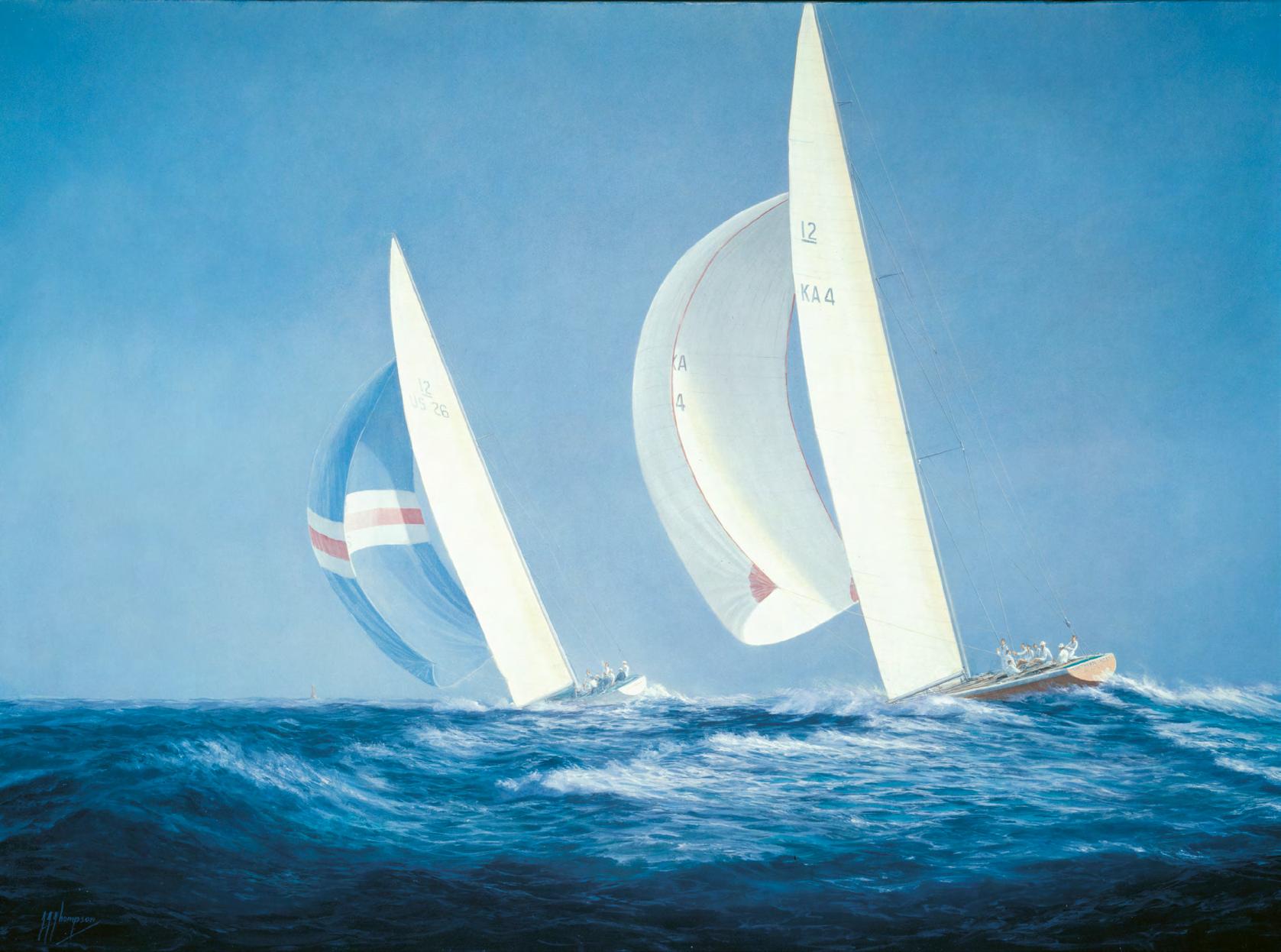
The Cup races, after all this excitement, were very disappointing and The Cross never came up to expectations. Conner, who had moved to Courageous as her tactician and starting helmsman, was not so sure, however, and only his clever use of wind shifts in the first two races got Courageous into the lead. In the second race The Cross managed to hold on remarkably well, losing out to her opponent only by putting in more tacks, and on the second leg, which was a run, she made up half the lost ground. But although later the frustrated Bond made various crew changes and did some splendid ‘coffee grinding’ himself, it was only to be counter-productive and after plenty of protests and counter-protests Courageous finished with a clean sweep. Ian Dear, writing in his Informal History of the America’s Cup, states that when Hardy was asked how he slept after losing the first race he said: ‘Like a baby. I woke up every two hours and cried.’ Perhaps there were many such nights for the Australians still to come!
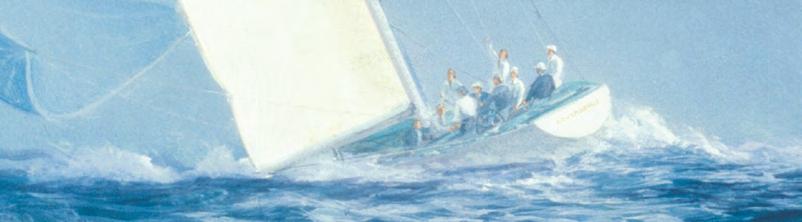
Downwind in the second race, Courageous set her red, white and blue North spinnaker, a gift from the Mariner syndicate, while Southern Cross, flying her magnificent white spinnaker, made up almost thirty seconds to the wing mark.
Courageous Southern Cross
1987 STARS & STRIPES DEFEATS KOOKABURRA III
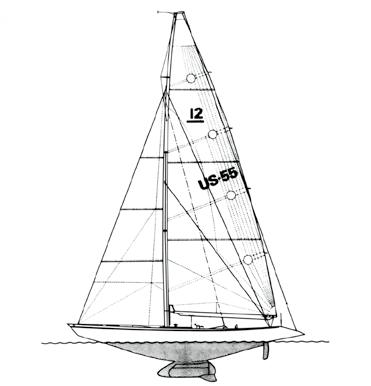
Stars & Stripes ‖ San Diego Yacht Club
LOA: 64ft 3in
LWL: 44ft 6in
beam: 12ft 6in
draft: 8ft 9in
displacement: 50,848lbs
(25.5 tons)
Onthe night that Australia II won the Cup in 1983, Alan Bond, in a wild moment he was later to regret, allowed her secret winged keel to be exposed to the press. It was the beginning of a technological scramble that has probably never been equalled, even in time of war.
Undaunted by the huge sums now required to put a competitive boat into the water, and attracted by the growing rewards to the vanquisher, fourteen challengers from Great Britain, the United States, France, Italy, Canada and New Zealand set their sails for Perth. This new battleground, dominated by the notorious ‘Fremantle Doctor’, a fierce wind that blows inland from the Indian Ocean on a summer’s afternoon to replace air rising from the hot Australian desert, demanded new standards of excellence; by the time racing began the total cost to all the syndicates competing was estimated to have risen to a staggering £150 million.
sail area: 1540sq ft
syndicate: Sail America
chairman: Malin Burnham
designers: Chance, Nelson, Pedrick
skipper: Dennis Conner
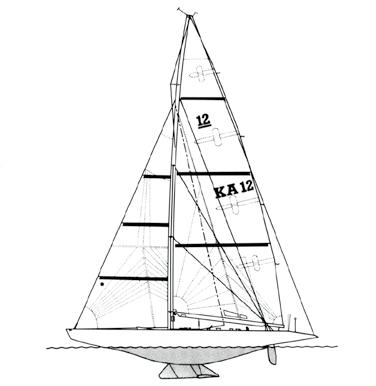
Kookaburra III ‖ Royal Perth Yacht Club
LOA: 67ft
LWL: 44ft
beam: 12ft 1in
draft: 9ft 1in
displacement: 54,880lbs
(27.5 tons)
sail area: 1799sq ft
syndicate: Taskforce 1987
chairman: Kevin Parry
designers: Murray, Swarbrick
skipper: Iain Murray
Alan Bond had already announced that this would be his last campaign, no win could measure up to 1983, and partly as a result of this, Australia IV never fully extended the best of the five other yachts built to defend the Cup. But in every other way the man who had so determinedly wrested the trophy from the New York Yacht Club after so many years had turned the event into a billion dollar bonanza.
As the press gathered from twenty-six countries, and over fifty television networks started broadcasting the America’s Cup throughout the world, his dreams began to come true.
The financial benefits for any club winning the Cup had become so great that as much time was spent on chasing up new sponsors as on the boats themselves. Individual budgets, at first set as low as £2 million, soon climbed to £8 million or more; the age of snap-on keels had arrived in earnest, and the maze of problems confronting designers trying to squeeze the last fraction of a knot out of their errant steeds had become a financial nightmare.
Amongst those who did not sleep too well were the British White Crusader team, for the Royal Perth Yacht Club had stated that no new keels could be cast by the challengers on Australian soil. Flying £30,000 keels around the world at £70,000 a time becomes an expensive pastime, and harsh words were spoken with some effect. But the toughest words came from that old man of the sea, Dennis Conner, who with others was unhappy that the New Zealand team should race its innovative ‘Plastic Fantastic’ without having her first drilled full of inspection holes.
No fibreglass boat had ever been raced in the America’s Cup before, and by using this material it was possible to lighten her ‘ends’ to advantage. But his demands fell largely on deaf ears. Conner, the master of gamesmanship, had tuned up in Hawaii away from the fleet, unlike the rest of the challengers. Riding the big surf in Honolulu, he had found conditions very similar to those in Western Australia, and with the help of Boeing and NASA he had been able to develop his four boats in utmost secrecy. It was unfortunate that when his stable arrived off Fremantle one of his yachts got stuck on a ‘bump’, and had to be towed off by Bondy’s boys, who must have had a quick peek. But he remained the dark horse just as he wanted to be, and as the round robin elimination series got under way in October 1986 and his gunsmokeblue Stars & Stripes failed to shine, few could have realised that he was probably ‘sandbagging’.
Horseracing stewards would not have looked kindly on Stars & Stripes’ jockey for not trying, but some may have given him the benefit of the doubt due to the lighter airs prevailing in the earlier rounds. Coming from behind he quietly notched up just enough wins to keep in touch, and then disposed of French Kiss, sponsored by Kis (a French company who were earlier accused of advertising), to meet the New Zealand boat in the finals of the challenger’s series. Named KZ7, because 7 was the lucky number of her sponsor Michael Fay’s string of racehorses, she had only once been defeated; when Conner beat her convincingly, the New Zealand punters could have skinned him alive.
Iain Murray, well known for his prowess with the boisterous eighteen-footers in Sydney harbour, had won the defender series with the laughing Kookaburra, the golden hope of Kevin
Parry, sporting more high-tech gear on deck than any yacht in history. But the black computer evaluation strips on her sails did not worry the Stars & Stripes camp at all. They had evaluated every yacht in Fremantle, using a Cray computer, the most powerful of its kind in the world; they knew that they had built a weapon that, in the stronger winds expected later on, would be some .02 knots faster than any other 12 Metre afloat. It was thus that the finals of the 1987 match were, to many, an anticlimax. Only the ‘Doctor’ came fully up to expectations, making heroes of the intrepid bowmen and pale shadows of most of the contestants’ ardent supporters.
Sailing faultlessly, and resorting to Machiavellian mischief only twice, to introduce a ‘Dolly Parton’ spinnaker and a skin of tiny riblets to reduce drag, Conner won the first race by 1 min 41 secs, and the second, after an exciting start, by a margin of 1 min 10 secs. The third race, won by 1 min 46 secs, will be remembered for his epic ‘duck’ under the Kookaburra’s stern to snatch the lead on the initial beat. The fourth and final race, won by Stars & Stripes from the start by 1 min 59 secs, was therefore only a formality. Discarded as skipper by the New York Yacht Club, but sponsored by such notable organisations as the Ford Motor Company, Budweiser and Merrill Lynch, and flying his home San Diego colours, revenge had been very sweet. Dennis Conner, the first man to win back the America’s Cup, counts only on excellence; but for those who may feel that he was now invincible, it is interesting to note that when he was later thrown into the dock, he couldn’t swim!
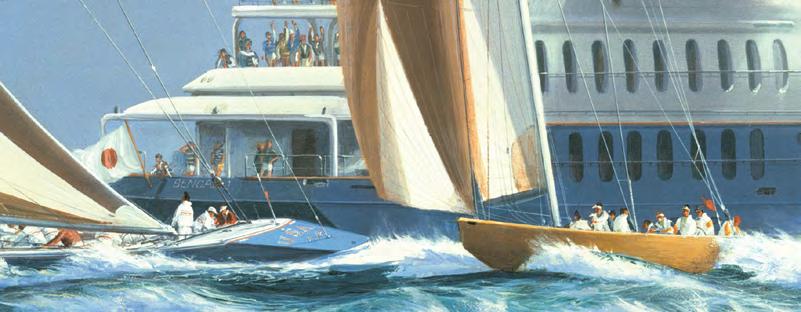
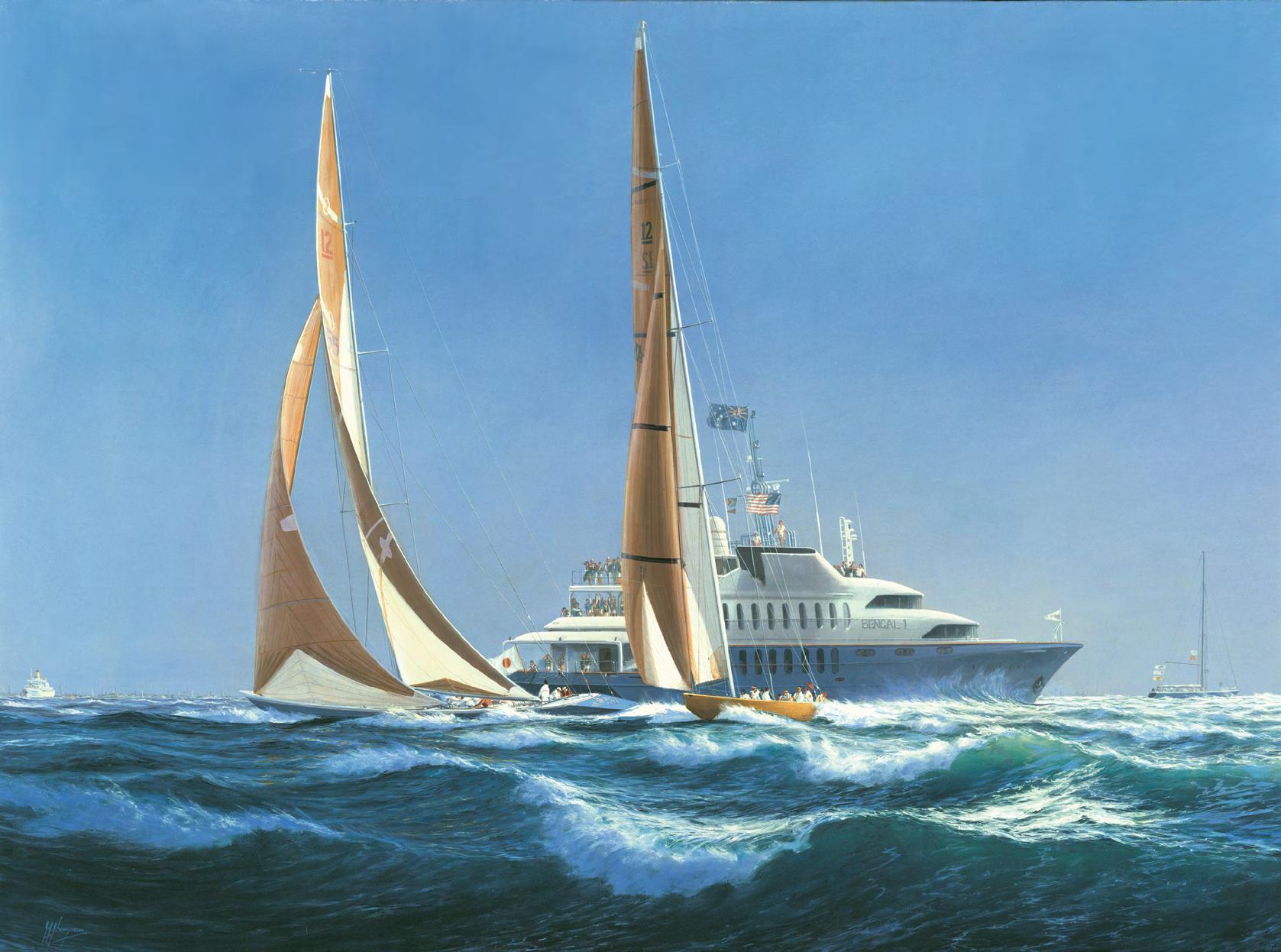
Before the start of Race 2, Kookaburra III chases Stars & Stripes round the spectator boat Bengal I, to try to get the dominant position.
Iain Murray hoists a protest flag as Dennis Conner gybes across his bows, but the protest fails
Stars & Stripes
Kookaburra III Bengal I
1992 AMERICA 3 DEFEATS IL MORO DI VENEZIA
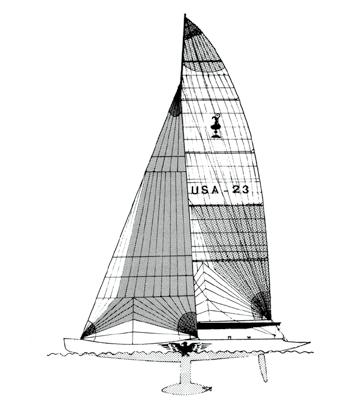
4 boats syndicate: America
syndicate head: Bill Koch designers: Peterson, Meldner, Milgram, Pugh, Reichel, Moeyersom builders: Hercules Aerospace, Goetz helmsmen: Buddy Melges, Bill Koch
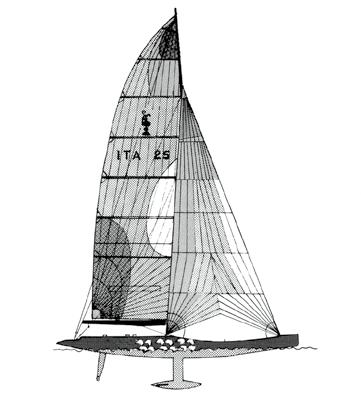
5 boats
syndicate: Compagnia della Vela chairman: Raul Gardini
designers: German Frers, Hopkins, Sena builders: Tencara (Montedison) helmsman: Paul Cayard
While the contentious 1988 challenge was taking place, Bruce Farr, designer of New Zealand, was one of those to realise that without a determined initiative, the reputation of the America’s Cup was on the line. He therefore helped convene a meeting of the world’s leading yacht designers to thrash out the specifications of a new ‘controversy-free’ class which would take the race well into the next century.
It was generally agreed that the new America’s Cup yacht should be more spectacular and testing for the crews than the ageing 12 Metres class, but some potential challengers, fearing a considerable escalation in building costs, argued that it would be possible to fit the existing 12s, or ‘Super 12s’ as they would be called, with larger rigs by adding as much as 10ft (3m) to the height of their masts. Building these yachts, they calculated, would cost just US$750,000 compared with $1.5m for the alternative suggestion of an entirely new class of 75-footers.
Before World War II America’s Cup yachts had always been larger and costlier than any other racing class, and now, once again, the dignity of the competition seemed to be at stake. With little ceremony the 75-footers won the day and by the end of March 1990 the first of this new International Class had been unveiled in France. Named simply F1, she immediately became the focus of attention, and Marc Pajot, her skipper, was quick to point out that ‘sailing this boat is totally different. She is faster, more sensitive and more demanding for the crew, who must handle a huge sail area.’
With the advent of the new Class came a flurry of revised rules and regulations, such as on-the-water umpiring instead of protest by jury, and a remodelled course to give the race better spectator appeal. Yachts were now to be fitted with two compulsory robot cameras, with challengers and defenders splitting the television revenue. But just as the great competitor Sir Thomas Lipton, one-time master of advertising, could not have envisaged the vast media coverage that the America’s Cup now enjoys, competing syndicates could not have foreseen the growing world economic slump, which by early 1991 made such potential earnings seem all the more appealing. Even Dennis Conner, hoping to raise some US$20m, discovered that corporate sponsorship was becoming hard to nail down.
Of the fifteen challengers with boats in the water a year before the 1992 match, only ten remained in contention at the start of the elimination series. Once the new IACC breed
of yachts was launched the costs, influenced by the big spenders, had quickly escalated to approximately US$4m for each boat, which included a $750,000 carbon fibre mast.
Two entries had been received, surprisingly, from Russia, at that time in a state of domestic turmoil. A bitter struggle followed between them, one challenge ending with an unfinished yacht in San Diego harbour and the other with no yacht at all, after a truck transporting her equipment from St Petersburg to the port of Tallinn was hijacked.
The situation was not much better back at the ranch. The America’s Cup Organising Committee was in a financial mess, having seemingly failed to appreciate the immense cost of running the event. The unfortunate defence, mainly conducted in the courtroom, of the 1988 raid by New Zealand, had drained their coffers dry, and the situation had been made worse by the reduction in the number of challengers from the twenty-three originally estimated. Those remaining now decided to help out by lending the ACOC US$1 million to finalise the vital broadcasting arrangements. But somehow San Diego felt, with its sprawling city and massive Naval dockyard, just too impersonal for the cream of world yachties, and on the other side of the harbour wall the port commissioner was heard to say, ‘The Cup has no appeal for the community here. It is not the Super Bowl.’
Some would have preferred, as Dennis Conner had once suggested, for the Cup to have been contested in the more demanding conditions he had experienced while training off Hawaii.
The 1992 America’s Cup was dominated, as is the nature of the beast, by money. Where the organising committee lacked it on shore, two syndicates, one challenger and one defender, had more than enough lucre to rule the Californian waves. Italy’s II Moro di Venezia syndicate, headed by Italian industrialist Raul Gardini, kicked off by building their own boatyard, and with the small change, kindly provided by the Ferruzzi–Montedison empire, they constructed five state of the art yachts. Bill Koch, a billionaire
amateur yachtsman with a penchant for riding rapids in a canoe, quickly matched the Italians by hiring a team of 200 technicians and then spending some $70m on four hulls, seven masts, nine keels and hundreds of sails. The main protagonists had locked horns.
Sir Michael Fay, not to be outdone, had meanwhile established a highly efficient development programme away from the crowd on the south-western perimeter of San Diego harbour.
Often the first to spring surprises, Bruce Farr’s innovative bowsprit fitted to New Zealand soon had them winning the challengers’ Louis Vuitton Cup by 13–1. Paul Cayard, skipper of Il Moro, objected, and after months of deliberation the race jury decided that although bowsprits were permitted, using them as an outrigger was not. Fifty thousand New Zealanders were expected in San Diego for the final round of the challengers’ series, but they were to be disappointed when their yacht never regained the initiative. Meanwhile the immaculate French entry Ville de Paris and the Japanese, Swedish, Spanish and two Australian syndicates left for home. The final could almost have been between two sailmakers. Team Dennis Conner had already conceded defeat to the overwhelming firepower of Bill Koch’s arsenal, when America3 came out flying such a silvery white sail that the crew all had to wear sunglasses. Claiming that his new fibre was ‘50 per cent lighter and twice as strong as Kevlar’, Koch, sometimes taking the helm from sixty-two-year-old Buddy Melges, moved into top gear mindful that Gardini had spent a fortune developing an ultra light, hugely expensive sailcloth woven with black carbon thread that Il Moro’s skipper had described as ‘the biggest innovation in sailmaking for ten years.’ For a breathless moment Cayard squared the series, but at 3–1 down Gardini admitted, ‘We are waiting for death.’ It was not long to follow.
Il Moro di Venezia is still tacking up to the mark on the last leg as America3 heads for the finish and the Cup.
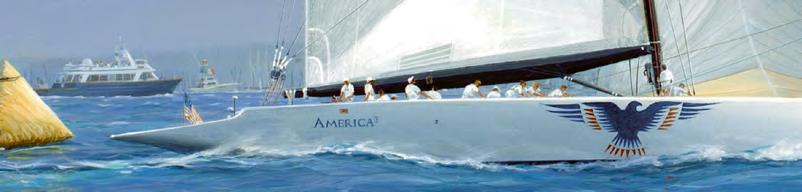
Bill Koch, the owner, often helmed the boat himself
America 3 ‖ San Diego Yacht Club
Il Moro di Venezia ‖ Compagnia della Vela
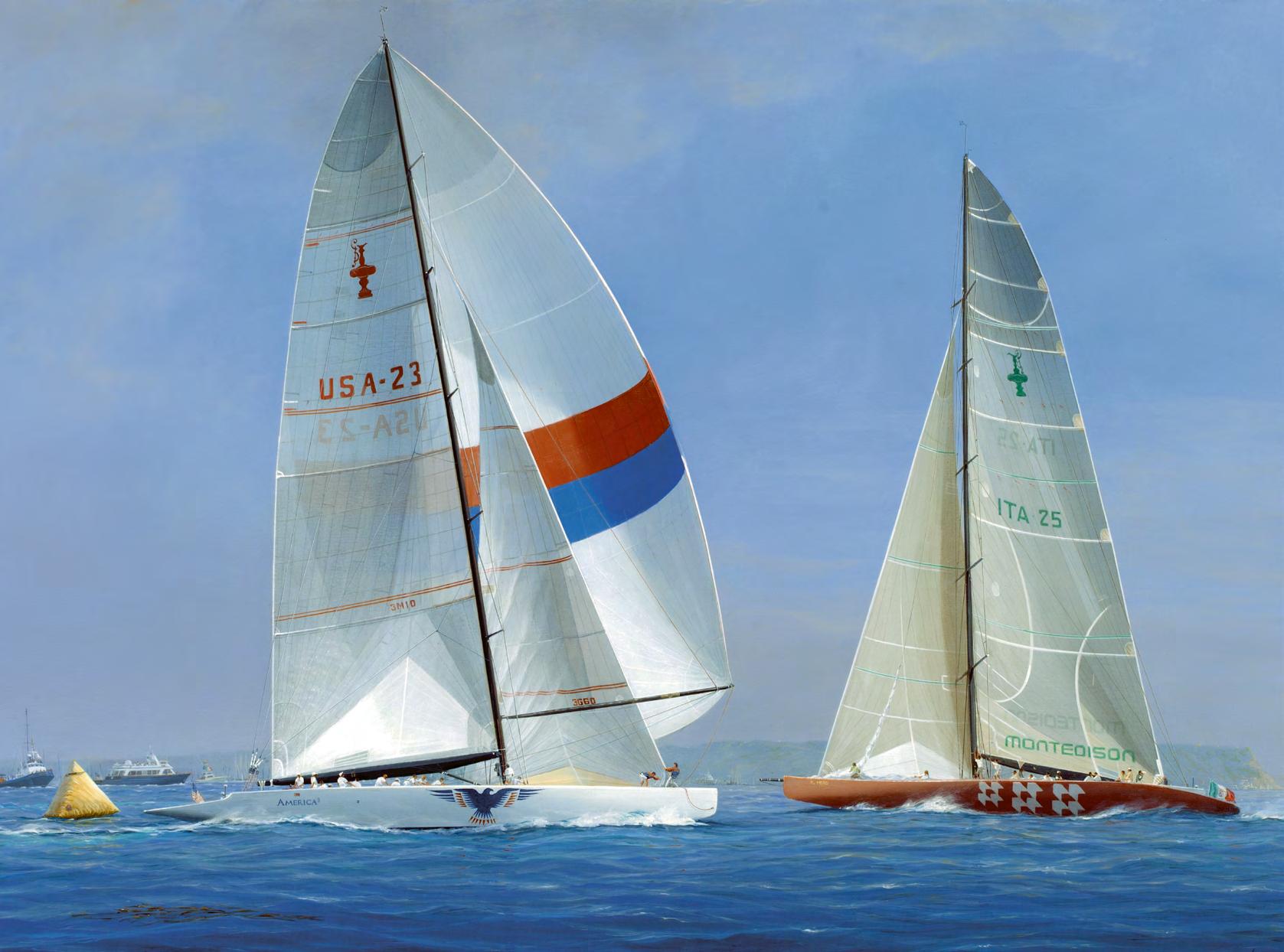
Il Moro di Venezia
2007 ALINGHI DEFEATS NZL 92
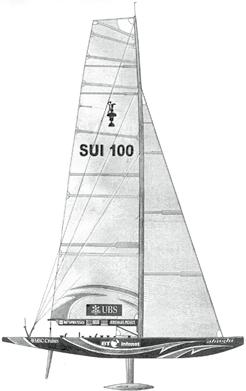
Alinghi ‖ Société Nautique de Genève
syndicate:
Alinghi Swiss Challenge
syndicate head:
Ernesto Bertarelli
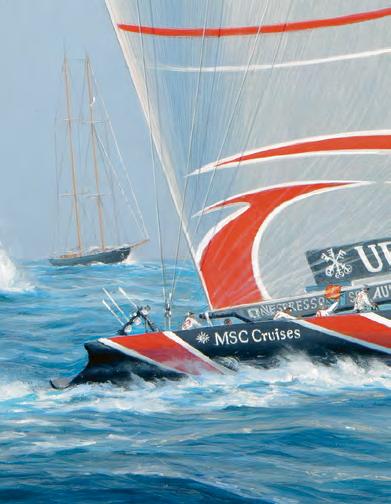
TheAmerica’s Cup, once noted for the power and sheer beauty of its competitors, particularly the ‘J’s, had for purists been changing for the worse. Any artist attempting to paint America’s Cup Class yachts in 2007 was hard put to convey the grace and vigour of yesteryear, particularly when many of their elegant bows, together with the tops of their once soaring Bermudan mainsails, had been snipped off as if with a pair of scissors! Since 2003 the boat designers and sail makers had been doing their worst, creating mean, boxy machines with one aim only, to beat the fickle winds likely to dog the bay of Valencia, by stretching the rules to the limit.
in this case, of relaxing them and coming to the rescue!
designers: Rolf Vrolikj and Alinghi Design Team builder: Decision SA sails: North Sails
skipper: Brad Butterworth
helmsman: Ed Baird
tactician: Brad Butterworth
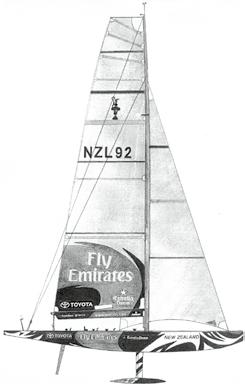
NZL 92 ‖ Royal New Zealand Yacht Squadron
syndicate: Emirates Team
New Zealand
syndicate head:
Grant Dalton
Sadly, one rule that has been stretched increasingly is the employment of foreign sailors. For 132 years, until the Australians put a foot in the door, the America’s Cup was strictly contested between nations. By 2007, however, the financial temptations of jumping ship had become so great that many traditionalists asked themselves if the Cup was degenerating into nothing better than a club football match. However, not for Russell Coutts, Alinghi’s brilliant Kiwi helmsman, who after exchanging words with Ernesto Bertarelli, her billionaire owner, leapt ashore to look for different challenges.
As opposed to Alinghi, whose team consisted of only one Swiss, her owner, among 130 people from twenty-one nations with a solid core of Kiwis, the yacht with the most nationals on board was that of Emirates Team New Zealand, led by their formidable countryman Grant Dalton. However, the English helmsman, Ben Ainslie, excelled himself as understudy to NZL 92’s skipper, Dean Barker, before the competition began in earnest. Two other old hands at the game, Patrizio Bertelli’s Luna Rossa, the new name for the Prada Challenge from Yacht Club Italiano, and the only challenge from America, Larry Ellison’s BMW Oracle from the Golden Gate Yacht Club, San Francisco, with an estimated budget of £80m, were also notching up brownie points. The early stages of the Louis Vuitton Cup were often delayed by light winds. But by the semi-finals the weather had steadied, bringing the triumphant progress of BMW Oracle to an abrupt halt against an inspired Luna Rossa, with Chris Dixon, her fiery skipper, getting a clipped ear. Two wins by the Desafio Espanol over the Kiwis had the Spanish celebrating as if they had won the Cup itself, but all to no avail, and the Kiwis sailed on to soundly defeat Luna Rossa 5–0 in the Louis Vuitton final.
sail then tangled with the wreckage and a third spinnaker failed to deploy fast enough. Alinghi pounced and although the Kiwis fought back gallantly, the game was over. In the sixth race the lead was once again to change dramatically on the second upwind leg, leaving the ‘Swiwis’, as some were now calling them, needing only one more race to win. Meanwhile, on shore, the fight had attracted an unprecedented 75,000 spectators!
At the moment of truth, although the Swiss matador had to wait for decent weather before drawing his sword, it was to pierce the heart of Emirates Team New Zealand with unswerving accuracy. At the top of leg three, the Kiwis were leading, but by not enough to cut across Alinghi, cleverly placed by Brad Butterworth, to the mark. Instead Dean Barker tried to dive behind and incurred a penalty. Then, as they trailed Alinghi towards the finish, the breeze dropped, the Kiwis charged ahead like a wounded bull, passed Alinghi for a final time, circled to shake off their penalty and crossed the line just one second behind. It was a thrilling end to possibly the closest contest in America’s Cup history.
designers: ETNZ Design Team builders: Cookson Boats, ETNZ sails: North Sails, skipper: Dean Barker
helmsman: Dean Barker
tactician: Ray Davies
The departure of Russell Coutts, three times winner of the America’s Cup, left Alinghi wallowing in the water, with the young pretenders including Shosholoza from South Africa, Desafio Espanol 2007, Areva Challenge from France, the United Internet team from Germany, the China Team challenge, and +39 from Sicily, together with the older pretenders Victory Challenge from Sweden sponsored by Red Bull, and Mascalzone Latino-Capitalia from Italy, rubbing their hands with glee. But not for long. After a winter spent tuning up his ship in Arabia, Ed Baird, one of the three contenders for Alinghi’s wheel, although not best known for his starting skills, soon began reeling in the opposition in a number of ‘fleet races’, or Louis Vuitton ‘Acts’, introduced by Ernesto Bertarelli prior to the elimination series for the Louis Vuitton Cup. These races provided an interesting new look, as did the additional hype and apparent air of respectability which surrounded them. Only when the underfunded +39 lost her one and only competitive mast in a collision with the yacht from Germany did the Cup’s build-up revert to its more enduring habits of dog eat dog. Masts, apart from hulls, are one of the few remaining areas still covered by nationality rules and their rivals had no intention,
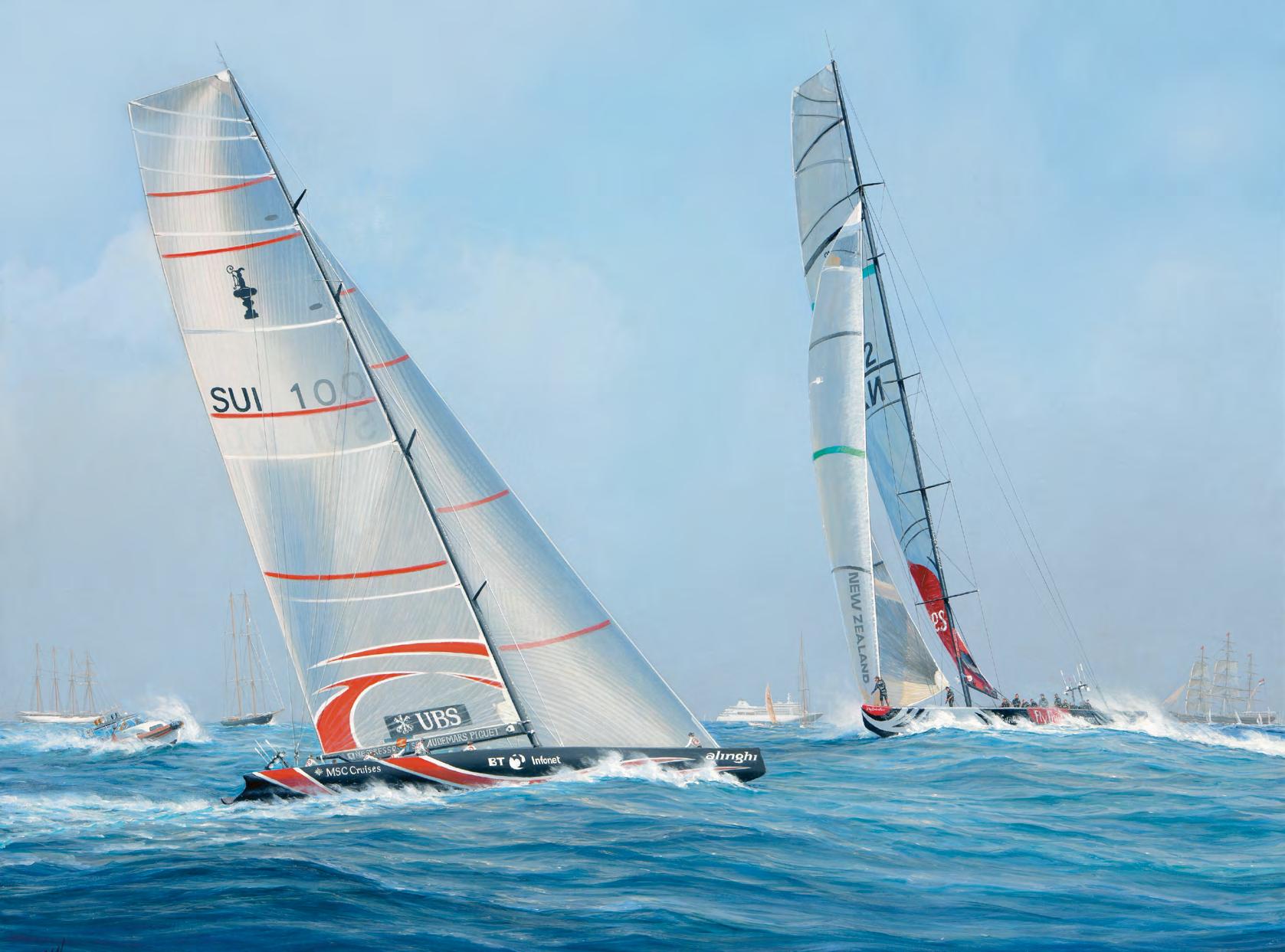
When the two America’s Cup opponents finally entered the Spanish bull ring in mid June, it was obvious that despite the one-design rules, they had two very different boats. Emirates Team New Zealand, with their aggressive, slab-sided concept, seemed to be banking on lighter airs, as they had done previously in Auckland when their boat fell apart in heavy weather, while Bertarelli’s SUI 100, the favourite, had a much fuller shape, with stronger winds in mind. The first race, held on a lumpy sea with a 15-knot east wind blowing, went to Alinghi, but in the second race, due to a lighter breeze and some skilful sailing by Dean Barker, the Kiwis grabbed back the lead before the final weather mark, levelling it at 1–1. That night Bertarelli, realising it was going to be no walkover, raised his glass to his chosen port of Valencia not realising that the following race, when the lead changed several times, was to go again to New Zealand. Ed Baird, annoyed that Alinghi had already dropped her guard twice, made no mistakes in race four, squaring the score at 2–2. In the fifth race NZL 92 was romping down the course with a substantial lead when disaster struck—as it had in 2003. The spinnaker blew out in a 16-knot nor’easter, the replacement
NZL 92 is penalised for not keeping clear of Alinghi as they approach the top mark in race seven of the America’s Cup.
Alinghi wins race seven by one second to retain the Cup
2013 ORACLE TEAM USA DEFEATS AOTEAROA
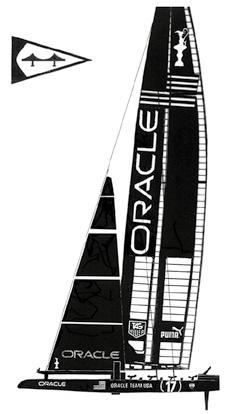
LOA: 86ft (26.2m)
LWL: 72ft (22m)
beam: 45.9ft (14m)
draft: 14ft (4.4m)
mast height: 131.2ft (40m)
wingsail area: 2800sq ft (260m2)
headsails: as chosen
type: Catamaran
syndicate:
Oracle Team USA
ceo: Russell Coutts
chairman: Larry Ellison
skipper: James Spithill
tacticians: John Kostecki, Sir Ben Ainslie strategist: Tom Slingsby design: Andrew Mason and Oracle Racing Design builder: Oracle Racing
syndicate: Emirates Team
New Zealand
managing director: Grant Dalton
skipper: Dean Barker
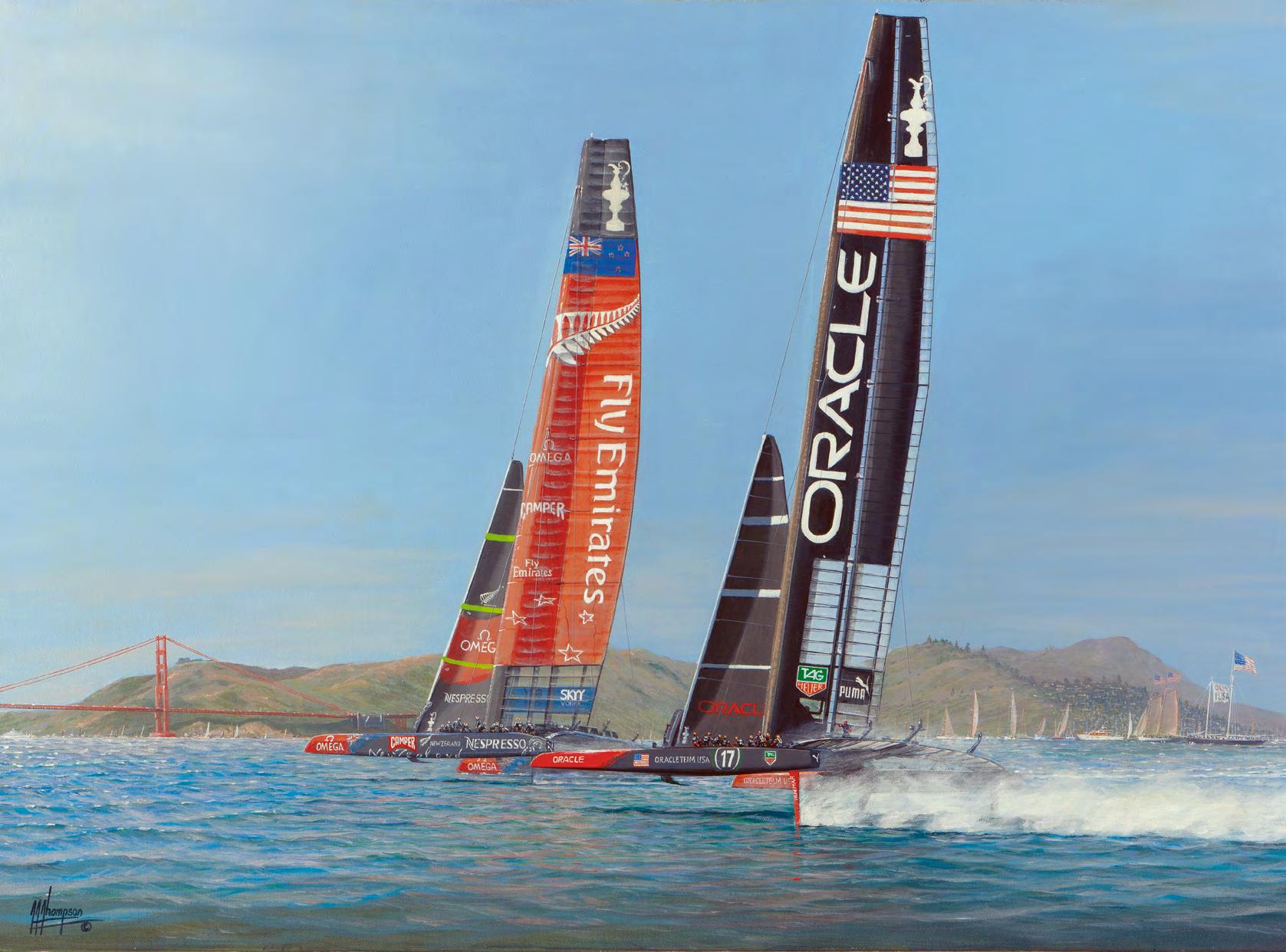
Due to the introduction of mega multihulls with wingsails and foils, first trialled by the Kiwis, many regarded the 2013 Cup as a turn for the worse, instead of regaining credibility after the 2010 match between two differently armed opponents. Indeed the start of the thirty-fourth America’s Cup became an instant nightmare. Not only had the fleet dropped from an estimated fifteen ‘One-Design’ challengers, who had limbered up on the smaller AC45s, to just three, as a result of ‘billionaire’s disease’ and the choice of the AC72, but far worse was the death of Andrew ‘Bart’ Simpson, one of England’s finest sailors, who, after joining the crew of the Swedish catamaran Artemis, became trapped under her wingsail when she capsized in practice. The event further deteriorated when Regatta Director Iain Murray announced that, as a result, the challengers would have to change to larger rudder elevators to obey new safety rules and, surprisingly, to conform to the defender Oracle’s rudder configuration! Emirates Team New Zealand and the Italian syndicate Luna Rossa Challenge, incensed by calls for such a last-minute adjustment to gear they regarded as safe, ultimately won their protest but not before the first race had been delayed to the relief of the gallant Swedes, who, naming their fight back as the ‘Bart Project’, were still determined to go racing. It was a case of ‘catch up’, for by the time Big Blue, their new AC72, hit the water, eight of the ten qualifying matches for the Louis Vuitton Cup had been declared wanting—Luna Rossa allowing Team New Zealand’s powerful catamaran Aotearoa to reach the Louis Vuitton finals without being stretched. Meanwhile Oracle Team USA were in trouble for rule infringements during the earlier AC45 matches. This resulted in a fine of £160,000, half going to the Andrew Simpson memorial fund, losing an experienced wing trimmer and having two valuable points deducted—thus establishing Team New Zealand, the Louis Vuitton winners, as firm favourites.
came charging back, winning race four at a top speed of 45.97 knots (53 mph). Then, in race five, when the Americans were clearly ahead, it all went pear-shaped when both Oracle’s skipper, Jimmy Spithill, and his tactician made a blunder at the second mark by executing a sharp ‘foiling turn’, allowing Aotearoa to win the match by over a minute. Devastated, Oracle’s skipper played his only wild card, kept usually for emergencies, and asked for race six to be postponed. This gave Spithill’s technicians time to tweak his flying boat’s rudder elevators, which, with on-going adjustments to her shorter foils, began to pay off.
Asked by the press if, as a result of race five, there were likely to be crew changes, Spithill replied that his own position could change from ‘rooster’ to ‘feather duster’ any minute. It was certainly time for the Yankees to regroup, and it was their tactician who was left on the jetty in favour of four times Olympic gold winner and master of the Laser and Finn dinghy classes, Great Britain’s Sir Ben Ainslie. He had been helming the American back-up boat throughout the trials but even his tactical wizardry and intuitive feel for the wind seemed not enough to bring the event alive again. Both boats had proved closely paced downwind, but the New Zealand yacht, with fuller hulls, at first appeared to be better into wind, and her crew more aggressive. Although Oracle took an early lead in race six, she was pushed off course by a clever move across her bows by Dean Barker, which gave the New Zealanders a forty-five second advantage. Race seven went the same way and with the outcome beginning to look like a formality, Aotearoa clocked up her sixth win by over a minute. Then, suddenly, all the whitewash brushes had to be thrown overboard.
Lifted by a wind, which at 19 knots was approaching the race safety limit, Aotearoa, while leading race eight by a whisker, lifted her starboard hull and almost capsized. It made
spectacular viewing but not for Dean Barker who, without the opportunity to counter-attack, saw Oracle disappearing rapidly into a red mist. He said later ‘Got a bit rushed on the tack and missed the hydros’—new sailing jargon meaning that without hydraulics the wing sail ‘failed to pop’—nearly tipping them into the drink.
All eyes turned to race nine as Aotearoa, needing only three more wins, punched through the weather side of the start leaving Oracle looking vulnerable. Then as they careered downwind, the stiff breeze blew its safety valve and the race was abandoned. Race nine, held on the following day, helped by sharp tactics and improving sail management, went again to the Americans, who were still trailing by six wins. It was already the longest America’s Cup ever, when, after two more wins by Team New Zealand, race thirteen proved their unlucky downfall. Well in the lead and about to grab the Cup, the wind dropped and the race was cancelled, only to be restarted with Oracle taking the win this time. By race sixteen Spithill, although still looking down the barrel of a gun, was confident that the tide was turning in Oracle’s favour. But the Kiwis still needed just one more win from the nine required, so was it fast enough?
The adverb ‘ever’ has been used before in America’s Cup history, but now it was to rattle off the tongue—‘The longest series ever.’ ‘The fastest boats ever.’ ‘The best course ever.’ ‘The most dramatic sporting comeback ever.’ When, on day twenty, with the score standing at a breathtaking 8–8, Oracle Team USA stormed home again, they did not just win the trophy, but created an immense groundswell of new interest in the America’s Cup.
tactician: Ray Davies
strategist: Adam Beashel
design: Nick Hutchins
builder: Cookson Boats
On 7 September, as the finalists jousted down the match racing course cleverly positioned within the Golden Gate and inside Alcatraz, it seemed that only the former prisoners were missing the fun. On shore thousands of spectators, never previously allowed so near the action, stopped waving the ‘stars and stripes’ as Team New Zealand under the capable hands of Dean Barker went flying, leaving Oracle in their slipstream. The next race was no different, although three races down and with two points stacked against them, the undaunted Oracle
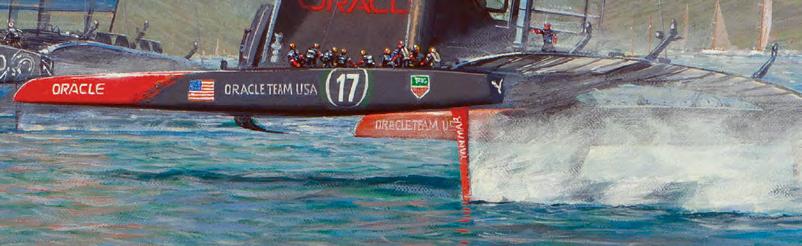
Race eighteen: Aotearoa does a lee-bow tack and loses momentum, while Oracle has a full head of steam and, in moments, takes the lead.
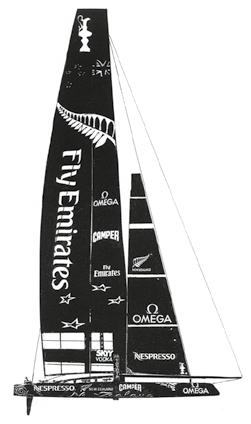
The Ac72s were the fastest boats ever to contest the America’s Cup
Oracle Team USA ‖ Golden Gate Yacht Club
Aotearoa ‖ Royal New Zealand Yacht Squadron
Aotearoa Oracle
2024 TAIHORO DEFEATS INEOS BRITANNIA
LOA: 75ft (22.86m)
LOH: 68ft (20.70m)
beam: 16ft (5m)
mast height: 87ft (26.50m)
mainsail area: 1560sq ft (145m2) crew: 11 + guest type: Monohull
It sounded like a gunshot and the crowd of Italians lining the shore in Barcelona gasped as Luna Rossa, known as the ‘Silver Bullet’, collapsed in a cloud of spray like a shot swan.
After the gallant French boat Orient Express had been eliminated in the early rounds, Luna Rossa had just started dicing with the fast-improving American Magic in the first of two races in the semifinal of the Louis Vuitton Cup when it all went wrong. It was only after a hectic night mending the parted traveller, that Luna Rossa finally beat the American boat before taking on Ineos Britannia, which had previously defeated the brave young Swiss team in Alinghi
Of the five contenders vying to grapple with the four-time champions Emirates Team New Zealand, Ineos Britannia had proved to be the most improving boat on the water. In the light winds, which sometimes grabbed hold of the flying yachts, individual hull designs became the matter of the moment. So when, after a tremendous duel with Luna Rossa, Ineos Britannia managed to achieve the seven wins needed to put the Italian boat to bed, the British were ecstatic.
For the first time since 1964, a British boat, led by Sir Ben Ainslie, alongside his co-helm Dylan Fletcher, his four super-fit cyclors and two accomplished sail trimmers, had, at last, won the right to fight for the America’s Cup.
Perhaps this was the moment to think back to those earlier races in the Cup’s history, when the British yachts had keels for crossing ‘The Pond’ (Atlantic) and were crewed by up to 30 knotted and gnarled seamen, who skinned their hands straining at sodden sheets and broke their legs on slippery decks changing acres of wildly flapping canvas. For countless years, with yachts fitted with bunks and galleys, they were to struggle on against America’s inshore leviathans such as Rainbow and the mighty Ranger, the odds always stacked against them.
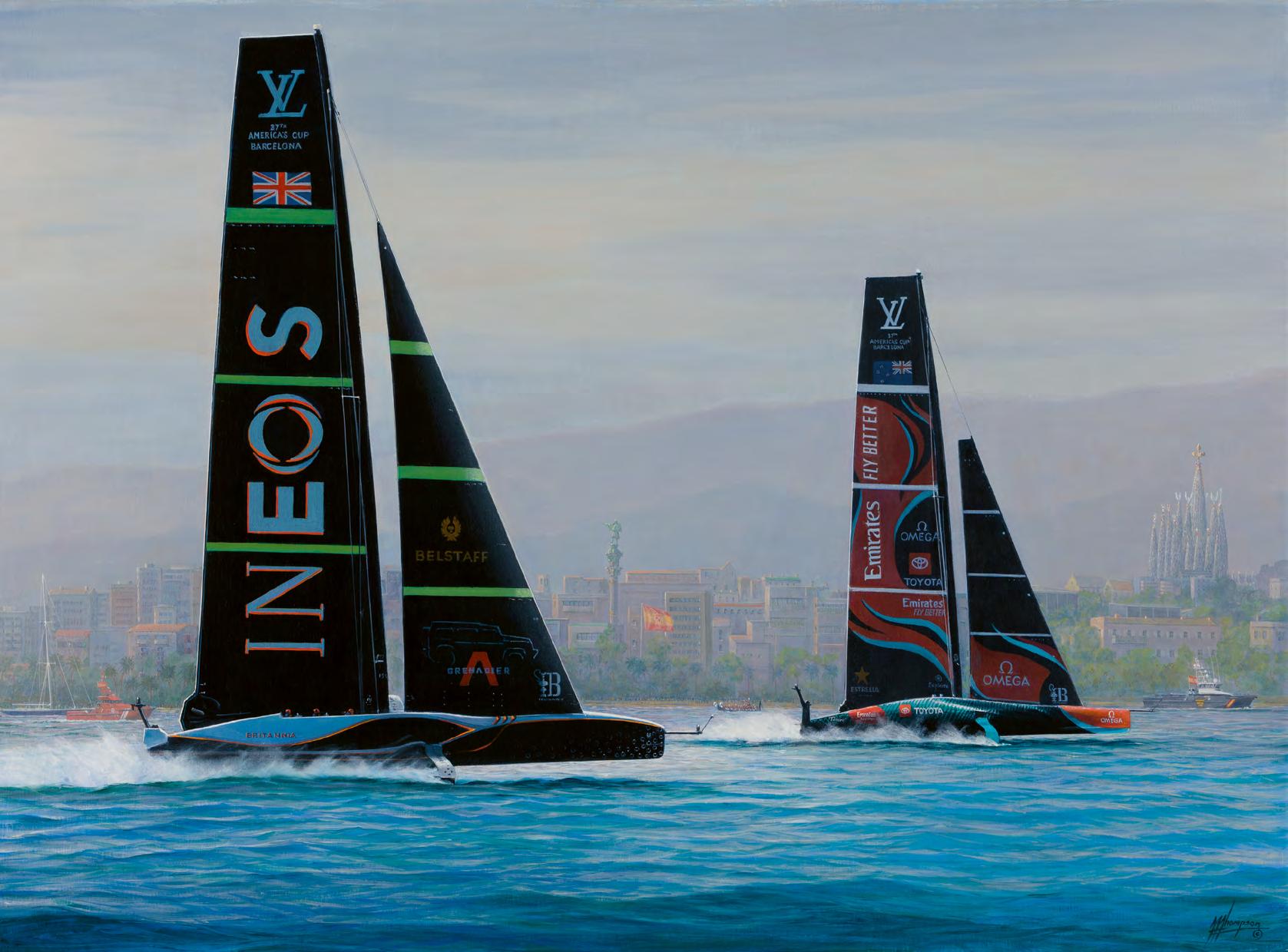
As the two pods of four men on Ineos Britannia hunkered down on each side of their carbon-fibre flying machine, keeping their heads down to ensure a smooth passage of air into their aerofoil shaped, double-sided mainsail, they will have thought that with the on-going technical support of Mercedes-Benz, their steed would have the measure of the opposition.
But, as in previous years, the Kiwis were again holding some secrets up their sleeves. These became more obvious as the finals progressed, with the New Zealand team winning the first four of the seven races needed to clinch the title. Not only did their boat appear to be faster,
but their precision sailing and sharper tacking made their bid for a third successive Cup look increasingly unstoppable.
For one brief moment, the British thought that all was not lost when after a lay day spent tinkering with their boat, they won the next two races—helped in the first of them by the Kiwi boat Taihoro falling back into the water, and in the second by a brilliant start causing the Kiwis to put in an extra tack in an unusually lumpy sea, which seemed to favour Ben Ainslie and Britannia’s hull design. No wonder that ‘Pistol Pete’, as Peter Burling was called, and Nathan Outteridge returned fighting, and by winning the next three races put the British back in the berth they had so eagerly set out from to defeat them.
When elevated on their foils, the hull shapes of AC75s, the major part of the design allowed to be adjusted within the rules, no longer seemed to matter. But so much else on the Kiwi boat did. Perhaps the competitive old salt who writes this book should not be attempting to suggest why the British lost the best opportunity they have had in 173 years for bringing the Cup home to Blighty, but I shall do so in defence of the brilliance shown by Sir Ben and Dylan, his fellow helmsman, by suggesting two reasons.
Once the AC75s are flying, their speed across the water, forgetting wind and the choice of sails, is reliant largely on the character of their foils and it was soon noticed that Taihoro’s were different. Not only were they said to be thinner but they were aimed slightly more forward, making them quicker on the turn, as with a ski stick. Similar to the New Zealand foils in 2021, they were also set with a single flap well behind a small cigarshaped cylinder, which parted the water ahead like the bulbous bow on a ship—and it worked.
Then there was the Kiwis’ integrated control system. When helicopter pilots had to balance moving one control by adjusting all the others, the difficulties of flying them had to be simplified. Perhaps Taihoro’s technicians thought the same, for it was believed they had made the boat’s handling doubly efficient by giving the helmsmen the ability to adjust all the controls automatically and instantly in the optimum direction.
But new innovations and tactics were forgotten when, true to the America’s Cup’s reputation for expecting the unexpected, the British challenge for the next America’s Cup clash was hit by such a devastating bombshell that many thought it would never recover. For it had been announced that Sir Jim Ratcliffe and Sir Ben Ainslie, one with all the cash but no top sailors and the other
with little cash but plenty of top sailors, had parted company after some mighty spat, each deciding to compete for the next America’s Cup on their own.
When Sir Jim further stated that he was entering a new Ineos Britannia with a dedicated team from Mercedes already working on her design, Sir Ben immediately came back with his intention of competing with a yacht backed by Athena Racing. Meanwhile, stunned supporters took a step back as they feared the worst, not knowing which yacht club (for Sir Jim had not yet chosen one) would be invited to set the next America’s Cup protocol as the Challenger of Record.
But the writing was already on the wall, and it was no surprise when Sir Jim announced that, although Ineos Britannia had a real chance of winning the next Cup, ‘the opportunity had slipped away.’ That left Sir Ben in the hot seat —but having already personally funded his team for a time, he meanwhile had managed to find a new backer for Athena Racing in Oakley Capital, a private equity firm, which promised financial stability for the America’s Cup new partnership in the competitions lying ahead.
Ineos Britannia ‖ Royal Yacht Squadron/Royal Cornwall Yacht Club
team: Ineos Britannia
ceo: Sir Ben Ainslie team principals: Sir Jim Ratcliffe/Sir Ben Ainslie
skipper: Sir Ben Ainslie builders: Carrington Boats
Taihoro ‖ Royal New Zealand Yacht Squadron
team: Emirates Team New Zealand
ceo: Grant Dalton team principal: Matteo de Nora
skipper: Peter Burling head of construction: Geoff Senior
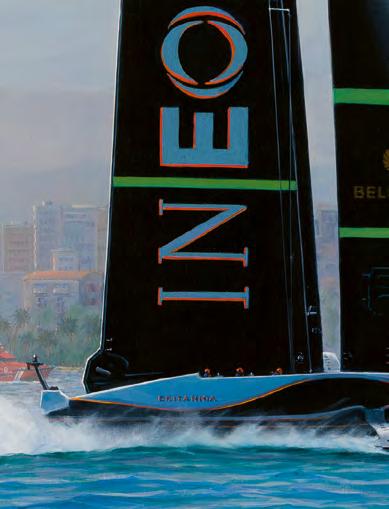
Ineos Britannia forges ahead to complete only the second win by a British yacht during the finals of the America’s Cup.
Clearly showing the innovative crew pod.
Ineos Britannia Taihoro
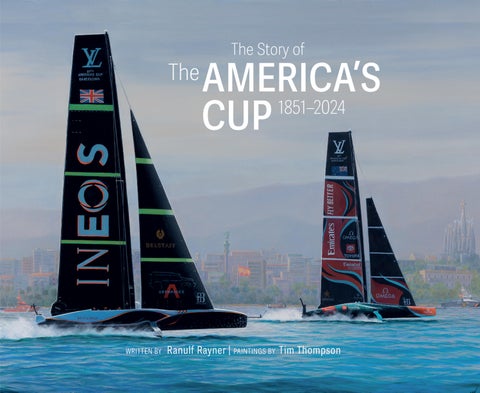
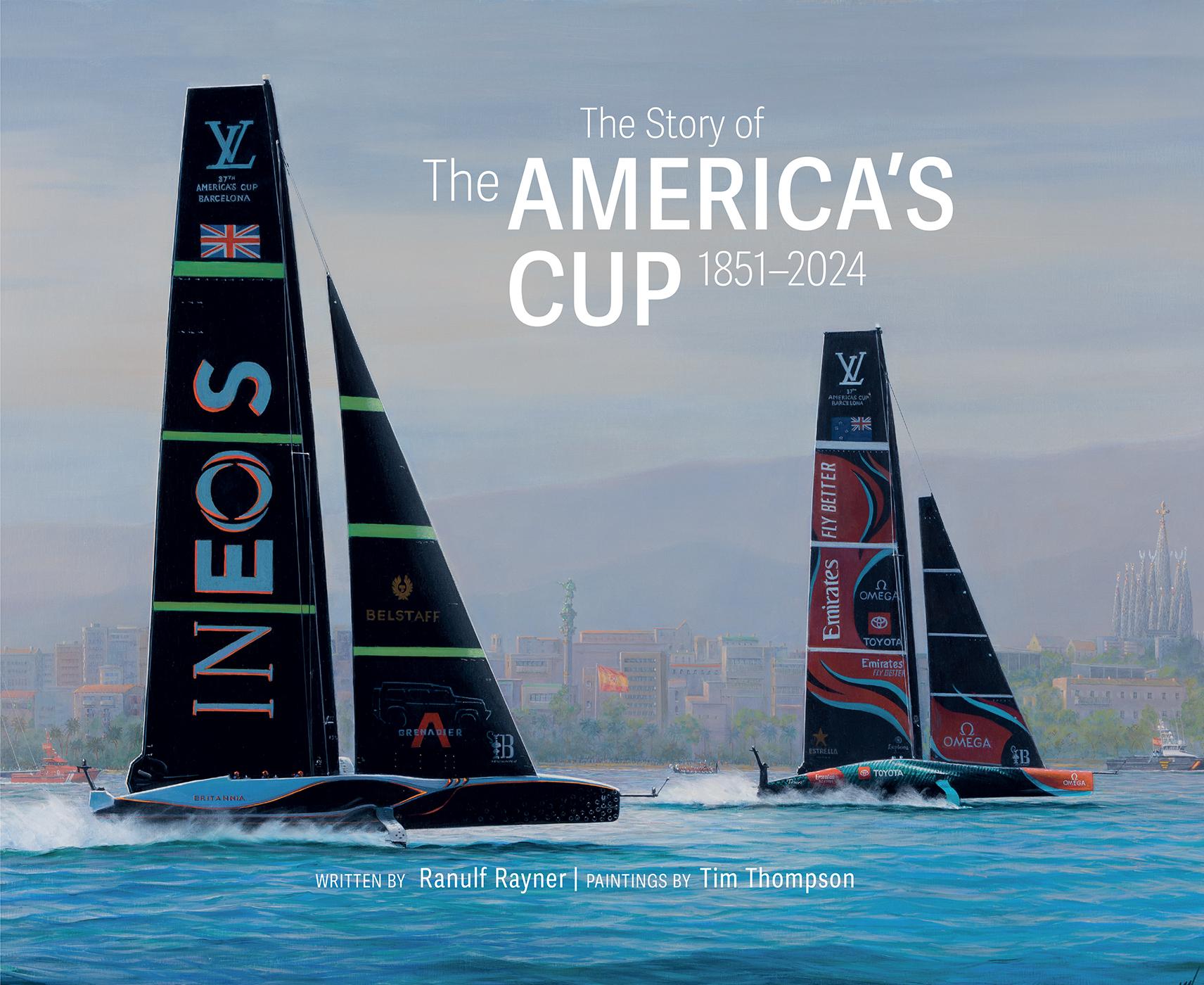
The America’s Cup has been the world’s most prestigious yacht race for over 170 years. This beautifully illustrated and fully updated book tells the story of the Cup from its inception through to the most recent race, held in 2024.
With a painting of each race since 1851 and detailed descriptions of the boats involved, The Story of the America’s Cup 1851–2024 is an evocative and insightful celebration of sailing’s ultimate contest.