
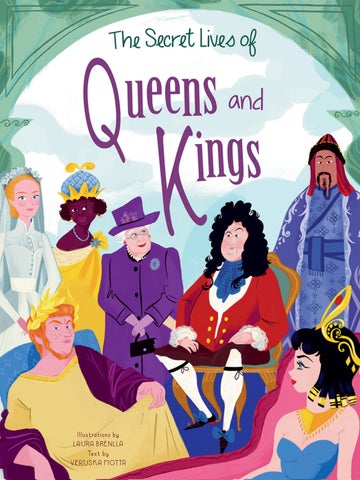
The Secret Lives of Queens and Kings

Page 1


Njinga Mbandi p. 46

1542 CE

Akbar the Great p. 42

Louis XIV p. 54

Marie Antoinette p. 62

Elizabeth II p. 70

The life I wish for... maybe not p. 78

Shah Jahan p. 50

Catherine the Great p. 58

Elisabeth of Bavaria p. 66

Grace of Monaco p. 74

ALEXANDER III, known as ALEXANDER THE GREAT

(356–323 BCE)

Three centuries before the birth of Christ, a king could enjoy the quiet life or could instead set off to conquer some nearby territory. “Why should I be happy with little?,” Alexander III must have thought. Originally from Macedonia, this young king created the biggest empire of his time; from Greece to India, it covered an area of more than 3 MILLION SQUARE MILES . His actions were so grand that he was called “ Alexander the Great ”—not bad for someone who lived only 33 years!

He certainly wasn’t the usual type. His teacher was Aristotle —one of the most important philosophers in history—and he obtained his first significant victory against the Greeks when he was just 18. He was a skilled warrior who loved risky challenges and aspired to extend his domain over all known lands. However, with great talent comes... GREAT DISCONTENT ! He imposed many customs and traditions on the people that he conquered— even traditions from the Persians , who were bitter enemies of the Greeks and of many high officials in his army—and this led to general unrest, especially among the soldiers. After all, it was extremely difficult to keep everybody happy over such a vast empire!

He died suddenly, without an obvious cause. Was he sick? Was he poisoned by his officials? It is A TRUE MYSTERY that has not been solved to this day.

UNUSUAL FRIENDS

Even a king needs friends. Alexander knew he could count on his best friend, Bucephalus . They grew up together, facing adventures and battles of all kinds. A battle killed his friend, whom Alexander never abandoned until the last... NEIGH .

Yes, Bucephalus was a horse! Alexander organized a funeral for him with honors and dedicated an entire city to his memory (Alexandria Bucephalous, today called Jalalpur!).

AT YOUR BECK AND CALL…OR AT YOUR FEET?

Being called “ the Great ” doesn’t help your modesty, and Alexander demanded his generals BOW DOWN AT HIS FEET , lying in front of him with their faces to the floor. It was a good position for a workout, but certainly not if you wanted to talk. With a couple of chairs, he could have avoided a lot of unhappiness!

OOPS, YOU SHOULDN’T HAVE SAID THAT!

“MOVE, LAZY!”

This might be something you say to friends who don’t move from the sofa, but it isn’t the right thing to say if you are talking to your soldiers, especially if they have been marching for 9,000 miles without a break (and fighting as well!).

Alexander dreamed of conquering the world, while his army dreamed of a vacation!

A LITTLE REMINDER : IF YOU ARE IN CHARGE OF TROOPS, EVERY NOW AND THEN REMEMBER TO LET THEM STOP AND TAKE A NAP (AND MAYBE EAT A SNACK TOO)!

QIN SHI HUANG

(ca. 260–210 BCE)

Over 2,200 years ago, all the kingdoms of China were unified by the first Chinese emperor, who managed to do so in only 20 years. Rising to the throne when he was just 12 years old, Qin Shi Huang had a life full of mystery, but we have some evidence of his greatness (and of his weirdness!). Although he was just a boy, one of his first actions was to build an entire TERRACOTTA ARMY to guard...his TOMB !

Over 8,000 soldiers, 130 chariots, and 670 horses can be seen today, but most of his immense necropolis is inaccessible because IT STILL LIES UNOPENED . Even if he was concerned with how to “furnish” the place where he would be buried one day, Qin Shi Huang did love life so much that he never wanted it to end. He made several journeys to find the “ mountain of immortality, ” and he sent his emissaries on reconnaissance. None of them managed to find the mountain, and as they feared being punished for this (Qin’s fury was legendary), they all fled to Japan.

Qin also demanded that the court doctors find a “cure for death”; they came up with some very special pills, but they certainly weren’t what the emperor expected.

The main ingredient in these pills was MERCURY , which at that time was believed to bring immortality, but today we know it to be a powerful POISON . And so, for a twist of fate, this elixir of eternal life ended up... KILLING HIM !

A SPACE WALL… OR MAYBE NOT?!

Qin Shi Huang loved grand things. He wanted a wall built to keep his enemies away and, of course, he wanted it big. He ordered the construction of the Great Wall of China . It is one of the Seven Wonders of the Modern World (even if the wall we see today is largely a reconstruction), and it is almost 5,600 MILES LONG! It has been said that it is the only human construction visible from space, but astronauts have reported that this is not true.

REFORMS THAT LEAVE THEIR MARK

If you think that the Chinese writing system is difficult, you should know that it was even more so before Qin Shi Huang’s empire! He introduced one unified writing system across the whole empire, which was much “ SIMPLER ” than the previous one. To make sure that everyone would use it, he ordered all old books to be burned.

OOPS, YOU SHOULDN’T HAVE SAID THAT!

“THIS IS JUST BETWEEN US”

In his mission to create a TERRACOTTA ARMY , the emperor hired over 700,000 people. It was a prestigious task, but the compensation for such hard work was...death! As he was afraid that those laborers would reveal the details of the work, Qin Shi Huang sent them to their deaths (some of them were actually buried alive!).

A LITTLE REMINDER : IT IS IMPORTANT TO ASK FRIENDS TO KEEP

A SECRET, BUT IT’S BETTER NOT TO OVERDO IT WHEN IT COMES TO TAKING PRECAUTIONS!

NERO

(37–68 CE)

There are emperors who are much loved and others who provoke a deep hatred... and then there is Nero, who first conquered the Romans’ hearts and later was forced to flee.

His accession to the throne was accompanied by a series of suspicious deaths, but the person responsible for his crowning was his power - hungry mother, Agrippina . One way or another, the boy with red hair and fair eyes (who was also a bit nearsighted) became emperor when he was only 16. By his side was Seneca , the most influential philosopher of the time, who taught him to love culture. The first years were perfect; even if his monarchy was absolute, his people loved him because he took away lots of privileges from the nobles. He organized great public events, games, and races that attracted the masses. He also gave money to the poor.

Nevertheless, it was not long before Nero started showing signs of madness. He thought everybody was antagonizing him, and he would do anything that sprang into his mind. Whoever tried to stop him ended up worse off, including his mother (what goes around, comes around!), his brother, and his old teacher. Even though the poor still loved their emperor, powerful people spread rumors against him until he was declared a “public enemy.”

NERO WAS FORCED TO FLEE FROM ROME, AND HIS REIGN ENDED WHEN HE WAS ONLY 31.

A SCREEN-FAMOUS EMPRESS

Do you know Steel Jeeg , the super - robot protagonist of Japanese manga cartoons and graphic novels? His biggest enemy is the queen of an ancient kingdom who has magical powers and an army of super - soldiers. Her name is Himika ...

SOUNDS FAMILIAR, HUH?!

Traces of the mysterious empress can also be found in the Tomb Raider video game and films . In them, Himiko looks 2,000 years old and is represented as a terrifying mummy.

OOPS, YOU SHOULDN’T HAVE SAID THAT!

“WOULD YOU FOLLOW ME EVERYWHERE?”

Himiko’s desire to be remembered in the afterlife was certainly understandable, but perhaps the 200 servants who were buried alive with her would have preferred a less epic end.

A LITTLE REMINDER : IT’S NICE TO HAVE YOUR DEAREST FRIENDS WITH YOU ALWAYS, BUT SOMETIMES IT’S MORE GENEROUS TO BE BRAVE AND CARRY ON ALONE!

A HOUSE FOR MEN ONLY

Even though the Imperial House was founded by Himiko, nowadays women are FORBIDDEN from becoming empresses in Japan. There were only about ten empresses in the whole history of Japan but Himiko isn’t listed among them; her story is so full of mysteries that it wasn’t included in the official list of the 125 emperors of the Far East .

ISABELLA I OF CASTILE

(1451–1504 CE)

Life at a European court in the 15th century was quite troubled - plagues, wars, attempted murder, rebellions, and many other dangers wouldn’t let one sleep peacefully. Upon her brother Alphonso’s death, Isabella of Castile became heir to the throne (which was held by her other brother, Henry IV), under the condition that she marry the king of Portugal. At 17, Isabella decided to follow her heart, rather than do what was expected of her, and secretly married her beloved, Ferdinand of Aragon . This led to the outbreak of WAR ; for five years there were battles to decide who should govern. After Henry’s death, Isabella ended up winning, and along with her husband, she immediately set off to conquer new territories. Not only did she invade with her army, but she also FORCED HER RELIGION upon her new subjects .

She was a tough woman, capable of untangling extremely complex political situations. She revealed herself to be forward - thinking when she sponsored a sailor who had already asked for money from the king of Portugal without success. Isabella gave him a lot of money (she even pawned her jewels) and THREE SHIPS . The mission was a success. As you may have guessed, the sailor was Christopher Columbus, and the mission resulted in the European discovery of America!

MONTEZUMA

(ca. 1466–1520 CE)

Ruling one of the greatest civilizations in the Americas must not have been easy, but Montezuma did it quite well. At the end of the 15th century he was the emperor of the Mexica people (that’s where the name “Mexico” comes from), today called the Aztecs . Their culture was rich, especially in science and myths; they believed that the world would end every 52 years, and they worshipped gods that resembled humans. Montezuma was more of a scholar than a warrior, but that doesn’t mean that he gave up on bloody practices like many of his predecessors, such as HUMAN SACRIFICES !

During his reign, he increased the power of the capital Tenochtitlan, which was surrounded by water, like Venice, Italy (Mexico City was later built on its ruins). The end of his empire came at the hands of 500 Spanish conquerors, led by Hernán Cortés . Wrongly believed to be divine messengers, the conquerers were welcomed with honors by Montezuma, who gave them huge amounts of gold. It was a big mistake; within a couple of years, the greedy Spanish destroyed the entire Aztec civilization. However, the worst enemies of the last emperor were not armor and iron swords—which the Mexica people found to be strange and scary—but rather EUROPEAN DISEASES , which were unknown in the Americas and against which the population had no immune defenses.

AKBAR THE GREAT

(1542–1605 CE)

Anyone who grows up during a war for the succession to a throne learns some important lessons, such as how to hunt and fight, but doesn’t have much time left to learn to read or write. For this reason, Akbar, who rose to the Moghul throne when he was only 13, was ILLITERATE . However, he was a man of great culture (he had books of every kind read to him) and was revealed to be one of the most ENLIGHTENED emperors in history.

After UNIFYING THE VAST TERRITORIES of Afghanistan, Pakistan, and India, and being tired of religious wars, he allowed freedom of religion— A TRUE REVOLUTION! —and he even married a woman of a different faith than himself to show that peace was his priority.

The fusion of different cultures led to an extraordinary evolution in the ARTS and ARCHITECTURE . Akbar had great taste and really innovative ideas for the time. He created a proper artistic center that hundreds of people passed through and used to create breathtakingly beautiful works.

By merging the best of each population and each tradition, THE EMPEROR WAS SURELY FORWARDTHINKING ! For this reason, Akbar truly deserved the name “ the Great. ”

SHAH JAHAN

(1592–1666 CE)

Being a child of the Great Moghul of India meant being prepared to fight for the throne. Prince Khurram knew that, and in order to rise to power, he had to defeat his own brothers, with imprisonments and violent deaths.

He managed to win and ruled under the name of Shah Jahan. The Moghul Empire reached its peak under him; he transformed the army into a powerful weapon of war, conquering new territories and preventing ENEMY INVASIONS . He was also very passionate about architecture and had the most sumptuous palaces in India built for himself. Maybe as a kid, he would have enjoyed playing with Legos!

One of his most beautiful works of architecture came from a big loss: the DEATH of his beloved wife Mumtaz Mahal . Because of the grief he suffered, Shah Jahan’s BEARD turned WHITE . He then decided to build a mausoleum for her to be buried in, a breathtaking building to match the beauty of his wife. The result was the Taj Mahal , one of the Seven Wonders of the Modern World, a fairy - tale construction made of white marble, shells, and coral.

IT REQUIRED 17 YEARS OF WORK BY 20,000 WORKERS AND MORE THAN 1,000 ELEPHANTS !

His reign ended in PRISON ; his own son had apparently learned the lesson from his ancestors and had his father arrested in order to take power.

Turn static files into dynamic content formats.
Create a flipbook