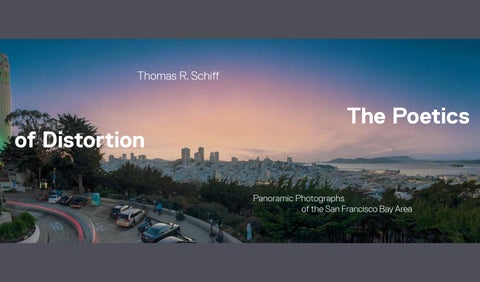
Thomas R. Schiff
The Poetics of Distortion

Panoramic Photographs of the San Francisco Bay Area


to decide what we might actually want to keep and what we are willing to lose
Time enters into Schiff’s pictures in a way that space cannot, for every photo automatically becomes a historical document the minute it is made, though sometimes we cannot see that until years have gone by. In Schiff’s case, certain changes have already become apparent. We are looking at the past when we contemplate his version of SFMOMA’s entrance hall, which has since been changed beyond recognition by the Snøhetta remodel (and how this photo makes me miss that old grayand-black-striped staircase!)(p.29). Or consider Schiff’s Brutalist-concrete version of the Berkeley Art Museum (p.85): it, too, is now gone, replaced by a sleek new Diller Scofidio + Renfro structure that, even without Schiff’s intervention, looks like something whose angles and dimensions have been radically distorted.
Famous architecture, on the whole, does not fare well in Schiff’s stretched-out world. Frank Lloyd Wright’s Marin County Civic Center, outlandish enough in real life, comes across as something that powerful aliens are gooily spreading over the local landscape. Portman’s Hyatt Regency looks like a robotic leviathan that wants to swallow us in its giant mechanical maw (p.77). The library of the Graduate Theological Seminary, based on a sketch by Louis Kahn, presents a series of coldly bulbous, threateningly panoptical bays that are totally un-Kahnlike in their aggressiveness (pp.58-59). Herzog and de Meuron’s exciting de Young Museum gets reduced to a funhouse mirror-turned-window (p.84). Even gorgeous San Francisco City Hall barely survives the transformation from encircling grandeur to flat picturesqueness (p.144).
The exception to this is theater auditoriums. Here the panoramic technique truly comes into its own, rendering something marvelous out of the merely quotidian. The California Theatre in San Jose, the Alameda Theatre, and the Paramount Theatre in Oakland all become magically exciting when we can sit within full view of the other seats around us as well as the stage. Perhaps it’s the inherent artificiality of the locations, the gilt and velvet and rococo decor that characterize theaters in general. Perhaps it’s something about the relationship between movies and the still camera (a relationship that has also inspired one of Hiroshi Sugimoto’s most trenchant series of photos). Or perhaps it’s the way the serried ranks of seats arrange themselves in beautiful unearthly curves at Schiff’s request. I don’t know why I find these pictures so moving, but they seem gorgeous and captivating in a way that many of the other interiors—even the fanciful missions and cathedrals—are not.
My favorites, though, are the scenes taken outdoors, which present us with a strange new city buried beneath or hiding behind the old one. To see the Chinatown gate enclosed in the arms of its neighboring corners and streets is to see it given new life; there is something charmingly Parisian about it, in this view (p.38). Davies Symphony Hall, sitting smack in the middle of a slice of Civic Center, exerts its peculiar roundness in a way I have previously only felt it do from inside the building (pp.40-41). Nob Hill looks so little like itself that what might threaten to be a photographic platitude— “elegant San Francisco neighborhood at sunset”—becomes something much stranger and more interesting (pp.162-163). Schiff gives us the city turned inside out, upsidedown, ass-backwards. For a place that has always prided itself on its beauty, this is no bad thing. We need to look freshly at what is around us to decide what we might actually want to keep and what we are willing to lose. We need, at least for a time, to stop thinking of space as a personal thing we carry with us, as something belonging to us individually. Schiff’s photos can lead us in that direction.

We need to look freshly at what is around us


SALES POINTS
Will appeal to fans of San Francisco and the Bay Area;
• Will appeal to fans of photography;
• Will appeal to people interested in new ways of looking at things; Will appeal to people interested in human experience and perception; and
• Will appeal to people who want a psychedelic trip without the flashbacks.
SPECS
ISBN: 978-1-943532-16-2
Trim: 10” x 17” landscape
Extent: 192pp
Binding: Hardbound
Cost: $49.95
Season: spring 2019
AUHTOR
Thomas R. Schiff studied photography under Clarence White, Jr. and Arnold Gassan while earning a BBA degree from Ohio University in 1970. Schiff began experimenting with panoramic photography in the mid-1980s, making use of a Hulcherama 360 panoramic camera. He has published eight previous books: Panoramic Cincinnati (2003), Panoramic Ohio (2002), Panoramic Parks (2005), Vegas 360 (2008), Wright Panorama (2010), Prospect (2012), Columbus, Indiana: Midwestern Modernist Mecca, and The Library Book (2017). Schiff helped establish Images Center in Cincinnati in 1980, and he is the founder of FotoFocus, a lens-based art biennial held in Cincinnati.
DESCRIPTION
Thomas R. Schiff’s vivid panoramic photographs capture the iconic buildings and landscapes of San Francisco and the Bay Area in new and surprising ways. From the Golden Gate Bridge to Coit Tower, they offer a refreshing perspective on familiar places and reveal unexpected treasures in everyday ones. With essays on photography, perception, and architecture by Susan Ehrens, Wendy Lesser, and Tim Culvahouse, and an author interview by Dave Christensen, The Poetics of Distortion: Panoramic Photographs of the San Francisco Bay Area is a mind-bending, eye-opening, very San Francisco journey.
For orders, inquiries, and all additional information, please contact: ORO Editions
31 Commercial Blvd. Suite F Novato, CA 94949
P: 415.883.3300
F: 415.883.3309 info@oroeditions.com www.oroeditions.com www.goffbooks.com