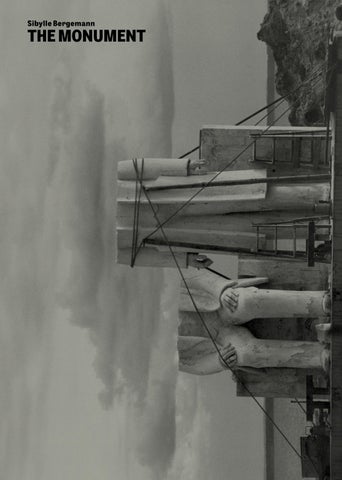
THE MONUMENT
Sibylle Bergemann’s
Series Das Denkmal in East and West Germany


4. Another caption
5. Caption to come, 19??
6. Another caption
7. Third caption here


In Suspense Sibylle Bergemann’s Photographic Monuments
Steffen Siegel
In the autumn of 1990, the Cologne publishing house Kiepenheuer & Witsch released Ein Gespenst verlässt Europa (A Spectre is Leaving Europe), a thin but weighty volume with poems by Heiner Müller and photographs by Sibylle Bergemann (fig. 1).1 Regarding calendar dates alone, this book represents one of the first publications issued in the very recently reunified Germany – but in a certain sense, it is also the last photo book of the East German state, which had just ceased to exist.2 The book marks a transitional moment and highlights this with its title: it is meant to accompany the exit of spectres, which one may consider good or evil, depending on one’s political standpoint. In the watershed year of 1848, Karl Marx and Friedrich Engels opened their Communist Manifesto with a provocative sentence: ‘A spectre is haunting Europe – the spectre of Communism.’3 One hundred and forty-two years later, another watershed year, one had some reason to think that this spectral appearance was about to exit the stage of history. At Kiepenheuer & Witsch, the editors evidently were anxious to publish Ein Gespenst verlässt Europa in time for the upcoming reunification celebrations. Can we interpret the absence of page numbers as an indication that the book was produced in a rush? It may well have been a conscious decision on the part of the book’s designer, Grischa Meyer. Be that as it may,
1 Heiner Müller and Sibylle Bergemann, Ein Gespenst verlässt Europa (Cologne, 1990).
2 In this sense, an extensive article on the book of Müller and Bergemann, featuring a total of ten images from it, appeared two days after the celebrations for German Reunification in ZEIT-magazin: Jutta Duhm-Heitzmann, “Entwurf ins Leere”, in ZEITmagazin, 5 October 1990, pp. 100–09. I am grateful to the publishing house Kiepenheuer & Witsch in Cologne for its helpful information concerning the precise date of the book’s publication.
3 Karl Marx and Friedrich Engels, Communist Manifesto (London, 1848), p. 3.
the eight poems and twenty-two photographs, complemented by a four-page afterword by Peter Voigt, form a work that remains remarkable. Much like Günter Grass, who at the same moment took to the pulpit as agent provocateur commenting on political a airs (one can read a selection of his speeches from the period immediately following the fall of the Wall in Ein Schnäppchen namens DDR. Letzte Reden vorm Glockengeläut, published in 2000), Müller and Bergemann, in their unusual collaboration, took the highly pressing current events as their starting point.4 These were, without the shadow of a doubt, extraordinary times – and yet the book of these two artists reveals perspectives which are detached from the specific historical moment and ultimately point far beyond it. The interplay of Müller’s poems and Bergemann’s photographs produce a tension spanning past, present and future, which keeps everything hanging in suspense.
One sees just how literally one can read that last phrase in the last of the twenty-two photographs that Bergemann contributed to this book (fig. 2). It was taken in February 1986, when, after protracted preparations, the monument to Karl Marx and Friedrich Engels was finally erected in the city centre of East Berlin. The picture shows a remarkable scene: for it seems as though the philosopher Friedrich Engels should all too literally do justice to his family name – in which the German word for ‘angel’ resonates. Nearly four metres high and weighing several tons, the sculpture is hanging high above the ground on a single rope. In the background, the peculiar scenery of East Berlin’s city centre is in evidence: to either side of the tower of Marienkirche (the Church of St. Mary), which recalls medieval Berlin, we see a line-up of buildings from much more recent
4 Günter Grass, Ein Schnäppchen namens DDR. Letzte Reden vorm Glockengeläut (Frankfurt am Main, 1990).

Heiner Müller, Ein Gespenst Verläst Europa,