
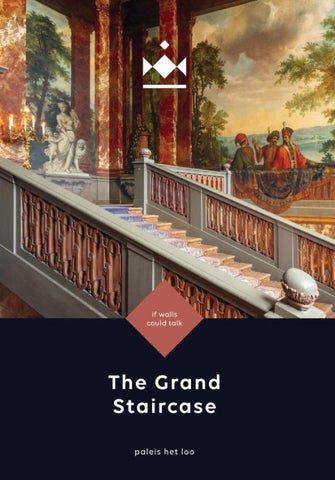
The Grand Staircase of Paleis Het Loo

Page 1


A painted ‘oculus’, a circular opening in the ceiling, gives the impression that we are looking straight at the sky. Reliefs are painted around it in grey tones. They depict small naked figures known as putti engaged in all kinds of hunting activities, referring to the palace’s original function. King-Stadtholder Willem III loved hunting.

Once the mural was completed, Marot made an etching of the finished result. It is likely that he did not use the painting itself as a reference, but rather a design sketch that has since been lost. It reveals that many elements of the wall paintings at Paleis Het Loo also occur in other designs by Marot. Yet there are noticeable differences too, making the Grand Staircase unique within his body of work. The two groups of men in Ottoman-style attire on the east and west walls of the staircase are particulary striking. They differ from the mythological or allegorical figures that Marot tended to depict in interiors like this, as at Slot Zeist and Huis de Voorst. Lavishly painted staircases were popular towards the end of the 17th century, and were a showpiece that graced many stately homes in the Netherlands.

A painted relief showing a scene with putti hunting. The painted ceiling above the staircase.

Welcoming the World

The palace’s lavishly decorated Grand Staircase was very important to Willem and Mary. It showed that they were part of a cultural elite, with contacts all over the world. Willem’s decision to entrust the design to Daniël Marot would later have consequences abroad, particularly in England.

Huis Honselaarsdijk

The Dutch Republic already had a tradition of interior painting prior to Marot’s arrival in the Netherlands. These paintings would sometimes include Asian elements. At the time, Asia was seen as another world entirely, very far away. Interior decorations that referred to Asia reflected the client’s status and connections. There are clear similarities between Marot’s design for the Grand Staircase at Paleis Het Loo and earlier 17th-century interior painting schemes. One example is a design, never executed, for a mural by Cornelis Holsteyn (1618–1658) at Huis Honselaarsdijk, a palace belonging to the stadtholder in Zuid-Holland province. The drawing features a balustrade and figures wearing turbans.

The previous occupants of Huis Honselaarsdijk, Stadtholder Frederik Hendrik (1584-1647) and Amalia of Solms-Braunfels (1602-1675), were Willem III’s grandparents. Willem and Mary later used the palace themselves. Several artists worked on the decoration of Honselaarsdijk in 1653. Some of them

One of the figures on the Grand Staircase.

the Grand Staircase in context

The Ambassadors’ Staircase at Versailles

Similar developments were occurring in interior painting in France during this period. This is interesting, as both the designer and main executor of the painting at Paleis Het Loo were inspired by French tradition. Marot was born in Paris and grew up among artists who were involved in the decoration of the Palace of Versailles. Robbert Duval also had a French background. In other words, Dutch and French influences met at Paleis Het Loo.

Perhaps the most important example for the paintings on the walls of the staircase in Apeldoorn was the famous ‘Escalier des Ambassadeurs’, the Ambassadors’ Staircase in Versailles. Architect Louis Le Vau (c. 1612-1670) designed the staircase for King Louis XIV (1638-1715) of France. It was built between 1672 and 1679 and decorated by leading painter Charles Le Brun (1619-1690). This was approximately fifteen years before the completion of the mural at Paleis Het Loo. The Escalier des Ambassadeurs was demolished in 1752, but we know what the staircase and the mural looked like thanks to etchings made by French printmaker Louis Surugue (c. 1686-1762).

The walls of the Escalier des Ambassadeurs were decorated with numerous figures that symbolised the peoples of the four parts of the world known at that time: Europe, Asia, Africa and America. This highlighted France’s global influence. A large proportion of the decoration was devoted to Louis’s victory in the Franco-Dutch War (1672-1678), in which he fought Stadtholder Willem III. As the name suggests, the staircase at Versailles was intended for use by foreign ambassadors who were en route to the Hall of Mirrors to meet the king. No high-ranking foreign guest would be able to overlook Louis’s military successes and the grandeur of his palace.

The figures above the entrance, directly opposite the first landing, are the most striking element of the Escalier des Ambassadeurs. Before the staircase was dismantled, a book of etchings by Louis Surugue was published, featuring ‘different nations’ in Asia and Africa. Le Brun’s positioning of these figures clearly influenced the staircase painting at Paleis Het Loo.

The Escalier des Ambassadeurs in Versailles in an etching made by Louis Surugue in 1725, (p. 36-37).

archrivals

The ‘Sun King’, Louis XIV of France, and Willem III were lifelong rivals. Willem was born in the year when his father, Stadtholder Willem II, died. This signified the start of the ‘first stadtholderless period’ (1650-1672) in the Dutch Republic. The regents, wealthy city administrators, were the new powers that be. But when the French invaded in 1672 – known in Dutch history as the ‘Rampjaar’, or Disaster Year – the Dutch sought a powerful leader to protect them. Willem III was appointed stadtholder like his father, grandfather and great grandfather before him. A stadtholder did not have absolute power like a monarch, but was the highest-ranking official in the Republic, in the service of its seven States. Willem III had mainly military duties, and was thus closely involved in foreign policy. He therefore took every opportunity to show that he could compete with or even surpass the French king. When he became King of England, Scotland and Ireland in 1689, he became his archrival’s equal. The painted staircase at Paleis Het Loo confirmed his status.

Portrait of King Louis XIV in armour, engraved by Gerard Edelinck after a painting by Jean de la Haye (detail).

Portrait of Thomas Hees (in the centre), his servant Thomas and nephews Jan and Andries Hees, painted by Michiel van Musscher in 1687 (detail).

fastening it across the chest. The figure on the far right of the west wall may be wearing a ‘kuşak’: a broad sash worn around the waist, often over other garments. Finally, five of the men have feathered aigrettes in their turban or cap (‘balıkçıl’). They were worn only at court, by the sultan himself and other high-ranking officials. One’s outfit, and particularly one’s headgear, was more than simply a fashion choice in the Ottoman Empire. Certain dress codes were exclusive to specific groups in society. What a man wore on his head showed at a glance what social class he belonged to.

There are few realistic depictions of Ottoman sultans from the 17th century. Images of people were long forbidden in Islamic art, for religious reasons. The portrait Jean Baptiste Vanmour painted of sultan Ahmed III is therefore highly exceptional. In the painting, the sultan wears a fur-trimmed kaftan fastened with çapraz, with an entari in the same colour underneath. On his head he wears a ‘kâtibî’, a turban skilfully wound round a simple headdress and decorated with a sumptuous feathered aigrette. The typical ‘onion shape’ of the turban indicates that it is an Ottoman style. The sultan’s belt is beset

Vanmour’s ‘Turkish’ paintings

Western artists often worked in Istanbul in the 16th and 17th centuries. However, they rarely had an opportunity to get a glimpse of the Ottoman court, let alone meet the sultan in the flesh. One artist was however lucky enough to do so: Jean Baptiste Vanmour (1671-1737), a Flemish-French painter who worked in Istanbul for many years. His paintings of people, interiors, towns and landscapes are an important cultural and historical source. In 1727 Vanmour accompanied the Dutch ambassador, Cornelis Calkoen (1696-1764), to an official audience with the sultan, Ahmed III. On this unique occasion, the painter was able to see the sultan with his own eyes. Afterwards, he painted a series of scenes at the Ottoman court for Calkoen. They included the reception of the ambassador and his retinue, and a full-length portrait of the sultan.

Vanmour’s painting shows that the Dutch at the audience with the sultan are wearing kaftans, which they may have received as a token of hospitality, and also to conceal their western clothes.

A plea for peace

The depiction of current events – or allegories of such events – in murals was quite common in northern Europe at this time. Patrons were concerned not only with decorating the interior of their home, but were also often keen to make their political position clear and convincingly present an important message to visitors. The mural around the Grand Staircase can therefore be seen as a visual plea for peace between the Holy Roman Emperor and the Ottoman sultan. What is more, the painting emphasises Willem III’s diplomatic role as a bridge builder between two worlds.

The landscape in the background looks most unlike the province of Gelderland. With its hills, water, castles, derelict forts and domed buildings, it is highly reminiscent of the Bosporus, the strait that passes through Istanbul, dividing the city between Europe and Asia. Highly distinctive, the Bosporus features in many 17th- and 18th-century views of Istanbul. One of the first examples in the Netherlands was a panorama almost ten metres in length that belonged to the collection of Grand Pensionary Adriaan Pauw (1585-1653). He displayed the spectacular print in his ‘camer Constantinopelen’ (‘Constantinople Chamber’)

Detail of a 1616/1617 etching by Pieter van der Keere depicting a panorama of Istanbul, which was probably lost when Heemstede Castle was demolished in 1810 (detail).

at Heemstede Castle. Vanmour also included the Bosporus in his views of the city, as seen from the Dutch embassy.

One striking feature of the background on the east wall of the staircase at Paleis Het Loo is a fortified tower. It might refer to the Rumelian Fortress. The historic fortress on the European banks of the Bosporus symbolised the Ottoman conquest of the city, when they took it from its former rulers, the Byzantines. The fortified tower and other ruins were probably not added to the mural until the 20th century, to underline the fact that it is the region around the Bosporus that is depicted in the painting.

With figures who seem to represent a high-ranking Ottoman delegation and a landscape resembling that beside the Bosporus in the background, the mural in Apeldoorn symbolises the meeting of Europe and Asia at Paleis Het Loo. It is a powerful visual representation of Willem’s efforts to secure peace between the Holy Roman Empire and the Ottoman Empire. Since the decoration was also inspired by the Escalier des Ambassadeurs at Versailles, the image is not only a nod to Willem’s role as a diplomatic mediator, but also a well-considered response to Louis XIV, a subtle message presenting Willem as a worthy rival to the Sun King.

Unique Heritage

recent conservation work

Wilhelmina’s granddaughter Princess Margriet and her family were the last people to live at Paleis Het Loo. When they left in 1975 the palace was restored and converted into a national museum. This included work on the staircase. The paintings had once again sustained considerable damage over the course of the 20th century due to leaks and unstable climatic conditions. To prevent further deterioration, the staircase was sealed off from the open air from 1977 to 1980. This caused a significant rise in humidity, however, with serious implications including cracked plasterwork, flaking paint and mould.

Conservation by Jelle Otter

In 1980-1985 conservation work was performed by painter and conservator Jelle Otter (1925-2012) and his team. The complexity of the problems made the job tricky, but the conservators were able to stabilise the paint layers. Again, the final step was to apply a layer of varnish. Whereas a natural varnish made of resin had always been used previously, other options were now available. The conservation team opted for a modern synthetic varnish, with the expectation that this would not become discoloured, unlike natural resin varnishes. This would make it easier to maintain the large painting.

The ceiling as seen from scaffolding during conservation work in 2020. Restoration work on the east wall in the 1980s (p. 90–91).

Commissioned by Paleis Het Loo

Publisher Waanders Publishers, Zwolle

Author

Răzvan-Iulian Rusu with Hanna Klarenbeek

Editor

Liesbeth van Noortwijk

Picture editor

Angelique van den Eerenbeemd

Design

Thierry De Rop, Tripp

Translation

Sue McDonnell

Lithography

Benno Slijkhuis, Wilco Art Books

Printed and binding

Wilco Art Books, Amersfoort

paleishetloo.nl waanders.nl

Photo credits

Alamy, George Hall, 45.

Amsterdam Museum, Amsterdam, 66. Bridgeman Images, Peter Willi, 40. CODA Archief, Apeldoorn, 24. Harvard Art Museums, President and Fellows of Harvard College, Cambridge, 39. KB, National Library of the Netherlands, The Hague, 51. Royal Collections, The Hague, 57, 73. Metropolitan Museum of Art, New York, 36-37. National Archives, The Hague, 82. National Library of Sweden, Stockholm, 58-59. National Trust Images, Andreas von Einsiedel, 44. Paleis Het Loo, Apeldoorn, 25, 71, 72, 74-75, 78, 79, 87, Jonathan Andrew, 10-11, René den Engelsman, 76, Tom Haartsen, 11, 13, 18, 64-65, 69, 70, 79, 84-85, Marnix Klooster, 16, 88, 94-95, Arnold Meine Jansen, 90-91. Cultural Heritage Agency of the Netherlands, Amersfoort, 19, 30, 31, 32, 33.

Rijksmuseum, Amsterdam, 12, 14, 20, 21, 28-29, 35, 44, 46, 48, 49, 50, 51, 52, 53, 55, 57, 60.

Royal Collections, Historic Royal Palaces, 42.

Van Rosmalen & Schenk, Erik van Rosmalen, front, back and inside cover, 2, 4, 6, 7, 8, 15, 17, 22, 23, 26, 39, 54, 55, 61, 62, 78, 79, 80, 81, 82, 83, 86, 93. Wien Museum, Vienna, Birgit and Peter Kainz, 56.

The research for this publication was sponsored by the Rembrandt Association (courtesy of its Ekkart Fund).

All rights reserved. No part of the content of this book may be reproduced, stored in an automated database or published in any form or by any means, electronic or mechanical, by photocopy, recording or any other means, without the prior written permission of the publisher.

The publisher has made every effort to acknowledge the rights to the illustrations in accordance with the law. Should any person nevertheless believe that they have a claim to certain rights, they should contact the publisher.

© 2026 Waanders Uitgevers b.v., Zwolle Paleis Het Loo | the authors

ISBN 9789462626980 NUR 644

This publication has also been published in a Dutch edition. ISBN 9789462626973

Turn static files into dynamic content formats.
Create a flipbook
The Grand Staircase of Paleis Het Loo by ACC Art Books - Issuu