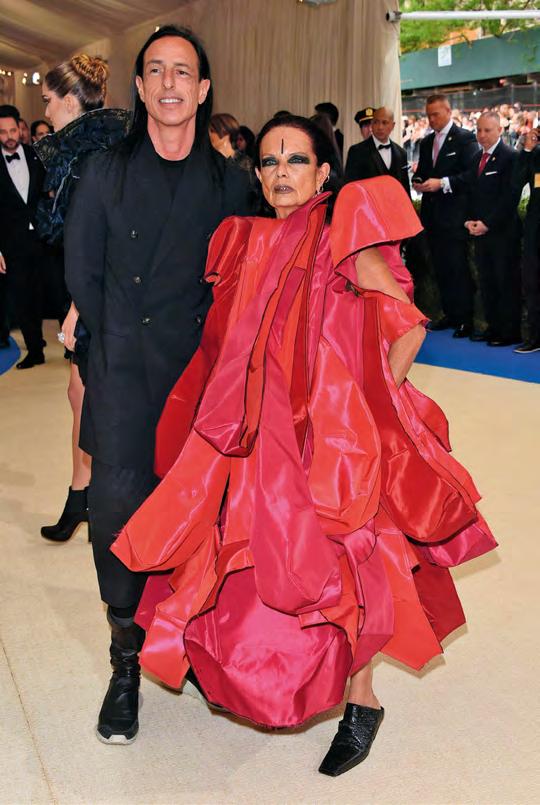
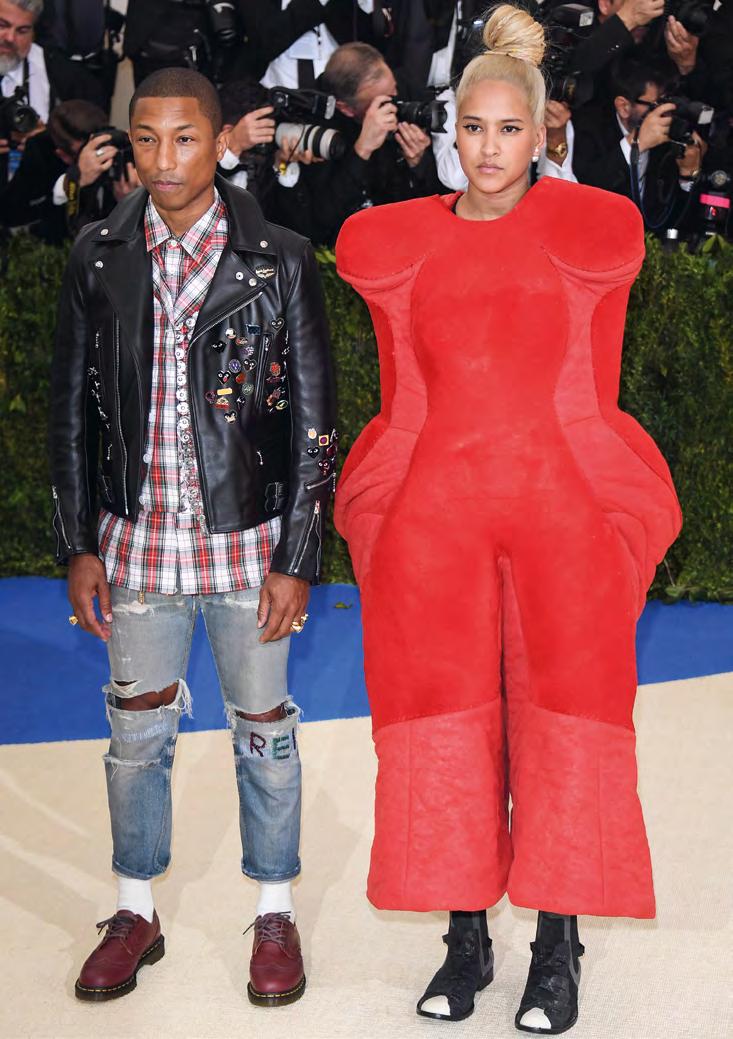
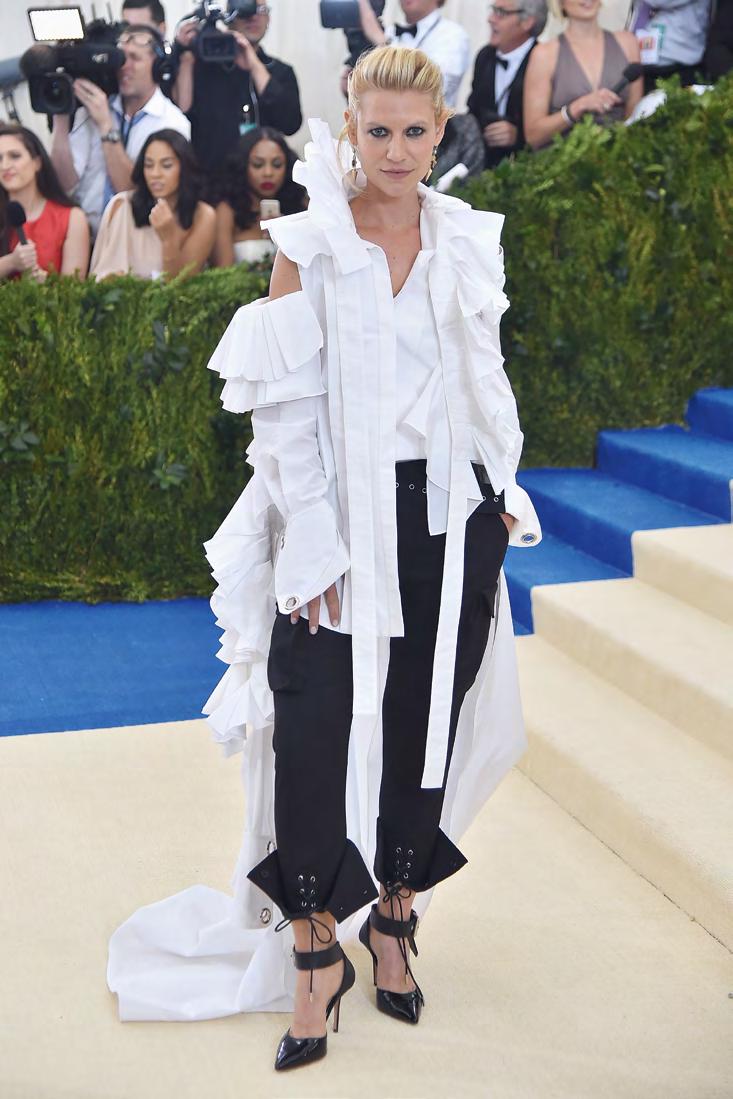
“Women tend to say it’s hard if you’re a woman. But if you know you really want to do it— that you have to— then it’s not difficult. It follows its own course.”
Rei Kawakubo (quoted in Brantley, 1983)
1. EARLY DAYS: REI BORN AND MADE
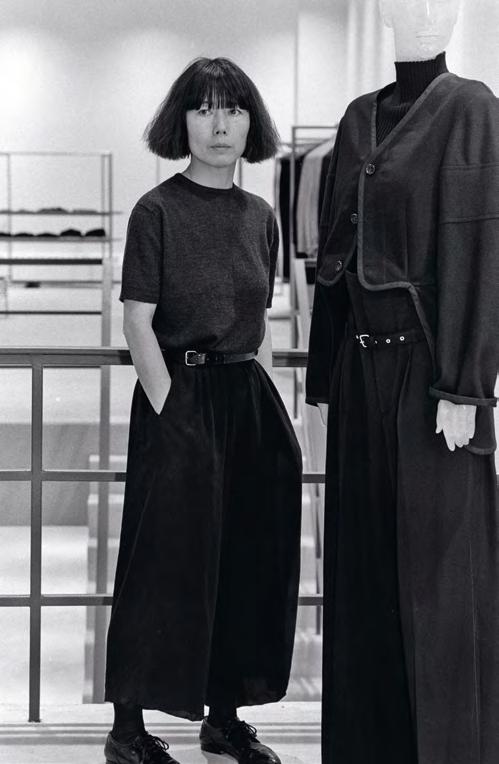
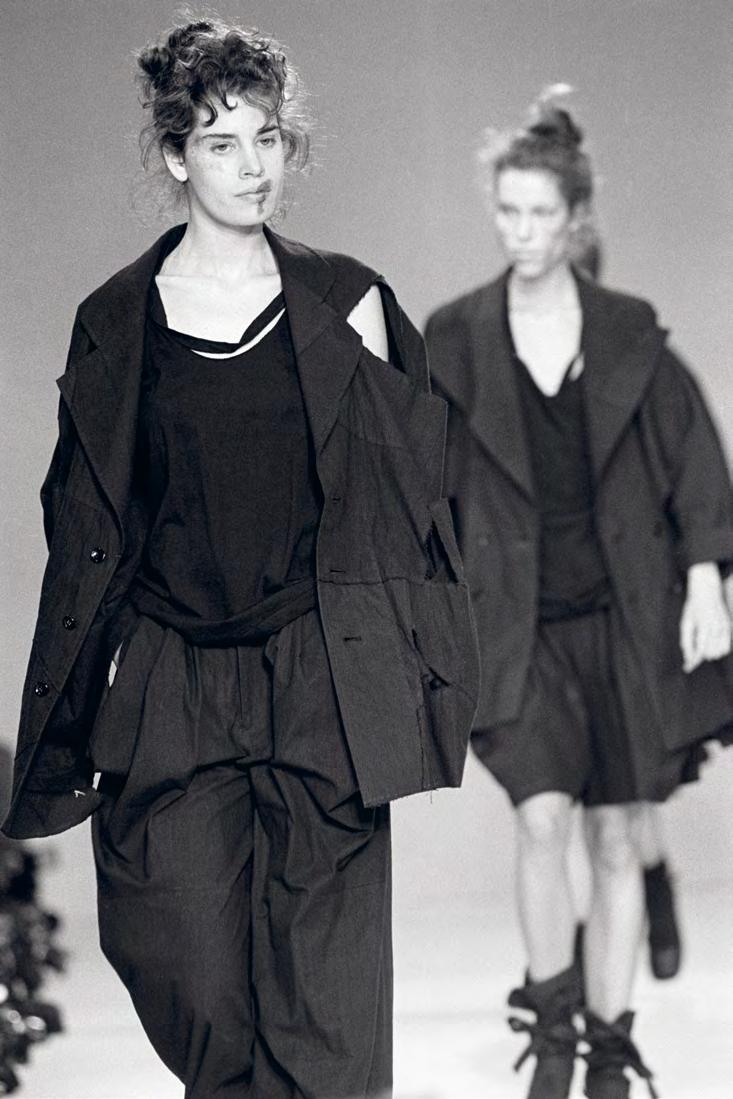
Opposite CDG Spring/Summer 1983 Readyto-Wear show, Paris.
life far away from the world of Western fashion. A traditional tea ceremony is wabi-sabi, as is flower arranging. Through Kawakubo’s work, in part, it translated as deconstructivism and had much in common with the impact of Westwood and McLaren’s punk explosion in the mid-1970s when shredded T-shirts and safety pins attempted to raze fashion past and created a new fashion. Rei’s Destroy was imbued with a cultural radicalism while Westwood and McLaren’s designs were seeded by music and activism. Interestingly, although both Westwood and Kawakubo would later be honoured by the Metropolitan Museum of Art with exhibitions curated about their work, their ideas took a while to assimilate.
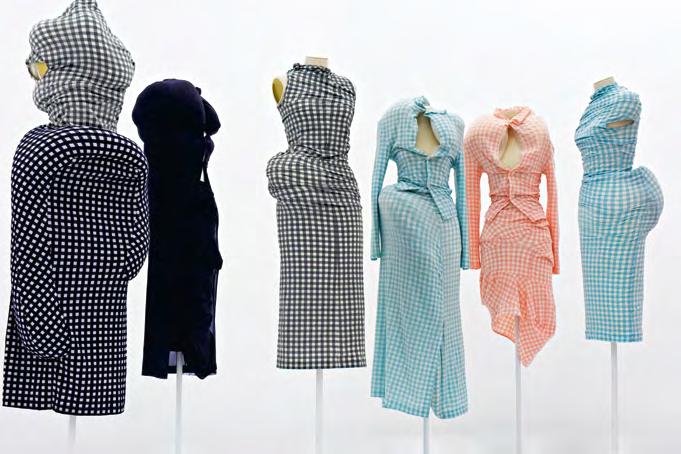
The New York Times fashion critic Bernadine Morris described Comme des Garçon’s first collections in Paris as “wild, barbaric, brutal, shocking” and “rag-pickers” clothes (Morris, 1985, 1987). But she admitted that just a few years later Kawakubo’s “clothes no longer seem strange. Not only has she adapted her work to Western taste, but Western eyes have also become accustomed to her way of looking at fashion” (Morris, 1985). However, Rei was confident about her message and declared: “Perfect symmetry is ugly…I always want to destroy symmetry” (Kawamura, 2004). The lop sided coats and dresses she put on the runway synergised with what curator Harold Koda (1985) called her ‘aesthetic of poverty’. The now famous 1982–83 Holes collection showed sweaters with intentionally ‘dropped stitches’ – examples of which are now held by the Victoria and Albert Museum in London’s archive. Kawakubo reflected: “To me, they’re not tears. Those are openings that give the fabric another dimension. The cut-out might be considered another form of lace” (The Met, 2017).
These early catwalk shows anticipated the ‘anti-glamour’ Martin Margiela would explore with his label, which debuted in Paris in 1989. And later, on a wider scale, when distressed fabrics would become more commonplace with trends including distressed sabi-inspired slashed and faux-faded jeans. The clothes Kawakubo designed similarly survey and celebrate the simplicity of form and texture – the wabi element that can be read scrutinising the silhouette and fabrics chosen to conceive her vision. Encompassing both creative elements of wabi-sabi, Comme des Garçons’ designs have brought to the fashion world a joy of individualism, non-conformity and the power of an alternative.
“I’m not an artist, not a fashion designer, I just use fashion, use clothes as a material to make a business out of creation. This is a very important part. Don’t put me in a box.”
Rei Kawakubo (quoted in Gibson, 2019)
6. A BUSINESS-WOMAN ARTIST
Previous page and opposite CDG Spring/Summer 2014 show, titled Not Making Clothes, Paris, France.
When she was just turning 71, Rei Kawakubo decided that ‘starting from zero’, which had thus far been the essence of her forging collections, was not quite enough. She had devised this rule in 1979 and used it as a method of articulating an experimental fashion language distinct from more mainstream brands. She used it as a guide to avoid repetition, expand the parameters of design imaginatively and look to the new. Over the course of Kawakubo’s career, this practice has helped her unpack new possibilities as to what clothes could be. It is still part of Comme’s kachikan She often refers to the concept in interviews, saying: “I have always started from zero, trying to make something that didn’t exist before. The process of creation is done mostly by words and imagination” (Gibson, 2019).
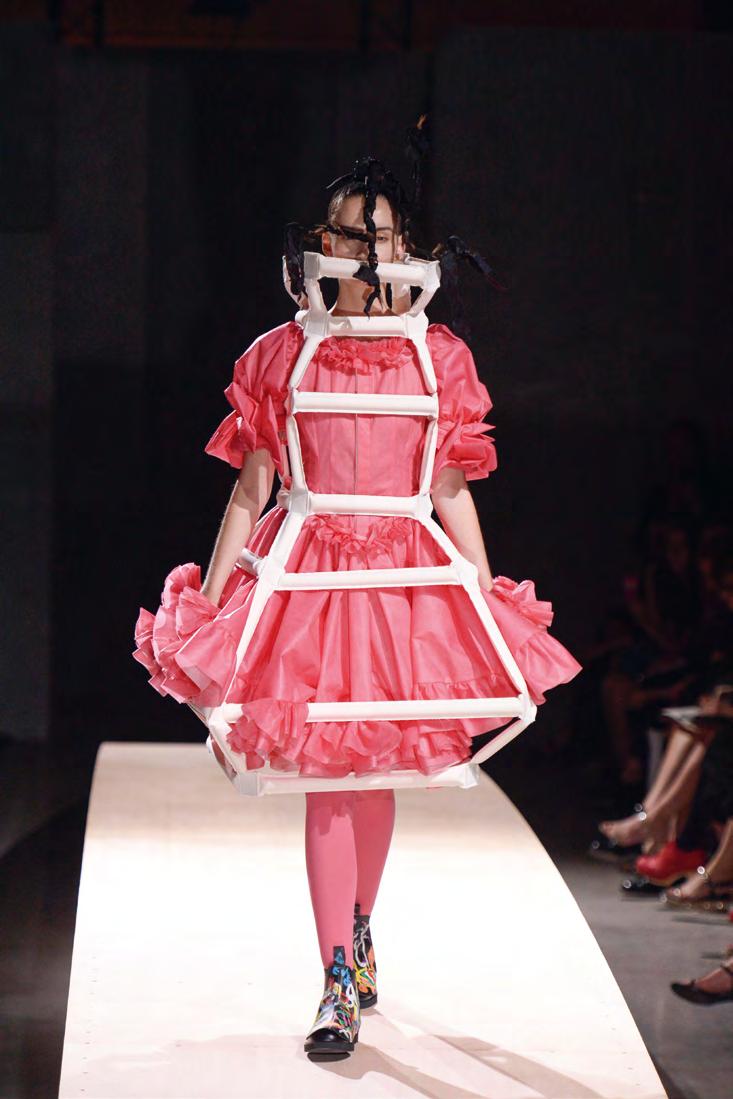
In 2013, it would lead to a paradoxical epiphany when shedding the old and looking to the new just didn’t seem motivation enough. Instead, in September that year Kawakubo presented her Summer 2014 Not Making Clothes show in Paris, and a month later disclosed a manifesto via System Magazine and The Business of Fashion that would help shed light on the techniques behind it. Her declaration argued that the initial premise of a new collection would no longer just start from zero, but by not making clothes at all. To keen Comme fans this was no revelation; each presentation since the early 1980s has been an experiment in chasing the new, a disregard of form, and shaping an almost abstract expression of something that doesn’t even feel like fashion. Kawakubo explained: “A lot of people were very moved, but for me it was not a complete, deep change of direction. It was more like a kind of…the word in Japanese is kirikuchi It’s like a way into [something]. It’s like an edge” (Schneier, 2017).
The manifesto seemed more like a clarification of a course of action that Kawakubo continuously hones; but equally, for many, it became a fresh reason for defining her work as art. The Not Making Clothes collection was a small but skilfully formed presentation of 23 outfits that Kawakubo explained “broke the idea” of clothes (Obrist, 2013). Silhouettes were oversized “wearable objects for the body” (Fury, 2017) that The New York Times described as “walking sculptures” (Menkes, 2013). Although each was unique, padding was a theme and was used to outline curious numbers, borders and straps that delineated fabrication and insets of some of
POLKA DOTS AND GINGHAM
“I think paradoxically (oppositely) about patterns I have used before. I put parts of patterns where they don’t usually go.”
Rei Kawakubo (quoted in Obrist, 2013)
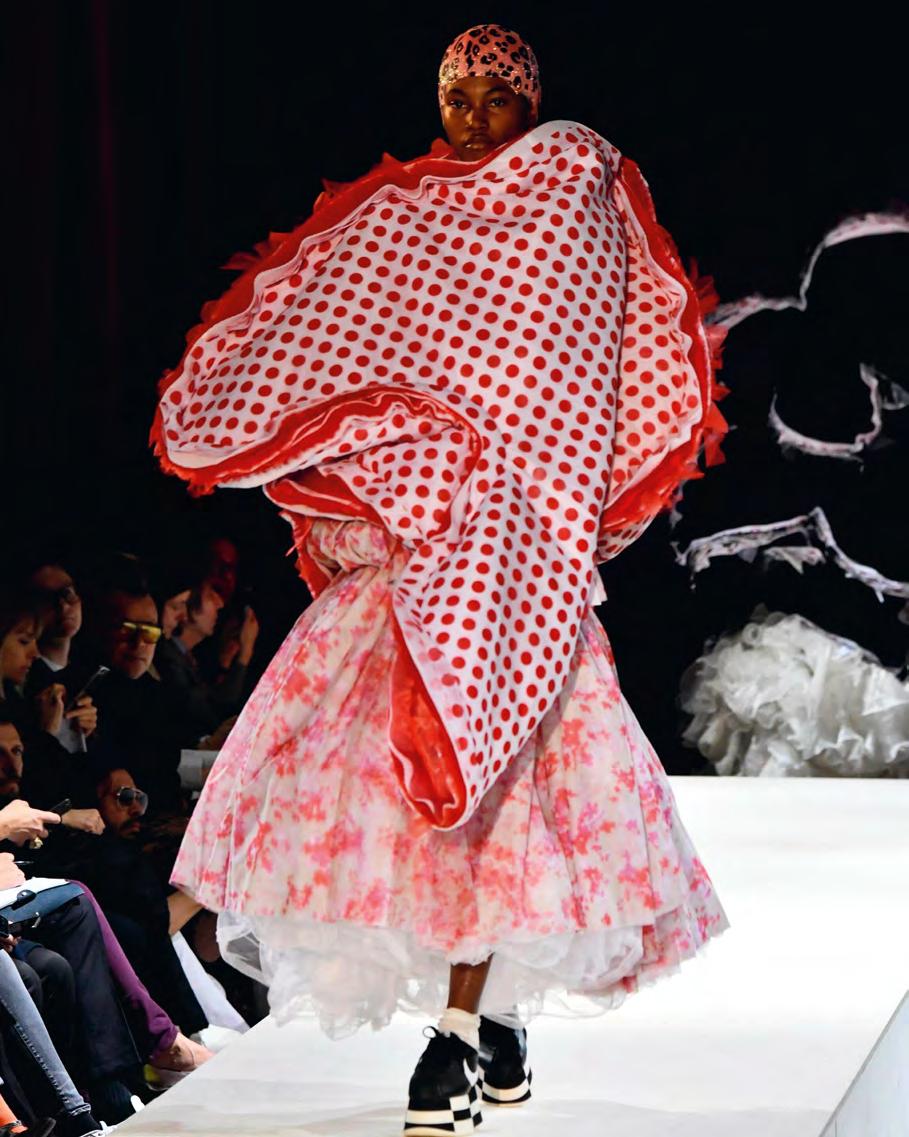
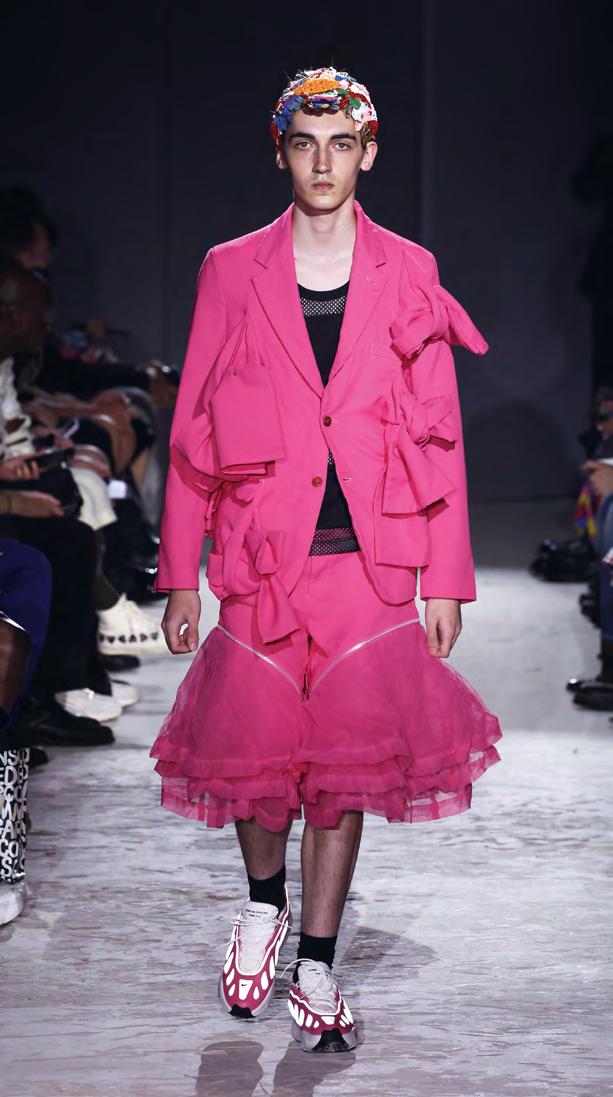
Opposite CDG Autumn/Winter 2018–2019 womenswear show, Paris.
The dotty world of Comme des Garçons is happily portrayed in the Play line which debuted in 2002. Together with its iconic Peeping Heart logo, Play is habitually swathed in spots – a print Kawakubo peppers on T-shirts, hoodies, hightop trainers, shirts and jumpers. Like the Play label itself, a polka dot signifies fun and evokes youth; in fact, “navy and white and polka dots” is one of Rei’s first recollections of fashion (Frankel, 2015b).
Spots are a resource Kawakubo uses not just to energise and enthusiastically animate wardrobe basics, but one employed across a sweep of Comme des Garçons’ brands to useful effect. Comme des Garçons Comme des Garçons, Girl, CDG Shirt and the Black range, along with accessories including wallets, backpacks and handbags, all enjoy its service. Polka dots have also been used in an array of key mainline presentations in the least obvious of ways right from the very start. Linda Evangelista walked the Spring 1992 ready-to-wear catwalk wearing a chestnut empire-line dress decorated with mustard-yellow dots with a deconstructed khaki sunhat.
Big statements can be made with a polka dot. For the Summer 2017 Blue Witch presentation, they manifested an enchantress edge, and the following year, in 2018, Rei identified spots as camp, creating her Comme des Garçons Camp collection. In a pre-show email, she said:
Previous page
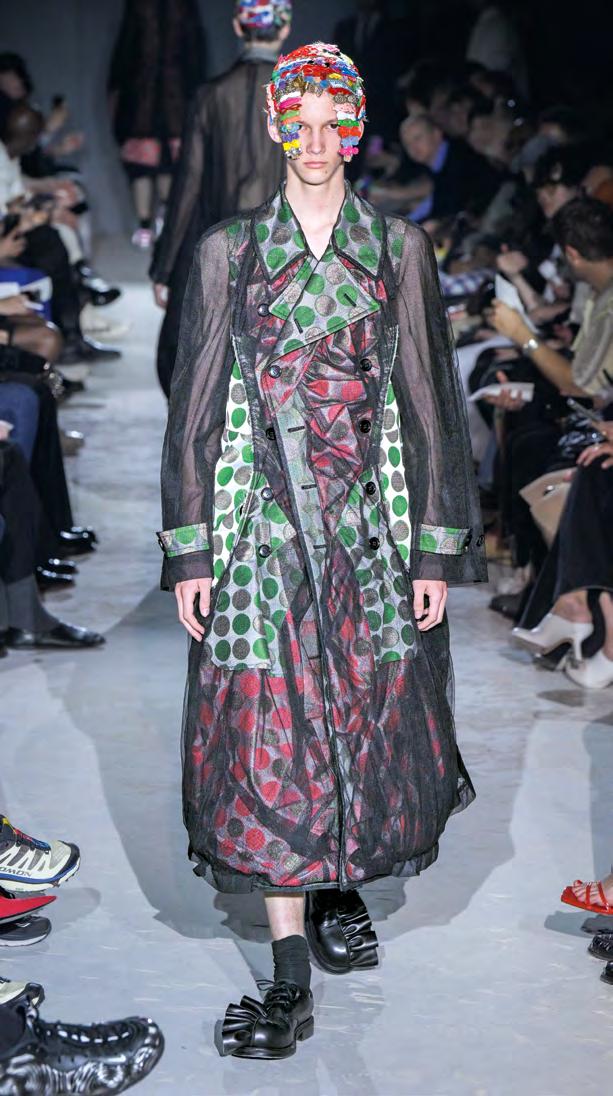
CDG Autumn/Winter 2013–2014 menswear show, Paris.
Opposite
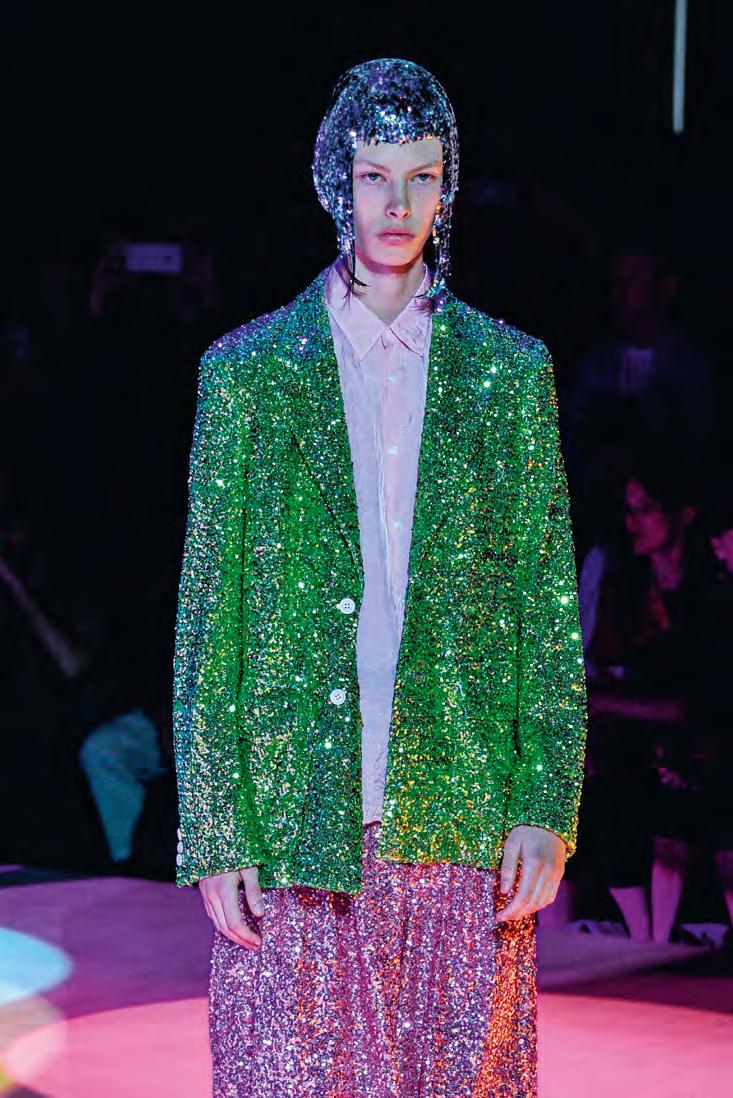
CDG Spring/Summer 2018 menswear show, Paris.
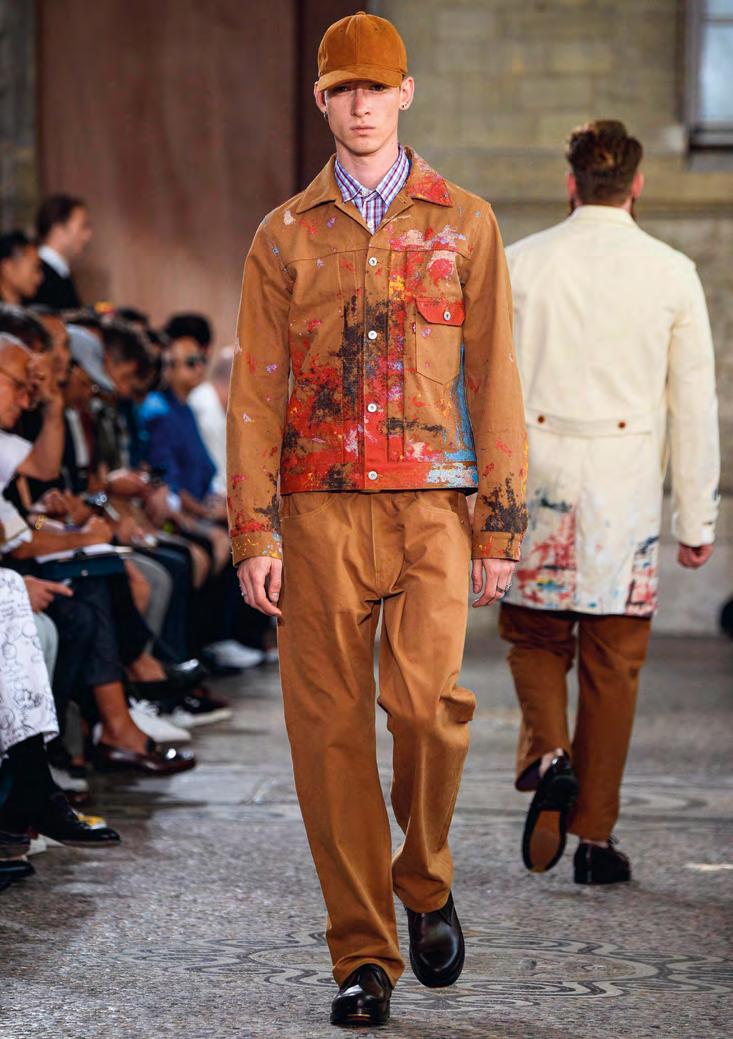
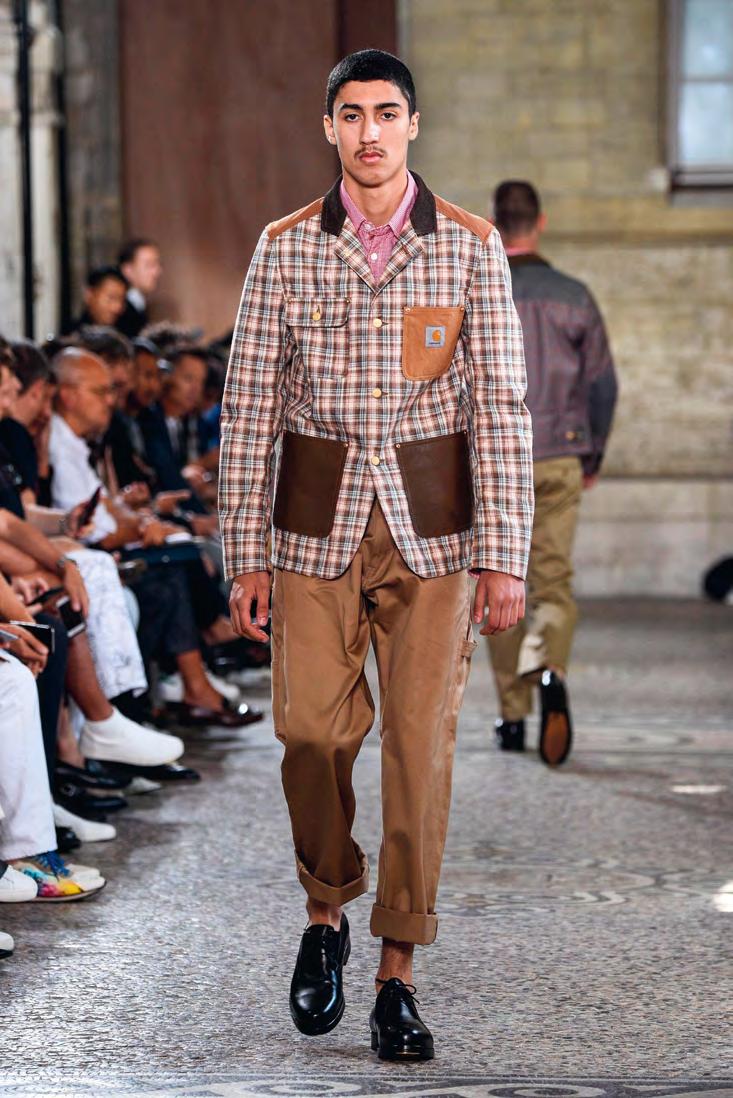
There is a lot of menswear in Comme des Garçons, not just apparent in their name or in the tailoring detail in the womenswear, but in the sheer variety of Homme labels that have existed over the years – an impressive collection that is evidence of Kawakubo’s business design skills. Influential and loved lines include Homme Plus, which Rei debuted in 1984 in Paris for the first time and is the most avant-garde; Comme des Garçons Homme Deux, a range of more formal pieces established in 1987; and CDGHP Evergreen, introduced in 2005 and since discontinued, which consisted of past design classics re-platformed with a twist.
The menswear labels are core building blocks of the brand and, to some extent, wind beneath the wings of the womenswear mainline, in so far as sales from additional lines help fuel the existence of its less commercial stablemate. Fundamentally, they are money spinners. A report in 2003 described Comme des Garçons Homme as “the Japanese firm’s principal and most commercial men’s collection, which is sold in some 80 stores in Japan and accounts for about a fifth of the house’s turnover” (Socha, 2003).
Rei Kawakubo first launched Comme des Garçons Homme in 1978, and from the start it felt a little more customer-facing and, within the universe of CDG, approachable. In 1985, The Globe and Mail described the Homme Plus range shown in Paris as “designs for men that have not been severed from all tradition. While there are pieces that count as something new under the sun (jackets with buttons so spaced, so spacey, that done up there is a gaping arch between the first and second, a brilliant, witty, humane touch that incorporates in design the accidental beauty of a mistaken or wrong or, at least, by conventional standards, awkward fit), there are balmacaan coats that, except for their looseness, are cut like ones by Aquascutum, and dark, striped, wool suits with wide notched lapels” (Livingstone, 1985).
In 2019, Rei admitted to WWD that Homme and Comme des Garçons Shirt lines were a couple of the first “quote-unquote commercial brands”, adding that they were “something that was easy to wear. But each one had its specific concept” (Foley, 2019). The Shirt line launched in 1988 was almost half the price of Homme – specifically manufactured in France to help keep costs lower and within the means of those who wanted
Junya Watanabe Spring/Summer 2018 at Paris Fashion Week.
“All celebrities would look better dressed by Rei Kawakubo. Why do all female movie stars show their tits at the Oscars? Pamela Anderson, Traci Lords, Mariah Carey, even Jessica Rabbit would look so much sexier dressed in a Comme des Garçons creation, one that showed confidence in being smart by purposefully downplaying their curves.”
John Waters, 2017