Numero verde / Toll-free Number 800 144 944 www.scriptamaneant.it segreteria@scriptamaneant.it
ISBN: 979-12-80717-62-7
A cura di / Curated by Fernando Castro Flórez
Testi di / Text by Fernando Castro Flórez
Dino Cura
Ambra Draghetti
Umberto Guerini
Edward Lucie-Smith
Maurizio Seracini
INDICE / CONTENTS
Dino Cura
6_ IMPROVVISAMENTE TUTTO CAMBIA / 7_ SUDDENLY EVERYTHING CHANGES
Edward Lucie-Smith
8_ FRANCIS BACON, DISEGNI / 10_ FRANCIS BACON, DRAWINGS
Umberto Guerini
12_ DISEGNI CHE SONO RIBELLIONE E AMORE / 18_ DRAWINGS AS REBELLION AND LOVE
Fernando Castro Flórez
22_ FRANCIS BACON, IL DISEGNO DEL CORPO / 33_ FRANCIS BACON, FULL-BODY DRAWING
44_ PULSIONI / DRIVES
92_ ESSERE E TEMPO / BEING AND TIME
226_ IL PAPA / THE POPE
310_ CROCIFISSIONI / CRUCIFIXIONS
366_ DEVOZIONI / DEVOTIONS
382_ RITRATTI / PORTRAITS
408_ AMORE / LOVE
Maurizio Seracini
430_ NEL SEGNO DI BACON: INDAGINI SCIENTIFICHE SUL DISEGNO TESTA DI FRANCIS BACON / 430_ IN THE NAME OF BACON: SCIENTIFIC INVESTIGATIONS ON FRANCIS BACON’S DRAWING HEAD
Ambra Draghetti
436_ SIGNUM BACONIENSIA / 440_ SIGNUM BACONIENSIA
Umberto Guerini
446_ SCOPERTE E AUTENTICAZIONI DELLA COLLEZIONE / 446_ COLLECTION’S DISCOVERY AND AUTHENTICATION
AUTHORS
Fernando Castro Flórez is a Spanish art critic and philosopher specializing in aesthetics, and professor of Art Theory and History at the Autonomous University of Madrid. He is also a curator of exhibitions and a contributor to the Culture section of the Spanish newspaper ABC. He is known for his erudite, cynical, and passionate style.
Edward Lucie-Smith was born in Kingston, Jamaica and moved to Britain in 1946. He began his career as an education officer in the R.A.F., and then worked in advertising for ten years before becoming a freelance author. He is now an internationally known art critic and historian, who is also a published poet, an anthologist and a practicing photographer. He has published more than a hundred books in all, over sixty of which are about art, and has written on art for many leading British newspapers and periodicals. His photographs are included in the collections of many museums around the world.
Dino Cura is the President of The Francis Bacon Collection.
Umberto Guerini is a lawyer and a professor of criminal law at the Faculty of Law at the University of Bologna. He defended and followed the legal authentication process the drawings were subjected to before being declared to be by Francis Bacon.
Ambra Draghetti is a graphological consultant at the Court of Bologna, who examined, studied, and authenticated Francis Bacon’s signatures on the drawings for 13 years.
Maurizio Seracini is a pioneer in the use of multispectral imaging and analytical technologies applied to works of art and monumental buildings. He joined UC San Diego in 2006, more than thirty years after graduating from UCSD with a B.S. in bioengineering in 1973 and a Doctorate in Electrical Engineering from the University of Padua in 1976. From 1975-77, he participated in the Leonardo Project in search of the long-lost fresco The Battle of Anghiari, a project sponsored by the Armand Hammer Foundation, the Kress Foundation, and the Smithsonian Institution. Seracini has studied over 4,300 works of art, most notably Leonardo da Vinci’s lost mural, the Battle of Anghiari, and The Last Supper, Botticelli’s Allegory of Spring and Caravaggio’s Medusa.
DESCRIPTION
NEW UPDATED EDITION WITH UPDATED SCHOLARSHIP
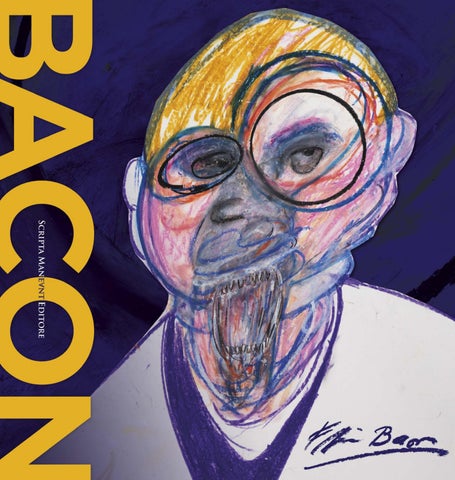
The Francis Bacon Collection is the result of an extraordinarily lengthy discovery and authentication process of previously unpublished works by Francis Bacon. Presented here for the first time now in this updated edition, the drawings are divided into thematic sections, each of which is preceded by an introductory text. For many years, experts wondered whether Bacon had produced any drawings at all besides his paintings. Since his death in Madrid in 1992, a proliferation of works on paper has appeared, some of which were authenticated and are now at the Tate and some are in a national collection in Ireland.
The Francis Bacon Collection includes the nearly 700 drawings, pastels, and collages in possession of Italian journalist Cristiano Lovatelli Ravarino. All the works have been photographed in ultra-high gigapixel capture exclusively for this volume.
Commentaries and essays especially written for this edition are by noted art historians Edward LucieSmith and Fernando Castro Flórez, together with an authentication report by Ambra Draghetti, the graphological consultant to the Court of Bologna for the authentication process. This elegantly produced edition presents new scholarship by Professor Umberto Guerini, who defended the legal authentication of the works at the Court of Bologna; Dino Cura, the President of The Francis Bacon Collection; and by Professor Maurizio Seracini, who pioneered the use of multi-spectrum diagnostic imaging and applied his technique to the drawings providing fascinating new details for the first time.
Cristiano Lovatelli Ravarino and Francis Bacon were close friends, spent time in Bologna and Cortina d’Ampezzo, and traveled through-
out Italy, where these Sejours provided for Bacon a powerful artistic drive.
As Edward Lucie-Smith explains in his contributing essay, “Bacon travelled to Italy not only because he was a cultivated man, fascinated by the history of Italian art, but because wanderings there represented a kind of freedom he could no longer fully enjoy among the courtiers who surrounded him in London, with their cries of “Yes, Francis! No. Francis! Buy us a drink, Francis!”
This collection unveils a rare and compelling dialogue between Renaissance subjects and one of the 20th century’s most unflinching artistic minds. The works presented here are less a static archive than a living substratum, a field of psychic excavation that nourished Bacon’s aesthetic violence.
With scholarly precision and interpretative daring, the collection maps how Bacon’s encounter with these drawings--fraught with gesture, torment, and spatial ambiguity—fed the ferocity of his own visual lexicon.
Most of the drawings represent single figures, some are portraits, some could be described as “repentances” reverting to earlier themes the artist thinks could have been done better. This is particularly true of the images that return to the image of the Pope.
Each image appears layered, interrogated, and luminous with implication and shows a tremendous creative restlessness, as if Bacon was continuously questioning the reputation he had gained. Edward Lucie-Smith defines them as “a monument to himself.”
An essential compendium for connoisseurs of drawing, students of Bacon, and all those attuned to the mesmerizing correspondences that flicker between epochs, this book offers a mediation on paper on influence, inheritance, artistic self-inquiry, and the continuity of human form and emotion across time.
Text in English and Italian
FRANCIS BACON DRAWINGS
Edward Lucie-Smith
There’s no doubt that the whole topic of Bacon drawings is a controversial one. Did Bacon make drawings, in addition to his paintings, or didn’t he? Bacon himself frequently denied that he did any such thing. He promoted a myth to the effect that he simply stood in front on a canvas and something happened: an image miraculously appeared. Since the artist’s death (in Madrid, to which he had gone in pursuit of a lost male lover) a mass of material has appeared— sheets that can only be described as, yes, drawings. A small proportion of these now repose in the Tate, as undoubted works by the artist. More, which unquestionably originated in Bacon’s studio, are piled up in the same collection, uneasily classified as ‘documentary evidence’. More still, if I remember correctly, are in a national collection in Ireland. And a very substantial number, illustrated in this book, remained in the possession of Bacon’s Italian friend and travelling companion in Italy, Cristiano Lovatelli Ravarino. Some drawings may have been made while they travelled, others were very likely made when Bacon was at home in London. All, during Bacon’s lifetime, wee sedulously kept out of the reach of Bacon’s dealer, the Marlborough Gallery, then much more dominant in the contemporary art trade than they are now, in the epoch of mega international dealers such as Gagosian, Pace and Hauser & Wirth. It is possible, but equally possibly unwise, to speculate as to why and how the myth that Bacon ‘didn’t draw’ was built up. Certainly, Bacon may have chafed over the control that Marlborough exercised over his work. There is also the fact that he was an autodidact, entirely self-taught, and perhaps always slightly uneasy about his status in the world of professional artists. In addition, and this may have been a decisive element, there was the nature of Bacon’s personality, dominant but increasingly bored and irritated by his own dominance in the bohemian world of London drinking clubs and London pubs. These were thronged with hangers-on with much less personality, and much less success, than Bacon had by that time carved out for himself. Bacon travelled to Italy not only because he was a cultivated man, fascinated by the history of Italian art, but because wanderings there represented a kind of freedom he could no longer fully enjoy among the courtiers who surrounded him in London, with their cries of “Yes, Francis! No, Francis! Buy us a drink, Francis!” Cristiano, bilingual, then very young, whom Bacon met at a party at the Villa Medici in Rome, represented
an escape from the entanglements that surrounded the famous artist in his country of residence. Italy had not yet encountered the full force of the Bacon myth. It is not surprising that Cristiano, in turn, was mesmerised by this close and increasingly priviedged encounter with genius. Even here, however, there were some deviations from the exact truth. A key product of Bacon’s wanderings in Italy was the series of paintings that he made, inspired by Velázquez’s Portrait of Pope Innocent X, now in the Doria Pamphilj Gallery in Rome. Bacon always claimed that this was based on a reproduction, not on an encounter with the original work.
To a limited extent this appears to be correct. A book about Bacon’s series of Pope paintings recently published by Phaidon offers the following:
“Bacon worked on his pope paintings, variations on Velázquez’s magnificent Portrait of Pope Innocent X, for over twenty years. He was already exploring the idea while in the South of France in late 1946. The first surviving version (Head VI) dates from late 1949, and he finally stopped in the mid-1960s. Subsequently, focused on Rome announced that he thought the works ‘silly’ and wished he had never done them. He acquired endless reproductions of the Velázquez painting from books, but famously did not see the original when he visited Rome in late 1954”
Most of this is accurate, but the final statement is misleading. Bacon continued to draw Popes, or Pope-like figures, even after he ceased to paint them. Cristiano remembers visiting the Doria Pamphilj Gallery in Bacon’s company. Bacon may not have gone there in 1954, but he did so later. What effect an encounter with the picture itself may then have had on him is unclear, but it remained part of his personal mythology. Their main wanderings together were not in Rome. They were in Bologna together, where Cristiano is still based, and also in the ski resort of Cortina d’Ampezzo. Their adventures together appear to have been somewhat raucous on occasion. Cristiano recalls Bacon giving away drawings to appease restauranteurs, who might possibly have been offended by their behaviour.
Most of the drawings—in fact, nearly all-represent single figures. Some are portraits. Some may perhaps be described as ‘repentances’. That is, they revert to earlier themes that the artist thinks he might have done better. This is particularly true of the images that return to the image of the Pope. And also to others that might be
described as ‘near-Popes’—ecclesiastics of some kind, but a little less specific. As is well known, Bacon, later in his career, tended to reject or belittle the Pope images that had made his original reputation.
Taken as a whole, what the drawings evince most of all is a restless desire to create. One gets the feeling, when looking through them, that Bacon was continually questioning the major artistic reputation that, against considerable odds, he had created for himself. As is well known, he had no religious faith—one reason why his end, in the care of charitable nuns, is ironic. He has no tomb—he left his body to science.
This long series of drawings, though fiercely contested by some supposed experts in his work, must therefore be thought of as being his monument to himself. They utter a fierce cry. What they say is: “In spite of the odds, I existed. And I will continue to exist. Every sheet carries the mark of my unique personality.”
At the same time, each sheet contains an element of denial. Or should one say, of deniability. It is clear, I think, that Bacon never intended them to have any kind of commercial existence. As a reward for Cristiano Lovatelli Ravarino’s friendship and companionship, and also as a gesture of thanks for Cristiano’s guidance through aspects of Italy not accessible to a man who didn’t have a command of the language, their role has been, to put things politely, ambiguous. Quite a lot of people now find their existence—ahem!—a bit inconvenient. They upset an established narrative: Bacon, it seems, lied about his creative process. The paintings he created weren’t just magicked into existence. Worse still, if you look at the drawings, the artist seems to have been increasingly pray to processes of self-doubt. Ironically, he had less faith in himself than his audience possessed, in the later, highly successful phases of his career. The drawings offer a complex self-portrait— one of an artist who was continuously questioning the nature and value of his own achievement. During and since Bacon’s time, there has been a plethora of contemporary artists who seem to be obsessed with making self-portraits. There is the endless series of self-portraits produced by the German NeoExpressionist Georg Baselitz, many of which show the artist’s likeness upside-down. There are the nude likenesses of herself produced by the YBA artist Tracey Emin. There are sculptural figures, made from lifecasts, by the British artist Antony Gormley. Bacon also made quite numerous self-portraits, though not quite with quite the same degree of obsessiveness.
Part of this multiplication of self-portraits has been due, one may guess, to the ever-increasing capacity of both still photography and also of video to offer both records of and comments upon the visible, physically present manifestations of nature itself and also on the complexities of human society. These records often seem superior to conventional works of figurative art undertaken using traditional techniques with the same down-to-earth intentions.
As long ago now as the period that immediately followed World War II, Western European and North American art pitched Abstract Expressionism and other abstract styles related to it as movements that produced art that mirrored the inner self—a region inaccessible to Soviet Socialist Realism.
There was also, however a tendency in Western art that resisted Abstract Expressionism as being too unspecific—too vague concerning what the visual arts have to tell us about our identity as individual human beings. The long series of drawings made by Francis Bacon that are published in this book are striking examples of this resistance. Every one of them is an attempt to define an absolutely specific personality, an inner self as manifested in outward appearance. Each drawing, whatever its subject, whether it is an image of a real person or of one that is purely imaginary, utters a cry of “Yes, I exist!”. For an artist who was dogmatically opposed to any belief in the hereafter, the drawings are paradoxically adept in asserting that those whom they represent are fully alive, not only in the conventional here-and-now, but in a continuing hereafter.
Bacon’s obsessive making of these drawings during the later stages of his career, seems to have been, most of all, an interrogation of inner selves—himself—, other individuals whom he knew, beings whom he imagined. The fact that some of these beings were religious personages, not only Popes and ecclesiastics, but images of the Crucified, illustrates his devotion to paradox. The holiest image is created by a determined non-believer. The drawings declare his adherence to a religion, but it is the religion of art. Also, one may perhaps guess, they demonstrate his continuing uncertainty about his own place, as an artist without any formal training, within that religion.
FRANCIS BACON DRIVES
The experience of the body in contemporary art courses through a nervous space where presence seems an accident, the inevitable mark of cruelty of the world or the testimony of pain. The body never implies intimacy of any sort, it rather excludes it as if we were forced, to use a lacanian term, to unfold a type of “exctintion.” Francis Bacon’s paintings contain an intention, in the first instance, contrary to that of Rainer Maria Rilke: to make visible the forces that are not. However, this strangeness he exteriorizes is not expressed in a stable figure but in the form of sensation, in the movement that escapes, to a great extent, the figurative. Gilles Deleuze has pointed out, regarding Bacon, that art is not about reproducing or inventing forms, but of capturing forces. 1 Bacon’s paintings do not represent anything but the actions of said invisible forces on the body. The involuntary marks, apparently random, of the canvas seem to stand in solidarity with that stranger who tightens his face or his muscles. This art is not merely a recipient of paint, in the paintings there is more scream than horror; 2 they reflect the stupid condition of existence, as if ignorance were more abysmal than anxiety. From the faces, only the grimace remains, the sign of hopelessness. The images appear in full light; 3 they seem to be located under prison lights of interrogation rooms, with the audience as the unasked witnesses of something taking place in an asylum or a prison, while the subjects lay on the WC or on a barber’s chair. What these half-dressed beings survey in those mirrors
1 “And, in effect, what interests Bacon is not exactly movement, even if his painting produces very intense and violent movement. But ultimately it is a movement that doesn’t move from the spot, a kind of spasm, which bears witness to a problem very different from Bacon’s very own: the action over the body of invisible forces (thus the deformations of the body motivated for this deeper cause)” (Gilles Deleuze: Francis Bacon. Lógica de la sensación, Ed. Arena, Madrid, 2002, p. 48).
2 “It could be said that the scream is an image of horror; in fact, I wanted to paint the scream more than the horror. I believe that I’ve studied more in depth the causes that make someone scream, I would have managed to reflect with greater success the scream that I was trying to paint” (Francis Bacon in conversation with David Sylvester: Entrevistas con Francis Bacon [Interviews with Francis Bacon], Ed. Random House, Barcelona, 2003, p. 49).
3 “Francis Bacon generally locates his subject under a tough, fixed electric light or, occasionally, under the light of a sharp sun which qualifies nothing deriving from meteorology, so that, ultimately, everything happens in the crude plenitude of the zenith—vertex of the day and the hour of truth—or under that other which we could term, using the language of the theatre, “full light”” (Michel Leiris: Francis Bacon, Ed. Polígrafa, Barcelona, 1987, p. 7).
is their condition—the same as ours—as voyeurs . 4 What interests him in art are trifles which, in his presence, have something brutal, capricious or disordered. Man in Bacon’s world has no illusions, his life is sheer nonsense, but, notwithstanding, the incongruity of his existence leads to a kind of “exhilarated despair.” 5 Bacon’s “studies” represent someone seated one leg over the other, the hands on the knees, confined to a geometric form, as if it were the altar of an abnormal liturgy; this is, without a doubt, an image of contemporary melancholy. The metamorphosis of the body is nothing but the result of that condensed time where the worse has happened already, in an inertial catastrophe which doesn’t require a stage no longer. 6 Every voyeur , notes lucidly Pascal Quignard, is a nocturnal man (either that or he’s blind, dead, or an animal). We look, enraptured by desire, at something which can petrify us and we need to bear those extremes, the spectacular ruse, as Perseus
4 “[...] the spectator, glued to the couch, is encouraged to take up the position of a voyeur who attends as a present body to this staged fiction without narrative anecdote and he is caught up in the trap of an almost always closed-in space, though always open to whom, with his imagination, penetrates within, as the whole dispositif seems to invite him to do” (Michel Leiris: Francis Bacon, Ed. Circe, Barcelona, 1955, p. 8).
5 While talking to David Sylvester, Francis Bacon points out that his paintings treat of something more than appearance: “It treats of my kind of psyche, it deals with—he expressed it in a very pleasing manner—my kind of exhilarated despair” (Francis Bacon in conversation with David Sylvester: Entrevistas con Francis Bacon [ Interviews with Francis Bacon ], Ed. Random House, Barcelona, 2003, p. 77). “Exempted of all double depth and without demanding more readings than the reading that comes from what is presented to the eye, since, when he paints, the author doesn’t intend to say more than what he paints and, consequently, is opposed from the start to all forms of ideological commentary, these paintings, which—sites of pure living presences which make reference to nothing—are under the sign of the absence of meaning or, if you will, of nonsense , and seem, in their downright nakedness of the very instant (nakedness from its four corners and not encumbered by anything which, from close or far, has anything to do with literature), images plucking the strings of the inanity of our relation in the bosom of this world where, ephemeral as we are, we remain the only beings capable of brilliant and wasteful raptures. [...] Authentic Western expression of our times, the work of Francis Bacon—a man who, when speaking about which, using the nietzschean expression, he termed his exhilarated despair , has explained admirably what he himself is and what is his contribution—can’t but reflect, no matter how personally determined he is to do an indoctrinating painting, the biting bewilderment of everything he experiences in these times of horror, sprinkled with wonders, as he contemplates them with vision” (Michel Leiris: Francis Bacon , Ed. Polígrafa, Barcelona, 1995, p. 19).
6 “It is like a catastrophe taking place over the canvas, in the figurative and probabilistic details” (Gilles Deleuze: Francis Bacon. Lógica de la sensación [ Francis Bacon. The Logic of Sensation ], Ed. Arena, Madrid, 2002, p. 102).
before the Gorgon. 7 Bacon’s “visions” transform bodies into something like an assortment of folded lines , snapshots of subjects which are at the same time full face and in profile, in apostrophe and also trying to escape from the final rigidity, making their way towards anxiety, perhaps trapped by the oracle. 8 Those characters are not meditating in the melancholic manner, even if they remain within the extreme edge of finitude. Francis Bacon narrates how he gained consciousness that death one day would visit him when he was sixteen: “I remember that I was looking at a dog’s shit on the sidewalk and suddenly I thought: there it is, I said, such is life. Curiously, it haunted me for months, until I reached, as it were, an acceptance that one is here, existing for a second, before he’s crushed down like a fly on the wall.” 9
Francis Bacon followed, obsessed and bearing the weight of a head, the precept of Nulle dies sine linea 10 His work is nothing but so many (tragic) at -
7 “If looking at the sex is in the origin of the rapture which in the night spurs to desire, sleep or death, it is necessary for the gaze to take a round about way that plucks us away from the deadly and speechless face to face with what remains nameless. It is necessary to “reflect” with a shield, a mirror, a piece of painting, in the waters of Narcissus’s river. It’s the double secret, to my mind, of the oblique gaze (because it is pictorial) of Roman women. Caravaggio, in the first years of the 17th century, said: “A painting is Medusa’s head. We can overcome our terrors through the image of terror. Every painter is a Perseus.” And Caravaggio painted Medusa. Fascination means the following: him who sees can’t avert his eyes. In the frontal face to face, both in the human world as in the animal world, death petrifies” (Pascal Quignard: El sexo y el espanto [Sex and horror], Ed. Minúscula, Barcelona, 2005, p. 80). “[...] le tableau du Caravage non seulement donne à voir la représentation parce qu’il représente, mais il détruit le procés mimétique dans sa mimésis même” (Louis Martin: Détruire la peinture, Ed. Flammarion, París, 1977, p. 150).
8 “If anxiety is translucent in painting, this is because life is riddled with anxiety, and that very fact made the paintings even more realists” (Andrew Sinclair: Francis Bacon, Ed. Circe, Barcelona, 1995, pp. 281-282). Deleuze, in reference to Foucault, speaks of “the great family of asphyxiated and asphyxiating martyrs” which leads to a culture of anxiety, to a writing of disaster, in the meaning of Blanchot, to a face to face with the dreadful, attempting to “express the inexpressible.” See Gilles Deleuze: La subjetivación. Curso sobre Foucault [Subjectivation. A Course on Foucault], Ed. Cactus, Buenos Aires, 2015, p. 197.
9 Francis Bacon in conversation with David Sylvester: Entrevistas con Francis Bacon [Interviews with Francis Bacon], Ed. Random House, Barcelona, 2003, p. 114.
10 “Not a day without a line. Nulla dies sine linea. In Latin linea is also the fishing line that is thrown into the sea. It is Pliny the Elder who collected that phrase-sententia in his Naturalis Historia. But the lesson of drawing that he gives is much more precise: “When you draw, place your sun to the left, don’t allow the line you are tracing to fall under the shadow of your hand. Hesitate the least possible. Demarcate the forms little by little. Delay as much as you can the tracing the shadow of the figure whose outlines you have previously silhouetted”. I add something else to this Roman meditation we owe to Pliny the Elder in connection with the origin of painting: the destruction of the night, the nocturnal sensation, is of very recent date. Electricity outside (in streets and roads) and in the interior (in houses and restaurants) has broken a fundamental, everyday, plurimillenial invisibility. Lamp-posts, neons, screens, shop windows and lighthouses have flooded the earth in less than a century. The Homo sapiens depended uninterruptedly on fire till the late 19th century. Suddenly, we, the moderns, have lost the night. We find ourselves no longer, at the end of each day, facing the uniform opacity of the world of the night where bodies and objects lose their outlines and blend into a continuous as well as untouchable substance” (Pascal Quignard: La noche sexual [The Sexual Night], Ed. Funambulista, madrid, 2014, pp. 170-171).
tempts to narrate what he had seen 11 He trusted in the dissecting capacity of the homosexual gaze ; 12 he wanted to accomplish, more than portraits, images of flesh that looks at us 13 and, as he said many times, he wanted to paint the scream, 14 something which, in his opinion, Poussin accomplished marvelously in his painting Massacre of the Innocents 15
The scream appears as humankind’s primal form of lament, which has nowadays been abandoned or practically doesn’t exist 16
“I’ve always been very impressed—says Bacon— about the movements of the mouth and the teeth. They say that there are all kinds of sexual implications, and I am always obsessed about the real configuration of the mouth and the teeth [...]. I like, let’s say, the glow and the colour that comes out of the mouth, and I always had the hope of painting the mouth in the same manner that, say, Monet paint-
11 “Nunc, si poteris narrare, licet! (Now, if you can tell, tell). Over the sodden head of the voyeur, who already endeavours to flee, there emerges a stag’s horns as rigid as the desire that has arched itself in his lower belly. His hooves take over his hands and his feet. The hooves drive him forward with such speed that, in the very progress of his race, he is astonished himself. Et se tam celerem cursu miratur… There is a joy in looking (in desiring), in the same way that there’s an abysmal anxiety in rejoicing (in having rejoiced)” (Pascal Quignard: La noche Sexual [The Sexual Night], Ed. Funambulista, Madrind, 2014, p. 121).
12 “Bacon was obsessed by people’s physique, particularly his, and was convinced that homosexuals had a penetrating eye specially trained to observe people’s constitution. “Homosexuals turn increasingly unbearable with age—he pointed out—, because they are obsessed with their physique. Simply, they never stop looking at the body, from head to toe, all the time, shredding it to pieces. That is the reason why, whenever I’ve wanted to know the true constitution of a person, I’ve always asked if they were fags. They are ruthless and precise”” (Michael Peppiatt: Francis Bacon. Anatomía del enigma [Francis Bacon. Anatomy of the Enigma], Ed. Gedisa, Barcelona, 1999, p. 250).
13 “Someone wrote regarding my painting: “The flesh of the back of the face which stares out.” That is pretty accurate, don’t you think?” (Francis Bacon in Franck Maubert: El olor a la sangre humana no se me quita de los ojos. Conversaciones con Francis Bacon [I Can’t Get the Smell of Blood Off My Eyes. Conversations with Francis Bacon], Ed. Acantilado, Barcelona, 2012, p. 61).
14 “There was a time when I had hope (not that it had any psychological meaning in particular), I had the hope to make one day the best painting about human screaming. I wasn’t capable of doing it, and it is better expressed in Eisenstein’s film [the nanny shrieking in Battleship Potemkin], and there it is” (Francis Bacon in conversation with David Sylvester: Entrevistas con Francis Bacon [Interviews with Francis Bacon], Ed. Random House, 2003, pp. 40-41). “Yes, Potemkin… That nanny that screams, weeps; that image has chased me, obsessed me [...]. I tried to use those clichés for the mouth, obviously, but it didn’t work, never worked. Eisenstein’s image is better” (Francis Bacon in Franck Maubert: El olor a la sangre humana no se me quita de los ojos. Conversaciones con Francis Bacon [I Can’t Get the Smell of Human Blood Off My Eyes. Conversations with Francis Bacon], Ed. Acantilado, Barcelona, 2012, pp. 29-30).
15 “[...] the Condé Museum, where I had seen an admirable painting by Nicolas Poussin, The Massacre of the Innocent. I was impressed for a long time… The most beautiful scream in all of history” (Francis Bacon in Franck Maubert: El olor a la sangre humana no se me quita de los ojos. Conversaciones con Francis Bacon [I Can’t Get the Smell of Human Blood Off My Eyes. Conversations with Francis Bacon], Ed. Acantilado, Barcelona, 2012, p. 31).
16 “When painting a scream, Bacon shows all the energies that had banished him, the lament of non-existence. Even if mentally a pessimist, he was nervously an optimist, so that he painted the sensation of the scream and not its terror” (Andrew Sinclair: Francis Bacon, Ed. Circe, 1995, p. 262).
ed sunsets.”17 Bacon presents, time and again, the mouth of the Pope screaming, 18 making visible the scream that has something of an entrance into the shadows. 19 “Between civilized men—writes Bataille in the magazine Documents —the mouth has lost even the relatively prominent character that it still has among savage men. However, the violent meaning of the mouth remains in a latent state, regains its power, in a literally cannibal expression, as mouth of fire , applied to canons with whose assistance men kill each other. In the great occasions, human life is still brutally concentrated in the mouth, furors make the teeth grind, terror and atrocious suffering turn the mouth into an organ of wrenching screams. It is easy to observe that the deranged individual pushes his head and stretches frantically his neck, so that his mouth is located, as much as possible, as a prolongation of the vertebral column, that is to say, in the position that it occupies in its animal condition , as if the explosive impulses should arise directly from the body and through the mouth in the form of vociferations.” 20 Certainly, Bacon sets his obsessive gaze, in those dread-inducing portraits, on the mouth, leaving aside the traditional conception of the face, 21 ushering a reality mediated by convulsive countenances.
In Lacan’s 11 Seminar, he points out that as one looks at an image the subject enters it, even if that implies that the subject appears under the shape of a blind spot, of something that can be erased. Bacon’s painting could be termed as apotropai -
17 Francis Bacon in conversation with David Sylvester: Entrevistas con Francis Bacon [Interviews with Francis Bacon], Ed. Random House, Barcelona, 2003, p. 50.
18 Bacon admits that his first Pope didn’t quite reach his expectations: “In that moment all I wanted to do was the mouth. Only the mouth of the pope screaming” (Francis Bacon in Franck Maubert: El olor a la sangre humana no se me quita de los ojos. Conversaciones con Francis Bacon [I Can’t Get the Smell of Human Blood Off My Eyes. Conversations with Francis Bacon], Ed. Acantilado, Barcelona, 2012, p. 47).
19 “Bacon makes a screaming painting because he makes the scream visible, the open mouth as an abyss of shadow, in relation with the invisible forces which are those of the future. Kafka spoke of detecting the diabolical powers of the future which knocks on one’s door. Each scream contains them in potency. Innocent X screams, but screams precisely behind the curtain, not only as someone who can’t be seen, but as someone who doesn’t see, who has nothing to see, who has no other function than that of making visible the forces of the invisible which make him scream, the powers of future” (Gilles Deleuze: Francis Bacon Lógica de la sensación [Francis Bacon. The Logic of Sensation], Ed. Arena, Madrid, 2002, p. 67).
20 George Bataille: “Mouth” in Documents, Ed. Monte Ávila, Caracas, 1969, p. 141.
21 “To the extreme that, in fact, the face, as we know it, would disappear completely in the glittering mud of painting, leaving behind an ocular orbit, the deep cavity of the nostrils or a lock of hair, an unquestionable document that somewhere within that resolute chromatic stain, an individual was being commemorated. There is no place here to define the scene: we find ourselves too close to a dentist of the eyes, the nose, the mouth and the teeth, and the rest of the world remains isolated” (John Russell quoted in Andrew Sinclair: Francis Bacon, Ed. Circe, Barcelona, 1995, p. 187).
ca , as a kind of (dis)figured exorcism impulsed by that ancestral élan to capture obsessions, as it already happened in the hands accumulated in prehistoric caves which produce an account of something that flees. 22 His work is, to a great extent, a mixture of certainty and corporeal crudity and of unconsciousness or assumption of the “lack of meaning.” 23 Attracted by wounds, interested or even fascinated by ugliness, 24 perhaps Bacon shares, in his own way, with Lacan, the idea that the space that separates beauty from ugliness is the same space that separates reality from the real: “the imbroglio of reality is the horror, the horror of the real, and what constitutes reality is the minimum of idealisation which the subject needs to be able to sustain the real.” 25 With extreme lucidity, and no trace of fear, Francis Bacon could paint traumas , 26 treasuring in his memory that turn of the lock (as in Eliot’s The Waste Land ) which anticipated the horror 27
22 “In many cave paintings there are representations of the human hand next to animals. We don’t know what is their ritual function. We know that painting serves to confirm a certain magic “camaraderie” between prey and hunter or, to say it in a more abstract manner, between existence and human ingenuity. Painting is the way of making explicit, and thus it was expected to be permanent, that camaraderie” (John Berger: “Algunos pasos hacia una pequeña teoría de lo visible” [“Some Steps towards a Small Theory of the Visible”], Ed. Taurus, Madrid, 2004, p. 21).
23 “Myself I don’t know what my painting is about. I don’t really know how concrete forms appear. I don’t mean to say by this that I am an inspired or especially gifted being. I simply don’t know. I see them… I see them, probably, from an aesthetic point of view. I know what they want to do, but I don’t know how to do it. And I see them as something strange, without knowing how those things have happened and why those brushstrokes which have followed on another against the canvas have transformed themselves into concrete forms. And then, obviously, I remember what I wanted to do and then I force those irrational forms to what I wanted to do at the beginning” (Francis Bacon in conversation with David Sylvester: Entrevistas con Francis Bacon [Interviews with Francis Bacon], Ed. Random House, Barcelona, 2003, pp. 92-93).
24 “I like wounds, accidents, illness, everything where reality abandons its ghosts… But well, ugliness can be interesting and fascinating, right?” (Francis Bacon in Franck Maubert: El olor a la sangre humana no se me quita de los ojos. Conversaciones con Francis Bacon [I Can’t Get the Smell of Human Blood Off My Eyes. Conversations with Francis Bacon], Ed. Acantilado, Barcelona, 2012, p. 60).
25 Slavoj Zizek: “Del deseo al impulso: ¿Por qué Lacan no es lacaniano?” [“From Desire to Impulse: Why Lacan is not lacanian?” in Atlántica, 14, Centro Atlántico de Arte Moderno, Las Palmas de GRan Canaria, Otoño, 1996, p. 36.
26 Anita Brookner remarked that Bacon “did something which is only possible after the first freudian generation: painting traumas.”
27 “Despite Eliot’s late faith in the hereafter, his poetry is pervaded by the inevitability and the constant presence of death. That and a common fascination with barbarity and the pathos of daily life attracted Bacon. In fact, he was willing to associate himself with Eliot not only in an interview but in his own work. The 1978 Painting shows a masculine figure turning the key of a lock with his foot. At the beginning it had a subtitle that recognized Eliot as its origin, and even before finishing it Bacon wrote to Michel Leiris: “I’m working on a triptych about Eliot’s line, “I’ve heard a key turn once and only once.” It’s a line from The Waste Land”” (Chris Stephens: “Épico” [“Epic”] in Francis Bacon, Museo del Prado, Madrid, 2009, p. 225.)
OPERE WORKS
p. 56
007 | Testa urlante, pastello e collage su carta, cm 70×100. / Screaming head, pastel and collage on paper, cm 70×100.
p. 57
008 | Figura in torsione, pastello e collage su carta, cm 70×100. / Turning figure, pastel and collage on paper, cm 70×100.
p. 58
009 | Testa urlante, pastello su carta, cm 50×70. / Head screaming, pastel on paper, cm 50×70.
p. 59
010 | Testa urlante, pastello e collage su carta, cm 70×100. / Screaming head, pastel and collage on paper, cm 70×100.
011 | Testa urlante, pastello e collage su carta, cm 50×70. / Head screaming, pastel and collage on paper, cm 50×70.
012 | Testa urlante, pastello e collage su carta, cm 49×63.5. / Head screaming, pastel and collage on paper, cm 49×63.5.
p. 84
052 | Figura seduta, pastello e collage su carta, cm 100×150. / Seated figure, pastel and collage on paper, cm 100×150.
p. 85
053 | Figura seduta, pastello e collage su carta, cm 100×150. / Seated figure, pastel and collage on paper, cm 100×150.
p. 86
054 | Testa urlante, matita su carta, cm 35×50. / Screaming head, pencil on paper, cm 35×50.
055 | Testa urlante, matita su carta, cm 35×50. / Screaming head, pencil on paper, cm 35×50.
056 | Testa urlante, matita su carta, cm 35×50. / Screaming head, pencil on paper, cm 35×50.
p. 87
057 | Figura in torsione, pastello e collage su carta, cm 70×100. / Turning figure, pastel and collage on paper, cm 70×100.
FRANCIS BACON
BEING AND TIME
Anonymous existences, as collected in Bacon’s paintings, even if they are portraits of people very close to him,1 have something of a biographical dubiousness. This compulsive and magisterial portrait artist declared that he didn’t like to paint the dead nor people he didn’t know, since, in his imagination, they lacked flesh; but he didn’t feel either like facing those he knew, in an exercise of exhausting scrutiny. He preferred a present photograph or a recent recollection, an impression that operated like a “call.” Among the many images that accompanied him, Muybridge’s Fighters, whose movement was decomposed in photographs, had a seminal character.2 “It isn’t as if—warns Gilles Deleuze in Francis Bacon. The Logic of Sensation—all things were at war, in struggle, as one could think from the point of view of a figurative pessimism. What causes the fight or the embrace is the overlapping of various sensations in two bodies, and not the other way around. So that the fight is much more the variable Figure who is apprehended between two bodies which sleep entangled, or rather the desire for mixture, or perhaps that which painting makes resonate. Dream, desire, art: spaces of embrace and resonance, spaces of fight.”3 Francis Bacon had, in his own words, voracity for life, 4 he wanted to show
1 “The people I’ve painted, I have either come across in pubs or met them from very intimately” (Francis Bacon quoted in Andrew Sinclair: Francis Bacon, Ed. Circe, Barcelona, 1995, p. 253).
2 “[The photographies of Muybridge] were an exhaustive register of human movement; a kind of dictionary. And this thing about doing series may come from looking at those books by Muybridge in which one may remark the different stages of movement in separated photographs” (Francis Bacon in conversation with David Sylvester: Entrevistas con Francis Bacon [Interviews with Francis Bacon], Ed. Random House, Barcelona, 2003, pp. 39-40). Muybridge’s photographs were for Bacon, as John Rothenstein wrote, “what the breviary is for a priest.” “Those sequences of naked mammals in movement compelled Bacon to paint other sequences of related scenes or portraits, which possess the deformed immediacy of instantaneous blurred series which could be obtained from a modern photographic passport machine or which could show us stroboscopic light on a stage. As pointed out by Francis Russell, Muybridge’s photographs were safe from the pollution of art. They were not moulded by the consciousness or the composition that modern photographers apply to their images so as to qualify them as art. Bacon took photography “the initial approach: the disposition to accept a deformed or implausible image as truth.” He returned to photography “its involuntary and spontaneous quality.” One could say that Muybridge and Bacon were the King Lear of their respective works. They showed man settling into the homeless, naked and divided animal that it was. Notwithstanding, Bacon was more determined in the end to unmask the truth of what Muybridge seemed to show. As he asserted, he would force “painting to speak with more bluntness than the story actually does”” (Andrew Sinclair: Francis Bacon, Ed. Circe, Barcelona, 1995, p. 131).
3 Gilles Deleuze: Francis Bacon. Lógica de la sensación [Francis Bacon. The Logic of Sensation], Ed. Arena, Madrid, 2002, p. 74.
4 “I have voracity for life and I am voracious as an artist. I have voracity
our desolate existence, a reality of the image in its most torn phases, the nakedness of human beings;5 he thought that life had so little life that we had to be extraordinary.6
Perhaps we will have to close our eyes to see. That would imply that what we need is the touch of the real, be it to confirm that what is in front of us is a wall or to see, in a different manner, that void that looks at us.7 “Disillusioned, under the open sky, our con-
towards whatever chance can give me, I think it can give me more than what it can calculate logically” (Francis Bacon in conversation with David Sylvester: Entrevistas con Francis Bacon [Interviews with Francis Bacon], Ed. Random House, Barcelona, 2003, p. 107).
5 “I have never wanted to paint pornography. I’ve rather suggested, I thought it had more power; and, after all, aren’t we all naked men before our feelings?” (Francis Bacon in Franck Maubert: El olor a la sangre humana no se me quita de los ojos. Conversaciones con Francis Bacon [I Can’t Get the Smell of Human Blood Off My Eyes. Conversations with Francis Bacon], Ed. Acantilado, Barcelona, 2012, p. 35).
6 In his biography of Bacon, Michael Peppiatt reproduces a toast the artist offered which conveys his brilliant lucidity and his capacity to transform the most downcast landscapes into scenes of celebration: “To your health—said Bacon raising a glass of champagne—, for whatever you need it. What else can I offer you? After all life is such a charade that there’s no reason not to accomplish whatever you want. But that’s a different story. Very few people follow their true instincts. Every now and then an artist emerges who does it and who does something new and truly complicates the plot of life. But it’s very rare. Most people wait for something to happen. You have to feel truly freely to find yourself, without any form of moral or religious restriction. After all, life is but a series of sensations, so anyone can make his extraordinary, extraordinary and brilliant, even if that means turning into a brilliant fool like myself and conducting the type of disastrous life I conduct. There it is. I knew all along that life was absurd, even when I was young, even if I’ve never been young in the meaning of innocent. I knew it was absurd and still I was never able to understand anything in school, I was always a clown, entertaining the other kids. That was all. I don’t believe in anything but I am always happy to wake up in the mornings. It doesn’t depress me. I’m never depressed. My nervous system overflows with optimism. I know it’s madness, but it’s an optimism about nothing. I think life has no meaning and nevertheless it excites me. I always believe that something wonderful is about to happen” (Francis Bacon quoted in Michael Peppiatt: Francis Bacon. Anatomía de un enigma [Francis Bacon. Anatomy of an Enigma], Ed. Gedisa, Barcelona, 1999, pp. 265-266).
7 Georges Didi-Huberman opens his beautiful book What We See, What Looks at Us, commenting upon a passage of Joyce’s Ulysses that closes with the phrase “shut your eyes and see”: “What does it mean? At least two things. In the first place, as he plays and ironically inverts very old metaphysical, even mystic, propositions, he shows us that to see is not thought or felt but is, actually, an experience of touch. In doing so, Joyce doesn’t do anything else but to indicate avant la lettre what will constitute at heart the testament of all forms of phenomenologies of perception. “It is crucial for us to accustom ourselves,” writes Merleau-Ponty, “even if all the visible is carved in the tangible, all tactile beings promise a certain form of visibility, and there is a kind of encroachment, not only between the touched and the toucher, but also between the tangible and the visible that is encrusted, encroachment.” As if the act of seeing would always end with the tactile experimentation of a wall built in front of us, an entrenched obstacle perhaps, dealt out in gaps. “If you can put your finger through it, it is a gate, if not a door.” But this admirable text proposes another lesson: we should close our eyes to see when the act of seeing brings us back, opens up a void
temporary universe is divided between weariness (increasingly more anxious about losing its means of consumption) or abjection and strenuous laughter (when the spark of the symbolic survives, and strikes down the desire for words).”8 A certain “metaphysics of absence”9 still lingers: that reality which would consist in the concealed which escapes. The infinitude affects everything: desire, discourse, dialogue and even the sublime. As Saussure said “the subject hallucinates his world.” One must try, as Francis Bacon does, to go through the fantasy, knowing that the meaning will probably never be anything but an effect of surface, a mirage, a foam. The symptomal reading denounces the illusion of the essence, the depth or the wholeness in favour of a cutting, ruptured reality of maturing. Art is always trying to take over the “other scene,” that is, that place where the signifier carries out his function in the productions of meaning which remains never conquered by the subject and from which he seems to be separated by a boundary of resistance. That fall of the subject which is meant to know what opposes the notion of obliteration of transference.
All tension is contained in a fall.10 Bacon doesn’t reproduce what he has seen but, paraphrasing Paul Klee, “makes visible.”11 From the symbolism of the Crucifixion to the torment of Orestes, Francis Bacon never stops projecting his drama 12 Art is like a battle, an agonistic
that looks at us, conjures up and, in a sense, constitutes us” (Georges DidiHuberman: Lo que vemos, lo que nos mira [What We See, What Looks at Us], Ed. Manantial, Buenos Aires, 1997, pp. 14-15).
8 Julia Kristeva: Poderes de la perversión [Powers of Perversion], Ed. Siglo XXI, México, 1988, p. 177.
9 “In our age, it seems, we live the end of history, of thought of the unconscious: after Heidegger and under his influence, the unconscious is not sought for any longer in the “real,” it is in what is absent, in the other, “what-always-evades-its-conceptual-capture.” And in them, the interpellation to the other, to what’s hidden beyond culture, is still, without a doubt, an interpellation to metaphysics” (Boris Groys: Sobre lo nuevo. Ensayo de una economía cultura [About the New. Essays on Economic Culture], Ed. Pre-textos, Valencia, 2005, p. 199).
10 “Primacy in Bacon is given to descent. Oddly, what’s active is what descends, what falls. The active is the fall, but not necessarily a descent in space, in extension. It is the descent as a step of sensation, as a difference of level understood as sensation” (Gilles Deleuze: Francis Bacon. Lógica de la sensación [Francis Bacon The Logic of Sensation], Ed. Arena, Madrid, 2002, p. 84).
11 “Bacon affected to have discovered the material reality of the body through a system of lines and colours. To do so, he had to resort to Klee’s formula: “Not to capture the visible, but to make the visible.” He had to show the invisible forces that pervaded the body, such as those of pressure and inertia, weight and attraction, gravity and growth”” (Andrew Sinclair: Francis Bacon, Ed. Circe, Barcelona, 1995, p. 262). See Gilles Deleuze: Francis Bacon. Lógica de la sensación [Francis Bacon. The Logic of Sensation], Ed. Arena, Madrid, 2002, p. 63.
12 “As if propelled by the strength of hist emotions, the atheist of Bacon had dug up in the primordial rituals of Greek and Christian faith; he was convinced that only there he could find a structure that would reflect the scope and contradictions of his own drama. This drama constitutes the key to the enigma that surrounded Bacon’s art. Even if he didn’t use to speak about it in conversation, about his myths, using them in the form of “frame,” as he himself termed it, from which he could “hang” all kinds of sensations and feelings. The theme of the Crucifixion dominated the first stage of his career, whereas the second part was marked by Greek myths, above all else, the Oresteia. (His enduring fascination for TS Eliot was connected, no doubt,
activity which bears resemblance, in the metaphoric plane, with bullfighting;13 at the end of the seventies bullfights were, in a certain way, one of the elements that attracted him the most from Spanish culture.14 In the work and the imagination of Bacon, death always lurks behind and even when he believes he has almost exorcised it, its shadow never truly abandons him.15
We could think that in his paintings, where sex appears with all its crudity, a catharsis could come about, in the tragical mode, even if ultimately the “facts” lead us nowhere.16 “Catharsis: Greek word meaning to “purge” or to “clean.” An incontrovertible etymology derives it from the Greek katheiro: “free the land of monsters.””17 Without a doubt, Francis Bacon throws over the pictorial surface his obsessions, his shadows, everything that excites him, but also that which he cannot accept. In these paintings we find a sordid beauty which paves the way towards the troubled realms of passion. As in the opening of Rilke’s first Duino Elegies, the beauty is the beginning of the terrible,18 something
with the fact that the poet had been also influenced by both themes.) In this sense, one could assert that, in the years preceding his maturity, Bacon identified himself with crucified Christ and, as he got older, with haunted and tormented Orestes” (Michael Peppiatt: Francis Bacon. Anatomía de un enigma [Francis Bacon. Anatomy of an Enigma], Ed. Gedisa, Barcelona, 1999, p. 327).
13 “Bacon admired their courage, and in the sixties, as he travelled through the South of France and Spain, he developed an interest for bullfighting, which he regarded as a spectacular test of courage and human resistance. He was also fascinated by metaphor: the closest the bullfighter gets to the horns of the bull, the greater can he brag about the magnitude of his boldness and the mastery of his art. In this aspect, Bacon was influenced by his friend Michel Leiris, whose superb essay “Literature as a Tauromachy” impressed him deeply; the French writer also sent him a copy of his Miroir de la Tauromachie [Mirror of Tauromachy] in 1969, a year when Bacon painted several bullfighting scenes” (Michael Peppiatt: Francis Bacon. Anatomía de un enigma [Francis Bacon. Anatomy of an Enigma], Ed. Gedisa, Barcelona, 1999, p. 272).
14 “Bullfighting studies [...] became a focal point that signalled the beginning of Bacon’s interest for peninsular Spain in 1969. There, he confronted the fiesta in the same manner that Hemingway had done: “As boxing: a marvelous appetizer before sex.” His two versions of Study for a Bullfight, the first one which went as far as to be hung in the members’ hall of the Royal Academy of Arts, deployed the iconography of the age: a circular ruedo where the bull, hemmed in and about to charge, discharges the white sputter of his potency; the somber matador, who puts his face and cape away from the charge; the multitude of voyeurs contained in a segment, like a mirror of orange panels that surrounds him; and a brown pool of frustrated lust that dribbles from the bottom of the canvas” (Andrew Sinclair: Francis Bacon, Ed. Circe, Barcelona, 1995, pp. 208-209).
15 Francis Bacon in conversation with David Sylvester: Entrevistas con Francis Bacon [Interviews with Francis Bacon], Ed. Random House, Barcelona, 2003, p. 72.
16 “[...] the most certain thing is that the artist aspires, from his earliest readings of Greek tragedy, to accomplish the purging of the feelings of sadness and fear through the indirect participation in the performed drama. Even if he didn’t think in any form of life after death, Bacon believed passionately in the supreme function that art had in this life of giving substance and meaning to what he called the “brief interlude between birth and pit”” (Michael Peppiatt: Francis Bacon. Anatomía de un enigma [Francis Bacon. Anatomy of an Enigma], Ed. Gedisa, BArcelona, 1999, p. 256).
17 Bruce Chatwin: Los trazos de la canción [The Traces of the Song], Ed. Península, Barcelona, 2000, p. 262.
18 “No artist of our time has presented the human condition with such depth of perspective and feeling. His paintings possess the unmistaka-
which we can hardly bear. “One could say that we have always tried to triumph over death by leaving images behind—said Bacon to Melvyn Bragg in 1985—, but that will change nothing.”
trace of the present. And I almost feel tempted to add the exclamation “ah!,” but for Bacon the virtues of truth and honesty transcend the tastes of fashion. They provide to his paintings an extraordinary beauty which has placed them among the most memorable images of the whole of history of art. Those paintings, furthermore, posses a timeless quality which allows them to hang with absolute naturality in the walls of our museums right next to those of Rembrandt or Van Gogh” (Allan Bownes: text published in the catalogue of Bacon’s retrospective in the Tate Gallery, London, 1985, quoted in Andrew Sinclair: Francis Bacon, Ed. Circe, Barcelona, 1995, p. 313).
OPERE WORKS
p. 142
145 | Testa, pastello e collage su carta, cm 48.5×68. / Head, pastel and collage on paper, cm 48.5×68.
146 | Testa, pastello e collage su carta, cm 48.5×68. / Head, pastel and collage on paper, cm 48.5×68.
147 | Testa, pastello e collage su carta, cm 33×50. / Head, pastel and collage on paper, cm 33×50.
148 | Testa, pastello e collage su carta, cm 50×64. / Head, pastel and collage on paper, cm 50×64.
p. 143
149 | Figura seduta, pastello e collage su carta, cm 70×100. / Seated figure, pastel and collage on paper, cm 70×100.
p. 156
180 |
/
181 | Figura seduta, pastello e collage su carta, cm 70×100. / Seated figure, pastel and collage on paper, cm 70×100.
182 | Figura seduta, pastello e collage su carta, cm 70×100. / Seated figure, pastel and collage on paper, cm 70×100.
Figura, pastello e collage su carta, cm 100×150.
Figure, pastel and collage on paper, cm 100×150.
p. 157
SPECIFICATIONS
24 x 29,5 cm
9.4 x 11.6 inches, Portrait
448 pages printed 4 + 4 colour
560 images
MSRP € 59,00
Hardcover coated with 150 grs matt coated paper and Gold Foil Kurz 428.
Headbands in gold.
Interior: 4+4 colours printed on matt coated paper of 170 gr/mq.
Endsheet printed in 4 +0 colors on uncoated white paper of 140 gr/mq.
Il marchio Scripta Maneant è di proprietà di Scripta Maneant Group, Bologna, Italia. The Scripta Maneant brand is owned by Scripta Maneant Group, Bologna, Italy.