
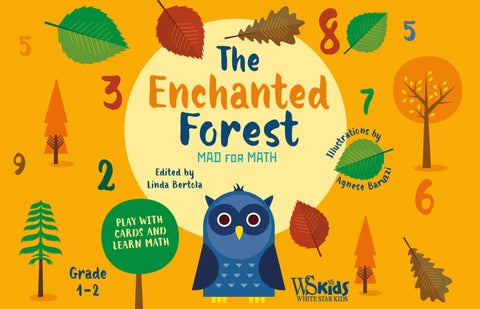
The Enchanted Forest

Page 1


THE PLAYING CARDS OF THE ENCHANTED FOREST

IN THE ENCHANTED FOREST YOU PLAY WITH 100 PLAYING CARDS, SPLIT IN 5 DECKS.

20 brown framed quantity-cards

20 green framed number-cards

20 orange framed addition-cards

20 blue framed subtraction-cards

20 purple framed difficulty-cards, for expert players

3 20-12

HOW TO PLAY

With the cards in this box you can play many different games. Depending on the selected cards, you can also gradually increase the difficulty.

The games revisit some of the most famous card games in a mathematical way.

Some of them are based on memory, others simply on luck.

In any case, players are led to practice the numbers up to 20 in a fun and challenging way.

In particular, through the game, the children will be proposed activities based on reading of quantities, numerical symbols, and comparison between quantity and operations (addition and subtraction).

To help younger children or those who encounter some difficulties in mathematics you can use concrete objects for the operations (buttons, beans, and so on).

CONCENTRATION-NUMBER

Number of players:

Card decks:

Select 2 card decks (1 and 2 or 4 and 5), shuffle each deck separately, and arrange them face down on the table. A player turns up the top card from each deck; if the two cards have the same value, the player takes them and plays a new round. Otherwise, the cards remain on the table and the play moves to next player, who turns up other two cards. If they have the same value, he picks up all the cards, including those of the previous round. The winner is the one who, at the end of the game, has collected the most cards.

Variants:

Depending on the selected decks, you can vary the degree of difficulty of the game from the simplest (decks 1 + 2), to the more complex (decks 4 + 5).

In case of very young children you can start by selecting only the cards from decks 1 and 2 with amounts from 1 to 10.

4 2

WAR OF THE NUMBERS

Number of players:

Card decks:

Select 2 (3 if the players are more than two) decks of cards, choosing them according to age and ability of the participants, shuffle and divide them among the players. Each player arranges his/her pile face down in front of him/her.

Players turn up the top cards of their deck at the same time. The player who turned the card with the higher value over takes all the cards on the table and places them at the bottom of his/her deck. The “battle” starts when two or more cards turned on the table have the same value: each of the players who have found cards with the same value have to cover their own card with another card face down and then place over them another card face up. The player who shows the highest value wins all the cards on the table. (When the value of the cards is equal again, start a new “battle.”)

The player who runs out of cards is eliminated; the last one to remain in the game wins.

THROW THE PAIR

Number of players:

Card decks:

Select two decks; remove one of the two cards with a value of 1 and shuffle all remaining. The dealer deals all the cards to the players. Each player picks up his/her cards and discards, throwing them in the middle of the table, the pairs formed by cards of the same value. The player who is left with more cards offers his/her cards spread face down, to the player on his/her right, who draws one card from the hand. If the drawn card is paired with one of the cards in his/her hand, the player discards them both, otherwise puts it in his/her deck. Now this player offers the hand to the player on his/her right which repeats the same operations as the previous player, and so on. Players who remain without cards end their game. The last player left with one card in hand loses.

Variant:

Instead of taking away the card with a value of 1, you can remove a card at random from the starting deck. This way no one will know you are holding the unpaired card until the end of the game.

BINGO

Number of players:

Card decks:

Choose four decks. Each player selects from them 6 cards, making sure that the cards have different values (this can be done by an adult). Each player arranges in front of him/her the cards face up. Shuffle the remaining cards and put them face down in the center of the table.

In turn, players turn over the top card of the deck and read the displayed value.

Players who have a card with the same value turn it face down. Those who flip first all their cards win.

ATTRACT CHILDREN TO MATHEMATICS

SOME TIPS

Looking back at their schooldays, many adults refer to mathematics as the most difficult subject; some of them even confess to be “hopeless at it.” Ask them to describe math; often they will tell you about a rigid and boring discipline, full of rules and formulas.

YET IT HAS BEEN SHOWN THAT INFANTS HAVE A MATHEMATICAL INTELLIGENCE THAT MAY ALREADY BE DEVELOPED DURING PRESCHOOL AGE.

Then, when and why was this widespread negative attitude towards mathematics born?

Scholars speak of “MATH PHOBIA” to refer just to the fear of mathematics. This phobia stems from the WIDESPREAD BELIEF THAT YOU MUST BE PREDISPOSED TO LEARN MATHEMATICS, as if it was already written in the destiny, who will be good at math and who will not.

This belief is “transmitted” at school or in the family, through words, phrases, and attitudes that emphasize the difficulty of the discipline and the inexorable fate of those who “are not good at”.

The fear for mathematics and the idea that it is something hard, stiff and cold then passes from parents to children, from teachers to students, allowing the fear to result in poor performance for educational level.

If our attitude towards numbers is negative, probably we will convey it to the children.

HOW CAN WE REVERSE THIS TREND AND HELP CHILDREN TO LOVE MATHEMATICS RATHER THAN HATE IT FROM AN EARLY AGE?

We must first create a positive attitude towards mathematics, avoiding describing it as boring, stiff or hard. Mathematics surely requires precision and rigor, but it is not written in stone that these adjectives are synonyms for “boring”.

YOU CAN LEARN MATHEMATICS IN A STIMULATING AND FUN WAY, WHATEVER YOUR AGE.

Learning through play lends itself to this purpose, and it develops in children a motivation based on the pleasure of learning. This type of motivation produces a deeper learning and is therefore more effective and lasting.

MATHEMATICS WILL DEFINITELY BE LESS DISTANT IF WE TEACH CHILDREN FROM AN EARLY AGE TO SEE IT IN THE WORLD AROUND US.

For example, we can go hunting for all digits that are hidden in the house and on the street (and they are many: house numbers, advertising boards, remote control buttons, kitchen scale, etc.). In this way, even very young children can understand the importance of numbers in everyday life and without effort they will begin to associate the symbol with the name of the number.

Children love counting: cars, steps, colored pencils . . . we can encourage this game, so that the simple repetition of a rhyme leads to the acquisition of the fundamental concept of correspondence (one object corresponds to a single tap with your finger and a number only).

As the children grow, the counting can always become more complex and challenging (backwards, leaps of two, ten, count large quantities, etc.). From reality you can assign tasks to solve: how many people will be at dinner? What happens if there are also the grandparents? How many plates do I have to put on the table? In short, the possibilities are numerous and it is really hard to get bored.

If many daily activities involve math, the same happens in other traditional games: to play hide and seek you must know how to count, and to play cards as well. You cannot play bingo without knowing how to recognize numbers, or advance on the chutes and ladders board game without knowing how to count.

MATHEMATICS IS EVERYWHERE, FAR FROM DISTANT AND ALIEN!

With a little creativity, you can also revisit MANY TRADITIONAL GAMES or increase the difficulty in a mathematical key; almost all card games are suitable for this purpose (such as those found in this box, but many others can be adapted by you). Even in the classic “Steal the Bacon” game, in which each competitor is given a number and when you call him or her, they have to be able to be the first to take the “bacon”, you can increase the difficulty by calling not just numbers, but operations; the same can be done with bingo.

As you can imagine THE POSSIBILITIES ARE VIRTUALLY ENDLESS, and with a little imagination you can always SUGGEST MOTIVATING AND FUN ACTIVITIES to help children discover the world of numbers.

2

5-4+0

1 8-4

1+3

3

6-5+2

1+0

9-7

White Star Kids® is a registered trademark property of White Star s.r.l.

© 2017 White Star s.r.l. Piazzale Luigi Cadorna, 6 - 20123 Milan, Italy www.whitestar.it

Translation and Editing: Iceigeo, Milan

All rights reserved. No part of this publication may be reproduced, stored in a retrieval system or transmitted in any form or by any means, electronic, mechanical, photocopying, recording or otherwise, without written permission from the publisher.

ISBN 978-88-544-1152-4

1 2 3 4 5 6 21 20 19 18 17

Printed in China

Turn static files into dynamic content formats.
Create a flipbook