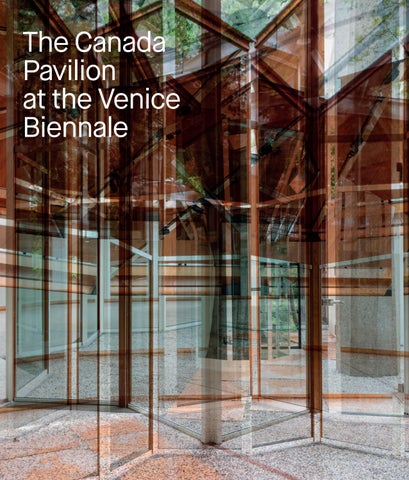
The Canada Pavilion at the Venice Biennale

Page 1


The Canada Pavilion at the Venice Biennale

Josée Drouin-Brisebois

Susanna Caccia Gherardini

steel beams, which create a multi-faceted surface. The individual beams that extend beyond the roof cover produce geometrical diaphragms below the tree canopy (fig. 2.16) Glazed insertions separate the roof from the perimeter wall, whose spiralling shape is interrupted to offer itself as an entrance façade: an opening that welcomes visitors, blending the interior exhibition space with the life of the Biennale The pavilion encompasses all the elements that BBPR’s research had focused on from the very beginning—the enveloping geometry, the contained measures, the transparency between art and nature, the understated dialogue with the visitor—which together reveal the harmony of human proportions.

Inserted between the British and German pavilions within an axial plan that was being modified by new buildings—those by Carlo Scarpa, Alvar Aalto, and Sverre Fehn among them—the Canada Pavilion, asserting its distance from the architectural tradition of the Biennale, spoke of BBPR’s mature heterodoxy. Slightly hidden away on the threshold between the exhibition grounds and the lagoon, light and curvilinear as if to unite these two realms, it is almost monochromatic in appearance, tinged with the organic, warm tones of wood, brick, and terrazzo, which produce a harmonious combination with the colours of the trees and the warmth of the humbler Venetian buildings. Discreet, immediate, and informal, the pavilion is open and amenable to gathering together people, ar t, and nature.

Having travelled along a similar trajectory—albeit as a competitor to BBPR—in the study of the relationship between history and architecture, the critic Bruno Zevi saw in the pavilion, more than in any other work by the Milan collective, the organicism that he himself championed. He recognized its dynamism, describing it as “an open structure, a rotating cross-section arrested in an instant of its movement, [deploying] a non-generic freedom that draws its ‘charge’ from the destruction of the elementary and completeness of the interior space, representing it in a moment of its cinematic becoming.”56 Although Zevi recognized the diversity that BBPR brought to the “avenue of tombs” that preceded it, Peressutti remained, however, the most perceptive reader of the pavilion; his quick, impulsive photographs blend the many materials of the pavilion, revealing the emblematic value of a civil and everyday monumentality.57

Fig. 2.16

View through the courtyard of the Canada Pavilion, spring 1958. BBPR, architects (1955-58). Università Iuav di Venezia—Archivio Progetti, fondo Enrico Peressutti. Photo: Enrico Peressutti

The Canada Pavilion and the Torre Velasca were both completed in 1958, a time when the path taken by Italian architecture and Casabella Continuità came under attack, particularly in the French and the English press, culminating in Reyner Banham’s incendiary April 1959 article “Neoliberty: The Italian Retreat from Modern Architecture.”58 The critique intensified at the CIAM conference in Otterlo the following September. It was with incredulity and sorrow that Rogers heard accusations that Casabella was promoting a stylistic and historicist regression of architecture, and that BBPR’s work—particularly the Torre Velasca—was symbolic of the Italian retreat from modernity and betrayal of CIAM’s principles The acrimonious debate brought an end to the international dialogue that had involved BBPR, who had been so persevering and hopeful in the quest for renewal. At the same time, the younger generation of architects, whom Rogers had welcomed into the editorial direction of Casabella, broke with their predecessors, denouncing the work of the Rationalists as “an unresolved attempt to represent the contradictions of Italian society, turning them into positive values, with an abstract, optimistic confidence in the capabilities of design.”59

The Canada Pavilion was caught in the midst of this architectural sea change, its legacy obscured as the international debate was renewed after the end of CIAM and as Italian architecture was being redefined by Vittorio Gregotti, Giancarlo De Carlo, and Aldo Rossi, all former students of Rogers and editors of Casabella With the publication of Rossi’s critique of modernism, L’Architettura della città in 1966, that page in the history of Italian architecture had definitively been turned. Yet, fifteen years after the inauguration of the Canada Pavilion, it was with some regret that Paolo Portoghesi, a proponent of post-modernism, reassessed BBPR’s ideal of architettura ambientale (environmental architecture):

Certain examples, only apparently minor, such as the US Pavilion in the Parco [Sempione] in 1951, the Children’s Labyrinth at the Triennale of 1954, and, above all, the beautiful Canada Pavilion at the Venice Biennale, woven around the trees of the park, hint at how much richer and more articulate the Italian contribution to the history of modern architecture could have been, if public commissions had made greater use of BBPR, removing them from the constraint—at once fascinating and limiting—that was their capacity of expressing the surviving values and the great aspirations of the most enlightened Milanese bourgeoisie.60

This, however, was also a reductive reading of the significance of BBPR’s oeuvre, which the small pavilion reclaimed in its magnitude In the secluded space of the Giardini, a place where each building expresses its own emblematic value, the Canada Pavilion remains the manifesto of an architectural utopia, the “substance of hoped-for things,”61 aspiring to a universal tradition, placed at the crossroads between the “permanent rooting of phenomena in given places [and] the circular, dynamic linking of one phenomenon with another through a shifting intellectual exchange between men.”62 As Rogers wrote immediately after the war: “Life is made for us. [. . .] Down with the rhetoric of imperial piazzas, of Lictor towers, and if anyone wishes to talk to us, he should descend from his pedestal and mingle with us, so that we, too, may talk with him: one man to another.”63

between Canada and video art for an international audience. In later years, from 1997 onward, video would recur regularly (at times as a relatively new form of expression for the artists) in exhibitions by Rodney Graham (1997), Janet Cardiff and George Bures Miller (2001), Jana Sterbak (2003), Rebecca Belmore (2005), and Mark Lewis (2009).

The challenge of displaying contemporary ar t in the Canada Pavilion continued to be felt throughout the 1980s in the exhibitions of Paterson Ewen (1982), Ian Carr-Harris and Liz Magor (1984), Melvin Charney and Krzysztof Wodiczko (1986), and Roland Brener and Michel Goulet (1988). Notably, the pairs of artists that were chosen to represent Canada speak more to concepts articulated in their work than to the individualism or diversity of voices apparent in earlier exhibitions. The above-mentioned shows focused on key developments in Canadian art, including the emergence of installation art in the Magor and Carr-Harris exhibition—both artists were concerned with the making of meaning and the viewer’s role in this process—the debate around public art and questioning of monuments with Charney and Wodiczko, and the use of found and manufactured objects in the sculptures of Brener and Goulet.30 The year 1988 also marked the first Canadian participation at the Biennale since 1952 not administered and financed by the National Gallery (with the help of the Department of External Affairs), opening up the curatorial role to different institutions. The competition model for the Canadian participation at the Venice Biennale would stay in place until 2011 when the Gallery resumed its role as the main organizer.

1990s

In 1990 Geneviève Cadieux, the first woman artist to be given a solo exhibition in the Canada Pavilion, worked closely with curator Chantal Pontbriand, Director of the magazine Parachute, in association with the Montreal Museum of Fine Arts. The artist made a bold decision to keep the pavilion’s doors closed and to use the glass façade in the courtyard as the support structure for her signature largescale colour photographs of body close-ups (fig. 4.6). 31 Cadieux’s work melds photography, sculpture, and architecture to create unusual if not uncomfortable encounters for viewers. Her Venice exhibition was no exception. In this instance she presented a single work, La fêlure, au choeur des corps, a site-specific photographic installation made up of colour photographs mounted on Masonite with an overall dimension of six by thirteen metres, which was designed to look like a skin stretched over the interior of the building’s glass panels In her catalogue essay, Pontbriand described the glass façade of the Canada Pavilion as a vitrine that provides “a window on nature as, in the opposite case, a window on art.”32 She offered insight into how the decision to use the courtyard came about, and the success of the piece’s desired impact on the visitor:

Simply as a pavilion in a public garden, the building is a historic artifact representing a certain conception of architecture and a dated interpretation of the relationship between nature and culture. As an exhibition space, it is commonly viewed as a problem, weighted with cultural baggage and physically inhospitable for many types of art. This troublesome site, then, led Geneviève Cadieux to devise a work for the windows of the interior court of the pavilion, which in this instance is considered to be a showcase. The work, to be viewed exclusively from the outside, invites the viewer to enter the courtyard. There, mounted on the gigantic windows, two colour photographs show a monumental image of a kiss incorporated into an image of a scar The scale of the enlargements coupled with the proximity of the viewer, who is constrained by the size of the courtyard to stay close to the piece, initially blurs the definition of the images and produces a disconcerting topological impression. The viewer quite tangibly senses the texture of the skin enveloping him on all sides. [. . .] The viewer is encompassed in this sea of skin, as if swallowed by the beast of love. His image is reflected in the windows, participating in an endless play of reflections imparted by the spiral form of the architecture, where the scar and the lips echo each other as exponents of violence wreaked upon the body.33

The success of Cadieux’s exhibition stemmed in large part from the artist’s innovative approach to the building and intervention within its existing structure She did not struggle with the pavilion; she utilized it to her advantage.

Nevertheless, the reviews written at the end of the 1980s and early 1990s reflect a growing discontent with the pavilion as a space for showing the best of Canadian art and a desire to have a more appropriate space at such an important international art event. Sarah Milroy, writing for Canadian

Fig. 4.6 (opposite page and above)

Geneviève Cadieux: La fêlure, au chœur des corps, Canada Pavilion, XLIV Biennale Arte di Venezia, 1990. Chantal Pontbriand, commissioner. Photos: Geneviève Cadieux

Since its inauguration in 1958 in the Giardini della Biennale di Venezia, the Canada Pavilion has been a featured venue for the international promotion of Canadian culture. This building, which presents works by the most important Canadian visual artists and architects of their respective eras, is also a remarkable example of modern architecture designed by the renowned Milanese firm, Studio BBPR. The recent restoration of the pavilion and the renewal of its surrounding landscape offered the occasion to reconsider its cultural significance. Bringing together previously unpublished archival materials and essays by Italian and Canadian scholars, this publication is the first devoted to the history of the pavilion erected more than six decades ago.

Turn static files into dynamic content formats.

Create a flipbook
The Canada Pavilion at the Venice Biennale by ACC Art Books - Issuu