ABSTRACT ART IN THE PUBLIC realm has proved to be incredibly dynamic and controversial over the past few years. A huge surge in public works leaning towards a non-ļ¬gurative form has seen the selection for this chapter surge from three to ten since the previous edition. Simultaneous industry developments can be pinpointed to explain this rising interest. Firstly, a more ļ¬uid link to the worlds of contemporary art and ļ¬ne art has been evolving through public works being presented in a more academic form. Second, a move towards more minimalist works from star post-graļ¬ti art producers has seen street cred move towards abstraction. Lastly, and raising more challenging issues in the street art discussion, public works are being used for commercial branding, with many artists in this chapter producing for highly commercial design contracts.
Over the past few years, a growing number of artists have been gravitating to producing abstract works, showing a tendency to be active in the worlds of both contemporary art and street art, with most of them holding higher education degrees in ļ¬ne art or design. It seems that street art is slowly being accepted (or perhaps absorbed?) into more academic environments, with many artists integrating an outdoor practice into a larger body of work. It is unexceptional today to see artists āstep out of the studioā, and common to see street artists become teachers in design courses or art schools. Although other styles of public art producers are also commonly āacademically certiļ¬edā, it seems more common for abstract artists to have solid CVs of gallery shows and institutional recognition.
Today, we witness artists who use public space with non-representational works having greater ease in being active in the communities of both contemporary art and street art. Proļ¬les like those of Nelio and Momo give seemingly equal importance to indoor and outdoor work. Although these bridges seem to be crossed more easily, there still remains a clear struggle between what is still seen as ālegitimateā or
āundergroundā, both groups being responsible for and victim to a certain degree of snobbism. On the ļ¬ip side, however, we see more established painters coming from the other end of the spectrum, artists like MadC representing a post-graļ¬ti trajectory, their propositions coming from a long journey through tagging, graļ¬ti lettering, exploration of colour and ļ¬nally a minimalist approach. These old-schoolers are seen to strengthen the close community ties that street art has been typically rooted in, their work representing the possibilities of artist development, always with an origin of urban counterculture.
The relationship between public art and marketing has been brewing for many years. Previously, the vulgarisation of this relationship saw brands try to buy āstreet coolā, placing their products alongside famous artistsā works in the hope that their audience would be naive enough to believe in their counterculture philosophy. Artists today seem to have taken stronger control, using their works to create their own design brands, collaborating with like-minded creators in fashion, object design and many other forms of commercial ventures. The positive repercussions include increased ļ¬nancial independence for artists, allowing them to control the use of their work and widening their potential audience. Some negatives can be seen as well, for example in productions made for purely commercial gain or to support marketing tactics.
It is these ļ¬ne moments of balance and struggle that have seen abstract artists develop bigger, more engaging, more controversial pieces. Abstract street art is inļ¬ltrating the creative sector from all sides and corners of the globe.
FELIPE PANTONE
Felipe Pantone, the Spanish-based child of the internet, has covered the globe with colossal murals as well as huge volumes of installations and a score of exhibition and design collaborations. Impossible to miss, his neon gradients, harsh geometric lines and mural glitches explore contemporary consumption of colour and light through the screens and computers of the digital world.
With a passion for graļ¬ti and imagery of the internet age, Felipe draws inspiration from the inļ¬nite and insatiable concept of programmed visuals. Creating huge works in public space reminds us of the inļ¬ltration of the synthetic into the tactile world: a wake-up call with a retro wink, as neons and thunderbolts create visual noise.
Felipe draws inspiration from the inļ¬nite and insatiable concept of programmed visuals.
KRISTIN FARR
San-Fran-based artist, curator and editor Kristin Farr
ļ¬oats through the online and tactile art world with a playful and unique vision of creative production and artistsā place in the world. Creator of the KQED Art School video series, editor of the famous Juxtapoz magazine and curator of Facebookās Artist in Residence programme, Kristin juggles many exciting roles. Her own art practice has an infallible style, however. The bright, multicoloured, geometric works show strong inļ¬uences from folk art, speciļ¬cally the hex signs that were used to decorate barns in Pennsylvania, which were ļ¬rst seen as early as the 19th century. Exuding addictive positivity, her geometric rainbows can now be seen splayed over walls, canvases and various design projects across the globe.
1 / Sacramento, California, USA, 2016
PHOTO BY THE ARTIST 2 / Manchester, Tennessee, USA, 2018
PHOTO BY THE ARTIST
The bright, multicoloured, geometric works show strong inļ¬uences from folk art.
3 / Walnut Creek, California, USA, 2018
PHOTO BY THE ARTIST 4 / Manchester, Tennessee, USA, 2018 PHOTO BY THE ARTIST
ALEX SENNA
ALICE PASQUINI
FIGURATION, OFTEN POISED at the opposite end of the spectrum from abstract art, is understood as creative output that makes direct reference to reality ā be it an object, landscape or person. Since the beginning of art production, ļ¬guration has been a common rite of passage for most artists, not only as a means of developing technique but also in order to articulate the process of appropriation and representation. By observing, translating and presenting a take on reality, artists position themselves in the art landscape, engaging in meaningful discussions with their audience and the world around them.
In the public domain, contemporary ļ¬gurative art takes on a huge variety of forms, from āclassicā painterly portraiture in the cases of Fintan Magee or Hyuro, to Cinta Vidalās recomposed urbanscapes, to Jazās man/beast creations. Representational artists often hold discourse on social issues, directly representing the community concerned in their works and therefore easily communicating messages to the greater public.
A group of 18 strong artists are presented here in the chapter on ļ¬gurative art. Our largest group, and debatably the most established in terms of career narrative, these artists display with spectacular force the creative variations possible in the street art world. We continue to be impressed by the innovative trajectory of the long-running stars, with Faith47 taking a fresh route towards experimental collaborations, Aryz continuing to reinvent his technique with incredible detail and class, and of course Low Bros, Fintan Magee, Escif and Sainer, all long-standing creative pioneers whom we look up to for their constant development of style.
In this particular selection, you will notice a ratio of women that is much higher than the norm, with more than half of the artists female. It would be a ļ¬ne world if we did not have to point this out, but the industry of art is still one of disparity between genders. Our selection highlights, through the voices of Milu Correch and Hyuro, an attempt to contribute to a global movement towards gender equality in the industry. We believe this grows more and more possible as industry leaders demand more equitable practice and these incredible artists become strong role models for the younger generations of creatives.
3 / Vera, Spain, 2018
PHOTO BY THE ARTIST
4 / Vera, Spain, 2018
PHOTO BY THE ARTIST
HYURO
Argentinian-born, Hyuro is best known for blending social issues into surrealist and dreamlike compositions. As an artist, her visual language is very poetic and often features women in challenging situations. The way she depicts the portraits in combination with her subtle palette of colours often results in an uncomfortable feeling, providing an ideal way to present socio-political topics to the world.
For Hyuro, painting in public spaces comes with responsibility. Street art can be a tool to provoke change, communicate, and share ideologies ā a way to build bridges, break down boundaries and inspire dialogue. It is her way of contributing to society.
The visual language is very poetic and her work often features women in challenging situations.
1 /
Vila-real, Spain, 2018
PHOTO BY THE ARTIST
2 / Ragusa, Italy, 2016
PHOTO BY THE ARTIST
There is a very peculiar balance, layering pop-culture references of the past and slick synthetics of an imagined future.
3 / Venice Beach, California, USA, 2018
PHOTO BY THE ARTIST
4 / Mannheim, Germany, 2017
PHOTO BY THE ARTIST
COLOPHON
AUTHOR
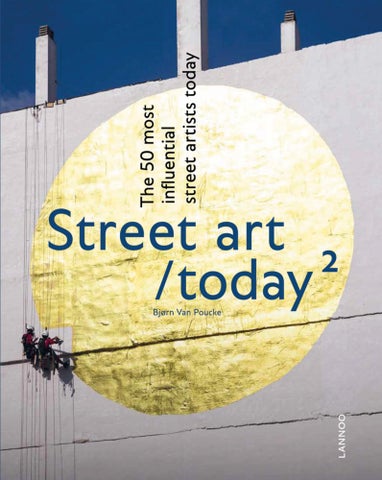
BjĆørn Van Poucke
COPY-EDITING
Joy Philips
BOOK DESIGN
Oeyen & Winters
Elise Luong drafted all texts in this edition excluding the artist interviews, the introduction and preface.
MARKED is an initiative by Lannoo Publishers www.markedbylannoo.com
JOIN THE MARKED COMMUNITY on @markedbylannoo
Or sign up for our MARKED newsletter with news about new and forthcoming publications on art, interior design, food & travel, photography and fashion as well as exclusive oļ¬ers and MARKED events on www.markedbylannoo.com.
If you have any questions or comments about the material in this book, please do not hesitate to contact our editorial team: markedteam@lannoo.com
All rights reserved. No part of this publication may be reproduced or transmitted in any form or by any means, electronic or mechanical, including photocopy, recording or any other information storage and retrieval system, without prior permission in writing from the publisher.
Every eļ¬ort has been made to trace copyrightholders. If, however, you feel that you have inadvertently been overlooked, please contact the publisher.