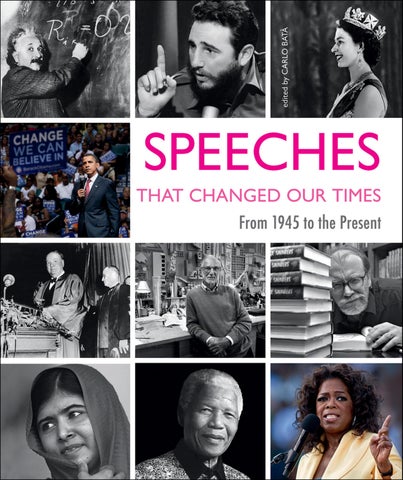
03/05/1946 • Winston Churchill “An iron curtain has descended across the Continent.”
08/10/1946 • Alcide De Gasperi Italian Premier Alcide De Gasperi’s speech
08/14/1947 • Jawaharlal Nehru
• David Ben-Gurion
12/09/1948 • Eleanor Roosevelt An appeal for the adoption of the Universal Declaration
05/01/1952 • Evita Perón The rallying cry for the descamisados to defend
06/02/1953 • Elizabeth II Speech given at her coronation ceremony 58
02/25/1956 • Nikita Khrushchev
Secret speech denouncing Stalin’s cult of personality and his crimes against the people 68
02/27/1957 • Mao Zedong
Speech about the correct handling of the contradictions among the Chinese people during the Hundred Flowers Campaign 74
01/20/1961 • John F. Kennedy Inaugural address as President of the United States of America 80
11/10/1962 • Pope John XXIII
Address on the occasion of the opening of the Second Ecumenical Council of the Vatican 86
08/28/1963 • Martin Luther King, Jr. “I have a dream” 90
04/03/1964 • Malcolm X
The ballot or the bullet: a speech about voting rights and armed revolution 96
04/20/1964 • Nelson Mandela “I am prepared to die”: his defense speech at the Rivonia trial 102
12/11/1964 • Ernesto “Che” Guevara Speech delivered to the General Assembly of the United Nations 108
09/11/1973 • Salvador Allende
Farewell speech on the day of Pinochet’s coup d’état 114
12/10/1979 • Mother Teresa
Acceptance speech for the Nobel Peace Prize 118
10/04/1984 • Thomas Sankara
Speech delivered to the General Assembly of the United Nations 124
05/08/1985 • Richard von Weizsäcker
Speech delivered during the fortieth anniversary of the end of World War II 130
06/12/1987 • Ronald Reagan
“Mr. Gorbachev, tear down this Wall!” 136
12/07/1988 • Mikhail Gorbachev
Address at the General Assembly of the United Nations regarding the reforms implemented in the Soviet Union 142
09/04/1995 • Benazir Bhutto
Address to the Fourth World Conference on Women 148
04/12/1999 • Elie Wiesel
Speech about the perils of indifference to the tragedies of the twentieth century 154
11/27/1999 • Anita Roddick
Address to the International Forum on Globalization 160
01/11/2002 • Stephen Hawking
Speech at his sixtieth birthday symposium at the University of Cambridge 164
05/22/2008 • Dalai Lama Conference at the Royal Albert Hall during his visit to the UK 170
11/04/2008 • Barack Obama
Victory speech after being elected President of the United States 176
03/19/2013 • Pope Francis “We must not be afraid of goodness or even tenderness!” 182
05/11/2013 • George Saunders
Commencement address to the students of Syracuse University 188
07/12/2013 • Malala Yousafzai
Speech delivered at the United Nations Youth Assembly 194
01/07/2018 • Oprah Winfrey
Acceptance speech for the Cecil B. DeMille Award at the Golden Globes 200
09/10/2018 • António Guterres
Speech about climate change delivered by the Secretary-General of the United Nations 206
04/05/2020 • Elizabeth II
Speech at the outbreak of the Coronavirus pandemic 212
09/14/2022 • Ursula von der Leyen State of the Union Address 216
About the author
222
Ho Chi Minh Declaration of independence of the Democratic Republic of Vietnam
Hanoi, September 2, 1945
On September 2, 1945, in Ba Dinh Square in Hanoi, Ho Chi Minh spoke before hundreds of thousands of people—the entire population of Vietnam, a population who harbored a strong sense of freedom. On that stage, pronouncing the word “independence” was essentially a declaration of the birth of a new country, the Democratic Republic of Vietnam. During World War II, which ended on that day, September 2, six years after it had begun, the French colony of Vietnam had fallen under Japanese domain, like much of Asia. In 1941, Ho Chi Minh founded the Viet Minh League for the Independence of Vietnam to fight the invaders, and instituted a provisional government to implement social reforms.
Japan’s surrender—a few days after the atomic bombs were dropped on Hiroshima and Nagasaki—changed the geopolitical situation in the region. Across Vietnam, thousands of people took to the streets to demand independence. French politics stood at a crossroads. They could return to colonial dominion and enter into a war to reconquer the territories they had lost, or they could accept the request for emancipation. No one in Paris was willing to give up the territories in Indochina. More than once, Ho Chi Minh wrote to the American president, Harry Truman, who had spoken favorably of the self-determination of
nations. In his communications, he denounced the revanchist aims of French colonialism and openly asked for help in the fight for independence. But since the United States feared a possible Soviet influence in the area, they decided to aid France. After a few feeble attempts to avoid military conflict with diplomacy, the War of Indochina broke out. In 1954, after hundreds of thousands of deaths, General Giap, the able military strategist who led the Viet Minh fighters, finally defeated the French at the battle of Dien Bien Phu.
The war against the United States was a new chapter in the fight for national sovereignty. Ho Chi Minh died before the end of the conflict. With his death, Vietnam lost the man who had led the country to independence in 1954, the man who had resisted the American army, and the man who had dedicated his entire life to the liberation of his country. At twenty years old, he had left his country to go to Europe and live in Paris and in London and, later, to the United States. So it was that his political education began, between one temporary job and another, and it continued when he went to Moscow and China. In all, he was far from his people and his homeland for thirty years before he returned to free them.
A close-up of the North Vietnamese leader Ho Chi Minh, president of the Democratic Republic of Vietnam, in 1965.
Alcide De Gasperi Italian Premier
Paris, August 10, 1946
For the countries who won World War II, Italy was seen more as a defeated enemy than as an ally; a country who had changed sides during the conflict, pulling out of its alliance with Hitler’s Germany only after the defeat of Mussolini on July 25, 1943 and the subsequent armistice with the Allies. At the Paris Peace Conference in 1946, the task of Alcide De Gasperi, the first president of the Council of Ministers of the newly formed Italian Republic, was to convince them of the contrary, despite the climate of suspicion and hostility that reigned. In fact, his first words were “I feel that everything—except your personal courtesy—is against me.” And he, who had personally suffered the oppression of the regime, was the best man for such a delicate assignment.
Italy’s national borders, established before Mussolini’s rise to power, were being challenged. The country was forced to give up its colonies in Africa, as well as Albania and the Dodecanese Islands. Moreover, and above all, there was the failure to retain Trieste within the Italian border. The Allies divided the city into two zones: one was placed under the protection of an Allied military government, and the other was temporarily controlled by Yugoslavia. Only eight years later, in 1954, would the area officially
Alcide De Gasperi’s speech to the Paris Peace Conference
return to within Italy’s national border. The country was also called upon to make reparations, monetary compensation for damages caused during the war. The economic situation was critical, and much of Italy needed to be rebuilt following the Allied bombings and the armed conflicts that preceded the Liberation. It had been eighteen long months during which the soldiers of the Reich had destroyed everything along their path as they slowly retreated northward.
For Italy, the conditions of the peace treaty were oppressive. De Gasperi underlined the decisive role that Italian partisans and soldiers had played in the final defeat of Germany. He also insisted upon the need for the international community’s trust and support for the newly formed Republic whose anti-fascist constitution would be approved in the months to follow. He asserted that punitive measures would serve no purpose, that they would be no more than unjust provisions based on prejudice and near-sightedness that would harm “a hard-working population of 47 million people.” The delegates listened to his fervent appeal with interest and, indeed, “courtesy”; but, ultimately, they were still cold and even indifferent.
The head of the Italian delegation, Alcide De Gasperi, during the speech he delivered at the Palais du Luxembourg in Paris, France, in 1946.
History has been harsh to us, perhaps, setting burdensome conditions which complicate our homecoming. . . .
DAVID BEN-GURION (1886–1973)
1904 He enrolled at the University of Warsaw in Poland, his native country.
1906 He traveled to the Holy Land for the first time.
1910 He took on the Jewish surname Ben-Gurion.
1914 He fought in World War I in the ranks of the Ottoman Empire.
1935 He was elected president of the Jewish Agency for Israel.
1946 He became the leader of the World Zionist Organization.
May 14, 1948 He formally declared the establishment of the State of Israel.
1948–1963 He performed the duties of prime minister and minister of Defense.
1956 He approved Israel’s intervention against Egypt in the Suez Crisis.
1970 At age 84, he resigned from the Knesset, the Israeli Parliament, and retired to private life.
A final fact. From our work in Palestine, from the society we are constructing, our economy and science, our culture and humanity, our social and fiscal order, and from no other source, must enlightenment come to our neighbors, for if they do not learn from us and labor with us, it is with strangers, potent and tyrannous, that they will find themselves partnered.
They in turn have much to give us, they are blessed with what we lack. Great territories, ample for themselves and their children’s children, even if they are far more prolific than they are today. We do not covet their expanses nor will we penetrate them—for we shall fight to end Diaspora in Arab lands as fiercely as we fought to end it in Europe, we want to be assembled wholly in our own Land. But if this region is to expand to the full, there must be reciprocity, there can be mutual aid—economic, political and cultural—between Jew and Arab. That is the necessity which will prevail, and the daily fulminations of their leaders should not alarm us unduly—they do not echo the real interests of the Arab peoples.
Come what may, we will not surrender our right to free Aliyah, to rebuild our shattered Homeland, to claim statehood. If we are attacked, we will fight back. But we will do everything in our power to maintain peace, and establish a cooperation gainful to both. It is now, here and now, from Jerusalem itself, that a call must go out to the Arab nations to join forces with Jewry and the destined Jewish State and work shoulder to shoulder for our common good, for the peace and progress of sovereign equals.
April 7, 1948, Ben-Gurion (in the center with the jacket) salutes the last British troops as they leave Palestine from the Port of Haifa.
Elizabeth II Speech given at her coronation ceremony
London, June 2, 1953
Her measured voice broke the silence. Her words were pronounced slowly and clearly so that all her subjects would understand them, from Canada to Australia, New Zealand, and Barbados; to the farthest corners of the Commonwealth. The coronation ceremony had just finished. Elizabeth was just twentyseven years old. She had become queen when her father, King George VI, died sixteen months earlier, but a period of mourning had to be observed and it had taken time to meticulously prepare the event with which she would be presented to the eyes of the world on that June 2, 1953. It was the first major event to be televised live, and on that day every television was tuned in to London to follow the Queen’s slow, majestic walk down the aisle of Westminster Abbey, accompanied by the scent of incense and the notes of solemn music. She addressed her subjects who had been invited to a ceremony from which they had been excluded in the past. She expressed gratitude for the welcome they had given her and prayed for wisdom and strength. She spoke as a young woman with little experience, as a wife and daughter; and the more she spoke, the more she began to sound like the heir to the throne, appointed by God. She outlined the vastness of her kingdom, thereby magnifying her power, but she did so without the vehement
impetus of a political idealist or a visionary leader; rather, it was her solid resoluteness that characterized her speech. The contents of her six-minute speech were not groundbreaking, but its delivery certainly was. The way in which the spectator was involved could certainly be seen as a prelude to the era of media events. For more than sixty years, in her anachronistic role, Elizabeth II has guided the United Kingdom through crises and scandals, in times of peace and war, with conservative and liberal governments. From the iron fist of Margaret Thatcher to the death of Princess Diana, from Winston Churchill to Boris Johnson, she has weathered political storms and tempests of gossip, tabloid headlines and desecrating punk rock hits.
She has always fulfilled her duty, uniting her people throughout the years and across generations, staying on the scene with grace and discretion. The rebranding of her image has been continuous— with her social-media presence, her numerous, brightly colored hats that span an entire Pantone color chart, the fleeting grins that she has let slip in her senior years, her lipstick touchups in public, the details of her private life that have been masterfully leaked. She even played the role of a Bond Girl for the inauguration ceremony of the Olympics in London in 2012. Queen Elizabeth is truly a pop icon of our times.
Elizabeth Alexandra Mary Windsor ascended the throne when her father, George VI, died on February 6, 1952 and was officially crowned Queen Elizabeth II in 1953.
Mao Zedong
Beijing, February 27, 1957
In 1956, Mao Zedong was still a relatively unknown figure in the West. He had yet to achieve the fame that would spread widely a decade later, when half of Europe’s students, inspired by the Cultural Revolution, took to the streets, waving his famous Little Red Book. At the time, the attention of the United States and Europe was focused on another, more familiar country to their East, the Soviet Union, and on Khrushchev’s condemnation of Stalin’s crimes. It may have been in response to the changes in Moscow that President Mao also chose to initiate a process of democratization, supporting the collaboration among political cadres, intelligentsia, and citizens in the name of freedom of speech and of the press. The goal was to stimulate the expression of collective ideas, without dogmatism, to resolve the complicated issues that arose as China’s antiquated government structures were transformed into a new socialist society. But the results were unexpected. The new regime had been established too recently to instill automatic acceptance of Maoist dogmas, and the initiative immediately backfired, opening up a Pandora’s box of malcontent and intolerance. The “gentle breeze and a mild rain” of criticism that Mao had hoped for turned out to
Speech about the correct handling of the contradictions among the Chinese people during the Hundred Flowers Campaign
be a tsunami that threatened to drown what had been gained during the Revolution. In Europe, the utopia of libertarian communism was dramatically shattered when the Red Army crushed the Hungarian revolt. In the meantime, in China, the dictatorial nature of the regime soon became evident and the consequences for criticism were the exact opposite of what had been initially anticipated.
Mao’s ruthless repression of the dissidents was facilitated by the public declarations they had made in the previous months, when they had expressed themselves freely in the belief that they could make their voices heard without repercussions. The victims were primarily the intellectuals whose integration with the masses of farmers and laborers was one of Mao’s greatest worries. This integration would be achieved forcibly, with arrests, convictions and detention in re-education camps. Free of dissidents, the party became stronger, and this led historians and scholars to question the true intentions of Mao and the Hundred Flowers Campaign. Had it been a sincere attempt at opening China up to democracy, or was it simply a tremendous scheme plotted against the Chinese people by the Great Helmsman?
On October 1, 1954, Mao Zedong salutes the crowd during the celebration of the anniversary of the People’s Republic of China, which he founded in 1949.
Pope John XXIII
Vatican City, October 11, 1962
The thousand torches that were ablaze in St. Peter’s Square called out to the Pope. The crowd of worshippers who had rushed to participate in the first day of the second Vatican Ecumenical Council jubilantly called for His Holiness to make an address. Pope John XXIII was a bit reluctant. He had already expressed many complex principles inside the cathedral, in front of the 2,800 cardinals, patriarchs, and bishops who had arrived from every corner of the world. But he knew he could not step away from the fervor; so, head bowed, he put on his stole and followed protocol. The speech he delivered from the window of the Apostolic Palace was unconventional. Rather than being magniloquent rhetoric, it was a memorable sample and an unmistakable sign of the times, broadcast worldwide. Initially, he called attention to the moon, encouraging worshippers to admire the beauty of such a creation through his simple eyes, the eyes of a man who had been born and raised in a family of humble origins. With the ardor of a father, he extolled the church’s sense of unity, the fellowship of populations, and the concept of Christian charity. He called upon Mother Mary, who was being celebrated that same day in Ephesus, Turkey, with a like number of burning torches at the shrine dedicated to her, the House of the Virgin Mary, believed to be where the Mother of
Address on the occasion of the opening of the Second Ecumenical Council of the Vatican
Jesus lived her last days on earth. He concluded his speech with an invitation to tenderness: “Give your children a caress and tell them ‘This is the caress of the Pope’”—a tangible, humane gesture to cherish in the warmest of handkerchiefs, to take to the children waiting at home, to dry their tears in a family bound by their faith.
The urgency of the church to speak to the world, to adapt the language of an “unchangeable doctrine” to the times, stemmed from this brief speech improvised by a pope who was moved by the historical steps that had just been taken. The works of the Council, which he had convened three years earlier, would be long and arduous, and the Good Pope, as he was known, would not live to see them finished. He died the following year, and the Council was closed by his successor, Pope Paul VI, in 1965.
The translation of the Bible into living languages, Mass being recited in languages other than Latin, the altar as a table from behind which the priest says Mass, facing the congregation rather than turning his back to them, the dialogue between Christians, the opening of the church to the world, and the inclusion of lay persons in the liturgy are only a few of the innovations that were born at the second Vatican Council, under the amenable light of that brilliant moon.
Angelo Giuseppe Roncalli was elected Pope on October 28, 1958, and was crowned on November 4 of the same year. He chose the name John XXIII.
Martin Luther King, Jr.
Washington, D.C., August 28, 1963
“I have a dream”
On a hot day in August 1963, more than 250,000 people from every corner of the United States converged on Washington to take part in the March for Jobs and Freedom, the largest rally for civil rights in American history. The African American community marched along the mile between the Washington Monument and the Lincoln Memorial, hoping it would be the last leg of the long, hard road that would lead to the recognition of their dignity. Slavery had been abolished a century earlier; but another, equally hateful form of racism and discrimination had quickly taken hold across the country: racial segregation.
After the dramatic clashes between police and protesters in Birmingham, Alabama, a few months earlier, tensions were running high and the deployment of law-enforcement agents was powerful. But from the first moments of the march, it was clear that that August 28 would be remembered as a great day for a movement that had made nonviolence its emblem, a day in which there would be no incidents or clashes. At the foot of the Lincoln Memorial, under the gaze of the president who had issued the Emancipation Proclamation in 1863 that declared the freedom of millions of slaves, speakers and performers took turns at the microphone; the gospel legend Mahalia Jackson; Joan Baez, who sang We Shall Overcome; and a young Bob Dylan. But the audience was waiting for the last speaker to take the podium. He was the Reverend Martin Luther King, Jr., the man who, more than any other, could give a voice and hope for a better future to the millions of African Americans that were being forced to live on the edge of society. The reverend’s intense passion and his inspired words shaped what would become one of the most riveting messages of peace, love, and equality in the history of the world. He spoke of his “dream” of a more equitable society, based on principles that are rooted in the Declaration of Independence and in the Constitution of the United States of America, but that seem to have been forgotten by so many citizens and politicians. Television brought Martin Luther King’s speech into the homes of millions of Americans, rattling the conscience of many of them. The approval of the Civil Rights Act in 1964 and the Voting Rights Act in 1965 established the end of segregation and the beginning of a new era for the African American community and for the entire country.
Thomas Sankara
New York, October 4, 1984
When the president of Burkina Faso, Thomas Sankara, got up to speak to the General Assembly of the United Nations, very little was known about him or the country he came from. He was a man about thirty years old in a military uniform who delivered his speech in French; but where was Burkina Faso, exactly? Until just a few months earlier, it had been known as Upper Volta, a landlocked strip of earth bordering on the Sahara desert, swept by a dry wind many months of the year. Sankara began by saying that after more than twenty years of independence that had brought them nothing, the people there no longer intended to die of hunger and thirst. Foreign aid made no actual contribution to development, and the models proposed by “charlatan” development specialists did not work and had to be abandoned. It was time for change, change that was possible even in Burkina Faso’s desperate situation, where one child in five did not reach the age of one and only two percent of the population could read and write; where few had access to drinkable water, and having two meals a day was considered a luxury. Sankara spoke of restraint, austerity, and moral integrity. At the same time, he expressed his solidarity with the populations of other countries who were enduring the same suffering and were also seeing their
Speech delivered to the General Assembly of the United Nations
basic rights be trampled for the economic gain of just a few.
The initial measures to be adopted were simple and necessary: to send children to school and vaccinate them so they did not die of measles; to overcome the feudal system that was still enforced in the countryside; to eliminate the tangle of privileges of many state officials; and to build houses for those who lived in miserable shacks on the edge of the cities. With pride and hope, Burkina Faso looked out on a world that was dominated by two great opposing powers. Struggling on the fringes were the Third-World Countries: lands that had been there for the taking. Lands that were plundered and pillaged without remorse by the powerful, who allocated great sums of money to build weapons, the instruments of death used to appropriate raw materials that were needed by the Western societies.
Sankara was killed three years later. He was disliked by many, not only in Africa. He was becoming an inspiration for Africa’s new generations, and his condemnation of the hypocrisy and arrogance of the powerful in the world had become intolerable to them. The essence of his philosophy called for the creation of a “world with more justice and no wars,” but it would have to wait. Who knows for how long?
The president of Burkina Faso, Thomas Sankara, during the visit of the French president, François Mitterrand, on November 18, 1986 in Ouagadougou, Burkina Faso.
Benazir Bhutto
Beijing, September 4, 1995
Benazir Bhutto was serving her second term as Pakistan’s prime minister when she delivered her speech to the Fourth World Conference on Women in Beijing on September 4, 1995. A courageous and progressive declaration was signed during the conference, promoting gender equality and human rights throughout the world. A platform of action was also approved. It indicated crucial areas of intervention: the introduction of laws, social policies, strategies, and plans of action aimed at helping women of all ages, the reinforcement of institutional mechanisms, and the promotion of practices that recognized the positive role and the fundamental contribution of women in society, politics, and economics. This was the context in which Benazir Bhutto took the podium. Although she knew how difficult it would be, she intended to fight for these causes personally, ideally picking up the torch of her father, Zulfikar Ali Bhutto, who had been overthrown and then executed by the men of the coup leader, Muhammad Zia-ul-Haq. In 1988, at the age of only 35, she had become the first woman to be elected prime minister in the entire Muslim world, but her government lasted for only twenty months. In 1990, she was unseated, like her father before her,
Address to the Fourth World Conference on Women
after a clash with President Ghulam Ishaq Khan, whom she accused of favoring the conservative Nawaz Sharif. In 1993, the Pakistan Peoples Party won the election again and Bhutto returned to power for three years, but the situation became so dangerous that she began to fear for her life and was forced to leave the country. With great courage and tenacity, she returned to Pakistan in 2007 but was assassinated during her election campaign.
In her speech, Benazir Bhutto mapped out the lines of a modern Pakistan where women would play a central role. It was an unprecedented view in a context where all decisions had always been made by men, some of whom exploited and distorted the teachings of the Qur’an in order to maintain that power. Women’s emancipation was also made more difficult by the dual system of civil law and Muslim, or sharia, law. A woman’s condition also depended on her class, the religion she professed, her level of instruction, her economic independence, and whether she lived in an urban or a rural area. In reality, Pakistan’s constitution, which was approved in 1973, guaranteed gender equality, but it was never applied.
An intense portrait of Benazir Bhutto in 1988, the year in which she returned from a two-year exile in the United Kingdom and became the prime minister of her country.
MALALA YOUSAFZAI (1997– )
2009 She wrote an anonymous blog for a BBC website in Urdu that told of her life under the Taliban regime.
2012 As she was coming home from school, she was the victim of an attack that she miraculously survived. She was treated at Queen Elizabeth Hospital in Birmingham (United Kingdom) and released at the beginning of the following year after a long period of rehabilitation.
2013 With her father Ziauddin proudly by her side, she launched the Malala Fund, a non-profit organization that promotes access to education for all the girls in the world.
2014 She was awarded the Nobel Peace Prize for her “struggle against the suppression of children and young people and for the right of all children to education.”
2018 She was admitted to Oxford University to study Philosophy, Politics, and Economics. For the first time in six years, despite the risk, she returned to Pakistan.
rights. A deal that goes against the dignity of women and their rights is unacceptable. We call upon all governments to ensure free compulsory education for every child all over the world. We call upon all governments to fight against terrorism and violence, to protect children from brutality and harm.
We call upon the developed nations to support the expansion of educational opportunities for girls in the developing world. We call upon all communities to be tolerant—to reject prejudice based on cast, creed, sect, religion or gender. To ensure freedom and equality for women so that they can flourish. We cannot all succeed when half of us are held back. We call upon our sisters around the world to be brave—to embrace the strength within themselves and realize their full potential.
Dear brothers and sisters, we want schools and education for every child’s bright future. We will continue our journey to our destination of peace and education for everyone. No one can stop us. We will speak for our rights and we will bring change through our voice. We must believe in the power and the strength of our words. Our words can change the world. Because we are all together, united for the cause of education. And if we want to achieve our goal, then let us empower ourselves with the weapon of knowledge and let us shield ourselves with unity and togetherness.
Dear brothers and sisters, we must not forget that millions of people are suffering from poverty, injustice and ignorance. We must not forget that millions of children are out of schools. We must not forget that our sisters and brothers are waiting for a bright peaceful future. So let us wage a global struggle against illiteracy, poverty and terrorism and let us pick up our books and pens. They are our most powerful weapons. One child, one teacher, one pen and one book can change the world. Education is the only solution. Education First.
Malala Yousafzai, the Pakistani activist and winner of the Nobel Peace Prize in 2014, attends the awards-ceremony concert at Oslo Spektrum in Norway.
Oprah Winfrey Acceptance speech for the Cecil B. DeMille Award at the Golden Globes
Beverly Hills, California, January 7, 2018
It had been two years since Meryl Streep had accepted the Golden Globe award for lifetime achievement. She had launched accusations against those among the powerful who humiliated the marginalized and attempted to silence dissent. She expressed solidarity with the ethical press who sought to “hold power to account, to call them on the carpet for every outrage.”
Two years later, on the evening of January 8, 2018, Oprah Winfrey held the same prize in her hands and delivered a speech that returned to the ideals expressed by Streep. She denounced the attacks on the press and called on its members to continue their search for the truth, despite threats and tensions. She also spoke of racial discrimination and violence against women.
Her speech was full of stories and characters, much like the TV program she had hosted for twenty-five years; a program that told the stories of everyday people and of celebrities with empathy and sincerity. She told the story of herself as a little girl, sitting in front of the television, excitedly watching the Oscars as the sought-after statue was awarded for the first time to an African American actor, Sidney Poitier. She also told the story of Recy Taylor, a young mother who was beaten and threatened, whose path crossed that of Rosa Parks. She told the story of
women who had been abused for years and whose voices had always been silenced and the story of women who had found the courage to tell their truths in spite of the powers that had tried to keep them quiet. Her voice and intense passion characterized a speech that vibrated with events from her own personal experience: a difficult childhood in Mississippi in an environment of poverty and hardship, the lack of affection and material possessions, the abuse she underwent, and an unwanted pregnancy with an unhappy ending.
Later, she moved to Nashville, Tennessee, and began to work at a number of local radio and television stations. Her sacrifices and determination paid off, and she became one of America’s best-loved talk-show hosts, as well as being a successful writer, producer, and actress. The “queen of daytime television” fought relentlessly against the veiled culture of sexism and racism. She demanded women’s rights and urged them to seek empowerment, self-determination, and self-awareness. Just as she had been inspired fifty years earlier by seeing Sidney Poitier receive his Oscar, perhaps some of the young girls who heard her speech on that evening of January 7, 2018, were motivated to fight for the day when there would be no more need to say “Me, too.”
The American actress and television host Oprah Winfrey, whose talk show aired on the American television network ABC for 25 years, from 1986 to 2011.
Ursula von der Leyen State of the Union Address
Strasbourg, September 14, 2022
Ursula von der Leyen, who had then been President of the European Commission for three years, came to the hemicycle of the European parliament dressed in blue and yellow, the colors of the flag of Ukraine. For seven months, the country had been living the horrors of war after having been invaded by the Russian armed forces. Olena Zelenska, the wife of the Ukrainian president, was present in the chamber. From the very beginning, Europe expressed solidarity with the Ukrainian people, calling for a unanimous and immediate response and, for once, setting aside hesitations and divisions. The war is at the frontier of the European Union. In fact, Ukraine shares borders with Poland, Slovakia, Hungary and Romania and there has been renewed talk of nuclear conflict. It is clear to everyone that we are facing “a turning point in international politics,” in a scenario that also includes the United States at the head of NATO, and China, which is increasingly demanding space and respect globally.
The speech lasted almost an hour during which the word “war” was repeated 16 times. Indeed, the war is an emergency, along with the ensuing energy crisis that the deteriorating relations with Russia have triggered, a crisis that will become even more serious when winter arrives.
Von der Leyen immediately assured that “Europe will prevail and Putin will lose,” as she outlined the attack on Europe and the democratic values that are being undermined by autocracies like Russia. “Today all of this has become the target of Russian missiles,” she bluntly concluded. She recalled those who had warned as much, explicitly citing Anna Politkovskaya, the Russian journalist who was highly critical of Putin’s actions and who was assassinated in 2006 under unclear circumstances. A partial admission of guilt, but one that confirms the realization that we can no longer back down.
There is an urgent need to strengthen the European Union and expand the number of its member countries, as well as a need to wage a serious battle internally, against the democratic distortions and the corruption that undermine the credibility of some states. Europe must also reduce its dependence on fossil fuels and respond to the increasingly pressing problem of climate change.Von der Leyen concluded, stating that the European institutions would strive to help struggling citizens and the small and medium enterprises that are being crushed by increasingly onerous conditions, adding that it would do so, however, in a context in which “all member states take responsibility for common problems.”
Ursula von der Leyen, President of the European Commission, wearing a dress in the colors of the flag of Ukraine as the country is in its seventh month of resisting the invasion of the Russian Armed Forces. Ukraine and its people have the unconditional support of the institutions of the European Union.