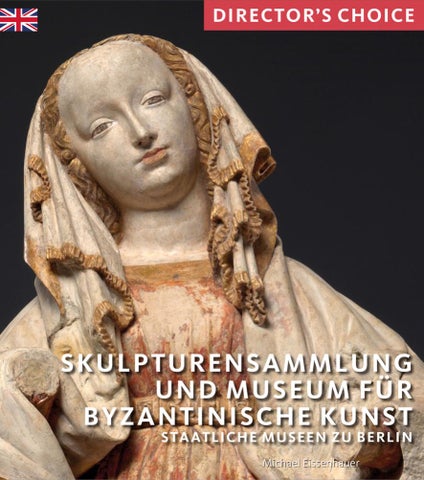
DIRECTOR’S CHOICE
SKULPTURENSAMMLUNG UND MUSEUM FÜR BYZANTINISCHE KUNST
STAATLICHE MUSEEN ZU BERLIN Michael Eissenhauer
|
SKULPTURENSAMMLUNG UND MUSEUM FÜR BYZANTINISCHE KUNST
SUBJECT OF SPREAD ENTRY
|
3
DIRECTOR’S CHOICE
SKULPTURENSAMMLUNG UND MUSEUM FÜR BYZANTINISCHE KUNST
STAATLICHE MUSEEN ZU BERLIN Michael Eissenhauer
|
SKULPTURENSAMMLUNG UND MUSEUM FÜR BYZANTINISCHE KUNST
SUBJECT OF SPREAD ENTRY
|
3
FOREWORD
Opened in 1904 as the Kaiser Friedrich Museum, the museum has borne the name of its founding director Wilhelm von Bode (1845–1929) since 1956. The works in the Skulpturensammlung und Museum für Byzantinische Kunst (Sculpture Collection and Museum of Byzantine Art), brought under one roof in the Bode-Museum, are among the world’s most important works of art. Through them, the history of European sculpture can be traced from its roots in Late Antiquity at the end of the third century AD in Greece, Rome, Byzantium and Egypt to the neoclassicism of around 1800 in southern and central Europe. This encyclopaedic cosmos is unique. The concept behind the works put on show when the museum first opened broke new ground: painting and sculpture, the two so-called ‘high arts’, were exhibited side by side for the first time. The innovative idea of connecting art objects with their historical context through the use of fittings such as portals, wooden ceilings and furniture was formulated by the Prussian Crown Princess Victoria (1840–1901), the wife of Emperor Frederick III (1831–1888), in an 1883 memorandum. Bode, the then director of the Gemäldegalerie (and later general director), put these ideas into practice. In 1897 construction began on the northern tip of Berlin’s Museum Island, using plans by the royal Prussian court architect Ernst Eberhard von Ihne (1848–1917). The neo-Baroque style museum was built within seven years and finally opened on 18 October 1904, the birthday of the deceased emperor after whom it was named: Emperor Frederick III. The building was severely damaged during the Second World War but was restored in the post-war years and then extensively renovated
4
|
SKULPTURENSAMMLUNG UND MUSEUM FÜR BYZANTINISCHE KUNST
after German reunification. The Bode-Museum was reopened to visitors in autumn 2006 in all its renewed splendour. The original concept of simultaneously presenting sculptures and paintings has been largely retained, although since 1998 the collection of paintings has been housed in a separate new building at the Kulturforum. Today, some 150 paintings engage in a dialogue with the sculptures. The focus of the Bode-Museum is on sculptures from Italy, especially the early Italian Renaissance. Gustav Friedrich Waagen (1794–1868), the first director of the Gemäldegalerie, and his successor Bode, made purchases from excellent private collections, so that major works by well-known sculptors such as Donatello, Verrocchio and the della Robbia family came into the collection. Equally groundbreaking are the late Gothic German sculptures, as well as important Renaissance and Baroque ivory statuettes. Thanks to the Kaiser Friedrich Museumsverein, founded in 1897 and still active today (making it the oldest museum association in Germany), the collection contains a rich variety of other items. It was not easy to choose 37 objects from the 1,700 works of art on display. So this is a small, very personal selection. Many readers may well feel that a famous masterpiece has been left out, or wonder why some rather unfamiliar piece has been included. But the charm of this book lies precisely in its varied collection of old, well-known items together with new pieces for you to discover. I hope that reading it will bring you much pleasure, and encourage you to discover other works of art and select your own favourites when visiting the Bode-Museum. For research, consultation and editorial support, I am deeply indebted to Julia Sedda. Thanks to Sigrid Wollmeiner for procuring the illustrations and providing support in the book’s production. And thanks to the publishers for including this book in their series.
FOREWORD
|
5
FOREWORD
Opened in 1904 as the Kaiser Friedrich Museum, the museum has borne the name of its founding director Wilhelm von Bode (1845–1929) since 1956. The works in the Skulpturensammlung und Museum für Byzantinische Kunst (Sculpture Collection and Museum of Byzantine Art), brought under one roof in the Bode-Museum, are among the world’s most important works of art. Through them, the history of European sculpture can be traced from its roots in Late Antiquity at the end of the third century AD in Greece, Rome, Byzantium and Egypt to the neoclassicism of around 1800 in southern and central Europe. This encyclopaedic cosmos is unique. The concept behind the works put on show when the museum first opened broke new ground: painting and sculpture, the two so-called ‘high arts’, were exhibited side by side for the first time. The innovative idea of connecting art objects with their historical context through the use of fittings such as portals, wooden ceilings and furniture was formulated by the Prussian Crown Princess Victoria (1840–1901), the wife of Emperor Frederick III (1831–1888), in an 1883 memorandum. Bode, the then director of the Gemäldegalerie (and later general director), put these ideas into practice. In 1897 construction began on the northern tip of Berlin’s Museum Island, using plans by the royal Prussian court architect Ernst Eberhard von Ihne (1848–1917). The neo-Baroque style museum was built within seven years and finally opened on 18 October 1904, the birthday of the deceased emperor after whom it was named: Emperor Frederick III. The building was severely damaged during the Second World War but was restored in the post-war years and then extensively renovated
4
|
SKULPTURENSAMMLUNG UND MUSEUM FÜR BYZANTINISCHE KUNST
after German reunification. The Bode-Museum was reopened to visitors in autumn 2006 in all its renewed splendour. The original concept of simultaneously presenting sculptures and paintings has been largely retained, although since 1998 the collection of paintings has been housed in a separate new building at the Kulturforum. Today, some 150 paintings engage in a dialogue with the sculptures. The focus of the Bode-Museum is on sculptures from Italy, especially the early Italian Renaissance. Gustav Friedrich Waagen (1794–1868), the first director of the Gemäldegalerie, and his successor Bode, made purchases from excellent private collections, so that major works by well-known sculptors such as Donatello, Verrocchio and the della Robbia family came into the collection. Equally groundbreaking are the late Gothic German sculptures, as well as important Renaissance and Baroque ivory statuettes. Thanks to the Kaiser Friedrich Museumsverein, founded in 1897 and still active today (making it the oldest museum association in Germany), the collection contains a rich variety of other items. It was not easy to choose 37 objects from the 1,700 works of art on display. So this is a small, very personal selection. Many readers may well feel that a famous masterpiece has been left out, or wonder why some rather unfamiliar piece has been included. But the charm of this book lies precisely in its varied collection of old, well-known items together with new pieces for you to discover. I hope that reading it will bring you much pleasure, and encourage you to discover other works of art and select your own favourites when visiting the Bode-Museum. For research, consultation and editorial support, I am deeply indebted to Julia Sedda. Thanks to Sigrid Wollmeiner for procuring the illustrations and providing support in the book’s production. And thanks to the publishers for including this book in their series.
FOREWORD
|
5
Dokimeion and Constantinople
Bas-relief: ‘Relief of Christ’, 3rd and 5th centuries Proconnesian marble, height 142 cm, width 124 cm, depth 25 cm Acquired in Istanbul, 1899 Inv. No. 2430
The Relief of Christ is considered a key early Byzantine bas-relief in
which the change from a traditional ancient, pagan form of representation to a new Christian style can be traced. Hardly any bas-relief of comparable quality has survived from that time. The end purpose of the Relief of Christ is still the subject of debate, but we can be sure of its place of production: the ancient Hellenistic and Roman city of Dokimeion in the province of Phrygia in Asia Minor (today’s Turkey). The depiction on the relief follows the rhythmically articulated architecture and the figurative programmes of pillar sarcophagi in Dokimeion, which is why it was long thought to be the separated narrow side of a sarcophagus. But this opinion has been contested; today, the general view is that the relief served as a wall decoration. When Christianity became the state religion in the late fourth century, the relief was altered to fit in with the new Christian context: by adding a cross in a nimbus, the middle figure became a representation of Christ; the heads of his two companions were brought stylistically up to date and reinterpreted as Apostles. The halo, depicted as a Greek cross, appears here for the first time in a sculpture. The Relief of Christ was discovered in 1896 in Istanbul, in an underground vault in the Armenian monastery of Sulu Manastiri, with the two relief icons of Mary and the Archangel Michael closely flanking it, either side (pp. 18–19).
6
|
SKULPTURENSAMMLUNG UND MUSEUM FÜR BYZANTINISCHE KUNST
The Relief of Christ and the two Berlin relief icons were found in an underground vault in the Armenian Church of St George, Sulu Manastiri; this photograph taken in 1896.
BAS-RELIEF: ‘RELIEF OF CHRIST’
|
7
Dokimeion and Constantinople
Bas-relief: ‘Relief of Christ’, 3rd and 5th centuries Proconnesian marble, height 142 cm, width 124 cm, depth 25 cm Acquired in Istanbul, 1899 Inv. No. 2430
The Relief of Christ is considered a key early Byzantine bas-relief in
which the change from a traditional ancient, pagan form of representation to a new Christian style can be traced. Hardly any bas-relief of comparable quality has survived from that time. The end purpose of the Relief of Christ is still the subject of debate, but we can be sure of its place of production: the ancient Hellenistic and Roman city of Dokimeion in the province of Phrygia in Asia Minor (today’s Turkey). The depiction on the relief follows the rhythmically articulated architecture and the figurative programmes of pillar sarcophagi in Dokimeion, which is why it was long thought to be the separated narrow side of a sarcophagus. But this opinion has been contested; today, the general view is that the relief served as a wall decoration. When Christianity became the state religion in the late fourth century, the relief was altered to fit in with the new Christian context: by adding a cross in a nimbus, the middle figure became a representation of Christ; the heads of his two companions were brought stylistically up to date and reinterpreted as Apostles. The halo, depicted as a Greek cross, appears here for the first time in a sculpture. The Relief of Christ was discovered in 1896 in Istanbul, in an underground vault in the Armenian monastery of Sulu Manastiri, with the two relief icons of Mary and the Archangel Michael closely flanking it, either side (pp. 18–19).
6
|
SKULPTURENSAMMLUNG UND MUSEUM FÜR BYZANTINISCHE KUNST
The Relief of Christ and the two Berlin relief icons were found in an underground vault in the Armenian Church of St George, Sulu Manastiri; this photograph taken in 1896.
BAS-RELIEF: ‘RELIEF OF CHRIST’
|
7
Egypt (Alexandria)
Torso of an emperor’s statue, 4th century Red Egyptian porphyry, height 96 cm, width 45 cm, depth 36 cm Acquired in Alexandria, 1908 Inv. No. 6128
This life-size torso presumably represents a son of Constantine the Great (reigned AD 306–337). He wears the typical attire of late Roman emperors: an undergarment (tunic), with a cloak (chlamys) over it, gathered around the body’s contours in loose folds and held in place on the right shoulder by a gemstone fibula, from which hang three pendulums identifying the person as a sovereign dignitary. Together with two other porphyry sculptures in Vienna and Turin, the Berlin Torso is interpreted as part of a family group including the sons of the Emperor Constantine. In the torso in the Vienna Kunsthistorisches Museum, just 46.5 cm high, his youngest son Constans is depicted in childhood. Since Late Antiquity, the use of purple porphyry had been reserved exclusively for the imperial family. It was extremely rare and was mined in very difficult conditions, at depths of some 1,200–1,600 metres, in quarries in the eastern desert of Egypt. The Roman legionary Caius Comenius Leugas is said to have discovered the stone deposits in AD 18 and the mines were worked between AD 29 and AD 335.
Torso of an emperor’s statue, 2nd quarter of the 4th century, porphyry, Kunsthistorisches Museum Vienna
TORSO OF AN EMPEROR’S STATUE
|
9
Egypt (Alexandria)
Torso of an emperor’s statue, 4th century Red Egyptian porphyry, height 96 cm, width 45 cm, depth 36 cm Acquired in Alexandria, 1908 Inv. No. 6128
This life-size torso presumably represents a son of Constantine the Great (reigned AD 306–337). He wears the typical attire of late Roman emperors: an undergarment (tunic), with a cloak (chlamys) over it, gathered around the body’s contours in loose folds and held in place on the right shoulder by a gemstone fibula, from which hang three pendulums identifying the person as a sovereign dignitary. Together with two other porphyry sculptures in Vienna and Turin, the Berlin Torso is interpreted as part of a family group including the sons of the Emperor Constantine. In the torso in the Vienna Kunsthistorisches Museum, just 46.5 cm high, his youngest son Constans is depicted in childhood. Since Late Antiquity, the use of purple porphyry had been reserved exclusively for the imperial family. It was extremely rare and was mined in very difficult conditions, at depths of some 1,200–1,600 metres, in quarries in the eastern desert of Egypt. The Roman legionary Caius Comenius Leugas is said to have discovered the stone deposits in AD 18 and the mines were worked between AD 29 and AD 335.
Torso of an emperor’s statue, 2nd quarter of the 4th century, porphyry, Kunsthistorisches Museum Vienna
TORSO OF AN EMPEROR’S STATUE
|
9
Adrian de Vries The Hague c. 1545/1556–1626 Prague
Rape of Proserpina, 1621 Bronze, height 192 cm, width 67 cm, depth 83 cm Acquired in 1935 from the collection of Albert Figdor (1834–1927) Inv. No. 8517
For the design of his royal residence, which he had relocated from Stadthagen to Bückeburg in 1606, the art-loving Count Ernst zu Holstein-Schaumburg (1569–1622) commissioned numerous bronze statues from the Dutchman Adrian de Vries, who had been active since 1601 as a court sculptor at the court of Emperor Rudolf II in Prague. The count’s orders included two life-size groups of figures representing Venus and Adonis, and the Rape of Proserpina. De Vries was still working on the first sculpture when he was able to convince Count Ernst to order the other, depicting Pluto and Proserpina. In accordance with Ovid’s Metamorphoses (V, 376–571), this group portrays the drama of Proserpina, abducted by a lust-maddened Pluto and taken down to the underworld. She strives with all her might to escape Pluto’s grasp, tugging him by the hair, but however much she writhes she cannot escape the god’s firm grip. The extraordinarily complicated and carefully composed group displays the artist’s mastery to the full. He skilfully shows the contorted bodies locked in a power struggle as they twist and turn in all directions. In compositional terms, the artist drew on two icons of Italian sculpture and merged them into an independent work. These were the Rape of the Sabine Women (1579–1582) by Giovanni da Bologna (1529–1608), in the Loggia dei Lanzi in Florence, and the Rape of Proserpina (1618–1625) created at about the same time by Gian Lorenzo Bernini (1598–1680), in the Galleria Borghese in Rome.
46
|
SKULPTURENSAMMLUNG UND MUSEUM FÜR BYZANTINISCHE KUNST
Adrian de Vries: Venus and Adonis, 1621, Skulpturensammlung und Museum für Byzantinische Kunst – Staatliche Museen zu Berlin
Adrian de Vries The Hague c. 1545/1556–1626 Prague
Rape of Proserpina, 1621 Bronze, height 192 cm, width 67 cm, depth 83 cm Acquired in 1935 from the collection of Albert Figdor (1834–1927) Inv. No. 8517
For the design of his royal residence, which he had relocated from Stadthagen to Bückeburg in 1606, the art-loving Count Ernst zu Holstein-Schaumburg (1569–1622) commissioned numerous bronze statues from the Dutchman Adrian de Vries, who had been active since 1601 as a court sculptor at the court of Emperor Rudolf II in Prague. The count’s orders included two life-size groups of figures representing Venus and Adonis, and the Rape of Proserpina. De Vries was still working on the first sculpture when he was able to convince Count Ernst to order the other, depicting Pluto and Proserpina. In accordance with Ovid’s Metamorphoses (V, 376–571), this group portrays the drama of Proserpina, abducted by a lust-maddened Pluto and taken down to the underworld. She strives with all her might to escape Pluto’s grasp, tugging him by the hair, but however much she writhes she cannot escape the god’s firm grip. The extraordinarily complicated and carefully composed group displays the artist’s mastery to the full. He skilfully shows the contorted bodies locked in a power struggle as they twist and turn in all directions. In compositional terms, the artist drew on two icons of Italian sculpture and merged them into an independent work. These were the Rape of the Sabine Women (1579–1582) by Giovanni da Bologna (1529–1608), in the Loggia dei Lanzi in Florence, and the Rape of Proserpina (1618–1625) created at about the same time by Gian Lorenzo Bernini (1598–1680), in the Galleria Borghese in Rome.
46
|
SKULPTURENSAMMLUNG UND MUSEUM FÜR BYZANTINISCHE KUNST
Adrian de Vries: Venus and Adonis, 1621, Skulpturensammlung und Museum für Byzantinische Kunst – Staatliche Museen zu Berlin
Artus Quellinus the Elder Antwerp 1609–1668 Antwerp
Samson and Delilah, c. 1640 Terracotta, height 37.5 cm, width 43 cm, depth 31 cm Acquired in 1850 Inv. No. 545
Samson is a hero in the Old Testament, chosen by
God. With his invincible powers, he protects the Israelites from oppression by the Philistines (Judges 13–16). However, the Philistines bribe his lover Delilah to find out the secret of his power. For a long time she implores him to tell her his secret, and finally elicits it from him: it lies in his long, uncut hair. When Samson falls asleep and innocently lays his head on her lap, she seizes the opportunity, cuts off his hair, and summons the Philistines, who put out his eyes. Representations of this theme are generally to be taken as allegorical warnings of the delusions of love and the power of the erotic. The rounded group of figures was probably created shortly after Quellinus’s return from Rome, where he had been active in the workshop of François Duquesnoy (pp. 58–59). The muscular back of the sleeping Samson in particular implies a knowledge of the famous ancient marble fragment known as the Belvedere Torso, in the Vatican. Quellinus was also inspired by the painting by his friend Peter Paul Rubens (1577–1640), created three decades earlier, from which he took the composition of Samson sleeping in Delilah’s lap. The terracotta model was probably intended to be recreated in marble. So far, however, neither a client nor a possible destination have been definitely established.
48
|
SKULPTURENSAMMLUNG UND MUSEUM FÜR BYZANTINISCHE KUNST
Peter Paul Rubens: Samson and Delilah, c. 1609-10 National Gallery London
SAMSON AND DELILAH
|
49
Artus Quellinus the Elder Antwerp 1609–1668 Antwerp
Samson and Delilah, c. 1640 Terracotta, height 37.5 cm, width 43 cm, depth 31 cm Acquired in 1850 Inv. No. 545
Samson is a hero in the Old Testament, chosen by
God. With his invincible powers, he protects the Israelites from oppression by the Philistines (Judges 13–16). However, the Philistines bribe his lover Delilah to find out the secret of his power. For a long time she implores him to tell her his secret, and finally elicits it from him: it lies in his long, uncut hair. When Samson falls asleep and innocently lays his head on her lap, she seizes the opportunity, cuts off his hair, and summons the Philistines, who put out his eyes. Representations of this theme are generally to be taken as allegorical warnings of the delusions of love and the power of the erotic. The rounded group of figures was probably created shortly after Quellinus’s return from Rome, where he had been active in the workshop of François Duquesnoy (pp. 58–59). The muscular back of the sleeping Samson in particular implies a knowledge of the famous ancient marble fragment known as the Belvedere Torso, in the Vatican. Quellinus was also inspired by the painting by his friend Peter Paul Rubens (1577–1640), created three decades earlier, from which he took the composition of Samson sleeping in Delilah’s lap. The terracotta model was probably intended to be recreated in marble. So far, however, neither a client nor a possible destination have been definitely established.
48
|
SKULPTURENSAMMLUNG UND MUSEUM FÜR BYZANTINISCHE KUNST
Peter Paul Rubens: Samson and Delilah, c. 1609-10 National Gallery London
SAMSON AND DELILAH
|
49
France
Queen Joan of Navarre as founder, c. 1305 Limestone, height 82 cm, width 25 cm, depth 18 cm Property of the Kaiser Friedrich Museumsverein Acquired in 2006 from the Pierre Girot de Langlade collection in Paris Inv. No. M 296
The massive sculptural quality, the symmetry and beauty of the
face carved with such remarkable precision and individuality, the royal crown, the clothing style and the motif, including the model of a chapel, suggest that the figure originated in the French court around the time of King Philip IV, known as Philip the Fair (1268– 1314). This allows us to identify the woman depicted as Philip’s wife Joan I, Queen of Navarre (1273–1305). In 1304 she founded the Collège de Navarre in the University of Paris, which by 1315 had been extended and provided with a chapel. The sculpture could have been created to commemorate this foundation, and placed in the building. Joan lovingly holds the model of the church she has founded and nestles it close to her heart as if it were a child. This precise allusion highlights the context of the foundation and clearly places the church model in the foreground, as a symbol of her action. Indeed, until its dissolution in the French Revolution, the Collège de Navarre was one of the best-equipped and most prestigious colleges of the University of Paris. It could take seventy college students and was open to students of grammar, logic and theology, regardless of their social or regional background. The sculpture is exceptionally well preserved. Even today, the most delicate tool marks from the time of its production are recognisable; the sculpture was probably kept indoors and hardly exposed to the weather, if at all. The back of the figure is not very elaborate, so it was definitely placed close to a wall or perhaps installed in a shallow niche.
QUEEN JOAN OF NAVARRE AS FOUNDER
|
51
France
Queen Joan of Navarre as founder, c. 1305 Limestone, height 82 cm, width 25 cm, depth 18 cm Property of the Kaiser Friedrich Museumsverein Acquired in 2006 from the Pierre Girot de Langlade collection in Paris Inv. No. M 296
The massive sculptural quality, the symmetry and beauty of the
face carved with such remarkable precision and individuality, the royal crown, the clothing style and the motif, including the model of a chapel, suggest that the figure originated in the French court around the time of King Philip IV, known as Philip the Fair (1268– 1314). This allows us to identify the woman depicted as Philip’s wife Joan I, Queen of Navarre (1273–1305). In 1304 she founded the Collège de Navarre in the University of Paris, which by 1315 had been extended and provided with a chapel. The sculpture could have been created to commemorate this foundation, and placed in the building. Joan lovingly holds the model of the church she has founded and nestles it close to her heart as if it were a child. This precise allusion highlights the context of the foundation and clearly places the church model in the foreground, as a symbol of her action. Indeed, until its dissolution in the French Revolution, the Collège de Navarre was one of the best-equipped and most prestigious colleges of the University of Paris. It could take seventy college students and was open to students of grammar, logic and theology, regardless of their social or regional background. The sculpture is exceptionally well preserved. Even today, the most delicate tool marks from the time of its production are recognisable; the sculpture was probably kept indoors and hardly exposed to the weather, if at all. The back of the figure is not very elaborate, so it was definitely placed close to a wall or perhaps installed in a shallow niche.
QUEEN JOAN OF NAVARRE AS FOUNDER
|
51
Jacques Morel, Lyon c. 1395–1459 Angers
Kneeling Bishop with St Stephen as an intercessor, c. 1450 Limestone, height 47 cm, width 24 cm, depth 17 cm Property of the Kaiser Friedrich Museumsverein Acquired in 2004 from the art dealer Thomas Knöll, Basel Inv. No. M 293
Praying in tranquil devotion, a bishop kneels beside his patron saint, St
Stephen, who looks benevolently upon him. Stephen wears the robe of a deacon and can be recognised by the attributes of his martyrdom: in his right hand he holds the Gospel upon which lie the three sharp-edged stones with which he was stoned to death, and in his left he holds a palm frond as a sign of victory, and a reward for his sacrificial death. St Stephen is one of the first seven deacons to be called directly by the Apostles. His ministry and martyrdom (he is the first martyr of Christianity) are described in the Acts of the Apostles (Acts 6:5–8:2). The sculptor effectively depicts the human warmth that radiates from St Stephen’s solicitous gaze and protective posture. Originally, the praying bishop was presumably facing a separate group showing the Madonna or the Holy Trinity, to whom he was being commended by his patron saint. The high sculptural quality of the group and its attribution to Jacques Morel point to the courtly milieu of the French kings Charles VII (1403–1461) and Louis XI (1423–1483). This milieu also produced the famous Melun Diptych (1456), which is similar in conception to Morel’s bishop and St Stephen. The Madonna wing of the diptych was always seen as modelled on Agnès Sorel (1422–1450), the long-time mistress of Charles VII; her elegant and extremely high-quality tomb in the church of Saint-Ours in Loches is attributed to Jacques Morel.
52
|
SKULPTURENSAMMLUNG UND MUSEUM FÜR BYZANTINISCHE KUNST
Jean Fouquet: Melun Diptych, 1456 Gemäldegalerie – Staatliche Museen zu Berlin (left) and Koninklijk Museum voor Schone Kunsten, Antwerp
KNEELING BISHOP WITH ST STEPHEN AS AN INTERCESSOR
|
53
Jacques Morel, Lyon c. 1395–1459 Angers
Kneeling Bishop with St Stephen as an intercessor, c. 1450 Limestone, height 47 cm, width 24 cm, depth 17 cm Property of the Kaiser Friedrich Museumsverein Acquired in 2004 from the art dealer Thomas Knöll, Basel Inv. No. M 293
Praying in tranquil devotion, a bishop kneels beside his patron saint, St
Stephen, who looks benevolently upon him. Stephen wears the robe of a deacon and can be recognised by the attributes of his martyrdom: in his right hand he holds the Gospel upon which lie the three sharp-edged stones with which he was stoned to death, and in his left he holds a palm frond as a sign of victory, and a reward for his sacrificial death. St Stephen is one of the first seven deacons to be called directly by the Apostles. His ministry and martyrdom (he is the first martyr of Christianity) are described in the Acts of the Apostles (Acts 6:5–8:2). The sculptor effectively depicts the human warmth that radiates from St Stephen’s solicitous gaze and protective posture. Originally, the praying bishop was presumably facing a separate group showing the Madonna or the Holy Trinity, to whom he was being commended by his patron saint. The high sculptural quality of the group and its attribution to Jacques Morel point to the courtly milieu of the French kings Charles VII (1403–1461) and Louis XI (1423–1483). This milieu also produced the famous Melun Diptych (1456), which is similar in conception to Morel’s bishop and St Stephen. The Madonna wing of the diptych was always seen as modelled on Agnès Sorel (1422–1450), the long-time mistress of Charles VII; her elegant and extremely high-quality tomb in the church of Saint-Ours in Loches is attributed to Jacques Morel.
52
|
SKULPTURENSAMMLUNG UND MUSEUM FÜR BYZANTINISCHE KUNST
Jean Fouquet: Melun Diptych, 1456 Gemäldegalerie – Staatliche Museen zu Berlin (left) and Koninklijk Museum voor Schone Kunsten, Antwerp
KNEELING BISHOP WITH ST STEPHEN AS AN INTERCESSOR
|
53
Chicart Bailly Active in Paris 1490–1533
Memento Mori, c. 1520 Ivory, height 28 cm, width 9.1 cm, depth 7.9 cm Acquired in 1935 from the collection of Albert Figdor (1843–1927) Inv. No. 8554
The filigree ivory sculpture, probably made by Chicart Bailly
in Paris, is an original example of a memento mori (‘remember that you will die’). Symbolic representations of the inevitability of death and the transience of every life were a central motif in Christian preaching from the tenth to the nineteenth centuries, enjoining people to lead a godly and virtuous life whatever social class they belonged to. This was the only way to escape being dragged down to eternal damnation at the Last Judgement and to have some chance of being granted entry into Paradise. The combination of two contrasting representations into a single figure is cleverly executed: on one side stands a young woman, on the other a corpse eaten by worms. Their postures are almost identical and, when viewed frontally, they are clothed in the same attire and yet at the same time separated by it. The young woman is naked except for her shoes, and with the middle finger of her right hand she points to her pudenda – a clear indication of an immoral life. At her feet a jester is cracking jokes: he is a symbol of mindless merriment and a life far from God. On the other side, death is depicted as a skeleton on which crawl worms and other vermin. On the pedestal below, a young nobleman unsheathes his sword, as if trying to defend himself. The nobleman and the fool are both in a garden; a lion and a dog are associated with the virtues of the former, while a monkey and a devil show that the latter is on the road to damnation.
54
|
SKULPTURENSAMMLUNG UND MUSEUM FÜR BYZANTINISCHE KUNST
MEMENTO MORI
|
55
Chicart Bailly Active in Paris 1490–1533
Memento Mori, c. 1520 Ivory, height 28 cm, width 9.1 cm, depth 7.9 cm Acquired in 1935 from the collection of Albert Figdor (1843–1927) Inv. No. 8554
The filigree ivory sculpture, probably made by Chicart Bailly
in Paris, is an original example of a memento mori (‘remember that you will die’). Symbolic representations of the inevitability of death and the transience of every life were a central motif in Christian preaching from the tenth to the nineteenth centuries, enjoining people to lead a godly and virtuous life whatever social class they belonged to. This was the only way to escape being dragged down to eternal damnation at the Last Judgement and to have some chance of being granted entry into Paradise. The combination of two contrasting representations into a single figure is cleverly executed: on one side stands a young woman, on the other a corpse eaten by worms. Their postures are almost identical and, when viewed frontally, they are clothed in the same attire and yet at the same time separated by it. The young woman is naked except for her shoes, and with the middle finger of her right hand she points to her pudenda – a clear indication of an immoral life. At her feet a jester is cracking jokes: he is a symbol of mindless merriment and a life far from God. On the other side, death is depicted as a skeleton on which crawl worms and other vermin. On the pedestal below, a young nobleman unsheathes his sword, as if trying to defend himself. The nobleman and the fool are both in a garden; a lion and a dog are associated with the virtues of the former, while a monkey and a devil show that the latter is on the road to damnation.
54
|
SKULPTURENSAMMLUNG UND MUSEUM FÜR BYZANTINISCHE KUNST
MEMENTO MORI
|
55
This edition © Scala Arts & Heritage Publishers Ltd, 2019 Text © Skulpturensammlung und Museum für Byzantinische Kunst, Staatliche Museen zu Berlin, and Michael Eissenhauer First published in 2019 by Scala Arts & Heritage Publishers Ltd 10 Lion Yard Tremadoc Road London SW4 7NQ, UK www.scalapublishers.com In association with the Skulpturensammlung und Museum für Byzantinische Kunst, Staatliche Museen zu Berlin www.smb.museum ISBN: 978 1 78551 248 3 Coordination and editing by the museum: Julia Sedda, Anna Wegenschimmel and Sigrid Wollmeiner Project editor (Scala Arts & Heritage Publishers Ltd): Sandra Pisano Translation: Andrew Brown in association with First Edition Translations Ltd, Cambridge Designer: Nigel Soper Printed in Turkey 10 9 8 7 6 5 4 3 2 1 All rights reserved. No part of this book may be reproduced, stored in a retrieval system or transmitted in any form or by any means electronic, mechanical, photocopying, recording or otherwise, without the written permission of the Skulpturensammlung und des Museums für Byzantinische Kunst, Staatliche Museen zu Berlin, and Scala Arts & Heritage Publishers Ltd. Every effort has been made to acknowledge correct copyright of images where applicable. Any errors or omissions are unintentional and should be notified to the Publisher, who will arrange for corrections to appear in any reprints. Director’s Choice is a registered trademark of Scala Arts & Heritage Publishers Ltd.
80
|
SKULPTURENSAMMLUNG UND MUSEUM FÜR BYZANTINISCHE KUNST
Images © Skulpturensammlung und Museum für Byzantinische Kunst, Staatliche Museen zu Berlin: Jörg. P. Anders: pp. 26, 38, 56, 58; David von Becker: pp. 4, 5; Markus Hilbich: pp. 14, 15; Daniel Hofer: back flap; Dietmar Katz: p. 34; Andres Kilger: p. 7; Jürgen Liepe: pp. 8, 17, frontispiece; Christoph Schmidt: p. 72; Antje Voigt: pp. 11, 12, 18, 21–25, 27, 29–31, 33, 35–37, 39–43, 45–51, 53–55, 57, 59, 61–71, 73, 75–77, 79, front and back covers; Bernd Weingart: Front flap. p. 6: Jahrbuch der Berliner Museen, 48, 2006, p. 11; p.9 KHM Museumsverband; p. 41 Rijksmuseum, Amsterdam; p. 44 Nikolas Hagele on behalf of the city of Augsburg; p. 48 The National Gallery, London/akg; p. 52 Royal Museum of Fine Arts Antwerp © www.lukasweb.be – Art in Flanders vzw, photo Dominique Provost; p. 60 akg-images/De Agostini Picture Library
Front cover: Virgin Mary Enthroned, (pp. 24/25) Front flap: Bode-Museum, Staatliche Museen zu Berlin Frontispiece: Middle part of a triptych with the forty martyrs of Sebaste (pp. 16/17) Back cover: Madonna with Child and Saints (Sacra Conversazione), (pp. 76/77)