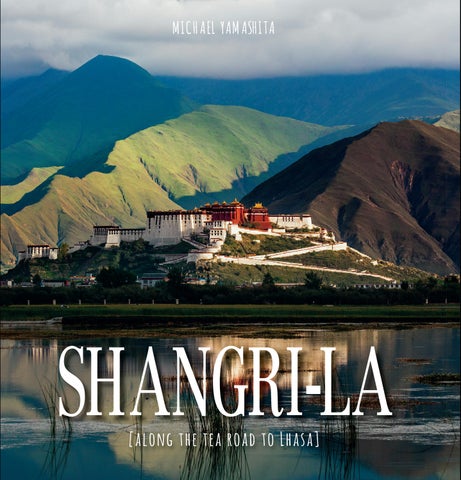
photographs and text by michael yamashita
text editor elizabeth bibb

project editor v aleria m anferto de f abianis
editorial assistant l aura a ccomazzo
graphic design p aola p iacco
Contents
foreword: in search of paradise page 12
introduction: shangri-la and beyond page 20
chapter 1: all the tea in china page 30
chapter 2: mystic mountains and monasteries page 60


chapter 3: cultural heart and soul page 98
chapter 4: nomads land page 160
chapter 5: on the road to lhasa and the top of the world page 206
chapter 6: elusive shangri-la page 246
biographies, bibliography and acknowledgments page 270


to study. I found a few books translated from Chinese, none with photography, and a number of websites offering off-the-beaten path tours in and around Greater Tibet—Yunnan Sichuan, and Qinghai provinces—and the Tibet Autonomous Region (TAR).
Perhaps the size and scope of the subject—three main routes crisscrossing the mountains, lakes and rivers of the Tibetan Plateau—put it logistically out of the reach of most magazine and book publishers. Also, its web of mountain passes, highways and trails branching out in all directions over varied terrain and cultures made finding a central focus, a narrative “hook,” challenging. But rather than discourage me, the complexity of the subject became my most motivating factor in embarking on a story about the Chamagudao. This was exactly my kind of assignment—a new story on a subject all but unknown outside of China, big and complex enough to warrant at least a year’s coverage for National Geographic.
By the early spring of 2008, just a few months before the Beijing Olympics, I was planning to start my coverage with the first picking of the tea harvest in Yaan, in Sichuan province, where the northern branch of the Chamagudao began. China couldn’t have been in a better mood, with everyone busy with final preparations for the country’s big coming-out party of the new millennium.
Then, on March 15, the anniversary of the 1959 Tibetan uprising against the armed takeover by the Chinese, riots erupted in Lhasa and in Kham, west of Chengdu. In response, the Chinese government closed all roads leading to Tibet to foreigners. So for most of 2008, I spent my time in China shooting—and tasting—a lot of tea, waiting for permits to allow me enter the Tibetan region and begin my travels along the Chamagudao.
Tea is a whole subject unto itself, and there’s no better place than China to experience it, since all tea originated there. That’s a bold statement considering how many different types of tea there are today, not to mention the ever-expanding number of places tea is now grown. But it’s generally believed that the birthplace of tea drinking is in the far southern tropical regions of Yunnan province. The area’s elevation, climate and rainfall make it perfect for tea cultivation. I first visited this region in the early 1990s, working on a National Geographic story tracing the Mekong River from its source on the Tibetan Plateau in Qinghai province to its mouth in Vietnam. Passing through the town of Puer, which is in the Xishuangbanna region of Yunnan, I photographed the harvesting and processing of one of China’s most expensive teas. I took hundreds of frames, shooting the various stages of tea production, from sorting and drying to grading and packing, but only one photograph from that shoot—of a mother and daughter covered by a plastic sheet, picking tea leaves in the rain—was published in the magazine. So I welcomed that chance to revisit the subject. Tea, after all, was half of what made the Chamagudao what it was—the Tea Horse Road.
• 2-3 Buddhist nuns at shusong nunnery in Benzilan, study ancient texts
• 4-5 tiBetan girls are decked in festival finery, turquoise, coral and silver
• 6-7 Prayer flags fly over the turquoise waters of the sacred lhamo latso lake
• 8-9 huge trucks are mere Pin-dots along the 16,404 ft (5000 m) trola Pass east of dege
• 10-11 sumzanling monastery Presides over the hillside of shangri-la (once known as zhongdian), in yunnan Province and may have Been the insPiration for the lamasery in Lost Horizon
• 12-13 the author/PhotograPher in tiBet
• 14-15 winter’s last Blast at five color lake in Jiuzhaigou national Park


• 44-45 a man B rings his sow and her family to market along the same road through s haxi that was traveled B y the tea and horse traders of centuries ago
• 46-47 t ime for P lay : elders in s haxi ’ s town square are intent u P on their B oard games and ma H jong tiles


• 88 a huge P ile of mani , inscri B ed P rayer stones , P ave the way to the s egyagu meditation center , near l hagong m onastery , whose monks are in the y ellow h at sect
• 88-89 t he faithful P erform the kora , circumam B ulating the tem P le , turning large P rayer wheels as they go , to ensure good karma
• 90-91 i n B ame , locals hel P P re P are yak B utter lam P s in P re P aration for an 18- day religious festival , honoring a l iving B uddha , l ongdo r in P oche


• 163 a nomad grandmother multi - tasks , making time for a hug and a kiss while churning yak butter s he and her family of seven will spend the summer here , 12 miles (20 km ) from their home near b ame
• 166-167 a long r oute 318, the southern route of the c hamagudao , the z ar g amala p ass is the highest vertical climb in t ibet from 5,570 ft (1,700 m ) to 15,282 ft (4,658 m ). a dding further to the thrills of traversing it are 180 switchbacks
• 168-169 y aks are indispensible to the t ibetan nomads , providing warmth and sustenance . i deally adapted to the high altitudes and cold temperatures of the t ibetan p lateau , yaks are perfect pack animals , sturdy and sure - footed


• 202-203 f resh from foraging for yartsa gombu on the grasslands , this nomad shows some P rime s P ecimens to traders
• 204-205 a hundred years ago , t i B etan horses would have B een tied u P in front of these storefronts in s erxu , B ut today , the motorcycle is the nomad ’ s P referred means of trans P ort