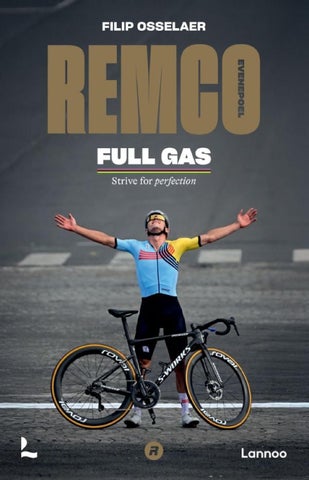
FILIP OSSELAER
FULL GAS
Streven naar perfectie Strive for perfection

For Patrick and Agna
For Oumi
And for Remco
āHeās good, apparently, your sonā
(Patrick
Lefevere goes out for a meal for the first time with Remco Evenepoelās father and mother)


FOREWORD
My name is Agna.
Iām Remcoās mother.
Lots of people address me like that, itās true: āYouāre really the mother ofĀ ...?ā IĀ see people looking at me and thinking: āLook, thatās his mother!ā To be honest, it bothers me sometimes. Of course, Iām proud. Of course, Iām the proud mother of a 24-year-old son. But IĀ was already that from the very first day of my pregnancy. His cycling career hasnāt changed that. People sometimes say to me: āIt must be really special, having such a talented son!ā But thatās not how IĀ view it, not at all. Arenāt all parents proud of their child? Surely they are? (Or they should be...). Because all children have their talents, whatever they do, whatever their achievements. All children deserve for their parents to be proud of them, to sing their praises.
No, Remcoās life hasnāt been without its ups and downs. From a young age he has trodden the most difficult path ā that was his own personal choice. During those periods, those phases, it wasnāt always easy to fit in with his wishes and slot everything into place. But IĀ dare to say ā for all to hear ā that together with Patrick, Remcoās dad, we did everything we could to make our son happy, to make things go the way they should for the best. Patrick and IĀ often told each other that we never wanted to regret not letting Remco do what he thought he needed to do ā Remco would never be able to say that he wasnāt allowed to do something. Our family, our close friends know how we feel about this, what our experience of it all has been. And that was all before Remco ever got on a bike. The only thing we expected from him was that he would put in the effort, just as we did, even when we had no idea where heād end up today. And that effort? That was no problem for Remco, far from it. It was even at the expense of his performance at school. To be honest, that was often to my great annoyance! IĀ could be strict. IĀ believed school was important. IĀ didnāt always give in, and then he would go to his dad ā perhaps he was a bit of a softer touch, thatās in Remcoās nature as well. Yes,
thatās the way it is: as a mother, you tend to look at certain things differently. Iām a dedicated mother.
Remco sets goals for himself. And heās strict, really strict about them. People see the pleasurable moments, the moments of success, after yet another victory, after yet another stunning performance. But thereās often a flip side to the medal; there are the disappointments, the crashes, the less successful days. Does the outside world give enough thought to that? Far too little, you know. It was not a matter of course to have to let go of Remco, our child, so early. It wasnāt easy to have to miss him so much ā and it still isnāt. It can be days, weeks even before IĀ can give him a hug, a kiss, and during the busiest periods, even thatās not possible āapart from doing it via WhatsApp. On the day of a race, we donāt see him, we just canāt get near him, and sometimes he doesnāt have time for us. Even so, at least weāre there for him. Our presence, knowing that weāre standing somewhere along the course is enough. Remco senses our support.
Such times apart, they are difficult times. But IĀ know why heās doing it and that helps. It also helps when IĀ see how independent Remco is, still only a youthful 24-year old, a young man who makes the small and the big decisions, making his own way through lifeās twists and turns. These are the moments when IĀ realise that IĀ wish IĀ could keep that little boy small forever, that IĀ could keep him by my side always ā but also the moments when IĀ realise that Remco has spread his wings, and IĀ know that IĀ have to let him go.
IĀ know this about myself: letting go is something IĀ need to work on (and isnāt that the case for lots of parents?). IĀ often miss Remco when heās back on the road. IĀ miss Remco when he is once again swallowed up by the persistent demands of others, of the outside world, by the rapid and steep ascent he is experiencing. Itās times like that when IĀ want to hold on to him a little more, to watch over his well-being, his happiness ā itās not good that others start dictating his life, that others make decisions
without taking what he wants into account. Iām aware that sometimes Remcoās life is restricted, and he can handle that: Remco is patient, IĀ know that, IĀ feel it. Up to the point when it becomes too much, until he explodes when heās had enough of it. Then, IĀ want just one thing: that he follows his own heart, keeps his eyes wide open, for the rest of his life. That he can continue to enjoy what he does, with the people he loves. IĀ donāt think Remco fully understands how much this weighs on my mind, how often IĀ miss having him around for a real conversation about it ā that little boy from the past, my son.
At a race, my eyes are looking in all directions at once. As a mother, IĀ see and feel so much. IĀ see the failures, IĀ see the suffering. But IĀ hide my feelings then, or at least as best IĀ can. In that regard, Remco and IĀ are alike: falling and getting back up ā donāt let it get to you too much, just keep going.
The older IĀ get, the more IĀ realise how quickly the time passes. When IĀ was younger, IĀ didnāt dwell on that. And maybe that was a good thing, else we might have made decisions in the family that we (and Remco) would have regretted. Thatās not the case now. When we were young or younger, we made the right choices. We wonāt have anything to regret. Remco has now reached the place where he wanted to be. And heās worked hard for that.
Heāll continue to do so, right up to the end of his career. As his mother, IĀ just want him to remain happy in everything he does, in everything he undertakes.
Then, with a deep sigh, Iāll be able to say: āMy little boy, whom IĀ love with all my heart, has achieved what he worked so hard for.ā
Agna
1 PROLOGUE
A warm, sunny day in the north of Italy ā the morning of 15 August 2020.
That was the date for the start in Bergamo of the 114th edition of the Tour of Lombardy. The riders will cycle all the way to Como, a distance of 231 kilometres, following a fantastic route that winds up and down through mountains and valleys against a background of stunning scenery featuring lakes, ravines, and babbling streams. The Tour of Lombardy is heavy going and only the best riders win, with only the greats appearing on the honour roll, from Fausto Coppi to Tom Simpson, from Felice Gimondi and Bernard Hinault to Roger De Vlaeminck and Eddy Merckx ā itās no place for amateurs.
The Tour of Lombardy is normally the last major classic of the cycling season. Thatās why the race is poetically called in Italian āla corsa delle foglie morteā, which means āthe race of the falling leavesā. The coronavirus measures were responsible for the beautiful autumn classic being held at the height of summer.
Strange, confused times characterised 2020.
In the middle of March, the world plunged into lockdown. Schools, restaurants, shops, museums, playgrounds, and cafĆ©s ā all had to close because of coronavirus. Working from home became the norm as you were no longer expected, or indeed allowed, to come to the office. Normal life was put on hold, families lived in bubbles, friends had no choice but to stay away, and loved ones could only see each other remotely on a laptop or iPad screen, or by waving through the window of their home. Stuck in solitary confinement, people died. Was the purpose of seeing each other over the course of a lifetime merely to cause pain? And now a final hug, a last conversation was no longer possible ā this was not something we humans were used to. The virus had cast people into a new reality, a frightening reality of remoteness, isolation, ignorance, and uncertainty: what else might happen? Hospitals were bursting at the seams and the healthcare system was pushed to the limit by the āpan-
demicā, a new word that inveigled its way into everyday vocabulary. Everything that happened is of course familiar to you, dear reader. After all, you lived through it all yourself.
But on 15 August 2020, the world was slowly coming back to life; people were allowed to leave their homes again, still subject to restrictions but it was a start. They could breathe again, and enjoy a modicum of freedom once more ā freedom to travel, to eat and drink in company, to enjoy themselves.
There was freedom to race again.
The entire cycling calendar was in a complete mess, with tours and oneday races being rescheduled. On 8 August, Wout van Aert was the winner of Milan-San Remo. In a normal year, this course is the seasonās first classic. La Primavera. Wout finished ahead of Julian Alaphilippe from France and Michael Matthews from Australia. The Tour of Flanders āĀ yet another Monument ā wonāt take place until 18 October, when it will be won by Dutchman Mathieu van der Poel. Two weeks before that, on 4Ā October, Slovenian Primož Roglic took victory in Luik-BastenakenLuik. Confusing, nāest pas? But wait and see, it gets even more complicated: on 3 October ā just a day before the Walloon classic ā the Tour of Italy kicked off in Monreale (Sicily), where the 15-kilometre time trial was won by the Italian Filippo Ganna. On 25 October, the Brit Tao Geoghegan Hart took the pink jersey. He won the Giro, 39 seconds ahead of Australian Jay Hindley. But ā canāt you just sense it coming, thereās even more confusion with the Tour of Spain also starting in the meantime on 20 October. Still following? A big tour in the midst of another big tour? Can it get any crazier? The Vuelta was won on 8 November by Primož Roglic. And, moving on, yet another change: having been scheduled for 25 October after all the rescheduling, in the end Paris-Roubaix was simply cancelled. Was riding over the cobbles thought to be too dangerous in the middle of autumn? Or was the virus once again too rampant? The Tour de France had also taken place meanwhile, from
29Ā August to 20Ā September, with Slovenian Tadej Pogacar the winner of that Tour.
Thatās just the kind of year it was.
But back to 15 August: Remco was one of the favourites in Lombardy. That was no surprise since in the races that did take place on schedule in 2020, he had been exceptionally good. Heād won the Tour of San Juan, the Tour of the Algarve, the Tour of Burgos, and the Tour of Poland as well. Born on 25 January 2000, Remco was then 20 years old. In midAugust, he crowned his already glittering season with a victory in Lombardy. The newspapers were at least able to agree on that: Remco was in form, Remco was going to win. Remco himself was also convinced and had expressed this ambition ā the self-belief was present. Of course he believed in himself.
Even so, it didnāt feel right, something was off.
āNo, it didnāt feel right,ā says Patrick, Remcoās father, some 4 years later. āIt was true, it didnāt feel right.ā Patrick arrived in Bergamo in the morning along with his wife Agna, best friends Pascal and Nadine, and daughter-in-law Oumi. They were met there by people they knew, people from the entourage of the Deceuninck-Quick Step team. Joeri De Knop from Het Laatste Nieuws, the Flemish newspaper, welcomed them. Patrick has known Joeri for a long time and has a good relationship with the journalist. There were others there too and it was busy in the vicinity of the hotel, with people getting in each otherās way ā the race was about to start and the sun was shining. Camera crews were present from VTM, the commercial television channel from the Evenepoel familyās home country, but that didnāt bother them as a documentary was being made about Remco. Patrick, Agna, and Oumi had got used to their presence and knew by now how to deal with all the attention. It was part and parcel of the fact that Remco had gradually become a celebrity.
āBut Agna said that something wasnāt right,ā says Patrick.
What was it though?
In a departure from their normal habit, Patrick, Agna, and OumiĀ went to the team bus just before the start. What was going on? āRemco had sent us a message,ā Patrick recounts. āHe wanted to see us for a moment. Just before setting off.ā They were warmly welcomed there at the start and there was no fuss from the organisers who told them to go through, no problem. āWe could go wherever we wanted and IĀ bumped into Joxean Matxin FernĆ”ndez from UAE, whom IĀ knew from the past when he was a scout for Quick Step. He said to me, āHave a good race later,ā and some other small talk, you know how it is. It was hectic, there around the bus.ā He pauses, taking a moment to gather his thoughts: āThings werenāt right. No, thatās putting it too strongly. It seemed like... Well, what did it seem like? Weād arrived OK, weād flown there in the morning, the weather was nice, you couldnāt fault it. And yet: Agna had a nasty feeling. How come? IĀ donāt know. Itās something Agna has, a gift, something special. She senses things. IĀ donāt know how she does it.ā
Patrick scrolls through the photos on his mobile. There they are: the pictures from 15 August 2020, Bergamo, Italy. āLook,ā he points, āhere we are standing next to Remco. And here, thatās us hugging him.ā Why is a family so intensely intimate before the race begins? Because a person is glad to see their child, their son, their loved one. Because something is going to happen, perhaps. Thatās probably it: a person senses it, they donāt know exactly when and where it will happen, but itās coming, that much is certain.
The race started and the Evenepoel family made their way along the course, wanting to follow how the competition would develop. They saw the riders go past twice and each time Remco gave the thumbs-up. Rushing by, heād recognized Patrick, Agna, Oumi, and the friends ā
everything was going well. There was another 100 kilometres or so to go.
āIn the meantime, weād arrived at Luca Paoliniās coffee house,ā says Patrick. PaoliniĀ was a former professional cyclist, the man with the ragged beard whoād won the 2015 Gent-Wevelgem, the edition with awful weather, persevering through rain and wind, over slippery cobblestones, over Casselberg and Monteberg, In Flanders Fields, a war zone in times of storm and adversity, where riders were blown off their bikes ā Gert Steegmans ended up in a ditch; you can find the footage on the internet. PaoliniĀ was removed from the 2015 Tour after being caught using cocaine. After an eighteen-month suspension and at the age of 40, he found himself without a team. As the media put it at the time, āDopo la squalifica, la nuova vita diĀ Luca PaoliniĀ riparte da un bar diĀ Comoā. āFollowing his suspension, Luca PaoliniĀ is starting a new life and opening a bar in Como.ā Sitting there were Patrick, Agna, Oumi, and people from the teamās staff ā general manager Patrick Lefevere, Alesandro Tegner, the teamās communications manager. Also accompanied by some UCIĀ members and GianniĀ Bugno, the former world champion. They watched the tour on television while having a cup of coffee. There was still another 50 kilometres to ride.
And then it happened all of a sudden: the disaster.
The riders had ascended the Muro diĀ Sormano, and a leading group of seven strong men had formed: Vincenzo Nibali, Bauke Mollema and Giulio Ciccone from Trek Segafredo; George Bennett from Jumbo-Visma; Aleksandr Vlasov and Jakob Fuglsang from Astana Pro Team.
And Remco Evenepoel from Deceuninck-Quick Step.
As soon as they were below, having completed the few minutes of descent, it would still be a good 40 kilometres to Como. In around an hour, that was where one of the seven leaders would win the Tour of Lombardy.
āDries Devenyns, the super domestique, had set up Remco perfectly,ā recounts Patrick. āRemco started the descent in the lead.ā But he decided to drop back. Was that a spur-of-the-moment decision? In any case: Nibali, a master of descent, was now in the lead. Remco followed, behind. This was not the place where the race would be won and Remco would be better off conserving his energy now, as heād need it soon enough since there would have to be a breakaway before long, and perhaps a sprint.
Patrick had just taken another sip of his coffee.
āWhen IĀ looked at the screen again, IĀ saw Remcoās bike up against that wall. Agna wasnāt sure at first but IĀ knew it immediately: thatās Remcoās bike,ā he says. āRemco himself was nowhere to be seen.ā Looking back, Patrick thinks it was weird: at first he did nothing, kept calm and stared at the bike, the bike up against the wall.
Then began nine minutes of not knowing. Nine minutes of no news, of staring at the TV, of concern for Oumi, nine minutes of silence, of waiting for a phone call that came eventually. A call from Brama ā Davide Bramati, the team manager who was accompanying the race. He said theyād found Remco. And reported that he was conscious. What goes through someoneās head at a time like that? You just stop thinking then, according to Patrick. āNo, then you canāt think of anything else. Or rather: all you can think is: heās all right, heās all right.ā
Thank goodness: Remco was all right. Or maybe not?
Patrick heaves a sigh, and swallows. He thinks back to the hours that followed.
Accompanied by the police, Remcoās loved ones set off for the hospital in Bergamo. To be truthful, they didnāt know what to expect. Remco was