
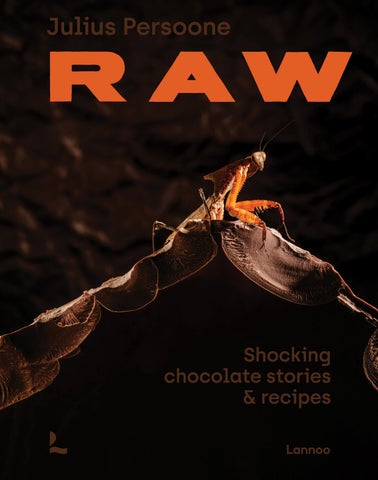
Raw

Page 1


Julius Persoone

Copywriting
Marlies Beckers
Photography
Pieter D’Hoop

TABLE OF CONTENTS

Julius, reinventor of chocolate

Welcome to my world Time line

What

others say

Some basic chocolate techniques

Becoming Julius: the formative years

Frog legs à la grandpa Frank

Salmon with pesto purée and red pepper coulis

Chewy maracuja-mango caramel in edible plastic

Corsican blood-orange orangettes

Mad on tomatoes

Tartare of smoked tomato and watermelon

‘Julius’ tomato praline

Becoming Julius: from chef to chocolatier

Parmesan sablé cookies

Praline tarte citron

Becoming Julius: a completely new team

Oysters with ponzu beurre blanc and white chocolate

My vision

Lacto-fermented carrot juice

Lacto-fermented tomato juice

Cacao-husk miso

Corn miso

Shoyu koji from north sea octopus

Chipotle garum

Umeboshi

Yuzu kosho

Yuzu kosho bearnaise

Glazed eel with cacao-husk miso, sansho and sticky rice

Pâte de fruit in two layers

My favorite

ingredients

Collabs that make a difference

Medical pralines

MOMU – fashion museum Antwerp

Chewy octopussy

Jan Fabre

Delvaux

Yves Creutz

Singapore Airlines: chocolatitude

The first collection of my own The Chocolate Line Plantation

Mole with Mexican bean to bar chocolate, key lime kosho and coriander oil (piquant)

Bean to bar tablet from our own criollo

Jungle moonshine

Mole with crispy chicken and huacatay (cold dessert)

Lacto-fermented key lime juice with hoja santa

Becoming Julius: the Julius Chocolate Bar and the future

The Chocolate Line signature chocolate milk

Umami gummies with fermented fruit

Dirty butter cookie

Spider back shot

The spoon

Cacao-husk miso ice cream with lemon verbena oil and key lime snow

Maya moussy

Wild strawberries (seasonal dessert)

Dama blanca

Cacao-husk tea

Yuzu from Antwerp

Mole with peanuts and Jerusalem artichoke (dessert)

Sapoteca

Raw and unfiltered

Sexy pavlova

Brain freeze

Crème caramel

Julius 2.0

Bone marrow ice cream

pin

JULIUS, REINVENTOR OF CHOCOLATE

Conceited. That’s how he could have turned out. As the son of a well-known TV chef and a flamboyant mother, as well as heir to a successful chocolate business, you might have expected that. But far from it, that’s not Julius in any shape or form (nor indeed his parents).

When we began working together, I was immediately struck by an unbelievable warmth. His youthful drive, creative vision and unquenchable enthusiasm are truly inspiring and endearing qualities. Every conversation gave me an incredible energy boost. But Julius is more than just words. He acts extremely fast. As soon as you ask him something, he carries it through immediately.

He expects a lot but isn’t unfair. Courteous, but not deferential. I admit to being impressed by him. At the age of 25, I was going through something of a quarter-life crisis, unsure of what I should do with my life to give it meaning. And there, right in front of me, was a 26-year-old who had taken over his father’s entire production line, had already won an award from Gault&Millau, taken the main stage at the Rolling Pin Convention by storm and was by then turning the medical world upside down with his pralines. And all the while, still remaining modest about the whole thing. Gulp.

As a food journalist, I’ve been lucky enough to taste more than my share of offbeat creations and speak with some brilliant chefs. The way in which Julius looks at chocolate, pralines and, by extension, at desserts reminds me enormously of René Redzepi. He sets no limits or restrictions on himself, as though he exists in some infinite universe of creative brainstorms. And he manages to turn them into real products, based on deep technical expertise and knowledge.

If the Belgian-Swiss pharmacist Jean Neuhaus was the inventor of the praline, then Julius Persoone is its re-inventor.

This book is not the last you’ll hear of him. I’m certain of that.

TO INFINITY AND BEYOND!

(after Buzz Lightyear in Toy Story)

WELCOME TO MY WORLD

‘Is this really the right time to write a book?’ That was the first thing I asked myself when Lannoo approached me about making a book. I’m still so young and feel like we’ve only just begun.

The book’s launch date got postponed. Not once but twice, because I wanted to add so much. By the time it went off to the printers, I was already working on a new project that also would have deserved a place in this book. And by the time you are reading this, that project will probably also have been completed and I’ll be working on the next one. To say nothing of how the book might have looked if it had come out two years from now.

When I look at this book, I can’t help but be incredibly proud and I have to acknowledge that quite a lot has already been accomplished, or at least the foundation, because we’re by no means finished yet. That, perhaps, is what is most characteristic in me –the persistent appetite for more and for something different are what keep me in motion. As soon as that stops and I have achieved something – whatever that may be – I know it’s over.

As things stand now, I have no plans to bring out a new book in two years’ time. The idea behind RAW: Reinventing Chocolate is for me to give you some insight into what I’m made of in terms of both my work and my life, because they are so interwoven with each other.

So what makes me who I am? A significant contribution comes from my parents. With the nonstandard upbringing they gave me and the creative environment they exposed me to, they gave me an enormous headstart in life. And I am so incredibly grateful for that. I love them dearly.

Another contribution comes from my girlfriend Alina, who always knows how to get my feet back on the ground when I get another crazy idea.

As a child, I was very often compared to my father, but not anymore. He has taken a back seat and given me the space to develop and grow. I’ve taught myself a lot, not because he couldn’t be bothered to explain something to me but because I was too stubborn to ask him. And although I no longer ever have the feeling that I’m standing in his shadow, nevertheless I do still feel like I have to prove myself every day. I have to stand there, and I want to stand there.

I WOULD NEVER ALLOW PEOPLE TO CALL ME A NEPO-BABY.

But without them and without the team, I wouldn’t be where I am. You get just one shot at life. If it doesn’t work out, I can’t come back and do it again, so I believe you should always go to the extreme. I consider myself fortunate to have attracted the right people who are willing to share wholeheartedly in this journey with me.

You’ll also notice an element of the extreme in my recipes. Confession: some recipes are not feasible to re create, or would only be possible for a handful of people. This is not me teasing you or being vain; instead, it’s in the hope of inspiring you and taking you out of your comfort zone. They showcase how I work. There may be parts with which you can do something. Anything is possible as long as you set your mind to it.

Only the creative part is not up for discussion: it’s my vision and I won’t compromise on it.

BECOMING JULIUS:

A COMPLETELY NEW TEAM

‘COVID was the first time that I felt a bit afraid. I noticed my parents were worried and my travel plans were dashed.’ Before long, Julius jumped in to help with his father’s production. Overmotivated, he worked to the wee hours of the night on a recipe for the perfect caramel, integrating all the techniques he’d learned but that didn’t go down well with the team.

‘I genuinely thought they were happy that I could teach them something, but they also thought of me as a bit of a know-it-all. Still, I had the feeling everything could be improved upon.’

The higher Julius raised the bar, the more people put in their resignation. In less than a month, 18 people had left, some after 20 years of service. Only Kasper Debuysere remained.

‘Dad was livid! “Congratulations!” he said, “now it’s up to you to fix things.” And he literally handed me his kitchen apron and did a calculation: “We have this number of staff, that’s such and such number of salaries and therefore such and such number of pralines. Get cracking on it!” And with that, he left!’

In reality, of course, there was a transition period and notice period, but Julius wasn’t given much time. ‘Fortunately, I knew a good few people in a lot of kitchens and moreover it was during COVID. I could offer them a stimulating environment with daytime hours. So I was able to get in gear fairly quickly, but even so I often worked through the night.’

CHEFS WHO MAKE CHOCOLATE

It was not an easy time, and not for Dominique either. ‘We talked a lot, and once in a while he came to help me when I was in really deep shit, but for the most part it was down to me to get it sorted. Freedom comes at a price. I was very knowledgeable about chocolate and patisserie, but knew nothing about managing a team. No, it was definitely not an easy transition.’ Tenacious as he is, Julius kept going like a freight train. His no-nonsense approach might make him harder to work with at times, but it also helps him achieve what he wants more quickly. In 2023, barely two years after taking over production at The Chocolate Line, he walked off with the ‘Chocolatier of the Year’ award at Gault&Millau ‘That’s when I knew I’d made it and my dad was very proud of me.’

For ca. 16 pieces of 55 g My ultimate comfort cookie.

DIRTY BUTTER COOKIE

EASY PEASY

INGREDIENTS

125 g quality butter

110 g caster sugar

165 g dark brown sugar

1 large egg (ca. 60 g)

1 vanilla bean (preferably from my father’s Virunga project)

205 g plain flour, sieved

140 g bean to bar chocolate 80% from Mexico, coarsely chopped Zeeland-Flemish sea salt flakes, to taste

PREPARATION

• Melt the butter over medium-high heat in a heavy-bottomed pan.

Lightly brown until you detect the aroma of hazelnut and caramel and the milk constituents turn golden brown. Pour into a bowl and allow to cool to room temperature.

• Mix the cooled beurre noisette with the caster sugar and brown sugar. Stir into a homogenous mixture.

• Add the egg, together with the seeds from the vanilla bean. Mix until completely smooth.

• Add the sieved flour and knead briefly until everything is mixed. Do the same with the chocolate pieces. Warning: do not mix for long.

• C over the dough and let it rest for 30 minutes in the refrigerator.

• Roll into balls of about 55 grams each. Briefly roll them in your hands and place on a baking tray lined with parchment paper. Allow to rest for another 30 minutes in the refrigerator.

• Preheat the oven to 175 °C (nonconvection).

• B ake the cookies for 12-14 minutes until golden brown at the edges but still soft inside.

• Immediately after baking, sprinkle with a few flakes of Zeeland-Flemish sea salt. Leave to cool down on a metal rack.

THE CHOCOLATE LINE PLANTATION

OUR PLANTATION, MY PLAYGROUND

I’m sure you will have noticed by now that I refer rather often to ingredients from our plantation in Mexico. I was 13 years old when my parents bought it. As a child, I loved wandering around in the jungle and thought it was great seeing how cacao grew in pods on a tree.

My parents and I planted the very first cacao trees on our plantation. I can still vividly remember digging the first cacao beans into the ground. It was just magical. The idea for having our own plantation originated with my father, who would get frustrated at times that he couldn’t obtain the right chocolate for the pralines he wanted to make. We wanted to go beyond from bean to bar and make chocolate from tree to bar

Of course, we still source cacao from elsewhere. Our plantation is not yet big enough to provide us with sufficient cacao for our needs. But we are in a position to proudly say that we’ve visited all plantations we work with and that we only work with single plantation cacao. In other words, we do not blend cacao from differing plantations. With one exception, we never purchase cacao in Africa. That exception is the Congo, where my father collaborates with the Virunga project.

When I mention visits, those are usually made by my father. He loves nothing more than going on a trek through the jungle with his Djeam team (each letter in Djeam represents the first letter of one of the team members’ names) searching for the finest cacao. This is then imported specially for us via Belcolade. Personally, I focus purely on the cacao obtained from our own plantation. One fine day, I hope to be able to cultivate all the cacao that I need. In much the same way as a vintner, it’s preferable to have control over the initial product.

MY PASSION FOR CROSSFERTILIZING, NOW EXPRESSED IN CHOCOLATE AS WELL

Mathieu Brees, my father’s best friend, lives on-site. He is a bio-engineer, one of the ‘cacao boys’ and the person responsible for the plantation. I keep in constant contact with him. Once every 2 weeks, we get together over a video call and Alina keeps a close eye on our imports of the products.

Now I can devote the love for cultivating and cross-fertilizing that I acquired during my ‘tomato years’ to cacao. Just like I did with the tomatoes, I cross lots of cacao varieties, my ultimate dream being to grow my own signature cacao one day and turn it into chocolate. No one else has ever done that before. When I think about my passion for cross-fertilizing cacao, I sometimes wonder whether I should have taken up farming.

The plantation is like my playground. Every week, I’m asking how my beans are getting on and how each type is responding. As soon as I arrive in Mexico, which happens about twice a year, I rush to the cacao trees to see how they’re doing. They are what I get most psyched about.

I can still vividly remember digging the first cacao beans into the ground. It was just magical.

PRODUCE FOR NOMA

Because not all of the plantation was suitable for cacao trees, we began to cultivate other produce, such as herbs, passion fruit, cinnamon, chili peppers and key limes. All of these are ingredients I often use and which I frequently refer to. The ingredients from the plantation are an inspiration for me in the creation of new chocolate, pralines and desserts.

Its soil has proven to be exceptionally fertile and our team of bioengineers and growers are extremely skilled. As a result, a significant portion of the vegetables and fruit used by René Redzepi and his team during a 2017 Noma pop-up in Mexico was grown by us at the plantation.

But let’s get back to our cacao. What makes our chocolate so different from most other chocolate?

We focus entirely on the highly exclusive Criollo, the rarest and most delicate among the cacao varieties, accounting for a mere 3 percent of global production.

FROM TREE…

Three cacao varieties

Officially, there are 3 main varieties of cacao: Criollo, Forastero and Trinitario.

Of the 3 varieties, Forastero is so to speak the workhorse, forming 80 percent of the most frequently cultivated cacao varieties around the world. It has a strong flavor and thanks to its high tannin content, it’s fairly bitter and earthy tasting. Ideal for bulk chocolate. Trinitario is a cross between Criollo and Forastero. This hybrid is somewhat more refined but still rather basic in the mouth.

We focus entirely on the highly exclusive Criollo, the rarest and most delicate among the cacao varieties, accounting for a mere 3 percent of global production. Criollo has an extremely complex flavor, but at the same time it’s particularly susceptible to diseases. And although yields are low, it scores very high in terms of finesse.

Within each variety, there are still around 100 cultivars, but at The Chocolate Line Plantation, we work with 3 Criollo cultivars:

• The magnificent Criollo Porcelana is characterized by its porcelain-white interior. It has a milky texture and a palette that comprises floral acidity and delicate tannins.

• Criollo Tito Blanco is slightly more robust than Porcelana but still delicate.

• Criollo Samuel contains more tropical fruit and its aromatic profile is broader than that of Porcelana.

Planting and shade management

Following selection of our Criollo cultivars, we plant the particular cacao trees in prepared soil with high organic activity. Over the subsequent 3 months, we plant banana trees between the rows of cacao.

For 6 portions

To touch all the neurotransmitters of the guest who tastes it.

BRAIN FREEZE

FOR PROFESSIONALS ONLY

INGREDIENTS

Coconut-citrus jelly (the outside of the brain structure)

400 g coconut milk (full fat)

200 ml water

60 g sugar

2 lemongrass stalks (crushed)

6 kaffir lime leaves

1 pinch sea salt

4 g agar-agar

1.5 g kappa-carrageenan achiote oil, dribbled, for the desired ‘brain color’

Banana-cacao-husk miso caramel (fluid inner of the brain pan)

180 g purée from very ripe bananas (plantation quality)

50 g sugar

40 g glucose

25 g butter

20 g cacao-husk miso (see recipe p. 64)

1 g fleur de sel

1 ml lime juice

PREPARATION

Coconut-citrus jelly

• Slowly bring coconut milk, water, sugar, lemongrass, kaffir lime and salt to a boil. Leave to steep for 10 minutes on a low heat, not allowing the coconut milk to split.

• Strain and slowly bring to a boil again.

• Mix in agar-agar and kappa-carageenan and sprinkle into the warm base while continuously stirring. Leave to cook through for 1 minute and fully activate.

• Remove from the heat and color gradually with achiote until you produce a warm, vibrant orange-pink shade: the color of brains.

• Pour into a brain-shaped mold and allow to set slightly into a flexible, wobbly jelly texture.

Banana-cacao-husk miso caramel

• Heat the banana purée with sugar and glucose until it lightly caramelizes. The purée should develop amber colors and the aromas of baked banana.

• Remove from the heat and mix in the butter and miso to form a coarse, creamy paste.

• Garnish with fleur de sel and lime juice. Mix everything with a hand blender.

• Allow to cool into a flexible, spoonable inner part (that will be injected into the jelly later).

FINISHING

• Fill the half-set jelly capsules with the warm (no longer hot) banana-cacaohusk caramel.

• Seal the molds carefully to preserve the ‘brain’ structure.

• Leave to fully jellify in the refrigerator and then remove from the brainshaped molds.

• Serve the whole thing in a ceramic monkey skull, chilled but not frozen so the jelly gently wobbles and the brain’s inner part remains fluid. (We finish it off in the bar with liquid nitrogen.)

MEDICAL PRALINES

Thomas Moors (Lancashire Teaching Hospitals ENT department): throat cancer

On completion of my training in Las Vegas, I began to post more and more photos of my pralines and creations on Instagram. It would appear that the bold colors and glossy chocolate caught people’s attention. One of the pralines took the form of an oversized pill. In 2019, I was approached by Foodpairing, an organization that works with flavor at the molecular level and explores fascinating flavor combinations. During their Eating the Gap event in 2020, they brought together people from 2 different disciplines for an experiment.

This was where I got to know Thomas Moors, a throat cancer specialist. He told me how, after chemotherapy, his patients could no longer recognize certain flavors because they weren’t producing enough saliva. You need saliva to be able to taste and it contains enzymes that initiate the digestive process. My challenge was to somehow enable them to still taste those flavors.

But how?

• First, we compiled a list of flavors that we got the patients to taste prior to chemotherapy. For example: strawberry, mint, vanilla and chili pepper.

• Post-chemotherapy, we got them to taste them again and this showed that strawberry and mint were the hardest flavors to taste.

• For the first layer in the praline, we made a gel from artificial saliva. That is a powder containing the same minerals and salts as you find in natural saliva. (The first time I mixed it up, it looked like snot. Disgusting! By bringing the emulsion up to body temperature, it exactly resembled real saliva.)

• For the second layer, we applied a thin layer of mint and strawberry.

• We coated the praline with our sourdough chocolate. The sourdough’s acidity further stimulates natural saliva production.

• For the design, we sprayed the coating with activated green tea charcoal and dried raspberry powder.

Eating those pralines brought the patients to tears of joy. It was a deeply touching moment. The only drawback is that the praline’s strength is also its Achilles’ heel. Since the saliva contains enzymes that promote digestion, the praline digests itself. Its shelf life is therefore limited to just 2 to 3 days, meaning it’s not suitable to sell commercially.

Eating those pralines brought the patients to tears of joy. It was a deeply touching moment.

Turn static files into dynamic content formats.
Create a flipbook
Raw by ACC Art Books - Issuu