![]()


BEN THE TARDIGRADE - p. 6
BEFORE WE BEGIN... - p. 8
UNDERSTANDING THE SYMBOLS - p. 10
A MAP OF THE EARTH - p.12
CHAPTER 1
THE PLANETS OF THE SOLAR SYSTEM - p. 14
CHAPTER 2
PLANET EARTH - p. 20
CHAPTER 3
THE ATMOSPHERE - p. 24
CHAPTER 4
THE ANIMAL KINGDOM - p. 28
CHAPTER 5
MOUNTAINS - p. 32
CHAPTER 6
OCEANS - p. 36
CHAPTER 7
RIVERS AND LAKES - p. 40
CHAPTER 8
FORESTS - p. 44
CHAPTER 9
SAVANNAS, TEMPERATE GRASSLANDS, STEPPES - p. 48
CHAPTER 10
SAND AND ROCK DESERTS - p. 52
CHAPTER 11
DESERTS OF ICE - p. 56
CHAPTER 12
RECORDS OF NATURE - p. 60
WE, THE PLANET’S GUARDIANS - p. 66


CHAPTER 1
Orbital velocity
Mass
Length of one day
Number of moons
Median temperature (above zero)
Median temperature (below zero)
CHAPTER 2
Revolution period
Rotation period
Radius
Mass
Orbital velocity
Maximum temperature
Thickness


Percentage of each layer‘s volume compared to the Earth's total volume
CHAPTER 3
Altitude
Median temperature
Median speed
Maximum size recorded
CHAPTER 4
Percentage of animal species that are thought to be unknown
Known animal species
Maximum height or length in the category
CHAPTER 5
Height
CHAPTER 6
Volume
Depth of the layer
Pressure
Temperature
CHAPTER 7
Total volume
Continents


Percentage of fresh water on individual continents
Maximum depth

CHAPTER 8
Maximum and minimum temperature
Maximum and minimum rainfall
Median height of plants
Number of animal species recorded
Expanse of forest
CHAPTER 9
Maximum and minimum temperature
Maximum and minimum rainfall
Median height of plants
Number of animal species recorded
CHAPTER 10
Maximum and minimum temperature
Maximum and minimum rainfall
Median height of plants
Expanse of desert
CHAPTER 11
Maximum and minimum temperature
Maximum and minimum rainfall
Expanse
Percentage of variance
Expanse of glaciers
Depth of the ice
CHAPTER 12
Height
Length
Rate of flow
Area
Speed
Strength
Height reached


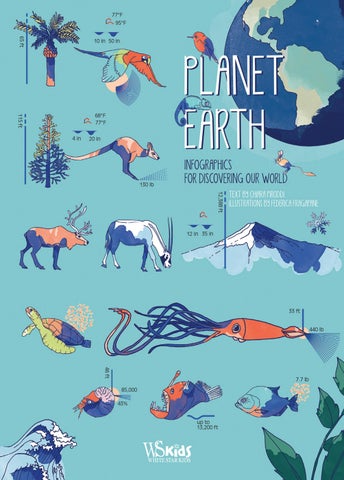
The animals that you’ll see portrayed beside the habitats in which they live, were chosen as typical examples of those environments.


Porpoise


PACIFIC OCEAN


Rüppell's Vulture


Have you ever looked up at the starry sky to admire the multitude of bright specks illuminating it, and asked yourself: I wonder what goes on up there?
At hundreds, thousands and millions of light years above our heads, there are stars and planets moving, flipping and tumbling through Space.
The Sun is one of these stars. Its gravitational force keeps several celestial objects, which are part of the Solar System in its orbit, including the Earth
The Solar System is kind of an enormous, irregular-shaped sphere with a diameter of about 80 au, Astronomical Units, a measure that is roughly 7 thousand 450 million miles (12 thousand million kilometers)!
Beside the planets and their respective moons, it includes smaller bodies like asteroids and comets, and finally dust, gas and particles that comprise the cosmic dust
The first time humans were able to venture into space was on April 12, 1961 with a mission named Vostok 1, which was undertaken by the very brave Russian cosmonaut, Yuri Gagarin, whom everyone watched with bated breath.
It was he who first stated that, seen from above, the Earth was blue!


We have now landed on the planet that is best known to man, and which has been studied in all its facets: the Earth. Earth is the third planet in the solar system, as well as the largest of the rocky planets and the only one that’s inhabited. It’s a few years old by now: in fact, it was created roughly 4 and a half billion years ago!
Our home is an extraordinary planet thanks to its characteristics, which seem to have been perfectly designed at the hand of an accurate engineer who developed the magic combination for the creation of the single most precious thing: life!

Mountains represent the memory of the Earth.
They are like a thousand-year old archive, in which the enduring history of the movements of the Earth’s crust, the collisions between the tectonic plates, and the repeated volcanic eruptions is preserved forever, along with the action of the wind and other weather events, all of which have molded these majestic giants like dedicated craftsmen.

Mountains are a conglomerate of earth and rock that is at least 980 ft (300 m) high. They have always played a key role in the life of our planet. Besides being home to numerous animal and plant species, they have for instance, outlined the natural boundaries of many countries, protecting them from enemy invasion.
Due to their height, they are able to influence a region’s weather pattern: blocking a storm or even causing rain.
The population in the mountains varies. Animals have learned to cope with the low temperatures and to adapt to the hostile environment. For example reptiles such as vipers, which like rocks and scrub, live there. Meanwhile, the queen of the mountains, the golden eagle, nests on the mountain peaks together with the white-winged snowfinch that lives on the edge of the glaciers, and the rock ptarmigan, whose plumage changes with the seasons: white as snow in winter and gray-brown like the rocks in summer.
Mammals that have adapted to the high altitude also live here, such as the Alpine marmot, the mountain hare, the short-tailed weasel as well as the Alpine ibex, the chamois, and the shaggy Tibetan yak. Due to their hoofs, the latter are known as ungulates, and have come to symbolize the mountains!


The first time the astronauts went into space, they noticed that the Earth, as seen from above, looked like a giant blue sphere; that is why they called it the Blue Planet
This color is due to the fact that 70% of the Earth’s surface is covered by oceans: vast, fascinating and powerful giants that contain 97% of all the water on Earth.
Even our planet’s climate is influenced by the motion and temperature of the oceans, which are essential links in the cycle of life.
Their dimension are: a minimum of 930 mi (1500 km) in with for the Atlantic, 8080 mi (13,000 km) for the Pacific, while the median depth is about 2.5 mi (4 km).


Grasslands are vast expanses of grass, and are populated by various species of mammals, from large predators to docile ungulates, as well as the most fearsome reptiles, all perfectly camouflaged in the environment.
The majority of plants here are herbaceous and without a trunk, reaching heights between 7.9 in (20 cm) and 6.5 ft (2 m), with deep roots up to 5.9 ft (1.8 m) long. The graminaceous plants, which have a very deep root system that enables them to survive for long periods of time without water, are by far the most widespread plants in the grasslands.
A distinguishing feature of the savannas, on the other hand, are the Acacias, in the shade of which, it is not unusual to find a leopard or a pride of lions
Grasslands are present across vast areas on all continents, with the exception of Antarctica.

understanding the symbols
5,290,000 mi2 (13,700,000 km2)

-72°F (-58°C)
Minimum and maximum rainfall
Environmental pollution is causing changes to the climate and increases in temperature. These phenomena, known as global warming, are endangering the existence of the polar ice caps!

5,339,406 mi2 (13,829,430 km2)


-121°F (-85°C)
in (150 mm) 2 in (50 mm)
Antarctica is an enormous expanse of ice: 98% of the land is covered by ice sheets 1 mi (1.6 km) deep!


It is thought that at this rate the Arctic ice sheets could disappear by 2050!


To date, the Antarctic is a small island that has been spared the effects of global warming; however, if the Earth’s temperatures continue to rise, over the next centuries the cold Antarctic winds and currents may no longer be able to protect our southern pole.

As you can see, the two poles are very different.
Of the two, the Arctic is the more fragile, due to the warmer temperatures and the thinner ice, which is more prone to melt as a result of global warming.
Unlike the Arctic, the Antarctic, is surrounded by the Antarctic Circumpolar Current, a cold ocean current that acts as a barrier from the other, warmer currents. This way, the seas’ temperatures are able to remain very cold, and continue forming ice.


The magnificence of Nature and its inhabitants is boundless. There are plants with bizarre characteristics, animals with skills short of heroic, mountains that pierce the clouds and rivers that flow endlessly.
Let’s go on a discovery tour of some of Mother Nature’s most impressive records, beginning with the highest peaks in the world, then reaching the deepest abyss!
Finally, we’ll witness a very exciting competition: the animal Olympics, are about to begin!
Because the Earth is our home, we need to nurture it.
The lack of care and respect for the environment can lead to dire consequences. Surely you are aware that the pollution caused by fossil fuels, industrial gases and landfill, has detrimental effects on the environment, such as rising sea levels, marine pollution, land degradation, and the melting of the polar ice caps!

Another great threat to our planet’s health is deforestation, that is the destruction of the forests, which act as the green lungs of the Earth and play a key role in keeping the air that we breathe clean.
Until a few years ago the Amazon forest, one of the Planet’s largest and most valuable ecosystems, was able to trap over 2 billion tons of carbon dioxide, an extremely toxic environmental pollutant. This impressive capacity is diminishing rapidly. Every year over 9266 mi2 (24,000 km2) of rain forest are destroyed and with it, more than 50,000 species of creatures living among its trees disappear.


Fortunately, not all human activity is detrimental to the environment.
Many organizations have sprung up with the purpose of protecting our planet’s health!

The daily efforts of major, historical associations such as the National Geographic Society, are essential to counteract the effects of pollution on the Earth and its inhabitants.