Section 1 The Manuscript
T H E P I L G R I M S ’ C O M PA N I O N : T H E K H A L I L I A N Ī S A L - Ḥ U J JĀ J —————————————————————————————————————————————————————————————————————————————————————— 12
Section 1 The Manuscript
T H E P I L G R I M S ’ C O M PA N I O N : T H E K H A L I L I A N Ī S A L - Ḥ U J JĀ J —————————————————————————————————————————————————————————————————————————————————————— 12
of court annals. While illustrated manuscripts continued to be produced, they no longer enjoyed the institutional support or prominence they had under his predecessors. However, Aurangzeb was known to support projects that were more reverent and functional but no less impressive, including the formation of a vast imperial library and the construction of the grand Badshahi Masjid in Lahore, which remains one of the most magnificent architectural achievements of the period. This alignment of piety and imperial vision makes it clear why a work like the Anīs al-Ḥujjāj would have been welcomed at court. Its reverent tone, scholarly ambition and practical value complemented the emperor’s contemporaneous reforms. In this light, it seems reasonable to assume that Aurangzeb would have approved, perhaps even encouraged his daughter’s patronage of such a project. Aurangzeb’s stance does not mean that certain practices became completely invisible (figs.7, 8). A good example is music: although the emperor personally abstained from musical performances and discouraged their display at court, musical patronage continued in private among the Mughal elite. Cultural life did not vanish; it simply shifted away from the imperial centre, taking on more discreet forms.145 In this context, it is plausible to view Zeb un-Nisa’s religious commissions, such as the Anīs al-Ḥujjāj, as part of a broader response to these parallel, often privately maintained, cultural expressions. While she operated within the constraints of her father’s court, her patronage suggests a conscious effort to align with its religiosity while also asserting her own intellectual and cultural agency. These commissions may have served to affirm her piety and political relevance, while other artistic outputs continued to thrive elsewhere in the empire.
The Audience The road to realising perfect, eternal bliss is performing Hajj and making ziyārah… May all Muslims, by His benevolence and grace, receive this gift. Hopefully, these pages will be of common use and comprehensive benefit to such an end, and a herald of glad tidings guiding the way toward it.
Fig.7 A Khamsah of Nizami for Prince Aurangzeb, possibly Iran (text); Mughal India (illustrations); possibly 15th century (text); 1640–45 (illustrations), ink, gold and opaque watercolour on paper, 26.5 × 16.5 cm, 17.1 × 9.9 cm (average), MSS 1023, fol.195a
It is with these words that Safi b. Vali presents his intention for the prospective readership of the Anīs al-Ḥujjāj, presenting it as both a devotional guide and a practical aid, aimed at preparing the reader for the spiritual and ritual dimensions of Hajj and ziyārah. If the text purports to be an auspicious herald of glad tidings and guidance to all Muslims, the pertinent question then becomes: who are ‘all Muslims’? This issue was discussed by the present author with Michael Wolfe, author of One Thousand Roads to Mecca, an anthology of ten centuries of travelogues on the Muslim pilgrimage. Wolfe notes that celebrated travellers to Mecca, such as Naser-e Khusrau (c.1050), Ibn Jubayr (1183–84) and Ibn Battuta (1326) were Muslims writing for a Muslim readership about a pilgrimage taking place within broadly familiar territory. Despite significant cultural differences, these authors navigated the Hijaz with confidence, moving easily among fellow pilgrims. They rarely elaborated upon the Hajj rituals, assuming their readers were educated enough in this regard. Wolfe elaborates:
Four of the illustrations to this Haft Paykar depict Aurangzeb in the guise of its hero, Bahram Gur. In later life Aurangzeb became known for his austerity, but in his youth he shared the refined tastes of other Mughal princes, including a fondness for illustrated romantic epics.146
Ibn Battuta has some beautiful passages of time spent around the Kaʻbah during Hajj, as does Ibn Jubayr, but neither spends pages detailing or interpreting the rites. Ibn Jubayr is journeying from Spain to Mecca during the Crusades; he is crossing contested territory and the passage is difficult and dangerous. He writes about his journey in great detail on this account – as an aide to travellers coming after. His description of Mecca and even of the rites tend to emphasize, not the details of the rituals, but the palpable contrast between
T H E P I L G R I M S ’ C O M PA N I O N : T H E K H A L I L I A N Ī S A L - Ḥ U J JĀ J —————————————————————————————————————————————————————————————————————————————————————— 38
S ection 1 : T he M an u script / T he D edication : O rnament o f W omankind —————————————————————————————————————————————————————————— 39
of court annals. While illustrated manuscripts continued to be produced, they no longer enjoyed the institutional support or prominence they had under his predecessors. However, Aurangzeb was known to support projects that were more reverent and functional but no less impressive, including the formation of a vast imperial library and the construction of the grand Badshahi Masjid in Lahore, which remains one of the most magnificent architectural achievements of the period. This alignment of piety and imperial vision makes it clear why a work like the Anīs al-Ḥujjāj would have been welcomed at court. Its reverent tone, scholarly ambition and practical value complemented the emperor’s contemporaneous reforms. In this light, it seems reasonable to assume that Aurangzeb would have approved, perhaps even encouraged his daughter’s patronage of such a project. Aurangzeb’s stance does not mean that certain practices became completely invisible (figs.7, 8). A good example is music: although the emperor personally abstained from musical performances and discouraged their display at court, musical patronage continued in private among the Mughal elite. Cultural life did not vanish; it simply shifted away from the imperial centre, taking on more discreet forms.145 In this context, it is plausible to view Zeb un-Nisa’s religious commissions, such as the Anīs al-Ḥujjāj, as part of a broader response to these parallel, often privately maintained, cultural expressions. While she operated within the constraints of her father’s court, her patronage suggests a conscious effort to align with its religiosity while also asserting her own intellectual and cultural agency. These commissions may have served to affirm her piety and political relevance, while other artistic outputs continued to thrive elsewhere in the empire.
The Audience The road to realising perfect, eternal bliss is performing Hajj and making ziyārah… May all Muslims, by His benevolence and grace, receive this gift. Hopefully, these pages will be of common use and comprehensive benefit to such an end, and a herald of glad tidings guiding the way toward it.
Fig.7 A Khamsah of Nizami for Prince Aurangzeb, possibly Iran (text); Mughal India (illustrations); possibly 15th century (text); 1640–45 (illustrations), ink, gold and opaque watercolour on paper, 26.5 × 16.5 cm, 17.1 × 9.9 cm (average), MSS 1023, fol.195a
It is with these words that Safi b. Vali presents his intention for the prospective readership of the Anīs al-Ḥujjāj, presenting it as both a devotional guide and a practical aid, aimed at preparing the reader for the spiritual and ritual dimensions of Hajj and ziyārah. If the text purports to be an auspicious herald of glad tidings and guidance to all Muslims, the pertinent question then becomes: who are ‘all Muslims’? This issue was discussed by the present author with Michael Wolfe, author of One Thousand Roads to Mecca, an anthology of ten centuries of travelogues on the Muslim pilgrimage. Wolfe notes that celebrated travellers to Mecca, such as Naser-e Khusrau (c.1050), Ibn Jubayr (1183–84) and Ibn Battuta (1326) were Muslims writing for a Muslim readership about a pilgrimage taking place within broadly familiar territory. Despite significant cultural differences, these authors navigated the Hijaz with confidence, moving easily among fellow pilgrims. They rarely elaborated upon the Hajj rituals, assuming their readers were educated enough in this regard. Wolfe elaborates:
Four of the illustrations to this Haft Paykar depict Aurangzeb in the guise of its hero, Bahram Gur. In later life Aurangzeb became known for his austerity, but in his youth he shared the refined tastes of other Mughal princes, including a fondness for illustrated romantic epics.146
Ibn Battuta has some beautiful passages of time spent around the Kaʻbah during Hajj, as does Ibn Jubayr, but neither spends pages detailing or interpreting the rites. Ibn Jubayr is journeying from Spain to Mecca during the Crusades; he is crossing contested territory and the passage is difficult and dangerous. He writes about his journey in great detail on this account – as an aide to travellers coming after. His description of Mecca and even of the rites tend to emphasize, not the details of the rituals, but the palpable contrast between
T H E P I L G R I M S ’ C O M PA N I O N : T H E K H A L I L I A N Ī S A L - Ḥ U J JĀ J —————————————————————————————————————————————————————————————————————————————————————— 38
S ection 1 : T he M an u script / T he D edication : O rnament o f W omankind —————————————————————————————————————————————————————————— 39
Fig.23 Section from the ḥizām of the Kaʻbah with the name of Sultan Selim II, Cairo, 1566–74, silk, silver and silver-gilt wire over thread padding, 93 × 750 cm, TXT 280
Fig.24 A complete kiswah for the maqām Ibrāhīm, with the name of Sultan Ahmad b. Ibrahim (Ahmad II), Cairo, dated AH 1105 (AD 1694/95), silk, silver and silver-gilt wire over thread padding, height 200 cm, TXT 312
Fig.21 Section from the internal kiswah of the Kaʻbah, Turkey, 1861/2, silk lampas, 45 × 35.5 cm, TXT 539
Fig.22 Al-dukhūl fī al-Kaʻbah al-Musharrafah (entering the Honoured Kaʻbah), the ḥizām from the Saudi era, photographic print, 14.5 × 9 cm, ARC.pc 370
Jalāluhū’ (‘May His majesty be exalted’). According to Zayn al-‘Abidin, the textile also bears the names of the Prophet’s companions. Safi b. Vali later states that it is permissible for them ‘to whom these have been allotted’ to purchase sections and subsequently resell them; a tradition said to have originated with the Prophet’s wife, Aisha. He also comments on the quality of the lining, which he identifies as a fine muslin, describing the contrast between the heavy black silk and the finer inner fabric as ‘balancing thickness with delicacy’. This observation suggests that he either examined the textile closely or saw it turned up during his visit, a common practice intended to protect the kiswah from damage during busy periods. The inner curtains of the Kaʻbah are also noted and described as similar in design to the exterior kiswah, although they are rendered in red and white and do not include the names of the Prophet’s companions. A later example resembling this description may be seen in fig.21. By contrast, Safi b. Vali offers no detailed description of the Ka‘bah’s interior, although he, like many pilgrims, did enter it (fig.22). Instead, he simply affirms the accuracy of Zayn al-‘Abidin’s account. Safi b. Vali’s visit inside the Ka‘bah took place on 10 Muḥarram, the Day of ‘Āshūrā’, when the inside of the building was open to the public. On this occasion, some Indian and Iranian pilgrims were granted the privilege of entering ‘in security’, a direct reference to Sūrat Āl ‘Imrān, III, 97.
T H E P I L G R I M S ’ C O M PA N I O N : T H E K H A L I L I A N Ī S A L - Ḥ U J JĀ J —————————————————————————————————————————————————————————————————————————————————————— 68
Zayn al-‘Abidin goes on to describe the ḥizām (belt), which he refers to as minṭaqah, located about two-thirds of the way up the Kaʻbah and likening it to ‘a belt around a robe’ (fig.23). He records that the ḥizām is inscribed with Sūrat Āl ‘Imrān, III, 96, the name of Murad IV and the date the textile was made. He also comments on the embroidered textile sitārah (door curtain), traditionally the most heavily decorated part of the Kaʻbah covering. He refers to it as pardah, although in other sources it is also referred to as burqu‘ or burqa‘. His account includes both practical and aesthetic observations: he notes, for instance, the vertical separation at the centre to accommodate the Kaʻbah’s door, as well as decorative features such as niches and the embroidered text of Sūrat al-Ikhlāṣ, CXII, 1–4, rendered in gold on silk along the edges. Fig.25 reflects precisely these features on a sitārah dating from Safi b. Vali’s visit, during the reign of Mehmed IV. This demonstrates that within the 50-year span between Zayn al-‘Abidin’s description of Murad IV’s sitārah and the Mehmed IV example, the design had remained consistent. Also mentioned is the maqām Ibrāhīm. The maqām Ibrāhīm is taken to be the actual stone Abraham stood on whilst constructing the Kaʻbah, as referenced in the Qur’an in Sūrat al-Baqarah, II, 125. Zayn al-‘Abidin
S ection 1 : T he M an u script / T he M asjid al- Ḥ ar ā m and H ajj ———————————————————————————————————————————————————————————————————————————— 69
Fig.23 Section from the ḥizām of the Kaʻbah with the name of Sultan Selim II, Cairo, 1566–74, silk, silver and silver-gilt wire over thread padding, 93 × 750 cm, TXT 280
Fig.24 A complete kiswah for the maqām Ibrāhīm, with the name of Sultan Ahmad b. Ibrahim (Ahmad II), Cairo, dated AH 1105 (AD 1694/95), silk, silver and silver-gilt wire over thread padding, height 200 cm, TXT 312
Fig.21 Section from the internal kiswah of the Kaʻbah, Turkey, 1861/2, silk lampas, 45 × 35.5 cm, TXT 539
Fig.22 Al-dukhūl fī al-Kaʻbah al-Musharrafah (entering the Honoured Kaʻbah), the ḥizām from the Saudi era, photographic print, 14.5 × 9 cm, ARC.pc 370
Jalāluhū’ (‘May His majesty be exalted’). According to Zayn al-‘Abidin, the textile also bears the names of the Prophet’s companions. Safi b. Vali later states that it is permissible for them ‘to whom these have been allotted’ to purchase sections and subsequently resell them; a tradition said to have originated with the Prophet’s wife, Aisha. He also comments on the quality of the lining, which he identifies as a fine muslin, describing the contrast between the heavy black silk and the finer inner fabric as ‘balancing thickness with delicacy’. This observation suggests that he either examined the textile closely or saw it turned up during his visit, a common practice intended to protect the kiswah from damage during busy periods. The inner curtains of the Kaʻbah are also noted and described as similar in design to the exterior kiswah, although they are rendered in red and white and do not include the names of the Prophet’s companions. A later example resembling this description may be seen in fig.21. By contrast, Safi b. Vali offers no detailed description of the Ka‘bah’s interior, although he, like many pilgrims, did enter it (fig.22). Instead, he simply affirms the accuracy of Zayn al-‘Abidin’s account. Safi b. Vali’s visit inside the Ka‘bah took place on 10 Muḥarram, the Day of ‘Āshūrā’, when the inside of the building was open to the public. On this occasion, some Indian and Iranian pilgrims were granted the privilege of entering ‘in security’, a direct reference to Sūrat Āl ‘Imrān, III, 97.
T H E P I L G R I M S ’ C O M PA N I O N : T H E K H A L I L I A N Ī S A L - Ḥ U J JĀ J —————————————————————————————————————————————————————————————————————————————————————— 68
Zayn al-‘Abidin goes on to describe the ḥizām (belt), which he refers to as minṭaqah, located about two-thirds of the way up the Kaʻbah and likening it to ‘a belt around a robe’ (fig.23). He records that the ḥizām is inscribed with Sūrat Āl ‘Imrān, III, 96, the name of Murad IV and the date the textile was made. He also comments on the embroidered textile sitārah (door curtain), traditionally the most heavily decorated part of the Kaʻbah covering. He refers to it as pardah, although in other sources it is also referred to as burqu‘ or burqa‘. His account includes both practical and aesthetic observations: he notes, for instance, the vertical separation at the centre to accommodate the Kaʻbah’s door, as well as decorative features such as niches and the embroidered text of Sūrat al-Ikhlāṣ, CXII, 1–4, rendered in gold on silk along the edges. Fig.25 reflects precisely these features on a sitārah dating from Safi b. Vali’s visit, during the reign of Mehmed IV. This demonstrates that within the 50-year span between Zayn al-‘Abidin’s description of Murad IV’s sitārah and the Mehmed IV example, the design had remained consistent. Also mentioned is the maqām Ibrāhīm. The maqām Ibrāhīm is taken to be the actual stone Abraham stood on whilst constructing the Kaʻbah, as referenced in the Qur’an in Sūrat al-Baqarah, II, 125. Zayn al-‘Abidin
S ection 1 : T he M an u script / T he M asjid al- Ḥ ar ā m and H ajj ———————————————————————————————————————————————————————————————————————————— 69
Fig.33 Tiles from a frieze, Ottoman provinces, Palestine or Syria, c. 1550, stonepaste body, stencilled in black under a bottle-green glaze, 70 × 70 cm, POT 1728 The stencils used for these tiles match those on the porches of the Dome of the Rock in Jerusalem, restored in the 1540s under Sultan Suleyman. Bottle green is an exceptionally rare colour in Ottoman tilework. A turquoise shade known as khaḍrāʼ was occasionally used during the Mamluk period, for instance on the dome of Sultan al-Ghuri’s mosque (r. 1501–1516) and is also known to have been used on the dome of the Prophet’s Mosque prior to the 19th century.
Fig.34 The miḥrāb al-nabī in the rawḍah of the Prophet’s Mosque, with octagonal pillars, 1950s, postcards, 10.8 × 15 cm, ARC.pc 213.12, ARC.pc 213.13
Safi b. Vali’s account details the architectural splendour of the Prophet’s Mosque and the courtyard. He remarks on the artistic refinement of the interior decoration: the marble pulpit, green-tiled octagonal columns (fig.33), the two mihrabs (fig.34), details of the dome, the elegant minarets and what he refers to as the ‘palm tree of the Prophet’, which corresponds to what is more commonly referred to as bustān Fāṭimah – the garden of Fatimah (fig.35).276 He also admires the open courtyard where the lanterns are stored. Indeed, the lanterns were housed in a separate, decorated structure within the courtyard and this building may be seen in numerous manuscript illustrations. It was initially referred to as the qubbat al-zayt (oil repository) and later as the khazīnat al-nabī (treasury of the Prophet), sometimes with variations of the name (fig.36). Constructed in 1180, the structure was rebuilt by Sultan Suleyman in 1566 and was used for keeping gifts offered to the sanctuary, as well as the oils for the lamps. It was removed in 1851.277
T H E P I L G R I M S ’ C O M PA N I O N : T H E K H A L I L I A N Ī S A L - Ḥ U J JĀ J —————————————————————————————————————————————————————————————————————————————————————— 78
S ection 1 : T he M an u script / M edina
————————————————————————————————————————————————————————————————————————————————————————————————————————————
79
Fig.33 Tiles from a frieze, Ottoman provinces, Palestine or Syria, c. 1550, stonepaste body, stencilled in black under a bottle-green glaze, 70 × 70 cm, POT 1728 The stencils used for these tiles match those on the porches of the Dome of the Rock in Jerusalem, restored in the 1540s under Sultan Suleyman. Bottle green is an exceptionally rare colour in Ottoman tilework. A turquoise shade known as khaḍrāʼ was occasionally used during the Mamluk period, for instance on the dome of Sultan al-Ghuri’s mosque (r. 1501–1516) and is also known to have been used on the dome of the Prophet’s Mosque prior to the 19th century.
Fig.34 The miḥrāb al-nabī in the rawḍah of the Prophet’s Mosque, with octagonal pillars, 1950s, postcards, 10.8 × 15 cm, ARC.pc 213.12, ARC.pc 213.13
Safi b. Vali’s account details the architectural splendour of the Prophet’s Mosque and the courtyard. He remarks on the artistic refinement of the interior decoration: the marble pulpit, green-tiled octagonal columns (fig.33), the two mihrabs (fig.34), details of the dome, the elegant minarets and what he refers to as the ‘palm tree of the Prophet’, which corresponds to what is more commonly referred to as bustān Fāṭimah – the garden of Fatimah (fig.35).276 He also admires the open courtyard where the lanterns are stored. Indeed, the lanterns were housed in a separate, decorated structure within the courtyard and this building may be seen in numerous manuscript illustrations. It was initially referred to as the qubbat al-zayt (oil repository) and later as the khazīnat al-nabī (treasury of the Prophet), sometimes with variations of the name (fig.36). Constructed in 1180, the structure was rebuilt by Sultan Suleyman in 1566 and was used for keeping gifts offered to the sanctuary, as well as the oils for the lamps. It was removed in 1851.277
T H E P I L G R I M S ’ C O M PA N I O N : T H E K H A L I L I A N Ī S A L - Ḥ U J JĀ J —————————————————————————————————————————————————————————————————————————————————————— 78
S ection 1 : T he M an u script / M edina
————————————————————————————————————————————————————————————————————————————————————————————————————————————
79
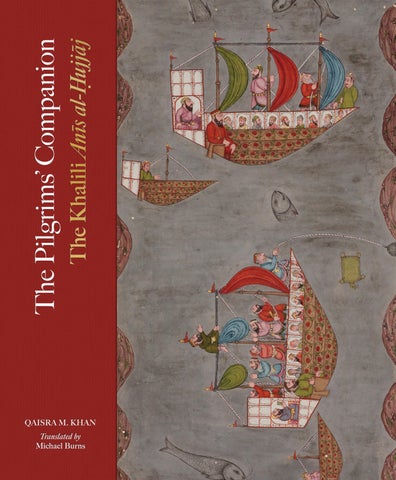
FOLIO 3b The Sea of Oman and Ships One of the best-known and striking illustrations in the Anīs al-Ḥujjāj depicts two vividly coloured pilgrim ships crossing the ‘Sea of Oman’. Rendered from an aerial perspective, the vessels are depicted in flat-outline profile, set against slate-toned waters populated with marine creatures. The artist Hew Locke observed, ‘In many cultures boats are a symbol of the journey through life, and beyond, both physically and spiritually.’80 This symbolism resonates powerfully here, as the ships navigate the dangers of the sea, carrying the pilgrims on their voyage to Mecca. The ‘Sea of Oman’ here does not correspond to the present-day Gulf of Oman, which is located north of the peninsula and would have been a diversion and therefore an unlikely route for the Salāmat Ras, but rather it refers to the north-western section of the Indian Ocean from Muscat to Aden, which Safi b. Vali predominately uses as his conduit to Jeddah. His narrative offers little geographical detail for this segment of the voyage between Surat and Aden, focusing instead on his experience of unpredictable weather, alternating between bouts of calm and severe storms. The illustration depicts four vessels in total sailing between two stretches of coastline, with various forms of marine life populating the surrounding waters. Recognisable is a loggerhead sea turtle (Caretta caretta) shown swimming between one of the ships and the shore (fig.49). Its form is reminiscent of another testudines, the life-size Indian terrapin (Kachuga dhongoka) carved from a single block of green nephrite, now in the British Museum.81 Also shown are four large sea mammals, rendered with a curious combination of scales and elongated barbel. These could be inspired by some form of catfish (Netuma thalassina) native to the north-western Indian Ocean and known to grow to substantial sizes (fig.50). Alternatively, they could represent the local dugong species, which live in shallow coastal waters with distinctive vibrissae, stylised here as exaggerated barbels. Their precise identification remains uncertain, suggesting a blend of observation and artistic imagination. Such creatures are evident in other Mughal seascapes, including a similar marine mammal that appears in a mid-17th-century illustration of Khwaja Khizr at the Victoria and Albert Museum.82 Another notable example appears in the Ṭūṭīnāmah (Tales Fig.49 Detail of loggerhead sea Fig.50 Detail of a sea turtle (Caretta caretta), from the mammal, from the of a Parrot), a work regarded as one of the best Anīs al-Ḥujjāj, fol.3b Anīs al-Ḥujjāj, fol.3b representations of the formative stages of Mughal style that originated during Emperor Akbar’s reign. In one scene from the work, the king of the ocean commands the sea creatures to deliver a message to a Brahman, illustrating a turbulent sea filled with various fantastical marine life.83 Another wonderful depiction, albeit not one with a ship, depicts the prophet Elijah rescuing Hamza’s nephew from the Ḥamzahnāmah. Here, the sea is painted as a tumultuous, inky expanse with frothy crests, emphasising its threatening nature; fantastical sea creatures emerge from the waters, heightening the movement and drama. In other works, marine creatures are portrayed as intimidating or threatening to the crew and ship. One example in the British Library shows Babur crossing the Jumna while threatened by an aquatic monster, even as he is entertained by musicians.84 However, in the Anīs al-Ḥujjāj the two captains show no sign of fear, suggesting either their confidence in divine protection or the routine familiarity of such encounters.
Fig.51 Iskandar voyages on the circumambient ocean, from a Khamsah of Nizami, Iran, Shiraz, dated Rabī‘ al-Awwal 964 (January 1557), 21 × 13.2 cm, MSS 455, fol.372a
T H E P I L G R I M S ’ C O M PA N I O N : T H E K H A L I L I A N Ī S A L - Ḥ U J JĀ J ———————————————————————————————————————————————————————————————————————————————————— 118
S ection 2 : T he I ll u strations / Folio 3 b ———————————————————————————————————————————————————————————————————————————————————————————————————————— 119
FOLIO 3b The Sea of Oman and Ships One of the best-known and striking illustrations in the Anīs al-Ḥujjāj depicts two vividly coloured pilgrim ships crossing the ‘Sea of Oman’. Rendered from an aerial perspective, the vessels are depicted in flat-outline profile, set against slate-toned waters populated with marine creatures. The artist Hew Locke observed, ‘In many cultures boats are a symbol of the journey through life, and beyond, both physically and spiritually.’80 This symbolism resonates powerfully here, as the ships navigate the dangers of the sea, carrying the pilgrims on their voyage to Mecca. The ‘Sea of Oman’ here does not correspond to the present-day Gulf of Oman, which is located north of the peninsula and would have been a diversion and therefore an unlikely route for the Salāmat Ras, but rather it refers to the north-western section of the Indian Ocean from Muscat to Aden, which Safi b. Vali predominately uses as his conduit to Jeddah. His narrative offers little geographical detail for this segment of the voyage between Surat and Aden, focusing instead on his experience of unpredictable weather, alternating between bouts of calm and severe storms. The illustration depicts four vessels in total sailing between two stretches of coastline, with various forms of marine life populating the surrounding waters. Recognisable is a loggerhead sea turtle (Caretta caretta) shown swimming between one of the ships and the shore (fig.49). Its form is reminiscent of another testudines, the life-size Indian terrapin (Kachuga dhongoka) carved from a single block of green nephrite, now in the British Museum.81 Also shown are four large sea mammals, rendered with a curious combination of scales and elongated barbel. These could be inspired by some form of catfish (Netuma thalassina) native to the north-western Indian Ocean and known to grow to substantial sizes (fig.50). Alternatively, they could represent the local dugong species, which live in shallow coastal waters with distinctive vibrissae, stylised here as exaggerated barbels. Their precise identification remains uncertain, suggesting a blend of observation and artistic imagination. Such creatures are evident in other Mughal seascapes, including a similar marine mammal that appears in a mid-17th-century illustration of Khwaja Khizr at the Victoria and Albert Museum.82 Another notable example appears in the Ṭūṭīnāmah (Tales Fig.49 Detail of loggerhead sea Fig.50 Detail of a sea turtle (Caretta caretta), from the mammal, from the of a Parrot), a work regarded as one of the best Anīs al-Ḥujjāj, fol.3b Anīs al-Ḥujjāj, fol.3b representations of the formative stages of Mughal style that originated during Emperor Akbar’s reign. In one scene from the work, the king of the ocean commands the sea creatures to deliver a message to a Brahman, illustrating a turbulent sea filled with various fantastical marine life.83 Another wonderful depiction, albeit not one with a ship, depicts the prophet Elijah rescuing Hamza’s nephew from the Ḥamzahnāmah. Here, the sea is painted as a tumultuous, inky expanse with frothy crests, emphasising its threatening nature; fantastical sea creatures emerge from the waters, heightening the movement and drama. In other works, marine creatures are portrayed as intimidating or threatening to the crew and ship. One example in the British Library shows Babur crossing the Jumna while threatened by an aquatic monster, even as he is entertained by musicians.84 However, in the Anīs al-Ḥujjāj the two captains show no sign of fear, suggesting either their confidence in divine protection or the routine familiarity of such encounters.
Fig.51 Iskandar voyages on the circumambient ocean, from a Khamsah of Nizami, Iran, Shiraz, dated Rabī‘ al-Awwal 964 (January 1557), 21 × 13.2 cm, MSS 455, fol.372a
T H E P I L G R I M S ’ C O M PA N I O N : T H E K H A L I L I A N Ī S A L - Ḥ U J JĀ J ———————————————————————————————————————————————————————————————————————————————————— 118
S ection 2 : T he I ll u strations / Folio 3 b ———————————————————————————————————————————————————————————————————————————————————————————————————————— 119
FOLIO 10a Al-Mashʻar al-H . arām and the Gathering of Pebbles for the Jamarat There is no other illustration known in the field of Hajj studies comparable to folios 10a and 10b of the Anīs al-Ḥujjāj. Together, they provide a thorough visual explanation of the Hajj rituals from the 9th day of Dhū al-Ḥijjah in Muzdalifah to the 10th and the following 11th, 12th and 13th days in Mina. Safi b. Vali’s text provides a detailed description of these rites in the Second Ṭarīq’s First Maslak, 9th to 10th Faṣl, which takes the form of a manāsik (ritual guide) within the work and aligns closely with both accompanying illustrations. The two folios depict the rituals that take place after the completion of rites in the Masjid alḤarām. The pilgrims subsequently proceed to three locations outside the sanctuary: Mina, ‘Arafat and Muzdalifah, each on specific days of the month of Dhū al-Ḥijjah. Following the important vigil at ‘Arafat on the 9th, which is not depicted in the Khalili Anīs al-Ḥujjāj, but is included in the CSMVS copy,98 the pilgrims travel in the evening to Muzdalifah, a rocky expanse located midway between ‘Arafat and Mina (fig.57). There, following two combined evening prayers, pilgrims gather pebbles for the next day’s rituals and spend the night under the open sky. Before dawn they depart and ascend via the Muḥassar Valley towards Mina for the rituals of the day of Eid al-Aḍḥā (folio 10b). Folio 10a illustrates the valley of Muzdalifah and the pilgrims’ movements there, including at alMash‘ar al-Ḥarām (the sacred waymark), which is mentioned in Sūrat al-Baqarah, II, 198 and refers to a location at the eastern edge of Muzdalifah. The building at the top left denotes Masjid-i Muzdalifah, which is commonly known as Masjid al-Mash‘ar al-Ḥarām and is the site from where the Prophet Muhammad offered a supplication during his Farewell Pilgrimage. To the right, Jabal Quzaḥ is labelled and is known as a hill in Muzdalifah upon which the Prophet stood, declaring the site a place of standing (mawqif). These sites are seldom represented in such detail in visual traditions, making this folio particularly remarkable. Where they do appear in other manuscripts, such as the Futūḥ alḤaramayn, Muzdalifah is rendered without pilgrims and in a typically schematic and rudimentary manner, often showing the mosque with banners, a well or a gateway (fig.58).99 The written accounts likewise provide little detail about this location, describing it only as a barren landscape where pilgrims pause as the Prophet directed; therefore, sources generally only mention it in passing. An early account by Ibn Jubayr in 1183 refers to this area by three names: Muzdalifah, al- Mash‘ar al-Ḥarām and Jam‘.100 It is, he writes, a flat terrain between two mountains surrounded by reservoirs and basins, some of which were provided by Zubaydah bt. Jaʻfar al-Mansur (d. 831), the wife of the Caliph Harun al-Rashid (r. 786–809). He notes
Fig.58 Muzdalifah and al-Mash‘ar al-Ḥarām from the Futūḥ al-Ḥaramayn, by Muhyi al-Din Lari, (top) copied by Ghulam ‘Ali, Mecca, Jumādā alThānī 990 (June–July 1582), 21.6 × 13.9 cm, MSS 1038, fols.30b-31a; (bottom) India, 18th century, 20.9 × 14.5 cm, MSS 1274, fols.30b–31a
Fig.57 The first aerial view of Muzdalifah flanked by the Muḥassar Valley and the Ma’zamayn mountains, by Safouh Izzat Naamani, Mecca, 1968, black-and-white negative, 50.6 × 60.8 cm, ARC.pp 216
T H E P I L G R I M S ’ C O M PA N I O N : T H E K H A L I L I A N Ī S A L - Ḥ U J JĀ J ———————————————————————————————————————————————————————————————————————————————————— 124
S ection 2 : T he I ll u strations / Folio 1 0 a —————————————————————————————————————————————————————————————————————————————————————————————————————— 125
FOLIO 10a Al-Mashʻar al-H . arām and the Gathering of Pebbles for the Jamarat There is no other illustration known in the field of Hajj studies comparable to folios 10a and 10b of the Anīs al-Ḥujjāj. Together, they provide a thorough visual explanation of the Hajj rituals from the 9th day of Dhū al-Ḥijjah in Muzdalifah to the 10th and the following 11th, 12th and 13th days in Mina. Safi b. Vali’s text provides a detailed description of these rites in the Second Ṭarīq’s First Maslak, 9th to 10th Faṣl, which takes the form of a manāsik (ritual guide) within the work and aligns closely with both accompanying illustrations. The two folios depict the rituals that take place after the completion of rites in the Masjid alḤarām. The pilgrims subsequently proceed to three locations outside the sanctuary: Mina, ‘Arafat and Muzdalifah, each on specific days of the month of Dhū al-Ḥijjah. Following the important vigil at ‘Arafat on the 9th, which is not depicted in the Khalili Anīs al-Ḥujjāj, but is included in the CSMVS copy,98 the pilgrims travel in the evening to Muzdalifah, a rocky expanse located midway between ‘Arafat and Mina (fig.57). There, following two combined evening prayers, pilgrims gather pebbles for the next day’s rituals and spend the night under the open sky. Before dawn they depart and ascend via the Muḥassar Valley towards Mina for the rituals of the day of Eid al-Aḍḥā (folio 10b). Folio 10a illustrates the valley of Muzdalifah and the pilgrims’ movements there, including at alMash‘ar al-Ḥarām (the sacred waymark), which is mentioned in Sūrat al-Baqarah, II, 198 and refers to a location at the eastern edge of Muzdalifah. The building at the top left denotes Masjid-i Muzdalifah, which is commonly known as Masjid al-Mash‘ar al-Ḥarām and is the site from where the Prophet Muhammad offered a supplication during his Farewell Pilgrimage. To the right, Jabal Quzaḥ is labelled and is known as a hill in Muzdalifah upon which the Prophet stood, declaring the site a place of standing (mawqif). These sites are seldom represented in such detail in visual traditions, making this folio particularly remarkable. Where they do appear in other manuscripts, such as the Futūḥ alḤaramayn, Muzdalifah is rendered without pilgrims and in a typically schematic and rudimentary manner, often showing the mosque with banners, a well or a gateway (fig.58).99 The written accounts likewise provide little detail about this location, describing it only as a barren landscape where pilgrims pause as the Prophet directed; therefore, sources generally only mention it in passing. An early account by Ibn Jubayr in 1183 refers to this area by three names: Muzdalifah, al- Mash‘ar al-Ḥarām and Jam‘.100 It is, he writes, a flat terrain between two mountains surrounded by reservoirs and basins, some of which were provided by Zubaydah bt. Jaʻfar al-Mansur (d. 831), the wife of the Caliph Harun al-Rashid (r. 786–809). He notes
Fig.58 Muzdalifah and al-Mash‘ar al-Ḥarām from the Futūḥ al-Ḥaramayn, by Muhyi al-Din Lari, (top) copied by Ghulam ‘Ali, Mecca, Jumādā alThānī 990 (June–July 1582), 21.6 × 13.9 cm, MSS 1038, fols.30b-31a; (bottom) India, 18th century, 20.9 × 14.5 cm, MSS 1274, fols.30b–31a
Fig.57 The first aerial view of Muzdalifah flanked by the Muḥassar Valley and the Ma’zamayn mountains, by Safouh Izzat Naamani, Mecca, 1968, black-and-white negative, 50.6 × 60.8 cm, ARC.pp 216
T H E P I L G R I M S ’ C O M PA N I O N : T H E K H A L I L I A N Ī S A L - Ḥ U J JĀ J ———————————————————————————————————————————————————————————————————————————————————— 124
S ection 2 : T he I ll u strations / Folio 1 0 a —————————————————————————————————————————————————————————————————————————————————————————————————————— 125
Fig.74 Diagram showing the orientation of various cities towards the Ka‘bah, arranged within four sectors corresponding to its corners (arkān), North Africa, 18th century, ink, gold and opaque watercolour on paper, 24.5 × 21.6 cm, MSS 765
Fig.73 Pilgrims around the Kaʻbah, c. 1590–95, India, watercolour and gold on paper, 37 × 25.5 cm (mount), MSS 569
T H E P I L G R I M S ’ C O M PA N I O N : T H E K H A L I L I A N Ī S A L - Ḥ U J JĀ J ———————————————————————————————————————————————————————————————————————————————————— 144
S ection 2 : T he I ll u strations / Folio 1 2 a —————————————————————————————————————————————————————————————————————————————————————————————————————— 145
Fig.74 Diagram showing the orientation of various cities towards the Ka‘bah, arranged within four sectors corresponding to its corners (arkān), North Africa, 18th century, ink, gold and opaque watercolour on paper, 24.5 × 21.6 cm, MSS 765
Fig.73 Pilgrims around the Kaʻbah, c. 1590–95, India, watercolour and gold on paper, 37 × 25.5 cm (mount), MSS 569
T H E P I L G R I M S ’ C O M PA N I O N : T H E K H A L I L I A N Ī S A L - Ḥ U J JĀ J ———————————————————————————————————————————————————————————————————————————————————— 144
S ection 2 : T he I ll u strations / Folio 1 2 a —————————————————————————————————————————————————————————————————————————————————————————————————————— 145
FOLIO 18a
T H E P I L G R I M S ’ C O M PA N I O N : T H E K H A L I L I A N Ī S A L - Ḥ U J JĀ J ———————————————————————————————————————————————————————————————————————————————————— 300
FOLIO 17b
T H E K H A L I L I A N Ī S A L - Ḥ U J JĀ J FA C S I M I L E ———————————————————————————————————————————————————————————————————————————————————————————————————————————— 301
FOLIO 18a
T H E P I L G R I M S ’ C O M PA N I O N : T H E K H A L I L I A N Ī S A L - Ḥ U J JĀ J ———————————————————————————————————————————————————————————————————————————————————— 300
FOLIO 17b
T H E K H A L I L I A N Ī S A L - Ḥ U J JĀ J FA C S I M I L E ———————————————————————————————————————————————————————————————————————————————————————————————————————————— 301