ORO Editions 2026 Spring

Page 1


As innovators in the publishing industry, ORO Editions and its imprints are renowned for their specialized process of book making, constructing meaning through editorial collaboration, design, and material craft.

ORO Editions’ well-established publishing program maintains an inventory of exceptional content, sustained across three decades of exemplary work. With an index of distinguished books on architecture, landscape, urban planning, applied research and design, photography, and art, ORO’s growing catalog is outfitted with the creativity of modern-day thinkers and practitioners.

ORO’s structured program is built on the performance of our expert team which aims for cohesive partnership on each book project. This working design delivers a distinct and aesthetically oriented approach to the development and production of every book. Likewise, ORO’s distribution and marketing program ensures visibility in libraries, bookstores, and art and design fairs worldwide. With this concept of practice, ORO and its catalog of Works have been recognized by the Society of Architectural Historians Exhibition Catalog Awards, Next Generation Indie Books Awards, the Pattis Family Foundation Global Cities Book Award, and the Hayek Book Prize, among other international juries.

Driven A Road to Iconic Design

$60.00

10” x 12” Portrait • 220pp • Hardbound 978-1-966515-54-8

Publication Date: Spring 2026

DRIVEN: The Road to Iconic Design invites readers into the world of award-winning classical architect Patrick Ahearn, FAIA, where automotive artistry intersects with timeless architectural design. In DRIVEN, his third published volume, Ahearn shares his ambitious pursuit of the extraordinary with a focus on bespoke carriage houses featured in so many of his legacy properties and classic cars that have shaped his design purview throughout his career.

Whether freestanding or seamlessly connected to the main residence, these exquisitely crafted carriage houses are tailored to their owners’ lives and dreams. Not just home to prized automobiles, they offer everything from gracious guest quarters to collector’s galleries, angler’s lounges, poolside retreats and elegant entertaining spaces.

Through ten inspiring projects, Ahearn reveals how these architectural gems elevate both the form and function of a property. Interwoven throughout are classic automobiles that

have impacted Ahearn’s life, each photographed against the backdrop of one of his homes, creating a dialogue between enduring forms of excellence.

With captivating photography and thoughtful narrative, DRIVEN will inspire architecture enthusiasts, car aficionados, and design connoisseurs alike with a celebration of historically inspired architecture, classic automobiles, and Ahearn’s lifelong journey towards iconic design.

Author

One of America’s most celebrated classical architects, AIA Fellow Patrick Ahearn has focused on historically motivated, site-sensitive residences that have advanced the art of placemaking in some of the nation’s most desirable destinations for the past 50 years.

Award-winning American architect Patrick Ahearn’s lifelong pursuit of excellence is celebrated in DRIVEN: The Road to Iconic Design, spotlighting ten bespoke carriage houses and classic cars that have shaped his design purview throughout his career.

Arturo Mezzèdimi, AFRICA HALL A Monument to African History

$85.00

9.61” x 11.02” Portrait • 400pp • Hardbound 978-1-961856-63-9

Publication Date: Spring 2026

All contributors

Antonio Baio, Dawit Benti, Amzat Boukari-Yabara, Monica Brondi, Laura Callea, Nelly Cattaneo, Kate Coucher, Edward Denison, Shimelis Bonsa Gulema, Fasil Giorghis, Rasselas Lakew, Gianfrancesco Lusini, Gianmarco Mancosu, Chloé Maurel, Hannah Mariam Meherete-Selassie Dereje, Bekele Mekonnen, Daniel Mulugeta, Ephrem Nigussie, Mengesha Seyoum, Kongit Sinegiorgis, and Martin Welz

This book is a photographic journey–complemented by a collection of academic essays on related historical, architectural and artistic topics–on the origin and life of “Africa Hall” in Addis Ababa, Ethiopia, a building recently declared “Monument to African History,” which was donated in 1961 by Emperor Haile Selassie to the United Nations and designed by architect Arturo Mezzèdimi to serve as its continental headquarters, becoming also the birthplace, in 1963, of the Organization of African Unity.

The building came to life with an inspiring story of reconciliation at a crucial moment in African history, when the continent was emerging out of the colonial period and making headway into a new era of independence and envisaged unity. Through its architectural composition and the embedded artworks, it embodied a Pan-Africanist vision and its rising ideals.

Edited by the grandson of the architect and representing Italy’s contribution to the renovation project, the book sits at the crossroads of photography, architecture, history, and art and comprises an amplitude of independent essays, contributions and recollections from authors of diverse profiles. Through impacting images and short articles, it addresses events of historical relevance on a global scale, for the entire continent of Africa, at a national level for Ethiopia, and locally for the city of Addis Ababa, concluding with an introduction to the life and work of its architect.

Author

Marcello Mezzèdimi (PhD) is the grandson of Arturo Mezzèdimi, architect of Africa Hall, and currently directs the Djibouti-based activities of the MEZZ group in the fields of construction, real estate development, architectural design, and family heritage. His educational background comprises an MSc in Aerospace Engineering (La Sapienza, 2002), an MSc in Mathematical Finance (Oxford, 2011), a PhD in Applied Mathematics (La Sapienza/Luiss, 2011), and a Master in Real Estate (Bocconi, 2006).

The Architecture of Will Bruder

Will Bruder with contributions by: Reed Kroloff; Billie Tsien; Robert McCarter; Teresa Rosano; Eric Höweler and Meejin Yoon; and Nader Tehrani

In celebration of his 50+ years in practice, architect Will Bruder is pleased to share this selection of his most-exemplary projects, presented through hundreds of gorgeous photographs, drawings, and original sketches.

Influenced by Frank Lloyd Wright, as well as Paolo Soleri, Bruce Goff and Gunnar Birkerts, Bruder opened his own design studio in 1974. His self-built house/studio on the desert edge of Phoenix garnered a Record Houses of 1977 design award.

A Fellowship in Architecture at the American Academy in Rome was a career turning-point permitting several months of intense reflection from a studio overlooking Rome, and travel throughout Europe to study historic and contemporary architecture.

Filled with fresh perspective, Bruder won the commission to design the 280,000 square foot Phoenix Central Library. It opened in 1995. Cultural, civic and private commissions followed, as did opportunities to travel, lecture, and teach. The library was awarded the AIA 25 Year Building Award in 2021.

This superb collection is divided into two sections: pre-Rome Prize projects, presented in black and white, and post-Rome projects dating from 1987 forward, presented in color. Six scholarly essays round out this long-awaited Bruder monograph.

Author

For more than 50 years Will Bruder has explored inventive and contextually-exciting architectural solutions in response to site opportunities and client needs. His work celebrates the craft of building in a manner not typical of contemporary architecture.

© Neil Koppes
© Bill Timmerman all photos this page

Mark Cavagnero Architect

Fifteen Projects

Over the past two decades, Mark Cavagnero Associates has been quietly making an imprint on San Francisco’s urban fabric. Born of the Modernist tradition of clean lines, abundant natural light, and functional, flowing open space plans, the firm’s work expands on these values, encompassing a deep understanding of the city and Bay Area. Mark Cavagnero Architect surveys fifteen of the firm’s foundational projects, ranging from cultural and civic buildings to recreational and educational facilities. Across this collection unfolds the development of a distinct design language that is at once remarkably consistent and refreshingly new with each individual project. The principles of interlocking volumes, a limited palette of wood and concrete, lightness, authenticity, and presence are applied and varied per the unique demands of client, community, and context. The resulting body of work is not based on style but on substantive thought.

Authors

Mark Cavagnero directs a large California architecture firm, founded in 1993. His work has earned over 200 design awards and extensive national and international recognition. His notable projects include the SFJAZZ Center, Oakland Museum, and Moscone Center.

Joseph Giovannini is a practicing architect who has written on architecture and design for three decades for such publications as the New York Times, Architectural Record, Art in America, and Art Forum, and he has served as the architecture critic for New York Magazine and the Los Angeles Herald Examiner.

Graphic by Brad Thomas Foreword by Joseph Giovannini

$60.00

7.5” x 9” Portrait • 260pp • Hardbound 978-1-966515-18-0

Publication Date: Spring 2026

University of Notre Dame Driehaus Laureate Series

Merrill, Pastor & Michael Architecture and Urban Design

This is the first place these projects have been collected and reflects 37 years of work in the US and abroad. The scale of the projects ranges from houses to a federal courthouse. Sites range from a fraction of an acre to forty acres. Merrill, Pastor & Michael Architects works with a range of master planners, principally with DPZ and DPZ CoDesign.

Author

Scott Merrill received a BA from the University of Virginia and a Master of Architecture from Yale University. The firm’s work received the Arthur Ross Award from the Institute of Classical Architecture in New York in 2004. Scott Merrill received the Seaside Prize in 2012 and the Richard H. Driehaus Prize in 2016.

All Credited Contributors:

Vincent Scully (posthumously)

Andres Duany

Leon Krier

$65.00

10” x 12” Landscape • 400pp • Hardbound 978-1-961856-88-2

Publication Date: Spring 2026

The Driehaus Laureate Series on new traditional architecture and urbanism at the University of Notre Dame is dedicated to master architects and urbanists whose exemplary work ranges in scope from the vernacular to the classical.

This book was made possible in part by support from the Driehaus Trust, Chicago, Illinois.

In collaboration with the University of Notre Dame, ORO Editions is honored to inaugurate this series and champion the enduring relevance of classical design.

Ratio Et Architectura University of Notre Dame

Court and Garden

From the French Hôtel to the City of Modern Architecture

The French Hôtel, an aristocratic Paris townhouse, is to the art of the plan as the Venetian Palace is to the art of the facade— the quintessential level of architectural achievement. The development of the hôtel between approximately 1550 and 1800 chronicles the formal transformation from an embedded urban building type to a free-standing suburban building type; it also illuminates the social transformation from total emphasis on the public realm under Louis XIV, to the dominance of private life in our time. In contrast to the principles of continuity and regularity of classical buildings, the design principles of the hôtels were based on discontinuity and irregularity, allowing freer, more adaptable architectural compositions. The French Hôtel is a direct ancestor of the modern “free-plan,” thus enabling a rich contemporary architectural vocabulary.

Author

Michael Dennis is an architect in Boston and Emeritus Professor of Architecture at MIT. He was the 1986 Thomas Jefferson Professor of Architecture at the University of Virginia, the 1988 Eero Saarinen Professor of Architecture at Yale University, and the 2006 Charles Moore Professor of Architecture at the University of Michigan. In 2011, he was awarded the CNU Athena Medal for his contributions to urbanism.

$45.00

8.5” x 11” Portrait • 336pp • Hardbound 978-1-966515-23-4

Publication Date: Fall 2025

Now

The Venetian Facade

There are no books that focus on the unique artistic characteristics of the Venetian facade and its potential relevance to contemporary architectural and urban issues, as this book intends.

This book is about architecture. It is not about history, although a bit of history is necessary to set the context. It is not about theory, although, again, a bit is necessary to connect the facade with urbanism. It is also not about structure and technology. And, most definitely, it is not about the plan. All of these topics are well-covered elsewhere. This book is about the facade. It explores the art and typology of the Venetian facade, not only as a high point of architectural literacy and achievement, but as a potentially useful contemporary stimulant.

Author

Michael Dennis is the principal of Michael Dennis & Associates in Boston, and Professor of Architecture Emeritus at MIT. 1986 Thomas Jefferson Professor of Architecture, University of Virginia; 1988 Eero Saarinen Professor of Architecture, Yale University; 2006 Charles Moore Professor of Architecture, University of Michigan.

$40.00

8.5” x 11” Portrait • 160pp • Hardbound 978-1-961856-35-6

Forthcoming coming in the Ratio et Architectura Series

Saarinen

Munkkiniemi-Haaga and Greater Helsinki

Classical Architecture

The Living

Traditions

Portuguese Houses with History

$60.00

8.27” x 11.69” Portrait • 296pp • Hardbound 978-1-961856-66-0

Publication Date: Fall 2025

For almost a decade we had an interior design studio which led us a unique opportunity to discover and visit Portuguese family houses, with stories and beauty that deserved to be portrayed. Since then, time has passed and with the growth of tourism in our country, many of these houses ended up being transformed into hotels, vacation rentals, airbnbs and rural hotels, as it was too expensive to keep them just as family homes. Watching this made us feel the need to make a book about the ones that still resist. Our shared passion for these houses and their unrepeatable identity convinced us that this could be a project where we could work together again, photographing the properties that we still managed to find so that at least their visual memory didn’t get lost. We want this book to pay homage to a memory, a Portuguese savoir-faire and taste that is disappearing with the massification of design, objects and furniture. We hope that this book will help raise awareness to what we feel is most valuable about these homes: the notion that this heritage is precious, that it is part of our history and must be preserved.

This book pretends to be a homage to Portuguese family houses, with stories and beauty that deserved to be portrayed. We hope this book will help raise awareness to what we feel is most valuable about these homes: the notion that this heritage is precious, that it is part of our history and must be preserved.

Authors

Birgit Sfat (b. 1974), is a photographer and creative consultant based in Lisbon. Her passion for photography and for Portugal developed naturally from her parents, who both were photographers. She spent much of the early 1990s each year at the family home near Tavira.

After studying economics, Birgit worked as a strategist in Munich, helping shape collections, communication, and brand identity for fashion labels before moving to San Francisco with her husband and daughter. There, she founded Over the Ocean, which reflected her interest in thoughtful design, storytelling, and the work of small European makers. In 2019, her family relocated to Portugal permanently and settled in Lisbon.

Felipa Almeida (b. 1979), is a curator and art director specializing in the intersection of art, crafts, and Portugal’s material culture and traditions. With degrees in Art History and Curatorial Studies, Felipa’s work celebrates and preserves Portuguese heritage.

Returning to Portugal in 2006, she joined the architect Ana Anahory to open the architecture and interior design studio AnahoryAlmeida (2011–2020) which focused on working with Portuguese materials. It was during this defining period that Felipa started collaborating closely with artists and craftspeople whose work became part of the spaces developed in the studio. AnahoryAlmeida Studio designed numerous hospitality and interior architecture projects including São Lourenço do Barrocal Hotel, Quinta das Murças House, and chef José Avillez’s restaurants in Lisbon.

Imaging Heaven

In this compelling photographic journey Arthur Becker captures the intensity and power of the ceiling frescoes of the Renaissance and Baroque periods. Vividly presented here in all of their diversity and splendor, these illusionistic ceilings, mainly located in the churches and palaces of sixteenth to early eighteenth-century Italy but also found in Austria, Germany, and Spain, are revealed as dazzling examples of Italian artistic imagination by some of the major figures of the period, including Mantegna, Melozzo da Forlì, Michelangelo, Correggio, Tintoretto, the Carracci, Caravaggio, Guercino, Guido Reni, Giovanni Battista Gaulli, Andrea Pozzo, Sebastiano Ricci, and the Tiepolo dynasty.

These images, many of which represent turning-points in the history of art, are accompanied by an in-depth introductory essay placing them in context by the art and architectural historian Daniel Sherer, who teaches at the Princeton University School of Architecture, and concise descriptions by Brian Kish, a well-known expert on Italian art and design. Bringing together in one place these remarkable frescoes for the first time, this book will be indispensable for art historians, connoisseurs of photography, and all those interested in Renaissance and Baroque art.

Authors

Arthur Becker’s formal exploration of the arts began at Bennington College in 1972, where he earned a degree in ceramics and photography, fostering his captivation of antiquity. Taking a hiatus from the art world to traverse into meditation, archi-

tecture practices, business school, and serving as CEO of two technology companies, Becker resumed his photographic work in the late 1990s.

Brian Kish is an Italian architecture and design expert specializing in production from the High Renaissance and 20th century. He is the curator of the first US exhibition on Gio Ponti: A Metaphysical World (Queens Museum of Art, NY, 2001) and a contributor to Entryways of Milan (Taschen, 2017), Gio Ponti Archi-Designer (M.A.D. Paris, 2018, and Gio Ponti (Taschen, 2021).

Dan Sherer is a professor of architectural history and theory at Princeton School of Architecture. He received his PhD from the Harvard University Department of the History of Art and Architecture in 2000 and his BA from Yale University in 1985. He has previously taught at Columbia, Cornell, Harvard, Yale, University of Venice, and others on the interaction of architecture, art, and design across various stylistic eras, including Italian Modernism, Italian Renaissance, and Baroque architecture. He has been published in numerous European and American journals as well as curated exhibitions related to these research interests.

$80.00

12” x 12” Square • 220pp • Hardbound • 978-1-961856-62-2

Publication Date: Fall 2025

Soundscape Architecture

SOUNDSCAPE ARCHITECTURE

KAREN VAN LENGEN AND JIM WELTY

$50.00

9” x 11.5” Landscape • 200pp • Hardbound 978-1-961856-74-5

Publication Date: Fall 2025

Soundscape Architecture presents historical examples, design projects and art works related to the sonics of architectural spaces and landscapes. This work grew out of our interest in listening to places that sponsor distinct sonic characteristics with specific and memorable identities. We have addressed this challenging design territory by beginning with the act of listening itself. We record the spaces, create new compositions from the recordings, draw (by hand and digitally) the sounds of these compositions, animate these drawings, and then create digital paintings as a memory of this process. We also present sonic installations, projects, and other exemplary art works as creative demonstrations that support the act of listening to the atmospheres of our natural and built environments.

Authors

Karen Van Lengen, FAIA, is an architect, artist, professor and former dean. Her recent work focuses on the sounds of iconic buildings and landscapes, by discovering methods to visually portray these sonic characteristics, in addition to designing architectural projects that deploy sound in the design process.

Jim Welty is an accomplished sculptor and digital artist, whose recent collaborative work with Soundscape Architecture has included the creation of drawings, animations and digital art to visualizes the sounds of space.

White Compositions

$35.00

10” x 10” Square • 84pp • Hardbound • 978-1-966515-17-3

Publication Date: Fall 2025

The White Compositions are symbolically charged with highly specific references that speak to Ames’s work and life as an architect in Georgia preoccupied with modernism, art and basketball, among other cultural and literary meanings. Ames playfully collages architectural elements, such as facades organized by grids, with everyday (yet highly specific) objects—like a Morandi-esque vase, a Corbusian pair of glasses, a can of coke, an electric guitar, or a basketball hoop. The contrast between the (supposedly) rational, objective, and universalizing characteristics of modernism in confrontation with the particular, the idiosyncratic, and the autobiographical quotidian communicates a uniquely Ames-ian sensibility that provides a distinctive and refreshing take on the 20th-century architectural movement.

Based in Atlanta, Georgia, Anthony Ames has operated his eponymous architecture office since 1976 and began painting in 1984. Ames’ White Compositions—a series of 11 monochromatic relief wall sculptures—originate from and elaborate on the architect’s painting practice, closely attending to proportion, layout, recurring forms, and motifs found within both his artistic and built works. His paintings—as described by Courtney Coffman in her previous review of Ames’s solo exhibition at a83 gallery in New York—“oscillate somewhere between the formality of a still life, the dynamism of sculptural relief, and the juxtaposed delight of collage.” A natural evolution in Ames’s practice, the 11 wall sculptures are accompanied by documents that provide insight into the precise and accomplished nature of Ames’ design process: from buildings to art. —Clara Syme

Author

Anthony Ames has maintained an architectural practice in Atlanta, Georgia since 1976. He received architectural degrees from Georgia Tech and Harvard University. He has taught at eleven universities and lectured at many more. Ames, a fellow at the American Academy in Rome and of the American Institute of Architects has received numerous architectural awards and has been widely published. See: Ames, Five Houses, (Princeton Architectural Press, 1987); Ames, Residential Work: Volume 2, (ORO Editions, 2007); and Ames, Fifty Paintings, (ORO Editions, 2021). He began painting in 1984 and has been struggling with it ever since.

New York Geologics Representations of Manhattan from the Anthropocene

Manhattan is commonly regarded as an iconic island-territory of the twentieth century. Conventional representations reinforce its reading as an urban condition resulting from neoliberal capitalism. These forces have expanded the city grid and extruded its architectures as a laboratory of urban ideas.

Yet, like many other coastal and insular conditions, twenty-first century Manhattan faces adverse Anthropogenic climate change. Stronger storm surges and sea level rise now demand that the island recalibrates its social and environmental positions. The city needs to consider once again its fluid archipelagic conditions inherited from glacial dynamics.

With a focus on iconic city representations, the book examines distinct logics that try to make capitalist progress compatible with its territorial conditions. Even though these logics of land, water and ground—here called geologics—are perhaps less dominant than the dense urban culture and, therefore, less predominant in the representation of the city, they are still important to explain why Manhattan evolved to its current condition. The book explores these geologics through relationships between three nineteenth-century plans of Manhattan and three late-twentieth-century architectural manifestos—De-

$50.00

7” x 9” Portrait • 400pp • Softbound 978-1-961856-39-4

Publication Date: Fall 2025

lirious New York (Rem Koolhaas), The Manhattan Transcripts (Bernard Tschumi), and Lower Manhattan (Lebbeus Woods).

Plans and manifestos are explored creatively through design experimentation that retrospectively repositions these representations from the perspectives offered by the Anthropocene. With an intricate connection between image, text, and installation, the book is an open invitation to radically interconnected imagination.

Geologics advocate for architecture to become a productive and fluid mediation between city and geology. They propose a reconfiguration of urban territories as resilient hybrid possibilities amongst accelerated change and large-scale geoengineering.

Author

Tiago Torres-Campos is a Portuguese landscape architect and Associate Professor at Rhode Island School of Design. He co-edited Postcards from the Anthropocene (2022) and is currently writing a new book that offers alternative ways of thinking and visualizing Manhattan geologically.

Jewelry on the Wild Side

$65.00

9.25” x 12.75” Portrait • 300pp • Hardbound (cloth) 978-1-966515-42-5

Publication Date: Spring 2026

This second Wild Side book continues to explore Elena Agostinis’s fascination with artists using the ordinary in extraordinary ways. In this book, the focus is on artists who make jewelry using materials not commonly associated with traditional jewelry-making.

While traveling afar, Elena’s profound realization was that people in the most far-flung places in the world all have this powerful urge to self-adorn. Despite never having been a jeweler, what she found fascinating was that the materials used by these artists and artisans are often simply what the earth yields. She’s tried to include works that illustrate these remarkable innovations and the materials used.

The wearable artworks chosen for this book all appear to comply with this extraordinary principle. Ms. Zanella’s work and the unique creations of so many other artists included here, all follow suit. Elena tried to carry this “lightness” through in my presentation of the artists’ creations as well.

The hope is that readers, conformists and non-conformists alike, will marvel at concepts that can open all our minds and

hearts to a world of colorful, wearable art, enabling us to seek out, try on, to feel the “fit” and to understand its formidable existential effect.

Author

Elena Agostinis is a bold creative force, best known for her fearless use of color, eclectic design sensibility, and commitment to joyful living. Her homes, featured in publications and admired by design lovers worldwide, are unapologetically expressive, deeply personal, and utterly unforgettable. Elena’s background in graphic design, her years at Condé Nast, and her experience running boutiques all shape her joyful visual language. Her interiors are layered with family treasures, outsider art, quirky upcycled pieces, and one-of-a-kind finds from around the globe. Each space tells a story. Each choice is intentional. Each home becomes an immersive, livable work of art.

Hotel Design

$65.00

8.5” x 11” Portrait • 284pp • Hardbound • 978-1-957183-56-5

Publication Date: Spring 2025

Hotel Design presents the beautiful, inviting, and defining hotels and resorts designed by FILLAT+ Architecture. With four studios and over 27 years of experience in hospitality design, the firm was founded in 1992 by Peter Fillat to explore a personal view of how people interact with the environment and to create an Architecture of Permanence, which delights and inspires the human spirit. FILLAT+ specializes in creating places and spaces for people to enjoy life. In the careful planning and sequencing of the interior and exterior spatial experience, the work creates comfortable, inviting spaces that are accommodating, respectful, and memorable. Each project responds to the unique needs and vision of its client as well as the needs of every guest that walks through its doors.

The book features 12 built works and 15 projects on the boards. Richly illustrated, the projects elaborate on FILLAT+’s unique approach to designing new destination hotels and resorts, whether building upon historic foundations or designing icons as key anchors in urban redevelopment master plans. Hotel Design features a foreword by Stacy Shoemaker, editor in chief of Hospitality Design magazine, and contributions by David Ashen and Michael Dennis.

Author

Peter Fillat is the principal of FILLAT+ Architecture, founded in 1992. He has over 30 years of experience with an international portfolio comprised of hospitality, mixed-use, multi-family residential, and retail projects. Fillat and his innovative designs have received numerous awards and citations from organizations across the globe. He holds a Bachelor of Architecture degree from Syracuse University and studied in Florence, Italy.

FILLAT+ is a design studio headquartered in Washington, DC. The practice serves both the public and private sectors with a focus on architecture, interior design, urban design, and sustainable practices. Its international portfolio encompasses hotels, resorts, multi-family residential buildings, offices, retail, restaurants, and mixed-use developments. The firm is committed to creating lasting works of architecture and designing in harmony with the environment. FILLAT+ is dedicated to engaging communities and individuals with the spaces we create. The studio creates works based in permanence that delight the people they serve, are respectful of the environment, and create unity between form, function, and spirit.

Building a Museum

This is Not a Manual

$50.00

8.5” x 11” Portrait • 160pp • Hardbound 978-1-966515-56-2

Publication Date: Spring 2026

Building a Museum is a comprehensive guide designed to assist museum professionals in navigating the complex process of planning, designing, and constructing a museum. In it, seasoned design professionals from the award-winning integrated design firm SmithGroup condense their decades of experience guiding numerous cultural institutions through successful projects, emphasizing best practices in organizing a capital project and offering suggestions to keep projects moving toward completion. Building a Museum is a user-friendly tool for museum leaders to easily understand every aspect of the building process and includes intuitive graphics and a handy glossary for common terms. It encourages readers to rethink the traditional approaches and embrace forward-thinking and collegial strategies that could revolutionize their projects. Collaboration and inclusivity in the process is encouraged, with an emphasis on the importance of building a strong network and leveraging professional connections. Building a Museum draws on the authors’ decade of conducting workshops on the museum capital project process, refining their content based on feedback from over 300 museum leaders, board members, administrators, curators, and facilities professionals. The book aims to demystify the planning and design process, making it accessible and practical for museum professionals at any stage of their project.

Author

Jamē Anderson is a vice president and director of SmithGroup’s national team of architects, planners, and engineers who focus exclusively on cultural capital projects. Her career is dedicated to cultural institutions, having held roles at the National Gallery of Art and Smithsonian Institution in addition to her tenure at SmithGroup.

Monteil Crawley is a senior principal at SmithGroup and a leading expert in the design of museums and cultural facilities, shaping a unique design vision for each facility and institution. He has spent his career with SmithGroup designing prominent spaces and places that celebrate and reveal the history and culture of the United States.

Sarah Ghorbanian is a principal at SmithGroup who specializes in the planning and project management of complex cultural projects. She is an expert at coordinating the intersection of architecture and exhibition design to create compelling, holistic, and engaging experiences for museum audiences.

Chris Wood is a vice president at SmithGroup and leads the firm’s Washington, D.C., studio of design and engineering specialists devoted to cultural projects. He leads design teams for cultural capital projects of all scales and is a recognized expert in the planning and design of museums and collections facilities.

Expos as Great Urban Projects Present and Future

$125.00

8.27” x 11.69” Portrait • 1,200 pages in two volumes Hardbound (two books in slipcase set)

978-1-957183-22-0

Publicatin Date: Spring 2026

Expos as Great Urban Projects: Present and Future is an outcome of a multiyear design research project that has been conducted at the Harvard University Graduate School of Design in collaboration with the Bureau International des Expositions (BIE) since 2018. The overall research has been led by Professor Joan Busquets, with Dingliang Yang and Michael Keller as co-principal investigators.

The research and publication explore the capacity of World Expositions as mega-event strategies in transforming and creating new conditions for urban development, and retrospectively reviews the innovative ideas on urbanism and architecture in Expos and examines future design strategies. The overall research is framed under the title “Expos as Great Urban Projects, Present and Future,” and the outcome is correspondingly organized in two volumes:

Volume 1: Understanding Expos in an Urbanizing World, condense two parts: the urbanistic impact of expositions at the scale of the metropolis or territory and the catalog for Interpreting Expos in the Urban Context, that explores the design and legacy impact of expositions at the scale of the site and immediate locality.

Volume 2: Learning from World Expositions, opens comparative studies of main Expos urbanistic features and conclusional analysis on the design of future expos.

Joan Busquets is a world-renowned architect, urban designer, and educator. He is the Martin Bucksbaum Professor in Practice of Urban Planning and Design at the Harvard University Graduate School of Design, and the founder of the design firm, BAU Barcelona.

Dingliang Yang is an instructor of urban design at Harvard University Graduate School of Design. He is the founding partner of VARI Design.

Michael Keller is a research associate the Harvard University Graduate School of Design with a background in architecture and landscape architecture.

Coastal

Transforming Naples through Influential Design 2009-2014

$65.00

10” x 12” Portrait • 228pp • Hardbound 978-1-966515-64-7

Publication Date: Spring 2026

Coastal is an inspiring exploration of Florida’s most exquisite high-end and boutique homes where architecture, design, and the spirit of the sea come together. Through stunning photography and captivating storytelling, the book reveals how light, texture, and craftsmanship define modern coastal living. From sun-washed beachfront estates in Naples to serene retreats along the Gulf and Atlantic shores, each home reflects a distinct interpretation of coastal elegance that is rooted in its surroundings yet elevated by sophisticated design.

Featuring projects by visionary architects and designers, Coastal highlights spaces that blur the lines between indoors and out, creating an effortless dialogue with the natural landscape. Readers are invited to step inside a world of calm and beauty, where timeless materials meet contemporary vision and every detail is crafted to capture the essence of life by the water. Whether you are an architecture enthusiast, design professional, or admirer of coastal living, Coastal offers a rare glimpse into the artistry and allure that define Florida’s shoreline today.

Author

As founder of MHK Architecture, Matt has been practicing since 1998. He’s proud of the firm’s lasting influence across South Florida and beyond—and most of all, of the exceptional team leading nine offices from Florida to Colorado.

All Credited Contributors:

Kristen Williams

Waterside Builders

Giovanni Photography

Exacta FL

Broad Avenue Studios

Dreamhouses of Old Naples

Architectural Land Design

DLY Design

The Williams Group

Build LLC

Amber Frederiksen Photography

Naples Kenny

Renee Gaddis Interiors

Encore Development

Kidago Creative

Koastal Design Group

Big Island Builders

Naples Bay Construction

Caple Landscaping

Kelly Godsey Design

Naples Redevelopment

Tom Broccolo Custom Homes

Environmental Design Studio

Jett Thompson Interiors

Gardenbleu Landscape Architecture

Jerry Maxson

Outside Productions

Habana Deco’

$50.00

10” x 12” Portrait • 104pp • Hardbound 978-1-935935-69-8

Publication Date: Spring 2026

The original impetus behind this project was the desire to document the extraordinary richness, variety, and quality of Havana’s Art Deco’ architecture. Looking back at these photographs, he is still glad he made the decision to undertake that adventure, despite the fact that the result of that effort, due to a series of circumstances, lay dormant for decades in a drawer in his studio.

There is no doubt that, the documentary value of the photographs remains intact—or perhaps increased, since it is possible that over these thirty years some of the works portrayed have succumbed to successive cyclones and lack of maintenance. The valuable aesthetic and compositional charge of the images does not seem to have been compromised by the passage of time. Today, however, alongside with the worn beauty of the buildings portrayed, what captures the viewer is the life that has been encapsulated in these photographs. A life frozen in most cases accidentally.

Author

Born in La Spezia, Italy, in 1960, Duccio Malagamba moved to Barcelona after graduating with an Architecture degree, and for several years he worked as an architect. In 1989, he obtained a grant for researching contemporary Spanish architecture. This research rekindled his youthful interest in photography, and in 1991 he decided to devote himself professionally to it. In his more than 30 years as an architectural photographer, he has participated in various exhibitions, conferences and juries, and specialized rankings have often included him among the most influential architectural photographers in the world.

Other contributors: Zoé Valdés

Paris from Behind A Flaneur’s

Guide To The Erotic Backside of Paris

$75.00

10” x 12” Portrait • 200pp • Hardbound 978-1-966515-35-7

Publication Date: Spring 2026

This book is a photo essay of all the 17th-, 18th-, and 19th-century statues of nude men in the squares, parks and museums of Paris. The pictures concentrate on the rarely photographed backsides of these statues. It is a celebration of the beauty of the male nude from the back with a particular focus on the muscular strength, sensual curves and erotic power of the derriere. It also celebrates the sculptors who have created these statues. Almost half were recipients of the Grand Prix de Rome, an award for exceptional young artists to go to Rome to study the art of the antiquities and the Renaissance. The majority of the artists had works shown in the Salons of Paris and most received major awards and commissions. The text features literary quotes about the beauty of the male, often particularly the derriere, by authors from ancient times to the present. The book is the product of a flaneur who had the time and leisure to walk the streets of Paris for the last six years collecting these images always from behind.

Author

Daniel R. Brooks, a former creative director for several global advertising agencies, has lived in New York, London and Rome. For the past several years, he has called Paris his home, where he lives with his long-time partner, Douglas Scott Perlman, and their two Cavalier King Charles Spaniels, Loulou and Lolly.

Roger J. Kilmartin is an international creative director and designer who has lived and worked in Auckland, Bahrain, Istanbul and London. Currently, he is residing and working in New York, where he lives with his husband, Toby O’Rorke, their daughter, Imogen, and their Jack Russell Terrier, Agnes.

Los Angeles Lost and Found

Essays on Identity, Place, and Belonging

$35.00

7” x 9” Portrait • Softbound

ISBN: 978-1-966515-43-2

Publication Date: Spring 2026

Los Angeles Lost and Found is a collection of essays and photographs that explores Los Angeles as a city of constant reinvention, where history is often buried beneath layers of change. Experience designer Margaret Chandra Kerrison uses the lens of narrative placemaking to examine how LA’s physical spaces—its streets, neighborhoods, and landmarks—shape both individual and collective identity.

What sets this collection apart is Kerrison’s deeply personal approach. She weaves her own story into the fabric of the city’s landscape, grounding cultural analysis in lived experience. Her reflections on the recent Los Angeles wildfires are especially poignant, revealing how natural disaster can strip a place down to its essence and reshape the stories we tell about it. Through these moments of vulnerability, she illustrates how loss and resilience are embedded in the urban environment.

Blending memoir with observation, Kerrison highlights how overlooked spaces carry emotional weight and cultural memory. In doing so, she invites readers to view Los Angeles not just as a city of spectacle, but as a living, breathing narrative.

Los Angeles Lost and Found is both intimate and expansive, offering a portrait of a city that continues to inspire and challenge those who call it home—or dream of doing so.

Author

Born in Indonesia and raised in Singapore, Margaret is a creative consultant and author with over 17 years’ experience crafting immersive narratives across media, brands, and experiences. She lives in Los Angeles and has authored three books on immersive storytelling.

5 Houses on the Wild Side

$65.00

9.25” x 12.75” Portrait • 440pp • Hardbound 978-1-966515-03-6

Publication Date: Fall 2025

Five Houses on the Wild Side is a visual feast showcasing the wildly imaginative, rules-free, cozy and sumptuous interiors Elena Agostinis has created for her family’s homes in New York, Montana, and Mexico.

Bold and courageous choices of colors and patterns, elements from the wildlife and fauna of her South African childhood, mixed and matched with the best of local artisanry, textiles purchased from souks and markets all around the world, giant papier-mâché’ animal garden sculptures, and wall art that spans from the elevated to the quirky and amusing, are Elena’s traits that will inspire readers to free-styling their own homes.

Elena’s irresistible style, originality, and use of wild colors has not only been restricted to her family homes, but inspired a quiet town in Upstate New York, Tannersville, to repaint its own Main Street store fronts, contributing to the town being selected in 2021 for the $10-million-dollars New York State Downtown Revitalization Initiative award.

Elena shares the inspiration from her childhood, travels, heritage, and family needs, encouraging readers to find their free spirit and apply it to their own interiors.

Author

Elena Agostistinis was born in Cape Town, South Africa, and holds a BA in Graphic Design degree from the University of Stellenbosch. She emigrated to the United States in 1975 with her husband Mark Patterson and worked at Conde’ Nast. She freelanced for design projects while raising their two sons, and initiated the Tannersville New York Paint Project in 2003, that, in 2021, won a $10 million Downtown Revitalization Initiative Award, typically reserved for large cities.

Fast Forward How HKS Shapes the Future of Design

Fast Forward: How HKS Shapes the Future of Design showcases recent work by global design firm HKS and offers a look ahead to the future of innovation in architecture and design.

The firm’s portfolio of architecture, interior design, urban planning and research demonstrates how HKS contributes to improving communities and transforming the design industry. For more than 85 years, HKS has brought a depth of knowledge and expertise to clients spanning diverse markets and sectors, crafting design solutions that rise to meet the challenges of today and tomorrow. The firm is now poised to continue its path of progress, influencing how the combined power of technology and design thinking will be an asset to society throughout the 21st century.

Author

HKS creates transformative designs that enrich lives and enhance communities. Our global team of experts collaborates with clients to deliver elegant solutions to complex issues. From iconic gathering places to healing environments, our

$70.00

9” x 11.124” Portrait • 338pp • Hardbound 978-1-961856-65-3

Publication Date: Fall 2025

designs are driven by research, technology, and a deep understanding of human needs. We don’t just design places, we create experiences that inspire, engage, and empower.

All credited contributors: Directors: Dan Noble, FAIA, FACHA; Heath May, FAIA

Preface: James P. Cramer, Hon. AIA, Hon. IIDA

Editors: William Richards, Kathleen M. O’Donnell

Editorial Direction: Anthony Montalto, AIA; Upali Nanda, PhD, Assoc AIA, EDAC, ACHE; Ann Kifer; Shalmir Johnston, Julie Obiala

Creative Director: James Frisbie

Graphic Designers/Illustrators: Estefanía Larragoity, Jaya Tolefree

SCDA Beyond Boundaries

SCDA celebrates the acclaimed firm’s extensive portfolio of work across the globe—from Singapore and China to the United States. Through SCDA’s diverse array of projects, spanning mixed-use high-rises, hospitality venues, commercial and institutional developments, and residential masterpieces, the monograph showcases Soo K. Chan’s mastery of shaping unique spatial experiences that transcend conventional boundaries. At the heart of SCDA’s design ethos lies a meticulous attention to detail and a profound understanding of form, light, and scale. Whether it’s crafting inviting public landscapes or sculpting dynamic high rises, Chan’s architectural visions tell a compelling story of harmony between the built environment and its natural surroundings.

Author

Soo K. Chan is the founding principal and design director of SCDA, a design studio seamlessly integrating architecture, interior design, landscape architecture and product design to create holistic spatial experiences. SCDA has offices in Singapore, Shanghai, Manila and New York. The firm has projects in over 70 locations across Asia, Africa, Europe, Oceania, and North America.

Chan was the inaugural recipient of the President’s Design Award, and the recipient of three American Institute of Architects (AIA) International and AIA New York Awards, and three Royal Institute of British Architects (RIBA) International prizes, and nine Chicago Athenaeum awards among others. The works of SCDA has been published extensively and was presented at the Venice Biennale. He has been featured at the Salone Del Mobile for product design for established Italian brands: Poliform and Cristina.

Chan obtained his Master of Architecture degree at Yale University. He is a Professor in practice and has taught in several international architecture schools including Syracuse University and National University of Singapore.

Other contributors:

Julia van den Hout

Vladimir Belogolovsky

Leon van Schaik

$70.00

10” x 13” Portrait • 420pp • Hardbound 978-1-961856-55-4

Publication Date: Spring 2025

Puzzling Assemblies

Puzzling Assemblies, by award-winning architects and educators Dwayne Oyler and Jenny Wu, is an in-depth investigation into the robust relationship between architectural concepts and puzzle logics.

Organized into three primary sections, Puzzling Assemblies is a dissection of this idea—offering insights into its potential to enrich contemporary architectural thinking. Through rigorous design investigations, detailed drawings, and diverse analysis, Oyler Wu unpacks some of the fundamental assembly methods of puzzled forms and engage a series of physical and perceptual operations that boldly reimagine them at a range of scales.

Succinctly composed and incisively abstract, Oyler Wu presents an inviting examination that expands on tectonic and aesthetic principles of this process, offering a fresh perspective on the evolution of their design approach. With essays from practicing architects like Nader Tehrani, Marcelyn Gow, Paul Lewis, Ed Ford, David Erdman, and Anna Neimark, and a new series of models and projects—Puzzling Assemblies presents a technical primer for multivalent explorations in design, introducing a methodology that emphasizes experimentation and discovery.

Authors

Dwayne Oyler and Jenny Wu are partners at the Los Angeles based architecture firm, Oyler Wu Collaborative. Internationally recognized for its innovative designs in tectonic form and architectural intervention, their projects range from high-end furniture design and installation to buildings and urban planning.

Jenny Wu received her Bachelor of Architecture from Columbia University and a Master of Architecture from Harvard Graduate School of Design. In addition to her architectural practice, she also founded LACE by Jenny Wu, a line of 3D printed fine jewelry in 2014. Since 2006, Jenny has taught at SCI-Arc and is currently a senior design faculty member and has taught visiting design studios at Cooper Union, Columbia GSAPP, Syracuse University, the University of Tennessee, the University of Texas at Austin, and the Harvard Graduate School of Design.

$50.00 7.44” x 9.68” Portrait • 312pp • Hardbound 978-1-961856-90-5

Publication Date: Fall 2025

Tashiding: Beyond Earth and Sky

The Gardens of Douglas & Tsognie Hamilton

Tashiding: Between Earth and Sky presents a sumptuous portrait of a 100-acre rural landscape and stunning residence developed in connection with the land and the environment. Visited by up to 500 guests annually, this number promises to increase with additional garden club registrations and publicity. Stunning photographs and the book’s elegant design take readers on an exquisite visual tour of the property and its development, including the origins and culture of its owners—Douglas Hamilton former president and chairman of The Walters Museum in Maryland and Tsognie Wangmo, the eldest child of the last king of Sikkim, shortly before the Himalayan royal kingdom was taken over by India.

This is the poignant and inspirational story of the origins and creation of Tashiding, which was developed by Douglas and Tsognie without plans, a design on paper, or a professional landscape architect or garden designer, personify their intuitive sensibility and innate knowledge—approaches that every gardener can use, and every designer will appreciate.

Tashiding showcases the joining of two distinct cultures, and how their Western and Eastern backgrounds are manifest in the landscapes, garden themes, sculpture, ornament, and the house’s interiors. Everyone who has visited Tashiding is moved by the experiential sensation of the landscape’s different places. In developing Tashiding’s four-seasons gardens, Douglas and Tsognie envisioned an environment that invites a sense of harmony and well-being—part arboretum, part park, and part Xanadu. It is a garden for both walking and quiet contemplation, for feeling the thrill of the wind on a cool March day or for sitting in the teahouse on a rainy afternoon, watching the wind form abstract ripples on the surface of the lake. Collecting and arranging the extraordinary quantity of rocks, boulders, trees and shrubs, they see their hands in all they did. Yet as the years have passed, each tree and plant grows in its own unique way, knitting together to form and new and perhaps more naturalistic landscape.

Author

Douglas Hamilton Jr., a self-taught gardener, credits his lifelong curiosity about the natural world, horticulture, travel, and Asian aesthetics as inspirations for the gardens he and his wife, Tsognie, developed at Tashiding. Douglas serves as board chair of Hamilton Associates and related entities, a family of entrepreneurial companies where he served as CEO for thirty-seven years. A former board chair and president of Baltimore’s renowned Walters Art Museum, Douglas has also served on the board of the Bhutan Foundation as well as those of the McDonogh School and the Valleys Planning Council. Douglas and Tsognie have two sons, Douglas III and Palden, and three granddaughters, Charlotte, Alice, and Tara.

Norman Barker is a Professor of Pathology and Art as Applied to Medicine at the Johns Hopkins University School of Medicine. Norman is an award-winning science photographer, writer, and designer. His work appears in textbooks, journals, and museums worldwide. His photographs are in the permanent collections of more than forty museums, including the Smithsonian Museum of Natural History, the George Eastman Museum, the American Museum of Natural History, and the Science Museum in London. He is an Accredited Senior Imaging Scientist and a Fellow of the Royal Photographic Society in Great Britain and the Biocommunications Association.

Foreword writer Kate Markert, executive director of Hillwood Estate, Museum, and Gardens since 2010, knows something about transforming a public treasure in the heart of northwest Washington, DC, into a major, landscaped destination.

Book Designer, Sarah Gifford.

$75.00

9.5” x 12.5” Landscape • 348pp • Hardbound 978-1-961856-86-8

Publication Date: Fall 2025

ISpace

The Architecture of Emotions

The Ispaces are a territorial redevelopment project born and developed in Rossa, in the canton of Grisons, Switzerland. They are an integral part of the broader initiative known as The Rossa Project, a collection of artistic, architectural, and cultural activities aimed at engaging the local population in social and sustainable initiatives capable of generating interest from external audiences.

Among the planned initiatives are the construction of private residences, facilities dedicated to cultural activities, such as a library and a youth hostel, the Temple of Thought, and the Ispaces themselves. These Ispaces are sculptures made from local larch wood, distributed throughout the forests surrounding Rossa, and can be visited along an immersive nature trail. The eight structures are inspired by geometric shapes-sphere, cube, pyramid, and hourglass - sometimes combined to create more complex compositions. The Ispaces explore and apply the principles of spatial psychology, with the goal of evoking

specific emotions and sensations. While common elements may be identified in the exploration experience, the project takes into account all psychological, behavioural, and social aspects.

Ispaces also embody the philosophy of the studio behind the initiative: the awareness that space exerts a profound impact on us and the ability to integrate principles of psychology and neuroarchitecture into present and future projects. It is not merely about constructing spaces but about creating places that enhance the potential of architecture, transforming design into fuel for a meaningful experience that puts humanity at its core.

Author

Davide Macullo, a Swiss architect, worked with Mario Botta for twenty years before founding his own studio in 2000. With over 800 projects in 49 countries, his work is distinguished by an ecological approach and a focus on the connection between places and human emotions.

Valentina Perazzolo (b. 2000, Milan, Italy) is a neuroarchitecture advisor and researcher based in Lugano, Switzerland. Her training combines psychology and architecture, with a focus on neuroscience applied to space design.

She has been working with Davide Macullo Architects since June 2024, while pursuing research activities at the Sasso Corbaro Foundation in Bellinzona.

$40.00

8.2” x 5.5” Portrait • 150pp • Hardbound 978-1-966515-12-8

Publication Date: Fall 2025

Philip Jodidio was born in the United States and attended Harvard University (Cambridge, Mass. 1976) where he studied art history and economics. He was Editor-in-Chief of the leading French art monthly Connaissance des Arts(1980-2002), and is the author of more than 100 books, mostly about contemporary architecture, including monographs on Tadao Ando, Renzo Piano, Zaha Hadid, Shigeru Ban, Kengo Kuma and Norman Foster.

DAVIDE MACULLO ARCHITECTS

Notes of Happiness

and sincere gesture. Through the coordination of body and mind, drawing becomes a bridge between the conscious and the unconscious, the real and the imagined, offering a personal navigation through different dimensions.

The Iscapes collection emerges from artistic and stylistic innovation, breaking the boundaries of classical drawing. Here, the stroke becomes a universal language capable of evoking deep emotions, from the ancestral charm of a mark in nature to the comfort of a place designed to be inhabited. This gesture, as simple as it is powerful, transforms abstract space into a lived place where individuals can find balance, introspection, and truth.

With Notes of Happiness, Davide Macullo invites us to rethink drawing as a critical and creative tool, a means to imagine and design authentic spaces. It is a journey through the beauty of the stroke and emotional engagement, fostering a connection between artistic gesture and humanity, offering new perspectives on life and reality.

Author

Davide Macullo, a Swiss architect, worked with Mario Botta for 20 years before founding his own studio in 2000. With over 800 projects in 35 countries, his work is distinguished by an ecological approach and a focus on the connection between places and human emotions.

$35.00

4” x 6” Portrait • 300pp • Hardbound 978-1-966515-11-1

Publication Date: Fall 2025

Go Native A Go Fish Card Game with California Plants

Go Native is a Go Fish card game that celebrates California’s native plants and fosters ecological awareness. Each card features vibrant illustrations by Lesley Goren, showcasing the beauty and uniqueness of these plants, along with their scientific and common names. The game is accompanied by a booklet offering insights into plant families, their connections, and their essential role in California’s culture, history, and ecosystems.

Rooted in the belief that learning is most impactful when it’s fun, Go Native combines interactive gameplay with educational content, providing an engaging experience for families, educators, and nature enthusiasts of all ages. Through playing Go Native, participants will begin to recognize these plants in their surroundings and gain a deeper appreciation for the vital role they play in California’s diverse ecosystems.

Author

Nahal Sohbati and Eric Arneson, the creative duo behind Topophyla, are landscape architects dedicated to designing spaces that honor the interconnectedness of life. Their work blends ecological harmony with a deep sense of place and purpose.

$29.95

3.5” x 5.5” Portrait • 54 cards + 20pp selfcover pamplet + box • Card Deck and pamphlet 978-1-966515-15-9

Publication Date: Fall 2025

Desitecture Polycultural Environment Sustainable Cities

Desitecture is a research-based practice developing propositions which consider the future of polyculture and sustainable cities and the use of emerging materials and processes.

The work focuses on the potential for a creative response to societal change and commercial imperatives in a time of climate change. Desitectures high density and vertical city projects work have featured in exhibitions, publications, and at conferences internationally.

Through Desitecture his research-based group he considers and produces solutions for the design of cities and their construction, based on applied research on polyculture and the development of emergent technologies and materials, reconsidering the city as a responsive participant in society, through internationally exhibited, presentations, debate and published projects, Vertical City, Osteon Cumulus Aero City Towers and Linearpolis, and PolyCity.

Authors

Layton Reid is an architect, designer and educator, he is founder and Design Director of Desi(tect)ure a research-based practice developing propositions considering the future of Polyculture and Sustainable cities and the use of emerging technologies, materials and processes, producing speculative solutions for the design of cities, based on Cultural research reconsidering the city as a responsive participant in society.

Focusing on the potential for a creative response to societal change and commercial imperatives in a time of climate change. Desi(tect)ure’s projects have featured in exhibitions, publications, and international conferences.

Awards include Diatom City WAFX 2023, Polycity GADA and WAF shortlists, Seacole Pods, Cryptopolis, Vertical City, Poly City, Osteon Cumulus.

Reid’s work includes championing IDE in design education and is co-Founder of Ikenga Organsiation.org working with Soho House internationally, transforming creative education. Recent publications include, Inside as Outsiders, II Dialogues and Dreams, University of Westminster Press 2021.

All Credited Contributors:

$45.00

9.5” x 9.5” Square • 300pp • Softbound 978-1-966515-20-3

Publication Date: Fall 2025

Paul Finch, Nick Lambert, Jeremy Melvin, Professor Alan Phillips , Elantha Evans, Professor Neil Thomas, Richard Patterson , Indujah Sikaram, Albert Talyor , Nick Lambert , David Gloster, Nigel Coates , Ada Yvars, Elsie Owusu, Rene Tan, Hariet Harries

Inverness By Design How Berkeley Made a Summer Place

Inverness is a coastal village on Tomales Bay about 40 miles north of the Golden Gate Bridge. For more than a century, Inverness has been where many Berkeley families vacationed for the summer. Its residential architecture—rustic, simple woodclad houses set in a hillside landscape—echoed Berkeley’s. These summer families shaped Inverness and its surroundings.

The story of how Berkeley families shaped Inverness and its surroundings runs counter to the prevailing narrative about California coastal living. Inverness avoids the California feeling of restless change. It remains purposefully underdeveloped at a time when stretches of California’s coastline are overdeveloped. Its houses generally present as a unified whole, not a bunch of expressions of conflicting individual tastes, as we often see today in California when affluence meets coastal landscapes. Inverness’s simple rustic cottages, and its siting along a calm, unspoiled bay, share more in common with Martha’s Vineyard on Cape Cod than with any Southern California beach community running from San Diego to Santa Barbara. Inverness is a frosted window through which to glimpse Berkeley’s Arts and Crafts past. More generally, it provides a backwards view into what Lewis Mumford termed the “usable past.”

Author

Courtney Linn works at a Sacramento-based credit union. His articles about Inverness have appeared in the Point Reyes Light and Under the Gables, a publication of the Jack Mason Museum of West Marin History. He lives part time in Inverness with his wife Sarah.

$45.00

8.5” x 11” Portrait • 220pp • Hardbound 978-1-961856-71-4

Publication Date: Fall 2025

Bunshaft Form Through Tectonics

$40.00

8” x 8” Square • 206pp • Softbound with flaps

978-1-961856-91-2

Publication Date: Fall 2025

The works of Gordon Bunshaft, developed while working for the multinational architectural firm SOM (Skidmore, Owings & Merrill), put together a number of concrete and abstract elements that fully reflected the modern movement during the years of its maximum artistic expression.

In the early fifties, the Lever House attracted fame and commissions, becoming a paradigm for new modern office buildings projects. The evolution of SOM’s design and construction processes generated a wide variety of formal solutions during the 50s. Fundamental to this process, the work organization of the firm was based on three fundamental aspects: modern architecture, American organizational methods and expertise, and development of techniques and industrialized building materials. Towards the sixties, SOM projects started to have more expressive and technically refined structures, which enhanced formal attributes and gained more functions than usual. The triad of SOM—modern architecture, North American organizational methods and the mastery and development of available industrialized construction techniques and materials—fully supported him.

Along four decades, his production accompanied technological advances, the state of the art and some cultural and social changes in the US, which are revealed in the presence of materials, construction systems and spatial configurations. Even so, Gordon Bunshaft never abandoned architectural modernity as the formal matrix for his projects.

Author

Nicolás Sica Palermo graduated with a degree in Architecture and Urbanism (2004) and Master in Architecture (2006) from the Federal University of Rio Grande do Sul (UFRGS); His Master’s (2008) and PhD (2012) in Architectural Projects is from Universidad Politecnica de Catalunya. He is an associated professor of the Faculty of Architecture—UFRGS.

California Changing 50 Sites of Climate Change in Augmented Reality

CALIFORNIA CHANGING

50 SITES OF CLIMATE CHANGE IN AUGMENTED REALITY

The state of California has emerged as a pioneering force in designing for climate change, yet it has also faced the devastating impacts of numerous climate-related disasters, including droughts, wildfires, and rising sea levels. This book offers a unique climate change tour, delving into architectural scale sites across the state. From innovative houses using sustainable techniques to historical locations ravaged by the combined forces of drought and wildfire, the book explores a range of poignant examples. The main visual contents are a set of architectural site illustrations that are each enhanced by an augmented reality component showcasing the interplay between past, present, and future scenarios. The publication caters to architects, landscape architects, planners, design

enthusiasts and general audiences alike, fostering a curiosity about climate change and its relevance to our daily lives. This book takes a small-scale approach seeing the ways that climate vulnerability and resilience has changed and is changing the very places we reside. A cabin at risk of wildfire. A house at risk of erosion. A public walkway that is estimated to be underwater in ten years time. This book is illustrated with 50 sites across California—an atlas of sorts—raising questions about how we live, what we value, and issues we might consider as we plan for the future.

Author

Brett Snyder researches and works at the intersection of architecture and media. Snyder is an associate professor of design at the University of California Davis, and a principal of Cheng+Snyder, an experimental architecture and design studio based in Oakland, California.

$29.95

5.5” x 7.5” Portrait • 124pp • Softbound 978-1-961856-18-9

Publication Date: Fall 2025

BRETT SNYDER

Battersea Power Station

The Architectural Rebirth of a Romantic Ruin

$35.00

9.75” x 9.75” Square • 184pp • Softbound 978-1-961856-85-1

Publication Date: Fall 2025

Having stood empty for almost forty years since being decommissioned in 1983, Battersea Power Station reopened its doors to great fanfare in 2022. Originally designed in the 1930s by renowned architect, Sir Giles Gilbert Scott, the Grade II* Listed Power Station’s thirty-year neglect had created a modern ruin. It was in a critical state of disrepair when it was purchased in 2012 by an ambitious consortium of Malaysian investors who entrusted architects WilkinsonEyre with the design of its repair and regeneration.

Battersea Power Station—The Architectural Rebirth of a Romantic Ruin charts the practice’s journey and processes to transform the building—one of the largest brick structures in the world and one of the UK’s most recognizable landmarksfrom twentieth century industrial relic to the sustainable heart of a thriving new London district.

Author

Architectural practice WilkinsonEyre has built some of the world’s most recognizable landmarks. Fusing architecture, engineering and culture with an informed use of technology and materials, they craft buildings of durability and delight, with people at their heart.

Intelligence Force Printing

This book delves into the forefront of architectural innovation by exploring the potential applications of 3D robotic concrete printing as structural prototypes. With a focus on intelligent computational design, the studio aims to revolutionize additive manufacturing techniques, particularly within the realm of large-scale concrete 3D printing. Through the utilization of digital design and cutting-edge fabrication methods, including three-dimensional graphic statics, bidirectional evolutionary structural optimization, and FURobot robotic manufacturing, students undergo a transformative journey, refining their design thinking, methodologies, and construction skills.

As a tangible outcome, the studio presents an experimental large-scale pavilion, serving as a testament to the practical implications of their research. This volume, soon to be published, encapsulates the studio’s findings, delving into both the aesthetic forms shaped by emerging design philosophies and the potential future applications of 3D articulate printing technology within the construction industry.

Authors

Philip F. Yuan is a professor and associate dean of the College of Architecture and Urban Planning at Tongji University. He is an Hon. FAIA and the co-founder of DigitalFUTURES Association, as well as president of CDRF Conference and Editor-in-Chief of Architectural Intelligence.

Dr Ding Wen ‘Nic’ Bao is a Senior Lecturer of architecture at the School of Architecture and Urban Design, RMIT University. He is a practicing registered architect and director of BW Architects, Wonderform Studio, FormX Research Lab, and a Partner at Ameba.

$30.00

The Metabolism of Settlement Coexistences

With the onset of the Anthropocene Era, concern for the metabolism of various kinds of settlement has risen appreciably. Of particular concern in the study of architecture and urban design are metabolic contributions of flows of stocks that go into the construction and operation of settlements of one kind or another. This book is about a methodological approach that allows urban settlement patterns to be re-written, as it were, into water, energy and other material flows emanating from original sources in the geosphere, biosphere, hydrosphere, and so on, through various stages of transformation during settlement construction and operation and then on to end-oflife activities. In short, the methodology produces a so-called ‘cradle-to-grave’ account of the material aspects of urban settlement from which technological and design proposals can be crafted ameliorating and diminishing adverse impacts, as well as related outcomes such as embodied energy and carbon concentrations so deleterious to climate change and proliferation of other hyperobjects.

$45.00

9” x 11.5” Portrait • 224pp • Hardbound 978-1-961856-17-2

Publication Date: Fall 2025

Authors

Carlos Arnaiz is an architect, educator, writer and urban design consultant. He is the founder and principal of CAZA, the co-founder of SURBA and an Adjunct Assistant Professor at the Graduate School of Architecture & Urban Design at Pratt Institute. Prior to founding CAZA, Carlos was an associate partner at SAA in charge of over 20 global projects. Carlos started his career working as a design associate at a number of world-renowned architecture firms such as Office dA and Field Operations.

Peter G. Rowe is the Co-Founder and Chairman of SURBA: Studio for Urban Analysis. He is also the Raymond Garbe Professor of Architecture and Urban Design at Harvard University and a Harvard University Distinguished Service Professor. He served as Dean of the Graduate School of Design at Harvard from 1992 to 2004, and was Chairman of the Urban Planning and Design Department there from 1988 until 1992, and Director of the Urban Design Programs from 1985 until 1990. Prior to Harvard, Rowe served as the Director of the School of Architecture at Rice University from 1981 to 1985 and also directed many multi-disciplinary research projects through the Rice Center, where he was Vice President from 1978 onwards, and at the Southwest Center for Urban Research. He has also served several other cultural and academic institutions, including the Center for Canadian Architecture, the Aga Khan Trust for Culture, and the Cities Programme of the London School of Economics, as well as holding several honorary professorships in China, as well as in Taiwan and Hong Kong. Currently, he is also a High-Level Foreign Expert and Guest Professor at Tsinghua University in Beijing. Rowe’s research and consulting are extensive and international in scope, including subjects dealing with matters of cultural interpretations and design, as well as urban formation in relationship to issues of economic development, housing provision, resource sustainability, and historic conservation. A recognized critic and lecturer in the field of architecture and urban design, in addition to numerous articles, Rowe is the author, co-author, or editor of thirty books

Claire Doussard is a landscape engineer, urban designer and doctor of planning. She is a specialist in sustainable urban planning and urban environmental and technological innovations. She holds a Doctor of Philosophy from Ecole Spéciale d’Architecture.

Other contributors:

Yona Chun

Yun Fu

Rolando Girodengo

Boya Guo

Trinity Kao

Priyanka Kar

Elyjana Roach

Muzharul Islam, An Architect of Tomorrow Architecture and Nation-Building in Bangladesh

Muzharul Islam was one of the principal stalwarts of South Asia who established the norms and practices of modernity. Uniquely passionate about architecture and political engagement, Muzharul Islam’s life and legacy contributed to the building up of a vibrant architectural culture in Bangladesh, with an impact beyond the boundaries of that country. The book Muzharul Islam, An Architect of Tomorrow is the first comprehensive book on the architect featuring his works and texts, and essays by notable figures from across the world. Muzharul Islam (1923-2013) was active from the early 1950s in defining the scope and form of modern architecture, first in Pakistan and then, after 1971, in Bangladesh. His task was an enormous one: to create a modern yet Bengali paradigm for architecture. For Muzharul Islam, modernism meant more than an architectural vocabulary; it was part of an ethical and rational approach for addressing social inequities of the region. His steadfast commitment to a modernist ideology stemmed from an optimistic vision for transforming society. Consequently, his commitment for establishing a strong design culture

political and ethical dimension of society, with building the nation, so to speak.

Author

Kazi Khaleed Ashraf is an architect, and architectural historian and critic, working at the intersection of architecture, urbanism and landscapes. He has established the Bengal Institute for Architecture, Landscapes and Settlements in Dhaka, Bangladesh, as a leading research and design organisation in the subcontinent. Ashraf has authored books and essays on architecture in Bangladesh and India, on the work of Louis Kahn, Balkrishna Doshi, Kongjian Yu, and on other critical topics.

$65.00

11.8” x 9.4” Portrait • 500pp • Hardbound 978-1-961856-48-6

Publication Date: Fall 2026

Second-Century Modernism

It could be said that Walter Gropius laid the cornerstone of modern architecture in 1919 by founding the Bauhaus. As a result, modern architecture is now over 100 years old. This first century of modernism has come to a close with a mixed review. Enthusiasm for its achievements goes hand in hand with a discontent about a sizeable portion of its outcome, as well as its effect on the natural and built environments. The most vocal supporters of these modernist ideals crafted epic claims that modernism was bound to deliver progressive and humane environments. Alas, the follow through of those promises was uneven at best.

Can we update this ideological framework, establishing a new outlook that is both open-ended and operational? If the first century of modernism can be considered an architecture of abstraction and ideas, then what might we design if we turn our attention, in this second century of modernism, to an architecture of emotional abundance? Second-Century Modernism creates an architecture of richness and community by placing a higher priority on emotional meaning, through a shift in the design process that balances the rational with the intuitive, and a “Less + More” approach to expanding the range of cultural values we can inclusively balance in our environments. It welcomes you to embrace the paradoxical qualities of human existence.

$65.00

11.5” x 11.5” Square • 264pp • Hardbound 978-1-957183-34-3

Publication Date: Spring 2025

John Jennifer Marx, AIA, is a co-founding principal and chief artistic officer of Form4 Architecture in San Francisco, California. He is responsible for developing Form4 Architecture’s design vision and philosophical language. In order to return a sense of humanity back into architecture, he advocates for the inclusion of philosophy, art, and poetry in the thoughtful making of place by creating emotionally resonant architecture and urban spaces. He is a student of absurdity, paradox, kindness, and art.

In Search of Spatial Scripts

Introspective Improvisations for Two Construction Sites: Parcel X Encampment (1994) and The Goodwin Memorial (2004)

IN SEARCH OF SPATIAL SCRIPTS

In Search of Spatial Scripts is a re-collection of improvisational stories and stage sets and serves those interested in Spatial Tales of Origin Revealed through Specifications for Construction. Peter Waldman first recounts Mining Mica in the alleys of Manhattan only to initiate a resultant collaboration with a bunch of boyhood buddies eight decades ago. Other magical oases were later encountered with both Citizens and Strangers, mapped odysseys somewhere between Princeton and Peru.

This project traces two construction sites through the self-reflective eyes of generations of others. One encampment is found in North Garden Virginia and one student memorial is situated on the North Terrace of Campbell Hall at Mr. Jefferson’s University spanning a decade in the cross hairs of the Millennium. Located somewhere between Rebecca Solnit’s A Field Guide to Getting Lost, Eugene O’Neill’s A Long Day’s Journey into Night, and Pirandello’s Six Characters in Search of an Author, this collection of collages evolves into vellum scrims which promotes architecture as The Word Made Flesh, Lessons and Carols. Through the eyes of others, a Cast of Circumstantial Characters re-read Lessons From the Lawn and then repair Connective Tissues to set a stage for perhaps the seventh Memo for the Next Millennium.

$60.00

10” x 10” Square • 220pp • Hardbound 978-1-961856-82-0

Publication Date: Fall 2025

Authors

Peter Waldman is an architect and educator who narrates Spatial Tales of Origin through Specifications for Construction. He has explored foundational curricula for five decades first at Princeton, then Rice, and since 1992, at the University of Virginia. His extensive built practice concerns Climatic Dwellings and Urban Precincts of Resilience with Surveyors, Nomads and Lunatics.

Patrick Sardo is a designer and photographer in Boston and holds a Master of Architecture from University of Virginia and an undergraduate degree in architecture from Ohio State University. His research focuses on architectural typologies emerging from the digital industrial revolution.

Sofia Kuspan is a designer in Boston and holds a Master of Architecture from University of Virginia and an undergraduate degree in architecture from Ohio State University. Her family’s restoration of a Usonian-style Frank Lloyd Wright apprentice home informs her explorations of preservation. These lessons contributed to her interest in alternative approaches to preservation, which contributed to her graduate thesis project, Wasteland Spolia.

David Turnbull is an educator and architect and the President & CEO of the Cosanti Foundation. He is also a senior advisor at GRoW Oyster Reefs LLC and a Senior Research Fellow of the Urban Futures Lab in Las Vegas. He has led major international projects while working in the office of James Stirling, Michael Wilford and Associates and has held academic appointments at universities around the world.

All contributors:

Peter Waldman, Ben Small, Sofia Kuspan, Patrick Sardo, David Turnbull, Ann Hamilton, Henry Moss, Karen Van Lengen, W.G. Clark

PETER WALDMAN
Introspective Improvisations for Two Construction Sites Parcel X Encampment (1994) and The Goodwin Memorial (2004)

Constructing Invisibility Infrastructure, Militarization, and the Extreme Environment

Today, designers, researchers, and scholars must responsibly engage the entangled networks and delineated systems far beyond boundaries of typical design practice to engage in thoughtful critique of the past and consider counter-imaginations of the future. Our discussion of the unseen begins first with an understanding of the power of sight. A look back at the technologies of control implicated in documenting the world reveals the closely intertwined evolution of imperial occupation and technological progress. Constructing Invisibility continues the exchanges initiated during the first symposium and builds upon the diversity of knowledge shared. The late French philosopher Bruno Latour reminds us that “politics has always been oriented toward objects, stakes, situations, material entities, bodies, landscapes, places. This is in effect the decisive discovery of political ecology: it is an object-oriented politics. Change the territories and you will also change the attitudes.” This issue uses these economies, landscapes, and places, including the boundless corporations and destructive climate realities, to better see the world. Further, the collection of essays seeks to understand how the construction of such sight impacts civilian occupation in the remaining world. Illuminating stories and places has become the aim of this volume, and shedding light on distant territories has become confounded by extremity, complexity, disparity, and secrecy.

$45.00

8” x 10” Portrait • 216pp • Softbound 978-1-935935-57-5

Publication Date: Fall 2025

Authors

Jeffrey S. Nesbit is an architect, urbanist, and assistant professor of architecture and urbanism at Temple University. Nesbit’s research focuses on processes of urbanization, infrastructure, and the evolution of “technical lands.”

Contributors:

Tyler School of Art and Architecture, Temple University, Kate Wingert-Playdon (foreword), Pedro Ignacio Alonso, Ryan Bishop, Keaton Bruce, Randy Crandon, Lindsey Freeman, Philip Glahn, Gretchen Heefner, Ghazal Jafari, Eliyahu Keller, May Khalife, César Lopez, Jeffrey S. Nesbit, Hugo Palmarola, Victoria Sanger, Malkit Shoshan, Mark Stanley, Charles Waldheim, Dongwoo Yim

Annina Nosei

$40.00

10” x 10” Square • 150pp • Softbound 978-1-961856-73-8

Publication Date: Fall 2025

Art historian by training, gallerist and art dealer by profession, Annina Nosei is an essential art-world figure. While still a student of the celebrated Giulio Carlo Argan at Rome’s Sapienza University, she took part in the first Happenings to export the cutting edge of 1960s US art to Europe. Completing her studies in the early sixties with a thesis on Marcel Duchamp, she promptly began her professional career at Ileana Sonnabend’s renowned Parisian gallery. Relocating to the United States soon after, she moonlighted as a freelance curator while lecturing at various universities, ultimately leading to the launch of her gallery in 1980: the enterprise that would cement her place among the international art world’s outstanding figures.

Author

Roberto Lambarelli is the founder and director of Arte e Critica. A notable contributor to the renewal of the Italian art scene of the 1980s, his many exhibitions and publications have charted his continuous reflection on modern and contemporary art.

Shamsul Wares

An Architecture of Elemental Modernism

$60.00

9.6” x 11.4” Portrait • 328pp • Hardbound 978-1-966515-14-2 Publication Date: Fall 2025

This pioneering monograph on Shamsul Wares, Bangladesh’s acclaimed architect and educator, demonstrates architecture as a reflection of the sociocultural conditions of a country, as well as global modernity. Shamsul Wares is widely known in Bangladesh to be a fiercely passionate teacher who professes architecture as a philosophy of modernism, one that views the challenges of space-making through the lens of twentieth-century modernist experiments through abstraction, platonic clarity, and humanism. Edited by Adnan Zillur Morshed with contributions from a diverse range of authors, this profusely illustrated book explains a cerebral architect’s design work with careful analysis and contextuality.

Author

Adnan Zillur Morshed is an architect, architectural historian and critic, urban theorist, and professor at the School of Architecture and Planning, Catholic University of America in Washington, DC. He received his Ph.D. and Master’s in architecture from MIT and BArch from the Bangladesh University of Engineering and Technology, where he taught before coming to the USA. Adnan Morshed was featured in the acclaimed documentary, Louis Kahn’s Tiger City (2019), and was a TEDx speaker at George Washington University, Wyeth Fellow at the Center for Advanced Study in the Visual Arts (National Gallery of Art, Washington, DC), and Verville Fellow at the Smithsonian Institution. He served as the principal architect of the team that designed eight regional offices for BRAC (the world’s largest NGO) across rural Bangladesh.

Writers/Contributors:

Adnan Zillur Morshed, Nurur Rahman Khan, Farida Nilufar , Mohammed Zakiul Islam , Mohammad Foyez Ullah, Naushad Ehsanul Huq, Sujaul Islam Khan, Shams Mansoor Ghani, Aida Hassan, Sumaiya Sarwat, Rifat Ara Mostafa , Doujita Kasfi, Nuzhat Shama, Sadia Ishtiaque, Noshin Tasfia Proma, Halima Hasin Tofa, Wahida Munsi Bani, Sazia Khan, Suriya Zabin, Fahmida sabah, Umme Habiba Turna,

Arthur Dyson The Soul of Architecture

As a contributor to the esteemed magazine l’architettura, under the discerning eye of Bruno Zevi, I first encountered the architectural brilliance of Arthur Dyson through a 1995 article on the Jaksha House. My fascination deepened during a pilgrimage to the United States in 2007, where I met Dyson in person, igniting an insatiable desire for a profound understanding of his work. This desire crystallized over the years, ultimately inspiring the writing of this book.

Dyson’s architecture, resplendent and visionary, emerges from a wellspring of fervent creativity and an intimate engagement with the unique qualities of its inhabitants. As an authentic organic architect, he envisions a reality that transcends the present, evolving into forms and narratives that are in perpetual flux. The remarkable Jaksha House serves as a precursor to the emblematic Woods House, which in turn leads to the spatial grace of the Hilton House. These are complemented by urban interventions such as the Webster Elementary School and the Selma Police Station, while the ethereal essence of the Betsuin Buddhist Temple offers a contemplative pause, resonating with spiritual depth.

Author

Giuliano Chelazzi was born and completed his architectural studies in Florence. After a stay in Germany, he carried out professional and journalistic activities, collaborating with the magazine l’architettura, directed by Bruno Zevi. In the last twenty years he has organized exhibitions on organic architecture.

All Credited Contributors:

Douglas Cardinal, Preface

Eric Lloyd Wright, Foreword

David Swann and Susan Thompson, photographers

$65.00

8.5” x 11” Portrait • 300pp • Hardbound 978-1-966515-10-4

Publication Date: Fall 2025

Episodes in Public Architecture

$60.00

7.25” x 9.75” Portrait • 448pp • Hardbound • 978-1-961856-41-7

Publication Date: Spring 2025

Architect Andrew Frontini converts the architectural monograph into a story telling vehicle to candidly reveal the inner workings of the architect’s creative process as it intersects with the constantly evolving needs of our society. Eleven narrative insertions are bound into the body of the monograph providing a parallel reading experience -one that gets in behind the polished architectural photography and curated drawings to reveal the poignant, often absurd and occasionally painful lessons that accompanied the gestation of each project. Every building has a story to tell and, in sum, these stories map the road an architect’s career can take. Populated with cunning contractors, inspiring design legends (such as the late Cornelia Oberlander), intractable bureaucrats, obstinate senior partners, mentors, students, rivals and collaborators of every stripe, Frontini’s road navigates technological revolutions, precipitous economies and societal threats that challenge the very notion of what architecture needs to be. With candor, humor and a design philosophy that is fundamentally open to suggestion, Frontini converts his personal experience into a set of universal reflections that are sure to inform, inspire and console architects (and the architecturally curious) at any stage in their journey.

Author Andrew Frontini is an award-winning architect who, over thirty years, has built a highly collaborative studio culture and a singular vision of public architecture imbued with poetry, humor and theatre. Andrew serves as the design director of Perkins&Will’s Toronto and Ottawa studios.

Introduction by Ian

No Excuses Integrated Design for a Sustainable Future

LPA Design Studios rose to national prominence and earned the 2025 AIA Architecture Firm Award by demonstrating that designers can make a real impact on carbon reduction and the human experience. “No Excuses: Integrated Design for a Sustainable Future” is a detailed exploration of the firm’s culture and integrated, research-driven design process, hailed by the AIA as “a trailblazer in sustainable, high-performance architecture.”

“No Excuses” presents a model for the future practice, developed around a shared commitment to address the biggest issues of our time. LPA’s culture breaks down barriers between architects, engineers, interior designers and researchers, and aligns sustainability with client goals on every project, regardless of scale or budget. Rallying around a core set of beliefs, the collaborative has achieved industry-leading results, illustrating the potential for any design firm to make broad impacts on carbon emissions, and the health and wellness of communities

AIA Gold Medal Winner — LPA Studio

Ultimately, “No Excuses” is a call to action, challenging the industry to work differently and think differently to achieve its goals.

“[No Excuses] offers not just a vision for a sustainable future, but a tangible road map for achieving it. ... It is a call to architects, planners, and all those involved in the built environment to embrace their role as catalysts for change.”

-Ed Mazria, founder of Architecture 2030 and 2021 AIA Gold Medal Honoree, in the book’s Foreword

Authors

Wendy Rogers, FAIA, LEED Fellow, is the Chief Executive Officer of LPA Design Studios, leading the firm’s mission to redefine what is possible in the built environment through collaboration, research, and performance-driven design. A strong advocate for integrating diverse voices in the design process, Wendy has championed a culture where sustainability, equity, and innovation are inseparable. Under her leadership, LPA has expanded its national profile and delivered projects that consistently connect design excellence with measurable outcomes.

$60.00

10” x 12” Portrait • 260pp • Hardbound 978-1-957183-76-3

Publication Date: Fall 2025

Keith Hempel, AIA, LEED AP, is the President of LPA Design Studios and a leading voice in advancing the firm’s integrated design model. With a background that bridges architecture, engineering, and design technology, Keith has helped build a culture where performance, creativity, and collaboration drive every project. His focus on cross-discipline integration and research-based strategies has helped position LPA as a national leader in delivering buildings that perform better for people and the planet.

Between Shadow and Light The Work of Maryann Thompson

Between Shadow and Light probes Maryann Thompson’s commitment to an architecture that is sustainable and regionally driven and her penchant for heightening the experiential qualities of each project through a holistic, consensus-building approach to design.

Between Shadow and Light is the first comprehensive monograph on the work of Cambridge-based architect Maryann Thompson. As one of her clients recently declared, Thompson inhabits a “liminal” space, a space of both-and, of inside and outside, of light and shadow. It is a dialogic space, a position from which to examine a situation from multiple perspectives, to facilitate opportunities for discussion, and, ultimately, to seek a consensual basis for design.

For Thompson, architecture is the stage on which we live out our lives, a philosophy that foregrounds its inherent symbolism, its ability to arouse our emotions, to challenge our preconceptions, and to provide sites of individual solace and respite from quotidian affairs as well as of heightened collective interaction. Her inclusive design process encompasses extended conversations with clients, patrons, users, and ultimately with the public at large—all envisioned as a means to address the collective social dimension of the work.

To address the myriad ways in which certain prominent themes in the work transcend notions of chronological development or typological classification, the book has a tripartite organization. A set of essays on certain theoretical starting points is followed by an elaboration of distinctive architectural themes. It concludes with brief analyses of selected examples of the work, grouped according to programmatic type.

Authors

Caroline Constant is Professor Emerita of Architecture at the University of Michigan, where she taught from 2001 to 2013. A fellow of the American Academy in Rome, she is author of numerous books and articles on the interrelationship of architecture and landscape.

Maryann Thompson, FAIA, is founding principal of Maryann Thompson Architects, a practice devoted to architecture that is sustainable and regionally driven, with a commitment to heightening the experiential qualities of each project through a holistic, consensus-building approach to design.

$55.00

8” x 10” Portrait • 192pp • Hardbound 978-1-961856-27-1

Publication Date: Fall 2025

Designing for Dignity Elements of Practice

Dignity is a state of being, a quality of humanness inherent to each individual. It describes a sense of value, worth, honor, and respect for one’s personhood—how we all individually navigate, independently experience, and uniquely perceive the world around us. It is the ultimate quality of being, a celebration of the human spirit, and the potential of each of us to live as fully as we define and determine.

Dignity in design, therefore, requires an intentional examination of the human experience—how we process information and connect with the world around us, how we fundamentally seek survival and pleasure in all we do, how we react in the presence of adversity and stress, surprise and delight. And with this understanding comes empathy for what it means to navigate the world as a complex, conscious, affectable human beings.

Dignified Design recognizes the role of our built environment in supporting and fostering the health of individuals, neighborhoods and communities. It acknowledges that nothing we design is neutral and that the places we inhabit shape our ideas about who we are and what we deserve. Drawing on broad multidisciplinary evidence and more context-specific

lived expertise of end users in the spaces we design, Dignified Design aims to create places that protect, promote, and celebrate the dignity of life.

Authors

Jennifer Wilson is the Director of Research and Impact at Shopworks Architecture. As a social worker and social scientist, Jennifer has direct practice and program management experience in shelter and service delivery. Her research agenda focuses on social innovation and interdisciplinary collaboration in housing and homeless service systems. Currently, her research at Shopworks is dedicated to examining trauma-informed design to promote dignity, equity, and healing in housing as a key social determinant of health.

Rachelle Macur is the Director of Sustainable Design and Social Impact at Shopworks Architecture and helps lead their research in Dignified Design. As a social scientist with a deep background in ecological and social sustainability, her focus is on the cross-section of humans, nature, and the built environment. Rachelle works with evidence-based research in trauma, health, neuroscience, and biophilia to further the industry’s knowledge and impact in designing spaces that are healing, people-centered, and dignified.

Chad Holtzinger has practiced architecture for more than 20 years and has been licensed in Colorado since 2001. His career has primarily consisted of affordable housing design and urban mixed-use development in Colorado and the Mountain West region of the US.

All Credited Contributors:

Daniel Brisson, PhD, MSW | Center for Housing and Homelessness Research, University of Denver

Tom Otteson, AIA| Shopworks Architecture

Laura Rossbert, MDiv | Shopworks Architecture

Rachel Speer, PhD, LCSW, MSW | Bryn Mawr College

Stacey Twigg, NCIDQ | Shopworks Architecture

Other contributors:

Graphic Design: Matt Brozovich

Editing: Chelsey Baker-Hauck

Art & Graphic Images: Catalina Lopez

Architectural Drawings: Jamie Wallace & Steph Pham

Photography: Matthew Staver Photography all images feature projects designed by Shopworks

$45.00

9” x 9.25” Portrait • 184pp • Hardbound 978-1-961856-95-0

Publication Date: Fall 2025

Common Architecture

What is the common value of architecture? The first description that come to mind is: something normal, ordinary, or rational. These keywords are pointing toward the opposite of newness. A brave jump of logic would make out that architecture does not need to call for newness. On the contrary, one must admit that other fields of design and art in fact need to be attracted to newness and the endeavors themselves are meaningful. But architecture has always been unique because it does not exclusively belong to either art or technology because it requires enormous amounts of coordination with various consultants to make one building work in addition to what we call “design.” This unique character of architecture demands commonness rather than newness.

Author

Born into a family of architects, Sunwoo Kim earned his Bachelor’s degree from the University of Seoul and a Master’s from the Yale School of Architecture, where he was profoundly influenced by Peter Eisenman’s pedagogy. His professional journey has taken him from Soltozibin Architects in Seoul to SOM in Chicago, and now to his current role as a project manager at Butler Armsden Architects in San Francisco. Through these experiences, he has developed a conviction that architects must go beyond simply constructing beautifully designed structures; but must also engage in building a value system around architecture to foster more meaningful and constructive discussions within the field.

$30.00

5.83” x 8.27” Portrait • 120pp • Softbound 978-1-961856-97-4

Publication Date: Fall 2025

A Legacy of Positive Consequence

Celebrating

50 Years of Design Excellence

$40.00 8” x 9” Landscape • 200pp • Softbound 978-1-961856-92-9

Publication Date: Fall 2025

Celebrating 50 years of design excellence:, A Legacy of Positive Consequence showcases Trivers’ enduring commitment to creating architecture that shapes communities and leaves a lasting impact. Featuring a selection of significant projects, the book underscores the firm’s dedication to historic preservation, adaptive reuse, sustainability and innovative solutions to complex challenges. As Trivers’ first publication, it honors the firm’s history and milestones while looking ahead to a future shaped by the transformative power of design.

Author

In 1975, Trivers was founded in St. Louis on values that still characterize the firm today: creating architecture of lasting positive consequence. Over five decades, the firm has expanded its impact, blending innovation and context to shape communities and inspire change.

Cohabitation Strategies Challenging Neoliberal Urbanization Between Crisis

Cohabitation Strategies: Challenging Neoliberal Urbanization Between Crisis presents twelve years of urban theories, projects, and interventions developed by Cohabitation Strategies, a Rotterdam- and New York City-based non-profit cooperative committed to radical socio-spatial research, design, and development.

Centering on the development of new action-research methodologies, neighborhood-based initiatives, and the facilitation of community-driven transformative interventions, the book offers critical insights and progressive visions on the dramatic impact that neoliberal spatial-restructuring had in communities of color and low-income neighborhoods in the Netherlands, Italy, France, Canada, and the United States.

The book proposes new transdisciplinary methodologies, practices, tools, and strategies to challenge for-profit-driven urban development and the advancement of the right to the city.

Authors

Cohabitation Strategies (CohStra) is an international non-profit organization for socio-spatial research, design, and development which focuses on conditions of urban decline, inequality, and segregation within the contemporary city. CohStra brings transdiciplinary methodologies to acquire a comprehensive understanding of the agents affecting urban areas and provides cross-disciplinary working frameworks to communities to generate sustainable transformations. It seeks to amplify the interest of individuals and communities through neighborhood-based initiatives and local programs connecting citizens with public officials, government agencies, and public

institutions. CohStra was founded in 2008 by Lucia Babina, Emiliano Gandolfi, Gabriela Rendón, and Miguel Robles-Durán in the City of Rotterdam. Since then, this non-profit has been engaged in urban and community projects of diverse scales and complexities commissioned by art, cultural, and academic institutions, as well as municipalities and government agencies in diverse countries, including the Netherlands, Italy, France, Germany, Venezuela, Ecuador, Canada, and the United States.

Lucia Babina is a cultural activist focused on research and reactivation of sustainable ways of cohabitation and coexistence. Her work aims to reflect on the current global unevenness and injustice through collective and artistic processes. She is the co-founder of Cohabitation Strategies and iStrike.

Emiliano Gandolfi is an urbanist and independent curator with a specific interest in communal agency and cultural strategies. He is co-founder of Cohabitation Strategies and Urban Front. Formerly, Gandolfi was the director of the Curry Stone Design Prize.

Gabriela Rendón is an urbanist committed to social and spatial justice. She is an assistant professor of urban planning and community development at Parsons School of Design, The New School, in New York City. Rendón is co-founder of Cohabitation Strategies and Urban Front.

Miguel Robles-Durán is a unitary urbanist focused on the design and analysis of complex urban systems, urban political-ecology and anti-capitalist strategy. He is an associate professor of urbanism at Parsons School of Design, The New School, in New York City. Robles-Durán is co-founder of Cohabitation Strategies and Urban Front.

David Harvey (foreword) is a distinguished professor of geography and anthropology at the Graduate Center of the City University of New York. His work in the fields of anthropology, geography, Marxists studies, political-economy, urban studies, and cultural studies have made him one of the most influential thinkers alive. He is co-founder of Urban Front.

Jeanne van Heeswijk (epilogue) is Dutch visual artist and curator who facilitates the creation of dynamic and diversified public spaces in order to “radicalize the local.” Her work focuses on social practice art and the relationship between space, geography, and urban renewal. She is co-founder of Urban Front.

Ruedi Baur (book designer) is graphic designer who looks at the relationships between architecture, urbanism, and political territory. He is professor of design at the École des Arts Décoratifs in Paris and the University of Strasbourg. He is co-founder of Institute of Research in Design Civic City, 10-Milliards-Humains and Urban Front.

$45.00

9.4” x 11.8” Portrait • 300pp • Hardbound 978-1-954081-74-1

Publication Date: Fall 2025

Reimagining Environmental Identity

Selected Works by Atelier Ping Jiang | EID Arch 2015–2023

Reimagining Environmental Identity by Ping Jiang presents a compelling exploration of architectural practice designed to navigate the dynamic urban landscapes of China and beyond. The book showcases 19 diverse projects from Jiang’s studio, reflecting a novel approach to architecture that engages deeply with social, cultural, technological, and environmental issues. Rather than adhering to conventional architectural norms, Jiang’s practice emphasizes the creation of meaningful, context-sensitive designs that foster a profound connection between people and their environment. Through a range of projects, from high-rise buildings to urban interventions and civic structures, the monograph highlights a non-linear design process that blends spatial experience with cultural relevance and environmental sensitivity. It underscores the importance of forging a unique sense of place and identity in architecture, advocating for designs that resonate with both local and global contexts. This collection offers insights into how contemporary architecture can address the complexities of urban life while preserving and enhancing cultural and environmental values.

Author

Ping Jiang, FAIA, is the founding principal of Atelier Ping Jiang | EID Arch, a leading international design practice based in Shanghai. Seeking a holistic approach to architecture, landscape and urbanism, Ping Jiang’s practice explores and integrates design innovation that is culturally relevant and environmentally responsive to create meaningful place.

$55.00

9.3” x 10.8” Portrait • 260pp • Hardbound • 978-1-961856-38-7

Publication Date: Spring 2025

Design as Activism

$20.00

6” x 9” portrait • 80pp • Softbound 978-1-966515-46-3

Publication Date: Fall 2025

This book features the key takeways—including transcripts, images, and design tools from more than 35 leading designers and organizers—from the 2024 Design as Activism Symposium in Chicago.

The proceedings of the 2024 Design as Activism Symposium are packed with inspiring and vital information for designers who want to design for more equitable outcomes. The book features partial transcripts of two keynote talks, three panel discussions, six workshops, and six conversations. It also includes methods and strategies that designers and design students can employ right away in their work.

The event itself (and the recordings permanently archived online) surfaced and highlighted the ways in which Chicago artists and designers are intersecting with activism. This book describes key themes facing Chicagoans’ battles to lead equitable and flourishing lives: the need for participation, power sharing, and co-design to ensure successful, sustainable designed outcomes; participation and accessibility for disabled people; sustainability and access to clean air and water;

inequitable access to healthcare for marginalized populations in segregated and historically exploited areas of the city; developing community resources to improve awareness and access to the built environment; strategies to imagine and create more just, joyful futures; the importance of democratic processes at the local and national levels

Readers will appreciate the highly interconnected, collaborative approach of Chicago artists and designers in doing this work, together.

Author

Jessica Meharry is a designer, researcher, facilitator, and educator who focuses on justice-oriented design methodologies in professional practice. She teaches graduate courses on equitable and liberatory forms of design practice at the Institute of Design at the Illinois Institute of Technology.

Main Contributor(s): Jessica Meharry

All Credited Contributors:

Flora Massah, Institute of Design

Becca Beltrán, Institute of Design

Anne H. Berry, University of Illinois Chicago

Sara Cantor, Greater Good Studio

Ahmad Jitan, IMAN

Nicole Robinson, YWCA Metropolitan Chicago

Lesley Kennedy, Chicago South Side Birth Center

Lucía Garcés Dávila, University of Illinois Chicago

Chris Rudd, ChiByDesign

Amira Hegazy, University of Illinois Chicago

Sir Charles, Made in Chi Town with Love

Cheryl Dahle, Flip Labs

Dimitri Nesbitt, Northwestern University

Ruth Aguilar, The Arc of Illinois

Andrés Lemus-Spont, ¡Animate! Studio

Marya Spont-Lemus, ¡Animate! Studio

Summer Coleman, Severe Side Productions

Nick Adam, Span

Cecilia Cuff, Nascent Group

Dave Pabellon, Columbia College Chicago

Emma Jasinski, Design Trust Chicago

Clio Lyons, Design Trust Chicago

Heather Snyder Quinn, DePaul University

Elizabeth Blasius, Preservation Futures

Katherine Darnstadt, Latent Design

William Estrada, University of Illinois Chicago

Ashley Williams, Just Transition Northwest Indiana

Kaitlyn Stancy, Indiana University Northwest

Luce James, Ascendant

Nermin Moufti, Field of Practice

Kristin Lueke, Field of Practice

Sharon Bautista, Code for America

Sharlene King, Salesforce

Justin Walker, ChiByDesign

Rafa Robles, Duo

Chandra Christmas-Rouse, Metropolitan Planning Council

Architecture Educators and Practitioners in Collaboration

Chicago Studio over 25 years

$20.00

6” x 9” portrait • 80pp • Softbound 978-1-966515-46-3

Publication Date: Fall 2025

The book tells the unwritten story of Chicago Studio over 25 years—a semester-long, place-based, experiential learning program harnessing the city as a learning lab through engagement of practitioners, city leaders and neighborhoods, while also providing pedagogical assessment and a look going forward.

The authors have played various roles—lead educator, host firm, mentor—for the program at various times and have come together to write their collective story. Architects usually write about buildings and their practices, but here the authors write about pedagogy and the collaboration between educators and practitioners. The book presents this unique model and what constitutes the elements for its resilience. It also includes pedagogical assessment of Chicago Studio with other transformational pedagogies globally.

Originating in 2002, more than 400 students have benefitted from this program. It developed from a network of professional and alumni relationships, and persisted as the network grew. The architects, allied professionals, city and community leaders rigorously supported the program through interactions with students – as mentor, critic, community activist, etc. Some

contributors are well-known while others are emerging professionals. All have an unwavering commitment – every semester, every year. Over 20 Chicago architecture practices have served as host firms, over 250 allied practitioners, and many other community organizations and neighborhood residents have impacted the students’ education.

Author

Kathryn Clarke Albright is a professor of architecture at the College of Architecture, Arts, and Design, Virginia Tech. She is a founder of Chicago Studio, which was awarded the National Council of Architecture Registration Boards’ 2005 Prize for Creative Integration of Education and Practice in the Academy.

Andrew Balster is a Chicago-based leader in the areas of architecture, urbanism, public policy, sociology, and academia. He is the former director of Chicago Studio 2011-2015, he outlined his vision in an article titled, “Into the world by way of the city,” published in DesignIntelligence in 2013.

Chip von Weise is a Chicago-based architect, director of Chicago Studio, associate professor of Practice in Virginia Tech’s School of Architecture. In 2022 he received the Nathan Clifford Ricker Award for Architecture Education from the American Institute of Architect’s Illinois chapter.

John Syvertsen is a retired Chicago architect, instructor in Virginia Tech’s School of Architecture. He taught at six Architecture schools and has 45 years leading firms ranging in size from 3 to 1,000. In 2019 he received the Lifetime Achievement Award from the American Institute of Architect’s Chicago chapter.

Ashraf M. Salama is a professor of architecture and Urbanism, Head of Architecture and the Built Environment, Northumbria University Newcastle. He is a renowned pedagogue for experiential learning where architecture education intersects practice and results in transformative educational models.

Karine Dupre is a professor of architecture, Associate Dean for Research and Creative Scholarship in the College of Architecture, Arts, and Design at Virginia Tech. She has published over 100 peer-reviewed publications as an expert in architectural pedagogy and social design.

Framework Thinking Lessons in Community Planning and Design

$40.00 9” x 7” Portrait • 160pp • Softbound • 978-1-961856-68-4

Publication Date: Spring 2025

Framework Thinking distills key lessons in creating extraordinary design outcomes. It shares how the clarity, power, and enduring presence of an inspired vision can be increased through holistic thinking, inclusive collaboration, and intentional process – in short, a framework thinking mindset.

Reflecting on decades of planning and design experience, and recent projects together, Bill Johnson and Har Ye Kan address the search for more complete, meaningful solutions. As an attitude, Framework Thinking features a ‘context-centered’ frame of mind, where every turn of the process, from start to finish, points to the larger picture of people and place.

While seeking short-term, achievable, design outcomes, Framework Thinking also embraces the long-term visionary guidance in the early discovery stages. Finding this ‘big idea’ in the structure of the place is often the difference maker in shaping communities of distinction.

In short, Framework Thinking is an encouragement to see more, to expect more, and to offer a way forward to the stewardship of our common good by making the little choices for digging deeper and thinking bigger.

Authors

William J. Johnson, FASLA, is a landscape architect, community planner, designer, teacher, and academic leader. A cofounder of Johnson, Johnson and Roy (JJR) and an Emeritus Professor at the University of Michigan, Bill’s contributions over his 60-year career have focused on contextual fitness, harmony, and community involvement in local and international settings.

Har Ye Kan, AICP, is a community planning/design consultant. She received her Doctorate in Design from the Harvard GSD and practices in West Michigan. Har Ye has co-authored two books and various articles on housing and community design.

100 Maps of Finland

$50.00

8.5” x 11” Landscape • 300pp • Softbound 978-1-966515-21-0

Publication Date: Spring 2026

100 Maps of Finland is a work of that is a combination of fact and fiction about Finland. The author uses the maps to invoke the ancient practice of visual narrative as a story-telling medium. It is also a cartographic and textual study of alternative ways to approach a selective history of Finland. Digital and analogue drawings and texts explore a range of cultural geographies of that incorporate Finnish mythology, history, fictions, and other stories. derived from author-constructed maps and texts. of maps, stories, and reflections built up over 25 years of work in Finland.

Author

Scott Wall is a registered architect, author, artist, and teacher. His research and creative work centers on the study of Finnish architecture and design culture. His work centers on the use various physical and digital mapping techniques to find ways in which a alternative mapping practices might provide orientation and carry meaning through the medium of visual narrative. Wall was a Fulbright Fellow in Finland in 2003, and in subsequent summers has served as the Residency Director of the College of Architecture and Design’s Finland Summer Architecture Institute in Helsinki.

To Reach the Source

The Stepwells of India

$35.00

9” x 11” Landscape • 120pp • Hardbound • 978-1-961856-34-9

Publication Date: Spring 2025

To Reach the Source: The Stepwells of India is a photography book about a unique and magnificent architectural form that remains unknown to most people outside (and even within) India.

More than just a shaft dug into the earth to fetch water, these are entire buildings that descend several stories below ground; they are spaces to be entered and occupied, serving functional, social, and ritual purposes. Often, they are as monumental and ornate as a church, and this is intentional. They are a source of water, a gathering space, and a temple all at once, but instead of rising into the sky, they descend below the surface. They create a spatial experience unlike any other, in which one is below ground but remains connected to the sun and sky. Today they lie largely abandoned and overlooked, in various states of preservation or, more often, disrepair.

The photographs seek to recreate the striking ambiance that they elicit. The brief text that follows the images (interspersed with a few architectural drawings) provides a necessary minimum of context, ultimately to reinforce the primarily visual nature of the reader’s experience, one in which the photographs have priority. The photographs seek to give readers some sense of the meditative process of descending into these beautiful structures, of going away from the surface on which we live, but not being cut off from it, instead directed towards the very source of life.

Author

Claudio Cambon has worked as a photographer for more than 30 years, and on the Indian Subcontinent for more than 25 of them. He has worked, exhibited, published, taught, and lectured across the world. He is currently residing in France.

Home on Earth Recipes for Healthy Houses

$50.00

8” x 8” Square • 330pp • Softbound • 978-1-961856-51-6

Publication Date: Fall 2024

The prototypical recipe book provides a loose framework for BLDUS’s unique farm-to-shelter architecture in Home on Earth, offering delectable suggestions for healthy modes of human habitation. Using traditional materials processed with contemporary techniques, BLDUS designs and builds sustainable houses in and around Washington D.C. that pay tribute to their contexts and gain integrity as they age. Home on Earth showcases built houses alongside material studies and models to propose a healthy building cuisine specific to the Mid-Atlantic Region. These contextual houses are advocates for simple healthy building materials that work well in the Mid-Atlantic region and have low impacts on their points of growth, manufacture, installation, inhabitation, and eventual disposal.

Authors

BLDUS is an architecture and development office founded by Jack Becker and Andrew Linn in 2013.

Adam Ainslie has been a contributor since 2020. Based in Washington DC, BLDUS creates an architecture of accommodation that pays tribute to its context and gains integrity as it ages.

Ty Cole is an award-winning photographer who is driven by a passion for design, technology and a curiosity about how humans connect with each other and their environments, built or natural.

A Sign is

$35.00

8” x 5.8” Portrait • 300pp • Softbound • 978-1-961856-72-1

Publication Date: Spring 2025

An insightful collection of essays on the overlooked sign. Each chapter explores the extraordinary connection that culture and society have to this common object. The book blends historical overview, graphic taxonomy, and design criticism on eleven signage types, ranging from signs that say no, to pharmacy signs, and all in-between. Every chapter uncovers the reasoning and logic of how and why our built environment is annotated the way it is form the simplest of signs to the largest of signs.

Author

Jeffrey Ludlow, an award-winning designer within signage & wayfinding, where his work spans from CCTV building in Beijing, Apple Park in Cupertino and a variety of cultural venues globally. Prior to POR studio, he was the creative director of Bruce Mau Studio and worked as art director at 2 x 4.

It’s About the People Unlocking the Social Art of Architecture

IT’S ABOUT THE

$50.00

6” x 9” Portrait • 300pp • Softbound • 978-1-961856-67-7

Publication Date: Fall 2025

This book is about architecture, but not about formal architectural images. It is about the people who inhabit and use buildings and places. It is about the people who have made and will make buildings and places. It is a book about subjects and themes that directly impact the lives of the people who will utilize these efforts.

All these issues open the door to the systematic investigation of the question of value, of what works and what does not, of what is good and bad. Inside the academy, it questions the accepted dogma of subjectivity and neutrality in traditional teaching, particularly as it applies to subjects of taste and perception in architecture. Outside the academy, it requires a willingness to engage with the community in ways much different from traditional detached observation and recordation. The result is a much different and much more sensitive relationship between architects and their clients, teachers and their students, and even between students and their peers.

Effectively, it points to the need of a seminal change in the way we look at the production of architecture as a whole today. Nothing is lost: not beauty, not individuality, nor the eagerness to experiment with form. The wonder of it all is that there is everything to gain.

Author

Benjamin Clavan is one of the founding members of the Berkeley Prize and has served for many years as its coordinator, organizing the yearly competitions, the prize’s worldwide outreach, and guiding the editorial content of the prize’s website. Benjamin is a licensed architect in California with completed projects in Los Angeles and beyond. He holds a Bachelor’s, Master’s and Ph.D. degree in Architecture with associated studies in anthropology and journalism.

Benjamin Clavan Benjamin Clavan
Foreword by Raymond Lifchez

Travel Artist Sketchbook Drawings and True Stories from the Road

Travel Artist: Sketchbook Drawings and True Stories from the Road is an illustrated travelogue drawn from 20 years of travel to 50 countries, and from the scores of sketchbooks and journals created along the way. A sketchbook changes travel, from checking off an itinerary checklist and Instagram moments to a journey of discovery: about places, about people, about yourself. Richards’ stories are told through hundreds of full color and black and white travel sketches and essays that cross the globe, from the savannahs of Kenya to the Central Highlands of Vietnam, from the Hemingway haunts of Key West to the customs interrogation room of the Havana airport. The stories and drawings pull the reader into the transformational experience of international travel, and the added richness and creative rush that closer observation and on-location sketching brings to it. The book is a must-have for creatives, for urban sketchers, and for anyone with an explorer’s heart and a creative itch.

Author

James Richards is a traveling artist, designer, professor and international workshop instructor. His sketching workshops and lectures have taken him to 50 countries and 27 universities. He’s the author of Freehand Drawing and Discovery and a popular online instructor, as well as an instructor and former Board of Directors member for Urban Sketchers. He’s based in Siesta Key, Florida.

$40.00

8.5” x 8.5” Square • 176pp • Hardbound • 978-1-961856-54-7 Publication Date: Fall 2025

Alameda: More Boss Architecture WORDS,

BUILDINGS, MACHINES

This third volume in the monograph series of work by Jones, Partners: Architecture picks up where the previous volume El Segundo left off. After 10 years in El Segundo the office has relocated near Sciarc in the arts district of DTLA (Downtown Los Angeles) where Jones is teaching and many of the team members have matriculated or are studying. Alameda covers all the work done in this location between 2007 and 2013, in 330 densely packed (but artfully designed, by the Afton Klein Design group) pages, including “words, buildings, machines,” as well as projects, competitions, furniture and over forty pages of the firm’s signature graphic production in convenient tear-out sheets of posters, competition boards and other client presentation material. As the title suggests, the spirit of the work continues to be Boss, but this volume also records a new and ongoing exploration of what Jones terms “hard modernism,” which is to architecture what hard cider is to apple juice. This work sees itself as continuing the evolution of the machines for living as mechanisms for contemporary meaning.

This third volume in the monograph series of work by Jones, Partners: Architecture continues the coverage of the firms “words, buildings, machines,” in the same signature graphic form that made the previous two volumes inspirational collector’s items.

Author

Wes Jones is a partner in the Los Angeles practice of Jones, Partners: Architecture, a Professor of Practice at the University of Southern California School of Architecture, an artist, author, inventor and father of Jack.

Photographers

Taiyo Watanabe, Ben Lepley, Doug Jackson, Steven Purvis, Aaron Olko

Bridges as Structural Art

Bridges as Structural Art features twenty-five bridges designed by Miguel Rosales and his firm Rosales + Partners, Inc. The firm is characterized by a unique combination of architectural sensitivity, engineering knowledge, and communication skills that allows it to create iconic, cost-effective and technically innovative bridges. These transformational bridges have become a source of pride in the areas in which they have been built and tangible expressions of the art of bridge design.

Author

Miguel Rosales is an award-winning bridge designer and architect. He is President of Rosales + Partners, Inc., a firm that specializes in bridge engineering and design. He started his eponymous firm in 1997. Recognized internationally as an expert on bridge aesthetics and design, he is also noted for his holistic bridge design approach. Rosales has designed and built notable landmark bridges across the United States, South America and the Middle East. Rosales received his Batchelor of Architecture from Universidad Francisco Marroquín and a Master of Science in Urban Design from the Massachusetts Institute of Technology. He was born in Guatemala and lives in Boston, Massachusetts, and Palm Beach, Florida.

UP|DN 88 Spins with Bill Pechet

This book is about architecture, but not about formal architectural images. It is about the people who inhabit and use buildings and places. It is about the people who have made and will make buildings and places. It is a book about subjects and themes that directly impact the lives of the people who will utilize these efforts.

All these issues open the door to the systematic investigation of the question of value, of what works and what does not, of what is good and bad. Inside the academy, it questions the accepted dogma of subjectivity and neutrality in traditional teaching, particularly as it applies to subjects of taste and perception in architecture. Outside the academy, it requires a willingness to engage with the community in ways much different from traditional detached observation and recordation. The result is a much different and much more sensitive relationship between architects and their clients, teachers and their students, and even between students and their peers.

Effectively, it points to the need of a seminal change in the way we look at the production of architecture as a whole today. Nothing is lost: not beauty, not individuality, nor the eagerness to experiment with form. The wonder of it all is that there is everything to gain.

Author

Leslie Van Duzer, professor at the University of British Columbia, has held academic positions in architecture schools across North America, Europe and Japan. She has published numerous monographs on modern architecture and was lead editor of the series, West Coast Modern Houses.

All contributors:

Interviewers: Thena Tak and Lőrinc Vass

Photographers: Michael Perlmutter and Greg Girard

Drawings: Lőrinc Vass + Bill Pechet

Book Design: Pablo Mandel of Circular Studio

$40.00

8.5” x 9.5” Portrait • 192pp • Softbound with flaps • 978-1-961856-53-0

Publication Date: Fall 2025

Everyday Architecture A Vast Wasteland?

A long-deserved survey, of the everyday building types that line our suburban roads and parking lots, affords an informative and diverting critique of their architectural and sociocultural foibles.

This project began with an essay on the “McMansion” phenomenon, and it grew to become a meditation on the assorted different building types that are found in every American city and suburb. While it’s true that good buildings do exist for each of those categories, they are very much the exception, these buildings more typically ranging from dull to assertively ugly. The book is meant to be a fairly pitiless and revealing look at this “vast wasteland,” with an architect’s hat on but without resort to the profession’s fads and verbiages. Several natural categories inform the organization of the contents, including commercial, residential, and institutional, even including cars and other manifestations of “architecture on the move” that have also lost their way in stylistic terms. The writing includes capsule histories of many of the building types included, plus some lesser-known facts and some sidebars on sociocultural aspects which make up much of one’s experience of these places. Stylistically, a bit of an acerbic tone makes for diverting as well as informative reading.

Author

$30.00

8.5” x 11” Portrait • 120pp • Softbound • 978-1-961856-87-5

Publication Date: Spring 2025

Following a year abroad as a Paris Prize scholar and interning with The Architects Collaborative, Kenneth M. Moffett co-founded the award-winning Tennessee architecture firm BullockSmith, where he spent a career as design director.

Searching for Authenticity

Rustic

Architecture in America 1877-1940

$60.00

9.5” x 9.5” Square • 500pp • Softbound • 978-1-957183-94-7

Publication Date: Fall 2025

Rustic Architecture in America 1887-1940 is a history of a series of misunderstood masterpieces, the log-based architecture that emerged in the Adirondacks and the National Parks between 1890 and 1935. It is a history of how both form and technology of construction were determined by the tourist industry and the railroads who built the buildings and the social and environmental damage caused by the larger process of which they were a part. Many of these buildings were constructional shams driven by romantic pretenses, but there is also in the best of this architecture something truly original. It is also a history of how the rustic aesthetic transcended glib, mythic romanticism to produce a truly original architecture, how the unique conditions of the West merged craft with the industrial, of how its designers drew on the landscape of the West in combination with the European traditions of the rustic to create an original architecture and a unique way of building. Forty buildings are examined in detail. The text and the numerous original drawings unfold the story how the work was actually constructed in relation to its many enduring myths.

Author

Edward Ford is the author of the two volumes of The Details of Modern Architecture (MIT), and The Architectural Detail (Princeton Architectural Press). His architectural work is the subject of Five Houses, Ten Details (Princeton Architectural Press) He has taught at Washington University-St. Louis, the University of Virginia, the University of Texas Austin, and other universities.

Lost Danish Treasure

$70.00

9.5” x 11” Portrait • 348pp • Hardbound 978-1-961856-22-6

Growing up, almost every kid dreams of finding buried treasure. That dream slowly fades with age as they realize that Blackbeard never visited their backyard. For some, the search for treasure continues in their adult lives in other ways. Metal detectors and shovels may be replaced with online searches and library visits, but the thrill of the hunt is still alive, ever driving the quest forward.

Lost Danish Treasure tells the tale of two stories: 1) the history of Finn Juhl’s iconic Chieftain Chair and a long-forgotten painting that preceded it, and 2) the individual connections to this design by a small group of collector researchers. Although starting in different eras and timelines, the two accounts start to intertwine over the course of the book, with the research efforts of today helping to unravel the mysteries of the past. As each chapter unfolds, more and more clues are revealed that slowly weave the storylines closer together—until the summer of 2021, when both accounts collided after Lot 242 popped up in an auction house in Chicago. The result of the subsequent analysis sheds new light about the origins and identity of the very first Chieftain Chair.

Author

Carl J. D’Silva, FAIA, is an award-winning architect based in Chicago. For the last 30 years, he has helped deliver large

Lost Danish Treasure

complex projects around the world, and is currently a Principal at Perkins&Will. He has been collecting and researching Danish Modern furniture since 2011.

A lost masterpiece of Finn Juhl has been found…no one realized it was missing.

Party Wall Common Collective Forms of Living

$35.00

8” x 10” Portrait • 220pp • Softbound 978-1-961856-60-8

Publication Date: Spring 2026

Party Wall Common confronts the concept of ownership, as well as the challenges pertaining to our disconnection from one another and our environment, by exploring the legal and spatial conversion of party walls typical of row house typology into a common ground.

In such a common ground, neither the public nor the private “governs”; rather, a multitude of interactions generated by a collective body embracing a field of changing configurations, by which the duality of “I” versus “THEY” is permeated by a third entity: the “WE”.

The notion of “we” is understood here as the legal and spatial materialization of a common ground unfolding via a party wall, in which a collective embraces a generative form of ownership that embraces social equity and care for one another, while sharing both material and immaterial resources by means of inhabiting Party

Author

Petra Kempf is an educator teaching architecture and urban design at Washington University in St. Louis. She has worked at institutions within the public and private sector and her work has been exhibited in in the United States and Europe and has been featured in multiple publications.

All Credited Contributors: Neeraj Bhatia and Daniel Spiegel, Lawrence Blough, Catherine Ingraham, Rafi Segal

Design for a Radically Changing World

53 offices, serving more than 3,500 clients in 100 countries. With expertise in four sectors—community, lifestyle, work, and health—and 33 practice areas, the firm leverages the power of design to tackle the world’s greatest challenges and create a brighter future.

FOR A RADICALLY CHANGING WORLD

$70.00

9.45” x 11.81” Portrait • 252pp • Hardbound 978-1-957183-84-8

Design for a Radically Changing World brings to light the impact of design on our everyday lives and offers innovative ways that design can help address some of the world’s most pressing issues and urgent crises. From rethinking the future of work and the integration of live/work/play in our daily lives, to addressing climate change and revitalizing our urban cores, design can bring people together, elevate the human experience, and provide hope for the future. Reflecting on decades of design experience and offering unique case studies, Andy Cohen and Diane Hoskins, co-CEOs of Gensler, uncover the design solutions impacting our lives and offer actionable advice for business leaders, designers, and all people, to embrace the power of design to create a better world for all.

Authors

Andy Cohen and Diane Hoskins are the global co-chairs of Gensler, the architecture and design powerhouse known for its award-winning design innovation and research. Focused on Gensler’s impact, vision, purpose, and market presence, they have exemplified collaborative leadership for more than 20 years. They served as co-CEOs from 2005 to 2024, overseeing the firm’s long-term strategy and daily operations. Under their guidance, Gensler has grown to become the most influential firm in the field, with over 6,000 people networked across

Andy Cohen Andy Cohen, FAiA | diane Hoskins, FAiA

GREATNESS Diverse Designers of Architecture

$45.00

9.5” x 11” Portait • 200pp • Hardbound 978-1-961856-21-9

GREATNESS: Diverse Designers of Architecture is a compelling exploration of the contributions of diverse architects to the field of architecture. This book delves into the essence of various architectural typologies, including residential, institutional, and master planning, through the lens of designers from varied backgrounds. It highlights the historical evolution of these typologies and their impact on urban planning and architecture, reflecting a wide range of lifestyles, cultures, and socio-economic backgrounds.

The book addresses the darker aspects of architectural history, such as housing injustice and redlining, while also celebrating the healing power of design in fostering community well-being and environmental sustainability. It emphasizes the importance of community-centric approaches in residential design and the role of architecture in shaping equitable and sustainable environments.

Featuring global projects, the book showcases how architects and designers worldwide address unique challenges and opportunities, enriching our understanding of architecture’s role in shaping human lives. GREATNESS: Diverse Designers of Architecture is a call to action for architects and designers to create inclusive, sustainable, and responsive environments that foster community, dignity, and a sense of belonging for all.

Author Architect. Activist. Visionary. Leader. Audacious Disrupter of the Status Quo. As the 315th living African American woman registered architect in the United States, Pascale Sablan is dedicated to advancing architecture for the betterment of society by bringing visibility and voice to the issues concerning women and BIPOC designers. She lives in New York with her young son.

All Contributors:

Everardo Jefferson (New York), Shantell Martin (New York), Chris T. Cornelius (Wisconsin), Jeanne Gang (Illinois), Damon F. Hewlin (Indiana), Vershae Hite (North Carolina), Yao Xiang Lin (California), Amanda Fuller (North Carolina), Phil Freelon (North Carolina), Teri Canada (Georgia), Marc Johnson (Georgia), Toshiko Mori (New York), Ashleigh Walton (Pennsylvania), Dawveed Scully (Illinois), Ishita Gaur (New York), Samuel Óghale Oboh (Edmonton, Alberta), Annya Ramirez-Jimenez (Puerto Rico and New York) , Jason E. Pugh (Illinois), Sika Ella Manteaw (Melbourne), Zena Howard (North Carolina), Gabrielle Bullock (California), Malcolm Davis (North Carolina), Drake Dillard (California), Renata Southard (Maryland), Josh Greene (Arizona) , Christian Benimana (Rwanda), Siboney Diaz Sanchez (Texas), Michael Marshall (Washington DC), Ivenue Love-Stanley (Georgia), William J. Stanley III (Georgia), Trevor Bullen (Minnesota), Donna Phaneuf (Virginia), Toto Hu (London), Jennifer Rittler (Ohio), Nina Ebbighausen (Minnesota), Michelle McCovey-Good (California), Emily Ray (Illinois) , Wandile Mthiyane (South Africa), Camille Urban Jobe (Texas), Anjali Iyer (California), Tara Gbolade (United Kingdom), Yakuh Askew (California), Amanda Adler (Texas), Kanyanta Chipanta (Australia), Audrey Jo (Jody) McGuire (Minnesota), Gustavo Rodriguez (New York), Roodza Pierrelus (Haiti)

Modern Chinese Architecture

Years

$69.99

9” x 12” Portrait • 472pp • Hardbound 978-1-961856-07-3

This is a clear, accurate, readable survey of the dramatic transformation of Chinese architecture from 1840 through 2020. It narrates the change from a predominantly timber-frame tradition to construction in twisted steel and ecologically sensitive local materials. The book places the buildings in historical context.

Modern Chinese Architecture: 180 Years tells the dramatic story of the transformation of Chinese architecture from a predominantly modular, timber-frame, single-story building system with ceramic tile roofs of anonymous, local craftsmen to skyscrapers designed by internationally acclaimed architects, from temple markets and itinerant peddlers to megamalls, and from open air stages to auditoriums and stadiums with cutting-edge acoustics. The architectural transformation occurs as China transforms from a dynasty ruled by emperors to a republic to a people’s republic, from a country in which fewer than half the male population, and perhaps 10 percent of the

female population could read to at least 97 percent literacy, and from a population that was fewer than 5 percent to more than 60 percent urban.

The development of architecture in China is explained century-by-century through five generations of architects: foreigners, China’s first generation who study modern architecture abroad, their students who design in China during years of war with Japan, internal warfare, and the Cultural Revolution, the next generation who in the 1980s begin to study abroad again, and designers of this century from every continent who compete to transform the Chinese landscape. Buildings in this book are from every province. Illustrations are superior.

Author

Nancy S. Steinhardt is Professor of East Asian Art and Curator of Chinese Art at the University of Pennsylvania. She is author or editor of thirteen books and more than 100 articles.

Noguchi’s Gardens Landscape as Sculpture

Nogu i’s Gardens Landscape as Sculpture

$70.00

10” x 10” Square • 304pp • Hardbound 978-1-957183-99-2

While sculpture remained central to his artistic practice, Isamu Noguchi’s (1904–1988) interests and production spanned an exceptionally broad terrain that included furniture and lamps, stage sets for dance, plazas, courtyards—and gardens. Noguchi made no distinction between design, craft, and the so-called fine arts: in his view all of these could all be considered art should their aesthetic qualities sufficiently transcend those generated by the simple address of need.

Although his gardens include several of the twentieth century’s most iconic landscape designs and have received almost universal praise, Noguchi nonetheless occupies a place removed from the normal practice of landscape architecture. As an artist he relied more on intuition—bolstered by focused study where required—than on objective analysis, and he shaped his landscapes as sculpture, with space as their primary vehicle. To Noguchi landscape design was a spatial and formal art, and from his earliest environmental projects to the works of his later maturity, he succeeded in conceiving and constructing a series of remarkable places.

In this comprehensive and richly illustrated study of Noguchi’s gardens, noted landscape historian Marc Treib describes and critiques projects that date from his early unrealized projects for playgrounds and monuments to a large park in Sapporo, Japan, whose construction was completed only posthumously. The story begins with the discussion of Noguchi sculpture that relate in some ways to actual landscapes, then moves to the dance set designs for Martha Graham, finally entering the realm of actual landscapes with his gardens for the Reader’s Digest offices in Tokyo and UNESCO House in Paris. Many more projects followed in the United States, Japan, and Israel.

Varying in their content and structure, several chapters collectively treat subjects such as landform, water, and the courtyard, while others focus on the major gardens monographically. Accompanied by stunning images from the archives of Isamu Noguchi Foundation and Garden Museum archives and the author’s own photographs, the story of Noguchi’s Gardens: Landscape as Sculpture will reward those interested in landscape architecture, art history, garden design, and art more broadly.

Author

Marc Treib Professor of Architecture Emeritus at the University of California, Berkeley, is a historian and critic of landscape and architecture who has published widely on modern and historical subjects in the United States, Japan, and Scandinavia. Books published by ORO Editions include Landscapes of Modern Architecture; Austere Gardens; The Landscapes of Georges Descombes: Doing Almost Nothing; and Thinking a Modern Landscape Architecture, West and East; and more recently The Aesthetics of Contemporary Planting Design and Serious Fun: The Landscapes of Claude Cormier

ORO
Marc Treib

This it Doug Hall A Memoir

$55.00

7.325” x 10.625” Portrait • 304pp • Softbound 978-1-961856-11-0

Even if you know Doug Hall’s work, you don’t know “this” Doug Hall: the little boy afraid of bears in Boston who became the love-smitten art student who grew into a fearless Conceptual artist challenging many of our most beloved assumptions. Although lavishly and beautifully illustrated, this is not a book only to be looked at but one to be thoroughly read and enjoyed. In an account at once intimate and historical, Doug Hall writes eloquently about his development as a person and an artist. He situates his story within the broader conflicts of the latter part of the twentieth century and shows how these often absurd forces influenced a generation of artists to adopt radical art practices—video, performance, and installation—as a counter to the modernist aesthetics that preceded them. From his hilarious and troubling descriptions of the Altamont Free Concert (1969) and his disorienting confrontation in Berkeley

with an LSD-tripping Indian Saddhu to his thoughts about teaching, making art, and the thinking behind some of his most important projects, Hall’s writing is generous and instructive for all those interested in our humanity and how it is nurtured through the arts.

Doug Hall became known in the mid-1970s for his innovative works in performance, video, and media installation, both as an individual artist and as a founding member of the T. R. Uthco Collective. In 1979 Hall expanded his studio practice to explore radical aesthetic practices with students at the San Francisco Art Institute where he taught from 1979 to 2008. He lives and works in San Francisco.

Experiential Design Schemas

$49.95

9” x 9” Square • 448pp • Softbound 978-1-957183-73-2

Experiential Design Schemas presents a new theoretical and practical framework for designing architectural experiences developed by two seasoned researchers, an architect and a building scientist.

It delivers forty-five experiential design schemas as generative design resources in a novel, multi-scalar networked language. Each schema is published as a modular four-page spread that explains the phenomena and potential feeling state, along with compelling precedents, supporting evidence and design guidelines. Their purpose is to help designers expand the delight, joy, serenity, and nature connections possible in buildings.

The schema-based design guidance enables architects to choreograph positive experiences of dynamic and variable environmental conditions that connect people to Nature’s rhythms.

Profusely illustrated with 157 photographs, 172 original illustrations in an elegant book design by architect Hansjörg Göritz. Full gate-fold cover.

Forewords by Joshua Aidlin and Bill Browning.

Authors

Mark DeKay, AIA, full professor of architecture, specializes in sustainable design theory, research, and design tools. He is author of Integral Sustainable Design: transformative perspectives and co-author of Sun, Wind + Light: architectural design strategies.

Gail Brager, PhD, and is a distinguished professor of architecture in the Building Science, Technology + Sustainability program at the University of California, Berkeley, and is the associate director of the Center for the Built Environment, an Industry/University collaborative research center.

Creating the Regenerative School

Creating the

Regenerative School

Creating the Regenerative School profiling case studies from around the world that exemplify best practices in creating healthy, climate appropriate learning environments for early learners through high school with designs that are not only beautiful places to learn, but embrace restorative principles— enhancing the lives of the occupants, the environment, and the community they reside in. Each project will be profiled with eight pages of content including multiple photographs, plans, diagrams and approximately 1,000 words of narrative capturing the unique solutions. Case studies were evaluated on five metrics:

• Net-Zero Energy/Carbon Strategies

• Healthy, Regenerative Building Attributes

• Utilization of Evidence Based Informed Design

• Occupant Satisfaction

• Post Occupancy Data

The case studies will be supplemented will essays from leading subject matter experts addressing topics ranging from:

• Evidence Based Design

• Occupant Health

• Net Zero Energy

• Net Zero Carbon

• Designing for Resilience in the face of Climate Change

• Best Practices in Designing for Safety and Security

• Biophilic Design

• Pathways to Advocacy

$50.00 9” x 10” Landscape • 376pp • Hardbound 978-1-957183-74-9

Extensive research, communications, interviews data analysis were utilized in compiling the book with the mission to share knowledge and insights that are vital to creating healthy, regenerative ECE-12 learning environments in all manner of contexts. Outcomes for each project will be profiled in the form of post occupancy data, certifications received, and client perspectives.

Authors

Alan Ford, FAIA, of Ford Architects is the author of the internationally released and bestselling 2007 book Designing the Sustainable School. He is a licensed architect with over 40 years of experience in the design of high performance ECE-12 schools.

Kate Mraw, LPA’s K-12 Practice Director, brings 20 years of educational design experience to her work, leading projects with learner-centered planning. Her research informed approach creates a connection at the intersection of learning and innovative, sustainable environments to improve user experience.

Betsy del Monte, FAIA, is an architect with 30 years of experience in high-performance design. She is an activist, teacher, and consultant, trying to reach and inspire as many as possible. She lives in Asheville, NC, with her husband, family and two large dogs.

Alan Ford, Kate Mraw, Betsy del Monte

Reimagined Worlds People, Play, and Purpose, A Designer’s Manifesto

$35.00

7” x 9” Portrait • 200pp • Softbound 978-1-957183-92-3

In Reimagined Worlds: Narrative Placemaking for People, Play, and Purpose, Margaret Chandra Kerrison presents an indispensable manifesto, compelling designers of environments and experiences to embrace a people-centered approach fueled by intentional narratives. This thought-provoking book delves into the realm of uncharted possibilities, envisioning a world that fosters a deep sense of belonging and authentic expression. She shares her unique insights, drawing from her experiences as a former Walt Disney Imagineer and the 2023 Paul Helmle Fellow at Cal Poly Pomona’s Department of Architecture. By combining storytelling with architectural and experiential design, the book inspires the creation of meaningful places that cultivate strong communities and shared values. Through this narrative lens, she encourages us to imagine and build a world we truly desire to inhabit, one that thrives on collaboration and purposeful living.

Author

Margaret Chandra Kerrison, an award-winning narrative lead, writer, and experience designer, weaves captivating narratives across diverse industries. With over sixteen years of expertise, her books, talks, and works explore the realms of immersive storytelling in both real and imagined worlds. In 2023, she was honored as the Paul Helmle Fellow at Cal Poly Pomona’s Department of Architecture.

Fountain Safari

$55.00

9” x 12” Portrait • 416pp • Softbound 978-1-961856-19-6

We build fountains—those vibrant symbols of life and physical embodiments of beauty—to mark and celebrate our favored places. This act is an honor to all, and like listening to music, it is understood on an intuitive level. We also build fountains to commemorate life. Water is the basis for, and the symbol of, life. Many fountains are articulated to recognize some person, institution, or idea. Those particular recognitions are fused with water’s deeper symbolism to convey everlastingness to the identities being celebrated.

Fountain Safari places on the shelf a sharply focused, comprehensive, useful, entertaining, and hopefully lasting survey aimed to provide a panoramic portrait of the fountain class of artistic endeavor. The material attends especially to the aesthetics of water expression by examining numerous esteemed examples. In the process, a sketch is roughed out of the evolution of fountains over some two millennia and across several cultures. Ultimately, the work attempts to deepen the understanding and appreciation of water features by identifying and clarifying their most essential aesthetic qualities.

Fountain Safari is written for design professionals, architects, landscape architects, urban designers, planners, students of the arts or the built environment—and everyone else interested in the engaging, one-of-a-kind subject of fountains.

Author

James Garland is an architect with a thirty-five-year career specialization in water design. In 2002, he founded Fluidity Design Consultants, an international water feature design and engineering firm, based in Los Angeles, where he continues to work, today.

Design Research for Uncertain Futures

Design Research for Uncertain Futures assembles a diverse group of thinkers and makers, and thinking-through-makers, to situate design research as a form of knowledge generation that is complementary to science, and especially needed now, given changing climates and uncertain futures.

Our model of design research envisions a distinct and powerful role for design researchers to work confidently with uncertainty and to skillfully negotiate contested futures as part of creating more equitable and resilient worlds. Using the tools of design research, knowledge is built through an iterative process of questioning, probing, proposing, building, testing, analyzing and revising. The climate crises that are challenging our collective survival demands—indeed, provokes—bold partnerships among the curious and committed to align creativity, analytic rigor and the plurality of values in the broader contexts of uncertainty and experimentation.

Authors

$40.00 7” x 9” Portrait • 240pp • Softbound 978-1-961856-10-3

Jamie Vanucchi is an associate professor in landscape architecture at Cornell University and a partner with the Great Lakes Design Labs. Her research is funded by NIFA, the Atkinson’s Center for Sustainability, The Landscape Architecture Foundation, and The Graham Foundation.

Ozayr Saloojee is an Associate Professor of Architecture at Carleton University, a co-director of the Carleton Urban ResearchLab, cross-appointed faculty at the university’s Institute for African Studies and affiliate faculty in Carleton’s Center for the Study of Islam.

Sarah Dooling is based in Duluth, MN. She has 22 years of leadership in urban ecology and advocacy experience fighting for climate and energy justice, and equitable building decarbonization.

Salty Urbanism

A Design Manual to Address Sea Level Rise and Climate Change for Urban Areas in the Coastal Zones

salty urbanism

a design manual to address sea level rise and climate change for urban areas in the coastal zones

$39.95

6” x 9” Portrait • 300pp • Softbound 978-1-957183-75-6

Salty urbanism is a concept that refers to the ways in which cities and urban areas will respond and adapt to rising sea levels and the accompanying increase in salinity of coastal and near-coastal land. This phenomenon is caused by a combination of factors, including global warming, sea-level rise, and human development along coastlines.

Salty urbanism can have a significant impact on urban infrastructure, such as roads, buildings, and water supply systems. As saltwater infiltrates freshwater sources, it can damage pipes and other infrastructure, leading to costly repairs and maintenance.

In response to salty urbanism, urban designers are exploring new strategies to adapt and mitigate the effects of rising sea levels and saltwater intrusion. These strategies include elevating buildings and infrastructure, implementing green infrastructure to absorb excess water, and developing coastal ecosystems to act as buffers against storm surges and flooding. Overall, Salty Urbanism highlights the urgent need for cities and urban areas to adapt and prepare for the ongoing and future impacts of climate change.

Author

Jeffrey Huber is a principal at Brooks + Scarpa and manages the firm’s South Florida studio. Huber is also an associate professor of the School of Architecture at Florida Atlantic University in downtown Fort Lauderdale.

All contributors

Lawrence Scarpa, Principal, Brooks + Scarpa Architects

Dr. Keith Van de Riet, Associate Professor

Dr. Colin Polsky, Director and Professor, Florida Atlantic University

Dr. Diana Mitsova, Associate Professor, Florida Atlantic University

Dr. Fredrick Bloetscher, Professor, Florida Atlantic University

John Sandell, Professor, Florida Atlantic University

Richard Jones, Senior Research Associate, Florida Atlantic University

Kun Li, Senior Project Designer, Brooks + Scarpa Architects

Pieter Conradie, Project Designer, Brooks + Scarpa Architects

Heather Akers, Project Designer, Brooks + Scarpa Architects

Aren Castro, Project Designer, Brooks + Scarpa Architects

Chance Stillman, Research Assistant, Florida Atlantic University

Dogus Oren, Research Assistant, Florida Atlantic University

Dane Quist, Research Assistant, Florida Atlantic University

Rayan Alhawiti, Research Associate, Florida Atlantic University

Connor Bailey, Research Associate, Florida Atlantic University

Gerardo Ormachea, Research Assistant, Florida Atlantic University

Ian Fennimore, Research Assistant, Florida Atlantic University

Wisdom of Place Card / Oracle Deck

$30.00 978-1-961856-43-1 3.5” x 6” Portrait • 78 Cards, 88pp booklet • Boxed

The accompanying oracle deck for Wisdom of Place intertwines art, nature, and metaphysics to illuminate the profound connections between humanity and the environment. Rooted in ancient myths and legends, the deck offers a modern lens through which to view our role as stewards of the Earth. Each card serves as a portal, inviting users to explore ecological imperatives and the sacredness of everyday landscapes. Through symbolism and imagery, the deck fosters a deeper understanding of environmental concepts, merging spiritual wisdom with scientific insight. Whether a creative soul or a seeker of truth, users can harness the deck’s wisdom to commune with the spirit of place and unlock nature’s mysteries.

Robotic Fabrication and Architectural Design

Integrated Approaches to Fabrication, Computation, and Architectural Design

$50.00

8” x 10” Portrait • 240pp • Hardbound 978-1-957183-96-1

Robotics and Autonomous Systems 1: Integrated Approaches to Fabrication, Computation and Architectural Design presents design research from the University of Pennsylvania Weitzman School of Design’s MSD-RAS program. At present, architectural design and construction approaches are unable to meet immediate and projected societal needs in productivity, affordability, and sustainability or to adequately engage with the diverse conditions found in our built environment. The MSD-RAS seeks to address these challenges through bespoke design solutions that are integral to a critical and creative approach to production. Implied in the term “RAS”, the program seeks to harness the potential of AI and robotic systems to work more adaptively than automation affords. Primarily operating through the development of robotically fabricated prototypes, projects are presented that incorporate custom approaches to generative computational design, machine learning, robot tooling, real-time adaptive robot programming, sensor feedback, material and manufacturing processes or human-in-the-loop activities. Serving as a graphical reflection on the first three years of the program, research projects are presented alongside interviews with some of the program’s graduates together with insights into the exciting career trajectories they embarked on poststudy. Essays from the program’s faculty dive deeper into several core topics such as the MSD-RAS’s approach to design research, critical engagement with industrial manufacturing processes, and the integration of semi-autonomous workflows in design and production. Also discussed is the program’s unique integrated approach to coursework and why it is inducive to the creation of novel collaborative work that expands design agency into unchartered territories and careers.

Author

Robert Stuart-Smith is Director of the MSD-RAS Program, an assistant professor of architecture, and an affiliate faculty in engineering’s GRASP Lab at the University of Pennsylvania. He also directs the Autonomous Manufacturing Research Lab in Penn’s Department of Architecture and University College London’s Department of Computer Science.

All contributors:

Robert Stuart-Smith

Jeffrey Anderson

Billie Faircloth

Nathan King

Andrew Saunders

Evangelos Kotsioris

Ezio Blasetti

Patrick Danahy

Emergent Tokyo Designing the Spontaneous City

$24.95 5.83” x 8.27” Portrait • 232pp • Softbound 978-1-951541-32-3

Tokyo is one of the most vibrant and livable cities on the planet, a megacity that somehow remains intimate and adaptive. Compared to Western metropolises like New York or Paris, however, few outsiders understand Tokyo’s inner workings. For cities around the globe mired in crisis and seeking new models for the future, Tokyo’s success at balancing between massive growth and local communal life poses a challenge: can we design other cities to emulate its best qualities?

Emergent Tokyo answers this question in the affirmative by delving into Tokyo’s most distinctive urban spaces, from iconic neon nightlife to tranquil neighborhood backstreets. Tokyo at its best offers a new vision for a human-scale urban ecosystem, where ordinary residents can shape their own environment in ways large and small, and communities take on a life of their own beyond government master planning and corporate profit-seeking. As Tokyoites ourselves, we uncover how five key features of Tokyo’s cityscape—yokochō alleyways, multi-tenant

zakkyo buildings, undertrack infills, flowing ankyo streets, and dense low-rise neighborhoods—enable this ‘emergent’ urbanism, allowing the city to organize itself from the bottom up.This book demystifies Tokyo’s emergent urbanism for an international audience, explaining its origins, its place in today’s Tokyo, and its role in the Tokyo of tomorrow. Visitors to Japan, architects, and urban policy practitioners alike will come away with a fresh understanding of the world’s premier megacity—and a practical guide for how to bring Tokyo-style intimacy, adaptability, and spontaneity to other cities around the world.

Authors

Jorge Almazán is a Spanish architect based in Tokyo and an associate professor at Keio University. His office, Jorge Almazán Architects, is committed to environmentally responsible and socially inclusive projects spanning from interiors and architecture to urban and community design.

Studiolab is a research and design unit led by Jorge Almazán at Keio University. Engaging students, researchers, and external collaborators, Studiolab combines rigorous academic research in the form of thesis and journal papers with real urban interventions and architectural projects.

Looking Forward to Monday Morning A Residential Architect’s Compendium

Forward to Looking Monday Morning

A Residential Architect’s Compendium by

Daniel Frisch, AIA

Essays, Observations, Dispatches

Looking Forward to Monday Morning is a collection of essays that weaves together stories from Daniel Frisch’s thirty-year (plus) residential architecture practice. The essays focus on design and technology, anecdote and philosophy, entrepreneurship and culture, and beyond. Taken together, the essays provide a look into the practice of architecture (with insights applicable to any collaborative field), demystifying the complexities of the profession and challenging the elitism for which architects are so well known.

In his writings, Frisch works both in the dirt and from a mile high in an entertaining and instructive voice, marrying the practical and the theoretical. His essays on technical issues will help all students, practitioners and homeowners understand the underpinnings of design and construction, while his more personal musings touch on universal themes that speak to the very core of running a client service business and fostering a creative culture. In his practice and his personal life, informed by real-world experience, Daniel Frisch maintains a sense of idealism, candor and wit that shines through on every page of Looking Forward to Monday Morning. Throughout the entire volume Frisch inspires by celebrating his great good fortune in his combining avocation and vocation.

Author

Daniel Frisch is the founding partner at Daniel Frisch Architecture, a residential architecture firm in midtown Manhattan. He is also a writer, teacher, and product designer. He lives in New York City and Kent, Connecticut with his wife and two children.

James H. Schriebl, Book Design

$30.00

6” x 9” Portrait • 288pp • Hardbound 978-1-961856-49-3

ENDORSEMENTS

“I recommend taking one or more (as needed) of Dan Frisch’s essays at bedtime on Sunday evening. It will transform your Monday from drudgery to inspiration.” —Joel Rosenman, Woodstock Founder and author of “Making Woodstock”

“Daniel Frisch is a polymath with unusually diverse talents. An esteemed and highly successful architect, he writes in a fluent yet epigrammatic style reminiscent of Christopher Gray’s. He is a sketch artist whose drawings enliven his words even farther. His subjects range beyond building design and structures, so rely on him for wisdom concerning careers, finance, movies, language, and legal predicaments. If you like technical writing that reads as smoothly as good fiction, Daniel is your man.” —Charles DeFanti, PhD, Author, educator, publisher, retired

“At all events, I know what it takes to write a book, and so does Dan. It ain’t easy. What has driven him to create Looking Forward to Monday Morning is that natural instinct to celebrate what he’s learned, share it, and reap benefits of earned erudition. We must raise a glass and toast to those impulses!” —Tom Casey, Author of “Strangers’ Gate” and “Unsettled States.”

Continuum

The book should be inspirational to any graphic designer, student of graphic design, teacher of graphic design, writer, poet and/or student of politics that would enjoy learning about global issues in a different way from what traditional mass media (television and newspaper) expose us to. Other venues can include any graphic design clubs for instance AIGA or Art Directors Club. Since the book is socially conscious it will speak to any social-political non for profit organizations, for example Amnesty International, who also fight for human rights. However we also feel that the curious layman can also enjoy the book as well.

Many graphic design books are currently available, but none that juxtaposes poetics and the visual language of graphic design so cohesively. The book challenges designers to leave their comfort zone to become “part poet” thereby having the potential to meld two communities into one.

With the advent of the digital age all the creative materials can be distributed either in printed version or online. The printed version is still more effective, even as the online version can be exposed to masses of people quickly. Effectiveness is the key. We project as our society is more digitized, any product released to it has more potential to transform itself into digital noise rendering the product itself ineffective. Again effectiveness is the key and printed material is hands down more effective. The hope is for the book to appeal

$45.00

7” x 9.5” Portrait • 328pp • Hardbound • 978-1-961856-44-8 Publication Date: Fall 2024

to a broad readership. If spacetime is right, any work can permeate though the consciousness of society.

Author

Marlena Buczek Smith moved to the US from Poland in the early ’90s, where she attended the School of Visual Arts in NYC. Her body of work includes posters, commercial graphic design, and paintings. Her posters have been printed in various publications including Print Quarterly and Graphis, the latter elevating her status to Graphis Master in 2023. She is featured in Graphis Journal 377 publication (Fall 2023). Marlena is frequently invited to judge and/or participate internationally in poster exhibitions, including the 8th International Biennale of the Socio-Political Poster, the 14 International Triennial of Political Posters, What Unites Us 2, and the 2021 New Jersey Arts Annual: Revision and Respond.

The Making of Modern Los Angeles A

Chronicle

Nick Patsaouras arrived from Athens at age seventeen. After establishing a successful electrical engineering firm, Nick decided to give back to his adopted city. He served on boards that oversee Los Angeles’ zoning appeals and its Department of Water and Power as well as the region’s transit systems. In his latter role, he spearheaded the development of the region`s subway and light rail lines and advocated for bus services. Nick became a volunteer “Mr. Fix-It” for a succession of Los Angeles mayors and county supervisors who asked him to oversee vital public infrastructure projects.

Nick’s chronicle of the modernization of Los Angeles was fifteen years in the making. Besides his firsthand account of decisions the boards he served on made, he draws heavily from public documents, news reports, and interviews with dozens of key players—elected officials and their aides, bureaucrats, corporate executives, developers, architects, engineers, preservationists, and academics. Nick has stitched together an absorbing, insightful account of the city’s evolution over a fifty-year period.

In his no-nonsense, straightforward writing style, he takes readers behind the scenes, where colossal egos clashed, where politics prevailed over principles, and where the art of compromise flourished. Nick also delves into the city’s

recovery from the Northridge earthquake; the fights against smog, oil drilling in Pacific Palisades, and an East Los Angeles prison; the construction of Walt Disney Concert Hall and the Museum of Contemporary Arts; the restoration of Angels Flight Railway; and the City’s architecture.

Nick is a true insider whose vision and persistence prevailed and made a monumental difference. The insights and wisdom he gained from all these endeavors are woven throughout this book, making it a must-read for anyone with even a passing interest in Los Angeles’ recent past and future.

Author

Nick Patsaouras received a Bachelor of Science degree in Electrical Engineering from California State University, Northridge. He established an electrical engineering practice in Los Angeles and performed the electrical engineering for a wide range of projects, including commercial, industrial, educational, residential, medical, institutional, religious, and entertainment. Nick has been actively involved in civic life for over forty years. He ran for Mayor of Los Angeles in 1993 envisioning “Transportation as a Catalyst in Rebuilding LA” after the devastating LA riots.

$30.00

6.5” x 9” Portrait • 624pp • Hardbound • 978-1-961856-42-4

Publication Date: Fall 2024

Witness to Matharoo Spirit

$29.95

5.83” x 8.27” Portrait • 200pp • Softbound 978-1-961856-46-2

“I have known G (Gurjit Singh Matharoo) since the days I was a student, and him, my teacher, who gave one-liners or sometimes just one-word lessons at the School of Architecture1. One day, he was on the public phone at the School, maybe a distress call from a client, and as I was jaywalking past him, he pulled me over and asked to join him. As destiny would have it, I ended up as a proud intern in his three-person studio.

Those were his struggling days, and with the practice gathering pace, a magazine approached him for an article on his work. He, instead, asked me to write something hurriedly. Just to avoid my discomfort with academic jargon, I said I would write about wit in his work, to which I was a key witness.”

Authors

Vagish Naganur is a graduate in Architecture and a post graduate in Landscape Design from CEPT, Ahmedabad. He moved from the dry city to Bangalore, the city of not just gardens. With his fondness for wilderness and his desire for emptiness, his interests branched out further by intertwining with many a firm as their Consultant, and as Design Faculty with few Schools of Architecture. He loves treading the informal path, unravelling hidden stories along its trail, and now with this budding foray into storytelling, is trying to live up to his name fame ‘Vagish - the God of speech.’

Gurjit Singh Matharoo was conferred an International Fellow of the Royal Institute of British Architects in 2012 - only the third Indian, after architects B.V.Doshi and Charles Correa, to receive this honour. The studio, Matharoo Associates, has gained International and Domestic acclaim for their innovative work, and are Winners of the 2011 Chicago Athenaeum Architectural Award, the 2010 AR House Award and the 2009 Emerging Architecture Award, to name a few. Gurjit enjoys teaching, and was visiting faculty from 1991-2016 and the Chair of Architectural Design from 2016-2019 at his alma mater CEPT, Ahmedabad. He is deeply passionate about all things mechanical, and is often seen riding his naked Ducati to work.

Manual of Biogenic House Sections Materials and Carbon

$39.95

7.5" x 11" Portrait • 352pp • Softbound 978-1-957183-09-1

Recognizing that buildings are a major contributor to global warming and the critical role of embodied versus operational carbon, the book focuses on houses built from materials that either sequester carbon (plants), use materials with very low embodied carbon (earth and stone) or reuse substantial amounts of existing materials. Organized by those materials (wood, bamboo, straw, hemp, cork, earth, brick, stone and re-use), and incorporating life cycle diagrams demonstrating how the raw material is processed into building components, the book shows how the unique properties of each material can transform the ways architects conceive the sections of houses.

The house was selected as the vehicle for these investigations due to its scale, its role as a site of architectural experimentation, and its ubiquity. Building on the techniques of the Manual of Section, the book is comprised of newly generated cross-sectional drawings of fifty-five recent, modestly sized houses from around the world, making legible the tectonics and materials used in their construction. Each house is also shown through exploded axonometric, construction photographs, and color photographs of the exterior and interior. Introductory essays set up the importance of embodied carbon, the role of vernacular plant-based construction, and the problems of contemporary house construction. Drawing connections between the architecture of the house, environmental systems, and material economies, the book seeks to

change how we build now and for the future.

Authors

Paul Lewis, FAIA, is a founding principal of LTL Architects. He is professor of architecture at Princeton University School of Architecture. He is the past president of the Architectural League of New York and a fellow of the American Academy in Rome. He received a Bachelor of Arts from Wesleyan University and a Master of Architecture from Princeton University.

Marc Tsurumaki is a founding principal of LTL Architects. He is currently an adjunct associate professor of architecture at Columbia University’s Graduate School of Architecture, Planning, and Preservation. He is the president of Storefront for Art and Architecture. He received a Bachelor of Science in Architecture from the University of Virginia and a Master of Architecture from Princeton University.

David J. Lewis is a founding principal of LTL Architects. He is professor of architecture and dean of Parsons School of Constructed Environments and is the recipient of the honorary position of adjunct professor of architecture at the University of Limerick, Ireland. He holds a Master of Architecture from Princeton University, a Master of Arts in the History of Architecture and Urbanism from Cornell University, and a Bachelor of Arts from Carleton College.

Architecture of Place

Bates Masi + Architects

$65.00 9" x 11" Portrait • 350pp • Hardbound 978-1-954081-19-2

To respond to the unique opportunities of each client and site, Bates Masi + Architects has developed an approach rather than a devotion to a particular style. Careful study of the needs of the site and owners uncovers a guiding concept particular to each project. That concept is distilled to its essence so that it can inform the design at all scales, from massing to materials to details. The consistency of the concept is evident in the finished product. The result is an architecture that is cohesive, innovative, contextual, and full of details that delight.

Architecture of Place is the follow up to Bespoke Home, the first comprehensive survey of Bates Masi’s fifty-plus years of work published in 2016. It focuses on the firm’s recent residential portfolio. Using each house as a case study, the book documents Bates Masi’s design process with concept images, diagrams, architectural models, and narratives for each project. This book demonstrates how influences of the physical and historical context, as well as the client, are distilled into a guiding concept for each project. With over 200 pages of photos and drawings of extraordinary second homes, Architecture of Place will appeal to architects and design devotees alike.

Authors

Pilar Viladas writes about design and architecture. She has been an editor at Interiors, Progressive Architecture, House & Garden, and The New York Times Magazine, as well as T Magazine. She has written three books on interiors, including Domesticities: At Home with The New York Times Magazine.

Paul Masi received a Bachelor of Architecture from Catholic University and a Masters of Architecture from the Graduate School of Design at Harvard University. He worked at Richard Meier & Partners before joining this firm in 1998. Mr. Masi serves as the firm’s principal and lead designer with projects underway throughout the Northeast and around the globe.

House Precinct Territory Design Strategies for the Productive City

HOUSE

PRECINCT

TERRITORY

$35.00

7.28” x 9.84” Portrait • 250pp • Softbound 978-1-957183-64-0

The book departs from a reflection on contemporary issues of environmental and social sustainability. With buildings and cities been one of the primary accelerators of climate change, the tightening of urban environments is one of the mechanisms by which architects and urban planners can affect change. To date, models of urban densification and compact cities have been focused on sites of urban consumption—residential, commercial, civic, and social spaces. Little thought has been given to the vast productive hinterlands around the world that support cities, through the growing of food, generation of power, production of goods, and disposal of waste.

Working through three scales of analysis, across three cities in the Asia Pacific Region, and deploying varying design research techniques ranging from critical observation to speculative scenario modelling, the book presents a series of projects that seek to retro-fit an existing urban environment with a productive program.

The purpose of this project is to describe a series of models for the folding of production into our cities, with ambition of consolidating all components of human inhabitation within a smaller overall physical and environmental footprint.

Authors

Dr. Rafael Luna is the co-founder of the architecture firm PRAUD and Senior Lecturer at the University of Technology Sydney. He received a Master of Architecture from MIT (2010), and his Ph.D. from L’Accademia di Architettura in Mendrisio, Switzerland (2022).

Dongwoo Yim is the co-founder of the architecture firm PRAUD and assistant professor in Architecture and Urban Design at Hongik University. He received a Master of Architecture and Urban Design from Harvard University, and his undergraduate studies from Seoul National University.

Dr. John Doyle is a senior lecturer in the School of Architecture and Urban Design at RMIT University. He is the director of the Master of Architecture program, and a visiting professor at Tokyo Institute of Technology. He is a practicing architect and partner at Common.

Dr. Graham Crist is an associate professor of Architecture at RMIT. He is a founding director of Melbourne based practice Antarctica Architects. Graham is currently the program manager and head of the Master of Urban Design.

Dr. Silvia Micheli (BArch Politecnico di Milano; PhD, IUAV, Venice) researches and teaches contemporary design and history of architecture at the University of Queensland, where she is senior lecturer. Silvia’s design research focuses on the productive city and how small-scale projects can enhance livability and resilience in our communities.

Dr. Antony Moulis is an associate professor in the School of Architecture at the University of Queensland, where he teaches and researches across architectural history and theory, urbanism and design. His collaborative design research investigates resilience and micro-urbanism in the contemporary city.

Dr. Peyman Akhgar is associate lecturer at the University of Queensland. He received a Master of Architecture from Politecnico di Milano University (2016), and his Ph.D. from the University of Queensland, Australia (2021).

Other Contributors

Tali Hatuka

Dr. Remi Ayoko

Areti Markopoulou

Nina Rappaport

Alexandre Chemetoff, Landscapes & Urbanism

Changing Everything without Changing Everything

Alexandre Chemetoff’s urban design draws on decades of designing landscapes, using new methods to reinvigorate older areas of the city and their architecture, while simultaneously proposing new buildings and neighborhoods—an innovative and unique method.

Alexandre Chemetoff’s professional trajectory and practice has veered from small to large as well as large to small. In contrast to much of the verbiage about so-called “landscape urbanism,” his work at city-scale draws on his experience designing landscapes, using new methods to reinvigorate older areas of the city and their architecture, while simultaneously proposing new buildings and neighborhoods—an innovative and unique method. Early works by his office, the Bureau des paysages, such as the internationally celebrated Garden of Bamboo at the Parc de la Villette in Paris and the Place de la Bourse in Lyon are more easily identified as beautiful landscape architecture; less easily categorized are major renewal projects such as the Île de Nantes and the creation of a new neighborhood and re-creation of an existing quarter in Nancy. While these works, products of intelligent and thoughtful design, can rightly qualify as either landscape architecture or urban design, there really is no specific term for the process that produced them.

Adopting a mode of operation intending to change everything without changing everything, designs by Chemetoff and the Bureau des paysages have eschewed any singular style. Chemetoff claims that he seeks “to construct a singular aesthetic which draws its sources from the surrounding world,” and in some projects the hand of the designer may not be at all apparent. Some design proposals have challenged governments and governmental policies with an attitude he terms “attentive disobedience,” in reference to naturalist and essayist Henry David Thoreau’s proposal of civil disobedience. The program provided or derived may be provocative, but it only poses the question. The program initiates; the designer questions; the context enriches the intensity of the enquiry and suggests an aesthetic. “There are no places abstracted from their context, places which are not inscribed in a history and a geography,” claims Chemetoff.

In all, the environments created over more than forty years of practice are worthy of study and the methods employed by Chemetoff and the Bureau des paysages worthy of consideration and emulation.

Author

Marc Treib, Professor of Architecture Emeritus at the University of California, Berkeley, is a historian and critic of landscape architecture and architecture and an honorary member of the American Society of Landscape Architects. His publications span a wide range of modern and historical subjects concerning architecture, landscape architecture, and art in the United States, Japan, and Scandinavia. More recent books include The Landscapes of Modern Architecture: Wright, Mies, Neutra, Aalto, Barragán; The Aesthetics of Contemporary Planting Design; Serious Fun: The Landscapes of Claude Cormier; The Shape of the Land: Topography and Landscape Architecture; and Noguchi’s Gardens: Landscape as Sculpture.

Alyssa Schwann is an environmental artist and designer whose work enfolds landscape conservation and cultural heritage across several regions. She is co-founding director of the Atelier Anonymous Global Landscape Foundation (AA-GLF), which advances community-based projects in Indigenous and intangible landscape traditions. A former tenured associate professor at the University of Manitoba in Winnipeg, Canada, she taught environmental design, landscape architecture, ecology, and climate change. Her current practice, grounded in both science and art, examines forest ecosystems and ecological conditioning in the context of shifting biogeoclimatic zones.

$60.00

7.5” x 10” Portrait • 256pp • Hardbound 978-1-966515-62-3

Publication Date: Spring 2026

Monument to Instrument Straight Talk About the Future of Architects

Architects must play an important role if American society is to survive climate change and immigration. Defining ourselves as artists limits that role. This book argues for a redefinition of architects as the experts on the relationships between humans and built environments. Architects must come to the public rather than asking the public to come to them. Consequently, the book attempts through “straight talk” to avoid the poetic language prevalent among architects writing about architecture. The book has six sections: A prologue describes the author’s path to the book; A collection of the author’s experiences illustrate the chasm between architects and the public; A brief iconoclastic history of western architecture describes the profession’s focus transitioning from monuments to instruments; Proposed changes to the practice of architecture designed to enable the architects to become, and convince the public they are, THE experts at the relationships between humans and built environments; Proposed changes to architectural education designed to develop those experts and produce more confident young architects; and An appendix includes a short professional biography of the author and an annotated list of the author’s favorite books.

$35.00

8” x 10” Portrait • 132pp • Softbound 978-1-966515-57-9

Publication Date: Spring 2026

The author’s position arises from principles developed during 50 years of practice, including: “Radical Functionalism,” practicing towards tight fit based on comprehensive programming; “Extreme Programming,” inspired by the writings of Ian McHarg and Louis Kahn’s conversations with bricks, a belief that there are many right answers and definitively wrong answers; “Legitimate Individuation,” searching for right answers based on a wide-ranging discovery of specifics of the project, including site characteristics, client wishes, current architect enthusiasms, community concerns and locally available skills and materials; and “Everything for a Reason, Artfully Done,” a goal that we and the client understand every move’s purpose and that every move contributes to the art of the project.

Author

Mike Mense, FAIA, has a 1973 Virginia Tech B.Arch. with highest honors and a 2016 CCNY master’s in urban design. Leading mmenseArchitect(s) since 1979, he chaired the 2012 AIA Committee on Design and, with morphosis, won the Alaska Capitol Competition.

$45.00

10” x 11.75” Portrait • 200pp • Hardbound 978-0-9827671-8-4

Publication Date: Fall 2025

Jim Melchert (1932-2023) is often described as the “great philosopher of the post-war craft movement.” This is the first monograph to document Melchert’s esteemed and influential career. The book is a long overdue tribute to one of America’s great artists, who challenged ceramic traditions of expression, form, and function and helped elevate the medium’s acceptance into mainstream contemporary sculpture. It presents an overview of his storied 60 year career, including his work in the 1960’s helping elevate ceramics to a contemporary art form. It documents the artists involvement in the California Funk movement, his groundbreaking 1970s performances, his work in conceptual art and showcases the thrilling broken tile works that preoccupied the artist at the end of his long career. Embedded in his late tile artwork, we see a philosophical concept that when something is broken, it can be repaired and made stronger and more beautiful. We see in Melchert’s tile work a metaphor for life. What lies behind these broken shards in Melchert’s mesmerizing works is something remarkable: Optimism. Nothing is beyond repair. These remarkable works are born from the belief that we have the power to bring positive change from our misfortune and contribute to the depth of our shared story.

Author

Griff Williams is an American painter, filmmaker, author and gallerist. In 1993, he founded Gallery 16 in San Francisco and has exhibited and published scores influential artists including Lynn Hershman Leeson, William Kentridge, bell hooks, Rex Ray, Margaret Kilgallen and Mark Grotjahn.

In 2021, Williams made an acclaimed feature film, Tell Them We Were Here, a documentary about eight of artists in the San Francisco Bay Area. The film was included in film festivals around the world and was awarded best documentary at Newport Beach Film Festival and Nevada City Film Festival.

His recent books include The Gay Seventies: Hal Fischer is the first monograph to feature the complete collection of works Hal Fischer produced in San Francisco’s Haight and Castro neighborhoods in the 1970s. His book on the life and artwork of the late San Francisco artist Rex Ray including essays by Rebecca Solnit was published by Chronicle Books in 2021.

Sequoia Miller is the Chief Curator and Deputy Director of the Gardiner Museum of Ceramic Art in Toronto. He holds a PhD in the History of Art from Yale University; an MA in Design History from the Bard Graduate Center; and a BA in Cultural Studies from Brandeis University. Recent curatorial projects include Magdalene Odundo: A Dialogue with Objects and Shary Boyle: Outside the Palace of Me. Publications include Magdalene Odundo: A Dialogue with Objects (2024), Ceramic Art (2023); and The Ceramic Presence in Modern Art (2015). Prior to his academic and curatorial work, Sequoia was a full-time ceramist who exhibited and led workshops across the United States

Tanya Zimbardo is a San Francisco-based curator and the assistant curator of media arts at the San Francisco Museum of Modern Art. Her research on Bay Area Conceptual art and performance has informed such guest curatorial projects as Bonnie Ora Sherk: Life Frames since 1970 (Fort Mason Center for Arts & Culture),Organic Logic (The 500 Capp Street

Foundation), Equilibrium: A Paul Kos Survey (di Rosa Center for Contemporary Art), Public Works: Artists’ Interventions 1970s— Now (Mills College Art Museum), and Scoresfor a Room: David Haxton and Jim Melchert (Worth Ryder Art Gallery, UC Berkeley).

Renny Pritikin was co-director of New Langton Arts in San Francisco from 1979 to 1986 and executive director from 1986 until 1992. He was chief curator at the Yerba Buena Center for the Arts from 1992 to 2004. He was director of the Nelson Gallery and Fine Arts Collection at UC Davis from 2004 until 2012. He was chief curator of The Contemporary Jewish Museum in San Francisco from 2014 until 2018. Career highlights include a lecture series in Japanese museums as a guest of the State Department in 1995. In 2003 he received a Fulbright Fellowship to lecture in museums throughout New Zealand. Pritikin is the author of five published books of poetry, most recently Westerns and Dramas, published by the Prelinger Library, where he was poet in residence (2020). He is a regular contributor to the art review site Squarecylinder and has been the United States correspondent for the Portuguese art magazine Umbigo since 2020. His memoir, At Fourth and Mission: A Life Among Artists, was published in October 2023; Hyperallergic said it “positions him staunchly in Bay Area art history.”

Maria Porges is a writer and artist. Since the early ‘90s, her reviews, articles, and interviews have appeared in many publications, including Artforum, Art in America, Sculpture, the New York Times Book Review. She has also authored more than 150 exhibition essays and book contributions. The recipient of a SECA award from SFMOMA, her studio practice focuses on sculpture and works on paper; over 25 solo shows of her work have included exhibitions at galleries, museums, and alternative spaces across the country. Porges received a BA from Yale University and an MFA from the University of Chicago and has twice been in residence at the Headlands Center for the Arts. She is currently a full professor at California College of the Arts.

Author: Griff Williams Essays by: Tanya Zimbardo (SFMOMA), Seqouia Miller, (Gardiner Museum), Renny Pritikin (Contemporary Jewish Museum) and Maria Porges.

“conceptually brilliant, and visually engaging, the artwork

artwork of Jim Melchert is gathered here for the first time.

Meet the AR+D Publishing Editorial Board

David Grahame Shane trained at the Architectural Association School of Architecture in London in the 1960s during the Archigram years. He completed an MArch in Urban Design and a PhD in Architectural and Urban History at Cornell with Colin Rowe. He taught at the A.A. School under Alvin Boyarsky before joining Columbia University in 1985 (and the Urban Design Program in 1991). He now also lectures at Cooper Union and City College in New York. Over the past twenty years he has taught Urban Design master-classes and lectured internationally, as well as being published widely.

In 2008 Kenneth Schwartz was appointed as dean of the Tulane School of Architecture after serving as professor, department chair, and associate dean for twenty-four years at the University of Virginia. As a founding principal of CP+D (Community Planning + Design) and Schwartz-Kinnard Architects, he has won four national design competitions exploring the constructive force that progressive urbanism and architecture can play in rebuilding cities. In addition to his design work, Mr. Schwartz has served as a planning commissioner and member of the Board of Architectural Review for the City of Charlottesville, focusing on design and preservation issues in the community. Mr. Schwartz served on the University of Virginia Master Planning Committee and the Art and ArchitectureReview Board for the Commonwealth of Virginia. He is a past president of the National Architecture Accrediting Board and recent board member of the Association of Collegiate

Schools of Architecture. Monica Ponce de Leon is the dean of the School of Architecture at Princeton University. Along with her success in academia, she is widely recognized as a pioneer in robotic architecture and practices widely through MPdL Studio, which she is the founder of. Throughout her career she has won various design awards including the Young Architect Award in 1997 from the Architectural League of New York, the Award in Architecture in 2002 from the American Academy of Arts and Letters, and the Emerging Voices award in 2003. Her past academic career includes being the former dean of A. Alfred Taubman College of Architecture and Urban Planning at the University of Michigan and work as a professor at the Graduate School of Design at Harvard University.

John Parman is a visiting scholar in Architecture at UC Berkeley and the co-founder of Snowden & Parman, an editorial studio. He was editorial director at Gensler from 1997 through 2017, launching its client magazine, its trends annual, and a monograph series. He co-founded and published Design Book Review from 1983 through 1999, and is an advisor to ARCADE (Seattle), Architect’s Newspaper (Los Angeles), and Room One Thousand (Berkeley).

Michelangelo Sabatino, PhD, is the interim dean of the College of Architecture at the Illinois Institute of Technology (IIT). Michelangelo is an architect, preservationist, and historian whoseresearch broadly addresses intersections between culture, technology, and design in the built and natural environment. From his research on preindustrial vernacular traditions and their influence on modern architectures of the Mediterranean region, to his current project, which looks at the transnational forces that have shaped the architecture, infrastructure, and landscape of the Americas over the course of the 19th and 20th centuries, he has trained new light on larger patterns of architectural discourse and production. Sabatino is professor and director of the doctoral program at the Illinois Institute of Technology College of Architecture in Chicago.

Lake Douglas, FASLA, is Professor Emeritus, Robert Reich School of Landscape Architecture, LSU. He received a BLA in landscape architecture from LSU, MLA from Harvard, and PhD from the University of New Orleans. He is the author of seven books—the most recent being Buildings of New Orleans (University of Virginia Press, 2018), which he co-authored with Karen Kingsley—and dozens of articles, book chapters, essays, and book reviews, many of which have been recognized with academic and professional awards. He is active in efforts to support open space equity and revitalize public spaces in New Orleans.

To learn more about our editorial board or to contact us about submitting a proposal, visit us at: www.appliedresearchanddesign.com Instagram: @ard_publishing

Collective Living and The Architectural Imaginary

$65.00

8” x 10.75” Portrait • 500pp • Softbound 978-1-966515-61-6

Publication Date: Spring 2026

In an era defined by housing precarity, social fragmentation, and environmental urgency, Collective Living and the Architectural Imaginary examines how architects have reimagined—and can continue to reimagine—the way in which we live together. Tracing a lineage of collective housing projects from early twentieth-century experiments to contemporary proposals that challenge dominant market-driven paradigms, the book presents sixty projects from across the globe, redrawn by the authors and organized into ten distinct approaches to housing design. Bridging past and future, built form and experimental drawings, the book summons readers to reconsider housing not only as shelter, but as a critical framework for rethinking domesticity, civic identity, and urban life. This volume invites architects, urbanists, and scholars to embrace collective housing as a critical arena for the design of the contemporary city—and for reexamine the terms of how we can dwell together.

Author

Felipe Correa is a New York–based architect, author, and educator, and a founding partner of Somatic Collaborative. His research and books examine urban form, resource extraction, and territorial transformation across Latin America and beyond. He is the author of Beyond the City, Mexico City: Between Geometry and Geography, A Line in the Andes, and São Paulo: A Graphic Biography.

Anthony Averbeck is Visiting Associate Professor of Architecture and the 2025–26 Design Research Fellow at Northeastern University. His teaching and research explore collective housing as a territory for reimagining domesticity, civic identity, and the design of the city in response to the contemporary housing crisis.

Devin Dobrowolski is a trained landscape architect and practicing architect. As a designer and educator, his work investigates questions of landscape, urban design, and architecture through the critical application of drawing, mapping, modeling, and other forms of graphic representation.

Supergraphic Landscapes

From Public Art to Urban Design

$60.00

10” x 12” Portrait • 220pp • Hardbound 978-1-966515-54-8

Publication Date: Spring 2026

Supergraphic Landscapes is a book about the future of public spaces—and how reimagining graphics in the built environment can unlock new ways of enacting civic participation.

What if the city could remember, care, and play back? Supergraphic Landscapes reimagines how graphics in the built environment can transform public space into places of connection, care, and collective memory.

Architect Joseph Altshuler and Graphic Designer Nekita Thomas introduce three design strategies: Play-scapes, Care-scapes, and Action-scapes, that reshape how we move, access, and commemorate in the city. Through essays, speculative drawings, and collaborations with guest contributors, they reveal how a painted pattern, a textured path, or a layered graphic can disrupt routines, nurture intimacy, and hold shared histories in place.

Author

Joseph Altshuler is cofounder of Could Be Design, a Chicago-based architectural design practice, and Assistant Professor at the University of Illinois at Urbana-Champaign where he teaches in the School of Architecture and the Department of Landscape Architecture. His teaching, practice, and scholarship explore architecture’s capacity to build solidarity, initiate serious play, and amplify participation in civic life.

Nekita Thomas is an experiential graphic designer, researcher, and Assistant Professor of Design at the University of Illinois at Urbana-Champaign, School of Art & Design. Her teaching, practice, and scholarship examine discourse on racial identity and urbanism, activating design’s power to spatialize justice, cultivate radical imagining, reclaim cultural narratives, and enact community-driven design.

The Urban Design Legacy of Colin Rowe

$70.00

8.5” x 11” Portrait • 508pp • Hardbound 978-1-940743-51-6

Publication Date: Fall 2025

The Urban Design Legacy of Colin Rowe describes the ideas developed and described primarily by Colin Rowe, professor of architecture and head of the Urban Design Studio at Cornell, and additionally by his students, his co-authors, and colleagues throughout the course of the last half of his highly influential career spanning the years 1963 till his death in 1999. From the simplest of techniques regularly used in present day planning, urban design, and architectural analysis and design work to the philosophical and aesthetic ideas related to them, these techniques and ideas inform much of current discussion about the appropriate forms of human settlement, sustainability, and even architectural style.

Colin Rowe is acknowledged to be the most influential figure in architectural theory in the last half of the 20th century. Although his contribution to the discipline and practice of urban design is equally important, there is no single text which specifically focuses on his work in this sphere. This book intends to address this omission by critically examining Rowe’s urban design theory and its evolution, which began at the Cornell University Urban Design program in 1963 and continued until his death in 1999. The text features a score of previously unpublished essays by prominent scholars, educators and practitioners, many of whom were his students or close collaborators. The Urban Design Legacy of Colin Rowe provides a

window to explore past, present and future themes central to the discipline of urban design as seen through the critical lens of Colin Rowe and those who continue to define their creative work in relationship to that extraordinary intellect.

Authors

Professor Steven Hurtt (University of Maryland); BA, MFA, Princeton; M. Arch, Cornell Urban Design with Colin Rowe (1966-67). Hurtt and his classmates dubbed Rowe’s developing theories “contextualism.” Intuitively understood, contextualism and associated ideas were quickly assimilated into teaching and practice.

Antonio Pietro Latini, DArch, University Rome Sapienza; M.Arch Urban Design, Columbia University; Architect, Order of Rome: Fellow, Italian National Institute for Urbanistics; twice Fulbright Fellow to the U.S., author of Battery Park City, New York; and trilogy on urban design.

James Tice, B.Arch and M.Arch in Urban Design, with Colin Rowe, is Professor of Architecture at the University of Oregon teaching studio and theory. He has co-authored books on American architecture and websites focusing on architecture and urbanism in Rome.

Images, Artifacts, Architecture 22 Projects by SU11 Architecture and Design

This book chronicles 25 years of design research at SU11 Architecture + Design, where ideas, concepts, and techniques have both shaped and been shaped by the evolution of digital and post-digital paradigms. The projects presented here reflect an era defined by the rise of new technological tools, their rapid proliferation, and the counter-movements critiquing some of their consequences—such as increasing formal homogeneity and the tendency to foster a new “universal” style. Through 22 individual projects, the book offers an eyewitness account of a practice deeply embedded in these transformations. As readers explore these works, they will uncover the influences, concepts, and techniques that have shaped SU11’s pioneering design strategies. Organized around distinct conceptual and aesthetic themes, the projects trace a disciplinary arc, positioning them within the broader digital and post-digital discourse. Two guiding questions drive SU11’s research: How do technological innovations intersect with contemporary cultural needs and desires? And how can such entwinements be effectively represented through architectural images, artifacts, and buildings? The evolution of these inquiries forms the core of SU11’s design research and the subject of this book.

Author

Ferda Kolatan is a founding director of SU11 Architecture + Design and an Associate Professor at UPenn. His work has been published and exhibited globally; he authored Misfits & Hybrids (2024) and coauthored Meander: Variegating Architecture (2010).

$45.00

8” x 10” Portrait • 180pp • Hardbound • 978-1-961856-81-3

Publication Date: Fall 2025

With and Without Walls

The Southern California Institute of Architecture in the 1970s and 1980s

The institutional history, With and Without Walls, reveals the origins and progress of the influential Southern California Institute of Architecture (SCI-Arc) through the 1970s and 1980s. After separating from the California State Polytechnic University, Pomona in 1972 amidst feelings of bureaucratic and ideological oppression, Ray Kappe, a Los Angeles-based architect and professor, proposed the formation of SCI-Arc and was the school’s first director. Focusing on its early years under Kappe’s leadership and the context of the social, cultural, and ecological idealism of the 1960s, the culture of the emerging school became an alternative model for training architects. Building off of the school’s founding premise, that in providing freedom through self-study it would be possible to produce both architects and architecture, the book shows how SCI-Arc utilized the “college without walls” concept, a variation on a pedagogical approach popular in the 1970s, “school without walls,” in the specific context of an architecture school. SCI-

Arc’s institutional culture adjusted over time, and it increasingly relied on the versatility of the institutional framework to forge its pedagogy. The principles engendered by the college without walls concept created challenges over the operation of the school and provided opportunities for the creative resolution of those challenges by empowering experimentation. In this way, SCI-Arc was, in itself, both a design problem and a solution in the field of architectural education.

Author

Benjamin J. Smith, Ph.D., is an assistant professor of architecture at the University of Minnesota where he coordinates and teaches the first design course for undergraduate students and the capstone studio for graduate students. Smith is a design theorist whose research focuses on design education and architectural aesthetics.

$55.00

7” x 10” Portrait • 300pp • Softbound • 978-1-961856-93-6

Publication Date: Fall 2025

Claying Architecture Making Machine and Material Kin

Claying Architecture: Making Machine and Material Kin presents a curated collection of essays, interviews, and projects from leading architects, designers, and researchers who are analyzing the role of clay 3D printing in contemporary architecture. The book blends research, theory, and practice to highlight how this ancient material is being reimagined through 3D printing, robotic fabrication, and innovative construction techniques. Through original essays and project showcases, Claying Architecture brings together 30 plus voices from contemporary architectural academia and practice to interrogate why clay is a protagonist in contemporary architecture as an agent capable of binding new kinships between processes, environments, and culture. In this sense, our ‘kinship’ with the machines of digital fabrication mirrors our ‘kinship’ with one another and opens up ways to reflect on how 3D printing clay is a method to reconsider how we code, construct, and conceive architecture.

Author

Doyle, Melendez, Murphy, and Scelsa are United States based architects and educators working in digital clay 3D printing as integral to their teaching and research practices.

Other contributors:

Matthew Allen, Rachel Armstrong, Ehsan Baharlou, Martin Bechthold, Richard Beckett, Van Beerendonk, Jennifer Birkeland, Jan Contala, Sandy Curth, Nancy Diniz, Shelby Doyle, Laura Garofalo, Nate Hume, Erin Lindsey Hunt, Margaret Ikeda, Evan Jones, Negar Kalantar, Omar Khan, Christian Lange, Adam Marcus, Kelley Van Dyck Murphy, Pierre Oskam, Sutherlin Santo, Shawn Protz, Jenny Sabin, Virginia San Fratello, Andrew Saunders, Jonathan A. Scelsa, Alex Schofield

$50.00 6” x 9” Portrait • 260pp • Softbound • 978-1-961856-84-4

Publication Date: Fall 2025

Re-scaling the Rural Some Reflections from Europe

Existing as it does on the brink of being overrun, urbanized or abandoned, rurality is contested. Even in the field of academia, it is often questioned or considered a minor subordinate appendix to urbanity.

Since the ancient Greeks, conceptions of the rural have praised it as an idyllic and tranquil place where humans were closer to nature. Nowadays however, notions of the countryside are more complex, it is also a place in constant flux, a place defined and controlled by the urban. Can rurality continue to depend on the urban? Or will future scenarios recognize it for its potential to live truly ‘closer to nature’ and as the place to be? What can we learn from current counter-urbanization movements that have sprung up in the wake of changing geopolitical circumstances as well as geographical and social inequality?

Re-scaling the Rural aims to generate a broader understanding of contemporary rurality as it exists in different countries, seen by different disciplines in the context of different scales in space and time. Rurality may become the place that answers to the Anthropocene and its crises of pollution, climate change, biodiversity loss, wars and rising inequalities.

The publication combines conceptual and practical explorations, from the outside-in (urban viewpoints) and inside-out (departing from an unknown rurality).

Authors

Mo Michelsen Stochholm Krag is an architect with specialization in adaptive reuse, rural transformation, radical preservation, and research by design. His special research focus is radical preservation of the rural built environment in Denmark.

Sophia Meeres is a landscape architect specialized in urban forestry and policymaking. Member of ARENA and the alterRurality network, she teaches at University College Dublin, her focus is on the design of a future woodland network, in towns and villages across Ireland.

Ben Stringer teaches architecture at the University of Westminster where he also contributes to the Emerging Territories research group. He is a member of ARENA and the AlterRurality network. His publications include the book Rurality Re-Imagined.

All Credited Contributors:

Stefan Darlan Boris , Morten Daugaard, Corinna Dean , Anne Mette Frandsen, Keith Halfacree, Marie-Laure Garnier , Sabine Girard, Eric Guibert, Knud Aarup Kappel, Mathilde Kirkegaard, Cæcilie Kildahl Kramer, Ditte Bendix Lanng, Jane Mcallister, Tom Nielsen, Karen Olesen, Tina Vestermann Olsen, Jens Christian Pasgaard, Pieter Versteegh, Katrina Wiberg

$45.00

8” x 10” Portrait • 252pp • Softbound • 978-1-966515-05-0

Publication Date: Fall 2025

Oblique Experiments Claude Parent’s Architectural Installations (1969–1975)

With the radical proposition of life on inclined planes—a theory known as the oblique function—the French architect Claude Parent sought to free architecture of orthogonal form, renew its social relevance, and inspire people’s interest in the built environment. Oblique Experiments: Claude Parent’s Architectural Installations (1969–1975) explores the significance of a series of temporary interventions that he designed in an attempt to convert his theory into practice. Referred to as practicables, these installations incorporated oblique geometries, involved interdisciplinary collaboration, and made themselves at home in existing buildings, often inside of French cultural centers known as maisons de la culture. Using rarely published archival materials as well as new drawings produced by the book’s author, Oblique Experiments brings overdue attention to this series of architectural experiments with enduring intellectual and creative appeal. Moreover, the book prompts the reader to imagine the radical potential of obliqueness in a range of contemporary practices—beyond the literal prospect of life on sloped floors. As such, Oblique Experiments builds upon Parent’s work in order to imagine new forms of experimentation in architecture, design, and art.

Author

Igor Siddiqui is an architect and Associate Professor at The University of Texas at Austin School of Architecture where he has served on the faculty since 2009. His research, practice, and teaching explore the relationship between design experimentation and public engagement. Siddiqui is the editor of the journal Interiors: Design/Architecture/Culture.

$40.00

6.5” x 9.5” Portrait • 268pp • Softbound • 978-1-966515-22-7 Publication Date: Fall 2025

The Mechanized Landscape

Statecraft and Environment in the Tennessee Valley

In 1933 the United States government created the Tennessee Valley Authority (TVA) and gave it jurisdiction over a demarcated region – the watershed of the Tennessee. The TVA was authorized to develop the resources in the Valley and promote the welfare of its residents. The TVA pursued these goals by constructing three large-scale operations, referred as the river, land and power machines. The TVA also invested in social projects, including support for housing and tourist industries in the region. The Mechanized Landscape: Statecraft and Environment in the Tennessee Valley examines this comprehensive effort as a form of statecraft—the art of government persuasion and diplomacy—manifested through environmental transformation. It follows the TVA’s physical transformations and its investment in infrastructural power – programs that extended the state’s capacity to reach even the most remote residents. The product of this process, the mechanized landscape, is a testament to the TVA’s complex approach to democracy, its racial and middle-class biases, and its technical and managerial acumen. By bringing together original photography, newly created maps, and text, this book offers a well-researched, visually compelling appraisal of the TVA’s plans and their implementation. Rather than following a linear textual narrative, readers are invited to explore the complexity of the mechanized landscape through multiple media.

Authors

Micah Rutenberg is an assistant professor at the University of Tennessee’s College of Architecture and Design. His teaching and research explore the large-scale infrastructural, technological, and ecological dynamics that shape patterns of settlement.

Avigail Sachs is a Professor of Architectural History at the University of Tennessee’s College of Architecture and Design. Her 2023 book, The Garden in the Machine: Planning and Democracy in the Tennessee Valley Authority.

$35.00

8.25” x 11.5” Lanscape • 200pp • Softbound • 978-1-961856-64-6

Publication Date: Fall 2025

Hot Air

$40.00

7.87” x 11.02” Portrait • 232pp • Softbound 978-1-961856-03-5

Publication Date: Fall 2025

Hot Air is a monograph that situates and defines the hot air of the urban equator through the architecture and creative practice of Erik L’Heureux and the Office of Equatorial Intelligence.

By critically evaluating intersections of architecture, the tropics, the equator, urbanization, colonialism, mechanical cooling, and fossil fuel dependency, L’Heureux’s built work offers decarbonization, passive comfort, and contextual case studies appropriate for the urban equator. The architectural projects are also the outcome of deeply personal and self-reflective thinking, having lived on the equator for 20 years.

The book offers insights into the practice of architecture on the equator in an age of climate calamity. Themes embedded in a series of architectural projects engender writings on tropical representation, postcolonialism, monoliths, jungles, carbon, and others from diverse contributors. Each contributor offers a divergent inquiry and critical reflection on Hot Air, examining the architectural work through different cultural and geographical contexts while situating the work at the equator and in our rapidly warming world.

Author

Erik G. L’Heureux (PhD) FAIA is an award-winning architect based in Singapore. Through his creative design practice, the Office of Equatorial Intelligence, Erik specializes in designing for the dense equatorial city in a rapidly warming world. He employs simple monolithic forms and delicate veils to harmonize buildings, interiors, and experiences with the hot air of the urban equator, resulting in delightful and surprising outcomes. Erik holds the position of Dean’s Chair Associate Professor at the National University of Singapore, where he imparts his knowledge to the next generation of architects, nurturing their commitment to decarbonization and the creation of planet-positive architecture tailored for the equator.

Silt Sand Slurry

Dredging, Sediment, and the

Worlds

We Are Making

$50.00

8" x 10" Portrait • 388pp • Softbound 978-1-954081-84-0

Silt Sand Slurry is a visually rich investigation into where, why, and how sediment is central to the future of America’s coasts. Sediment is an unseen infrastructure that shapes and enables modern life. Silt is scooped from sea floors to deepen underwater highways for container ships. It is diverted from river basins to control flooding. It is collected, sorted, managed, and moved to reshape deltas, marshes, and beaches. Anthropogenic action now moves more sediment annually than “natural” geologic processes—yet this global reshaping of the earth’s surface is rarely-discussed and poorly understood.

In four thematic text chapters, four geographic visual studies, and a concluding essay, we demonstrate why sediment matters now more than ever, given our contemporary context of sea level rise, environmental change, and spatial inequality. We do this through a documentation of the geography of dredging and sediment on the four coasts of the continental United States. The book explores the many limitations of current sediment management practices, such as short-sighted efforts to keep dynamic ecosystems from changing, failure to value sediment as a resource, and inequitable decision-making processes. In response to these conditions, we delineate an approach to designing with sediment that is adaptive, healthy, and equitable.

Rob Holmes is an associate professor of landscape architecture at Auburn University. Brett Milligan is an associate professor of landscape architecture at the University of California, Davis. Gena Wirth is design principal at SCAPE Landscape Architecture. The authors are members of the Dredge Research Collaborative, an independent 501c3 nonprofit organization which aims to improve sediment management through design research, building public knowledge, and facilitating transdisciplinary conversation. Their work with the DRC has received numerous awards, including two national awards from the American Society of Landscape Architects, and includes design projects on all four coasts of the continental United States.

Three other members of the Dredge Research Collaborative, Sean Burkholder, Brian Davis, and Justine Holzman also contribute essays, and the book includes five interviews with experts, public agencies, and environmental justice leaders.

Authors

The Nuclear Chronicles Design Research on the Landscapes of the US Nuclear Highway

$49.95

8” x 11” Portrait • 296pp • Hardbound 978-1-957183-39-8

The Nuclear Chronicles: Design Research on the Landscapes of the US Nuclear Highway leverages fictional design narratives as devices for discussing the impact of nuclear technology within the territory of the western United States. Storytelling registers design research in a graphic novel format while promoting the use of such a method to provide insight into speculative design that informs and aids in approaching the contemporary territorial issues that landscape architecture seeks to address. The conflicts and controversies surrounding the landscapes of the “Nuclear Highway” system of the United States are made visible through a graphic novel format. The research visualizes alternative realities in which projects actually proposed by the US government that were not carried out are implemented. The narratives provide perspectives from both the landscape and its occupants of how such dramatic infrastructures and policies, if implemented, would play out. Novel economies, infrastructures, and technologies are generated to cope with and adapt to the newly defined realities of the post-atomic age. The work intends to address methods of presenting design research that move beyond written and verbally dominated modes into spatial formats. The nuclear highway—through its scales, ecologies, economies, technologies, and geographies—is leveraged to legitimize speculative design and storytelling as modes of operation for furthering research and intervention in the field of landscape architecture.

Author

Andrew Madl is an assistant professor at the University of Tennessee Knoxville College of Architecture + Design. His teaching and research explores digital media to speculate landscape consequences in response to technological explorations and advancements.

Designing for Empathy The Architecture of Connections in Learning Environments

$40.00 7" x 9" Portrait • 232pp • Softbound 978-1-957183-42-8

Designing for Empathy: The Architecture of Connections in Learning Environments explores the intersections between human development theories and spatial perception, and proposes design strategies for creating learning environments that catalyze empathy. The critical question guiding the book is: how can architecture influence human development, and by extension, how can concepts of empathy in development be influenced and catalyzed by architecture? Planners, architects, and designers are responsible for shaping our physical environment—from our homes, schools, and cultural and religious centers to the wider neighborhoods and cities within which human development takes place. However, architecture is conspicuously absent in most development theories, even though the environment is omnipresent.

In Designing for Empathy, architect Aybars Aşçı puts forth a new perspective on empathy in architecture, which shifts focus toward designing emphatic spaces. If the empathic imagination of the designer is at play during the creative process, designing for empathy occurs after the design reaches its intended users. Applied to the design of learning environments, this proposed approach aligns closely with development theories and explores the important impact of spatial environments on the experience of learning. Through examples of projects designed by Aşçı, the book illustrates how physical spaces have the potency to catalyze empathy in learning environments.

Aybars Aşçı, architect and educator, is an advocate of research-driven design, with a focus on designing learning environments. His projects range from planning large scale campuses to designing play structures. As a practicing architect he has over 25 years of experience, working in New York and London, on projects located in North America, South America, Middle East, and Asia. Aşçı is the president and founder of Efficiency Lab for Architecture, a design practice specializes in the design of Education Facilities.

Other contributors: Dr. Julia Higdon

Author

Drawing Codes Experimental Protocols of Architectural Representation

$49.95

8” x 11” Portrait • 296pp • Hardbound 978-1-957183-39-8

Emerging technologies of design and production have transformed the role of drawings within the contemporary design process from that of design generators to design products. As architectural design has shifted from an analog drawing-based paradigm to that of a computational model-based paradigm, the agency of the drawing as a critical and important form of design representation has shifted. Drawing Codes: Experimental Protocols of Architectural Representation examines the effects of this transformation on the architectural discipline and explores how architects have critically integrated procedural thinking into their drawing process. The book contains 96 commissioned drawings by a diverse range of architects that investigate how rules and constraints inform the ways architects document, analyze, represent, and design the built environment. The publication features essays by architects and theorists offering diverse perspectives on how computational techniques and, more importantly, computational thinking, can revitalize the role of architectural drawing as a creative and critical act.

Each drawing responds to a shared conceptual prompt developed by the authors and conforms to a standard size and format. The intent is for this consistency to elicit a wide range of approaches to questions of technology, design, code, and representation. The book documents how computational processes such as procedural drawing, digital simulation, automated production, and machine learning can contribute to a new understanding of what drawings are and how they are created. The result is a considerable diversity of medium, aesthetic sensibility, and content, demonstrating how conventions of architectural representation remain fertile territory for invention and speculation.

Authors

Andrew Kudless leads the design practice Matsys and is a professor at the University of Houston.

Adam Marcus directs the design practice Variable Projects and is an associate professor at Tulane University.

All Credited Contributors:

Ila Berman

Sarah Hearne

John McMorrough

Amelyn Ng

Way Beyond Bigness is a design-research project that studies the Mekong, Mississippi and Rhine river basins, with particular focus on multi-scaled, water-based infrastructural transformation. The book proposes a simple, adaptive framework that utilizes a three-part, integrative design-research methodology, structured as: Appreciate + Analyze, Speculate + Synthesize, and Collaborate + Catalyze. To do such, Way Beyond Bigness realigns watersheds and architecture across multiple: scales (site to river basin), disciplines (ecologists to economists), narratives (hyperbolic to pragmatic), and venues (academic to professional). The research critiques and recasts Oxford Dictionary’s two very different definitions for a “watershed”: 1) “An area or ridge of land that separates waters flowing to different rivers, basins, or seas” and 2) “An event or period marking a turning point in a situation in a course of action or state of affairs” and its two very different definitions for “architecture”: 1) “The art or practice of designing and constructing buildings” and 2) “the complex or carefully designed structure of something.” The book highlights the author’s comprehensive work of over more than a decade, including in depth field research across the Mekong, Mississippi and Rhine, along with a diverse body of academic and professional collaborations, ranging from the speculative to the community-based.

Authors

Derek Hoeferlin, AIA, is principal of [dhd] derek hoeferlin design, an award-winning, trans-scalar architecture and design practice based in St. Louis. He is an associate professor at Washington University in St. Louis, where he teaches undergraduate and graduate level multi-disciplinary approaches to architecture.

Margarita Jover (foreword) is an architect, urban designer, and landscape architect based in Virginia, USA and Barcelona, Spain. She is the founder and principal, with Inaki Alday, of the firm ‘aldayjover architecture & landscape,’ and an associate professor at the University of Virginia School of Architecture.

Other contributors

Anthony Acciavatti, Jess Vanecek, Paul Wu, Chenyu Zhang Kees Lokman, Meghan Kirkwood, Chuck Theiling, Jesse Vogler, Jennifer Colten, Forbes Lipschitz, Justine Holzman, Alex Kolker, Robbert de Koning, Dale Morris, Ian Caine, Han Meyer, Jonathan Stitelman, Allison Méndez, L. Irene Compadre, Chad Fisk, Rob Birch, Washington University in St. Louis, Mike Clark

Way Beyond Bigness

The Need for a Watershed Architecture

BLANK

Speculations on CLT

This book weaves a much needed and transformational narrative about making architecture through paying close attention to cross-laminated timber as a material for today. The material becomes the site of experimentation, innovation, and research in search of specific meanings of CLT in architecture at various scales by selecting the “CLT Blank” as the building unit. The structure of the book brings together work and texts from a diverse group of theorists and practitioners, who make material central to their inquiry, to suggest design approaches that will broaden the cultural, spatial, and technological significance for architecture, education, engineering, and industry.

The outcome focuses on materiality through fast slippages between art, architecture, and science, that we hope will invigorate and expand new discourse to act as an antidote to the current conversations about the material, that is fixated on its making and mass production, disappointingly portraying it as a bland and lifeless product—a notion we want to be distant from in preference to seeking areas we feel were not yet conceptualized or theorized . The potential to see the spatial properties of its use and what kind of world that might suggest is shown in the book, with selected striking visual materials, to reposition its architecture though new forms of representation and responses that continue to stay in touch with pragmatics. Aesthetics of CLT with a connection to wood and art practice is a central thread though the book.

Jennifer Bonner is director of MALL and associate professor of architecture at the Harvard Graduate School of Design. She is the author of A Guide to the Dirty South—Atlanta and guest editor of a special issue of ART PAPERS on Los Angeles. Her design work, including Haus Gables, a single-family residence in Atlanta constructed of eighty-seven CLT panels, has been widely published and exhibited.

Hanif Kara is cofounder and design director of AKT II, a design-led structural and civil engineering firm based in London, and professor in practice of architectural technology at the Harvard Graduate School of Design. Kara has gained international standing in the field of the built environment through practice, pioneering research, and education in interdisciplinary design.

$49.95 8″ x 11″ Portrait • 240pp • Hardbound 978-1-954081-02-4

Authors

Designing the Computational Image, Imagining Computational Design

$49.95

7” x 9” Portrait • 380pp • Hardbound 978-1-954081-34-5

During the three decades following the Second World War, before the advent of the personal computer, government investment in university research in North America and the UK funded multidisciplinary projects to investigate the use of computers for manufacturing and design. Documenting the eponymous exhibition, Designing the Computational Image, Imagining Computational Design explores this period of remarkable inventiveness and traces its repercussions on architecture and other creative fields through the work of computational architects, designers, and artists working today. Alongside a compelling visual archive showcasing hundreds of unpublished or lesser-known computational images, drawings, films, and software, the book features essays by architecture, media, and science and technology scholars offering close readings of specific images, as well as conversations and interviews with historical protagonists and contemporary practitioners. Together, these materials illuminate in unprecedented detail the confluence of technical innovations in software, geometry, and hardware with a fledging technological imaginary of design and creativity, tracing the emergence—and reimagining the potentials—of a vibrant field of interdisciplinary research and practice.

Authors

Daniel Cardoso Llach, Ph.D., is Associate Professor of Architecture at Carnegie Mellon University and the author of numerous publications, exhibitions, and technologies exploring the interplay of design and computation including the book Builders of the Vision: Software and the Imagination of Design, published by Routledge in 2015.

Theodora Vardouli, Ph.D., is Assistant Professor at the Peter Guo-hua Fu School of Architecture, McGill University. She is co-editor of Computer Architectures: Constructing the Common Ground, published by Routledge in 2020, and author of a forthcoming book with the MIT Press entitled Graph Vision: Digital Architecture’s Skeletons.

Contributors

Gabriela Aceves Sepulveda, Matthew Allen, Moa Carlsson, Sean Keller, Anna-Maria Meister, Akshita Sivakumar, Olga Touloumi, David Theodore, Jacob Gaboury, Molly Wright Steenson, Nathalie Bredella, Ranjodh Singh Dhaliwal, Andres Burbano, Mario Carpo, and Wendy Chun.

Featured Artists

Introductory essays by: Daniel Cardoso Llach and Theodora Vardouli; guest essays by Gabriela Aceves Sepúlveda, Matthew Allen, Andrés Burbano, Moa Carlsson, Mario Carpo, Emek Erdolu, Jacob Gaboury, Sean Keller, Anna-Maria Meister, Ranjodh Singh Dhaliwal, Akshita Sivakumar, David Theodore, and Olga Touloumi.

Conversations/interviews with Kristy Balliet, Nathalie Bredella, Joseph Choma, Dana Cupkova, Golan Levin, Carl Lostritto, Jonah Marrs, Leslie Mezei, Frieder Nake, Paul Pangaro, George Stiny, Molly W. Steenson, Rachel Strickland, and Elizabeth Vander Zaag.

Artworks by BairBalliet, Philip Beesley, Joanna Berzowska, Joseph Choma, Dana Cupkova and Daragh Byrne, Felecia Davis and Delia Dumitrescu, Jean Dubois, Madeline Gannon, Benedikt Groß, Andrew Heumann, Daniel Iregui, Jürg Lehni, Golan Levin, Zach Lieberman, Carl Lostritto, Rafael Lozano-Hemmer, Jonah Marrs, Leslei Mezei, Vernelle Noel, Ben Snell, John Stehura, Lillian Schwartz, George Stiny, Jer Thorp and Diane Thorp, Elizabeth Vander Zaag, Alan Warburton, and Shaheer Zazai.

Autonomous Urbanism Towards a New Transitopia

$39.95

7” x 10” Portrait • 344pp • Softbound 978-1-957183-63-3

Automated vehicles (AVs) are beginning to appear on our roads. Their arrival represents the next disruptive technological innovation to our mobility systems. In a moment in which the contemporary conversation around driverless technology largely neglects its longer-term spatial implications, this book argues that AVs offer a major opportunity to rethink the design and evolution of our city’s built environments – with profound implications on urban life, infrastructure, and form since automobiles replaced horse-powered travel and changed the design of cities in the prior century. Driverless vehicles also carry with them however, the distinct risk to reinforce many of the negative externalities brought by 20th century automobile-based urbanism including urban sprawl, mono-functional mobility infrastructures, traffic congestion, and environmental degradation. Instead, this book proposes a vision for our cities in which AVs have been used to spur a mobility paradigm shift from private automobile use towards automated mass transit and mobility as a service – using the city of Los Angeles as a testbed.

To take up these charges, this book is structured through two companion volumes: one that deploys the unique format of a graphic novel to depict a narrative experience of this future city through the eyes of the everyday public, and one that lays the framework for that speculative future to potentially occur, grounding it in our recent urban mobility history, transportation policies, and typological spatial implications at multiple scales. In envisioning this potential urban future and delineating the foundational design and policy steps towards achieving it, this book contends that there is hope in transitioning cities from the Autopias of today, to the Transitopias of tomorrow. This is a big shift. Are cities and their inhabitants ready?

Authors

Evan Shieh is an architect, urbanist, researcher, and educator. He is an Assistant Professor of Architecture at New York Institute of Technology (NYIT) where he teaches as a full-time faculty member, and is also the director of Emergent Studio, a design and research office operating at architecture’s intersection with urbanism, landscape, and infrastructure. Shieh is a graduate of Harvard University’s Graduate School of Design, from which he holds a Master of Architecture in Urban Design.

Smallx20

Twenty Years of Community Engaged Design in New Orleans

The Albert and Tina Small Center for Collaborative Design is the outreach arm of the Tulane School of Architecture. The Center works with nonprofit organizations and community-based groups to provide design services to communities who are consistently underserved by the design professions. The work focuses on equitable participation, meaningful outcomes, design excellence, and inclusion as critical parts of the design process. Smallx20 tells the story of the Center’s founding and illustrates the Center’s approach to design in service to community needs. In August 2005, Hurricane Katrina struck New Orleans, and the ensuing federal levee failure flooded 80% of the city. While the groundwork for Small Center was established before the storm, the Center’s early work served to support community needs during the city’s recovery. Smallx20 details how the Center’s responsiveness to community voice continues to characterize its approach to public interest design and architectural education. The Center is consistently recognized as a national leader in community-based design, with a commitment to deep collaboration and design excellence. Through guest reflections, case studies, and photographs Smallx20 offers a window into the Center’s working methods, the resulting designs, and a portrait of the communities and traditions that shape New Orleans culture.

Authors

Maggie Hansen is an assistant professor in Landscape Architecture at the University of Texas at Austin. From 2014-17 she was director of Tulane’s Small Center for Collaborative Design, and continues to write, teach, and research models of participatory practice across disciplines.

Nick Jenisch is associate director of Urban Design at Tulane’s Small Center for Collaborative Design. He has worked in public interest design for twenty years, with projects encompassing architectural design/build, water management, park & public space design, and cultural sustainability.

Other contributors:

Austin Allen, Scott Bernhard, Jackson Blalock, Anna Brand, Pam Broom, Maxwell Ciardullo, Maurice Cox, Dan Etheridge, Rashida Ferdinand, Johanna Gilligan, Doug Harmon, Baha Javadi, Anya Groner, Melissa Lee, Jazmin Miller, Suzanne-Juliette Mobley, Andreanecia Morris, Sarah Satterlee, jackie sumell, Matt Williams, Ann Yoachim

$40.00

8” x 10” Portrait • 260pp • Softbound • 978-1-966515-09-8

Publication Date: Fall 2025

Value of Design Creating Agency Through Data-Driven Insights

$45.00

6” x 8.75” Portrait • 224pp • Softbound with jacket 978-1-951541-97-2

Publication Date: Spring 2025

In the context of architecture and real estate, the value of design—be it financial or social value—remains largely unmeasured, overlooked, and inadequately researched. By failing to acknowledge the potential of design, we miss opportunities to address the wide-ranging social and sustainability challenges at play today. This book acts as a platform to bridge the gap between design and finance, using empirical research to dissect design into measurable features through data-driven methodologies, with New York City serving as the experimental research site. Novel analytical tools such as AI, machine learning, and natural language processing, along with new forms of data like anonymized mobile phone data, social media data, and image data, unlock new dimensions for gauging the

impact of previously immeasurable design elements of the built environment on human behaviors.

These novel measurements, when integrated into real estate valuation models, establish a financial benchmark for design, catalyzing a shift in the industry’s perspective on the intrinsic worth of design and ensuring that future projects properly account for the qualitative impact of design on economic value and social benefits. As we uncover and quantify the inherent value of design, it becomes possible to persuade key stakeholders—real estate developers, investors, and policy-makers—about the significant returns of thoughtful, sustainable, and human-centric design strategies. In essence, we aim to explore how the amalgamation of design and finance via empirical research and innovative data-driven methodologies can lead to a more integrated and holistic valuation practice.

Authors

Dr. Andrea Chegut (1981-2022) was the Founder and Director of the MIT Real Estate Innovation Lab, and was Head of Research and a co-founder of MIT’s DesignX venture accelerator. Her work centered on the financial performance and economic outcomes of change in the built environment, stemming from design, technology and innovation. Her research identified product innovation with the aid of data science and machine learning techniques to measure how real estate and planning policy can be aligned across stakeholders to create more sustainable, healthy, socially-inclusive and intelligent real estate.

Minkoo Kang is currently a real estate developer based in Boston. His practice is informed by his various international experiences as an architect. He started as a researcher of urban affairs in Moscow, then worked at the Office for Metropolitan Architecture (OMA) in Rotterdam, Doha, Hong Kong, and the New York office. He got his Master’s in Real Estate Development from MIT in 2018.

Helena Rong is an urbanist, designer, and technologist, whose work leverages design and emerging technologies such as blockchains and AI to foster collective intelligence and resilience in the built environment. She is the founder of CIVIS Design and Advisory, a design and research practice based in Boston and Shanghai that engages in multi-scalar and interdisciplinary projects. She is working on completing her PhD in Urban Planning at Columbia University and will join NYU Shanghai in the Fall of 2024 as a Tenure-Track Assistant Professor Faculty Fellow in Interactive Media Business.

Juncheng “Tony” Yang is a doctoral candidate at the Harvard Graduate School of Design and Partner at CIVIS Design and Advisory. His research focuses on the institutional arrangements for governance in tech-enabled urban environments. He received a Master of Science in Urbanism from MIT and Bachelor of Architecture from Rice University.

All a Blur Photographs from the Infinity Series

The numinous work of Bill Armstrong has long stretched the boundaries and expectations of contemporary photography. In his visual explorations, Armstrong foregrounds qualities of the photographic medium that have been typically underexplored—ambiguity, misdirection, and radiant color. The ostensible objectivity and precision that have distinguished photography among the visual arts yields here to a process that is as personal to the artist as it is revelatory to the viewer.

A resplendent presentation of more than 300 photographs, All a Blur: Photographs from the Infinity Series is the first indepth monograph of Armstrong’s decades-long exploration of photographic abstraction. Named after the focus setting on his camera that blurs his subjects to near unrecognizability, the Infinity Series contends with topics central to art history and criticism—figure and ground, color relationships—but only more recently in photography.

With a foreword by art and photography critic Lyle Rexer, whose groundbreaking survey The Edge of Vision (2009) documents the rise of abstraction in photography that Armstrong is a critical part of, as well as contributions by prominent collectors, curators, and critics including W.M. Hunt, A.D. Coleman, and Katherine Ware, All a Blur is a majorcontribution to fine art photography, and a testament to Armstrong’s singular vision.

$80.00

10” x 11” Portrait • 336pp • Hardbound • 978-1-966515-32-6 Publication Date: Fall 2025

Authors

Bill Armstrong is an internationally acclaimed fine art photographer known for the blurred color work which has been exhibited in 30 solo and 100 group exhibitions over the past 25 years. Mr. Armstrong’s Sistine Gestures is a permanent installation in the Vatican Museums in Rome.

All credited contributors:

Lyle Rexer holds two degrees from Columbia University and was a Rhodes Scholar at Merton College, Oxford University. He is the author of many books, including How to Look at Outsider Art (2005), The Edge of Vision: The Rise of Abstraction in Photography (2009), and The Critical Eye: 15 Pictures to Understand Photography (2019).

He has published hundreds of catalogue essays, reviews, and articles on art, photography, and contemporary literature and contributed to such publications as the New York Times, Art in America, Aperture, BOMB, Harper’s, and The Brooklyn Rail.

All credited contributors

A. D. Coleman is an independent American critic, historian, educator, and curator of photography and photo-based art, and a widely published commentator on new digital technologies. He has published eight books and more than 2000 essays on photography and related subjects. He has lectured and taught internationally; his work has been translated into twenty one languages and published in more than thirty countries.

Katherine Ware is Curator of Photography at the New Mexico Museum of Art and served as Curator of Photographs at the Philadelphia Museum of Art and Assistant Curator in the Department of Photographs at the J. Paul Getty Museum, among other positions. She is author of numerous publications on historic and contemporary photography.

W. M. “Bill” Hunt is a New York based collector, curator and consultant — a champion of photography. His collection Dancing Bear consists of m agical, heartstopping images of people whose eyes cannot be seen. The book of his collection, The Unseen Eye , is published by Aperture.

Brian Sholis was previously an editor at Artforum and Aperture and the curator of photography at the Cincinnati Art Museum. He is a writer, editor, and the cofounder of Valise, an inventory tool for artists. He lives in Toronto.

Collier Brown is a poet, photography critic, and literary scholar. He holds a PhD inAmerican Studies from Harvard University, where he continuesto teach, and an MFA in Poetry from McNeese State University. He is the former editor at 21st Editions and Od Review. His essays on photography have appeared in more than twenty books.

Mies van der Rohe The Centric and the Peripheric

This volume presents anew the influential twentieth-century architect Ludwig Mies van der Rohe, whose reputation has unfairly languished. Critics often see him as a chameleon who turned against the vibrant aesthetic culture of Berlin upon emigrating to Chicago and created instead the spare, tectonically obsessed, blank box stylism that looms over so many American downtowns. That prevailing interpretation ignores the aesthetic and conceptual coherence within his oeuvre.

Mies often spoke vaguely of a “great form” emerging within modernity. He spent his career seeking to express this condition in the spaces he designed. Through close analysis of over sixty of his buildings and projects, this study reveals that underlying essence. A formal dialectic of center/periphery threads throughout his production, which gives nascent form to the profound societal tensions he sensed. A peculiar interleafing of the centric and the peripheric dominates his shaping of space.

Rarely is Mies considered formally. Using nearly a hundred new analytical diagrams, this book unlocks fresh interrelations between his compositions and between his career’s phases. Unexpected parallels are struck with nineteenth-century Romantic artists like Caspar David Friedrich and with modernists like Piet Mondrian and Mark Rothko. The strands within Mies’s deep readings on philosophy are expanded by comparing him with regional thinkers—Kant on the sublime, Novalis on infinity, Kierkegaard on repetition, Freud on the uncanny, Adorno on negation, and Gadamer on hermeneutics. The outlines of the “great form” Mies sensed become clearer.

A new and integral Mies emerges, far different from previous interpretations and with enhanced relevance for our contemporary condition. He intuited our pulse and built phenomenological expressions of our societal evolution.

Author

Randall Ott is a registered architect and educator who served as Dean of the School of Architecture and Planning at the Catholic University of America in Washington D.C., from 2003 to 2020. Previously, he has taught at the University of Colorado, the University of Michigan, and Columbia University. Ott has written widely on Modernism in central and Northern Europe with a critical focus on Mies van der Rohe, Karl Friedrich Schinkel, and Germany.

$65.00

9” x 11” Portrait • 360pp • Hardbound • 978-1-961856-37-0 Publication Date: Fall 2025

Drawing Proper Drawing Improper

$35.00

8” x 10” Portrait • 176pp • Softbound • 978-1-961856-59-2

Publication Date: Fall 2025

Drawing Proper/Drawing Improper is a meditation on contemporary architectural drawing practice framed through 56 artifacts created by 28 architectural firms from around the globe. Each drawing replies to a simple prompt: How can architectural drawing be dutiful? How can it be mischievous? This open-ended question invited diverse responses, spanning the spectrum from practical to whimsical.

By presenting this dichotomy—dutiful or mischievous—the book’s drawings expose the diverse and often conflicting values embedded in the practice of representing architecture. Some adhere strictly to functional rigor, while others embody open-ended explorations with no fixed outcome.

In this way, Drawing Proper/Drawing Improper expands the scope of architectural drawing, revealing the diverse motivations and approaches within the field. The collection is a testament to the diversity of thought and method that characterizes architectural practice today.

Accompanied by descriptions of the works and a series of reflective essays and interludes by Anca Matyiku and Marc Swackhamer, editor Kevin Hirth brings varied drawing practices into conversation, offering a dynamic cross-section of contemporary architecture. Contributors include: Current Interests, Perry Kulper, Frank Fantauzzi & Charie O’Green, CJ Lim, Lanza Atelier, NEME Studio, Norman Kelley, Office CA, William O’Brien Jr., The Open Workshop, Outpost Office, T8 Projects, Nada Subotincic, SORT // Studio, Variable Projects, Mark West, Design Earth, Alam Profeta, Studio Ames, Studio Sean Canty, Now Here, Bair Balliet, JaJa Co, CJ Lim, Medium Office, HouMinn, EXTENTS, and Hume Coover Studio.

Author

Kevin Hirth can be found in the mountains and city streets of Colorado. His design practice, KEVIN HIRTH Co., founded in 2013, has been published widely for its valued architectural design and novel drawings. Kevin is an Assistant Professor and the Director of Undergraduate Architecture at the University of Colorado Denver.

Credited Contributors (essays): Anca Matyiku and Marc Swackhamer

Landscapes for Adaptation Evidence from China

The climate crisis is now readily evident rather than a future possibility. After decades of failing to mitigate our impacts, we must now adapt to survive in the context of a rapidly changing climate. Adaptation requires enlightened planning and reconceptualization of our urban environments. The engineering solutions inherited from the nineteenth century are obsolete. These Western single-purpose civil engineering systems are brittle and prone to catastrophic failure. Climate adaptation demands that we replace those obsolete systems with landscapes for human adaptation. This process demands the best available scientific knowledge, experiments, and evidence. In the twenty-first century, China has built more experiments in climate adaptation than any other culture. An overwhelming number of those experiments are the work of Kongjian Yu and his firm, Turenscape. Over the past two decades, Turenscape has realized hundreds of built experiments in climate adaptation through landscape architecture and planning. This publication presents sixty of the most significant of those experiments. The book analyzes those projects and evidence of their environmental performance. Landscapes for Adaptation assembles a menu of practical strategies and real-world tactics for landscape adaptation in China and around the world.

Author

Charles Waldheim is an architect and urbanist whose research examines the relationships between landscape, ecology, and contemporary urbanism. Waldheim is John E. Irving Professor of Landscape Architecture at the Harvard University Graduate School of Design where he directs the Office for Urbanization.

$70.00

9” x 10.5” Portrait • 508pp • Hardbound • 978-1-961856-33-2 Publication Date: Fall 2025

Seeking Abundance Design, Ecology and a Flourishing Planet

Regenerative design is a way of building that heals our planet and our communities by halting biodiversity loss, reversing climate change, and improving social equity. Over the last decade, the nonprofit design practice MASS has proven that we can yield positive social, environmental, and economic results through a series of projects in Rwanda and the Democratic Republic of the Congo. Seeking Abundance argues for reducing the harm our building activities wage in our environments and that we can—and must—help people and the planet thrive together. The proof? MASS’ projects represent a coherent and replicable philosophy that responds to local ecologies and transforms lives. This groundbreaking new book, co-edited by Sierra Bainbridge and Alan Ricks, examines how the power of multidisciplinary collaboration, regenerative practices, and community engagement can actively contribute to a healthier, more harmonious world.

Authors

Alan Ricks is Co-Executive Director and Founding Principal and Sierra Bainbridge is a Senior Principal and Managing Director of MASS Design Group, a design firm that focuses on creating spaces that foster human flourishing while considering the needs of the environment. Their work spans a variety of sectors, including education, healthcare, and conservation, with a commitment to using architecture as a force for positive change.

Editor

William Richards

All credited contributors:

Lesley Lokko

Sam Nshutiyayesu

Dieuveil Malonga

Gaël Ruboneka Vande Weghe

Patricia Gruits

Chris Hardy

John Paul Sebuhayi Uwase

Emily Goldenberg

Anita Berrizbetia

Maggie Jacobstein Stern

Niels Datema

Theresa Graf

Hanif Kara

Sarah Ichioka

Joe Christa Giraso

James Kitchin

Chris Schwaga

Andrew Brose

Rachel Brose

A Scheme to Annihilate Magnificent Distances

An Artist Memoir

Authors

How does one emancipate herself when the constrictions of society are too great to bear? A Scheme to Annihilate Magnificent Distances is both a memoir and the reflection of an era of social and political unrest. Thea’s memories of growing up in post-World War II Brooklyn emerge in poetry-like texts that live beside her story of breaking into the male-dominated New York City art scene in the late 1960s. This combined narrative style, which moves between stream-of-consciousness and structured prose, establishes the rhythm and tone of the book. Thea’s art, much of which is exhibited in this volume, received immediate recognition. Her feminism and her role in the women’s rights movement are telling of the times and deeply personal, and understanding this is central to understanding her art. Following the death of her mother, the nature of Thea’s creative output shifts, and she produces critical rhetoric for the art world in which she was so immersed. A Scheme to Annihilate Magnificent Distances is a record of the artist’s memories and experience, of her art and activism, and it is yet another way in which she has expressed her perception of the world she inhabits.

Carolee Thea is a New York City-based artist, writer, curator, and art critic. In her three decades as a multimedia artist, her work was exhibited across the country in galleries, museums, art centers, sculpture gardens, and universities. In the late 1960s, she entered the New York art world and received recognition for her contributions to the development of contemporary art and to the growing feminist movement. Her work spanned sculpture, film, photography, performance, and public earthworks, breaking with tradition by blurring formal conventions and precipitating urgent conversations about gender, authorship, and corporeality. In the second half of her career, Ms. Thea transitioned to art writing, ultimately writing three books of interviews with some of the most significant curators in the world: Foci: Interviews with Ten International Curators (2001), On Curating (2006), and On Curating 2 (2016). Her writing has been featured in such publications as Artnet, ArtAsiaPacific, NYArts Magazine, Sculpture Magazine, among others, and she served on the editorial board of the fifth issue of Heresies. She has taught at Pratt Institute, Parsons School of Art, and the College of New Rochelle, among others. Thea attended Skidmore College and Columbia University, and in 1976, she earned her MA from Hunter College, City University of New York. Her books continue to be relevant to contemporary debates around globalization and the role of the international curatorial apparatus.

$40.00

6.5” x 9.5” Portrait • 162pp • Softbound • 978-1-966515-40-1

Publication Date: Spring 2026

This issue of Architectural Design Journal focuses on how architectural skills are deployed in entertainment to communicate design and form the backdrops for stories to play out. It includes articles on installations, exhibition designs, entertainment architecture, narrative projects, speculations on future human identities, video gaming, and memorial tombs—an international plethora of staged examples of how architectural thinking can bring vitality to situations not usually perceived to be within the realms of traditional practice. The issue engages with popular culture, fictions, art, performance, technology, and architectural history and theory.

Exploring the full spectrum of spatial propositions that architects can bring to staging events, the work featured is theatrical and exuberant, and the product of many collaborative architectural voices including curators, artists, performers, digital intelligences, fabricators, and writers.

Authors

Ashley Simone is the editorial director of Axiomatic Editions and Architectural Design (AD) and an adjunct associate professor at the Pratt Institute School of Architecture.

Neil Spiller is the Former Visiting Professor of Architecture, Carleton University, Canada and Visiting Professor IAUV Venice. Previously Hawksmoor Chair of Architecture and Landscape at the University of Greenwich, London. He was Vice-Dean and Graduate Director of Design at the Bartlett School of Architecture, University College London.

All credited contributors

Peter J Baldwin, Mark Burry, Leah Kelly, Jaffer Kolb, Adrian Hawker, Charles Holland, Owen Hopkins, Elena Manferdini, Eva Menuhin, Mark Morris, Luke Casper Pearson, Bart-Jan Polman, Rahesh Ram, Jessica Reynolds, Stephen Rustow, Ashley Simone, Neil Spiller, Michael Szivos, and Sandra Youkhana

Featured architects and artists: Atelier Manferdini, Charles Holland Architects, Frederick Kiesler, Metis, New Affiliates, Sam Jacob Studio, SOFTlab, STUFISH, Pamela Phatsimo Sunstrum, TAKK, vPRR, Mark Wasiuta, and You+Pea

Image credit:

New Affiliates, Beaux Arts Ball installation, Brooklyn Navy Yard, New York,2022

Front cover: The architects focused on designing a series of ice-joints that ranged from small props to large sculptural armatures to hold the reclaimed panels in multiple orientations. Some leaned casually and slightly in a contrapposto stance while others were held in acrobatic suspension. © Michael Vahrenwald/Esto

AD Journal 95:2

Architects and Furniture

$40.00

8.5” x 11” Portrait • 144pp • Softbound 978-1-961856-99-8

Publication Date: Spring 2026

Architects have designed some of the most iconic items of furniture. This 2 feature ingenious architect-protagonists of this genre, and explores the recent history and chronology of architectural involvement in the discipline.

Furniture augments architect-designed environments, contributing to the holistic ambience of a space and displaying in microcosm architects’ preoccupations with material palettes, haptic sensitivities and structural invention. It can take the form of props for commercial purposes including business meetings and offices, for spaces susceptible to the weather, or for convivial, domestic settings. Whatever the programmatic imperative, architects have contributed in the most aesthetic ways. This issue honors some of the best.

Authors

Ashley Simone is the editorial director of Axiomatic Editions and Architectural Design (2) and an adjunct associate professor at the Pratt Institute School of Architecture.

Neil Spiller is the former visiting professor of Architecture at Carleton University in Ottawa, Canada (2020-22) and at IUAV Venice (2021). He was previously Hawksmoor Chair of Architecture and Landscape at the University of Greenwich, London. Prior to this, he was Vice-Dean and Graduate Director of Design at the Bartlett School of Architecture, University College London (UCL).

All Credited Contributors:

Nigel Coates, Johan Deurell, Carrie Eastman, Nick Elias, Todd Gannon, Kiki Goti, Vanessa Grossman, Dimitra Tsachrelia, Sandy Jones, Dean Maltz, Nana Mendes da Rocha, Eoin Shaw, John Szot, and William Richards

Featured architects and designers: 4/16 Architects, AL_A, Ron Arad, Shigeru Ban, CRAB Studio, Foster + Partners, Frank Gehry, Zaha Hadid, Steven Holl Architects, Greg Lynn, Paulo Mendes da Rocha, Morphosis, Geatano Pesce, Oyler Wu Collaborative, Reiser+Umemoto, Neil Spiller, Guilherme Wisnik, and Andrew Skey

Photo captions/credit:

Nigel Coates, Gallo collection, Poltronova, Firenze, Italy The Gallo armchair was inspired by the wings of a cockerel, the sofa stretched a single wing into an upholstered back, and the console has a carved and curved bow supporting a glass top and a single sculpted leg. They are still in production today. © Poltronova, photo Carlo Gianni

Printworks

Tradition and precedent inspire invention, architectural drawing, and media practice. This issue presents a series of encounters with printed drawings, leading to their transformation and reimagination in a series of new works. Archival media from the John Nichols Printmakers Archive, located at the a83 gallery in New York City, is the foundation for these new inventions by contemporary architects.

International contributors extend the discourse on architectural representation and its evolution through print media, offering critical reflections on specific pieces. The project and a83 exhibition— entitled “The Sixth Somewhat Annual Meeting”— from which this issue stems concern questions of the archive; modes through which archival materials may become activated; situated approaches to intricate material objects that allow them to be read in non-normative ways; media transformations; and issues of disciplinary indebtedness and influence. The writers address and/or extend these concerns in their consideration of specific works.

Guest editors

Mark Dorrian holds the Forbes Chair in Architecture at the University of Edinburgh, is Co-Director of Metis and Editor-in-Chief of Drawing Matter Journal. His work spans topics in architecture and urbanism, art history and theory, and media studies.

Riet Eeckhout is an associate professor in Drawing Architecture at KU Leuven, Belgium. Her research explores the critical role and the generative capacity of drawings beyond mere representation within the discipline of architecture. She exhibits, lectures and writes about the practice of drawing from within the discipline of architecture.

Arnaud Hendrickx is an Architect, Associate Professor and program director of the Master of Architecture at KU Leuven. His research and teaching explore the overlapping field between art and architecture. His current practice focuses on artistic collaborations, installations, and exhibitions rather than buildings.

All contributors

Stan Allen, Greg Barton, Paddi Alice Benson, Peter J. Baldwin, Adam Dayem, Iman Fayyad, Jimenez Lai, Jason Lee, Bea Martin, Thom Mayne, Alex Pillen, Aleksandra Wagner, and Bart Verschaffel.

Drawings and works by:

Bryan Cantley, Nat Chard, Peter Cook, Riet Eeckhout, Arnaud Hendrickx, James Kennedy, CJ Lim, Metis, Shaun Murray, Owen Nichols, Neil Spiller, Smout Allen, Michael Webb, and Michael Young.

Cover image © Smout Allen

$65.00

9.1” x 10.8” Portrait • 220pp • Hardbound 978-1-966515-47-0

Publication Date: Spring 2026

All In: Skateboard Photography by Dave Swift 1989–2025 brings to print his four decades of skateboard photography. As the longtime editor of Transworld Skateboarding and The Skateboard Mag, Dave Swift documented skateboard ing around the world with the best amateur and professional skateboarders of all time. From Tony Hawk to Sky Brown, Dave has captured many timeless images over the course of his career. This book encapsulates those images and brings them to life with stories and quotes from the author and many of the skaters featured in the book. Skateboard icons such as Tony Hawk, Geoff Rowley, Rob Dyrdek, Christian Hosoi, Kris Markovich, Atiba Jefferson, Jeremy Klein, Danny Way, Sky Brown, Keegan Palmer, Lizzie Armanto, and many others have contributed to the book. The book is a must-have for lifelong skateboarders as well as those new to the sport looking to learn a bit of history or for inspiration.

Dave Swift grew up in San Diego, California, where he started his skateboard journey. He was a sponsored amateur skateboarder and Del Mar Skate Ranch local through the rest of the 1980s. In 1989 he was hired as an editorial assistant at Transworld Skateboarding. At this time, he picked up photography with the help of his co-worker J. Grant Brittain and began a lifelong career in photo journalism.

“It was the magazi ne s a n d

Hitting the Head

$35.00

9” x 9” Square • 250 pp • Softbound • 978-1-961856-79-0

Publication Date: Fall 2025

Hitting the Head is a compelling photography and art book that dives deep into the heart of New York City’s iconic dive bar scene. Published by Goff Books in 2025, this visual archive captures the character-filled, often overlooked interiors of these cultural landmarks, preserving their stories and essence before they disappear amidst urban renewal.

The title, rooted in maritime tradition, reflects both the literal act of visiting the restroom and the figurative moments of joy, community, and spontaneity found within these cherished spaces. From gritty interiors to neon-lit corners, Hitting the Head tells the tale of a world that thrives on camaraderie and rebellion, offering readers a nostalgic journey through NYC’s counterculture history.

Perfect for fans of urban history, design, and nightlife, this book invites readers to explore the vibrant soul of the city through its hidden gems—dive bars that have long been sanctuaries for connection, storytelling, and authenticity.

Author

Andre Howard, a creative music executive and NYU adjunct professor, has driven innovation and artist growth at Def Jam, Republic Records, eOne, Warner/ADA, and UnitedMasters, collaborating with icons like JAY Z, Brandy, YoungBoy Never Broke Again, and Brent Faiyaz.

Welcome to Bhutan

$60.00

9.75” x 12.5” Landscape • 172pp • Hardbound 978-1-966515-31-9

Publication Date: Spring 2026

Bhutan has the reputation as being the happiest place in the world and prides itself on its index of Gross National Happiness. Whether Bhutan’s claim to the happiness pedestal is hype, or verifiable fact, Bhutan is a remarkable place! A small country, Bhutan is nestled in the Himalayas between China, India, Tibet, and Nepal. Steeped in Buddhist tradition which commands respect for the environment and all creatures in it, discipline, and acceptance, Bhutan prides itself on basing its governmental decisions on their impact on the collective happiness of the country. Not that long ago, Bhutan was closed to the outside world, but as it has opened up to tourism, it has also worked hard to hold onto its traditions while trying to build the infrastructure to allow a balance of modernization and tradition. At least four factors contribute to Bhutan’s charm and spirit: the place, the people, the culture, and the hopefulness that these elements will persist into the future as reflected through the children of Bhutan. This large format photobook explores these themes through four interdependent sections of fine art photographs shot in either full frame medium format or 35 mm and presented with accompanying native insights into Bhutan and Buddhism.

Author

Dr. David Francis holds a Hugh Roy and Lillie Cranz Cullen Distinguished University Chair in Psychology at the University of Houston. His research focuses on reading development, developmental disabilities, and the education of at-risk populations. His photos have won awards and appeared in juried shows across the United States.

Namgyal (Namgay) Tshangkhap is one of the co-founders of Illuminating Tours. He works as a head tour guide for the company and leads some of Illuminating Tours recurring and custom photography tours in Bhutan.

Places In Time A Photographic Journey

This book is a compilation of four decades of pictures taken in places familiar and remote. It is entirely of the film era and ends with the beginning of the 21st century. In Jeffrey Heller’s 20s and 30s, he had two professions—he was working as an architect as well as a professional photographer, burning the candle at both ends. He had briefly studied with Ansel Adams and for a year with Minor White. In his mid-30s, he realized that he could not continue both professions and decided to make architecture his primary calling and photography his artistic outlet. This freed Heller to photograph as he wished, and he took his cameras with him wherever he went, whether the travel was vacation or business he would make time to photograph. Heller always used professional equipment and took his photography as seriously as his architecture. Heller worked with his wife, a photographer and artist herself, and went through probably 2000 images to Select the ones for this book. The book is from a wide range of places, but the emphasis is on the image and not the place. The photographs are an impression in time and character and visual content.

Author

Jeffrey Heller, born in New York City, finished his higher education in Architecture at MIT in the Boston area. He has lived in California since the late ’60s. He attended a summer workshop-1 week with Ansel Adams in Yosemite in1966. He studied photography with Minor White at MIT for one year in 1968. Heller has been principal at his own international Architecture firm for the past 40 years. He did commercial photography for a decade and personal work for the past 50 plus years.

Publication Date: Fall 2025

Bixby Creek Bridge, 1966
Guggenheim Museum, Frank Gehry, Bilbao

Glideology

Deliberations on Traffic and Reimagining Urban Space

$50.00

7” x 10” Portrait • 150pp • Softbound 978-1-966515-30-2 Spring 2026

This is a book about the amenity that we call streets and how we choose to use them to move about. What makes the street so vitally important today is that it has the capacity to allow for many different modalities of travel to coexist in the public space instead of being dominated by any single mode of travel. Glideology, an invented word, is meant to evoke memories of gliding downhill on your bicycle as a child or sledding down a hill in the winter. Glideology represents an optimistic outlook for traffic for the near future. It anticipates that common-sense will take hold and urban public space will be improved to focus on the many different reasons that one travels; short local trips, medium-distance trips of 15 minutes or less, multi-modal options to travel offer an antidote to simply defaulting to taking the car to get some milk at the corner store because this is a learned behavior that can be altered for a more sustainable and obvious options. This book explores in a comic format the many shared experiences and feelings that go into commuting in urban areas and it looks to how the street can accommodate a multi-modal approach to sharing the laneways so that real options exist for the pedestrian.

Author

Andrew Furman is a design professor at Toronto Metropolitan University. He is pursuing his PhD at TMU and York University. He lives in Toronto with his wife and three children. He enjoys riding his bike and walking through the ravines.

Other contributors:

Peter Birkemoe

Andrew O’ Malloy

Orion Ussner Kidder

Remnants of Childhood

Printed Children’s Textiles of Yesteryear

$49.95

9” x 9” Square • 308pp • Hardbound 978-1-966515-16-6 Fall 2025

Like other books by Susan Meller, Remnants of Childhood gathers up everyday objects from people’s lives and brings them into focus on the pages of this book–pieces of cloth designed especially for kids; patterned cotton feed and flour sacks repurposed into dresses; children’s hankies; whimsical baby bibs; muslin storybook books, and much more. The common thread weaving through this book is cotton cloth. The time period is the 1880s through the 1950s. The theme is Americana.

Author

Susan Meller is a textile collector, historian, and author of four textile-related books—with three more in the works. She is the founder and creator of The Design Library, an archive of over five million period designs.

Other contributors:

Susan Meller & Sarah Gifford, Designers

Susan Homer, Editor

Marty Kelly, Photographer

More publications by Susan Meller: Labels of Empire. Goff, 2023

Silk and Cotton. Abrams, 2013

Colors of the Oasis (contributing). The Textile Museum, 2010

Russian Textiles. Abrams, 2007

Textile Designs. Abrams, 2002

Remnants of Childhood takes us by two hands to gently dance with our own young selves.

- Peter Koepke, The Design Library

Coney Island Ink

Portraits of The Coney Island Tatto Festival

$60.00

9.5” x 11.75” Portrait • 120pp • Hardbound 978-1-966515-53-1 Spring 2026

Starting in the mid 1980s, Sideshows by the Seashore on the legendary Coney Island Boardwalk hosted an event distinct from its usual fare of sword-swallowers, contortionists, and other marvels: the Annual Coney Island Tattoo Festival, which gathered together tattoo enthusiasts of every walk of life from all over the city, the country, and eventually, the world. It also drew a photographer from the Bronx with a fascination for tattooing, at a time when the art form was illegal in NYC and widely condemned as part of a dangerous fringe culture. For several years, Thomas Santelli served as the festival’s “unofficial official photographer,” documenting this lively, colorful event and the remarkable people who attended it. In this book, he shares approximately 200 of his black-and-white and color portraits from the festival, to celebrate the tattooing community and this slice of Coney Island history and to honor all of the people who graciously sat for his camera.

Author

Thomas Santelli is a portrait and fine art photographer—retired after 32 years of teaching at the rank Professor Emeritus of Art. He has a BFA from Pratt Institute, and an MFA from Rochester Institute of Technology.

All contributors: Amy G. Krakow

Dr. Matt Lodder Essay by Amy Shearn

Project 2 Craigs

$45.00

6.125” x 7.75” Portrait • 148pp • Hardbound 978-1-966515-44-9 Spring 2026

Project 2 Craigs is a compilation of a collaborative project that offered two distinct visions—one armed with pencil, pen, brush, and paper—the other with lens, light, and the physical world. Over 52 weeks, the efforts of photographer Craig Cutler and illustrator Craig Frazier, converged into something more than just shared images—a celebration of the art of visual dialogue.

Over 116 images and production notes describe a sustained conversation between mediums, thinking, and the unique approach each Craig brings to their work. It reminds us that making images is not just about output, but about intention, attention, and response.

Author

Craig Frazier has been an illustrating designer since 1978. His work is recognized internationally for its wit, surprise and simplicity. Craig published his second monograph titled Drawn (Goff Books) in January of 2024 following his first monograph titled The Illustrated Voice (Graphis Press) in 2003.

Craig Cutler’s meticulous combination of craft and style brings an element of art to his work as a director and photographer. Conceptual thinking lays the foundation for both his print and film approach. His work is differentiated by his focus on lighting. Craig’s film and photography work is currently on view in his exhibition Collective Knowledge from Our Changing World at the Natural History Museum of Los Angeles. Recent awards include the Cannes Lions Grand Prix, Graphis Platinum Photography Award, Communication Arts and American Photography annuals.

Cultivate Belinda Fox

$60.00

9” x 11” Portrait • 208pp • Hardbound 978-1-966515-55-5 Spring 2026

Cultivate charts a decade of artistic evolution by Belinda Fox, an Australian artist whose practice navigates the fragile balance between beauty and vulnerability, resilience and collapse. Spanning painting, printmaking, ceramics, glass, and ambitious collaborative installations, the works gathered here respond to both personal transitions and global upheavals: migration, ecological fragility, and the search for hope amid uncertainty. This lushly produced volume, designed by award-winning designer Evi O, presents more than 200 works from the past ten years, reproduced in vibrant detail. It follows Fox’s first monograph, Back to the Start (Goff Editions, 2016), acting as a sequel of sorts that continues the story of her evolving practice. Together, the two books mark significant phases of her artistic journey. Alongside Fox’s own reflections, Cultivate features contributions from leading voices who know her work closely. Sophie Travers (Co-Director/CEO, Australian Tapestry Workshop) traces her restless expansions across continents and media; critic John McDonald situates her imagery within broader cultural and ecological dialogues; Danny Lacy (Director, Shepparton Art Museum) provides the foreword,

framing this decade as one of resilience and transformation; and Katherine Roberts (Senior Curator, Manly Art Gallery & Museum) engages the artist in a candid conversation about process, place, and purpose. Beautifully designed and deeply considered, Cultivate is both a record and an invitation: to pause, to look, and to enter the layered spaces where material, story, and humanity converge.

Author

Belinda Fox is an acclaimed multidisciplinary artist whose practice spans painting, printmaking, glass, sculpture, and collaboration. Exhibited internationally and represented in major public collections, her work explores fragility, resilience and shared humanity, offering beauty as a counterbalance to our turbulent times. She has held over 35 solo exhibitions internationally, received multiple awards, and her work is represented in major collections including the NGV, NGA and Kunstmuseum, Netherlands.

Features essays and insights contextualising her art within global social, cultural, and environmental concerns.

Prague Revisited From World War II to the Velvet Revolution

$50.00

10” x 11.5” Landscape • 240pp • Hardbound • 978-1-961856-75-2

Publication Date: Spring 2025

This book of over 200 photographs by Bernis and Peter von zur Muehlen covers the sweep of Prague’s history from World War II to the “Velvet Revolution.”

The first chapter, illustrated by his mother’s black and white snapshots of the city, is an account of Peter’s life in Prague as a young boy during the months leading up to the end of World War II and of his family’s narrow escape days before the Red Army entered the city. The following chapters describe four visits by Bernis and Peter between 1985 and 1992, an epoch that saw Czechoslovakia’s transformation from Communist dictatorship to the restoration of democracy. The images reveal not only a glorious city, but also the many less prominent sites that give Prague its unique charm. Haunting images of the Old Jewish Cemetery remind the reader of the turbulent history of the Jews, nearly exterminated by the Nazis. One chapter traces the evolution of the Lennon Wall, a famous symbol of Prague’s long struggle for freedom. Lively accounts of the photographers’ travel experiences document a city slowly coming to terms with its own history. A foreword by John Rasmussen, Director and Curator of the American University Museum at the Katzen Arts Center, sets the stage for the story and images in this book. An afterword by Ori Z. Soltes, noted

lecturer and author of twenty five books, illuminates the city’s Judaeo-Christian history.

Author

Bernis von zur Muehlen’s work has been widely recognized and includes images of the male and female nude, portraiture, still life, and natural landscapes. Since 1974, her work on the male nude has been published in several anthologies and has also been exhibited in numerous commercial galleries as well as in museums in the US and abroad. In the mid-eighties she began to focus on other subjects, including Nepal and Prague, producing photographs that have been exhibited in commercial galleries and in museums. In 2023, an exhibit at the American University Museum featured her most recent photographs of natural landscapes.

Peter von zur Muehlen is an economist with a Ph.D from Princeton University who has published papers on monetary and climate policy utilizing game theory. His photographs of still lives and urban landscapes have been shown in group and solo exhibits in commercial galleries and in a number of museums.

Petra Rephotographed A Century of Change in the Rose Red City

Petra Rephotographed represents an exploration of time and change across the iconic archaeological city of Petra, Jordan, through repeat photography––meticulously replicating historic images of the landscape and monuments a century later.

In the early 1920s, retired civil engineer Sir Alexander Kennedy set out to explore and photograph the archaeological wonder of Petra, an ancient city of ruins nestled in the striking Jordanian Highlands. Armed only with a field camera of the day, Sir Kennedy captured the Rose Red City’s magnificent features: dramatic stone façades, sweeping vistas, and hewn carvings— shedding light on what was then a mostly untouristed region. One hundred years later, Dr. Kaelin Groom, a noted heritage scientist and geographer with over a decade of experience in Petra, retraces Sir Kennedy’s footsteps with a modern field camera, meticulously rephotographing his 100-year-old images in the contemporary landscape. Studying Petra a century later, now a UNESCO World Heritage Site and one of the New Seven Wonders of the World, Dr. Groom visualizes the profound resiliency of the indomitable Rose Red City through modern imagery and observes the influence humans have had on the landscape for generations. Petra Rephotographed takes the reader on a historic photographic journey, incorporating meticulously replicated images of the past which help the reader visualize changes and evolution of the archaeological city’s iconic monuments and timeless landscapes.

$35.00

9” x 10” Portrait • 160pp • Softbound • 978-1-961856-70-7

Publication Date: Spring 2025

Author

Dr. Kaelin Groom is a two-time Fulbright scholar and educator at Arizona State University focused on geography, landscape change, and cultural resource management. As Director of the Stone Heritage Research Alliance, Groom has served as consultant to USAID, UNESCO, and Wadi Rum in Jordan.

All Credited Contributors:

His Royal Highness (HRH) Prince El Hassan Bin Talal of Jordan (Foreword)

Dr. Casey Allen (Supplemental photo credits)

Molly Groom (Supplemental photo credits)

McKay Barker (Featured in new photos)

Habis Abdullah Al-Samahin (Featured in new photos)

Rami Abdullah Juma Al-Samahin (Featured in new photos)

Ahmad Al-Masry (Featured in new photos)

FLOSS

$50.00

9” x 12” Portrait • 192pp • Hardbound 978-1-961856-08-0

FLOSS is a monographic series of retrospective portraits photographed by Roger Erickson on urban fashion, Hip Hop and Rock’n Roll artists from the 1990s through the early 2000s. These uniquely stylized images explore the aspirational, unrestrained and often extravagant nature of artists during an era when urban pop culture burst into international prominence. His wholly original vision captures the vitality of urban music, arts and culture in the ’90s. Often delving into the psyche of these personages for his inspiration, crafting iconic conceptual portraits that have become synonymous with the recording artists. The celebrities include Snoop Dogg, Dr Dre, Eminem, Joan Jett, Neil Young, Ozzy Osbourne, Ice Cube, Lil’KIm, Chaka Khan, LL Cool J, Fat Joe, Da Brat, Ja Rule, Nelly, EVE, and many more.

The book has won the following awards:

Communication Arts, Photography Annual 66: Award of Excellence (Books, 2025)

American Photography 41 Awards (Books, 2025)

Tokyo International Foto Awards: Bronze Medal (Book / People, 2024)

passion for editorial photography led him to make a significant move to London, where he first embarked on his remarkable career.

In 1990, Roger achieved a milestone with his first commissioned assignments for Select Magazine, photographing iconic figures such as Motörhead, Neil Young, and Crazy Horse. His talent and dedication propelled him to become the first African American photographer to capture two covers for Vogue Magazine in 2003.

His distinctive perspective in American portraiture sets his work apart, contributing to the rich tapestry of the art form. Roger’s portfolio extends across renowned publications and brands, with his images gracing the pages of GQ (US), Harper’s Bazaar (UK), Vogue (México y Latinoamérica), ELLE (France), and more. His photographs offer a unique perspective in American visual culture, with a portfolio that spans across prestigious publications and advertising campaigns for global brands.

Beyond the pages of magazines and billboards, Roger’s work finds expression in exhibitions. His solo exhibition, OUTspoken: Portraits of LGBTQ Luminaries, held at SFAC Galleries in San Francisco City Hall, marked a significant chapter in his artistic journey. He has also contributed to group exhibitions like Voices for Womankind: Resilience at One Art Space Gallery in Manhattan and Determined: The 400-Year Struggle for Black Equality at the Virginia Museum of History & Culture. Roger Erickson’s commitment to diversity and representation extends to filmography, where he has produced two-part short documentary films recognized at notable film festivals.

Craig Frazier | Drawn

$50.00

7.75” x 10.33” Portrait • 276pp • Softbound 978-1-957183-91-6

Craig Frazier | Drawn is a compendium of Frazier’s illustrations for the most prominent publications and businesses in America and abroad. The book presents over 405 illustrations and sketches curated from a career spanning over 40 years. Respected by design peers and leaders in business, Frazier’s illustrations connect two often disparate audiences with wit, metaphor and unabashed simplicity. Incorporated are several essays by Frazier on his upbringing and love of drawing, the transition from designer to illustrator, the computer, the business of illustrating, and myriad stories of how—and why—he makes the work that he makes.

Through essays and illustration, Craig Frazier | Drawn shows Frazier’s career of work as a designer then an illustrator. He reveals in personal detail the principles and underpinnings of that work. Frazier talks about the business of illustration and his early plan he had to secure the right clientele and the style that he was formulating. He describes his commitment to create conceptual illustrations that are embedded with visual riddles, incongruities and wit designed to intrigue the reader—the style he is recognized for.

Drawn is a deeply personal journey through Frazier’s creative career. His candor in word and work is equally inspiring and entertaining.

Author

For the past 26 years, Craig Frazier has been illustrating the stories and communication of American business. eighteen years prior to that (1978-1996), Craig was a graphic designer working for the most prestigious companies in technology, the arts, and furniture.

Hippie India

Dreamers and Seekers in the Land of Nirvana

HIPPIE IN DIA

$45.00 9.25” x 10.5” Landscape • 160pp • Hardbound 978-1-961856-20-2

In the 1970s many thousands of young persons traveled from Europe to Asia on the Hippie Trail in search of adventure, spiritual enlightenment, and personal discovery. Their sprawling, free-wheeling escapades changed their lives and the places they visited. While the overland route between Amsterdam and Kathmandu no longer exists, its stopovers in India—Pushkar, Rishikesh, Hampi, Goa, and the Pushkar Valley—continue to attract counterculture travelers from throughout the world. And just as the visitors have absorbed experiences and material culture, even spiritual wisdom, from their Indian hosts, so, too, have local residents learned a thing or two from their hippie guests. During the past half century, an intense cultural intermingling has taken place in these distant locales, where lifeways, architectures, and philosophies are exchanged as freely as costumes, music, and hairstyles. This photographic book, the first of its kind, vividly captures the beguiling love affair between East and West in its portrayal of modern-day India and the free-spirited people who travel or reside there—Westerners and Indians, alike. Acclaimed essayist and travel writer Pico Iyer wrote the book foreword entitled “The Long Strange Trip.”

Author

David Zurick is an American photographer who first visited India in 1975 on the Hippie Trail and has been a regular traveler in the country ever since. He is the author of ten books and recipient of numerous arts and literary awards.

A Cursed Life

$15.00

5” x 7” Portrait • 112pp • Softbound 978-1-961856-52-3

Alida is from the mountains of northern Albania, where she grows up with her family: her father, her mother, and two twin sisters. The book is set in the historical period of Enver Oxa, but in the northern countryside of Albania people are raised and live according to the rules of Lek Dukagjin’s Kanun. Alida’s father falls victim to a revenge sanctioned by the Kanun: a bullet in the back, which causes a severe injury and makes him lose the use of his legs. This given, one of his daughters has to become a Burrnesh, or ‘Sworn Virgin’: a man.

The chosen one is Alida, who is forced by her mother to undergo a transformation that makes her lose her life as a woman. Such operation follows an archaic ritual in which any aspects of womanhood are erased in front of the leaders of the Twelve Clans, and it is her own mother to perform it: she cuts Alida’s hair very short, she binds her breasts until they disappear, and then Alida has to wear her father’s clothes.

Alida is now allowed to drink, smoke, and handle weapons as if she really were man, since the ritual and her vow of chastity have transformed her into a man—on the surface. And she will actually deal with all male typical duties, but never giving up her femininity, or the desire to become a mother. It thus begins an incredible journey that will bring her to the United States, where Alida will be reborn and become again the woman she was.

(Translated to English from Italian.)

Author

Gabriella Guidi is from Italy and a woman full of interests who has always been a reading and books enthusiast. During one of her trips, she has met Alida, the protagonist of A Cursed Life.

Click, Bid, Collect The Modern Guide to Online Art Buying

Click, Bid, Collect.

The Modern Guide to Online Art Buying

Click, Bid, Collect offers a clear and insightful guide to the rapidly changing world of online art buying. With the online art market projected to exceed $13.5 billion in sales by 2027, Simone Falanca combines practical advice with thoughtful analysis to explore this exciting and growing space. From navigating online auctions to discovering digital galleries, this book provides readers with the tools to confidently engage with the art market from the comfort of their screens. Packed with expert insights and real-world examples, it is a valuable resource for both new and experienced collectors. An essential read for anyone looking to understand how technology is reshaping the way we discover, buy, and appreciate art.

Author

Simone Falanca (1979) is an Italian author and investigative writer, currently based in Belgium, known for his incisive exploration of political and financial intrigue. He authored the book Banche Armate alla Guerra: L’intrigo politico-finanziario dietro la guerra infinita, which critically examines the connections between financial institutions and military conflicts, shedding light on the political and financial complexities that drive global wars.

Falanca is also known for his work Alfa e Beta: Cosa c’entrano Berlusconi e Dell’Utri con la stagione delle bombe 1992-93? This book delves into the controversial links between prominent Italian political figures, including Silvio Berlusconi and Marcello Dell’Utri, and the series of bombings that shook Italy during 1992-1993. His writing is marked by a sharp, analytical style that seeks to uncover the hidden mechanisms of power and influence.

After publishing these works, he embarked on a corporate career that took him to live between Paris and Brussels. Recently, he has returned to the literary scene with a focus on the art world, writing about the art market and art collecting. Simone leverages his extensive experience to advise private clients on building their art collections, highlighting significant emerging and established artists. He also manages a popular Instagram account, @auctionsinsider, where he shares insights into the world of art auctions, “one bid at a time.”

$30.00

6” x 9” Portrait • 104pp • Softbound • 978-1-961856-96-7

Publication Date: Fall 2025

Simone Falanca

While We Slept

WHILE WE SLEPT

$40.00 9” x 11” Landscape • 160pp • Softbound 978-1-961856-14-1

While We Slept is Pete Mauney’s culminating book of a decade spent flipping his sleep schedule to obsessively photograph the firefly population near his home in rural New York State.

Mauney’s masterful images depict accurate representations of time, space, and patterns among the lightning bugs illustrating the magic that occurs while we sleep.

The book is interspersed with reflections by prominent photographers David Hume Kennerly and Tim Davis as well as biophysicist Orit Peleg and Mauney himself, contextualizing Mauney’s work and process among the arts and science. Mauney’s in depth account of his process through Q & A, attempts to bring the reader into his experience of what it takes to capture the ethereal spirit of the firefly and share some of his first-hand observations of what he’s noticed over time.

Authors

Pete Mauney (b. 1967) is a photographer and photographic technician. Mauney received his MFA and BA in photography at Bard College with a prior two-year stint at NYU in film. He has worked with a number of distinguished clients supporting on a range of levels such as art reproduction, fine art printing, and drum scanning. For the past decade, Mauney’s personal work has focused on documenting fireflies and airplanes in the evening, applying his technical knowledge and skills to accurately depicting an accumulation of time in space. His work has been featured on NPR, Wired, Chronogram, and Colossal to name a few and is in multiple collections including the Morgan Library and The Black Gold Museum in Saudi Arabia.

(Foreword) Tim Davis (b. 1969) is an artist, essayist, and songwriter based in Tivoli, New York. Davis is a Joseph H. Hazen

Rome Prize recipient. He received an MA from Yale University and a BA from Bard College, where he is an assistant professor of photography.

David Hume Kennerly (b. 1947) won the 1972 Pulitzer Prize for Feature Photography for images of the Vietnam War and other work he made in 1971. He has photographed every American president since Johnson. He is the first presidential scholar at the University of Arizona.

Orit Peleg (b. 1983) is a computer scientist, biophysicist and Associate Professor in the Computer Science Department and the BioFrontiers Institute at the University of Colorado Boulder in Boulder, CO. She is known for her work on collective behavior of insects and the biophysics of soft living systems, including honeybees and fireflies.

Jessica Chappe (b. 1994) is a mixed media storyteller and an oral historian based in Catskill, NY. Her projects focus on how people find belonging through community, place and self. She received a BA in Photography at Bard College in 2016.

’93 til

A Photographic Journey Through Skateboarding in the 1990’s

With the 2021 Summer Olympics hosted in Tokyo, Japan, skateboarding made its Olympic debut; augmenting both park and street competitions for men and women. As this book is a culmination and photographic collection of the past three decade’s growth of skateboarding throughout the US focusing in on the pivotal decade of the 1990s, the addition of this sport in the summer’s upcoming games is of considerable relevance to the skateboarding pioneers featured in this work.

To be a skateboarder today is a much different experience than it was for much of the 1990s. The photographs, quotes, and anecdotal text in ’93 til captures a time in skateboarding when making a livable income as a professional skater was a rare luxury and public understanding of skateboarding was at an all-time low. It was a time when skateboarding was searching for an identity, a time before Instagram and big corporate influences. Street skating was coming of age, testing its limitations and aligning itself with a new and innovative style of hip-hop culture that was emerging. Looking back, many skaters today feel as though the ’90s were the golden years of skateboarding. ’93 til is a captivating portal into a decade and a culture that is remembered with warmth and nostalgia. Much of the photography that Pete has unearthed for ’93 til was buried in boxes for close to two decades and has never been seen or published before. The 230-page book also contains several timeless images from his years shooting for SLAP and Transworld Skateboarding Magazine that will be familiar to the initiated. In addition to his stunning action shots are plenty of portraits and unguarded, candid moments that span from the late ’80s up through 2004. The book reveals a raw, unapologetic perspective of a world that no longer exists.

Also included in the book alongside Pete’s imagery are quotes and anecdotes from legends like Tony Hawk, Arto Saari, Jamie Thomas, Guy Mariano, Nyjah Huston, Geoff Rowley, Stevie Wil-

liams and others. Although still a working photographer, Pete moved on from his career in skate photography in 2004 and is currently living in Brooklyn.

Author

In a photography career spanning nearly three decades, Pete Thompson worked as senior staff photographer for Transworld Skateboarding Magazine and contributing photographer for SLAP and Skateboarder Magazine. Pete has photographed many of the best skateboarders in the world, during a time in the ’90s that some call “the golden era” of skateboarding, before leaving the skate industry in 2004.

After re-locating to New York City in 2008, and assisting Danish fashion photographer Anders Overgaard, Pete’s work made a pivotal shift, exploring a more nuanced, spontaneous feeling. His current work focuses on capturing candid moments that communicate a spirit of honesty, and authenticity. Pete currently resides in Brooklyn NY.

$60.00 9.25″ x 12” Portrait • 250pp • Hardbound 978-1-951541-46-0

Labels of Empire Textile Trademarks: Windows into India in the Time of the Raj

$100.00

9” x 11.75” Portrait • 544 + tip on + 1,285 full-color illustrations Hardbound + jacket + reinforced spine binding with Cotton JHT cloth over 3.5mm boards case + spot Varnish on all images 978-1-954081-25-3

It was said that at one time Great Britain clothed the world. In the 1880s, when the British textile industry was at its most prosperous to date, much of the world’s population wore clothing made from fabric produced in the mills of Lancashire. From 1910 to 1913 alone, seven billion yards of cloth were folded, stamped, labeled, and baled. Most of this output was for export—with 40 percent of it shipped to India.

In order to differentiate their goods, British textile manufacturers and their agents had illustrated paper labels known as “shipper’s tickets” pasted to the faceplate of each piece of folded cloth sold into the competitive Indian market. Designed to appeal to the local people, and printed and registered in Manchester, these brightly colored images further helped to establish a company’s brand. Hindu gods, native animals, scenes from the great Indian epics—the Mahabharata and Ramayana—and views of everyday life were common subjects. In a sense a form of premium, they provided the consumer with an additional incentive to buy the goods of a particular firm.

Organized by subject, from “Gods and Goddesses” to “Swaraj and Swadeshi,” Labels of Empire begins with the late 19th-century heyday of British textile manufacturing and closes with Indian independence in 1947. By combining visual narrative, magical realism, popular culture, and history in a way never done before, this book gives an unprecedented view of the British textile industry during the time of the Raj—and its remarkably successful use of Paper labels as trademarks.

Author

Susan Meller is co-author of Textile Designs: Two Hundred Years of European and American Patterns (Abrams, 1991); author of Russian Textiles: Printed Cloth for the Bazaars of Central Asia (Abrams, 2007) and Silk and Cotton: Textiles from the Central Asia that was (Abrams, 2013; La Martinière, 2013); and contributing author to Colors of the Oasis: Central Asian Ikats (The Textile Museum, 2010).

Editorial & Sales

SAN FRANCISCO

31 Commercial Blvd. Suite Novato CA 94949

USA

1.415.883.3300

LOS ANGELES

804 Cerise Ave. Torrance, CA 90503

Jake@oroeditions.com

1.707.775.8511

NEW YORK

250 Hudson Street, Suite 702 New York, NY 10013

Ashley@oroeditions.com

1.917.721.0195

SINGAPORE

52 Genting Lane

#06-05 Ruby Land Complex Block 1 Singapore 349560 656.749.3551

SHENZHEN

D104, Building 7

Ying Jun Nian Hu, Nanwan St. Longgang District, Shenzhen Guangdong Province, China

86.1372.4392.704

BUENOS AIRES

Juramento 3115 Buenos Aires C1428DOC Argentina

54.911.6861.2543

Contact

ORO EDITIONS

www.oroeditions.com info@oroeditions.com 1.415.883.3300

APPLIED RESEARCH + DESIGN www.appliedresearchanddesign.com info@appliedresearchanddesign.com

GOFF BOOKS www.goffbooks.com info@goffbooks.com

AXIOMATIC EDITIONS www.axiomaticeditions.com info@axiomaticeditions.com

Distribution Contacts

Ingram Publishing Services is our North American book distribution company and one of the largest in the world. Additionally, our sales rep group is Actar D, specializing in the fields of architecture, design, landscape architecture, urbanism, interior design, photography, and contemporary art. The company has sales offices in New York with direct representation to the trade, special sales, gift trade, museums, design schools, libraries, and a host of design conferences to ensure a strong market presence.

USA

Ingram Publisher Services (IPS) 210 American Drive Jackson, TN 38301 USA

Brian Brash Actar D 4 40 Park Avenue South, Penthouse New York, NY 10016 USA

1.212.966.2207

EUROPE, EASTERN EUROPE, MIDDLE EAST, AFRICA

Anna Pearce - ACC ACC Art Books

Riverside House Dock Lane Melton, Suffolk, IP12 1PE UK

+44 (0) 1394 389950

ASEAN COUNTRIES

Amnah Tan - APD Singapore Pte Ltd 52 Genting Lane #06-05 Ruby Land Singapore 349560 Singapore (656) 749-3551

MAINLAND CHINA, HONG KONG AND TAIWAN: Kate Miao: KATEAQUARIUS@HOTMAIL.COM Tim Burland: TKBURLAND@GMAIL.COM

JAPAN & SOUTH KOREA: Tim Burland: TKBURLAND@GMAIL.COM

INDIA

SBD Subsciption Services

51/1 New Market, Near Liberty Cinema Karol Bagh New Dehli 110005 India

AUSTRALIA & NEW ZEALAND

Books at Manic Distribution PO Box 8 Carlton North VIC 3054 Australia 03 9380 5337 manicex@manic.com.au

To submit a book for consideration, please message: info@oroeditions.com

Turn static files into dynamic content formats.
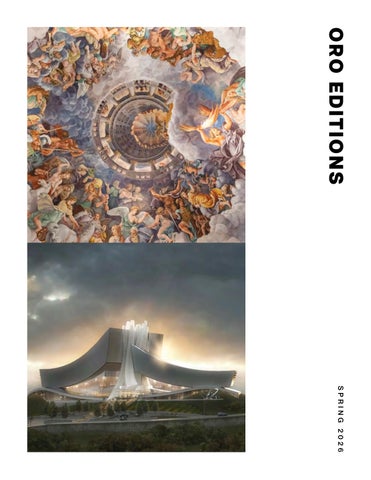
Create a flipbook
Issuu converts static files into: digital portfolios, online yearbooks, online catalogs, digital photo albums and more. Sign up and create your flipbook.