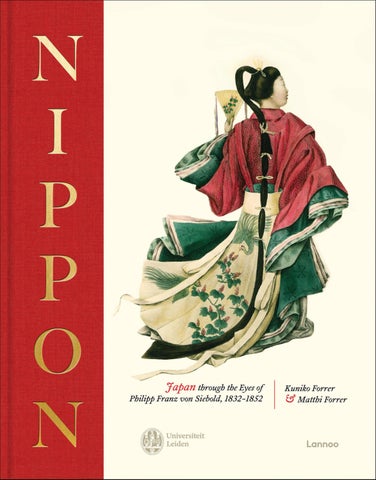
For the miraculous rebirth of Nippon
It is a question that writers o en get asked and the response is o en a denial, but it is true nevertheless: a book really does feel like your baby. e parallels between such a brainchild and a human child are evident: it did not exist before you came up with the idea, you have to let it grow slowly and then, anxious but also full of expectation, you send it out into the world as best you can. I even have a tendency to see not only my own books but also other people’s works as children. Perhaps that is why I always experienced a pang of pity when I thought of Philipp Franz von Siebold’s Nippon, as I have never felt so much compassion for a book as I do for this one.
Nippon was conceived in the mind of its spiritual father in 1826 on the small island of Deshima. is was the Dutch trading post o the coast of Japan, which was still largely isolated from the outside world at that time. Franz von Siebold lived and worked there in the employ of the Dutch government as the trading post’s doctor. As usual, the annual mission from Batavia (modern Jakarta) brought him several books that autumn, including Alexander von Humboldt’s Essai politique sur le royaume de la Nouvelle-Espagne. is French translation of a work about the country now known as Mexico by Franz’s childhood hero and idol (he even named his eldest son a er him) became the blueprint for the comprehensive reference work about Japan that the ambitious young doctor hoped would signify his breakthrough as a scientist and author in Europe. As he had already written somewhat dramatically to his family in Germany in April 1823, while still en route to Deshima: “I now face either death or a happy, honourable life”.
Humboldt was known to be an outstanding cartographer and Franz therefore went on a frenzied search for maps of Japan, which was still virtually terra incognita in Europe at the time. Indeed, his e orts were so frantic that in 1829 he was arrested by the Japanese authorities on suspicion of espionage and banished from the country for life. at merely served to make Nippon, as he had christened his intended masterpiece, all the more important. Franz had been forced to leave not only a country and culture that he had become utterly enamoured with, but also the love of his life – his concubine Sonogi – and their three-year-old daughter Ine. His sorrow was boundless. “I have yet to meet a child as sweet as Ine in all of Java,” he wrote to them in one of his many letters, which were almost literally soaked in tears.
e only hope Franz now had of ever returning to his “happy island” and his family was to become so famous and successful that his exile would be revoked. To achieve that, he needed to produce a book that would outshine all its predecessors and competitors in its depth of knowledge and completeness. Once back in the Kingdom of the Netherlands, which was struggling economically at the time, he did his utmost to realize his megaproject. He even founded his own publishing house and lithographic printing shop, named O cina Sieboldiana. He received nancial support from the Dutch king William I, who hoped that scienti c publications from his own country would help to restore the international prestige that he had lost when Belgium seceded in 1830
As Kuniko Forrer shows later in this book in her superb reconstruction, Franz genuinely spared no expense or e ort to make his literary venture a resounding success. He purchased the latest machinery, brought in top lithographers from far and wide, and rented one of the nest houses on Rapenburg street in Leiden as his home and workplace. He entrusted the sales of the planned volumes of Nippon – no fewer than twenty of them – to agents in Leiden and Amsterdam who, as was customary at the time, marketed the work through a kind of subscription system. How bitterly disappointed he must have been when, as the rst two volumes of the German-language edition rolled o the presses in 1832, only eighty people had been found who were willing to subscribe for a sum of 15 to 25 guilders per volume. For the Dutch translation, which was issued in the autumn of the following year, there were fewer than thirty subscribers.
e disappointing level of interest was partly due to the lack of moderation in Franz’s ambitions. Neither the sheer size of the opus nor the rather pompous subtitle the author had given it exactly encouraged people to read it. Moreover, the Netherlands was not a wealthy country in those years and there was simply no cash for the kind of luxury editions through which Franz was so desperately seeking to acquire money and glory. But there was no turning back and a er the rst volumes had been distributed, the rest also had to be published. His enthusiasm for writing seemed to have faded, though, because from that point on he le the content of both his Nippon and the equally ambitious Flora Japonica and Fauna Japonica to a colourful posse of contributors he had managed to gather around him.
Meanwhile, Franz himself spent months travelling from one European court to the next from the autumn of 1834 onwards, selling subscriptions and thus scraping together an income. In terms of his personal reputation, this tour was de nitely a great success. Wherever he went, monarchs hung on his every word and the genteel ladies all but swooned when they heard the blood-curdling adventures of their handsome and charismatic guest. When he got back home to Leiden in the summer of 1835, however, the number of honours he had received along the way outstripped the number of subscriptions sold by far. By 1838, his money had completely run out and Franz was le with no choice but to dismantle his O cina Sieboldiana. He rented out the ground oor of the building he had bought on Rapenburg to a student association, while he himself withdrew to the upper storeys with his collection of Japanese artefacts, which he had in the meantime sold to the Dutch government.
e volumes of Nippon that had already been printed – six of them by then – su ered a very demeaning and humiliating fate. e book that had come into the world with such high expectations did not even get so much as a discrete honourable retreat via a buyer or a discount second-hand bookshop. e quires, printed with great care and coloured in by hand, were pulled apart and the pages were used to level the walls upstairs. So Nippon pretty much ended up as wallpaper. Just how bad can it get for a book?
However, Franz’s stubborn tenacity was no less boundless than his ambition. A er securing in middle age a young German wife who was both well-heeled and from the nobility, from 1845 onwards he continued writing the Nippon volumes he had promised his few subscribers, with the help of his wife’s brother. However, progress was slow. is was partly because Franz – as his brother-in-law would later note in his own memoirs –was not a particularly brilliant writer and was constantly distracted by things he found more interesting, such as current developments surrounding the Japanese island empire, which remained closed o from the outside world. In 1854, an American expedition led by Commodore Matthew C. Perry succeeded, through a show of brute force, in persuading the Japanese shogun to open up his country. To his considerable frustration, Franz von Siebold played no part in this, but his brainchild Nippon did. Perry reportedly paid no less than 503 dollars for the rst volumes of the book, which were extremely rare due to the small print run.
Five years later, the moment nally arrived: at the age of sixty-three, Franz saw his banishment li ed and he was allowed to return to his lost paradise in the Paci c. Admittedly not in any diplomatic capacity, as he had fervently desired, but as a simple adviser working for the Dutch colonial trading company Nederlandsche Handel-Maatschappij N.V. In the spring of 1859, he boarded the steamship Scotland in Marseille, taking his oldest son, twelve-year-old Alexander, and his dog with him. In addition to six crates of merchandise, his luggage contained no fewer than forty crates of documentation for the remaining parts of Nippon, which he intended to write while in Japan.
According to the travelogue later written by Alexander, his father initially made genuine attempts to complete his life’s work, but soon became preoccupied with something that interested him much more, namely the domestic developments in Japan. at led in 1861 to a brief period of employment as an adviser to the shogun. at rapidly came to an end – largely due to Franz’s total and indeed by then notorious lack of diplomatic skills – and he was expelled from Japan again, this time at the insistence of representatives of the Dutch government. Franz, now aged sixty- ve, was however so convinced that he would be back soon that he le both his son and the forty crates of Nippon material behind in Japan.

Painting on paper depicting a lunch on Deshima in the residence of the opperhoofd, overlooking Nagasaki Bay. Siebold, wearing his green Mailander Mūtze (Milanese cap) from his Moenania student corps, is at the back, carving the meat. Sitting opposite him is Heinrich Bürger and at the head of the table is Carl Hubert de Villeneuve. To Siebold’s left are the opperhoofd De Sturler and then Mesdagh, captain of the Johanna Elizabeth. In the foreground is Bezemer, captain of the Vasco de Gama, in conversation with Eduard de Sturler, son of the opperhoofd, who had come to Deshima to visit his father. Behind Siebold, we see Sonogi and Itose, and Orson is bringing in a new dish. Kawahara Keiga, 1825. Nagasaki, Nagasaki Museum of History and Culture.
He would never again return to the land of his dreams, though. He died in 1866 at the age of seventy, having made himself an unpopular gure with many during his nal years in his desperate and fruitless attempts to re-enter Japan. In the end, it was his two eldest sons who completed Nippon, more or less, and later published an abridged version. However, this seems to have been more in the way of a tribute to their father than as a commercial venture. By then, Franz’s observations about the Japan from which he had been exiled in 1829 had already largely become outdated and irrelevant. Nippon, which once began with such in nite optimism and ambition, thus seemed to be coming to a silent and inglorious end, more than half a century a er its birth.
at makes it all the more wonderful that this unfortunate and awed child is now being given the opportunity to become the public favourite that its spiritual father had envisioned. I give the book a much better chance this time, if only because I have come to know the people who are taking care of it – and they are considerably more loving and responsible parents and less hampered by hubris than Franz von Siebold. I hereby wish the book a wonderful and long new life, surrounded by the admiring readers it deserves.
7 | Nippon I. Tab B V. Gezigt op de haven en de Baai van Nagasaki
This view of Nagasaki Bay shows the arti cial fan-shaped island of Deshima in the foreground. From 1790 onwards, only two Dutch ships were allowed to sail from Batavia to Nagasaki each year. They generally departed in late June or early July and reached Nagasaki after two to three weeks. The two large ships to the right of the island are moored at what was known as the Water Gate, through which all goods were brought ashore and where some 500 or 1,000 piculs of copper could be quickly loaded back on board (1 picul was the weight that one man could carry, set in Japan at about 61 kilograms). The goods brought ashore, such as sugar, spices, sappan wood and various cloths and silks, were weighed immediately and taken to the warehouses. The trading season lasted until 20 November, after which the ships remained anchored for almost another month at Papenberg –the small triangular island beyond the headlands on the right in the picture. The most valuable cargo was stored in the two brick-built, reproof warehouses on the right in the foreground, known as the Lelie and the Doorn, which the Dutch built at their own expense in 1663 and 1671 respectively. Behind them, we see the opperhoofd ’s residence with the double staircase on the outer wall. As we know that it was demolished in 1833, the paintings of Deshima can be dated fairly accurately. Behind on the left is the vegetable garden, with the cowshed and pigsty to its left. In the corner of the island at the bottom left, you can see the large games house with a billiard table on the ground oor. That building was where Siebold was allowed to live, on the rst oor, and to store and study his ever-growing collection. In the foreground on the far left, we can see the rectangular trading post of the Chinese and two Chinese junks.
e people of Deshima and Japanese warfare
Volume 11a & 11b – e People and the State: Physiognomy of the people | Portraits of those close to Siebold | Warfare
A er giving a description of Japan’s geography in Nippon, Siebold gives a picture of its inhabitants in this section. Indeed, he does so fairly literally. Because Siebold had medical training, he came to Deshima in the capacity of trading-post physician. In uenced by physical anthropology, which emerged as a branch of knowledge in the nineteenth century with a particular interest in skull dimensions, Siebold began recording the measurements of the people around him. e exact measurements of his wife Sonogi, who was 1. 42 metres tall, have also been preserved.
is part of Nippon is perhaps the most personal section of the work, as Siebold based his descriptions primarily on the people in his immediate surroundings. He shows the people he worked with on a daily basis, such as the interpreters, a civil servant and some gobanjosi from Deshima, as well as his servant Komaki and his slave Orson. He even depicts his wife Sonogi twice, albeit with the caption “a woman of the Nagasaki middle class” in order to maintain the requisite distance. A er all, he was rst and foremost a scholar and only secondly a husband. Nevertheless, these plates bring us closer to Siebold here than anywhere else in the book. In this sense, it is also interesting to compare the portraits by Wilhelm Gottlieb Tilesius (1769–1857), who accompanied the Russian captain Adam Johann von Krusenstern on his voyage around the world from 1803 to 1806, with those by Carl Hubert de Villeneuve (1800–1874), the European artist whom Siebold had asked to join him in Japan. e latter seem more expressive and more personal. ere is no way of knowing whether this says something about De Villeneuve’s artistic abilities or about the bond that Siebold and the artist shared with their subjects.

An illustration of a Japanese guardhouse by Wilhelm Gottlieb Tilesius, made during his voyage of circumnavigation with Adam Johann von Krusenstern. In A.J. von Krusenstern, Atlas van een reis om de wereld 1803 -1806, 1814.

Siebold was primarily interested in the Japanese physiognomy – the facial structure –from an academic point of view. In his discussion of what he called the “slanted eyes of the Chinese race”, Siebold concluded that this is related to the structure of the skull. Siebold was in fact using the term “Chinese race” as a generic classi cation for Asian peoples including the Japanese. According to him, the frontal bone (os ontis) and facial bones make the nasal bone lie deeper than in the Caucasian race. His detailed analysis shows that he conducted thorough studies of several Japanese skulls, some of which he managed to bring back to the Netherlands. Studying not only those skulls but also the people around him led him to discover that sometimes up to a third of the eye’s outer surface was hidden behind the eyelid and that tears sometimes owed through the nose when the person was crying. He also observed this phenomenon among “Javanese, Makassarese, Eskimos, Portukudese and several other non-European peoples” ( plate 53).
e modern explanation is however di erent, namely that the epicanthic fold in the upper eyelid is caused by larger muscles in the eyelids. ose muscles do indeed run from the frontal bone to the nasal muscles, so Siebold was not far from the mark here. Nowadays, scientists do not associate that with the cranial structure.
Japan’s rst weapons
From his observations about the faces of the Japanese and the inhabitants of Deshima, Siebold’s Nippon moves on to the harsh reality of war. Information about the weapons and warfare of the Far East was naturally very interesting to the pugnacious Western countries. According to Siebold, Japanese weapons were extremely unusual because they had been developed independently of the Asian mainland. e earliest Japanese stone weapons are similar to nds elsewhere in the world ( plates 69-71), but subsequent weapons began to di er. Siebold’s conclusion, based on early depictions of Jinmu Tennō, the legendary rst emperor of Japan, was that the rst weapons must have been Korean in origin. Con icts between the peoples of northern Japan and the earlier
A painting by Kawahara Keiga of the Deshima lookout post with (from right to left): Sonogi with her daughter Ine on her back. Next to her is Orson, Siebold’s Javanese slave. Siebold is wearing the green cap of his Moenania student society. To his left, Heinrich Bürger is looking at a Dutch ship in Nagasaki Bay through a telescope. His wife Otsune is coming up the stairs. 1827, Nagasaki, Nagasaki Museum of History and Culture.
inhabitants of the southern island of Kyūshū drove the followers of Emperor Jinmu to perfect their weapons.
Siebold lists the bow and arrow, spear and lance as the most traditional weapons. In his writings, he gives a detailed discussion of the characteristics of the two-metre bow, which is made of di erent types of wood and bamboo glued together ( plate 61). e arrows were approximately 90 centimetres long and also made from a special type of bamboo. ey were seasoned with oil over a re and etched with feathers from falcons or other birds. Siebold also depicts various arrowheads that had been developed for di erent purposes, including arrows that were only ever used ceremonially on stage. Siebold then goes on to discuss the naginata , a combination lance and sabre that was developed in the eighth century. is weapon, which was between 2.5 and 3 metres in length, could let a soldier take out an opponent from a great range. Even so, this weapon was also largely only used ceremonially. e metal tip of the naginata was therefore usually covered in one way or another. e same applied for spears, yari. ese were reserved exclusively for members of the samurai warrior class, who received an income of at least 200 koku (approximately 2,400 guilders) per year. e samurai carried a long sword, the katana , and a short sword, the wakizashi, together called daishō (‘long and short’). ese swords too were mainly used ceremonially. Ritual suicide, seppuku, required a short sword, and women of the samurai class o en carried a dagger-like knife for self-defence or to take their own lives rather than falling into enemy hands. Siebold also discusses the forging of the sword blades and ornate aspects of the weapons, such as their richly decorated hilts, o en with handles nished with ray skin ( plate 60).


Woodblock print of Emperor Jinmu, the mythical rst emperor of Japan, during his conquest of Japan. A golden bird of prey is depicted on the emperor’s large wooden bow. Watanabe Nobukazu, The Eastern Expedition of Emperor Jinmu ( Jinmu tennō tōsei no zu) 1890-1895. Amsterdam, Rijksmuseum, RP-P-1985-485.
Naginata, made by Naokatsu, c. 1855. Part of a gift from Shogun Tokugawa Iesada to King William III. Leiden, Wereldmuseum, RV-360-7914.
The weapons shown in Nippon are largely based on a series of paintings of weapons and military artefacts by Ōtsuka Hachirō, 1826 -1828. Left: Firearm accessories. Right: Equipment for capturing castles. Leiden, Wereldmuseum, RV-1-4485.
Firearms and gunpowder
It was not until 1543 that the Japanese were introduced to rearms and gunpowder, when a Portuguese ship washed ashore on their coast ( plate 4). Based on those early examples, a merchant called Tachibanaya Jūsaburō from the port city of Sakai is said to have mastered the art of making guns on the island of Tanegashima. But even a er Japan had learned to make rearms, their traditional weapons were not abandoned. ey were not eager to adopt new developments and kept using matchlock guns, which had been introduced to Japan by the rst Portuguese, until well into the nineteenth century ( plates 65.1 and 65.1a).
Cannons were introduced a little later, in 1551, as a gi from the Portuguese to Ōtomo no Muneakira, the ruler of Bungo Province. Shortly a erwards, the Japanese themselves were also casting cannons ( plates 65.12 and 65.13). However, Japan remained an insular country in terms of its weaponry. In 1825, for example, the shogun refused a six-pound artillery piece as a gi from the Netherlands. Conversely, foreigners faced the death penalty for exporting Japanese swords, guns, bows and arrows – or even images of them. Even dolls or models carrying such weapons could not be taken out of Japan, as Siebold was to discover during what is known as the Siebold Incident ( p. 22).
Traditional weapons were retained for a long time because the Edo period (1603–1868) was above all an era of peace. Domestic unrest was limited to some clashes with Christians in Kyūshū (1637–1638), with the peoples living on the northern island of Hokkaidō, and the peasant uprisings of 1836. Ultimately, a civil war involving various aristocratic landowners (daimyō), who wanted to depose the Tokugawa shogun and restore the emperor to his traditional power, led to the Meiji Restoration of 1868. is con ict was not purely internal, as it was also motivated by a wish to yield to foreign pressure to open up Japan. When the samurai class was abolished in 1871, traditional weapons lost their primary function and became status symbols of the past. From that point on, swords of dubious quality were produced on a large scale for a conscript army. e fact that this new army had not been inculcated with the code of honour of the samurai class may also explain the excesses of the Second Sino-Japanese War, which broke out in 1937.


139 | Nippon II. Tab E XVII. Bijwijven van den Mikado
Two women dressed in what appears to be a female version of the suō nagahakama ( plate 142). They had to develop a walking gait in which they carried the train of their kimono behind them. The lady on the right has a Pekinese on a leash. These dogs were popular in Japan from the end of the eighteenth century. She may well be one of the emperor’s concubines (the “bijwijven ” in the plate description), but we only know the lady on the left from an anonymous painting as one of the emperor’s concubines.
140 | Nippon II. Tab E XVIII. Sjôgun
The shogun of Japan, whom Siebold saw on 1 May 1826 during an audience at the shogun’s castle in Edo. He was the military ruler of Japan and had more actual power then than the emperor. During this period, the emperor more or less lived under guardianship in Kyoto. The eleventh Tokugawa shogun, Ienari, ruled from 1787 to 1837. He is dressed in his somewhat old-fashioned kariginu attire, with a sword at his side, a fan in his right hand, and an eboshi on his head.
It is highly surprising that Siebold was able to get Katsuragawa Hoken (1797–1844, alias Wilhelmus Botanicus as his Dutch name) to portray the shogun, his wife ( plate 141), his heir ( plate 135 ), a daimyō and his wife ( plates 142-143 ) and a general on horseback ( plate 76 ). We know that he regularly visited Siebold at the Nagasakiya inn and that he sent him his copy of Tani Bunchō’s book about the mountains of Japan as early as 1825, of which Siebold included several in Nippon ( plates 9-21). Through his position as a physician and a botanist, as well as his interest in archaeology, he had developed a great talent as a painter. We can assume that these paintings are exceptionally reliable portraits. After all, his role as the shogun’s court physician meant he would have been very familiar with these high-status individuals. When the Siebold Incident began to rear its head in late 1828, Siebold managed to keep these portraits – as well as those of the emperor, his wife, concubines and councillors – outside the investigation and had them shipped by Carl Hubert de Villeneuve to Batavia and eventually on to Rotterdam. This allowed these portraits of both the shogun’s retinue and the imperial family to be preserved.


142 | Nippon II. Tab E XX. Hofdragt d. Buge
Two men, both wearing suō nagahakama. They had to adjust their walking gait so that their long trousers were dragged along with every step. The man on the right is wearing a kamishimo with its characteristic broad shoulders, and two swords and he is holding a fan in his hand. On the left is a daimyō, a provincial governor, wearing an eboshi hat and also holding a fan.
143 | Nippon II. Tab E XXI. Eene vorstin
A lady sitting on a wooden oor, dressed in a kimono with plum blossoms. Her hair is styled in two hanging plaits. She has a y swat in her hand. She is the wife of a daimyō, the governor of a province ( plate 142).
141 | Nippon II. Tab E XIX. De vrouw d. Sjôgun
The shogun’s wife, seen from behind, dressed in what appear to be ve kimonos and an obi (?) with stylized phoenixes and blossoms from the Paulownia tree, kiri. Her long hair is tied up in the osuberakashi style and she is holding a fan in her left hand. In 1789, the nineteen-year-old Ienari o cially married Midaidokoro Sadako as his “ rst wife”, but he also had a harem of 900 women and apparently fathered at least 75 children. These children were often adopted into various daimyō families. Given her youthful appearance, it does not seem likely that this will be Sadako, who would have been almost fty by then.
144 | Nippon II. Tab E XXII. Het toilet Several young women in an interior, possibly a tea house with geishas in training. On the far left is a woman washing herself, her upper torso exposed. On the right is a woman having her hair done, and on the left in the foreground, two women sitting in front of mirrors, the one on the right brushing her teeth. Further back are a woman sewing a kimono and another singing while playing the shamisen, a threestringed plucked instrument somewhat like a banjo.
145 | Nippon II. Tab E XXIII. Toiletgereedschappen, schoenen & 1. Tabi, cotton toe socks; 2. Waraji, sandals woven from rice straw; 3–4. Zōri, slippers; 5–8. Various types of geta, used for all footwear with wooden soles; 9. Waraji with woven protection, osōkizōri ; 10–16. Various types of hairpins: the rst one is a kōgai and the others are kanzashi ; 17–19 & 23–26. Various types of combs, kushi ; 20–22. Various types of hairnets for creating fashionable hairstyles; 29. Scissors, hasami ; 30. Tweezers; 31–32. Brushes for applying white powder make-up to the face; 33. A small brush for applying lipstick; 34. An ear speculum, mimigaki, for removing earwax; 35. A toothpick, yōji ; 36. A toothbrush, hamigaki
146 | Nippon II. Tab E XXIV. Hoofdsieraad, waaijers, brieventaschen &
1. The Empress’s crown for o cial occasions; 2–5. Various types of folding fans, sensu or ōgi ; 6–8. Various sti fans, uchiwa, of which number 6 is Korean; 9. A brocade pouch for a mirror and other toiletries; 10–13. Small holders for storing toothpicks; 14. A purse; 15. A tinder box, hiuchibukuro ; 16. A small bag such as the ones young girls carried, danbukuro, decorated with a crane.