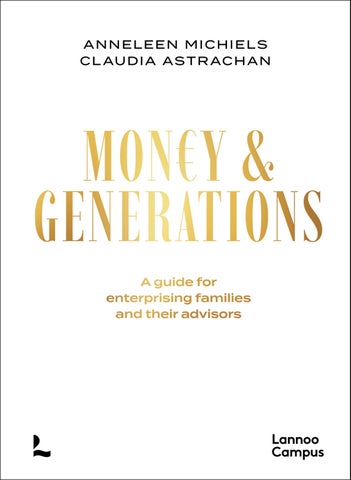
Money & Generations

Page 1


To Joe and Max

About Money & Generations

Sigmund Freud is believed to have said that the greatest depressant to happiness is money as no nice person will speak of it . Anneleen and Claudia, in this wonderful book, are opening up all the arenas for families where money is involved and offering positive ways to talk about it. As I believe Freud was right this book will truly help your family system thrive.

James (Jay) E. Hughes, Jr, author of Family Wealth: Keeping it in the Family; Family the Compact: Among Generations, and co-author of Complete Family Wealth

Money & Generations fills a crucial gap in the family enterprise field, blending academic insight, practical experience, and emotional intelligence. Anneleen and Claudia reveal how unspoken beliefs and family dynamics shape financial decisions. This essential book helps families and advisors build trust, values, and open dialogue to sustain wealth across generations.

Peter Vogel, Professor at IMD Business School and author of the Family Office Navigator

This creative and practical resource is ideal for families, advisors, and family office professionals seeking fresh ways to prepare the next generation for wealth stewardship. Anneleen and Claudia offer field-tested guidance and ageappropriate activities that go beyond theory, grounded in real experience and multi-generational insight. A must-have for your library!

Kirby Rosplock, PhD, author of The Complete Family Office Handbook, Founder & CEO, Tamarind Partners and Founder & CEO, Tamarind Learning

I wish I could have read this book 15 years ago. It might have brought us to the point where we are now with our family office much faster. Truly a valuable book.

Guus van Puijenbroek, Director Strategic & Family Matters, fifth generation family member, VP Capital

Anneleen and Claudia have created a valuable resource on family wealth and enterprise. Money & Generations helps readers explore their money beliefs and offers practical guidance for navigating family dynamics, financial education, and family business fundamentals. With clear insights and real-world examples, this book is an important contribution to families and the field.

James Grubman PhD, author of Strangers in Paradise: How Families Adapt to Wealth Across Generations, and co-author of Wealth 3.0: The Future of Family Wealth Advising

The authors show how financial choices in family enterprises and family offices are inseparable from the human dynamics that shape them. This book is a thoughtful and timely reminder that money, when aligned with purpose and relationships, becomes a powerful force for multigenerational legacy.

Jill Barber, President, CYMI Holdings

Anneleen and Claudia succeed in clearly mapping out the complex dynamics of wealth and family. As a third-generation family member, I appreciate the clear insights that demonstrate how important it is to keep financial interests and perceptions in continuous harmony with long-term vision and values.

Guido Van Herpe, CEO La Lorraine Bakery Group, third generation family member, Chair FBN Belgium

This is an excellent book for three key reasons. First, it is exceptionally well written and thoughtfully designed. Second, it offers practical insights grounded in academic literature, which the authors clearly understand. Third, it tackles taboo topics with clarity and provides outstanding advice.

Adrian Furnham, Professor of Psychology, author and academic

Anneleen and Claudia have created an insightful, practical resource for wealthy families and family enterprises seeking to sustain both their enterprise and their relationships. Money & Generations offers tools to navigate family dynamics, define shared purpose, and foster wellbeing and cohesion. A must-read for families and advisors leading with clarity, purpose, and emotional intelligence.

Money & Generations makes the taboos surrounding money within business families accessible and practical to discuss. With illustrative cases and reflection questions, the book helps families engage in conversations about money in a low-threshold way, enabling them to make better decisions – both emotionally and socially.

Albert Jan Thomassen, Chair FBN Netherlands

INTRODUCTION

This book is not really about money. It is about what money represents and how it manifests in enterprising families: shaping their dynamics, strengthening bonds, or driving them apart. We have all read, watched, and heard the tales of families being torn apart by money – think L’Oréal in the real world and Succession on the screen. While such conflicts are rarely just that – actual disagreements over money – we cannot ignore the profound influence money has on family relationships and decision-making.

Money has the power to both connect and divide, and it can evoke strong emotions ranging from pride to shame, love to envy. How individuals and multigenerational, enterprising families understand, address, and deal with this force determines the difference between harmony and conflict, between sustained success and decline. This is what makes money in a context where family and business overlap so fascinating.

Because money is so much more than just a currency, when enterprising families make important financial decisions, such as those regarding dividends, compensation, loans, investments, or valuations, rational considerations are not the only factors at play. Such conversations, and subsequently decisions, are often unconsciously driven by family members' deeply held beliefs and emotions regarding money and assets. Because these money scripts – individuals’ strongly held beliefs about money – are rarely made explicit, they can lead to misunderstandings, judgment calls, and conflicts that then undermine family harmony.

Moreover, conflicts over money often mask deeper underlying issues. When we take a closer look at what drives conflicts that, on the surface, present as disagreements over money, we soon realize that the actual conflict goes deep into the underbelly of family dynamics, the shared history, perceived injustices, and decades of misunderstanding. Take, for instance, a family board member opposing their cousin’s executive compensation package. On the surface, this may seem like a straightforward business disagreement – but it could just as easily be a way for the family director to voice their frustration over what they

12

perceive as long-standing unfairness in branch dynamics. Similarly, families of wealth sometimes use money to guide behavior. Think, for example, of financially rewarding children for earning educational degrees or 'punishing' undesirable behavior by withholding funds.

The complex interplay between emotional and financial factors makes financial decision-making in enterprising families uniquely challenging. And while cultural differences, ownership structures, such as publicly traded versus fully private enterprises, and company size certainly play a role, the underlying family dynamics and emotions often reveal striking similarities. This book offers universal lessons applicable to a broad range of business families, regardless of their size or location, the industries they operate in, or the structure of their ownership group.

As researchers and consultants for the past fifteen years, we have studied and guided the complex relationship between money, family, and enterprise. Through teaching, research, and advising enterprising families around the world, we have learned from hundreds of families and their advisors. These experiences and insights form the foundation of this book, which is enriched with scientific research and illustrated with anonymized practical examples.

Our book offers practical tools for everyone involved with enterprising families, whether you are a (future) owner, director, manager, consultant, or researcher. It provides a framework for identifying and addressing the often-invisible dynamics surrounding money. The goal is to help families and their advisors develop a more conscious and constructive approach to financial matters. By doing so, money can remain a means of creating value rather than a source of conflict. This is what the book offers:

• Part I explores the psychology of money within families. What unconscious money beliefs shape your family dynamics? How do these beliefs influence financial decisions – both big and small? And most importantly, how can families pass down not just wealth to the next generation, but also the mindset and skills needed to manage it wisely?

• Part II applies these insights to real-world challenges. From dividend policies and executive compensation to family offices, each chapter connects technical financial matters with the emotional and relational

dynamics at play in families, offering tools to build sustainable, longterm strategies.

While this book covers a broad range of topics, its goal is not to examine each in exhaustive detail, but rather to offer a comprehensive overview of the many facets of financial management in enterprising families. The intention is to clarify the relationships between different aspects and to provide a solid basis for further in-depth study of specific topics. Given the broad target audience of this book, the ‘Finance 101’ appendix provides a concise introduction to key financial terms and concepts for readers looking to refresh their basic knowledge.

With this book, we wanted to create a resource that is both theoretically rigorous and practically accessible for enterprising families and their many stakeholders. Understanding how money is embedded in family relationships, how it influences interactions, and how it shapes decision-making is a crucial step toward building resilience and ensuring long-term success.

A common Dutch saying suggests that “You should walk with your family, not do business” or in English, “Don’t mix family and business.” While there are plenty of stories of family businesses gone wrong, there are even more examples of enterprising families building communities, driving innovation, and creating positive change through bold investments and a commitment to the long term. Enterprising families play a role in building and maintaining societies and economies around the world. As educators, researchers, and advisors, we want to give them tools to have difficult conversations to strengthen their family bonds, reduce conflict, navigate financial decision-making more effectively, and ultimately increase their chances of long-term success and harmony.

Our goal is to encourage enterprising families to not just walk, but to climb mountains together, and to courageously stay in business together despite the occasional emotional turmoil they may encounter – because they know that their shared values and goals, and their ability to have difficult conversations, make them capable of not just ‘running towards the hard stuff’, but to come out whole on the other side.

PART I ROOTS & VALUES

CHAPTER 1

FAMILY & FINANCE HOW MONEY SHOWS UP IN THE ENTERPRISING

FAMILY

“Money is probably the most emotionally charged subject in our modern lives: only food and sex come close in terms of intensity and diversity of feelings, meanings, and desires.”

Krueger, 19861

In this first chapter, we provide readers with a foundational understanding of the unique characteristics and functioning of enterprising families. We begin discussing the role that money plays in the family system and how, intentionally or without intent, it can shape the financial and non-financial decisions enterprising families make.

How money shows up in the enterprising family

Have you ever experienced or heard about situations like these within your own family or others you know?

• At the annual family shareholder meeting, tensions flare as family shareholders clash over financial priorities. Those actively involved in the business or serving on the board push to reinvest profits, emphasizing the need for repairs and growth to secure the company’s long-term

success. Meanwhile, passive shareholders advocate for increasing their modest dividends, feeling their legitimate financial expectations are being ignored. Who is in the right? And more importantly – how can families navigate these competing priorities without eroding trust?

• Steven, the 22-year-old son of a wealthy entrepreneur, dreams of becoming a teacher. While his parents appreciate his passion for education, they attempt to steer him toward a career in law, promising financial incentives to pursue the more lucrative path with better advancement opportunities. “On a teacher’s salary,” they say, “you’ll never be able to afford the lifestyle you’ve become accustomed to – the traveling, dining out, a nice apartment. And we won’t always be here to financially support you.” Do they have a point? Or are they prioritizing wealth over well-being?

• Laura, a talented rising-gen, joined the family enterprise at her mother’s and uncle’s urging, turning down an exciting outside opportunity after graduating top of her class at a prestigious university. For six years, she accepted a below-market salary for her demanding role, reassured that she would “inherit some of it one day anyway”. As the oldest of her cousin group, Laura also felt a strong sense of responsibility to carry on the family legacy and hoped her example might inspire other cousins to join the business. But after years of feeling undervalued and unappreciated, and frustrated by the lack of interest from her cousins, Laura decides to leave. Her departure sparks a heated argument with her mother, who accuses her of abandoning her responsibilities. Is her mother right to feel let down? Or has Laura given enough?

These three examples reflect the complex and often deeply personal ways in which money intersects with identity, responsibility, and family dynamics in enterprising families. Each story illustrates a different yet common tension in family enterprises: the shareholder dispute illustrates the inevitable friction that occurs when business and family – collective or individual – needs and expectations clash. Those working in the business prioritize reinvestment for long-term growth, while passive shareholders, who are typically disconnected from dayto-day operations, focus on immediate returns. Steven’s story reveals the tension between personal fulfillment and family expectations. His parents use financial incentives to attempt to steer him toward a more lucrative career, highlighting the power of money to influence life choices – and the underlying fear that passion alone will not sustain financial security, which they feel should be prioritized.

And lastly, Laura’s experience underscores the problems frequently arising from role confusion, in this case, not clearly separating Laura’s role as a dividend-receiving owner and a salaried employee. Instead of basing her compensation on her experience and capabilities, her mother and uncle feel that because of her future ownership, she should accept a lower salary. Her willingness to accept this, over time, leaves her feeling undervalued, ultimately prompting her to leave.

Mixing money and family often creates a forced attachment in enterprising families. Money binds as much as it divides: the family enterprise provides financial security and, therefore, binds family members to each other and the company from an early age. Family members remain connected, sometimes against their will, through dividends or employment. Financial dependence has two sides. On one hand, family members may feel assured by the economic stability provided by the family business. On the other, they may feel trapped in a system where financial business decisions have deeply personal outcomes, and where every move within the business is closely monitored by other family members. Family members may find themselves in a double bind – longing to break free from their golden cage yet risking family bonds (as well as the financial comfort and security they have grown used to) in the process.

The three examples above reveal the profound psychological charge that money carries in enterprising families. Beyond its financial function, money often plays an emotional role, as it can be used to incentivize, motivate, or even coerce. In doing so, it tends to amplify existing family dynamics, power struggles, and unresolved tensions. In this book, we explore how tensions around money emerge, how they shape relationships, and what families can do to build financial systems that foster trust, respect, and long-term success. By understanding the underlying issues behind these stories – whether it is unmet expectations, perceived injustice, or the struggle for independence – families can make better decisions about wealth, responsibility, and their collective future.

Money: The great ‘magnifier’

The truth is, for most of us, money is hardly ever just money – it is a deeply symbolic concept, tied to a wide range of emotions and associations, some of which are conscious, many not. The more we understand our emotional relationship

Turn static files into dynamic content formats.
Create a flipbook
Issuu converts static files into: digital portfolios, online yearbooks, online catalogs, digital photo albums and more. Sign up and create your flipbook.
Money & Generations by ACC Art Books - Issuu