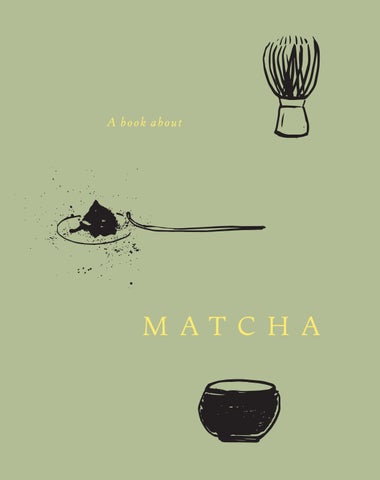
A b o ok a b ou t
M ATCHA
INDEX
4
A B OW L WO R T H S LOW I N G D OW N FO R
Chapter 01
8
A B OW L O F G R E E N
Chapter 02
18
T H E L E A F T H AT C H A N G E D J A PA N
Chapter 03
28
THE ART OF TEA
Chapter 04
38
F R O M F I E L D TO B OW L
Chapter 05
50
SHADES OF GREEN
Chapter 06
60
T H E L A N G U AG E O F M ATC H A
Chapter 07
72
B E YO N D T H E B OW L
Chapter 08
82
A NEW RITUAL
Chapter 09
94
THE FUTURE IS GREEN
Chapter 10
106 R E C I P E S
Chapter 11
148 R E STA U R A N T S 170 CREDITS
MATCHA 3
A B OW L OF GREEN There are few ingredients that have travelled the world quite like matcha.
ONCE KNOWN ALMOST EXCLUSIVELY within Japan, this finely ground green tea has become a familiar sight in cafés, restaurants and homes across the globe. Its unmistakable colour appears in everything from carefully whisked ceremonial bowls to morning lattes, delicate pastries, artisan chocolates and contemporary cocktails. What was once considered a niche ingredient has evolved into an international symbol of craftsmanship, wellness and modern café culture. Its popularity has been remarkable, but its success is hardly accidental. At first glance, matcha seems perfectly suited to contemporary tastes. It is visually striking, endlessly versatile and naturally photogenic—qualities that have undoubtedly helped propel it into the global spotlight. Yet reducing matcha to its vibrant green appearance or its presence on social media would overlook the very reasons it has captivated people for centuries. Behind every bowl lies a tradition shaped by patience, precision and an appreciation for the quiet rituals that transform ordinary moments into meaningful ones. 10 MATCHA
MATCHA 11
THE LEAF T H AT CHANGED J A PA N Few people realise that matcha’s story does not begin in Japan.
ITS ORIGINS lie across the East China Sea, where tea had already been cultivated and enjoyed for centuries before it ever reached the Japanese islands. During China’s Tang Dynasty (618–907), tea had become an important part of daily life, celebrated by scholars, monks and poets alike. By the time of the Song Dynasty (960–1279), preparing powdered tea by whisking finely ground leaves into hot water had become a refined practice among the Chinese elite. It was elegant, meditative and deeply connected to the intellectual and artistic life of the period. Among those who encountered this tradition were Japanese Buddhist monks travelling to China in search of religious knowledge. They returned home carrying far more than sacred texts. Along with new philosophies, architectural ideas and artistic influences came tea seeds and the methods of preparing powdered tea—small introductions that would eventually reshape Japanese culture in ways few could have imagined. One name stands above all others in this story: Eisai. 20 MATCHA
MATCHA 21
THE ART OF TEA To many first-time visitors, the Japanese tea ceremony can seem almost mysterious.
THE MOVEMENTS are slow and deliberate, the room remarkably quiet, and every action appears carefully choreographed. Water is poured with precision, utensils are handled with reverence, and even the smallest pause seems intentional. Without understanding the philosophy behind it, the ceremony can easily be mistaken for an elaborate performance. It is anything but. At its heart, the tea ceremony is not about perfection, nor is it simply a method of preparing matcha. It is an expression of hospitality. Every decision made by the host—from the choice of bowl and flowers to the hanging scroll in the alcove and the sweets served before the tea—is made with a single purpose: to create a meaningful moment for the guest. Nothing is accidental, yet nothing is intended to impress. The greatest host is often the one whose care is felt rather than noticed. This understanding of tea reached its fullest expression during the sixteenth century through the teachings of Sen no Rikyū, the tea master whose influence still shapes Japanese culture today. While earlier generations had often associated tea gatherings with displays of wealth and imported luxury, Rikyū believed that true beauty could be found in simplicity. Rather than polished Chinese porcelains, he favoured humble Japanese ceramics with uneven glazes and imperfect forms. Instead of grand reception halls, he designed intimate tea rooms where host and guest sat close together, free from status or distraction. His vision transformed tea from a social occasion into a philosophy. 30 MATCHA
MATCHA 31
SHADES OF GREEN The first encounter with matcha is almost always visual.
BEFORE ITS AROMA unfolds or its flavour reaches the palate, the eye makes its own quiet assessment. A bowl of exceptional matcha seems to glow from within, its surface displaying a vivid, almost luminous green unlike any other tea. It is a colour that suggests freshness, vitality and careful cultivation, inviting curiosity before a single sip has been taken. For centuries, experienced tea masters have understood that appearance offers the first clues to quality. While colour alone never tells the entire story, it often reveals how the tea was grown, harvested and processed. The finest ceremonial matcha displays a vibrant emerald hue, the result of careful shade cultivation that encourages the tea plants to produce generous amounts of chlorophyll. Lower grades, by comparison, gradually lose that brilliance, taking on duller olive or yellow-green tones that hint at older leaves, increased sunlight or different production methods. Yet appearance is only the beginning. 52 MATCHA
THE L A N G UAG E O F M ATC H A Walk into a traditional Japanese tea room and you will notice something remarkable. There is very little to see.
UNLIKE MANY CULTURES that celebrate abundance, the tea room embraces restraint. The space is intentionally uncluttered, allowing every object to assume a quiet importance. A single flower arrangement may decorate the alcove. A hanging scroll might offer a seasonal poem or a Zen calligraphy. The utensils are placed with care, each occupying its own deliberate position. Nothing feels decorative for decoration’s sake. Every object belongs. This simplicity is no coincidence. For centuries, the Japanese Way of Tea has celebrated the belief that beauty emerges when nothing unnecessary remains. The utensils used to prepare matcha embody that philosophy perfectly. Although each has a distinct purpose, they also reflect generations of craftsmanship, regional traditions and an enduring respect for natural materials. Together, they form a language understood by tea masters across Japan—a vocabulary spoken not through words, but through quiet gestures and carefully chosen objects. 62 MATCHA
MATCHA 63
B E YO N D T H E B OW L Few ingredients have crossed cultural boundaries as gracefully as matcha.
FOR CENTURIES, its world was defined by temple gardens, tea houses and carefully observed rituals. It belonged to Japan not simply because it was grown there, but because it reflected a distinctly Japanese way of seeing beauty, craftsmanship and hospitality. Its preparation was intimate, its traditions carefully preserved and its purpose deeply rooted in everyday life. Few could have imagined that this vivid green powder would one day become one of the world’s most recognisable ingredients. Yet that is precisely what happened. During the past two decades, matcha has experienced a remarkable transformation. Once known primarily among tea practitioners and Japanese households, it has become a familiar presence in speciality cafés from Melbourne and Copenhagen to New York, London and Seoul. Baristas whisk it into oat milk, pastry chefs fold it into laminated dough, chocolatiers pair it with white chocolate and citrus, while bartenders explore its earthy complexity in cocktails that bridge East and West. Matcha has become both ingredient and inspiration, equally at home in traditional tea bowls and contemporary tasting menus. Its success is often explained through changing food trends or growing interest in Japanese cuisine, but those factors tell only part of the story. 74 MATCHA
MATCHA 75
A NEW R I T UA L Every culture has its rituals.
SOME ARE CENTURIES OLD, passed quietly from one generation to the next. Others emerge almost unnoticed, shaped by the rhythms of everyday life rather than tradition. We gather around dinner tables, light candles as evening falls, grind coffee before sunrise or bake bread on slow Sunday mornings. These small, repeated actions often appear ordinary, yet they give structure to our days and meaning to moments that might otherwise pass unnoticed. Preparing matcha belongs to that same timeless tradition. While the Japanese tea ceremony represents one of the world’s most refined ritual practices, the appeal of matcha has never depended upon formal ceremony alone. Today, millions of people prepare it in their own kitchens with no intention of recreating centuries-old traditions. They whisk tea before work, after exercise, while reading a book or during a quiet afternoon break. The surroundings have changed, but the impulse remains remarkably familiar: to create a small pause within the flow of everyday life. Perhaps that explains why matcha has found such a natural place in contemporary culture. 84 MATCHA
MATCHA 85
THE FUTURE IS GREEN Few traditions have travelled as far as matcha while remaining so deeply connected to their origins.
ACROSS JAPAN, the rhythms of production have changed remarkably little over the centuries. Tea bushes are still shaded before harvest. The youngest leaves are still selected with extraordinary care. Steam still arrests oxidation within hours of picking, preserving the vibrant colour and delicate flavour that define the finest teas. Granite mills continue to turn slowly, producing only a handful of grams each hour. In an age increasingly defined by automation, matcha remains one of the world’s most labour-intensive agricultural products. Yet the world surrounding it has changed dramatically. Demand for high-quality matcha has grown at a pace few producers could have anticipated. What was once a relatively specialised domestic product has become an international ingredient sought by cafés, restaurants, retailers and home enthusiasts across every continent. This growing appreciation has brought new opportunities to tea-producing regions, introducing younger generations to an industry that, until recently, faced an uncertain future. 96 MATCHA
M ATC H A G R E E N T E A M U F F I N S
12
15 min.
18-20 min.
INGREDIENTS
INSTRUCTIONS
1 cup whole wheat flour
Preheat your oven to 180°C. Line a muffin tin with paper liners or grease it lightly.
Divide the batter evenly among the muffin cups, filling each about ⅔ full.
In a large bowl, whisk together the whole wheat flour, oat flour, coconut sugar, matcha powder, baking powder, baking soda, and salt.
Bake in the preheated oven for 18–20 minutes or until a toothpick inserted in the center comes out clean.
½ cup oat flour (or blend rolled oats in a blender until fine) ¼ cup coconut sugar (or your preferred sweetener) 1 tablespoon matcha green tea powder 1 teaspoon baking powder ½ teaspoon baking soda ¼ teaspoon salt ½ cup unsweetened applesauce ¼ cup almond milk (or any plant-based milk) ¼ cup plain Greek yogurt (or a non-dairy alternative) 1 teaspoon vanilla extract 1 large egg (or a flax egg for a vegan option)
Optional add-ins ½ cup dark chocolate chips (preferably 70% cacao or higher) ½ cup chopped nuts
In another bowl, mix the applesauce, almond milk, Greek yogurt, vanilla extract, and egg until well combined.
Allow the muffins to cool in the pan for 5 minutes, then transfer them to a wire rack to cool completely.
Pour the wet ingredients into the dry ingredients and stir until just combined. Be careful not to overmix. If you’re adding any optional ingredients, such as chocolate chips or nuts, fold them in gently.
(such as walnuts or almonds) ¼ cup dried fruit (such as cranberries or raisins) 108 MATCHA
MATCHA 109
M o re t h an a d ri n k , m a t cha i s a r i tual— a mome nt of st il l n e ss in a n i n crea s i n gly hur r i e d wor ld. F rom the tea ho use s o f K yo to to c o n te mporar y c afé s i n Se oul, Pa r is a n d N e w Yo rk , m a tc ha has be c ome a s y mbol of c raf t sm a n s h i p , m i n d f u lne s s an d re fi ne d tas te . B e au t if ul ly i llu s tra te d t h roughout, M atc ha exp l o re s t h e tra d i t i o n s b ehi n d fi ne ly ground gre e n tea, t h e a rti s a n s w h o h a ve pe r fe c te d i t, and the ca f é s re d e f i n i n g h o w i t i s e n joy e d today . M ore th an a jo u rn e y t h rou gh re mar k able plac e s , i t i s a cel e bra t ion o f b ea u ty, s i mpli c i ty an d the e n dur i n g ap p e a l o f on e of t h e w o rld ’s mos t e le gant tradi ti on s .