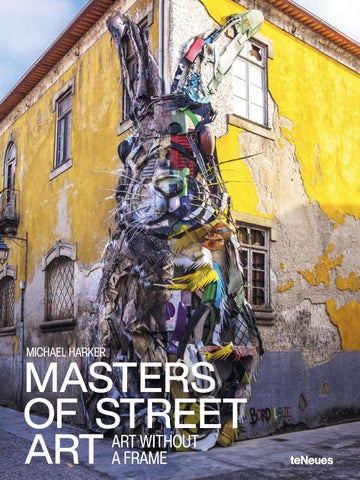
MASTE
R S OF ST R EET
ART ART WITHOUT A FRAME
MICHAEL HARKER

2/3: Mena, SaĂ” Paulo
4/5: Shepard Fairey, The Mosaic of Peace and Harmony, Singapore
6/7: Okuda, SaĂ” Paulo
8/9: Louis Masai, Swimming Towards a New Existence, Turin
10/11: Ernest Zacharevic, Singapore
12/13: Jacoba Niepoort / Bifido, Playground Love, Vienna
14: Senkoe, Vienna
15: Boaz Untay, Vienna
16/17: Gonçalo MAR, Defend the Deep, Lisbon
18/19: Vhils, SaĂ” Paulo
20/21: Kamlaurene, Paris


walls SolitÀre WÀnde

24/25: Jef Aerosol / Choofy / Shepard Fairey / Invader, Paris
27: Jef Aerosol / Choofy, Paris
Quinta do Mochoââ Europeâs Largest Gallery Quinta do Mocho: âDie gröĂte Galerie Europas
The municipality of Loures, located northeast of Lisbon, harnessed the creativity and inspiration of street artists to transform a socially disadvantaged area into a massive open-air gallery, which has profoundly changed the lives of residents in the Quinta do Mocho neighborhood. The high-rise housing project was constructed in the 1990s to provide housing for people who had previously occupied a nearby slum. They were primarily from the former Portuguese colonies in AfricaâââCape Verde, Guinea, Mozambique, and Angola. The area was quickly crime-infested, and social exclusion and unemployment shaped everyday life.
The Neighborhood and the World, the first street art project in Quinta do Mocho (Owl Quarter), involved a handful of invited artists who colorfully redefined the drab walls of the high-rise buildings. The initiative was well received by residents; they could now identify more strongly with their surroundings. Young people from the neighborhood offered tours, and visitors from all over the world came to participate. Since then, crime has decreased, and the people who live here have developed a sense of pride for their quarter. This initiative has continued to thrive and gradually developed a more festival-like character. Since 2016, the Quinta do Mocho âgalleryâ has been part of the Loures Arte Publica project. New works are added each year, further shaping Europeâs largest open-air museum. By 2020, there were 108 large murals by artists from throughout the world.
Die Gemeinde Loures nordöstlich von Lissabon nutzt die KreativitĂ€t und Inspiration der Street-Art-KĂŒnstler, um einen sozialen Brennpunkt in eine riesige OpenAir-Galerie zu verwandeln, die das soziale Leben im Viertel Quinta do Mocho nachhaltig verĂ€ndert hat. Die Hochhaussiedlung entstand in den 1990er-Jahren um Menschen, die sich in der NĂ€he in einem Slum angesiedelt haben und hauptsĂ€chlich aus den ehemaligen portugiesischen Kolonien in Afrika â Kap Verde, Guinea, Mosambik und Angola â stammen, ein Zuhause zu geben. Das Gebiet weist schnell eine hohe KriminalitĂ€tsrate auf, soziale Ausgrenzung und Arbeitslosigkeit prĂ€gen den Alltag.
An der ersten Street-Art-Aktion The Neighbourhood and the World in Quinta do Mocho [Viertel der Eule] nehmen eine Hand voll eingeladener KĂŒnstler teil, um die tristen WĂ€nde der HochhĂ€user zu gestalten. Die Initiative kommt bei den Bewohnern gut an, sie können sich nun stĂ€rker mit ihrem Quartier identifizieren, Jugendliche aus der Nachbarschaft bieten FĂŒhrungen an, Besucher aus aller Welt kommen hierher, die KriminalitĂ€t ist gesunken und die Bewohner empfinden so etwas wie Stolz fĂŒr ihr Wohnviertel. Die Aktion wird ĂŒber viele Jahre fortgesetzt und bekommt Festivalcharakter. Seit 2016 ist die âGalerieâ von Quinta do Mocho Teil des Projektes Loures Arte Publica. Von Jahr zu Jahr kommen neue Werke dazu und formen das gröĂte Open-Air-Museum Europas. Im Jahr 2020 sind es 108 groĂe Murals von KĂŒnstlern aus aller Welt.


64 Quinta do Mochoââ Europeâs Largest Gallery Quinta do Mocho: â Die gröĂte Galerie Europas

Jo di Bona, Lisbon â Quinta do Mocho
Female Figures as Symbols of Coexistence
Frauenfiguren als
Zeichen
des Miteinanders
In street art, we often encounter strong female figures. They represent motherliness, a connection to our earth, as well as a diverse and multicultural society with nature.
At the Ourcq Living Colors festival in Paris, Ghanaian Moh Awudu created a portrait of a proud African woman wearing an entire city, a culture, as an earring. As an accompaniment to this work was one of Kaldeaâs Asian-inspired portraits of women, who is also a street artist. Around the corner, a girl from Vinie muses. Her thoughts, inscribed in her hair, are a homage to the festival and its founder, Da Cruz, who is also a street artist. For Sitou Matt, who comes from Togo, the search for co-existential harmony is his artistic impetus. The recurring chameleon in his works serves as a symbol for adaptation to diversity. Huarius Mother, on the other hand, refers to 250,000 child soldiers and their terrible fate. In Vienna, she holds vigil over a childrenâs playground. Arranged around the face of the young woman in Jacqueline de Montaigneâs mural in Lisbon are ten blossoms and flowers, considered in earlier times to be bearers of love.
The ethereal female figure by Jana & Js in the Portuguese city of Leiria is turned away from the viewer. This mural may have been inspired by one of the photographs the artist duo takes at the locations where they work, and which very often portray residents. The figure appears lost and isolated in front of the cityâs architecture.
In der Street-Art begegnen uns sehr hĂ€ufig starke Frauenfiguren. Sie stehen fĂŒr MĂŒtterlichkeit, fĂŒr Erdverbundenheit, aber ebenso fĂŒr eine bunte multikultu rel le Gesellschaft. Sie demonstrieren das Miteinander von Menschen ebenso wie das Miteinander von Menschen und Natur.
Der Ghanaer Moh Awudu realisiert auf dem Ourcq Living Colours Festival in Paris das PortrĂ€t einer selbstbewussten afrikanischen Frau, die eine ganze Stadt, eine Kultur, als Ohrring trĂ€gt. Dazu gesellt sich eines von Kaldeas asiatisch angehauchten FrauenportrĂ€ts mit dem fĂŒr sie so typischen Mund. Um die Ecke sinniert ein MĂ€dchen von Vinie. Ihre in das Haar eingeschriebenen Gedanken sind eine Hommage an das Festival und seinen BegrĂŒnder Da Cruz, der selbst Street Artist ist. FĂŒr den aus Togo stammenden Sitou Matt ist die Suche nach Harmonie im Zusammenleben kĂŒnstlerischer Antrieb. Als Symbol der Anpassung an die Vielfalt taucht in seinen Arbeiten immer wieder das ChamĂ€leon auf. Huarius Mother verweist auf 250.000 Kindersoldaten und ihr schreckliches Schicksal. In Wien wacht sie ĂŒber einem Kinderspielplatz. Um das Gesicht der jungen Frau in Jaqueline de Montaignes Mural in Lissabon sind zehn BlĂŒten und Blumen angeordnet, die in frĂŒheren Zeiten als Ăberbringer von Liebesbotschaften galten.
Die Ă€therisch wirkende Frauenfigur von Jana & Js in der portugiesischen Stadt Leiria wendet sich vom Betrachter ab Vorbild hierfĂŒr ist womöglich eine der Fotographien des KĂŒnstlerduos, die an den Orten ihres Schaffens entstehen und sehr oft Bewohner portrĂ€tieren. Die Figur wirkt verloren und isoliert vor der Stadtarchitektur.


127 126/127: Gonçalo MAR, Vulpes vulpes, Setubal (Portugal)
Dream Worlds âTraumwelten
In addition to various socially critical themes, street art often incorporates pure, even innocent fantasies that reflect dreamlike worlds. Many of these depictions possess a magical, fairytale quality, creating illusions that stimulate the viewerâs imagination. Artists like ENIVO and Alex Ferror portray fairy tale characters, while other works offer actual dream landscapes, each allowing ample room for personal interpretation and creativity.
Utopia features charming and subtly smiling girls surrounded by colorful globes that have expressive faces, reflecting different moods. Whether these spheres represent the girlsâ thoughts is left to the viewerâs interpretation. In Setubal, an underwater elf holds similar globes while water lilies and fish swirl around her hair, adding to the enchanting scene.
Kruella dâEnfer also explores mysterious and enigmatic narratives through her surreal and sometimes abstract artwork. In her works, animal and plant motifs are just as significant as constellations and galaxies. One mural in Lisbon is part of a map for the video game Valorant, pointing out the effects of climate change. This scene depicts a city transformed into a place where underwater plants coexist with elements of the natural world.
Neben sozialkritischen Themen findet immer wieder auch die mitunter kindlich-naive Fantasie in Form von Traumwelten Eingang in die Motive der Street-Art. Manchen Darstellungen haftet etwas Magisches, MĂ€rchenhaftes an. Sie erschaffen Welten, die dem Betrachter Raum fĂŒr eigene Fantasie lĂ€sst. Ob MĂ€rchenfiguren wie bei ENIVO oder Alex Ferror oder tatsĂ€chlich Traumwelten â fĂŒr die Fantasie des Betrachters bleibt viel Raum.
Utopias charmant-hintergrĂŒndig lĂ€chelnde MĂ€dchengesichter sind oft umgeben von bunten Kugeln mit ausdrucksstarken Gesichtern, die unterschiedliche Stimmungen zu zeigen scheinen. Ob sie die Gedanken des MĂ€dchens widerspiegeln, bleibt dem Betrachter ĂŒberlassen. Auch die Unterwasserelfe in Setubal hĂ€lt solche Kugeln in der Hand, wĂ€hrend Seerosen und Fische ihr Haar umspielen.
Geheimnisvolle und rĂ€tselhafte Geschichten sind es auch, die Kruella dâEnfer beschĂ€ftigen. In ihren surrealen, teilweise abstrakten Arbeiten spielen Tier- und Pflanzenmotive eine ebenso wichtige Rolle wie Sternbilder und Galaxien. Das Mural in Lissabon gehört zu einem Plan fĂŒr das Computerspiel Valorant, dessen Konzept es ist, den Klimawandel sichtbar zu machen. Die Szenerie zeigt, dass die Stadt nun ein Ort fĂŒr Unterwasserpflanzen geworden ist, die jetzt gemeinsam mit Objekten der portugiesischen Tradition, etwa dem Instrument und architektonischen Elementen, existieren.


Shepard Fairey, Carga FrĂĄgil, SĂŁo Paulo
Threatened World Bedrohte Welt
One of the major themes in street art is humanityâs treatment of the environment, such as nature, animals, and our natural resources. Many artists focus their work on these issues. Additionally, social factors such as human coexistence and the impact of war also play significant roles in this art form.
At the second United Nations Conference of the Sustainable Ocean Alliance in Lisbon, Gonçalo MAR created a poignant, haunting mural titled Defend the Deep. It warns us all that the exploitation of the oceans, particularly the effects of deep-sea mining, will have its terrible consequences: the terror and fear vividly portrayed on the faces of the creatures he depicts.
Similarly, Rocket 01 titled his massive mural in Lisbon, located behind Parque das NaçÔes, The World in Our Hands. In this artwork, natureââârepresented by animals from the elements of air, water, and earthâââforms a crown around a female figure symbolizing humanity. A helmet is on her head and has buttons featuring symbols for âpeaceâ and ârecyclingâ on her jacket, and she holds the world protectively in her arms, entwined with flowering plants.
Another notable piece is These Sunsets Are to Die For by Shepard Fairey, a 114-meterlong mural located on Heckenstallerstrasse in Munich. This mural uses dramatic imagery to highlight humanityâs dependence on fossil fuels and the resulting devastation of the planet. Over 100,000 vehicles pass by this spot every day.
Eines der ganz groĂen Themen der StreetArt ist der Umgang des Menschen mit der Umwelt, der Natur, den Tieren und damit nicht zuletzt mit seinen eigenen Ressourcen. Viele KĂŒnstler haben ihre Arbeiten diesem Thema verschrieben. Auch soziale Aspekte wie menschliches Zusammenleben und Krieg spielen eine groĂe Rolle.
AnlĂ€sslich der zweiten âUnited Nations Conference of Sustainable Ocean Allianceâ in Lissabon schuf Gonçalo MAR das eindringliche und erschreckende Wandbild Defend the Deep das vor der Ausbeutung der Ozeane warnt, vor allem vor dem SchĂŒrfen in der Tiefsee. Schrecken und Angst sind seinen Kreaturen buchstĂ€blich ins Gesicht geschrieben.
The world in our hands betitelt Rocket 01 seine riesige Arbeit in Lissabon hinter dem Parque das NaçÔes: Hier umkreist die Natur â Tiere aus den Elementen Luft, Wasser, Erde â den Menschen. Die Frauenfigur, die fĂŒr die Menschheit steht, trĂ€gt Buttons mit Symbolen fĂŒr âPeaceâ und âRecyclingâ auf ihrer Jacke. In ihren Armen hĂ€lt sie schĂŒtzend die Welt, umrankt wird sie von blĂŒhenden Pflanzen.
These Sunsets Are To Die For von Shepard Fairey, ein 114 Meter langes Mural an der HeckenstallerstraĂe in MĂŒnchen, fĂŒhrt mittels drastischer Bildwelten den Umgang des Menschen mit fossilen Brennstoffen und damit die Zerstörung der Welt vor Augen. An dieser Stelle kommen tĂ€glich ĂŒber 100.000 Fahrzeuge vorbei.


282 Tamara AlvesâââWounds Tamara Alves â Verletzungen

283 282/283: Tamara Alves, Viseu
MASTERS OF STREET ARTâââArt without a Frame
MICHAEL HARKER
This book was conceived, edited, and designed by teNeues.
Conception, Introduction and Texts by Dr. Suzanne BĂ€umler
Foreword by Jakob Kattner
Edited by Katrin GĂŒnther
English Adaption by Michael Edward Troy
Proofread by Benine Mayer, teNeues
Editorial Management by Dr. Johannes Abdullahi, teNeues
Design by Marcus Taeschner
Layout by Marcus Taeschner
Photo Editorial by Jens Grundei
Production by Nele Jansen, Sandra Jansen-Dorn, teNeues
Printed in Bosnia-Herzegovina by GPS
Made in Europe
FSC LOGO
FSC LOGO
Published by gestalten, Berlin 2025
ISBN 978-3-96171-697-5
1st printing, 2025
© teNeues, an Imprint of Die Gestalten Verlag GmbH & Co. KG, Berlin 2025
All rights reserved. No part of this publication may be reproduced or transmitted in any form or by any means, electronic or mechanical, including photocopy or any storage and retrieval system, without permission in writing from the publisher.
Respect copyrights, encourage creativity!
For more information, and to order books, please visit www.teneues.com and www.gestalten.com
Die Gestalten Verlag GmbH & Co. KG
Mariannenstrasse 9â10 10999 Berlin, Germany hello@gestalten.com
DĂŒsseldorf Office
Waldenburger StraĂe 13 41564 Kaarst, Germany verlag@teneues.com
teNeues Press Department press@gestalten.com
Bibliographic information published by the Deutsche Nationalbibliothek. The Deutsche Nationalbibliothek lists this publication in the Deutsche Nationalbibliografie; detailed bibliographic data is available online at www.dnb.de