
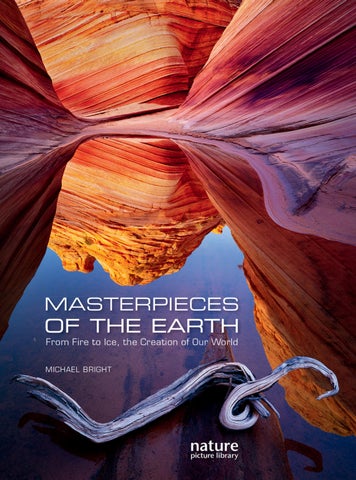
Masterpieces of the Earth

Page 1


INTRODUCTION

page 6

FIRE

Disruptor and Creator from the Depths page 12

WATER

Mysterious Sculptor in Continuous Movement page 52

WIND

Invisible and Unpredictable Designer of the Ages page 112

ICE

Brittle, Transparent, Crystalline Carver page 166

Text by Michael Bright

FIRE

Disruptor and Creator from the Depths

Named for Vulcan, the Roman god of fire, volcanoes are great ruptures in the Earth’s crust that enable molten magma, volcanic ash and hot gases to break out of the surface of our planet. The magma is hidden many kilometres underground in a vast magma chamber that is under enormous pressure. Over time this pressure causes the surrounding rocks to fracture, and the magma eventually finds its way to the surface and spews out as molten lava. The temperature of the redhot lava is generally between 700°C and 1,300°C, but when it hits the air, it cools rapidly and solidifies as hard volcanic rock. It is a dramatic and often spectacular reminder that our planet is still blisteringly hot and very much ‘alive’.

On the Earth today, there are more than 1,500 active volcanoes, excluding those on midocean ridges, and about 500 have erupted in historic times. They occur mainly, but not exclusively, at the margins of tectonic plates, where material is brought up or returned to the Earth’s mantle. The largest seismically active zone in the world is the ‘Pacific Ring of Fire’, a chain of active volcanoes around the edge of the Pacific Ocean, where all but three of the 25 most powerful volcanic eruptions in the past 10,000 years have occurred.

The volcanoes of Kamchatka, in the Russian Far East, are part of the northeastern sector of the Ring of Fire. They have formed because the western edge of the Pacific plate is plunging below the eastern margin of the Eurasian plate. The unstable zone above gives rise to 109 active volcanoes, the highest concentration of erupting volcanoes in the world. Plosky Tolbachik volcano is one, and its neighbour Ostry Tolbachik is another. Plosky’s most notable eruption in recent times was in 1975. A swarm of earthquakes preceded an eruption that produced the most lava of any Kamchatka volcano.

Not all volcanoes are at plate margins. The volcanoes of Hawaii are located, not at the edge of a tectonic plate, but in the middle. This is because they sit over a hot spot, an upwelling of molten

LEFT New land is created. Red-hot molten lava from Hawaii’s Kilauea volcano pours from a lava tube into the Pacific Ocean, causing violent steam explosions and the sea to boil. This large and active shield volcano is in Hawaii Volcanoes National Park, where it erupted almost continually from 1983 to 2018, each time adding new land to Big Island. It is the youngest of the island’s volcanoes, having formed between 300,000 and 600,000 years ago. The oldest, Kohala, is more than a million years old.

FIRE

intense geothermal activity, with an extraordinary number of geysers, mudpots and hot springs, is a vast caldera complex, the leftovers of a super-volcano that has erupted in at least three known caldera-forming eruptions 2.1 million, 1.3 million and 640,000 years ago. According to recent measurements, magma has refilled its chamber, which is a staggering 90 kilometres by 30 kilometres. The level is now similar to what it was before the last eruption, so it is ready to blow its top any time soon! The amount of energy released during such a volcanic eruption is hard to comprehend. The amount of thermal energy produced by the eruption of a super-volcano like Yellowstone would be greater than the entire nuclear arsenals of the USA and Russia combined.

A geothermal area a little different to that at Yellowstone can be found in the Danakil Depression of Ethiopia. In this area on the Horn of Africa, the source of underground heat is not a dormant super-volcano or a simple hotspot, but a place on the Earth’s surface where the crust is splitting, a triple junction where the edges of three tectonic plates meet. In the region of Lake Karum, it has given rise to volcanoes, lava lakes, hot sulphur springs and extensive rifting. It is part of the East African Rift Valley, which stretches from Ethiopia to Mozambique, and could be the product of a super-plume of magma lying below the African continent, which is pushing up and causing the whole place to crack. The end result is that Africa will be parting company with Asia, and is likely, one day, to give birth to a new ocean.

Volcanoes not only eject lava and volcanic ash, but also a cocktail of gases that enter the atmosphere. Dominant among them is the greenhouse gas carbon dioxide, which is always in the news these days as the cause of global warming, but even volcanoes pale beside our contribution. The world’s volcanoes account for an estimated 200 million tons of carbon dioxide per year, but people, through fuel for transportation, energy supply, industry and agriculture, pour 24 billion tons into the atmosphere. The difference is that global warming can be curtailed by volcanic activity. Sulphur dioxide, ash and other particles from volcanoes become trapped in the stratosphere and shield the planet. They reflect solar energy back into space. Scientists have estimated that, after a major eruption, the atmosphere can cool by as much as 0.5°C within a year. So, killer volcanoes can have a very positive affect on our everyday lives.

RIGHT This primeval landscape is Lake Karum (Assale). It lies in the volcanically active Danakil Depression, part of the Afar Region of Ethiopia. Salt and sulphur deposits, hot springs, and miniature geysers give the lakebed an unearthly appearance, and it’s hot. It has the world’s highest average annual air temperature of 35°C, and in summer this can peak at 55°C. It rarely rains. The lake is over 120 metres below sea level, so Lake Karum is one of the hottest, driest, and lowest places on Earth.

LEFT and ABOVE Like the skin of a scaly reptile, dried mud formations form on the surface of mud volcanoes near Berca, Romania. These structures lie where pressurised natural gases, including methane, helium and nitrogen, push salty water and mud deposits bubbling to the surface. The mud dries to form volcano-like structures typically a few metres high. The gases originate about 3,000 metres below the ground and they are not hot, as they come from within the Earth’s crust and not the mantle.

WIND

Invisible and Unpredictable Designer of the Ages

Wind is a perceptible movement of the air, but generally not until it is so strong that it turns our umbrella inside out or knocks us over are we really aware of it at all; and like the other agencies of erosion and deposition, it shapes a great many landscapes on the surface of the Earth.

Winds have always been important to us. Ancient seafarers in their sailing ships recognised them by their vigour and latitude, with names like the ‘roaring forties’, ‘furious fifties’, ‘screaming sixties’ and the ‘doldrums’. Artists such as Cezanne and Van Gogh lived in Provence in the south of France, where the cold, dry, northwesterly winds of the mistral made for clear skies and vibrant colours. Weather forecasters know winds for their direction, strength and duration: short bursts of high-speed winds are gusts, which, if they last for a minute or more, become squalls, while winds of longer duration are described by their average strength – breeze, gale, storm force and hurricane. Whatever their names, these winds can pick up and move dust and sand, and, in a process similar to sandblasting, fling it at rock surfaces, wearing them down until they become as smooth and rounded as the ‘Giant Marbles’ in Joshua Tree National Park, California, or the ragged ‘fins’ of Gold Butte, Nevada. How the particles behave depends on their size. Large particles roll along the ground, smaller particles are lifted into the air and bounce along, and the very small dust-like particles are lifted by the wind and carried over long distances. They all lead to wind-eroded landforms, which are especially prevalent in hot, dry desert landscapes like those in the American Southwest.

One of the most spectacular is ‘The Wave’ at Coyote Buttes in the Vermillion Cliffs National Monument, Arizona. Like a sweeping multicoloured skateboard park, it is composed of bands of red, white, pink and yellow sandstone. They are the rock layers that were once windblown sand, but now look like the contours on a topographical map, only writ large. Fast-flowing water carved out the original chutes, but they have dried up and the wind has taken over, skimming the surface as if somebody has taken an enormous sheet of sandpaper and smoothed and rounded the rocks. It is such a charismatic site that many people try to visit, but the rock formation is so delicate that

LEFT On the high desert of the Colorado Plateau in Arizona, petrified sand dunes create a striped pattern that is more obvious as the sun sets and shadows are longer. It’s been called the ‘red rock country’, because the main rock is red sandstone.

RIGHT A formation of spiky ice stalactites was discovered at Lake Baikal in Siberia. The lake is the world’s largest, deepest, clearest and oldest freshwater lake. It sits in a rift valley, where the Earth’s crust is being pulled apart, so the lake widens by about 2 centimetres per year. From early January until May or June, the lake is covered by ice with a thickness of 1.4 metres. Where hummocks occur it can be more than 2 metres thick. The ice is quite clear, with a transparency of about a metre.

Turn static files into dynamic content formats.
Create a flipbook