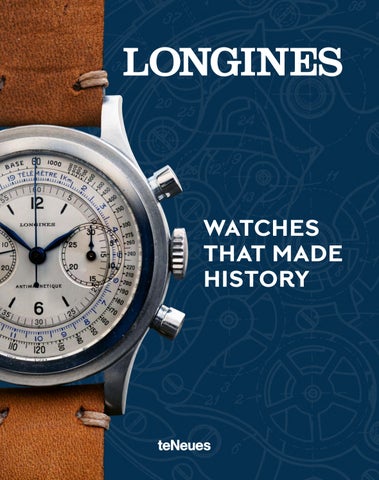
WATCHES THAT MADE HISTORY

AN EARLY LONGINESâ AND A CLEAR VISION
This early Longines from 1867 marked the transition from handcrafted to machine-made watches. Jacques Davidâs report from the United States jolted the Swiss watch industry.


Longines visionary Jacques David traveled to the USA and wrote a meticulous report on the industrialization and competitive advantages of American watchmakers.

Longines Savonnette Pocket Watch in Silver
Date of production: 8 October 1867
Date of sale: 23 October 1867
Type: Savonette pocket watch
Serial number: 183
Diameter: 52 mm
Case: Sterling silver
Movement: Caliber AA4 (Ă©bauche by Japy), 15 jewels, winding mechanism with key, special lever escapement for improved accuracy, inner case back (cuvette) engraved with âImproved Lever Longinesâ
Frequency: 18,000 vibrations per hour
Dial: White enamel dial with black Roman numerals, outer scale of minutes in black, mark of E. Francillon and Longines, subdial for seconds at 6 oâclock
throughout the entire Middle Eastâa role he maintained even beyond the Ottoman Empireâs collapse and through the birth of modern Turkey in 1923. His dealer network was legendary, with strategically positioned subagents in Damascus, Beirut, Smyrna, Baghdad, Salonika, Aleppo, and other cities generating sales. His clientele extended to include railroad companies, which placed particular value on precise timekeeping.
The dual time systems that coexisted for so long, alaturka and alafranga, embodied more than mere chronometryâ they represented a cultural clash. The lives of the agrarian majority of the population revolved around working in the fields, so they naturally preferred to measure the time to the end of sunâs descent. Islamic prayer hours, too, followed the rhythm from one sunset to the next. Traditionalists long remained devoted to alaturka time, recognizing it as fundamental to their cultural identity. Ahmet Ha im, a prominent voice of the period, captured this sentiment with poetic elegance: âTime was an infinite

Right: The enamel dial features the name of Longines importer Djezvedjian. The movement is engraved with the winged hourglass, the logo of Longines.
garden, and the hours were colourful flowers lit by the sun which bloomed there, inclining sometimes to the left, sometimes to the right. Until we became accustomed to foreign time, the twenty-four-hour âdayâ with each end lost in the darkness of night ... was unknown.â
Nevertheless, Western timekeeping swiftly infiltrated administrative corridors, government offices, and military institutions. In late 1925, the Turkish parliament issued a decree ending the ancient time system. Today, the historical timepieces have become treasured collectorsâ itemsâeven though the memory of the evening cannonâs sound that once thundered across Constantinople has long since faded.


The luxury train Orient Express earned titles such as the âKing of Trainsâ and âTrain of Kings.âPassengers with their luggage upon the arrival of the Orient Express in Istanbul in 1890.
Two women pose in front of the Orient Express in the 1920s.


EINSTEINâS GOLD LONGINES AND THE MYSTERIOUS SPY
Albert Einstein revolutionized physics with his theory of relativity. On his wrist he had a Longines, which he gifted to his last loveâunaware she was a Soviet spy.

Albert Einstein wearing his gold Longines watch on his wrist at the El Mirador Hotel in Palm Springs, California, February 10, 1933.

Longines Tonneau-shaped Menâs Gold Wristwatch
Date of production: July 1929
Serial number: 4â876â616
Dimensions: 26 x 38 mm
Case: 14K gold
Movement: Caliber 10.86N, 17 jewels, movement adjusted to temperature and two positions, Breguet hairspring, bimetallic balance
Frequency: 18,000 vibrations per hour
Special functions: Tonneau-shaped small seconds display, movement with fine adjustment
The chronograph caliber 19.73N featured a non-magnetic balance.


Right side: The fluted crown with integrated push-piece for the chronograph. Perfectly preserved enamel dial with red numeral 12.
reducing the overall height from 9 to 7.4Â millimeters, while also playing a leading role in modernizing production methods in Saint-Imier.
Caliber 19.73N was produced in multiple versions. It was available with counters for 30 minutes or 60 minutes. In 1910, the movement was already equipped with a split-second function for pocket watches. That same year, a high-frequency version (5 Hz) was created for the first time to measure tenths of a second, followed in 1916 by a version that could measure hundredths of a second (50Â Hz).
At this time, pocket watches still dominated the marketâ wristwatches were considered effeminate, and gentlemen displayed their precious timepieces on chains across their waistcoats. The militaryâs needs and the evolution of aviation, however, demanded practical, easy-to-read watches pilots could consult without fumbling in their pockets mid-flight. This necessity made reducing watch sizes a key priority. The 19.73N wrist chronographs remained substantial at 47.4 millimeters in diameter, but this generous sizing ensured they would be very easy to read in airplane cockpits.
Longines continued producing the classic caliber 19.73N for various markets until 1928; it was used in pilotâs watches, wristwatches, and pocket watch chronographs. Initially, a dual-crown arrangement was adopted, where the lower crown served no functionâit was purely aesthetic, added for visual symmetry. The two subdials were positioned either vertically (at 6 and 12Â oâclock) or horizontally (at 3 and 9Â oâclock). Most of the 19.73N wrist chronographs were sold on the Russian market through Schwob & Fils, though some were also sold in Spain, Italy, and Switzerland.
Today, the early 19.73N wrist chronographs are exceptionally rare. They represent pioneering chapters in both aviation and wristwatch history. The technical sophistication of these timepieces remains impressiveâ particularly considering they were created without computer-controlled machine tools or modern design aids.
Left side: A rare version of the 19.73N chronograph: Movement produced on May 2, 1912, housed in a 14-karat gold case for the Russian market in January 1917.


RACE CAR DRIVER WITH A FLYBACK CHRONOGRAPH
Fred Agabashian clocked the fastest lap in training for the Indianapolis 500 race in 1952âand Longines introduced a new way to measure time.

Fred Agabashian at a young age: He captured his first Northern California Racing Association title at the age of 24.

Longines Chronograph 13ZN
Reference 5415
Date of production: 17 November 1947
Date of sale: 26 January 1948
Reference: 5415
Diameter: 38 mm
Case: Stainless steel, water-resistant, screw-down case back
Movement: Caliber 13ZN, 17 jewels, anti-magnetic, Glucydur balance
Frequency: 18,000 vibrations per hour
Dial: Matte silvered, Arabic numerals, 30-minute counter, subdial for seconds, 1/5 second scale, blued hands
Special function: Flyback chronograph
COCKPIT CLOCK ON FIRST PACIFIC NONSTOP FLIGHT
They flew bootless and landed without landing gear: Pangborn and Herndon piloted the first nonstop Pacific crossing in 1931, a dual time zone clock in their cockpit.

The two gentlemen before their record-making flight of 1931: Clyde Pangborn (left) and Hugh Herndon.
Longines Cockpit Clock with Dual Time Zone Display
Date of production: 8 April 1929, prototype for Wittnauer USA
Diameter: 90 mm
Case: Aluminum
Movement: Caliber 18.69N, 15 jewels, bimetallic balance, âExtra Qualityâ, regulated for isochronism
Frequency: 18,000 vibrations per hour
Dial: Dual 24-hour scale for double hour and minute hands (one set blued, one set in gold), both scales with a minute scale, subdial for seconds

Special functions: Dual hour and minute hands for displaying two time zones; slide at 3 oâclock to stop the movement
39
MILITARY TIMEPIECES


Below:
ocean, 1947.


All evidence suggests that the timepiece belonged to Norwegian radio operator Knut M. Hauglandâan expedition participant, World War II resistance fighter, and later the first director of the Kon-Tiki Museum. In an old photograph, he can be seen wearing a watch that looks exactly like the Longines in the museum. He most likely acquired this personal piece that accompanied him across the Pacific from military surplus. Today, the timepiece with serial number 6â890â163 is in the Kon-Tiki Museum in Oslo, and in âsurprisingly good condition,â as a watchmaker discovered with amazement upon opening the watch.
In addition to the âTuna Can,â an alternative stainless steel case for the C.O.S.D. was manufactured by the


British company Dennison Watch Case Co. Ltd. These models typically feature MoD dials, subsequently printed in the United KingdomâMoD stands for Ministry of Defenceâas well as smaller winding crowns, which may also have been produced by Dennison. Three of these gold-cased watches are known to exist today.
One
C.O.S.D. watch embarked on a second career after the war: Knut Haugland wore it on the Kon-Tiki expedition of 1947.

The Kon-Tiki raft on the open
Right:
The Longines C.O.S.D. belonging to Knut M. Haugland, a member of the 1947 Kon-Tiki expedition.
Far right:
The Norwegian crew sailed some 4,300 miles across the South Pacific from Peru to Polynesia on a simple balsa raft.
Opposite page: The solid nickel chrome-plated brass case was made in England by Goldsmiths & Silversmiths.


A LONGINES FOR THE FRENCH NAVY
The Marine Nationale watch of 1947 was a forerunner of the diverâs watch: It was waterproof, shockproof, and designed for military operations.

The cover of the monthly magazine Marine Nationale from the September 1947 issue.

Longines Marine Nationale
Date of production: 2 September 1947
Date of sale: 5 September 1947
Reference: 5774
Diameter: 33.5 mm
Case: Stainless steel, water-resistant to 30 meters, screw-down case back engraved with âM Nâ
Movement: Caliber 12.68N, 17 jewels, manual winding mechanism, shockresistant, anti-magnetic balance, fine adjustment (réglage serré)
Frequency: 18,000 vibrations per hour
Dial: Silvered, with Arabic numerals, hands and numerals coated with radium, 1/5 of a second scale
the
After years of development, the engineers in Saint-Imier achieved their goal of making a purely mechanical watch without a battery as accurate as Accutronâs electronic tuning fork watch.
This meant the barrel also had to be enlarged to accommodate the spring. As all the gears in the gear train were subjected to much higher loads, their manufacture required much greater precision. In addition, a screwless three-armed Glucydur balance (beryllium bronze) with a non-magnetic, self-compensating Nivarox balance spring was employed.
The Ultra-Chron presented here is the dive watch version, cataloged as reference 7970. With this model, Longines introduced the worldâs first dive watch with a high-frequency movement. The watch with the 41millimeter stainless steel case is a rarity, as it is from the first series of reference 7970. The sporty watch was invoiced to American importer Longines-Wittnauer Watch Co. on August 22, 1968. It featured a finely knurled, unidirectional rotating bezel with a 60-minute graduation. As befits a dive watch, the minute hand was highlighted in reddish orange to match the indexes of the same color on the bezel. The second hand, in turn, ended in a triangle filled with luminescent material at its tip. Dive watches with high-beat movements remain rare today,
Opposite page: An advertisement from 1969: Water skiing was an up-and-coming sport at the time. Longines also offered the Ultra-Chron as a ladiesâ model and as a waterproof chronograph with a tachymeter scale specifically for water skiing.
making them particularly interesting for watch collectors. Back in the spring of 1967, Longines commissioned renowned specialist La Centrale in Biel, Switzerland, to manufacture the steel case, which was to be waterproof to 200 meters. Longines presented the watch at a trade fair in Basel in 1968. Approximately 50Â years after the modelâs production ended, in 2022, Longines launched another Ultra-Chron dive watchâonce again with a highbeat movement, of course.

Excerpt from
1968 catalog: Dive watches for ladies with automatic winding and the Ultra-Chron in the center.

ACKNOWLEDGEMENTS
This book originated as an idea of our loyal collectors. Leading the way were Adonya Ourshalimian and Frank Smits, to whom we owe a great debt of gratitude. They entrusted us with this ambitious project, but without the constructive and dedicated involvement of our collectors, this book could never have come to life. Not only do they own most of the watches presented here, but they also shared their valuable knowledge with us. These collectors include Eitan Arrusi, Dave Bagg, Valentino Balboni, Emil Borokhovich, Vefa Borovalı, Luigino Bottoni, Nicolas Dauphas, doctorsteelitaly, Guido Hamacher, Matt Hanson, Oliver Hartmann, Tanguy Laviolette, Seiji LĂ©pine, Dave Marcinek, Glenn Mariconda, Christian MĂŒller, Melodie Nga Ting Wong, Olivier Odelin, George Pakkos, Matthieu Schegg, Milos Svoboda, Andrew Tolley, Dino van Lingen, and Gerd Wellhausen. Our heartfelt thanks for your collaboration!
More than a dozen of the watches presented come from the collection of the Longines Museum, which comprises over 400 fascinating watches, navigation instruments, and professional timekeeping devices from the companyâs more than 190 years of history. You are most welcome to visit this interactive museum in Saint-Imier, Switzerland (www.longines.com/de/universe/museum). All guided tours are offered in German, French, Italian, or English.
Special thanks go to the Brand Heritage Team at Longines, especially to Fatima Boulanouar, who provided invaluable support in organizing, coordinating, translating, and researching images, as well as Marie Reber, Anne Develey, and Philippe Hebeisen, who completed supplementary research for the book. Mayu Kanazawa from Atelier Heritage deserves recognition for her work refining the Japanese translation.
The road from project concept to finished book was a long one, and the friendly and collaborative support from Pit Pauen and Luisa Krause-Rossa at teNeues/Die Gestalten Verlag proved tremendously helpfulâwe are deeply grateful!
ABOUT THE AUTHORS


Pierre-AndrĂ© Schmitt, born in 1958, is a renowned journalist with a career spanning 40+ years. From 2017 to 2023, he served as editor-in-chief and co-owner of the watch magazine Watch Around, which published ten issues a year. Deeply passionate about horology, Schmitt has been writing about watches for over two decades, particularly as deputy editor-in-chief of the prestigious Swiss business magazine Bilanz . In this role, he oversaw the publicationâs coverage of watches, gaining invaluable insights into the world of timepieces. Prior to this, Schmitt was editor-in-chief of Swiss Automobil Revue, Europeâs oldest automotive magazine, and also served as deputy editor-in-chief of the Swiss news magazine Facts.
Daniel Hug, born in 1963, has been Head of Brand Heritage at Longines since 2019, stewarding the history of the brand with the winged hourglass. Previously, he headed up the Business section at NZZ am Sonntag in Zurich, where he spent 16 years researching and commenting on companies, markets, and economic policy, always devoting particular attention to analyzing and reporting on the watch industry. In 2007, he was awarded the Zurich Journalism Prize (ZĂŒrcher Journalistenpreis). In total, he worked as a business journalist for 25 years, including positions at the Tages-Anzeiger in Zurich and Bund in Bern. Hug holds a degree in business administration, economics, and political science from the University of Bern and earned his MBA in communications at the University of Lugano.