
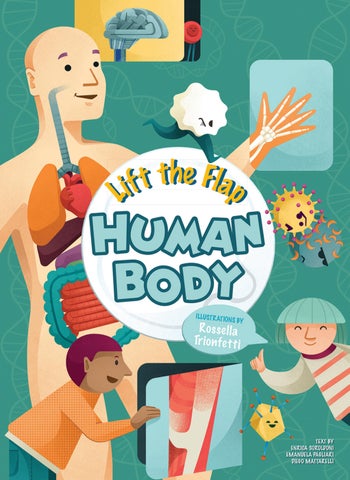
Lift the Flap Human Body

Page 1


INTRODUCTION

Our body is a wonderful machine that works thanks to the cooperation of many different organs, each one of them with a very specific task!

Let’s find out about them in the coming pages and explore our body together! This is what we will be talking about…

2

We can run, jump, sit down, play and smile, thanks to them.

1

Take a deep breath…

After entering the nose, where does the air go from there?

What are we talking about?

3

Flavors, scents, sounds, colors…the world is full of them!

Thanks to what, do we manage to feel them?

4

It wraps around our body; it protects us and lets us “feel” the world outside through touch.

6

So hungr y…we need

5

It is our in-built computer, that can analyze lots and lots of information at the same time. We are talking about…

8

It cleanses the body from waste, thanks to the pee. It’s…

7

What is the most important tool we have to “recharge”?

The brain!

The renal system. What hides behind such a difficult name?

Sleeping. Would you have ever dreamed that to be true?

The skin.

How does it work?

The digestive system.

In the lungs. How does it reach the rest of the body? We will find out.

The bones that support us and the muscles that make all our movements possible.

Let’s find out what they are called!

The senses.

Catching my breath!

In order to work properly, the human body needs oxygen. Every time we take a breath, this precious gas enters our body and starts its journey towards all our cells. Let’s try to follow it!

I am the oxygen

What route does THE OXYGEN travel after we inhale?

I AM A RED BLOOD CELL

How can the OXYGEN circulate through the whole body?

Let’s take a closer look at the HEART!

How does the BLOOD reach every part of the body?

Why is BLOOD red?

Exploring the world

Colors, sounds, scents and flavors: the surrounding world constantly sends us lots of stimuli that our senses capture and transform into signals, that are then processed by the brain. In this way we can communicate with others, listen to our favorite music, read a book or contemplate a beautiful landscape.

3tinybones hidden in the ear?

How many scents can we recognize?

Why do we have two ears positioned at the opposite sides of the head?

Our eyes can see only 3 colors. Which ones?

Why does everything look grey at night?

The main flavors are five: can you name them?

us to recognizeflavors thanks to the papillae. How aretheymade?

Touching and learning

Our skin is like a natural overall that wraps our whole body and has several functions: it protects the body, helps regulating its temperature, contains glands such as the ones that produce sweat and, most importantly, it puts us in touch with the external world, capturing lots of information.

Ifan object is too cold

why do we

instinctivelywithdrawourhand
ortoohot,

When we touch a surface, we leave our fingerprints. What are they?

Thanks to touch, we are able to recognize the characteristics of surfaces. How is this possible?

What areas of the skin have most tactilereceptors and therefore are the most sensitive?

–giveus“goosebumps”

?

ticklingWhydoesshivering–duetothecold, orastrongemotionalreaction

Ifyoufall,youend upwithasmall wound. What happenstoyour skin in that case?

a wound. let me deal with it!!!

Thinking through!

Our brain is roughly the size of a melon and is as complex as a computer. It is the brain that controls the functioning of the whole body and allows us to do things and to think.

Our brain is made up of specialized cells, called neurons. How many neurons are in the brain?

Isthebrainorganized?

Thebrainisvery delicateandfor thisreason,itis wellprotectedby abonyshell.

Howisthisstructurecalled?

Is the brain connected to our senses?

What is the name of the area in the brain where thoughts and memories are created?

When we think about an unpleasant experience in thepast ,

experiencing those uncomfor table sensations again.

Howisthatpossible?
itfeelslikeweare

Being hungry!

Your body needs energy to be able to run, play, study, read a book or simply watch TV! How does it get energy? From food. Everything we eat is transformed into nutrients that can be used as fuel by our cells. Let’s follow the food in its journey through the digestive system, which is the system responsible for this transformation, called digestion.

The smell of your favorite food makes your mouth water. How come?

The food is turned into a bolus in the mouth and can now start its journey. Firstly, it is pushed down into the esophagus.

Whyisit important to chew the food thoroughlybefore swallowing?

The food then reaches an organ that functions similarly to a blender. It is called...

This is the liver! What is its function?

Sometimes we hear embarrassing noises coming from our tummy. Who is the culprit?

The last part of the digestive system is the intestine: it is folded on itself many times to reach an incredible length of…

When the food reaches the last part of the intestine, it is reduced to water and fibers. However, it is processed a bit more. Into what?

When the food waste needs to be expelled, where does it go?

Needing to pee!

Why do we need to pee? The pee is a substance that allows our body to eliminate the waste produced by the cells during their job. The urinary system is responsible for cleansing our body and for the regulation of the quantity of water inside it.

Where is the pee collected?

The kidneys are two beanshaped organs that clean the blood from the waste. How?

Does the pee bad?smell

How do we understand when we need to pee?

At the base of the bladder there What ’s their purpose? are some important muscles.

What is pee made of?

Falling asleep

Nothing contributes to our wellness more than a good sleep! During our sleep, though, our body doesn’t simply pause. It does a general check-up of all its vital systems!

When we sleep, are we completely still?

When we are awake, our brain is always alert and receives stimuli all the time. What does it do when we sleep?

What are dreams?

Because sleep is a fundamental phase for our body, we need to dedicate the right time to it: how many hours should we sleep every night?

Turn static files into dynamic content formats.
Create a flipbook
Lift the Flap Human Body by ACC Art Books - Issuu