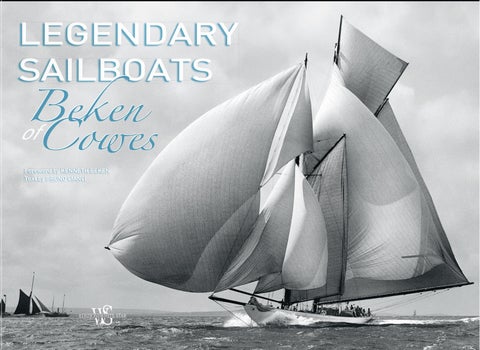
Beken of Cowes LEGENDARY
Photography by Beken of Cowes
Foreword by Kenneth Beken
Text by Bruno Cianci
LEGENDARY SAILBOATS
FOREWORD by Kenneth Beken INTRODUCTION by Bruno Cianci
AMERICA’S CUP YACHTS
GENESTA 1884
GALATEA 1885
PURITAN 1885
THISTLE - METEOR I 1887
VALKYRIE II 1893
VALKYRIE III 1895
DEFENDER 1895
COLUMBIA 1899
SHAMROCK I 1899
SHAMROCK II 1901
SHAMROCK IV 1914
THE ‘J’ FACTOR
BRITANNIA 1893
ASTRA 1928
CAMBRIA 1928
CANDIDA 1929
SHAMROCK V 1930
YANKEE 1930
VELSHEDA 1933
ENDEAVOUR 1934
ENDEAVOUR II 1936
THE GREAT OCEAN RACES
ILEX 1899
TUIGA - KISMET III 1909
JOLIE BRISE 1913
HALLOWE’EN 1926
DORADE 1930
PATIENCE 1931
EILEEN 1935
BLOODHOUND 1936
LATIFA 1936
VANITY V 1936
EILEAN 1937
TIMELESS CLASSICS
SATANITA 1893
METEOR II 1896
METEOR III 1902
SHAMROCK 23 m 1908
METEOR IV 1909
WESTWARD 1910
MARIQUITA 1911
LULWORTH 1920
MOONBEAM 1920
BLUENOSE 1921
CREOLE 1927
ALTAIR 1931
The boats have undergone numerous changes over time, both in terms of configuration and size, hence any discrepancies. Where possible we have tried to record the measures of the yachts as they were when originally launched.
The period referenced by the images in this volume covers around half a century of yachting history. It starts around 1888, the year that saw Alfred E. Beken capture the first images in the Solent, to 1939, when his grandson Keith (who was also a beginner but could at least benefit from the experience of his father Frank) was preparing to do his duty during the war, working for Air-Sea Rescue recovering pilots who had crashed into the seas around Britain.
In those 50 years the docksides around Cowes have witnessed the passing of many great sailors and yacht owners passing sailors and yacht owners who remain unforgotten – and unforgettable: these, the protagonists in the golden age of yachting. Some have flashed by like a passing comet, while others, especially the figures in the public domain such as monarchs and princes, great skippers and captains of industry, have left a lasting mark in the nautical firmament, becoming the true icons of the sport sailing in magical era when they were the star.
Even more durable is the mark left by the boats that these characters built, owned and sailed with so much passion, not only because there’s photographers Navy sent their precious testimonies and printed on sheets of paper, but also because the design of each boat has influenced, directly or indirectly, the shape of all those that came afterwards. In the evolution of the boats, there is nothing more empirical or factual than observing the behavior of a boat in the intensity of a race, and then making progressive refinements of a boat’s features and performance.
All those that appear in this book are boats that have left an important mark on the history of yachting evolution. To select just a few dozen out of many hundreds of yachts was probably the most complex – and most painful – part of my work in putting this book together.
1900 - THE DOCKS OF COWES USED TO FILL WITH SPECTATORS DURING THE REGATTAS. THESE EVENTS LED ALFRED E. BEKEN TO MAKE HIS FIRST EXPERIMENTS IN PHOTOGRAPHY.
1934 - ENDEAVOUR, ONE OF THE MOST SUCCESSFUL BRITISH AMERICA’S CUP YACHTS EVER, ENGAGES THE KING


No racing yacht in English history can claim a level of importance that would compare to the cutter Britannia, as her name would suggest and, judging by the name, it could not be otherwise. Britannia, in fact, is the personification of Britain, an icon of the ancient land of Albion, represented by a helmet, shield and trident.
Designed by Scotsman George L. Watson, Britannia was just over 37 meters in length, slightly less than Satanita launched the same year, although with slightly less sail area. Launched in 1893 by the future Edward VII, then Prince of Wales, Britannia remained in commission for 47 years, making modifications from time to time – especially to the rig – in order to keep pace with the times and take on the challenge of the rival category known as the Big Class.
Although a yacht of blue blood, Britannia was distinguished by the simplicity of the cabins and other details, a distinctive feature of thoroughbred racing. Among the most notable features are the huge tiller (later replaced) operated by a block-and-tackle purchase system, and the cabins which could accommodate only four people, an incredible figure given that the yacht needed a crew of more than 50 men. Britannia came from an era when the owner and the crew did not mix – even less so on a royal yacht – but historical recordings make it clear that below decks, Britannia was spartan.
She was a very fast boat. One of her first ‘victims’ was the American yacht Vigilant, winner of the America ‘s Cup in 1892, which Britannia defeated 11 times out of 17. It was almost as though Britannia was saying that if she were given the chance, she would bring the silver ewer back to the Solent. But on July 8, 1936, five years after being converted to a J-Class, Britannia was towed by two destroyers to the south of the Isle of Wight and was scuttled at the request of King George V, who had died in January earlier the same year. No one else would ever get the chance to own this piece of British history.
1893 BRITANNIA
TYPE: Gaff cutter (converted to J-Class in 1931)
YEAR OF LAUNCH: 1893
BUILDER: D & W Henderson, Glasgow
DESIGNER: George L. Watson
LENGTH: 121 ft 5 in (37.20 m)
BEAM: 23 ft 6 in (7.21 m)
DRAFT: 15 ft (4.60 m)
SAIL AREA: 10,328 sq ft (959.5 sq m)
HULL MATERIAL: wood
1934 - BRITANNIA IN A PHOTOGRAPH TAKEN THREE YEARS AFTER THE ROYAL YACHT WAS CONVERTED TO A J-CLASS. LAUNCHED IN 1893, THIS BOAT WAS SUNK IN 1936, ACCORDING TO INSTRUCTIONS IN THE WILL OF THE RECENTLY DECEASED GEORGE V.

BRITANNIA
1893 - BRITANNIA PICTURED IN THE DAYS WHEN SHE WAS RACED BY THE FUTURE EDWARD VII, THEN PRINCE OF WALES. THE RIG WAS MODIFIED MANY TIMES TO MAINTAIN THE YACHT’S COMPETITIVE PEDIGREE.
1921 - BRITANNIA, HEELING OVER ON A DAY OF STRONG WIND AND CHOPPY SEAS, WITH HER LEEWARD GUNWALE UNDER WATER. THE DECK LAYOUT WENT THROUGH MANY CHANGES OVER THE YEARS.

CANDIDA 1934 - LAUNCHED AS A 23-METER, CANDIDA DESIGNED BY CHARLES E. NICHOLSON WAS ONE OF THE FIRST MAJOR BRITISH YACHTS TO HAVE THE BERMUDAN RIG INSTEAD OF A GAFF. SHE WAS CONVERTED TO A J-CLASS IN 1931.

Launched in April 1930 at the Camper & Nicholson shipyard in Gosport, Shamrock V was the fifth yacht in which Sir Thomas Lipton attempted to win the America’s Cup, 31 years after his first attempt. The designer was Charles E. Nicholson, an icon of British yacht design. Shamrock V was built very strong and rugged, constructed from mahogany planking over steel frames, while the original mast was a hollow spruce spar, although later replaced with a more modern mast built from lighter and more advanced materials. With an overall length of more than 36 meters, Shamrock V belonged to the J-Class, the most elegant class of boats to have participated in the America’s Cup. After Lipton’s death in October 1931, the boat was purchased by Sir Thomas Sopwith, an aviation entrepreneur, who needed a ‘trial horse’ to help launch his first challenge for the Cup in 1934, in which he competed with the yacht Endeavour.
Shamrock was then sold to another military industrial magnate Sir Richard Fairey, inventor of the biplane torpedo bomber, the Fairey Swordfish. Between 1937 and 1986 the yacht, later converted to a cruising ketch, was owned by two Italians who are believed to have changed the yacht’s name for superstitious reasons from Shamrock (meaning ‘Threeleafed Clover) to Quadrifoglio, or ‘Four-leafed Clover’.
Shamrock V has undergone four major restorations in her life. At the end of the third restoration in 1989, she was more or less returned to being a J-Class yacht and participated in a historic rerun of her match against Endeavour on the original America’s Cup course in the waters of Narragansett Bay off the coast of Newport, Rhode Island, the same venue of their Cup contest 52 years earlier. Between 1999 and 2001 Shamrock V underwent yet another restoration at the Pendennis shipyard in Falmouth, Cornwall.
1930 SHAMROCK V
TYPE: J-Class
YEAR OF LAUNCH: 1930
BUILDER: Camper & Nicholson, Gosport
DESIGNER: Charles E. Nicholson
L.O.A.: 120 ft (36.58 m)
BEAM: 19 ft 9 in (6.07 m)
DRAFT: 15 ft 6 in (4.75 m)
SAIL AREA: 7,540 sq ft (700.5 sq m)
HULL MATERIAL: mahogany planking over steel frames
1930 - SHAMROCK V PHOTOGRAPHED DURING HER FIRST SEASON, BEFORE THE TRIP TO THE U.S. TO COMPETE IN THE AMERICA’S CUP. THE YACHT SAILS STILL TO THIS DAY.

Ilex is part of the category of medium-sized yachts that really made the early history of ocean racing. Measuring 15.50 meters overall, Ilex has been through at least four different configurations and sail plans: gaff cutter, yawl, cutter and Bermudan ketch. Rigged as a yawl, flying the burgee of the Royal Engineer Yacht Club, Ilex achieved the most prestigious results of her career. The pinnacle of her achievements was her victory in the 1926 Fastnet Race, the offshore classic which she completed nine times in all. She also won the Plymouth-Santander Race. During her first five years under new ownership this yawl engaged in some interesting duels with the queen of offshore races of the time, Jolie Brise, only becoming superseded in 1931, when the Bermudan yawl Dorade, designed by Olin Stephens, won the Transatlantic and Fastnet Races, against all predictions.
From World War II to the early 1970s, the boat suffered a period of decline, culminating with her use as a floating office by an American insurer in the 1960s. Ilex finally took to the sea once again when she was bought by Salvador Dali’s secretary, John P. Moore, who had her reconfigured as a ketch and refurbished the interior, mooring the yacht in Cadaques, near Girona. At the end of the 1980s, Ilex was ransacked as some of Dali’s artworks were stolen from the yacht.
The most recent revival of Ilex dates back to the 1990s, when the yacht when through a major restoration on the initiative of the new owner, Germán Ruiz. This entrepreneur from Madrid did such a good job in such painstaking detail, that Ilex is admired by all classic yacht enthusiasts who see her in the Mediterranean. Among other notable changes, Ilex was once again restored to her original design as a cutter. This wonderful restoration was noticed and admired across the English Channel, with Ruiz being elected an honorary member of the Royal Engineer Yacht Club.
TYPE: Gaff cutter
YEAR OF LAUNCH: 1899
BUILDER: Camper & Nicholson, Gosport
DESIGNER: Charles E. Nicholson
L.O.A.: 50 ft 8 in (15.50 m)
BEAM: 11 ft 1 in (3.40 m)
DRAFT: 8 ft 5 in (2.37 m)
SAIL AREA: 1,776 sq ft (165 sq m)
HULL MATERIAL: Burmese teak on oak planking
1927 - BUILT IN THE LATE 19TH CENTURY, THE YAWL ILEX IS ONE OF VERY FEW YACHTS THAT CAN BOAST OF BEING ACTIVELY USED ACROSS THREE DIFFERENT CENTURIES, AS THE BOAT IS STILL SAILING TODAY.

Tuiga is one of four existing 15-Meter International Rule yachts designed by William Fife III, together with Mariska (1908), Hispania (1909) and Lady Anne (1912). Launched in Fairlie in May 1909, this yacht featuring elm planking over steel frames. She was commissioned by Luis Salabert, 17th Duke of Medinaceli and friend of Alfonso XIII, built for the purpose of racing against Hispania, the twin yacht owned by the Spanish monarch.
Tuiga changed rig – from gaff to Bermuda – as well as her name and owner several times; at different times she was known as Dorina, then Betty IV and Kismet III. During the 1920s, for a brief period the yacht also belonged to the entrepreneur and politician Warwick Brookes.
The name Kismet III is inextricably associated with the most important result in competition ever achieved by the boat in its 100-plus years life: the yacht’s line-honors victory in the 1935 Fastnet Race, while Stormy Weather, designed by Olin and Rodman Stephens won on corrected time. Based in Southampton, Kismet III spent 32 years in the owner ship of J.B. Douglas and family, after which the yacht was sold to a gentleman from Glasgow who renamed her Nevada (1970).
The sailing world lost track of Kismet III for a while, until she was purchased by two French associates and then by the Swiss enthusiast Albert Obrist, founder of Fairlie Restorations, the boatyard in Hamble which specializes in the restoration of yachts designed by William Fife III. After being transported from Cyprus to England, the yacht underwent a meticulous restoration at the beginning of the 1990s.
Today Tuiga, having reclaimed her original name and gaff rigging, is owned by the Monaco Yacht Club, founded in the Principality in 1953. Since her return to the sailing world, Tuiga’s tiny cockpit has played host to some exceptional helmsmen such as Eric Tabarly, Paul Cayard, Dennis Conner and, of course, Prince Albert II of Monaco.
1909
TUIGA - KISMET III
TYPE: Gaff cutter (15-Meter International Rule)
LAUNCH YEAR: 1909
BUILDER: William Fife & Son, Fairlie
DESIGNER: William Fife III
LENGTH: 76 ft (23.18 m)
BEAM: 13 ft 6 in (4.15 m)
DRAFT: 9 ft 7 in (2.95 m)
SAIL AREA: 4,456 sq ft (414 sq m)
HULL MATERIAL: elm over steel frames
1910 - THE YACHT TUIGA, A 15 METER DESIGNED BY WILLIAM FIFE III, IS BEST KNOWN FOR TAKING LINE HONORS VICTORY IN THE FASTNET RACE.

Launched in March 1936 in Fairlie, the great Eric Tabarly declared this 12-Meter International Rule to be “the greatest ever” in its class. Vanity V had some distinguishing features such as a clear deck and large overhangs.
Even if no objection could be made to Vanity V’s designer William Fife III with regard to her beauty and finish, you could have argued about the yacht’s racing performance, which wasn’t always up to it. In 1936, for example, the boat suffered a dismasting which called into question its sail plan. Although no definitive counterproof exists, it seemed that the very comfortable – and heavy – interiors requested by the first owner, a John R. Payne, were also causing the boat’s lack of speed.
Being predisposed to cruising, the yacht was seldom used in regattas, and spent almost three decades in the Mediterranean under the name La Pinta II. In this period the yacht was stationed in Toulon. In the early 1990s, the yacht was transferred to Saint-Malo, in Northern France, where she underwent a drastic restoration which suffered some delays due to a lack of funding.
In 1996 a couple of enthusiasts caught sight of the yacht, now in a serious state of decline, and decided to invest in its restoration. This took place in the Chantier du Guip in Brest, where the main concern was boat conservation, whilst still taking into account the trends and technologies of modern times. The new mast, for example, is hollow and not solid like the original – unfortunate – one; the rudder wheel was replaced by a tiller bar similar to the original; the interiors were renewed in order to better satisfy the new owners’ demands, such as their suggestion of moving the galley. The beautifully-restored Vanity V’s sails are made of a cream-color, old-looking Dacron.
1936
VANITY V
TYPE: 12-Meter (International Rule)
LAUNCH YEAR: 1936
BUILDER: William Fife & Son, Fairlie
DESIGNER: William Fife III
LENGTH: 70 ft 8 in (21.58 m)
BEAM: 12 ft 2 in (3.72 m)
DRAFT: 8 ft 7 in (2.65 m)
SAIL AREA: 2,150 sq ft (199.74 sq m)
HULL MATERIAL: teak and mahogany over acacia and steel frames
1937 - VANITY V, A 1936 12-METER, WAS CONSIDERED BY THE GREAT FRENCH SAILOR ERIC TABARLY TO BE “THE MOST BEAUTIFUL EVER SEEN.” HOWEVER, THE WEIGHT OF THE FURNITURE INSIDE IMPEDED HER RACING PERFORMANCE.

The ketch Eilean, Gaelic for ‘small island’, was designed by William Fife III in 1936 and was launched in 1937. With an untold number of Atlantic crossings, Eilean was well cared for by her owner, an architect called John Shearer. During a trip to Malta in 1974, Shearer – who as a young boy had enjoyed a holiday on board the yacht – saw Eilean and, along with his father, decided to buy her. Having done so, he sailed Eilean many times across the Atlantic.
In 1982 the boat, then kept in Antigua, was hired for the filming of the hit music video “Rio,” by the British pop group Duran Duran. Just two years later began the sad decline of the boat, which was rammed by a ferry in the Spanish port of Malaga along with other unfortunate vessels. Despite John Shearer’s best efforts, financial and otherwise, it is only more recently that the ketch has been restored to her former glory, when she was bought by the luxury watchmaker Officine Panerai, who moved the ailing yacht to Viareggio and took about three and a half years to restore her. In total, It took about 40,000 hours to complete the restoration. The operation, complex and painstaking, saw the re-use of approximately 70% of the original Burmese teak planking, demonstrating how high was the quality of the construction materials used by the shipyard of William Fife. Much more has been rebuilt, although done with the utmost respect for the original project.
In her capacity as an ambassador of Panerai, in 2012 Eilean crossed the Atlantic to once again participate in the Antigua Classic Yacht Regatta, an event that has taken place every year in April since 1967 and which is now part of the calendar of regattas reserved for vintage boats sponsored by the same watchmaking company. During the summer, Eilean’s home is the Mediterranean Sea.
TYPE: Bermudan Ketch
YEAR OF LAUNCH: 1937
BUILDER: William Fife & Son, Fairlie
DESIGNER: William Fife III
LENGTH: 72 ft 8 in (22.20 m)
BEAM: 15 ft 3 in (4.65 m)
DRAFT: 10 ft 7 in (3.25 m)
SAIL AREA: 3,240 sq ft (301 sq m)
HULL MATERIAL: Burmese teak planking on galvanized iron
1938 - EILEAN, ON THE RIGHT, RACING WITH THENDARA. DESIGNED BY FIFE IN 1936 AND LAUNCHED THE FOLLOWING YEAR, THIS BOAT HAS MADE NUMEROUS ATLANTIC CROSSINGS.

The schooner Bluenose was built specifically for two very different purposes: to operate both as a fishing boat with a crew of 20-22 men, and as a racing boat. In North America in the early years of the 20th century, in fact, a popular regatta began with the purpose of comparing two great schools of cod fishing: that of Gloucester, Massachusetts (for instance like those of the ‘Courageous Captains’), and that of Halifax, the capital of the Canadian province of Nova Scotia. The defeat of Delawana at the hands of the Americans’ boat, Esperanto, triggered the decision to build a new hull capable of restoring Canadian supremacy.
Constructed and maintained in racing trim with public taxes, the schooner Bluenose was built to a design by W.J. Roue and launched March 26, 1921 in Lunenburg, Nova Scotia. Beyond the impressive load capacity and ability to stay at sea for long periods of time, this boat collected many prizes, such as winning the coveted International Fishermen’s Trophy and remaining undefeated until she stopped showing up at the start line. Bluenose took part in other races too; one of them saw her compete overseas, without much success, around the Isle of Wight against four other schooners, including Westward and Altair.
Sold in 1942, the boat went on to serve as a freighter in the Caribbean, but unfortunately ran aground in January 1946 while she was carrying a cargo of bananas. Given the impossibility of salvaging her, the schooner was abandoned to her sad fate. In 1963 and 2013, however, two replicas of Bluenose were built.
Since 1937, Canada has paid tribute to Bluenose with three issues of postage stamps and minted 10-cent coins depicting the schooner. And even car license plates in the province of Nova Scotia have occasionally featured the profile of this legendary boat.
1921 BLUENOSE
TYPE: Fishing gaff schooner
YEAR OF LAUNCH: 1921
BUILDER: Smith & Rhuland, Lunenburg, Nova Scotia
DESIGNER: W.J. Roue
L.O.A.: 143 ft (43.58 m)
BEAM: 27 ft (8.23 m)
DRAFT: 15 ft 10 in (4.83 m)
SAIL AREA: 10,000 sq ft (929 sq m)
HULL MATERIAL: wood
1935 - BLUENOSE WAS THE FISHING AND RACING SCHOONER THAT MADE IT POSSIBLE FOR THE CANADIAN PROVINCE OF NOVA SCOTIA TO ESTABLISH A LASTING SUPREMACY OVER THE RIVAL ‘DESIGN SCHOOL’ OF MASSACHUSETTS.

When this elegant three-masted schooner designed by Charles E. Nicholson was launched in 1927, with the name Vira, she was very different from how the brilliant British designer had conceived her. The three masts, in fact, had been shortened considerably to enable this yacht of more than 214 feet (over 65 meters) to sail with a small crew, a request by the first owner. The lead keel was also reduced, since the boat no longer needed the righting moment patiently calculated by Nicholson, who accepted the changes, but found them hard to swallow. Fortunately the next owners wanted to make the masts longer, in accordance with the instructions of the designer who, over the years, saw the schooner – renamed Creole – more and more come round to what he had originally had in mind.
Before the Second World War Creole was photographed by Beken in the Solent, just before she was temporarily requisitioned by the Royal Navy, who used the boat to transport troops and materials. This was one of the many yachts used for the war effort in Britain. During the 1950s and 1960s Creole was owned by the Greek tycoon Stavros Niarchos, and she stayed more or less permanently in the Mediterranean, which she had already visited several times. In 1962, the future King of Spain, Juan Carlos de Borbon, and Sofia of Greece spent a few days on board Creole during their honeymoon. After Niarchos the boat was owned by a Danish consortium which unfortunately did not have the means to maintain her properly. In 1983 she was bought by a well-known Italian fashion family, who restored the yacht to her former splendor. In 1992 in San Diego, during the America’s Cup, her appearances on TV drew many compliments for the yacht from the general public.
1927 CREOLE
TYPE: Three-masted schooner
YEAR OF LAUNCH: 1927
BUILDER: Camper & Nicholson, Gosport
DESIGNER: Charles E. Nicholson
LENGTH: 214 ft 2 in (65.30 m)
BEAM: 31 ft 2 in (9.50 m)
DRAFT: 17 ft 5 in (5.35 m)
SAIL AREA: 11,334 sq ft (1,053 sq m)
HULL MATERIAL: Burmese teak
1939 - CREOLE, DESIGNED BY CHARLES E. NICHOLSON, IS ONE OF THE MOST BEAUTIFUL CLASSIC SCHOONERS STILL IN EXISTENCE. WHEN SHE WAS LAUNCHED, THE YACHT HAD SHORTER MASTS THAN WERE TYPICAL OF THE PERIOD.