A Quick Drive Through Early Automotive History page 14
A Fresh Wind: Aerodynamics rounds off those boxy bodies page 28
Fiat 508 Balilla page 32 Tatra 77 page 36
Citroën Traction Avant page 40
Maria Cucchi Preface page 12
Alfa Romeo Giulietta Sprint and Spyder page 120
Style and Speed:
The pace increases page 124
Citroën DS page 126
Rolls-Royce Silver Cloud page 132
MGA page 136
Austin Healey 100 page 140
Ford Thunderbird page 142
Ferrari 250 GT page 144
Triumph TR3A page 148
Mini page 150
Jaguar Mk II page 154
Cadillac Eldorado Biarritz page 158
Jaguar XK-E (E-type) page 162
Shelby AC Cobra page 166
Aston Martin DB5 page 168
Chevrolet Corvette Sting Ray page 172
Flexing Their Muscles:
Horsepower rules page 174
Ford Mustang page 178
Porsche 911 page 182
Pontiac GTO page 186
Lamborghini Miura page 188
Alfa Romeo Duetto page 190
Ferrari Dino 206 GT page 192
Ferrari 365 Daytona page 196
Maserati Ghibli page 200
De Tomaso Pantera page 202
Lamborghini Countach page 204
Rough Road Ahead:
The gasoline and other crises page 206
BMW M1 page 210
Audi Quattro page 214
De Lorean DMC12 page 216
Ferrari Testarossa page 218
The Making of the Modern Car: And the modern car company page 220
Ferrari F40 page 224
Bugatti EB110 page 226
Dodge Viper RT/10 page 228
2-3 THE LATE 1930S TALBOT LAGO HAD A SHAPE THE FRENCH CALLED “GOUTTE D’EAU.”
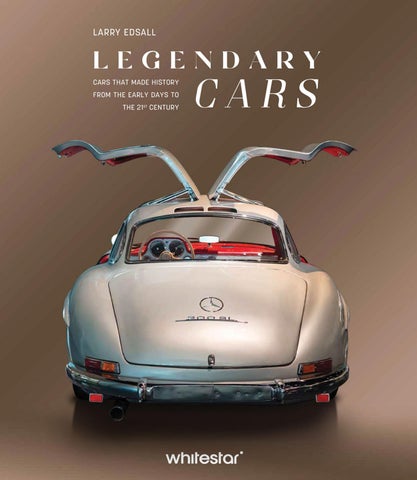
4-5 THE MID-1950S MERCEDESBENZ 300SL, KNOWN AS THE “GULLWING”.
6-7 JAGUAR’S ICON OF THE 1960S – AND, IN FACT, FOR THE AGES – WAS THE XK-E.
8-9 THERE HAVE BEEN FEW CARS AS AUDACIOUS AS THE DODGE VIPER OF THE 1990S.
10-11 ROLLS-ROYCE INTRODUCED THE SECOND GENERATION OF ITS SILVER CLOUD IN 1959. THIS „DROPHEAD COUPE” WAS POWERED BY A NEW V8 ENGINE.
Jaguar XJ 220 page 232
McLaren F1 page 234
Full Speed Ahead: These are the good old days page 236
BMW Z3 page 240
Volkswagen New Beetle page 242
Ferrari 360 Modena page 246
Nissan 350Z page 250
Mercedes-Benz SRL McLaren page 252
Enzo Ferrari page 256
Chevrolet Corvette page 262
Porsche Carrera GT page 264
Audi R8 page 268
Bugatti 18/4 Veyron page 272
Maserati GranTurismo page 276
Chevrolet Camaro page 278
McLaren MP4-12C page 280
Tesla Model S page 284
Ferrari FXX-K Evo page 286
Aston Martin Valkyrie page 288
Ferrari SF90 Stradale page 290
Chevrolet C8 Corvette page 292
Rimac Nevera page 294
Volkswagen ID.Buzz page 296
Lotus Evija page 298
Gordon Murray Automotive T.50 page 300
Bibliography, Acknowledgments and Index page 302
TATRA 77
Nesseldorfer Wagenbau-Fabriks-Gesellschaft began building railroad coaches in 1853. By 1897 it was producing central Europe’s first automobile, the Präsident (President), designed by engineer Hans Ledwinka and powered by a 2-cylinder Benz engine. By 1900 the company was building its own engines.
After World War I, the Austro-Hungarian Empire was carved up and the former Nesseldorf became Koprivnice, Czechoslovakia. The car company took its new name
from the Tatra Mountains, the range where it had tested many of its products.
Ledwinka’s first Tatra was the Tatra 11, notable because it was built around an 11-cm (4.3-inch) steel-tube spine rather than a standard chassis and featured independent suspension. Ledwinka’s engines ranged from an air-cooled boxer 4-cylinder to 6-cylinders and even a V12.
Tatra later built the 70, a luxury limousine, and in 1932 introduced the 57, a handsome sedan.
But what made Ledwinka and the Czech
automaker most famous was the Tatra 77 introduced in 1934. The Tatra 77 was a pioneer in unit-body motorcar architecture, but what really set it apart was its long-tailed, high-finned aerodynamic design with an air-cooled V8 mounted behind the rear axle. Ledwinka and his associate Erich Uberlacker were convinced that putting the engine at the rear would enhance aerodynamics, would reduce power losses inherent with a long driveshaft and would improve traction because the engine’s weight was close to the wheels that powered the car.
LEFT THE TATRA 77 HAD NO REAR WINDOW. HOWEVER, ITS DRIVER COULD GLIMPSE THE ROAD BEHIND THROUGH LOUVERS ON THE LARGE ENGINE COVER, THOUGH EVEN THAT VIEW WAS SPLIT BY THE CAR’S LONG REAR TAIL FIN.
RIGHT WHILE THE PURSUIT OF IMPROVED AERODYNAMICS
RESTRICTED THE DRIVER’S REAR VIEW, THE WRAPAROUND WINDSHIELD AND A LOW FRONT HOOD PROVIDED A GOOD LOOK AT THE ROAD AHEAD OF THE 1934 TATRA 77.
MERCEDESBENZ 540K
The automobile companies founded by Gottlieb Daimler and Karl Benz combined in 1926. Together, they would produce some of the most spectacular vehicles of the era.
Arriving at Mercedes-Benz about this same time was Ferdinand Porsche. Porsche stayed only a couple of years before leaving to open his own engineering company – and
to create not only spectacular Auto Union racing machines but the people’s car, the Volkswagen, which would surpass Henry Ford’s Model T as the best-selling vehicle of all time. Though he wasn’t there long, Porsche had a significant impact on Mercedes-Benz, both in terms of its awesome racing cars and its amazing road machines, those produced while he was there and those built on their foundation after he left.
Daimler’s son, Paul, had worked to apply aero engine supercharging to passenger car motors.
Combining supercharging with Porsche’s engines and automotive design genius created new horizons.
Mercedes-Benz 26/120/180 Model S was technically a sports car, though much longer, larger and heavier than what modern eyes accept as a sports car.
Porsche created an alloy-block, six-cylinder engine with overhead camshaft and when supercharged this 6.8-liter engine generated 180 horsepower, propelling the large Mercedes-Benz S to speeds of more than 100 miles per hour (160 km/h). Only some 300 of these S series cars were built, and many were used primarily for racing, with victories in everything from Grands Prix to the Tourist Trophy and from mountain climbs to the Mille Miglia. The engine was enlarged to 7.1 liters for the SS, and special short wheelbase and lightweight versions, SSK and SSKL, respectively, were propelled by as much as 300 horsepower.
Porsche also developed an inline eight-cyl-
inder engine for Mercedes-Benz racing cars.
After he left, the straight-eight architecture was used in a new line of road cars that carried forth the heritage of the S cars but now combined relatively sporty dynamics – as sporty as a 5000-pound car could be in the 1930s – with truly elegant, even timeless proportions and luxurious amenities.
First came the 500K (K for kompressor, the German word for compressor, the technical term for supercharger) in 1934. The 500K was powered by a 5.0-liter eight-cylinder engine that pumped out 160 horsepower, enough to carry the large and elegant twoseater to speeds of more than 100 miles per hour (165 km/h) on its all-independent suspension. In 1934, the engine was enlarged to 5.4 liters for the 540K, with 180 horsepower and a top speed of 170 km/h, a speed easily attainable on Germany’s new autobahn highway system. To maintain such speeds,
TOP THE MERCEDES-BENZ 540K WAS VERY MUCH A LUXURY CAR WITH SUCH TYPICAL 1930S FEATURES AS WING-LIKE FENDERS, LARGE, STAND-UP HEADLAMPS AND AN UPRIGHT GRILLE WITH A LARGE ORNAMENT ON ITS RADIATOR CAP.
BOTTOM CE THE MERCEDES-BENZ 540K WAS A DIFFERENT SORT OF LUXURY CAR. IT HAD LONG AND SLEEK LINES, A VERY POWERFUL ENGINE AND A LOWER STANCE. THIS WAS ALSO A SPORTY CAR, BOTH ATHLETIC AND ELEGANT.
Mercedes equipped the 500K and 540K with four-speed transmissions. But what truly set the cars apart were their designs. Engines were mounted behind the front axle so hoods were incredibly long and provided a large palette for bright work trim. Front fenders were large curved-metal sculptures that flowed back toward the car’s sloping tail section, which like the engine cover served as a canvas for bright and artistic trim.
Eventually known as S-T-D (SunbeamTalbot-Darracq), the company was sold to the Rootes brothers in 1935. They put a Frenchman, Major Antoine (Antonio) Lago in charge of engineering and management, and a year later he made Talbot his own company, developing his own cars and 2.7- and 3.0-liter six-cylinder engines to power them.
Lago had a history in racing and he specialized in building cars that were suitable not only for motoring, but for motorsports. In 1937 Lago Specials swept the top three positions in the French Grand Prix at Montlhéry.
That same year, Joseph Figoni of French coachbuilder Figoni & Falaschi designed the teardrop bodywork for the Talbot-Lago T150 SS (Speciale Sport) coupe. The car was stunningly beautiful, and its design made it appear larger than it really was. It also was equipped with large brakes, which were useful because the car was powered by Lago’s new 4.0-liter, twin-carbureted six-cylinder engine that provided 140 horsepower and a top speed of 100 miles per hour (160 km/h). With its aerodynamically shaped bodywork, the car could cruise com-
fortably at speeds in the 85-90 miles per hour (140-145 km/h) range. Talbot resumed production in the later part of the 1940s, though in very low volumes. The Talbot Record and Grand Sport were sports cars that were particularly successful in racing. In 1950, they took on the likes of Ferrari, Jaguar, Aston Martin
TOP LEFT MOMA CURATOR ARTHUR DREXLER NOTED THAT WHEN FENDERS OF THE TALBOT LAGO WERE PAINTED IN A COLOR THAT CONTRASTED WITH THE MAIN BODYWORK, THEY HIGHLIGHTED THE CAR’S CONTOURS AND MADE CLEAR THE OVERALL ORGANIZATION OF THE DESIGN.
BOTTOM CENTER THE TEARDROP-SHAPED BODYWORK FOR THE TALBOT LAGO T150 SS (SPECIALE SPORT) COUPE WAS DESIGNED BY JOSEPH FIGONI OF THE FAMED FRENCH COACHBUILDER, FIGONI & FALASCHI.
TOP RIGHT THE DRIVER, SITTING TO THE RIGHT, SAW THE TACHOMETER WHILE THE PASSENGER GOT TO CHECK JUST HOW CLOSE THE TALBOT LAGO WAS TO APPROACHING IT TOP SPEED OF 100 MILES PER HOUR.
and even Cadillac at Le Mans and finished first and second. A year later they were second and fourth. In 1952 a Talbot held the lead at Le Mans as late as an hour and ten minutes from the finish. Antonio Lago died in 1960, not long after his ailing company had become part of French automaker Simca.
TOP LEFT MORE THAN 80 PERCENT OF XK120S WERE EXPORTED. THE CAR WAS ESPECIALLY POPULAR WITH AMERICANS, INCLUDING HOLLYWOOD STARS SUCH AS CLARK GABLE.
BOTTOM CENTER THE XK120 WAS ALSO BUILT AS A COUPE WITH TEARDROP-SHAPED SIDE WINDOWS THAT REMINDED MANY OF THOSE IN THE FAMED BUGATTI ATLANTIC.
TOP RIGHT WITH ITS LONG HOOD AND LOVELY, FLOWING CURVES, THE JAGUAR XK120 WAS BEAUTIFUL. BUT IT ALSO WAS FAST, THE FASTEST ROAD CAR OF ITS TIME.
their own Swallow bodies for the Austin Seven motorcar. Using powertrain and other components from the Britain’s Standard car company, they produced their own cars, the SS I and SS II, beginning in 1932. After Wamsley left, Lyons changed the company’s name to SS Cars Ltd., which showed a four-door model, the SS Jaguar, at the London show in 1936.
That first “Jaguar” was powered by a Standard engine much modified by William Munger Heynes and Harry Weslake. Heynes led the development of Jaguar’s own engine, the XK, a 3.4-liter straight six with dual overhead camshafts that helped it generate 160 hp and 195 pound-feet of torque to propel the car from a standing start to 60 mph in just 10 seconds.
The XK 120 may have had a tiny cockpit, little luggage room, weak headlights and weaker brakes, but it was fast and became the car of choice for daily driving by Hollywood stars and world racing champions. The car was so popular in overseas markets – more than eight out of every ten cars were exported –that it wasn’t until 1950 that the car was readily available to British buyers.
British automaker Austin designed its A90 Atlantic with Americans in mind. It even used the Indianapolis Motor Speedway to set a series of stock car speed records; over the course of seven days and nights and despite inclement weather, the Atlantic covered nearly 12,000 miles (more than 19,000 kilometers) around the famous Brickyard at an average speed of more than 70 miles per hour (112 km/h).
The Austin Atlantic went on sale as a 1949 model, first as a convertible and later
AUSTIN HEALEY 100
as a sedan. Americans bought them, though not in the sort of numbers Austin had anticipated, so the automaker asked several British specialists to see what they could do with the A90’s mechanical components to create a product more suited to American tastes.
Donald Healey had been among Europe’s top rally racers and then became technical director at Triumph. After World War II, he started his own car-building company and built more than 600 Healey touring cars and Silverstone sports cars in the late 1940s and early ‘50s.
Healey’s designer Gerry Coker created a two-seat sports car that Healey packaged around Atlantic components. The project drew considerable attention when Healey took his car to Belgium, ran it at speeds of up to 117 miles per hour (188 km/h) and then
immediately displayed it on his stand at the 1952 London Motor Show, where the car was presented as the Healey 100. Austin merged with Morris in 1952 to form the British Motor Company and BMC’s Sir Leonard Lord was so impressed with Healey’s car that he put it into production as the Austin Healey 100.
Healey had recognized a gap in the fledgling American sports car market between MG’s T series roadsters and Jaguar’s XK120, both in terms of price and performance. The Austin Healey 100 sold for just less than $3,000 (U.S.), about a thousand dollars more than an MG and a thousand less than the Jaguar.
To demonstrate the car’s potential, Healey himself drove a modified Austin Healey 100 to speeds of more than 142 miles per hour (nearly 230 km/h) in October 1953 at the Bonneville Salt Flats. Even in stock trim, the car could exceed 100
miles per hour (160 km/h) and accelerate from a standing start to 60 miles per hour (96 km/h) in slightly more than 10 seconds. Stock trim for the Austin Healey 100 included a 90-horsepower, 2.6-liter Austin A90 four-cylinder engine, double-wishbone front suspension and a life rear axle with leaf springs. The car sat almost too low to the ground, and exhaust routing made things hot in the cockpit, but the body was beautiful, the windshield would fold flat and the car set standards for a relatively inexpensive roadster. In the first year of production, half of all Austin Healey 100s were sold in the United States. Over the course of some six years of production, thousands more would cross the Atlantic.
Austin Healey introduced the 100M in 1956; this car drew power from a 110-horsepower engine and came with a two-tone paint scheme.
The company also produced slightly more than 50 100S versions, designed for motorsports competition, with aluminum bodies, 132 horsepower and was the first production car to wear Dunlop disc brakes inside all four of its wheels.
In 1957, the car grew heavier and longer, with a 2.6-liter six-cylinder engine, a back seat and an available detachable hardtop.
Austin Healey introduced its back-to-basics Sprite roadster model in 1958 and a year later 100 production ended when the company introduced the Austin Healey 3000.
TOP LEFT THOUGH BUILT AS A ROADSTER, A REMOVABLE HARDTOP WAS AVAILABLE FOR THE AUSTIN HEALEY 100.
BOTTOM RIGHT DONALD HEALEY MADE THE 100 DURABLE AND FAST, ABLE TO EXCEED 100 MILES PER HOUR EVEN IN STOCK TRIM.
ASTON MARTIN DB5
It’s been called the world’s most famous car, the Silver Birch-colored Aston Martin DB5 that Bond, James Bond drove, first in Goldfinger, then in Thunderball.
Equipped by Q with such non-factory options as an ejection seat, retractable machine guns, bulletproof rear shield, oil slick sprayer and tire-shredding wheel extensions, the car became a star in its own right, so famous that sixteen years after shuttling actor Sean
Connery through his various adventures, it came out of retirement for a cameo appearance in yet another movie, “The Cannonball Run.”
Aston Martin launched the DB5 in 1963 as the mildly updated successor to the seven-year-old DB4, which had been the first all-new model the company produced after it was purchased in 1947 by David Brown. Brown gave his initials to the company’s cars after he added Aston Martin to industrial
BOTTOM CENTER THE DB4’S DESIGN WAS DONE IN ITALY BY TOURING, WHICH ALSO BUILT THE BODIES FOR THE CAR, WHICH WAS AVAILABLE AS EITHER A FIXED-HEAD COUPE OR A CONVERTIBLE WITH AN OPTIONAL REMOVABLE STEEL HARDTOP.
TOP RIGHT SOME THINK SEAN CONNERY WAS THE STAR OF THE JAMES BOND MOVIE, GOLDFINGER, BUT MANY SAY THE MOVIE’S CLASS ACT WAS THE “SPECIALLY EQUIPPED” ASTON MARTIN DB5.
BMW M1
In celebration of the 1972 Olympic Games hosted by its headquarters hometown of Munich, Germany, BMW had its design director Paul Bracq create a special concept car. The gullwinged BMW Turbo was presented it as an experimental safety vehicle, although its wedge-shaped and low-slung body looked more like an exotic sports car than something designed with safety in mind.
The Olympic concept car was notable
for many reasons. It took its name from the turbocharging of its 4-cylinder engine, which a year later would provide power to the highest-performance version of the company's heralded sports coupe, the 2002. The Olympic car also was the first BMW with mid-engine architecture.
Fast-forward to 1975 and to recently revised international racing rules and BMW’s desire to maintain its competitiveness in international endurance racing. With
BOTTOM LEFT DESIGNER GIORGETTO GIUGIARO EXPLORED NEW IDEAS IN FRONT AND REAR CRASH PROTECTION IN DRAWINGS HE MADE IN 1978 FOR THE BMW M1.
RIGHT THE DESIGN OF THE BMW M1 INCORPORATED
THE COMPANY’S CHARACTERISTIC TWINKIDNEY GRILLE INTO THE THIN NOSE OF A WEDGESHAPED BODY THAT FEATURED GULL WING DOORS. THE CAR WAS THE ONLY BMW PRODUCTION VEHICLE BUILT AROUND MID-ENGINE ARCHITECTURE.
BMW’s 3.0CSi showing its age, a new car would be needed for racing in the Group 4 category of the World Manufacturers Championship. With Bracq having returned to his native France to work for Peugeot, BMW turned to Giorgetto Giugiaro to design a body based on the ‘72 Olympic Turbo concept.
BMW contracted Italian sports car maker Lamborghini to do development engineering for the tube-frame chassis and to
THE LINES OF THE NEW BEETLE LEND THEMSELVES TO CUSTOMIZATION OF ALL KINDS.
VMB Publishers® is a registered trademark property of White Star s.r.l
All rights reserved. No part of this publication may be reproduced, stored in a retrieval system or transmitted in any form or by any means, electronic, mechanical, photocopying, recording or otherwise, without written permission from the publisher.