
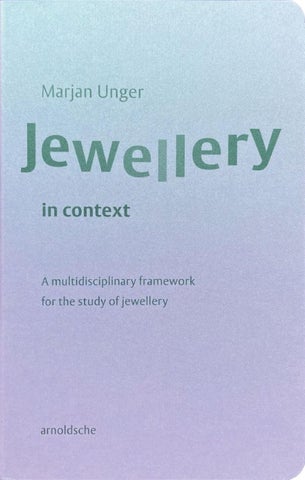
Jewellery in Context

Page 1


You hold in your hands the second edition of the English translation of Marjan Unger’s dissertation. In my opinion, this essay is one of her purest. Among all the other texts I know on adornment and jewellery, it stands out as an absolute elementary standard work, and I consider it a ‘must-read’ for every jewellery student. But also for professionals, it will certainly open new perspectives and widen horizons. For interested laymen, it is a perfect introduction to the field of jewellery and adornment.

Until now, ‘Jewellery in Context – A multidisciplinary framework for the study of jewellery’ was available in Dutch only.

I often asked Marjan to also publish this text in English in order to make it available beyond the Dutch-speaking borders. But knowing that she did’t have much time left, she kept telling me that she preferred to do ‘new’ writing and asked me to be patient – again and again. Just before she passed away, she gave me the right to publish the English version of her dissertation and asked me to take care of it. In consultation with Gerard Unger and Chequita Nahar, I conceived this book as a co-publication with many other jewellery institutions, schools, entrepreneurs and interested individuals. we considered this to be mostly in Marjan’s spirit.

My sincere thanks go to Suzanne van Leeuwen, Chequita Nahar, Dirk Allgaier, Wolfgang Lösche and all the co-publishers for making this possible.

Dr. Marjan Unger passed away in 2018 – a grave loss, not only for our field. Her work and heritage however, will continue to inspire and educate generations of jewellery lovers worldwide. Holding the Englisch version of Marjan Unger’s dissertation in the second edition in my hands makes me happy. I wish you the same while reading this book!

February 2026, Theo Smeets

Doctoral Committee

Promotors:

Prof. Dr. T. M. Eliëns, Leiden University

Prof. Dr. C. W. Fock, Leiden University

Other members:

Prof. Dr. K. Zijlmans, Leiden University

Prof. Dr. A. Bergmans, University of Ghent

Prof. Dr. J. R. ter Molen, Radboud University Nijmegen

Dr. M. Groot, Leiden University

1 A term such as ‘modern jewellery’ refers more to a certain period within the twentieth century than to a distinction with jewellery from the preceding periods.

2 Jewellery is essentially nothing less than wearable money; all the same, it can be more than wearable money.

3 The goldsmith’s trade is a shining example of a design discipline in which recycling has always been the norm.

4 Symbolism in jewellery is rooted in the motifs that underlie its wearing. These motifs are based not only on social, cultural and moral norms that often have a great deal of continuity, but also on the personal and time-bound points of view of the maker, the client and the wearer.

5 The term ‘art’ should not be used as a quality standard with regard to design products, including jewellery.

6 It is amazing to think that many of the natural materials used in jewellery come from ‘the underworld’: ores from deep underground, stones that are mined, treasures from the sea and the raw materials used to make synthetic materials. The things from ‘the upper world’ serve more as inspiration and model. This observation can serve as a metaphor for analysing the many forms of symbolism associated with jewellery.

7 The fact that jewellery primarily has an affirmative function within social groups, that each group lives with its own codes and that the lower classes or subcultures can also influence the preferences of other social groups, are recent notions from the human sciences that are of great value for the study of jewellery.

8 Craft does not exclude thinking.

9 An art historian cannot live on masterpieces alone

10 Neither the possession of a pearl necklace nor the wearing of a it constitute an essential obstacle to the scientific approach to a cultural phenomenon such as jewellery.

Foreword Theorems

1 Introduction 11

2 Definitions and classifications 15

2.1 Definitions 15

2.2 Classifications 20

3 Art history as foundation for the study of jewellery 28

3.1 A useful basis 28

3.2 Obstacles within the art historical approach to jewellery 34

3.3 Conflicting classifications 38

4 Man as measure 51

4.1 Body 51

4.2 Appearance 55

4.3 Health 58

4.4 Men, women, children 61

5 Angles from other disciplines 66

5.1 Humanities 66

5.1.1 Psychology 67

5.1.2 Sociology 69

5.1.3 Anthropology, ethnology and material culture 76

5.2 Relationship between the study of jewellery and the study of fashion and clothing 81

5.2.1 Study of fashion is a few steps ahead 85

5.3 Literature 92

5.4 Economy 97

5.4.1 Market value 97

5.4.2 Materials and technique 100

5.4.3 Single copies, serial production or bulk good 107

5.4.4 Pricing and consumption 110

5.5 Morality 116

5.5.1 Philosophy 116

5.5.2 Beauty, a moral standard? 121

5.5.3 Religion 124

6 Symbolism in jewellery 131

6.1 Power 134

6.2 Fertility, protection and eroticism 137

6.3 Remembrance or memento 142

7 Evaluation 147

7.1 Five values 147

7.2 Explanatory notes 149

7.3 Quality assesment 160

7.3.1 Rehabilitation of ‘inconspicuous’ jewellery 161

7.3.2 More attention for conventions and the role of the wearer 162

7.3.3 A matter of numbers 163

7.3.4 Art is not a quality standard 166

7.4 Comprehensiveness, the sublime and reciprocity 168

8 Conclusion 171

8.1 Multidisciplinary approach 171

8.2 The next phase 175

Notes 180 Bibliography 212 Summary 225 Curriculum vitae 229

Cooperation and co-publishers

Pieces of jewellery are expressions of the fundamental human need for decoration and ornamentation. They symbolise people’s enjoyment of life and respond to their need to make themselves known to each other and to face the world around them with their head held high.

In primeval times people would already satisfy this need with a beautiful shell, a delicate stone, a few flowers or the teeth of a defeated wild animal. Pieces of jewellery belong to people and are probably as old as mankind.

The human body determines the size of jewellery. Being small objects, essentially, they can carry an incredible number of meanings. (1) Over the centuries, all human pleasures and challenges have been represented in jewellery: eroticism, power display, pragmatism, the conjuration of the supernatural as much as the love for the natural, the love for a certain person, sadness and the pure pursuit of beauty. Each era generates its own messages, usually as variations on these universal meanings.

Jewellery items are not always immediately visible. They have a certain intimacy, because they are close to the skin and they can generally be appreciated only from up close. In our culture we are not inclined to violate this intimacy too much.

What fascinates is the tension between the intimacy of jewellery and the scope of the messages conveyed by jewellery. (2)

The concentration of meanings in small objects like rings, necklaces, bracelets, belts and headdresses is outright fascinating. The limited size invites not only precision and excellence, or the highest levels of craftsmanship, but also spontaneity, as ornaments may be worn for a few hours only.

Masterpieces of goldsmithing, composed of durable materials, have often withstood the times best, and they tend to be well documented as well. They are attractive to beholders largely for the monetary value they represent, and over time they have given jewellery the dubious aura of status symbol.

However, the value of an ornament is not only determined by its material value or market value. Jewellery generates an endless variety of temptations. As an art historian specialising in design, I like to be seduced by jewellery, but I also want to understand why people wear jewellery and what messages they thus communicate (at present and in the past) in order to arrive at more insight into what determines the value of jewellery.

For Het Nederlandse sieraad in de twintigste eeuw (Dutch jewellery in the twentieth century), a study published in 2004, I spent ten years researching jewellery made and worn in the Netherlands, with a specific focus on the underlying mentality which in several respects differs from uses and customs in the neighbouring countries. The most important difference is the particular reticence regarding outward display, which appears to be deeply anchored in Dutch culture.

This research addressed not only cultural highlights of the jewellery trade or jewellery worn by the upper classes, but also jewellery worn by the rank and file, such as regional jewellery, war and liberation jewellery and, for example, the discreet return of men’s jewellery at the end of the twentieth century. I traced many unknown works from before 1968 and placed them in a cultural-historical context. I considered the post 1968 period, about which much more is known, according to the same principles and criteria: not only the highlights from applied art and design, but also popular and widely disseminated forms of jewellery. If for the period until 1968 I could address most developments in detail, for the period after that I had to be much more selective.

My quest for a comprehensive picture spanning an entire century complicated the effort to sketch the broad outlines in a number of ways. It proved hard in particular to develop a multidisciplinary approach to the study of jewellery in great detail, as all the information complicated the design of such approach. (3) Because many more jewellery items and texts on the jewellery trade are available on the period after 1968, I gave much attention to putting the so-called revolution in Dutch jewellery

design of around 1970 into perspective. This approach was also a response to the unbalanced and limited view on jewellery, which in the study of jewellery has been the norm rather than the exception. (4)

For this reason, Het Nederlandse sieraad (Dutch jewellery) is perhaps best regarded as a collection of detailed studies, instead of as a consistent treatise on jewellery as a cultural phenomenon. Today, however, I would still forcefully defend the organisation of the book and the way in which it describes jewellery as part of Dutch culture throughout that most exciting century. The questions I explored as an art historian for each sub-topic are still relevant. My direct approach, one of a critical yet benevolent observer and wearer of jewellery, is quite appropriate for the study of jewellery. Wearing a piece of jewellery, after all, is and will continue to be the ultimate test to assess its effect. (5)

What a piece of jewellery is, is rarely or never defined in publications about jewellery. This also became evident in my follow-up research about which I report in this essay. (6) Jewellery is such a universal phenomenon that a definition seems superfluous, but the ways in which it is looked at are constantly changing. This was very much the case in the course of the twentieth century, for example, partly in response to particular societal and economic developments. In the western world, more people than ever gained access to luxury goods. At the same time, jewellery became more and more the exclusive domain of women. Strict divisions also arose in the jewellery trade: value judgements with regard to design and materials began to shift, certainly within the upper echelons of the cultural domain.

It is common for all kinds of opinions and arguments to be linked to the concept of jewellery, but when it is not possible to trace them back to a definition or other point of reference, they are hardly verifiable, if at all.

In all honesty, I should add that I myself did not solidly define jewellery as a concept in Dutch jewellery, even though I implicitly or partially may have done so when discussing specific sub-areas. In articles which I subsequently published about jewellery, I omit-

14

ted providing such definition as well. In this essay I rectify this omission and I also develop a foundation for a multidisciplinary scholarly approach to jewellery. The scope of my research is limited neither to a time period nor to the work of Dutch makers. The latter will certainly please those amongst my friends and critics who are true lovers of jewellery. They always felt that my strong focus on Dutch jewellery and the modest approach underlying it went at the expense of a broader and more international perspective on jewellery. (7) This essay, then, is about jewellery in all its various meanings and manifestations.

The study of jewellery as a cultural good deserves a sound theoretical framework. This essay aims to develop such frame. I zoom in on more comprehensive and widely disseminated literature on jewellery and provide a thorough analysis of the underlying perspectives and personal motivations of various authors who have written about jewellery. I also discuss well-founded sub-studies which fell outside the scope of Dutch jewellery

Since the publication of Dutch jewellery in 2004, my views on jewellery have been sharpened by attending symposia, giving lectures and writing a number of articles. (8) The many trips I was able to make were a great stimulus. I have enjoyed exhibitions in Paris and Brussels, which unembarrassedly spotlighted precious jewellery. It turned out that I was greatly attracted to the sturdy and colourful jewellery of the Naga, a people living in the eastern mountainous parts of India. These are also worn by men and nowadays can be found in cities like Istanbul, Paris, Brussels, Shanghai and Amsterdam – a contemporary sign of the ease with which jewellery can travel around the world. Africa continues to fascinate, with its nomadic peoples wearing their possessions in the form of jewellery on their bodies and with cities and regions whose economy is based on barter trade in jewellery and beads. Fortunately, there are still countries and cultures that have let themselves be guided by western notions of economy, culture and society less strongly, and that have different patterns of behaviour for men and women than the ones we live by. These western notions have prevented many critics of jewellery not

only from placing it in a broad perspective but also from substantiating their claims about this comprehensive cultural phenomenon.

The development of understanding of culturally determined patterns of thought and behaviour which are not inherent to the current, western oriented awareness of standards proved to provide useful building blocks for the creation of a theoretical framework for the study of jewellery. It was crucial to recognise that most jewellery symbols by far are symbols of coherence within social groups, rather than elitist signs of power worn by high-ranking people to impress lower-ranking people. The current preoccupation with individuality in particular cultural circles also needs to be put into perspective. From such angle, it is possible to replace the hierarchical and chronological normative awareness of traditional art history by a more nuanced approach, featuring not only artistic qualities but also other values. In this way this study fits in with the current tendency within the arts and cultural history to consider all sorts of artefacts, tools and utensils much more in the context of their use and to analyse and map their social and economic dimensions.

2 Definitions and classifications

2.1

Definitions

Most publications on jewellery lack a definition of jewellery. Instead, authors first rely on standard dictionaries in their own language. The main Dutch dictionary, Van Dale’s Groot Woordenboek der Nederlandse Taal , indicates that ‘jewellery’ refers to ‘something that enhances the beauty of a person, of the whole to which it belongs, of his environment’. A second meaning given is: ‘object made of precious metal, precious stone set in metal, etc. with which one adorns oneself’. To mention enhancement of beauty as the only purpose of jewellery and then to pin down the choice of materials to precious metals and gemstones twice

16 involves an unnecessary restriction, one that is bound to be counterproductive to any sound study of jewellery.

Jewellery pertains to people’s self-image and the ways in which they relate to each other; a jewellery item is like a piece of a jigsaw puzzle in how people demarcate their identity and reveal themselves to others. Pieces of jewellery are wearable objects and as such pre-eminently suitable as signs of affirming one’s position within a society. They may thereby stress mutual similarities as well as differences amongst individuals. Additionally, they are vehicles for mitigating fears, they testify to the human joy of decoration or they help to keep memories alive.

Beauty is just one of the elements that play a role in people’s interpersonal contacts. Beauty refers to something exceptional; it is a rather elusive norm which is set as example within a certain time and culture. By not further defining beauty and considering it the only purpose of jewellery, pieces of jewellery are reduced from the outset to being toys for fuzzy creatures, who are, yes, likely to be female. Although the Dutch dictionary does not suggest that jewellery is mainly about women, it is another rather fixed and typically western prejudice that men do not actually wear jewellery. This assumption does not seem limited to the Dutch language area (cf. section 4.4 below).

More useful is the description of jewellery found in another conventional Dutch source, the Winkler Prins encyclopaedia: ‘objects to decorate body and/or clothing, made of (precious) metal, wood, ivory, jade, glass, mother of pearl, plastics, etc., whether or not provided with precious stones, semi-precious stones or imitation precious stones; the term jewellery is usually restricted in speech to jewellery in which (precious) stones are incorporated. The French term bijou (= trinket) is used as a synonym for jewellery’. This source only mentions ornamentation as purpose of jewellery, which is basically true of course. Moreover, the list of potential materials is much larger, while single pieces of jewellery are linked to jewellery in general.

The term ‘jewel’ is closely related to the term jewellery, as is true of the term ‘bijou’. In Dutch jewellery I described this term

as follows: ‘A jewel is a precious adornment, basically one of precious metal in which one or more stones are incorporated’. (9)

There is no misunderstanding about the term ‘jewel’, not even in the international literature: it is a category within jewellery. Sometimes the word ‘jewel’ is used to refer only to a stone that is placed as decoration on an object or a garment. The word ‘bijou’ was still frequently used in the Netherlands in the 1960s, but has meanwhile fallen into disuse in Dutch. (10)

The word ‘jewel’ is etymologically related to the Latin iocus, meaning ‘sketch’, ‘play’ or ‘small diversion’. (11) This origin can still be recognised in several languages. In the English language area, jewellery refers to both bijou and ‘high’ jewellery. In French, joaillery and bijoux are used side by side, in German Juwelen is used alongside the more general term Schmuck, and in Italian gioiello is the most common term. For many people, then, a piece of jewellery is something that provides enjoyment, a fact that has rightly been used by many an author about jewellery to explain his fascination with jewellery. This sympathetic yet onesided explanation should not be a reason to close one’s eyes to all the unsavoury practices associated with the extraction, processing and marketing of the typical materials for making jewellery – precious metals and precious stones.

Terms also relevant for the study of jewellery are ‘decoration’, ‘ornament’ and ‘adornment’. Decoration means embellishment or distinction, and there is no doubt that a piece of jewellery can be described as a decoration of people’s outward appearance. The concept of ornament has a more nuanced meaning. In everyday language ornament is used as a synonym for jewellery, embellishment or decoration, but within art history ornament stands for a specific motif, a decorative addition to works of visual art, architecture or particular utensils. In this essay the term ‘ornament’ is used in this way. ‘Adornment’ is synonymous with embellishment and decoration. In this essay, ‘adornment’ refers to all decorative elements on and around the body, not only jewellery but also accessories and body decorations such as tattoos and piercings. In connection with decorative elements on clothing, adornment

18 can be highly complex; in this sense, a piece of jewellery is part of adornment.

In many languages, the word ‘jewellery’ is also used metaphorically. However, this essay is exclusively about jewellery as referring to concrete objects.

Proposal for a definition of ‘piece of jewellery ’:

A piece of jewellery is an object that is worn on the human body, as a decorative and symbolic addition to its outward appearance.

A number of aspects of this definition deserve brief explanatio n:

1 Materials for making jewellery can vary widely – from metals, stones and other minerals to animal, vegetable and synthetic materials. Because there are hardly any restrictions as to the materials that can be used to make jewellery, it is not necessary to specify them in a definition.

2 The term ‘accessory’ is often mentioned in one and the same breath with jewellery. This definition also applies when referring to an addition to clothing or outward appearance. In terms of professional practice, the manufacture of clothing accessories is usually seen as part of fashion. The design, production and marketing of jewellery is a separate discipline and the making of ‘high’ jewellery is at most considered a specialisation within goldsmithing. There is also a grey area in which the distinction between jewellery and accessories appears to fade. Partly because ‘accessory’ is a broader term (cf. interior accessories, car accessories and so on), the distinction between jewellery and fashion accessories rarely causes problems in everyday language.

3 Pieces of jewellery which serve as autonomous objects are distinguished from body-related decorations such as tattoos, body alterations or mutilations and hairstyle. As far as their cultural and social aspects are concerned, the latter arise from similar motives as jewellery, but as ‘immovable properties’ they do not have the transferability and therefore the exchange value so strongly characterising jewellery. They do not survive their

owner, while their making or craftsmanship markedly differs from that of the jewellery trade.

4 It is essential for a piece of jewellery that it can be worn on the human body. As such the person is both measure and yardstick: a piece of jewellery is only a piece of jewellery if you can somehow wear it on the body. The motivation for wearing it is a decidedly human affair as well. Whether this motivation is perhaps more important than the intentions of the maker is an open-ended issue. Metaphorically speaking, a wearer can make or break a piece of jewellery without changing or damaging anything. Furthermore, the maker is bound to include statements in his work about the way in which it can be worn and why. Even if he does not, inevitably he is still making a statement about this aspect.

5 This definition includes the reasons for why jewellery is worn at all in the two adjectives ‘decorative’ and ‘symbolic’. The verbs ‘decorate’ and ‘adorn’ partly overlap, while ‘decorating’ also comes with the association of ‘decor’ or stage (for a theatre play) – in itself a beautiful metaphor for wearing jewellery. More importantly, ‘decorative’ is a common term in art history. Decorative art is a synonym for applied art or what is nowadays called ‘design’. ‘Symbolic’ refers to an infinite array of meanings potentially comprised in jewellery as attribute. If ‘decorative’ as adjective basically refers to the effect of jewellery, ‘symbolic’ refers to the meanings of a piece of jewellery, including the reasons for wearing it. The decorative effect of a piece of jewellery may be more important than its symbolic value, and vice versa, but the two are not mutually exclusive.

6 By calling a piece of jewellery an addition to a person’s outward appearance, it is distinguished from clothing, which covers or can cover the body. Jewellery represents an added value, which should be seen however in relation to clothing and other aspects of the way in which people show themselves to the world.

7 The notion of ‘outward appearance’ emphasises that the human body is not a static given, but a complex form that is potentially subject to being shaped quite a bit. This notion of

Turn static files into dynamic content formats.
Create a flipbook