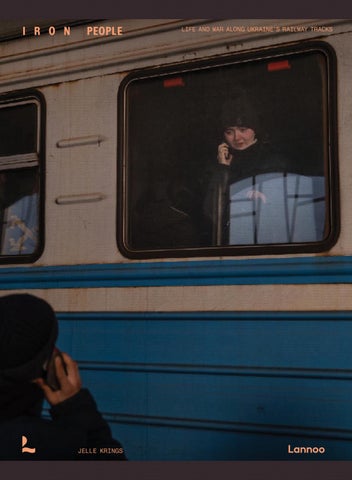
PREFACE -- JELLE KRINGS
In the weeks leading up to February the 24th, 2022, Kyiv was plagued by rumours of Russian troops and weapons amassing along Ukraine’s borders. The air was tense with anticipation as many residents made plans to flee the country in case of invasion. Others were sceptical and dismissed concerns, convinced that they were caught up in Russian propaganda designed to pressure Ukraine into submission.
As Kyiv braced for impact, I travelled to the capital and stayed at the Ibis Railway Hotel. On Sicheslavska Street, beside the large pillars at the entrance of the central railway station, I breathed in the cold winter air. Surely, I thought, the station would be among the first targets for Russian bombs.
In the immediate aftermath of the invasion I covered a mass exodus as millions of refugees fled their country. Lviv, in Western Ukraine had become the main transit point for those travelling to Poland. Arriving on evacuation trains, Ukrainians moved through the station in vast numbers: tens of thousands every day. Their gazes were distant, marked by the trauma and shock of what had become their new reality: full-scale war.
I soon realised that without those trains, most of the people passing through would have been trapped in towns and villages besieged by Russian troops. Ukraine stretches 1,316 kilometres from east to west and even before the war was one of Europe’s poorest countries. Rail transport is the primary mode of travel. In hindsight, knowing of Russia’s war crimes, these people could have been wounded, captured, raped or killed.
Amidst the chaos at Lviv station, I noticed how – after helping their distraught passengers onto the platform – train attendants and drivers climbed aboard their empty trains to head back east. Setting course against the stream of Ukrainians fleeing their homeland they were determined to save more.
Inspired by the railway workers’ courage, I followed them back east to document their plight. It was not long before I became deeply entrenched in the community. For the next three years I embedded with railway workers and their families in trains, depots, along the tracks, and in their homes. As the war unfolded in front of their eyes, our everyday reality became one of rocket strikes, broken families, hospital visits, and funerals –sometimes all in the same day.
Before the full-scale invasion, railway jobs in Ukraine had seemed unimportant, and railway workers were often taken for granted. But, after February the 24th, those who worked along the rails became essential to Ukraine’s survival. Their relentless effort to keep the trains running despite coming under fire from Russian troops, became a source of national pride. Their courage is now widely seen as illustrative of Ukraine’s resistance to Russian aggression. A story of ordinary people defying an existential threat – to protect their values, freedom and way of life.
During years of full-scale war, Ukraine’s railway workers demonstrated indomitable strength, courage and resilience. Their refusal to break enabled their country to withstand an invasion by a stronger, far larger enemy. What follows is their testimony.
2 ALONG THE TRACKS 3 NETWORK OF SUPPORT
Ukraine’s railway network has been under constant attack since the Russian invasion. Trains run towards the frontline, within range of Russian artillery and drones. Stations have become targets for their logistical value. Repairs are carried out in mined fields and under fire. Every day, railway workers risk their lives to keep the system running. The second part of this book tells their story of resilience.
The workers along the railway tracks in Ukraine rely on a strong support system, which has developed over decades in depots, factories, and communities across the country. Part three of this book explores how a network of infrastructure and support has kept the railways operational through years of full-scale war.
Ukraine’s railway network has been vital to the country’s wartime logistics. It enables the timely deployment and movement of tanks, artillery, weapons, ammunition, and soldiers to where they are needed along more than 1,000 kilometres of frontline. Part four of this book looks at how the railway community supports the military in its efforts to resist the Russian invasion on the battlefield.
Ukraine’s railway community helps keep the country moving towards freedom, but at a tremendous cost. Railway workers, soldiers, and civilians pay with their lives. The book concludes by reflecting on how the railway community has shaped wartime society and continues to carry the country forward.
IT WAS MY CHILDHOOD DREAM TO BECOME A CONDUCTOR. -- TETIANA VISLOHUZOVA
I travelled by train a lot, as early as first grade. I loved the feeling of being on the train. The sound, the movement, the tea they served in the metal-and-glass cups. Eventually I enrolled in the Institute of Railway Transport Engineers and became a head of train, which I’ve now been for 12 years. I couldn’t believe the war would start. Even when I saw on TV that all the diplomats were leaving Kyiv. They kept saying: here are the Russian troops at the border, this is where the war will start. Everyone was worried. When my colleagues said: “The war will begin.” I said, “Nothing will start. What war? Turn off that TV. Don’t listen to it. Nothing will happen.”
I didn’t believe it until the very end. It was a shock when they called me at 7 a.m. on February the 24th, and said the war had actually started. I thought it was a joke. On my first day at work, three rockets flew past. I still didn’t believe it. I never thought that it would be a full-scale war. I didn’t think that they would come from all sides, or to Kyiv. Before the war, life was different. We carried ordinary passengers. Happy people going about their lives. Since the invasion, everything has changed. I now work on evacuation trains. The people we carry are very different. Many are fleeing active war zones. They’ve lived for months in basements – three, sometimes even six months underground – waiting for the shelling to stop. Some of them don’t even have homes to return to anymore. They are sad, but at the same time happy to be alive.
In the beginning, there were evacuation routes from Kramatorsk and Sloviansk. 300 people were crushed into a carriage that had just 52 to 54 seats. In a car meant for 36, we had 200 people. 12 people were crammed into a single compartment meant for four. Even the hallways were packed.
It’s better now, but many still choose to leave every day. My current route is from Pokrovsk, because it is the safest train station among all – so to speak – hot spots in the East. We go around four to five times per month. Volunteers – with their own vehicles –take people from their homes by the frontline to the train station in Pokrovsk, and from there, we evacuate them. We’ve evacuated so many people, a huge number since the start of the war. About seven million, I believe.
We evacuated them from station war to station peace. Ukrzaliznytsia has played an enormous role.
We rescue all kinds of people. People whose homes are completely destroyed, who have nothing left at all. Some have spent months underground, waiting until their home is finally hit. It’s very hard to hear their stories. We take them to safety, usually to Dnipro. That’s where we start figuring out who has somewhere to go and who doesn’t. Some people are simply headed nowhere. You ask, “Where are you going?” and they say, “We don’t know.” So we help them find some kind of temporary shelter. We make sure they’re not left on the street.
Tetiana Vislohuzova Head of Train Evacuation Train 233 (Pokrovsk - Lviv)
We hear many stories on the train, you know, and each of them is powerful in its own way. One story that stayed with me happened on this very trip. I was arranging housing for people injured in a missile strike – a family: a grandfather, grandmother, mother, and a young son. They had just been released from the hospital; the grandparents had been wounded.
The mother sat down next to her son and said, “We lived underground in a shelter for three and a half months.” One day, she said, a missile landed in their garden. She shouted to her son, “Max, go to the shelter, to the basement.” And he made it. But he had been outside with another boy. His friend, Oleg.
Then this sweet boy, this six-yearold boy sitting in front of me, told me how his friend was torn to pieces right before his eyes. Oleg had tried to run the other way, to his mother, who had been behind a wall. The mother made it because the wall shielded her from the explosion. The father was wounded. The boy… he was torn to pieces.
This little boy told me the whole story. Can you imagine? A six-year-old child telling me this? He should be having a childhood, he should have… He should be playing football, playing with toys. Well nothing like that! Instead, he’s telling me this. Honestly, I’m still in shock. I can’t speak about it calmly – I’m sorry.
One time, when I was working on an ambulance train, there was another child, an 11-year-old girl in Kramatorsk. She had lost both legs in a missile strike. We were evacuating her. It was very hard to watch. Even the doctors who were with her couldn’t hold it together – they stepped out into the corridor and cried. That hit me hard. That kind of thing stays with you.
You prepare yourself. You mentally brace yourself. You know in advance what kind of misery people are going through, that their homes have been bombed, that they have nowhere to go. I understand that. I understand how hard it is for them. But stories like this are hard for me.
We are coping. Well, we have to cope, but what to do? We work and cope, and
what? There’s no other way out. If something happens, we talk about it together. Everyone is in shock, in a way. Because we’re all going through the same thing. I think the war has made us different: more united, and kinder.
We’re like a big family, the railway workers in Ukraine. That’s how it feels. There are many families who have worked along the railway for generations. Parents and children working together: they work as one unit –husband, wife, children – all on the railway. It happens often.
Not everyone fights as a soldier at the front. Everyone has their own front. There are our politicians, our soldiers and then there’s us. Everyone who works contributes to our victory. Everyone plays a part, but the soldiers of course – they make the biggest sacrifice.
When you’re on the job, you don’t really think about being afraid. You just go. You do your job. But when you’re off duty, when you’re at home and reading the news – when you hear about air raids or missile strikes –then it can get scary. Especially when I read that a place has been bombed right before I’m supposed to head there for work.
One time we arrived about ten hours after a strike. And the first thing that came to my mind was, “Thank God we didn’t get hit”. That we weren’t there when it happened. We arrived at the station and looked around. It was destroyed. There were fragments lying all over the platform. Glass was shattered. It was terrible.
I don’t have any polite words for the Russians invading our country. They stand by while our country is being destroyed. While bombs are falling, houses are collapsing – and they just watch. Why do they remain silent? Why don’t they respond in any way? I can’t tell you. I can’t wrap my head around it. What can I say?
I feel that, in my own way, I’m making a contribution to our victory. I stayed; I didn’t leave the country. I keep working, and this is how I help. I evacuate people from the hot spots. That’s my part in this war – my contribution to our victory. To be honest, I’m satisfied. I’m glad to be doing this work.