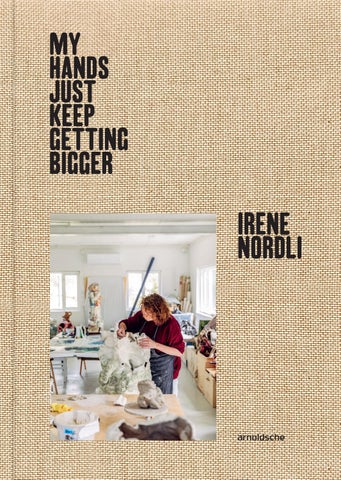
MY HANDS JUST KEEP GETTING BIGGER


IRENE NORDLI

![]()


← A long-standing conversation between Irene and Gjertrud forms the foundation of this book.
This book is the result of a close and exploratory collaboration between four creatives – artist Irene Nordli, writer and editor Gjertrud Steinsvåg, photographer Thomas Ekström, and the graphic designer Martin Lundell. In addition, we invited the writer Tyra Teodora Tronstad to contribute a text.
It is a monograph about Irene Nordli (b. 1967), one of the most prominent artists in the field of Nordic ceramics. She trained at the National College of Art and Design in Bergen (now part of the Faculty of Art, Music and Design at the University of Bergen) and has held a professorship at the Oslo National Academy of the Arts. Figurines, porcelain, new interpretations of materials, and the relationship to the human body are central elements of her art and her work with clay. Our goal has been to shed light on this work.
The texts and images address several essential aspects of Nordli’s artistic production and development since her graduation in 1996. Right from the outset, one of the motivations for the book has been to highlight the history of ceramic art in Norway and to celebrate its achievements by focusing on the career of one individual artist. Nordli’s own trajectory intersects with significant developments in education, material-based art and the role of institutions, collaborations and international dialogue.
Penned by Gjertrud Steinsvåg, the main text aims to introduce Nordli’s work and to o er insights into how it has been shaped by the artist’s life, memories and reflections. It is based primarily on conversations between the two, although Steinsvåg also invited Nordli’s family to share their perspec-

← The studio at Bøler. The foreground photo was taken at Gustavsberg Porcelain Factory during Irene’s 2021 residency.
It was in December 2014. I was on the bus from Oslo to Arendal. My destination for the day was the exhibition Transformator (Transformer) at Bomuldsfabriken Kunsthall. Harald Solberg (1954–2020), Bomuldsfabriken’s director since 1997, had agreed to meet me at the bus station. This was my first visit to the magnificent exhibition venue, and considering the number of superb exhibitions Solberg had organised, it was long overdue. Sitting on the bus, I checked my emails, thinking I could hardly a ord the time away from the Norwegian Crafts o ce, although I still found time to text a guy I was dating at the time.
Initiated by the artist Tulla Elieson (1950– 2023), the project Transformator brought together seventeen artists who had been given opportunities to use the workshops at the Norwegian Technical Porcelain factory in Fredrikstad. The idea was to explore what could happen technically and artistically for the individual artists who had access to these facilities, which have been producing and supplying high-voltage insulators for electrical infrastructure all over the world for over a century. For the first time, a project had been organised that took the combined aspects of the factory, its product range, skill set, manufacturing processes and specialised equipment, as the basis for a major exhibition. The outcome of the various artist residencies was a range of abstract sculptures, objects, installations, and audio and video works.
Harald and I started with lunch at a café. A chat about art and life, the Norwegian art sector, its economics and geography. Back at Bomuldsfabriken, Harald had some things

← The Hellemyr Creature Stoneware, 2017
Sketch for a 2-metre-tall sculpture commissioned by Hellemyr school in Kristiansand.
In 2010, Irene and her family bought an old car repair shop in Heestrand on the Swedish coast. Today, it is both a home and a place of work. It is also a place of generosity and hospitality. Of food and the sea.
Heestrand is our joint art project. The whole family has been involved in transforming a place no one wanted into a place we want, a place where we can be together, where there’s space enough for us all and even for friends and colleagues. In Heestrand we found an old car repair shop that had stood empty for years. We bought it. I have the nicest workshop I could imagine and I love working there. Here at last my big sculpture projects can become reality, and many people can work there at the same time –assistants, students and others curious about what ceramics can be.
Heestrand is where I’ve created many of my major commissions for public buildings and outdoor spaces. Large sculptures, many covered with mosaics. As this book is being written, I’m working on three projects: one for a school in Oslo, one in Tromsø, and one for a sculpture park in Espoo, Finland. I always sketch in clay. Each sculpture relates to its intended site and adds to its identity. The sculptures can be explored by anyone, young or old. You can climb on them and discover them in di erent ways.

← Dobbel Venus Porcelain, 2011
From 2009 to 2011, Kunsthall Grenland ran a three-year initiative of collaborative projects in China involving various artists and institutions. As part of the initiative, the Kunsthall financed a lengthy residency for Irene and Toril Redalen in Jingdezhen, followed by their participation in the Beijing Art Fair 2010. Significant works that Irene created during the residency include Super White and Stacks, the large-format sculptures Dobbelvenus (Double Venus) and three versions of Birdy. Back in Porsgrunn, Irene and Redalen showed works from China in a shared exhibition in 2011, Perspective China – Clay (e)scapes.
Porcelain has taken me on journeys to China and Jingdezhen – first in 2011 and then in 2017. Jingdezhen is of major historical importance as a city of porcelain and has been the centre of Chinese porcelain production for something like a thousand years. It’s where porcelain was first produced. In 2011, I went there to learn how to build large porcelain sculptures. I learnt how to make moulds for pressure casting from a master. In parallel, I worked with the whitest porcelain I had ever seen. I made a large series of small, abstract, cast porcelain sculptures.
In 2017, with the assistance of Norwegian Crafts, I went back there as a guest artist at a university in Jingdezhen, where I took classes with Huan Fei. He was a master of “blue and white painting” – an

← Arkanum nr. 8 Porcelain, 2023
Part of Irene’s most ambitious solo show to date, Arkanum, this installation draws on magical, alchemical and mystical traditions. Blending the familiar with the uncanny, it explores hidden knowledge and the unseen within everyday materials.
In February 2012, Irene’s younger sister, Katrine, is relieved to receive the news that her cancer is gone. She is in her late thirties and a mother of three small children. Big brother Øyvind describes her as the glue that held the family together.
Katrine was constantly inviting us to join her in things she felt ought to be marked or celebrated – and there were many of them. In her world, nothing was more important than family. Katrine, a photographer, once said she dreamt of living in a five-storey house. Her own family would occupy one floor, Irene and co another, me and my lot a third, and our parents a fourth. The ground floor would be a communal area. We would have breakfast together every morning in the kitchen. In the afternoon we would come together for dinner. In the evening, before going to our separate apartments, we would come together for supper and tell each other how we had spent the day.
I know Irene loved that idea, whereas I and my own family were more sceptical.
Six months after the cancer has supposedly gone, Katrine calls Irene: “I won’t get to see my children grow up.”
They cry endlessly, clinging to the hope that once again her condition will improve.

I Find It Harder and Harder
To Live Up To My Blue China, 1 Porcelain, 2012 Private collection


That Was the River. This Is the Sea Polyestyrene, fibreglass, polyester, glass- and ceramic mosaic, 2015 Public Art Commission, Bodø secondary school


Written by Tyra Teodora Tronstad
“My hands just keep getting bigger.”
This is what the artist Irene Nordli says, and I can’t forget the way she says it. It’s the summer of 2022, and we’re sitting in her garden in the artists’ cooperative Trolltun at Bøler, Oslo. We’ve been neighbours here for years, and we do what the women in these artist houses have been doing ever since they were built: we take walks in the woods, meet for co ee and chat about life, art and what we’re working on. That day, during an extended co ee break, we slip into a long conversation about what it means to work with the body. We talk about the fact that Irene’s job is physical not just in the sense that she makes things with her hands, but also because everything she makes somehow relates to the body and is kindred with it. It’s as if clay and the body were inseparable. This is what we talk about.
I say that I can’t think of a single one of Irene’s sculptures or figures that doesn’t have some kind of association to a body, whether that of a human or an animal, or sometimes even some other organism, but in any case the body of an organism, and I wonder whether Irene agrees.
“I agree,” she says. “Or rather,” she adds, “maybe I do. I might agree.”
This text stems from twenty years of conversations Irene and I have had while walking narrow paths through the woods, over cups of co ee in our gardens or on the steps in front of our houses. The artist’s cooperative Trolltun lies right beside the forest. Forest is just what the body and the mind need to let go of the familiar, to get the feet o the floor and out
← Reindeer antlers at the back of Irene’s terraced house.