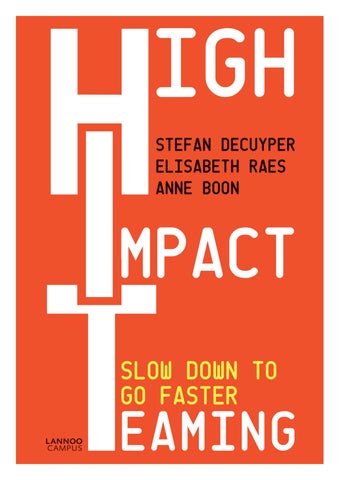
High Impact Teaming

Page 1


D/2020/45/301 – ISBN 978 94 014 6997 5 – NUR 807, 808

cover design Gert Degrande | De Witlofcompagnie interior design Banananas.net

© The authors & Lannoo Publishers nv, Tielt, 2020.

LannooCampus Publishers is a subsidiary of Lannoo Publishers, the book and multimedia division of Lannoo Publishers nv.

All rights reserved. No part of this publication may be reproduced and/or made public, by means of printing, photocopying, microfilm or any other means, without the prior written permission of the publisher.

LannooCampus Publishers Vaartkom 41 box 01.02 P.O. Box 23202 3000 Leuven 1100 DS Amsterdam Belgium Netherlands www.lannoocampus.com

This book is dedicated to Paul Stinckens, Olympic kayaker and founder of Unicorn.

PROLOGUE: WHY ‘I’?

The first words of this book date back to the 2nd of March 2010. I wrote them on the back of an envelope, in a strange house in a strange city about 145 km east of Mexico City.

My quest for the essence of teamwork, however, began much earlier than just one decade ago. First, I studied for fifteen years at the University of Leuven, Belgium: ten years of educational sciences and five years of organizational psychology. Afterwards, I successfully finished three PhDs on team learning.1 Then, I gained over fifteen years of experience as a team coach, mostly within Unicorn, a company that supports teams at CXO level throughout Europe (www.unicorngroup.com).

Before you start reading my book, there is just one small thing you should know: ‘I’ don't exist. You might have noticed that this book cover cites three authors: Stefan Decuyper, Elisabeth Raes, and Anne Boon. The I addressing you here is the aggregate of these three people.

There is no I in team…

But there sure is one in teaming.

– I

We wrote this book together and chose to write it in the first person singular because we believe that the stories come across better that way. But there is a second reason. It is very likely that you have heard the saying, ‘There is no I in team’. The I in this quote refers to the first person, suggesting the team is more important than the individuals in the team. But you never bump into a team in the hallway, do you? You don’t run into teams, you run into one, two, or three individuals. People expect far too much of the team. But the team isn’t doing anything. Maybe there is no I in team but there sure as hell is one in Teaming. High Impact Teaming always starts with an individual, an I. An

I takes the initiative to ask others how they see the situation in order to start constructing a shared vision. An I shows vulnerability, admits that he or she was wrong and rebuilds psychological safety. An I challenges, starts the good fight, and the result is that the team achieves better results together.

Sometimes, people ask us, ‘You wrote a book on High Impact Teaming. So tell me, were you guys a perfect team?’ Well, that single question reveals just about everything that is wrong with how we are educated on teamwork. We are promised formulas for collaboration that will solve all our problems. Let me tell you a little secret: the way we collaborated was far from problem-free because collaboration never is. The difference between theory and practice is always bigger in practice than it is in theory. It doesn’t matter how much expertise you have on the topic or how well you have worked together in previous collaborations. Teams never start off great. Effective teams just keep on figuring out how to improve. Step by step, they create their own formula for success. Not just once, but again and again and again.

Now that we have finished this book and the dust has settled, we can clearly see how that is exactly what we did. How each of us made big mistakes and how we did everything we could to fix them. How our team and each individual in it benefited from the struggles we faced and conquered. How the result is an example of what three individuals can achieve when they write and rewrite their own formula for effective collaboration: a book without compromises. Written from one pen. That is why we use I.

INTRODUCTION

Text Message 1: ‘Dad is in hospital. There’s something wrong with his heart.’

Text Message 2: ‘Everything OK, though. Visitors allowed.’

Text Message 3: ‘He is in Sacred Heart Hospital, room 402.’

On our family WhatsApp, my mother’s messages inform us about my father‘s hospitalization. The three messages reveal exactly the one thing she is trying to hide: panic. I suddenly feel my heart in my throat and my hands shake while I type: ‘I’m on my way.’ About 30 minutes later, I knock on the door.

‘Come in,’ Mom says. Her eyes are swollen. My father looks tired and his face is a bit red. ‘Everything is under control,’ he softly growls. He does what fathers do: he reassures me. Just when I am about to ask what happened, two nurses enter the room. Their name tags read Stephanie and Kelly.2 They tell us it is time for a bedside briefing because the new shift has started, and ask my father whether it is okay for him that we stay in the room. He nods. While Stephanie explains the situation to Kelly – what has already happened and what still needs to be done – I feel my body beginning to relax again. My breath moves from my breast to my stomach. The first tests were not 100% conclusive, but at first sight there is no acute danger.

My attention is drawn to what has always fascinated me: people who collaborate. It seems a bit unusual to me that Stephanie and Kelly debrief the shift in the presence of the patient. Stephanie explains. Kelly listens and asks questions. At some point, my father interrupts to make an additional comment: ‘Stephanie took my blood pressure and it dropped from 18 over 10, to 14 over 8.’ After a few minutes, the nurses leave the room. ‘They never used to do these kinds of debriefings with the patient in the room,’ my father says. ‘At least I know now that a new nurse is in charge and I feel reassured that all the information has been transferred to her. Back in the day, we didn't have a clue.’

It is true. They didn’t do that before. In numerous cases, crucial information disappeared in the gap between two shifts. Necessary adjustments in medications didn't always happen. People died as a result. Not as a result of

bad intentions, nor as a result of incompetent staff, but as a result of work processes that no one really questioned.3 Today, the work flow in this hospital is different. After my visit, I asked one of the nurses how their new methods of working had arisen. With a proud look in her eyes, she told me that the change had not occurred after the intervention of expensive consultants. They had developed the new method themselves. A nursing colleague had read about it and presented the basic idea at one of the team meetings.4 The head nurse reacted enthusiastically. ‘We decided to test it for a while and now it is our new normal. Bedside briefings take the same amount of time as before, but you can do certain tasks, like checking the intravenous drip, alongside one another. When you are in the room in the presence of the patient, the information you transfer tends to be more accurate. And sometimes, when we forget something, patients complete the information themselves.’5

That is what this book is about: High Impact Teaming. Or, to put it more simply: team learning with impact. Learning how to collaborate more effectively, more efficiently and more consciously. Of course, High Impact Teaming is not always a matter of life and death. In fact, most of the time it isn’t. Most of the time, it is about small things, small improvements. The difference between bad and a bit less bad or good and a bit better. It is about a short conversation here and a little intervention there.

High Impact Teaming isn’t rocket science, but the devil is in the detail. This book explains that the biggest differentiator of top teams and other teams is to be found in these details. It’s about how they slow down just for a moment to go faster afterwards. How they stop together to think. How they improve the psychological safety in the team, the shared vision, or the team organization. How they ensure that good ideas from outside the team find their way in. How they talk about what is going on beneath the surface.

We can all remember that one great moment in the life of the team that changed everything. That single team conversation that seemed to reboot the hard drive and got you and your colleagues up and running again. Scientists call those moments turning points. But at the same time, we all know there is no silver bullet for improving teamwork. We all know that hits are never made overnight. That success is always the result of a cumulation of moments.6 During my doctoral research, I studied turning points, and the truth is that the big moments we tend to remember are always preceded by many small ones that we tend to forget. So turning points are more like

tipping points. It is hard to create them consciously and they often arise when we least expect them.

Life can only be understood backwards, but it must be lived forwards.
– Søren Kierkegaard7

In contrast to those big moments, the small moments can be created consciously. Those small improvements are within our circle of influence. I will never forget how the coach of the Dutch women’s hockey team drilled his team on the value of small improvements: ‘50 times two percent is 100 percent too.’8 This book reveals how effective teams improve their own formula for success, percentage by percentage. They do so by continuously creating little moments of slowing down to go faster.9 That’s how they manage to live forwards. By tackling small problems and opportunities step by step.

Now, you all work with other people. Sometimes you call them team mates or group members. Sometimes you call them colleagues or stakeholders. It doesn’t matter what you call them. One thing is certain. This book is not just about how standard teams learn to collaborate more effectively. It is about how you can improve any kind of short- or long-term collaboration. It doesn’t matter whether you give that collaboration the name team, group, division, company, or any other name. As long as your collective has some kind of desire to accomplish something together, this book is written for you 10 And you don’t need to be the formal leader, the manager, or the coach. It’s okay if you are. It’s okay if you’re not. This book is about how anyone in or around the collective can influence its effectiveness.

Reading is like sex: sure, it may give some practical results, but that’s not why we do it.
– adjusted from Richard Feynman

In the first chapter, I present the High Impact Teaming model in a nutshell. In the subsequent chapters, I deepen each of its components. Along the way, I present a number of models and tips and tricks for improving team effectiveness.11 However, I am compelled to end the introduction of this book with a disappointing message. You will not learn anything new. Somehow – at some level – you already know all of it. The only thing this book has to offer is a science-based mirror. And the sole purpose of that mirror is to help you reflect on your own mindset about effective collaboration. Reflections on how to frame and clarify what you already know. Reflections on those things you might have lost sight of. ‘That sounds pretty ambitious. I seriously doubt that you will be able hold up a mirror to me.’ I hear you. You are right. I cannot confront you with a mirror. But you can. Just read this book with yourself and your team(s) in mind. ‘And what if that doesn’t work?’ Well, just in case, there is a plan B. Along with my colleagues from Unicorn and the University of Leuven, I created a free online questionnaire based on the High Impact Teaming model (www.teammirror.eu).12 With just three clicks of your mouse, you can set it up for any team. You only need the email addresses of the team members, a deadline for completing the questionnaire, and a moment to discuss the results together. Two days before that meeting, all team members automatically receive their individual Team Mirror report. The Team Mirror reflects how you and your colleagues see the team and where there are opportunities for High Impact Teaming.

CHAPTER 1: THE HIT MODEL

Books and articles about teamwork usually start in more or less the same way. First, the author emphasizes that teamwork has become broadly accepted as the best way for organizations to cope with the rapid changes in contemporary society. Then, the author offers convincing proof that he or she has read most of the existing literature and earned a few stripes in the world of working with teams. The introduction ends with a convincing suggestion that the author has discovered the holy grail: a handful of variables which, when assembled correctly, comprise the magic formula for effective teamwork.

Control + alt + delete.

The key message of this book is fundamentally different. I can understand why some people confuse what I try to do with presenting a new formula for success. After all, the HIT model that I present in this book looks quite similar to many of those magic formulas. But in truth, I find it quite embarrassing when that happens. Because the key message I am trying to convey is, in fact, the exact opposite.

My key message is that there will never be a universal recipe for effective collaboration. Of course, I know there are lots of scientific studies about how teams can work together effectively. In the studies I read, I counted hundreds of variables that were proven to influence effective collaboration. Variables at the level of the individual, the team, the organization, and beyond.13 And in practically every study I found a slightly different formula for successful collaboration. So I find myself sitting on my porch, staring into the shadow of that huge mountain of scientific studies on teamwork, and I can conclude

only two things. One, that mountain is far too high for a single person to climb. Two, there is no universal way to collaborate effectively. There are thousands of ways.

The team that became great didn’t start off great. It LEARNED how to produce extraordinary results.

If you remember only one sentence after reading this book, then let it be this one: ‘High Impact Teams discover their unique formula for success by learning what works and what doesn’t by themselves.’ A team is not a machine. Imagine your car broke down in four different places:15 two tires, the engine, and the brakes. The formula to get your car back on the road again is universal. Have a mechanic repair it at each of these four points. That’s it. For a team, the reality is quite different. With a team, the most the ‘mechanic’ can do is talk to the car and its parts. Only the car can fix itself. But more importantly, sometimes you have to start repairing the car by fixing its steering wheel. Once that is done, the engine magically starts running again and the tires inflate themselves. In other cases, the engine gets fixed and magically the two tires inflate automatically and the steering wheel grows back. The point is: in contrast to cars, teams are living systems. In living systems, the parts influence one another and have the ability to self-heal.

I admit that it sounds like an expert answering a difficult question with the most irritating counter-question ever: What do you think? I feel you. I also dislike answers that avoid the question. Answers that actually aren’t answers. But don’t worry. In this chapter, I offer you a couple of simple, science-based answers to the question of how High Impact Teams can fix their mechanics.

If you can’t explain it simply, you don’t understand it well enough.
– Albert Einstein16

Paul Stinckens, the founder of Unicorn, reminded me about the first step to take when trying to put a difficult puzzle together. Start with the corners and the edges!17 Once the framework is there, fitting the rest of the pieces becomes a lot easier. In the following 11 pages, I spell out the main messages of this book by laying out the corners and the edges of the puzzle. I describe the High Impact Teaming model. Not a new universal formula for effective collaboration. Just a framework exemplifying what effective teams do to develop their own formula for success. But before I present that HIT model, I’d like to answer two other frequently asked questions. Where does the word Teaming suddenly come from? And what does High Impact actually mean?

FROM TEAM TO TEAMING

On their way home, Harry and his family notice a man lying in the middle of the road ahead. He is not moving. Harry hits the brakes and hurries to the trunk of his car to get the warning triangle out. He starts directing traffic while his wife Kim, who is a nurse, attends to the man and examines his pulse and breathing. Nothing. She instructs a bystander: ‘Call an ambulance! This man has no pulse.’ She immediately starts CPR. One minute passes. The situation is being monitored by somebody from the 911 emergency center through the bystander’s phone. At the same time, the call center remains in close contact with the ambulance that is on its way.

When I say the word team, what kind of collective do you instinctively imagine? Would you think of a collective such as the nurse, her husband, and the bystander from the example above? Are they a team in your opinion?

One definition that is often cited is this: ‘A team is a collection of individuals who are independent in their tasks, who share responsibility for outcomes, who see themselves and who are seen by others as an intact social entity embedded in one or more larger social systems (for example, business unit or corporation) and

who manage their relationships across organizational boundaries.’18 Kim, Harry, and the other people in the story above do not really match this definition. When we hear the word team we think instead of more stereotypical teams, like management teams and sports teams. Teams with members who work almost exclusively in that one team, with low turnover, clear goals, welldefined working methods and a high degree of trust. Teams who most likely work together face-to-face, within the same time-zone, and for the same organization.

But the long-standing dominance of these types of teams seems to be fading. More and more often, people work in several teams at the same time. More and more often, teams rapidly change in composition in order to keep up with the constantly changing situation, clients, goals, and so on. In some teams, the composition changes so often that the team members don’t really know one another at the start of their assignment, let alone trust each other. Often, teams don’t start off with clear goals or working methods. Today, many teams don’t work in the same building but collaborate across the globe through virtual contact alone.

In 2012, Amy Edmondson wrote the book Teaming. She coined the term to mark these fundamental changes in the world of collaboration.19 The word teaming shifts the focus from narrow definitions – what teams are or should be – to what people do when they work together as effectively as possible. Teaming is a verb. It is an action that is not just applicable to standard teams, but also to individuals who meet one another for the first time and collaborate on the fly. People working together towards results without the formal structures and relational conditions that are typically associated with the traditional concept of teams. Airline attendants with different flight crews every day. Teams in operating rooms with a changing combination of surgeons, anesthetists, and nurses for every surgery. Teams who assemble and dissolve again within the time frame of a single operation.

Once, I did a two day team coaching session with the Extended Executive Committee of a large bank. The top managers in this team, who come from all over Europe, meet face-to-face four times a year. They did not have shared targets, and their CEO was reluctant to take a hierarchical stance. It was agreed with the CEO that he would kick off with a short introduction on the goals and the program of the seminar. He gave an inspiring speech about how they were all about to become a real team and he cited some of the typical standards. I could feel the disappointment in the room. All these people had

packed agendas. Fear of a huge loss of time dripped from the walls of the conference room.

By the time it was my turn, you could have cut the atmosphere with a knife. But it wasn’t just the vibe in the room that made me nervous. Just fifteen minutes before the start of the seminar, I had made some last-minute changes to the slides I was about to present. I slipped in some theory on High Impact Teaming. And I completely forgot to align my new message on teaming with the CEO. In my opinion, this group of people did not match the classical definition of a team at all.

I had a choice: either skip my slides and build on what the CEO had just said about becoming a real team, or position myself in opposition to the CEO by unexpectedly pushing the concept of Teaming. I took a risk and chose the second option. On my first slide, there was a picture of a management team and a football team, accompanied by the definition of a team. After a short explanation, I moved to the next slide presenting one question: ‘Raise your hand if you think this Extended Executive Committee should become a team as defined on the previous slide.’ Nobody moved. I looked in the direction of the CEO. Luckily, he could see the humor in the situation. He nodded and gave me a forgiving smile. In the next few minutes, I introduced the concept of Teaming. You cannot imagine the wave of relief that went through the room: ‘We can just think about how we will work together more effectively without having to pretend we are going to become a team?’ Correct! Thank you, Amy Edmondson.

The traditional concept of team that comes to mind spontaneously can give direction and clarity. But just as often it is a heavy harness that can get in the way of moving towards more effective collaboration. I wrote this book for everyone who wants to play with the efficiency and effectiveness of the way they work together. It doesn’t matter if that collaboration looks like a classical team or not. If you have a classical team, great! But that is absolutely not a prerequisite for reading this book. By the way, don’t forget that classical teams are also increasingly confronted with turnover due to dismissals,20 burnout, and job-hopping or trends like digitalization and the new way of working. Can you remember the last time everything ran smoothly, everyone was productive, and you weren’t training any replacements or newcomers?

FROM HOT AIR TO HIGH IMPACT

Kurt is an interim manager. His team performs poorly, the atmosphere is not optimal and it is clear to him that something needs to change. He hires a professional team coach who analyzes the situation. There are personal tensions in the team. The conclusion is that the team needs team building. The coach organizes a vote and the majority agrees to a one-night program. In the evening of the first day, the team coach organizes a gin dropping. Some team members have real doubts about whether this is going to change anything, but they engage diplomatically. After a few gins, the atmosphere changes. When they arrive at the target location, some team members start dancing. They have an awesome party. The next day at ten o’clock, the team goes kayaking. In the afternoon, when most team members have recovered from their hangovers, the team coach challenges them to build a bridge, strong enough to hold a minivan, over a small creek. Everyone cooperates successfully. The mood of the team is elated as Kurt drives them across the creek in the minivan. They all feel as if something has really changed.

Do you want to know what I think about this team coach? That he sells hot air. He encourages a mediocre mindset about collaboration: ‘The team is a goal in itself.’ But if you start from that mindset, mediocrity or low impact is guaranteed. Chances are that you will attach excessive importance to good relationships, democracy, and the atmosphere in the team. Today, there are plenty of scientific studies that show that such team building has no, negative or inferior long-term effects.21 That kind of team building is often no more than a pleasant pat on the back or a small plaster on an open wound.

A far more effective mindset is this one: ‘The team is never a goal in itself. The reason for the existence of any team is not in the team, but outside of it.’22 People with that mindset will build teams for the right reasons: (1) Results, (2) Sustainability, (3) Acceptance, and (4) Essence. In consequence, they will do it far more effectively.

Results

Top teams focus on achieving the desired results. They win the finals. They score the hit. They heal the patient. They exceed the expectations of the customer. Teaming means nothing if it does not ultimately lead to results.

You can work as hard and as much as you like to improve the collaboration in your team, but if that does not lead to results, nothing will change. And in the long run, the entire system will fall apart. When that happens, you can loudly proclaim how unfair that is. That you and your team have done the right thing. But sometimes the world is a hard and cold chessboard and the winner takes it all.23 That’s a reality best taken into account. I know what it feels like to be in a team that keeps on failing time and time again. The energy of the team is draining, confidence drops, people start scapegoating, differences in vision are magnified, and so on.

You can learn a lot from failure, and some teams manage to bounce back to a higher level. No team, however, survives failing time and time again. Make sure your team achieves results. Nothing is as powerful for High Impact Teaming as impact. Impact is the basis for motivation, trust, and everything that follows. If the desired results are achieved, psychological safety increases, there is more space for win-win thinking, and the team automatically reorganizes when it encounters small hurdles.

In 2005, I had the opportunity to listen to Ignace Van Doorselaere – former Vice President at AB InBev Western Europe, then CEO at Van de Velde, and now CEO at Neuhaus – explaining to his troops what impact meant to him. He compared it to pushing a row of five domino tiles. Suppose you push the first domino over and the second and the third also fall, but the fourth and the fifth remain upright. Did you have an impact? Many people stop after pushing the first domino over. They did their job so they assume that the desired results will follow. Top team members continue until the last domino falls. Only then is there impact. If the last domino doesn’t fall, you might just as well have done nothing.24 And that last domino is almost never located inside the team, but rather outside of the team, with the customer, the client, the patient. What about the results of your team? Does your last domino fall?

Sustainability

Mediocre teams sometimes manage to push over that last domino once – the so-called one-hit-wonders. Maybe they had a lucky shot. Maybe they pressured one another for months to arrive at that single shiny outcome. A week later, two colleagues resign and another is at home with burnout. In the long run, it is likely to go from bad to worse. High Impact Teaming is about achieving sustainable results. It is about learning to work together in such a way that the desired results are achieved again and again and again.

Stephen Covey uses Aesop’s fable of the goose that laid the golden eggs to explain sustainability. Aesop25 tells of a farmer whose goose starts laying golden eggs. In the beginning, the farmer is happy that his goose is making him richer every day. But after a while, he becomes impatient and greedy. The farmer decides not to wait for the golden eggs to come one by one. After all, he knows where those eggs come from. They’re all in the belly of the goose. He cuts the goose open and that’s the end of the story.

The golden eggs symbolize the results of your team. The goose symbolizes everything that gives you and your colleagues the energy and resources to keep achieving those results time and time again: your body, your colleagues, the way you work together, your home situation, and so on. How is your goose doing?

I see many teams laying golden eggs in a way that is not sustainable. They crush themselves, they try to tackle everything at once and keep telling themselves that after this month it really will become more manageable. Team members place high demands on themselves and on one another, the atmosphere becomes strained and conflicts arise. Confidence decreases and everything costs more energy. People feel undervalued for all the work they do. The goose still lays some golden eggs occasionally, but she is exhausted. High Impact Teaming is about developing a good balance between the wellbeing of the goose and the golden eggs in order to achieve results in a sustainable way.

Acceptance

Sometimes I deal with teams who really think highly of themselves. They have the feeling that they are doing extremely well, but if you ask important stakeholders – colleagues, the supervisor, or the customers, to name but a few – they see something completely different. High Impact Teaming is

Turn static files into dynamic content formats.
Create a flipbook
Issuu converts static files into: digital portfolios, online yearbooks, online catalogs, digital photo albums and more. Sign up and create your flipbook.