![]()


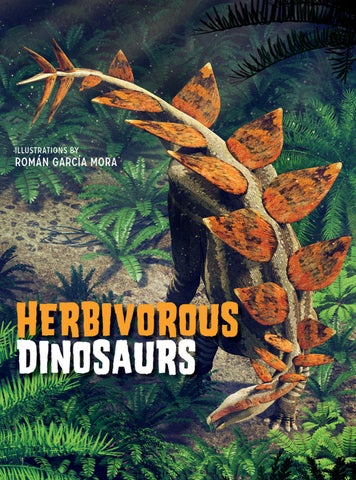
ILLUSTRATIONS BY ROMÁN GARCÍA MORA
TEXT BY GIUSEPPE BRILLANTE AND ANNA CESSA

Origin of Man

Ice Age mammals
Extinction of the dinosaurs
Diversification of Lambeosaurus
Diversification of Ceratopsia
Emergence of mastication
First modern feather
Origin of Ornithischia
Origin of mammals
Giant dinosaurs, Brachiosaurus Origin of dinosaurs, Eoraptor

Origin


EVEN THOUGH SOME OF THE MOST WELL-KNOWN DINOSAURS ARE CARNIVORES, SUCH AS THE GIGANTIC AND FEARSOME T-REX, THERE ARE ALSO SOME “CELEBRITIES” AMONG THE HERBIVOROUS DINOSAURS . WITH ITS LARGE PLATES AND SPIKES-PACKED TAIL, STEGOSAURUS WAS ABLE TO INFLICT FATAL INJURIES ON THE MOST AGGRESSIVE PREDATORS. TRICERATOPS LOOKED LIKE A PROPER PREHISTORIC TANK, WITH ITS HORNS AND BONY FRILL. MAIASAURA WERE THOUGHTFUL MOTHERS, WHILE OURANOSAURUS WOULD FRIGHTEN ITS ENEMIES AND WIN OVER FEMALES DURING THE MATING SEASON, THANKS TO THE LONG SAIL ON ITS BACK.
HOWEVER, FEW COULD COMPETE WITH THE MAJESTY OF THE BIGGEST EXAMPLES OF SAUROPODS . AS TALL AS A FIVE-STOREY BUILDING , THEY WEIGHED AS MUCH AS TEN ELEPHANTS PUT TOGETHER. THEY WERE AMONG THE MOST IMPRESSIVE ANIMALS THAT OUR PLANET HAS EVER HOSTED. SOME OF THEM HAVE BECOME TRUE “STARS,” LIKE DIPLODOCUS : WITH ITS DISPROPORTIONALLY LONG NECK, 19 FT (6 M) HIGH AND WEIGHING 17.6 T (16 MT), IT IS ONE OF THE MOST BELOVED AND ADMIRED DINOSAURS, ALONG WITH BRONTOSAURUS (OR, MORE APPROPRIATELY, APATOSAURUS).
THESE HUGE HERBIVORES OR, MORE CORRECTLY, “VEGETARIANS,” AS GRASS DID NOT EXIST AT THE TIME OF THE DINOSAURS , APPEARING ON THE PLANET ABOUT 40 MILLION YEARS AGO, WELL AFTER THEIR EXTINCTION—HAVE GIVEN SCIENTISTS MORE THAN ONE PUZZLE TO SOLVE. FOR EXAMPLE, HOW COULD SUCH GIANTS MOVE WITHOUT BEING CRUSHED BY THEIR OWN BODY?

WHERE IT LIVED: North America, Europe, Africa, China
WHERE THE MOST IMPORTANT FOSSILS WERE FOUND: United States of America, Portugal
WHEN IT LIVED: 156-150 million years ago
SIZE:
up to 29.5 ft (9 m) long and over 6.5 ft (2 m) tall
WEIGHT:
3.3 t (3 mt)

Dinosaurs came in various shapes and sizes, but Stegosaurus was definitely one of the most extraordinary, thanks to the elaborate structure of its body . What made it so uniquely identifiable were the DOZENS OF PLATES —some even 3 ft (1 m) high— running in two parallel lines on its back from head to tail . What they were used for remains a mystery to paleontologists. There are many theories: perhaps they provided PROTECTION AGAINST PREDATORS , or served as signals during the mating season, when it was necessary for males to find strategies to show off and attract females. But there are also those who argue that these plates were FILLED WITH BLOOD VESSELS and thus helped Stegosaurus regulate its body temperature

Its tail could be a lethal weapon, with BONE SPIKES at the end that could be as long as one meter. Even though it was clumsy and slow, Stegosaurus probably more than compensated for its lack of agility with the power of its blows , as it was capable of inflicting mortal injuries on even the most aggressive carnivorous predators. AS LARGE AS
,
Stegosaurus had to eat dozens of pounds of vegetables each day to survive. Until recently, it was not entirely clear to scientists how these
dinosaurs managed to procure such a large amount of food. Grass had not yet appeared on the planet and, unlike other herbivores, Stegosaurus’ narrow and elongated beaked head DID NOT HAVE POWERFUL JAWS or teeth to chew food. So how did it get enough food to survive considering all these limitations? A recent research conducted by some British universities has shown that Stegosaurus had a BITE which was incredibly POWERFUL, considering the limited setup of its mouth.


WHERE IT LIVED: North America
WHERE THE MOST IMPORTANT FOSSILS WERE FOUND: Alberta (Canada), Utah and New Mexico (USA)
WHEN IT LIVED: 100-65 million years ago
SIZE:
up to 32.8 ft (10 m) long and 10-15 ft (3-4.5 m) tall
WEIGHT:
2.2-3.3 t (2-3 mt)

Some have called this dinosaur the “GREAT TRUMPETER.” Why? It was able to produce incredible sounds. Its over 3 ft (1 m) long crest was hollow and the maze of chambers inside was connected to the breathing, as air would pass through them in its journey from the nostrils to the lungs. If necessary, however, Parasaurolophus used them as a POWERFUL SOUNDING BOARD when creating sounds.

Two scientists have even managed to replicate these sounds. Using one of the most complete fossil skulls belonging to this species found near Farmington, New Mexico, they took 350 scans of the crest and with a sophisticated computer, SIMULATED THE NOISE that this animal might have produced. The result was a sound similar to that of A GIANT CLEARING HIS THROAT .
Some scientists have speculated that this distinctive trait served the purpose of allowing members of the same species to recognize each other even from a considerable distance and even in the intricacy of a dense forest. The sounds were probably used by males to attract females and to WARN THEIR RIVALS ABOUT THEIR POWER , thus avoiding violent physical clashes.

THE CREST OF PARASAUROLOPHUS WAS FOR A LONG TIME A MYSTERY. MANY THEORIES WERE FORMULATED ABOUT ITS FUNCTION, BEFORE UNDERSTANDING THAT IT WAS USED TO PRODUCE SOUNDS. ONE OF THESE THEORIES ARGUED THAT IT WAS SOME KIND OF BREATHING TUBE TO BE USED WHEN THE ANIMAL’S HEAD WAS COMPLETELY IMMERSED INTO THE WATER LOOKING FOR AQUATIC PLANTS TO EAT.

SIZE: up to 29.5 ft (9 m) long and over 6.56 ft (2 m) tall
WEIGHT: up to 3.3 t (3 mt)
IWHERE IT LIVED: North America
WHERE THE MOST IMPORTANT FOSSILS WERE FOUND: Montana (USA)
WHEN IT LIVED: 76 million years ago

n the summer of 1978, American paleontologists Jack Horner and Bob Makela made an incredible discovery that would change our understanding of dinosaurs forever. When they found the remains of A CONICAL-SHAPED MUD NEST in Montana which contained the bodies of fifteen fossilized baby dinosaurs, they realized that these babies had stayed inside the nest for a long period of time after hatching. Their skeletons were relatively developed, which meant that they were a few months old Their teeth showed signs of wear and tear due to chewing food, while many of the eggshell fragments that lay around in the nest had been trampled on by their paws. After weeks of digging, the paleontologists had found HUNDREDS OF EGGS and dozens of dinosaur skeletons of different ages still in the nests—which were located about 23-26 ft (7-8 m) away from each other— while others were scattered in the surrounding area. This certainly provides evidence that these animals were LIVING IN A GROUP, LOOKING AFTER THE NESTS and continuing to take care of the young dinosaurs for a long period after the hatch. That was the nesting area of a new species of dinosaur which they named MAIASAURA (“GOOD MOTHER LIZARD”) , after their ability of taking care of their offspring: a behavior that no one had considered happening in dinosaurs up to that point.

THE FACT THAT THE NESTLED FOSSIL SKELETONS OF THE BABY MAIASAURA WERE OF DIFFERENT AGES (SOME MEASURED JUST 1.6 FT [ 0.5 M ] ) WHILE OTHERS WERE ALMOST 7 FT [ 2 M ] LONG) SUGGESTS THAT THE MOTHER DINOSAUR WENT OUT TO FIND FOOD FOR THEM. SHE THEN RETURNED WITH BERRIES AND VEGETABLES THAT SHE PROBABLY REGURGITATED INTO THE NEST AND THE YOUNG DINOSAURS ATE.


WHERE IT LIVED: Europe
WHERE THE MOST IMPORTANT FOSSILS WERE FOUND: Germany and Switzerland
WHEN IT LIVED: 214-200 million years ago
SIZE:
up to 29.5 ft (9 m) long and 13.1 ft (4 m) tall
WEIGHT: up to 4.4 t (4 mt)

Plateosaurus is a very old dinosaur and was one of the first ones to become specialized in eating only plants
We know a lot about it because more than ONE HUNDRED FOSSILIZED SKELETONS have been discovered, many of which are complete.
We know, for example, that these dinosaurs would move mainly using their hind legs.

As a result of their stance and their LONG NECK , this dinosaur could reach the tallest tree branches. We also know that it lived on average between 12 to 20 years because most of the discovered fossils were of that age (the oldest was 27). The strange thing is that Plateosaurus came in VERY DIFFERENT SIZES and there were even some of them
that could almost be defined as “dwarves”: some adults did not exceed 13 ft (4 m) in length while others reached up to 29.5 ft (9 m). This was probably due to the availability of food . The smaller-sized animals were able to live in environments with limited resources.

MANY RECONSTRUCTIONS OF PLATEOSAURUS SHOW IT IN A FOUR-LEGGED POSITION, BUT A RECENT STUDY BY GERMAN PALEONTOLOGIST HEINRICH MALLISON HAS PROVEN THIS TO BE WRONG. ITS FRONT LEGS ACTUALLY FEATURED PALMS THAT FACED INWARDS AND WERE LOCKED. HENCE IT WAS IMPOSSIBLE FOR THE ANIMAL TO ROTATE THEM AND LAY THEM ON THE GROUND TO WALK. IT WAS CERTAINLY TWO-LEGGED.


SIZE:
29.5 ft (9 m) long and up to 13 ft (4 m) tall
WEIGHT: up to 5.5 t (5 mt)
WHERE IT LIVED: South America
WHERE THE MOST IMPORTANT FOSSILS WERE FOUND: Argentina
WHEN IT LIVED: 130 million years ago
It was one of the most bizarrelooking dinosaurs. TWO ROWS OF BONY SPINES , as extensions of the dorsal vertebrae, ran in parallel along the top of its back, from its neck—where they were even more pronounced and could reach up to 1.6 ft (0.5 m) in height—to its tail. One of the theories about their function is that they worked as a weapon against predators, because they were COVERED IN HORNS . However not everyone agrees with this theory, as the position of the spines could only have offered a limited amount of defense. It would have been different if they had been distributed over the rest of its body. Given that ONLY THE MALES POSSESSED THEM , perhaps Amargasaurus used them to fight with rivals of its species during confrontations over females.

It is even possible that these spines supported TWO SKIN “SAILS,” regulating body heat or intimidating enemies and attracting the opposite sex during mating season. They could also have been the support structure OF LARGE KERATINOUS RIDGES
Although it belonged to the sauropods,
its size differed from Apatosaurus and Brachiosaurus. It had only half the stature of its gigantic “cousins.” However, it did not pass unnoticed: it was almost as long as three cars placed one after the other.

DESPITE BEING A HERBIVORE, AMARGASAURUS DID NOT HAVE ANY TEETH THAT WERE SUITABLE FOR CHEWING FOOD. IT SWALLOWED WHOLE PARTS OF PLANTS; ONCE IN THE STOMACH, THEY WOULD BE GROUND UP WITH THE HELP OF STONES THAT THE ANIMAL INGESTED ALONGSIDE.